
Andrew Hickey
Shared posts
24 Dec 18:51
http://www.andrewrilstone.com/2016/12/im-going-tell-you-right-wing.html
by Andrew Rilstone
I’m going tell you right wing authoritarian nativists; you may be surprised
The people in this world are getting organized
You're bound to lose: you right wing authoritarian nativists are bound to lose.
All of you right wing authoritarian nativists are bound to lose!
All of you right wing authoritarian nativists are bound to lose!
All of you right wing authoritarian nativists are bound to lose!
You’re bound to lose; you right wing authoritarian nativists are bound to lose!
All of you right wing authoritarian nativists are bound to lose!
All of you right wing authoritarian nativists are bound to lose!
You’re bound to lose; you right wing authoritarian nativists are bound to lose!
Race hatred cannot stop us: this one thing we know
Your poll tax and Jim Crow and greed has got to go
You're bound to lose: you right wing authoritarian nativists are bound to lose.
All of you right wing authoritarian nativists are bound to lose!
All of you right wing authoritarian nativists are bound to lose!
All of you right wing authoritarian nativists are bound to lose!
You’re bound to lose: you right wing authoritarian nativists are bound to lose!
All of you right wing authoritarian nativists are bound to lose!
All of you right wing authoritarian nativists are bound to lose!
You’re bound to lose: you right wing authoritarian nativists are bound to lose!
People of every color are marching side to side
Marching across the fields where a million right wing authoritarian nativists died
You’re bound to lose; you right wing authoritarian nativistss bound to lose!
All of you right wing authoritarian nativists are bound to lose!
All of you right wing authoritarian nativists are bound to lose!
All of you right wing authoritarian nativists are bound to lose!
You’re bound to lose; you right wing authoritarian nativists are bound to lose!
You’re bound to lose; you right wing authoritarian nativistss bound to lose!
All of you right wing authoritarian nativists are bound to lose!
All of you right wing authoritarian nativists are bound to lose!
All of you right wing authoritarian nativists are bound to lose!
You’re bound to lose; you right wing authoritarian nativists are bound to lose!
24 Dec 16:42
Quantum physics and prime numbers: the answer to life, the universe and the third moment of the Riemann zeta function.
Quantum physics and prime numbers: the answer to life, the universe and the third moment of the Riemann zeta function.
24 Dec 16:39
Programming is forgetting: toward a new hacker ethic.
Programming is forgetting: toward a new hacker ethic.
14 Dec 23:11
Will we have overtime four years from now?
by Fred Clark
It will happen this way, slowly and quietly at first, then faster and louder, and then it will be done.
The post Will we have overtime four years from now? appeared first on slacktivist.
14 Dec 20:33
Article 50 can’t be invoked, surely, without the country knowing whether its revocable or not
by Mike Smithson
David Davis tells MPs govt doesn't know if Article 50 process can be stopped once it starts – whether its 'revocable'
— Laura Kuenssberg (@bbclaurak) December 14, 2016
Latest Betfair Article 50 betting

Betting on the delay at 2/1 might be a good bet
The Laura Kuenssberg Tweet reporting that Brexit Sec, David Davis, saying that the government doesn’t know if Article 50 process can be stopped once it starts highlights an issue that’s been around for some time and featured a lot in the Supreme Court case – whether once the move has been made its ‘revocable’ or not.
This is such a massive step that the country needs to know one way or the other before pulling the trigger. It strikes me that if it is not revocable then it very much weakens the government’s negotiating position with Brussels and it would be politically foolhardy for Mrs May to institute such a move without knowing.
The problem, of course, is that to get clarity the matter would have to be referred to the European Court of Justice which could delay things considerably and would certainly make it much harder for TMay to achieve her deadline of March 31st 2017.
Trying to clarify this question is a key part of the crowd-funded court case that is being brought in Dublin by the London QC, Jolyon Maugham.
Mike Smithson
14 Dec 12:05
Choose your own email adventure! A tool to help freelancers negotiate contract terms.
Choose your own email adventure! A tool to help freelancers negotiate contract terms.
14 Dec 00:06
Might People On The Internet Sometimes Lie?
by Scott Alexander
From Reddit: Parents Of Children Who Claim To Have Had Past Lives, What Did They Tell You?. Some sample comments:
When he was 6 years old my son described in great detail my grandmother’s house he never been to. This was in 1986 or so, pre-internet. There are no pics of the place that I’m aware and no one owned a camcorder in our family, so video is out of question either. It’s a small house with red roof and a purple door (grandma painted the door every couple of years). He described all of it – that it had one big room with a fireplace across from the window, he explained where the doors are located, how there always were some boxes under the stairs, that there always was a faint smell of apples in the house (grandma ran a small time apple sauce business). That there was this cat almost completely white with a black spot around his right eye (that’s mr. Whiskers, my grandma’s cat!).My grandma and Whiskers both died in 1977, 3 years before my son was born. To this day I can’t fathom it and can’t even get a remotely sane explanation on how does he know all this. I never told him about it, my wife has never met my grandma and never been to her house and in 1986 we were stationed in Germany, so none of my old friends could have reached my son, so this is definitely not someone’s prank. Best part of this is my son says he doesn’t remember telling me that, but my wife heard him saying that too, so if definitely happened!
And from Reddit, What Is The Creepiest “Glitch In The Matrix” You’ve Encountered?:
When I was in school I had this hippie teacher who would always tell us that the universe can help if you just ask it.
She told us one time her daughter had lost something very important and when she asked the universe to help she suddenly had a massive pulling feeling towards the sink. She walks over and immediately stuck her hand down into the garbage disposal and pulled the item out in perfect condition.
So I think it’s total bullshit of course, but later that day I was searching for a thin little booklet that I really, really needed for school. I spent 3 hours looking for it and had no luck. Finally out of frustration I almost sarcastically said, “I need your help universe.” I immediately walked over to this bookcase filled with books from my step dad. I had never once used this shelf or any book on it.
I grab a random book I’ve never seen from the middle of a huge pile. I open it to somewhere around page 200 and right there is my booklet smashed in between the pages. It was incredibly thin so you couldn’t even tell there was anything in there if you looked at it from another angle.
I’m sure there’s a good explanation, but it’s been well over a decade and I still remember the incredibly freaky vibe I got the moment I saw the book.
I don’t believe in reincarnation or paranormal forces. When I read stories like this, my first impulse is to try to think of reasonable explanations or ways they could be a coincidence. Maybe some kids have instinctive talent at that sort of cold-reading thing TV psychics do sometimes. Maybe your unconscious can remember where you put a booklet and then repress it from the conscious mind for some reason.
But these kinds of claims are often themselves far-fetched. If I told you in normal conversation, unrelated to compelling reincarnation theories, that kids have a natural talent at cold reaading, you’d scoff and demand proof. And it’s not just reincarnation and booklet-finding. If you read Reddit enough, you’ll find hundreds of equally compelling stories of telepathic contact, cryptid sightings, UFOs, et cetera.
So. Alternate hypothesis. About one million people view Reddit every day. Let’s assume 10% of those see threads like the above – which were pretty popular and which I think both made it to the front page. That’s 100,000 people. Now let’s assume that even 1/10,000 people on the Internet are annoying trolls, which is maybe the easiest assumption we’re ever going to have to make. If each of those annoying trolls posts one fake story to a thread like that for the lulz, that’s enough for ten really convincing stories per thread – which is really all there are, the other fifty or sixty are just the usual friend-of-a-friend-had-a-vague-feeling stuff.
(it’s true that in a site read by a million people, there will also be far more people who have experienced a genuine one-in-a-million coincidence, but that shouldn’t scale nearly as quickly; after all, liars can invent coincidences way more far-fetched than the sheer numbers would allow)
This hypothesis seems obviously right. If I ask “what’s the chance that at least one in ten thousand Internet users is an annoying troll?” you laugh hysterically and tell me that nobody has even invented numbers that high. It perfectly explains mysterious events that would otherwise require impossible coincidences or weird theories about hidden brain functions. So why is it so hard to make myself believe?
I think part of it is a failure of scale. Reddit looks a lot like a normal forum or blog comment section, the sort of BBS I used to go on as a kid with twenty or thirty regulars who would dominate all the discussions. If indeed 1/10,000 people is the sort of jerk who would make up a story like this just to troll people (or even 1/1,000 or 1/100 people), the chance that I’d run into them on my little BBS/comment section/Dunbar-number-group is pretty low, and I can safely ignore the possibility that five different crazy paranormal comments are all by pathological liars. It’s only when you get a place like Reddit, which manages to feel like a community while also having a million readers a day, that you have to start thinking about these things.
This suggests a more general principle: interesting things should usually be lies. Let me give three examples.
I wrote in Toxoplasma of Rage about how even when people crusade against real evils, the particular stories they focus on tend to be false disproportionately often. Why? Because the thousands of true stories all have some subtleties or complicating factors, whereas liars are free to make up things which exactly perfectly fit the narrative. Given thousands of stories to choose from, the ones that bubble to the top will probably be the lies, just like on Reddit.
Every time I do a links post, even when I am very careful to double- and triple- check everything, and to only link to trustworthy sources in the mainstream media, a couple of my links end up being wrong. I’m selecting for surprising-if-true stories, but there’s only one way to get surprising-if-true stories that isn’t surprising, and given an entire Internet to choose from, many of the stories involved will be false.
And then there’s bad science. I can’t remember where I first saw this, so I can’t give credit, but somebody argued that the problem with non-replicable science isn’t just publication bias or p-hacking. It’s that some people will be sloppy, biased, or just stumble through bad luck upon a seemingly-good methodology that actually produces lots of false positives, and that almost all interesting results will come from these people. They’re the equivalent of Reddit liars – if there are enough of them, then all of the top comments will be theirs, since they’re able to come up with much more interesting stuff than the truth-tellers. In fields where sloppiness is easy, the truth-tellers will be gradually driven out, appearing to be incompetent since they can’t even replicate the most basic findings of the field, let alone advance it in any way. The sloppy people will survive to train the next generation of PhD students, and you’ll end up with a stable equilibrium.
The weird thing is, I know all of this. I know that if a community is big enough to include even a few liars, then absent a strong mechanism to stop them those lies should rise to the top. I know that pretty much all of our modern communities are super-Dunbar sized and ought to follow that principle.
And yet my System 1 still refuses to believe that the people in those Reddit threads are liars. It’s actually kind of horrified at the thought, imagining them as their shoulders slump and they glumly say “Well, I guess I didn’t really expect anyone to believe me”. I want to say “No! I believe you! I know you had a weird experience and it must be hard for you, but these things happen, I’m sure you’re a good person!”
If you’re like me, and you want to respond to this post with “but how do you know that person didn’t just experience a certain coincidence or weird psychological trick?”, then before you comment take a second to ask why the “they’re lying” theory is so hard to believe. And when you figure it out, tell me, because I really want to know.
13 Dec 23:59
Stuck in the middle with who?
by Nick
 It’s been interesting watching the reaction from some to the Liberal Democrat victory in the Richmond Park by-election. One trend I’ve noticed is people (generally from the left) pointing out that Tim Farron hasn’t said that the party would never be in a coalition with the Tories again it means that the party is clearly just a bunch of evil Tories in disguise, can never be trusted and are somehow responsible for everything bad that has ever happened.
Now, while the interpretation might be a bit extreme, the basic fact is true in that Tim Farron hasn’t ruled out coalitions with anyone. (What he has done, however, is set out that any Lib Dem participation in coalition would be based on red lines like electoral reform without a referendum, that it’s hard to see the Tories agreeing to) However, there’s a reason for this, which is best illustrated by comparing his position to Paddy Ashdown’s back in 1992.
Back then, the party was well know for its policy of equidistance between the two main parties. Paddy’s Spitting Image appearances generally revolved around the phrase ‘neither one thing nor the other, but somewhere inbetween’, and polling showed that the public were pretty much evenly split on which party we were closest to. Then, a few weeks after the 1992 election Paddy gave a speech in Chard which declared a new strategic direction for the party. The party’s task for the next Parliament would be:
to create the force powerful enough to remove the Tories; to assemble the policies capable of sustaining a different government; and to draw together the forces in Britain which will bring change and reform.
That set the party on an explicitly anti-Tory path, which passed back and forth through various levels of co-operation and co-ordination with Labour, and eventually gave the party its best electoral performance in years at the 1997 election. (I’ve written a lot more about that here)
There’s plenty of people who would like to see Tim Farron make a similar declaration, but despite being from the left of the Liberal Democrats, he’s not in the same strategic position Ashdown was. For a start, Paddy was talking after thirteen years of Tory rule, which an unexpected election victory now threatened to make eighteen. That’s considerably longer than they’ve been in power now or will be by the time of the next election. Perhaps more importantly, Labour was in a completely different position. They’d just got 37% of the vote in the election under Neil Kinnock, who was about to be replaced by the very popular John Smith. Even though they’d lost the election, they were a credible alternative Government.
The problem Farron faces is that if he explicitly positions the party as anti-Tory, the immediate question from the media becomes ‘so you want Jeremy Corbyn as Prime Minister, do you?’ Labour in 2016 are simply not a credible alternative government in the way Labour of 1992-97 were, and the way our media frame politics as a binary choice mean Farron’s options are limited for the time being.
All that being said, Farron also has to be conscious of a much bigger opportunity than Ashdown ever had: a realignment of British politics. The referendum and its aftermath has shown up a division in our politics that could supplant the left-right cleavage as the main determinant of voter identification and electoral choice. If that sounds far-fetched, remember that there are already two parts of the UK – Northern Ireland and Scotland – where questions of identity and nationalism drive the political debate much more than economic. If the politics of England and Wales follow a similar path and Leave/Remain (or nationalist/internationalist or open/closed) becomes the main political division then which side of left/right the Liberal Democrats support becomes a moot point.
 If that happens, then the important issues for the Liberal Democrats are how to organise and co-ordinate a whole new wing of politics, which is an entirely different mindset to operating a party in the centre of it. It also puts Labour into a whole new set of troubles, trying to straddle a division and hold itself together while forces within it are pulling it in vastly different directions.
Farron’s having to play coy on the ‘which side do you support?’ question right now because giving a definitive answer weakens the party’s position, but if things keep changing, it might not be him who gets asked that question in the future.
12 Dec 12:04
The first ever Doctor Who story begins with ordinary people who follow someone extraordinary to a blue box that’s bigger on the inside than the outside and travels in time and space.
The best idea in the world hits the ground running: William Hartnell’s fantastic Doctor; a mysterious girl who’s both genius and hopeless, living in a junkyard; mind-expanding maelstroms of light and noise; prehistoric power struggles; throwing people into another time, throwing violence, dirt, role-reversals and every emotional and physical trial at them. Their world, and ours, will never be the same again.
I restarted these posts again last Wednesday with the first Doctor Who I ever saw – celebrating the series’ fifty-third anniversary. Now it’s time to go back to the very beginning. Again. Which I can pretend is completely appropriate, because the very first episode, An Unearthly Child, was repeated a week later, immediately before The Cave of Skulls, the second episode of this story, was first broadcast. It’s almost as if I planned a repost – I mean, a ‘Special Edition’ – on its own fifty-third anniversary. So this is another post that I wrote originally last year with the idea of fifty-two-weeks’-worth of idiosyncratically selected Doctor Who. I hope it’ll still go on to be an exciting variety but, again, with my timing as reliable as the TARDIS, the next one may turn up later or sooner or just vanish completely. I’m having fun so far, though.
This is the point where I’d usually say to press “Play All” on the DVD. Just this once it’s more complicated than that. If you’ve bought An Unearthly Child as a DVD on its own or as a download, that probably works. If you have it – as I do, and probably the best value, as the other discs are excellent too – in the Doctor Who DVD box set The Beginning, then it’ll make things much simpler and much more watchable, although it seems weird, if you press “Play All” but then skip forward seven chapters. I’ll explain later.
1 – The Beginning.
From the first second, everything says ‘This is a television programme like no other.’ On Saturday 23rd November 1963 Ron Grainer and Delia Derbyshire’s incredible music and Barnard Lodge’s swirling howlround titles first grabbed people like nothing on Earth. The direction’s terrific, the lines memorable and the actors superb, and by the end of just the first episode you’ve been plunged from an ordinary school into the astonishing futurism of the TARDIS and then an eerie prehistoric wasteland. It’s inspired, but it delivers on all of that inspiration. This may just be the most brilliant piece of television ever… And there are still three episodes to go of this story alone, or, if you take a longer view, at minimum at least another eight hundred and twenty-seven more to follow. And counting.
2 – The Doctor.
For me, William Hartnell’s performance here is one of the greatest of any Doctor in any story. He’s at first calculating and almost sinister – because he’s under threat. He becomes a lot more fun once the worst has happened and humans have forced their way into his TARDIS, seeing them much as he’ll call them “stupid apes” many years later. He might start off making life difficult for two nice teachers, but then he’s unexpectedly kind, then spoils it by hardly being able to keep his face straight (there’s an absolutely gorgeous touch at one point where he keeps having to turn away from Ian, smiling as if looking directly at him would crack him up). His unpredictability feels like a person, and a fascinating, charismatic one, even as you think ‘He can’t say that!’ He’s fiercely intelligent and utterly irreverent. He shows off outrageously. He has enormous authority but is anti-establishment to his core, and childishly sulks or shouts when he doesn’t get his own way. And he gets your heart in your mouth when he suddenly shows the ache of tragedy. Too many ‘wise old men’ characters are dull or paternal, but this one starts as an explorer who asks all the difficult questions, and it seems a natural progression from that to discovering the sheer fun of toppling empires – helped enormously by William Hartnell, who’d done the authoritarian roles and wanted something different. The Doctor is as different as you get.
3 – Susan.
I knew Susan, Ian and Barbara first from outstanding novelisations of stories from long before I was born and that I never thought I’d see. For some reason, as a boy the TARDIS teams that felt most right to me from the books were three different groups of several different people around the Doctor. I wrote about Polly, Ben and Jamie a few days ago, and here’s another – the original crew. Each of the companions that really stuck with me are a mix of men and women, but especially each with one woman who shows she’s got a brain and some gumption, who can stand up to the Doctor. That really should have been Susan, but she doesn’t always make it. Fortunately, another woman decides to intervene…
4 – Ian and Barbara.
Ian Chesterton and Barbara Wright are the most utterly reassuring people in this: 1960s schoolteachers who clearly know what they’re doing and are just the people to find out what’s strange about their pupil Susan. But, marvellously, though they always remain reassuring and endearing, they’re at the centre of everything about the way this show turns things upside-down.
Ian is a handsome authority figure and so obviously going to be the lead in any programme made in 1963, with actor William Russell a star who’d had his own series as Sir Lancelot, and who’s engaging from the word go. So it’s a treat that it’s Barbara who’s done all the investigating and only wants him to back her up – and that, after Ian’s sure there’s a perfectly normal explanation, he’s the first one to nearly have a nervous breakdown when the explanation’s nothing of the kind. He reaches one of the lowest of all companion low points on disembarking from the TARDIS for the first time, utterly bewildered by the Doctor’s prophetic poetry coming true around him, touching the cold sand, hearing the mocking cries of strange birds, then clapping his hand to his head for all the world as if one of them’s just capped his terrible day by dropping something on it.
Jaqueline Hill is fabulous, and Barbara starts by confronting point-blank the stereotyped ‘hysterical fantasist woman’ dismissal which Ian and the 1963 audience might be tempted to put on what she says, and is proved right. Then they take it in turns throughout to be the sensible one who’s coping or the one who’s losing it, just as they take it in turns to be helpfully the science teacher and the history teacher who can help us make some sense of the science-fictional or historical settings in which they’re going to find themselves. They make a wonderful couple.
5 – The making of Doctor Who.
Doctor Who was created by a remarkable group of people for the BBC in 1963 – the BBC’s iconoclastic Canadian drama supremo Sydney Newman didn’t just want a programme that would be unlike anything else in the establishment Corporation, but people that would shake it up. He made Verity Lambert the BBC’s youngest and only female drama Producer. The first director she chose was a young, gay Anglo-Indian, Waris Hussein. To the rest of the BBC, they were in the wrong place, at the wrong time – naturally, they became television legends. For some reason much of the BBC establishment fought them tooth and nail, but even given the smallest, oldest and grottiest of studios they still made Doctor Who incredible.
6 – Into the TARDIS.
7 – Inspired games with role-reversals.
Doctor Who was designed as a drama aimed at children watching with their families, not just to talk down to them as a ‘kids’ show’. So in the very first episode we get the perfect deployment of the show’s anti-establishment ethos to get the kids on its side: show up the teachers. Susan goes from verbally patting “Mr Chesterton” for knowing something unexpected to exasperation with him being much stupider than she’d expected. It’s far more effective than making the teachers cartoon idiots or having child leads, especially when the Doctor joins in – an authoritative old man who acts like a mischievous child, but also talks down to authority figures who don’t like their own medicine at all, while children across the land must have enjoyed it immensely.
But it’s not just getting the audience on side. The role-reversals are crucial to the story and the developing relationships between our four main characters. The Doctor chooses a simile about television to explain the Ship’s dimensions, kindly thinking of a way within the teacher’s limited grasp to explain something incredibly simple that’s quite beyond his tiny mind, as Ian might to a child – made all the more delicious when Ian still can’t see and the Doctor can’t help but laugh. It’s a satirical pre-echo of the ‘primitives’ part of the story: the Doctor’s among primitives already. On moving from modern London to prehistoric cavepeople, the Doctor first regarding Ian and Barbara as savages prevents the audience from feeling too smug about the Tribe, but it also means he’s rapidly shoved together with the teachers so he can start thinking of them as semi-civilised. If they’d landed among the Daleks and Thals first, he’d probably have dumped the teachers, or at least spo-ken ve-ry slow-ly and clear-ly to them and apologised for bringing a pair of savages to meet futuristic peoples: ‘I’m sorry, you’ll have to excuse them, they’re from the Twentieth Century.’ Just as Ian becomes less narrow-minded and insular with the Doctor’s influence, the teachers’ presence gives the Doctor the opportunity to start learning from them more subtly, starting here. The Doctor’s moral sense, appropriately, is more a flickering ember and a wisp of smoke here than a beacon in the dark yet – but even in Twenty-first Century stories, he still has a ruthless streak without human friends to talk him out of it.
8 – Old Mother.
This is a grim tale, with its sweaty, dirty, horror brought home to us perhaps more than any other Doctor Who story by the raw emotion of our heroes. There’s not much humour after the hilarious put-downs of the teachers. But if you’re in the right mood for it, there’s an undercurrent in the horrible life of the Tribe that makes me laugh. On the surface, the story is a battle for supremacy between two alpha males, Za versus interloper Kal. But it isn’t just Kal who jeers at Za for not being the man his father was. The Tribe’s older generation are still around to threaten him with several varieties of conservative prejudice, and the worst of the lot is the Tribe’s Queen Mum, known as Old Mother or just “the old woman” (played superbly by Eileen Way). She hates fire and thinks it a waste of time, but still laughs at his impotent attempts to light up. It’s very hard not to see some sort of metaphor in Za rubbing his bone while his Old Mother gives a spiteful commentary on how unimpressive his manhood is. Za’s “woman” Hur – no, it’s not an especially feminist Tribe in naming its women – has problems with her father too, at one point shouting “You should lie on the old stone ’til your blood runs into the earth!” when he grumbles too much. It’s all deadly serious, but also very funny intergenerational conflict.
9 – The Doctor invents courtroom drama and Columbo.
It’s a terrific scene. William Hartnell is outstanding, slipping effortlessly between quiet, naturalistic instructions and a theatrical display of Stone Age rubble-rousing, but it’s a brilliant idea, too: years before Columbo ever aired, Doctor Who invents the format. The TV audience has already seen the murderer, and the Doctor exposes him through a combination of psychology, demagoguery and forensic evidence. And while he’s settling the rivalry between Kal and Za, at the same time he’s settling with argumentative teacher Ian just exactly who is the leader of the TARDIS crew, and the star of the show (fifty-three years later, he still is). Just as with the Twentieth-Century humans, the Doctor can speak their language and then get into their mindset and manipulate it, which makes you wonder just how much he’s talking down to our level, too.
10 – An optimistic and wonderful show that’s “steeped in death” (as Russell T Davies put it many years later).
Though Doctor Who doesn’t have its first really full-fledged ‘undead’ story until William Hartnell’s final adventure, most of his first season has some hint of it, and how is the very first story resolved? By using a combination of the idea of the undead and special effects to frighten the people watching, which is what the series will be doing for ever after (and, with the Tribe obsessed throughout with fire and using skulls to terrify our heroes, it’s the perfect con to employ at the climax).
And then our heroes start running.
Seriously, on just this one DVD – at least the one in The Beginning – press “Play All” and then immediately skip the first seven chapters.
The trouble is, if you just press “Play All” you get a version of the Pilot episode, An Unearthly Child. Then the first episode, An Unearthly Child, which is a different version of the same thing. Then the next three episodes, which finally get on with more of the story. So while I often go back and watch the Pilot version as interesting in its own right, it’s a confusing place to start. If you skip the first seven chapters on the DVD you’ll start where the producers intended you to, it’ll make a lot more sense, and you’ll get the best version first. As you play on through the rest of the story, I suppose I should point out that some people think the second, third and fourth episodes are a different story, or not as good, or even disposable. They’re wrong. See above.
Eternal thanks to many people at the very beginning, particularly BBC Head of Drama Sydney Newman, Script Department head Donald Wilson, script editor David Whitaker, scriptwriters Anthony Coburn and before him C. E. Webber, director Waris Hussein, soundscapers Delia Derbyshire, Dick Mills and Brian Hodgson, legendary producer Verity Lambert, and, of course, William Hartnell. The Doctor.
And, if you need one, my score:
I’d give 10/10 to the proper transmitted version of An Unearthly Child, the first and possibly even best episode of Doctor Who – or of television itself. And I’d give 9/10 to the next three episodes. So I considered giving the whole story 9 ½. But I’ve decided half-marks are weaselly, so I won’t be awarding any. That means this and a handful of other stories coming up in the 52 that might be 9 ½ in my head will be rounded up to:
10/10
The Pilot version of An Unearthly Child, obviously, which is weird and jarring but also brilliant. Every other Doctor Who story featuring William Hartnell makes him kindlier and funnier – which was what the actor wanted anyway. So you might instead pick a story from Doctor Who’s second season, where the Doctor’s personality is more fully formed.
Deep Breath is for now the most recent of all the many new beginnings for Doctor Who, 2014’s introduction to the current Doctor. It’s a very different adventure, but like William Hartnell, Peter Capaldi plays a Doctor in a much older body, one who’s abrasive and alienating at times, or funny, or brilliant, and I love them both. Surrounding a new Doctor with familiar friends from the previous Doctor to help him and us adjust to his new self has a touch of Robot, too. I could also point out that it’s in London but has characters from prehistoric times, and that the Doctor’s companion is a teacher at the same Coal Hill School where Ian and Barbara taught and Susan mystified, but – despite that – Deep Breath really isn’t very like An Unearthly Child at all. Still marvellous, though.
The beginning… What, another one? Fantastic!
Doctor Who 52: 02 – Ten Reasons to Watch An Unearthly Child (SE)
by Alex Wilcock
Introducing Doctor Who – An Unearthly Child…
The first ever Doctor Who story begins with ordinary people who follow someone extraordinary to a blue box that’s bigger on the inside than the outside and travels in time and space.
The best idea in the world hits the ground running: William Hartnell’s fantastic Doctor; a mysterious girl who’s both genius and hopeless, living in a junkyard; mind-expanding maelstroms of light and noise; prehistoric power struggles; throwing people into another time, throwing violence, dirt, role-reversals and every emotional and physical trial at them. Their world, and ours, will never be the same again.
I restarted these posts again last Wednesday with the first Doctor Who I ever saw – celebrating the series’ fifty-third anniversary. Now it’s time to go back to the very beginning. Again. Which I can pretend is completely appropriate, because the very first episode, An Unearthly Child, was repeated a week later, immediately before The Cave of Skulls, the second episode of this story, was first broadcast. It’s almost as if I planned a repost – I mean, a ‘Special Edition’ – on its own fifty-third anniversary. So this is another post that I wrote originally last year with the idea of fifty-two-weeks’-worth of idiosyncratically selected Doctor Who. I hope it’ll still go on to be an exciting variety but, again, with my timing as reliable as the TARDIS, the next one may turn up later or sooner or just vanish completely. I’m having fun so far, though.
This is the point where I’d usually say to press “Play All” on the DVD. Just this once it’s more complicated than that. If you’ve bought An Unearthly Child as a DVD on its own or as a download, that probably works. If you have it – as I do, and probably the best value, as the other discs are excellent too – in the Doctor Who DVD box set The Beginning, then it’ll make things much simpler and much more watchable, although it seems weird, if you press “Play All” but then skip forward seven chapters. I’ll explain later.

Ten Reasons To Watch An Unearthly Child (warning: spoilers lower down the list)
1 – The Beginning.
From the first second, everything says ‘This is a television programme like no other.’ On Saturday 23rd November 1963 Ron Grainer and Delia Derbyshire’s incredible music and Barnard Lodge’s swirling howlround titles first grabbed people like nothing on Earth. The direction’s terrific, the lines memorable and the actors superb, and by the end of just the first episode you’ve been plunged from an ordinary school into the astonishing futurism of the TARDIS and then an eerie prehistoric wasteland. It’s inspired, but it delivers on all of that inspiration. This may just be the most brilliant piece of television ever… And there are still three episodes to go of this story alone, or, if you take a longer view, at minimum at least another eight hundred and twenty-seven more to follow. And counting.
2 – The Doctor.
“If you could touch the alien sand and hear the cries of strange birds – and watch them wheel, in another sky – would that satisfy you?”I first saw An Unearthly Child when it was repeated in 1981. Tom Baker had just stopped being the Doctor; I knew there were others, I’d even thrilled to many of their adventures on the page, but I’d not seen any of them. This wasn’t just spellbinding, but startling. The Doctor here is so different from the Fourth Doctor even at his most alien – he’s so different, I know now, even from how William Hartnell’s character will become as he shows different facets from the brilliantly sparkling git in his introduction. This story introduces the central mystery and the TARDIS perfectly, but is it the right place to start with the Doctor? Well, of course. What other story can be more exciting to discover for the first time? And where else can you see the Doctor discovering humans are people for the first time and starting to become the character we know? He’s as ruthless and hostile-seeming here as you’ll ever see him, but by the second episode, he’s already saving the companions he’s previously chewed out and kidnapped, then starting to cheer them up, then before the story’s out making his first of many moral judgements. Though his instinct is first to explore then, when that lands him in tricky situations, to escape, he’s already starting to flex his brain to achieve more than that.
For me, William Hartnell’s performance here is one of the greatest of any Doctor in any story. He’s at first calculating and almost sinister – because he’s under threat. He becomes a lot more fun once the worst has happened and humans have forced their way into his TARDIS, seeing them much as he’ll call them “stupid apes” many years later. He might start off making life difficult for two nice teachers, but then he’s unexpectedly kind, then spoils it by hardly being able to keep his face straight (there’s an absolutely gorgeous touch at one point where he keeps having to turn away from Ian, smiling as if looking directly at him would crack him up). His unpredictability feels like a person, and a fascinating, charismatic one, even as you think ‘He can’t say that!’ He’s fiercely intelligent and utterly irreverent. He shows off outrageously. He has enormous authority but is anti-establishment to his core, and childishly sulks or shouts when he doesn’t get his own way. And he gets your heart in your mouth when he suddenly shows the ache of tragedy. Too many ‘wise old men’ characters are dull or paternal, but this one starts as an explorer who asks all the difficult questions, and it seems a natural progression from that to discovering the sheer fun of toppling empires – helped enormously by William Hartnell, who’d done the authoritarian roles and wanted something different. The Doctor is as different as you get.
3 – Susan.
“Of course, the decimal system hasn’t started yet.”The Doctor’s granddaughter is the start of it all: wanting to live like human people, she’s the brightest, strangest teenager at school. She’s an utter genius but makes incredible mistakes – in a brilliant gamble by the writers, she assumes Britain’s using its decimal currency nearly a decade before the actual switch, and there’s a great evocation of an alien way of thinking when she can’t solve a problem without adding other dimensions. Carole Ann Ford is convincingly alien even after being ordered to tone it down, treating teachers absently like just slightly dim people to patronise and then utterly confident when at home in a space-time Ship. In her very first scene, a teacher shows off with his pop knowledge, but only to highlight that Susan’s in a world of her own, grooving along to an aristocrat who’s masquerading as an ordinary person…
I knew Susan, Ian and Barbara first from outstanding novelisations of stories from long before I was born and that I never thought I’d see. For some reason, as a boy the TARDIS teams that felt most right to me from the books were three different groups of several different people around the Doctor. I wrote about Polly, Ben and Jamie a few days ago, and here’s another – the original crew. Each of the companions that really stuck with me are a mix of men and women, but especially each with one woman who shows she’s got a brain and some gumption, who can stand up to the Doctor. That really should have been Susan, but she doesn’t always make it. Fortunately, another woman decides to intervene…

4 – Ian and Barbara.
Ian Chesterton and Barbara Wright are the most utterly reassuring people in this: 1960s schoolteachers who clearly know what they’re doing and are just the people to find out what’s strange about their pupil Susan. But, marvellously, though they always remain reassuring and endearing, they’re at the centre of everything about the way this show turns things upside-down.
Ian is a handsome authority figure and so obviously going to be the lead in any programme made in 1963, with actor William Russell a star who’d had his own series as Sir Lancelot, and who’s engaging from the word go. So it’s a treat that it’s Barbara who’s done all the investigating and only wants him to back her up – and that, after Ian’s sure there’s a perfectly normal explanation, he’s the first one to nearly have a nervous breakdown when the explanation’s nothing of the kind. He reaches one of the lowest of all companion low points on disembarking from the TARDIS for the first time, utterly bewildered by the Doctor’s prophetic poetry coming true around him, touching the cold sand, hearing the mocking cries of strange birds, then clapping his hand to his head for all the world as if one of them’s just capped his terrible day by dropping something on it.
Jaqueline Hill is fabulous, and Barbara starts by confronting point-blank the stereotyped ‘hysterical fantasist woman’ dismissal which Ian and the 1963 audience might be tempted to put on what she says, and is proved right. Then they take it in turns throughout to be the sensible one who’s coping or the one who’s losing it, just as they take it in turns to be helpfully the science teacher and the history teacher who can help us make some sense of the science-fictional or historical settings in which they’re going to find themselves. They make a wonderful couple.
5 – The making of Doctor Who.
Doctor Who was created by a remarkable group of people for the BBC in 1963 – the BBC’s iconoclastic Canadian drama supremo Sydney Newman didn’t just want a programme that would be unlike anything else in the establishment Corporation, but people that would shake it up. He made Verity Lambert the BBC’s youngest and only female drama Producer. The first director she chose was a young, gay Anglo-Indian, Waris Hussein. To the rest of the BBC, they were in the wrong place, at the wrong time – naturally, they became television legends. For some reason much of the BBC establishment fought them tooth and nail, but even given the smallest, oldest and grottiest of studios they still made Doctor Who incredible.
6 – Into the TARDIS.
“Have you ever thought what it’s like to be wanderers in the fourth dimension? Have you? To be exiles…?”The first mystery the show ever presents us with is a mysteriously humming police box in a junkyard, and it’s the mystery to which Susan’s mystery leads the two schoolteachers. From the moment Barbara and Ian plunge into the TARDIS, everything is astonishing. The dazzling scene that forms the second half of the first episode is just about the best the series ever has. All the mysteries we’ve encountered so far erupt into this one impossible place, abruptly, the biggest idea ever, in the smallest box, the world changing and the Doctor and Susan suddenly in their natural element. The TARDIS control room still looks extraordinary, but it’s the dialogue that’s really compelling. William Hartnell is absolutely commanding here, taking the script and flying with it from irritated to endearingly distracted, kindly to mischievously entertained, vulnerable to ruthlessly determined. And in a brilliant piece of mutual reinforcement, exactly at the point that the Doctor explains the TARDIS with reference to television, the television camera is telling us that he’s the lead character by pointing directly at him, the others backgrounded. Ian the handsome young lead character the viewers expected is left floundering – it’s not his show after all. And the Doctor’s judgement that humans would only fight over himself and his ideas if given the chance is proved right over the following episodes…
7 – Inspired games with role-reversals.
Doctor Who was designed as a drama aimed at children watching with their families, not just to talk down to them as a ‘kids’ show’. So in the very first episode we get the perfect deployment of the show’s anti-establishment ethos to get the kids on its side: show up the teachers. Susan goes from verbally patting “Mr Chesterton” for knowing something unexpected to exasperation with him being much stupider than she’d expected. It’s far more effective than making the teachers cartoon idiots or having child leads, especially when the Doctor joins in – an authoritative old man who acts like a mischievous child, but also talks down to authority figures who don’t like their own medicine at all, while children across the land must have enjoyed it immensely.
But it’s not just getting the audience on side. The role-reversals are crucial to the story and the developing relationships between our four main characters. The Doctor chooses a simile about television to explain the Ship’s dimensions, kindly thinking of a way within the teacher’s limited grasp to explain something incredibly simple that’s quite beyond his tiny mind, as Ian might to a child – made all the more delicious when Ian still can’t see and the Doctor can’t help but laugh. It’s a satirical pre-echo of the ‘primitives’ part of the story: the Doctor’s among primitives already. On moving from modern London to prehistoric cavepeople, the Doctor first regarding Ian and Barbara as savages prevents the audience from feeling too smug about the Tribe, but it also means he’s rapidly shoved together with the teachers so he can start thinking of them as semi-civilised. If they’d landed among the Daleks and Thals first, he’d probably have dumped the teachers, or at least spo-ken ve-ry slow-ly and clear-ly to them and apologised for bringing a pair of savages to meet futuristic peoples: ‘I’m sorry, you’ll have to excuse them, they’re from the Twentieth Century.’ Just as Ian becomes less narrow-minded and insular with the Doctor’s influence, the teachers’ presence gives the Doctor the opportunity to start learning from them more subtly, starting here. The Doctor’s moral sense, appropriately, is more a flickering ember and a wisp of smoke here than a beacon in the dark yet – but even in Twenty-first Century stories, he still has a ruthless streak without human friends to talk him out of it.

8 – Old Mother.
This is a grim tale, with its sweaty, dirty, horror brought home to us perhaps more than any other Doctor Who story by the raw emotion of our heroes. There’s not much humour after the hilarious put-downs of the teachers. But if you’re in the right mood for it, there’s an undercurrent in the horrible life of the Tribe that makes me laugh. On the surface, the story is a battle for supremacy between two alpha males, Za versus interloper Kal. But it isn’t just Kal who jeers at Za for not being the man his father was. The Tribe’s older generation are still around to threaten him with several varieties of conservative prejudice, and the worst of the lot is the Tribe’s Queen Mum, known as Old Mother or just “the old woman” (played superbly by Eileen Way). She hates fire and thinks it a waste of time, but still laughs at his impotent attempts to light up. It’s very hard not to see some sort of metaphor in Za rubbing his bone while his Old Mother gives a spiteful commentary on how unimpressive his manhood is. Za’s “woman” Hur – no, it’s not an especially feminist Tribe in naming its women – has problems with her father too, at one point shouting “You should lie on the old stone ’til your blood runs into the earth!” when he grumbles too much. It’s all deadly serious, but also very funny intergenerational conflict.
9 – The Doctor invents courtroom drama and Columbo.
“This knife has no blood on it.”By the start of part four, Za’s cleverer but nastier rival Kal has murdered Old Mother and pinned the blame on Za and our heroes. Things look bleak. Kal’s great strength has been as a demagogue, yet as he waves Za’s stone knife before the Tribe, weaving his story before them, the apparently frail old Doctor shows he can not only defeat a physically much stronger opponent with superior brainpower, but beat him at his own simple declamatory style and even muster the physical force to drive him out. It starts with the Doctor’s simple observation that Za’s knife has no blood on it, and from that point Kal unravels: he calls it a bad knife for not showing what it has done; the Doctor needles his vanity, saying it’s much better than his; Kal falls for it, proudly pulling out his bloody weapon; and the Doctor parades it around the Tribe like a prize lawyer. Rousing the whole Tribe against the strong fighter, he throws a stone at him and gets everyone else to do the same, forcing the murderer to retreat under a barrage of rocks.
It’s a terrific scene. William Hartnell is outstanding, slipping effortlessly between quiet, naturalistic instructions and a theatrical display of Stone Age rubble-rousing, but it’s a brilliant idea, too: years before Columbo ever aired, Doctor Who invents the format. The TV audience has already seen the murderer, and the Doctor exposes him through a combination of psychology, demagoguery and forensic evidence. And while he’s settling the rivalry between Kal and Za, at the same time he’s settling with argumentative teacher Ian just exactly who is the leader of the TARDIS crew, and the star of the show (fifty-three years later, he still is). Just as with the Twentieth-Century humans, the Doctor can speak their language and then get into their mindset and manipulate it, which makes you wonder just how much he’s talking down to our level, too.
10 – An optimistic and wonderful show that’s “steeped in death” (as Russell T Davies put it many years later).
“Well, fear makes companions of all of us, Miss Wright.”Mass death prompts the Doctor to make his first moral judgment; being forced together in the same setting starts our heroes bonding. The Tribe’s struggle for power is fed by the fear they all have of death, from the cold, from the tiger, from each other. And Waris Hussein’s brilliant direction uses images of death as a motif throughout. Skulls keep recurring in close-up, from the smashed dummy in the junkyard, to an attack on the Doctor cross-cut with an animal skull and smashed equipment to suggest the violence it doesn’t quite show, through the Cave of Skulls and several dead beasts, to the climax when it all comes to a head. Are we meant to associate them with palaeontological discoveries of early human skulls and therefore the deep past, or the Tribe’s animalistic nature, or simply the visceral closeness to death in a constantly dangerous environment?
Though Doctor Who doesn’t have its first really full-fledged ‘undead’ story until William Hartnell’s final adventure, most of his first season has some hint of it, and how is the very first story resolved? By using a combination of the idea of the undead and special effects to frighten the people watching, which is what the series will be doing for ever after (and, with the Tribe obsessed throughout with fire and using skulls to terrify our heroes, it’s the perfect con to employ at the climax).
And then our heroes start running.

What Else Should I Tell You About An Unearthly Child?
Seriously, on just this one DVD – at least the one in The Beginning – press “Play All” and then immediately skip the first seven chapters.
“It’s true! Every word of it’s true!”Here’s why. The BBC had more than one go at making the very first Doctor Who episode. Sydney Newman, the BBC Head of Drama who more than anyone else had driven through the initial idea of the show, didn’t like the first version they shot – mainly because of technical problems and the Doctor being too harsh. For the second go a few weeks later, there were minor changes to the script, significant changes to the way the Doctor’s played and Susan became much less ‘unearthly’. That was the version that was transmitted, led into the following three episodes and the following fifty-three-and-more years, and it’s the version I’ve given reasons to watch above. The first attempt was retrospectively called the “Pilot” episode, and miraculously still exists, in multiple pieces (they had another go on the spot to fix some of the technical faults, which means there are actually three versions of some of the first ever episode). It’s fascinating, and I love it. But I love the final version more, despite preferring Susan weirder, some brilliant alternative lines and getting to see what the Doctor’s like when he’s really alienating and without a sense of humour. It’s great, but the ‘proper’ version is better – not least because it doesn’t seem like our four leads are going to kill each other within a fortnight.
The trouble is, if you just press “Play All” you get a version of the Pilot episode, An Unearthly Child. Then the first episode, An Unearthly Child, which is a different version of the same thing. Then the next three episodes, which finally get on with more of the story. So while I often go back and watch the Pilot version as interesting in its own right, it’s a confusing place to start. If you skip the first seven chapters on the DVD you’ll start where the producers intended you to, it’ll make a lot more sense, and you’ll get the best version first. As you play on through the rest of the story, I suppose I should point out that some people think the second, third and fourth episodes are a different story, or not as good, or even disposable. They’re wrong. See above.
“Footsteps in a time in which they should not have walked.”Sometimes this whole story is given a different title – usually “100,000BC” or “The Tribe of Gum”. Back in 1963, just as with Doctor Who today, multi-part television stories weren’t given overall titles, just titles for each of their individual episodes. This year’s been an exception to a post-2005 run of mostly one-episode stories, but when the series started almost every story had several episodes. It’s one thing to list a story as, say, “The Magician’s Apprentice / The Witch’s Familiar”, but calling the very first one “An Unearthly Child / The Cave of Skulls / The Forest of Fear / The Firemaker” is cumbersome and, by the time you reach 1965 and start on a story that’s twelve episodes long, all gets a bit silly. After 1966 until 1989 they just gave every story one title, no matter how many parts it was in, but for those early stories people like to disagree. Some adventures had what might have been an internal BBC title or maybe just a description to file all the episodes together, but though those are occasionally used by pedants, the only titles the public saw on TV or in the Radio Times were for the episodes. So call this one “100,000BC” if you like, although there’s no evidence that’s when it’s set, or “The Tribe of Gum”, although none of the Tribe call themselves that. This first story is titled An Unearthly Child on the DVD. The novelisation’s called An Unearthly Child too. And it starts by getting us curious about an unearthly child. It’s “An Unearthly Child” for me.
Eternal thanks to many people at the very beginning, particularly BBC Head of Drama Sydney Newman, Script Department head Donald Wilson, script editor David Whitaker, scriptwriters Anthony Coburn and before him C. E. Webber, director Waris Hussein, soundscapers Delia Derbyshire, Dick Mills and Brian Hodgson, legendary producer Verity Lambert, and, of course, William Hartnell. The Doctor.
And, if you need one, my score:
I’d give 10/10 to the proper transmitted version of An Unearthly Child, the first and possibly even best episode of Doctor Who – or of television itself. And I’d give 9/10 to the next three episodes. So I considered giving the whole story 9 ½. But I’ve decided half-marks are weaselly, so I won’t be awarding any. That means this and a handful of other stories coming up in the 52 that might be 9 ½ in my head will be rounded up to:
10/10
If You Like An Unearthly Child, Why Not Try…
The Pilot version of An Unearthly Child, obviously, which is weird and jarring but also brilliant. Every other Doctor Who story featuring William Hartnell makes him kindlier and funnier – which was what the actor wanted anyway. So you might instead pick a story from Doctor Who’s second season, where the Doctor’s personality is more fully formed.
Deep Breath is for now the most recent of all the many new beginnings for Doctor Who, 2014’s introduction to the current Doctor. It’s a very different adventure, but like William Hartnell, Peter Capaldi plays a Doctor in a much older body, one who’s abrasive and alienating at times, or funny, or brilliant, and I love them both. Surrounding a new Doctor with familiar friends from the previous Doctor to help him and us adjust to his new self has a touch of Robot, too. I could also point out that it’s in London but has characters from prehistoric times, and that the Doctor’s companion is a teacher at the same Coal Hill School where Ian and Barbara taught and Susan mystified, but – despite that – Deep Breath really isn’t very like An Unearthly Child at all. Still marvellous, though.
Next Time…
The beginning… What, another one? Fantastic!
11 Dec 16:08
Eleven Tweets
by Charlie Stross
Normally, I use my blog as a soap-box for spouting complex opinions. Twitter, with its 140 character limit, is very constrained: it's almost impossible to express long, nuanced opinions. But sometimes it's necessary to eat your own dog food. Here's a series of eleven tweets I posted last week, expressing a hypothesis about what's wrong with twitter today.
If your business model relies on ads for income, you require eyeballs. Easiest way to get them is to generate outrage/emotional kick. /1
Hence clickbait news sites. Hence internet rumours. Hence paranoia. Outrage draws eyeballs to ads, it's as simple as that. /2
The ad networks don't care about truth, honesty, accuracy in reporting, public discourse, or democracy. Just eyeballs and CPM. /3
Ad networks compete. They drive ad prices down b/c we only have 168 hours/person/week to look at them. This promotes escalation. /4
Trying to build a business on ad revenue is like building on quicksand. FB and Twitter are huge; have to keep growing or die. /5
So FB/Twitter are driven to escalate, become more addictive, push the dopamine reward button harder all the time, to keep selling ads. /6
Traditional TV/newspaper news didn't continually escalate emotional engagement b/c ad space was a rivalrous resource; barriers to entry /7
... were steep. New media know they can be killed and eaten in months by upstarts. So the competition to be the most addictive is fierce. /8
Solution? Global ban on ad-supported social media. Instead, micropayment architecture funded via ISP subscriptions. Unfortunately ... /9
That's not what we've got. It's the phone system (you pay your provider for access) but the web was free to push growth in early days. /10
And it may be too late to re-engineer the web so that it doesn't destroy democracy and promote politics of hate on a global scale. END /11
So here's my question for the blog discussion: what is to be done?
(Point of clarification on tweets 9-10: the phone system effectively runs on micro-billing, with costs for services passed on to the end-user eventually, either by being bundled up in a line rental fee or by being charged per unit consumed. But the internet was originally a corporate/academic system where commercial use was actually forbidden (I'm thinking back to NSFNet and ARPANet days). And as the web was built out from about 1993 onwards, everyone agreed to make the new internet free but for infrastructure fees (the line rental on your DSL modem), and that services provided over the internet should be funded on a per-service basis by subscription or advertising. So there's no universal micro-billing mechanism in place.)
07 Dec 13:35
Go whole hog
by Fred Clark
Think some awful thoughts and say some awful words and don't think no more about reforming. Take up the wickedness of liberation, and if you can think of anything worse, do that, too. As long as you're in, and in for good, you might as well go the whole hog.
The post Go whole hog appeared first on slacktivist.
06 Dec 18:47

Thin Air
by Scott Alexander
The International Journal of Obesity (h/t amaranththallium) points out a correspondence between US topography and US obesity rates:
It’s easy to see the Rocky Mountains on the obesity map. Not too hard to see the Appalachians either. Squint a little and you can even see California’s Central Valley vs. its coastal ranges.
This doesn’t seem to be related to poverty or population density. It does look a lot like the map of exercise level, but apparently it stays significant even when you control for that.
The IJO study finds that people living at sea level are five times more likely to be obese than people living at 500m elevation, even after controlling for “temperature, diet, physical activity, smoking, and demographic factors”. I don’t always trust controlling for things, but in this case the effect is big enough, and similar enough to the results of eyeballing, that it seems pretty plausible. Also, European studies find the same effect in high-altitude areas there, as do studies in Tibet. And someone did a study on US soldiers, who are randomly assigned (via deployment) to different areas, and found the same effect controlling for BMI at enlistment.
(on the other hand, a study in Saudi Arabia finds the opposite. Whatever. I didn’t even know Saudi Arabia had mountains.)
So what’s going on? There’s a well-known phenomenon called altitude anorexia where lowland people going to a high altitude suddenly can lose a lot of weight. Unfortunately most of the studies just stop at showing an acute effect; it’s not clear how long it lasts or whether there are more general principles involved. One study on rats found that they ate 58% less one day after being transported to Pike’s Peak, and were still eating 16% less per day two weeks afterwards. An article in High Altitude Medicine noted without further details that altitude anorexia seemed to persist after initial acclimatization. Pugh et al note weight loss of 1 kg/week up to 5-10 kg over a several week Everest ascent, reversing quickly as the climbers descended. A controlled experiment where obese subjects were ferried to the Swiss Alps, told to eat as much as they want, and banned from exercising resulted in weight loss of three pounds after a week, mostly sustained (?!) after a month at low altitude. It seemed mediated by eating less, which was independent of altitude sickness and persisted after people were no longer altitude-sick.
The active ingredient of altitude seems to be hypoxia. The air is thin at high altitudes so the body gets less oxygen. Being in low oxygen conditions in normal pressure seems to cause weight loss too – see here and here for studies of people exercising in low oxygen conditions. I don’t know of any studies where people were just kept in low-oxygen environments for a long time without exercise to see what happened to their weight. It’s not really clear how reduced oxygen makes people eat less. A lot of people mention leptin, but the studies seem pretty unconvincing, and people try to work leptin into everything.
This BMJ editorial suggests that hypoxia should get credit for smoking-related weight loss. But it reads like a completely unhinged screed from the tobacco lobby of an alternate dimension (“Might the aggressive anti-smoking lobby have contributed to the costly epidemic in obesity and type 2 diabetes that Professor Sir George Alberti have warned us about?”) so maybe we shouldn’t take it too seriously. Also, nicotine gum works just as well as cigarettes here, so it’s probably an effect of the nicotine itself, and in fact we have some pretty good ideas how this happens. Maybe unhinged screeds by alternate-universe tobacco lobbies aren’t the most trustworthy source of information.
Anyway, this is boring. Let’s move on to a more interesting question – did global warming cause the obesity epidemic?
The arguments in favor: there’s a lot more carbon dioxide in the air now than there was just a few decades ago. The obesity epidemic began around the time carbon dioxide concentrations really started getting worrying. And there are various body functions that are exquisitely dependent on CO2 levels. Bierworth (2014) has a good run-down of some of these and how they might be affected by increasing atmospheric CO2 levels (dear conservatives who always talk about Chesterton’s Fence and principle of precaution – has it occurred to you that doubling the concentration of a major bioactive atmospheric gas might be a bad thing?). I see some conflicting claims about how much atmospheric CO2 could affect average blood pH. Neurons that produce obesity-regulating chemical orexin are potentially very sensitive to blood pH, so maybe this could be involved?
Wild animals are affected by the obesity epidemic too, even though they eat far fewer Big Macs. Even lab rats and zoo animals, supposedly kept on a well-monitored diet, are heavier now than they were decades ago. It’s hard to think of some obesogenic factor so prevalent that it could seep into laboratories and zoos unnoticed by scientists and zookeepers. If it were a chemical, it would have to be really prevalent. The xenoestrogens in the water are one possiblity. But the other is the atmospheric gas breathed in by every living thing which we already know has been increasing for decades.
This at least is the theory of epidemiologist Lars George Hersoug. He did a study where he put some people in a high-CO2 room and found that they gained weight. It got a decent amount of press.
I really like this theory. It’s elegant. It’s clever. It’s at exactly the right level of contrarianism to be fun. If it were true, it would solve global climate change – once tabloids covers trumpet THE ONE SECRET TO A TIGHT BELLY DOCTORS DON’T WANT YOU TO KNOW – TELL YOUR CONGRESSMAN TO PASS THE PARIS AGREEMENT TO LIMIT CLIMATE CHANGE TO WITHIN 2 DEGREES CENTIGRADE OF PRE-INDUSTRIAL LEVELS, we will finally get Middle America on board. Insofar as scientific theories can be “fun”, this theory is fun.
But I grudgingly acknowledge that it’s probably not true.
For one thing, the study involved kind of sucks. It has a sample size of six. The six people were in a chamber that elevated CO2 levels about 50x higher than human industrial activity has elevated them in the atmosphere. And it got a non-significant result. In fact, food intake decreased in three of the six subjects, with almost all of the (nonsignificant) positive trend coming from one guy who apparently was just really hungry that day. There is a decent study showing CO2-related orexin effects in mice, but it’s at 2000x atmospheric concentrations. Also, when I look at the orexin neuron calculations, even if their hypothesis is true it suggests that orexin neurons might fire a little less than 1% more often now than they did 100 years ago. Unless there’s something really nonlinear going on, this is not enough to cause an epidemic.
For another, it doesn’t seem to line up geographically. Zheutlin, Adar, and Park try to correlate the geography of US obesity with the geography of US atmospheric CO2 in the same way that some of the studies above successfully correlated US obesity with US altitude. Here they fail. After adjusting for appropriate confounders, there is no clear relationship between CO2 levels and obesity. I think this might also reflect a more general point, which is that CO2 has been rising all over the world but obesity hasn’t; Japan, for example, is a very high CO2 emitter but has almost totally avoided a US-level obesity crisis.
(but while we’re talking about this study, it did find that serum bicarbonate has been increasing over the past decade or two. No proof as yet that this is a real effect or related to CO2, but have I mentioned that increasing the concentration of a bioactive atmospheric gas worldwide is a really bad idea?)
One last counterargument. A global warming skepticism blog points out that submarines are a natural laboratory for the effect of high CO2 on human health, since they usually have CO2 levels up to ten times atmospheric (and several times worse than even a poorly-ventilated building). I don’t see any formal tests of their own argument, which is that submariners don’t suffer any cognitive problems, and I’m not sure they’re right to use intuition and failure to notice gross impairment – after all, the original studies showing impairment were done in office buildings, and there’s no grossly noticeable differences there. But in any case, the Navy actually did a formal study and found that submariners do not gain weight. This seems pretty fatal for a CO2 = weight gain theory.
So my guess is that Hersoug is wrong and CO2 doesn’t cause appreciable weight gain in normal concentrations. We should abandon the beautiful theory of climate-change-induced obesity and go down a level of contrarianism to blaming boring normal-person things like xenoestrogens and gut microbiota.
(I’ve heard there are theories of obesity even less contrarian than those, but I’ve never been to such low contaranianism levels and wouldn’t be able to tell you what they might be.)
Jdinoto likes this
06 Dec 18:45
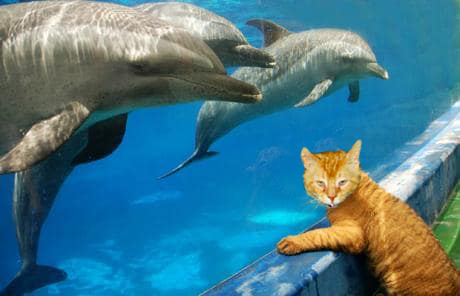

Dolphinese
by Peter Watts
This is how you communicate with a fellow intelligence:
you hurt it, and keep on hurting it, until you can
distinguish the speech from the screams.
—Blindsight
Believe it or not, the above quote was inspired by some real-world research on language and dolphins.
Admittedly the real-life inspiration was somewhat less grotesque: scientists taught a couple of dolphins how to respond to a certain stimulus (if you see a red circle, push the yellow button with your nose— that sort of thing) then put them in different tanks but still let them talk to each other. Show the stimulus to one, but put the response panel in the tank with the other. Let them talk. If the dolphin in the response tank goes and pushes the correct button, you can conclude that the two of them communicated that information vocally: you can infer the presence of language. What’s more, you’ve recorded the vocalizations that carried that information, so you’ve made a start at understanding said language.
As I recall, the scientists rewarded correct responses with fish snacks. Blindsight‘s scientists didn’t know how to reward their captive aliens— they didn’t even know what the damn things ate— so they used a stick instead of a carrot, zapped the scramblers with painful microwaves for incorrect responses. It was more dramatic, and more in keeping with the angsty nihilism of the overall story. But the principle was the same: ask one being the question, let the other being answer it, analyze the information they exchanged to let them do that.
I’ve forgotten whether those dolphins ever passed the talk test. I’m guessing they did— a failed experiment would hardly make the cut for a show about The Incredible Smartness of Dolphins— but then, wouldn’t we have made more progress by now? Wouldn’t we at least know the dolphin words for “red circle” and “yellow button” and (given that we are talking about dolphins) “casual indiscriminate sex”? Why is it that— while dolphins seem able to learn a fair number of our words— we’ve so far failed to learn a single one of theirs?
I was always a sucker for the dolphins-as-fellow-sapients shtick. It’s what got me into marine mammalogy in the first place. One of my very first stories— written way back in high school— concerned a scientist living in an increasingly fundamentalist society, fighting funding cuts and social hostility over his attempts to crack the dolphin language because the very concept of a nonhuman intelligence was considered sacrilegious. (In the end he does get shut down, his quest to talk to the dolphins a complete failure— but the last scene shows his dolphins in a tank quietly conversing in their own language. They’ve decided to keep their smarts to themselves, you see. They know when they’re ahead.)
Anyway. I watched all those Nova documentaries, devoured all the neurological arguments for dolphin intelligence (Tursiops brains are 20% larger than ours! Their neocortices are more intricately folded, have greater surface area!). I read John Lilly’s books, embraced his claims that dolphins had a “digital language”, followed his Navy-funded experiments in which people sloshed around immersed to the waist in special human-dolphin habitats.
Maybe these guys will have better luck.
By the time I started my M.Sc. (on harbor porpoises— one of the bottlenosed dolphin’s stupider cousins), I’d grown significantly more skeptical. Decades of research had failed to yield any breakthroughs. Lilly had gone completely off the rails, seemed to be spending all his time dropping acid in isolation tanks and claiming that aliens from “Galactic Coincidence Control” were throwing car accidents at him. Even science fiction was cooling to the idea; those few books still featuring sapient dolphins (Foster’s Cachalot, Brin’s Uplift series) presented them as artificially enhanced, not the natural-born geniuses we’d once assumed.
We still knew cetaceans were damn smart, make no mistake. Certain killer whale foraging strategies are acts of tactical genius; dolphins successfully grasp the rudiments of language when taught. Then again, so do sea lions— and the fact that you can be taught to use a tool in captivity does not mean that your species has already invented that tool on their own. The expanded area of the dolphin neocortex didn’t look quite so superhuman when you factored in the fact that neuron density was lower than in us talking apes.
So I passed through grad school disabused of the notion that dolphins were our intellectual siblings in the sea. They were smart, but not that smart. They could learn language, but they didn’t have one. And while I continued to believe that we smug bastards routinely underestimate the cognitive capacities of other species, I grudgingly accepted that we were still probably the smartest game in town. It was a drag— especially considering how goddamned stupid we seem to be most of the time— but that was where the data pointed. (I even wrote another story about cetacean language— better-informed, and a lot more cynical— in which we ultimately did figure out the language of killer whales, only to discover that they were complete assholes who based their society on child slavery, and were only too willing to sell their kids to the Vancouver Aquarium if the price was right.)
*
But now. Now, Vyacheslav Ryabov —in the St. Petersburg Polytechnical University Journal: Physics and Mathematics— claims that dolphins have a language after all. He says they speak in sentences of up to five words, maybe more. The popsci press was all over it, and why not? I can’t be the only one who’s been waiting decades for this.
Now that it’s happened, I don’t quite believe it.
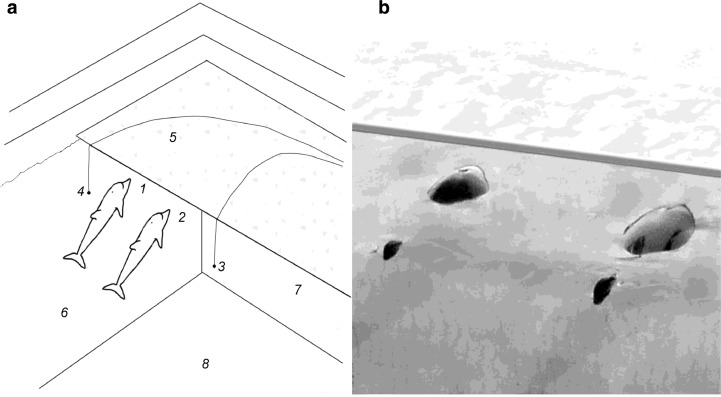
Actually they’re a bit more impressive in real life. (Fig. from Ryabov 2016.)
It wasn’t a controlled experiment, for one thing. No trained dolphins responding to signals that mean “ball” or “big” or “green”. Ryabov just eavesdropped on a couple of untrained dolphins— “Yana” and “Yasha”— as they chatted in a cement tank. We’re told these dolphins have lived in this tank for twenty years, and have “normal hearing”. We’re not told what “normal” is or how it’s measured, but concrete is an acoustic reflector; it’s fair to wonder how “normal” conditions really are when you take creatures whose primary sensory modality is sound, and lock them in an echo chamber for two decades.
Leaving that aside, Ryabov recorded Yana and Yasha exchanging 50 unique “noncoherent pulses” in “packs” of up to five pulses each. Each dolphin listened to the other without interruption, waiting until the other had finished speaking before responding in turn. Based on this Ryabov concludes that “most likely, each pulse … is a word of the dolphin’s spoken language, and a pulse pack is a sentence.” He goes on to compare these dolphin “words” with their human equivalents. (Dolphins words are much shorter than human words, for one thing— only about 0.25msec— because their wider frequency range means that all the phonemes in a “word” can be stacked on top of each other and pronounced simultaneously. Every word, no matter how long, can be spoken in the time it takes to pronounce a single syllable. Cool.)
I find this plausible. I do not find it remotely compelling. For one thing, it doesn’t pass the “tortured scrambler” test: while the pulses are structured, there’s no way of knowing what actual information— if any— is being conveyed. If Yana consistently did something whenever Yasha emitted a specific pulse sequence— say, swam to the bottom of the tank and nosed the drain— you could reasonably infer that the sequence provoked the behavior, that it was a request of some kind: Dude, do me a favor and go poke that grill. Language. But all we have here is two creatures taking turns making noises at each other, and dolphins are hardly the only creatures to do that. If you don’t believe me, head on over to Youtube and check out the talking cats.
Nobody denies that dolphins communicate. Lots of species do. Nature is full of animals who identify themselves with signature whistles, emit alarm calls that distinguish between different kinds of predator, use specific sounds to point out food sources or solicit sex. Killer whale pods have their own unique dialects. Honeybees communicate precise information about the distance, bearing, and quality of food sources by waggling their asses at each other. The world is rife with the exchange of information; but that’s not grammar, or syntax. It’s not language. The mere existence of structured pulses doesn’t suggest what Ryabov says it does.
He does buttress his point by invoke various cool things that dolphins can do: they can learn grammar if they have to, they can recognize images on TV screens (responding to a televised image of a trainer’s hand-signal the same way they would if the trainer was there in the flesh, for example). But all his examples are cadged from other studies; there’s nothing in Ryabov’s results to suggest a structured language as we understand the term, nothing to “indirectly confirm the hypothesis that each NP in the natural spoken language of the dolphin is a word with a specific meaning”, as he puts it.
It’s a tempting interpretation, I admit. This turn-by-turn exchange of sounds certainly seems like a conversation. You could even argue that a lack of correlated behaviors— the fact that Yana never did nose the drain, that neither pressed any buttons or got any fish— suggests that if they were talking, they were talking about something that wasn’t in their immediate environment. Maybe they were talking in abstracts. You can’t prove they weren’t.
Then again, you can say all that about Youtube’s talking cats, too.
So for now at least, I have to turn my back on the claim that my life-long adolescent dream—the belief that actually shaped my career— has finally been vindicated. Maybe Ryabov’s onto something; but maybe isn’t good enough. It’s a sad corollary to the very principle of empiricism: The more you want something to be true, the less you can afford to believe it is.
The Great Black Hope.
But all is not lost. Take long-finned pilot whales, for example. They were never on anyone’s short list for Humanity’s Intellectual Equals— the Navy loved them for mine-sweeping, but they never got anywhere near the love that bottlenosed dolphins and killer whales soaked up— and yet, just a couple of years ago, we learned that their neocortices contain nearly twice as many neurons as ours do.
Maybe we’ve just been looking at the wrong species.
06 Dec 13:29
Advice about seasonal greeting cards from a friend who is a postal worker
[this is specifically UK oriented, but most of it will apply in any country where end-of-year greeting cards and gifts are a big deal]
Okay, now that the Christmas card season is underway, allow me to offer some first-hand tips aimed at stopping your cards getting lost or damaged in the massive crush the Royal Mail endures at this time of year. Every day I see the stack of damaged cards in the mail centre, and I try not to think about the wasted effort, and possibly even heartbreak that it represents. It's easily avoided.
The less expensive cards have awful gum on the envelopes. Make sure the card is correctly sealed, and don't be afraid to use tape if you have to.
Never, and I mean NEVER send cash money through the post. We have all sorts of casuals in during the festive season, and they can't all be thoroughly vetted. It's easy to spot a letter with a banknote in it. Really.
Identify your letter simply and easily with your surname and postcode on the back. That's enough to track you down if something bad happens. That's a good tip for all mail anyway.
Try and post all of your cards at once, and stick a rubber band around them. Everyone concerned in the handling process will bless you, and it makes them easy to handle and process, and prevents random damage occurring to them in the early stages of handling. If you have no rubber bands, accost your postman. I guarantee he will have access to thousands.
ALWAYS take them to a post office if you can. The rubbish in mailboxes is dreadful during the party season. Just today I pulled a half-drunk can of Red Bull from a box full of mail, and of course, some of it was soaked. You see worse things too. Ghastly.
If you HAVE to use a post box, bear the following in mind: Don't post mail in the rain or snow. I have scooped many tragic handfuls of mail from boxes, posted by people who should really have known better. Post boxes are not waterproof. The older ones are better. The boxes in supermarkets are great too, as the mail goes straight into a bag, avoiding much scraping and pulling.
Here's one you might not have been able to work out for yourself: If you are using a post box at this time of year, leave it as close to the collection time as you can. REALLY don't post too early in the day. Why? Well, imagine a big metal tube full of letters, with the removal window at the bottom. Imagine all the weight on top of the bottom cards, the ones which have to be removed first. Perhaps ones with a "budget" flimsy envelope. The ones which have to be pulled through the opening guarded by a rusty, fifty year old wire frame. Do I have to complete the picture? The ones posted late are usually OK, because they don't have so many on top.
Despite this, please keep sending cards. This is a great time of year for us. I'm working 12 hour days at the moment, but everyone I meet is smiling, and chatting, and wishing me a happy Christmas. I'd love to think that folks were doing all they can to make sure all of their cards arrive at their correct destinations, and everyone has as happy a festive season as possible.
On behalf of all my colleagues at Royal Mail, have a very Merry Christmas, and, of course, a Happy New Year.
Okay, now that the Christmas card season is underway, allow me to offer some first-hand tips aimed at stopping your cards getting lost or damaged in the massive crush the Royal Mail endures at this time of year. Every day I see the stack of damaged cards in the mail centre, and I try not to think about the wasted effort, and possibly even heartbreak that it represents. It's easily avoided.
The less expensive cards have awful gum on the envelopes. Make sure the card is correctly sealed, and don't be afraid to use tape if you have to.
Never, and I mean NEVER send cash money through the post. We have all sorts of casuals in during the festive season, and they can't all be thoroughly vetted. It's easy to spot a letter with a banknote in it. Really.
Identify your letter simply and easily with your surname and postcode on the back. That's enough to track you down if something bad happens. That's a good tip for all mail anyway.
Try and post all of your cards at once, and stick a rubber band around them. Everyone concerned in the handling process will bless you, and it makes them easy to handle and process, and prevents random damage occurring to them in the early stages of handling. If you have no rubber bands, accost your postman. I guarantee he will have access to thousands.
ALWAYS take them to a post office if you can. The rubbish in mailboxes is dreadful during the party season. Just today I pulled a half-drunk can of Red Bull from a box full of mail, and of course, some of it was soaked. You see worse things too. Ghastly.
If you HAVE to use a post box, bear the following in mind: Don't post mail in the rain or snow. I have scooped many tragic handfuls of mail from boxes, posted by people who should really have known better. Post boxes are not waterproof. The older ones are better. The boxes in supermarkets are great too, as the mail goes straight into a bag, avoiding much scraping and pulling.
Here's one you might not have been able to work out for yourself: If you are using a post box at this time of year, leave it as close to the collection time as you can. REALLY don't post too early in the day. Why? Well, imagine a big metal tube full of letters, with the removal window at the bottom. Imagine all the weight on top of the bottom cards, the ones which have to be removed first. Perhaps ones with a "budget" flimsy envelope. The ones which have to be pulled through the opening guarded by a rusty, fifty year old wire frame. Do I have to complete the picture? The ones posted late are usually OK, because they don't have so many on top.
Despite this, please keep sending cards. This is a great time of year for us. I'm working 12 hour days at the moment, but everyone I meet is smiling, and chatting, and wishing me a happy Christmas. I'd love to think that folks were doing all they can to make sure all of their cards arrive at their correct destinations, and everyone has as happy a festive season as possible.
On behalf of all my colleagues at Royal Mail, have a very Merry Christmas, and, of course, a Happy New Year.
05 Dec 22:03
Early morning thoughts after Richmond Park
by Nick
 In a year of waking up to so much bad news, today has finally brought some cheer to 2016 with the news that Sarah Olney has defeated Zac Goldsmith to become the new Liberal Democrat MP for Richmond Park. Congratulations to her and the team who delivered this result – yes, it was a winnable by-election, but it still had to be won, and that takes a lot of effort from a lot of people to achieve.
The #LibDemFightback takes a big step forward
This is a great result for the party – the first by-election gain since Dunfermline and West Fife over a decade ago – and a continuation of the trend from local council by-elections of big swings from Conservative to Liberal Democrat, especially in areas that voted Remain in June. It’ll give a massive boost to campaigners across the country, and will likely result in more media coverage and attention. It may even prove to be one of those by-elections that helps to kickstart a rise in the opinion polls as a result of the new focus and coverage. The result should give Tim Farron and the party a bigger platform, now it’s up them to use it.
Progressive alliances can work
Richmond Park offered us a sight not seen since the 80s: multiple party leaders campaigning for a single candidate. The decisions by the Greens and WEP to not stand candidates in favour of endorsing Sarah Olney were as welcome as they were unexpected, and the narrowness of the result (Olney’s majority is smaller than the Green vote in 2015) means they were very likely a critical factor. I’ve said before here that we need to find ways to work together, and this bold step will hopefully lead to a whole lot more. Caroline Lucas and Jon Bartley deserve a lot of praise for making this happen, and for facing down those in their party who were opposed to it. Hopefully, this is the start of something between the parties, not just a one-off.
The question of working together could be a key issue across a lot of parties over the next few months, and might prompt some interesting divisions and new alliances. We’ve seen Scottish politics shift massively over the last few years as independence and unionism become the two key poles of political competition, might the rest of the UK now follow suit and realign around pro-European and pro-Brexit poles? When a Tory MP is cheering on a Lib Dem by-election victory, the tectonic plates of British politics might just be shifting a little bit more.
Labour losing their deposit: all of this has happened before and will happen again
Labour’s vote share fell from double figures to just 3.7% and they lost their deposit. Surely, this must mean they’re going to be wiped out at the next election? Maybe, except exactly the same thing (right down to the 3.7%) happened in the 2000 Romsey by-election, and they did OK in the 2001 election, as I recall. They also slumped lower than that when the Lib Dems gained Newbury and Christchurch at by-elections, which didn’t harm Blair too much in 1997.
Yes, the circumstances are different, but this feels more like a good old fashioned tactical squeeze of the Labour vote rather than some Corbyn-related calamity. Anecdotal evidence from people campaigning in Richmond Park was reporting a big anti-Goldsmith switch from Labour voters, eager to punish him for his nasty campaign against Sadiq Khan in May. There’s not really much good news for Labour in this by-election, but the bad news isn’t as bad as some will make it out to be.
05 Dec 21:54
UKIP has ceased to be a serious player and the BBC should stop pandering to them
by Mike Smithson
Last night we had Radio 4’s Any Questions in town. It was a good evening except for the fact that there was no Lib Dem on the panel. Instead we had as well as the statutory LAB & CON rep an SNP MP and the barely coherent deputy UKIP leader, Peter Whittle.
You’d have thought that the BBC planners would have figured out that the Richmond by-election was taking place the day before and would likely feature a Lib Dem or made provisions just in case they had a good result. Without one on the panel they were unable to take direct questions on the election outcome.
Many were furious by this and the presence, yet again by the BBC, of a Kipper – a party that is struggling in all the elections it is fighting at the moment and didn’t even field a candidate in Richmond.
The chart above graphically illustrates how poorly UKIP has been doing in Westminster by elections this year. The BBC should take notice.
Mike Smithson
02 Dec 21:48


Hey, Looks Like It’s Time Once Again For Me to Talk About Writing On Politics
by John Scalzi
Because of the election and all, I’ve gotten a few people griping to me about the fact I write about politics here and in other places. It’s been a while since I talked extensively about me writing about politics, and also, about the more general topic of entertainers and creative people who talk about politics, and the people who tell them to shut up about it. So let’s talk about these things, shall we.
For ease of discussion, I’ve broken this up into ten points. The first five are about me specifically, and are short. The second five are more general, and rather longer. Ready? Let’s get to it.
I. The Short Points About Me Writing On Politics
1. If you tell me you’re tired of me talking about politics, or tell me to shut up about them, I’ll tell you to kiss my ass. I’ll write about what I want, when I want, where I want, which in this case happens to be about politics, now, here.
2. If you don’t want to read me opining on politics, you are presumably a grown human being with free will and the ability not to read things. Skip over the piece or stop reading the site entirely.
3. If you complain to me about my expressing political opinions in areas under my own control that you are not actually being forced to read, there’s a very good chance I’m going to be rude to you. This is actually covered in the site disclaimer, which has been up for years, on every page of the blog.
4. I don’t give a shit if you become unhappy with me for being rude to you.
5. Likewise, I don’t care if your dislike of my writing about politics and/or your being upset that I was rude to you when you complained about it means you no longer choose to read my books. Stop reading my books, then.
II. The Longer Points About Creators and Entertainers, Including Me, Opining On Politics
6. For the occasional jackass who opines that entertainers like myself should stick to entertaining and not write about politics or anything else that might possibly offend someone, a) fuck you, b) you’re wrong, c) independent of either of those points, long before I was an author I got paid to write about politics, and still do from time to time (as recently as last month, in fact, in one of the largest newspapers in the nation). So, yeah, actually, writing about politics is a thing I do professionally, thanks so much for asking.
Now, here’s a hot take for you: “Entertainers” are fully-dimensional human beings who don’t exist solely to entertain you, writers in particular write professionally and/or critically about many things over the course of their career, and you suggesting that people not express themselves about politics (or anything else) because they are an “entertainer” makes you the asshole in that scenario, not them. So maybe don’t be shocked when they tell you to sod off.
7. Likewise, this blog existed before I was a published author, and before I was a published novelist. I’ve been writing about politics here literally since the very first week it was up (that week I also wrote about baseball, journalism, my pets, tech stuff and sending out invoices. The site lived up to its name even then). The blog isn’t here to sell my books, although it’s done that incidentally, which makes me happy. It’s here for me to write about whatever I want to write about, when I feel like writing about it, and has been since 1998. Sometimes I will write about politics! And sometimes I won’t — there are entire years (see: 2014) where I pretty much didn’t, because I didn’t want to.
Which again is the point of the blog: It’s about me, writing about what interests me, when it interests me. It’s not about you, or what you want me to write about, or to not write about. Likewise, my Twitter feed, or anything else I control that I put my words out on. If you’re confused about the vector of impetus and control regarding these outlets, for any reason, you’re likely to have a bad time. Especially if you complain to me about it. Other entertainers and creative people may feel similarly about their own spaces, which is a thing you should consider as well.
8. With that said, if my politics make you itchy, then actually, you should probably consider skipping out on the next four years here. I can’t imagine I’m not going to write about politics on a regular basis. I mean, come on: whatever one thinks about Trump, that asshole isn’t boring. Nor are American politics or social issues going to be anything but a bumpy ride the next few years. I’m not going to say it’s going to be fun. But it’s not going to be something I’m likely to take a pass on as a writing topic. If you want a spoiler alert on the matter, this is it. Don’t expect me not to go off on politics, folks. And don’t expect other creative/entertaining folks to be quiet about politics either, the next four years. That’s just not gonna happen.
9. Why, yes, I’m cranky on the subject of people trying to tell me — or other writers, creators and entertainers — to stop expressing opinions on politics and other social issues. People have been trying to do this for my entire professional writing life, which is 26 years now, and much of which has consisted of me being paid to have a goddamned opinion on things. I imagine it will continue, as people with fragile worldviews and/or monstrous senses of entitlement and/or a wildly misplaced sense of my desire for their input and/or simple, virulent passive-aggressiveness decide they need to tell me what and how and when to write, or not write.
And, folks. One: Are you my spouse or my editor? No? Then feel free to fuck right off. Two: You may have noticed I’m doing pretty well for myself with this whole writing thing. One secret to that is not listening to various randos telling me what to do, or what not to do, with my writing career. Three: Do you understand how boring and exasperating it is for me — or any writer, creator or entertainer — to have to deal with various randos telling us what to do or not to do? It’s really goddamn boring and exasperating! And maybe other folks who have to deal with this bullshit choose to be patient or quiet about this because they’re earlier along in their career, or they’re still under the impression that their career can be hurt by some rando telling them to shut up or else, or because they’re nicer than me, or because they’re not, like me, a well-off straight white dude so they actually have to worry about their randos being terrifying stalkery bigot assholes, especially now, when actual fucking Nazis are cracking off salutes like it’s 1933. All of those are fine reasons for them to be quiet about this shit.
But I am not them, so I’m pretty comfortable saying the following: Piss off, rando yutz, you’re boring me. After 26 years, you’re not going to find a way to tell me to shut up that I haven’t heard before and haven’t already offered a middle finger to. And after 26 years, I’ve run out of fucks to give on the matter. Tell me to stop writing about politics? Fuck you. Suggest that I shouldn’t write about politics? Fuck you again. Whine to me that you’re tired about me writing about politics? Fuck you a third time. There’s the door. Go.
10. Seriously, people, what do you think you’re doing when you tell a writer (or musician, or actor, or whomever) that they shouldn’t talk about politics, or social issues, or whatever? Do you believe they will genuinely think, “My god, this random person I don’t know has entirely changed my mind about expressing an opinion in public! I am so grateful”? I can’t speak for all creators everywhere, but anecdotally speaking, I can tell you that most of the creators I know do not think oh wow, this random person is so right. They think, what an asshole.
And maybe you are an asshole! Certainly there are any number of people who send me notes along the line lol shut up dude no one cares what you think, which aren’t meant to persuade, but just to try to insult or belittle me, and, well. That’s adorable. But if you didn’t intend to be an asshole, maybe consider a different strategy.
For example, a couple of years ago there was a Scottish entertainer I admired, so I followed their Twitter account, which turned out to be nothing but blathering about Scottish independence. Did I tell this entertainer to oh my God will you just stop talking about Scottish independence I don’t even care? No, I just stopped following their Twitter account. Because you can do that! There are whole swaths of creators and entertainers whose work I admire who I don’t follow on social media, or read their blogs, or otherwise track their lives because I know they care about things I don’t, or that I disagree with. There are other swaths of entertainers who I do follow, but when they get a bug up their ass about something I don’t care about, I skip over those topics. A writer I admire has gone on for years about vaping. I couldn’t give a shit about vaping; I think it’s a dumb thing to invest any brain cycles on. But they disagree! Good for them. I skip over the vaping rants. It’s really just that simple.
It’s okay to disagree, sometimes vehemently, with people whose work you admire. It’s all right to think they spend too much time on things you don’t care about. It’s fine to think to yourself or to tell others ugh why can’t they just get over that dumb thing I don’t care about. But the minute you go out of your way to tell them to shut up, no matter how “politely” you put it, you’re the asshole. Yes you are. And some of the people you’ve told to shut up will treat you like the asshole you’ve become.
I will, in any event. Fair warning.
02 Dec 21:46


Changing Our Minds: “Story of Your Life” in Print and on Screen.
by Peter Watts
Spoilers. Duh.
We share a secret prayer, we writers of short SF. We utter it whenever one of our stories is about to appear in public, and it goes like this:
Please, Lord. Please, if it be Thy will,
don’t let Ted Chiang publish a story this year.
We supplicate thus because whenever Ted Chiang does put out a story— not all that often, thankfully— it’s pretty much guaranteed to walk away with every award that’s lying around, leaving nothing for the rest of us. More often than not, it deserves to. So it will come as no surprise to learn that the first movie to be based on a Ted Chiang story is very smart, and very compelling.
What might come as a shock— and I hesitate to write this down, because it smacks of heresy— is that in terms of storytelling, Arrival actually surpasses its source material.
It’s not that it has a more epic scale, or more in the way of conventional dramatic conflict. Not just that, anyway. It’s true that Hollywood— inevitably— took what was almost a cozy fireside chat and ‘roided it up to fate-of-the-world epicness. In “Story of Your Life”, aliens of modest size set up a bunch of sitting rooms, play Charades with us for a while, and then leave. Their motives remain mysterious; the military, though omnipresent, remains in the background. The narrative serves mainly as a framework for Chiang to explore some nifty ideas about the way language and perception interact, about how the time-symmetric nature of fundamental physics might lead to a world-view— every bit as consistent as ours— that describes a teleological universe, with all the Billy Pilgrim time-tripping that implies. It’s fascinating and brow furrowing, but it doesn’t leave you on the edge of your seat. Going back and rereading it for this post, I had to hand it to screenwriter Eric Heisserer for seeing the cinematic potential buried there; if I was going to base a movie on a Ted Chiang story, this might be the last one I’d choose.
Now that’s a proper Starfish Alien.
In contrast, Arrival‘s heptapods are behemoths. What we see of them hints at a cross between the proto-Alien from Prometheus and the larger members of that extradimensional menagerie glimpsed in The Mist. While the novella’s spaceships remained invisibly in orbit, the movie’s hang just overhead like asteroids pausing for one last look around before smashing the world to rubble. The novella’s geopolitics consist largely of frowning uniforms, grumbling ineffectually in the background; in the movie, half the world’s ready to start lobbing nukes. Armageddon hinges on whether the aliens really mean “tool” when we read “weapon”.
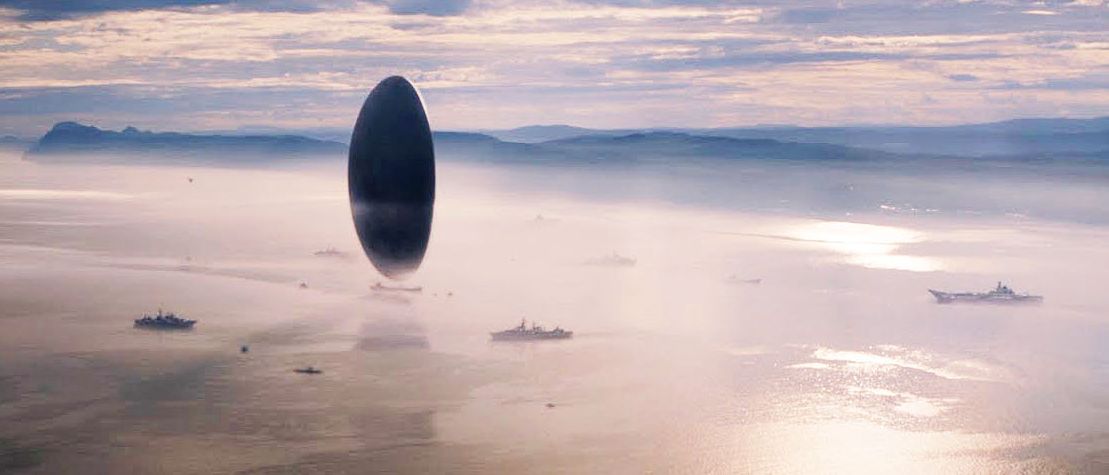
Yeah, I know Wolfram came up with some Mathematicoid gravity-wave rationale for the shape. They still look like big dirty contact lenses to me.
All standard Hollywood Bigger-Is-Better, and— for once— done in a way that doesn’t betray the sensibility of the source material. For the most part I preferred the more epic scale— although I was irked by the inevitable portrayal of Murricka as the calmer, cooler, peaceful players while Russia and China geared up to start Interstellar War I. (The portrayal of the US as the world’s most pacifist nation is probably the single least-plausible element in this whole space-alien saga.) But I’m not just talking about the amped-up levels of jeopardy when I say I prefer movie to novella: I’m talking about the way different story elements tie together. I’m talking about actual narrative structure.
“Story of Your Life” presents a number of elements almost in isolation. We know that Louise will marry, have a daughter, get divorced. We know that the daughter will die. We know that the heptapods leave, but we never know why— or why they showed up in the first place, for that matter. (When quizzed on the subject they say they’re here to acquire information, which would have a lock on “Most Maddeningly Vague Answer of the Year” if such an award actually existed.) (If it did, of course Ted Chiang would win it.)
Arrival ties all these loose ends together, elegantly, satisfyingly. The aliens are here to give us a “weapon/tool”— or more accurately a gift: to teach us their teleological mindset, uplift us to a new worldview. They are here to literally change our minds. Louise makes that conceptual breakthrough, uses the new paradigm to head off nuclear war in the nick of time. Her divorce— years after the closing credits— is not just something that happens to happen; it occurs when her husband learns that she’d known in advance (thanks to her new precognitive mindset) that their daughter would be doomed to a slow, painful death at a young age— and yet went ahead and birthed her anyway (not that choice had anything to do with it, of course). It’s not belabored in the screenplay— a couple of oblique references to Daddy looks at me differently now and I made a decision he thought was wrong. But the implicit conflict in the moral algebra between two people who love each other— We can at least give her a few glorious years vs. You’ve sentenced her to agony and death— is heartbreaking in a way that Chiang’s Kubrickian analysis never managed.
More to the point, though, all these events tie together. They all arise from the central premise, from the cursed gift the Heptapods bestow upon us. Everything’s connected, organically, logically, causally. Teleogically.
The movie has an unfair advantage, insofar as it can present straightforward memories of future events and be confident that the audience will assume that they’re flashbacks; the moment we realize our mistake is one of the best aha! twists of the movie. Chiang, stuck with the written word, had to give the game away pretty much at the start by writing his future memories in future tense; a beautiful device, but with little room for surprise.
Which is no reason to not read the story. Offhand, I can’t think of any good reason to not read a story by Ted Chiang.
But in this case, I think there’s more reason to see the movie.
30 Nov 13:16
The blockchain paradox: once you address the problem of governance, you no longer need a blockchain.
The blockchain paradox: once you address the problem of governance, you no longer need a blockchain.
30 Nov 13:12
On top of LAB polling woes first analysis of the new boundaries suggests LAB will need vote lead of 13.5% to get a majority
by Mike Smithson

The Tories only need a 1.9% margin
YouGov’s Anthony Wells who runs UK Polling Report had produced his first analysis of the planned new boundary changes and the outcome is excellent for the Tories and terrible for Labour.
The analysis also has the LDs down to just four MPs.
I’m just on my way home from the Political Studies Association Awards in London and I’ll do more on this when I’ve had time to look at this in greater detail.
Mike Smithson
30 Nov 12:15
Roll Model
by evanier
This is important enough for me to interrupt the script I have to finish today and come back here to post it. As all of you are aware I'm sure, it matters a lot which way the toilet paper comes off the roll. It should hang off the front (as in the photo at left below) not the rear (as in the photo at right).

As I wrote back here, I once did a show with Jerry Lewis and we were warned that he would walk out on the taping if the john in his dressing room had an incorrectly-mounted roll of toilet paper. I do not think the person who told me this was kidding.
In this world, there is no fact or truth so universally accepted that someone won't insist on the opposite. Well, we have now have proof — or at least as much as we're ever going to get — that the front overhang is the correct configuration. Writer Owen Williams dug up the 1891 patent for perforated toilet paper and the device that holds it. It clearly shows how it was supposed to work.
I can't think of any reason to have it hang down the back unless it's that you want to get Jerry Lewis out of the building. Then again, that might be a great reason.
The post Roll Model appeared first on News From ME.
29 Nov 10:40
After some of my reasons to love the first Doctor Who I ever saw, what could follow but the first book I ever read? Gerry Davis novelises Patrick Troughton’s fight with Cybermen on the Moon – or, as the back cover puts it with charmingly oblivious self-deprecation,
This is another Special Edition post, complete with a new photo from this very June (or from 1975, depending on where you stand). About this time last year I had the brilliant idea of choosing an exciting variety of Doctor Who stories in an idiosyncratic order to run through the year, one every week, inspired by the fifty-second anniversary – and, just to make it still more unlikely, I planned an erratic series of sidesteps away from television Doctor Who. This was originally one of the pieces I managed to write before hitting the horror that is 2016. I’m not promising to get through the whole list this time, but at least I’ve made it to the second one…
1 – Prologue: The Creation of the Cybermen
Many of the more marvellous Target Books add much more to the stories that were seen on TV. Gerry Davis doesn’t add much, but he adds this. It’s enough.
2 – Anneke Wills reading the Audiobook.
Anneke Wills was marvellous as the Doctor’s companion Polly in 1967, and she’s just as marvellous reading the 2009 audiobook. She has a great storyteller’s voice: slightly deep, intimate and reassuring, with a compelling array of characters (though her accents are variable). Her Polly is of course perfect, and her rather breathy Doctor is especially compelling in his determination towards the climax. Interestingly, she uses higher registers for the Doctor’s other companions, the cute young men Jamie and Ben (hearing the line “they were able to follow Ben’s keen gaze” read aloud, I thought, ‘Yes, I know quite a few of those’). She breathes new life into the book with one of the best of the readings. There’s just one slightly flubbed line which tickles me, when she invents a rather unusual colour as a side-effect of a word being split across two lines in the original printing as Moonbase ‘night’ falls and we hear about “red-
dish-coloured lights”.
Half-way through the audiobook Ms Wills is joined by Nick Briggs as the voices of the Cybermen. He’s known for a great many Doctor Who monster voices and recreates those of the TV version. The two big Cyber-reveals are also my favourite pieces of the score, where the music climbs into an electronic rasp not unlike the Space Adventure theme that accompanied the Cybermen in 1967’s TV stories (and gets a bit of bagpipes mixed in when Jamie defies them!). They also get a tensely scored ‘stalking’ sequence towards the end of the first CD, and in a later chase sequence there’s a very effective echoing boom, which stands for both the terrible Cyber-tread and their desperately running victim’s heart.
3 – The Doctor.
Patrick Troughton was a very visual actor, constantly fascinating to watch, which makes it even more frustrating that the BBC junked so many of his performances. This book was my first experience of his Doctor, and it does a remarkable job of evoking him. The text introduces his famous “terrible things” speech with Polly seeing a “far-horizons” look in his blue-green eyes, making us pay extra attention, but it’s the first half of this Doctor’s famous mixture of ‘Free-thinking fun’ and ‘Destroy all monsters’ that’s surprisingly more vivid here. Losing control of the TARDIS like a ship in a stormy sea; miscalculating the date, provoking applause and laughter from a tense Moonbase crew, and still being pleased with himself for being just twenty years out, then being suddenly brought down when asked to do some work; his “relieved, almost silly grin”; all these stuck in my head as characteristics of the Second Doctor. But what most appealed to me were the passages in which the Doctor is trying to trace a mysterious Space Plague that’s struck the Moonbase personnel.
4 – The Space-Food.
Even when I was thin and tiny I loved references to food almost as much as I liked food. So what could be better than food as a major plot point? Gerry Davis’ vision of the future was full of Space-age ‘food concentrate’ that were always off-putting to the Doctor’s companions from the Twentieth, Nineteenth and Eighteenth Centuries and a sign of dehumanising Cybermen on your plate. It didn’t work. They fascinated me decades before I ever touched a microwave. So I’m still fascinated by the story’s use of – sugar. Not sugar spray, or reconstituted sugar pellets, but actual bags of it. It sounds reassuring and familiar amid all the suspicious Space Food. But how are the Cybermen spreading their not-really-a-space-plague to weaken the base whose controller, to fans’ delight, actually says “from our point of view, we’re under siege”? Spoilers and spillages: it turns out to be the good, old-fashioned, comforting sugar that’s betraying them. Though personally I’m always more suspicious of the cream, given they have to wait a month for a rocket even for medical samples.
5 – Polly.
The Cybermen are both deeply weird and nearly robots in this book, as befits dead bodies walking around enclosed in metal and plastic and embalmed in circuitry. I once sketched an appropriately B-Movie Cyberman poster with the tagline “Mummy-wrapped zombies from the vampire planet”, perhaps inspired by the Doctor’s famous musings on their eldritch elements in Lawrence Miles’ Christmas On A Rational Planet. Using techno-holy water to dissolve their plastic unlife-support units is the most explicit of all of these. But on a base full of male scientists, none of them come up with the solution. It’s a very female-gendered idea from the only woman. Polly is the companion that the Doctor keeps by his side here to have the intelligent conversations with. In one of my favourite scenes, she basically asks him whether he’s up to it, hilariously spotting potential gaps in his qualifications. And in the book, marvellously, she does it as an aside while examining her nails. Then the Cybermen have a container like a giant powder compact. It’s the only Doctor Who book with Chekhov’s make-up kit.
When the Doctor patronises Polly, the text tells us he’s being patronising; when she’s finally asked to make the coffee, it’s when the Doctor’s run out of any other strategy to get the base commander off his back and several chapters after he sent Ben to do it; and when Ben and Jamie are sexist to her, she just ignores them and does what she was going to do anyway. Which is to use a mixture of solvents, inspired by nail varnish remover, to melt the Cybermen’s plastic vital systems into gruesome goo. A story with only one woman does at least have her save everyone’s life by weaponising Clarins and, to cap the Deb striking back, Anneke Wills puts a lot of joy into her exclamation, “A cocktail!”
If you’ve read my first TV entry in this fitful series, you’ll probably guess why I picked this book as my first sidestep. My primary school had a little bookshop in a corridor. You saved up 5p Wise Owl Stamps to buy them. This was eight stamps, and the first book I ever bought. It was Doctor Who! There was a Cyberman on the cover! And I couldn’t read. But buying my first book wasn’t the only thing that happened when I was five. I also fell seriously ill and was hospitalised… Which (unlike most of my long-term health problems) turned out to be one of the best things that ever happened to me. The various primary school books I’d been meant to be learning to read on had been having precisely zero impact on me through their banal ‘narratives’ of going to school, sometimes by bus, sometimes in the rain; I did that. Why would I want to read about it? But when my Mum, who’s never loved Doctor Who, eventually gave in and brought along my copy of Doctor Who and the Cybermen. The ‘If you go to the sickbay you’ll be carried off and possessed’ plot didn’t put me off at all, but it didn’t appeal as much to her. Half-way through reading this book to her little invalid, she could stand no more and did something that changed my life (and, within a couple of months, changed my measurable reading age from ‘off the bottom of the scale’ to well over double my actual age). Thanks, Mum; thanks, Gerry Davis. She told me to read it myself.
I did.
The TV Doctor Who story The Moonbase is one of many that suffered through BBC short-sightedness, so the DVD has two fully existing episodes and two recreated using animation and the soundtrack. The book was published in February 1975, two months before a new Cyberman story on TV which Gerry Davis had been working on at around the same time as this novelisation. Readers of Doctor Who and the Cybermen will spot several similarities with Revenge of the Cybermen as seen on TV, though the novel is more unadulterated Gerry Davis – despite his getting sole writer credit, parts of his later script were heavily rewritten. I wonder if that’s why the book keeps in the lines where Cybermen sneer about how silly “revenge” is. He does give us a preview here of Cyberleaders with black helmets, though, so that’s one ultra-modern 1975 touch.
Chris Achilleos’ cover boasts a threatening closer-to-1975-than-1967-look Cyberman, as well as a thrilling fizz around the Moon and a great Patrick Troughton. In Spring of this year, the Cartoon Museum in Bloomsbury held an exhibition of Target Books Doctor Who Artwork, and – fabulously – this was one of the paintings on display. Thirty-nine years after I read my first book, I was enthralled to be able to see the original art up close. You had to be there to admire the sheer detail in the Doctor’s face and the Moon’s surface, or the vibrancy of the colours, but it was a real treat for me (and I’m sure for a great many other visitors besides). Alan Willow’s internal illustrations can be found right through to the 2011 BBC Books edition, though sadly for the audiobook they’re printed the size of postage stamps in its apologetic little insert. Gerry Davis always struggled slightly with the science – trying valiantly, but despite, say, using vacuum as a major threat, occasionally forgetting that the Moon doesn’t have air, or that a laser beam isn’t the same as a flaming torch. Modern Doctor Who TV and novel writer Gareth Roberts pays tribute to Gerry Davis’ ability to tell a cracking yarn in his introduction to the BBC Books edition; the book’s 2011 editors pay tribute to his trying really hard but sometimes making a howler by seriously informing us that the Kit Pedler and Gerry Davis-inspired Doctor Who story The War Machines was scripted not by Ian Stuart Black but by slightly more famous television writer Ian Kennedy Martin…
This is not the best Doctor Who book ever, but it’s still a load of fun, and I love it. My Mum hates it. Take your pick.
And, if you need one, my score:
7/10, or 9/10 when Anneke Wills is reading it.
Two other novelisations of stories pitting Patrick Troughton’s Doctor against more of his iconic monsters: Terrance Dicks’ Doctor Who and the Abominable Snowmen and Brian Hayles’ Doctor Who and the Ice Warriors. Each of them is also available in modern BBC Books editions, and as audiobooks – both David Troughton and Frazer Hines give quite uncanny readings of their Doctor. But there’s a suddenly topical and high-profile tie-in with a more iconic monster still…
Doctor Who – The Power of the Daleks is currently high in the new DVD charts (amongst a wide array of formats, led by BBC Store). One frustration to my love of Ben and Polly is that so little of their time with the Doctor still fully exists; well, it’s some consolation as well as excitement that to celebrate its fiftieth anniversary, the BBC have just released one of their most thrilling adventures. Ben and Polly are crucial in coping, alongside the audience, with the Doctor’s very first regeneration. This is Patrick Troughton’s first story as the Doctor – but in new and rather stylish animated form. Though the BBC destroyed many of Doctor Who’s early episodes a few years after broadcast, Doctor Who inspired such fascination from the very first that some viewers made home sound recordings of all the TV stories later short-sightedly exterminated. So although no episodes of The Power of the Daleks survive to be seen as they were in 1966, you can now watch the whole thing remade to the original soundtrack in the most ambitious Doctor Who animation project yet. If that puts you in the mood for more Ben and Polly, I’d also recommend the DVDs of The Moonbase itself and original Cyberman story The Tenth Planet, each of which can now be seen in full but in a mixture of existing episodes and similarly recreated ones of animation and audio to fill in the ones the BBC destroyed.
The only story where Michael Craze and Anneke Wills’ original performances as Ben and Polly survive in full on screen as well as in their voices, however enticing their cartoon versions, is their first – The War Machines, where they join the TARDIS with William Hartnell’s Doctor. Fortunately, it’s a good one, but it’s still dispiriting that this wonderful team has just a single ‘complete’ outing. But my favourite story for Ben, Polly and Jamie is one you can only get as a soundtrack, as there’s almost nothing left of the TV bar a few dozen still images (though it’s worth searching online for Reconstructions combining those photos and even a little CGI with the soundtrack to aid the storytelling). It’s The Macra Terror, and it’s eerily glorious and super-liberal fun. That’s the story that originally followed The Moonbase on TV, and if there’s one thing this book’s missing, it’s ending with a giant claw…
Five Reasons to Read Doctor Who and the Cybermen – Doctor Who 52 Extra: A (SE)
by Alex Wilcock
Introducing Doctor Who and the Cybermen…
After some of my reasons to love the first Doctor Who I ever saw, what could follow but the first book I ever read? Gerry Davis novelises Patrick Troughton’s fight with Cybermen on the Moon – or, as the back cover puts it with charmingly oblivious self-deprecation,
“Can the Doctor defeat an enemy whose threat is almost as great as that of the mighty Daleks?”Can I find five reasons you should read ‘Invasion of the Also-Rans’? It’s time to sit down, mix yourself a celebratory Cocktail Polly, and curl up with a book.
This is another Special Edition post, complete with a new photo from this very June (or from 1975, depending on where you stand). About this time last year I had the brilliant idea of choosing an exciting variety of Doctor Who stories in an idiosyncratic order to run through the year, one every week, inspired by the fifty-second anniversary – and, just to make it still more unlikely, I planned an erratic series of sidesteps away from television Doctor Who. This was originally one of the pieces I managed to write before hitting the horror that is 2016. I’m not promising to get through the whole list this time, but at least I’ve made it to the second one…

Five Reasons To Read – or Listen To – Doctor Who and the Cybermen (warning: spoilers lower down the list)
1 – Prologue: The Creation of the Cybermen
“Centuries ago by our Earth time, a race of men on the far-distant planet of Telos sought immortality. They perfected the art of cybernetics—the reproduction of machine functions in human beings. As bodies became old and diseased, they were replaced limb by limb, with plastic and steel.When this story was shown on TV in 1967, it was called The Moonbase. When Target Books published it in 1975 as one of their first Doctor Who novelisations, they gave it a more sales-friendly title but picked a 1967 hand to write the rest of it in his functional but endearing prose. Author Gerry Davis had been Doctor Who script editor for the TV version of this story, and though it’s credited to Kit Pedler, Gerry Davis worked with him as co-author and as co-creator of the Cybermen. So before the Cybermen enter the text as stealthy presences, then unleashing terrible Cyber-chops or gruesomely electrocuting Cyber-weapons, Mr Davis makes an appropriate start here with a two-page Cyber-mission statement (just as his TV script gave the Second Doctor his own manifesto about terrible things which must be fought). It’s later borrowed to introduce two more Cybermen novelisations, adding to its legendary quality. For all its hyperbole and even inaccuracy, there’s still something terribly thrilling about it, and you imagine Mr Davis was only disappointed that it wasn’t read in portentous tones as it scrolled down a screen full of flaming space battles and legions of Cybermen marching across the stars with the strength of ten men! The Twelfth Doctor sniffing last year that nobody adds the prefix “Space”? If you want someone who does, Gerry Davis is your man. He gives you Earth-things. He gives you Space-things. And most of all, he gives you TERRIBLE CYBER-THINGS.
“Finally, even the human circulation and nervous system were recreated, and brains replaced by computers. The first Cybermen were born.”
Many of the more marvellous Target Books add much more to the stories that were seen on TV. Gerry Davis doesn’t add much, but he adds this. It’s enough.
2 – Anneke Wills reading the Audiobook.
Anneke Wills was marvellous as the Doctor’s companion Polly in 1967, and she’s just as marvellous reading the 2009 audiobook. She has a great storyteller’s voice: slightly deep, intimate and reassuring, with a compelling array of characters (though her accents are variable). Her Polly is of course perfect, and her rather breathy Doctor is especially compelling in his determination towards the climax. Interestingly, she uses higher registers for the Doctor’s other companions, the cute young men Jamie and Ben (hearing the line “they were able to follow Ben’s keen gaze” read aloud, I thought, ‘Yes, I know quite a few of those’). She breathes new life into the book with one of the best of the readings. There’s just one slightly flubbed line which tickles me, when she invents a rather unusual colour as a side-effect of a word being split across two lines in the original printing as Moonbase ‘night’ falls and we hear about “red-
dish-coloured lights”.
Half-way through the audiobook Ms Wills is joined by Nick Briggs as the voices of the Cybermen. He’s known for a great many Doctor Who monster voices and recreates those of the TV version. The two big Cyber-reveals are also my favourite pieces of the score, where the music climbs into an electronic rasp not unlike the Space Adventure theme that accompanied the Cybermen in 1967’s TV stories (and gets a bit of bagpipes mixed in when Jamie defies them!). They also get a tensely scored ‘stalking’ sequence towards the end of the first CD, and in a later chase sequence there’s a very effective echoing boom, which stands for both the terrible Cyber-tread and their desperately running victim’s heart.
3 – The Doctor.
Patrick Troughton was a very visual actor, constantly fascinating to watch, which makes it even more frustrating that the BBC junked so many of his performances. This book was my first experience of his Doctor, and it does a remarkable job of evoking him. The text introduces his famous “terrible things” speech with Polly seeing a “far-horizons” look in his blue-green eyes, making us pay extra attention, but it’s the first half of this Doctor’s famous mixture of ‘Free-thinking fun’ and ‘Destroy all monsters’ that’s surprisingly more vivid here. Losing control of the TARDIS like a ship in a stormy sea; miscalculating the date, provoking applause and laughter from a tense Moonbase crew, and still being pleased with himself for being just twenty years out, then being suddenly brought down when asked to do some work; his “relieved, almost silly grin”; all these stuck in my head as characteristics of the Second Doctor. But what most appealed to me were the passages in which the Doctor is trying to trace a mysterious Space Plague that’s struck the Moonbase personnel.
“It was into this scene of concentrated activity that the Doctor, armed with a bottle of swabs, specimen tubes and a large pair of scissors entered and immediately began to disrupt. He was doing what he enjoyed best; research for a scientific, or in this case, a medical truth. With a mad gleam in his eye, he moved quickly round the room snipping off pieces of the men’s overalls and putting them into bottles. Scraping their shoes and boots and taking swabs from their hands. He seemed not at all put out by the irritated gestures of his victims.”I think the author tells us an explicit moral for the Doctor’s favourite thing so parents wouldn’t cop that investigation isn’t what the Doctor loves most at all. It’s being disruptive. It’s the “mad gleam”, the winding people up, and the nodding happily a few pages later when accused of turning the base upside-down. That’s what appealed to kids reading this, and the way we remember him. It’s anyone’s guess why Gerry Davis talks about his “long legs”, though…
4 – The Space-Food.
Even when I was thin and tiny I loved references to food almost as much as I liked food. So what could be better than food as a major plot point? Gerry Davis’ vision of the future was full of Space-age ‘food concentrate’ that were always off-putting to the Doctor’s companions from the Twentieth, Nineteenth and Eighteenth Centuries and a sign of dehumanising Cybermen on your plate. It didn’t work. They fascinated me decades before I ever touched a microwave. So I’m still fascinated by the story’s use of – sugar. Not sugar spray, or reconstituted sugar pellets, but actual bags of it. It sounds reassuring and familiar amid all the suspicious Space Food. But how are the Cybermen spreading their not-really-a-space-plague to weaken the base whose controller, to fans’ delight, actually says “from our point of view, we’re under siege”? Spoilers and spillages: it turns out to be the good, old-fashioned, comforting sugar that’s betraying them. Though personally I’m always more suspicious of the cream, given they have to wait a month for a rocket even for medical samples.
5 – Polly.
“‘Here’s our holy water,’ said Polly, holding up the small bottle of nail varnish remover. ‘I’m going to do an experiment… Voilà cocktail Polly!’”Context makes such a difference. When I read this book as a boy, I noticed and was influenced by the multi-national Moonbase crew and lack of jingoism. Four decades later, the progressive message is obscured by interloper Polly being the only woman (other than a bureaucrat on the radio) and the black guy dying first. People always cite Polly being told to make the coffee here, too. But then there’s the context. Feminism, like science, is not a language Gerry Davis writes fluently, but there’s no doubt who’s the lead companion here. Fellow sexy, modern (both he and Polly updated from 1960s to 1970s in the book) youth Ben is sent off to help with the ‘shopping’, wash the cups and fetch drinks first (he calls himself “the official Moonbase coffee-boy”); Jacobite Highlander Jamie’s injured and in bed; the main action each of them take is following Polly’s plan, which is the only successful attack on the Cybermen until the climax. This isn’t to put down Ben or Jamie. For me Polly, Ben and Jamie were the business, but Polly is obviously first among equals.
The Cybermen are both deeply weird and nearly robots in this book, as befits dead bodies walking around enclosed in metal and plastic and embalmed in circuitry. I once sketched an appropriately B-Movie Cyberman poster with the tagline “Mummy-wrapped zombies from the vampire planet”, perhaps inspired by the Doctor’s famous musings on their eldritch elements in Lawrence Miles’ Christmas On A Rational Planet. Using techno-holy water to dissolve their plastic unlife-support units is the most explicit of all of these. But on a base full of male scientists, none of them come up with the solution. It’s a very female-gendered idea from the only woman. Polly is the companion that the Doctor keeps by his side here to have the intelligent conversations with. In one of my favourite scenes, she basically asks him whether he’s up to it, hilariously spotting potential gaps in his qualifications. And in the book, marvellously, she does it as an aside while examining her nails. Then the Cybermen have a container like a giant powder compact. It’s the only Doctor Who book with Chekhov’s make-up kit.
When the Doctor patronises Polly, the text tells us he’s being patronising; when she’s finally asked to make the coffee, it’s when the Doctor’s run out of any other strategy to get the base commander off his back and several chapters after he sent Ben to do it; and when Ben and Jamie are sexist to her, she just ignores them and does what she was going to do anyway. Which is to use a mixture of solvents, inspired by nail varnish remover, to melt the Cybermen’s plastic vital systems into gruesome goo. A story with only one woman does at least have her save everyone’s life by weaponising Clarins and, to cap the Deb striking back, Anneke Wills puts a lot of joy into her exclamation, “A cocktail!”

What Else Should I Tell You About Doctor Who and the Cybermen?
If you’ve read my first TV entry in this fitful series, you’ll probably guess why I picked this book as my first sidestep. My primary school had a little bookshop in a corridor. You saved up 5p Wise Owl Stamps to buy them. This was eight stamps, and the first book I ever bought. It was Doctor Who! There was a Cyberman on the cover! And I couldn’t read. But buying my first book wasn’t the only thing that happened when I was five. I also fell seriously ill and was hospitalised… Which (unlike most of my long-term health problems) turned out to be one of the best things that ever happened to me. The various primary school books I’d been meant to be learning to read on had been having precisely zero impact on me through their banal ‘narratives’ of going to school, sometimes by bus, sometimes in the rain; I did that. Why would I want to read about it? But when my Mum, who’s never loved Doctor Who, eventually gave in and brought along my copy of Doctor Who and the Cybermen. The ‘If you go to the sickbay you’ll be carried off and possessed’ plot didn’t put me off at all, but it didn’t appeal as much to her. Half-way through reading this book to her little invalid, she could stand no more and did something that changed my life (and, within a couple of months, changed my measurable reading age from ‘off the bottom of the scale’ to well over double my actual age). Thanks, Mum; thanks, Gerry Davis. She told me to read it myself.
I did.
The TV Doctor Who story The Moonbase is one of many that suffered through BBC short-sightedness, so the DVD has two fully existing episodes and two recreated using animation and the soundtrack. The book was published in February 1975, two months before a new Cyberman story on TV which Gerry Davis had been working on at around the same time as this novelisation. Readers of Doctor Who and the Cybermen will spot several similarities with Revenge of the Cybermen as seen on TV, though the novel is more unadulterated Gerry Davis – despite his getting sole writer credit, parts of his later script were heavily rewritten. I wonder if that’s why the book keeps in the lines where Cybermen sneer about how silly “revenge” is. He does give us a preview here of Cyberleaders with black helmets, though, so that’s one ultra-modern 1975 touch.
Chris Achilleos’ cover boasts a threatening closer-to-1975-than-1967-look Cyberman, as well as a thrilling fizz around the Moon and a great Patrick Troughton. In Spring of this year, the Cartoon Museum in Bloomsbury held an exhibition of Target Books Doctor Who Artwork, and – fabulously – this was one of the paintings on display. Thirty-nine years after I read my first book, I was enthralled to be able to see the original art up close. You had to be there to admire the sheer detail in the Doctor’s face and the Moon’s surface, or the vibrancy of the colours, but it was a real treat for me (and I’m sure for a great many other visitors besides). Alan Willow’s internal illustrations can be found right through to the 2011 BBC Books edition, though sadly for the audiobook they’re printed the size of postage stamps in its apologetic little insert. Gerry Davis always struggled slightly with the science – trying valiantly, but despite, say, using vacuum as a major threat, occasionally forgetting that the Moon doesn’t have air, or that a laser beam isn’t the same as a flaming torch. Modern Doctor Who TV and novel writer Gareth Roberts pays tribute to Gerry Davis’ ability to tell a cracking yarn in his introduction to the BBC Books edition; the book’s 2011 editors pay tribute to his trying really hard but sometimes making a howler by seriously informing us that the Kit Pedler and Gerry Davis-inspired Doctor Who story The War Machines was scripted not by Ian Stuart Black but by slightly more famous television writer Ian Kennedy Martin…
This is not the best Doctor Who book ever, but it’s still a load of fun, and I love it. My Mum hates it. Take your pick.
And, if you need one, my score:
7/10, or 9/10 when Anneke Wills is reading it.

If You Like Doctor Who and the Cybermen, Why Not Try…
Two other novelisations of stories pitting Patrick Troughton’s Doctor against more of his iconic monsters: Terrance Dicks’ Doctor Who and the Abominable Snowmen and Brian Hayles’ Doctor Who and the Ice Warriors. Each of them is also available in modern BBC Books editions, and as audiobooks – both David Troughton and Frazer Hines give quite uncanny readings of their Doctor. But there’s a suddenly topical and high-profile tie-in with a more iconic monster still…
Doctor Who – The Power of the Daleks is currently high in the new DVD charts (amongst a wide array of formats, led by BBC Store). One frustration to my love of Ben and Polly is that so little of their time with the Doctor still fully exists; well, it’s some consolation as well as excitement that to celebrate its fiftieth anniversary, the BBC have just released one of their most thrilling adventures. Ben and Polly are crucial in coping, alongside the audience, with the Doctor’s very first regeneration. This is Patrick Troughton’s first story as the Doctor – but in new and rather stylish animated form. Though the BBC destroyed many of Doctor Who’s early episodes a few years after broadcast, Doctor Who inspired such fascination from the very first that some viewers made home sound recordings of all the TV stories later short-sightedly exterminated. So although no episodes of The Power of the Daleks survive to be seen as they were in 1966, you can now watch the whole thing remade to the original soundtrack in the most ambitious Doctor Who animation project yet. If that puts you in the mood for more Ben and Polly, I’d also recommend the DVDs of The Moonbase itself and original Cyberman story The Tenth Planet, each of which can now be seen in full but in a mixture of existing episodes and similarly recreated ones of animation and audio to fill in the ones the BBC destroyed.
The only story where Michael Craze and Anneke Wills’ original performances as Ben and Polly survive in full on screen as well as in their voices, however enticing their cartoon versions, is their first – The War Machines, where they join the TARDIS with William Hartnell’s Doctor. Fortunately, it’s a good one, but it’s still dispiriting that this wonderful team has just a single ‘complete’ outing. But my favourite story for Ben, Polly and Jamie is one you can only get as a soundtrack, as there’s almost nothing left of the TV bar a few dozen still images (though it’s worth searching online for Reconstructions combining those photos and even a little CGI with the soundtrack to aid the storytelling). It’s The Macra Terror, and it’s eerily glorious and super-liberal fun. That’s the story that originally followed The Moonbase on TV, and if there’s one thing this book’s missing, it’s ending with a giant claw…
27 Nov 20:40
A reminder
by Charlie Stross
I'm distracted at present (sorting out the final edits to "The Delirium Brief", finishing the first draft of "Ghost Engine"), but I can't help thinking that it's about time we all re-read Umberto Eco's magisterial essay on Ur-Fascism, published in the New York Review of Books in 1995.
... The fascist game can be played in many forms, and the name of the game does not change. The notion of fascism is not unlike Wittgenstein's notion of a game. A game can be either competitive or not, it can require some special skill or none, it can or cannot involve money. Games are different activities that display only some "family resemblance," as Wittgenstein put it. ... Fascism became an all-purpose term because one can eliminate from a fascist regime one or more features, and it will still be recognizable as fascist. But in spite of this fuzziness, I think it is possible to outline a list of features that are typical of what I would like to call Ur-Fascism, or Eternal Fascism. These features cannot be organized into a system; many of them contradict each other, and are also typical of other kinds of despotism or fanaticism. But it is enough that one of them be present to allow fascism to coagulate around it.
It's a long-ish essay, but absolutely essential reading. Remember, Eco wasn't just speculating—he grew up under a fascist dictatorship. And if you look around the world today and can't see the relevance of this essay, I suggest that you look again. Not just Trump: look at the BJP in India, the recent coup attempt in Montenegro, the rise of Marine Le Pen in France, Vladimir Putin's Kremlin, and so on.
PS: See also Dr Lawrence Britt on the common core features of fascism.
Update: I am seeing a number of commenters qualify their denunciations of fascism by taking ritual strokes on the dead horse of communism (or "extreme leftism") at the same time. Stop it. We do not currently have a systemic problem with a communist international seizing the reins on power in numberous developed nations; you appear to be twitchily recapitulating the doctrine of false equivalence that the news media in the US have fed you, and it's a distraction and a snare.
riella likes this
27 Nov 20:39
Presidential terms, in graphs
Here's a nice graph.

"Yes, Nicholas, but what does it mean?"
Let me tell you what it means.
Along the bottom you will see the names, in order, of the US Presidents to date.
Immediately above them is a blue line, which corresponds to the length of each president's term in days. (Counting Cleveland's two terms separately, and assuming Obama serves until 20 January 2017.)
Above the blue line is an orange line, showing the cumulative terms of pairs of presidents who served successively. So the leftmost point corresponds to the almost 12 years, 4,325 days, served by Washington and Adams; the next point is at almost the same level, corresponding to the twelve years exactly, 4,382 days, served by Adams and Jefferson. (Usually there are 4,383 days in twelve years, but 1800 was not a leap year.) And so it continues, dipping to four years for Harrison/Tyler, Taylor/Fillmore and Garfield/Arthur, rising to twenty years for FDR/Truman, and ending with a stable sixteen years for Clinton/Bush and Bush/Obama.
The third line, which is grey, combines each group of three successive presidential terms - from almost 20 years for Washington/Adams/Jefferson to 24 years for Clinton/Bush/Obama, peaking at twenty-eight for FDR/Truman/Eisenhower, dipping to eight three times.
And so on up to the top.
The two presidencies of less than a year - the elder Harrison and Garfield - have the most noticeable effect on the graph, sharp jumps rippling up through the centuries. There are similar but shallower gradients associated with the other short presidencies - Taylor/Fillmore, Harding, Ford, Kennedy.
But if you look closer, you can also see the impact of timing. Both Harrison and Garfield died less than a year into office; both succeeded one-term presidents (Van Buren and Hayes); both of them succeeded eight-year presidents (Jackson and Grant, who had other things in common). So in both cases the gradient shows a sharp decline/increase as those factors hit. By contrast, although Taylor and Fillmore both served less than four years, they were in the middle of a period of one-term presidents and therefore stand out less.
The shallower ripple from FDR's 12 years is also visible - boosted by the fact that his immediate successors also served relatively lengthy terms, but both before (Hoover/Coolidge/Harding) and after (Kennedy/Johnson/Nixon/Ford/Carter) there were periods of shorter service.
I'm sure this can be made more beautiful with someone who has better graphic skills than I do. If you decide to have a go, try this one as well:

This is the inverse of the other graph, in a way. I've taken each quadrennial period, from inauguration to inauguration (thus counting the shorter 1789-93 and 1933-37 periods equally with the rest) and calculated what fraction of a presidential term fitted into each. So, for the 1841-45, 1849-53 and 1881-85 quadrennia, the lowest line, blue again, peaks at 2 presidential terms; FDR's first term, from 4 March 1933 until 20 January 1937 (the date of Inauguration Day was changed by the Twentieth Amendment), was 32.1% of his entire time in office and so represents the lowest dip, fractionally below the 33.0% of the 1937-41 and 1941-45 periods. The next line up shows how many presidents served in each eight-year period, starting at 1 (Washington, 1789-1797) and ending at 1 (Obama, 2009-2017) and dipping to 0.651 (FDR, 1933-41).
You can see the ripple effect of the lengthy presidencies from 1933 to 1961 going right up through the graph. The longer presidential terms both at the start and the end of the overall peiod from 1789 to 2017 also slim down the contours at the edges. Of the shorter presidencies, the Garfield/Arthur period of 1881-1885 stands out a bit more than the earlier ones, partly just because it is closer to the middle I suppose.
Unlike the earlier graph, there are some striking horizontal lines here. The brown line seventh from the bottom, representing 32 years, is almost flat from 1845-1877 to 1881-1913, with eight full presidencies in each of the 32-year periods 1845-77 (Polk-Grant), 1849-81 (Taylor-Hayes), 1853-85 (Pierce-Arthur), 1857-89 (Buchanan-Cleveland 1), 1861-93 (Lincoln-B Harrison), a bit more than eight in 1865-1897 (Lincoln served 3% of his presidency after the 1865 inauguration, then there are eight from Johnson to Cleveland 2), a bit less in 1869-1901 (Grant-Cleveland 2 is seven, and McKinley served 88% of his presidency before the 1901 inauguration), a sliver less in 1873-1905 (half of Grant's term, seven from Hayes to McKinley, 46% of Theodore Roosevelt's term), and eight exactly again in 1877-1909 (Hayes-T Roosevelt) and 1881-1913 (Garfield-Taft). There are others further up (notably near the top, where the 8,4,8,8,8 pattern of the first five presidencies is matched by the most recent five, so Washington-Carter, J Adams-Reagan, Jefferson-GHW Bush, Madison-Clinton, Monroe-GW Bush and JQ Adams-Obama are all periods of 192 years with 39 full presidential terms).
Again, I suspect that someone can present this more beautifully than I have done. If you do, please give me credit!

"Yes, Nicholas, but what does it mean?"
Let me tell you what it means.
Along the bottom you will see the names, in order, of the US Presidents to date.
Immediately above them is a blue line, which corresponds to the length of each president's term in days. (Counting Cleveland's two terms separately, and assuming Obama serves until 20 January 2017.)
Above the blue line is an orange line, showing the cumulative terms of pairs of presidents who served successively. So the leftmost point corresponds to the almost 12 years, 4,325 days, served by Washington and Adams; the next point is at almost the same level, corresponding to the twelve years exactly, 4,382 days, served by Adams and Jefferson. (Usually there are 4,383 days in twelve years, but 1800 was not a leap year.) And so it continues, dipping to four years for Harrison/Tyler, Taylor/Fillmore and Garfield/Arthur, rising to twenty years for FDR/Truman, and ending with a stable sixteen years for Clinton/Bush and Bush/Obama.
The third line, which is grey, combines each group of three successive presidential terms - from almost 20 years for Washington/Adams/Jefferson to 24 years for Clinton/Bush/Obama, peaking at twenty-eight for FDR/Truman/Eisenhower, dipping to eight three times.
And so on up to the top.
The two presidencies of less than a year - the elder Harrison and Garfield - have the most noticeable effect on the graph, sharp jumps rippling up through the centuries. There are similar but shallower gradients associated with the other short presidencies - Taylor/Fillmore, Harding, Ford, Kennedy.
But if you look closer, you can also see the impact of timing. Both Harrison and Garfield died less than a year into office; both succeeded one-term presidents (Van Buren and Hayes); both of them succeeded eight-year presidents (Jackson and Grant, who had other things in common). So in both cases the gradient shows a sharp decline/increase as those factors hit. By contrast, although Taylor and Fillmore both served less than four years, they were in the middle of a period of one-term presidents and therefore stand out less.
The shallower ripple from FDR's 12 years is also visible - boosted by the fact that his immediate successors also served relatively lengthy terms, but both before (Hoover/Coolidge/Harding) and after (Kennedy/Johnson/Nixon/Ford/Carter) there were periods of shorter service.
I'm sure this can be made more beautiful with someone who has better graphic skills than I do. If you decide to have a go, try this one as well:

This is the inverse of the other graph, in a way. I've taken each quadrennial period, from inauguration to inauguration (thus counting the shorter 1789-93 and 1933-37 periods equally with the rest) and calculated what fraction of a presidential term fitted into each. So, for the 1841-45, 1849-53 and 1881-85 quadrennia, the lowest line, blue again, peaks at 2 presidential terms; FDR's first term, from 4 March 1933 until 20 January 1937 (the date of Inauguration Day was changed by the Twentieth Amendment), was 32.1% of his entire time in office and so represents the lowest dip, fractionally below the 33.0% of the 1937-41 and 1941-45 periods. The next line up shows how many presidents served in each eight-year period, starting at 1 (Washington, 1789-1797) and ending at 1 (Obama, 2009-2017) and dipping to 0.651 (FDR, 1933-41).
You can see the ripple effect of the lengthy presidencies from 1933 to 1961 going right up through the graph. The longer presidential terms both at the start and the end of the overall peiod from 1789 to 2017 also slim down the contours at the edges. Of the shorter presidencies, the Garfield/Arthur period of 1881-1885 stands out a bit more than the earlier ones, partly just because it is closer to the middle I suppose.
Unlike the earlier graph, there are some striking horizontal lines here. The brown line seventh from the bottom, representing 32 years, is almost flat from 1845-1877 to 1881-1913, with eight full presidencies in each of the 32-year periods 1845-77 (Polk-Grant), 1849-81 (Taylor-Hayes), 1853-85 (Pierce-Arthur), 1857-89 (Buchanan-Cleveland 1), 1861-93 (Lincoln-B Harrison), a bit more than eight in 1865-1897 (Lincoln served 3% of his presidency after the 1865 inauguration, then there are eight from Johnson to Cleveland 2), a bit less in 1869-1901 (Grant-Cleveland 2 is seven, and McKinley served 88% of his presidency before the 1901 inauguration), a sliver less in 1873-1905 (half of Grant's term, seven from Hayes to McKinley, 46% of Theodore Roosevelt's term), and eight exactly again in 1877-1909 (Hayes-T Roosevelt) and 1881-1913 (Garfield-Taft). There are others further up (notably near the top, where the 8,4,8,8,8 pattern of the first five presidencies is matched by the most recent five, so Washington-Carter, J Adams-Reagan, Jefferson-GHW Bush, Madison-Clinton, Monroe-GW Bush and JQ Adams-Obama are all periods of 192 years with 39 full presidential terms).
Again, I suspect that someone can present this more beautifully than I have done. If you do, please give me credit!
27 Nov 12:05
[pols, curr ev, Patreon] Don't Change the Game: Towards Better Allyship
[Read in black and white]
We on the Left are simultaneously trying to deal with the Trump election on three time-scales. We can call them the Short Game, the Medium Game, and the Long Game.
The Short Game is immediate resistance to Trump actually being inaugurated, trying to wrest control of the government of this country away from the Republican party: the petitions, the calls to government officials, the efforts to get a recount, etc. It's also about short term self-care and preparation for living through a Trump administration.
The Medium Game is attempting to preserve this country and its government during four or more years of a Trump administration, for instance by trying to replace Trump-allied elected officials during the mid-term elections. It may also involve direct action and volunteer work to protect vulnerable peoples that find themselves in the cross-hairs of the administration. It may also involve struggle for survival, safety, and well-being, depending on just how bad things get.
The Long Game is attempting to fix the circumstances in this country from which the present situation arose, with an eye to long-term prevention.
I share this paradigm with you for two reasons. First, to help you organize your own thoughts. Category systems can help make a flood of options and issues a little less unwieldy, a little more manageable.
The second is to help us all be better allies to one another.
Because here's the thing: any injection of one Game into a discussion of another is a derail.
I'm sorry that I never got you all my Unified Theory of Derailing post (on the TBD list), which would have been helpful here. In summary: derailing is when somebody changes the topic of a conversation a group of people were having and wanted to go on having. If you run in social justice circles, you've probably come to associate certain specific topics as "derails" of others, classic examples being classism as a derail of racism, and personal security (how to defend oneself from being raped) as a derail of rape culture (how to get people who rape to stop raping people). But "derailing" is not an essential property of those specific topics; it's that those topics are typically and frequently used to derail conversations that make more privileged people uncomfortable. In a discussion of classism, bringing in racism can be a derail (which is one reason I forbade discussion of race in my big post on the American class system); shutting down discussion of personal security to rail against misogyny is also a derail.
Anything can be a derail, and a conversation doesn't need to concern social justice to be derailable (see Frost's poem "West-Running Brook"; spoiler: she's trying to tell him she's pregnant). Any time somebody is trying to have a conversation of some import to them and a party to the conversation changes the topic so they can't, that's a derail.
This is important now, because we on the Left need to be able to have these three different discourses concurrently. And we need to not derail them by crossing the streams. We need to make sure the discussion of different Games doesn't derail one another, so they can be complementary, not competitive. By following this norm, we can help all these necessary discussions flourish.
Take this paradigm with you and spread it through the internet: Don't Change the Game. If you come into a discussion online, and it's about the Short Game, don't bring up the Medium or Long Games. If it's about the Medium Game, don't bring up Short or Long Game considerations. If it's about the Long Game, don't hijack it with stuff about the Short or Medium Game.
I am proposing a new internet-specific norm of conduct for people wanting to be constructive and helpful. It goes like this: when showing up or joining in to an online conversation which has been started by somebody else, first figure out which Game is being discussed (this is probably the tricky bit), and only discuss that Game.
In an important sense, this is just politeness: don't selfishly hijack conversations that were going fine without you to be about what you'd prefer to discuss instead. On the other hand, I doubt anybody has ever in your entire lives suggested that changing a conversational topic is ever impolite, except, you know, this whole "derailing" concept from social justice activism on the internet. And most people are actually pretty terrible at discerning just what the topic is in a discussion, it not being a skill it ever crossed normal people's minds to desire to acquire.
A more full flowering of this norm would involve a lot more understanding of the concept of topic, and a widespread increase in the ability to parse it out. So this is the training-wheels version: just figure out which of the three Games is under discussion, and stay within that Game. The way to figure out which Game is under discussion is to ask yourself what time frame something is actionable.
(Pro tip: at this moment, all discussions of how the great mass of the other side thinks are Long Game, unless directly pertinent to midterm elections, then Medium Game.)
Some of you are thinking, "But- but- but- Does that mean I can't bring up what's important to me?!" Absolutely not. You have two options. You can either find a conversation, ongoing, that is already about the Game you want to discuss, or you can start a new conversation. What you can't do is stop somebody else's conversation to start yours.
This is the internet. Everybody is in a position to initiate a conversation somewhere. We all have blogs, social media accounts, accounts on various forums, etc. We all are in a position to start the conversations we want to have. And if we want a bigger audience than we have in our normal haunts, we can use search engines and word of mouth to find other forums.
Here on the internet, all discussions have initiators, and usually it's plainly obvious who it is: the person who posts to the blog, the person who opens the thread, the person whose Wall it is. This proposed new norm arrogates to the initiator of a conversation the prerogative of setting the topic.
By making this explicit, I dare say I am merely making conscious an intuition a whole lot of people already have: the initiator gets to set the topic, and if somebody else horns in to change it, there's something faintly aggressive or disrespectful or cavalier about that. (Or not so faintly, as the case may be.) It already gets people's hackles up, they just don't know why.
"But, Siderea–"
Look, if you really, really, really have to Change the Game under discussion, if you really think you have a justification sufficient to merit disrupting others' conversation of one Game to discuss another – like, there are hostages that will die if you don't or whatever – then there's a mitigation for doing it.
If you're going to disrupt somebody else's discussion with a Game Change, at the very, very least, do it in maximally respectful way by saying that you're changing the topic. Say something explicitly like, "Sorry to interrupt, but terrorists will shoot me if I don't change the Game to the Short for a moment."
You're still doing something bad, but at least you're not being rude about it, and you're making it easier to repair. By saying "I'm changing the Game under discussion", you give other people a way to say, "If we're done with that digression, let's change back to the Game we were previously discussing."
Examples:
Problematic and rude: "But that's all in the future! What can we do right now?!?"
Problematic, but not rude: "I'd like to change the topic to the Short Game, and what we can do right now to stop Trump's inauguration."
Problematic and rude: "Yeah, but even if any of this works we're still screwed because half the populace voted for this wack job."
Problematic, but not rude: "We've been discussing the Short Game, but I think we critically need to discuss the Long Game. Can we do that?"
Finally, I'm telling you how to behave to enhance the flourishing of conversations you participate in. The inverse is also true, of course. If what you want is to disrupt conversations online, especially in a really subtle way most moderators will never, ever catch... well, I just told you how to do that, didn't I?
Use your powers for good, my beauties.
Link for sharing: http://siderea.livejournal.com/1324762.html?format=light
This post brought to you by the 116 readers who funded my writing it – thank you all so much! You can see who they are at my Patreon page. If you're not one of them, and would be willing to chip in so I can write more things like this, please do so there.
Please leave comments on the Comment Catcher comment, instead of the main body of the post – unless you are commenting to get a copy of the post sent to you in email through the notification system, then go ahead and comment on it directly. Thanks!
We on the Left are simultaneously trying to deal with the Trump election on three time-scales. We can call them the Short Game, the Medium Game, and the Long Game.
The Short Game is immediate resistance to Trump actually being inaugurated, trying to wrest control of the government of this country away from the Republican party: the petitions, the calls to government officials, the efforts to get a recount, etc. It's also about short term self-care and preparation for living through a Trump administration.
The Medium Game is attempting to preserve this country and its government during four or more years of a Trump administration, for instance by trying to replace Trump-allied elected officials during the mid-term elections. It may also involve direct action and volunteer work to protect vulnerable peoples that find themselves in the cross-hairs of the administration. It may also involve struggle for survival, safety, and well-being, depending on just how bad things get.
The Long Game is attempting to fix the circumstances in this country from which the present situation arose, with an eye to long-term prevention.
I share this paradigm with you for two reasons. First, to help you organize your own thoughts. Category systems can help make a flood of options and issues a little less unwieldy, a little more manageable.
The second is to help us all be better allies to one another.
Because here's the thing: any injection of one Game into a discussion of another is a derail.
I'm sorry that I never got you all my Unified Theory of Derailing post (on the TBD list), which would have been helpful here. In summary: derailing is when somebody changes the topic of a conversation a group of people were having and wanted to go on having. If you run in social justice circles, you've probably come to associate certain specific topics as "derails" of others, classic examples being classism as a derail of racism, and personal security (how to defend oneself from being raped) as a derail of rape culture (how to get people who rape to stop raping people). But "derailing" is not an essential property of those specific topics; it's that those topics are typically and frequently used to derail conversations that make more privileged people uncomfortable. In a discussion of classism, bringing in racism can be a derail (which is one reason I forbade discussion of race in my big post on the American class system); shutting down discussion of personal security to rail against misogyny is also a derail.
Anything can be a derail, and a conversation doesn't need to concern social justice to be derailable (see Frost's poem "West-Running Brook"; spoiler: she's trying to tell him she's pregnant). Any time somebody is trying to have a conversation of some import to them and a party to the conversation changes the topic so they can't, that's a derail.
This is important now, because we on the Left need to be able to have these three different discourses concurrently. And we need to not derail them by crossing the streams. We need to make sure the discussion of different Games doesn't derail one another, so they can be complementary, not competitive. By following this norm, we can help all these necessary discussions flourish.
Take this paradigm with you and spread it through the internet: Don't Change the Game. If you come into a discussion online, and it's about the Short Game, don't bring up the Medium or Long Games. If it's about the Medium Game, don't bring up Short or Long Game considerations. If it's about the Long Game, don't hijack it with stuff about the Short or Medium Game.
I am proposing a new internet-specific norm of conduct for people wanting to be constructive and helpful. It goes like this: when showing up or joining in to an online conversation which has been started by somebody else, first figure out which Game is being discussed (this is probably the tricky bit), and only discuss that Game.
In an important sense, this is just politeness: don't selfishly hijack conversations that were going fine without you to be about what you'd prefer to discuss instead. On the other hand, I doubt anybody has ever in your entire lives suggested that changing a conversational topic is ever impolite, except, you know, this whole "derailing" concept from social justice activism on the internet. And most people are actually pretty terrible at discerning just what the topic is in a discussion, it not being a skill it ever crossed normal people's minds to desire to acquire.
A more full flowering of this norm would involve a lot more understanding of the concept of topic, and a widespread increase in the ability to parse it out. So this is the training-wheels version: just figure out which of the three Games is under discussion, and stay within that Game. The way to figure out which Game is under discussion is to ask yourself what time frame something is actionable.
(Pro tip: at this moment, all discussions of how the great mass of the other side thinks are Long Game, unless directly pertinent to midterm elections, then Medium Game.)
Some of you are thinking, "But- but- but- Does that mean I can't bring up what's important to me?!" Absolutely not. You have two options. You can either find a conversation, ongoing, that is already about the Game you want to discuss, or you can start a new conversation. What you can't do is stop somebody else's conversation to start yours.
This is the internet. Everybody is in a position to initiate a conversation somewhere. We all have blogs, social media accounts, accounts on various forums, etc. We all are in a position to start the conversations we want to have. And if we want a bigger audience than we have in our normal haunts, we can use search engines and word of mouth to find other forums.
Here on the internet, all discussions have initiators, and usually it's plainly obvious who it is: the person who posts to the blog, the person who opens the thread, the person whose Wall it is. This proposed new norm arrogates to the initiator of a conversation the prerogative of setting the topic.
By making this explicit, I dare say I am merely making conscious an intuition a whole lot of people already have: the initiator gets to set the topic, and if somebody else horns in to change it, there's something faintly aggressive or disrespectful or cavalier about that. (Or not so faintly, as the case may be.) It already gets people's hackles up, they just don't know why.
"But, Siderea–"
Look, if you really, really, really have to Change the Game under discussion, if you really think you have a justification sufficient to merit disrupting others' conversation of one Game to discuss another – like, there are hostages that will die if you don't or whatever – then there's a mitigation for doing it.
If you're going to disrupt somebody else's discussion with a Game Change, at the very, very least, do it in maximally respectful way by saying that you're changing the topic. Say something explicitly like, "Sorry to interrupt, but terrorists will shoot me if I don't change the Game to the Short for a moment."
You're still doing something bad, but at least you're not being rude about it, and you're making it easier to repair. By saying "I'm changing the Game under discussion", you give other people a way to say, "If we're done with that digression, let's change back to the Game we were previously discussing."
Examples:
Problematic and rude: "But that's all in the future! What can we do right now?!?"
Problematic, but not rude: "I'd like to change the topic to the Short Game, and what we can do right now to stop Trump's inauguration."
Problematic and rude: "Yeah, but even if any of this works we're still screwed because half the populace voted for this wack job."
Problematic, but not rude: "We've been discussing the Short Game, but I think we critically need to discuss the Long Game. Can we do that?"
Finally, I'm telling you how to behave to enhance the flourishing of conversations you participate in. The inverse is also true, of course. If what you want is to disrupt conversations online, especially in a really subtle way most moderators will never, ever catch... well, I just told you how to do that, didn't I?
Use your powers for good, my beauties.
Link for sharing: http://siderea.livejournal.com/1324762.html?format=light




This post brought to you by the 116 readers who funded my writing it – thank you all so much! You can see who they are at my Patreon page. If you're not one of them, and would be willing to chip in so I can write more things like this, please do so there.
Please leave comments on the Comment Catcher comment, instead of the main body of the post – unless you are commenting to get a copy of the post sent to you in email through the notification system, then go ahead and comment on it directly. Thanks!
26 Nov 23:48
The actual filing. [PDF, on Dropbox].
OMG, if you people pull this off I will send you $11 every year like a goddamned Nova Scotian Christmas tree for the rest of my natural life.
PLEASE HELP. They still need money to do this. They need $7M, and as of this moment, they're at $5.8M. Donate here. Please, give whatever you can, even if it's only a little. A nation of school-children funded the erection of the Statue of Liberty by pooling their pennies. We the People can do this. Can you spare even $5? Not to be alarmist or anything, but the fate of the world hangs in the balance.
ETA: VOLUNTEERS NEEDED IN PENNSYLVANIA, URGENTLY:
They also need volunteers to observe the recount in every county in all three states. Volunteer here: PA, MI, WI.
[pols, curr ev, election2016] Recount: It's Happening
Stein, the Green party’s candidate in the presidential election, formally filed for a recount with Wisconsin authorities shortly before the state’s 5pm deadline on Friday. She also planned to request recounts in Michigan and Pennsylvania in the coming days.(The Guardian, via MSN)
Wisconsin’s election board agreed on Friday to the statewide recount. The process, including an examination by hand of the nearly 3 million ballots tabulated in the state, is expected to begin late next week after Stein’s campaign has paid the required fee, the Elections Commission said.
The actual filing. [PDF, on Dropbox].
OMG, if you people pull this off I will send you $11 every year like a goddamned Nova Scotian Christmas tree for the rest of my natural life.
PLEASE HELP. They still need money to do this. They need $7M, and as of this moment, they're at $5.8M. Donate here. Please, give whatever you can, even if it's only a little. A nation of school-children funded the erection of the Statue of Liberty by pooling their pennies. We the People can do this. Can you spare even $5? Not to be alarmist or anything, but the fate of the world hangs in the balance.
ETA: VOLUNTEERS NEEDED IN PENNSYLVANIA, URGENTLY:
In addition to the costs of a recount, we also need to find at least three voters in each election district willing to submit an affadavit to their county board of elections requesting a recount. We will be working with our legal team to develop the affadavit language to send to those willing to do so.You can volunteer here.
They also need volunteers to observe the recount in every county in all three states. Volunteer here: PA, MI, WI.
26 Nov 15:31
With the French Republican primary run-off tomorrow David Herdson wonders why doesn’t France use AV
by David Herdson

Their stupid voting system could let in an unpopular extremist
Just as one never-ending presidential election ends, another begins. France goes to the polls again tomorrow to pick the centre-right candidate of Les Républicains; their choice being between former prime minister Alain Juppé and former prime minister François Fillon.
Fillon is the extremely strong favourite (1/16 with Ladbrokes, to Juppé’s 8/1); a remarkable turnaround given that the polls in the week of the first round of the primary indicated a close three-way fight with former president Nicholas Sarkozy. In fact, the polling failure there was even worse than the recent high-profile ones in Britain and the US: Fillon won by some 15.5%.
As things stand then, next year’s general election will come down to a fight between Fillon and the Front National leader, Marine Le Pen. However, so much has changed within the last week that it would be foolish in the extreme to simply assume that today’s standings will be reproduced five months hence.
One factor which may come into play is the particularly stupid voting system used, which manages to import the worst features of FPTP into a majoritarian system. With only the top two candidates going into the run-off (assuming that no-one receives more than 50%, which they won’t), voters are obliged to think tactically as well as in terms of positive support. Can their candidate reach the last two? If not, do they still support them or do they switch to a more popular alternative to ensure that they do make it through?
Similarly, parties are obliged to think about playing a similar game. A field too crowded will ensure that none of those there are successful – but the game of who should stand and who should stand down is one of bluff and bravado as much as logical and mutual interest.
The best example of how it can all go wrong remains that of Lionel Jospin in 2002. The election should really have been there for the taking for the Socialist. The incumbent president, Jacques Chirac, was unpopular and Jospin was his only serious mainstream rival. However, the field was extremely fractured and while only three candidates polled more than 7%, the total share for those minor candidates came in at some 47%; enough to enable Jean-Marie Le Pen to scrape into the run-off with just 16.9%, to Jospin’s 16.2%.
As Le Pen proved in the second round, the FN was incredibly transfer-unfriendly (he gained less than 1% in the second round; Chirac gained more than 60%) and had France used full preference transfers as under AV, we can be virtually certain that he’d have been knocked out before the final round, which would likely have been the expected Chirac-Jospin battle.
But it wasn’t then and nor is it now. Could something similar happen? The risk is that it could be even worse. We’ve not had any general election polling since Fillon’s surprise breakthrough and to date, nearly all the polls named Juppé or Sarkozy as LR’s candidate (though given the polls’ performance last weekend, we have to be dubious about their utility anyway). What does seem extremely likely is that Marine Le Pen will finish in the top two: it’s over three years since any poll placed her outside and the FN seems to have enough solid support to keep it above 25%, which would be more than enough to qualify for the run-off and could be enough to lead the field.
Unlike 2002, short of some scandal, there probably isn’t anything that could prevent the FN reaching the second round; they simply have too much support. The question is who will face her.
It ought to be Fillon given his result last week. Will it though? He should certainly win the primary. His 44% from the first round is an extremely strong starting point and Sarkozy’s endorsement will help too. After that, it’s a more open question. His time as prime minister marked him as a reformist much keener on the market and ‘Anglo-Saxon ideas’ than is traditional in France (not the least of which is that his wife is Welsh).
If Fillon does win the primary, that’s likely to be enough to prompt François Bayrou of MoDem into the race (Bayrou had said he would support Juppé were he the nominee). When Sarkozy was named in the polls, Bayrou was usually quoted for the same reason, with the former president taking only around 20%.
Three other candidates need mentioning at this point: Emmanuel Macron, running as an independent but formerly a member of Hollande’s government; Hollande himself; and Jean-Luc Mélenchon, of the left-wing Parti de Gauche. Of these, Hollande can be most readily dismissed. Polling dismally, he may not even win his primary and it’s not impossible that he won’t even stand, though the alternatives for the Socialists barely do any better. The other two candidates however poll in the mid-teens.
The risk for France is that as in 2002, a crowded field lets someone into the run-off with a score in only the upper teens which a large majority of the population actively would not want. In this case, that’d be Mélenchon. However, unlike in 2002, there wouldn’t even be a flawed mainstream candidate in the final round; the line-up instead being far left vs far right. It wouldn’t happen with AV.
David Herdson
26 Nov 15:28
What if jobs are not the solution but the problem?
What if jobs are not the solution but the problem?