
Andrew Hickey
Shared posts

06 Jan 14:21
Hormonal contraceptives are linked to depression, and doctors can no longer ignore it.
Hormonal contraceptives are linked to depression, and doctors can no longer ignore it.
06 Jan 13:32
peeners in history
| archive - contact - sexy exciting merchandise - search - about | |||
 |
|||
| ← previous | January 4th, 2017 | next | |
|
January 4th, 2017: Sorry for saying "weiners" and "peen" so much, in this, the new year of Luigi!! – Ryan | |||
06 Jan 13:32
it's a new year! let's talk about it now, several days into the new year!
| archive - contact - sexy exciting merchandise - search - about | |||
 |
|||
| ← previous | January 6th, 2017 | next | |
|
January 6th, 2017: HAPPY NEW YEAR, everyone! I started 2017 by eating poutine with pals - the same way I have started it for the past eight years - so it's off to a great start so far! – Ryan | |||
06 Jan 00:32
Philip K. Dick, Ubik
by Wesley
There are writers I count among my favorites even though if I made a list of my favorite books nothing they wrote would be on it. Philip K. Dick is one of those writers. I like his tone, the off-kilter feel of his writing, like he’s not bothering to smooth over the points where his world doesn’t join up properly. It matches the bemusement I’ve always felt when reality itself seemed too random or silly to believe. The real world doesn’t always join up properly, either.
The idea of Dick’s writing was a big influence on me even though I can’t honestly say he ever wrote a book I particularly loved. On my scale none of his novels rise past very good to great, unless it’s the imaginary Platonic ideal Dick novel he never quite wrote. Then again, a hypothetical perfectly artful Dick novel it might not have had what attracted me to his work in the first place: his “let’s just throw stuff in there, why not” attitude.
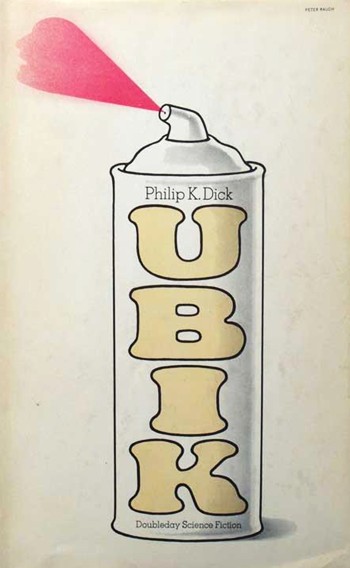
Take Ubik. Joe Chip lives in the far-off world of 1992. Everything is coin-operated including Joe’s front door, which argues like one of the doors from The Hitchhiker’s Guide to the Galaxy. Ensembles like “a cowboy hat, black lace mantilla, and bermuda shorts” or “a floral mumu and Spandex bloomers” are the height of fashion–Ubik introduces everybody by describing their ridiculous clothes. Joe’s employed by an agency for “inertials,” psychically powered people who counteract other people’s psychic powers. Joe hires a new inertial who counters precognition by traveling back in time to change the present. Meanwhile Joe’s boss Glen Runciter is losing touch with his dead wife, who helps run the company from cryogenic “half-life,” because the teenager a few crypts down keeps breaking into their conferences. Joe and Runciter travel to the moon with some inertials for a job but their contact turns out to be a talking robot bomb; Runciter dies. So Joe carts him back to Earth to be put in half-life. But Joe’s coins spontaneously acquire Glen Runciter portraits, food and cigarettes decay, gadgets turn into worn-out obsolete equivalents, and eventually the world around him becomes Des Moines in the 1940s. More worryingly, his intertial pals are spontaneously mummifying. Then Joe starts getting messages from Runciter directing him to look for something called Ubik that will solve all his problems…
Ubik is full of weird little side details that didn’t have to be there. Like, one character has a nightmare that’s invaded by a couple of psychics, and it’s genuinely disquieting but could just as easily have been cut. And there’s no reason at all for those weird clothes. But Dick must not have felt everything needed a reason. He had so many weird ideas he could just toss them around like glitter.
Dick is not among the great prose stylists of science fiction. He’s abupt, shambolic, and pulpy. Not that he can’t deliver moments of beauty or grab you with whatever emotion he wants you to feel; at times you can tell he put in the work. But the bulk of most Dick novels have this “just bang it out and send it off, I’m on a deadline here” vibe.
There’s the aforementioned scene in Ubik where Stanton Mick, who wants to hire the inertials, suddenly inflates, floats, and explodes. Ubik just says “Stanton Mick floated to the ceiling of the room, his arms protruding distendedly and rigidly” in the same tone it might use to describe Stanton walking across the room. The bomb is just there. And without much in the way of context: “‘I’ve heard of this,’ Runciter said to Joe. ‘It’s a self-destruct humanoid bomb. Help me get everybody out of here. They just now put it on auto; that’s why it floated upward.’” This is astonishingly casual. Runciter doesn’t sound shocked; neither he nor the narrative react like he’s in immediate danger. This casualness is typical of Ubik. When Joe discovers his pocket is full of Glen Runciter money it is at first just another aggravation at the end of a long and trying day. I mean, yeah, he knows it’s weird. But it’s the same kind of weird as ordering coffee and getting it already cold. Joe’s not immediately questioning everything he knows about reality, is what I’m saying.
Standards for what’s considered well-crafted in genre fiction are always changing. Today, a respectable SF novel builds up to the scenes on which the plot hinges. Forshadows the big reveals. Changes the prose style and pacing to suit sudden bursts of action. Artfully slips all the explanations the reader needs into the background as it goes.
Ubik… uh, doesn’t. Ubik is more like the pulp stories Raymond Chandler ruefully looks back on in “The Simple Art of Murder”:
…the demand was for constant action and if you stopped to think you were lost. When in doubt have a man come through a door with a gun in his hand. This could get to be pretty silly but somehow it didn’t seem to matter. A writer who is afraid to over-reach himself is as useless as a general who is afraid to be wrong.
Philip K. Dick is one of those “have a man come through a door with a gun” writers, only the guy he sends through the door has psychic powers and takes a bite out of the hero’s arm. Dick’s main virtue as a writer is that he’s not afraid to over-reach himself.
And, weirdly, his stylistic awkwardness helps. That humanoid bomb scene I described above is, technically, not well written. But Dick brilliantly captures the feel of dreams. Not the bluntly metaphorical dreams you often get in fiction, like writers use when they can’t think of a good way to work in a theme. I mean actual dreams with their arbitrariness and disjointed shifts. (Dick has a lot in common with David Lynch, here.)
Like… you’re in a meeting, and a guy floats up to the ceiling. And you suddenly know, the way dreamers suddenly know things, that the guy is a bomb. And all of this–the meeting, the floating man, the sudden knowledge–feels normal. Dreams don’t divide the banal from the unreal. You’re in one situation, then you’re in another. That’s how Dick writes in his pulpy “just get things down” mode. Moments other novels would build up to, make a big deal of, Dick describes matter-of-factly. Like the way Magritte undramatically, naturalistically painted a man with an apple for a face. So much of the hallucinatory quality of Dick’s novels comes from the contrast between his wild, prolifgate imagination and his straightforward delivery.
Dick’s style joins hands with his love of surrealism, and his flaws become virtues. I have no idea whether this was intentional on Philip K. Dick’s part. Whether it was or not, I think it’s brilliant.
This is not to criticize craft. As Chandler goes on to say of his years in the pulps: “As I look back on my own stories it would be absurd if I did not wish they had been better.” A well-crafted novel, all else being equal, beats a poorly-crafted one. It’s just that Dick’s writing, because of his particular, peculiar, circumstances, breaks the rule. When bad writing successfully creates an effect, intentionally or not, it’s no longer bad. It follows that any prose can be good prose–if only it’s used for the right job.
06 Jan 00:29
[DW, LJ, Patreon] Welcome Back to Social Journaling
My regular readers are, unusually, not my intended audience for this, though you may find it useful. This is for readers who are, shall we say, irregular.
Dear returnees, welcome back to social journaling!
Recently, many people who haven't posted here on Dreamwidth in years have been roused by all the subscription notifications and grant notifications they've gotten from all of us Livejournal refugees getting set up on DW. A number have come back and pledged to try posting here regularly again.
How wonderful to have you back! If you were someone who friended me back on LJ, I've missed you.
Here's the thing.
It would be certainly nice to hear about what you've been up to. Those of us who don't use FB and G+ and otherwise don't run into you have no idea what you've been posting there, and as such have no idea what has been happening in your lives.
But if you want to re-connect with your DW (or LJ) using friends, posting isn't enough.
You have to read your Reading Page – what was called on LJ a "Friends Page" – too.
I certainly hope you're returning to resume your acquaintance with your LJ/DW-using friends. You can't do that just by posting about yourself. You also have to resume following what your friends here are up to, and you do that by checking your Friends Page to read what they write, too. Friendship, after all, is a two-way street.
Now, if you've been using FB or G+, this might not have occurred to you (and is why I am mentioning). A lot of people's use of FB and G+ is through phone apps, which are super pushy. You probably don't have to consciously think, "Hey, I should check up on what my friends are up to on FB or G+" because those apps are constantly sending you little tickles right in your pocket, and drawing your attention back to those platforms.
DW and LJ don't really do that the same way. DW I don't think has an app of its own(?), and while LJ does, I don't know either that anybody much uses it or that it's quite as pushy as FW and G+ are. And while most phones can do DW and LJ these days, that doesn't get you smartphone-style notifications. And I get the impression that most usage of DW and LJ is at the computer, not the phone. As such most people's mental model of interacting with DW and LJ involves having to chose to go check in on it when one is at one's desk or pulls out one's laptop.
So if you've been using FB or G+ in the intervening years, and you've been using the apps, then you might have become accustomed to relying on the app to draw your attention back to FB/G+. You might not have any habit of checking in on your social networking deliberately, in the absence of such prompts.
You might not even realize you have in a sense been relying on such notifications to keep you engaged with your social media.
Because DW (and LJ) is not so pushy, if this is true of you and you don't realize this about yourself, you're never going to resume using DW (or LJ), because you will be unconsciously relying on the platform to do something it won't do: prompt you to engage with it, on your phone.
So, if you're one of these people habituated by G+ or FB's apps – or maybe even if you aren't, and just lack the conscious realization that checking in manually is necessary to stay engaged – what will happen is this. You'll post a few times on DW (or LJ), you'll get a few banal comments like "Nice to see you're back" and "Long time no see" that don't invite further discussion, and then you'll never post again and fall right out of DW (or LJ) again.
There's two sorts of things you can do to address this, if you want to get involved in DW (or LJ – but really, move to DW!) again:
1) Just make a habit of checking your Reading Page regularly. If necessary, put a reminder in your phone that beeps at you. Yes, set a repeating alarm. "Time to check DW!" Eventually, you will get habituated and, even better, re-engaged with people and conversation here, and won't need the prompt (maybe).
2) Make the technology more pushy, by being clever with notification settings and how you set up your phone.
Regarding the first: I know – because I've talked with some friends about this – that for some of you, when you hear me say "read your Friends Page", you groan, because you find reading your Friends Page (on DW = Reading Page) a real drag.
If you find that reading your Reading Page is a drag, there's some common reasons that might be so, which are fixable. They're social problems for which DW (and LJ) have features for managing. Both DW and LJ have reading filters, which are hugely helpful for managing various social problems with one's Reading Page. Effectively, they give you multiple reading pages
There's a variety of problems for which this can be a solution. The most obvious one is having an alternative filter (i.e. an alternative Reading Page) for people (and comms, and feeds) that get you down to read. Perhaps you follow some people (I may be one of them!) who post a lot of political information that you agree with and support – but which is grim and hard to see every day. You may feel it's very morally important to keep up with that information, but you find yourself avoiding checking your Reading Page because it's there and you know it will be more bad news. One option you have is moving the subscriptions you have that you know are important to you but maybe hard reading off your main Reading Page and onto a filter (separate Reading page), that you check on more infrequently. That way, tolerating the woes of the world is not the price of admission to connect with your friends. You can check your Reading Page frequently, and your filtered content when you feel up to it.
This approach works for a variety of problems. Back when I was reading LJ on a device that would stop rendering images after a page hit 2M, I moved all my high-bandwidth photography comm subscriptions onto a separate reading filter. That way, if a friend posted a pic, I would see it.
You can also use reading filters to load-balance if you have, like me, A Lot of people you're trying to follow. I find that if I have everybody on one Reading Page, I wind up missing things I don't want to miss. I don't know why this should be, but I find that for whatever reason it works better if I just have multiple Reading Pages, where I try to balance the population on each filter so I get about the same typical number of posts on each Reading Page. Don't know why this works for me better than just paging back, but it does. Also, rather than use the convenient pull-down menu in the bar at the top of my Reading Page, I like to have them as nav-elements in my layout, so I put links to them in the Links feature of my journal theme.
Alternatively, you can use reading filters to group by postiness, so you're less likely to miss the occasional rare post from someone you don't hear much from. If you have a bunch of chatty friends who post very frequently, that can make it hard to catch the rare and precious posts of other friends who only post very occasionally. If there are people that it's important to you that you not miss it when they post, and they don't post much, you could put them together on a filter for low-volume posters. Subscription filters aren't exclusive, so you don't have to take them off your main Reading Page to do this; you'll just have a way to quick-check whether any of your infrequently posting friends might have posted something you missed on your main Reading Page.
Obviously, this approach can also be used to prioritize some journals over others. You might want to reserve your default Reading Page for your closest friends, especially if you're short on spoons for socializing, and move acquaintances to a filter you check when you get the chance to. There may be people that you want to follow, or, at least, don't want to give the offense to of unsubscribing from, but it brings you down to see them pop up on your Reading Page. You can move them off your Reading Page and onto a filtered Reading Page – or to no filter at all, if you have a Default filter – and, voila, a Reading Page you don't feel the need to avoid.
That said, I'd like to propose that if there are people whose posts showing up on your Reading Page really brings you down, or if you have a lot of garbage showing up on your Reading Page that you have to tediously wade through, to the point that your Reading Page is aversive and you avoid it.... maybe you shouldn't be following these accounts at all? Just a thought.
Cause it's like this. I'm pretty sure, from conversations I've had, usually at parties, that there's people who I account as friends who fell out of contact with me, not for anything whatsoever to do with our relationship, but because they found their Friends Page (over on LJ) aversive enough due to other parties that they stopped checking it. I have to say, if you are a friend and the reason that you fall out of contact with me is that you have this irrational belief that you must, simply must, have your condo associations' comm on your default Reading Page so you know what those weasels are up to, but that makes you so loathe to actually check your Reading Page because, ugh, condo association, such that you never see my posts any more, then fuck you: you have let your contentious and maybe co-dependent relationship with your condo association take priority over, minimize, and ultimately rub out your friendship with me, and I am hurt and disappointed in you for letting that happen to our friendship. And, damnit, I miss you and wish you would get a grip on managing your Reading Page so we can relate again.
Substitute SCA group/crazy ex/boss/frenemy/WoW guild/etc for "condo association", as necessary.
Seriously: if you like me and want to read what I post, and somebody else's nonsense showing up on the same Reading Page is disengaging you from me? Move one of us off the page, and then don't read the one they're on.
Substitute anybody else at all you care about for "me", as necessary.
In any event, the way you do reading filters on Dreamwidth is through the Manage Subscription Filters page. The usage is pretty obvious for most things: if you want a filter, create a filter, then populate it. Putting people (or comms, or feeds) on a filter doesn't take them off other ones.
The one non-obvious thing is that to be able to filter the default Reading Page, you have to create a filter called "Default". By default, you don't have a Default filter, you have to create it if you want it. The filter named "Default", if it exists, gets automagically applied to your Reading Page. Please note, the moment you create it, it has nobody in it, so until you add subscriptions to it, nobody at all appears on your Reading Page. Don't make the mistake of creating it, wandering off to do other things before populating it, then comingback to try to check your Reading Page, because you will panic about your Reading Page being blank.
Once you've created Subscription Filters, you can use them to read filtered Reading Pages by going to your Reading Page, where your filters will appear as choices under the "Filter:" pull-down on the bar across the top of the page.
Now, there is an alternative to using the Subscription Page(s) to follow others' journals, which brings us to the next thing I mentioned: configuring the technology to be more pushy.
DW (and LJ) will reach out and touch you through email, if you let it. Under accounts page, on the notifications tab, you can set up email notification of a whole bunch of things. Make sure everything relevant is on. In particular, note that the check boxes on the left are necessary but not sufficient for getting email notifications: you also have to tick the corresponding "email" ticky-box on the right side of the page.
(Yeah, you have to opt into inbox notifications first, as a precondition of getting email notifications. Yes, DW knows this is undesirable, but apparently it's super hard to fix because legacy code, and somewhere on their to-do list. It's open source; maybe we could put together a posse and get it done?)
I recommend more email rather than less, especially when getting back up to speed. Especially if you're used to your social networking platform tickling you on frequent occasions.
The defaults are sensible – but I don't know they were always sensible, and DW may have changed since you signed up for your account if that was years ago, and in any event you may have changed them when you first got the account. Go check. In particular, make sure you're getting email notifications for comments (each of "any entry on my journal", "replies to my comment", and "replies to my entry in a community") and private messages ("sends me a message") you get.
There's another form of email notification that may be of use to you, that is strictly opt-in: you can get email notification when users of your choice post. On DW, this is called tracking.
To track a journal, go to its profile page and you'll see, on the right in the little menu, the option to "Track". When you click on that, you'll be taken to a page with a bunch of more specific options. Pick the ones you want, and when you do, a second check-box, specifically for having notifications emailed to you, will appear on the right side of the page. Click the corresponding options for email notification.
Using tracking gives you an alternative to the Reading Page for following the posts of people who are important to you. Note, there's limits on how many tracking notifications you can subscribe to, so you may still want to rely on checking your Reading Page(s) if you have more than a few journals it's important to you to monitor.
Note that you can track not just a a specific user, but just specific tags of a specific user, such that you'll only get an email notification if that user posts with that tag. So, for instance, if you wanted to get email notifying you of my Patreon posts, this is a way to do it, by tracking my posts to my "Patreon" tag.
Additionally, you can track individual posts, if you just want notifications added for comments on a post not your own, and even individual comment threads that you wouldn't ordinarily get notifications about new comments in, because they're not in your journal or on a post you made or in reply to you.
Using the notification system means that you will at least get tickles to come back to DW in your email. If you want that to be a more FB-appish experience, that means you're going to have to get those emails onto your phone, if you don't already.
How you do that will depend on your specific email system and your phone. Obviously I can't speak to that, not knowing your specifics. I will just observe that if you want your DW (or LJ) notifications to go to your phone's email client, but don't want other emails to do so, you can do some pretty clever things with forwarding these days, and email accounts can be had for free. If you have some specific configuration of reality having to do with notification emails in mind, and you're trying to figure out how to make it happen, feel free to ask here; even if I don't know your tools, I bet someone will.
Link for sharing: https://siderea.dreamwidth.org/1308831.html
This post brought to you by the 119 readers who funded my writing it – thank you all so much! You can see who they are at my Patreon page. If you're not one of them, and would be willing to chip in so I can write more things like this, please do so there.
Please leave comments on the Comment Catcher comment, instead of the main body of the post – unless you are commenting to get a copy of the post sent to you in email through the notification system, then go ahead and comment on it directly. Thanks!
Dear returnees, welcome back to social journaling!
Recently, many people who haven't posted here on Dreamwidth in years have been roused by all the subscription notifications and grant notifications they've gotten from all of us Livejournal refugees getting set up on DW. A number have come back and pledged to try posting here regularly again.
How wonderful to have you back! If you were someone who friended me back on LJ, I've missed you.
Here's the thing.
It would be certainly nice to hear about what you've been up to. Those of us who don't use FB and G+ and otherwise don't run into you have no idea what you've been posting there, and as such have no idea what has been happening in your lives.
But if you want to re-connect with your DW (or LJ) using friends, posting isn't enough.
You have to read your Reading Page – what was called on LJ a "Friends Page" – too.
I certainly hope you're returning to resume your acquaintance with your LJ/DW-using friends. You can't do that just by posting about yourself. You also have to resume following what your friends here are up to, and you do that by checking your Friends Page to read what they write, too. Friendship, after all, is a two-way street.
Now, if you've been using FB or G+, this might not have occurred to you (and is why I am mentioning). A lot of people's use of FB and G+ is through phone apps, which are super pushy. You probably don't have to consciously think, "Hey, I should check up on what my friends are up to on FB or G+" because those apps are constantly sending you little tickles right in your pocket, and drawing your attention back to those platforms.
DW and LJ don't really do that the same way. DW I don't think has an app of its own(?), and while LJ does, I don't know either that anybody much uses it or that it's quite as pushy as FW and G+ are. And while most phones can do DW and LJ these days, that doesn't get you smartphone-style notifications. And I get the impression that most usage of DW and LJ is at the computer, not the phone. As such most people's mental model of interacting with DW and LJ involves having to chose to go check in on it when one is at one's desk or pulls out one's laptop.
So if you've been using FB or G+ in the intervening years, and you've been using the apps, then you might have become accustomed to relying on the app to draw your attention back to FB/G+. You might not have any habit of checking in on your social networking deliberately, in the absence of such prompts.
You might not even realize you have in a sense been relying on such notifications to keep you engaged with your social media.
Because DW (and LJ) is not so pushy, if this is true of you and you don't realize this about yourself, you're never going to resume using DW (or LJ), because you will be unconsciously relying on the platform to do something it won't do: prompt you to engage with it, on your phone.
So, if you're one of these people habituated by G+ or FB's apps – or maybe even if you aren't, and just lack the conscious realization that checking in manually is necessary to stay engaged – what will happen is this. You'll post a few times on DW (or LJ), you'll get a few banal comments like "Nice to see you're back" and "Long time no see" that don't invite further discussion, and then you'll never post again and fall right out of DW (or LJ) again.
There's two sorts of things you can do to address this, if you want to get involved in DW (or LJ – but really, move to DW!) again:
1) Just make a habit of checking your Reading Page regularly. If necessary, put a reminder in your phone that beeps at you. Yes, set a repeating alarm. "Time to check DW!" Eventually, you will get habituated and, even better, re-engaged with people and conversation here, and won't need the prompt (maybe).
2) Make the technology more pushy, by being clever with notification settings and how you set up your phone.
Regarding the first: I know – because I've talked with some friends about this – that for some of you, when you hear me say "read your Friends Page", you groan, because you find reading your Friends Page (on DW = Reading Page) a real drag.
If you find that reading your Reading Page is a drag, there's some common reasons that might be so, which are fixable. They're social problems for which DW (and LJ) have features for managing. Both DW and LJ have reading filters, which are hugely helpful for managing various social problems with one's Reading Page. Effectively, they give you multiple reading pages
There's a variety of problems for which this can be a solution. The most obvious one is having an alternative filter (i.e. an alternative Reading Page) for people (and comms, and feeds) that get you down to read. Perhaps you follow some people (I may be one of them!) who post a lot of political information that you agree with and support – but which is grim and hard to see every day. You may feel it's very morally important to keep up with that information, but you find yourself avoiding checking your Reading Page because it's there and you know it will be more bad news. One option you have is moving the subscriptions you have that you know are important to you but maybe hard reading off your main Reading Page and onto a filter (separate Reading page), that you check on more infrequently. That way, tolerating the woes of the world is not the price of admission to connect with your friends. You can check your Reading Page frequently, and your filtered content when you feel up to it.
This approach works for a variety of problems. Back when I was reading LJ on a device that would stop rendering images after a page hit 2M, I moved all my high-bandwidth photography comm subscriptions onto a separate reading filter. That way, if a friend posted a pic, I would see it.
You can also use reading filters to load-balance if you have, like me, A Lot of people you're trying to follow. I find that if I have everybody on one Reading Page, I wind up missing things I don't want to miss. I don't know why this should be, but I find that for whatever reason it works better if I just have multiple Reading Pages, where I try to balance the population on each filter so I get about the same typical number of posts on each Reading Page. Don't know why this works for me better than just paging back, but it does. Also, rather than use the convenient pull-down menu in the bar at the top of my Reading Page, I like to have them as nav-elements in my layout, so I put links to them in the Links feature of my journal theme.
Alternatively, you can use reading filters to group by postiness, so you're less likely to miss the occasional rare post from someone you don't hear much from. If you have a bunch of chatty friends who post very frequently, that can make it hard to catch the rare and precious posts of other friends who only post very occasionally. If there are people that it's important to you that you not miss it when they post, and they don't post much, you could put them together on a filter for low-volume posters. Subscription filters aren't exclusive, so you don't have to take them off your main Reading Page to do this; you'll just have a way to quick-check whether any of your infrequently posting friends might have posted something you missed on your main Reading Page.
Obviously, this approach can also be used to prioritize some journals over others. You might want to reserve your default Reading Page for your closest friends, especially if you're short on spoons for socializing, and move acquaintances to a filter you check when you get the chance to. There may be people that you want to follow, or, at least, don't want to give the offense to of unsubscribing from, but it brings you down to see them pop up on your Reading Page. You can move them off your Reading Page and onto a filtered Reading Page – or to no filter at all, if you have a Default filter – and, voila, a Reading Page you don't feel the need to avoid.
That said, I'd like to propose that if there are people whose posts showing up on your Reading Page really brings you down, or if you have a lot of garbage showing up on your Reading Page that you have to tediously wade through, to the point that your Reading Page is aversive and you avoid it.... maybe you shouldn't be following these accounts at all? Just a thought.
Cause it's like this. I'm pretty sure, from conversations I've had, usually at parties, that there's people who I account as friends who fell out of contact with me, not for anything whatsoever to do with our relationship, but because they found their Friends Page (over on LJ) aversive enough due to other parties that they stopped checking it. I have to say, if you are a friend and the reason that you fall out of contact with me is that you have this irrational belief that you must, simply must, have your condo associations' comm on your default Reading Page so you know what those weasels are up to, but that makes you so loathe to actually check your Reading Page because, ugh, condo association, such that you never see my posts any more, then fuck you: you have let your contentious and maybe co-dependent relationship with your condo association take priority over, minimize, and ultimately rub out your friendship with me, and I am hurt and disappointed in you for letting that happen to our friendship. And, damnit, I miss you and wish you would get a grip on managing your Reading Page so we can relate again.
Substitute SCA group/crazy ex/boss/frenemy/WoW guild/etc for "condo association", as necessary.
Seriously: if you like me and want to read what I post, and somebody else's nonsense showing up on the same Reading Page is disengaging you from me? Move one of us off the page, and then don't read the one they're on.
Substitute anybody else at all you care about for "me", as necessary.
In any event, the way you do reading filters on Dreamwidth is through the Manage Subscription Filters page. The usage is pretty obvious for most things: if you want a filter, create a filter, then populate it. Putting people (or comms, or feeds) on a filter doesn't take them off other ones.
The one non-obvious thing is that to be able to filter the default Reading Page, you have to create a filter called "Default". By default, you don't have a Default filter, you have to create it if you want it. The filter named "Default", if it exists, gets automagically applied to your Reading Page. Please note, the moment you create it, it has nobody in it, so until you add subscriptions to it, nobody at all appears on your Reading Page. Don't make the mistake of creating it, wandering off to do other things before populating it, then comingback to try to check your Reading Page, because you will panic about your Reading Page being blank.
Once you've created Subscription Filters, you can use them to read filtered Reading Pages by going to your Reading Page, where your filters will appear as choices under the "Filter:" pull-down on the bar across the top of the page.
Now, there is an alternative to using the Subscription Page(s) to follow others' journals, which brings us to the next thing I mentioned: configuring the technology to be more pushy.
DW (and LJ) will reach out and touch you through email, if you let it. Under accounts page, on the notifications tab, you can set up email notification of a whole bunch of things. Make sure everything relevant is on. In particular, note that the check boxes on the left are necessary but not sufficient for getting email notifications: you also have to tick the corresponding "email" ticky-box on the right side of the page.
(Yeah, you have to opt into inbox notifications first, as a precondition of getting email notifications. Yes, DW knows this is undesirable, but apparently it's super hard to fix because legacy code, and somewhere on their to-do list. It's open source; maybe we could put together a posse and get it done?)
I recommend more email rather than less, especially when getting back up to speed. Especially if you're used to your social networking platform tickling you on frequent occasions.
The defaults are sensible – but I don't know they were always sensible, and DW may have changed since you signed up for your account if that was years ago, and in any event you may have changed them when you first got the account. Go check. In particular, make sure you're getting email notifications for comments (each of "any entry on my journal", "replies to my comment", and "replies to my entry in a community") and private messages ("sends me a message") you get.
There's another form of email notification that may be of use to you, that is strictly opt-in: you can get email notification when users of your choice post. On DW, this is called tracking.
To track a journal, go to its profile page and you'll see, on the right in the little menu, the option to "Track". When you click on that, you'll be taken to a page with a bunch of more specific options. Pick the ones you want, and when you do, a second check-box, specifically for having notifications emailed to you, will appear on the right side of the page. Click the corresponding options for email notification.
Using tracking gives you an alternative to the Reading Page for following the posts of people who are important to you. Note, there's limits on how many tracking notifications you can subscribe to, so you may still want to rely on checking your Reading Page(s) if you have more than a few journals it's important to you to monitor.
Note that you can track not just a a specific user, but just specific tags of a specific user, such that you'll only get an email notification if that user posts with that tag. So, for instance, if you wanted to get email notifying you of my Patreon posts, this is a way to do it, by tracking my posts to my "Patreon" tag.
Additionally, you can track individual posts, if you just want notifications added for comments on a post not your own, and even individual comment threads that you wouldn't ordinarily get notifications about new comments in, because they're not in your journal or on a post you made or in reply to you.
Using the notification system means that you will at least get tickles to come back to DW in your email. If you want that to be a more FB-appish experience, that means you're going to have to get those emails onto your phone, if you don't already.
How you do that will depend on your specific email system and your phone. Obviously I can't speak to that, not knowing your specifics. I will just observe that if you want your DW (or LJ) notifications to go to your phone's email client, but don't want other emails to do so, you can do some pretty clever things with forwarding these days, and email accounts can be had for free. If you have some specific configuration of reality having to do with notification emails in mind, and you're trying to figure out how to make it happen, feel free to ask here; even if I don't know your tools, I bet someone will.
Link for sharing: https://siderea.dreamwidth.org/1308831.html

This post brought to you by the 119 readers who funded my writing it – thank you all so much! You can see who they are at my Patreon page. If you're not one of them, and would be willing to chip in so I can write more things like this, please do so there.
Please leave comments on the Comment Catcher comment, instead of the main body of the post – unless you are commenting to get a copy of the post sent to you in email through the notification system, then go ahead and comment on it directly. Thanks!
05 Jan 00:19
Theoretically at least TMay is the leader with biggest challenge keeping support together over BREXIT
by Mike Smithson

Anti-BREXIT yellows can siphon away blue votes as well as red ones.
While most pundits appear to have focused on Labour’s problems over BREXIT let’s not forgot that the Tory support base is even more divided. YouGov’s latest BREXIT tracker published yesterday had the above splits in party supporters view of the issue that’s set to define British politics.
As can be seen the Tory voter base goes 63% right to 33% wrong on current views of the BREXIT vote. Labour, by comparison has 25% saying decision was right with 69% saying wrong.
While people are talking about the pincers LD-UKIP pincer movement on Labour voters there same exists but more so for the Tory leadership.
-
With the LDs kicking on the heels of the Tories in many of the seats Cameron’s party gained in 2015 Mrs. May has to tread very carefully.
With Farron’s party fighting hard in Copeland with an unequivocal anti-BREXIT message the by-election will be a test for both main parties.
Mike Smithson
04 Jan 17:28
Trump And The Batman Effect
by Scott Alexander
Today on Trump Twitter:
"@DanScavino: Ford to scrap Mexico plant, invest in Michigan due to Trump policies"https://t.co/137nUo03Gl
— Donald J. Trump (@realDonaldTrump) January 3, 2017
Here’s my concern.
When US companies do something that sounds good in the next few years, whether it’s hiring new people, or deciding to stay in the United States, or reporting high profits, some of them are going to credit President Trump.
First, because it’s going to get them good press. “Ford decides not to build plant in Mexico” is tenth-page news. “Ford decides not to build plant in Mexico because of President Trump” is front-page news.
But second, because it’s going to make the President like them. I don’t know whether Trump is secretly sending people to whatever conferences all of these people go to, saying “if you decide to do something good, give me credit, and I’ll do you a favor later”. I assume he isn’t. This is the sort of thing that coordinates itself, without any inconvenient documents that can get posted to WikiLeaks later. If you’re the CEO of Ford, and you notice you’re doing something that would make Trump look really good if you attributed it to him, why not attribute it to him for free, then remind him how much he likes you next time you need a tax cut or a subsidy or something? Trump has put a lot of effort into crafting his image as a person who repays favors (think appointing many of his earliest supporters to Cabinet positions) – you think businesspeople aren’t going to notice that kind of thing?
But also:
Big day on Thursday for Indiana and the great workers of that wonderful state.We will keep our companies and jobs in the U.S. Thanks Carrier
— Donald J. Trump (@realDonaldTrump) November 30, 2016
0.1% of the time a US company does something that looks bad, like close a plant or move jobs overseas, Trump is going to launch a media crusade against them. The Presidency has a big pulpit and he’s going to get a lot of people angry. Then Trump will offer them some kind of deal, and the company will back down. Not because they’ve learned the error of their ways. Not even because the deal was so good. But because making the President (and the public) happy is much more important to them than moving jobs to Mexico or whatever they were doing before.
Mother Jones mentions in passing that Carrier air conditioning, Trump’s biggest job “success” so far, is owned by a giant defense contractor who gets probably like 1% of their profits from air conditioning. Presumably the company would be happy to never sell another air conditioner again if it meant that the government chooses their fighter jets over the competing brand. Knowing Trump’s style of corruption, they have every reason to believe this will happen after they handed him a big PR victory.
This plan isn’t going to scale. Even Trump can only create so many media circuses. 999 companies will successfully move to Mexico in the amount of time it takes Trump to convince one company not to. But almost tautologically, the only ones we’ll ever hear about are the ones that become media circuses, and so it will look like Trump keeps winning.
So based on these two strategies, we are in for four years of sham Trump victories which look really convincing on a first glance. Every couple of weeks, until it gets boring, another company is going to say Trump convinced them to keep jobs in the United States. The total number of jobs saved this way will never be more than a tiny fraction of the jobs that could be saved by (eg) good economic policy, but nobody knows anything about economic policy and Trump will make sure everybody hears about Ford keeping jobs in the US. Every one of these victories will actively make the world worse, in the sense that these big companies will get taxpayer subsidies or favors they can call in later to distort government priorities, but nobody’s going to notice these either.
I think it’s important that we be prepared for this and send a clear message, before this gets any worse, that these aren’t to be taken seriously.
I also think it’s important to be prepared for the fact that this clear message won’t work. Imagine you’re a factory worker in Indiana, and every week you hear on the news that Trump convinced another factory to stay in the US. And also, you read an editorial by Paul Krugman or someone saying that this is all a trick. What do you end out believing?
And saving jobs isn’t the only way he can do this. Trump’s talent is PR, having his finger on the pulse of the media. He can spot things like that guy who raised the price of the toxoplasma drug 1000%, and then he can go in, make some corrupt deal, and get him to back down. He can spot all of those culture war things where the entire country is going to spend a month focused on the same small-town bakery, and by throwing around the entire might of the federal government he can probably make everyone back off and pose together for a nice group photo. If he can get all of these things right (and it will play exactly to his talents), then a majority of people won’t care what policies his administration passes. I think this is a big part of his plan.
There’s an old joke about Batman. Suppose you’re a hypercompetent billionaire in a decaying city, and you want to do something about the crime problem. What’s your best option? Maybe you could to donate money to law-enforcement, or after-school programs for at-risk teens, or urban renewal. Or you could urge your company full of engineering geniuses to invent new police tactics and better security systems. Or you could use your influence as a beloved celebrity to petition the government to pass laws which improve efficiency of the justice system.
Bruce Wayne decided to dress up in a bat costume and personally punch criminals. And we love him for it.
I worry that Trump’s plan for his administration is to dress up in a President costume and personally punch people we don’t like, while leaving policy to rot. And I worry it’s going to work.
[prediction: highly-publicized stories about Trump successfully keeping businesses in the US on a case-by-case basis, which never add up to a significant number of jobs saved, will keep coming, and be a central point of how his administration relates to the public over the next year: 50%]
Hbregalad likes this
04 Jan 16:07
And the Rabid Nazi Raccoons shall inherit the Earth
by Charlie Stross
Andrew HickeyStross' predictions are all notably more optimistic than mine...
So here's the final (only slightly late) installment of my predictions for 2017.
Have a happy new year!
October Theresa May resigns as Prime Minister of the UK after a delegation from the 1922 Committee pay her a visit with baseball bats. Boris Johnson, one-time leader-in-waiting, bribes his way onto one of the few still-flying airliners bound for the United States and tweets in mid-air about his intention to request political asylum and re-assert his US citizenship. The aircraft is intercepted over the Atlantic and shot down by F-15s acting at the request of President Pence (who really doesn't want to give BoJo a shot at making his run in 2024).
An elderly back-bencher is prevailed upon to do the honorable thing and accept the office of the Bailiff of the Chiltern Hundreds, thereby freeing up a seat for a by-election. On the basis of the theory that when you're up to your nose in shit the only way out is to take a deep breath and dive, Nigel Farage is fast-tracked as candidate for the by-election and, upon election, is promptly shoved through the door at Number Ten: at his first interview with the monarch he is told "you broke it, you fix it". (His subsequent plaintive requests for Jimmy Saville's phone number go unanswered.)
In the wake of the September melt-down, Germany's Bundestag elections produce huge voter swings to the AfD (from the CDU) and the Greens and Left (from the SPD), with the Pirate Party passing the critical 5% threshold for the first time. The AfD, taking heart from what they perceive as a swing to the right in global politics, go one step too far by openly calling for the rehabilitation of Adolf Hitler and are banned by the constitutional court; a Green/Left/Pirate coalition is formed and announces its intention of moving to leave the World Trade Organization to permit a sweeping regime of nationalization of banks and financial institutions and emergency measures to keep industry and agriculture going.
The new hard-left German government with it's Grumpy Cat logo is greeted with horror in the United States and is denounced in Moscow as Communism. However, when the new regime in Berlin announces its intention of forgiving all personal debt owed by Greek borrowers (denominated in the collapsed Euro, hence not worth very much at all) and to institute a universal basic income scheme throughout the EU and work to abolish wage slavery for all it buys them a lot of friends. The situation is very murky, and made murkier by the slow, unanounced withdrawal of Russian tanks from the Baltic region and their re-appearance further south.
(The joke that "the surprise twist in the third act is that Germans get to be the good guys who save the world" trends on twitter, where most people aren't aware of the underlying catastrophic financial situation: roughly 90% of the money circulating in global markets has evaporated, the two current (and one previous) planetary reserve currencies have imploded, crops are rotting in the fields and containers rusting aboard drifting freighters.)
The Russian government rhetoric about reunification with the Ukraine, Moldova, the Baltics, and certain bits of Poland cools off remarkably rapidly as the Russian foreign ministry tries to work out how to save the President's Bahamian bank accounts and keep the lights on over winter.
There is a particularly ominous silence from China, where state censorship has clamped down with extreme rapidity on any unapproved news about interest rates, exports, the balance of trade surplus, and the gathering global financial crisis. There are rumors of lock-ins, and of riots and massacres outside closed factory gates: the shock waves are still feeding back through the supply chain but the liquidity crisis is affecting demand for Chinese exports, and the workshop of the world is about to down tools for the first time since 1989, ending the post-Tiananmen settlement.
The third week of October might be described as "the long double-take", a period during which the global balance of power is poised on a knife edge so sharp that nobody dares to breathe. The situation is clearly worse than the 2008 crisis, with major political protest votes rocking the entire developed world.
Then President Pence catches a dose of stomach flu and Donald Trump pops up in the Oval Office like the unwelcome surprise at the end of a slasher movie: "I'm baaaaack!"
... And the Campi Flegrei finally erupts, spewing smoke and ash 25km into the stratosphere and emitting a pyroclastic flow that rolls over Naples; shortly thereafter a second eruption breaks out beneath the Gulf of Pozzuoli, creating a steam explosion the like of which hasn't been seen since the eruption of Krakatoa in 1883. The first eruption is estimated to have killed two million people directly: the second one shatters windows from Edinburgh to Tel Aviv, swamps both north and south Mediterranean coastlines with tsunami waves, kills half the population of Italy and a quarter of the population of Greece, and ejects an estimated 200 cubic kilometers of dust and debris, shutting down aviation again and ushering in a period of intense global cooling that will result in famines and ultimately starve up to half a billion people.
President Trump's response is to appoint his golf caddy to head up FEMA and to tweet furiously about the urgent need to cut the foreign aid budget.
November A long-period comet is identified crossing the orbit of Venus, inbound towards the sun for the first time in half a million years. An elderly comet, it isn't outgassing much any more, so lacked a visible coma (tail) until it was unusually close to the sun. Astronomers excitedly announce that its course crosses the Earth's orbit so closely that it is expected to pass between the Earth and the Moon on its way out, in December.
However, nobody much gets to hear the news because a new and particularly virulent piece of malware is doing the rounds, hijacking kettles, toasters, and car stereos worldwide. Like most such, it demands a ransom payable in Bitcoin; but Bitcoin has inflated so much since the malware was released that nobody can afford to unlock their devices, and meanwhile the botnet continues to look for other devices to hijack—including popular cable and ADSL modems, cellular base stations, and iPhones (by way of a hitherto unidentified zero-day exploit). With over 200 million hosts it's the biggest botnet in history, and it succeeds in doing what no botnet has done before, and shutting down cellular data traffic across much of the developed and developing world.
(Also? The alt-right leaders riding high have noticed that reality has a marked left-wing political bias and aren't listening to—or paying—scientists any more.)
November 21st: it's probably not connected in any way with October's eruption in the Mediterranean, but one thing's for sure: the Cascadia Subduction Zone has been frisky for the past few tens of thousands of years. There's also some evidence that the Cascadia subduction zone has triggered most of the quakes along the San Andreas Faultline in California. The long feared "big one" finally strikes: an undersea magintude 9 quake about fifty miles off the coast between Portland and Seattle triggers tsunamis all the way north to Vancouver and south as far as Northern California. Luckily—perhaps—the temblors are down below magnitude 8 when they strike the coastal cities; unfortunately they're still violent enough to cause devastation, washing away everything within a mile of the coastline and even further inland in some places (as with the quakes that followed the Great Tohoku Quake of 2011). The Hanford DOE Site is fortunately far away from the coastline. Unfortunately, many of the most contaminated buildings there—dating to the 1940s—were built without adequate attention to earthquake resilience, and thus one of the most heavily contaminated nuclear sites on the planet takes a magnitude 7+ quake on the chin.
Drinking from the Columbia river after the quake is, shall we say, contraindicated.
Aftershocks continue, to the dismay of the survivors, for the next couple of weeks. The San Andreas fault burps, but it's a relatively minor 4.5 magnitude shimmy that probably causes more heart attacks due to anxiety than actual direct casualties. Mount Hood begins to tremble and outgas a plume of steam, but the survivors are too busy to pay much attention: there are tens of thousands of dead and a radiological disaster bigger than Three Mile Island for Trump's golf caddy to deal with.
Nigel Farage has not been heard from for two weeks after being appointed Prime Minister, but a steadily growing pile of empty cans of Carlsberg Special Brew is building up by the back door of Number Ten.
December On the first of December, the worst news of all finally escapes into the wild, bristling and growling beneath the spotlights. The path of Comet Trump-LePen-Putin-Farage (the discoverers waived the opportunity to name it after themselves) has been calculated, and it is definitely going to pass between the Earth and the Moon. In fact, it's going to pass so close there's some uncertainty over whether it's going to pass between the ISS and the Earth. In fact ...
... Let's just hope our successor species (the descendants, two megayears hence, of the indigenous Bavarian Raccoons, themselves introduced to Europe for hunting purposes by senior Nazis, and now a rabies vector, so we can reasonably call them rabid nazi racoons) make a better job of it than we did!
(Fade to black, to the tune of We'll Meet Again.)
03 Jan 09:27
Media bias should be Good News
by Fred Clark
This is how news works. It is inescapably "biased" in that it is presented and received as either Good News or Bad News. And most of the time, no one complains about the bias implicit in all such judgments because everyone agrees. What kind of sicko wouldn't agree that a family losing their home is Bad News? And who could be so demented as to not understand that the family surviving the fire is Good News?
03 Jan 09:22
Nixon's the One
by evanier
Everyone cares about current outrages but not many of us care about old ones. I care a lot about this one…
Some pretty solid new evidence has emerged that while the 1968 Presidential Election was in full swing, then-President Johnson was on the verge of brokering a deal that might have ended the Vietnam War then and there. But since that might have helped Hubert Humphrey win the presidency, his rival Richard Nixon sabotaged that deal.
If that's true, that's one of the worst things a human being — and certainly a person who won the presidency — ever did.
It's Treason with a capital-T — real treason, not using the word the way we do now in politics as a charge any time any political opponent does anything you don't like. People found guilty of a lot less have been stood up against a wall and shot by a firing squad…and they got off easy.
Now, I understand that it's sometimes difficult to summon up emotions about long-ago deeds and long-dead people…but we do. The Holocaust still matters to some people. So does the assassination of John F. Kennedy and a few others. This one strikes me as something that's deserving of more than a shrug and a head-shake. But that's probably about all it will get from many Americans who are more upset about Steve Martin tweeting that he thought Carrie Fisher was beautiful.
The post Nixon's the One appeared first on News From ME.
02 Jan 17:49
Blogversary/The Annual Resolution To Post More
by feministaspie
Andrew HickeyAll good posts worth reading or rereading
This blog is officially four years old! *raining confetti*
On a related note, this blog still exists. I kind of dropped the ball again, so this is my first post since Autistics Speaking Day on 1st November, and of course since then the world has gone even more to shit than it already was, which is maybe part of the reason I feel like the gap between posts is longer than it really is.
I feel like it’s usually around the same time of year when my blogging lapses, and I think that’s because for me autumn still means a new year at university (and this year, a new university!), so routines take time to change and the blog gets lost along the way. My other excuse this time round is that I’ve been focusing on my own Twitter rather than hiding away under the FeministAspie alias, which I guess is a good thing, but I think I still find the more anonymous space beneficial and I don’t intend to completely abandon it!
Evidently, my blogversary coincides almost exactly with New Year, which means I always end up making and re-making the same resolution: Post on FeministAspie once a week. To be fair, this usually lasts at least a couple of months, but this time I’ve had the idea of giving myself a weekly deadline so that a blogging routine is incorporated into my existing routine. So, from now on, I aim for posts to be scheduled for publication on Fridays at 7pm (UK time). This will be the official FeministAspie timeslot. We’ll see how long it lasts!
Finally, given that it’s also the end of 2016 (which sounds reassuring, until you remember that Brexit and Trump haven’t even really happened yet and 2016 was basically just laying the foundations for the awfulness to start…), here are my five most-viewed posts of the year:
- Ableism kills. Again. – The murder of autistic children is not okay. I can’t believe we still have to point that out.
- Fine, Let’s Talk About The Autism Life Expectancy Study – My attempt at working through the upsetting (though not all that surprising) statistics around autism and premature death published back in March.
- Why “technology is ruining society” is my number one pet hate – Please please please can this “darn kids and their internets, nobody really connects anymore” narrative stay in 2016? Please?
- Things I Wish I Could Say When It’s All Falling Apart – Not sure how this one made it here given that it was basically desperate post-meltdown rambling, but apparently people liked it.
- Think Before You Food-Police – An issue that is perhaps particularly important now that the January diet industry push is approaching, but remember that food-policing goes far beyond the diet industry and weight-policing. Just don’t shame people for keeping themselves alive with sustenance, okay?
02 Jan 12:06
CON slips 3 and LAB drop to 24% in new YouGov Times poll
by Mike Smithson

The squeeze on LAB from Yellow and Purple continues
Unlike the last last parliament when there was at least one poll every single day for more than four years surveyd are now few and far between at the moment. The only regular (monthly or more) Westminster voting polls are coming from just four firms – YouGov, ICM, Opinium and Ipsos MORI. At least individual polls are not having a greater impact.
The big picture is the continuation of the sorry state of Labour which is being squeezed by both UKIP and the LDs. Both have very clear visions of Europe which Team Corbyn has been unable to articulate.
We saw at GE2015 in Scotland how a party can totally collapse. At GE2010 LAB has 41 MPs north of the border. Now it has just one and LAB is now in third place in Holyrood surveys.
Mike Smithson
01 Jan 19:57
My best prediction for 2016 was not predicting anything
by Nick
 Back in January, I explained why I wasn’t going to try and predict what happened politically in 2016 because things were just so chaotic as to make predictions pointless:
My only prediction is that all your predictions will be wrong.
Of course, my grounds for predicting that weren’t entirely right, ascribing unpredictability to just the EU referendum and Jeremy Corbyn’s leadership of the Labour Party, and entirely failing to mention Donald Trump.
It feels like we’re now in a period where politics is incredibly febrile and chaotic and the sort of certainties we base our predictions on are washed away as soon as we seek to put any of our weight upon them. For instance, it’s entirely possible that by the end of 2017 Justin Trudeau could be the longest-serving national leader in the G7: Obama and Hollande are leaving office, Merkel faces a tricky election and Abe has lasted a lot longer in office than most Japanese Prime Ministers have managed.
Trying to predict the politics of 2017 in an atmosphere like this is pointless, there are just too many wildly fluctuating variables that can throw even the simplest and most obvious prediction way out of the realms of possibility. Besides, for all we know, this time next year we could be scraping through the ruins of a post-apocalyptic wasteland, far more concerned about surviving than wondering just who predicted the date and cause of the apocalypse most accurately (though for the sake of completeness: 19th August, and a viral tweet about the crispiness of bacon).
Aside from that, it’s another year of my only prediction being that all your predictions will be wrong. Though please do give me credit for predicting the Bacopocalypse when it comes.
01 Jan 19:39


The New Year and the Bend of the Arc
by John Scalzi
As we begin 2017, there is something I’ve been thinking about, that I’d like for you to consider for the new year. It starts with a famous quote, the best-known version of which is from Martin Luther King, but which goes back to the transcendentalist Theodore Parker. The quote is:
“The arc of the moral universe is long, but it bends toward justice.”
In the main I agree with that quote. There are things about it, however, that I think many of us elide.
The first is the word “long.” I think both Parker and King understood that moral endeavors can be measured in years, decades and sometimes centuries. This is not an argument toward complacency; indeed I think it’s an argument against defeatism and fatalism in the face of setbacks and stalemates. We live in moments and days and it’s often hard to see past them, and it’s easy to believe when we are struck a hard blow that all is lost. All is not lost. The arc is long. Nothing is ever fully decided in the moment or the day. There are years and decades and sometimes centuries yet to go. The arc continues to bend, if we remember that it is long, and that we need to imagine it extending further.
We need to imagine that because of the second thing: The arc is not a natural feature of the universe. It does not magically appear; it is not ordained; it is not inevitable. It exists because people of moral character seek justice, not only for themselves but for every person. Nor is the arc smooth. It’s rough and jagged, punctuated in areas by great strides, halting collapses, terrible reverses and forcible wrenching actions. There are those, always, who work to widen the arc, to make that bend toward justice as flat as they can make it, out of fear or greed or hate. They stretch out the arc when they can. If people of moral character forget the arc is not ordained, or become complacent to a vision of a smooth, frictionless bend toward justice, the work to flatten the arc becomes that much easier.
Right now, today, here in 2017, there are those working very industriously to flatten out the arc. They have lately seen little penalty for their hate, or their dissembling, or their disdain or greed; they have contempt for justice other than a cynical appreciation of its features when and only when it is to their advantage; they don’t care for anyone or anything outside the close horizon of their own interests. They have won a moment; they have won a day. They will try to win more than that, now, however they can, flattening the arc with hate and fear and greed.
On this day, in this year, in our time: Help to bend the arc back.
As you do, there are things to remember.
Remember the arc is long. It’s not one moment or one day or even a year or four years, even when that moment or day or year seems endless.
Remember the arc is not inevitable. It needs you. You are more important than you know, if you don’t give in to despair, to complacency, or to apathy. Add to the moral weight that bends the arc toward justice. You can’t do it alone, but without you the work becomes that much harder.
Remember that those who are working to flatten the arc hope you give up and give in. They are relying on you to do just that. Disappoint them. Disappoint them in big ways. Disappoint them in small ways. Disappoint them each day, and every day, in all the ways you can. Do not consent to this flattening of the arc.
Remember finally that this arc toward justice never ends. We are human. We are not perfect. We will not arrive at a perfect justice, any more than we will achieve a perfect union. But just as we work toward a more perfect union, so too we bend the arc toward justice, knowing the closer we get, the better we and our lives are, as individuals, as communities, as a nation and as a world. This is a life’s work, not just work for a moment, or day, or year. You won’t see the final result. There isn’t one. It doesn’t mean the work doesn’t matter. It matters. It matters now. It matters for you. It matters for everyone.
It’s a new year. There’s work to be done. I hope you will do it, and that you find joy in the work.
Happy 2017.
See you on the arc.
celia.reaves likes this
28 Dec 00:49
Carrie Fisher, R.I.P.
by evanier

Sorry to hear about the death of Carrie Fisher. Not being much of a Star Wars fan, I admired her more for her other activities, which included some very witty and honest writing. She struck me as an extremely bright woman who was miscast — though I'm sure to great financial advantage — doing the "eye candy" part of Princess Leia's role. Not that she wasn't cute doing it but I used to cringe years later when I came across Internet messages complaining she didn't look like she did in the first movie. It was as if (a) that was all she was good for and (b) she should have had the decency to not age.
I'm sorry I don't have a lot of great personal anecdotes about her but I only met her twice. The first time, we were skinny-dipping together. Don't get too excited about that concept. I was ten years old and she was six.
The next time was around 45 years later. It was at a bachelor party for my friend, Paul Dini. Some entertainment had been arranged — a couple of attractive young women were going to perform burlesque dances in the classic tradition, meaning they had expensive, elaborate costumes and they'd be dancing to prerecorded music and removing very few of their garments.
The first dancer was introduced. The door into the room opened and in came…Carrie Fisher and Tracey Ullman? Huh? The male audience was quite puzzled but here's what had happened —
The party was in the back room of a fancy Beverly Hills restaurant. There was no other place for the dancers to change so they had done so in the ladies' room. Ms. Fisher and Ms. Ullman had been dining in the front part of the restaurant and they'd gone to the loo in tandem and seen the performers there, getting into their ornate outfits. They had peppered the young ladies with questions about their wardrobe and artistry and then, fascinated with it all, decided to crash the bachelor party to see the performances. So they were slipping in ahead of the ecdysiasts.
Once in the room, Carrie looked over in my direction, yelled "Mark!" and came running my way with arms extended as if about to engage in some serious hugging. I thought for a split-second, "She recognizes me from when I was ten?"
Then I remembered I was sitting next to Mark Hamill. Oh, yeah. She would know him.
After the show, Mark introduced me to her and we talked a little about skinny-dipping (she kinda remembered it) and for some reason, about a then-recent offer she'd turned down to appear at some fan convention. I remember asking her if she sold her book, Postcards from the Edge, at these events. It's a very good book, by the way.
She said, "Sometimes, but they just buy it for the autograph. I don't think very many of them read it." If you admired her at all, you might want to get a copy and read it — and that probably goes for any of her books. You'll have a lot more reasons to admire her if you do.
The post Carrie Fisher, R.I.P. appeared first on News From ME.
24 Dec 18:58
Caroline, no!
by Michael Leddy
Billboard reports that the Beach Boys are considering an invitation to perform at an upcoming presidential inauguration. This photograph and some recent history make me think that the response to this invitation will be yes we will Yes. And I suspect that members of Mike Love and Bruce Johnston’s supporting cast will not be allowed to opt out. They are not Rockettes.
I long ago learned, with some exceptions, to separate the art from the artist. So I won’t be burning my LPs and CDs. But this news is just one more dab of awful in awful times.
You’re reading a post from Michael Leddy’s blog Orange Crate Art. Your reader may not display this post as its writer intended.
This work is licensed under a Creative Commons 3.0 License.
I long ago learned, with some exceptions, to separate the art from the artist. So I won’t be burning my LPs and CDs. But this news is just one more dab of awful in awful times.
You’re reading a post from Michael Leddy’s blog Orange Crate Art. Your reader may not display this post as its writer intended.
This work is licensed under a Creative Commons 3.0 License.
24 Dec 15:57
Foyle (SDLP), Londonderry E (DUP) and W Tyrone (Sinn Fein)
Mid-Ulster (Sinn Fein), Antrim North (DUP) and Antrim South (UUP)
Antrim South (UUP), North Belfast (DUP) and West Belfast (Sinn Fein)
West Belfast (Sinn Fein), South Belfast (SDLP) and North Belfast (DUP)
South Belfast (SDLP), West Belfast (Sinn Fein) and Lagan Valley (DUP)
South Down (SDLP), Newry and Armagh (Sinn Fein) and Upper Bann (DUP)
Fermanagh and South Tyrone (UUP), Mid-Ulster (Sinn Fein) and Upper Bann (DUP)
Fermanagh and South Tyrone (UUP), Newry and Armagh (Sinn Fein) and Upper Bann (DUP)
Dwyfor Merionedd (Plaid Cymru), Clwyd South (Labour) and Clwyd West (Conservative)
Dwyfor Merionedd (Plaid Cymru), Clwyd South (Labour) and Montgomeryshire (Conservative)
Dwyfor Merionedd (Plaid Cymru), Ceredigion (Liberal Democrat) and Montgomeryshire (Conservative)
Ceredigion (Liberal Democrat), Carmarthen East and Dinefwr (Plaid Cymru) and Preseli Pembrokeshire (Conservative)
Ceredigion (Liberal Democrat), Carmarthen East and Dinefwr (Plaid Cymru) and Brecon and Radnorshire (Conservative)
Carmarthen East and Dinefwr (Plaid Cymru), Llanelli (Labour) and Gower (Conservative)
Carmarthen East and Dinefwr (Plaid Cymru), Neath (Labour) and Gower (Conservative)
Copeland (Labour), Westmorland and Lonsdale (Liberal Democrat) and Penrith and the Border (Conservative)
Leeds North West (Liberal Democrat), Pudsey (Conservative) and Leeds West (Labour)
Leeds North West (Liberal Democrat), Leeds North East (Labour) and Elmet and Rothwell (Conservative)
Sheffield Hallam (Liberal Democrat), Penistone and Stocksbridge (Labour) and High Peak (Conservative)
Sheffield Hallam (Liberal Democrat), Derbyshire Dales (Conservative) and Derbyshire North East (Labour)
Southport (Liberal Democrat), South Ribble (Conservative) and Lancashire West (Labour)
Richmond Park (Liberal Democrat), Brentford and Isleworth (Labour) and Twickenham (Conservative)
Richmond Park (Liberal Democrat), Hammersmith (Labour) and Chelsea and Fulham (Conservative)
Carshalton and Wallington (Liberal Democrat), Sutton and Cheam (Conservative) and Mitcham and Morden (Labour)
Carshalton and Wallington (Liberal Democrat), Croydon North (Labour) and Croydon South (Conservative)
Brighton Pavilion (Green), Hove (Labour) and Arundel and South Downs (Conservative)
Three party constituency tri-points
by Nick


Following the forthcoming resignation of Jamie Reed from the Commons, there’ll be a by-election coming soon in the Copeland constituency. As someone who regularly visits the Lake District I was curious about what the full boundaries of the constituency were, both to scope out the potential for an excuse for a quick holiday campaigning hard in the by-election and to work out what would be the highest represented point in England in the period when Copeland, which includes Scafell Pike, has no MP. The answer to that is the summit of Helvellyn, which forms part of the boundary between Copeland and Penrith and the Border (represented by Rory Stewart).
I discovered something interesting while looking at that border – when I went up Helvellyn a couple of years ago, it seems the route we took up (following the stream from Dunmail Raise to Grisedale Taren, then over Dollywagon Pike and Nethermost Pike) first followed the boundary between Copeland and Westmorland and Lonsdale, then the boundary between Copeland and Penrith and the Border, which means that around where the two pictures above were taken was the tripoint where all three constituencies meet. The first picture is the view down the stream towards Dunmail Raise, so the left hand side of it is the Liberal Democrat gold of Tim Farron’s Westmorland and Lonsdale, while the right is the bright Labour red of Copeland. The second is Grisedale Tarn, in the true blue lands of Penrith and the Border.
But that got me thinking: while there are obviously plenty of tripoints where constituencies meet (and I’m sure someone will tell me if there’s a quadpoint anywhere in Britain), how many of them are places represented by three different parties like this one. From what I can work out (and I’m open to corrections) this is what I found:
Scotland: none. Despite having four parties holding seats, the three non-SNP seats don’t border on each other and even when Dumfries and Galloway touches a non-SNP seat at the border, it’s also Conservative-held (Penrith and the Border).
Northern Ireland: Eight of them, helped by having several parties in Parliament. I’m also not sure if there’s a quadpoint in the centre of Belfast, which would have been four-party between 2010 and 2015 but is only three party now.
UPDATE: Thanks to Nicholas Whyte for clarification that Belfast has two tripoints rather than one quadpoint:
Great stuff, @nickjbarlow. In Belfast, N S & W seats meet at Bridge St/High St jn, N S & E on Queen's Bridge 500 m away.
— Nicholas Whyte (@nwbrux) December 22, 2016
Wales: Seven seats, all involving Plaid Cymru and the Conservatives.
England: Despite having a lot more seats than the other three nations, there are only eleven in England, because so many seats are held by the Tories and Labour. Two of the seats held by other parties (Norfolk North and Clacton) are wholly surrounded by Tory seats.
So there we are. Twenty-six tripoints in total, which means I have another twenty-five to visit if I want to complete the set, though not quite sure how to visit the two Richmond Park ones, which are in the middle of the Thames.
Update (February 2017): The tripoint that inspired this post no longer exists following the Copeland by-election, but a new one has been (re)born to replace it.
24 Dec 03:18
[gastronomy, med hist] 14th Century Lo-Carb Feminist Cheese Latkes
OMG, from The Atlantic (last year, actually, h/t Metafilter):
ETA: Googling has revealed that "ricotta pancakes" are a thing, though apparently not deep fried (so far).
ETA2: Okay, have discovered "ricotta fritters" e.g..
How did Jews celebrate the festival before they migrated away from the Mediterranean shores? The latke, it turns out, has its roots in an old Italian Jewish custom, documented as early as the 14th century. That, it seems, is where Jews first fried pancakes to celebrate Hannukah. Only back then, they were made of cheese.Anybody tried to come up with a deep-fried ricotta latke recipe?
Cheese? Well, yes. The original latkes were, effectively, deep-fried ricotta. They honored the custom of celebrating the holiday by consuming dairy goods.
Hold on. Dairy goods? The custom was based on the story of Judith. She seduced a general named Holofernes, who came at the head of an invading army, by feeding him and plying him with wine. As he slipped into an alcoholic stupor, she seized his hair and hacked off his head with a sword. Then she tucked it in with her picnic provisions, left his camp, and presented it to the people of her town to mount on the wall. The terrified invaders fled, and the land was saved.
Did you miss the part about the cheese? Well, it’s not in the standard text, or in the ancient variants—except for an obscure Syriac version. The Book of Judith – like the books of I and II Maccabees, which relate the story of Hannukah – is not even in the Jewish Bible; it’s an apocryphal text. All three, however, were included in the Bibles of Catholic Europe. Whether through an unbroken chain of transmission, or more probably, as a story adapted from the version preserved in the Vulgate, the tale of Judith began to circulate again in Medieval Jewish communities.
And in one of those Hebrew versions, Judith feeds Holofernes two pancakes, salted and mixed with cheese. That version may have reflected an existing rabbinic tradition, but more likely inserted these details as allusions to other Biblical episodes. But either way, medieval Jewish legal codes soon recorded the custom of eating cheese to honor Judith, variously the sister or aunt of Judah Maccabee.
ETA: Googling has revealed that "ricotta pancakes" are a thing, though apparently not deep fried (so far).
ETA2: Okay, have discovered "ricotta fritters" e.g..
22 Dec 17:07
A Comment About Jerry Lewis
by evanier
You know…every few months, Jerry Lewis seems to give some sort of interview or statement that seems rude and nasty and often unconnected with reality. And every time, a lot of people rush to defend him…
He's Jerry Lewis. He made a lot of great movies. He raised a ton of money to fight Muscular Dystrophy. He's always been like this. Comedic geniuses have a right to be cranky. The interviewer was at fault. Jerry's a living legend.
I've done some of this defending and it's getting harder and harder, especially the part about "He made a lot of great movies." Usually, the folks who say that can name The Nutty Professor and nothing else. That's like one out of fifty-three movies, not counting cameos.
And I don't even think The Nutty Professor is that good a movie. It's almost like you got the idea he's a great comedian in spite of his actual body of work and then you were challenged to name his best film and you picked that one because a lot of people said it was.

(I think Jerry's best movie was something with Dean in it. It's hard to pick one because they're all about the same. If I had to pick the best solo Jerry film, it would probably be The Bellboy. There are others I like from a nostalgia viewpoint. They amused me when I saw them not because they were good but because I was ten.)
Look, I'll give him the "raised a ton of money" thing. The telethons were a Guilty Pleasure for so many of us. Other televised fund-raisers attract donations by offering genuine entertainment amidst the appeals for dough. Jerry offered ego excesses, self-pity, tirades against his critics, excessive praise of his friends — no wonder this guy loves Trump — and his oft-voiced worldview that people in Show Business are just plain better human beings than people who aren't in Show Business. Still, he did raise a lot of cash from those lesser human beings who aren't in Show Business and it did a lot of good.
But the other stuff….I'm sorry. "Oh, that's just Jerry being Jerry" doesn't work for me on any level. If Harry next door beats his wife and kicks his dog, you don't just say "Oh, that's just Harry being Harry." Jerry, like Trump, is proof that if you get famous enough, some people will let you get away with anything.
I always wanted to like Jerry Lewis but he's made it too difficult. Too difficult. I'm going to stop trying to convince myself or anyone that he was a great comedian and that his tirades are anything other than the ramblings of a bitter, angry man. If you want to continue to see him as someone to be admired, don't let me stop you…because he needs all the love he can get.
But you know what? No matter how much there has been — and he's been loved more than most people on this planet get to be loved — it has never been enough.
The post A Comment About Jerry Lewis appeared first on News From ME.
22 Dec 16:26
More on Jerrygate
by evanier
Folks on the 'net are still talking about that Jerry Lewis interview and taking sides. A lot are cheering Jerry, saying that the interviewer was unprepared, disrespectful, whatever…and that it was great that Jerry put that rude punk in his place. Typical of some comments is the lady on Facebook who wrote, "Imagine that you have a session with one of the world's great filmmakers and you don't come armed with well-researched questions to tap into his history and knowledge."
I would like to defend the interviewer, who I think but am not certain was a writer named Andy Lewis — no relation, one presumes. I do not know this person but I think he's getting a bad rap here.
First off, let me say as a longtime Jerry watcher who even worked with the man once, Jerry has a long history of occasional trainwreck interviews. Some days, he's great. In others, the interviewer can do no right.
The last time I saw him in person, he was being interviewed by Leonard Maltin at the Paley Center…and no one is more prepared and respectful than Leonard Maltin. I wrote about that event and here's a little of that report…
A few years ago at a Paley Center event, I watched him being interviewed by Leonard Maltin and it was a strange, surreal evening. Leonard asked very good questions without a trace of hostility or challenge. Jerry gave long, rambling answers that didn't remotely match up with the questions and he bounced back and forth between being philosophical in a professorial way and being on the defensive as if under some kind of implied attack.
The audience was full of celebrities who rose to tell Jerry and the world how much they loved him and worshiped him and thought he was the greatest comedian ever…and you'd think a man would be humbled and happy. But then one little imagined slight set him off and he began screaming at the folks who'd arranged the event, furious over essentially nothing. Lewis's emotional excesses were always kind of fascinating and funny on the telethons, especially at 3 AM when he'd shift into self-pity mode and start rambling on about how hurtful people could be towards his efforts. I think his tirade at the Paley event caused me to stop viewing his outbursts as amusing.
But getting back to the Hollywood Reporter fiasco: I don't think those now faulting the interrogator understand that the interview was part of a series of real short interviews with folks in show biz who were over ninety about why they hadn't retired, why they were still working, what special challenges they face, etc. The questioner was not there to ask Jerry in depth about his career and films. He was just there to get 2-3 minutes on why and how Jerry was still working at his age.

Jerry was asked essentially the same questions that were asked of the others — Dick Van Dyke, Betty White, Carl Reiner, Cloris Leachman, et al — and none of them had any problem answering them. I believe the same interviewer did the one with Norman Lear, which went fine. Everyone else who agreed to sit for an interview about working at age 90+ had a good answer for the question, "Have you ever thought of retiring?" At that age, you kind of have to.
Only Jerry tried to turn the session into a dialogue with the interviewer — which was a problem since the format of these videos was to have the interviewer unheard in the final edit. I'm sure if you've ever been interviewed on camera more than a few times, you've done these. They always tell you up front that they need answers in complete sentences since the questions will be edited out.
The interviewer's detractors say that he was ill-prepared to interview Jerry and that he didn't know what he was doing. I think he was prepared with all the same questions that everyone else was asked and that what he wasn't prepared for was the subject trying to turn the interview into a dialogue and not answering in sentences that would make sense once the questions were cut out.
What I hear from the off-camera voice is a flustered, unsuccessful attempt to get something usable out of Mr. Lewis. He never got it when they got back to assembling their video feature, the folks at the Hollywood Reporter didn't have the footage they needed to make Jerry's interview a piece with all the others. They had a lot of one word answers so they decided to put up seven minutes of raw footage and I'm guessing someone said, "Hey, if this is how he wants to come off, fine."
I would question whether that was the best decision but the alternative was probably to cut Jerry, who'd given them an hour or three of his time, down to one of folks in the piece who got a brief paragraph and no video. That probably would have made him angrier.
In Jerry's defense, a lot of his time was apparently wasted by a crew that took way too long to set up in his office. That might explain his cranky mood but I don't think it excuses it. He's done hundreds of interviews and he knew this one was going to ask him, as practically every interviewer has for the last decade so, why he was still working, if he'd ever considered retiring, if there was anything he hadn't done in show business that he still hoped to do, etc. (That last question might have gotten him to talking about having his musical of The Nutty Professor perhaps someday open on Broadway.)
In February of 2013, Jerry appeared on a panel at the TV Academy called "Retire From Show Biz? No Chance!" He spoke charmingly and in polysyllabic sentences on the same topic that the Hollywood Reporter asked him about. He was proud that he was still working. He could have said the same things for this new interview but he didn't.
There are rude, unprepared interviewers out there who ask stupid questions and maybe some of them deserve to not get what they came to get. This doesn't seem to me to be an example of one.
The post More on Jerrygate appeared first on News From ME.
18 Dec 22:01
2016’s been a bloody awful year for anyone apart from fascists, and I’m not trying to say I’ve had anywhere near the worst of it. I’m just aware some people have been worried about me in the last few weeks, because my health’s been extremely worse than usual. So the main thing I should say is: as when I was hospitalised with the same thing two and half years ago, while it was intensely awful, it wasn’t life-threatening. Just, like all my other miserable chronic conditions, stopping any sort of quality of life. I was in hospital again, I’m out again, and I’m told it’ll take at least a month for the bonus pain and other suffering to settle down until my health is back to Alex-normal. Which is pretty crappy but which I can cope with some of the time.
After my worst ever year for health and – not unconnectedly – for writing, I made a determined effort in November and published a few blog posts. Even if they were mostlyrepeats special editions. I finally got a little mojo back. What could possibly go wrong?
When I ended up spending an entire holiday in hospital in mid-2014, I wrote about it a month later when I was starting to recover. Reading it back, it was a pretty good piece, though obviously deflecting all sorts of awkward questions and dark places with humour. I’m not at the stage where I can write anything like that yet, so if you want some of my better work, read it again. This is going to be more of a bulletin from the pit and less diverting.
Here are a sanitised few of the main details, then. I have several chronic health conditions which are there all the time. The biggies have been going for about two decades. Most years I seem to get a bonus one or two, which if I’m lucky will be temporary, but rather in the health equivalent of standing on a narrow plinth being given another cabbage, I’ve collected quite a few more permanent ones over the years and as a result had to stop doing most of life. Sometimes I can cope, most days I can’t do anything more than just about cope, and rather than rattle off the list (I keep four pages of prescriptions on my phone to show at all my hospital appointments) I have long-term things wrong with me literally from my head to my toes.
So when some other health problem hits me, it tends to hit me very hard and it takes me a long time to recover. 2016’s been my most incapacitated year of my adult life. It started with my being clobbered by various viruses in concert for rather more than the first three months of the year, so I went from the usual ‘didn’t get out much’ to ‘barely got out at all’ and haven’t really clambered steadily as far as Alex-normal for more than a week or so at any time since. None of this helps any of my usual conditions, none of which take a holiday, and while the rest of my psyche can’t find eagerness for any part of life my depression feeds eagerly on every physical downturn. Several other extras hit me in between, knocking me out completely for several shorter patches, one infection starting in June lingered about three months and half a dozen prescriptions, then came back again, but hasn’t been especially extra-painful most of the time, so, hey… And then came the hilarity of November.
Among the few things I’m grateful my body holds up on are that I don’t routinely get high blood pressure, and that while plenty of the prescriptions I’m on have several awkward side effects, I’m not actually allergic to any medications. Until last month, when I suddenly had a massive allergic reaction to an antibiotic I’d had several times, and when the tests I’m always having started to show my blood pressure soaring. The doctor was concerned enough that this was becoming a thing that I was booked on December Seventh to have a device fitted to monitor me for twenty-four hours. Of course, I’m now waiting for that to be re-booked, because it turned out I couldn’t make it to the surgery that day while interned in the Royal London Hospital.
After a few ominous days of trying to ignore the signs, I woke at three in the morning on Thursday December First with a great deal of pain and dauntingly familiar symptoms. By five, after several different painkillers and failure to get back to sleep, I woke my long-suffering husband on his busiest day of the month and asked him to drive me to Accident and Emergency a few miles away in Whitechapel (in part as, though I thought I knew what it was and that was bad enough, I’d also been told before that the same symptoms could mean something very much worse). At least this time I decided to act much earlier in the condition and went armed with a clinical record I carry on my phone and can recite with the speed and accuracy of a soldier collapsing prone to attention with name, rank and number, which I suspect helped the whole thing to be pretty bloody awful but not reach quite the appalling crisis of last time.
One plus, at least: it turns out Thursday at 5am isn’t one of the busier times for A&E, so it wasn’t long before I was in a gown and a cannula and being SirDigbyChickenCaesared around on a trolley. No, there was another bonus, too: the cheery doctor who was the most reassuring part of the whole experience (after my beloved Richard). So he told me I was very ill, and was absolutely right to come to A&E, and that though he was giving me some antibiotics now and sending me home after five hours, it was quite likely things would get worse instead and that, if they did, I should come right back to A&E as first point of contact rather than trying to wait anywhere else in the system. But he was cheery while recognising my pain and fear, and he actually listened to me, and he paid attention to my clinical record, and he kept me informed, and he told me what I needed to do. I won’t go into later experiences in detail, but let’s just say each one of these attributes is a rare and precious jewel, so I wish I’d caught his name to thank him.
At this point I would like to thank Transport For London for their imaginative rebuilding of Whitechapel Station. Since the Royal London itself was rebuilt, there is only one lane leading towards the nested north entrance of the hospital, but at least it was planned to face the entrance of the Tube Station across the road, so on my frequent visits for tests for all my Alex-normal chronic conditions all I and other patients had to do was go up two flights of stairs and through to the hospital in a direct line.
This year TFL has had the genius idea to move the station entrance to such a remarkable extent that, although the train I get out of still emerges directly below the pavement facing the hospital, anyone entering or leaving – a sick person, for example, one who might be in considerable pain or have difficulty walking – now has to go up several extra flights of stairs, walk the whole length of the station west and some way more, then leave at a point way back from the road, then walk to the road and round the corner and up the road before being able to cross the road into the narrow cleft to the hospital entrance. This adds a minimum of five minutes – as timed when late for an appointment and running – but more usually an extra ten minutes’ walk or much more for the more significantly invalided. Good show, TFL! Perhaps you could ask your staff to look out for anyone clutching a hospital letter and give us a good kick down all the additional stairs as a bonus.
After two days of drugs, pain and exhausted attempts to sleep, obviously I had to face up to both feeling and very visibly being very much worse. I strongly suspected I would not just be sent away with stronger drugs this time, so packed such essentials as my tower of prescriptions and several books, as well as loading my phone with more books, Doctor Who stories, an extended playlist I’d prepared after the last time, and of course that still extraordinarily accurate and topical documentary Carry On Doctor. Plus recharger and plugs. As it turned out, I mostly read JP Martin’s Uncle tales, which I’d recently found as eBooks many years after consuming them at my school library.
On the Saturday afternoon Richard drove me back to A&E. I was there five hours, and I was not happy. This was a busier time and the cheery doctor only passed me in a corridor. There are few things so alienating and afraid as hours alone in a hospital room: my condition may not have been as bad as in 2014, but the communication was far worse. No phone signal in the deep places, either. When they eventually decanted me into a chair and wheeled me round and round and up and up to be admitted into a proper ward, somehow I wasn’t grateful for the excessive speed after the long wait – being dragged and bumped behind an orderly so that I received the maximum excessively painful jolts and couldn’t even see where I was going. I just managed to read the ward number as I whizzed past, but wasn’t helped by the sign headed “Visiting Hours” without any times marked on it.
And so I ended up laid out in a small ward so deep inside the hospital that not only did it not have any windows but that the nearest windows were along enough tangled corridors that I didn’t see natural light again until the following Thursday. This did not have a cheering effect. The evening wasn’t helped by having had literally no food all day and told that I’d missed the evening meal so all they could give me was a packet of biscuits, nor by it taking several requests and an hour to find out when visiting time was. I was finally able to send my distress call to Richard after it had officially finished, but he stayed until they threw him out, for which I was even more grateful than the half-hour in the middle where he legged it out to the nearest supermarket for their saggy surviving sandwiches. Which at that point were awesome (and my husband far more so).
I don’t really want to talk about the next four days. Richard came every minute allowed – and considerably more – that he wasn’t at work. He is the most wonderful man. Be nice to him. He’s frazzled and he needs it.
Thank you, too, for all the people who sent good wishes via his FaceBook, to several people who sent very kind messages (and I’m sorry I replied to so few), and to a friend who came to visit and was extremely nice even when I was at one of my worst points and was shakily and soggily poor company (not least for asking if I could cope with a visitor and then asking if it was time for him to go so I could be alone with Richard). Thanks also particularly to Nurse Tracy, who ran the ward at night over the weekend and was really good at it – the medical side, the reassurance side, and even the little things like bringing replacement gowns and wash-kits before you think to ask for them. If they don’t do that, ask for them. Which brings me to…
If you ever end up in the same sort of situation, the most important thing is to fight to stay informed and to ask questions. Particularly if you have a medical history that you know and that they’ve not read (I’m still impressed that, along with two antibiotics that I’m still taking and still being knocked out by, one of the painkillers I was discharged with explicitly warns against taking if you have not one but two of my chronic conditions and, when a doctor suggested I risk it if I really needed it – obviously I really needed it – had as bad an effect as you might imagine).
If a doctor seems to contradict another doctor, ask and give evidence-based back-up to your questions. They probably won’t listen to you, but there’s a chance the next one will when they contradict again. I’m glad that they hit on the right treatments eventually, as a week after discharge I’m showing slow but noticeable signs of improvement, but when you have a different medical opinion and complete reversals every day you must pay attention, because there’s a strong chance you’re the only one who is. My particular winner was the specialist who came up with the best antibiotic but at the same time seemed fanatically in favour of a medical procedure that I’d previously been and was subsequently told would be a disaster. He was also the doctor who told me with utter certainty what had caused my condition and simply repeated himself in the most dismissive way possible when I asked how his off-the-peg assumptions squared with actual individual medical facts and clinical records that not just contradicted him but proved what he was saying was impossible, including those from two and a half years of follow-up tests and operations by his own department. I am not a trained doctor, but I am at least able to grasp that an operation in January 2015 and the continuing complications from it may indeed be among of the banes of my life, but they did not cause the condition that first hospitalised me in July 2014 and to which they were themselves all consequences. Perhaps I shouldn’t have been surprised by a doctor whose firm and unalterable convictions were based on time travel, but I wasn’t reassured by him.
If you’re at your lowest and weakest and most in pain, if two other patients strike up a loud and extended vitriolically homophobic conversation (one led it, but the other went along), you should probably do something. But I’m f**ked if I know how to summon up the spirit to do it rather than just both feeling more vulnerable and isolated than ever and feeling grateful you’re isolated in a corner constantly inside curtains and can try to pretend you’re not in the same room.
Cannulas are the work of the devil (they’re a sort of tap fitted into you so they don’t need to find your veins with fresh needles every few hours). I find they bruise hideously in the hand and much less so in the arm, but both will be painful all the time and far more so when they snag on your gown or as you turn in fitful sleep. When your blood pressure is measured every four hours of day or night, learn not to be too disturbed because there’s nothing you can do when each new nurse says, alarmed, “Did you know your blood pressure is very high?” and when it starts flashing and saying “Emergency” on the readout be patient when they switch to the other arm in the hope that reading will be a crucial few points lower and they don’t have to call a doctor. But especially, if your cannula is in the crook of your elbow, tell the nurse loudly every time and when they don’t listen, push the blood pressure armband further up your biceps before the pressure closes on the needle in your arm and risks breaking it.
If you’re cold, and in an air-conditioned ward with only a thin gown and a thin sheet you probably will be, ask for a blanket and keep asking when the nurse’s face suggests you have asked for a statue of yourself in an ermine wrap. If you are still cold, ask for another one. If you are to be trundled on your bed to another floor for tests, ask for blankets in advance. Assume that you might, for example, be about to be left in a much colder corridor for an hour and a half while waiting for the scanner. Whatever you are in for will not be improved by catching a chill. This might mean, for example, that you are shuddering uncontrollably while the doctor who’s just peeled back your gown and gasped, “Oh! That looks very painful” is trying to keep a steady hand, and that, for example, your temperature and pulse might rocket that night and the nurses have to give you extra medication while you ache appallingly and sweat your entire bodyweight.
Most importantly of all, fight your British instinct to answer ‘Are you feeling all right / better / comfortable?’ with ‘OK / fine / not too bad / embarrassed shrug’. You must gaze steadily at the medical professional and say the words ‘Very bad. I need some morphine.’ Or you will remain in an even greater level of pain than you will be when stuffed with painkillers.
Also get up the bottle – especially if the doctors have ticked you off for not drinking enough fluid after no amount you drink can make up for your massive dehydration after another night pouring sweat on a plastic mattress – to ask for more water and keep asking in the three hours after breakfast in which the jugs have been taken for cleaning and the nurses believe they will return instantly by house-elf while patients discover replacements will only arrive at the next meal. Unless you doggedly keep asking.
Doggedly keep asking.
And that’s it for what I’ll say. I’m out. I’m hoping not to go in again. I’ve had two short walks since I was released and both were so painful and exhausting I was knocked out for a couple of days afterward. I am still in a great deal of pain, somnolent from all the pills, and in either a foul or just a hopeless mood, and very grateful that my husband somehow puts up with me. My health has now been increasingly poor for twenty years and after this year I am very much more fed up with it than ever.
Here’s hoping that my personal 2016 goes into the bin and takes with it all the bonus health disasters so that by a few weeks into the New Year I can enjoy the giddily flourishing vigour of Alex-normal.
Another Health Bulletin
by Alex Wilcock
2016’s been a bloody awful year for anyone apart from fascists, and I’m not trying to say I’ve had anywhere near the worst of it. I’m just aware some people have been worried about me in the last few weeks, because my health’s been extremely worse than usual. So the main thing I should say is: as when I was hospitalised with the same thing two and half years ago, while it was intensely awful, it wasn’t life-threatening. Just, like all my other miserable chronic conditions, stopping any sort of quality of life. I was in hospital again, I’m out again, and I’m told it’ll take at least a month for the bonus pain and other suffering to settle down until my health is back to Alex-normal. Which is pretty crappy but which I can cope with some of the time.
After my worst ever year for health and – not unconnectedly – for writing, I made a determined effort in November and published a few blog posts. Even if they were mostly
The Gory So Far
When I ended up spending an entire holiday in hospital in mid-2014, I wrote about it a month later when I was starting to recover. Reading it back, it was a pretty good piece, though obviously deflecting all sorts of awkward questions and dark places with humour. I’m not at the stage where I can write anything like that yet, so if you want some of my better work, read it again. This is going to be more of a bulletin from the pit and less diverting.
Here are a sanitised few of the main details, then. I have several chronic health conditions which are there all the time. The biggies have been going for about two decades. Most years I seem to get a bonus one or two, which if I’m lucky will be temporary, but rather in the health equivalent of standing on a narrow plinth being given another cabbage, I’ve collected quite a few more permanent ones over the years and as a result had to stop doing most of life. Sometimes I can cope, most days I can’t do anything more than just about cope, and rather than rattle off the list (I keep four pages of prescriptions on my phone to show at all my hospital appointments) I have long-term things wrong with me literally from my head to my toes.
So when some other health problem hits me, it tends to hit me very hard and it takes me a long time to recover. 2016’s been my most incapacitated year of my adult life. It started with my being clobbered by various viruses in concert for rather more than the first three months of the year, so I went from the usual ‘didn’t get out much’ to ‘barely got out at all’ and haven’t really clambered steadily as far as Alex-normal for more than a week or so at any time since. None of this helps any of my usual conditions, none of which take a holiday, and while the rest of my psyche can’t find eagerness for any part of life my depression feeds eagerly on every physical downturn. Several other extras hit me in between, knocking me out completely for several shorter patches, one infection starting in June lingered about three months and half a dozen prescriptions, then came back again, but hasn’t been especially extra-painful most of the time, so, hey… And then came the hilarity of November.
Among the few things I’m grateful my body holds up on are that I don’t routinely get high blood pressure, and that while plenty of the prescriptions I’m on have several awkward side effects, I’m not actually allergic to any medications. Until last month, when I suddenly had a massive allergic reaction to an antibiotic I’d had several times, and when the tests I’m always having started to show my blood pressure soaring. The doctor was concerned enough that this was becoming a thing that I was booked on December Seventh to have a device fitted to monitor me for twenty-four hours. Of course, I’m now waiting for that to be re-booked, because it turned out I couldn’t make it to the surgery that day while interned in the Royal London Hospital.
“From what I can see of the people like me
We get ‘better’
But we never get ‘well’”
Paul Simon – Allergies
A&E
After a few ominous days of trying to ignore the signs, I woke at three in the morning on Thursday December First with a great deal of pain and dauntingly familiar symptoms. By five, after several different painkillers and failure to get back to sleep, I woke my long-suffering husband on his busiest day of the month and asked him to drive me to Accident and Emergency a few miles away in Whitechapel (in part as, though I thought I knew what it was and that was bad enough, I’d also been told before that the same symptoms could mean something very much worse). At least this time I decided to act much earlier in the condition and went armed with a clinical record I carry on my phone and can recite with the speed and accuracy of a soldier collapsing prone to attention with name, rank and number, which I suspect helped the whole thing to be pretty bloody awful but not reach quite the appalling crisis of last time.
One plus, at least: it turns out Thursday at 5am isn’t one of the busier times for A&E, so it wasn’t long before I was in a gown and a cannula and being SirDigbyChickenCaesared around on a trolley. No, there was another bonus, too: the cheery doctor who was the most reassuring part of the whole experience (after my beloved Richard). So he told me I was very ill, and was absolutely right to come to A&E, and that though he was giving me some antibiotics now and sending me home after five hours, it was quite likely things would get worse instead and that, if they did, I should come right back to A&E as first point of contact rather than trying to wait anywhere else in the system. But he was cheery while recognising my pain and fear, and he actually listened to me, and he paid attention to my clinical record, and he kept me informed, and he told me what I needed to do. I won’t go into later experiences in detail, but let’s just say each one of these attributes is a rare and precious jewel, so I wish I’d caught his name to thank him.
Diversion: Putting the F in TFL
At this point I would like to thank Transport For London for their imaginative rebuilding of Whitechapel Station. Since the Royal London itself was rebuilt, there is only one lane leading towards the nested north entrance of the hospital, but at least it was planned to face the entrance of the Tube Station across the road, so on my frequent visits for tests for all my Alex-normal chronic conditions all I and other patients had to do was go up two flights of stairs and through to the hospital in a direct line.
This year TFL has had the genius idea to move the station entrance to such a remarkable extent that, although the train I get out of still emerges directly below the pavement facing the hospital, anyone entering or leaving – a sick person, for example, one who might be in considerable pain or have difficulty walking – now has to go up several extra flights of stairs, walk the whole length of the station west and some way more, then leave at a point way back from the road, then walk to the road and round the corner and up the road before being able to cross the road into the narrow cleft to the hospital entrance. This adds a minimum of five minutes – as timed when late for an appointment and running – but more usually an extra ten minutes’ walk or much more for the more significantly invalided. Good show, TFL! Perhaps you could ask your staff to look out for anyone clutching a hospital letter and give us a good kick down all the additional stairs as a bonus.
Hospital Again
After two days of drugs, pain and exhausted attempts to sleep, obviously I had to face up to both feeling and very visibly being very much worse. I strongly suspected I would not just be sent away with stronger drugs this time, so packed such essentials as my tower of prescriptions and several books, as well as loading my phone with more books, Doctor Who stories, an extended playlist I’d prepared after the last time, and of course that still extraordinarily accurate and topical documentary Carry On Doctor. Plus recharger and plugs. As it turned out, I mostly read JP Martin’s Uncle tales, which I’d recently found as eBooks many years after consuming them at my school library.
On the Saturday afternoon Richard drove me back to A&E. I was there five hours, and I was not happy. This was a busier time and the cheery doctor only passed me in a corridor. There are few things so alienating and afraid as hours alone in a hospital room: my condition may not have been as bad as in 2014, but the communication was far worse. No phone signal in the deep places, either. When they eventually decanted me into a chair and wheeled me round and round and up and up to be admitted into a proper ward, somehow I wasn’t grateful for the excessive speed after the long wait – being dragged and bumped behind an orderly so that I received the maximum excessively painful jolts and couldn’t even see where I was going. I just managed to read the ward number as I whizzed past, but wasn’t helped by the sign headed “Visiting Hours” without any times marked on it.
And so I ended up laid out in a small ward so deep inside the hospital that not only did it not have any windows but that the nearest windows were along enough tangled corridors that I didn’t see natural light again until the following Thursday. This did not have a cheering effect. The evening wasn’t helped by having had literally no food all day and told that I’d missed the evening meal so all they could give me was a packet of biscuits, nor by it taking several requests and an hour to find out when visiting time was. I was finally able to send my distress call to Richard after it had officially finished, but he stayed until they threw him out, for which I was even more grateful than the half-hour in the middle where he legged it out to the nearest supermarket for their saggy surviving sandwiches. Which at that point were awesome (and my husband far more so).
I don’t really want to talk about the next four days. Richard came every minute allowed – and considerably more – that he wasn’t at work. He is the most wonderful man. Be nice to him. He’s frazzled and he needs it.
Thank you, too, for all the people who sent good wishes via his FaceBook, to several people who sent very kind messages (and I’m sorry I replied to so few), and to a friend who came to visit and was extremely nice even when I was at one of my worst points and was shakily and soggily poor company (not least for asking if I could cope with a visitor and then asking if it was time for him to go so I could be alone with Richard). Thanks also particularly to Nurse Tracy, who ran the ward at night over the weekend and was really good at it – the medical side, the reassurance side, and even the little things like bringing replacement gowns and wash-kits before you think to ask for them. If they don’t do that, ask for them. Which brings me to…

Things To Do In Hospital
If you ever end up in the same sort of situation, the most important thing is to fight to stay informed and to ask questions. Particularly if you have a medical history that you know and that they’ve not read (I’m still impressed that, along with two antibiotics that I’m still taking and still being knocked out by, one of the painkillers I was discharged with explicitly warns against taking if you have not one but two of my chronic conditions and, when a doctor suggested I risk it if I really needed it – obviously I really needed it – had as bad an effect as you might imagine).
If a doctor seems to contradict another doctor, ask and give evidence-based back-up to your questions. They probably won’t listen to you, but there’s a chance the next one will when they contradict again. I’m glad that they hit on the right treatments eventually, as a week after discharge I’m showing slow but noticeable signs of improvement, but when you have a different medical opinion and complete reversals every day you must pay attention, because there’s a strong chance you’re the only one who is. My particular winner was the specialist who came up with the best antibiotic but at the same time seemed fanatically in favour of a medical procedure that I’d previously been and was subsequently told would be a disaster. He was also the doctor who told me with utter certainty what had caused my condition and simply repeated himself in the most dismissive way possible when I asked how his off-the-peg assumptions squared with actual individual medical facts and clinical records that not just contradicted him but proved what he was saying was impossible, including those from two and a half years of follow-up tests and operations by his own department. I am not a trained doctor, but I am at least able to grasp that an operation in January 2015 and the continuing complications from it may indeed be among of the banes of my life, but they did not cause the condition that first hospitalised me in July 2014 and to which they were themselves all consequences. Perhaps I shouldn’t have been surprised by a doctor whose firm and unalterable convictions were based on time travel, but I wasn’t reassured by him.
If you’re at your lowest and weakest and most in pain, if two other patients strike up a loud and extended vitriolically homophobic conversation (one led it, but the other went along), you should probably do something. But I’m f**ked if I know how to summon up the spirit to do it rather than just both feeling more vulnerable and isolated than ever and feeling grateful you’re isolated in a corner constantly inside curtains and can try to pretend you’re not in the same room.
Cannulas are the work of the devil (they’re a sort of tap fitted into you so they don’t need to find your veins with fresh needles every few hours). I find they bruise hideously in the hand and much less so in the arm, but both will be painful all the time and far more so when they snag on your gown or as you turn in fitful sleep. When your blood pressure is measured every four hours of day or night, learn not to be too disturbed because there’s nothing you can do when each new nurse says, alarmed, “Did you know your blood pressure is very high?” and when it starts flashing and saying “Emergency” on the readout be patient when they switch to the other arm in the hope that reading will be a crucial few points lower and they don’t have to call a doctor. But especially, if your cannula is in the crook of your elbow, tell the nurse loudly every time and when they don’t listen, push the blood pressure armband further up your biceps before the pressure closes on the needle in your arm and risks breaking it.
If you’re cold, and in an air-conditioned ward with only a thin gown and a thin sheet you probably will be, ask for a blanket and keep asking when the nurse’s face suggests you have asked for a statue of yourself in an ermine wrap. If you are still cold, ask for another one. If you are to be trundled on your bed to another floor for tests, ask for blankets in advance. Assume that you might, for example, be about to be left in a much colder corridor for an hour and a half while waiting for the scanner. Whatever you are in for will not be improved by catching a chill. This might mean, for example, that you are shuddering uncontrollably while the doctor who’s just peeled back your gown and gasped, “Oh! That looks very painful” is trying to keep a steady hand, and that, for example, your temperature and pulse might rocket that night and the nurses have to give you extra medication while you ache appallingly and sweat your entire bodyweight.
Most importantly of all, fight your British instinct to answer ‘Are you feeling all right / better / comfortable?’ with ‘OK / fine / not too bad / embarrassed shrug’. You must gaze steadily at the medical professional and say the words ‘Very bad. I need some morphine.’ Or you will remain in an even greater level of pain than you will be when stuffed with painkillers.
Also get up the bottle – especially if the doctors have ticked you off for not drinking enough fluid after no amount you drink can make up for your massive dehydration after another night pouring sweat on a plastic mattress – to ask for more water and keep asking in the three hours after breakfast in which the jugs have been taken for cleaning and the nurses believe they will return instantly by house-elf while patients discover replacements will only arrive at the next meal. Unless you doggedly keep asking.
Doggedly keep asking.
And that’s it for what I’ll say. I’m out. I’m hoping not to go in again. I’ve had two short walks since I was released and both were so painful and exhausting I was knocked out for a couple of days afterward. I am still in a great deal of pain, somnolent from all the pills, and in either a foul or just a hopeless mood, and very grateful that my husband somehow puts up with me. My health has now been increasingly poor for twenty years and after this year I am very much more fed up with it than ever.
Here’s hoping that my personal 2016 goes into the bin and takes with it all the bonus health disasters so that by a few weeks into the New Year I can enjoy the giddily flourishing vigour of Alex-normal.
“All component parts are functioning normally, master.”
“I don’t believe it. I don’t believe it! All component parts functioning normally – ha! Puh. You mean to tell me that after all we’ve been through, the systems are functioning perfectly?”
“No – not ‘perfectly’, master. Adverb attributed was ‘normally’.”
K9 reporting on the Doctor’s broken-down TARDIS, Doctor Who – Full Circle
18 Dec 11:53
May the Source Be With You
by evanier
Mark Peters writes about how Jack Kirby might be deserving of some recognition for elements in Star Wars and its special mythology. I see a connection but then I see connections all over the place between Jack's work and that of many successful authors, artists, directors and other creative folks.
Jack certainly perceived a lot of Kirby inspiration in the first Star Wars film but he was in no way upset with George Lucas or anyone on that end. What rankled him was that when he'd done the New Gods and its allied titles for DC, the whole thing had been dismissed by DC's licensing division…which didn't see much value to anything but Superman, Batman, Wonder Woman and maybe one or two other long-established properties. When Jack suggested his Fourth World series would make a dandy movie, he was treated like an amateur who didn't understand how the business worked.
That was one of the reasons the books were axed when they were. They were showing a profit but, the licensing folks insisted, they had no potential to be anything else but comic books. The overwhelming success of Star Wars convinced Jack he'd been right. So his main beef was that no one at DC had agreed with him and done it first. And of course since then, many of the characters from those books have been hugely merchandised and seen on TV, and the Master Villain is heading for the big screen in a multi-zillion dollar movie. This kind of thing happened with Jack a number of times.
The post May the Source Be With You appeared first on News From ME.
16 Dec 18:44
Fighting For Her Honor
by evanier

Groucho Marx rarely mentioned his frequent co-star Margaret Dumont without claiming that she never got the jokes; that he'd hurl some ribald innuendo her way and then she'd come to him later and cluelessly ask, "Julius, what does that mean?" A number of folks like whoever posted as SisterCelluloid are questioning that view of her.
I think the piece overstates her importance to the act a bit when it says "This is a woman who was as responsible as anyone on earth for the success of his films" but she was very, very good with whatever they gave her to do, which often did not amount to a lot of screen time. Then again, she sure did work a lot for a couple of decades there and especially when she was on the stage with them, she had to have understood what the audience was laughing at.
As much as I admired Groucho Marx, he never seemed to be a good judge of women, especially with that last one he let into his life. I'm inclined to think Madame Dumont has been underestimated in the joke-understanding department.
The post Fighting For Her Honor appeared first on News From ME.
16 Dec 18:44
The Dumont Network
by evanier
Here's another post about the great character actress Margaret Dumont and whether or not it's true that, as Groucho often said, she never understood the jokes in their scenes together. Weighing in is my buddy Steve Stoliar, who knew Groucho well in the last years of that great comedian's life and worked for him…
Here's my take on the Dumont question: I think it's altogether possible that she was a skilled comic actress who didn't really understand the sophisticated wordplay in the Marx scripts. In other words, I don't see this as either/or. It's possible Groucho's getting a bum rap with everyone saying he was spreading false rumors about her lack of a sense of humor. The example he would often give is, "I said, 'Remember, we're fighting for this woman's honor, which is probably more than she ever did.' And she'd say, 'Julie — What does that mean?'" Understanding a line like that requires an understanding of puns and double-entendres and the serpentine workings of clever wisecracks. That's an entirely different comic mechanism than funny situations, funny physical bits, funny characters, funny expressions/reactions.
The idea that Groucho would intentionally malign Dumont seems dubious, because I always found him to be eminently fair in how he sized people up. Given the fact that Groucho appeared with Dumont in two Broadway plays — and their road tours, with all the traveling — plus half of their films, it doesn't seem possible that she could've "fooled" him into thinking she didn't understand his jokes. Groucho wasn't very foolable, even in a short amount of time, never mind all those years of live performances and films.
So isn't it possible that both tenets are valid? She had a lengthy comic career and had splendid timing, but verbal wordplay wasn't her strong suit?
Quite possible. And I have worked around experienced comedians who were somewhat lost as to what a joke was when they were working in a soundstage with no live audience present. And someone else wrote in to suggest that maybe Ms. Dumont did such a good job playing a stuffy dowager who doesn't know about the world outside her mansion that folks around her thought she was that character…and the legend grew to the point where even Groucho went along with the myth.
Thanks, Steve — and I note that someone has recently come across a kinescope (alas, in German) of Buster Keaton's 1951 TV show. Most episodes of that series are lost but this one that turned up has Lady Dumont in it, thereby expanding her list of great comedians she appeared with. It already included not only the Marx Brothers but also Laurel & Hardy, W.C. Fields, Abbott & Costello, Danny Kaye, Red Skelton, Jack Benny, Martin & Lewis and — if you want to count Wheeler and Woolsey — Wheeler and Woolsey. I tend to think you couldn't continue for so many years to appear worthy of sharing the screen with such folks if you didn't understand your own scenes.
The post The Dumont Network appeared first on News From ME.
16 Dec 14:45
Fifty years ago today...
...was a doubly significant day in cinema history.
In Caifornia, Walt Disney died, ten days past his 65th birthday, still working on The Jungle Book, The Happiest Millionaire, and Winnie the Pooh and the Blustery Day.
And in Italy, Il buono, il brutto, il cattivo, better known to many by its English title The Good, the Bad and the Ugly, was released for the first time. (It wasn't released elsewhere until 1967). It's the only Western that I could watch again and again.
Enjoy.
In Caifornia, Walt Disney died, ten days past his 65th birthday, still working on The Jungle Book, The Happiest Millionaire, and Winnie the Pooh and the Blustery Day.
And in Italy, Il buono, il brutto, il cattivo, better known to many by its English title The Good, the Bad and the Ugly, was released for the first time. (It wasn't released elsewhere until 1967). It's the only Western that I could watch again and again.
Enjoy.
16 Dec 13:59
[election2016, pshrinkery, Patreon] On the Unlikeliness of the Repathologization of Homosexuality
[Read in black and white]
It has come to my attention that there are a lot of people out on the internet who are anxious that under a Trump administration homosexuality will again be considered a mental illness.
Today is the forty-third anniversary of the very day that American Psychiatric Association decreed homosexuality to not be a mental illness, a topic about which I know a bit, so I thought it a fine occasion to address these concerns.
tl;dr: The good news: I don't think that the repathologization of homosexuality is a thing you need to worry about. The bad news: because the people who want to subjugate LGBTQ peoples can make an end-run around having to do it.
First, be clear on the distinction between pathologization and criminalization. Historically, the fact that homosexuality was considered a mental illness, i.e. pathological, may have been used as justification for making homosexual behavior against the law, i.e. criminal. Which, no, makes no sense.
I hope it's obvious that nobody needs to repathologize homosexuality to criminalize it. Indeed, one doesn't even need to criminalize homosexuality, itself, to make LGBTQ people's lives hard. I think both repathologization and recriminalization are unlikely, because the Right has shown a predilection for eliminating legal protections and civil liberties of LGBTQ people and then letting the mob do its work for it.
But this post is specifically about repathologization.
Repathologization would entail someone getting some standards body responsible for a psychiatric nosology to introduce homosexuality into it. At this moment, there are two such nosologies pertaining in the USA, the DSM and the ICD.
The Federal Government of the United States has no authority over either. This may come as a surprise, but the Feds have no say, whatsoever, over what is, and is not, any sort of illness. Doctors do. Organizations of doctors. Organizations of doctors that feel wildly, fiercely protective over their prerogative to say what is, and is not, a disorder. Because they are doctors and medicine belongs to them. And also because huge amounts of money are riding on it.
No government in the world has the authority to tell the American Psychiatric Association what to do with its golden-egg-laying goose, the Diagnostic and Statistical Manual, now in its fifth edition (DSM-5). It is the APA, through its DSM, that basically has the authority to dictate what is, and is not, a psychiatric disorder throughout the world. Or at least had that authority.
The International Classification of Diseases, of which USAns now use the tenth edition (IDC-10), is maintained by the World Health Organization (WHO), a non-governmental organization which is headquartered in Geneva. The ICD-10's psychiatric part is, AFAICT, lifted entirely from an earlier edition of the DSM. I think I figured out it was DSM-3-r, but not sure. If anybody cares really deeply, let me know and I'll go look it up again.
Recent developments in how the wacky world of healthcare works in the US have made the ICD-10 much more important to the world of psychiatry than it was five years ago (which is exceptionally wacky because adopting ICD-10 means reverting to an older nosology). But the DSM is still widely considered authoritative.
The Federal government of the USA simply doesn't have the power to order the APA to reclassify homosexuality as a psychiatric disorder. That doesn't mean the Feds couldn't get it done, only that it couldn't be done by any sort of governmental fiat. The two ways it could be done are:
1) Through infiltration and political maneuvering within the APA. This was, in fact, is how homosexuality got removed in the first place – and which is why the APA now has antibodies against that sort of thing. The removal of homosexuality was an amazing political accomplishment in the APA of 1973, and since then the APA's bureaucracy around nosology (the definition of what is and is-not a disorder) has grown a thousand-fold. The DSM has also, consequently, become enormously change resistant, both emergently (hard to change that many minds, huge numbers of stakeholders in the status quo) and deliberately (they learned from the homosexuality incident and have taken steps to prevent it happening again).
What was, back then, one committee, is now a vast system of DSM Working Groups. Planting sympathetic members on the relevant ones and in the relevant oversight bodies would be a vast, involved political project of many years. It would entail enlisting a whole bunch of psychiatrists who not only wanted to pathologize homosexuality, they were willing to be on committees to do it. Just finding enough psychiatrists who want to fight that battle would be hard, because you're basically taking the intersections of the sets of: homophobic psychiatrist, psychiatrists who want to be politically active in the DSM working groups, and psychiatrists who think it desirable that psychiatrists have official sanction to treat patients for homosexuality.
This last is actually kind of interesting. When homosexuality was a disorder in the DSM (pre 1973), the "gold standard" and mainline psychiatric treatment (of anything) was Freudian psychoanalysis. The (American) Freudians thought that homosexuality was amenable to treatment with psychoanalysis, so when a patient presented with same-sex sexual desire, psychiatrists trained in that tradition (which was IIRC 60% of them in the 1950s and 1960s) were like "oh, good, I know what to do about that".
Today, the "gold standard" and mainline psychiatric treatment is psychopharmacology. Pills. And there's no medication for being gay. So even if a psychiatrist thought that homosexuality was a disorder, they aren't going to think, "oh, good, something I know how to treat", they're going to think, "Well, crap, damned if I know what to do with you."
Perhaps unsurprizingly, psychiatrists, as a population, aren't wildly enthusiastic about adding diagnoses they can't treat.
One of the things that makes the politics of psychiatric nosology as complex as it is, is that there are these two broad populations of treaters. Psychiatrists basically do psychopharmacology; psychotherapy is done by pretty much any mental health professional that isn't a psychiatrist. The people who get stuck treating things there aren't pills for? That's us, the psychotherapists. And let me tell you: the psychiatrists aren't really all that interested in our opinions.
So, yeah, to be crude about it, it's the pill-pushers (sorry, psychiatrists) that control the DSM, and the pill-pushers are intrinsically motivated to obstruct new diagnoses that aren't treatable with pills.
So co-opting the DSM would involve stacking its relevant Working Groups with psychoanalysts or other sorts of psychiatrists who think they have a (presumably non-psychopharmacological) treatment for homosexuality, plus the relevant other bodies of the organization, and this would involve finding a bunch of them and be the work of years.
Meanwhile, all the scientific evidence which convinced the original Committee on Nomenclature to pursue deletion hasn't gone anywhere. Homosexuality has become radically less stigmatized in the general population. Finding homophobic psychiatrists might not be so hard, but finding homophobic psychiatrists who were willing to "come out" about wanting to repathologize homosexuality?
I don't think they've got the numbers to pull it off. But let's say they did. Let's say that for some reason NARTH decided this was the moment to start pushing for repathologization and have enough members to do this. How fast could they pull it off?
DSM-5 just came out, in 2013. It was a fiasco. It had been 20 years since DSM-IV, and even so, the timeline the committee imposed for the development of the new one was scandalously (literally) rushed, being something like only four years. The scientific validity of the changes was roundly and widely criticized – and little changed very much. Since so little of any value was changed, it was widely decried as a crass commercial maneuver to force millions of mental health professionals to buy new DSMs (at $150 a pop, that's no joke).
All of this caused something to happen that I don't think many clinicians expected: the DSM and the APA actually lost a lot of stature with the publication of DSM-5. In response (it is widely assumed) to all the mishegas with the DSM-5, the NIMH has threatened/promised to develop their own rival nosology.
Meanwhile, as I alluded above, the ICD-10 became much more prominent as a political force in the US when the US insurance industry forced-marched the entire healthcare industry intothe last quarter of the 20th century the 21st century, with the Oct 1 2015 flag day national insurance cluster%@*&/cut-over to ICD-10 in the US, dragging mental health care along with it. From that day forward, if you are a mental health professional who wants to bill an insurance company, you have to swap from DSM-IV diagnoses to ICD-10 diagnoses. Note the complete absence of DSM-5 in this story. The shift from the DSM being the authoritative psychiatric nosology in the US – at least according to the insurance industry, and he who pays the piper etc. – to the ICD-10 being the authority has meant a weakening the grip of the DSM on, well, everything.
Consequently to all of this drama, I'm under the impression that the APA isn't feeling it terribly urgent to get to work on DSM-6. Frankly, the DSM-5 process looked from the outside like the APA putting their collective fork in a light-socket, and not something I would expect them to rush to repeat. Nobody's suggested to me it's happening soon. It was two decades between DSM-IV and DSM-5, so we may have another two decades before DSM-6 comes out.
Whenever it is, that would be the earliest normal opportunity to pathologize homosexuality. That said, the deletion, itself, happened between editions. I don't know that that's happened for any other disorder, ever. It involved a vote of the entire APA. No kidding. So I'm not too worried about that scenario.
Unless...
2) This process could be sped up – or abrogated – if the Federal government arrests/shoots/disappears members of the APA DSM Working Groups and repopulates the Working Groups with the Trumpists' chosen representatives at literal gunpoint and they announce a new politically edited DSM forthcoming immediately. Again, this is darkest timeline stuff; I gather this sort of thing has happened under totalitarian regimes. Lysenkoism may be an example.
I don't think this is a scenario we have to bother worrying about, because, first of all, I don't think Trumpists feel the need to go to the enormous trouble of pathologizing homosexuality to get what they want.
Back in 1973, medicine was a much... purer social institution. What the APA said about psychopathology goes. Or, er, went. But then there came managed care in the 1980s, and health insurers began to fight – fiercely – paying for mental health care, pushing back against excesses. It had been (or so I'm told by those who were there then) that if the APA put a diagnosis in the DSM, then it was valid for insurance billing; then in the 1980s(?) insurers stopped taking the whole DSM as authoritative for billing purposes. The multiaxial diagnostic system pioneered with DSM-III (pub 1980) turned out to be a great boon to the insurance industry looking for grounds to refuse to pay for treatment: this is, I gather, when Axis II diagnoses became grounds for refusing to authorize psychiatric/psychotherapeutic treatment.
By 2000, whether or not a disorder was in the DSM was somewhat orthogonal to whether insurance companies would pay to have it treated.
Back in the 1970s, getting something into the DSM meant that insurance companies had to respect it as a "real" diagnosis; that's the story of PTSD, for example. Now? The insurance industry doesn't care that something is in the DSM. There are lots of things in the DSM they don't pay to treat.
Imposing homosexuality on the DSM (or ICD for that matter) would only get the Trumpists the rosey glow of sticking it to teh Gays (and the rosey glow of sticking it to teh Shrinks), which is not what the leading homophobes of that pack want, which is for insurance to pay for conversion therapy.
Putting something in the DSM doesn't get you that automatically any more.
To get insurance companies to pay to "treat" homosexuality, they're going to have to fight the insurance companies, anyway. Getting the APA to authorize that looks, to me – and maybe to them – like an unnecessary diversion. Why not just skip shooting psychiatrists, and go right to shooting insurance company executives, if you're going to have to do that anyway?
And, honestly, if the Trump administration is willing to solve problems by direct and flagrant use of violence, they don't need to bother messing about with niceties like the psychopathological status of homosexuality.
Prior to WWII, US culture was somewhere between tolerant of and oblivious to homosexuality. After WWII, American culture took a turn for the hostile and paranoid. I am under the impression that at this time, American culture became, in general, ruthlessly conformist, a condition against which the hippy movement of the 1960s was countercultural against, and a state which persisted well through the 1980s and into the 1990s. In the social sciences, very specifically in the US, there became preoccupations with ideas of deviance from social norms being bad/wrong/unwanted/pathological/criminal. In psychiatry, this was expressed most floridly in the American psychoanalytic formulation of homosexuality as a psychiatric disorder.
In 1935, Freud had famously wrote in a letter to an American mother, reassuring her about her gay son:
This served the purposes of the then-government well: the Lavender Scare, the shadow of the second Red Scare, started in 1950. Wikipedia:
First, note how at no point was same-sex sexual behavior made illegal by the Feds. Congress passed no law forbidding homosexual acts nor specifying homosexuality was grounds for involuntary commitment. Individual states did these things, but not the Federal government. The Feds were perfectly able to ruin gay people's lives through Executive Orders and policies. Instead of criminalizing homosexual behavior directly, they made it mandatory for government agencies and grant recipients (!) to fire anyone identified to them as homosexual. Note that this includes just about all universities.
Second, note that how the pathological status of homosexuality gave the Feds a justification for banning the hiring of identified homosexuals, they didn't actually need it, because they had another sufficient justification: homosexuals were blackmailable. Because being outed as homosexual could cost you your job, if you were gay, you had to stay in the closet – which made you highly vulnerable to blackmail. This wasn't specious; it actually happened. But it was perfectly circular: it was the persecutory nature of society which made gay people extortable, which justified persecuting them.
So, on one hand, the incoming administration has this model of how to discriminate against and oppress gay people that doesn't even involve getting anything through Congress, much less getting the APA or WHO to do their bidding.
On the other hand, their justifications for doing that are gone. Gay people are, overwhelmingly, no longer blackmailable for being gay, by simple virtue of being out. And with the depathologization of homosexuality, their justification of supposed mental derangement is also gone. Even if somehow the Trump administration managed to impose homosexuality on the DSM by killing members of the APA until they cooperate, it wouldn't have the social force that the previous disease construct did in the 1950s and 1960s. People – including psychiatrists – actually believed those slanders back then, because that was what psychiatry held true. Forcing nonsense into the DSM isn't going to change very many people's minds about homosexuality, one way or the other, at this point.
So, honestly, I don't think they'd bother trying to wrestle with the APA (or the WHO.)
The bad news is that what they want is the "right" for private citizens to do bad things to LGBTQ people. They want conversion therapists to be able to (1) practice at all, and (2) charge insurance companies; they want to be able to send their wayward gay and gender non-conforming youth to conversion therapists. They want landlords and employers and vendors to be able to discriminate freely. They want chuckleheads to be able to commit hate crimes and have them chalked up as bar brawls, at worst, or simply ignored. They want to be able to deny insurance coverage of gender transition medical care, and, in their wildest fantasies, denying insurance coverage of anything to do with AIDS.
At least so far, gay people haven't been scapegoated by the Trumpists, the way Muslims and (presumed-illegal) immigrants have been. That means that at this stage, gay people don't have to worry about being targeted for direct organized oppression by the Federal government, like being rounded up and forced into "detention centers"/"internment camps" or whatever we're calling them this time around. The threat aimed at gay people is having protections stripped from them so they're fair prey to their fellow citizens.
Link for sharing: http://siderea.livejournal.com/1327597.html?format=light
This post brought to you by the 120 readers who funded my writing it – thank you all so much! You can see who they are at my Patreon page. If you're not one of them, and would be willing to chip in so I can write more things like this, please do so there.
Please leave comments on the Comment Catcher comment, instead of the main body of the post – unless you are commenting to get a copy of the post sent to you in email through the notification system, then go ahead and comment on it directly. Thanks!
It has come to my attention that there are a lot of people out on the internet who are anxious that under a Trump administration homosexuality will again be considered a mental illness.
Today is the forty-third anniversary of the very day that American Psychiatric Association decreed homosexuality to not be a mental illness, a topic about which I know a bit, so I thought it a fine occasion to address these concerns.
tl;dr: The good news: I don't think that the repathologization of homosexuality is a thing you need to worry about. The bad news: because the people who want to subjugate LGBTQ peoples can make an end-run around having to do it.
First, be clear on the distinction between pathologization and criminalization. Historically, the fact that homosexuality was considered a mental illness, i.e. pathological, may have been used as justification for making homosexual behavior against the law, i.e. criminal. Which, no, makes no sense.
I hope it's obvious that nobody needs to repathologize homosexuality to criminalize it. Indeed, one doesn't even need to criminalize homosexuality, itself, to make LGBTQ people's lives hard. I think both repathologization and recriminalization are unlikely, because the Right has shown a predilection for eliminating legal protections and civil liberties of LGBTQ people and then letting the mob do its work for it.
But this post is specifically about repathologization.
Repathologization would entail someone getting some standards body responsible for a psychiatric nosology to introduce homosexuality into it. At this moment, there are two such nosologies pertaining in the USA, the DSM and the ICD.
The Federal Government of the United States has no authority over either. This may come as a surprise, but the Feds have no say, whatsoever, over what is, and is not, any sort of illness. Doctors do. Organizations of doctors. Organizations of doctors that feel wildly, fiercely protective over their prerogative to say what is, and is not, a disorder. Because they are doctors and medicine belongs to them. And also because huge amounts of money are riding on it.
No government in the world has the authority to tell the American Psychiatric Association what to do with its golden-egg-laying goose, the Diagnostic and Statistical Manual, now in its fifth edition (DSM-5). It is the APA, through its DSM, that basically has the authority to dictate what is, and is not, a psychiatric disorder throughout the world. Or at least had that authority.
The International Classification of Diseases, of which USAns now use the tenth edition (IDC-10), is maintained by the World Health Organization (WHO), a non-governmental organization which is headquartered in Geneva. The ICD-10's psychiatric part is, AFAICT, lifted entirely from an earlier edition of the DSM. I think I figured out it was DSM-3-r, but not sure. If anybody cares really deeply, let me know and I'll go look it up again.
Recent developments in how the wacky world of healthcare works in the US have made the ICD-10 much more important to the world of psychiatry than it was five years ago (which is exceptionally wacky because adopting ICD-10 means reverting to an older nosology). But the DSM is still widely considered authoritative.
The Federal government of the USA simply doesn't have the power to order the APA to reclassify homosexuality as a psychiatric disorder. That doesn't mean the Feds couldn't get it done, only that it couldn't be done by any sort of governmental fiat. The two ways it could be done are:
1) Through infiltration and political maneuvering within the APA. This was, in fact, is how homosexuality got removed in the first place – and which is why the APA now has antibodies against that sort of thing. The removal of homosexuality was an amazing political accomplishment in the APA of 1973, and since then the APA's bureaucracy around nosology (the definition of what is and is-not a disorder) has grown a thousand-fold. The DSM has also, consequently, become enormously change resistant, both emergently (hard to change that many minds, huge numbers of stakeholders in the status quo) and deliberately (they learned from the homosexuality incident and have taken steps to prevent it happening again).
What was, back then, one committee, is now a vast system of DSM Working Groups. Planting sympathetic members on the relevant ones and in the relevant oversight bodies would be a vast, involved political project of many years. It would entail enlisting a whole bunch of psychiatrists who not only wanted to pathologize homosexuality, they were willing to be on committees to do it. Just finding enough psychiatrists who want to fight that battle would be hard, because you're basically taking the intersections of the sets of: homophobic psychiatrist, psychiatrists who want to be politically active in the DSM working groups, and psychiatrists who think it desirable that psychiatrists have official sanction to treat patients for homosexuality.
This last is actually kind of interesting. When homosexuality was a disorder in the DSM (pre 1973), the "gold standard" and mainline psychiatric treatment (of anything) was Freudian psychoanalysis. The (American) Freudians thought that homosexuality was amenable to treatment with psychoanalysis, so when a patient presented with same-sex sexual desire, psychiatrists trained in that tradition (which was IIRC 60% of them in the 1950s and 1960s) were like "oh, good, I know what to do about that".
Today, the "gold standard" and mainline psychiatric treatment is psychopharmacology. Pills. And there's no medication for being gay. So even if a psychiatrist thought that homosexuality was a disorder, they aren't going to think, "oh, good, something I know how to treat", they're going to think, "Well, crap, damned if I know what to do with you."
Perhaps unsurprizingly, psychiatrists, as a population, aren't wildly enthusiastic about adding diagnoses they can't treat.
One of the things that makes the politics of psychiatric nosology as complex as it is, is that there are these two broad populations of treaters. Psychiatrists basically do psychopharmacology; psychotherapy is done by pretty much any mental health professional that isn't a psychiatrist. The people who get stuck treating things there aren't pills for? That's us, the psychotherapists. And let me tell you: the psychiatrists aren't really all that interested in our opinions.
So, yeah, to be crude about it, it's the pill-pushers (sorry, psychiatrists) that control the DSM, and the pill-pushers are intrinsically motivated to obstruct new diagnoses that aren't treatable with pills.
So co-opting the DSM would involve stacking its relevant Working Groups with psychoanalysts or other sorts of psychiatrists who think they have a (presumably non-psychopharmacological) treatment for homosexuality, plus the relevant other bodies of the organization, and this would involve finding a bunch of them and be the work of years.
Meanwhile, all the scientific evidence which convinced the original Committee on Nomenclature to pursue deletion hasn't gone anywhere. Homosexuality has become radically less stigmatized in the general population. Finding homophobic psychiatrists might not be so hard, but finding homophobic psychiatrists who were willing to "come out" about wanting to repathologize homosexuality?
I don't think they've got the numbers to pull it off. But let's say they did. Let's say that for some reason NARTH decided this was the moment to start pushing for repathologization and have enough members to do this. How fast could they pull it off?
DSM-5 just came out, in 2013. It was a fiasco. It had been 20 years since DSM-IV, and even so, the timeline the committee imposed for the development of the new one was scandalously (literally) rushed, being something like only four years. The scientific validity of the changes was roundly and widely criticized – and little changed very much. Since so little of any value was changed, it was widely decried as a crass commercial maneuver to force millions of mental health professionals to buy new DSMs (at $150 a pop, that's no joke).
All of this caused something to happen that I don't think many clinicians expected: the DSM and the APA actually lost a lot of stature with the publication of DSM-5. In response (it is widely assumed) to all the mishegas with the DSM-5, the NIMH has threatened/promised to develop their own rival nosology.
Meanwhile, as I alluded above, the ICD-10 became much more prominent as a political force in the US when the US insurance industry forced-marched the entire healthcare industry into
Consequently to all of this drama, I'm under the impression that the APA isn't feeling it terribly urgent to get to work on DSM-6. Frankly, the DSM-5 process looked from the outside like the APA putting their collective fork in a light-socket, and not something I would expect them to rush to repeat. Nobody's suggested to me it's happening soon. It was two decades between DSM-IV and DSM-5, so we may have another two decades before DSM-6 comes out.
Whenever it is, that would be the earliest normal opportunity to pathologize homosexuality. That said, the deletion, itself, happened between editions. I don't know that that's happened for any other disorder, ever. It involved a vote of the entire APA. No kidding. So I'm not too worried about that scenario.
Unless...
2) This process could be sped up – or abrogated – if the Federal government arrests/shoots/disappears members of the APA DSM Working Groups and repopulates the Working Groups with the Trumpists' chosen representatives at literal gunpoint and they announce a new politically edited DSM forthcoming immediately. Again, this is darkest timeline stuff; I gather this sort of thing has happened under totalitarian regimes. Lysenkoism may be an example.
I don't think this is a scenario we have to bother worrying about, because, first of all, I don't think Trumpists feel the need to go to the enormous trouble of pathologizing homosexuality to get what they want.
Back in 1973, medicine was a much... purer social institution. What the APA said about psychopathology goes. Or, er, went. But then there came managed care in the 1980s, and health insurers began to fight – fiercely – paying for mental health care, pushing back against excesses. It had been (or so I'm told by those who were there then) that if the APA put a diagnosis in the DSM, then it was valid for insurance billing; then in the 1980s(?) insurers stopped taking the whole DSM as authoritative for billing purposes. The multiaxial diagnostic system pioneered with DSM-III (pub 1980) turned out to be a great boon to the insurance industry looking for grounds to refuse to pay for treatment: this is, I gather, when Axis II diagnoses became grounds for refusing to authorize psychiatric/psychotherapeutic treatment.
By 2000, whether or not a disorder was in the DSM was somewhat orthogonal to whether insurance companies would pay to have it treated.
Back in the 1970s, getting something into the DSM meant that insurance companies had to respect it as a "real" diagnosis; that's the story of PTSD, for example. Now? The insurance industry doesn't care that something is in the DSM. There are lots of things in the DSM they don't pay to treat.
Imposing homosexuality on the DSM (or ICD for that matter) would only get the Trumpists the rosey glow of sticking it to teh Gays (and the rosey glow of sticking it to teh Shrinks), which is not what the leading homophobes of that pack want, which is for insurance to pay for conversion therapy.
Putting something in the DSM doesn't get you that automatically any more.
To get insurance companies to pay to "treat" homosexuality, they're going to have to fight the insurance companies, anyway. Getting the APA to authorize that looks, to me – and maybe to them – like an unnecessary diversion. Why not just skip shooting psychiatrists, and go right to shooting insurance company executives, if you're going to have to do that anyway?
And, honestly, if the Trump administration is willing to solve problems by direct and flagrant use of violence, they don't need to bother messing about with niceties like the psychopathological status of homosexuality.
Prior to WWII, US culture was somewhere between tolerant of and oblivious to homosexuality. After WWII, American culture took a turn for the hostile and paranoid. I am under the impression that at this time, American culture became, in general, ruthlessly conformist, a condition against which the hippy movement of the 1960s was countercultural against, and a state which persisted well through the 1980s and into the 1990s. In the social sciences, very specifically in the US, there became preoccupations with ideas of deviance from social norms being bad/wrong/unwanted/pathological/criminal. In psychiatry, this was expressed most floridly in the American psychoanalytic formulation of homosexuality as a psychiatric disorder.
In 1935, Freud had famously wrote in a letter to an American mother, reassuring her about her gay son:
Homosexuality is assuredly no advantage, but it is nothing to be ashamed of, no vice, no degradation, it cannot be classified as an illness; we consider it to be a variation of the sexual function produced by a certain arrest of sexual development. Many highly respectable individuals of ancient and modern times have been homosexuals, several of the greatest men among them (Plato, Michelangelo, Leonardo da Vinci, etc.). It is a great injustice to persecute homosexuality as a crime, and cruelty too. If you do not believe me, read the books of Havelock Ellis.Freud died in 1939. By the mid-1950s, the American psychoanalytic tradition – particularly the branch called ego psychology, which was then ascendant in American psychiatry – had broken entirely with Freud in the matter of homosexuality, describing it as a pernicious and disabling illness, and a social blight. This became the mainstream teaching in American psychiatric education.
This served the purposes of the then-government well: the Lavender Scare, the shadow of the second Red Scare, started in 1950. Wikipedia:
In 1950, the same year that Senator Joseph McCarthy claimed 205 communists were working in the State Department, Undersecretary of State John Peurifoy said that the State Department had allowed 91 homosexuals to resign.[5][6] On April 19, 1950, the Republican National Chairman Guy George Gabrielson said that "sexual perverts who have infiltrated our Government in recent years" were "perhaps as dangerous as the actual Communists".[7] The danger was not solely because they were gay though. The homosexuals were considered to be more susceptible to blackmail and thus were labeled as security risks.[8] McCarthy hired Roy Cohn—who died of AIDS and is widely believed to have been a closeted homosexual[9][10]—as chief counsel of his Congressional subcommittee. Together, McCarthy and Cohn—with the enthusiastic support of the head of the FBI, J. Edgar Hoover (also believed by many to have been a closeted homosexual)[11]—were responsible for the firing of scores of gay men and women from government employment and strong-armed many opponents into silence using rumors of their homosexuality.[12][13][14] In 1953, during the final months of the Truman administration, the State Department reported that it had fired 425 employees for allegations of homosexuality.[15][16][17]I think there's two important take-aways here.
McCarthy often used accusations of homosexuality as a smear tactic in his anti-communist crusade, often combining the Second Red Scare with the Lavender Scare. On one occasion, he went so far as to announce to reporters, "If you want to be against McCarthy, boys, you've got to be either a Communist or a cocksucker."[18] Some historians have argued that, in linking communism and homosexuality and psychological imbalance, McCarthy was employing guilt-by-association if evidence for communist activity was lacking.[19]
Executive Order 10450
In 1953 President Dwight D. Eisenhower signed Executive Order 10450. EO10450 set security standards for federal employment and barred homosexuals from working in the federal government. The restrictions set in place were cause for hundreds of homosexuals to be exposed as gay and fired from the state department. The EO was also the cause for the firing of approximately 5,000 homosexuals from federal employment; this included private contractors and military personnel. Not only did the victims lose their jobs, but also they were forced out of the closet and thrust into the public eye as homosexuals. The EO stayed on paper and in effect until 1995 when President Bill Clinton rescinded the order and put in place the "Don't ask, don't tell" policy for admittance of gays into the military.[20]
First, note how at no point was same-sex sexual behavior made illegal by the Feds. Congress passed no law forbidding homosexual acts nor specifying homosexuality was grounds for involuntary commitment. Individual states did these things, but not the Federal government. The Feds were perfectly able to ruin gay people's lives through Executive Orders and policies. Instead of criminalizing homosexual behavior directly, they made it mandatory for government agencies and grant recipients (!) to fire anyone identified to them as homosexual. Note that this includes just about all universities.
Second, note that how the pathological status of homosexuality gave the Feds a justification for banning the hiring of identified homosexuals, they didn't actually need it, because they had another sufficient justification: homosexuals were blackmailable. Because being outed as homosexual could cost you your job, if you were gay, you had to stay in the closet – which made you highly vulnerable to blackmail. This wasn't specious; it actually happened. But it was perfectly circular: it was the persecutory nature of society which made gay people extortable, which justified persecuting them.
So, on one hand, the incoming administration has this model of how to discriminate against and oppress gay people that doesn't even involve getting anything through Congress, much less getting the APA or WHO to do their bidding.
On the other hand, their justifications for doing that are gone. Gay people are, overwhelmingly, no longer blackmailable for being gay, by simple virtue of being out. And with the depathologization of homosexuality, their justification of supposed mental derangement is also gone. Even if somehow the Trump administration managed to impose homosexuality on the DSM by killing members of the APA until they cooperate, it wouldn't have the social force that the previous disease construct did in the 1950s and 1960s. People – including psychiatrists – actually believed those slanders back then, because that was what psychiatry held true. Forcing nonsense into the DSM isn't going to change very many people's minds about homosexuality, one way or the other, at this point.
So, honestly, I don't think they'd bother trying to wrestle with the APA (or the WHO.)
The bad news is that what they want is the "right" for private citizens to do bad things to LGBTQ people. They want conversion therapists to be able to (1) practice at all, and (2) charge insurance companies; they want to be able to send their wayward gay and gender non-conforming youth to conversion therapists. They want landlords and employers and vendors to be able to discriminate freely. They want chuckleheads to be able to commit hate crimes and have them chalked up as bar brawls, at worst, or simply ignored. They want to be able to deny insurance coverage of gender transition medical care, and, in their wildest fantasies, denying insurance coverage of anything to do with AIDS.
At least so far, gay people haven't been scapegoated by the Trumpists, the way Muslims and (presumed-illegal) immigrants have been. That means that at this stage, gay people don't have to worry about being targeted for direct organized oppression by the Federal government, like being rounded up and forced into "detention centers"/"internment camps" or whatever we're calling them this time around. The threat aimed at gay people is having protections stripped from them so they're fair prey to their fellow citizens.
Link for sharing: http://siderea.livejournal.com/1327597.html?format=light
This post brought to you by the 120 readers who funded my writing it – thank you all so much! You can see who they are at my Patreon page. If you're not one of them, and would be willing to chip in so I can write more things like this, please do so there.
Please leave comments on the Comment Catcher comment, instead of the main body of the post – unless you are commenting to get a copy of the post sent to you in email through the notification system, then go ahead and comment on it directly. Thanks!
15 Dec 17:43
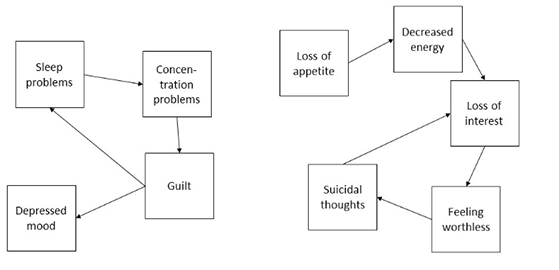
SSC Journal Club: Mental Disorders As Networks
by Scott Alexander
I.
Suppose you have sniffles, fatigue, muscle aches, and headache. You go to the doctor, who diagnoses you with influenza and gives you some Tamiflu.
There’s some complicated statistics going on here. Your doctor has noticed some observable variables (sniffles, fatigue, etc) – and inferred the presence of an invisible latent variable (influenza). Then, instead of treating the symptoms with eg aspirin for the headache, she treats the latent variable itself, expecting its effects to disappear along with it.
Psychiatry tries to use the same model. You get some symptoms – depressed mood, insomnia, fatigue, feelings of worthlessness, suicidality. You go to the psychiatrist, who diagnoses you with depression and gives you an antidepressant.
The psychiatrist is implicitly assuming that the causal structure of her field matches the causal structure of better-understood diseases like influenza. Generations of psychiatrists have noticed that different symptoms all tend to show up together and follow a similar pattern, suggesting some kind of deep connection between them. So psychiatrists follow the influenza model and attribute this collection of linked symptoms to a latent variable called “depression”.
This gets complicated really fast. Psychiatric disorders are diagnosed through clusters of symptoms, but we don’t expect every person to have every symptom in the cluster. For example, we diagnose depression when a patient has five out of nine symptoms on a list including fatigue, guilt, sleep disturbance, suicidality, et cetera. Each of these symptoms is often but not always present in a patient who has most of the others – for example, 75% of depressed patients have sleep disturbances, but 25% don’t.
But all psychiatric disorders are hopelessly comorbid with each other. If someone meets criteria for one DSM disorder, there’s a 50% chance they’ll have another one too. 60% of people with major depression also have an anxiety disorder. This is awkward when compared to eg the 75% sleep disturbance rate. Why are we calling sleep disturbance a “symptom” of depression, but anxiety a “comorbid condition” with depression? If we’re trying to cluster symptoms together to identify conditions, how come “sleep” is grouped with a bunch of other symptoms in the depression cluster, but “anxiety” gets to be a cluster of its own? Are there really two conditions called “depression” and “anxiety”, or just one big condition that has various symptoms including low mood, sleep disturbance, and anxiety, and some people get some of the symptoms and other people get others? I’m told that the people who write the DSM have long conversations about this using rigorous methods, but to the rest of us it seems kind of arbitrary.
The problem isn’t that nothing ever clusters together – depression, for example, is a very natural category. But so are various subtypes of depression. And so are various supertypes of depression, like depression + anxiety, or depression + psychosis, or depression + anxiety + psychosis. Choosing to draw the borders around depression and say “Yup, this is the Actual Disease” isn’t a bad choice, but it doesn’t jump out of the data either. When people try to use sophisticated clustering algorithms on psychiatric disorders, they usually come up with something like this, where there are only three supercategories instead of the 297 different diagnoses in the DSM. And even three supercategories are pushing it – people with psychosis are far more likely to have depression too! Having any number of categories starts seeming arbitrary and fuzzy.
So Nuijten, Deserno, Cramer, and Borsboom (from here on: NDCB) ask: what if that’s wrong? What if there isn’t a latent variable like “influenza”? What if it’s symptoms all the way down?
Consider a network in which each symptom is a node, connected to all the others by pathways with certain weights on each direction. So for example, “sleep disturbance” might be connected to “fatigue” by a strong path – people with disturbed sleep are much more likely to be tired. These might both be connected to “low mood” – people who don’t sleep well, or who are tired all the time, start feeling down about themselves. And this path might go the other way too: people who feel down about themselves might have more trouble getting to sleep on time. And maybe all of these are connected to suicidality, because if you feel bad about yourself you’re more likely to commit suicide, and if you’re suicidal you might feel bad about it, and if you’re tired all the time then maybe you can’t accomplish anything useful with your life and so death might seem like a good way out, and so on.
A sample image from the paper, showing two possible simple networks of depression symptoms
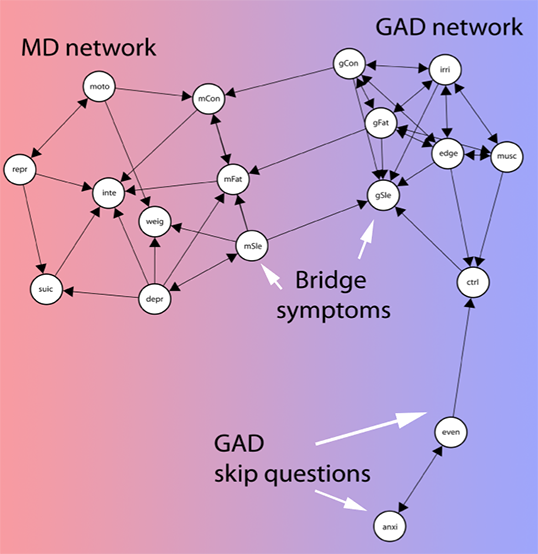
Also from the paper. This shows a more complicated (and apparently empirically validated) network of symptoms. MD is major depression. GAD is generalized anxiety disorder. The nodes are all different symptoms – for example, “inte” is “loss of interest in activities” and “musc” is “muscle tension”.

Not from the paper. But if you figure out a good way to calculate weights on this one, email me.
Each node might affect the others with a certain delay. Being suicidal might make you feel guilty, but even if your last suicidal thought was fifteen minutes ago, you might still feel guilty now. Maybe it would take months or even years before you no longer felt guilty about your suicidal thoughts. So there could be loops: in a simple model, your low mood makes you feel suicidal, your suicidality makes you feel guilty, and your guilt makes you have low mood. This type of loopy network might be stable and self-reinforcing. Maybe your boss yells at you at work, which makes you have a bad mood. Then even if the direct effect of your boss would go away quickly, if it causes suicidal thoughts which cause guilt which cause more low mood, then the cycle can stick around forever.
In NDCB’s model, all possible psychiatric symptoms are connected like this in a loose network. Particularly tight-knit symptom clusters that often active together and reinforce each other correspond to the well-known and well-delineated psychiatric diseases, like depression and schizophrenia. But there are no natural boundaries in the network; low mood and poor sleep may be closely connected to each other, but they’ll also be more distantly connected to anxiety, and even more distantly connected to psychosis. This corresponds to the fact that some depressed people will develop psychotic symptoms, even though psychosis isn’t usually associated with depression. The paths aren’t usually as strong as those between low mood and poor sleep, but they’re there, and in some people with a predisposition to psychosis or some idiosyncratic factor strengthening those paths beyond their usual level in the population, that will be enough.
There are lots of good things about thinking about psychiatric problems this way:
1. It helps explain how life stressors can cause depression. Some people who have a bad breakup will get depressed. This should be mysterious if we think of depression as a biological illness – and we have to at least a little; some people who take the drug interferon-alpha will get depressed afterwards too. But if depression is a symptom network, it becomes easier to explain. The bad breakup causes low mood, which under the right conditions and genetic predispositions can activate all of the other depression symptoms and create a stable, self-reinforcing depression. Likewise, poor sleep is a risk factor for the development of subsequent depression, which is hard to explain if we just think of it as a symptom of some latent-variable-style condition.
2. It explains how treating depression symptoms can treat the depression. I’ve heard a lot of different perspectives on this, but at least one of my attendings (and some studies) believes that treating poor sleep with a sleeping pill like Ambien can help dispel an underlying depression, including symptoms seemingly unrelated to sleep like “feelings of worthlessness and guilt”.
3. It explains how therapy can treat depression. If eg cognitive behavioral therapy helps you stop thinking of yourself as worthless, then you’ve de-activated the “feelings of worthlessness and guilt” node and made it a lot harder for all the other nodes to coalesce into a stable self-reinforcing pattern.
4. It explains the polygenic structure of mental illnesses. If a mental illness were one specific thing, we would expect it to have one specific cause, or at least be limited to genes active in one specific area or process. In fact, it’s hard to come up with anything that genes involved in these illnesses have in common other than “they’re mostly expressed in the brain” – and sometimes not even that. In NDBC’s model, genes might be involved in any of the symptoms, or in the paths between the symptoms. A gene involved in poor sleep could predispose to depression. So could a gene involved in low energy levels. Even a gene involved in anxiety or psychosis could have some effect. And so would any gene that influenced the probability that, given poor sleep, a person would have low energy levels; or that given anxiety, a person will have psychosis. The end result would be everyone having a slightly different network, with different amounts of work needed to activate each node and different weights on each of the inter-nodal paths.
5. It helps explain why so many brilliant people searching for The One True Cause Of Depression have come up empty.
II.
Actually, this last one deserves more explanation. NDCB think of these symptoms as visible patient complaints (“poor sleep”, “feelings of worthlessness”), and treat the connections between them as common sense (“if you don’t sleep, you’ll probably be fatigued”, “if you feel very guilty, you might attempt suicide because you think you deserve to die”). But their theory also works for networks of biological dysfunctions, or networks that combine biological dysfunctions with common-sense observed symptoms.
For example, we know that there’s a link between depression and inflammation. But it’s not a very good link; not all depressed people have increased inflammation, not all people with increased inflammation get depressed, and drugs that decrease inflammation don’t always cure depression. There’s similarly good evidence linking depression to folate metabolism, serotonergic neurotransmission, BDNF levels, and so on. Suppose we made a graph like the ones above, except that instead of putting things like “poor sleep” and “feelings of guilt” on it, we used “inflammatory dysfunction”, “folate metabolism dysfunction”, “serotonin dysfunction”, and “BDNF dysfunction”. There are a lot of reasons to expect these things to interconnect – for example, folate helps produce a cofactor necessary for serotonin synthesis, so any dysfunction in folate metabolism could make a problem with serotonergic neurotransmission more likely.
In a best case scenario we could merge the biological and psychological perspective, replacing “disturbed sleep” with “disturbance in the orexin and histamine systems that regulate sleep” and “tiredness” with “disturbance in the dopamine system that regulates goal-directed action”, and so “poor sleep makes you tired” with “disturbance in the orexin system causes a disturbance in the dopamine system”. In practice I expect this would be a terrible idea and that common-sense concepts mostly don’t have simple well-delineated biological equivalents. But what I’m saying is that the model where all of these things are observable symptoms, and the model where they’re all disturbances in brain chemicals and metabolism, aren’t necessarily in conflict.
So we can expand point (5) to say not only that it explains why nobody has found the One True Depression Cause, but why they have found so many promising leads that never quite pan out. Just like depression has a bunch of different symptoms, each of which is often-but-not-always involved, and each of which reinforces the others — so it has a bunch of different disturbances in biological systems, each of which is often-but-not-always involved, and each of which reinforces the others. Maybe there’s a nice correspondence between one disrupted biological system and one symptom, or maybe they sit uneasily together as different nodes on the same big graph.
III.
Are there any problems with this theory?
There are a couple of disorders that really don’t fit this model. Bipolar disorder, for example, doesn’t quite work as a collection of self-reinforcing symptoms. It’s marked by depressive episodes that can give way to years of stable mood before the person has a manic episode months or years later. I can’t think of any way to model this except as some underlying unified tendency toward bipolar disorder – although the ability for this tendency to cause a depression that looks just like normal unipolar depression is a point in NDCB’s favor, since it suggests there can be many different causes for the same syndrome.
The impressive success of ketamine also counts as a point against. NDCB imagine psychiatric disorders like depression as gradually fading out on a symptom-by-symptom basis, eventually reaching a point where enough symptoms are gone that the rest of them aren’t self-reinforcing and just sputter out. This matches the course of eg SSRI treatment, where the medications will gradually improve a few symptoms at at time over the space of a month or so and maybe cause a full remission if you’re lucky. It doesn’t really match ketamine, where every aspect of depression vanishes instantly, then returns after a week or so without treatment. There are a couple of other equally impressive things – staying awake for thirty hours straight, for example, can have an immediate and near-miraculous antidepressant effect, which unfortunately vanishes as soon as you go to sleep. Both of these treatments seem like direct strikes against the One True Cause Of Depression, and both suggest that an underlying tendency toward depression can exist separate from any symptoms (or else why would the depression come back after the effects of the ketamine wore off?)
I don’t think it’s possible to cure depression by blasting every symptom simultaneously. That is, suppose somebody is depressed with symptoms of poor sleep, poor appetite, low energy, suicidality, and low mood. Ambien can make them sleep. Pot can make them eat. Adderall can give them energy. Clozaril can make them stop wanting to kill themselves. And heroin can perk up mood. So if you gave someone Ambien, pot, Adderall, Clozaril, and heroin at the same time, would that cure their depression? I’m pretty sure no one has ever tried this, but I don’t think anyone’s reported exceptional results from less extreme cocktails like Adderall + trazodone + pot, which I’m sure a bunch of people end up taking. This along with the stuff from the last paragraph suggests that if we want to go with this model, maybe we should think less in terms of actual poor sleep and more in terms of dysfunction in the biological system of which sleep is a visible correlate. In that case we could say that Ambien helps the sleep itself but not the underlying dysfunction. But that takes some of the elegance out of the theory.
Despite these issues, I feel like something along these lines has to be true. There are too many things that sort of kind of cause psychiatric problems, and too few things that look like One True Causes. Things that look a lot like schizophrenia can be caused by viral infections in utero, by genetic factors, by hitting your head really hard as a child, by hypoxia during the birthing process, by something something something intestinal tract, by something relating to immigration which seems like it might involve psychosocial stress, and so on. Studies of the immune system, the dopamine system, the glutamate system, and the kynurenine system have all found disruptions. There have been so many really brilliant attempts to reduce all of these to a single brain region, or the levels of one specific chemical, or something that’s simple in the same way that lack-of-insulin-causes-diabetes is simple. But nobody’s ever succeeded. Maybe we should just give up.
I guess I’ve felt for a long time that some kind of weird change in attractor states of biological systems is the best way to explain these kinds of things, but I was never able to express what I meant coherently besides “weird change in attractor states of biological systems”. NDCB offer a clear model that suggests good avenues for future research.
(And I wasn’t joking when I said that little diagram with the two pentagons was the solution to 25% of extant philosophical problems.)
Adam Victor Brandizzi, Landryst likes this
15 Dec 15:48
Empire Games sneak peek
by Charlie Stross

So, in case you were wondering what the thing I've been working on since late 2012 looks like, there's now a chunk of the first chapter of "Empire Games" up on Tor's website. And the book goes on sale just over a month from now in the US! Alas, we Brits have to wait an extra week—Tor USA and Tor UK may share a name but they're actually different publishers with different shipping schedules.
Preorder (via Amazon.com): US hardcover, US Kindle edition, UK Kindle edition.
(Amazon UK only list the Kindle edition right now because Tor UK decided to switch the paper edition from hardcover to trade paperback, and the change is still propagating through Amazon's database. I'll update with a link to the trade paperback as soon as I get it.)