On trade, whilst there are perhaps grounds for axing the Trans Pacific Partnership, in doing so the way he has, he has undermined key relationships in a volatile region, where China seeks to maximise its power, soft and hard. If the Japanese and the South Koreans, in particular, sense that America is not engaged, they will be obliged to take a more respectful stance towards China. And, from the perspective of his near neighbourhood, his ruthless jettisoning of TPP, and the attempts to bully Mexico, spell trouble for NAFTA.Andrew Hickey
Shared posts
How do you solve a problem like Donald, Theresa?
On trade, whilst there are perhaps grounds for axing the Trans Pacific Partnership, in doing so the way he has, he has undermined key relationships in a volatile region, where China seeks to maximise its power, soft and hard. If the Japanese and the South Koreans, in particular, sense that America is not engaged, they will be obliged to take a more respectful stance towards China. And, from the perspective of his near neighbourhood, his ruthless jettisoning of TPP, and the attempts to bully Mexico, spell trouble for NAFTA.Rebel Chic
Yes, yet more Star Wars.
I still have a Patreon, as does Eruditorum Press (please give to the group before you give to me). And Wrong With Authority Ep 2 is still downloadable.
Note: This isn’t a ‘review’.
SPOILERS
As noted previously, Rogue One is a Second World War spy movie. This is probably why the Empire in Rogue One looks more explicitly Axis than ever before. And it was always pretty specifically Axis, with its Stormtroopers and its officers’ togs reminiscent of WW2 Japanese uniforms. But in Rogue One the Empire is placed specifically in the role of the baddies in a WW2 movie. I talked a bit about this last week, and Jane showed up in the comments to observe that Rogue One is also a Pacific Theatre movie, with its showdown in a beachy, tropical location, and its nukes.
The irony of the carefully scaled-down deployments of the Death Star is that their very comparatively small scale makes them spectacular in a way the destruction of Alderaan wasn’t. Alderaan just blows up. The city in Jedha, and the base on Scarif, are both destroyed locally, which means that the blasts can be observed from the point of view of the planet on which they occur. The result is, as Jane suggested, is something very visually reminiscent of the mushroom cloud, which itself - especially in this context - inevitably brings to mind Hiroshima and Nagasaki. As I myself noted in previous essays, Hiroshima and Nagasaki were always lurking in the series’ subconscious. Here they billow to the surface.
But there’s an obvious inference here. Hiroshima and Nagasaki were perpetrated by the United States. America remains the only country in history to ever actually deploy nuclear weapons - the ultimate indiscriminate killer, and therefore the ultimate war crime - against civilians as part of an actual conflict. Again, the implication of the US in the crimes of empire, of the twentieth century’s greatest horrors, has always lurked in the series. Here, again, it becomes more open than ever before. The scaling-back of the Death Star’s deployment makes the semiotic effect less bombastic, and hence less obscure. The Death Star becomes the Enola Gay, dropping Little Boy and Fat Boy on Jedha and Scarif. Consequently, the Empire is implicitly compared to the United States. Whereas before it has sometimes looked like the British Empire or the Confederacy, here it’s the USofA herself, and at the height of the good war and the greatest generation. More pertinently, it is the US at the historical moment when it became the world’s greatest superpower, which is another way of saying the world’s most powerful empire. This isn't exactly coherent... you could certainly suggest that it looks like America attempting to put its own crimes onto the victims of those crimes... but sometimes incoherence is more eloquent. There is as much power in the implied association as in any implied victim-blaming, especially when you consider that there are other ways in which Rogue One flirts with implying quite a strong critique of US imperialism. All the stronger for being references to more recent things, and to touchier subjects.
Jedha, for instance, is semiotically the Middle East and/or Central Asia (sorry to conflate them, but the film does). Jedha is an occupied Middle East and/or Central Asia. Tanks roll through the streets. The natural resources of Jedha are being appropriated by the Empire, to fuel its great industrial technology, not to mention its machinery of mass destruction. It doesn’t matter that Jedha has been conquered by a military state. So was Iraq. The displays inside the Death Star of destruction seen from orbit recall the satellite images of actual missiles actually blowing up actual places, presumably with actual people inside them, which chilled my blood when I watched them on the TV news as a kid during the first 'Gulf War'. Jedha even has a giant toppled statue.
Though giganticised, we know what this signifier means to a whole generation of people the world over. Again, the change of scale and scope only makes the echo clearer.
![]()
This is the section of the film that is perhaps most unusual. Not only does it inescapably recall the US invasion and occupation of Iraq, but it goes on to implicitly compare such imperialism to the German imperialism of the mid 20th century. You’re really not supposed to draw those kinds of comparisons. You get accused of moral relativism… by people who don’t realise that real moral relativism is assuming that it’s okay when ‘we’ do it but evil when someone else does it.
Relatedly, the film takes a startlingly positive attitude to violent, organised native resistance, given the context. It takes the usual Orientalist signifiers applied to the alien Other (see ‘Sand People’), with all their built-in racism, and adds signifiers which irresistibly recall political iterations of violent, even terroristic resistance - the black hoods, for instance. And it inflects them so that they stand for what is, by any measure, a necessary rebellion against the occupying force. The depiction isn’t unambiguous. The Jedha resistance are ruthless; it is arguable whether what they are doing is particularly useful or efficacious; one of them takes aim at Jyn (without knowing who she is); they seem to use torture on prisoners, etc. But it would be a perverse reading of the film that doesn’t see it as ultimately siding with them.
The ambiguous figure of Saw Gerrera makes the general trend of the film’s sympathies plain. He is Jyn’s saviour and mentor, even if he was erratic in that role. He is said by the ‘official’ ‘respectable’ Rebellion to be an “extremist” and a “militant”, etc (all big Bad words, traditionally used for describing Bad People). He is a sort of Rebel analogue of Darth Vader: an estranged paternal figure, disfigured and maimed, cybernetic, ready to use torture, ruthless, wheezing on breathing apparatus, etc. But his very similarity is interesting. Rather than the role such a similarity would usually play, in Rogue One it disambiguates rather than ambiguates, dissociates one side from another instead of associating. Rather than saying ‘see how similar the two sides are... if you fight the baddies you become the baddies’, Rogue One seems to say ‘superficial similarities aside, there are real and substantial moral differences’. Instead of the usual more-grown-up-than-thou ‘complexity’ and ‘nuance’ which sees the goodies as becoming ‘just as bad’ as the baddies because they don’t play nice, Rogue One says ‘you can play dirty and still be a good guy - it depends on what you’re fighting for, and who you’re fighting’. This isn’t a radical and subversive manifesto… but in a popular popcorny bit of multi-million dollar multiplex media production, it’s rather refreshing.
Of course, the name ‘Saw Gerrera’ doesn’t take much deciphering.
![]()
Did a Hollywood film just compare the US imperialism in the Middle East and/or Central Asia to the Axis powers imperialism during World War Two? Did it implicitly compare the Iraqi and Afghan Resistance to the French Resistance, cutting through bullshit that foxes most liberal political commentators? Did it compare the leaders of the Iraqi Resistance to Che Guevara, the most glamorous and chic of all the guerilla revolutionaries in the Western media spectacle? Rogue One is doing a lot better than most ‘serious’ movies about these issues. (It’s certainly doing a lot better than, say, Iron Man.)
Of course, the grubby “militants” and “extremists” who looks a bit like ‘terrorists’ have to all die without achieving anything much. Saw Gerrera - the only black main character in the film - has to die with them, apparently simply deciding to die because there’s nothing else for him to do in the story. There is a lingering uneasiness about the legitimacy of this kind of rebellion. In the end, those less salubrious rebels don’t get to perform any of the galaxy-saving heroics… and the whole rebellion, problems notwithstanding, is implied to only be respectable because it is run within the confines of a rump Republic, the remains of a liberal democratic structure run mostly by white people, etc.
Even here though, as I say, there are problems. Good problems. There is a very acute moment when, faced with the story told by Jyn, the Rebel Council - the respectable, non-militant, non-extremist embodiment of resistance - pretty much unanimously (though not really democratically) decides to give up and run away. They seem to be in an almost unseemly haste to give up and run away actually. They're eager to give up and run away, in the true style of such respectable rebels. You get the feeling that, at least for some of them, they're happy the Death Stat problem came along, because it has finally given them a respectable reason to do what they've been dying to do all along.
The motley band which assembles over the course of the film has to go rogue - hence their name, and the name of the film - to get something done. They are, of course, ultimately sanctioned (albeit in secret) by the most forward-thinking elements of the respectable Rebellion, including Bale Organa, who is in a rush to re-recruit Obi-Wan Kenobi. All of a sudden. For some reason. Tortured continuity aside, what’s happening is the revival of the old Republic structure, with the last of those establishment enforcers the Jedi called back into service. This is still Hollywood, after all.
It’s worth pausing a moment to consider why the film goes even as far as it does. Well, I think a lot of it is down to the same stuff I mentioned last week: the ability of capitalist ideology to adapt and absorb, and the relative financial security of a Star Wars film. But that rather begs the question. It might explain the how, but not the specific why. I don’t actually have any particularly convincing arguments. I’d like to hear suggestions. But I do suspect that, in the wake of Mad Max Fury Road, Hollywood is identifying a useful new marketing vector, which can be combined with a certain cultural prestige. And capitalism, while paranoid in some sectors, is smart enough in others to realise that it can incorporate almost any form of critique - even the comparatively mild critique offered in Rogue One, which only looks startling by comparison - without actually risking anything. The very same mode of address which can make the usual reinforcement of hegemonic cultural ideas and values so insidious, can also render a flirtation with radical critique nothing more than a tangy spice on top of an otherwise safely processed consumable. There’s a reason the only revolutionary whose name is directly invoked is Che Guevara.
![]()
There’s a sense in which the most radical thing you could do with Star Wars would be to show us what citizens of the Empire watch on their holographic infotainmentscreens. I wonder if they watch inspiring dramas about brave, plucky rebels fighting a desperate battle against the forces of darkness. The citizens of Nazi Germany certainly did, as did those of their enemies.
*
Given all this, it’s worth asking… where does tyranny come from, according to Rogue One? And we’ll have a look at that next week. I need to get a few Fridays out of this one.
Six times as many LD supporters say they’re concerned about BREXIT than UKIP voters

This dynamic could have an impact next Thursday
The above chart is based on data from the latest Ipsos MORI issues index and shows the party splits of those, unprompted, naming BREXIT as the main, or one of the the main, issues facing Britain at the moment.
As can be seen there is a huge gap between the LDs, with 79% raising it, to UKIP voters where the figure is 15%. The Tory figure is highish well ahead of LAB.
-
I’d suggest that this might be reflected in the turnouts in the two Westminster by-elections next Thursday. The main challenge for UKIP is to convert perceived anger about BREXIT into votes actually cast.
How strong is that feeling for UKIP backers to go to the polls to give LAB a good kicking? We’ll know next Friday morning. There’s also the question of whether LD voters are more motivated.
Each month for 40 years Ipsos MORI has been operating a totally unique poll – its Issues Index. On this those sampled are simply asked face to face “What do you see as the main/other important issues facing Britain today?”. They are given the time to respond and can name any number of things that come into heads.
Because of the unprompted nature of the approach this has been regarded over the decades as one of the best tests of the salience of issues without the question wording itself having an impact on the responses. This has stood the test of time.
Mike Smithson
‘Under a spell’: Bonhoeffer on folly
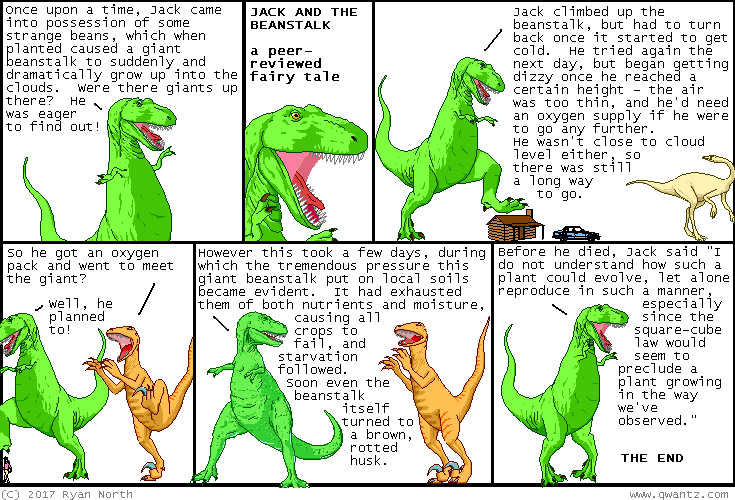
peer-reviewed fairy tales: jack and the beanstalk!
| archive - contact - sexy exciting merchandise - search - about | |||
![]() |
|||
| ← previous | February 15th, 2017 | next | |
|
February 15th, 2017: Thanks to everyone who came out to say hi on the West Coast! It was great doing events in cities I'd never done them in before, and so many people came by to say they'd been reading Dinosaur Comics for 10+ years. CRAZY. So I wanted to say "thank you, you are awesome" and also "wow I can't believe you've let me in your brain for so long, wait putting it that way sounds creepy, sorry". – Ryan | |||
Trans politicians, part 2 (1999-2009)
As part of LGBT History Month, I have been researching the history of openly trans politicians in the UK and I will be posting these over the next few days. You can read part one of this mini-series here and part two, covering 2010 to 2016, here.
Jennifer Liddle (Liberal Democrats)
1999: City Council Candidate for East Chesterton Ward, Cambridge
2000-2007: Cambridge, East Chesterton (Reelected 2004)
2008-2010: Cambridge, East Chesterton
Jenny Bailey (Liberal Democrats)
2002-2008: Cambridge, East Chesterton (Releected 2004)
2007-2008: Mayor of Cambridge
There is a question as to exactly where in the timeline Liddle and Bailey – partners who represented the same ward on Cambridge City Council at the same time – should appear in the narrative. Liddle first stood in 1999 before being elected in 2000, but there was little or no media coverage at the time. Liddle herself has described their trans status as “the worst-kept secret in Cambridge” and then County Councillor for the same ward, Julian Huppert, says that “there were certainly voters who knew … it did come up occasionally on doorsteps. Not, sadly, in a positive light“*
They did not receive widespread coverage until 2007, shortly before Bailey was sworn in as Mayor of Cambridge which, as far as is known, makes Bailey the first and to date only trans mayor in the UK. The publicity didn’t seem to hurt Liddle’s election when she re-stood in 2008, gaining 38.4% of the boat, versus 38.3% in 2004.
Regardless of where chronologically their entry should appear, Liddle and Bailey began a near-continuous run of openly trans representation on Cambridge City Council, broken only for one 12 month period in 2014-2015.
Sources and further reading:
Cambridge Local Elections – Candidates A – B
Cambridge Local Elections – Candidates O – L
First sex-swap mayor is sworn in. BBC News, 24th May 2007
Transsexual Becomes Mayor in Cambridge, England. Fox News, 25th May 2007
* In conversation with the author
Rebecca Baty (Conservatives)
2002: Council Candidate for Bruce Grove ward, Haringey
Relatively little is documented about Baty, who stood for election as a Tory candidate in London in 2002. This was a no-hope seat for the Conservative party, and despite being the top-placed candidate from her party Baty managed less than a quarter of the number of votes of the lowest-placed Labour candidate. Despite this, she received some press coverage. In 2002, merely being a candidate whilst out as trans was notable enough to be newsworthy.
Baty also stood in 1998 in the Quadrant Ward of Islington, but does not appear to have been out at the time as no press coverage of her from that election has been located.
Although non-principal council results have not been included, it’s worth noting that in 2009 Baty also stood unsuccessfully for Ramsgate Parish council, in the same ward that in 2015 saw UKIPs only known trans councillor, Sarah Larkin, secure a seat.
Sources and further reading:
London Borough Council Elections, 7th May 1998
London Borough Council Elections, 2nd May 2002
McGowan, Patrick. Tories to field first transsexual. Evening Standard 14th March 2002
Sex change Tory hopeful says she should be judged on her merits. Scotsman 15th March 2002
Allen, Peter. The Lady Who Turned Is to Stand for Tories. Daily Mail. 15th March 2002.
Parish of Ramsgate Election – Thursday, 4th June, 2009
Krystyna Haywood
2002: Council Candidate for Park, Sheffield (Liberal Democrats)
2007: Council Candidate for Arbourthorne, Sheffield (Green)
Sources and further reading:
Norton, Cherry. The pressure and confusion are terrible. Independent 29th July 1999.
Local Elections Archive Project – Sheffield City Council Election Results 2002
Local Elections Archive Project – Sheffield City Council Election Results 2007
Stephanie Dearden (Liberal Democrats)
2005: Westminster Parliamentary Candidate for Tooting
2006, 2010, 2014: Council Candidate for Graveney, Wandsworth
It’s not clear if Dearden was already “out” before the Leicester South by-election in 2004, but an unattributed attack leaflet distributed during the run-up to polling day put her name in the public domain and, according to subsequent interviews during the election campaign, Dearden’s own web site initially made mention of it. As with MacRae back in 1992, being a candidate only likely to secure third-place didn’t stop interest from the Daily Mail, which briefly interviewed her in the weeks prior to the election.
Dearden is still involved in politics, having unsuccessfully stood for election to the same area three times – in 2006, 2010 and 2014.
Sources and further reading:
Cohen, Nick. The ghost of Enoch. The Guardian 22nd August 2004.
Letts, Quentin. Not Hattie Jacques, but the ladies are no pushover Mail Online. 8th April 2005
Bain, Charlie. Lib-Dem Lady Who Was a Man Mail on Sunday. 1st May 2005
UK General Election result for Tooting, 2005
Wandsworth Council election results 2006
Wandsworth Council election results for Graveney Ward 2010
Wandsworth Council election results 2014
Ailsa Spindler (Scottish Greens)
2005: Westminster Parliamentary Candidate for Edinburgh West
Although she did not make it into the collective memory of the trans community or LGBT politicians in the same way as Dearden did, possibly due to being a member of the smaller Scottish Green Party, Spindler stood in the same General Election. Public knowledge of her trans status appears to have been entirely at her own initiative – multiple sources published on the same day give the same quotes, suggesting a press release simuntaneously sent to multiple outlets.
Sources and further reading:
UK General Election result for Edinburgh West, 2005
Green Party candidate says sex change is not an election issue Scotsman. 23rd April 2005
Stokes, Christina. The Sex-Change Green Who Wants Voters to Swing Her Way in May Daily Mail. 23rd April 2005
Stokes, Christina. Sex Swop Boxer Bids to Land Knockout Blow for the Green Party The Mirror. 25th April 2005
The post Trans politicians, part 2 (1999-2009) appeared first on Complicity.
#1293; In which an Affliction is assumed
it was like the walking dead, only they also ran a bit too i guess.
Andrew HickeyThe alt text for this one: ""Oh, here's one of literally dozens of ways to implement proportional representation without the inherient unfairness and distortions of first past the post systems. That was actually really easy. I didn't even need to be smart for this one."
| archive - contact - sexy exciting merchandise - search - about | |||
![]() |
|||
| ← previous | February 10th, 2017 | next | |
|
February 10th, 2017: This week I am in the UNITED STATES as part of a book tour! It's for Squirrel Girl but I'll also be happy to talk/sign anything else, INCLUDING Dinosaur Comics stuff! TONIGHT I am in Seattle: the details are RIGHT HERE. You should come! – Ryan | |||
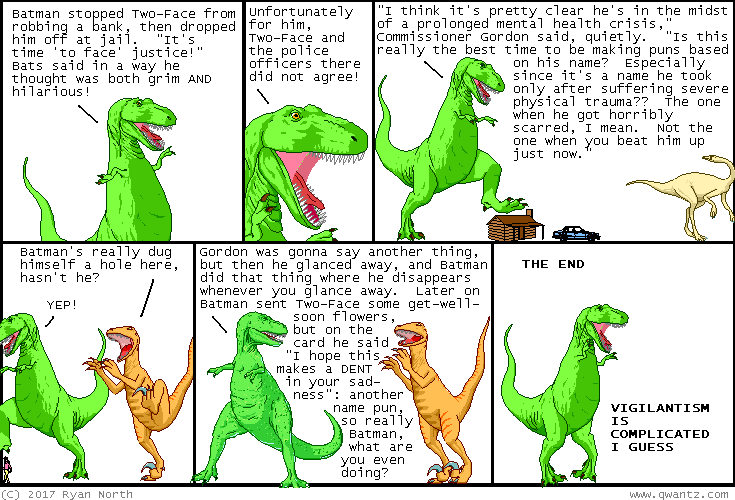
"here's a joke I just thought of," Batman said. "and I'm sure you'll find it to be a LAUGH AND A HAL--" "don't," Harvey interrupted.
| archive - contact - sexy exciting merchandise - search - about | |||
![]() |
|||
| ← previous | February 13th, 2017 | next | |
|
February 13th, 2017: Thanks to everyone who came out to say hi on the West Coast! It was great doing events in cities I'd never done them in before, and so many people came by to say they'd been reading Dinosaur Comics for 10+ years. CRAZY. So I wanted to say "thank you, you are awesome" and also "wow I can't believe you've let me in your brain for so long, wait putting it that way sounds creepy, sorry". – Ryan | |||
Trans politicians, part 1 (1986-1999)
As part of LGBT History Month, I have been researching the history of openly trans politicians in the UK and I will be posting these over the next few days.
Our history is often confused by the media’s need for sensationalism and they will often latch on to the idea that someone might be “first” at something to make another otherwise run-of-the-mill human-interest story about someone seem more interesting. Sometimes politicians reuse these stories themselves, not realising that the media have not bothered to fact-check their claims. This does not help trans representation in the long run, because it makes people feel as if being elected in politics is something remote and unobtainable for trans people rather than something that is quite achievable.
For those interested in the topic, it’s worth checking out this excellent report from the University of North Carolina’s LGBTQ representation and rights research initiative which covers the global situation.
More information is always welcome, as I will certainly have missed people prior to 2014, when I started compiling lists of known trans candidates at principle authority level or above each year. However, I will state my usual caveat here – I am aware of a number of trans people who hold or have held public office but are not out. I am not in the business of outing people, so I will only include those who are publicly out or have already been outed by the media.
Finally, if any historians would like to work on turning this series into a more formal paper for publication please do get in touch. I would like to be able to get this information recorded in a format more amenable to citation by future generations of activists.
Part two of this series covers 1999-2009, and part three 2010-2016.
Rachael Terri Webb (Labour)
1986-1990: Councillor for Ferndale Ward, Lambeth
1990-1994: Councillor for Gipsy Hill Ward, Lambeth
The history of successful trans politicians stretches back surprisingly far – to the mid 1980s. This was a time not just before the Gender Recognition Act was passed but before the campaign group that fought for that legislation, Press for Change, was formed. The trailblazer was Rachael Terri Webb who was, as far as anyone has been able to establish, not only the first openly trans person to have been a candidate in a UK election, but the first to have been elected.
Webb stood for Lambeth council in 1986 to the safe Labour ward of Ferndale, serving there until 1990. She then stood in Gipsy Hill in 1990, until retiring in 1994.
As with many people, it is difficult to establish the extent to which Webb’s history was known prior to her first election as the media rarely gives much coverage to candidates for local councils. More recent articles suggest she was outed by the tabloid press in 1983 as a result of using a loan available to all council employees to pay for surgery, but it has not been possible to locate the original articles yet. However, her position as the earliest known out trans politician and the first to win an election is secure, as there are references in the 1987 book “Bodyshock: The Truth about Changing Sex” as well as other sources prior to her re-election. She was also known to the wider trans community, presenting on the topic of “Transsexuals and Local Authority Equal Opportunities Policies” to the GENDYS conference in 1990.
Looking at the election results, it is notable that although elected comfortably Webb placed third of all three Labour councillors in both elections. That difference is most pronounced in the 1990 Gipsy Hill results, in which she polled 8% lower than the other two Labour candidates in an election that otherwise seems to have seen people voting a straight party ticket, with little or no difference in the votes between candidates of the same party. Concerning though this difference might be, it is entirely possible this difference in votes was for entirely political reasons. She was apparently well known and referenced in a number of articles and books in the late 80’s and early 90’s. These sources typically do not mention her as a trans woman, but do focus on her history as an outspoken member of Militant, on the left wing of the Labour party during a period that saw internal party disagreement on a par with today’s troubles.
Webb sadly died in 2009.
Sources and further reading:
London Borough Council Elections, 8th May 1986
London Borough Council Elections, 3rd May 1990
Hodgkinson, Liz (1987), Bodyshock: The Truth about Changing Sex. Columbus Books.
Ekins R, King D (2002), Blending Genders: Social Aspects of Cross-Dressing and Sex Changing. Routledge
International gender dysphoria conference 1990. Beaumont Trust
Zagria, A Gender Variance Who’s Who – Rachael Webb (1940 – 2009)
Webb, Rachael. Letters to the Editor. The Guardian. 2nd October 1990
Alexandra “Sandra” MacRae (SNP)
1992: Westminster Parliamentary Candidate for Glasgow Provan
MacRae has been in the headlines well before she became a candidate for the SNP, having been outed in 1981 by the News of the World in a story described by the Press Council as “distasteful” – it appears the Scottish Daily Record also ran less-than-positive stories during the election. Despite this, she appears willing to talk about her background publicly as a Herald Scotland article repeats by then historical quotes from her General Election campaign in 1992 where she talks about her transition. Coverage of her candidature is sparser than might be expected – the SNP then were less prominent than today, and MacRae was not expected to win. She placed second on 21.7%, with Labour comfortably holding the seat with 66.5% of the vote.
MacRae was no stranger to elections, having stood at least four times prior to transition, in Edinburgh Central (Feb & Oct 1974), Edinburgh Pentlands (1970) and Midlothian. (1966) Unfortunately, most sources about MacRae are from 1997 when she hit the headlines for all the wrong reasons following a conviction for fraud. According to media reports, she was the first trans woman to be housed in a female prison but as with most media claims about “firsts”, this is tricky to verify.
Sources and further reading:
‘News of the World’ censured. The Observer. 9th August 1981, page 5
Lawyer stole #16,000 from clients, Prisons face dilemma of sex-change embezzler. The Herald. 10th December 1997
Transsexual man jailed in women’s prison. BBC News. 1st September 1998
UK General Elections since 1832
Zagria, A Gender Variance Who’s Who – Sandra MacRae (1942–) solicitor, SNP candidate
Mark Rees (Liberal Democrats)
1994-1998: Councillor for Rusthall Ward, Tunbridge Wells
Mark Rees is perhaps better known as co-founder of Press for Change and a prominent campaigner for gender recognition which resulted in the passage of the Gender Recognition Act in 2004 – a journey which began with a European Court hearing as far back as 1986, the same year that Webb was first elected. In the middle of this period, Rees had served four years as a councillor in Tunbridge Wells, standing in Rusthall Ward first in 1991 before going on to win in 1994. Although he re-stood in 1998, he was not successful.
There are many excellent resources about Rees’ life online, and rather than try to summarise them here, anyone interested should read the articles published by either LGBT History Month or Zagria. Christine Burns’ eBooks, Pressing Matters also cover the story of the campaigning group, Press for Change.
As well as being the first, to date, Mark remains the only openly trans man known to have been elected to public office in the UK.
Sources and further reading:
Rees v. The United Kingdom – 9532/81 [1986] ECHR 11. 17 October 1986.
Burns, Christine (2013) Pressing Matters (Vol 1)
Famous and Inspirational Trans People: Mark Rees. LGBT History Month
Zagria, Mark Rees (1942 – ) Part II: activist, councillor
Tunbridge Wells Borough Council Election Results 1973-2012
Rosalind Mitchell (Labour)
1997-1999: Councillor for Redland Ward, Bristol
Mitchell was not out when first elected to Bristol Council. In fact, she didn’t transition until 6 months after her election, meaning she can lay claim to being the first trans person known to have transitioned whilst holding public office in the UK. She was in office for a relatively brief period, and her tenure appears to have not been trouble-free as although apparently accepted by the Labour Group on the council she was refused entry to a Labour Women’s group and did not restand when her term expired in 1999.
Sources and further reading:
Election results for Redland, Bristol, 1997 (Election data has been updated by Bristol Council to refer to Mitchell’s current name. It is clear from other sources that she did not transition until November 1997)
Burns, Christine (2013) Pressing Matters (Vol 1)
Burns, Christine. The Rosalind Mitchell Story, Press For Change. 21st September 1997, archived from the original.
Dyer, Clare. Labour transsexual comes out. The Guardian. 22nd September 1997, page 6.
Winkler, Elisabeth. The year that changed my life, The Independent. 27th December 1998
New Labour, New Woman, part of the Home Ground series. BBC. 7th July 1998
Dyer, Clare. Labour Group Throws out Sex Change Woman. The Guardian. 19th March 1998, page 4.
Sex objection to Bristol Woman. Local Government Chronicle. 31st March 1998.
The post Trans politicians, part 1 (1986-1999) appeared first on Complicity.
Battle Scars
One of the things that bugs a lot of people about Trumpism — and I'll bet it bugs a lot of people who still back the guy — is the idea that "the facts" can be whatever you want them to be if it helps you win an argument.
It serves Trump's purposes for the murder rate in this country ("the carnage") to never have been higher…so it's never been higher, no matter what the actual statistics say. In a year or so, he can point to the actual stats (even if they go up) and claim credit for bringing them down to that. It also serves his purposes for millions of illegal votes to have been cast for Hillary and for terrorism attacks to be so numerous that the press doesn't even report them.
My closest friend who is glad Trump won cringes at this kind of stuff because he thinks it, more so than anything Democrats are doing, de-legitimizes a presidency that he wants to see succeed, at least for certain of its goals.
It's also just really, really uncomfy for him to support Trump when people like me are saying to him, "Hey, you said Al Gore was a congenital liar when he said [summary of inconsequential Gore distortion of facts]. How do you feel about your boy Trump saying [summary of consequential Trump lie]?" It's bad enough that he has to defend/overlook the "pussy" talk or his candidate's marital and business track records.
I guess I should have been better prepared for this because I've spent a lot of time on Internet message boards and forums where, encouraged by distance and often anonymity and/or alcohol, people say some real stupid, untrue things. When such forums work — when people remain civil and relatively factual — some wonderful, enlightening discussions can occur. I've enjoyed many and learned from many.
But then every so often, along comes someone who's really mad at about something and/or committed to some personal agenda…and they just make things so unpleasant that the sane people prove their sanity by going elsewhere. These disruptors usually proclaim success but when I look at them, what I think is: "This person is really, really committed to winning arguments here because he or she is not winning anything very often in real life."
That may be unfair but in at least a few cases, I'm sure it's true. I know it's true.
Often, they remind me of the Black Knight in Monty Python and the Holy Grail, who may be the all-time greatest literary analogy ever for someone who loses and loses and loses and still thinks that he's winning if he doesn't admit defeat — to himself or anyone. King Arthur lops off the Knight's arms and legs off and the Knight's still clinging to some fairy tale bromide about how a man who won't be beaten can't be beaten. (When people quote that to me as if it's oh so true, I usually ask them what happens when one man who won't be beaten battles another man who won't be beaten…)

It's so bizarre to me at times to find people defending beliefs of microscopic importance to the death. I'm sure it happens on discussion forums of all topics but it never seems so petty as the comic book chat venues, where people — many of them alleged grown-ups — are arguing over who's stronger, The Thing or The Hulk, or who drew the best Batman. And hey, do you think Archie should marry Betty or Veronica?
I care about many, many aspects of the comic book world, especially those that impact the lives and appreciation of its great creative talents…but when you find yourself jousting online with a Black Knight about which writer's version of The Joker was definitive, all you can do is click your mouse and go find a better place to be. This is something you need to do before you get stuck playing their game for very long.
No one can win their game. You can't and they can't, though that won't stop them from deciding they did and taking victory laps. All they can really do is waste your time, energy and attention.
I argue occasionally with those who spread misinformation but try to not to get into debates over opinions because, well, they're opinions. We're not supposed to all like all the same stuff for all the same reasons. It's sometimes hard to find the dividing line though when you're dealing with people who think their opinions are facts; that the answer to "Who was Jack Kirby's best inker" is just as evident and inarguable as the answer to "What's 2+2?"
Over the years, I've learned to avoid certain individuals on the 'net because they're like that. Last year at Comic-Con in San Diego, one of them sought me out to talk…and I'll say this for the guy: He was a much nicer, saner human being than I would ever have imagined based on his online posts. I think we forget this sometimes. Some people, and I think I'm one of them, write pretty much as they are. If you don't like me from what I write here, don't bother trying to meet me. I don't get any better in person.
But some people aren't the same guy, possibly because they aren't all that facile with words and don't express themselves well. When all you have to go on about a person is how and what they write, it's hard not to formulate an overall view of them based on that. When I was in my early teens and reading mimeographed and ditto "fanzines," I kind of assumed that if someone's writings had a lot of typos in them, if you'd met that individual in person, they'd have a corresponding speech impediment. Or if they typed in elite type instead of pica, which is larger, they'd have a very soft voice.
Anyway, this guy at San Diego seemed intelligent and decent in person, which had not always been the case with his Internet postings. He had sensed over the years that I was avoiding him and wanted to know why. I told him as nicely as I could that online, I thought he was a maniac who was sloppy with his facts…and since there was no reasoning with him, why bother? He said he understood that, he apologized for being too strident and unwilling to concede error…
…and then he said, by way of explanation and not as an excuse, "I was having a rough time in my life back then." I think I always sensed that. I didn't know anything about the fellow but his arguments didn't always seem to be about what they were about. He was stressing over things in his world that weren't working out the way he wanted them to so he became a little more crazed to see them work out his way on this forum where we discussed comic books.
That's not just my "take" on the situation. It was his, as well. I think a lot of arguments on the 'net are in the same category.
It helps to remember that some people don't always manage to write that they mean by way of tone and often, substance. It also helps to remember that those who post under handles may feel no responsibility for what they post under that phony name and also that the Internet is a place of immediate reaction.
In the old days, something might get you furious and you'd sit down and dash off an angry, outraged letter — what a friend of mine used to a call a "Dear Mr. Asshole" letter — and then the mere act of writing it would take half the fury out of your soul. Then a half-hour later, the other half would evaporate and instead of sending the letter, you'd decide to save a stamp and your reputation so you'd tear it up.
Today, you finish it, you hit "send" and there it is for all the world to see, possibly forever.
When you read the Internet in this era of Trump, you see a lot of stuff that makes you think people are insane, which of course some are. You and I may disagree as to who the insane people are but I'll bet we agree that they're there on the Internet, just like porn, spam, clickbait, overhyped headlines, piano-playing cats, Nigerian scams, Kardashian photos and more porn. Being aware of the crazy people is important because you can't avoid them if you don't remember that they're there.
It's probably also important because we all have our bubbles and we need to remember that those bubbles are never as large as we like to think they are. Sadly though, the more you browse the web, the more you may become convinced we live in a world where we're outnumbered by crazies.
And maybe we are. But maybe some of those crazies aren't as crazy as they seem. Maybe they're stressing over something else, something largely unrelated to whatever they're being crazy about on some forum or comment section.
Or maybe they're coming across crazier than they really are because they're not very good writers. Remember that…and while you're at it, have a little sympathy for those who've lost and are so out of touch with reality that they just don't know it. You can usually spot them lying there with their arms and legs cut off, and they're offering magnanimously to declare the battle a draw.
The post Battle Scars appeared first on News From ME.
John Bercow and the paper-thin skins of the Brexiteers
The House of Commons has no trouble with the idea that an MP can, overnight, go from taking a party whip to being its impartial speaker.
So it really ought to be able to cope with John Bercow having expressed a view on Brexit after the referendum.
I have never been a Bercow fan - see the column I wrote for Liberal Democrat News when he was first elected speaker - but the meetings with young people he holds around the country to talk about parliament and its workings seem wholly admirable.
No, what the fuss in the media this weekend shows is the incredibly thin skins of the Brexiters.
They won the referendum, yet they do not seem to be enjoying it. They are constantly on the look out for slights and treason.
If Brexit is a revolution, then what I once said of Jeremy Corbyn's followers is relevant here too:
The failure of the revolution is always blamed on sabotage and the new regime takes brutal action against the supposed culprits.
Once they have been eliminated, the people are told, all the promises of a better world that accompanied the revolution will be fulfilledThis hunt for traitors will only increase when Brexit fails to deliver the more prosperous and ordered society that its proponents seek.
The good news is that they will probably end up fighting each other. I quoted Bryan Magee in the same post:
There is a situational logic to revolutions. Disparate groups unite to overthrow an existing regime, but once they have succeeded in doing so the cause that brought them together has gone, and they then fight one another to fill the power vacuum that they themselves have created.
These internecine struggles, usually savage, among erstwhile allies perpetuate the revolutionary breakdown of society far beyond the overthrow of the old regime, and delay the establishment of a new order.
The View From the Top of Amazon’s Heap

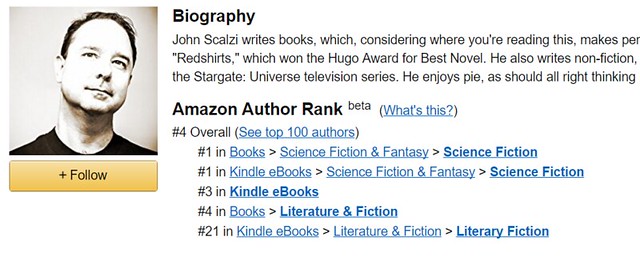
Yesterday nine of my novels were on sale for $2.99 in ebook format, across a bunch of different retailers, but most prominently on Amazon, because, well, Amazon. Amazon has a number of different ways to make authors feel competitive and neurotic, one of which is its “Amazon Author Rank,” which tells you where you fit in the grand hierarchy of authors on Amazon, based (to some extent) on sales and/or downloads via Amazon’s subscription reading service. And yesterday, I got to the top of it — #1 in the category of science fiction and fantasy, and was #4 overall, behind JK Rowling and two dudes who co-write business books. Yes, I was (and am still! At this writing!) among the elite of the elite in the Amazon Author Ranks, surveying my realm as unto a god.
And now, thoughts!
1. To begin, it won’t last. The thing that got me into the upper echelons of the Amazon rankings was an unusual sale of a large number of my books for what is (for me) a very low price point, and that sale is meant to be of a short duration, i.e., one day. When that price point goes away, my Amazon sales will go back to their usual level, and my Amazon Author Rank will decline to its usual ranking, which is — well, it kind of bounces around a bit, because honestly that’s what most Amazon Author Rankings do. I’m often somewhere in the top 100 for science fiction, but I’m often somewhere not in the top 100, either.
2. Why? Got me, and this is the point I often make to people about Amazon Author Rankings (and other various rankings on the site): They’re super opaque. I mean, in this case, there’s a direct correlation between my $2.99 sale and the boost in my author ranking. But it’s also the case that sales are not the only criterion — a large number of top Amazon authors are ones who sign their books up for Amazon’s subscription service, for which they don’t make sales, but make money based on however Amazon decides to track engagement with the book via Kindle. How much is that criterion weighted versus sales? I don’t know, nor, I suspect, does anyone outside Amazon, nor do we know what other criteria go into the rankings.
3. This opacity works for Amazon because it keeps authors engaged, watching their Amazon Author Rankings go up and down, and getting little spikes or little stabs as their rankings bounce around. I mean, hell, I think it’s neat to have a high ranking, and I know it’s basically nonsense! But I do think it’s important for authors to remember not to get too invested in the rankings because a) if you don’t know how it works, you don’t know why you rank as you do, at any particular time, b) it’s foolish to be invested in a ranking whose mechanism is unknown to you, c) outside of Amazon, the ranking has no relevance.
4. Which is also a point I think people forget about: Amazon, despite its dominant position in the bookselling industry (particularly in eBook), is not the entire market. Regardless of my day-to-day Amazon ranking, I generally sell pretty well and pretty steadily in book stores and other eBook retailers, and in audio and in translation, none of which is tracked by Amazon for its rankings. Most authors who are not wholly committed to Amazon via its subscription service likewise have outside sales and attention channels. It’s in Amazon’s interest to keep authors’ gaze on it, and especially to have authors sign on to its subscription service, with a bump in Amazon Author ranking a potential and implicit part of that deal.
5. This doesn’t make Amazon malign, incidentally. Amazon’s gonna Amazon. And in a mild defense of Amazon, one reason that Amazon’s rankings, of authors and books, weighs so heavily on the psyches (and neuroses) of authors is that author-related data in publishing is often either equally opaque (in the case of publishers) or effectively non-existent (in the case of self-publishing, which would rely on thousands of authors accurately self-reporting data to some informational clearinghouse). I mean, here’s Amazon saying “Look! We have rankings! Tons of rankings! Rankings for every possible subdivision of writing! And your book is probably a top ten bestseller in one of those!” Amazon gets authors. Authors love validation, even if that validation comes in the form of a “bestseller” label in a genre subdivision so finely chopped that the ranking is effectively a participation ribbon. As I write this, Old Man’s War is #1 in the following Amazon subdivision: “Kindle Store > Kindle eBooks > Science Fiction & Fantasy > Science Fiction > Military > Space Fleet” That’s pretty finely chopped, and I might argue not especially useful (there’s not really a “space fleet” subgenre in SF). But if I were a newer author, I’d be thrilled! Even as an established author, it doesn’t suck! Hell yeah, space fleets!
6. The flip side of all of this is that it’s very easy, if you’re the sort of personality inclined to do so, to transmorgify your Amazon ranking into a dick-waving contest. Every now and again I see authors who don’t like me much crow about beating me or one of my books in an Amazon ranking, as if this were a sort of personal victory against me. My responses to this tend to be, a) congrats, b) you know it’s not actually a contest, right, c) and if you want to assert that it is anyway, well, then, bless your heart. If you believe the world is truly a zero-sum contest in which evanescent book/author rankings promulgated by a corporation for its own interests represent the final word on your self-worth, which apparently must be assessed in relation to me (or any other author you might have a bug up your ass about), then please, take this victory. I want you to have it. Everyone else should maybe not do that.
7. Which is not to say one shouldn’t have fun with rankings, when the opportunity presents itself:
OH HAI NEIL HEY LOOK WE ARE TOTALLY AMAZON AUTHOR RANKING PALS NOW@neilhimself pic.twitter.com/lPNpAsibsP
— John Scalzi (@scalzi) February 11, 2017
John, stop staring up at me. No, please. It's getting weird. https://t.co/CydYq0etut
— Neil Gaiman (@neilhimself) February 11, 2017
@neilhimself YOU'LL BE PLEASED TO KNOW YOUR NOSE HAIRS ARE IMPECCABLY TRIMMED NEIL
— John Scalzi (@scalzi) February 11, 2017
8. And that’s really the point of Amazon Author Rankings (and other rankings Amazon might offer): Enjoy them when they’re up but don’t stress about them when they’re down. One’s writing career will have many moving parts, and Amazon’s rankings are only about Amazon’s part in that, and then only opaquely. I’m having fun being at the top of Amazon’s heap. It won’t last, and when it doesn’t, I’ll still be fine. And I’ll still be writing.
The Revenge of Louie

A few days ago, I stopped into a market to pick up about a dozen items. I was in the Canned Meats aisle when it occurred to me that I oughta hit the Men's Room before I left. I didn't have to go right that second but I sensed that I would before I got home.
The men's room had a combination lock on the door. You had to ask someone who worked there for the code. So I asked someone there for the code and they didn't know. So I asked someone else there for the code and they didn't know. So I asked someone else there for the code and they didn't know. So I asked someone else there for the code and they didn't know but they said, "You'd better ask the manager" and they told me where to find him.
I found the manager and he said he was sorry but he didn't know the code to the men's room either. I said, "Well, someone must know it." The manager kind of half-chuckled and said, "Louie knows it but he doesn't work here anymore."
Then he explained to me. They had an assistant manager named Louie. Louie was a problem and they told him he was fired. Louie was pissed about this. He left but before he left, he reprogrammed the doors to the public men's room and ladies' room, just to cause trouble. I said, "There must be some sort of master back-up code for them."
The manager said, "There is…but he changed that, too." I asked how long ago this was done and he said it was going on ten days. "I've phoned him a couple of times and demanded he give us the new codes but he said if we want them, we have to hire him back."
By now, I was way deeper into this story than I cared to be but I was also needing the men's room more and more. I asked, "What about the key? There's a key lock on those doors, too." The manager said, "Yeah, well, nobody here seems to know where the key is. We didn't use it much…once or twice a year when some homeless person would lock themselves in there for an hour or two. I've searched and I'm not sure Louie didn't take all the keys, too."
I asked if I could use whatever men's room the employees there used and he said sure and walked me back into the "authorized personnel only" section to show me where it was. On the way, he told me, "I've called the company that installed the locks and they're going to send someone out with a master key. They say once they get the doors open, they can reprogram the locks.
"I think they're coming tomorrow. I hope so because I have to do the final January accounting and I can't finish without one ledger that I don't have. It disappeared the same time Louie left and I called him and asked here the hell it was. He said it was in the ladies' room along with a couple crates of FatBoy ice cream sandwiches."
The post The Revenge of Louie appeared first on News From ME.
Richard Hatch, R.I.P.
Okay, I didn't have an Irwin Corey story but I do have a Richard Hatch story.
And I don't mean to insinuate that my silly little story has any importance on this day when it's been announced that Mr. Hatch has died at the age of 71. He seems to have been a popular actor and I never heard anything bad about him. Having never watched most of the shows he was on, I just have nothing to say about him other than to express sadness at the loss and respect for a long, successful career. But I do have this one story…
In 1976, ABC ran the second of those Battle of the Network Stars specials. I think this one was originally called The Challenge of the Network Stars but when they reran it later, they renamed it Battle of the Network Stars II.
I was at the taping at Pepperdine University, mostly sitting on the bench of the ABC team and helping its team captain, Gabe Kaplan, come up with insults for the host, who was Howard Cosell. Kaplan's team included Levar Burton from Roots, Hal Linden from Barney Miller, Jaclyn Smith from Charlie's Angels, Ron Howard from Happy Days, Penny Marshall from Laverne & Shirley…and Richard Hatch, who was then on The Streets of San Francisco with Karl Malden. Also on the ABC team was an actress named Darleen Carr.
I had a clipboard with the schedule and rosters and all sorts of paperwork and at one point, Hatch walked up to me and asked, "That woman, Darleen Carr…what show is she on?"
I consulted my notes and told him, "Yours." She had just been added to the cast as Karl Malden's daughter and hadn't shot any scenes yet with Richard Hatch…so they hadn't been introduced.
He took the clipboard from me, checked to see that what I said was true, handed it back, said "Thanks" and walked over to Darleen Carr and said, "I've been waiting for the opportunity to welcome you to the show."
Hope that doesn't sound phony on his part. I actually thought it was a very classy gesture.
The post Richard Hatch, R.I.P. appeared first on News From ME.
Day 5882: The Prophecy
This is a version of my entry to the “Britain in 2030” essay competition run by “Your Liberal Britain”. But because of their 500-word limit you lucky readers get about 50% more stuff!
Congratulations to winner, Lee Howgate, and all the runners up.
Now… I feel a vision coming on…
It is 2030 and Tim Farron’s Liberal Democrat-led government is seeking re-election after a remarkable if turbulent five years.
Sal Brinton, elected as presiding officer of the new Senate of the Commonwealth of British States and Nations, reflects on the three outstanding achievements of the Lib Dem Prime Minister.
First is the rescue of the economy from the disastrous protectionist experiment – the so-called “Trump Slump”. Freedom to trade and travel across 35 countries of the European Union has seen a flourishing of new ideas and new jobs. The young people who had felt their future torn away by “Brexit” rediscovered a new global sprit of Britain. The older generation have remembered that they actually liked going to Europe. True, the end of the pound was a high price to pay for readmission, and the process nearly foundered because of it, but the huge boost given to the economy by joining the Euro at such an advantageous rate has left many wondering at the “Project Fear” scare stories of the discredited Brexiteers.
Second was the healing brought about through the “Big British Conversation”, inspired by the way that new members of the Liberal Democrats in 2015 came up with new ways for the Party to review its goals and policies, which was the starting point for the constitutional reforms. For the first time people across Britain had felt that their ideas were being listened to, that they were in control of the outcome. Not everyone got what they wanted, but almost everyone felt the outcome was fair enough. The conversation has even been such a success that Ambassador Clegg is now being asked to help the Union roll out a similar process to rebuild the institutions of Europe.
Agreeing the framework for government devolution, instead of the haphazard approach that had resulted in a wildly differing powers from Scotland’s Parliament to London’s Mayor, gave people back the feeling they were all of equal importance to the country. Regional identities such as Cornwall, Wessex, Mercia, Yorkshire and Northumbria re-emerged when, after years of nationalist demands for an English identity, it turned out that there wasn’t one.
No one had expected Prince William to decline the throne, but no one was surprised when Kate Middleton-Windsor beat Tony Blair by a landslide to become our first elected Queen. Sean Bean had modestly laughed off moves to make him hereditary King of the North.
The axis of politics had shifted, from the old, backward-looking workers v capital left-right of the Twentieth Century, to the Twenty-First Century “Outward or Inward” of Liberal Internationalists versus Protectionists. The old two-party system had finally admitted it couldn’t cope, leading at long last to fair votes. While the right-wing Tories struggled on in alliance with former-Faragists in the newly-merged United Kingdom Conservative Party, some places saw up to four candidates competing for the label True Labour. Jeremy Corbyn remains leader of one of them. No one is sure which.
(As for Mr Farage, he was unable to take up the peerage offered him in the resignation honours of the last Tory Prime Minister as the House of Lords was abolished while he was still away on a six-month junket in America.)
Third, and in many ways most important, are the foundations laid for a future of opportunity.
Today, the Secretary of State for Sustainable Development Sarah Olney is at the ceremony to break ground on the first of four new fusion reactors, while Environment Secretary Liz Leffman cuts the ribbon on the latest tidal lagoon power plant and is able to announce that the Zero Carbon Britain target has been achieved. Health Secretary Norman Lamb will welcome the completion of the National Health and Care Service, and Home Secretary Caroline Lucas is widely praised for the latest figures that show implementing Liberal Democrat reforms to the drugs law has both cut crime and the number of people sent to prison.
On the World stage, Foreign Secretary Alistair Carmichael is at the United Nations getting them to agree to establishing no-fly zones and safe havens that will protect civilians threatened with war. He was right to resist calls to join further American military adventures, and instead we have pioneered the use of drone aircraft for delivering humanitarian aid not bombs. Meanwhile our forces in the Joint European Defence Initiative, led by Lord Ashdown, have now participated in four UN Peacekeeping Actions and rescued more than a million refugees from the Mediterranean.
Britain is getting back to work. British-made Jaguar-Tesla self-driving electric autocars are driving themselves to France, Germany, Italy and Poland. West Country Hemp is already established as a world leading brand. ARM holdings has bought out the remains of Apple, and are planning to launch a “retro” ZX iPhone. British and international cast and crew are filming Star Wars Episode XII at Elstree. People are working fewer hours but producing more, and Chancellor Ed Balls (International Labour) will announce the increase of the Citizens’ Income, sharing the growth in GDP.
We will build our success on openness to bold new ideas, to sharing our wealth, and on being part of the ever-wider family. This is now a Liberal Britain.
Alas, it’s only just over a month later, and this already seems shockingly naïve. The notion that we might somehow swerve and avoid the worst of Brexit and Trump Presidency has been shown to be hollow in the light of Theresa May’s Lancaster House speech setting out her 12-point plan for a hard-as-nails cliff-edge Brexit and a first fortnight from the new Administration in Washington that has seen a blizzard of executive orders and Constitution-baiting and plumbed new depths of deceit, from illusory crowd sizes to invisible walls to imaginary massacres.
Theresa May makes her plans if not clearer at least fractionally less opaque – and they are plans for a cold and cheerless tax haven Britain, lowest common denominator Britain without social care and a rundown NHS, where the Fat Cats can protect their assets and the just about managing just about can’t.
Now firmly in the claws of the Brextreemists, they drag her further and further to the exploitation right, seeming almost gleefully to desire the failure of our exit negotiations so they can go buccaneeringly alone, quite wilfully ignorant to the fact that we can’t just “adopt WTO tariffs” without the agreement of the WTO’s 169 members, one of whom is the EU.
And our non-opposition Opposition of Jeremy Corbyn is three-line-whipping his Labour rabble to support the Tories as Theresa takes her suicide-leap into the arms of the odious Trump.
And as Boris “punishment beatings” Johnson tells us that it trivialises the holocaust to compare Theresa’s fawning love-in with the man who has placed an actual White Supremacist in charge of America’s security with the rise to power of the 30’s iteration of Fascism, satire lies weeping and bleeding.
So what use is a fluffy little homespun future, when all about us the darkness gathers and the very worst of human spirit is in ascendance? All the use in the world, if it gives you hope.
Find hope where you can.
History sometime rhymes in odd ways. After the Scottish Independence Referendum, the Nationalists were galvanised and swept to stunning victories in Holyrood and Westminster elections. I think a lot of people assumed the EU Referendum would be the same. Except the SNP lost that Referendum, whereas the Farragist Nationalists won on Brexit. And as in Scotland, oddly rhyming, it is the losing side that is now winning.
Support is coming back to the Liberal Democrats. Sometimes in very surprising places. We understand the big swings to the Gold Party in Remain areas like Witney and sensationally Richmond Park, but there are some even bigger swings in those Labour/Leave heartlands of Sunderland and Rotherham. This cannot just be a surge of Remainiac votes; there’s got to be some change of mind behind this.
Perhaps what united and energised the people in Scotland wasn’t crude “nationalism”; it was a sense of a bright future ripped away.
Perhaps what’s behind this change of mind, is a sense that this is not the change people voted for.
Find hope where you can.
Stay strong, my fluffy lovelies, stay safe. Resist the urge to fight hate with hate. Though the darkness closes around us, there is still a hope of light. We will build that Liberal Britain. One day.
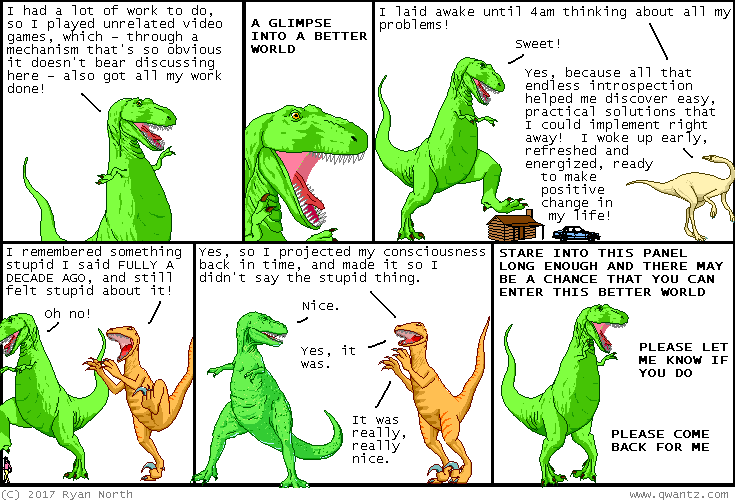
kindness COULD save them after all
| archive - contact - sexy exciting merchandise - search - about | |||
![]() |
|||
| ← previous | February 3rd, 2017 | next | |
|
February 3rd, 2017: Next week I will be in the UNITED STATES as part of a book tour! It's for Squirrel Girl but I'll also be happy to talk/sign anything else, INCLUDING Dinosaur Comics stuff! Wednesday Thursday and Friday in San Diego, Portland, and Seattle: the details are RIGHT HERE. – Ryan | |||
Some notes on the worst-case scenario
Confession time: I'm an optimist, especially about the ideas of social progress that emerged in Europe at the end of the middle ages and became mainstream in western politics in the early 20th century. I called the outcome of the Brexit referendum wrong (by underestimating the number of racist bigots and Little Englanders in the UK population: Brexit is a proxy for English nationalism, which is absolutely not the same as British nationalism), and I called the US presidential election wrong (underestimating the extent of gerrymandering and micro-targeted black propaganda driven by data mining in the campaign).
Since January 20th we've seen a degree and type of activity emanating from the new US administration that is markedly different from anything in my politically aware lifetime (loosely: since Reagan). Blanket bans on entry to the USA by anyone associated with certain nationalities, mass firings at the State Department, a president railing against a "so-called judge", the head of the Joint Chiefs of Staff being booted off the National Security Council and replaced by a white nationalist ideologue, and a former CEO of Exxon in the Cabinet: what's going on?
Let me pull on my pessimist's hat and advance the most scary hypothesis I can imagine that explains the current situation.
Please note that the following scenario assumes that what we are witnessing is deliberate and planned and that the people in Trump's inner circle actually have a coherent objective they are working towards. (I desperately hope that I'm wrong on all counts.)
Here's the thing: we are looking at an administration that is very clearly being operated on behalf of carbon extraction industries. Trump's cabinet picks are almost all climate change deniers. While there are some questionable exceptions--Tillerson has apparently conceded some human link with climate change--even those who are "soft" on climate change existing at all stand to benefit from interests in the coal and oil industries.
There is a huge asset bubble tied up in uncombustable fossil fuels--the carbon bubble. In addition, there is a base of approximately $70Tn ($70,000 billion--let that sink in for a moment) of installed infrastructure for processing fossil fuels and petrochemicals (with plastic and composite manufacturing being relatively small compared to packaging, shipping, and burning the stuff for energy).
Meanwhile, rival power industries are coming on stream rapidly. Solar power and electric cars could halt growth in fossil fuel demand as soon as 2020. The cost of solar has fallen by 85% in the past 7 years: by 2035 electric vehicles could make up 35% of the road transport fleet, and two-thirds by 2050. These estimates are conservative, based on the assumption that breakthrough technologies will not emerge to permit photovoltaic cells and battery capacities vastly better (or cheaper) than today.
It follows logically that if you have heavily invested in fossil fuels, time is running out to realize a return on your investment. Buying a US administration tailored to maximize ROI while fighting a rear-guard action against action on climate change and roll-out of a new, rival energy infrastructure is therefore rational (in business terms).
Russia and the Putin angle is best understood as part of this; oil and gas exports accounted for 68% of Russia's export revenues in 2013. The possibility that Trump is personally heavily invested in Rosneft via shell proxies while being at loggerheads with Merkel might be an inversion of the normal state of affairs in international relations for the past 70 years but is entirely consistent with the big money picture: Germany is trying to push (heavily) for renewable power (as well as generally being welcoming to refugees--see below).
It isn't possible for a US administration to make a ban on solar power and electric vehicles to stick globally. By its nature, solar will work well in equatorial regions, and these are where economic growth is currently focussed (China, India, and Africa all having huge population bases and demand for rapid roll out of infrastructure). Because PV is local, the need for capital-intensive centralized power stations and distribution grids is avoided: this will make it easier for Africa to catch up, just as the large-scale roll-out of telephony is sub-Saharan Africa has largely leap-frogged fixed wires and gone straight to cellular. Late adopters get better infrastructure.
Looking ahead, the carbon barons have to know that in 10-20 years time the USA will be stuck with obsolescent infrastructure and a loss of relative advantage if they pursue this course (although they, individually, will be a whole lot richer). What is to be done?
Let's consider the other strand of the Trump administration: white nationalist revanchism.
Without derailing into a close examination of the creed of this movement, I'm going to generalize by saying that the alt-right are overtly anti-muslim, anti-semitic from the grass roots up, and Steve Bannon is effectively setting foreign policy. (They're also anti- just about every minority group you can think of, including anyone who isn't neurotypical, able-bodied, conformist, and predictably supportive of their agenda.) Bannon believes in an existential war between Christendom and Islam; he doesn't believe in international institutions like the UN, NATO, or the EU (even though these were in most cases created by US foreign policy during the era of containment. What alliances the Bannon administration is building overseas are being made with extremists and neo-fascists. Trump appears to be attempting to destabilize Australian PM Turnbull, who is vulnerable to a back-bench challenge and is "soft" on immigration policy compared to such lunatics as Tony Abbott (his predecessor) or Pauline Hanson (and Australian immigration policy is an international disgrace). Trump seems to be happy to deal in France with Marine Le Pen, a court-confirmed fascist (she lost a libel case against a journalist who described her as such), or UKIP's former leader Nigel Farage (whose school habits included researching and singing old Hitler Youth drinking songs). And the authoritarian, homophobic strand in Russian politics is just another piece of the jigsaw.
To talk in terms of a white supremacist neo-fascist international doesn't seem extreme at this point. The fourteen signs of fascism are politically convenient to the carbon entrepreneurs. Fascism's disdain for facts plays well with climate change denial. It's elevation of nationalism above all other virtues helps anyone whose goal is to play divide-and-conquer, profiting by arbitrage of commodities trafficked across international borders (such as coal and oil and gas). And so, fascism is promoted and prospers under a carbon bubble bust-out regime.
But there's a more dangerous end-game on the horizon, once the oil men have packed their bags and retired to enjoy their riches.
Note that climate change denialism is a flag of convenience for the folks at the top. It's a loyalty oath and a touchstone: they don't necessarily believe it, but it's very convenient to fervently preach it in public if you want to continue to turn a profit.
If you believe in anthropogenic climate change but dare not admit it, you cannot be seen to do anything obvious to remediate it. But there is one remediation tactic you can deploy deniably: genocide.
We are on course to hit 10 billion people by the end of the 21st century, and although the second derivative of the curve of population increase is flat, our peak population won't begin to decline at this rate until well into the 22nd century. Estimates for the Earth's human carrying capacity vary and may be ideologically biased to support various conclusions; Malthusian ideas persist despite constant upward revision of the peak population. One thing is sure, for decades now other folks' population has been a political football. Thanks to the Green Revolution in agronomy we're well past the previously posited breakdown points of the 1960s.
I am going to posit that a foreign policy set by white supremacists in support of a carbon extraction regime is going to cleave to certain pseudo-scientific ideas, notably Social Darwinism (which isn't Darwinian, isn't social, and is fundamentally flawed as bad science) and Malthusianism (which has been used in the past as an excuse for tactics ranging from the innocuous--improving access to family planning and birth control--to the monstrous--conquest and genocide. And that last point brings us neatly round to Hitlerism.
While the gas chambers and extermination camps of the Final Solution get the most attention, people tend to forget that a large chunk of Hitler's plan for conquest, Generalplan Ost, relied in the short term on the Hunger Plan--to kill 20-30 million people in Eastern Europe and Russia by systematically stealing their food (to feed the Reich's own armies and slave workers who would be engaged in the enterprise of conquest)--and in the long term (post-war) on the systematic "removal" of 45 million more persons, nominally by exile into Siberia, but in practice probably by an extension of the already operating death camp system.
But the Neo-Nazi International won't need death camps in the 2020s to 2030s if their goal is to cut the world population by, say, 50%. Climate change and a clampdown on international travel will do the job for them.
Consider Bangladesh, and the Bay of Bengal fisheries collapse, not to mention the giant anoxic dead zone spreading in the By of Bengal (which means those fisheries won't be coming back for a very long time). There are nearly 170 million people there, mostly living on alluvial flood plains feeding into the gradually rising ocean. If the sea level rises by just one meter, 10% of the land area will be flooded; most of the country is less than 12M above sea level. It's a primarily agricultural economy (it's one of the main rice and wheat producing nations), heavily dependent on fisheries for protein to supplement the diet of its citizens.
Bangladesh can't survive the 21st century on this basis. It's vulnerable to devastating tropical cyclones bringing storm surges, and as the atmosphere heats, these are going to become more energetic. The loss of fisheries may cripple its ability to feed its population, even if temperature rises don't kill off the wheat and rice crops. Flood, famine, and storm look as if they will inevitably render a large part of the country uninhabitable within 50 years.
I see three possible responses:
A rational and humane response to this would involve attempts to: promote GM crops with increased heat resistance and increased bioavailable protein and micronutrient contents to repace the dying fisheries: promote female literacy, education, and access to healthcare (demographic transition correlates strongly with female education and emancipation): redeploy human capital to urban center construction in the northern highlands: invest in survival infrastructure (flood/weather shelters), and so on.
An unplanned, current-day response to this would be to provide ad-hoc famine relief and aid on demand, to wring hands when millions die in heat emergencies or super-cyclone storm surges, to prevent mass emigration by criminalization rather than by trying to make Bangladesh a more attractive place to stay, and so on. You know this scenario because we're living it today.
A white supremacist response to this would be to build a wall around Bangladesh--probably a "virtual" one patrolled by killer robots--and starve the inmates to death so they don't pump any more carbon into the atmosphere. After all, the residual carbon content of a dead foreigner is measured in single-digit litres.
All the pieces of the neo-Nazi solution to climate change already exist. Walls: look to the West Bank barrier or the Mexico-United States barrier for examples. Drones for border patrol are already a thing. The global crack-down on immigration by the developed world should need no introduction; there are loopholes (so called "Investor Visas") for anyone with six or seven digits in cash who wants to move freely, but these are generally out of the reach of even the western middle classes. (Free movement of labour as well as capital would defeat the core principle of arbitrage upon which economic imperialism depends.)
So here's what I expect to see if the alt-right get their way globally:
- The obvious stuff (the agenda dictated by the fourteen signs of fascism) is a distraction
- The real plan, in the short term, is to maximize the liquidation of capital investments in the carbon bubble on behalf of the principal shareholders
- Once the carbon bubble has deflated, the angry and impoverished citizens of the first world will be pointed at a convenient scapegoat--foreigners overseas
- A clampdown/shutdown on most international travel will ensue (hint: there's a reason Bannon et al hate the EU, and it's not economic: it's all to do with the bit about freedom of movement)
- Tighter controls on "immigration", enforced out of sight by killer drones, will replace relatively permeable frontiers with exclusion zones enforced by bullets and bombs
- Climate-change induced famine will replicate the intent of Hitler's "hunger plan", without the need for hands-on involvement by Western soldiers who might be traumatized by the requirement to shoot the surviving "living skeletons"
- A systematic genocide of the Middle East and the Islamic world (hint: that's where the eliminationist rhetoric of the islamphobes leads if you follow it to its logical conclusion) will reduce Earth's human population by up to 30%: other culls elsewhere will be enforced by containment of would-be migrants and the primary tool of murder will be famine and lethal heat waves.
- This will be presented to the citizens of the west as a "solution" to anthropogenic climate change for which they should be grateful, and framed as defending us from hordes of dark-skinned alien terrorists and asylum seekers who want to come to our lands and out-breed us and convert us to their weird and scary way of life and enslave our women (and you know the rest of this dismal litany of racism already, so I'll stop here).
Never say Nazis don't learn the lessons of history. This time round, the Final Solution to Anthropogenic Climate change will be entirely deniable! There are no gas chambers or Einsatzgruppen involved: any bullets will be fired by autonomous robots, without a human finger on the trigger, and will be an automatic reaction to an attempted border crossing, so not the fault of the perpetrators. The victims will have only themselves to blame, for being born in the wrong place, in the wrong century, and for failing to adapt, and for starving themselves, and for inviting the attention of the border patrol drones. It will be a slow-motion atrocity on a scale that dwarfs the Holocaust. And it is the logical conclusion of the policies our new fascist international overlords appear to be working towards implementing.
Please can you explain to me why I'm wrong to fear this outcome?
ASK me
Ken Provost sent me this…
Thank you for the lovely piece about Dan Spiegle. He was one of the best comic artists ever and didn't receive sufficient accolades and attention because he didn't work on Batman or the X-Men. I really like how you seem to have felt privileged to have so many opportunities to work with him.
I hope this question doesn't seem insensitive but as you are well aware, we are losing the comic book makers of his generation. No disrespect is meant to the many fine writers and artists who have come along since that generation's heyday but I can't help feel there was something different about the men and women who made the first thirty years of comic books. I would think you were in a unique position to observe what that was and I wonder if you could write a little about that. Thank you as always for the blog and the fact that yours doesn't keep nagging me to buy things, especially things based on my past browsing history.
Yes, there was definitely something different about the folks of whom you speak. For one thing, most of them got into comics because they loved doing that kind of work. Some got in to make a living while they aspired to something better and then were unable to get out. But no one started writing or drawing comic books because they thought it would make them rich or famous because even as late as the seventies, that did not seem possible. It would have been like getting a job as a guard in a men's prison because you thought it would make you a millionaire, plus it would be a great way to meet cute chicks.
At Comic-Con as you probably know, I've had the opportunity to interview a lot of comic book writers and artists of comics' early days and one recurring theme for me is a certain amazement that they have followers. Nick Cardy was practically moved to tears several times when he first came out to San Diego and had grown, adult professionals lining up to say to him, "I discovered your work when I was ten and I followed it and you were a big influence on me becoming a professional artist." Nick was especially stunned that people were asking for his autograph or offering him money to do commissions. All those years he was drawing Aquaman, he never dreamed it meant so much to so many.
One thing I've come to believe strongly about those writers and artists is that it's a mistake to leap from "I didn't like that guy's work" to "Obviously, that guy was just hacking it out for the paycheck." I would guess that was true of less than 5% of the talent in the generation of which we speak. There were a number of people whose work I didn't like but I came to see that it was not because they weren't trying to do good work. Some of them were trying like hell, spending hours on a page and redoing it and redoing it to make it better. They just weren't very skilled. And some of them were just egregiously miscast or misinstructed by their editors.
When you become aware of how poorly they were paid and how badly they were sometimes treated, it's amazing that so many of them drew and wrote so well and worked so hard at it. Very few guys who were paid the minimum did the minimum. At times, I find myself wondering not "Why was this one artist so bad?" but "Why were so many of the others any good at all?" That is still to me the defining question about the generation we're losing.
Got a question you want me to answer on this blog?
Send it here. No politics, no personal replies...
and tell me if you want me to leave your name out of it.
The post ASK me appeared first on News From ME.
This may herald the departure of one of Corbyn’s staunchest allies, and maybe even Corbyn himself
If he's losing the support of Diane Abbott then the end is nigh for Corbyn. https://t.co/YDmVVSw0Pc pic.twitter.com/bqU6aCoOOk
— TSE (@TSEofPB) February 4, 2017
If Corbyn’s losing the support of Diane Abbott then can the last Corbynite left please switch off the lights.
Perhaps I’m being overly dramatic, but if Corbyn’s losing the support of Diane Abbott, and she does leave the Shadow Cabinet over this, then a Rubicon will have been crossed for the leadership of Jeremy Corbyn. She’s always been one of his most passionate supporters, so much so that back in September 2015 Jess Phillips, the Labour MP for Birmingham Yardley, ended up telling Diane Abbott to ‘Fuck off’ after Diane Abbott had defended Jeremy Corbyn from criticisms by Jess Phillips.
But today’s Observer reports ‘Diane Abbott’s future in the shadow cabinet was in doubt on Saturday night after she failed to guarantee that she would vote to trigger Brexit negotiations in the Commons this week.’
One of the major assumptions of my betting strategy has been that Corbyn will be Labour leader until the next general election, now that assumption might be flawed. There are a few betting markets up on Corbyn’s departure date, I don’t think there’s any value in backing the 2/1 on Corbyn going in 2017 that William Hill have, but others might disagree.
If it does look like Corbyn might go, Mrs May might decide to hold an early election before Corbyn goes, the intricacies of the Fixed Term Parliament Act notwithstanding, again there’s probably no value in backing the 2/1 currently available on a 2017 general election.
There’s a great irony here, if Corbyn is toppled over his support for enabling Brexit, then he would be toppled over one of the few issues a majority of voters support him and his policies.
Diane Abbott’s migraine might well out turn out to be as important as John Major’s dental problems during the Tory leadership contest of 1990 that saw Mrs Thatcher toppled as Tory leader and Prime Minister.
TSE
3. Zinda Laash, aka The Living Corpse / Dracula in Pakistan (1967), dir. Khwaja Sarfraz
I watched it with
After watching the film itself, we then also watched two documentaries on the DVD, one interviewing the makers of this particular film and one about Indian and Pakistani horror films in general, which between them gave us a better picture of the industry, the people involved in it, where they were starting from and what they were trying to achieve. In essence, much like Hammer in the first place, Pakistani film-makers basically churned out stuff they thought would be fun without taking it too seriously, especially during the 1980s. But this particular film seems to have been an early attempt to take on the western Gothic horror genre, so of course it was produced by people who were not hugely familiar with its tropes and motifs. In some places that meant lots of creativity and vitality, but in others it just missed the mark - at least for us. I'm sure Pakistani viewers feel the same when they see westerners trying to take on their stories.
The plot for this film is very close to Hammer's Dracula, although an opening sequence sees the 'Dracula' character (here initially a human being called Professor Tabani) using classic movie 'sciencey-science' equipment (bunsen burners, conical flasks, long distillation tubes, etc.) to make an elixir of life. By implication, he expects to remain human but become immortal when he drinks it, but instead he dies and becomes an undead vampire! This of course picks up on the scientific feel of Hammer's own take on the vampire myth (at least in the first film), where Dracula cannot turn into a bat or wolf, and vampirism is presented as a contagion with symptoms similar to addiction. In fact, for all we know, Hammer's Dracula could originally have become a vampire in the same way - the issue is never explicitly addressed in their films. In Zinda Laash, though, it does get them into a bit of trouble later on in the story. The professor is supposed to be the first ever to have produced the elixir of life, and yet it turns him into a known creature called a vampire with known weaknesses (particularly sunlight). So the plot and dialogue vacillate a little between whether the characters involved understand the nature of what they are dealing with or not.
There is also a bit of a muddle around what the Jonathan Harker character (Dr. Aqil) and Van Helsing character (here, his brother) know or are motivated by in the early stages of the story. When Dr. Aqil arrives at Professor Tabani's house, he claims that he has just turned up on spec for no particular reason, and indeed Pakistani hospitality culture probably means he doesn't need to use any subterfuge to get in there in the way that Harker does by pretending to be a librarian in the Hammer film. Aqil then proceeds to take notes on odd aspects of the Professor's behaviour, and apparently knows enough about vampires to dispatch the Professor's female companion, while his brother later confidently explains to his fiancée's family that Aqil was turned into a vampire while at the Professor's house. So far, so in line with the Hammer film - we are meant to understand that they are vampire-hunters, and know the Professor's true nature from the start. Except that towards the end of the film, when they return to the area to try to rescue the Mina-character, they seem to need the man who runs the local bar to explain to them how the Professor became a vampire and how to destroy him. It is actually this bar-keeper who comes closest of all to playing the traditional expository Van Helsing role within the story, leaving me puzzled as to what Aqil and his brother actually did know at the beginning.
Anyway, things basically settle down to the understanding that the Professor is a vampire in the broadly normal sense of that term. But many of the usual western motifs of vampirism are missing, not least of course because the cultural context is non-Christian. Crosses are never used or mentioned, and nor in fact are garlic and wooden stakes. Instead, the Professor and his minions can be killed by stabbing them with a knife, shooting them with a gun or exposing them to sunlight. (This last of course provides the exciting climax, much as in the Hammer film, except that the Van Helsing character knocks the shutter off a window accidentally, rather than pulling down curtains deliberately). Hammer's comic relief characters (the undertaker, the frontier guard) are also utterly gone, but in their place we get lots of song-and/or-dance sequences, along the lines most of us are familiar with from Bollywood films (except of course that this isn't a Bollywood film, as it is Pakistani not Indian). These were incongruous on one level, as sequences like that amongst what is otherwise ordinary acting and dialogue almost always feel quite shoe-horned in, but also amazing and awesome in their own way, and in their very incongruity - especially the first one, which was the Professor's vampirised assistant doing a drapery-flouncing dance in order to seduce and bite the unfortunate Dr. Aqil. Very different from Valerie Gaunt's exceptionally English pretence at helpless victimhood in Hammer's equivalent scene.
The assistant is the first of three women to be attacked or pursued by the Professor, and I felt we learnt quite a lot about 1960s Pakistani fears around female transgression from all of them. Certainly, Omar Khan, himself a horror film director, explained in the documentary on the DVD that female victims in Pakistani horror films are always coded as transgressive - e.g. they have blonde hair or smoke cigarettes. In this film, the assistant's fate was pretty much sealed from the moment she entered the Professor's laboratory, found him absent, and immediately made a beeline for the drinks tray on the side to pour herself a glass. This didn't directly kill her, but it did come immediately before her discovering the Professor's prone body behind the sofa (and dropping the glass in shock), and then as soon as he had been buried and come back to life, she was the first one he went for. Later on, the Lucy character (Shabnam) dies not because she persuades the maid to get rid of the garlic keeping Dracula away (as per Hammer), but because she persuades the maid, who has been sitting watching over her in person, to leave the room altogether - i.e. she is left unchaperoned. And the Mina character (Shirin) gets into trouble because she goes off on her own and gets into a taxi, which of course turns out to be being driven by the Professor himself. So, yes, there are some pretty direct messages there.
The acting seemed strangely variable to my eye. Sometimes, it was very stagey and melodramatic, but sometimes characters showed no signs of the emotional responses I would have expected given the circumstances - e.g. people staking vampires like it was utterly routine and no biggy, or simply standing stock-still on their last mark while another character did or said something dramatic. I would need to watch it again to check whether this was a case of the same actors behaving differently in different scenes, or rather a matter of clashing acting styles. The soundtrack music was also very varied, ranging from traditional-sounding Pakistani music during the song-and-dance routines, to cheerful popular music in exterior travel scenes and lots of ripped-off cues from James Bernard's original Hammer Dracula soundtrack during the most Gothic scenes. Lovely though this was to hear, it sometimes missed the mark for me by using the music 'inappropriately' - e.g. using slow, creepy music for chase scenes, or dramatic action music for seduction scenes. But that's what is bound to happen when you are not deeply familiar with a musical genre and it all sounds generally western and Gothic to you. Again, I'm sure westerners would make the same sorts of mistakes with what they perceived simply as 'Bollywood music'.
The cinematography was generally pretty impressive, with some nicely-composed shots and effective chase sequences, as well as particularly good use of a crumbling old-fashioned building for the exterior shots of the Professor's house. The main action of the film is set in the 1960s (another departure from Hammer), but this building looked like it might be a left-over relic of the colonial era. I'm not well-enough versed in Pakistani architecture of any kind to be sure, but if so that added some excellent resonances to the motif of vampirism. The Professor himself was Pakistani, rather than white British, which would have ramped the symbolism up all the higher, giving us the vampire as an undead remnant of the former colonial power, still haunting the land a generation after the Raj itself had been expelled. But still, just situating him within that setting hinted at the issues without overdoing it, while affording us some nice shots of crumbling brick-work in the process.
Overall verdict - a fascinating watch, for which I'm grateful to DracSoc chair Julia Kruk for the recommendation, and which has made me curious to explore the world of Pakistani horror and fantasy a little further.
Click here if you would like view this entry in light text on a dark background.
Frictionless border with Ireland impossible after Brexit, government is told.
FAIL TRUMP
A Law Student’s Guide To Free Speech (and what it isn’t)
Here are some of the main sources of the basic human right to freedom of expression:
- Universal Declaration of Human Rights Article 19 (N.B. This is not technically binding law, although many aspects now form part of customary international law)
- International Covenant of Civil and Political Rights Article 19 (this one is the legally binding version of the UDHR, hence the extra detail; note in particular the mention of “special duties and responsibilities” and restrictions such as to protect the rights of others)
- In Europe, European Convention of Human Rights Article 10 (again note the similar restrictions – at least for now, this is available in UK law through the Human Rights Act 1998, with Section 12 giving particular protection to freedom of expression)
- In the USA, the First Amendment to the United States Constitution (full disclosure: I’m British, I’ve never actually studied this)
Freedom of expression is formulated slightly differently in each of those documents so I’d encourage having a look for yourself, but basically, it means everyone has the right to hold and express opinions without interference from the state. This interference might include:
- Threatening to defund institutions in response to protesting
- Ordering the censorship of objective facts about climate change
- Withholding funds from organisations providing information on abortion (Incidentally, an outright ban on providing such information in Ireland has been deemed to violate ECHR Article 10, see Open Door v Ireland, although the Mexico City policy is based on funding rather than outright restriction)
Freedom of expression means you are free to express your views in general, but it does not give you a right to specific private platforms or audiences. If I invited you into my room and you started yelling abuse at me, I could kick you out without violating your freedom of expression – you remain free to yell abuse everywhere else. Indeed, if I invited you into my room and you do nothing wrong but then I have to go to class, I could kick you out and end the conversation with me without violating your freedom of expression – you remain free to express yourself to everyone else. In fact, I don’t HAVE to invite you in at all – you can still hold and express opinions, you just have to do it outside or somewhere else. The same principle would apply if my space was virtual and my name was Twitter.
Here are some other things free speech does not include:
- An invitation to speak at a university event
- A major film screening (yep, Andrew Wakefield is still trying to push his anti-vaccine narrative…)
- A Twitter verification tick
These are privileges; the majority of us won’t ever receive these privileges, but that doesn’t mean we’ve all lost our rights to free speech!
As noted above, the right to freedom of expression protects against interference from the state – it cannot be violated by private parties. Having said that, it’s true that some private actions might impede a person’s ability to express themselves freely even though this cannot amount to a legal violation of freedom of expression, for example:
- LITERALLY SHOOTING A PROTESTOR (funny how that’s received less attention than poor little Milo being denied some kind of right to a privileged university platform…)
- Co-ordinated harassment designed to force someone away from a platform that they are currently permitted to use
Neither of those violate the right to freedom of expression (although they may violate other laws), but you could certainly argue they go against the general spirit of why freedom of speech is so important.
Which begs the question – why is freedom of speech so important? There are various reasons for this. Firstly, there’s the importance of self-expression for developing autonomy and self-fulfilment (although it’s probably worth mentioning at this point that media corporations are not human beings developing autonomy and self-fulfilment). Then there’s the argument based around democracy – in a democratic society, we should be able to hear a wide range of views in order to evaluate them ourselves as opposed to, say, far-right white men shouting everyone else down and creating an atmosphere hostile to other voices.
This is where those restrictions I mentioned earlier come in – at least at a UN and European level, a proportionate, legal restriction on freedom of speech is permitted where this is necessary for a specific list of aims – both the ICCPR and ECHR include the rights of others in this list. A common example of a situation where this balancing is needed is the tension between freedom of the media and the right to privacy of the individual they are reporting on. However, some speech can also reinforce or increase existing damage to the rights of others; for example, trans people are already at high risk of sometimes fatal violence and are frequently denied healthcare, and high-profile transphobic speech (such as this high-profile transphobic speech…) perpetuates the belief that these human rights violations are acceptable. So transphobes may have a right to express their hatred, but this has to be balanced against the rights of trans people to, in many cases, literally continue to exist. I don’t imagine freedom of expression would prevail there.
Basically: All free speech really means is that an opinion is legally allowed to exist without state interference. And if the best defence of an opinion you can think of is “it’s legally allowed to exist”, perhaps it’s time to start looking around for some better opinions.
prepping as a fandom
There’s been a rash of pieces on preppers of all kinds, for obvious reasons. There are rich tech CEO preppers, liberal preppers, fictional preppers, but my favourite kind of prepper is the mum prepper:
“All the websites are the same!” Bedford exclaims from the driver’s seat of her pickup, which she’s piloting with ease through the sea-like puddles of rain, the hum of talk radio droning in the background. “They’re all very, very male-oriented, and those men are much more into the idea of protection. They’ll spend hours debating firearms. But I read something like that, and I think, I know most of you have wives and girlfriends, so where do they come in? You’re sitting here debating the right kind of specific specialty tool for your bug-out bag, but what about your wife? Could she really haul a 45-pound carry? What about your kids? What are you going to do when your autistic son won’t eat anything but Cheerios and mac ‘n’ cheese three meals a day, and now you have to get out of the house?”
She’s the only person I’ve seen who seems to think about people other than herself, a rarity in what otherwise seems like an intrinsically selfish activity. I mean, it’s still selfish, but it’s a lot better than the farm-in-New-Zealand crowd.
A deal with the devil: embracing complicity, abandoning principle
The Big Idea: Jess Nevins

One day author Jess Nevins decided to see how far back the origin story of “superheroes” went — it wasn’t Batman or Superman, folks — and the answer to the question (or the answer he arrived at) was both further back in time and more complicated than he could have ever expected. The result: His new book, The Evolution of the Costumed Avenger. And also: This Big Idea piece.
JESS NEVINS:
The Big Idea behind The Evolution of the Costumed Avenger was my attempt to answer a long-running question in the comic book community: where did superheroes come from? In my Encyclopedia of Fantastic Victoriana I had said that the superhero arose not out of twentieth century cultural movements and dynamics and cultural trends, but out of nineteenth century movements, dynamics, and trends. (Sorry, partisans of Johnston McCulley and Baroness Orczy, but it’s true: Zorro and the Scarlet Pimpernel were inheritors of a tradition, not inventors of one).
But when I was observing the latest in attempts to answer this question and was shaking my head (more in sorrow than anger) at the answer given, it occurred to me that perhaps my answer wasn’t that much better, and that I hadn’t give the question its due. Did the superhero come from the nineteenth century? That’s how I’d written it, back in 2004–but was there more to it than that? Did the superhero’s roots lie deeper still, and farther back than Victoria’s reign?
It’s rare that one gets or takes the opportunity to correct Internet Misinformationtm in print, and I intended to treat the question seriously in a reasonably-sized monograph, but as I soon discovered, the question of the superhero’s origins isn’t easily answered to anyone’s satisfaction. First I had to define what I meant by a superhero, something that proved to be surprisingly tricky. (For every definition of what a superhero is, there are exceptions to it. Every definition. Yes, even yours). After a lot of thought I came up with a better way of approaching the matter of definitions, but simply writing out that new method took up most of chapter one. (And I hadn’t even gotten started on the history of superheroes yet!)
The big problem, I quickly discovered, is that there’s no real starting point for something like this. After I’d run back through the pre-Superman superheroes of twentieth century popular culture, and back through the superheroes of nineteenth century popular culture, I discovered that the eighteenth century had its share of proto-superheroes, those extraordinary characters who have most if not all of the elements of the superhero but which appeared before Superman’s debut. And these eighteenth century proto-superheroes were influenced by characters from the seventeenth century, who in turn were derived from the heroes of the sixteenth and fifteenth centuries.
And then I reached Robin Hood, a significant proto-superhero, who is the most famous of the noble outlaws of the Middle Ages–not the only one, merely the best-known. And beyond the noble outlaws are the knights of King Arthur, and beyond them are El Cid and the heroes of medieval epics and ballads, and then Roland and Beowulf and the Alexander of the Alexander Romance…
…and so on and so forth, always working backwards, always tracing influences, until I reached the first major work of literature in human history, The Epic of Gilgamesh. (By now I’d abandoned all idea of my “History of the Superhero” being either reasonably-sized or a monograph). Gilgamesh as the first superhero? Okay, cool, that would make a good beginning for what I now knew would be a sizable book.
Except–and here was the part that complicated the writing of the book–I had to take a good look at Gilgamesh, the way I did at all the proto-superheroes, and I concluded that he made a great epic hero but not a particularly good superhero. Briefly: he lacks what we would think of today as a heroic, selfless motivation. Gilgamesh is a great epic hero, but not a great person–not “heroic” as we’d now think of it. Gilgamesh’s sidekick and B.F.F. Enkidu, on the other hand, has the selfless motivation as well as the other elements of the superhero.
So Enkidu it was, to begin with, and after him the major heroes of literature and popular culture. But research on a subject like this is exponential and fractal; there’s always more of it to do, more items of interest or awesomeness to discover, more connections to make, more inferences to draw. So I found out about the latrones, the heroic outlaws of ancient Rome (and the forefathers of Robin Hood). And about Nectanebo II, last pharaoh of Egypt’s Thirtieth Dynasty and the ancestor of every heroic sorcerer in comics. And about the delightful Mary Frith, grandmother of Batman and every other urban vigilante. And about medieval proto-superheroines of color; if Enkidu was the first POC superhero, the “lady knights” of the middle ages were the first POC superheroines. And about Talus, the first heroic android (and from the sixteenth century, to boot!).
And so on. It all turned out to be more fascinating and complex than I’d ever anticipated. Superheroes didn’t evolve linearly; they are a river with many tributaries, whose source lies four thousand years ago but whose individual elements are disparate and widely scattered in time and place. That’s what I hope readers take away from The Evolution of the Costumed Avenger (I mean, besides the fact that Mary Frith was freaking cool): that the superhero is neither American nor twentieth century–nor white or male, for that matter–but belongs to everyone, and has deep, deep roots in human culture.
—-
The Evolution of the Costumed Avenger: Amazon|Barnes & Noble|Indiebound|Powell’s
Read an excerpt. Visit the author’s blog. Follow him on Twitter.