| archive - contact - sexy exciting merchandise - search - about | |||
 |
|||
| ← previous | April 12th, 2017 | next | |
|
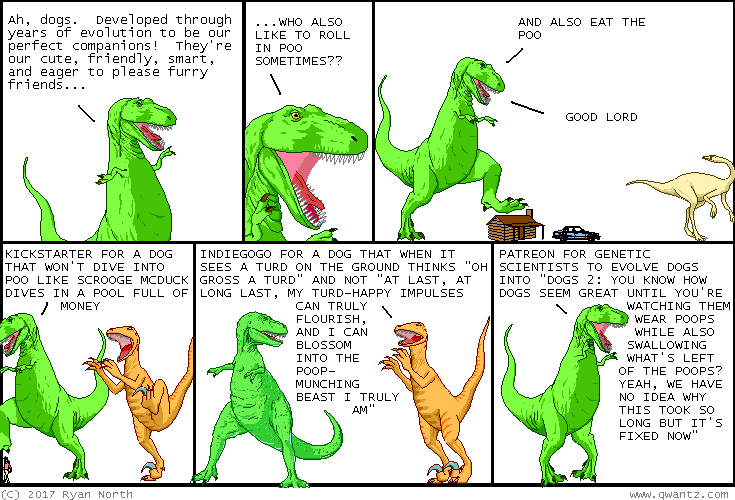
April 12th, 2017: okay maybe this one was based on a true story, and it's possible I only post pictures of my dog when he's looking cute and hide all these other "incidents"?? – Ryan | |||
Andrew Hickey
Shared posts
13 Apr 22:27
comics which are MAYBE inspired by a weekend in which chompsky the dog had a GREAT TIME and i had significantly less of a GREAT TIME
12 Apr 12:55
2117 revisited
by Charlie Stross
Where are we going to be, a century from now?
Let's go back and chew on this old bone again--from a different angle.
Let me first eliminate from discussion a bunch of possible outcomes I'm not interested in examining. Total human extinction could happen in a variety of ways, ranging from wars over access to scarce resources (idiotic, but it's something humans have prior form for), to plagues, to the collapse of agricultural viability on a global scale due to climate change, sudden catastrophic collapse of unrecognized critical infrastrcture (e.g. the single factory in Bangladesh that makes the cheap quantum computer chips everyone uses to get around the central planning problem is taken out by a Cat-6 Typhoon: this causes a cascading loss of efficiency in global supply chains, leading to ...) to an asteroid mining operation gone horribly wrong. But scenarios in which everyone is dead are not currently interesting to me, as a fiction writer.
Let's also ignore transport technology, Mars colonization, climate change, the shift to non-carbon energy sources and distribution, how the hell the west will survive the shift to robotic labour (I'm assuming that by 2117 we'll have robots that can make a good stab at changing the bed linen, which is just about the acme of low-paid but algorithmically intractable jobs right now). I mean, if we're currently hearing billionaires discussing the merits of a universal basic income system, I think that tells us where the SS Titans of Capitalism is trying to steer to avoid the iceberg ...
What new fun things can I project that are both plausible, likely, and didn't feature in my earlier prognostication set a century out?
Everyone's currently focussed on anthropogenic climate change and the in-progress mass extinction. Despite the odd attempt at resurrecting extinct charismatic megafauna, the folks focussing on de-extinction of mammoths aren't talking about raising the ghosts of mammoth lice and mammoth tapeworms; only bits of the gone-away biosphere are up for revival, like preserving the frontage of a 19th century building embedded in a modern glass-and-steel office cube. Similarly, there's another extinction event going on quietly in the background: languages are vanishing, and to the extent that we can only reason about things we have words for, this may be a subtle but far-reaching loss. In fact, language is just one aspect of human culture, and what's going on in the background is a mass extinction event of variant human cultures,and their replacement by a handful of global mega-cultures. From here in the west it's easy to point the finger at Arab/Sunni islam as a rival (perceived as hostile) culture; but there's a state-supported marketing push behind it, and it's not the only one: fish don't notice the water they swim in, and our own culture is also aggressively expansionist. (Note: justifying the western free market/capitalist hegemonic system on the grounds that it brings prosperity is all very well, but it only brings prosperity to the survivors: and since 2007 it has increasing brought prosperity to an ever-smaller elite at the very apex while conditions stagnate or decline for everyone else.)
So here's a projection: by 2117, there's going to be a marked decline in the diversity of ideological and social systems in which we live, brought about by faster communications and the forced spread of the most aggressive societies. The apex societies will be mixed at ground level--there will be plenty of places where followers of religion A rub shoulders with members of economic system B--but they're still hegemonic ideologies, and there will be friction where they rub up against each other. There's also going to be a decline in the number of languages spoken: the main world languages will be down to English, Mandarin, Spanish, and some dialect of Arabic (Arabic is highly fragmented), plus surviving secondary languages with large bodies of adherents (over a hundred million each: for example German, Russian, Japanese).
We're also going to see the widespread deployment of deep learning driven machine translation and, most importantly, near-real-time interpretation. There'll be less reason for a native speaker of an apex language to learn other tongues simply because such a language gives direct access to over a billion other people and translation between apex languages will be at least as accurate as translation between English and Donald Trump speeches at this time.
And the apex languages will have changed considerably.
This goes beyond picking up new vocabulary (imagine a time traveller from 1917 trying to follow a discussion about viewing youtube videos of cruise missile strikes on ISIS positions in Syria on iPhones: the grammatical structure is accessible but a lot of the noun parts cannot be clarified without a dizzying deep dive into unimagined-in-1917 new technologies). Let's consider English--which I expect will still be around as a trade language, at least, simply because it's already so widespread. We're already seeing a shift towards simplified spelling (as practied in the US dialect) and towards abandonment of some punctuation forms; the semi-colon may be on the way out, as is the plural apostrophe, just as a number of characters used in old English (the thorn or "y"-like character, for example) vanished. More controversially English: is going to acquire a new writing system. Not all languages use a single alphabet; consider Japanese, with its eclectic mixture of syllabaries (hiragana and katakana), logographic ideograms (kanji), and romanji (roman alphabet, mostly used for loan words), not to mention arabic numerals. English currently has about three main writing systems (if we exclude shorthand notations, now a dying form, and Braile): we have roman block lettering in upper and lower case, we have arabic numerals, and we have cursive handwritten forms (also now slowly dying out). But a fourth English form is rapidly emerging in the shape of emoji, which I think are best viewed as a secondary ideographic written form optimised for visually dense text on display devices. Emoji are pared down and lack a bunch of the characteristics we associate with English grammar such as tenses and punctuation and verb conjugation ... but that's not what they're for. I suspect that over the next century (assuming we don't lose our technological infrastructure) current mechanisms for writing will be supplanted by newer ones--e.g. the replacement of discrete mechanical keys on keyboards with multitouch keyboards and then with gestural/swipe interfaces, where each dictionary word is replaced by a directional ideogram swiped across a QWERTY keymap, until eventually the ideogram replaces the alphabetic word or is auto-replaced by a corresponding emoji.
So: gradual obsolescence of some grammatical forms, appearance of entire new writing systems, unforseen changes due to the vagaries of machine translation, assimilation of loan words from other cultures, and the 2117 equivalent of "don't drone me, bro" (new shorthand to describe stuff that has become the new normal).
What am I overlooking?
12 Apr 10:46
Corbyn: not there on LGBT
by Jen
Interestingly, Jeremy Corbyn has just launched his plan for LGBT+ rights.
Now that's a welcome thing, as I want for even people who are off to the right of me politically like Jeremy Corbyn and George Osborne to support LGBT equality.
But on reading it... well, it reminds me of the left-right coalition's "LGB&T Action Plan", only without the excuse of having to be written in a hurry by people having to crib their info off a Stonewall report whilst attempting to avoid alienating Peter Bone too much.
Because "Proud of our Diversity" is a classic of the bi-erasure genre. Throughout we are told about the LGBT+ community and the LGBT+ agenda, and a scattering of talk of homophobia and transphobia, of lesbian, gay, and trans, but there is not a single use of the words "bisexual" or "biphobia" anywhere in the document.
Jeremy's strategy is, sadly for the rest of the country, to relive the early 1980s, and while he's apparently got on board with trans inclusion, the LGB content here reminds us merely of what was so crap about gay politics back then.
Try harder, Jez.
Now that's a welcome thing, as I want for even people who are off to the right of me politically like Jeremy Corbyn and George Osborne to support LGBT equality.
But on reading it... well, it reminds me of the left-right coalition's "LGB&T Action Plan", only without the excuse of having to be written in a hurry by people having to crib their info off a Stonewall report whilst attempting to avoid alienating Peter Bone too much.
Because "Proud of our Diversity" is a classic of the bi-erasure genre. Throughout we are told about the LGBT+ community and the LGBT+ agenda, and a scattering of talk of homophobia and transphobia, of lesbian, gay, and trans, but there is not a single use of the words "bisexual" or "biphobia" anywhere in the document.
Jeremy's strategy is, sadly for the rest of the country, to relive the early 1980s, and while he's apparently got on board with trans inclusion, the LGB content here reminds us merely of what was so crap about gay politics back then.
Try harder, Jez.
11 Apr 20:44
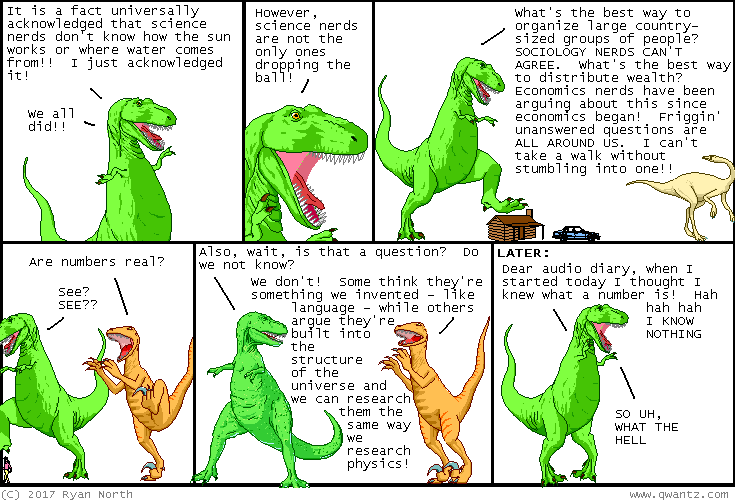
whoah this comic really did a... number on me
| archive - contact - sexy exciting merchandise - search - about | |||
 |
|||
| ← previous | April 7th, 2017 | next | |
|
April 7th, 2017: I wanted to thank Thomas for the email about how French rap changed her life, drastically altering the course of her entire existence for the better!! I always suspected that these things were possible with French rap, but it was really nice to see it confirmed! – Ryan | |||

11 Apr 19:13
The Tory GE2015 expenses probe could have been the reason that the party’s been polling the LD seats it gained
by Mike Smithson

The blue team taking precautionary measures in case of possible by-elections?
Last week there were a number of stories sparked off first by George Eaton in the New Statesman about a series of private Crosby Textor polls that the Tories are said to have commissioned in many of the 27 seats that were gained from the LDs at GE2015.
The reported polling results suggested that the Tories would struggle to hold onto all but a small handful of them. The hugely successful message that the Crosby campaign used at GE2015 about not letting in a Miliband government that was in hock to Alex Salmond was not now relevant and the Tories would find it hard to develop a new message with anything like the same potency.
The assumption was that Tories had carried out the polling ahead of a possible early election and this was merely scoping the ground.
-
Now PB is being told that the reason for polling these seats was nothing to do with that but out of worries about where the expenses probe, first highlighted by Channel 4 News, was going.
If these went to court it is possible that some GE2015 seat outcomes could be discarded and there would have to be fresh elections in the constituencies. Mrs May’s majority is so small that it wouldn’t take many such losses for that to be wiped out.
Decisions on the next stage of the probe are expected soon from the Crown Prosecution Service.
Mike Smithson
10 Apr 21:31
More of those who actually vote in local and general elections went for REMAIN not LEAVE
by Mike Smithson

LEAVE won because of its success with the politically disengaged
It has become very common since the referendum to view all other elections through the prism of what happened on June 23rd last year. Thus parliamentary constituencies are divided into leave or remain depending on how they voted and this becomes the shorthand for describing a place.
We are told, for instance, that twice as many Labour MPs are in constituencies that voted leave than remain leading, I would suggest, to Mr Corbyn’s ambivalent attitude towards the result and to the process following on from that.
-
When you dig deep into what polling data exists it is clear that the Brexit split in a particular area is far from a reliable guide to current political behaviour.
A major issue is that leave was highly successful in securing the support of those who are most politically disengaged. These are those who say they have no strong party identification and little or no interest at all in politics.
The table above, prepared by Professor John Curtice based on National Centre research, shows the split between what people did at the general election and what they did at the referendum based on the level of interest in politics and the strength of their party identification period. He writes:
“Those without much interest in politics and those who do not identify with a party were much more likely to have voted for Leave than those with an interest in politics and those with a strong party identity. No less than 64% of NatCen’s panellists with little or no interest in politics who voted in the referendum backed Leave, whereas amongst the remainder there was a small majority (53%) in favour of Remain. Similarly, as many as 72% of those who do not identify with a political party voted for Leave, whereas again, amongst the remainder of the sample Remain (52%) was slightly ahead..”
So the data suggests that those who vote in local/general elections are more likely to be remainers and, I’d suggest, that this is more pronounced with elections such as local ones and Westminster by-elections where turnout is markedly down on the general election.
Mike Smithson
10 Apr 12:42
Len McCluskey thinks LAB could be in government after GE2020 – a pipe dream or a possibility?
by Donald Brind

Don Brind on where the UNITE boss is right and where wrong
Len McCluskey is right. Labour could be back in government as a result of the 2020 General Election. I agree with the Unite leader that while there’s little chance of Labour winning the election there’s a decent chance that the Tories will lose it.
McCluskey is rather more emphatic than me: “ I don’t think the Tories will win the next election. They might be the largest party but I don’t think they will be able to form a government,” he told the Observer What he foresees is a minority government supported by the Liberal Democrats and the SNP.
With Labour languishing in the mid 20s in the polls and trailing the Tories by up to 18 points that many will think Len and I have taken leave of our senses.Theresa May looks impregnable.
But then so did Sir John Major in 1992. BBC Parliament is giving us Labour masochists the chance to relive the trauma of that defeat when Major he garnered a record 14 million votes to see of the challenge from Neil Kinnock. . Perhaps the channel should now think about re-running coverage for September 16th 1992 — “Black Wednesday. Less than six months after his victory Major’s government imploded – and Europe was the issue.”The UK was forced out of the Exchange Rate Mechanism damaged the Major government’s economic credibility beyond repair.
And like Len McCluskey I suspect the Theresa May’s is much more fragile than it looks. I aired my hostility to her policies in my last post here.
Her current popularity could be tested by underfunding of the NHS and schools as well as the continuing sharp squeeze on living standards and, of course, Brexit.
Then there the signs of a Lib Dem recovery, which according to the New Statesman’s political editor George Eaton is worrying Tory MPs. He says,
“The MPs’ fears, I can reveal, were later reinforced by private Conservative polling. According to multiple sources, a survey conducted by Crosby Textor showed the party would lose most of the 27 gains they made from the Lib Dems in 2015, including all those in south London, all those in Cornwall and most of those in Devon.”
Those gains were crucial to May’s Commons majority of 16 – which is, of course, smaller than Major’s in 1992.
This is where I part company with the Unite leader. If it’s governments that lose elections the Opposition has to be ready to profit. McCluskey thinks Jeremy Corbyn should be given more time to prove he can win over the voters. I believe this is impossible. Voters in general, and workers class voters in particular, have made up their minds. They don’t see him as a Prime Minister.
Electing a new leader is the ultimate game changer. Look at Germany where, as the Guardian reports, the advent of Martin Schultz, “has already seen the SPD, after nearly two decades in which it has haemorrhaged support, boosting the number of its card-carrying members by thousands, while polls have shown voter support has risen by about 10 points.”
The sooner Labour gets the chance to find its Martin Schultz the better.
Don Brind
09 Apr 20:04
Can Vladimir Putin make Jeremy Corbyn Prime Minister?
by TSE

Picture: Vladimir Putin meeting French Presidential candidate Marine Le Pen.
If Putin made Donald Trump President why couldn’t Putin make Corbyn PM?
For us political gamblers one of the things we’re now having to factor in to our bets is which candidate or party is Vladimir Putin backing.
It just isn’t those gamblers who wear tin foil hats who are wondering about this. Even that well known Democratic Party member and liberal snowflake Dick Cheney recently commented that
Russia’s alleged interference in last year’s US presidential election could be considered “an act of war”, according to former US Vice President Dick Cheney.
Mr Cheney, who was George W Bush’s deputy between 2001 and 2009, said there was “no question” that Vladimir Putin had attempted to influence the election outcome.
“There’s no question there was a very serious effort made by Putin and his government, his organisation, to interfere in major ways with our basic fundamental democratic processes,” Mr Cheney said during a speech at a business conference in New Delhi, India.
“In some quarters, that would be considered an act of war. I think it’s a kind of conduct and activity we will see going forward. We know he’s attempted it previously in other states in the Baltics.
“I would not underestimate the weight that we, as Americans, assign to the Russian attempts to interfere with our internal political processes,” he added.
US intelligence agencies have claimed Moscow was responsible for several hacks on computers belonging to the Democratic Party and senior members of Hillary Clinton’s campaign team – the contents of which were later released by Wikileaks.
With the picture atop this thread shows what many perceive as Putin’s interference in the French Presidential election, which this week culminated with France’s polling watchdog warning Russia organisations to stop meddling with the polling/reporting in the election.
The events in Syria have resulted in UK/Russian relations deteriorating with Russia mocking Boris Johnson you can see why Putin might prefer a different government in the UK, especially with an opposition party leader and staff who even Labour MPs are accusing of being pro Putin/Russia.
Stop criticising Corbyn's slow response: it takes time for Seamas to run the draft statement by the Kremlin, Stop the War + the Morning Star
— Michael Dugher MP (@MichaelDugher) April 7, 2017
So Vladimir Putin could well be Jeremy Corbyn’s Tenzing Norgay as Corbyn attempts to climb the electoral Everest that is winning a general election. I mean we’ve seen it before, a candidate with appalling personal ratings, loathed by his party establishment, but believed to be backed by Putin won the election. Jeremy Corbyn might just be the British Donald Trump.
TSE
09 Apr 11:38
The Zombies, or so conventional wisdom has it, never performed any of the songs from Odessey and Oracle live until their recent, well-received concert performances of the whole album.
As this live recording for a BBC session shows, that isn't wholly true.
The song is introduced by Brian Matthew, who died yesterday.
The Zombies: Friends Of Mine
by Jonathan Calder
The Zombies, or so conventional wisdom has it, never performed any of the songs from Odessey and Oracle live until their recent, well-received concert performances of the whole album.
As this live recording for a BBC session shows, that isn't wholly true.
The song is introduced by Brian Matthew, who died yesterday.
08 Apr 20:22
Asperger's Syndrome, Diagnosis and the Genetic Link
by Gavin Bollard
I was recently asked about my diagnosis and about the whole genetic link in Asperger's Syndrome. I thought I'd already answered this somewhere on the blog but when I didn't find it, I figured that it was something that I should clarify.
 Yes, I do have Asperger's syndrome. I also have a son, currently aged 16 with Asperger's and NVLD and ADHD(I). I have a second son with HFA but since he's very verbal, even more son than his older brother, it's clearly Asperger's now... or would be if the diagnosis of Asperger's still existed.
You can find out more about my family and I on the "About page" and you can find out more about me specifically via my four part introduction.
See here for Parts One, Two, Three and Four.
Part four in particular talks about diagnosis.
Being good parents, we read a lot of books of Asperger's but what was interesting is that we read them completely separately. I read during my transport to and from work, while my wife read at home while I was at work. We didn't talk about it until we were mostly through the books.
 I couldn't see anything odd or different about my son. He was very normal to me. In fact, he was "more normal" to me than most kids his age.
He was doing everything that I did at his age. The books described me far more than they described my son and for a little while I wondered if somehow my "wrong" parenting was rubbing off on him and changing him.
When we finally got back to talk about our books, my wife's first words were; "this book is about you".
We got our son diagnosed but kept reading.
It was another six months or so before I decided to talk to the psychologist. By then I had read a few more books and I was pretty sure of my diagnosis. So, apparently was the psychologist. He'd met me a few times before and said that he'd known from the start.
When my youngest was born, we fully expected that he had a chance of being on the spectrum and we recognised the signs from an early age even though he was (and at 13, still is) vastly different from my older son.
There's absolutely no doubt in my mind that there's a genetic link and that it's a strong one. Over the years, I've met quite a few people on the spectrum, particularly during my five year stint as a scout leader. In those years, I got to know the kids very well before getting to know their parents. I would usually know which kids were on the spectrum long before they were diagnosed and I would nearly always see the signs in one, sometimes both, parents.
Sometimes I'd know that a child was on the spectrum and I'd meet their father and think... "no, he's definitely not on the spectrum" .... and then months or years later, I'd meet their mother, and I'd see the signs immediately.
 Co-conditions, particularly ones which aren't "fully-fledged" are very good indicators. If a person has fully-fledged OCD for example, they tend to allow it to rule their lives. It becomes extremely difficult for them to leave the room because there are so many leaving rituals which need to be performed, so many doors which have to be closed a certain way, footsteps which have to be repeated to end on an even number and so on.
A person with an OCD co-condition that isn't fully fledged, can have some disorder in their lives but they will still have rituals.
They may still require specific pockets of order, for example, they may sort their shelves very specifically or alphabetise their collections but OCD doesn't rule their lives. It doesn't prevent them from living their lives normally.
Asperger's rarely travels alone. There are nearly always co-conditions such as ADHD, Dyslexia, OCD and Bi Polar disorder and these are usually what people notice first. It's these co-conditions that make Asperger's particularly difficult to diagnose.
At the same time, if you look for the co-conditions, you'll quite often find the "aspie".

You can find out more about my family and I on the "About page" and you can find out more about me specifically via my four part introduction.
See here for Parts One, Two, Three and Four.
Part four in particular talks about diagnosis.
"This Book is About You"
In a nutshell though, my eldest child was diagnosed at 5. His differences were picked up by his teachers who met with us several times and who kept saying to my wife with pointed looks towards me; "the apple doesn't fall far from the tree". I had no idea what they were talking about.Being good parents, we read a lot of books of Asperger's but what was interesting is that we read them completely separately. I read during my transport to and from work, while my wife read at home while I was at work. We didn't talk about it until we were mostly through the books.

He was doing everything that I did at his age. The books described me far more than they described my son and for a little while I wondered if somehow my "wrong" parenting was rubbing off on him and changing him.
When we finally got back to talk about our books, my wife's first words were; "this book is about you".
We got our son diagnosed but kept reading.
It was another six months or so before I decided to talk to the psychologist. By then I had read a few more books and I was pretty sure of my diagnosis. So, apparently was the psychologist. He'd met me a few times before and said that he'd known from the start.
Genetics
The books made the whole inherited part fairly clear but I couldn't see a family connection at first. After all, my father was just my father and I had more in common with my uncle. My uncle liked similar (techy) things to me but apart from that he simply didn't fit the profile. I later talked to my parents about my grandfather whom I didn't know well enough because he was older and too unwell by the time I knew him. That was when I realised that he fit the profile of Aspergers. I then re-evaluated my father as a "person" rather than as "my dad". I watched him meeting new people and I watched him in conversations with family and friends. It was there all along, I'd just never noticed it.When my youngest was born, we fully expected that he had a chance of being on the spectrum and we recognised the signs from an early age even though he was (and at 13, still is) vastly different from my older son.
There's absolutely no doubt in my mind that there's a genetic link and that it's a strong one. Over the years, I've met quite a few people on the spectrum, particularly during my five year stint as a scout leader. In those years, I got to know the kids very well before getting to know their parents. I would usually know which kids were on the spectrum long before they were diagnosed and I would nearly always see the signs in one, sometimes both, parents.
Sometimes I'd know that a child was on the spectrum and I'd meet their father and think... "no, he's definitely not on the spectrum" .... and then months or years later, I'd meet their mother, and I'd see the signs immediately.
Co-conditions make Great Disguises
If you have one person with Asperger's or any other autism spectrum disorder in the family, there's a pretty good chance that there are others. The link isn't always 100% direct but it's there, somewhere.
A person with an OCD co-condition that isn't fully fledged, can have some disorder in their lives but they will still have rituals.
They may still require specific pockets of order, for example, they may sort their shelves very specifically or alphabetise their collections but OCD doesn't rule their lives. It doesn't prevent them from living their lives normally.
Asperger's rarely travels alone. There are nearly always co-conditions such as ADHD, Dyslexia, OCD and Bi Polar disorder and these are usually what people notice first. It's these co-conditions that make Asperger's particularly difficult to diagnose.
At the same time, if you look for the co-conditions, you'll quite often find the "aspie".
08 Apr 19:37
It is organisation more than BREXIT that is driving the Lib Dem resurgence
by Mike Smithson
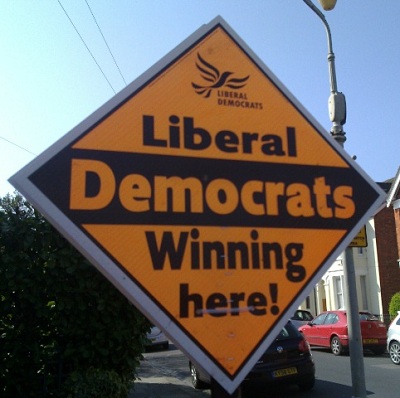
The latest local by elections with an LD gain from UKIP on a whopping 26% swing top off what has been a good week for the LDs. Firstly there have been the Rallings/Thrasher and Lord Robert Hayward May elections’ projection suggesting that the yellows are in for a substantial number of gains on May 4th.
In addition to that we have had news of the private Crosby Textor constituency polling for the Tories suggesting that the party is set to win back a the bulk of the seats lost in the South West and Greater London that were lost to the Tories at GE2015.
That information is, of course, private, but PB sources have it that all but three or four of the seats could be back in LD hands at the next election and we know that it is Tory MPs who made gains last time who are most opposed to an early general election.
But to assume that this is all down to BREXIT is being simplistic. There are other factors at play as James Kirkup in the Spectator describes:
“…But while Brexit may motivate many Lib Dems, my hunch is that what matters at least as much is something generally overlooked by us chattering Westminster types: organisation.
Part of the reason some Tories are quietly concerned about the Lib Dems is that the Lib Dems are quite good at not just recruiting people to their cause but deploying them on the ground. Pavement-pounding and leaflet-dropping have always been a central part of the Lib Dem experience, along with Glee Club and misleading bar-charts. That makes them tough local opponents.It’s no exaggeration to say that the Lib Dems’ ground-level resurgence is a bigger check on Tory thoughts of an early election than all those Corbynistas liking each other’s posts on Facebook..”
A big test of that organisation will come in the Manchester Gorton by-election which is also being held on May 4th. This is a seat where pre-Coalition they were a good second on 30%+ of the vote. With Labour supporters apparently demoralised by their leader and the threat posed by George Galloway then a good LD result could on the cards. The 6/1 currently available on Betfair looks like a value bet.
Mike Smithson
08 Apr 19:37
In the local by-elections since last May the parties supported mostly by REMAINERs have performed best
by Mike Smithson

08 Apr 19:36
The broadcaster Brian Matthew died this morning at the age of 88.
The BBC, which erroneously announced his death a couple of days ago, has a good obituary.
I wrote my own tribute to him back in 2008:
Brian Matthew has died
by Jonathan Calder
The broadcaster Brian Matthew died this morning at the age of 88.
The BBC, which erroneously announced his death a couple of days ago, has a good obituary.
I wrote my own tribute to him back in 2008:
Just about my earliest memory is climbing into my parents' bed on Saturday mornings, and I clearly remember Matthew's Saturday Club being on the radio when I did so. I may well have heard some of the Spencer Davis Group performances from the show that I bought last year (volume 1 of Mojo Rhythms & Midnight Blues) when they were first broadcast.
Fast forward to my university years. In those days there was only one mainstream radio station that broadcast into the small hours (when, of course, many undergraduate essays are written). That was Radio 2 and between 11 p.m. and 2 a.m. the programme it broadcast was Brian Matthew's Round Midnight.
Probably because of the power of the musicians' union in those days, Matthew had to broadcast an awful lot of Barry Forgey and the Radio 2 Big Band. But he also included many interviews with artists of all kinds. And he could be acerbic. I remember his replying, when a student theatre group solemnly informed listeners that they were against stereotypes, "that's very controversial of you".And, as I went on to say, in 2008 Matthew was still going strong with Sounds of the Sixties on Radio 2 on Saturday mornings.
08 Apr 16:59
If we can believe the Guardian, and I am increasingly unsure if we can, the National Trust has “axed Easter”, “omitted the word Easter from its annual children’s egg hunt” “airbrushed Christianity out of its annual chocolate egg hunt” “scrapped any mention of the Christian festival” and (again) “omitted Easter from the egg hunt.”
 The Prime Minister — the actual Prime Minister — was reportedly Very Angry about this. “Easter is very important. It is a very important festival for the Christian faith for millions across the world. So I think what the National Trust is doing is frankly just ridiculous.” The reliably nutty Archbishop of York did his best to diffuse the situation, saying that the decision to not use the word Easter was “tantamount to spitting on the grave of John Cadbury.” (*)
Interesting choice of words, I should say. "Axing" implies premature cancellation, as when a TV station cancels a show because of poor ratings. "Axing an Easter Egg hunt" I could understand — it would mean that the event used to happen but wasn't happening any more. "Axing the word Easter” not so much. The same goes for “scrapping”: you can scrap a Royal Yacht or a library, but not usually a piece of vocabulary. Even “omitting the word Easter from it's egg hunt" I have a problem with. I don't think children ever did scramble around Leigh Woods chanting "Easter, Easter, Easter, Easter." And “airbrushing” is incredibly loaded. “Airbrushing” means “changing or ignoring an historical fact” — like never mentioning that there were black soldiers in the first world war, or saying that Stan Lee created Spider-Man. It's a word, significantly, which is most often used in the context of communist Russia.
The allegation is not really that the the National Trust has axed, scrapped, omitted, removed, banned, airbrushed or abolished Easter, the Easter bunny, Easter Egg hunts or the Christian religion. The allegation is simply that they have removed the word "Easter" from the advertising and branding of this year's Egg hunt.
And it's just not true.
It a brilliant publicity stunt on the part of Cadbury and the National Trust, actually. I was vaguely aware of Easter Egg hunts as one of those mostly American things that has taken off here a little bit: people with big enough gardens hiding little chocolate eggs for the kids to find. Maybe some churches and schools do it too. I am quite sure that somewhere in the Derbyshire, in between the village which does the Pancake Race and a the village which does the Black Pudding Two Hundred Meter Hurdles you can find a village where an ancient tradition of beating the parish bounds with hard boiled eggs painted with colours of the Duke of Argyle is still observed. But did you know that the National Trust ran official hunts for Cadbury’s chocolate eggs on their properties, and have done so for some years? I certainly didn’t.
“But what have chocolate eggs got to do with the death and resurrection of Jesus in the first place?" you are probably going to ask me. Well, some people say that there was a pagan goddess called Easter who rode around Narnia on a sledge pulled by magic egg-laying rabbits. Others point to a suppressed gnostic gospel in which Jesus hatched out of a giant crocodile egg like Isis. Rather desperate clergymen say that when the Very Early Christians wanted something to remind them of the stone that was laid in front of Jesus' tomb, what naturally occurred to them was an egg (as opposed to, say, a stone). The story that is most likely to be true is the most boring one: Christians give up rich food and treats after Pancake Day and start eating them again after taking Holy Communion on Easter Sunday. So naturally, Easter afternoon involves chocolate, eggs, cakes, bonnets, and Morris dancing.
The period of abstinence is called Lent; it is supposed to remind us of Jesus forty day fast in the wilderness. The last and holiest days of Lent are Good Friday (the day Jesus was killed) and Easter Saturday (the day he lay in the tomb).
I don’t want to come across as very pious here. This Good Friday I shall probably go to Bristol Cathedral in morning and Bristol Folk House in the evening and one of Bristol's many fine coffee shops in the afternoon and I haven't give up anything at all. But you really can't have it both ways. You can't claim that chocolate eggs are mainly a symbol of resurrection and new life and then start eating them on Good Friday. You can't claim that eating chocolate eggs is mainly part of the Christian feast of Easter and then recommend that people do it on one of the fast days.
A lot of people are seeing this story as a bit of a joke; as our Prime Minister focusing on chocolate eggs when she should be concentrating on starting a war with Spain. I think it is much more sinister than that.
The story that Theresa May has put on all the front pages is not that, (interestingly enough), the word Easter is being used less and less nowadays. The story that Theresa May has put on all the front pages is that THEY have stopped YOU from celebrating, sorry, saying the word, Easter -- where "they" ARE commies, Europeans and, especially Muslims. Making up stories about how the National Trust have banned Easter, Birmingham has banned Christmas, London is a caliphate and Tescos have straightened all their bananas is a tactic which the racist right uses to radicalize white people. The more we can pretend that Easter and Christmas and Valentines and Bonfire night and the Eurovision Song Contest are Christian events, the less Muslims and Sikhs and Jews and Richard Dawkins can participate in our local culture.
I think there may be an even nastier side to it.
I think that the banning of Easter and Christmas and the Sharia regime in Birmingham are objects of faith for the very far right. Winston Smith had not only to say that two plus two equaled five, but actually believe that it did. I think that when someone -- a Prime Minister or a Bishop -- looks steadily and full on at an Easter Egg and says "There is no Easter Egg here" they are signalling very clearly which side they are on.

Flake News
by Andrew Rilstone
A perfectly ordinary member of the Church of England moves from the former United Kingdom to Another Country. I forget whether he had to get out in a hurry because they were threatening to intern Remain votes, or whether he was just looking for work.
Anyway, he’s been there about six months, when his neighbor says “Would you like to come to dinner tomorrow. It’s a big holiday in this country. Bound up with one of our Holy Religious Festivals, of course, but tomorrow night is just a family get together, followed by a silly treasure hunt where the kids win Turkish Delight.”
Well, the Perfectly Ordinary Fellow thinks this is very kind, and he goes, and has a nice time, and come December asks his neighbors round for mulled wine and mince pies and crackers. He stays in Another Country for the rest of his life, treats it as his home, and has kids who just sort of take it for granted that the second Wednesday after the first snowfall of February is Turkish Delight Day. (In fact, he hears that some people in the Old Country are taking up the tradition as well, because it’s fun.)
But then the Maharajah of Another Country makes a speech.
“We must all start eating Turkish Delight in February, like we did in the old days,” she says.
“It is shameful the way Turkish Delight has been banned to appease Anglicans” she continues.
“Turkish Delight is a very important Holy Religious Festival which shows we believe in the One God (which, by the way, I don’t, but my Dad did) and are definitely not like these crazy Anglicans who think there are Three.”
Well, I don’t know if the Perfectly Ordinary Anglican buys his kids Turkish Delight (which you can get in all the shops, despite it being banned) that February; but he feels much less comfortable accepting his friend's dinner invitation that year. We can still be friends, he thinks, but as an Anglican I clearly shouldn’t be part of one of these people’s Holy Religious Festivals. Holy Religious Festivals remind me that I can never really be part of this country however long I stay here. I guess that’s the point of them.
That night, hardly anyone goes to the Temple of the Definitely Only One God, but everyone eats far too much Turkish Delight and gets sick.
A few years later, one of the Perfectly Ordinary Anglican's kids is beaten up by a group of thugs shouting "Another Country Above All The Other Countries!" and the Perfectly Ordinary Anglican, fearing he has no home in this world any more, jumps off a bridge.
A few years later, one of the Perfectly Ordinary Anglican's kids is beaten up by a group of thugs shouting "Another Country Above All The Other Countries!" and the Perfectly Ordinary Anglican, fearing he has no home in this world any more, jumps off a bridge.
“How do such terrible things ever happen?”says the Maharajah. And they all live happily ever after.
 |
|
Ce n'est pas un oeuf de Pâques |
If we can believe the Guardian, and I am increasingly unsure if we can, the National Trust has “axed Easter”, “omitted the word Easter from its annual children’s egg hunt” “airbrushed Christianity out of its annual chocolate egg hunt” “scrapped any mention of the Christian festival” and (again) “omitted Easter from the egg hunt.”
 Interesting choice of words, I should say. "Axing" implies premature cancellation, as when a TV station cancels a show because of poor ratings. "Axing an Easter Egg hunt" I could understand — it would mean that the event used to happen but wasn't happening any more. "Axing the word Easter” not so much. The same goes for “scrapping”: you can scrap a Royal Yacht or a library, but not usually a piece of vocabulary. Even “omitting the word Easter from it's egg hunt" I have a problem with. I don't think children ever did scramble around Leigh Woods chanting "Easter, Easter, Easter, Easter." And “airbrushing” is incredibly loaded. “Airbrushing” means “changing or ignoring an historical fact” — like never mentioning that there were black soldiers in the first world war, or saying that Stan Lee created Spider-Man. It's a word, significantly, which is most often used in the context of communist Russia.
The allegation is not really that the the National Trust has axed, scrapped, omitted, removed, banned, airbrushed or abolished Easter, the Easter bunny, Easter Egg hunts or the Christian religion. The allegation is simply that they have removed the word "Easter" from the advertising and branding of this year's Egg hunt.
And it's just not true.
It a brilliant publicity stunt on the part of Cadbury and the National Trust, actually. I was vaguely aware of Easter Egg hunts as one of those mostly American things that has taken off here a little bit: people with big enough gardens hiding little chocolate eggs for the kids to find. Maybe some churches and schools do it too. I am quite sure that somewhere in the Derbyshire, in between the village which does the Pancake Race and a the village which does the Black Pudding Two Hundred Meter Hurdles you can find a village where an ancient tradition of beating the parish bounds with hard boiled eggs painted with colours of the Duke of Argyle is still observed. But did you know that the National Trust ran official hunts for Cadbury’s chocolate eggs on their properties, and have done so for some years? I certainly didn’t.Last week's egg story was a little bit more nuanced. Most eggs don’t have the word “Easter” on them, but then, they never did; most eggs are halal, but then they always were. But this weeks is complete fiction. You can prove this by a simple experiment: go to the Cadbury's National Trust website at www.easter.cadbury.co.uk.
I will say that again: www.easter.cadbury.co.uk.
The first thing you will see is a headline saying "Enjoy Easter fun at the National Trust..." You will also see links to “Easter Range” and “Easter Events”. The first takes you to a Cadbury's chocolate catalog, which tells you that "Our eggstensive (ho-ho) range is packed with treats for the Easter period..." including "The Cadbury Easter bundle..." and "Our Easter favourites...."
If you follow the link to "Easter Events" your will find the dates and times at which the “Easter Egg Hunt" takes place (from 10 -3 on Good Friday and again from 10 - 3 on Easter Saturday.)
It is true that there is a logo that says "Join the Cadbury Egg Hunt". But that seems a small thing to make a moral panic about.
If you follow the link to "Easter Events" your will find the dates and times at which the “Easter Egg Hunt" takes place (from 10 -3 on Good Friday and again from 10 - 3 on Easter Saturday.)
It is true that there is a logo that says "Join the Cadbury Egg Hunt". But that seems a small thing to make a moral panic about.
“But what have chocolate eggs got to do with the death and resurrection of Jesus in the first place?" you are probably going to ask me. Well, some people say that there was a pagan goddess called Easter who rode around Narnia on a sledge pulled by magic egg-laying rabbits. Others point to a suppressed gnostic gospel in which Jesus hatched out of a giant crocodile egg like Isis. Rather desperate clergymen say that when the Very Early Christians wanted something to remind them of the stone that was laid in front of Jesus' tomb, what naturally occurred to them was an egg (as opposed to, say, a stone). The story that is most likely to be true is the most boring one: Christians give up rich food and treats after Pancake Day and start eating them again after taking Holy Communion on Easter Sunday. So naturally, Easter afternoon involves chocolate, eggs, cakes, bonnets, and Morris dancing.The period of abstinence is called Lent; it is supposed to remind us of Jesus forty day fast in the wilderness. The last and holiest days of Lent are Good Friday (the day Jesus was killed) and Easter Saturday (the day he lay in the tomb).
I don’t want to come across as very pious here. This Good Friday I shall probably go to Bristol Cathedral in morning and Bristol Folk House in the evening and one of Bristol's many fine coffee shops in the afternoon and I haven't give up anything at all. But you really can't have it both ways. You can't claim that chocolate eggs are mainly a symbol of resurrection and new life and then start eating them on Good Friday. You can't claim that eating chocolate eggs is mainly part of the Christian feast of Easter and then recommend that people do it on one of the fast days.A lot of people are seeing this story as a bit of a joke; as our Prime Minister focusing on chocolate eggs when she should be concentrating on starting a war with Spain. I think it is much more sinister than that.The story that Theresa May has put on all the front pages is not that, (interestingly enough), the word Easter is being used less and less nowadays. The story that Theresa May has put on all the front pages is that THEY have stopped YOU from celebrating, sorry, saying the word, Easter -- where "they" ARE commies, Europeans and, especially Muslims. Making up stories about how the National Trust have banned Easter, Birmingham has banned Christmas, London is a caliphate and Tescos have straightened all their bananas is a tactic which the racist right uses to radicalize white people. The more we can pretend that Easter and Christmas and Valentines and Bonfire night and the Eurovision Song Contest are Christian events, the less Muslims and Sikhs and Jews and Richard Dawkins can participate in our local culture.
I think there may be an even nastier side to it.
(*) John Cadbury was a Quaker and would probably not have celebrated Easter in the first place. Quakers don’t really keep holy days, because they think that all days are holy, in the same way that they don’t celebrate the sacraments because they think that everything is sacramental. In the past, they preferred to say First Day, Second Day, Third Day, so "Easter Monday" is unlikely to have been a big thing. Chocolate eggs were invented by Bristol's Joseph Fry in 1873 but John Cadbury had started making them within a couple of years. A price list from John Cadbury’s lifetime is headed “Easter Eggs”, although the individual products are just called “eggs”. (Some of them seem to have been ordinary chocolates in elaborate egg-shaped packaging, incidentally.) But a flier from a few years after John Cadbury himself died is already calling them “chocolate eggs” (for the milk chocolate ones) and “Bournville eggs” (for the more expensive dark chocolate ones). They are decorated with secular spring flowers made of icing sugar and marzipan. Quakers are sometimes thought of as puritans, but I don’t think Cadbury would have had any objection to children’s treasure hunts. He clearly didn't have any objection to chocolate! He would have had a very simple grave, but I don't think he would be turning in it over what people called his eggs.
06 Apr 23:17
Following today's Supreme Court judgement, the Liberal Democrats issued a press release quoting John Pugh, our shadow education secretary:
This enthusiasm for giving councils the power to fine parents began with New Labour, whose least appealing aspect was its authoritarianism. It was often hard to say where its education policies ended and its policing policies began.
And some time before that, policymakers gave up on the idea that they could take action to make the economy work more efficiently.
Instead, education has emerged as the arena where ambitious young wonks feel they can intervene with confidence.
They know what is right for children and for the country, but they are not so sure about parents and headteachers.
John Pugh talks sense on term-time absence
by Jonathan Calder
Following today's Supreme Court judgement, the Liberal Democrats issued a press release quoting John Pugh, our shadow education secretary:
“Today’s judgment was disappointing but the ball is back in the government's court, they could act and change the law and bring back sensible rules with proper safeguards in place. Nearly 20,000 people have been prosecuted and caught in a dragnet by these laws in the last year.
“Many employees have no choice when to take their holidays. People in some areas have to work all through the summer at the height of the tourism season.
“Others simply cannot afford to go on holiday at peak times, when the cost of holidays goes through the roof. So, it's vitally important to offer more flexibility to schools and headteachers to help families who need to take a break together.
“We believe that headteachers should be allowed to grant up to 10 days of term-time absence in special circumstances".That sounds about right to me.
This enthusiasm for giving councils the power to fine parents began with New Labour, whose least appealing aspect was its authoritarianism. It was often hard to say where its education policies ended and its policing policies began.
And some time before that, policymakers gave up on the idea that they could take action to make the economy work more efficiently.
Instead, education has emerged as the arena where ambitious young wonks feel they can intervene with confidence.
They know what is right for children and for the country, but they are not so sure about parents and headteachers.
06 Apr 23:16
 Jonn Elledge mourns the embarrassment Ken Livingstone has become, arguing that he made a very good job of being London's mayor.
I am sad for Ken because I remember him as leader of the Greater London Council.
It's not that I thought his policies were great, but the way he conducted himself was a model for any aspiring politician.
Though this was the era in which the Sun labelled him "the most odious man in Britain", he remained unfailingly calm in interviews and was witty too.
He was a star. When he resigned his seat and fought a by-election as part of the campaign against the abolition of the GLC, I helped the Liberal candidate Steve Harris.
One Saturday the great and good of Richmond Liberals turned up to help. Their children asked if they could go on Ken's bus.
Contrast that with the Ken Livingstone of today.
It's not just that he is wrong about Hitler and Zionism - David Baddiel is good on this. It's that I have no idea what he was hoping to achieve by raising the subject in the first place. And now it has come to be an obsession that risks being all he will be remembered for
So farewell then, Red Ken, You were a class act once.
So farewell then, Red Ken, You were a class act once
by Jonathan Calder

I am sad for Ken because I remember him as leader of the Greater London Council.
It's not that I thought his policies were great, but the way he conducted himself was a model for any aspiring politician.
Though this was the era in which the Sun labelled him "the most odious man in Britain", he remained unfailingly calm in interviews and was witty too.
He was a star. When he resigned his seat and fought a by-election as part of the campaign against the abolition of the GLC, I helped the Liberal candidate Steve Harris.
One Saturday the great and good of Richmond Liberals turned up to help. Their children asked if they could go on Ken's bus.
Contrast that with the Ken Livingstone of today.
It's not just that he is wrong about Hitler and Zionism - David Baddiel is good on this. It's that I have no idea what he was hoping to achieve by raising the subject in the first place. And now it has come to be an obsession that risks being all he will be remembered for
So farewell then, Red Ken, You were a class act once.
06 Apr 23:16

Flashabak.com tweeted this beautiful poster yesterday, so I had a look to see what I could find out about the Jester Company of Leicester.
An article by Sarah Hartwell tells us:
Jester Wools of Leicester
by Jonathan Calder
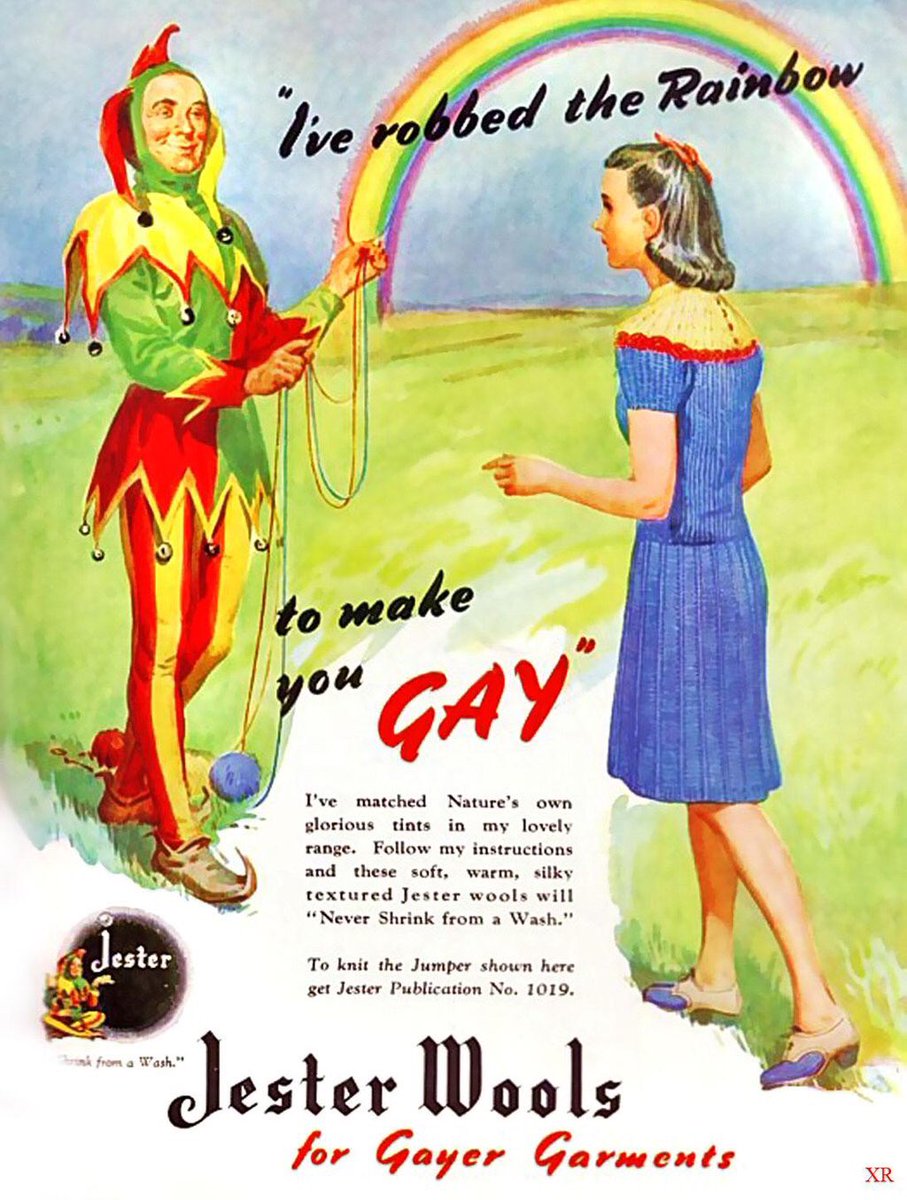
Flashabak.com tweeted this beautiful poster yesterday, so I had a look to see what I could find out about the Jester Company of Leicester.
An article by Sarah Hartwell tells us:
Jester Company limited, Leicester, was a textiles company (knitting wools, patterns, rug kits etc) founded in October 1944, they went into liquidation in 1996 and were finally dissolved in 1997.
Their address was Jester House, Roman Forum, Leicester (in 1987 the registered office was at 14 West Walk, Leicester, LE1 7NA and in 1988 it was 91 All Saints Road, Leicester, LE3 5AB)She reproduces some more striking advertisements and tells us that the vainglorious "Roman Forum" address was really in Talbot Lane.
06 Apr 22:53
 First, there’s the fact that the voters of Britain do tend to describe themselves as being generally quite centrist. The graph to the right here (from the 2015 British Election Study) shows how voters position themselves on a scale from 0 (left) to 10 (right), showing a marked peak in the centre and fewer and fewer voters the further you get from it. Second, there’s evidence to show that in Britain when the two main parties move away from the ideological centre, there’s an increase in support for the centre (see Nagel and Wlezien, 2010).
It looks like you’re starting a new centre party. Would you like some help with that?
by Nick
There used to be a distinct summer ‘silly season’ in British politics. Unfortunately, global warming and the catastrophic meltdown of most rational sense about politics in this country means we’re now living in a permanent silly season where ideas that would normally be laughed off are now taken utterly seriously. So, we have this:
Blair has publicly stressed that the institute will not become a new centrist political party. But in private, close allies admit that the idea of a new party emerging around the time of the next British general election is being seriously considered.
With Theresa May’s Conservative Party resolute in its hard Brexit stance, Labour under Jeremy Corbyn declining to offer resistance to the triggering of Article 50 to take Britain out of the EU, and the Lib Dems a minuscule parliamentary force with just nine MPs, the question of whether a new party is needed to oppose Brexit has become a favorite topic in Westminster.
While the Lib Dems publicly eschew such talk, Farron was contacted last summer by a close ally of former Tory Chancellor George Osborne, who suggested the creation of a centrist party called “The Democrats,” the New Statesman reported. Nick Clegg, the Lib Dem former deputy prime minister, met with Blair in November, ahead of the creation of his new institute in March.
Like so many ideas associated with Blair, this one too has its roots abroad, this time in the remarkable and rapid ascent of Emmanuel Macron to frontrunner in the French Presidential election. In the past year, he’s jumped from the Socialist Party, set up his own movement (En Marche! – or, as Google Translate likes to call it, Walk!) and become very appealing to a population that’s become very tired of the old parties of left and right. (By the way, if he gets into power and disappoints his supporters with his education funding policies, I’ve already copyrighted ‘Nick Cloeuf’)
 Of course, if Macron wasn’t there to be held up as the shining example, then the mantle of Great Centrist Role Model would have remained with Canada’s Justin Trudeau who took the Canadian Liberals from third place into majority government in 2015. Like Macron, Trudeau was an outsider if you squint hard enough – the son of a former Prime Minister, he’d eschewed a political career until a few years ago – but unlike him, had the advantage of becoming leader of a party that, while it was at a low ebb, had provided more Canadian Prime Ministers and governments than any other.
Somehow, these two pieces of electoral fortune outside of the UK have translated into a belief that what the British people are crying out for is a new centre party led by Tony Blair and George Osborne. Like a rushed undergrad essay, it’s making a big leap to some rather bold and unsupported conclusions, but it is based on some solid ground.
Voter left-right self positioning, 2015 BES
Obviously, people talking about setting up new centre parties is of great personal and academic interest to me, but the actual prospect of Blair, Osborne et al doing it doesn’t fill me with any great hopes for its success (even if they’re eminence grises, kept well away from the public spotlight). It feels to me as though they (and others) have spotted that there’s a gap in the electoral market and decided that it’s necessary to fill it without asking why no one’s come along to fill it already.
The first problem is that the term ‘centre party’ covers a wide range of different parties and proponents of one don’t seem to have any clue about which of them their party would be. We can probably assume it won’t be one of the old Scandinavian Centre parties which tied old agrarian parties in which the urban bourgeoisie, but are they looking at following the model of the Christian Democrat parties that sought to occupy the centre between extremes of right and left, or the various post-dictatorship Democratic Centre parties (like the one David Sanders advocated last year) that sought to rebuild the democratic foundations of a country, or are they looking towards the model of catch-all liberal parties that try to combine both right- and left-liberalism in the same party? They’re all commonly referred to as centre parties, but they have a very different approach to politics and come from different political circumstances. It’s all well and good talking about the need for a centre party, but what is that party actually going to stand for?
Second, there’s the problem that just saying ‘we’re going to create a new political party’ is just a tiny part of the process. One can set up a nice shiny office somewhere in London, pay someone to design you a nice logo, but political parties need people to function, especially in Britain. Not only do you need to recruit a membership, you need to find an activist base within that membership who’ll go and do all the donkey work of populating the institutions that make up a political party. The key driver of the RoadTrip 2015 campaign that’s got the Tories under such heavy investigation at the moment was the problem of getting actual feet on the ground to do campaigning in key constituencies. It’s all well and good having lots of people to make interesting graphs in your HQ, but who’s going to be calling members and supporters in Easthampton West to find out who’ll agree to do polling station telling on election day? The idea that a party might somehow ’emerge’ shortly before the next election ignores everything that’s involved with creating an actually functioning political party.
Third, there’s what you might call the SDP problem (and I deserve some sort of congratulations for going a thousand words into this without mentioning them): the British electoral system makes it ridiculously hard for a new party to break through into Parliament. There’s a catch-22 problem for all new parties: you’re going to need well over 20%, possibly 30% of the national vote share to make a significant breakthrough into Parliament, but unless you’ve made that breakthrough into Parliament, people aren’t going to think you’re credible enough to be worth voting for to get you that share of the vote that gives you a breakthrough. Otherwise you’ll be following the example of the Alliance in the 80s (and UKIP in 2015) in doing moderately well in a lot of seats, but winning next to none of them. As I’ve said before, being an equidistant centre party is good for winning votes and terrible at winning seats.
That’s three questions anyone wanting to set up a new centre party has to answer, just as a preliminary: What does your proposed party stand for? How are you going to build an actual party, not just an HQ? How are you going to win Parliamentary seats and not just accumulate wasted votes?
Once they’ve got the answers to those, then we can move on to the more important ones, like how are they going to actually work in the current British party system. But we’ll save the advanced questions until we’ve got answers to the basic ones.
06 Apr 22:49
http://www.andrewrilstone.com/2017/04/httpswwwpatreoncomrilstone.html
by Andrew Rilstone


06 Apr 22:49
Ian Stewart Named Worldcon 75 Science Guest
by Mike Glyer
Mathematician, popular science writer, and sf novelist Ian Stewart will be Science Guest at Worldcon 75 in Helsinki. An Emeritus Professor of Mathematics at the University of Warwick, England, Stewart is an active research mathematician with over 180 published papers. … Continue reading →
06 Apr 22:26
The making of the Hugo video
When I agreed to take on the role of Hugo administrator for Worldcon 75 back in late 2015, almost the first decision I made (with my then deputy, Colette Fozard) was about timelines.
Worldcon this year is comparatively early - the second weekend of August (and Tuesday-Sunday rather than Wednesday-Monday) and Easter relatively late (16 April). Worldcon timing has become more flexible in recent years; four of the first six were held in July, but for the half century from 1949 to 1998, only one (1975) was in mid-August, all the rest at the end of August or early September. In the last 20 years, however, the 1998, 2005, 2008, 2009, 2014, 2015 and 2016 Worldcons were all held earlier in August. Both 2018 and the Irish bid for 2019 will also be in mid-August.
I'm one of those who rather like the idea of announcing the Hugo finalists at conventions held over the Easter weekend. But that would have led to a very squeezed timetable for voters, and indeed for us. Working backwards, it seemed best to aim for an announcement in the first week of April, and to close votes two weeks and an extra weekend before that, knowing that it was likely that the 2016 WSFS Business Meeting would give us a larger task than before. That led inevitably to the decision that we'd close voting on St Patrick's Day, 17 March, and aim to make the announcement on 4 April - the first sensible weekday more than two weeks after the close of the vote. (Mondays are almost as bad as weekends for stories like this.)
I was not at all surprised to hear that MidAmeriCon II also decided not to make the announcements at Easter - for the opposite reason, ie that Easter last year was comparatively early, 27 March. The announcement of the final ballot came on my birthday last year, as I was stuck in a noisy pub with a former British MP, trying to discuss serious politics but very distracted by the news coming in from Twitter. I did like the style of graphics for each category (which allow you to tag those finalists with Twitter handles). However I missed the feeling of immediacy that you get with a live announcement.
I toyed with various ideas, such as doing a live webcast announcement (but by whom? And from where?), or organising a sponsored evening event (again, sponsored by whom? And where?). At the same time, at the back of my mind were lurking the images of Helsinki conjured up by Tuula Karjalainen's biography of Tove Jansson, both the city as Tove herself knew it, and her father's sculptures in the city centre for which she modelled.
And I woke up in the middle of the night at the start of February, and I had it - a video tour of Helsinki, with 18 celebrities and fans announcing the 18 Hugo categories for the longest ever Hugo final ballot. If it didn't work, we could always fall back on the tested MidAmeriCon model of timed tweets. But it was surely worth a try. It would be a bit different from the usual way of doing things, and would also be a way to showcase Helsinki for the international audience of Worldcon.
My crazy idea was agreed with surprisingly little fuss. Once we got started, things went really well. Katariina Ihalainen, who is in charge of videography for Worldcon 75 as a whole, accepted the challenge of filming 18 short segments on 1 April and then combining them. Sanna Lopperi took over the inviting and scheduling of individual announcers. Charlotte Laihanen took on logistical wrangling on the day. And before I knew it I was on the plane to Helsinki last Friday, staying overnight with Jukka Halme and Sari Polvinen, and ready for a full day's work on a day of very uncertain weather. And here it is:
The final sequence that you have seen is, of course, very different from the order of filming. It was also a bit different from the original set of ideas. I'd have loved to have had some Finnish politicians, some of whom are sympathetic, but there are municipal elections in Finland this coming weekend and everyone was busy campaigning. If we'd had more time I would have liked to try our luck filming at the old observatory, or the Suomenlinna island fortress, but we were constrained by the calendar and the hours of daylight. We had intended to do shots of the Uspenski Cathedral, Senate Square and the harbour, but the weather was against us. On the other hand, one venue turned us away - luckily by then the weather had improved and we retreated to the Tove Jansson statue in Kaisaniemi Park.

We had actually started next door to there, at 9 am in the main railway station with Johanna Vainikainen, aware of the chilly wind blowing in from the outside. By the time we got to the Finlandia Hall and National Museum, it was actually snowing a little. At the Sibelius monument, I took a selfie with my favourite composer as the snow turned to sleet. Johanna Sinisalo stood in the well of a dormant fountain with a Tove Jansson mermaid, reading the Best Novel finalists with rain dripping off her umbrella. The last shot of all, which was actually the first shown (Hanna Hakarainen and the Campbell Award finalists), was filmed at 5.30 in the very foggy Malmi cemetery, eight and a half hours after we started. But we were still more or less on schedule, and (perhaps more amazingly) we were all still on speaking terms with each other.

We were happy but also glad it was over. (Though Katariina then had the task of editing it all together, and did a fantastic job.)
I don't think this need be seen as some sort of challenge to future Worldcons to replicate (or exceed) what we did. Easter is at a more normal time next year (1 April) and Worldcon 76 is a little later in August, so a return to the Easter weekend announcement is perfectly feasible. But I think it was good to do something a little different, and I hope you enjoyed watching it.
Worldcon this year is comparatively early - the second weekend of August (and Tuesday-Sunday rather than Wednesday-Monday) and Easter relatively late (16 April). Worldcon timing has become more flexible in recent years; four of the first six were held in July, but for the half century from 1949 to 1998, only one (1975) was in mid-August, all the rest at the end of August or early September. In the last 20 years, however, the 1998, 2005, 2008, 2009, 2014, 2015 and 2016 Worldcons were all held earlier in August. Both 2018 and the Irish bid for 2019 will also be in mid-August.
I'm one of those who rather like the idea of announcing the Hugo finalists at conventions held over the Easter weekend. But that would have led to a very squeezed timetable for voters, and indeed for us. Working backwards, it seemed best to aim for an announcement in the first week of April, and to close votes two weeks and an extra weekend before that, knowing that it was likely that the 2016 WSFS Business Meeting would give us a larger task than before. That led inevitably to the decision that we'd close voting on St Patrick's Day, 17 March, and aim to make the announcement on 4 April - the first sensible weekday more than two weeks after the close of the vote. (Mondays are almost as bad as weekends for stories like this.)
I was not at all surprised to hear that MidAmeriCon II also decided not to make the announcements at Easter - for the opposite reason, ie that Easter last year was comparatively early, 27 March. The announcement of the final ballot came on my birthday last year, as I was stuck in a noisy pub with a former British MP, trying to discuss serious politics but very distracted by the news coming in from Twitter. I did like the style of graphics for each category (which allow you to tag those finalists with Twitter handles). However I missed the feeling of immediacy that you get with a live announcement.
I toyed with various ideas, such as doing a live webcast announcement (but by whom? And from where?), or organising a sponsored evening event (again, sponsored by whom? And where?). At the same time, at the back of my mind were lurking the images of Helsinki conjured up by Tuula Karjalainen's biography of Tove Jansson, both the city as Tove herself knew it, and her father's sculptures in the city centre for which she modelled.
And I woke up in the middle of the night at the start of February, and I had it - a video tour of Helsinki, with 18 celebrities and fans announcing the 18 Hugo categories for the longest ever Hugo final ballot. If it didn't work, we could always fall back on the tested MidAmeriCon model of timed tweets. But it was surely worth a try. It would be a bit different from the usual way of doing things, and would also be a way to showcase Helsinki for the international audience of Worldcon.
My crazy idea was agreed with surprisingly little fuss. Once we got started, things went really well. Katariina Ihalainen, who is in charge of videography for Worldcon 75 as a whole, accepted the challenge of filming 18 short segments on 1 April and then combining them. Sanna Lopperi took over the inviting and scheduling of individual announcers. Charlotte Laihanen took on logistical wrangling on the day. And before I knew it I was on the plane to Helsinki last Friday, staying overnight with Jukka Halme and Sari Polvinen, and ready for a full day's work on a day of very uncertain weather. And here it is:
The final sequence that you have seen is, of course, very different from the order of filming. It was also a bit different from the original set of ideas. I'd have loved to have had some Finnish politicians, some of whom are sympathetic, but there are municipal elections in Finland this coming weekend and everyone was busy campaigning. If we'd had more time I would have liked to try our luck filming at the old observatory, or the Suomenlinna island fortress, but we were constrained by the calendar and the hours of daylight. We had intended to do shots of the Uspenski Cathedral, Senate Square and the harbour, but the weather was against us. On the other hand, one venue turned us away - luckily by then the weather had improved and we retreated to the Tove Jansson statue in Kaisaniemi Park.
We had actually started next door to there, at 9 am in the main railway station with Johanna Vainikainen, aware of the chilly wind blowing in from the outside. By the time we got to the Finlandia Hall and National Museum, it was actually snowing a little. At the Sibelius monument, I took a selfie with my favourite composer as the snow turned to sleet. Johanna Sinisalo stood in the well of a dormant fountain with a Tove Jansson mermaid, reading the Best Novel finalists with rain dripping off her umbrella. The last shot of all, which was actually the first shown (Hanna Hakarainen and the Campbell Award finalists), was filmed at 5.30 in the very foggy Malmi cemetery, eight and a half hours after we started. But we were still more or less on schedule, and (perhaps more amazingly) we were all still on speaking terms with each other.
We were happy but also glad it was over. (Though Katariina then had the task of editing it all together, and did a fantastic job.)
I don't think this need be seen as some sort of challenge to future Worldcons to replicate (or exceed) what we did. Easter is at a more normal time next year (1 April) and Worldcon 76 is a little later in August, so a return to the Easter weekend announcement is perfectly feasible. But I think it was good to do something a little different, and I hope you enjoyed watching it.
06 Apr 13:06
Will the last person to quit UKIP please remember to turn out the lights
by Mike Smithson
Job done: Why I am joining the Conservative Group in the Welsh Assembly pic.twitter.com/7TFh9JD6zE
— Mark Reckless AM (@MarkReckless) April 6, 2017
Mark Reckless, 2nd CON MP to defect to UKIP in 2014,rejoins the blue team
Just two weeks afte UKIP’s first elected MP, Douglas Carswell, announced that he was leaving the party the second big MP defector from 2014, Mark Reckless, has announced that he’s doing the same.
Reckless had been MP for Rochester in Kent and won the by-election the following his defection. He failed, however, to retain the seat at the 2015 General Election period and last year he was elected to the Welsh Assembly a position he has held since.
Quite how this move will be welcomed by the blue team is hard to say. There was a huge amount of resentment about his actions in 2014 and it was felt that the timing and manner of his move was designed to cause the maximum of damage to Cameron’s party.
There was a huge effort by the Tories at the general election to win back the seat which day did easily.
With two major defections from UKIP in such a period the impression it’s certainly coming over other party that is going through a crisis. Ukip’s main area of electoral strength, ts MEP base at the European Parliament, is going to cease to exist in just two years time when Britain leaves the EU. The purples are also predicted to have a very tough next month’s set of local elections.
Whatever it’s current situation you cannot deny that the party has been remarkably successful in its main aim – the extraction of the UK from the EU. Since then it has been hard to see the point.
No doubt there will be some betting markets linked to UKIP put up in the next day or so.
Mike Smithson
06 Apr 13:05
Random excuses
by Charlie Stross
So I've been busy lately.
After lying on my back panting for a few days (the usual follow-up to finishing a new novel in first draft) I'm now making plans for the rewrite, because no novel is ever publishable in its initial form, and there are things I need to sort out before it goes anywhere near an editor. (Notably: I started out with over-ambitious plans for a funky structure that proved unworkable, so now I need to go back and un-kink everything so that the story flows smoothly on its own terms—which it will, because I think I got the rest of it right.) So I'm about to dive back down the rabbit hole of Ghost Engine to try and produce a final draft by the end of the month.
And while this was going on, other stuff happened that's going to distract me from blogging for a while.
You may or may not know that this isn't my only blog. For about the past 15 years I've maintained a presence on Livejournal, a rather fascinating parallel-universe alternative social network that I vastly prefer to Facebook (because unlike FB, you can pay for an ad-free experience). Don't go looking for me by name; my LJ is locked down so that only selected invitees can read it, because for the past decade I've used it mainly for beta-testing work in progress—it's really useful to have a couple of dozen trusted readers kick the tires. Unlike Facebook, LJ offers a bunch of features that make it extremely useful for that purpose: the focus is on a user's journal, which is optimized for textual content and supports threaded discussions, user-run communities, and (importantly) tools for keeping such discussions private.
I started out on Livejournal because, back in the day, it inherited a bunch of folks from SFFNet when SFFNet curled up and sort-of died; SFFNet in turn inherited the users of the Delphi SF forum from bulletin board days. It's all about the people, as usual, and Livejournal for many years was a social network hub for SF/F fans and authors. But Livejournal gradually lost out to Facebook in the anglophone world, just like MySpace. Unlike MySpace, LJ survived by becoming the social network of choice in Russia: a few years ago LJ was sold to a Russian company, and has gradually become a 90% Russophone social site with a weird bag of western SF fans still lurking in the moldering wreckage of what was once a thriving social networking system. There were periodic upsets because any major Russian political event would seemingly draw distributed denial of service attacks; a lot of people left, either decamping to Facebook, or to smaller specialized social hubs—the founders of Livejournal released their software under an open source license, and some folks are successfully running small-scale LJ servers with their own distinct communities.
I probably stuck with LJ for too long, because back in the day I paid for a perpetual premium account—unlimited access and no ads: the urge to get one's money's worth out of something you've paid for is hard to resist. But the rot has finally gone too far. This Tuesday Livejournal pushed out a revision to their terms of service that emphasize the service runs under Russian law, and specifically requires compliance with Russian law on minors—which makes any discussion of "sexual deviancy" (aka LGBT issues) illegal or at least a violation of the ToS.
So I'm currently migrating my entire Livejournal presence to Dreamwidth, a service set up by some of LJ's original founders that focuses on providing a Livejournal-like set of services for creative types (and, significantly, is not subject to Russian law because it's not based in Russia).
Meanwhile, while all this was happening, this blog crawled past its 190,000th comment. There are upwards of 3000 blog entries/essays here; a backup of the blog content runs to over 240Mb, most of it text fles. As you'll have noticed if you've been here for a while, I haven't done a major update to the blogging software for a few years. This is now overdue, and some time in the next few weeks I'll be updating the server here—extremely carefully, though!
06 Apr 11:41
space nerds FINALLY put on blast
| archive - contact - sexy exciting merchandise - search - about | |||
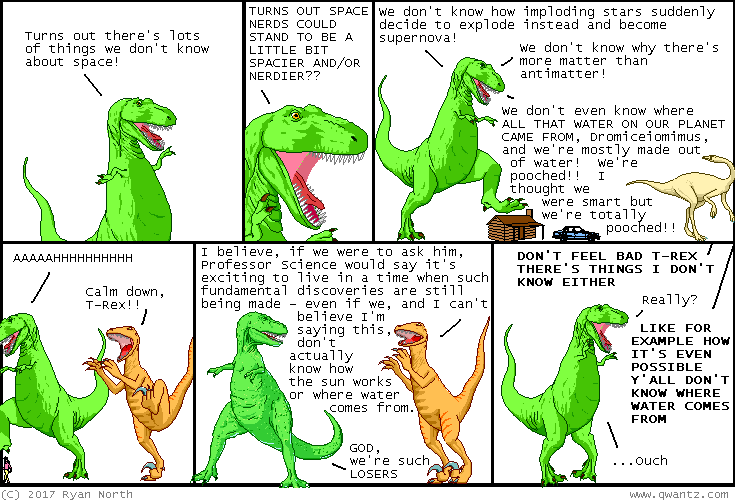 |
|||
| ← previous | April 5th, 2017 | next | |
|
April 5th, 2017: I wanted to thank Thomas for the email about how French rap changed her life, drastically altering the course of her entire existence for the better!! I always suspected that these things were possible with French rap, but it was really nice to see it confirmed! – Ryan | |||
06 Apr 00:17
The Case Of The Suffocating Woman
by Scott Alexander
[Content warning: panic, suffocation]
I.
I recently presented this case at a conference and I figured you guys might want to hear it too. Various details have been obfuscated or changed around to protect confidentiality of the people involved.
A 20-something year old woman comes into the emergency room complaining that she can’t breathe. The emergency doctors note that she’s breathing perfectly normally. She says okay, fine, she’s breathing normally now, but she’s certain she’s about to suffocate. She’s having constant panic attacks, gasping for breath, feels like she can’t get any air into her lungs, been awake 96 hours straight because she’s afraid she’ll stop breathing in her sleep. She accepts voluntary admission to the psychiatric unit with a diagnosis of panic disorder.
We take a full history in the psych ward and there’s not much of interest. She’s never had any psychiatric conditions in the past. She’s never used any psychiatric medication. She’s never had any serious diseases. One month ago, she gave birth to a healthy baby girl, and she’s been very busy with all the new baby-related issues, but she doesn’t think it’s stressed her out unreasonably much.
We start her on an SSRI with (as usual) little immediate effect. On the ward, she continues to have panic attacks, which look like her gasping for breath and being utterly convinced that she is about to die; these last from a few minutes to a few hours. In between these she’s reasonable and cooperative but still very worried about her breathing. There are no other psychiatric symptoms. She isn’t delusional – when we tell her that our tests show her breathing is fine, she’s willing to admit we’re probably right – she just feels on a gut level like she can’t breathe. I’m still not really sure what’s going on.
So at this point, I do what any good psychiatrist would: I Google “how do you treat a patient who thinks she’s suffocating?” And I stumble onto one of the first convincing explanations I’ve ever seen of the pathophysiology of a psychiatric disorder.
II.
Panic disorder is a DSM-approved psychiatric condition affecting about 3% of the population. It’s marked by “panic attacks”, short (minutes to hours) episodes where patients experience extreme terror, increased heart rate, gasping for breath, feeling of impending doom, choking, chest pain, faintness, et cetera. These episodes can happen either after a particular stressor (for example, a claustrophobic patient getting stuck in a small room) or randomly for no reason at all when everything is fine. In a few cases, they even happen when patients are asleep and they wake up halfway through. The attacks rise to the level of a full disorder when they interfere with daily life – for example, a patient can’t do her job because she’s afraid of having panic attacks while engaged in sensitive activities like driving.
The standard model of panic disorder involves somatosensory feedback loops. Your body is always monitoring itself to make sure that nothing’s wrong. Any major organ dysfunction is going to produce a variety of abnormalities – pain, blockage of normal activities like digestion and circulation, change in chemical composition of the blood, etc. If your body notices enough of these things, it’ll go into alarm mode and activate the stress response – increased heart rate, sweating, etc – to make sure you’re sufficiently concerned.
In the feedback model of panic disorder, this response begins too early and recurses too heavily. So maybe you have an itch on your back. Your body notices this unusual sensation and falsely interprets it as the sort of abnormality that might indicate major dysfunction. It increases heart rate, starts sweating, et cetera. Then, because it’s stupid, it notices the increased heart rate and the sweating that it just caused, and decides this is definitely the sort of abnormality that indicates major dysfunction, and there’s nothing to do except activate even more stress response, which of course it interprets as even more organ dysfunction, and so on. At some point your body just maxes out on its stress response, your heart is beating as fast as it can possibly go and your brain is full of as many terror-related chemicals as you can produce on short notice, and then after a while of that it plateaus and returns to normal. So panic disorder sufferers are people who are overly prone to have the stress response, and overly prone to interpret their own stress response as further evidence of dysfunction.
This is probably part genetic and part learned – I have a panic disorder patient who has a bunch of really bad allergies, whose body would shut down in horrifying ways every time he accidentally ate a crumb of the wrong thing, and this seems to have “sensitized” him into having panic attacks; that is, his body has learned that worrying sensations often foretell a health crisis, and lowered its threshold accordingly to the point where random noise can easily set it off. I’ve done a lot of work with this guy, but none of it has been “just ignore your panic attacks, you’ll be fine”. His body knows what it’s doing, and we’ve got to work from a position of respecting it while also teaching it not to be quite so overzealous.
So this is where my understanding of panic disorder stood until I Googled “how do you treat a patient who thinks she’s suffocating?” and came across Donald Klein’s theory of panic as false suffocation alarm. You might want to read the full paper, as it’s got far too many fascinating things to list here, including a theory of sighing. But I’ll try to go over the basics.
Klein is a professor of psychiatry who studies the delightful field of “experimental panicogens”, ie chemicals that cause panic attacks if you inject them in someone. These include lactate, bicarbonate, and carbon dioxide, all of which naturally occur in the body under conditions of decreased respiration.
But this is actually confusing. All of these chemicals naturally occur in the body under conditions of decreased respiration. But they don’t cause panic attacks then. During exercise, for example, your body has much higher oxygen demand but (no matter how much you pant while running) only a little bit higher oxygen supply, so at the muscle level you don’t have enough oxygen and start forming lactate. But exercise doesn’t make people panic. Even deliberately holding your breath doesn’t make you panic, although it’s about the fastest way possible to increase levels of those chemicals. So it looks like your body is actively predicting how much lactate/bicarbonate/CO2 you should have, and only getting concerned if there’s more than it expects.
So Klein theorized that the brain has a “suffocation alarm”, which does some pretty complicated calculations to determine whether you’re suffocating or not. Its inputs are anything from blood CO2 level to very high-level cognitions like noticing that you’re in space and your spacesuit just ruptured. If, after considering all of this, and taking into account confounding factors like whether you’re exercising or voluntarily holding your breath, it decides that you’re suffocating, it activates your body’s natural suffocation response.
And the body’s natural suffocation response seems a lot like panic attacks. Increased heart rate? Check. Gasping for breath? Check. Feeling of impending doom? Check. Choking? Check. Chest pain? Check. Faintness? Check. Some of this makes more sense if you remember that the brain works on Bayesian process combining top-down and bottom-up information, so that your brain can predict that “suffocation implies choking” just as easily as “choking implies suffocation”.
A quick digression into medieval French mythology. Once upon a time there was a nymph named Ondine whose lover was unfaithful to her, as so often happens in mythology and in France. She placed a very creative curse on him: she cursed him not to be able to breathe automatically. He freaked out and kept trying to remember to breathe in, now breathe out, now breathe in, now breathe out, but at some point he had to fall asleep, at which point he stopped breathing and died.
So when people discovered a condition that limits the ability to breathe automatically, some very imaginative doctor named the condition Ondine’s Curse (some much less imaginative doctors provided its alternate name, central hypoventilation syndrome). People with Ondine’s curse don’t exactly not breathe automatically. But if for some reason they stop breathing, they don’t notice. Needless to say, this condition is very, very fatal. The usual method of death is that somebody stops breathing at night (ie sleep apnea, very common among the ordinary population, but not immediately dangerous since your body notices the problem and makes you start breathing again) and just never starts again.
Klein says that this proves the existence of the suffocation alarm: Ondine’s Curse is an underactive suffocation alarm – and thus the opposite of panic disorder, which is an overactive suffocation alarm. In Ondine’s Curse, patients don’t feel like they’re suffocating even when they are; in panic disorder, patients feel like they’re suffocating even when they’re not.
This picture has since gotten some pretty powerful confirmation, like the discovery that panic disorder is associated with ACCN2, a gene involved in carbon dioxide detection in the amygdala. If you’re looking for something that causes you to panic when you’re suffocating, a carbon dioxide detector in the amygdala is a pretty impressive fit.
I don’t think this is necessarily a replacement for the somatosensory feedback loop theory. I think it ties into it pretty nicely. The suffocation alarm is one of the many monitors watching the body and seeing whether something is dysfunctional, maybe the most important such monitor. It goes through some kind of Bayesian learning process to constantly have a prior probability of suffocation and update with incoming evidence. Let me give two examples.
First, my patient with the bad allergies. Every time he eats the wrong thing, he goes into anaphylactic shock, which prevents respiration and brings him to the edge of suffocating. His suffocation alarm becomes sensitized to this condition, increases its prior probability of suffocation, and so drops its threshold so low that it can be set off by random noise.
Second, claustrophobics. There’s a clear analogy between being crammed into a tiny space, and suffocating – think of people who are buried alive. For claustrophobics, for some reason that link is especially strong, and just being in an elevator is enough to set off their suffocation alarm and start a panic attack. Now, why agoraphobics get panic attacks I’m not sure. Maybe fear makes them feel woozy and hyperventilate, and the suffocation alarm treats wooziness and hyperventilation as signs of suffocation and then gets stuck in a feedback loop? I don’t know.
III.
Bandelow et al find that you’re about a hundred times more likely to develop a new case of panic disorder during the postpartum period than usual.
This can be contrasted with two equally marked trends. Panic attacks decrease markedly during pregnancy, and disappear entirely during childbirth. This last is really remarkable. People get panic attacks at any conceivable time. When they’re driving, when they’re walking, when they’re tired, when they’re asleep. Just not, apparently, when they’re giving birth. Childbirth is one of the scariest things you can imagine, your body’s getting all sorts of painful sensations it’s never felt before, and it’s a very dangerous period in terms of increased mortality risk. But in terms of panic attack, it’s one of the rare times when you are truly and completely protected.
Maternal And Fetal Acid-Base Chemistry: A Major Determinant Of Perinatal Outcomes notes that:
There is a substantial reduction in the partial pressure of carbon dioxide in pregnancy…this fall is found to reach a mean level of 30-32 mmHg and is associated with a 21% increase in oxygen uptake. The physiological hyperventilation of pregnancy is due to the hormonal effect of progesterone on the respiratory center.
In other words, you’re breathing more, you have more blood oxygen, you have less blood CO2, and you’re further away from suffocation. This nicely matches the observation that there’s fewer panic attacks.
According to Klein, “There is a period of extreme hyperventilation during delivery, which drops the blood carbon dioxide to the minimum recorded under nonpathological conditions”. This explains the extreme protective effect of labor against panic disorder, despite labor’s seeming panic-inducing properties. When your CO2 is that low, even an oversensitive suffocation alarm is very far from a position where it might be set off.
(source)
Then you give birth, and progesterone – the hormone that was increasing respiratory drive – falls off a cliff. Your body, which for nine months has been doing very nicely with far more oxygen than it could ever need, suddenly finds itself breathing much less than usual and having a normal CO2/oxygen balance. This explains the hundredfold increased risk of developing panic disorder! Somebody who’s previously never had any reason to think they’re suffocating finds themselves with much less air than they expect (though still the physiologically correct amount of air they need), and if they’ve got any sensitivity at all, their suffocation alarm interprets this as possible suffocation and freaks out.
This can go one of two directions: either it eventually fully readjusts to your new position and becomes comfortable with a merely normal level of oxygen. Or the constant panic and suffocation feelings sensitize it – the same way that my allergy patient’s constant anaphylaxis sensitized him – the alarm develops a higher prior on suffocation and a lower threshold, and the patient gets a chronic panic disorder.
The reason my patient was so interesting was that she was kind of in the middle of this process and had what must have been unusually good introspective ability. Instead of saying “I feel panic”, she said “I feel like I’m suffocating”. This is pretty interesting. It’s like a heart attack patient coming in, and instead of saying “I feel chest pain”, they say “I feel like I have a thrombus in my left coronary artery”. You’re like “Huh, good job”.
So I explained all of this to her, and since she didn’t know I used Google I probably looked very smart. I told her that she wasn’t suffocating, that this was a natural albeit unusual side effect of childbirth, and that with luck it would go away soon. I told her if it didn’t go away soon then she might develop panic disorder, which was unfortunate, but that there were lots of good therapies for panic disorder which she would be able to try. This calmed her down a lot and we were able to send her home with some benzodiazepines for acute exacerbation and some SSRIs which she would stay on for a while to see if they helped. She’s scheduled to see an outpatient psychiatrist for followup and hopefully he will monitor her panic attacks to see if they eventually get better.
IV.
I realize that case reports are usually supposed to include a part where the doctor does something interesting and heroic and tries an experimental new medication that saves the day. And I realize there wasn’t much of that here. But I think that in psychiatry, a good explanation can sometimes be half the battle.
Consider Schachter and Singer (1962). They injected patients with adrenaline (a drug which among other things makes people physiologically agitated) or a placebo. Half the patients were told that the drug would make them agitated. The other half were told it was just some test drug to improve their eyesight. Then a confederate came and did some annoying stuff, and they monitored how angry the patients got. The patients who knew that the drug was supposed to make them angry got less angry than the ones who didn’t. The researchers theorized that both groups experienced physiological changes related to anger, but the patients who knew it was because of the drug sort of mentally adjusted for them, and the ones who didn’t took them seriously and interpreted them as their own emotion.
We can think of this as the brain making a statistical calculation to try to figure out its own level of anger. It has a certain prior. It gets certain evidence, like the body’s physiological state and how annoying the confederate is being. And it controls for certain confounders, like being injected with an arousal-inducing drug. Eventually it makes its best guess, and that’s how angry you feel.
In the same way, the suffocation monitor is taking all of its evidence about suffocation – from very low-level stuff like how much CO2 is in the blood to very high-level stuff like what situation you seem to be in – and then adjusting for confounders like whether you’re exercising. And I wonder whether telling a patient “You’re not actually suffocating, your panic comes from a known physiologic process and here are the hormones that control it” is the equivalent of telling them “You’re not really angry, your agitation comes from us giving you a drug that’s known to produce agitation”. It tells the suffocation alarm computer that this is a confounder to be controlled for rather than evidence on which to update.
I can’t claim to really understand this at a level where it makes sense to me. There are a lot of things that very directly increase CO2 but don’t increase panic, or vice versa. Hyperventilation can either cause or prevent panic depending on the situation. There seems to be something going on where the suffocation monitor controls for some things but not others, but this is an obvious cop-out that allows me to avoid making real predictions or narrowing hypothesis-space.
For example, this theory would seem to predict that waterboarding shouldn’t work. After all, its whole deal is artificially inducing the feeling of suffocation in a situation where the victim presumably knows that the interrogators aren’t going to let him suffocate. You would think that eventually the alarm realizes that “is being waterboarded” is a confounder to control for, but this doesn’t seem to be true.
(on the other hand, the inability to condition yourself seems relevant here. It seems like the brain might be not be controlling for whether something is reasonable, but only for whether something is produced by yourself. So maybe exercise counts because it’s under your control, but waterboarding doesn’t count because it isn’t. I wonder if anyone has ever tried letting someone waterboard themselves and giving them the on-off switch for the waterboarding device. Was Hitchens’ experience close enough to this to count? Why would this be different from letting someone hold their breath, which doesn’t produce the same level of panic?)
But overall I find Klein’s evidence pretty convincing and feel like this must be at least part of the story. And I think that giving this kind of explanation to somebody can comfort them, reassure them, and (maybe) even improve their condition.
05 Apr 15:55
Why we can’t have Nice Things
by Fred Clark
Want single-payer, Medicare-for-all health care? So do I, and so does a majority of the American public. But a big chunk of that public will stop wanting this for themselves if getting it means that people of color have it too. So that desirable, necessary goal will remain elusive and impossible until we change that.
05 Apr 14:40
Labour’s problems go well beyond Corbyn – it’s just that they’re not part of the main political conversation of the day
by Mike Smithson
Jeremy Corbyn reacts angrily to a question from @PaulBrandITV about his leadership https://t.co/oxUZs7yWuj pic.twitter.com/9VD4gsXsZc
— ITV News (@itvnews) April 4, 2017
There has been quite a lot of coverage of Jeremy Corbyn’s interview on ITV news in which he hit back after the interviewer raised questions about his leadership.
There’s some merit in his complaint. Labour is saying things about a wide range of issues at the moment but the problem is nobody’s wanting to listen. The reason is not just the leader but that the main political dialogue at the moment is on Brexit and here the main opposition party has struggled to have a definitive view.
There a good analysis of this in a commentary from the political analysts Ciceroelections.
“… the problem is that the Brexit issue is becoming so all-encompassing in how the media is covering politics that it is almost inevitable that Labour becomes somewhat marginalised. Other than seeking concessions on how the process will be scrutinised and setting out ‘tests’ against which Labour will judge the Brexit deal, there is no escaping the fact that negotiating Britain’s exit is a matter for government, not opposition. Meanwhile Labour’s stated desire to represent neither only the 52% nor the 48% but the 100% runs the distinct risk of seeming in fact to represent nobody.. “
This all comes only weeks before the May elections which can sometimes be a difficult period for party leaderships particularly those that are struggling.
The Lib Dem election analyst Mark Pack has noted that if Labour does suffer losses, as is being predicted, it will be the third consecutive year when the main opposition party has lost seats. This is totally unprecedented. Generally oppositions do well in local elections particularly when it is not a general election year.
If indeed this happens it will further raise questions about Mr Corbyn and he can expect more interviews like the one with ITV.
Meanwhile Mrs. May can continue without worrying about the opposition.

Mike Smithson
05 Apr 12:30
2017 Hugo Awards Finalists (with links to free fiction) - A Breath of Fresh Air!
by Kat Jones
The 2017 Hugo Awards ballot is out! Voting will close July 15 this year. The
online voting system is not yet live. But that’s okay – there’s plenty to read!
Best Novel
2078
ballots cast for 652 nominees.
Votes for finalists ranged from 156 to 480.
Votes for finalists ranged from 167 to 511.
Votes for finalists ranged from 74 to 268.
Votes for finalists ranged from 87 to 182.
Votes for finalists ranged from 88 to 424.
Votes for finalists ranged from 71 to 221.
Votes for finalists ranged from 240 to 1030.
Votes for finalists ranged from 91 to 193.
Votes for finalists ranged from 149 to 229.
Votes for finalists ranged from 83 to 201.
Votes for finalists ranged from 53 to 143.
Votes for finalists ranged from 80 to 434.
Votes for finalists ranged from 53 to 159.
Votes for finalists ranged from 76 to 109.
Votes for finalists ranged from 80 to 152.
Votes for finalists ranged from 39 to 121.
Votes for finalists ranged from 129 to 325.
Votes for finalists ranged from 88 to 255.
Looks
like the Sad Puppies have moved on this year. The Rabids are still trolling,
and very thoughtfully nominated some artists who had no qualifying work in 2016
so that we can say with complete confidence and clarity that their voters are trolling
with a slate they aren’t personally familiar with, as though there were ever any
doubt. Fortunately, they only nominated one or two things per category in order
to better game the new nominating system, so the effect on the overall ballot
is minimal. I’ve marked the Rabid Puppy noms in the list below.
I
haven’t seen mention of a Voter Packet yet. Whether we get one or not, as
usual, I’m compiling a list of links to the nominated works that are available
online for free, to aid us in getting on with our reading! The links to free
works will be included below. If you know of others, please let me know and I’ll
add them!
For
everything else, I'm adding in lots of links to make it easier to get started
reading/listening/watching. Happy reading!
ETA
(4/23): Best Fan Artist updated to reflect today’s change: Rabid Puppy nominee AlexGarner disqualified at his own request. Huge respect and kudos to Alex Garner
for coming forward to the Hugo committee to inform them he had no qualifying
fan art last year. His vacated spot on the finalist list has gone to Steve
Stiles.
Best Novel
Votes for finalists ranged from 156 to 480.
·
All the Birds in the Sky, by Charlie Jane Anders (Tor Books / Titan Books)
·
A Closed and Common Orbit, by Becky Chambers (Hodder & Stoughton / Harper
Voyager US)
·
Ninefox Gambit, by Yoon Ha Lee (Solaris Books)
·
The Obelisk Gate, by N. K. Jemisin (Orbit Books)
·
Too Like the Lightning, by Ada Palmer (Tor Books)
Best
Novella
1410
ballots cast for 187 nominees.Votes for finalists ranged from 167 to 511.
·
The Ballad of Black Tom, by Victor LaValle (Tor.com publishing)
·
The Dream-Quest of Vellitt Boe, by Kij Johnson (Tor.com publishing)
·
Every Heart a Doorway, by Seanan McGuire (Tor.com publishing)
·
Penric and the Shaman, by Lois McMaster Bujold (Spectrum Literary Agency)
·
A Taste of Honey, by Kai Ashante Wilson (Tor.com publishing)
·
This Census-Taker, by China Mieville (Del Rey / Picador) – *Rabid Puppy Slate
Best
Novelette
1097
ballots cast for 295 nominees.Votes for finalists ranged from 74 to 268.
·
Alien
Stripper Boned From Behind By The T-Rex, by Stix Hiscock (self-published) – *Rabid
Puppy Slate
·
"The Jewel and Her Lapidary", by Fran Wilde (Tor.com, May 2016)
·
"Touring with the Alien", by Carolyn Ives Gilman (Clarkesworld Magazine, April
2016) – ***READ FOR FREE***
·
"You'll Surely Drown Here If You Stay", by Alyssa Wong (Uncanny Magazine, May
2016) – ***READ FOR FREE***
Best
Short Story
1275
ballots cast for 830 nominees.Votes for finalists ranged from 87 to 182.
·
"A Fist of Permutations in Lightning and Wildflowers", by Alyssa Wong
(Tor.com, March 2016) – ***READ FOR FREE***
·
"Our Talons Can Crush Galaxies", by Brooke Bolander (Uncanny Magazine, November
2016) – ***READ FOR FREE***
·
"Seasons of Glass and Iron", by Amal El-Mohtar (The Starlit Wood: New Fairy Tales,
Saga Press) – ***READ FOR FREE***
·
"That Game We Played During the War", by Carrie Vaughn (Tor.com, March 2016) –
***READ FOR FREE***
·
"An
Unimaginable Light", by John C. Wright (God, Robot, Castalia House) -
*Rabid Puppy Slate
Best
Related Work
1122
ballots cast for 344 nominees.Votes for finalists ranged from 88 to 424.
·
The Princess Diarist, by Carrie Fisher (Blue Rider Press)
·
Traveler of Worlds: Conversations with Robert Silverberg, by Robert Silverberg and
Alvaro Zinos-Amaro (Fairwood)
·
The View From the Cheap Seats, by Neil Gaiman (William Morrow / Harper Collins) -
*Rabid Puppy Slate
·
Words Are My Matter: Writings About Life and Books, 2000-2016, by Ursula K. Le Guin
(Small Beer)
Best
Graphic Story
842
ballots cast for 441 nominees.Votes for finalists ranged from 71 to 221.
·
Black Panther, Volume 1: A Nation Under Our Feet, written by Ta-Nehisi Coates,
illustrated by Brian Stelfreeze (Marvel)
·
Ms. Marvel, Volume 5: Super Famous, written by G. Willow Wilson, illustrated by
Takeshi Miyazawa (Marvel)
·
Paper Girls, Volume 1, written by Brian K. Vaughan, illustrated by Cliff Chiang,
colored by Matthew Wilson, lettered by Jared Fletcher (Image)
·
Saga, Volume 6, illustrated by Fiona Staples, written by Brian K. Vaughan, lettered
by Fonografiks (Image)
·
The Vision, Volume 1: Little Worse Than A Man, written by Tom King, illustrated by
Gabriel Hernandez Walta (Marvel)
Best
Dramatic Presentation (Long Form)
1733
ballots cast for 206 nominees.Votes for finalists ranged from 240 to 1030.
·
Arrival,
screenplay by Eric Heisserer based on a short story by Ted Chiang, directed by
Denis Villeneuve (21 Laps Entertainment/FilmNation Entertainment/Lava Bear
Films)
·
Deadpool,
screenplay by Rhett Reese & Paul Wernick, directed by Tim Miller (Twentieth
Century Fox Film Corporation/Marvel Entertainment/Kinberg Genre/The Donners'
Company/TSG Entertainment) - *Rabid Puppy Slate
·
Ghostbusters,
screenplay by Katie Dippold & Paul Feig, directed by Paul Feig (Columbia
Pictures/LStar Capital/Village Roadshow Pictures/Pascal Pictures/Feigco
Entertainment/Ghostcorps/The Montecito Picture Company)
·
Hidden Figures, screenplay by Allison Schroeder and Theodore Melfi, directed by
Theodore Melfi (Fox 2000 Pictures/Chernin Entertainment/Levantine Films/TSG
Entertainment)
·
Rogue One, screenplay by Chris Weitz and Tony Gilroy, directed by Gareth Edwards
(Lucasfilm/Allison Shearmur Productions/Black Hangar Studios/Stereo D/Walt
Disney Pictures)
·
StrangerThings, Season One, created by the Duffer Brothers (21 Laps
Entertainment/Monkey Massacre)
Best
Dramatic Presentation (Short Form)
1159
ballots cast for 569 nominees.Votes for finalists ranged from 91 to 193.
·
Black Mirror: "San Junipero", written by Charlie Brooker, directed by Owen
Harris (House of Tomorrow)
·
Doctor Who: "The Return of Doctor Mysterio", written by Steven Moffat,
directed by Ed Bazalgette (BBC Cymru Wales)
·
The Expanse: "Leviathan Wakes", written by Mark Fergus and Hawk Ostby,
directed by Terry McDonough (SyFy)
·
Game of Thrones: "Battle of the Bastards", written by David Benioff and D.
B. Weiss, directed by Miguel Sapochnik (HBO)
·
Game of Thrones: "The Door", written by David Benioff and D. B. Weiss,
directed by Jack Bender (HBO)
·
Splendor& Misery [album], by Clipping (Daveed Diggs, William Hutson, Jonathan
Snipes)
Best
Editor ・Short Form
951
ballots cast for 191 nominees.Votes for finalists ranged from 149 to 229.
Best
Editor ・Long Form
752
ballots cast for 148 nominees.Votes for finalists ranged from 83 to 201.
·
Vox
Day – *Rabid Puppy Slate
·
Sheila
E. Gilbert
Best
Professional Artist
817
ballots cast for 387 nominees.Votes for finalists ranged from 53 to 143.
Best
Semiprozine
857
ballots cast for 103 nominees.Votes for finalists ranged from 80 to 434.
·
Beneath Ceaseless Skies, editor-in-chief and publisher Scott H. Andrews
·
Cirsova
Heroic Fantasy and Science Fiction Magazine, edited by P. Alexander – *Rabid
Puppy Slate
·
GigaNotoSaurus,
edited by Rashida J. Smith
·
Strange Horizons, edited by Niall Harrison, Catherine Krahe, Vajra Chandrasekera,
Vanessa Rose Phin, Li Chua, Aishwarya Subramanian, Tim Moore, Anaea Lay, and
the Strange Horizons staff
·
Uncanny Magazine, edited by Lynne M. Thomas & Michael Damian Thomas, Michi Trota,
Julia Rios, and podcast produced by Erika Ensign & Steven Schapansky
·
The Book Smugglers, edited by Ana Grilo and Thea James
Best
Fanzine
610
ballots cast for 152 nominees.Votes for finalists ranged from 53 to 159.
·
Castalia
House Blog, edited by Jeffro Johnson – *Rabid Puppy Slate
·
Journey Planet, edited by James Bacon, Chris Garcia, Esther MacCallum-Stewart, Helena
Nash, Errick Nunnally, Padraig O'Mealoid, Chuck Serface, and
Erin Underwood
·
Lady Business, edited by Clare, Ira, Jodie, KJ, Renay, and Susan
·
nerdsof a feather, flock together, edited by The G, Vance Kotrla, and Joe Sherry
·
Rocket Stack Rank, edited by Greg Hullender and Eric Wong
·
SF Bluestocking, edited by Bridget McKinney
Best
Fancast
690
ballots cast for 253 nominees.Votes for finalists ranged from 76 to 109.
·
The Coode Street Podcast, presented by Gary K. Wolfe and Jonathan Strahan
·
Ditch Diggers, presented by Mur Lafferty and Matt Wallace
·
Fangirl Happy Hour, presented by Ana Grilo and Renay Williams
·
Galactic Suburbia, presented by Alisa Krasnostein, Alexandra Pierce and Tansy Rayner
Roberts, produced by Andrew Finch
·
The
Rageaholic, presented by RazorFist – *Rabid Puppy Slate
·
Tea and Jeopardy, presented by Emma Newman with Peter Newman
Best
Fan Writer
802
ballots cast for 275 nominees.Votes for finalists ranged from 80 to 152.
·
Jeffro
Johnson – *Rabid Puppy Slate
Best
Fan Artist
528
ballots cast for 242 nominees.Votes for finalists ranged from 39 to 121.
·
Alex Garner – *Rabid Puppy Slate
·
Likhain (M. Sereno)
· Mansik Yang – *Rabid Puppy Slate
Best
Series
1393
votes for 290 nominees.Votes for finalists ranged from 129 to 325.
·
The Craft Sequence, by Max Gladstone (Tor Books)
·
The Expanse, by James S.A. Corey (Orbit US / Orbit UK)
·
The October Daye Books, by Seanan McGuire (DAW / Corsair)
·
The Peter Grant / Rivers of London series, by Ben Aaronovitch (Gollancz / Del Rey /
DAW / Subterranean)
·
The Temeraire series, by Naomi Novik (Del Rey / Harper Voyager UK)
·
The Vorkosigan Saga, by Lois McMaster Bujold (Baen)
John
W. Campbell Award for Best New Writer
933
votes for 260 nominees.Votes for finalists ranged from 88 to 255.
·
Sarah Gailey (1st year of eligibility)
·
J.
Mulrooney (1st year of eligibility) – *Rabid Puppy Slate
·
Malka Older (2nd year of eligibility)
·
Ada Palmer (1st year of eligibility)
·
Laurie Penny (2nd year of eligibility)
·
Kelly Robson (2nd year of eligibility)
Declined/Ineligible
The
following nominees received enough votes to qualify for the final ballot, but
either declined nomination or were found to be ineligible.
·
Best
Dramatic Presentation (Short Form): Game of Thrones: "The Winds of
Winter" – *Rabid Puppy Slate
o
(No
more than two episodes of any one show may be finalists in this category)
·
Best
Professional Artist: Tomek Radziewicz - *Rabid Puppy Slate
o
(No
qualifying publications in 2016)
·
Best
Professional Artist: JiHun Lee – *Rabid Puppy Slate
o
(No
qualifying publications in 2016)
·
Best
Semiprozine: Lightspeed Magazine
o
(Not
eligible)
·
Best
Fanzine: File 770
o
(Declined
nomination)
04 Apr 20:40
Ken suspended from LAB for a year over Hitler comments – not expelled
by Mike Smithson
Typical of Labour to shy away from a decision

Ken Livingstone escapes expulsion from Labour over his Hitler remarks. Party disciplinary panel suspends his membership for one year.
— David Wooding (@DavidWooding) April 4, 2017
Labour's commitment to finding the option that irritates everyone is second-to-none.
— Stephen Bush (@stephenkb) April 4, 2017
Ken Livingstone: "I apologise for the offence caused by those Labour MPs who lied and said I said Hitler was a Zionist."
— Kevin Schofield (@PolhomeEditor) April 4, 2017
I.e. not even suspension from membership, just from holding office within party. https://t.co/eRqnZDDMbS
— Luke Akehurst (@lukeakehurst) April 4, 2017