Shared posts

17 Apr 11:56

On Brexit

by fugitive ink

Let me preface what will necessarily be a personal, subjective yet sustained pre-Brexit lament with a slightly alarming confession.

In 2001, I worked for several months on Iain Duncan Smith’s leadership campaign, and then for a few more months in the Leader’s Office at CCO. As a lifelong Tory who voted ‘Remain’ and who parted company with the party in September 2016, part way through Theresa May’s ‘citizen of the world’ speech, I now heartily regret this brief chapter of my life, realise it constituted monumentally bad judgement on my part, and wish it had never happened. Sorry, everyone.

My reason for reminding the world of this embarrassing interlude, however, has less to do with some random masochistic-exhibitionist personal quirk than it does with insisting on a more general historical point regarding Britain’s rupture with the European Union, which Theresa May has announced that she will trigger tomorrow.

Here it is: in 2001, even a famously Eurosceptic, ‘right wing’ campaign conducted first within the parliamentary Conservative Party, then within its grassroots, did not envision prying the UK out of the EU. It did not envision hard Brexit. In its darkest, weirdest, most extreme moments, it did not even begin to imagine the sort of enormity that Ms May will perpetrate on Wednesday.

Since leaving the Tory party and joining the ranks of the politically homeless, I have learned a lot. One of the things I have learned is that people from what might broadly be termed the mainstream left sometimes have some very strange notions about what goes on within what might broadly be termed the mainstream right. This isn’t intended as a criticism, by the way, so much as a rueful reflection; the right also misses plenty about the left, as I have discovered over recent months, including unexpected reserves of practical good sense, historical subtlety, humour and pragmatism.

Be that as it may, let’s clear up a few possible misconceptions about the IDS leadership campaign.

For a start, we were not all monsters, bigots, fascists or otherwise card-carrying evil people. Some of us were surprisingly normal. Indeed, to an extent that might surprise many, our campaign office — a few extremely messy, loud, computer-cluttered rooms in a small Lord North Street early Georgian townhouse — ‘looked like Britain’. Without going into detail, members of the campaign team were variously female, gay / bisexual, from religious or ethnic minority backgrounds, young as well as old, from different parts of the UK and the world beyond, possessed of wildly varying degrees of education, family wealth and social status. Like the Tory party itself, we were a broad church, and a tolerant one, too.

But the campaign was also a broad church in terms of political orientation. Sure, there were one or two people, all apparently charming in other ways, whose proleptic concerns regarding halal meat or ‘political correctness’ would now set alarm bells ringing. But there were also several of us who, like me, were long-time supporters of free migration and confessional diversity. There were people whose personal experiences of the NHS, state education, long-term unemployment or social exclusion were reflected in political convictions rarely associated with the (post) Thatcherite right. Social conservatism wasn’t very obvious, full stop. We spent a fair amount of time laughing at Edward Leigh behind his back, because he wasn’t really one of us.

I am also reminded, writing this, of 9/11, which took place during the leadership campaign, unfolding in its incomprehensible visual horror on the televisions tucked into the corner of the noisy Lord North Street offices. We had several people in the office with strong links to the USA, as well as several people far too young to have grown thick-skinned regarding the prospect of terrorist violence on our own shores. It was an emotional day, which we were probably lucky to have experienced amongst a group of friends. At the same time, though — and I am only spelling this out because it may come as a genuine surprise to some of my new-found pals on the left — I also recall a fairly bitter argument that evening with a fellow Tory who made a strong case, at a time when survivors were still being pulled from the burning wreckage of the Twin Towers, that the West in general, and the US in particular, had done a lot to bring this nightmare upon itself. He went on to be one of the few people I’ve ever met who opposed the Iraq war from the start.

The Duncan Smith campaign was avowedly Eurosceptic, but even here, there was plenty of variation. At the Parliamentary level, of course there was a hard core of long-time Europhobes — I mean Bill Cash and his ilk — if only because the one solitary thing anyone knew about Duncan Smith in 2001 was that he had been a Maastricht rebel of sorts. But the campaign team tended to regard these people as, well, blinkered, faintly embarrassing loons, definitely with an agenda of their own, to be kept at an arms’ length. More central were younger Europsceptics like Bernard Jenkin and Owen Patterson, who — at the time, anyway — were both less obsessive and more pragmatic. But then there were also people like Dominic Grieve and Oliver Letwin, whose views regarding the EU were always more obviously nuanced.

And as far as that goes, it is worth remembering what it meant to be a Eurosceptic back in 2001. Recently, for complicated reasons not relevant here, I re-read Alastair Campbell’s published diaries, including The Burden of Power: Countdown to Iraq, the volume that deals with the period 2001-2003. Even as someone who was around at the time, I’d forgotten the extent to which the adoption of a single European currency was, even then, a live issue. Despite the ERM debacle of 1992, it really did seem like a possibility — even, if one was that way inclined, an imminent danger. It caused tensions with the Labour leadership. And it was the issue of the European single currency, as much as anything, that probably defined which way Tories jumped, at least after the parliamentary stages of the 2001 leadership election. St Kenneth Clarke, whom Remainers like myself now revere for his bravery and resolution, wanted the UK to join the Euro. Duncan Smith, very definitely, did not.

That was what Euroscepticism meant. Do you see, now, how far May has brought us?

Let’s be clear about this. No one, during the course of that 2001 campaign, was arguing that we should leave the EU. No one was arguing that we should give up the Common Market. True, a lot of us wanted a looser, less standardised, less integrated Europe. We wanted a Europe that was more about free trade, liberal rather than corporatist, not over-burdened with fiddly regulations and tolerant of historic differences. I suspect, if our core campaign team had been fast-forwarded into the future and invited to peruse a speech by, say, Emmanuel Macron, we would have found very little to criticise in it. Some of us very much liked the idea of EU enlargement, if only as a way to mandate that looseness, the lack of standarisation and ‘let a thousand flowers bloom’ variety. Although free movement wasn’t the issue then that it is now, quite a few of us saw it either as beneficial in practical terms — a way to keep employment markets vibrant and energised, to make up for low birth rates or generally ageing populations — or, perhaps, as a first step towards some libertarian utopia of free trade and free movement more generally.

My left-wing friends will doubtless be appalled by some of these goals, but we can, perhaps, at least agree on the concept that continued British engagement with the EU served some sort of constructive purpose, both for the UK itself and for the world more generally.

What takes even more of an effort of imagination these days, though, is to think oneself back to how that leadership election ended. Duncan Smith won. And — even when it became clear, as frankly had been the case for some time before the votes were even counted, that Duncan Smith lacked the qualities of leadership and judgement to deliver on any of our hopes and expectations— we really thought we’d achieved something useful. We had, self-evidently, settled the issue of Europe within the Conservative party for a generation  — perhaps even forever. By demonstrating beyond argument that a charisma-free, intellectually limited, personally disorganised and badly-staffed unknown could defeat all sorts of proper candidates, purely because he did not want further European integration, we had paved the way for healing our painfully divided party. As we all know, the only way to end a civil war is through the outright, unconditional, total victory of one side over the other. Well, we’d done that. Next, we could turn our minds to creating a party capable of responding to the existential challenge thrown up by New Labour, a bunch of pragmatic centrists who, as it turned out, were actually very good at governing …

Parenthetically, if anyone reading this thinks I’m totally bonkers — perhaps addled beyond repair by the sheer trauma of the experiences described above — you don’t have to take my word for this narrative. There’s an excellent article in Parliamentary Affairs by Richard Hayton and Timothy Heppell called ‘The Quiet Man of British Politics: the rise, fall and signficance of Iain Duncan Smith’ (9 February 2010) that bears out many of my contentions, as well as presenting some very sensible conclusions regarding its subject.

Let me borrow, though, two apposite quotations from interviews carried out by Hayton and Heppell, the authors.

Here is what May said to the authors of the article, presumably c. 2010:

There were a lot of people who voted for Iain because they thought he would be sound on Europe and would put Europe centre-stage. And he didn’t: one of the first things he did was to park Europe as an issue.

And here is a quotation from Duncan Smith himself:

I made an edict, ‘I will not speak about Europe’ … . I didn’t think there was any point in talking about it really, because I didn’t think there could be anyone in Britain who didn’t know what our view was. Ironically, it [the message] had got through on that one, which is, that we didn’t want any more integration and we thought that the level of integration that we were at now needed serious review … . I cleared up the position over the single currency, and in actual fact we didn’t discuss it again for the whole time I was there.

And finally, let’s have the authors’ own conclusion, presumably also written in 2010:

With regard to internal unity, Duncan Smith helped to create the political space for Cameron to flourish by making a significant contribution to ending the fratricidal struggle over Europe. Duncan Smith hardened the position on the single currency to one of opposing membership in principle, and reduced the prominence of the politics of nationhood in Conservative discourse. In doing so, he contributed significantly to the transformation of Conservative politics in relation to European integration, to the extent that it no longer appears to be the defining issue it once was. It is no longer the source of critical party management problems for the leadership, nor is it the cause of discordant displays of disunity. In a move that seemed barely plausible even a few months earlier, in January 2009 the personification of Conservative Europhilia, Ken Clarke, was assimilated with hardly a murmur of discontent into the shadow cabinet. The ‘harder but quieter’ position embedded by Duncan Smith has contributed to the Conservatives maintaining a broadly consistent and unified Eurosceptic position. The neutralisation of this deleterious subject is a hugely significant ideological change in the Conservative Party, perhaps even signalling the tentative beginnings of a genuinely post-Thatcherite narrative of conservatism based upon different priorities and issues.

The point, here, isn’t to mock the authors for getting it wrong. If anything, it’s to gauge the scale of David Cameron’s achievement in managing, only a few short years later, to destroy Britain’s relationship with the EU, split the Conservative party and jeopardise the future of the Union, just as it’s to marvel at May’s achievement in ensuring that each and every one of Cameron’s disasters are exacerbated and, what’s more, rendered completely irreparable.

After the leadership election, the core campaign team all gradually went our own separate ways. Quite a few of us vanished from politics, for all the usual reasons why people vanish from politics: the demands of work, families, real life, or simply growing out of it. It is strange to think, now, that it’s been a decade since I’ve had anything to do with anyone from that campaign. But in a way, that tells its own story. At the time, it felt as if we were friends who had a lot in common — but actually, maybe we didn’t at all. Or maybe I just didn’t have much in common with them. Even at this distance, the answer isn’t obvious.

And now let us fast-track forward a little, to circa 2008-2014.

A few years before the Brexit vote was triggered, I used have lots of conversations with the father of one of my son’s school friends — let’s call him John — about politics, and in particular, the UK’s relationship with the EU. John is a classical liberal, but such an agreeably humane and unpredictable one that I was never sure until I asked where he stood on anything: gun control (against), immigration (very much for), party politics (varies). I have fond, bemused memories of standing on an crowded No. 19 bus, trying to calm over-excited six-year olds and placate grumpy tut-tutting elderly female passengers, while at the same time John asked me extremely thoughtful and complicated questions about Hayek or Friedman (elder and younger, both, please), to which I could never do any sort of justice whatsoever.

Here’s the point, though. We used to talk about how we would vote if there ever were a referendum on membership of the EU. John, I am pretty sure, was always clear that he’d vote Remain. Whereas, taking seriously my pantomime role as the bad-tempered Tory opposition to John’s eirenic liberalism, I would first of all object to referendums in general — they’re mob rule! indirect democracy is the only non-disastrous form of democracy! etc, etc — before chickening out, slightly, and saying that I’d decide when the time came, if only because even then we both worried that the campaign would turn out to be not about EU membership per se, but about immigration. And so it transpired.

But it took a while for the choice to be framed in these terms, which allowed me time to wonder a little. Again, I am being more honest here than perhaps is entirely sensible, but be that as it may — I did consider, briefly, voting Leave. Why? Oh, all sorts of not very laudable reasons: an aversion to Cameron’s smugness, for instance, the faint tidal pull of all that history on the Eurosceptic wing of the Tory party, and the knowledge that EU trading rules sometimes genuinely made it harder to trade with developing countries which probably could have used the economic boost.

But there were reasons to vote Leave that never, not even for a second, made sense to me. For example, many old friends of mine, variously ranged across the conservative / libertarian spectrum, seem to have voted Leave because they somehow hoped that, in the absence of EU strictures, the UK would immediately adopt a policy of unilateral free trade, free migration, vanishingly low taxes and — I am not making this up — in the case of one very dear friend, building more space ports. This did not seem to me a particularly likely outcome. No government, of any type whatsoever, would ever be able to make any of that, err, fly.

And then there was the purely existential reason, more an emotional state than an argument, best articulated by another old libertarian friend who recently, in the midst of a massive rant about why he was supporting Brexit and Trump, insisted repeatedly that what was good about both was that they would ‘blow everything up’ — in essence, quite a negative, nihilistic case. I puzzled over this for a while until someone on Twitter accidentally explained it to me — that this line of reasoning only works if one assumes that, out of total global meltdown, amidst all the protectionism and subsidies and curbs on immigration, what will emerge will be that variegated libertarian utopia of free trade and free movement mentioned above. But as a gut-level Tory who quite likes all those time-tested institutions, as well as gradualism, compromise, good manners and a functioning economy — who, in short, doesn’t think that things are all that bad right now — the emotional state reflected by my friend didn’t resonate with me.

So it was that, well before the referendum campaign was properly triggered, I had become an unshakeable Remain voter. And in a way, that a was ultimately a Tory thing too. Just as there are institutions that have arisen out of historical accident, that no one would sit down to invent in exactly that way today — the British monarchy, the Union, the BBC — that, nonetheless, work so so much better than any of the alternatives as to be worth retaining, if occasionally requiring renovation around the edges, our EU membership seemed to me to be an existing thing that worked. Of course it wasn’t perfect. I never lost my conviction that it could do with a bit of liberalisation, decentralisation, a warmer embrace of its own internal diversity and complexity. But at the same time, on a more practical level, I could see that it did a lot of good, even in fairly trivial ways.

It was hard, for instance, to see much of a future for the City of London without continued EU membership — yet directly or otherwise, the City has done a lot to shape my London life, not only through what it contributes to our national income, but also by attracting so many talented, interesting, life-enhancing people from all over the world to that short muddy bend in the Thames. My son’s London-based school is a very international one, but even the parents who aren’t Europeans by birth are often here in the UK on EU passports. It is the EU that makes those connections with a wider world possible. If my son has grown up viewing news stories that take place in Japan, Syria, Turkey, Russia or Ukraine not as something abstract thing happening far away to strangers, but rather as events with very direct implications for his friends, this has a lot to do with the ability of people with EU passports to live and work anywhere in the EU. For better or worse, he is, by instinct, a citizen of the world, purely by virtue of having spent so much of his childhood in London. I think this is a good thing.

But our Norfolk life is shaped by the EU and its freedoms as well. Our brilliant local cafe here is staffed almost exclusively with East Europeans, who — like so many of the agricultural and service sector workers here — are seasonal visitors to north Norfolk. The cafe’s owner has been very open about why he employs so many East Europeans: British people simply don’t want these jobs. I worry about what will happen to the farms here, to the open fields and long views, when the UK has to formulate its own policies on agricultural subsidies and set-aside, agricultural research, environmental protection and the use of chemicals, in the context of weakened sterling, a badly diminished tax base and a government that seems to think the only thing rural people want or need is a political discourse informed by UKIP-lite borderline racism. There is also a fair bit of poverty in rural Norfolk — more than casual visitors to the chocolate-box tourist villages ever realise — and it’s hard to see how the economic shocks will do them, or the elderly with their fixed incomes, any favours.

But again, there’s more to it than sheer practicality. Here in north Norfolk, we are closer to the pretty red brick architecture and tiled roofs of the Hague than we are to Exeter, Cardiff or Edinburgh. As I have pointed out previously, Norfolk’s history has always had as much to do with Europe as it has the rest of the UK — perhaps more. If Scotland and Ireland decide they can manage without London, can East Anglia — which, despite all those ‘Leave’ votes, probably feels more alienated from London than it does from the EU — be far behind in the push to break free of it? Is this not just the end of some sixty-year experiment, but in fact the end of more than a thousand years of English history?

This particular strand of anxiety may seem to have little to do with the mechanics of Brexit, its practical challenges and its execution, but that is actually precisely the point. We all, as Maurice Cowling put it, have our own narrownesses, but surely May, whose fault hard Brexit is, has more narrowness than most.

Indeed, May could almost be defined by the things that do not interest her. She has shown no obvious enthusiasm for agriculture, industry, the arts, education, sport, science, ecology, economics, defence, foreign policy, social policy, freedom of speech, freedom of the press, the judiciary and rule of law, our unwritten constitution or indeed our national or regional history. That leaves, basically, not a lot — just policing (although the police don’t like her, as she does not believe either in paying them or giving them much discretion), security (particularly where it involves curtailing personal freedom), deporting people (she’s a fan), deporting Islamists (she’s a huge fan), immigration (she’s not at all a fan), Tory party internal management and, lastly, winning elections — although it must be said that since becoming prime minister, her enthusiasm for a general election has not been very evident either, despite something like 20-point lead in the polls, a spavined opposition and a better economic picture than she is likely to see for the next decade or so.

I confess that I’m still slightly baffled by May’s handling of Brexit. She was elevated to her current position amid deafening sighs of relief from a nation simply grateful that she wasn’t Andrea Leadsom. Next came a rather bizarre series of cabinet appointments, wherein she purged plenty of perfectly good ministers purely because they had some sort of tangential association with her arch-nemesis, glib public school boy George Osborne. This looked petty, vindictive and also marginally self-destructive. Odder still, she gave the ridiculous Boris Johnson one of the great offices of state, despite the fact that diplomacy is hardly one of his more obvious strengths. At the time, hopeful commentators flagged this up as clever tactics, thinking that a grownup’s job would deprive the famously lazy Boris of the chance to cause her domestic political trouble. With hindsight, though, as with Trump’s appointment of Rex Tillerson, it may actually just have been an instinctive ‘sod you’ gesture directed at the whole idea of international diplomacy. Meanwhile to Brexit itself, she harnessed an improbable troika: shambolic and widely-hated Johnson; the unclubbable, increasingly erratic David Davis; faintly ridiculous and comprehensively disgraced Atlanticist Liam Fox. Again, those of hopeful disposition praised her tactical cunning, telling us that if Brexit failed, upon these three would would fall the opprobrium. Nonsense. If — when — Brexit fails, the dented careers of three slightly nere-do-well Tory politicians are literally going to be the least of anyone’s problems. No one will care. No one will care the tiniest bit.

My real suspicion, though, is that May still regards the whole subject of Brexit as a matter of party management, first and foremost. The important thing is doing what keeps Tory core voters on side, or perhaps attracts substitute Tory voters, or scares and coaxes the parliamentary party into a sort of grudging unhappy compliance, or at any rate prevents the sort of meltdown that saw off Duncan Smith. Here it’s not so much that the bigger picture doesn’t interest May, as that she is fundamentally unaware of it. In short, she has taken Cameron’s basic mistake and elevated it into the presiding idea behind an entire premiership. But while Cameron — a just-in-time PM, reactive and contingent, having in turn learned all the wrong things from Blair, while taking none of the moral seriousness or plain old hard work on board — at least created disasters with the elegant casualness of a patrician gambler, May is so very, very earnest in her careful ineptitude. She must have dreamed of that cabinet purge for years. She must have so, so looked forward to that Vogue profile. The spiteful sentiments in that awful ‘citizen of the world’ speech are doubtless authentic, and very near to her heart. Its message, after all, was that being anything other than ordinary — by being foreign, making lots of money, thinking in a way that is cosmpolitan rather than narrow and sectional — was bad, undesirable, traduces the will of the people.

Well, doubtless this stuff appeals to someone out there. Whether it will still appeal once the economy has tanked, unemployed people are forced into the sort of exhausting and unrewarding physical work they have happily left for foreign folk for years now, normal things have become very expensive (which is already happening), assets like property sag in value, real wages lag behind prices, public services struggle in the context of diminishing tax receipts and an ageing population, global instability coexists with our diminished military capability and some deeply rebarbative ’empire 2.0′ rhetoric, we’re in thrall to a failing superpower headed up by a psychopath, everyone who can emigrates and the UK collapses into a generation of malaise, social disorder and disintegration, remains to be seen.

I am not optimistic about Brexit. I am particularly not optimistic about the May-style hard Brexit. A better government could have put together a detailed, plausible plan for a very serious re-negotiation of the terms of EU membership — enough to address many of the genuine concerns of ‘Leave’ voters, whilst ensuring access to EU markets for UK goods and services, continued defence and security cooperation, a reasonable solution to the issue of a land border on the island of Ireland, that sort of thing — and then put that to the electorate in a general election this spring in search of a mandate for such negotiation. Instead, as everyone keeps saying, correctly, we are being forced to leap into the unknown, led by people who not only patently have no idea what they are doing, but aren’t even all that interested in finding out. Parliament hasn’t been given adequate opportunities for scrutiny, the Dacre / Murdoch press shouts down criticism whilst revving up the xenophobia that in the end constituted ‘Leave”s strongest electoral asset, and the rest of us look on in absolutely horror, apparently powerless.

Another confession: one of my most frequent nightmares involves being out on the shore at night, in the dark, where I can just about see in the ill-lit distance a massive wave approaching, which is going to kill everyone, but no one seems at all interested, or sometimes I simply cannot move or even make a sound. In real world political terms, that is Brexit. How can we make ourselves wake up?

Of course plenty of other people are interested — which is why we’re experiencing a re-configuration of the political landscape to a degree not seen for decades. If someone had drawn me aside in that Lord North Street campaign office in the summer of 2001 and told me that, fifteen years hence, I’d be listening with enthusiasm and a sense of warm confraternity to the words of Tony Blair, Lord Heseltine, Kenneth Clarke himself — well, I wouldn’t have taken that very seriously.

On a similarly surreal note, since 2002 I have been working, on and off, on what is now a novella-length blog post with the working title ‘Unlikely heroes: in praise of Alastair Campbell’. In 2002, younger members of the congregation may need reminding, this title was joyously counter-intuitive, if only because a pretty broad swathe of people on the Left, more or less everyone on the Right, and most people in between regarded Blair’s combative, consequential yet enigmatic press secretary as anything but heroic. Today, however, at a time when anti-Brexit political leadership is sorely lacking — for our political leaders are, with the odd exception, my dream-people on the shore, cheerfully unaware of the wave about to sweep away their entire existence — Campbell (erstwhile busking piper in the south of France, writer of soft-core porn, tabloid journalist and professional friend of Sir Alex Ferguson) has once again reinvented himself, this time as the one man on earth with the relevant set of skills, contacts and personality characteristics necessary to take the fight to the Brexiteers. Strange days indeed.

It was Brexit, with hindsight, that eventually drove me out of the Conservative party. Heaven knows, it had annoyed me enough over many long decades. I was no great fan of the Maastricht Treaty, had my doubts about the prisoner release scheme attached to the Good Friday Agreement, and really disliked Michael Howard’s 2005 campaign, which was mostly about how awful immigration is. (From memory, Cameron was actually in charge of writing the manifesto for that one.) And indeed, I thought Cameron was a pretty rotten leader, with no particular obvious aim except the acquisition and retention of power as an end in itself — reactive and too easily spooked by the media — and arrogantly dismissive of the party membership, who are considerably less useless than most people assume. Well, as we’ve seen, I’ve got quite a lot of things wrong in my life, but I’m still happy to stand by that one. Yet as a wise friend recently remarked, all political parties are really coalitions. It seemed better to stay within the party and work to shift the balance inside it.  I suspect that anyone who has engaged with party politics will understand this feeling all too well.

Theresa May’s 2016 conference speech was something different though, with its nudge-wink references to ‘citizens of nowhere’ and ‘global elites’ — not helped by Amber Rudd’s suggestion that employers should be made to publish lists of how many ‘foreign’ workers are on their payrolls, Liam Fox’s vision of a Britain redeemed by its sales of ‘innovative jams and marmalades’, or indeed briefings in which it became clear that the much-vaunted Great Repeal Act was in fact an enabling measure that would grant to the executive the power to delete laws (and hence rights) without recourse to parliament. With hindsight, it’s quite ironic that, back in 2002, party chairman May referred to the perception of the Tories as the ‘nasty party’. This stuff, though, excepting perhaps the bit about jam which was just silly, is more Nazi than nasty. Anyway I wasn’t going to associate myself with it any longer. I still have friends in the party, who are decent people, and I wish them good luck. But the Conservative party really isn’t my party any more.

By changing what is at stake in political terms, Brexit has genuinely shifted my politics. To the extent that left / right means anything these days, I am clearly some way to the left of my 2001 self. Part of that, no doubt, is the perfectly normal process by which normal human beings become a little less doctrinaire, a little more empathetic and pragmatic, as the years go by. We only have one shot at life — a realisation, I can promise you, that’s more obvious at 50 than it was at 30 — and so to take away someone’s chance to receive a worthwhile education, a satisfying career, adequate medical care, the scope for self-expression and self-knowledge, just for the sake of intellectual consistency or a higher ideology — well, that is a pretty unforgiveable thing to do, really. I do think that free markets tend to work better than state intervention, that capitalism is better than the alternatives, and that it’s generally good when government steps back and lets people get on with their own projects, as long as these don’t cause unacceptable harm to others — but at the same time I accept that there are grey areas galore here, that people who have made life choices based on expectations created by a welfare state really shouldn’t have to suffer arbitrary or unanticipated checks on those expectations, and that sometimes other things matter more than paying less tax.

And then there’s all the racism, xenophobia and free-ranging Little England bigotry that has somehow become entangled with the ‘will of the people’, so that monsters like Farage and Hopkins can now frame themselves as brave speakers of difficult home truths without everyone, of all possible backgrounds and nationalities, simply choking themselves on incontinent laughter. Today, this matters to me as much as matters of actual policy. It’s irresponsible for any serious political party to allow its tone, let alone its actions, to endorse the hatred of foreigners, or minorities, or anyone else.

The issue is a pretty basic one. Tony Blair, of all people, framed the problem accurately when he suggested that ‘left versus right’ has been replaced by ‘open versus closed’ as the central dichotomy of our politics. The genius of this formulation lies in its flexibility, because ‘open versus closed’ can address itself to international trade, defence and security policy, foreign aid — but also to how we feel about the guy sitting two rows ahead of us on the bus and the language in which he is speaking into his ‘phone, that random woman in the headscarf who feels uncomfortable after the bad-tempered old Sloane Ranger tells her off because her baby’s crying, or even that old friend whose political views have become rancid and our uncertainty about whether to turn away or to listen and try to understand.

Maybe I have changed. There are moments when my present-day politics probably align more closely with Blair’s — minus all that casual tinkering with the constitution, which annoyed me back then and annoys me still — than with those of any other living politician. And I don’t just mean Blair’s politics now — I mean his politics back in the late 1990s, as evinced in Campbell’s diaries as well as my own rose-tinted, possibly inaccurate memories of them. Whatever else he may have done, and whatever he necessarily got wrong along the way, Blair created a centrist movement that wasn’t afraid of building bridges or speaking to genuine anxieties, he took the practical business of governing hugely seriously, and — although people who simply can’t forgive him for Iraq might want to look away now — I genuinely believe that he tried to do the right thing, rather than just the easy thing, or the thing that would please the media, or gain a few more votes at the margins. Also, he didn’t destroy the Union, or trigger our departure from the EU. So, well, that’s good too.

To what extent should I feel bad about having made a lot of mistakes in the course of my political life? Who knows. It isn’t always easy to make one’s own convictions, priorities and anxieties align with those of any single political party, especially when most political parties are themselves riven with internal conflicts and personal blood-feuds. In the months since Brexit landed me amidst a whole host of new, left-leaning allies — at least several of whom may still want anything to do with me after reading this — one thing I have discovered is a thick vein of low-intensity small-c conservative instinct operating under the surface of the mainstream liberal left. Which is to say, having grown up in a place where a vaguely progressive, liberal but gradualist way of operating is pretty normal, these people quite like that situation and want it to continue. Meanwhile, on the right, people who have grown up in similar circumstances but who self-identify as conservative often want to conserve exactly that same vaguely progressive, liberal but gradualist order. Corbynists can and do hate this; so does my old Conservative friend who embraces Brexit because it will ‘blow everything up’. Here in the centre, though, it seems strangely easy, armed with human empathy and good manners, to cultivate an expanse of common ground. So for the moment, anyway, I think I’ll get on with trying to do just that.

No degree of soul-searching, though, will now protect any of us against Brexit. There is no point in listing all the things that aren’t properly thought through about it, or the catastrophes likely to befall us as a result of May’s cynicism and lack of vision. One could go on about the loss of the customs union, or the issues relating to agriculture,  clearing, air travel and transport, or the fact that we probably need to cough up £50 billion just for the privilege of leaving our current advantageous setup — but what’s the point? Fewer and fewer people the UK feel anything positive about Brexit, as even the ghastly Daily Mail now admits. A year from now, it will be interesting to see whether anyone has anything positive to say about it at all.

The economic consequences are already with us, in the devaluation of sterling and its impact on the price of imported goods, but as economic shocks of this kind invariably hit the poorest hardest — particularly those on fixed incomes — an increase in social inequality and instability cannot be very far behind. This, though, is not what worries me most as May gets ready to trigger Article 50. What worries me is that her small-minded inflexibility, coupled with her dim idea that walking hand-in-hand with Trump is in any way a suitable substitute for EU membership, will between them contribute to the collapse of the current sixty years of peace in Europe.

Again, history matters here. It is easy to forget what the alternative to peace looks like in practice. It is particularly easy for my generation to forget that peace isn’t simply the default setting for human existence.

Other, older generations — or people of similar vintage but from different parts of the world — don’t have this problem. My parents’ generation was shaped by war. Perhaps, for my generation, that is why the reality of war is so hard to grasp. Just as some of us have a blind spot for the architecture, the clothes, the ways of cooking and speaking and thinking about the world that seemed normal and right to our parents, or to friends of our parents — the 1970s dinner party food, the casual racism, the sexual mores of a John Updike novel — that hard-won gut-level understanding of what war actually means can seem seriously alien, even off-putting.

I am reminded here of a dear friend’s father, a kind, intelligent and very likeable man now suffering from dementia. For several years now, whenever I have a chance to talk with him, within minutes the conversation has come round again to the same subject. He grew up in a city on the south coast of the UK during the Second Wold War. The city in question was very heavily bombed. He, and people whom he loved, endured some truly horrific experiences. He grew up in a world where people who mattered to him could, as quite a normal thing, be blown to unrecognisable, unrecoverable fragments overnight. I have known this man for decades, but it is really only since dementia has taken hold of him that the war has come to dominate his conversation in this way — yet it must always have been present in him, somewhere below the surface, and there is something very profound, moving yet terrible about the way it now seems to define him. Reduced to a stripped-down version of the complex, engaging and funny person he once was, it’s as if all that matters is communicating to another generation a single great fact — not that war is evil, which might be easier to accept, but rather that the Germans were evil — perhaps even that the Germans are evil.

Along similar lines, my mother always had a very ambivalent relationship with Japan. On the one hand, in common with more or less every civilised human being ever, she loved Japanese gardens, Japanese flower arranging, the formal asymmetries of Japanese art, and kept a well-worn copy of the Diary of Lady Murasaki by her bed. On the other hand, she absolutely hated the Japanese. The reason for this paradox was not hard to understand. Born in 1930, she was the daughter of a colonel in the US Army Air Corps (latterly the USAF), and I think it is right to say that the great love of her life was a US serviceman who had experienced horrific things as a prisoner of the Japanese during the war — experiences that damaged him, and in the years following the war led to his early and violent death.

In a far more watered-down way, these attitudes turn up in Lord Heseltine’s recent comments about how Brexit is wrong because, as he put it, Germany, having lost the Second World War, cannnot be allowed to win the peace. Born in 1933, three years after my mother, this veteran pro-European must always have been motivated less by warm affection for our near neighbours than by anxiety about what they might get up to, left to their own devices. And indeed, those old enough to remember the heady days of German unification will also recall those who, like Lady Thatcher and my mother, greeted the new state not with optimism, but with genuine foreboding. While I celebrated the demise of East German communism, the unlocking of all that marvellous potential, another generation saw only the potential for further German aggression, more violence, more deaths.

These attitudes trouble me. I don’t agree with them. It seems wrong — it always did seem wrong, even when I was a child — to hate a whole nation, particularly when so many of its people were born long after whatever actions generated that hatred in the first place. So it’s easy for me to assume that my lack of hatred is some sort of default state, while the hatred itself is an add-on occasioned by a particular set of bad experiences. It doesn’t take much imagination, however, to turn this particular cosy liberal certainty on its head, and wonder whether my own vision of Germany — a place I tend to associate with W. G. Sebald’s sense of humour, Gerhardt Richter and Anselm Kiefer, Fischer-Dieskau singing Schubert’s Der Lindenbaum, Kraftwerk, Jurgen Klopp’s boundless charm, and a very good company from which I bulk-buy cat litter as well, of course, as the endless positive qualities of a number of actual German friends — may not itself be the product of an historical experiment which is, alas, about to come to an end.

May is no historian. I doubt she has ever paused to consider whether her nation’s pervasive myth of the Second World War is in fact an excuse to avoid thinking of something else entirely, which is the way in which Britain first gained and then lost an empire. I doubt she realises either that empire really wasn’t at all about free trade — pretty much the exact opposite, in fact — or that far from our own shores, memories of empire might still generate resentment and anger rather than a warm sense of shared history. My son, whose London-based school is so very international, has grown knowing that there are plenty of different narratives of the Second World War out there, not least because when he was six or seven and first discovering Second World War history, his friends included boys from Ukraine and China, as well as the proud and articulate descendant of a founder of the Indian National Congress party. (Hint: Indians often see Britain’s contribution to the war as distinctly unhelpful, while Ukrainians believe Britain’s involvement was so marginal as hardly to signify at all.)

Once again, I doubt May has had my son’s advantages in this respect. I doubt that May is very interested in Dresden, or the repatriated Cossacks, or the sort of Second World War references that might not raise a cheer from the floor at Tory party conference. And for all these reasons, I doubt that May understands the value of peace, the potential for it to go wrong at any moment, the true horror of what happens when the alternatives to peace start to play out in practice. That, surely, is why she can be so casual in her willingness to throw away our EU membership, in search of another few years in power, a few more ill-deserved votes. She literally has no idea how high the stakes here are.

Well, we all make mistakes. We all mythologise bits of history, improve them in the telling or simply forget them altogether. But in some cases, this matters more than in others. And when May triggers Article 50 tomorrow — something she doesn’t have to do, and indeed could decide not to do, because we all change our minds and think better of things sometimes — it is going to matter a lot, for all of us.
 

05 Apr 12:31

Measuring the Rabid Puppies Effect on the 2017 Hugo Ballot

by Mike Glyer
The 2017 Hugo ballot released April 4 contains 13 finalists that were on Vox Day’s Rabid Puppies slate. While 16 of the 22 entries on his slate (72%) received enough votes to be finalists, three were ruled ineligible. So only 59% … Continue reading →
04 Apr 20:41

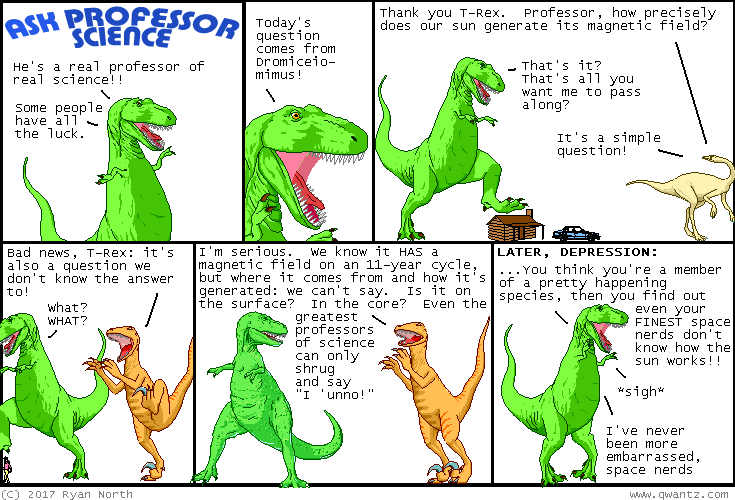
"professor science" is his name, and with slight modification, his passion (the professing of science)

archive - contact - sexy exciting merchandise - search - about
← previous April 3rd, 2017 next

April 3rd, 2017: I wanted to thank Thomas for the email about how French rap changed her life, drastically altering the course of her entire existence for the better!! I always suspected that these things were possible with French rap, but it was really nice to see it confirmed!

– Ryan

04 Apr 13:41

Trans politicians, part 3 (2010-2016)

by Zoe O'Connell

Happy Local Election Nomination Deadline Day! If you are planning on standing for election on May 4th, you have until 4pm today to get your nomination papers in. As I expect to be posting the 2017 candidate list in the next few days, it is an appropriate day to post the final part of the series on openly trans politicians in the UK, which started as part of LGBT History Month. (For earlier years, see part one covering 1986-1999 and part two, 2000-2010) LGBT History Month is now long past, but as a result of the first two parts I received a number of new leads to chase down on candidates who stood – most turned out to be people who didn’t come out until after they had left office, but many thanks to those who sent them in.

2010 was, in mainstream political terms, when it all kicked off for openly trans representation in the UK – going from one elected councillor in May 2010 up to a record three elected councillors and 9 other candidates in May 2016. It’s notable enough that a trans person standing for election might warrant a short and usually positive human interest piece in the local press, but at least for local election candidates it no longer generates the kind of mock-outrage by tabloid commentators that was previously common. The sheer number of people standing makes it difficult to write a biography for everyone, so only brief details are given on those elected.

The emphasis above is on “openly” above, as there are a number of trans politicians in the UK at local election level who are not out. At least some of the recent increase in numbers can be attributed not just to the increased number of trans candidates standing, but also the increased likelihood of people being out. Records prior to about 2010 are also sketchy, and it is likely some earlier candidates have been missed.

There are two known out Candidates who are now out, but are not listed below as it has not been able to confirm were out at the time of election: Sarah Larkins (UKIP, 2015) and Lee-Anne Lawrance. (Green, 2016)

If you have not been included in this list and believe you should be, please drop me a line. If I know you and have not included you here, it is because I believe you are not out.


2010

Sarah Brown (Liberal Democrats)
2010-2014: Cambridge, Petersfield

Appeared on the Independent on Sunday “Pink List” (later called the “Rainbow List”) of top 100 most influential LGBT people in the UK from 2011 to 2015. Cambridge City Council’s Executive Councillor for Community Services 2013-2014.

Herbert, Ian. The IoS Pink List 2011 Independent on Sunday. 22nd October 2011
Barkham, Patrick. ‘Why three in a bed isn’t a crowd’ – the polyamorous trio The Guardian. 20th April 2013
Cambridge Local Elections – Candidates A – B
Sarah Brown (politician) Wikipedia
Councillor details – Councillor Sarah Brown Cambridge City Council


2011

Unsuccessful City/Borough Council Candidates: Zoe O’Connell (Liberal Democrats)


2012

Unsuccessful City/Borough Council Candidates: Zoe O’Connell (Liberal Democrats)


2013
No known candidates


2014
2014 candidates list
2014 results list

Unsuccessful European Parliament Candidates: Nikki Sinclaire (We Demand a Referendum)
Unsuccessful City/Borough Council Candidates: Anna May Booth (Labour), Sarah Brown (Liberal Democrats), Alice Chapman (Liberal Democrats), Zoe Kirk-Robinson (Conservatives), Charlie Kiss (Green), Anwen Muston (Labour), Zoe O’Connell (Liberal Democrats)


2015
2015 candidates/results list

Zoë O’Connell (Liberal Democrats)
Cambridge, Trumpington (Term expires 2019)

Deputy Leader of the opposition on Cambridge City Council since 2016, Vice-Chair of the Liberal Democrat Federal Conference Committee and the author of this blog.

Barkham, Patrick. ‘Why three in a bed isn’t a crowd’ – the polyamorous trio The Guardian. 20th April 2013
Cambridge Local Elections – Candidates L – O
Councillor details – Councillor Zoe O’Connell Cambridge City Council


Zoe Kirk-Robinson (Conservatives)
Bolton, Westhoughton North and Chew Moor (Term expires 2019)

Councillor details – Zoe Kirk-Robinson


Unsuccessful Westminster Candidates: Emily Brothers (Labour), Stella Gardiner (Green), Charlie Kiss (Green), Zoe O’Connell (Liberal Democrats)
Unsuccessful City/Borough Council Candidates: Kirsten Ruth Bayes (Liberal Democrats), Anna May Booth (Labour), Alice Chapman (Liberal Democrats), Rachel Lawson (Green), Anwen Muston (Labour)


2016
2016 candidates list
2016 results list

Anwen Muston (Labour)
Wolverhampton, Eask Park (Term expires 2020)
Councillor details – Anwen Muston


Unsuccessful Regional/Metro Assembly Candidates: Brothers (Labour, London Assembly), Crow (Green, Scottish Parliament), Murray (Green, NI Assembly)
Unsuccessful City/Borough Council Candidates: Kirsten Ruth Bayes (Liberal Democrats), Helen Belcher (Liberal Democrats), Aimee Challenor (Green), Jane Fae (Liberal Democrats), Henry Foulds (Liberal Democrats), Jennifer Kirk (Conservatives), Maria Munir (Liberal Democrats)


The post Trans politicians, part 3 (2010-2016) appeared first on Complicity.

04 Apr 12:29

The signs are that UKIP will get a pasting in the May 4th elections

by Mike Smithson

They’re defending seats won at their 2013 highpoint

For me this week is all about the May 4th elections. Yesterday the Tory psephologist, Lord Robert Hayward, gave his annual presentation and predictions and there’s a fair bit of coverage in today’s press.

Unlike the Rallings and Thrasher seat projection which is confined to the English local council elections Lord Hayward embraced Wales and Scotland as well and in the latter suggested that would produce more big problems for LAB including the possible loss of the iconic Glasgow. His seats net gains/losses projection was:

LAB -125
LDs +100
UKIP -80
CON +100

With all the focus on LAB we must not ignore UKIP which in this round of elections in 2013 reached a high point securing 145 English council seats and a national equivalent vote share of 22%.

Since then the party has struggled in local by-elections and has the worst retention rate of all the main parties. In the aftermath of the second Brexit referendum last June it has been working to find a role for itself and has had a series of leadership issues. Last month, of course, it lost its single MP.

The main beneficiary of a weakened UKIP looks set to be CON which is also set to do well where it is up against LAB. This will help TMay’s party offset some of the expected losses to the LDs particularly in the South West.

Today I’m off to London again for a Political Studies Association briefing with Profs John Curtice and Tony Travers on the new super-mayors that will be elected for the first time for the six combined authorities that have been created.

Mike Smithson

Follow @MSmithsonPB

Tweet

04 Apr 12:28

Day 5932: The Firebird and the Dragon

by Millennium Dome
B-Day:

So it has happened. Theresa May has sent the “dear John” to Donald Tusk (good elephant name, just sayin’) to let him know we are all shooting ourselves in all of our flappy feet by triggering Article 50.

Remember, if we all get BEHIND the Prime Monster, then when SHE goes over the cliff… we DON’T have to follow!

The Brex Maniacs tell us to be optimistic. So I’ll tell you what I am optimistic about: we CAN turn this around. We can FIX this. WE CAN WIN.

Let me put it in a story:


Never upon a time… the Island of Briton was without magic or stories. And the people were sad and angry.

So the King and the Queen put up a proclamation and asked: who among the free citizens will go to faraway lands to return with a magical animal to bring stories to the people.

From the people who stepped forward, the King chose a rich country squire, who spoke with clever words how he knew better than anyone what the people needed. But the Queen picked a stable lass who came from the city with a lot of pluck and a cheeky wink.

So each went out on a boat.

The rich man, who was very old and very wise, sailed off to the lands of iron and gold and returned with a Dragon. And the maid who was younger but some would say wiser, set her boat towards the sun and returned with a golden Firebird.

And the King said to the Queen, the Dragon is very large, and very cunning and very very strong: it can protect us from all of our enemies and they will fear and respect us. What good is your songbird, then?

And the Queen said to the King: what use is a land ravaged by your Dragon. My Firebird will sing and give people hope.

And the Dragon was just as large and just as cunning and even stronger than the King had said, but it was also envious, and avaricious, and gluttonous, and full of angry fire. And it ravaged the land from end to end, eating many of the people and stealing all of their money, before crawling into a deep cave and coiling up to sleep on its huge hoard of stolen gold in the dark heart of its dungeon lair.

And the people heard phoenix song and had hope.

The Dragon woke up angry and afraid. It didn’t like this at all. And it flew out of its cave in a fury to find the Firebird and burn it to ashes.

But from the ashes, the Firebird was reborn to sing its song again.

This made the Dragon even more afraid and even more angry and it came and burned the Phoenix to ashes again. And stomped on the ashes for good measure.

But you cannot kill a song like that. And the Firebird was reborn to sing once again.

Time after time the Dragon burned the Firebird. And time after time, the Firebird came back. Hope born again and again, in spite of every defeat.

And seeing all this, the people started to sing the Phoenix song. Just a few at first. But more and more. And this made the Dragon so frightened that it went away and hid.

And the people were able to live in hope and happiness, at least for a while, until enough of them might give in to greed, or fear, or envy and the Dragon might come back.

Because Dragons live forever. But hope never dies.

We are the Firebird, the Bird of Freedom; however much they burn us, we keep coming back. And we can beat the Dragon of fear and anger. With hope.


As a fluffy elephant, inheritor of the WOOLLY MAMMOTHS, I might just have a better claim to be a NATIVE Briton that any of you monkey-people who wandered here over the Doggerland in the last Ice Age or the many peoples, Romans, Anglo-Saxons, Danes, Normans, and all the rest who migrated here since.

I am English, and like most English I am a bit of a MONGREL. I’ve been a Londoner, an East-Ender; my Daddies are from Stockport; one is half-Scottish half-American; the other is of Yorkshire stock; we are from ALL OVER.

But Europe is my home and my family, a family that has spent my entire life – and my DADDIES’ entire lives (which is AGES!) – working for peace and prosperity, through art and science, through learning and living together as much as through trade. We make each other so much better off in so many more ways than just money. We show the World that there is another way, a better way, than wars and dictators.

The Leave campaign – never fact based – placed its great emotional appeal on two weapons: the grass is always greener and nostalgia for a better past.

Well BOTH OF THOSE ARE ON OUR SIDE NOW.

I want people to remember the great days, the glory days when stopped being the SICK MAN of Europe and started to get better off, when we could AFFORD an NHS that treated people on time, when we could HALVE child poverty, when we could SAVE Bosnia AND protect the Falklands, when we could confidently INTRODUCE Human Rights and Freedom of Information, when we could feel we were good.

I want to them to remember ECONOMIC MIRACLES and COOL BRITANIA and remember that they happened WHEN WE WERE IN THE EU.

But this doesn’t need to be just nostalgia.

Europe will evolve without us, they have to, and hopefully they will become both a stronger economy and a fairer democracy. We have forfeited our right to be part of leading that change. But that does not mean we cannot continue to engage, to listen to what Europe wants, learn from them, help if we are able, if we are asked. Europe will be the green and pleasant land 21 miles away across the Channel.

The Tories have such a NARROW and PETTY vision of Britain, not a Great Britain but a GREY Britain, a cold offshore tax haven, under the choke of the Dragon.

But we can be BETTER THAN THAT. We WILL be better than that.

Tell the story of a Britain that listens to HOPE, not to FEARS, and takes our place again among the family of nations. The story of a people who are look bravely outward to new challenges, not inward to past failures. The story of how we can become again that Great Nation that leads in Europe, no need to cower away.

Tell them we ARE the Firebird. And we can SING.
03 Apr 20:35

Liberal Democrats tipped to regain Cornwall and Somerset

by Jonathan Calder


It's not clear what he bases it on, but the Conservative peer and psephologist is tipping the Liberal Democrats to do well in May's local elections.

According to the Financial Times:
Lord Hayward predicted that the Lib Dems could see a net gain of about 100 seats, in line with a recent estimate by fellow psephologists Colin Rallings and Michael Thrasher. 
“They have a seriously good prospect of winning both Cornwall and Somerset,” he said.
He goes further over at Heart FM:
Elections analyst Robert Hayward told Sky News the Tories would surge to victory if Mrs May went to the country in the coming months, fresh from triggering Article 50. 
The party could lose up to 15 seats to the Liberal Democrats, his projections suggest, but make major gains from Labour and could take a handful of seats from the Scottish Nationalists.
03 Apr 13:25

Michael Howard is an alien

by Jonathan Calder


How do we account for his desire to launch a war with Spain, that strange accent and his belief that prison works?

I have vague memories of writing a column for Liberal Democrat News back in 1997 about an alien spacecraft being sighted over Michael Howard's Kent home.

And it seems those memories are accurate.

A Guardian article from 2010 says:
But the opening of the latest batch of Britain's own "X-files" today reveals that the RAF in March 1997 did mount an inquiry into reports from six members of the public, including two firefighters, of a large, triangular "humming" object in the sky above his Folkestone home during his last months as home secretary. 
The Ministry of Defence file reports that witnesses said the UFO hovered for several minutes above a field before shooting off in a flash of light. Sophie Wadleigh, 25, from Hythe, told the Folkestone Herald: "It was so peculiar, it all felt really odd and I heard this humming noise. As I looked across the field I saw a large triangular shaped flying craft hovering about 300 feet off the ground." 
The MoD file includes a report from Chris Rolfe, of the East Kent UFO monitoring group, which says he believes it could have been looking for the former home secretary, as it was not interested in Wadleigh: "This … has left me wondering if its purpose had something to do with Mr Howard."
I think Mr Rolfe may have been on to something.
03 Apr 13:25

A Sincere But Futile Attempt To Engage With Ayn Rand (1)

by Andrew Rilstone
If I am going to talk about Steve Ditko, I suppose am going to have to try and talk about Ayn Rand. 

I know that this is a bad idea. My left wing friends are already telling me that even thinking about Rand gives her a spurious credibility. My Objectivist friends, of whom I have none, will soon be telling me that this is exactly the kind of thing you’d expect liberals to say, which proves their point...

This is not a response to the whole of Ayn Rand’s, or indeed Steve Ditko’s world view: it couldn’t possibly be. It’s really just an attempt to show how the first few chapters of The Virtue of Selfishness — particularly the essay entitled The Ethics of Emergencies — strike me. Think of it as an atheist reading through St Mark’s Gospel or a Tory reading The Communist Manifesto.

*

“I’m thru getting pushed around — by anyone. From now on I just look out for number one — that means — me!”
        Amazing Fantasy #15


I swear by swear by my life and my love of it that I will never live for the sake of another man, nor ask another man to live for mine
        Atlas Shrugged

Rand claims to have devised or discovered a rational system of ethics. Since it is an objective fact that all human beings are alive, their first moral obligation is to stay alive. Since it is an objective fact that all human beings are conscious, their second moral obligation is to be happy. But they should only be concerned with their own life and their own happiness. I have no duty to help anyone else; no-one else has a duty to help me.

“Just as life is an end in itself, so every living human being is an end in himself, not the means to the ends or the welfare of others — and therefore the man must live for his own sake, neither sacrificing himself to others nor sacrificing others to himself. To live for his own sake means that the achievement of his own happiness is man’s highest moral purpose.”

I grok that, if I don’t believe in conventional morality, or religion, or mysticism, or some great big idea like Communism or the Singularity, then all I have left to believe in is me. And I think I can also see the romantic appeal of the great objectivist man, whether it's Rorschach never compromising, even in the face of Armageddon, or Del-Boy Trotter taking nothing from the government and giving nothing to the government. I owe no man anything and no man owes anything to me. Hurrah!

What I don’t know is how you get logically or rationally from “human beings are alive” to “human beings ought to try to stay alive.” I agree that human beings do on the whole mostly try to stay alive, but I don't know how you get logically or rationally from that to "Human beings should always try to stay alive." And if, by some alchemy, “I am alive” implies “I ought to try to stay alive” I still do not understand why “You are alive” does not equally imply “I ought to try to keep you alive” — why "We are all alive" doesn't imply "We all ought to try to keep each other alive."

Even if me being alive and you being alive were mutually exclusive alternatives — say, if Titanic had just struck an iceberg and there were only one spare seat on the lifeboat — I don’t know why I ought to prefer my life to yours. I don't know why Rand's morality (I ought to preserve my own life at the cost of yours) is more rational than everyone else's morality (I ought to preserve your life at the cost of my own).

I would certainly prefer it if you decided to stop being alive and allowed me to carry on, but I don’t know how I can rationally infer, from the fact that we are both alive, that pushing you out of the lifeboat is the moral thing to do. It’s equally true that I can’t rationally demonstrate that I ought to give my place on the lifeboat to you. Without some premises to work from, I can't rationally or logically demonstrate why I ought to do anything at all. I don't know how to get from any kind of "is" to any kind of "ought".

I understand that David Hume didn't, either.

I might decide to let you have the spare place on the lifeboat for all sorts of reasons — because you have dependent kids and I don’t; or because I want history to remember me as a good guy and not a bad guy; or because it wouldn’t be British to push to the front of a queue. But that's because I have a totally irrational belief that not depriving kids of their father, achieving posthumous honour and displaying good manners are more important that mere longevity. 

I doubt that such a things as rational ethics exists, in the same way that I doubt that such a thing as vegan beef casserole exists. Why should you give the other guy your place on the life boat? Because it is the right thing to do. Why should  we refuse to drop bombs on civilians in wars? Because it is the right thing to do. Why did Valjean admit that he was the escaped convict and Champmathieu was innocent? Because it was the right thing to do. Why should you stop a burglar who runs past you in a TV studio, even if no-one is paying you? Because it is the right thing to do. 

As you are presumably aware, Prof. C.S. Lewis (who Rand, rather pleasingly, abominated) thought that "doing the right thing" meant acting in accordance with the tao. By the tao he simply meant everything which human beings have always thought are the right things to do. He wasn't interested in Chinese philosophy: he just wanted to avoid specifically Christian terms. Christians don't have the monopoly on doing the right thing.

To say that something is the right thing to do because it is part of the tao is to admit that I can't say why it is the right thing to do: it just is.  Rand will only convince me that she has come up with a rational basis for ethics if she can teach me how I ought to behave without ever appealing to the tao. And that includes explaining what she means by what that pesky little word ought.

*

All I can tell you is that when it came to the point whether I would take my own neck out of the noose and put another man's into it, I could not do it.
                                 Shaw, "The Devils Disciple"

It is a fact that, in an extreme situation like a shipwreck, some people act unselfishly. They allow someone else to take their place in the lifeboat or swim into dangerous waters to prevent someone else from drowning. And some people act selfishly — save their own lives without a thought for who else perishes. And some people make a dash for the lifeboat but feel guilty about it afterwards: lots of us know what the right thing to do would be, but don't actually do it. How do we decide which group are doing the right thing and doing the wrong thing? If we ought to do unto others as we would like other to do unto us, then the group who allowed others to live did the right thing. ("Do unto others" is the whole basis of the tao.) But if morality is the same as self-interest we have to say that the person who forced his way into the boat did the right thing. Indeed, we have to say that those who sacrificed or risked their own lives acted wickedly. Billy Zane is the hero and Leo DiCapprio is the bad guy.

Rand appears to agree that this would be absurd. She argues:

1: That the question is illegitimate, and the very fact that we are asking it proves the superiority of objectivists to altruists.

2: That the rational way of behaving in a shipwreck is in any case very much like that dictated by the tao: the rational man will rescue his friends, loved-ones, and possibly even strangers.

3: But this doesn’t make any difference because emergencies are special cases where special rules apply.

Turning the argument round and attacking the moral character of the people making it is not necessarily the hallmark of a serious philosophical essay. It smacks of "Weak case: insult opposing lawyer." What bad people these altruists must be to test a new theory by examining edge-cases! Lack of self-esteem, lack of respect for others, nightmare view of existence…

“A lethargic indifference to ethics, a hopelessly cynical amorality—since his questions involve situations which he is not likely ever to encounter, which bear no relation to the actual problems of his own life and thus leave him to live without any moral principles whatever.”

On no possible view could it be true to say that altruists have no moral principals. Even by Rand’s own arguments, they have lots of moral principals — just the wrong ones. But that aside: how do you get from “altruists point to extreme cases" to “altruists have no moral principals whatsoever.”

I suppose you would have to construct an argument along these lines:

1: Altruists point to extreme cases like fires and shipwrecks to refute the idea that we have no duty to help anyone else.

2: Therefore, extreme cases like fires and shipwrecks must be the only exceptions to the general rule that we have no duty to help anyone else.

3: It is intrinsically unlikely that any individual will ever experience a shipwreck or earthquake.

4: Principals drawn from improbable circumstances have no application to probable ones.

5: Therefore any attempt to infer the correct behavior in probably circumstance from the correct behavior in an improbably one is necessarily false.

6: Therefore people who argue from extreme cases have no basis for their conclusions.

7: Since people who believe in altruism argue from extreme cases, altruists have no basis for their belief in altruism.

8: Since people who believe in altruism have no basis for their belief in altruism, they have no basis for any of their other beliefs either. 

But this doesn’t work at all. Point 1 is not necessarily true. Because I raise one example, it doesn't mean there aren't any others I could have raised. You can believe something for more than one reason. Point 4 begs the question: it might be that the same rules apply in the exceptional case as in the normal one, or it might not. And point 8 is obviously nonsense: it doesn't follow at all that if I have one false belief, all my other beliefs are false as well. 

If we accepted Rand's position, we would have to say that any argument involving a hypothetical or a thought experiment is automatically invalid: that you can only make moral judgement about specific, concrete events. (I believe that some anarchists are reluctant to state general principals for this reason: because there are no general cases, only an infinite number of unique ones.) But extreme and unlikely cases are frequently useful because they help us to visualize a question. Conscientious objectors were always asked “What would you do if a German officer were raping your grandmother?”— not because there was much chance of the German army molesting that particular pacifist’s elderly relative, but because the proposition “I will not join the army because killing is wrong under all possible circumstances” is refuted if you can come up with even one circumstance where it might be right. When asked what he understood courage to mean, Socrates asked “Well, suppose you were a passenger at sea in a terrible storm….?” Would a rational man have replied “But I am not in a terrible storm, so obviously you have to live your life without any understand of courage whatsoever. See where this 'philosophy' stuff gets you!”

But this is a distraction, because it turns out that if a group of Randian objectivists really were on a sinking ship they would be just as likely to pull each other out of the water, give up their places in lifeboats, and generally act in accordance with the tao as anybody else.

In the first place, says Rand, this rule that you should look out for yourself and not for others doesn’t apply to friends and lovers. But this isn't really an exception: when you do a good turn for someone you love, you are acting selfishly, because:  

“It is one’s own personal selfish happiness that one seeks, earns and derives from love.”

Ah, so: objectivists are cynical people, choosing their friends and wives in anticipation of some tangible return — money, social status, career advancement, someone to look after the kids, invitations to the best parties, sex etc? Not a bit of it. What you get out of a loved one is “a profoundly personal, private joy” and “personal, selfish happiness”. So when you help someone else, you are really acting to preserve that “private joy” and “personal happiness”. If a rich man spends a fortune to save his wife’s life, he is not acting altruistically, but selfishly. He wants her to live because he derives happiness from her; he doesn’t want her to die because he would then be less happy than he would be if she were still alive:

"In the above example, his wife’s survival is of greater value to the husband than anything else that his money could buy, it is of greatest importance to his own happiness and, therefore, his action is not a sacrifice." 

But all this does is re-frame altruistic actions as selfish ones: instead of saying “I will save your life because I don’t want you to die” we have to say “I will save your life because I don’t want to be sad". It might be possible, and it might also be interesting, to re-frame all moral choices in that way. You say "I donate money to feed a starving child because it is the right thing to do": I say "You donate money to feed a starving child because you selfishly dislike the sensations of guilt you experience when imagining the child starving to death." But that hasn't told us anything new about how we ought to behave. Either way, the wife gets the surgery and the child gets a bowl of rice. 

We assume that the man who pays for his wife’s operation honestly loves his wife, and will truly have less happiness and less joy if she dies than if she stays alive. But supposing he does not have those feelings? Supposing he he actually sick to death of the crabby old ratbag, is quite sure he'd be happier as a widower, but stomps up the money because it’s the right thing to do. Do we have to say that he's acted immorally? Or suppose he’s with us on that sinking ship and says “I will save my baby rather than my wife, because I honestly think that the baby is more important to my personal happiness than the woman”? Does his wife get a say? Supposing he says “I will save my mistress rather than my wife” or even “I will save my puppy rather than my baby”? Assuming that his dog really was important to his personal private joy and happiness and the baby wasn't, do we have to say that he acted in rational self-interest and therefore morally?

Or are we allowed to say “Maybe you did love your dog more than your child, but you ought not to have done”?

If we take the first line, then what set out to be rational theory of ethics turns out to mean “be guided by your emotions: do whatever will make you happy”. Do what thou wilt shall be the whole of the law, without even the qualification about harming none. This is exactly what Prof. Lewis warned us would happen. There is a certain irony about how much of our rational ethic comes down to emotions like love, joy and happiness. 

But if you take the second line — that the sensible, rational, selfish thing to do is indeed to save the lives of the people who you love but if, and only if, you love the people you ought to love and do not love the people you ought not to love — then Rand hasn’t said anything very new. Ethics is about arranging your values in the correct order — loving the most important things most; the second most important things second most; the least important things least; and the unimportant things not at all. Isn't this exactly what Aristotle told us all those months ago?


[to be continued]


03 Apr 13:25

Who will speak for Millennials?

by TSE

Young voters lack political representation says Keiran Pedley. So who is going to step up?

One of the topics discussed on the latest PB/Polling Matters podcast was the striking difference in views on Brexit by age.

This week saw the first political poll by my company (GfK) for 12 years. One of the questions we asked was whether Brits thought Brexit was the “right decision” or the “wrong decision”. The results can be found in the chart below.

Table 1: Brexit: Right decision / wrong decision (by age)

Our poll this week got most attention for the finding that showed Jeremy Corbyn’s approval rating as low as Donald Trump’s but in my opinion this chart is more important. What it shows is a huge difference in opinion on the future of the country by age. For example, 55% of those aged 18-24 think Brexit was the “wrong decision” whereas 59% of those aged 65 and above think it was the “right decision”.

Brexit is not the only issue that divides Brits by age. Younger Brits also seem to be much more negative about the economic prospects of the country too. Here are some numbers from the same poll looking at economic optimism overall and by age. Once again, the differences are striking.


Based on these numbers, it seems that if you are aged 55 and over you are reasonably confident about the economic future of the country and the country’s future more generally. For younger voters the story is very different. It isn’t hard to see why. With wage growth frustratingly weak, tuition fees and rents rising and the property ladder a distant dream for many in their 20s, there is little to be particular optimistic about for millennials post Brexit. Or at least, for many it will feel that way. That’s before we even touch what the retirement age for the average 25 year old is likely to be.

The question is will this frustration manifest itself politically or will it just breed more apathy?

It seems to me that there is an opportunity for a politician or political party to develop a platform for government based on the idea that younger voters have it tough and that needs to change. Many will dismiss this idea for the obvious reason that younger people are much less likely to vote than older people. This is true. But those younger people have parents and grandparents. Perhaps one way the centre-left can reinvigorate itself in Britain is to make inter-generational inequality the centrepiece of its revival, appealing to older voters that their children’s and grandchildren’s futures are at stake if action isn’t taken. It’ll take guts but it is worth a try. Plus, it is also the right thing to do.

So over to you Jeremy Corbyn and Labour. If the British left is going to go down in flames, it might as well do so fighting on behalf of a cause worth fighting for. Or if you won’t, maybe the Lib Dems will. Let’s wait and see.

Keiran Pedley

Keiran Pedley tweets about public opinion and politics at @keiranpedley and is the presenter of the ‘Polling Matters’ podcast. Listen to the latest episode on Brexit and Scotland below.


03 Apr 13:23

French polling watchdog intervenes after Russian report that Fillon’s now ahead in polls

by Mike Smithson

Fillon moves sharply in the betting to 19% at Macron’s expense

All the movememt in the French betting in the past 24 hours has been to the Republicn candidate, Francois Fillon, following a Russian news report quoting a Russian “poll” that he’s now in the lead. This is the Telegraph report

“..In a statement released on Sunday, the watchdog said the survey could not be described as representative of public opinion and that Sputnik had improperly described it as a “poll” because it did not fulfill the legal definition of the term under French law.

“It is imperative that publication of this type of survey be treated with caution so that public opinion is aware of its non-representative nature,” the commission’s statement said.

Sputnik published a similar online survey by the same firm in mid-February, also showing Mr Fillon in the lead while opinion polls were placing him third.”

There’s a lot of nervousness in Paris about the Russian involvement in the election and it appears that the Putin gang don’t want Mr. Macron.

My guess is that we’ll see a lot more of this in the next three weeks.

French law has very strict controls over political polling including what and what cannot be descirbed as a poll.

It is not beyond the bounds of possibility that there will be an attempt to influence the betting markets as well.

Mike Smithson

Follow @MSmithsonPB

Tweet

03 Apr 13:22

Two-round electoral systems: a thought experiment

by Nick

(AKA, today in anti-clickbait titles…)

Special offer: use this card to vote, and get your second ballot free!

We’re just three weeks away from the first round of the 2017 French Presidential election and I’ve recently been trying to write a journal article about tactical voting, so various things have smashed together in my head to create an electoral system that would never be used but would make for interesting campaigns.

A quick recap for those who don’t know: the French electoral system has two rounds. In the first (taking place on April 23rd this year), all candidates that can get themselves nominated stand and all voters get to vote for one of them. The two leading candidates then advance to the second round (held two weeks later on May 7th) where all voters get to choose between them and the one with the most votes wins. (National Assembly elections, which will follow the Presidential election, follow similar rules, though any candidate with over 12.5% of the vote can remain in for the second round)

In theory, this allows people to vote in different ways in the two rounds. In the first, they can vote expressively for the candidate they want to win, then in the second they can vote instrumentally between the two candidates with the most support. In practice, of course, there’s a tactical element to any first round vote as voters have to consider who they want to see in the second round. For example, suppose there are 4 candidates in the election: A, B, C and D. You really like A, don’t mind B, don’t like C, and actively detest D. However, you also believe that D is very likely to finish in the top two accompanied by one of B or C and A will not have sufficient support to get into the top two. Do you vote for A, or choose to vote for B (who you don’t mind) in order to keep C (who you don’t like) out of the second round? What do you do if C is more likely to beat D in the second round than B, or vice versa? You can see how it gets complicated. (Now imagine having to do that and then choose your second round vote at the same time without knowing who the candidates are, and you’ve got the Supplementary vote system we in the UK use for mayoral elections)

So, my thought was how could you have an entirely expressive first round which would be a way to demonstrate the true level of support for a candidate or party? One way to do that would be to remove the compulsory elimination of candidates between the two rounds. There’d still be two rounds, separated by time, and whoever came top in the second round would be elected, it’s just that any withdrawal between the two rounds would be entirely voluntary on the part of the candidates, rather than enforced by the system. In the example above, you’d be able to cast your vote for A without concern about who made it to the second round as everyone would. In the gap between the two rounds, candidates and voters would be able to make decisions about whether to stay in and/or whether to endorse someone else with everyone aware of what their level of support actually is. The first round would be truly expressive, and the second very instrumental as people decided – based on their knowledge of the first round result – how they could best use their vote to get the result they preferred.

In the case of national parliamentary elections, it would also give people the chance to see how their constituency affects or is affected by the national picture. Imagine if we’d had a system like this in the 2015 UK general election, where a first round would have revealed that the Tories were much more likely to win a majority than Labour, that the SNP were surging and the Liberal Democrats had collapsed. The main campaign would have been entirely different, and people could have chosen their second round vote based on a much more accurate understanding of the national picture than they had from polling.

Now, there are plenty of problems with this as a practical solution, not least the difficulty of pitching ‘we’ll have an election, then we’ll repeat it a few weeks later’ as a practical and workable electoral reform, but for me it does solve an important issue of elections in that it gives voters both an opportunity to vote without tactical considerations and then the opportunity to have much more useful information when they cast their meaningful vote in the second round.

02 Apr 20:35

I'll know if Brexit has worked.

by noreply@blogger.com (Richard Morris)
So, the deed is done and the letter has been delivered - the Brexit process has begun.

In an excellent and thought provoking piece in The Guardian today, Rafael Behr argues the case that there is no going back now. And more to the point, no matter how badly it goes, the Brexiteers will always be able to argue the case that it's only because its not a tough enough Brexit, and if only it was done properly, all will/would have been well.

The problem as he sees it, it that there's no alternative history to compare and contrast. As Rafael puts it...

"Pro-Europeans will struggle to disprove those arguments because there will be no demonstrable counterfactual. The claim that Britain would have been better off on a different path will be no more effective than the prediction in last year’s referendum that Brexit would hurt. No one who ignored that warning wants to be assailed with a smug chorus of “we told you so”. "

And its on this point that I disagree with Rafael. Because I fear there is a counterfactual.

While I think on balance, Britain will be economically worse off out of the EU rather than in, this was never my overarching reason for voting 'in'. Indeed, I suspect there's a lot of guesswork on both sides around the economic ups and downs of Brexit.

No my reason is different - and one where a strong counterfactual does exist.

I've been fortunate enough to see some wonderful Statesman and women speak over the years- I saw Reagan speak on Capitol Hill, I heard Helmut Kohl speak when I was a student - but the greatest political speech I ever heard 'in the flesh' was given in a meeting room in Portcullis House about 15 years ago - by Michael Heseltine.

He spoke, without notes for maybe 20 minutes, about peace in Europe. He was informed, authoritative, mesmerising, running over maybe 100 years of European history and arguing the case for why it was the EU that had delivered, for the first time, long term peace in Europe.

I have never forgotten it.

I am also of an age that I grew up at a time - the 1970s - when the Second World War may have seemed to us as children as ancient history, but we played football around the air raid shelters in the park, and the railings of the houses in our streets were just stumps in the wall, the metal having been removed (we were told) to make munitions. This makes peace seem a little more fragile perhaps than many people remember.

Similarly war in Europe is not a remote, ludicrous proposition. What we often refer to quite glibly as 'the troubles' is anything but a distance memory, and we have had war in Europe in the recent past, and indeed in the Ukraine right now. It's not coincidence that no EU country has been involved in this.

So my counterfactual for Brexit is this; peace in Western Europe for the next 44 years.

Anything less and Brexit is a failure.
02 Apr 20:30

poop emoji poop emoji my truest most secret self that even i can't look at because it's too upsetting emoji poop emoji

archive - contact - sexy exciting merchandise - search - about
← previous March 29th, 2017 next

March 29th, 2017: This weekend I got to hang out with 3 (THREE) different dogs and watch a friend pet a new type of dog for the first time, so it's been a great weekend for dogs. I hope yours was the same!!

– Ryan

02 Apr 18:28

The country’s leading psephologists bring more bad news for Corbyn

by TSE

Whilst the primus inter pares of psephologists gives his analysis

For a sitting government to make gains and the main opposition to lose seats in local elections is rare, and speaks volumes about the appalling nature of Jeremy Corbyn’s leadership. Perhaps losses this year and next year might persuade his more passionate supporters to realise their man is the electoral equivalent of Ebola. For those who want a strong Labour party of a strong opposition, it might be best if Labour get absolutely shellacked in these local elections and the elections in 2018.

The Lib Dem fightback we’ve been seeing most Thursday nights since last June will continue this May as well, if Rallings and Thrasher are correct, if I were a Tory MP in the South West I might start to get a little nervous and pressure Mrs May to come up with plans and policies to help retain those seats, given the smallness of her majority she might have no choice if she wishes to govern properly.

As for UKIP, we appear to have seen peak UKIP, unless Mrs May’s Brexit deal is a Brexit lite deal which could re-energise UKIP, but with Arron Banks setting up The People’s Front for UKIP The Patriotic Alliance, it might not matter.

TSE

02 Apr 10:59

Cadburys Ban Easter (April Fool!)

by Andrew Rilstone
We are all familiar with the War on Christmas, when (according to an ancient tradition going back to pagan times) a journalist stands in front of a Christmas tree next to a man dressed as Father Christmas in a Christmas market and says “Christmas has been banned again.”

This year, we have an excellent War on Easter as well. 

It takes two forms. The first, and more benign, goes something like this:

My kids have just asked me why the word Easter no longer appears on Cadburys Easter Egg boxes. What should I tell them, please?

I'm not saying a Cadbury Easter Egg has much to do with Easter or Jesus but have they really banned the word Easter to avoid offendin people?

The more malignant version goes more like this:

Just seen a pic of a halal certificate being proudly held aloft by Cadbury. You don't seem to realise this is offensive to many.

Cadbury Accused of Anti-Christian Conspiracy Over Rumours of 'Halal' Creme Eggs 

Muslim Easter Eggs with the word "Easter" taken off!  Almost as good as the terribly funny "Kosher Mince Pies" which comes up every year. Because everyone knows that only observant Christians eat chocolate in the spring time and little fruit pies in the winter and that fine old hymn Easter Bonnet was definitely not composed by a religious Jew. 

Cadburys bans Easter contains at least 5 factoids (*):

1: Up to now, all Cadburys chocolate eggs have had the word “Easter” printed on them.

2:This year, no Cadburys chocolate egg has the word "Easter" printed on it. 

3:The word Easter is offensive to Muslims.

4: Someone — Muslims, government censors, "the PC brigade", Big Brother — has the power to make companies change the design of products which offend people. 

5: Changing something because it offends people is a wrong and crazy to thing to do. 
    I don't think that you can pass on the "Cadburys no longer labels its chocolate eggs as Easter eggs" message without passing on the other 5 claims with it. That is why this sort of thing is so pernicious.

    In fact:

    1: By no means all chocolate eggs have ever had the word “Easter” printed on them. Cadburys Creme Eggs were always Cadburys Creme Eggs, and branded eggs seem always to have taken the name of their brand — Maltesers Eggs or Smarties Eggs or Quality Street Eggs.

    2: Many chocolate eggs still have the word Easter prominently displayed on the packaging. My impression is that very elaborate, decorated products are likely to be called “Easter Eggs” but cheap branded ones are likely not to be. If fewer eggs have the Easter branding than was the case 50 years ago, that would be an interesting (and not particularly surprising) piece of information. 

    It is certainly the case that Creme Eggs used to be sold only at Easter, but are now available all year round, because people are prepared to buy them all year round. It might be that Cadburys want to encourage the idea that a 99p “Cadburys Flake Egg” is an acceptable treat at any time between January and May, while you would probably only buy the £10 Easter Egg with elaborate ribbons and flowers as a gift for Easter itself. I used to quite like it when you could literally only get Hot Cross Buns on Good Friday (and the baker shop opened specially to sell them, and wasn’t allowed to sell anything else). But companies want to sell as many of their products as they possibly can.
    The supernatural leporine being who delivers the eggs is universally referred to as the Easter Bunny (and hidden features in computer games are always called Easter eggs).

    3: There is not the slightest evidence that the word Easter does offend Muslims, just as there is not the slightest evidence that Muslims turn into pillars of salt if you throw pork sausages at them. The racist right is again creating an evil mirror image of itself. Because racists are freaked out by anything even slightly Muslim — by the word Ramadan, by the presence of a Mosque in the same city as them, by the existence of halal options in cafes — they assume that Muslims are freaked out by anything even slightly Christian. 

    I swear to Buddha that there is a travel agent in Bristol offering package trips to Mecca as part of an Easter special. Because "Easter" is a time of year as well as a religious festival. 

    4: So, obviously, there is no reason to think that Cadburys have taken the word Easter off their chocolate, which they haven’t, because it offends Muslim, because it doesn’t.

    5: If Cadburys had in fact made Easter Eggs without the word Easter on them available so that people who don't like the word Easter could still enjoy overpriced chocolate wrapped in foil during the spring equinox, this would not actually be a wrong or crazy thing to do. It would be both kind and good business sense. If there were people with a deep religious conviction that they were only allowed to eat chocolate in the springtime if the word "Easter" appeared somewhere on the packaging, and if that Christian-friendly chocolate had somehow ceased to be available, then Christians might have the right to feel aggrieved. But there aren't and it hasn't and they don't.

    It's like our old friend who still moans about the BBC cancelling the Black and White Minstrel show "because it wasn't PC". It's true that the BBC used to show blackface minstrel shows, and it's true that they don't any more. But the "PC" part smuggles in the idea that no-one sensible could possibly object to blackface entertainments, and that some mysterious but unidentified force (usually known simply as "they") forced the BBC to stop showing them, in the teeth of Common Sense and the Will of the People. Which is why no fair-minded person should ever use the term "PC" in any context: there is always a less evil way of expressing the same thought. ("The text of some of Enid Blyton's stories have been slightly changed to make them more inclusive" or "Some old comic books contain words that nice people wouldn't use any more" or "This comedian tells racist jokes".)

    The halal thing, is even more tricksy. When someone starts telling you that Cadburys Creme Eggs are halal they are conflating:

    1:Halal = permissible for an observant Muslim to eat
    2: Halal certified = Some expert in the Muslim law has issued a certificate saying that it is permissible for an observant Muslim to eat them
    3: Halal slaughter = a method of killing animals which some people consider to be cruel
      The trick is that you can assert, truly, that Cadburys Creme eggs are halal (Muslims are allowed to eat them); while smuggling in the idea that Cadburys are being nice to brown-skinned people (by making chocolate that they are allowed to eat) and even that a civilised person wouldn’t eat one of these heathen eggs which you have to torture a poor moo-cow to make (even though they don't contain any meat products). As Cadburys indefatigable social media team have been saying all week: all their chocolate is halal, because all chocolate is halal, in the same way that all water is halal and all bread is halal; but none of their products is halal certified; they haven't changed the recipe in order to make it halal; and certainly no ritual slaughter is involved in the manufacture of chocolate.

      But again, the trick works: the idea is smuggled in that some kinds of chocolate have been Muslimified, and the racist right starts to assert that if you buy Cadburys products you are obviously no Christian; extremely unpleasant tweets start to circulate asking shopkeepers to please stack their Creme Eggs near their Pork Scratchings so that Muslims won't be able to eat them.

      I wonder how many of the people passing on these messages will be taking Holy Communion on Easter Sunday? Come to that, what are they doing eating Creme Eggs in Lent in the first place?


      (*) Factoid — Widely believed lie; a thing which everyone thinks is true but ain't. NOT "a trivial fact".


      02 Apr 10:59

      With three weeks to go the value French President bet is that Marine Le Pen won’t do it

      by TSE


      Alastair Meeks looks to follow up on his Dutch success

      There are few more baffling markets at present than the market on the next French president.  It’s a very active market  with more than £8 million traded so far, so its oddities can’t be put down to there being few punters.  Yet the odds seem very hard to square with the polling.

      The electoral system is designed to produce a centrist.  The voting takes place over two rounds.  First, the full range of candidates are put to the nation.  The two front runners then go through to a head-to-head.

      Marine Le Pen has for months been getting polling results that suggest she will comfortably make the last two, without ever recording an opinion poll that suggests that she is even within touching distance of beating the person who at that given moment would be projected to face her in the last round.

      For some time, the polling has suggested that her likely opponent will be Emmanuel Macron.  Both of them are consistently polling in the mid-20s and recently M. Macron has appeared to open up a slight lead on Marine Le Pen.  Her voters seem very certain in their minds that they will back her while his are notably much less fixed on their choice.

      Nevertheless, both currently have l’eau bleue claire between themselves and the chasing pack.  Their closest challenger, Francois Fillon, is polling 5% or more behind them.  Jean-Luc Mélenchon is gaining ground but remains fourth for now.

      The first round of voting is only just over three weeks away.  The polling may be wrong (in particular, we might reasonably suspect either shy Fillonites who do not wish to admit supporting someone with such serious allegations against him or shy Mariners who do not want the albatross of supporting the FN hung round their neck) or the public may change their minds, but time is running out.  The jelly is setting.

      So how should we approach this market?  We need to consider the two rounds in turn.  Given where the polling currently stands, it seems to me that we need to consider three possible last round candidates: Marine Le Pen; Emmanuel Macron and Someone Else.  In an ideal world you would consider each of the also-rans separately but it gets too complicated and given current polling the effort is not yet justified.

      Based on current polling, I assign these probabilities of 90%, 80% and 30% respectively (they need to add up to 200% because there are two berths to fill).  I make MLP a 90% chance of getting through to round 2 (her supporters are very clear in their own minds).  I make Emmanuel Macron an 80% chance of getting through to round 2, with the bulk of the other 30% made up by Francois Fillon.  For convenience, I shall treat Someone Else as being Francois Fillon, though the overlap is far from complete.

      Then we need to consider how each match-up would play out.

      Marine Le Pen’s chances of becoming next president are say 1 in 20 if she faces Emmanuel Macron and say 2 in 10 if she faces Francois Fillon.  Every poll against Macron shows her being annihilated.  To beat him, she would need a Black Swan (or perhaps a Siberian Goose).  The polls against Fillon are rather closer, though still not all that close (and if Francois Fillon makes the last two, he will be outperforming current polling), and there are a lot of abstentions in the figures.

      I rate Emmanuel Macron’s chances in a last two match against Francois Fillon at 75%.

      If there are only three contestants and one has a 90% chance of being in the last two and one has an 80% chance of being in the last two, the contest possibilities must be:

      70% MLP vs EM

      20% MLP vs FF

      10% EM vs FF

      From Marine Le Pen’s view, that means that if my assessment of the probabilities is correct, she has 0.05 x 0.7 + 0.2 x 0.2 chance of winning = 7.5% chance.

      From Emmanuel Macron’s view, he has a 0.95 x 0.7  + 0.75 x 0.1 chance of winning = 74% chance.

      From Francois Fillon’s view, he has a 0.8 x 0.2 + 0.25 x 0.1 chance of winning = 18.5% chance.  (However, note that I have let Francois Fillon stand for all the other contenders, so his probability is not really that high.  I would credit him with roughly a 12% chance of winning with the other 6.5% largely, but not completely, falling to Jean-Luc Mélenchon.  Certainly, I regard the current price on Betfair for Francois Fillon of 5.9 as far too short.)

      Now obviously a lot of people disagree with me about the underlying odds or Marine Le Pen wouldn’t be 4.9 on Betfair right now.  Feel free to do so also.  But I still think it’s very possible that Marine Le Pen might drift rather than tighten after the first round as the size of her task against Macron is then focused on, if that is indeed her last round opponent.  The more likely you think that Marine Le Pen will reach the last two, the more that achievement should be regarded as baked into her current price.  And it may well be that after the first round her task looks harder, not easier.  On my assessment of the probabilities, if she finds herself facing Emmanuel Macron in the last two, her chances have actually got worse.

      So if like me you don’t think that in reality Marine Le Pen stands more than an outside chance in the last two and you intend to lay her on Betfair, it may not pay to wait for the first round to take place.  This may be as short as her price gets.

      Alastair Meeks

      Follow @AlastairMeeks

      Tweet

      01 Apr 19:01

      The Multiplier Effect: Regional, Social and Brexit swing make a bad story worse for Corbyn’s LAB

      by David Herdson

      Polling analysis: CON’s getting biggest swings where it matters most

      Writing a thread on why Labour might do even worse than headline polling figures suggest feels uncomfortably like kicking a man when he’s down. However, if that’s what’s happening then it needs reporting and interpreting; I am only the messenger. And it is happening. Poll after poll has reported differential swings across regions, social groups and Brexit alignment.

      I’ve therefore looked at all the polls published in March to see if we can make sense of what’s going on and where it would lead. The figures I’ve derived are – unless otherwise stated – based on an average of the five companies to have published polls in March’s own average figures for the month.

      The national baseline is that the average headline figures for March (together with the swing since the 2015 GE) were:

      Con 42.7 (+5.0)
      Lab 27.1 (-4.1)
      LD 10.2 (+2.1)
      UKIP 9.8 (-3.1)

      This represents a net 4.5% swing from Lab to Con – though in fact most of the actual movement is the result of voters switching to and from third parties.

      This of itself would be bad enough for Labour. Electoral Calculus predicts a Conservative majority of 106 on those vote shares, using the current boundaries. The regional swings however, produce a multiplier effect.

      Unfortunately for Labour, their smallest swings mostly come where it helps least. The one exception is Scotland. To describe this as a disaster zone for them is putting it kindly. The way things stand, Scotland has more chance of winning the World Cup than it does of electing a Labour government. Even after the losses of 2015 and 2016, the trend remains downwards, with the firms reporting an average support of just 12%. Two polls (those by ComRes and Mori), had Scottish Labour in fourth place, behind the Lib Dems and in single figures; Mori gave them just 6%. This might be bad news for Scottish Labour councillors but the good news as far as the general election goes is that the party can only lose one seat north of the border, which of course it would.

      In England, however, the picture doesn’t pan out so well. A London-only YouGov poll published yesterday found support of Lab 37 / Con 34 / LD 14 / UKIP 9. (These are in fact similar figures to the aggregated London subsamples from the nationwide polls, which is reassuring as to their reliability for other regions). This represents a notional Lab-Con swing of just under 3%, so less than the national average – though in reality it’s more a secondary effect of a 7% Lab-LD swing, mostly in Inner London. Unfortunately, London has an unusually large number of close Lab-held marginals and even a swing of that size would sweep eight seats into the Con column, though in all probability this would be offset by some Con losses to the Lib Dems.

      Elsewhere, both Labour and Tory support across the rest of the South – a huge area of the country, almost entirely Blue – is virtually unchanged. Polling for both parties puts them within 1% of where they were at the 2015 general election.

      Instead, the areas where the swings are greatest are those which are packed with middle-target marginals: the Midlands, Wales and the North.

      Not all firms disaggregate Wales from the Midlands, presumably because of its small population and – unlike Scotland – its tendency to swing more-or-less in line with England. But taking the three regions of Wales, the East Midlands and West Midlands together, produces a swing over that super-region of no less than 7.6%. Put another way, it turns the tidy 5.5% lead that Con had in the 2015 election into a monster 20.7% lead.

      Likewise, while the polling is unusually inconsistent, even for subsamples, in the picture painted by the polls for the North, we can see something similar. In 2015, Labour held a 12.4% advantage; that’s now been turned into a lead of about 1.5% for the Conservatives: just shy of a 7% swing. In contrast to London, Labour holds only ten seats in the northern super-region with majorities of less than 3k but holds 22 with majorities of between 3k and 7k (not all over Con).

      All this would be bad enough but two other factors are likely to multiply the differential even further (though we should be aware of some element of double-counting here).

      Firstly, the swing to Con has come almost entirely from the working class.
      Unlike regional voting, the baseline of the 2015 election here is, for obvious reasons, less secure. Even so, Mori carried out a sizable post-election poll which is the best information we have. Using that, it seems that since the election, the ABC1 group has swung to the Tories by just 1.6%, whereas the C2DE group has swung by some 8%. As the Tory target seats as the party heads from comfortable win into landslide territory will tend to become increasingly working-class, the vote is again exactly where TMay needs it.

      And secondly, returning to the top of the polling data, polls are consistently reporting that between a quarter and a third of the 2015GE UKIP vote has defected to the Conservatives. It was the small and medium northern and midlands towns which won it for Leave and while the match isn’t a perfect fit – the Labour seats are too diverse for that – it’s still likely to have a boosting effect to the swing to Con where it matters.

      Is there any good news at all for Labour? Yes: two items. One is that the Tories are currently hitting the sweet spot. If the polls shift, they probably won’t be; the multiplier effect works both ways. And the other is that there is probably quite a simple solution to bringing about such a change.

      David Herdson

      Follow @DavidHerdson

      Tweet

      01 Apr 18:59

      Corbyn’s ratings hit an historical low for a LAB leader at this stage

      by Mike Smithson

      Only one of those in the chart led party to GE victory

      Punters give JC a 39% chance of staying till GE

      01 Apr 18:52

      Your April Fool’s Day Fun: Build Your Own Fake Collapsing Empire Cover

      by John Scalzi

      As you may know, recently a fellow with more ineffectual rage than sense recently attempted to cash in on The Collapsing Empire by rushing out a “me too” book with a “me too” cover. I don’t suspect it fooled very many people, or did much other than to confirm some people have too much time on their hands, but one good thing to come out of it is that Camestros Felapton felt inspired to create a Collapsing Empire fake cover generator. An “explanation” and link to the cover generator may be found here. I had fun playing around with it, and I suspect you might as well.

      Thus is represented the full sum of my April Fool’s tomfoolery today.


      31 Mar 20:40

      People joked about regulations for growing fruit before Britain joined Europe

      by Jonathan Calder


      "When I was 11 my favourite radio comedy was The Men from the Ministry," as I once blogged.

      This episode of that show was first broadcast in April 1980. It deals with the ministry's attempts to enforce a standard size for stick of rhubarb.

      A satire on the European Union's banana regulations?

      No. Because this is a remake of an episode that was broadcast back in 1962.

      I suspect  the sort of people who believe government is ridiculous have always believed government is ridiculous.

      If we leave the European Union then they will believe Westminster is ridiculous - and that it imposes silly regulations about fruit and vegetables too.

      In other words, the sort of people who campaigned for Brexit will not me made happy by it.
      31 Mar 19:30

      If the trend in today’s London poll was replicated in Manchester Gorton then LAB might struggle

      by Mike Smithson

      Today’s main polling news has been a London poll by YouGov for Queen Mary University where Professor Phil Cowley is one of the leading politics dons. He created the above charts. The main figures with changes on April last year were:-

      CON 34+4
      LAB 37-9
      LD 14+7
      UKIP 9-4
      GRN 5+1

      As we all know London has a very different demographic profile from most of the country and there are very few places indeed which come close to matching it. One I’d suggest is Manchester Gorton where Labour is defending a Westminster by-election on May 4th.

      Gorton is an inner city seat with a huge number of students and a large BME population which has a much younger profile to the rest of the UK

      Based on the betting odds the big battle is between Labour and the LDs who secured a third of the vote at GE2010 and where the yellows are fighting hard.

      If the Gorton Labour vote is falling in the manner portrayed in the London poll with the strongly anti-BREXIT LDs the main beneficiary from these numbers should could be the yellows. Like London Manchester Gorton was strongly for REMAIN last June 23rd.

      There has been no published Gorton polling though I’m given to understand from my links in the city that voters there say they have been polled. I can only assume that was a private poll for one of the parties.

      There’s the added complication for LAB in the by-election of the LEAVE campaigner George Galloway running as an independent. I’m sure both the yellows and reds will not be slow in reminding voters that the former RESPECT MP announced his Gorton plans on the website of Arron Banks.

      When Galloway made his intentions clear the week before last I laid Labour at 1.13 on Betfair. That’s now shifted to above 1.2 and I’ve taken the profits by betting on Labour.

      Mike Smithson

      Follow @MSmithsonPB

      Tweet

      31 Mar 18:42

      The red telephone box is returning to Market Harborough High Street, but Leavers shouldn't get too excited

      by Jonathan Calder
      A ray of light on a dark day has been the news that the red telephone box will be returning to Market Harborough High Street.

      Last month, without warning, BT sent a lorry to carry it away, even though Harborough in Bloom were keen to adopt it.

      As the Liberal Democrat councillor Barbara Johnson said at the time: "It’s been part of the street scene in a conservation area for years."

      But today the Harborough Mail reports that
      the box should be back within a month - as a bit of visual nostalgia; it won’t have a working phone.
      Is this a portent of what Brexit Britain will be like? First red telephone boxes come back, then queuing, proper cricket and corporal punishment?

      No. Leave supporters should not get too excited.

      Already it is clear that big business will use Brexit as an opportunity to campaign to get rid off 'red tape'.

      In other words, to get rid of the laws that protect the built and natural environment.

      If you still have a red telephone box in your town and village, Brexit makes it more likely that you will lose it.
      31 Mar 14:18

      Can we end this “snap election” speculation – TMay, like Dave before, simply does not have the power to call one

      by Mike Smithson

      Everybody seems to be ignoring the Fixed Term Parliament Act

      In the latest PB polling matters podcast we hear that polling has been going on asking the public what they think of the idea of having an early General Election. The responses are interesting but they ignore one pertinent fact:

        The prime minister, unlike all those before Cameron, does not have the personal power to go to the monarch and seek the dissolution of Parliament. The Fixed Term Parliament Act has changed that.

      This legislation came about as part of the 2010 coalition deal between the Conservatives and the Liberal Democrats. It was pressed for by the yellow team because they didn’t want to get into a situation where the Tories could just govern for a year or so and then go straight to the country when circumstances appeared most right ditching them.

      The Act remains in force and will do so until such time as it is repealed. But that process of itself might not necessarily return the discretion to the prime minister. In any case a repeal act would have to go to both houses of parliament and it is highly possible that the measure could run into trouble in House of Lords which could delay it.

      There are two provisions in the act for early elections and both present enormous hurdles. Firstly there can be one if two-thirds of the entire House of Commons votes for one. The proportion is based on the total legal number of MPs and would including vacancies, abstentions and, of course, the Sinn Fein representatives who do not take their seats.

        In the current Parliament 434 MPs would have to back the measure. That would mean getting Labour agreement so the choice would be in Mr. Corbyn’s hands.

      The the other way a snap election can be held is if there is a vote of no confidence in the government which is not rescinded within 2 weeks.

      So the Tories could have a contrived vote of no confidence in themselves which if passed would mean Mrs May would have to go to the palace and tell the Queen that the Commons had no longer any confidence in her government and she would have to resign.

      In this case the sovereign would probably call the alternative Prime Minister in waiting, the leader of the opposition, to see if he could form a government.

      Clearly that would be very difficult but there is just a possibility that Mr Corbyn could become Prime Minister for a very short period even if he lost a confidence vote himself a few days later.

        A reason why Labour MPs might not back a Commons motion calling for an early election is that it is so much better for them if they force the government to go through the vote of confidence process.

      No doubt Mrs May has taken her own legal advice on this issue. One of the reasons why she has steadfastly ruled out an early election is that she knows the difficulty.

      If you don’t mind locking money up for three years bet on a 2020 general election.

      Mike Smithson

      Follow @MSmithsonPB

      Tweet

      31 Mar 14:17

      Maybe a reason why LAB gets poor media coverage is that the Corbyn-appointed PR team is not up to it

      by Mike Smithson

      It is as if the red team has given up

      I have never been a fan of Seumas Milne, the PR chief of Corbyn’s Labour, not because of his politics but that he is so poor at the job.

      The series of Tweets highlighted by Sam Coates of the Times above is something that the whole LAB leadership should worry about – they are after all the OFFICIAL opposition with all the associated perks that go with it.

      Until this is sorted out let’s hear no complaints from Corbyn cultists about the way their man is treated. Mr. Milne was the leader’s appointment.

      I’m not hopeful of change.

      Mike Smithson

      Follow @MSmithsonPB

      Tweet

      30 Mar 14:14

      What is Territorial Cissing?

      by Sarah

      There has been a recent spate of articles in the UK press, mostly at weekends. Pretty much all of them are written by cis women. They all attack trans women for, as far as I can tell, having the very nerve to exist as women. Perhaps the most notable recently was this piece by Woman’s Hour presenter, Jenni Murray (paywalled). Murray starts by proclaiming that she is definitely not transphobic in any way, and certainly not a TERF.

      After this important disclaimer, she then trots out a few classic TERF tropes, which she seems to earnestly believe: trans women are fashion obsessed airheads; we were “socialised as men”; we need to stop pretending we’re “real” women; and by the way, a trans woman she knows agrees with her so don’t call her transphobic.

      This is tedious. There’s nothing new here. These “arguments” are such cliches that one can number them ahead of time and provide handy links to their standard refutations if one desires. It’s well into “drinking game” territory.

      I found myself wondering what the point of these “paint by numbers” weekly hit pieces is. The people writing them act like they’re imparting important new information, but pretty much the exact same piece appears every few days. Right on cue, a few days later author Chimamanda Ngozi Adichie came out with the same nonsense, and then a few days after that it was the turn of Hadley Freeman. Yesterday it was Ellie Mae O’Hagan’s turn.

      Here’s my recipe for writing one of these pieces:

      Start by declaring yourself “not transphobic” and say something about how you “deplore discrimination”. Like those things companies add to the bottom of emails, this is Very Important and Definitely Legally Binding.

      Talk about how trans women have “male socialisation”, then pick a few of these and write a paragraph about each:

      • Political correctness means you can’t say “cervix” any more
      • Something about testosterone and sport
      • Trans activists are transing our children and forcing them to swallow bottles of deadly hormones
      • “autogynephillia” (caution – this will blow your “not a TERF” cover – use with care)
      • Trans women are airhead bimbos, definitely all of them, and no cis women behave like this, ever, amen

      Now you’ve carefully constructed your devastatingly effective and completely original (or your money back) argument, close out by saying that trans women need to identify as trans women, and stop calling themselves women, and get off my territory!

      Because that’s the rub, isn’t it? The thing these pieces are all asserting is territorial dominance. “I am woman, this is mine, you can’t have none, look at my expensively maintained by an Islington dentist middle class canine teeth! Grrrr!”

      A dank pedestrian underpass

      This seems safe

      You know those dark, concrete pedestrian underpasses? Every city has them: even beautiful Cambridge with its medieval university. They’re just a bit grim, no matter how hard councils try to make them seem safe and welcoming.

      And quite often, they smell of urine.

      We all know who’s doing this. By and large, it’s young men. Whatever they think their reasons are, this whole “urinating in underpasses” thing has a very clear effect: it marks the area for women as being a place we shouldn’t linger. We’re probably not safe there. It’s not our territory.

      The man pissing there probably did so with their mates present. They probably thought it was “top bantz”, or something. They were probably drunk and engaging in the sort of loud, territorial behaviour that women tend to instinctively fear. Yes, even trans women, despite what these thinkypieces would have us believe.

      These constant hit pieces in the press are doing the same thing. Every time we see one, it reminds trans women that we can never take acceptance by feminists, or by any cis women we don’t already know well enough to trust, for granted; it’s not safe for us to do so. Feminism and women’s issues aren’t for us; if we speak up we will be punished and cast out because this is not our space, it belongs to the people who want us dead, or at least invisible. Like uppity women asking drunk men to just use the fucking toilet, we’re spoiling their gig.

      And just to remind us, they’re going to ensure the media constantly bombards us with their territorial cissing, week in, week out.

      30 Mar 13:57

      Inner Emigration: A Citizen Of Nowhere

      by noreply@blogger.com (Jae Kay)
      So today the die was finally cast. The country now heads off away from the EU, for better or worse. There have been many calls for those of us opposed to this move to give up on a future that is no longer coming and join with Brexiters "for the good of the country".

      Theresa May has called for unity repeatedly and Brexiters have been lambasting Remoaners for months. The cries of "traitors" have begun to grow as some Remainers have sought to continue the fight.

      I've no real urge to help build a future I've got no investment in. The country has spoken and it said "No thanks" to what I thought was best. It is now up to those who voted for Brexit to make it work. My love for the United Kingdom hasn't grown any smaller. It is just I've found very few people share my love for the country. They worship the flag of St. George, express little more than a very thin loyalty to Her Majesty and think compromise, that which has seen our country through many a constitutional muddle, is an evil and that any other course of action, no matter how dangerous, is worth considering before it.

      I've already discussed my own personal brand of patriotism here. It has become crystal clear to me that I'm in a tiny minority of people who still believe that being British means having honour, decency and respect. The trolls have taken over our country and the nationalists are preparing to laugh themselves silly over whatever remains in the next few years of our once noble nation.

      Look... I'm just not going to claim to share any sort "patriotism" with people like this:


      The flag is upside down. Suspended between two bins. This is what we're dealing with. I just... I can't bear it. It is wounding to see such people win. And win they did. And they'll continue to win...

      I see no prospect of a change of heart in this nation, regardless of what happens. The Tories are ascendant with little to no realistic opposition for the foreseeable future. Culturally we've lost our devotion to being better people.

      So I'm out. Just out. I'll tinker around with my family tree. I'll drool over gorgeous men. I'll read, watch movies, get on with my life as best I can. But the country I owe allegiance and loyalty to is gone. It may never have even existed. And soon even its name may be consigned to the history books if the nationalists get their way. 

      And one day, if opportunity presents itself, I'll leave.
      30 Mar 13:56

      Cambridge Analytica and the Other Turing Test.

      by Peter Watts
      Not even scripted.

      Not even scripted.

      Near the end of the recent German movie “Er Ist Wieder Da” (“Look Who’s Back”), Adolph Hitler— transported through time to the year 2015— is picking up where he left off. On the roof of the television studio that fueled his resurgence (the network thought they were just exploiting an especially-tasteless Internet meme for ratings), the sad-sack freelancer who discovered “the world’s best Hitler impersonator” confronts his Frankenstein’s monster— but Hitler proves unkillable. Even worse, he makes some good points:

      “In 1933, people were not fooled by propaganda. They elected a leader who openly disclosed his plans with great clarity. The Germans elected me… ordinary people who chose to elect an extraordinary man, and entrust the fate of the country to him.

      What do you want to do, Sawatzki? Ban elections?”

      It’s a good movie, hilarious and scary and sociologically plausible (hell, maybe sociologically inevitable), and given that one of Hitler’s lines is “Make Germany Great Again” it’s not surprising that it’s been rediscovered in recent months. Imagine a cross between “Borat”, “The Terminator”, and “Springtime for Hitler”, wrapped around a spot-on re-enactment of that Hitler-in-the-Bunker meme.

      But that rooftop challenge: that, I think, really cuts to the heart of things: What do you want to do, Sawatzki? Ban elections?

      I feel roughly the same way every time I read another outraged screed about Cambridge Analytica.

      The internet’s been all a’seethe with such stories lately. The details are arcane, but the take-home message is right there in the headlines: The Rise of the Weaponized AI Propaganda Machine; Will Democracy Survive Big Data and Artificial Intelligence?; Robert Mercer: the big data billionaire waging war on mainstream media.

      The executive summary goes something like this: An evil right-wing computer genius has developed scarily-effective data scraping techniques which— based entirely on cues gleaned from social media— knows individual voters better than do their own friends, colleagues, even family. This permits “behavioral microtargetting”: campaign messages customized not for boroughs or counties or demographic groups, but at you. Individually. A bot for every voter.

      Therefore democracy itself is in danger.

      Put aside for the moment the fact that the US isn’t a functioning democracy anyway (unless you define “democracy” as a system in which— to quote Thomas Piketty— “When a majority of citizens disagrees with economic elites and/or with organized interests, they generally lose”). Ignore any troublesome doubts about whether the same folks screaming about Cambridge Analytica would be quite so opposed to the tech if it had been used to benefit Clinton instead of Trump. (It’s not as though the Dems didn’t have their own algorithms, their own databased targeting systems; it’s just that those algos  really sucked.) Put aside the obvious partisan elements and focus on the essential argument: the better They know you, the more finely They can tune their message. The more finely They tune their message, the less freedom you have. To quote directly from Helbing et al over on the SciAm blog,

      The trend goes from programming computers to programming people.” [breathless italics courtesy of the original authors]

      Or from Berit Anderson, over at Medium.com:

      “Instead of having to deal with misleading politicians, we may soon witness a Cambrian explosion of pathologically-lying political and corporate bots that constantly improve at manipulating us.”

      You’d expect me to be all over this, right? What could be more up my alley than Machiavellian code which  treats us not as autonomous beings but as physical systems, collections of inputs and outputs whose state variables show not the slightest trace of Free Will? You can almost see Valerie tapping her arrhythmic tattoos on the the bulkhead, reprogramming the crew of the Crown of Thorns without their knowledge.

      And I am all over it. Kind of. I shrugged at the finding that it took Mercer’s machine 150 Facebook “Likes” to know someone better than their parents did (hell, you’d know me better than my parents did based on, like, three), but I was more impressed when I learned that 300 “Likes” is all it would take to know me better than Caitlin does. And no one has to convince me that sufficient computing power, coupled with sufficient data, can both predict and manipulate human behavior.

      But so what? ‘Twas ever thus, no?

      No, Helbing and his buddies assert:

      “Personalized advertising and pricing cannot be compared to classical advertising or discount coupons, as the latter are non-specific and also do not invade our privacy with the goal to take advantage of our psychological weaknesses and knock out our critical thinking.”

      Oh, give me a fucking break.

      They’ve been taking advantage of our psychological weaknesses to knock out our critical thinking skills since before the first booth babe giggled coquettishly at the Houston Auto Show, since the first gurgling baby was used to sell Goodyear radials, since IFAW decided they could raise more funds if they showed Loretta Swit hugging baby seals instead of giant banana slugs. Advertising tries to knock out your critical thinking by definition. Every tasteless anti-abortion poster, every unfailing-cute child suffering from bowel disease in the local bus shelter, every cartoon bear doing unnatural things with toilet paper is an attempt to rewire your synapses, to literally change your mind.

      The face of the enemy (figure: J. Albright)

      The face of the enemy (figure: J. Albright)

      Ah, but those aren’t targeted to individuals, are they? Those are crude hacks of universal gut responses, the awww when confronted with cute babies, the hubba hubba when tits are shoved in the straight male face. (Well, almost universal; show me a picture of a cute baby and I’m more likely to vomit than coo.) This is different, Mercer’s algos know us personally. They know us as well as our friends, family, lovers!

      Maybe so. But you know who else knows us as well as our friends, family and lovers? Our friends, family, and lovers. The same folks who sit across from us at the pub or the kitchen table, who cuddle up for a marsupial cling when the lights go out. Such people routinely use their intimate knowledge of us to convince us to see a particular movie or visit a particular restaurant— or, god forbid, vote for a particular political candidate. People who, for want of a better word, attempt to reprogram us using sound waves and visual stimuli; they do everything the bots do, and they probably still do it better.

      What do you want to do, Sawatzki? Ban advertising? Ban debate? Ban conversation?

      I hear that Scottsman, there in the back: he says we’re not talking about real debate, real conversation. When Cambridge Analytica targets you there’s no other being involved; just code, hacking meat.

      As if it would be somehow better if meat were hacking meat. The prediction that half our jobs will be lost to automation within the next couple of decades is already a  tired cliché, but most experts don’t react to such news by demanding the repeal of Moore’s Law. They talk about retraining, universal basic income— adaptation, in a word. Why should this be any different?

      Don’t misunderstand me. The fact that our destiny is in the hands of evil right-wing billionaires doesn’t make me any happier than it makes the rest of you. I just don’t see the ongoing automation of that process as anything more than another step along the same grim road they’ve been driving us down for decades. Back in 2008 and 2012 I don’t remember anyone howling with outrage over Obama’s then-cutting-edge voter-profiling database. I do remember a lot of admiring commentary on his campaign’s ability to “get out the vote”.

      Curious that the line between grass-roots activism and totalitarian neuroprogramming should fall so neatly between Then and Now.

      Cambridge Analytica’s psyops tech doesn’t so much “threaten democracy” as drive one more nail into its coffin. For anyone who hasn’t been paying attention, the corpse has been rotting for some time now.

      ‘Course, that doesn’t mean we shouldn’t fight back. There are ways to do that, even on an individual level. I’m not talking about the vacuous aspirations peddled over on SciAm, by folks who apparently don’t know the difference between a slogan and a strategy (Ensure that people have access to their data! Make government accountable!) I’m talking about things you can do right now. Easy things.

      The algos eat data? Stop feeding them. Don’t be a Twit: if all Twitter’s other downsides aren’t enough to scare you off, maybe the prospect of starving the beast will lure you away. If you can’t bring yourself to quit Facebook, at least stop “liking” things— or even better, “Like” things that you actually hate, throw up chaff to contaminate the data set and make you a fuzzier target. (When I encounter something I find especially endearing on Facebook, I often tag it with one of those apoplectic-with-rage emojis). Get off Instagram and GotUrBalls. Use Signal. Use a fucking VPN. Make Organia useless to them.

      What’s that you say? Thousands of people around the world are just dying to know your favorite breadfruit recipe? Put it in a blog. It won’t stop bots from scraping your data, but at least they’ll have to come looking for you; you won’t be feeding yourself into a platform that’s been explicitly designed to harvest and resell your insides.

      The more of us who refuse to play along— the more of us who cheat by feeding false data into the system—  the less we have to fear from code that would read our minds. And if most people can’t be bothered— if all that clickbait, all those emojis and upward-pointing thumbs are just too much of a temptation— well, we do get the government we deserve.  Just don’t complain when, after wading naked through the alligator pool, something bites your legs off.

      I’m going to let Berit Anderson play me offstage:

      “Imagine that in 2020 you found out that your favorite politics page or group on Facebook didn’t actually have any other human members, but was filled with dozens or hundreds of bots that made you feel at home and your opinions validated? Is it possible that you might never find out?”

      I think she intends this as a warning, a dire If This Goes On portent. But what Anderson describes is  the textbook definition of a Turing Test, passed with flying colors. She sees an internet filled with zombies: I see the birth of True AI.

      Of course, there are two ways to pass a Turing Test.  The obvious route is to design a smarter machine, one that can pass for human. But as anyone who’s spent any time on a social platform knows, people can be as stupid, as repetitive, and as vacuous as any bot. So the other path is to simply make people dumber, so they can be more easily fooled by machines.

      I’m starting to think that second approach might be easier.

      28 Mar 22:37

      Tim Farron: Defecting Labour MPs would be "generals without armies"

      by Jonathan Calder


      Tim Farron has given a characteristically frank, even ingenuous, interview to the Evening Standard.

      As a veteran (I almost wrote survivor) of the Alliance years, I was particularly interested in these comments:
      Labour friends keep inviting Farron to see Limehouse, the new Donmar Warehouse play about the formation of the SDP. Perhaps remembering that struggle, no Labour MPs have asked to defect yet. 
      “Much as I love them, they’re all generals without armies, and I’m interested in armies. At this time when anything can happen, why couldn’t the best thing happen? That’s the Lib-Dems taking their place.”
      Politics today can feel very like the early 1980s, so I am relieved that Tim is not planning to turn the Liberal Democrats into a tribute act.

      This confirms my judgement that, despite that boyish exterior, he has got every big decision as leader right.

      He is also shrewd on the fall and rise of his predecessor:
      The 2015 unofficial message — “it would have been worse without us” — was a tough sell, he concedes, but “absolutely works now”. He says Nick Clegg even gets cheered at universities. “Brexit has been a reset button in British politics.” 
      Other, more personal, insights from the interview come when he talks about religion:
      Are people in public life afraid to talk about religion? “Yes. In America you’ve got to invent a faith to be taken seriously; in the UK you have to pretend not to have one. You shouldn’t be ashamed.”
      and here:
      And when I ask about his greatest mistake (expecting him to name abstaining on a gay marriage vote), he instead says: “I wish I had reached out more to Charles Kennedy when he stepped down. It was an unimaginably hard time for him. I regret that more than anything.”
      But, above all, I am pleased that he found time to name-check one of my early football heroes:
      His conversation is littered with football similes. Labour under Corbyn is “like when you replace a good centre-half with a non-leaguer — suddenly there’s no proper defence”. In the coalition, the Lib-Dems were “Chopper Harris — clearing every ball off the touchline”.
      28 Mar 12:29

      At the last Gorton by-election the Tories, led by the visionary pro-European Ted Heath, came within 557 votes of victory

      by Mike Smithson

      How will the BREXIT Tories do now?

      After their extraordinary gain of a by-election seat from LAB in Copeland we have heard very little of the blue team’s prospects in Manchester Gorton which is expected to take place on May 4th. Yet as the panel shows the Tories got very close to victory in the seat in 1967.

      No one is suggesting that the Tories have any chance whatsoever. The result from 1967 and what we know about the area now highlights the huge demographic changes that have taken place in the UK generally and specifically in this part of Manchester. In the 60s Manchester had 9 MPs, five LAB and four CON. No more. This has been a no-go area for the blues for a long time

      In November 1967 the UK was going through considerable financial upheaval and just over two weeks after the by-election the pound was devalued from the dizzy heights of $2.80 to to $2.40 – a fall of 14%. Wilson’s “the pound in your pocket” broadcast has gone down as one of the defining political moments of the decade.

      The Tories were led by Ted Heath who two and a half years later pulled off one of the biggest political surprises in recent times achieving something that is unique on modern British political history. A party that had a working Commons majority was replaced with Heath’s Tories that had working Commons majority. In the changes of government in 1951, 1964, 1974, 1979, 1997 and 2010 either the outgoing party didn’t have a working majority or the incoming one didn’t achieve one.

      It was the 1970-74 Heath government that took us into what was then called the Common Market. There was no referendum. That came in 1975 when Harold Wilson was trying to deal with the splits in his own party.

      Alas Heath’s achievements are now viewed by the Tories in much the same way that the LAB movement views Tony Blair.

      Mike Smithson

      Follow @MSmithsonPB

      Tweet