
Andrew Hickey
Shared posts
20 Apr 12:56
“That would be an ecumenical matter”
by Zoe O'Connell
 There has been some fuss recently about Tim Farron, the Liberal Democrat party leader, and his views on sin. I am finding I am having to answer the same questions and rebut the same half-truths over and over again, so I put together a quick handy guide. The progression of points in here is typically how the debate unfolds but my style tends to be quite dry. Those who want a slightly more emotional response to the issue, which can best be summarised by “FFS, not this again”, should read Jennie Rigg’s post. Jennie is also chair of LGBT+ Liberal Democrats.
For those new to this blog, I should clarify that I’m a bisexual transwoman in a polyamourous relationship.
I have avoided criticism of other politicians in this post, but I would like to note that there is more than enough of the brown stuff to go around if we want to get into a mud slinging contest. Some people might want to go there, but that’s not something I’m doing in this post.
Edit: Since I wrote this post, Tim has answered a direct question on this in parliament. His reply to “Do you believe that homosexuality is a sin” was “I do not”. You can see the clip on BBC iPlayer at about 13:46. It remains to be seen if he has opened Pandora’s Box or not…
But why won’t Tim Farron say gay sex is not a sin?
I don’t think he can, because the question is a trap. It’s not a new trap, and back in 2003 Tony Blair was stopped from answering questions on religion by his spin doctors with the now-infamous line “We don’t do God“.
For political leaders, religion is a Pandora’s Box and should stay closed. Cathy Newman, when she asked him the question, no doubt had follow-up questions for him to try to back him into a corner – she’s an accomplished political journalist and anyone of that calibre will not ask a question without follow up questions in mind. With enough questioning, any politician is going to find themselves forced either into a row with religious leaders (Just look at what happened with Cadbury’s and the National Trust) or with their own party. Neither of those are vote-winning choices.
Unfortunately, Tim did fluff a 2015 interview with Cathy Newman on Channel 4 by starting to talk about theology before he had realised it was a bad idea in his new role as party leader. This original error is why the issue has become a story. For those who might have missed the initial interview, what he actually said was “We’re all sinners”. Yes, it is theologically accurate, but it is unhelpful for a party leader to say. Nevertheless, he has definitely never said he thinks gay sex is a sin.
I do recognise that some people won’t be happy unless he says “No” to the question and that not everyone will agree with me here, but I believe that Tim’s statement that he is not going to make theological pronouncements is probably the right approach. Although Cathy Newman has so far failed to ask any other political leadership figures the same question, you can bet that the likes of May, Khan and so on now all have their own soundbite-sized version of “We don’t do God” prepared.
But he abstained on Same-Sex Marriage!
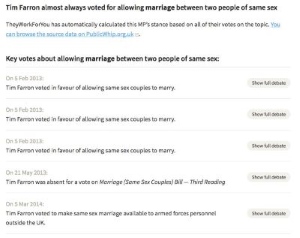 There were six votes, and Tim abstained on one of those due to issues surrounding the spousal veto. “They Work For You” have more on this, just click the linked image on the right to see the detail. If you think that trying to fix the spousal veto during the passage of the Marriage (Same Sex Couples) Act was a bad thing, then that’s far from evidence that Tim is homophobic and I must respectfully disagree with you on parliamentary tactics. One of my regrets is that trans politicians did not rock the boat more at the time and try to persuade people to vote against the bill due to its transphobic content. Sadly, we did not as a group have the influence then that we have now.
Gay frogs!
Seriously? That wasn’t even close to Tim’s usual tweeting style and he’s hardly likely to wade into random twitter debates on LGBT issues with the British Humanists Association. He’s not the only party leader to have his twitter hacked either.
He’s only suddenly become LGBT+ friendly since he became party leader!
This is where I get to point out that Tim has a long track record of positive action on LGBT+ issues. Tim doesn’t – or didn’t, I suspect the school of hard knocks may affect this – do vapid soundbite politics. Those of us in bi/queer/trans circles often get marginalised by soundbite politics, with “Equal Marriage” being a prime example. (Top tip: We do not have Equal Marriage in the UK. We have Same-Sex Marriage, and you only have to look at the injustices perpetrated by the spousal veto, pension laws and so on to realise this) What he had done is learnt about the detail and spoken in favour of many positive Liberal Democrat policies that are often overlooked.
There’s plenty more press coverage since he became leader, and Pink News have a pretty good list of his pro-LGBT work once you scroll past the headline and attacks on him. Most recently, Tim was front of the queue condemning the homophobic atrocities in Chechnya, when I don’t think we’ve heard anything at all from Corbyn or May. However, there are a whole host of other things linked to from that article. Please do go and have a look.
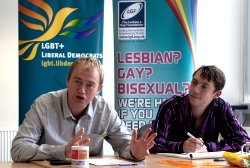
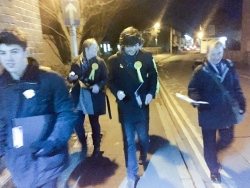 The older stuff has less coverage as party presidents don’t usually get the limelight, but the photo at the top of this article was at an LGBT+ Liberal Democrats event he spoke at in 2012. From memory, that was the event where several of us spoke to him on the concerns trans people had about accreditation at party conference and which he helped us lobby on in his role as party president. The photo on the right was taken in February 2015, when Nick Clegg was still leader and Tim was out campaigning in my ward. Anyone local to Cambridge may recognise this as being outside the primary school on Coronation Street. Apologies for the poor photo, we didn’t realise this was going to be a “thing” at the time.
You’re only defending him because you’re a Liberal Democrat!
 Hardly, and I was quite willing to be critical of Clegg when he messed up.
There are a number of loud bisexual/poly/queer/trans voices in the party defending Tim – Jennie Rigg, whose blog post I linked to above for example. A number of us get Righteously Annoyed when people attack Tim on LGBT+ issues because he has been solid on the BT+ parts of the debate for many years when other political leaders have left us out in the cold for not being vote-worthy enough. Seeing people, and sometimes even the same people who sold us down the river over Same-Sex Marriage, attack him for not being word-perfect and repeating the same damaging soundbites as other leaders (“Equal” Marriage) is predictably going to rile us up.
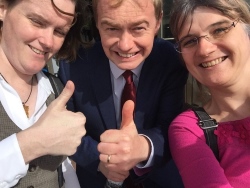
As I said on Twitter, we’re the Awkward Squad. We don’t DO “Loyal party drone”. But I do have a nice photo of two of us with Tim Farron in Bournemouth that I’d like to share.
The post “That would be an ecumenical matter” appeared first on Complicity.
20 Apr 12:53
damn this country damn this country’s const...
by Andrew Rilstone
damn this country
damn this country’s constitution, where tiny majorities equate to landslide victories
damn this country’s constitution where leaders can have elections whenever the hell they like
damn this country’s constitutions where leaders can have elections whenever the hell they like, after specifically introducing laws which say they can’t
damn the whole archaic idea of monarchy, which allows party leaders to act like queens
even though i quite like the pageantry
damn the whole idea of the established church which lends spurious divine authority to politicians while paying stipends to priests who reject even the most basic christian teachings
damn anyone who cares what easter eggs are called
damn the teachers who belittled us, lied to us, hit us, and stared at us in the showers and the judges who sentenced mentally handicapped teenagers to be hanged and the mad nostalgia merchants who want it all to happen again
damn anyone who thinks that 63360 is a sensible number of centimeters for there to be in a kilometer
damn the hooray henries and public school boys and vicar's daughters and grocer's daughters who think that politics is a series of funny japes
damn the amoral careerists who vow to work every day to undermine their own leader
damn the followers of the middle way who sold their birth right and never even got the pottage.
damn the national anthem, the cenotaph, the donkey jacket and the bacon sandwich
damn everyone who is not a racist themselves but thinks we have to pay attention to the very real racism of the working class
damn the daily mail and all those who have ever read it
we do renounce them
damn the daily express and all those who have ever read it
we do renounce them
damn rupert murdoch and the god-father of his baby
we do renounce them
damn nigel farage who did all this single-handedly.
(although, in a certain light, fair play to the canny bastard as well)
damn tony blair and his dossier
damn neil kinoock and his rally
damn thatcher and her milk
damn thatcher and her war
damn thatcher and her strike
may her grave be licensed for dancing forever
i sometimes think that the big war the grown ups promised us did come after all and the extra forty years we spent inventing new types of coffee and looking at kittens and pornography was a radiation dream and soon the cloud will pass and we will emerge from our inner refuge into nuclear winter and resume normal activities
we finally really did it.
NOTE: For the benefit of my mother, one of the words in this piece has been changed to a different word. An unexpurgated version is available on request.
20 Apr 12:48
 A small piece of history today as Parliament voted to dissolve itself for the first time. Like all momentous historical decisions, it was taken after a 90-minute debate that they’d only had twenty four hours notice of, but that’s still actually more democratic than just making dissolutions solely at prime ministerial fiat. By such small steps do we stumble towards democracy, and then canter into a general election that’s been called specifically because the Prime Minister doesn’t think that a Parliamentary majority gives her enough unchecked power to do whatever she wants.
2017 General Election Diary Day 2: Into the valley of death rode the 650
by Nick
This is a thing that once happened.
And with that, everyone went off onto the campaign trail. Learning the lessons from yesterday, Jeremy Corbyn ventured outside and found some Labour people to stand around him on a street in Croydon. Tim Farron went to Richmond Park to do the same, while Theresa May remembered one good thing she learned from David Cameron – how to make it look like you’re at a big event when you’re not. I guess we can expect seven weeks of her giving very similar speeches in front of Tory activists holding up signs, while no one in the media points out that these campaign rallies aren’t even vaguely close to the size of the American events they’re trying to emulate. In so many ways we are now just the Poundland America.
Today’s potentially interesting development is that the broadcasters intend to carry on with having debates and are threatening to empty chair May if she continues to say she won’t take part. Given her current track record on election promises, I think we can safely expect that she will decide to do it in the end, and the press will all tell us how it’s actually a masterstroke of leadership and decision making, not a hasty U-turn. Either that, or they’ll just remove the whole empty chair thing and let the other leaders bicker amongst themselves without her there as someone to focus on. Which would probably fit with the giant circular firing squad this election’s turning into for everyone but the Tories.
Aside from that, the main election news so far is about who’s standing and who’s not. George Osborne’s down to just five jobs after announcing he’s not running again, and so traffic jams should be expected on the M6 as wannabe MPs descend on Cheshire trying to work out exactly where Tatton is so they can claim they’ve always known about the area and would love to represent it. (There are similar queues on the southbound M1 as Lib Dem wannabes turn away from Sheffield Hallam after Nick Clegg announced he is standing again) Gisela Stuart’s joining the ‘we broke it, but we don’t have to stay around to fix it’ club and not standing again, and with Alan Johnson going as well, it means the heads of Labour Leave and Remain will both be missing from the next Parliament.
Two days gone and the election’s definitely on. There’s no stopping this seven week ride towards whatever strange destination we end up in, but from the signs of the early polling it’s probably not going to be a pretty one.
19 Apr 20:49
No one knows anything. What to do if/when Mrs May wins today’s vote
by TSE

In 2011, Ruth Ellen Brosseau was a bartender in Ottawa, Canada’s capital. Some of her regulars were political activists for the New Democratic Party and when the federal election was looming, they twisted her arm to stand as a paper candidate in a no-hoper constituency in a heavily French-speaking area of Quebec. She didn’t campaign (just as well, since her French wasn’t very good), she didn’t even visit the constituency. During the election campaign she went on holiday in Vegas.
2011 was a breakthrough election for the New Democratic Party in Canada. They supplanted the Liberals as the main opposition, taking 103 seats when they had previously held only 36. Among those 103 MPs was a very surprised Ms Brosseau.
The 2017 general election in Britain also looks likely to be a mould-breaker. The Conservatives currently look set to make sweeping gains. If so, uniform national swing (UNS) is going to be of limited value. It works well when considering smallish movements in the polls. The bigger the swings, the more unevenly distributed those swings will be. In 2015, the swing from Labour to the SNP in Scotland was 23.9%, but the swing to the SNP reached 39.3% in Glasgow North East (and only 10.9% in Edinburgh South, which Labour held onto).
Even smaller swings are usually unevenly distributed. In 2015, Labour obtained a 0.4% swing from the Conservatives, but this concealed substantial variations – the Conservatives obtained a 3.9% swing towards themselves in Vale of Clwyd, while Labour benefited from a 6.4% swing in Ilford North.
As at 18 April, when Theresa May announced the election, three different polls found that the Conservatives had a 21% lead over Labour, representing a 7.5% swing from Labour to the Conservatives (though separately Opinium found only a 9% lead). If that projected 7.5% swing to the Conservatives is replicated at the general election, we might easily see some seats with no swing to the Conservatives and others with a 15% swing.
Overlaying that, the EU referendum has upended previous loyalties. The Prime Minister is seeking a mandate to deliver Brexit and the Lib Dems are seeking votes from opposing it. Labour is seeking a policy on it. It is likely that this will make the effects in different constituencies lumpier than usual, as some voters switch allegiances in order to back the party they judge will best deliver their preferred referendum outcome.
So the election will be wild. The most obvious consequence is that no one will really be clear which seats are in play and which seats are foregone conclusions. With the sort of leads that the Conservatives are enjoying, they will be looking to take seats in which their party membership is not strong and where they will not have the intensively-gathered information that they have accumulated in the seats vital for gaining power.
Meanwhile Labour need to decide where to try to construct a firewall. A 7.5% adverse swing sees Labour lose 67 seats to the Conservatives. Labour could not sensibly seek to defend all of these (and would be daft to try on current polling). They will need to focus their efforts.
But they will also need to keep an eye on seats that fall to a greater than 7.5% swing. 135 Labour seats are vulnerable to a 15% swing to the Conservatives (some of these are vulnerable to other parties on smaller swings as well) and, as I note above, if some seats have a less than average swing, others will see a greater than average swing.
I haven’t begun to talk about the Conservative-held seats that Labour should be taking aim at. Right now, those don’t look like a priority.
The risk in these circumstances is always that the defensive party is too optimistic. It does Labour no good to keep the adverse swing down to 6% if the Conservatives only need a 3% swing to take a seat. Meanwhile, if a seat that is safe up to an 8% swing gets a 10% swing, that’s two seats lost where one might have been saved. But it is very hard to tell a sitting MP that he or she is not going to be supported.
The Lib Dems were nearly wiped out in 2015 because they were too optimistic in such circumstances, despite being pretty disciplined about these calculations. This stuff is hard, emotionally but also strategically.
So Labour have some excruciating decisions to make about prioritising. With a membership of hundreds of thousands, they have the troops to mount a campaign but they need to deploy them effectively. This is going to take detached judgement, ruthlessness, discipline, focus and unity. These are not qualities that Labour are currently noted for. I expect Labour will either be far too optimistic or, perhaps more likely, that it will never get as far as drawing up a defensive strategy and leaving every constituency for itself.
My expectation, therefore, is that Labour will probably do significantly worse than uniform national swing suggests, as they fail to keep the seats that they are actively defending and see greater than average swings in some seats that they haven’t actively defended that could have been saved. As to which seats those are, I don’t know either. No one knows anything.
Alastair Meeks
18 Apr 23:14
My on-a-hiding-to-nothing General Election prediction
by noreply@blogger.com (Richard Morris)
What do I want to happen? Lib Dems romp home with a historic 50 seat majority.
What (more prosaically) do I think is the most likely outcome?
1. We will successfully defend our 9 seats. The hardest will ironically be our newest - the home of Ham Common, Richmond Park, where we are defending a seat the Tories won in 2015 with a 20k+ majority, and we wont have the benefit of thousands of activists descending on us every week. Needless to say we will be fighting hard.
By the way - WHERE'S MY RICHMOND PARK VICTORY BADGE?)
2. We will win around half of our target seats - and we'll end up with 30- 40 seats in Parliament.
3. SNP will defend most of theirs and end up with around 50. They'll lose a couple to us and at least one more to the Tories.
4. Many of our wins will come at the expense of the Tories in the South West and London. Let's say the Tories lose around 25 seats this way.
5. This means the Tories need to win at least 42 seats from Labour in order to defend their majority, let alone increase it. This is in fact easier than it sounds. Number 45 on their target list - Chorley - needs a swing of just 4.4% to turn blue. If we say they won't win any of the non Labour seats above that (there are 5), number 50 - Bury South - requires a 5.2% swing, again well within current polling predictions.
But that's just to stand still
6. In order to get say a 100 seat majority, they'd need to take another 50 seats off Labour. That takes us to seats like Swansea West and needing a 10%+ swing - tough.
7. So my prediction looks a little like this
Tories 337
Labour 205 - which I think would roughly match their performance in 1983
SNP 48
Lib Dems 35
Others 25
A Tory majority of 24. Which leaves things pretty much as you were. And I would guess Theresa May will be in a worse position than she is now. Butterfingers.
Two other things to note - I suspect we may do better than this. A seat by seat examination of our top 50 target seats looks like that.
And I guess its possible that Labour will do worse than 1983. But just how low could they realistically go - not far below 200 I suspect?
Thoughts?
What (more prosaically) do I think is the most likely outcome?
1. We will successfully defend our 9 seats. The hardest will ironically be our newest - the home of Ham Common, Richmond Park, where we are defending a seat the Tories won in 2015 with a 20k+ majority, and we wont have the benefit of thousands of activists descending on us every week. Needless to say we will be fighting hard.
By the way - WHERE'S MY RICHMOND PARK VICTORY BADGE?)
2. We will win around half of our target seats - and we'll end up with 30- 40 seats in Parliament.
3. SNP will defend most of theirs and end up with around 50. They'll lose a couple to us and at least one more to the Tories.
4. Many of our wins will come at the expense of the Tories in the South West and London. Let's say the Tories lose around 25 seats this way.
5. This means the Tories need to win at least 42 seats from Labour in order to defend their majority, let alone increase it. This is in fact easier than it sounds. Number 45 on their target list - Chorley - needs a swing of just 4.4% to turn blue. If we say they won't win any of the non Labour seats above that (there are 5), number 50 - Bury South - requires a 5.2% swing, again well within current polling predictions.
But that's just to stand still
6. In order to get say a 100 seat majority, they'd need to take another 50 seats off Labour. That takes us to seats like Swansea West and needing a 10%+ swing - tough.
7. So my prediction looks a little like this
Tories 337
Labour 205 - which I think would roughly match their performance in 1983
SNP 48
Lib Dems 35
Others 25
A Tory majority of 24. Which leaves things pretty much as you were. And I would guess Theresa May will be in a worse position than she is now. Butterfingers.
Two other things to note - I suspect we may do better than this. A seat by seat examination of our top 50 target seats looks like that.
And I guess its possible that Labour will do worse than 1983. But just how low could they realistically go - not far below 200 I suspect?
Thoughts?
18 Apr 23:13
After the carnage of 2015, I was too scared to spend much time studying the general election results in detail.
Election Polling is made of sterner stuff and has produced a list of Liberal Democrat targets in order of the swing needed to win them. And the picture is more encouraging than I expected.
Here is the top 20:
Top 20 Liberal Democrat targets on 8 June
by Jonathan Calder
After the carnage of 2015, I was too scared to spend much time studying the general election results in detail.
Election Polling is made of sterner stuff and has produced a list of Liberal Democrat targets in order of the swing needed to win them. And the picture is more encouraging than I expected.
Here is the top 20:
- Cambridge (Labour) 0.58%
- Eastbourne (Conservative) 0.69%
- Lewes (Conservative) 1.07%
- Thornbury & Yate (Conservative) 1.54%
- Twickenham (Conservative) 1.63%
- Dunbartonshire East (SNP) 1.97%
- Kingston & Surbiton (Conservative) 2.39%
- St Ives (Conservative) 2.56%
- Edinburgh West (SNP) 2.93%
- Torbay (Conservative) 3.42%
- Sutton & Cheam (Conservative) 3,93%
- Bath (Conservative) 4.06%
- Burnley (Labour) 4.08%
- Bermondsey & Old Southwark (Labour) 4.36%
- Yeovil (Conservative) 4.67%
- Fife North East (SNP) 4.80%
- Caithness, Sutherland & Easter Ross (SNP) 5.62%
- Colchester (Conservative) 5.74%
- Cheltenham (Conservative) 6.06%
- Cheadle (Conservative) 6.08%
18 Apr 20:24
Three things I’d do if I was Tim Farron today
by Nick
 I’m still debating whether to follow the example of 2010 and 2015 and do a daily general election post here. Part of me feels like I should if only solidarity with the academics who about elections and have suddenly found that they’ve now got to add ‘write an election book’ into their already overstuffed 2017 diaries. While I debate that, here’s the first of my election hot takes, as everyone with a blog is mandated by law to do at least one of these today.
This election has the potential to start rebuilding the Liberal Democrats as a Westminster force after the catastrophe of 2015. However, what Tim Farron has to be careful of is not falling into the trap of the Alliance in the 80s (and, to some extent, Clegg in 2010) of piling up lots of votes but not turning them into seats. To do that – and to have any chance of denying Theresa May an overall majority in Parliament on May 9th – I think he needs to do three things.
1) Keep up what he’s done for the last four hours – The party’s press team was on the ball, getting out press statements as May was speaking, and Tim was quickly delivering a clear and confident statement about the party and its prospects. Some of the framing was slightly lucky, but in PR terms, the fact that he was making his statement in the Cornish sun surrounded by activists while Jeremy Corbyn’s was delivered indoors in an empty room, is a good start at delivering the image of him and the party as active and campaigning. He (and the rest of the party) need to keep that up for the next seven weeks.
2) Make a statement about coalition – 2010-15 is still an albatross around the party’s neck, and ‘you’ll just go into coalition with the Tories again’ is still being repeated as a reason not to vote Lib Dem. He should look at the way Theresa May has pitched this election – her vision for Brexit against all those opposed – and take it as an opportunity. A statement on the lines of ‘Theresa May is committed to delivering a hard Brexit which we’re totally opposed to. There are no circumstances under which we could enter a coalition with the Conservatives or support them in Government after this election.’ would be entirely in line with the party’s policy and positioning. With Jeremy Corbyn talking about a ‘Brexit that works for you’, it would be a clear positioning of the party as the real opposition on the key issue of this election.
3) Make alliances with others – Given the current state of the polls, the only way to deny the Tories a majority is with widespread tactical voting. The only way to have a chance of getting widespread is for the parties to actively encourage it. Tim needs to demonstrate a real commitment to this and there’s an easy way for the party to do it: announcing we’re not going to oppose Caroline Lucas in Brighton Pavilion. We already know she’s in favour of cross-party pacts, and making a clear signal like that is the opportunity for Lib Dems, Greens, Plaid Cymru, anti-Brexit Labour and Tories, and others to get together and work out where and how we can make deals for local electoral alliances. This election is too important for everyone to sit around waiting for someone else to make the first move, and Tim can use this opportunity to build a strong Parliamentary force against May’s Brexit.
Our political climate is changing rapidly, and this election will help create the future political rules of this country. It’s a time to take risks, not play it safe, and Tim needs to take the chance to put the Liberal Democrats at the heart of the new politics.
18 Apr 20:24
2017 General Election Diary Day 1: Can we survive 52 days of this?
by Nick

Until this morning, the biggest surprise news I might have expected to hear this week was who the new Doctor is, then there came news that Theresa May was going to be making an announcement at 11.15.
'I have spent the weekend in extensive talks with Chris Chibnall and I am now calling on the nation to unite behind Kris Marshall.'
— Nick Barlow (@nickjbarlow) April 18, 2017
I might almost have preferred that, but instead it looks like we’re getting the first snap election Britain’s had for a while and everyone’s spent the rest of the day running around wondering just what it all means. Me included, and having failed to come up with an explanation for everything, I’ve decided to resurrect my General Election Diary feature just so I can chronicle all the strange things that go on over the next seven weeks and also leave a historical record of my descent into gibbering incoherence by the 8th of June. We’ve got the longest UK election campaign I can recall in a time when all politics appears to have gone stark staring bonkers, so who knows what I might be happily chronicling in a few weeks time as if it’s entirely normal?
So, what has happened today? Well, the Prime Minister called for a General Election in a speech that gets scarier the more often you see it. Talking about how “At this moment of enormous national significance there should be unity here in Westminster, but instead there is division.” and “The country is coming together but Westminster is not.” amongst other things is the rhetoric of an autocrat, not a democrat. She uses a good chunk of her speech to dismiss the various opposition parties not just as having different views to her, but of being fundamentally wrong and somehow opposed to the will of the people. The point of democracy is that because there is no single overriding, everyone-agrees-to-it ‘will of the people’ we find ways in which everyone gets their voice heard, and through those debates, challenges and discussions we come up with what’s best. Instead of that, we’ve instead got a Prime Minister who wants to sweep away and dissent and opposition as unpatriotic and invalid. It makes me quite scared for what comes next if she wins a majority in June.
Never mind, though, because we’ve got a united opposition party who’ll be able to take the fight to… Oh. Never mind. It does seem like we’re not to get the absolute civil war of mandatory reselection of all sitting MPs before the election, but they’re not looking like a party ready for the fight, or even wanting one. When Corbyn is promising that Labour want ‘a Brexit that works for you’ it’s hard not to feel dispirited.
This does feel very different from other election campaigns I’ve experienced, partly because everyone’s still trying to convince themselves it’s actually happening (and until Parliament votes to dissolve itself tomorrow, it technically isn’t). It’s an election where a lot of news that would normally come out in the pre-election period (who’s standing again, and who’s not) is going to happen in the next week or so, and meanwhile a lot of people are still out campaigning for the local elections in two weeks time. Everyone’s off-balance so look out for lots of little slip ups over the next couple of weeks as people get themselves into the game and works out their campaign plans. That this caught everyone by surprise suggests that even the Tories haven’t done too much pre-planning of it, as something would have leaked, but it’s probably a good time to buy shares in printing companies given all the election literature that’ll be coming out over the next few weeks.
One potentially interesting development is Theresa May ruling out taking part in any election debates, to which all the opposition leaders have responded to with disdain and called for them to carry on with an empty chair for her if necessary. It’s obvious why she doesn’t want to do them – no clear frontrunner in an election ever wants to take a risk like that – but pre-emptively ruling out participation in them could be a mistake. Before 2010, the traditional way around this was to say that you were open to the idea, then send in negotiators with so many demands that the broadcasters and other parties couldn’t agree to them, and watch the whole thing fall down. That might have worked this time, given the short timescale, but stating from the outside that you won’t do them after they’ve been a feature of the last two elections risks them going ahead without you. Maybe the plan is to have a debate where the opposition leaders all bicker amongst themselves, leaving May above the fray, but it feels to me that ‘we’ll need to discuss terms’ would have been a better response at this point than ‘we won’t do them’.
Come back tomorrow when we might have more of an idea what’s going on, or we might just have seen the whole election disappear as a damp squib when Parliament refuses to vote for it and May realises that voting for no confidence in herself to make it happen is just a bit too silly.
17 Apr 19:54
the "laws" "of" "physics"
| archive - contact - sexy exciting merchandise - search - about | |||
 |
|||
| ← previous | April 17th, 2017 | next | |
|
April 17th, 2017: pew pew zzzzzap – Ryan | |||
Phil Phry likes this
17 Apr 19:20
The canvas data that proved to be spot on in Richmond suggests Labour could be in trouble in Manchester Gorton
by Mike Smithson

At Richmond Park the LD numbers understated their position
For all the speculation on Labour’s polling collapse there’s only one thing that really matters – how the party performs in actual elections and the first real test of that is May 4th which includes, of course, the Manchester Gorton by-election where they are defending a majority of 24k.
On the face of it Gorton looks impregnable but is it? The Lib Dems have published their latest canvas data for the seat which had them on 31% to LAB’s 51%.
Before you dismiss party canvas data remember what happened when the LDs published similar data ahead of last December’s Richmond Park by-election. This was treated with a high degree of scepticism at the time yet as the chart shows it was extraordinarily predictive of what was going to happen. Those who backed Zac at very tight odds lost.
In Richmond the LD’s main challenge was to attract LAB tactical voters – a task made easier by the way Zac had conducted his London mayoral campaign seven months earlier. The yellows wanted LAB voters to be in no doubt that they could defeat Zac by switching to the LDs and we had the bizarre experience of seeing LAB pick up fewer votes than members in the constituency.
In Manchester Gorton there is a very different challenge – simply trying to get over the fact that they can be credible in a seat where at GE2015 they lost their deposit coming in fifth place with just 4.2% of the vote. The more the battle is portrayed as between red and yellow the greater LD hopes can be.
-
The 51-31 LAB-LD split is dramatically closer than at GE2015 and suggests a high degree of momentum. An LD victory while not being probable is now starting to look possible
Previous by-election experience is that we can expect a high degree of narrowing between the contenders seen to be in the final two during the close of the campaign. Could, for instance, many of the 9.7% GE2015 CON voters decide that their vote is best used creating another awful embarrassment for Labour?
We can expect more such canvas data releases the LDs.
The current betting value is with the LDs who are are 4/1 or 5/1.
Mike Smithson
17 Apr 10:38
Another day, another 21% poll lead for the Tories, this time with YouGov
by TSE
Con 44 (+2) Lab 23 (-2) Lib Dems 12 (+1) UKIP 10 (-1)https://t.co/xyWwshHpSJ
— TSE (@TSEofPB) April 16, 2017
.@YouGov @thetimes The LD have climbed back to 12%, their equal best level of public support this parliament, which they matched once before in December
— TSE (@TSEofPB) April 16, 2017
For those of us who thought 25% was Labour’s floor, we might need to start re-evaluating our assumptions. Surely Labour and Corbyn can’t carry on like this, if Corbyn stays as leader until the general election then after the 2020 general election there might not be a Labour party worth saving.
TSE
16 Apr 23:55
Ben Aaronovitch, The Hanging Tree
by Wesley
Among my least favorite trends in contemporary pop culture–I have several–is the serialization of everything. This thought was inspired by The Hanging Tree, the most recent of Ben Aaronovitch’s Peter Grant novels, the better of the two novel series by former Doctor Who writers about London magic police.[1] Peter Grant is an officer and apprentice wizard in the Folly, a department dealing with magical crimes. At first Peter and his old-fashioned but open-minded wizardly mentor are the whole staff; the series hook is that Peter is almost by himself figuring out how modern fantasy police ought to work.
Sometimes all you need to make an adventure compelling is a strong voice. Peter is a distinct, likable first person narrator: he’s amused more than he’s disgusted and unlike most contemporary heroes he actually seems to like people. The narration doesn’t just report action as though novelizing a TV series–Peter’s point of view is apparent in every description, and he offers frequent asides on police procedure and magic to explain what he’s doing and why. I have a hard time finding light SF that’s both intelligent and genuinely good-natured; Aaronovitch’s books fit the bill.
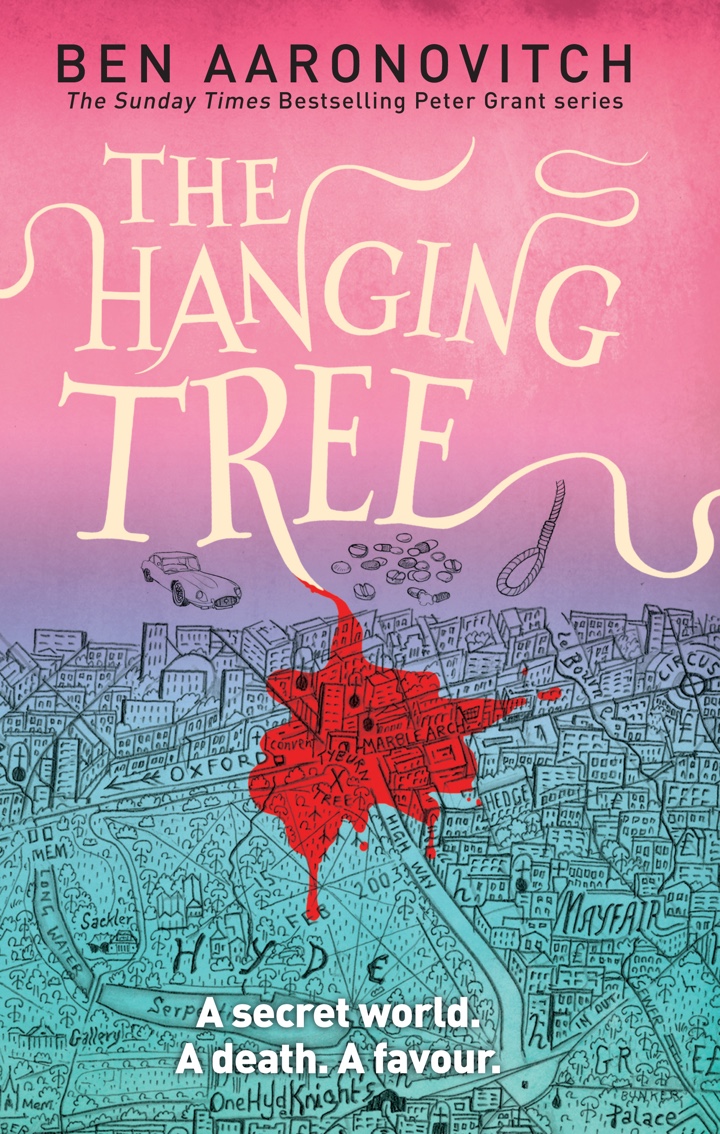
The Hanging Tree’s voice is as likable as the earlier volumes… but what struck me was its weird structure. Here’s the plot promised by the blurb: at a party of wealthy and privileged teenagers one kid drops dead of a drug overdose. A guest’s mother asks Peter to keep her daughter out of trouble. Inasmuch as the mother is not only Peter’s girlfriend’s aunt but also a powerful river goddess, he has some incentive to cooperate. This is not a bad premise. Magic is privilege; wizards are powerful and, lacking oversight, often aren’t held to account for their actions, much as in reality the very wealthy often aren’t. At the intersection of money, privilege, impulsive teenage recklessness, and literally reality-warping power is a novel’s worth of theme to dig into. On top of that, the choice between bending the rules or pissing off a goddess is an interesting dilemma.
The Hanging Tree, though, gradually becomes a different story. As you reach the last quarter of the book you realize the drug overdose was a red herring, Peter’s professional ethics won’t have consequences in his personal life, and the imperiled god-offspring has dropped out of the novel. Her mother sticks around, but doesn’t seem to belong anymore: she’s just visiting from the first unfinished story. The new The Hanging Tree is about small-time crooks stealing magical artifacts and, in a lovely bit of bathos, selling them on eBay.
Now, this is also a potentially great story, the urban fantasy equivalent of a Donald Westlake caper or a Coen brothers comedy. But The Hanging Tree doesn’t finish this story either! The eBay plot becomes instantly irrelevant as soon as it leads Peter to the artifacts’ owner: the Faceless Man. Which will mean nothing to you unless you’ve read other books in the series.
The Faceless Man is a wizardly crime lord who’s been lurking far in the background of Peter’s investigations without being actually immediately relevant to the resolution of any of them. The climax of The Hanging Tree is the moment we discover, after seven volumes of buildup, the Faceless Man is… a character just introduced in this book! And not even one of the important ones! To be fair, using the climax of a novel to unmask your mysterious multi-book villain is a no-win situation. If the villain is a character we thought we’d gotten to know, it’s a cheap O. Henry twist. If the villain is some guy we never saw before, it’s meaningless. And, honestly, these books never convinced me I should care whether Peter identified or caught the Faceless Man at all: see again, lurking far in the background and not actually immediately relevant.
Which makes me wonder why this big reveal didn’t come at the beginning of a book: get the underwhelming part out of the way first and you have an entire novel to explore the consequences. (It’s surprising how often the most interesting parts of a story happen after it ends.) And there would have been plenty to explore–behind the Faceless Man are hints of personality and theme. He has a library full of J. R. R. Tolkien and Alan Garner and other writers at the intersection of epic fantasy and British folk horror, and in a previous book he left a magic booby-trap inscribed with Elven runes. He’s a toxic nerd. From what little we see of him, he’s also a rich xenophobe, an England-for-the-English type. I know Aaronovitch probably came up with this character years ago, but this all feels very relevant.
Series were not always like this. My shelves are full of series in which books build on each other and characters evolve over time, but individual volumes work by themselves–Steven Brust’s Taltos series[2] and Terry Pratchett’s Discworld books are examples, as are any mystery series in which the characters develop. The exceptions are often single stories split for convenience, like The Lord of the Rings. One reason for the difference might be availability: maybe pre-Amazon, authors were more likely to assume some readers wouldn’t be able to get their hands on the whole series? I would guess that another may be the influence of other media on contemporary written SF–especially television.
Over the last couple of decades TV storytelling has shifted. The overarching story dominates to the point that individual TV episodes often work more like chapters in a novel than stories in themselves. (Streaming services now release entire seasons at once in the assumption the audience will watch 12 hours in one go!) As these series go on it gets harder for any one episode to get a complete story out from under the ever-accumulating baggage.
TV series can be renewed for years if they make money, or cancelled on short notice. This encourages arc plots busy enough to drag out interminably with twists, counter-twists, unexpected betrayals, and the revelation of increasingly convoluted background mythology… but simple enough to wrap up on short notice in a jury-rigged series finale. Basically, stories with more room than actual content; lots of ostensible action but little real movement in the underlying plot, character, or thematic arcs. The fantasy genre is still home to an improbable number of three-volume novels; now genre television is reinventing the penny dreadful.
It’s this style of storytelling The Hanging Tree reminds me of. The Faceless Man story arc played out past its natural length. Now The Hanging Tree brings it to a climax so fast it interrupts itself.[3] Weirdly structured novels are not a problem for me. In fact, it’s often a selling point–I like novels that meander, take detours, eschew traditional plot, and just generally don’t go where I expect. It has to be a good weird structure, though, and this time it wasn’t: The Hanging Tree crams three stories together so tightly none have room to dig into their themes. This is the point where the gravitational pull of the arc so deforms the individual installment it’s no longer coherent or satisfying in and of itself.
-
The other is a rather grumpier series by Paul Cornell. ↩
-
Still current, but it started in the 1980s. ↩
-
Twice. No, three times–I haven’t even mentioned the mother/daughter wizards looking for a Very Important Manuscript, who are major characters for a while but eventually, anticlimactically, just pick up the manuscript and walk offstage in what’s almost an aside. They’re not part of this novel; they’re being set up to be important in some other novel. ↩
16 Apr 21:23


I am in fact a Hobbit
by PG
I am in fact a Hobbit in all but size. I like gardens, trees, and unmechanized farmlands; I smoke a pipe, and like good plain food (unrefrigerated), but detest French cooking; I like, and even dare to wear in these dull days, ornamental waistcoats. I am fond of mushrooms (out of a field); have a very simple sense of humor (which even my appreciative critics find tiresome); I go to bed late and get up late (when possible). I do not travel much.
J.R.R. Tolkien
Click to Tweet/Email/Share This Post
16 Apr 18:34
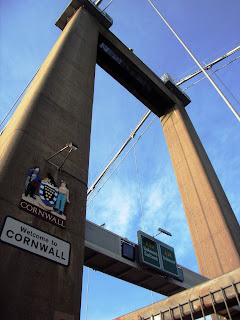 As the local elections approach, the Liberal Democrats and the recent rise in their fortunes are gaining more coverage.
The latest example is a Guardian article by Steven Morris which talks of "what increasingly seems to be a strong revival in the party’s fortunes in Cornwall".
He writes:
Talking of Lynton Crosby's fears, which were based on polling the Conservatives have had conducted in former Lib Dem seats, there was an interesting post on PoliticalBetting.com the other day.
Mike Smithson wrote:
Guardian talks of "strong revival" by Cornish Lib Dems
by Jonathan Calder

The latest example is a Guardian article by Steven Morris which talks of "what increasingly seems to be a strong revival in the party’s fortunes in Cornwall".
He writes:
The Lib Dems have won a succession of council byelections in Cornwall and are now once again the biggest group on the council with 43 members, governing in coalition with the independents.
Lib Dem loyalists are buoyed both by the national party’s resurgence and by a report in the New Statesman claiming that Lynton Crosby, who helped the Tories into government in 2015, has warned the prime minister, Theresa May, that if she called a snap general election she would lose all the Lib Dem seats her party gained in Cornwall.
The Lib Dems are fielding candidates in all 123 Cornwall seats at next month’s council election, 31 of them new members.The prominent role being played by new members is one of the striking features of the article.
Talking of Lynton Crosby's fears, which were based on polling the Conservatives have had conducted in former Lib Dem seats, there was an interesting post on PoliticalBetting.com the other day.
Mike Smithson wrote:
The assumption was that Tories had carried out the polling ahead of a possible early election and this was merely scoping the ground.
Now PB is being told that the reason for polling these seats was nothing to do with that but out of worries about where the expenses probe, first highlighted by Channel 4 News, was going.
If these went to court it is possible that some GE2015 seat outcomes could be discarded and there would have to be fresh elections in the constituencies. Mrs May’s majority is so small that it wouldn’t take many such losses for that to be wiped out.
16 Apr 18:33


Stand Down
by Andrew Rilstone

I guess that in the olden days most savings banks and mortgage lending companies were local concerns — you had a Manchester Building Society and a Liverpool Building Society, didn't you. The bank I use must have decided to put its Unique Selling Point in its name: the Nationwide Building Society. But when I get a letter from the bank, I don’t particularly hear the word “nationwide”and think "gosh, that must be happening all over the country" — it’s just what the company is called. Similarly, I don’t hear the sounds of hammers and anvils when I talk to my friend Mr Smith, or feel particularly surprised if Mrs Green is wearing a blue dress today. In fact, it was actually a little funny when it first occurred to me that my friend Clifford’s name could be understood to mean “a ford by a cliff”.
I contend that this is what has happened with times and seasons and festivals. There is a thing we do in December called Chris Muss. If we stop to think, we can see where the name came from. Douglas Gresham insists on referring to it as “the Christ Mass” which frankly just sounds weird. Most of us. even if we keep up the religious parts of the festival, don't specially hear the "Christ" part. "Chrissmuss" is just what it happens to be called. When a church puts up a poster saying "Christmas begins with Christ" they are making a pun, on a level with "ASSUME makes an ASS of U and ME".
Now, fairly obviously, this is what has happened with the Easter festivals. Maybe, just maybe, the druids did have a goddess called Easter who they worshiped in the spring, and maybe, just maybe the Christians came over and said “We’re ‘aving that, we are.” But Estre was probably the goddess of the sunrise or the dawn, and Sunrise or Dawn are perfectly good names for the day of the Resurrection, so Christians might perfectly well have come up with the name independently. But no-one, Christian, atheist or Archbishop of York connects the word Easter with "dawn" or "East" or pagan bunny goddesses. It’s just what the time of year is called.
So, somewhere along the line the Friday before the first Sunday after the first full moon after the vernal equinox got labeled “Good Friday”. The most likely reasons are:
1: It’s a corruption of Gud Friday i.e Holy Friday
2: It’s a corruption of God’s Friday.
3: In a very real sense, things which look very bad to us can look very good to God and the only true goodness is in the badness.
4: We don’t know.
But Guffriday is what the day happens to be called.
So for a supermarket to put out an advertisement for cheap beer, only on sale over the holiday, under the slogan “Good Friday just got better” is another pun. The reaction of most people, including most Christians, is not “OMG Tescos think cheap cider is better than Jesus’s free gift of eternal life made once for all upon the cross”. They are more likely to think "Oh yes. Guffriday, Good Friday, got better. Very good. Very satirical."
No, we don’t mark times and seasons as much as we used to. I myself drank a pint of beer yesterday evening. Yes, I can remember when no shops, and definitely no pubs or off-licenses opened on Guffriday — apart from bakers who were allowed to sell hot cross buns provided they didn’t also sell any bread. (Can anyone tell me why we eat spicy buns on Good Friday if Good Friday is a fast day?) And yes, it is a pity that many people do not realize that Good Friday is a sad an solemn day. But the sight of otherwise sane clergymen queuing up to describe the advert as crass, offensive, insensitive, sacrilegious, ignorant and illogical made me think that someone was jumping, rather late, onto a rather ludicrous egg-shaped bandwagon.
NOTE:
I think that it is an Easter "Egg Hunt", not an "Easter-egg Hunt". I might say to you in September "Will you come to my home for Christmas Dinner" and you would understand that I was inviting you to eat turkey with me on the 25th of December. But I would not necessarily say to my guests while they were drinking their sherry and eating their nuts on the big day "Will you come through to the dining room for Christmas Dinner, and then we can pull a Christmas Cracker and eat some Christmas Cake and have a Christmas Mince Pie" although I grant that the steamed pudding you eat with brandy butter is called Christmas-Pudding and would be called Christmas-pudding even if for some reason you had some in July. So I think that if the parish council were planning its events in January, they might say "And then Mrs Wren will organize the Easter 'Egg Hunt'". But on Easter morning after church, Mrs Wren might say "All children who want to join the Egg Hunt meet me outside". No-one would stand up and ask why Mrs Wren had removed all reference to Christianity from the egg hunt and whether she was going to go and spit on the grave of Farine Nestle. (I looked it up.) She doesn't need to say Easter "Egg Hunt" because everyone already knows it is Easter.
I also don't think that it matters.
I also don't think that it matters.
16 Apr 18:30
Writing about Julian Critchley after visiting his grave at Wistanstow, I quoted an interview he gave to Naim Attallah:
Macmillan came to power because of Suez. Will it take a similar national humiliation to bring the Conservative leadership to its senses?
Theresa May is the opposite of Harold Macmillan
by Jonathan Calder
Writing about Julian Critchley after visiting his grave at Wistanstow, I quoted an interview he gave to Naim Attallah:
I had two heroes in politics: Macmillan and Roy Jenkins. Macmillan, because he controlled to a very great extent Britain’s decline in power and was responsible for our adjustment in straitened circumstances – something he managed despite a party of fools.
My admiration for Roy Jenkins was based on the fact that as a young Labour MP he would advocate the cause of Europe in cross-party meetings, and he advocated brilliantly.Leaving Roy to one side, it strikes me that Theresa May is doing the precise opposite of what Macmillan did. She still has a party of fools to contend with, but she is allowing them to indulge their fantasies of glorious isolation or Empire 2.0.
Macmillan came to power because of Suez. Will it take a similar national humiliation to bring the Conservative leadership to its senses?
16 Apr 18:30
Polling Matters on the Lib Dem fightback – how high can their support go as the party of Remain?
by TSE
On this week’s PB/Polling Matters podcast Leo Barasi talked about the Lib Dem fightback with Mark Pack, a campaign strategist and expert on the party. You can listen to the episode below or by clicking here.
The SNP lost a referendum and won a landslide. Could the Lib Dems do something similar by becoming the party of Remain voters?
This week’s PB/Polling Matters Opinium poll suggests the party could do well with a relentless focus on stopping Brexit. But it also shows that a single-issue stop Brexit party would be unlikely to win more than a quarter of voters.
Only around 11% currently say they’d vote Lib Dem, but the Opinium poll found 41% of the public would definitely vote Lib Dem or would consider doing so, including 47% of current Labour voters. Winning over half of those considering the Lib Dems would put the party above even its record 2010 vote.
So should the party try to gain these voters with a promise that they would keep the UK in the EU?
In part the poll backs this up. Among those who voted Remain, 60% would at least consider the Lib Dems – around 29% of voters.
But this overstates the opportunities for the Lib Dems in focusing on stopping Brexit. Most Remainers don’t care enough about staying in the EU to put it above all other issues.
In another question the poll found that only 22% agree with the statement “My top priority when deciding who to vote for is supporting a party that will try to stop Brexit”. This 22% may be a more realistic limit for how far a stop Brexit party could go.
This still suggests the Lib Dems could double their vote share with an anti-Brexit focus. Even winning over just those who strongly agree with the statement, and aren’t already Lib Dem voters, would add 7pts to the Lib Dem vote.
With Labour now facilitating Brexit, the field is clear for the Lib Dems to be the party of Remain. The poll suggests this focus could serve the Lib Dems well, in comparison with their 2015 vote.
But a single-issue stop Brexit party is unlikely to win more than one in four voters. Unless the UK’s exit goes so badly that public opinion changes, this focus can take a party from fourth to third, but it can’t take them from third to second.
Leo Barasi
You can listen to the latest PB/Polling Matters podcast with Leo and Mark Pack below:
Leo Barasi tweets about politics and public opinion at @leobarasi
Keiran Pedley is on holiday
16 Apr 12:19
 Encouraging stuff from Toby Helm on the Guardian website this evening:
Guardian talks up Lib Dem chances in Manchester Gorton
by Jonathan Calder

The Liberal Democrats are fast closing the gap on Labour in next month’s Manchester Gorton byelection and believe they could steal a victory to match their stunning success over the Conservatives in Richmond last December, according to an internal campaign briefing ...
A briefing for senior Lib Dem officials and campaigners written by deputy director of campaigns Dave McCobb says the party’s messages on Brexit, including calls for a second referendum on the outcome of negotiations, are winning over voters in a seat where more than 60% voted remain in last June’s Brexit referendum.
McCobb says that the Lib Dems are making up ground fast and are on 31% with Labour on 51%, a level of support he says that is “running well ahead of where we were in the Witney byelection ... and approaching Richmond Park levels of support at this stage.”If you want to help the Lib Dems campaign in Gorton, by donating or on the doorstep, see the details on the party website.
16 Apr 12:05
Dissecting Theresa May’s popularity and you find out she has the potential to be Gordon Brown Mark II
by TSE

This week YouGov released some fascinating polling on Theresa May and her popularity. As we can see from the above chart it helps explains why Mrs May has such a colossal lead over Jeremy Corbyn on who would make the best Prime Minister and why if Jeremy Corbyn is Labour leader at the next general election, the 2020 general election is going to be the electoral equivalent of the Anglo-Zanzibar war.
But is her popularity down to Mrs May not being Jeremy Corbyn?
YouGov went onto dissect Mrs May’s popularity rating further, is her popularity down to herself or not being Jeremy Corbyn.

YouGov say that
Among those who think she would make the best Prime Minister, there is a nearly even split between those who that say it is because of her strengths (47%) and those that say it is because of Jeremy Corbyn’s weaknesses (46%). Whilst some, including many traditional Labour supporters, see Theresa May as the better of two evils this could quickly change with a more popular opposition leader.
The second threat is that were a few slip-ups or crises to occur, perceptions of her could quickly change – and this is where the comparison to Gordon Brown is perhaps apposite. At the start of his Premiership he was also seen as being strong but cold and also enjoyed a decent “honeymoon” period. Yet within a year of taking over, just 18% saw him as strong and 14% as decisive as his reputation was harmed by the financial crisis and his decision not to call an election.
Labour went from being 5-10% ahead in the polls to lagging the Tories by 15-20% and eventually lost the general election. Now, ten years after he took over, a quarter (26%) still think Gordon Brown was a “terrible” Prime Minister with a further 31% rate him as “poor.”
While history doesn’t always repeat itself, there are many potential crises on the horizon – whether it’s the complicated Brexit negotiations, economic challenges, or pressure on the NHS. If Theresa May can navigate them she could – like Margaret Thatcher – be remembered by many as a strong and decisive leader who has what it takes to get things done. But as if she fails then then in the public’s mind she could risk being seen as another Gordon Brown.
So if Labour do come to their senses and replace the electoral liability that is Jeremy Corbyn with someone more popular & competent coupled with a poorly handled Brexit negotiations or recession which is blamed on Mrs May and the Tories then Labour’s chances at the next election could improve significantly, after all on current boundaries, it only takes a swing of 0.88% to deny the Tories a majority.
With Sir Lynton Crosby’s polling indicating Mrs May would undo David Cameron’s hard work in obliterating the Liberal Democrats in the South West, so instead of Theresa May being spoken in the same bracket as Margaret Thatcher, Mrs May could be bracketed as the Tory Gordon Brown, but with Liam Fox, David Davis, and Boris Johnson working hard on the Brexit front, I’m sure Mrs May has nothing to worry about.
TSE
15 Apr 18:25

Striking a Pose
by evanier

Every few years, the contract between the Writers Guild of America and the Alliance of Motion Picture and Television Producers expires and a new one must be negotiated. Sometimes, the negotiations are simple and sometimes, they are not. When they are not, it is because someone at the A.M.P.T.P. — or at at least one of the member companies that comprise the A.M.P.T.P. — decides he or she can be a hero and advance his or her career by engineering a deal that pays the writers less or at least denies us cost o' living increases.
I joined the W.G.A. on April Fool's Day of 1976 so I have been through many of these and sometimes been fairly close to the negotiations. It is my observation that these dust-ups are never about what's "fair," at least from the Producers' standpoint. And when they say things like, "The business is hurting…everyone needs to understand that and accept some cuts," that is always, 100% of the time, horseshit. For them, these dickerings are only about one thing: Getting as much as possible. The less we get, the more they get.
Whenever Renegotiation Time rolls around, my guild assembles something called the Pattern of Demands — a wish list of things we'd like to discuss. Many times, it is a waste of time because the studios simply refuse to address anything on our list. Their negotiators literally end the meeting if our reps bring out the list. One of the Producers' lawyers in years past liked to say things like, "We are never going to let these sessions be about what you want. They will only be about what we are willing to give you."
If anyone does look at our Pattern of Demands, they'll see items about increased compensation but they will also always see issues that are not directly about money. We want our work to be respected more. We want to be listened-to more on creative matters. We want minorities (including older writers of any color) to be given more consideration. We want our credits to be protected and so forth. Call these the non-monetary issues.
There are people in management at the studios who care about such things but we tend to not negotiate with those folks. The people we deal with only care about the money and with keeping as much of it as possible for their employers. If they address the non-monetary issues at all, it's because they think they can trade one of the unimportant non-monetary issues for an important monetary one. In the '85 negotiations for instance, the Producers demanded a change in credit procedures that would have gutted the WGA's ability to control who received screen credit. They didn't really care about that. They just wanted to be able to say, "Okay, we'll drop our demands about credits if you drop your demands about money."
Because we care (somewhat) about the non-monetary issues and they don't, sometimes that works. Indeed, in '85, they dropped those demands but in the same bargaining sessions, we accepted for other reasons a lowering of the fees we were paid when films or TV shows we wrote were put out on home video. The former cost them nothing. The latter cost us billions. From the Producers' standpoint, that was a wildly-successful negotiation. That year, I don't think they ever even listened to anything we had in our Pattern of Demands.
Even factoring in that our brief strike that year cost them some cash, the guys who engineered that deal for them were superstar heroes. It was like they'd made a dozen movies as lucrative as Star Wars or Titanic. Each time we embark on a new negotiation, there's someone there who dreams of doing that again.
Don't let it come to this by being afraid it will come to this.
It has been my observation that Writers Strikes all start the same way: Someone at the A.M.P.T.P. makes an assessment of how strong and united the W.G.A. is at the moment: How willing is the membership to go on strike? If that assessment is way too low, there will probably be a strike. The Producers will agree among themselves to offer us X as a final, non-negotiable offer. They will also agree among themselves that if/when (almost certainly when) we turn down their final, non-negotiable offer of X, they will offer us the really and truly final, non-negotiable offer of Y.
Y will be a tiny bit better than X. The theory here is that maybe, rather than reject that offer and go on strike, we will grab Y and congratulate ourselves on a huge victory, forgetting that Y is still "The Producers get more and the Writers get less."
It's kind of like if someone came to you and said, "We're going to kick you in the crotch ten times" and you said, "The hell you will, I won't stand for that" and they said, "How about if we kick you in the crotch five times?" and you yelled "Deal!" And then as they were kicking you in the crotch the five times, you were yelling between shrieks of agony, "I sure outsmarted them on that one! ARRRGHHHHH!"
When they lowball us on X and we then don't accept Y, that's when you have your long strikes…because the Producers have a great deal of trouble moving off Y. They have a rule of unanimity. The major member companies of that Alliance have to agree on all offers and sometimes, they aren't able to do that.
In '88, they agreed on X and Y — terrible, terrible offers to lower our pay and health benefits at a time when the industry was raking in record profits. But given our spectacular fold in '85, I guess they couldn't resist trying it again. The "X" offer was the equivalent of "Last time, you let us kick you in the crotch fifty times. This time, we're going for a hundred." The "Y" was only slightly less awful.
And that's a lesson we all learned back then: Once you take a bad offer, you're setting yourself up to get an even worse one next time.
But they had drastically underestimated the Guild that time. Owing to better leadership and the lesson of '85, we were much more united, much more willing to resist. We voted down X by a much wider margin than the Producers had expected and we voted down Y by almost as much.
The A.M.P.T.P. couldn't agree on another offer and there was also a stubborn determination to not let one labor union "win" a strike, lest others get the idea that maybe they too could. So we had a strike that lasted 155 days. That was what it took to get to a deal that they could have given us in the first place if they hadn't figured we'd grab Y or maybe even X.
So now it's time to play this game again. Negotiations are ongoing and the Guild leadership has voted unanimously to ask for a Strike Authorization from the members. This is not a vote to strike. Understand that. It is a vote to empower the leadership to call a strike if they feel it is absolutely necessary.
I am sure they will get that authorization but the magnitude will be critical. If it's by 51% or even 70%, the Producers will figure that the Guild is weak and divided and that a lousy offer will be accepted. They'll assume that even if we do go on strike, it won't last long. If the vote is 90% or over…well, that might make them think a bad offer won't be cost-effective. (The vote will not be 100% or even a few points shy of that because some of those voting will be writer-producers or writer-directors and some of those folks vote in what they see as the best interests of their non-writer functions.)
The voting begins Wednesday and you can kinda figure out what I hope will happen. Some articles on the state of the negotiation can be found here. In the video below, you'll see members of the W.G.A. Board and Negotiating Committee urge a "yes" vote and explain why it's important.
The Guild currently has excellent, responsible leadership and I'm optimistic that they can bring back a deal that everyone can live with without work stoppages, picketing and all the ill feelings and ancillary damage that come with a strike. But they need to have the membership behind them and a strong Strike Authorization would be the measure of that.
There seem to be some new members who, not having lived through these skirmishes before, think we should not threaten to strike so as to show we're "reasonable." That has never been what happens. If you announce you're willing to consider a dreadful offer, that's what you'll get.
Some also seem to think that voting for a Strike Authorization is the same thing as voting to strike. No. A strike results when we get a take-it-or-leave-it offer we cannot possibly accept and we have to leave-it. To give our leaders a Strike Authorization is to give them more power in the negotiation — power that will increase the likelihood that we will get an offer we can accept.
Most of you reading this aren't W.G.A. members who'll be voting but I would hope you'd at least understand that if we strike, it will not be because we enjoy it, or because we want to kick the Producers in their crotches. We just don't want them to do that to us. Listen to some of our leaders…
The post Striking a Pose appeared first on News From ME.
15 Apr 11:33
What ‘good’ will look like for the parties in this year’s May elections
by David Herdson

Who should win what, and what will the misses and bonuses mean?
The expectations game is an unavoidable part of politics and one that pundits and practitioners play with relish. It is, of course, such an intrinsic part of betting that it’s difficult to meaningfully isolate betting from expectations.
There are more direct practical consequences of how a party performs against expectations. It’s one thing to lose seats; it’s another to lose more than people expect – or, for that matter, to lose fewer. Leaderships and the fates of parties and countries can turn not on the absolute results themselves but how they matched up against what people thought they should or could have been.
The local elections are a very good case in point. In any normal year, the Tories and SNP could expect to be taking losses. Governments in mid-term are generally unpopular and almost always so in their second and subsequent terms. The usual expectation game would be in setting what scale of losses would be survivable. Not so this year – and that’s all because of Labour.
Labour is facing a triple-whammy, suffering from the effects of the Corbyn leadership nationally, but also their existential-level disaster in Scotland, from which they haven’t even begun to work out an answer, and also the effects of running the Welsh governent for 18 years. As just mentioned, under normal circumstances, Labour should be looking to make sizable gains in England and Scotland but no-one expects that and rightly so.
The prediction by Thrasher and Rallings of 50 losses in England seems reasonable to me but if Labour can hold their UK score to Lord Hayward’s forecast of 125 losses they will have done very well. Scottish Labour won nearly 400 seats on 31% of first-preference votes in 2012. With the party now polling in the low teens at best, they might easily lose at least half that total. On a similar note, Welsh Labour gained 237 seats in 2007, an election where it held a lead of 20% over Plaid and Con. Given current polling, a three-figure loss this time should be expected.
In reality, if Labour can keep UK losses below 300, they’ll have outperformed current polling (though critically, not current expectations). To make it a good night, they’ll need to hold on to their English councils – the Scottish ones are surely beyond hope – and sweep the mayoral contests outside Cambridgeshire.
By contrast, the Conservatives will be looking for and expecting gains. For a government to make gains in anything other than a general election year is highly unusual – it happened in 2011, when the Tories made enough gains from the Lib Dems to offset losses to Labour, but otherwise not since the 1980s. With the Scottish Tories riding higher than at any point in a generation, the UK party enjoying consistent double-digit leads and UKIP faltering badly (particularly in local elections), a good night would see the Conservatives pick up at least 250 seats.
Of more prominence will be the mayoral contests. These are now the highest-profile races after the UK, Scottish and Welsh general elections and the London mayoralty. Cambridgeshire and Peterborough should be a comfortable win but can the Tories pick up one or more of the urban mayoralties? To win one would be good; to win more would be excellent. These elections are of course held under SV, which will play a part although it’s rare (but not unknown) for transferred votes to switch the outcome. Probably the biggest prize in play is the West Midlands – Greater Manchester is surely a step too far – but any of the contests outside Lancashire might see a high-profile Con gain.
If the fates of the Tories and Labour are running counter to normality, the Liberal Democrats will and should expect something closer to traditional form. They’ve always been strongest in local elections and while the coalition years were deeply attritional to the party’s council base, the losses weren’t as bad as those suffered by their MEPs and MPs. So as they survived, now they (and others) expect them to recover.
That strength, however, has generally been the result of targeting – wards, constituencies and at most, councils. So just as the losses were minimised by local strength (in 2013, the Lib Dems won more than twice as many councillors as UKIP despite polling 8% behind on NEV), so that same effect will now limit gains. Even so, a good night for the Lib Dems will see a three-figure net seat gain across the UK and winning control of at least one county in the South West.
Targeting will also limit chances of winning the big mayoralities. Unlike the Tories, Labour, UKIP and SNP, neither the Lib Dems nor their predecessors have won a million-voter contest in the last 100 years. The ‘West of England’ (or Greater Bristol) contest is the only one that might just be within range, particularly given the split in the Labour vote.
-
The biggest potential cherry on the Lib Dem cake is Manchester Gorton. The party has always prided itself on its by-election ability and after a fallow period during Cameron’s leadership of the Tories, the Lib Dems are now back in the game. However, it’s a massive ask, even given the Lib Dems’ pre-2010 record there. No party (never mind an opposition party) has ever lost a 24,000 majority at a by-election.
If the Lib Dems can go into the elections in a confident frame of mind, UKIP has no such luxury. That the party is contesting fewer than half the seats (and fewer than the Greens) tells its own story. Indeed, UKIP’s whole local government story has come full cycle: 2013 was their breakthrough year and those initial gains are now the seats being defended.
Rallings and Thrasher predict a decline from a 22% NEV in 2013 to just 10% this year. I’ve never been convinced by that 22% figure, which had to be calculated somewhat blind given the lack of prior knowledge about areas of UKIP strength. Even so, a sharp decline in vote share seems inevitable, combined with an even sharper decline in seats won. For UKIP, a good night is likely to be one where their performance is mostly ignored. If they keep their losses in double figure (defending fewer than 150) they will have done well.
In stark contrast to UKIP (in just about every way), the 2017 Scottish local elections are the last set in which the SNP can make sizable gains, which after 2015 and 2016, is the minimum expected. Salmond talked about gaining Glasgow in 2012; his successor should pull off the feat. That alone would make for a good night, though outside Scotland few will notice the detail, particularly as the STV system means not that many seats will change compared with FPTP, and most councils will end up NOC anyway.
May 4 is going to provide a lot of material for the media but only three stories at most will be chosen because there simply isn’t space for more and because the media love ‘leader under pressure’ narratives. Those that are will very probably be those which don’t fit expectations. On that basis, I’d predict Lab losses, Con gains (though this will be more patchy), and, possibly, Manchester Gorton.
David Herdson
14 Apr 11:50
ryan i always add "butiwouldratherbereading=somethingmorehistoricallyaccurate" to your urls so I have slightly fewer complaints than most
| archive - contact - sexy exciting merchandise - search - about | |||
 |
|||
| ← previous | April 14th, 2017 | next | |
|
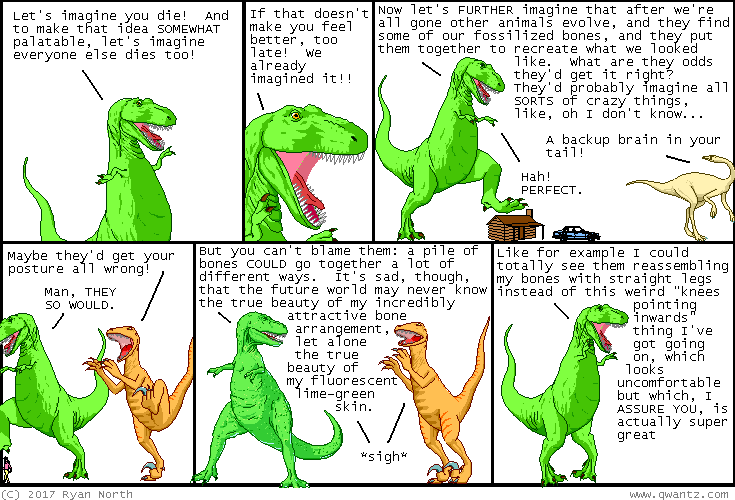
April 14th, 2017: Is this the first time I've address T-Rex's leg position in the last panel? Listen, it's been fourteen years, I finally decided it was time!! – Ryan | |||
14 Apr 11:45


In Music, DRM Is Back While Ownership Is Going Away
by PG
From Copyright and Technology:
The RIAA’s annual revenue figures for recorded music are a goldmine of information about the state, health, and direction of the music industry. The 2016 figures that the RIAA published at the end of March generated a few common headlines in the trade and business press:
- Recorded music revenue in the United States is finally growing again, up 11% over last year after five years of flat-to-slight-decline;
- Subscription streaming revenue growth accelerated, more than doubling since 2015. It is now the majority source (51%) of recorded music revenue, even counting CDs and other physical products;
- The vinyl renaissance is hitting its limits, as growth has slowed and vinyl looks headed for a new peak of 6% of total industry revenue.
But beneath those headlines lie a few more developments which indicate fundamental tipping points in music’s digital transformation.
First, and most relevant to us here, is something I’ve predicted but the RIAA numbers make it official: encrypted digital music accounts for more revenue than DRM-free music (digital or analog). In other words — if you define DRM as any encrypted means of content delivery — DRM for music is back.
. . . .
[O]nly 30% of digital music comes from DRM-free sources while 70% is encrypted in some way.
. . . .
The only modes of digital music delivery that don’t use encryption today are CDs, downloads, and many simulcast streams of AM/FM radio signals. CDs have fallen so far from their 1999 peak that they now account for only 15% of total revenue. Download revenue is also in free-fall and now accounts for 24% of total revenue.
. . . .
An even more important indication of change is the shift in consumer preference from “ownership” to “access” models. This won’t come as a shock to those who have been watching the music industry evolve for a while, but it’s reality now: people have found that when music is available everywhere on any device, it’s not so important to own it anymore.
Link to the rest at Copyright and Technology
Click to Tweet/Email/Share This Post
14 Apr 11:23
Returning an old favour
by Jen
Here in Greater Manchester we're one of the six English subregions electing new supermayors, alongside places like Liverpool City Region and a sprawling mass of Yorkshire and Derbyshire around Sheffield.
You get to exercise two preference votes in this, so you get to pick two parties or two individuals, but one preference is a dead simple decision - because Jane Brophy's standing.
While I get to ponder who to give my other vote to, for one preference, it's payback: more than 20 years ago Jane stood alone in Trafford against Labour and Tory homophobia, indeed the other day I found a copy of the Delga News reporting the story.
New Labour Trafford had signed up to the UN Convention on the Rights of the Child, and wanted to celebrate the fact in an attention-seeking event that would please the press. Cue a big conference at Manchester United football ground, with lots of sixth-form students from nearby schools bussed in.
However a consultation with those same young people in the Trafford area had produced a list of things they wanted to get from the event, and in those days of an unequal age of consent, no partnership rights, and the freedom of employers to fire staff at will on the grounds of bisexuality or homosexuality, the single most frequently raised issue had been being LGB. Probably not LGBT: it was the 90s remember.
But Section 28 was on the statute books, so even though article 17 of the Convention is the right to information and article 28 is a right to education, the council's Labour leadership and Tory opposition decided it was all too liable to encourage kids to turn gay, and barred such information from being provided at the conference. Even though the previous three such events, held in other towns, had offered the same thing and without a whisper of a Section 28 prosecution ensuing.
As an aside, you do have to wonder how a workshop telling teens that they (if male) had to wait another five years to have sex, couldn't marry or adopt, would be perpetually insecure in their working life, would have lesser pension rights, be more likely to be made homeless and so forth, could be deemed to encourage them to make such a "lifestyle choice". This might be a sweeping generalisation about what people hope for in their futures, but surely it would if anything put them off.
As a local Lib Dem councillor Jane Brophy made a speech in full council challenging this, championing the need for isolated young bi and gay people to be given the information and support they needed. It was great to witness a press storm on the day that saw the leader of Trafford on Radio 4's Today programme and in the Manchester Evening News having to defend her decision to bar young people from learning about their rights at an event supposedly celebrating the council's commitment to doing exactly the opposite.
Anyway, back in those days of the mid 90s LGB(T+) rights were not popular, and when there were no votes to be had in championing them Jane stuck her neck out because it was the right thing to do.
Giving her my first preference vote seems a small thing to do to return the favour.
You get to exercise two preference votes in this, so you get to pick two parties or two individuals, but one preference is a dead simple decision - because Jane Brophy's standing.
While I get to ponder who to give my other vote to, for one preference, it's payback: more than 20 years ago Jane stood alone in Trafford against Labour and Tory homophobia, indeed the other day I found a copy of the Delga News reporting the story.

New Labour Trafford had signed up to the UN Convention on the Rights of the Child, and wanted to celebrate the fact in an attention-seeking event that would please the press. Cue a big conference at Manchester United football ground, with lots of sixth-form students from nearby schools bussed in.
However a consultation with those same young people in the Trafford area had produced a list of things they wanted to get from the event, and in those days of an unequal age of consent, no partnership rights, and the freedom of employers to fire staff at will on the grounds of bisexuality or homosexuality, the single most frequently raised issue had been being LGB. Probably not LGBT: it was the 90s remember.
But Section 28 was on the statute books, so even though article 17 of the Convention is the right to information and article 28 is a right to education, the council's Labour leadership and Tory opposition decided it was all too liable to encourage kids to turn gay, and barred such information from being provided at the conference. Even though the previous three such events, held in other towns, had offered the same thing and without a whisper of a Section 28 prosecution ensuing.
As an aside, you do have to wonder how a workshop telling teens that they (if male) had to wait another five years to have sex, couldn't marry or adopt, would be perpetually insecure in their working life, would have lesser pension rights, be more likely to be made homeless and so forth, could be deemed to encourage them to make such a "lifestyle choice". This might be a sweeping generalisation about what people hope for in their futures, but surely it would if anything put them off.
As a local Lib Dem councillor Jane Brophy made a speech in full council challenging this, championing the need for isolated young bi and gay people to be given the information and support they needed. It was great to witness a press storm on the day that saw the leader of Trafford on Radio 4's Today programme and in the Manchester Evening News having to defend her decision to bar young people from learning about their rights at an event supposedly celebrating the council's commitment to doing exactly the opposite.
Anyway, back in those days of the mid 90s LGB(T+) rights were not popular, and when there were no votes to be had in championing them Jane stuck her neck out because it was the right thing to do.
Giving her my first preference vote seems a small thing to do to return the favour.
14 Apr 10:31
Chametz
by Scott Alexander
It was just before midnight when a cloud covered the moon and a bat flew right in front of me. Before I had time to worry about whether I was up to date on my rabies shots, it had transformed into a pale man in a black cloak.
“I have come to suck your blood!” he said in a heavy Eastern European accent.
Years of watching television and movies had prepared me well. I put my hands together into the sign of the cross.
“Oy. Again with the crosses! What do I look like, the Pope?”
The accent was the clue. “You’re Jewish?”
“You think I don’t look Jewish? I’m wearing all black! You want I should have the hat and forelocks, too?”
I groaned. “But…you can’t be Jewish. Jews aren’t allowed to drink blood.”
“Okay Mr. Big-Shot Rabbinical Authority. You’ve never heard of pikuach nefesh? You’re allowed to violate the law if you need to do it live. What do you want me to eat? Gefilte fish?
“But you’re not allowed to invoke pikuach nefesh in order to justify killing someone.”
“So maybe I don’t kill someone. Maybe I just leave you drained and a little bit blechedich.”
I didn’t know what blechedich meant, but it sounded ominous. I had a plan, but I needed to buy time. I started walking – not running away, just looking like I was pacing as I thought. The vampire followed effortlessly, floating beside me.
“The problem is, it’s not just that my blood isn’t kosher. I’m chametz”
“Chametz? You’re flour? You’re leavened bread?”
“No. But I ate lots of bread just before coming out here. Loads of bread. French bread, tortillas, naans, croissants, every type of bread you can think of. I’m sure it’s all in my bloodstream.”
“You ate bread? But it’s Pesach!”
“So maybe I’m not the most frum Jew in the world.”
“Not the most frum Jew in the world? Complicated Talmudic controversy, this is not! Not eating chametz on Passover is the basics!”
“Okay, fine, maybe I’m not religious at all. Maybe I’m the kind of Jew they kick out of Reform synagogues for not being observant enough. Whatever. The point is, I ate chametz, my blood is chametz, and it’s not going to kill you to go find somebody else who didn’t eat any bread today.”
“So you’re not religious. Why should I have to suffer because you’re not religious? It’s not like I’ve come to suck your stomach contents.”
I started walking a little faster. I was almost home now. Once I was in front of my house, if I made a run for it I might be able to get into the door. And once I was across the threshold, I knew vampires couldn’t come inside unless invited.
“So that’s actually not relevant. You’re not supposed to benefit indirectly from chametz on Pesach. So if I eat the chametz and use it to form my blood, and you drink my blood, then you’re benefitting. This is why some people won’t drink milk on Passover if they can’t prove the cow didn’t have chametz.”
“Milk, schmilk. Everyone agrees you can have meat on Pesach no matter what the cow ate.”
“So I think blood is more like milk. It’s a liquid product of the body, rather than part of the body itself.”
“It’s more like meat. It’s a part of the body, used to sustain the body, rather than something that’s meant to go outside of it.”
I had exhausted my knowledge of dietary law, but that was okay, because my distraction had been successful. I was in front of my own house now. With a burst of speed, I ran through the front yard, flung the door open, and made it into my living room. “Ha!” I said. “I’m over the threshold! And I’m not going invite you in!”
The vampire shrugged, walked straight across the threshold, and grabbed me by the neck.
“How?!” was the last word I managed to say before losing consciousness.
“You are not so frum a Jew? Well, maybe I am not so frum a vampire.”
14 Apr 10:27
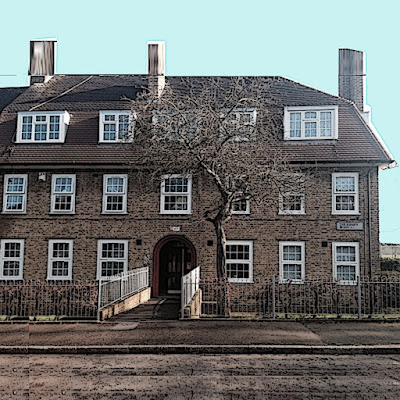
The letters are in white envelopes, obviously something personal and handwritten with some strange code on the reverse. The letters are also fairly frequent, and yet on the few occasions I've met Theresa - to whom they are addressed - she doesn't seem like the sort of person who would spend a lot of time engaged in correspondence. She's young, white, blonde hair in a scrunchy to effect what will eventually be known as a Croydon facelift, and she usually wears trackie bottoms. She has a malnourished face, slight but hard.
The flats along Thurbarn Road, Catford will eventually be described as apartments on the websites of certain estate agents, but right now it's 1991 and they're just flats - probably just fucking flats, if you want to get technical; Theresa might be imagined at her writing desk, pausing for thought as she gazes from the window then dipping that quill in the ink pot as inspiration strikes, but anyone who met her would have found the image unconvincing.
She is a friend of Princess. Princess - or Emma as she's named on her giro - is a big girl, mixed race with hair in dreads. She has a kid called Shane and she's loud and overpowering, but not confrontational. She just lacks either understanding or two shits which might be given regarding her own volume, and so she booms, and it's always a relief when she laughs because it's with you rather than at you - which is good to know because otherwise she'd sound like she was picking a fight all the time. She's married to Irish Barry who is Jean's boy, or one of them - there's a big one as well, built like a brick shithouse, as the saying goes. Irish Barry is the little one. It's the brick shithouse who usually comes down three floors to meet me at the door asking for his mum's giro. It's kind of terrifying at first. I just hand it over and remind myself that stuff gets lost in the post all the time and it's not like anyone can really prove anything. Also, the residents of Thurbarn Road habitually expect the dole to have withheld their money this week, so it will be a few days before anyone might consider accusing me, probably. It will sort itself out.
After the third or fourth giro handed over to the brick shithouse without ensuing complaints, I meet him in the company of Jean, his mum, and understand that he really is coming down all those stairs to save her the trouble. Thurbarn Road is on the southernmost edge of Catford in south-east London, a couple of hundred yards from roads listed as being in the county of Kent. It's a council estate, or was a council estate before market forces embarked upon the gradual reclassification of its brick and concrete boxes as apartments. I'm in my twenties and haven't been at the job very long, and of all the places to which I've delivered, it's thus far the one with the greatest potential for being a no go area for cops and certain emergency services, depending on which way the wind's blowing. It's not that there's a lot of graffiti or a significant quota of boarded up dwellings or broken windows, but it's a bit rough around the edges. Theresa seems very much at home here.
The letters Theresa gets are often embellished with acronyms, as I realise when I notice SWALK among them - sealed with a loving kiss. They must be from her boyfriend. I guess he lives a long way away or something.
'Do you ever see SWALK written on the back of envelopes?' I ask Micky Evans, an older postman who seems to know most things.
'Sealed with a loving kiss,' he confirms as we eat egg on toast in the canteen. 'Probably someone in the nick, I should think.'
'Really?'
'It usually is, yeah.'
'So what about NORWICH?'
'Nickers off ready when I come home. He might be in the army, I s'pose - posted overseas or summink, but it's usually jail birds write all that.'
Mick seems to know everything. There doesn't seem to be a question you can't ask him. He became a postman after being made redundant. He used to work at the docks up near Deptford and remembers the strikes back in the sixties being broken up by the Kray twins. 'Horrible pair of cunts they were,' he tells me. 'Fucking scum of the earth, and everyone idolises them like they're heroes.'
I ask him about HOLLAND, which Theresa's jail bird also writes on the back of the envelopes, but Mick doesn't know that one.
'How is she?' he asks, because he did Thurbarn Road before me for a couple of months. 'She never looks well, does she?'
'I think she's okay,' I say. 'Hard to tell, really.'
Theresa joins the list of names of those I recognise on Thurbarn Road and the surrounding streets. It's important that I recognise them because they follow me around on giro day, so I need to keep track of who is who. Obviously I'm not allowed to hand mail out to people in the street, but I do it anyway once I know who they are because it isn't hurting anyone and I remember what it's like waiting for your giro to turn up. The pay off, I suppose, is that I get to know the people to whom I deliver a little better which makes the job more pleasant.
Also pleasant is that Jean now invites me in for a cup of tea every once in a while. She's an Irish woman, in her fifties with long dark hair suggesting former if admittedly distant associations with swinging London, and I have the strangest feeling she fancies me a bit - which I don't mind because she's nice and very funny, even if it would never work due to the age difference. We drink tea, and talk about our lives and slag off her neighbours. She has a fluffy cat called Libby who also seems to like me, and sometimes Princess passes through with Shane and I remember that Jean is a grandmother, which is a peculiar thought.
Months pass, skies turn grey, and I notice clumsily rendered repairs to Theresa's front door up on the top floor of her block. There's a crescent of splinters around the lock where I suppose someone must have tried to kick it in. A couple of days later I see her from a distance. She no longer chases me down on giro day, so I deliver the thing along with all of her junk mail. I don't get close but it looks as though she has a black eye.
'I used to hear some terrific fucking rows up her place,' Micky Evans tells me, shaking his head in despair at the mess of some people's lives. 'What a terrible thing.'
A week later there is a note taped to the main door of the block just below the security buzzers.
Her mail begins to come back to me marked deceased and not known at this address. There doesn't even seem to be a pattern. Some of the mail is addressed to a name I don't recognise; and some of it is addressed to her, but she isn't dead, just upset - at least so far as I know. I collect the pile of mail on my bay, take a roll of the red stickers which will return it all to the various senders, and wonder whether there's really much point in my trying to understand any of this.
Code
by noreply@blogger.com (Lawrence Burton)

The letters are in white envelopes, obviously something personal and handwritten with some strange code on the reverse. The letters are also fairly frequent, and yet on the few occasions I've met Theresa - to whom they are addressed - she doesn't seem like the sort of person who would spend a lot of time engaged in correspondence. She's young, white, blonde hair in a scrunchy to effect what will eventually be known as a Croydon facelift, and she usually wears trackie bottoms. She has a malnourished face, slight but hard.
The flats along Thurbarn Road, Catford will eventually be described as apartments on the websites of certain estate agents, but right now it's 1991 and they're just flats - probably just fucking flats, if you want to get technical; Theresa might be imagined at her writing desk, pausing for thought as she gazes from the window then dipping that quill in the ink pot as inspiration strikes, but anyone who met her would have found the image unconvincing.
She is a friend of Princess. Princess - or Emma as she's named on her giro - is a big girl, mixed race with hair in dreads. She has a kid called Shane and she's loud and overpowering, but not confrontational. She just lacks either understanding or two shits which might be given regarding her own volume, and so she booms, and it's always a relief when she laughs because it's with you rather than at you - which is good to know because otherwise she'd sound like she was picking a fight all the time. She's married to Irish Barry who is Jean's boy, or one of them - there's a big one as well, built like a brick shithouse, as the saying goes. Irish Barry is the little one. It's the brick shithouse who usually comes down three floors to meet me at the door asking for his mum's giro. It's kind of terrifying at first. I just hand it over and remind myself that stuff gets lost in the post all the time and it's not like anyone can really prove anything. Also, the residents of Thurbarn Road habitually expect the dole to have withheld their money this week, so it will be a few days before anyone might consider accusing me, probably. It will sort itself out.
After the third or fourth giro handed over to the brick shithouse without ensuing complaints, I meet him in the company of Jean, his mum, and understand that he really is coming down all those stairs to save her the trouble. Thurbarn Road is on the southernmost edge of Catford in south-east London, a couple of hundred yards from roads listed as being in the county of Kent. It's a council estate, or was a council estate before market forces embarked upon the gradual reclassification of its brick and concrete boxes as apartments. I'm in my twenties and haven't been at the job very long, and of all the places to which I've delivered, it's thus far the one with the greatest potential for being a no go area for cops and certain emergency services, depending on which way the wind's blowing. It's not that there's a lot of graffiti or a significant quota of boarded up dwellings or broken windows, but it's a bit rough around the edges. Theresa seems very much at home here.
The letters Theresa gets are often embellished with acronyms, as I realise when I notice SWALK among them - sealed with a loving kiss. They must be from her boyfriend. I guess he lives a long way away or something.
'Do you ever see SWALK written on the back of envelopes?' I ask Micky Evans, an older postman who seems to know most things.
'Sealed with a loving kiss,' he confirms as we eat egg on toast in the canteen. 'Probably someone in the nick, I should think.'
'Really?'
'It usually is, yeah.'
'So what about NORWICH?'
'Nickers off ready when I come home. He might be in the army, I s'pose - posted overseas or summink, but it's usually jail birds write all that.'
Mick seems to know everything. There doesn't seem to be a question you can't ask him. He became a postman after being made redundant. He used to work at the docks up near Deptford and remembers the strikes back in the sixties being broken up by the Kray twins. 'Horrible pair of cunts they were,' he tells me. 'Fucking scum of the earth, and everyone idolises them like they're heroes.'
I ask him about HOLLAND, which Theresa's jail bird also writes on the back of the envelopes, but Mick doesn't know that one.
'How is she?' he asks, because he did Thurbarn Road before me for a couple of months. 'She never looks well, does she?'
'I think she's okay,' I say. 'Hard to tell, really.'
Theresa joins the list of names of those I recognise on Thurbarn Road and the surrounding streets. It's important that I recognise them because they follow me around on giro day, so I need to keep track of who is who. Obviously I'm not allowed to hand mail out to people in the street, but I do it anyway once I know who they are because it isn't hurting anyone and I remember what it's like waiting for your giro to turn up. The pay off, I suppose, is that I get to know the people to whom I deliver a little better which makes the job more pleasant.
Also pleasant is that Jean now invites me in for a cup of tea every once in a while. She's an Irish woman, in her fifties with long dark hair suggesting former if admittedly distant associations with swinging London, and I have the strangest feeling she fancies me a bit - which I don't mind because she's nice and very funny, even if it would never work due to the age difference. We drink tea, and talk about our lives and slag off her neighbours. She has a fluffy cat called Libby who also seems to like me, and sometimes Princess passes through with Shane and I remember that Jean is a grandmother, which is a peculiar thought.
Months pass, skies turn grey, and I notice clumsily rendered repairs to Theresa's front door up on the top floor of her block. There's a crescent of splinters around the lock where I suppose someone must have tried to kick it in. A couple of days later I see her from a distance. She no longer chases me down on giro day, so I deliver the thing along with all of her junk mail. I don't get close but it looks as though she has a black eye.
'I used to hear some terrific fucking rows up her place,' Micky Evans tells me, shaking his head in despair at the mess of some people's lives. 'What a terrible thing.'
A week later there is a note taped to the main door of the block just below the security buzzers.
the Lady in number 37 is very upset as her boyfriend passed away on 22/3/91 so plese be considorate because she is upset
Her mail begins to come back to me marked deceased and not known at this address. There doesn't even seem to be a pattern. Some of the mail is addressed to a name I don't recognise; and some of it is addressed to her, but she isn't dead, just upset - at least so far as I know. I collect the pile of mail on my bay, take a roll of the red stickers which will return it all to the various senders, and wonder whether there's really much point in my trying to understand any of this.
13 Apr 19:04
 I have never got further into Skegness than the town's railway station, but one day I will visit this Lincolnshire resort where the working class of Leicester used to go for its holidays.
Perhaps I will walk down to the nature reserve at Gibraltar point at gaze across the Wash to the more genteel North Norfolk coast.
The New European has also been to Skegness, coming up with this illustration.
If they were setting out to lend support the idea that European cause was a cause for metropolitan types who laugh at the rest of us while eating their artisan quinoa, they could not have made a better job of it.
I can see that cultivating affluent pro-Europeans in and around London makes business sense for the New European. That is a market that is easy for them to identify and serve.
But if we want to build public pressure for a second referendum and then win it, this approach is deeply damaging.
If you want people to change their minds and support you, the very last thing you should do is ridicule them. I refer you to a post I wrote in February 2016:
Turning the European cause into a sort of grooming session where metropolitan liberals tell each other how noble they are and how ghastly everyone else is, would be a guarantee of failure and also show a remarkable lack of ambition.
Back in the 1975 referendum on whether Britain should remain a member of the European Economic Community, Lincolnshire voted Yes by almost 3:1 - the exact figure was 74.7 per cent to 25.3 per cent.
We should also worry about the many affluent constituencies in Southern England that voted No to the EU last year, but if we want to win the battle for Europe we shall have to change the minds of people who live in towns like Skegness.
The New European is weakening the pro-European cause
by Jonathan Calder

Perhaps I will walk down to the nature reserve at Gibraltar point at gaze across the Wash to the more genteel North Norfolk coast.
The New European has also been to Skegness, coming up with this illustration.
If they were setting out to lend support the idea that European cause was a cause for metropolitan types who laugh at the rest of us while eating their artisan quinoa, they could not have made a better job of it.
I can see that cultivating affluent pro-Europeans in and around London makes business sense for the New European. That is a market that is easy for them to identify and serve.
But if we want to build public pressure for a second referendum and then win it, this approach is deeply damaging.
If you want people to change their minds and support you, the very last thing you should do is ridicule them. I refer you to a post I wrote in February 2016:
If we want the forces of light to win the referendum on British membership of the European Union then we have to get away that it is a project of the elites.But no one, particularly not Emma Thompson, listened.
Turning the European cause into a sort of grooming session where metropolitan liberals tell each other how noble they are and how ghastly everyone else is, would be a guarantee of failure and also show a remarkable lack of ambition.
Back in the 1975 referendum on whether Britain should remain a member of the European Economic Community, Lincolnshire voted Yes by almost 3:1 - the exact figure was 74.7 per cent to 25.3 per cent.
We should also worry about the many affluent constituencies in Southern England that voted No to the EU last year, but if we want to win the battle for Europe we shall have to change the minds of people who live in towns like Skegness.
13 Apr 14:54
The LDs go for the jugular against Corbyn in Manchester Gorton
by Mike Smithson
Brutal Lib Dem leaflet for Manchester Gorton by-election. pic.twitter.com/VUQq3zS23E
— George Eaton (@georgeeaton) April 12, 2017
An attack also designed for Remainers
Above is a brutal Lib Dem leaflet that is going out in Manchester Gorton where the by-election takes places on May 4th.
The party which used to hold all but two of the council seats in the seat believes it is in with good chance of getting a good result and is throwing a lot at the campaign.
Corbyn’s ambivalence over Brexit was always a vulnerability and neither helps the party with leavers or remainers. My own view is that the red team has read too much into the data that had Leave the winners in two thirds of its MPs seats. Those wanting to stay in the EU are much more fired up than those who back Leave.
If the LD leaflet appears brutal then think how the Tories will exploit the LAB leader’s history and that of his shadow chancellor, John McDonnell. Their back stories have so many hostages to fortune.