Shared posts

28 Apr 13:18

New YouGov Scottish poll suggests the Tories could make 7 gains in Scotland

by Mike Smithson


Graphic – The times

And the LD could triple their Scottish seats

The main General Election polling news overnight has been a YouGov/Times survey of Scotland which suggests that the Conservatives could start to win back some of the seats in Scotland that they held more than a quarter of a century ago.

The Lib Dems could also stage a small recovery tripling the Scottish total to three seats.

Labour, which at GE2010, won 41 of Scotland’s 59 seats, is still projected to be down at just one. It was that Scottish wipeout that was the dominant feature of the 2015 election and enabled the Tories to portray Ed Miliband as being in the pockets of the SNP.

We will get a better idea of opinion in Scotland next Friday when we have the results of the Scottish local elections which were last held in 2012.

Mike Smithson

Follow @MSmithsonPB

Tweet

28 Apr 00:11

Coming: Gamma Virginis (10 hours away)

Gamma Virginis is 38.6 light years away and only 10 hours from the outer surface of your light cone - your ever-growing sphere of potential causality - which began its expansion from Earth on October 05 1978.
27 Apr 12:58

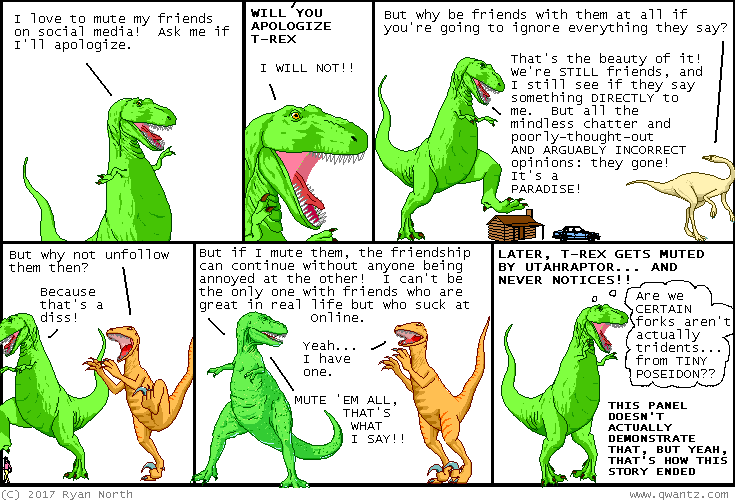
i love to #mute my #friends on #socialmedia, don't @ me

archive - contact - sexy exciting merchandise - search - about
← previous April 26th, 2017 next

April 26th, 2017: I am still in Alaska! IT IS STILL GORGEOUS!! Everyone come here, it's great! Only some local teens burned down the local (AMAZING) park so I am here to tell you: teens, don't do that. Teens, you will go to jail for burning down a park and then everyone will say "what the heck is wrong with these teens".

– Ryan

27 Apr 09:35

Anorexia And Metabolic Set Point

by Scott Alexander

[Content warning: fat, anorexia, dieting]
[Epistemic status: crazy speculation from someone who isn’t an expert in the field. Please don’t take too seriously.]

Some anorexics I talk to describe their condition as falling into two phases.

In Phase 1, they’re a model or a ballerina or something where they’re under a lot of pressure to become thin. So they go on a diet, they have trouble just like everyone else, but they stick to it and gradually get thinner. People praise them for their thinness. They win the Ballerina Of The Year award. They’re pretty happy with how things are going, and their dieting is ego syntonic – ie they agree with it and can explain the reasons they think it’s a good decision.

In Phase 2, somebody tells them, wait, this is unhealthy. Maybe they end up in the hospital. Maybe some friends stage an intervention. They admit that they have anorexia and decide to get better and gain weight. And then they can’t. The exact way that this presents varies among people. A few say they never feel hungry – as if they’re always so stuffed they couldn’t eat another bite. More often they still feel hungry, but they feel a sense of horror at their fatness, even if they rationally understand they’re really thin. This makes it very hard to regain weight.

This reminds me of the model of obesity I talked about the other day. People start overeating for social reasons (specifically, because our society is full of tasty food). Then they find they can’t stop – their body has adjusted to its higher weight as a new set point and will defend it vigorously, producing hunger pangs and food obsessions if they try to diet.

The brain system producing these effects is called the “lipostat”, and it seems to work through a control loop. Fat cells produce a hormone called leptin. The hypothalamus measures the amount of leptin, compares to its preferred set point, and based on the result generates strong urges to eat/exercise/fidget either more or less. This in turn makes the person gain or lose weight, increasing or decreasing the amount of fat and the concentration of leptin, and completing the loop.

In (at least some cases of) obesity, constant overeating makes the hypothalamus leptin-resistant – that is, it systematically underestimates the blood level of leptin. Suppose a healthy person weighs 150 lbs, his body is on board with that, and his lipostat is set to defend a 150 lb set point. Then for some reason he becomes leptin-resistant, so that the brain is only half as good at detecting leptin as it should be. Now he will have to be 300 lbs before his brain “believes” he is the right weight and stops encouraging him to eat more. If he goes down to a “mere” 250 lbs, his brain will panic, believe he’s starving, and demand he eat more.

One point that The Hungry Brain stressed again and again is the cognitive complexity of the hunger response. For example, from Ancel Keys’ Starvation Experiment:

Over the course of their weight loss, Keys’s subjects developed a remarkable obsession with food. In addition to their inescapable, gnawing hunger, their conversations, thoughts, fantasies, and dreams revolved around food and eating – part of a phenomenon Keys called “semistarvation neurosis”. They became fascinated by recipes and cookbooks, and some even began collecting cooking utensils. Like leptin-deficient adolescents, their lives revolved around food. Also like leptin-deficient adolescents, they had very low leptin levels due to their semi-starved state.

And from studies of leptin-deficient children:

Farooqi explains that the primary reason leptin-deficient children develop obesity is that they have “an incredible drive to eat”…leptin-deficient children are nearly always hungry, and they almost always want to eat, even shortly after meals. Their appetite is so exaggerated that it’s almost impossible to put them on a diet: if their food is restricted, they find some way to eat, including retrieving stale morsels from the trash can and gnawing on fish sticks directly from the freezer. This is the desperation of starvation […] Unlike normal teenagers, those with leptin deficiency don’t have much interest in films, dating, or other teenage pursuits. They want to talk about food, about recipes. “Everything they do, think about, talk about, has to do with food” says [Dr.] Farooqi. This shows that the [leptin system] does much more than simply regulate appetite – it’s so deeply rooted in the brain that it has the ability to hijack a broad swath of brain functions, including emotions and cognition.

Once again, it’s not really clear how people’s metabolic set point drifts up, but it seems to maybe have something to do with overeating junk food.

So suppose there was an exactly opposite process. People who severely undereat find that their metabolic set point drifts down, with their hypothalamus becoming hypersensitive to leptin. Again, consider a person who would ideally weight 150 lbs. If they become twice as sensitive to leptin, their body won’t be happy unless they weigh 75 pounds. If they gain weight to be 100 pounds instead, they’ll be getting “too much” leptin, their brain will feel like they’re too fat, and their bodies will vigorously “defend against” weight gain to try to return to the distorted set point. This sounds a lot like anorexia nervosa.

Some more evidence: people with anorexia fidget like crazy. This is the conventional wisdom among generations of psychiatrists, and has been confirmed in studies – see for example Measurement Of Fidgeting In Patients With Anorexia Nervosa Using A Novel Shoe-Based Monitor, which found anorexics fidget almost twice as much as healthy controls. This seems really damning to me. Consciously deciding to fidget is hard. If you don’t believe me, try to fidget as much as possible for the next two hours (the length of the study linked above) and see how well it goes. Most people just can’t do it. On the other hand, fidgeting (renamed to the more dignified “non-exercise activity thermogenesis”) is the classic strategy that the lipostat uses to maintain unconscious control over weight:

The research of James Levine, an endocrinologist who works with the Mayo Clinic and Arizona State University, explains this puzzling phenomenon. In a carefully controlled overfeeding study, his team showed that the primary reason some people readily burn off excess calories is that they ramp up a form of calorie-burning called “non-exercise activity thermogenesis” (NEAT). NEAT is basically a fancy term for fidgeting. When certain people overeat, their brains boost calorie expenditure by making them fidget, change posture frequently, and make other small movements throughout the day. It’s an involuntary process, and Levine’s data show that it can incinerate nearly 700 calories per day.

A purely social paradigm of anorexia can’t explain the fidgeting; a biological paradigm outright predicts it.

I’m not an expert on anorexia, so for all I know lots of people have thought of this and I’m late to the party. But a quick Google search only reveals a few small leads. Heidebrand et al have studied leptin in anorexia nervosa, but only because they think it might affect symptoms. They find circulating levels are low – which makes sense given anorexics’ low BMI, and which neither confirms nor disconfirms a leptin hypersensitivity hypothesis. They also find that leptin increases more quickly when anorexics gain weight than when healthy people gain weight, which is suggestive but doesn’t prove that much.

I also found a paper, the appropriately-named Treasure (2005) which described anorexia nervosa apparently due to brain lesions. For example:

Of the seven anorexia cases associated with primary tumours in the area of brain stem and the fourth ventricle (Table 1: cases 24–30),12,25–30 two (24 and 25) presented as typical restrictive anorexia nervosa with fear of fatness; surgical removal of the tumours led to remission and sustained weight gain in both cases.

Thirteen cases of eating disorders associated with lesions in the cerebral hemispheres were identified (Table 1: 31–43).31–38 The damage was predominantly localised in the frontal and temporal lobes (six frontal, four temporal, three frontotemporal) of the right hemisphere (nine right, three left, one bilateral)…seven cases presented as “typical” anorexia nervosa with weight and shape preoccupations.

Most of these cases weren’t typical anorexia, and almost all of them involved other obviously-neurological symptoms that ordinary anorexics lack. And most of the relevant tumors were not the hypothalamus (although a similar paper by Chipkevitch finds a disproportionately high number of hypothalamic lesions). But it does prove that excessive concern about becoming fat isn’t just caused by ballet coaches and the patriarchy. It can also be induced by purely neurological mechanisms.

(and a complicating factor – most brain tumors increase intracranial pressure, which seems to increase the ability of leptin to enter the cerebrospinal fluid in ways that might cause obesity or something. There’s actually some suggestive literature that “leptin resistance” might just be serum leptin not making it into the cerebrospinal fluid, and a bunch of studies show that anorexics have proportionally much higher – and obese people proportionally much lower – CSF:serum leptin ratios. But these studies don’t explore causality and it might just be that if you’re too fat your leptin transporters get overloaded.)

I probably shouldn’t focus on leptin so much. Everybody agrees that leptin is only one part of the biology of weight gain, that other hormones are probably more important in weight loss, and that using leptin to represent the entire biological regulation of obesity is kind of a streetlight effect.

But I feel like something like this might be true. There must be some reason why the symptoms of anorexia resemble lipostat action so closely. There must be some reason why anorexics fidget so much. And there must be some reason why brain tumors can mimic some of the most striking symptoms of anorexia, like obsessive fear of becoming fat. All of these make sense only in the context of metabolic set point theory, and I hope more people start trying to link these two ideas up.

27 Apr 08:34

Lib Dems choose candidate to follow John Pugh in Southport

by Jonathan Calder


Sue McGuire, the leader of the Liberal Democrat group on Sefton Council, has been selected by the party to fight for Southport, reports the Southport Visiter.

The seat is currently held for the Lib Dems by John Pugh.

While we wonder why the paper has that odd name, let's enjoy this old railway poster.
26 Apr 08:30

#1306; In which Assets are leveraged

by David Malki

By stimulating demand among tacky-garbage producers to print even more tacky garbage, Otto is very selflessly Creating American Jobs

26 Apr 08:17

Why we are all going to be able to get to bed earlier this election night

by Mike Smithson

No simultaneous elections on June 8th means speedier counts

One of the features of the June 8th General Election it is that no other elections are being held on the same day. This is in sharp comparison to all the general elections since 1992 when John Major went to the country in April four weeks before that year’s locals.

This is important because it should have a big impact on the time it takes for the counts to proceed. If you have more than one election in a constituency then all the votes for those as well as the general election votes have to be verified before counting can start. This adds a considerable time to the process.

The table above, prepared by the former head of political research at the BBC David Cowling, sets out how many declarations there were in the different time slots. The contrast with 1992 is very striking and that year is the model that we should be looking at.

Thus by 1am in 1992 there had been 156 declarations compared with just 5 at GE2015.

Tony Blair, when he was in a position to choose the date, always liked to have other elections taking place on the same day because of his hope that this would ensure that more LAB voters would turnout.

Mrs Thatcher, meanwhile, is said to have preferred June because she liked the assurance of seeing the local election results before making the final decision to commit to a specific date. So the 1983 and 1987 elections both took place on June.

I think it is possible to load too many elections onto voters on the same day. On General Election day in 2015 Bedford where I live there were five separate votes taking place creating much confusion at polling stations. Every voter had to be issued with five ballot forms which each had to be individually processed. This inevitably led to longer queues and a prolonged count.

Mike Smithson

Follow @MSmithsonPB

Tweet
.

25 Apr 22:44

Labour’s May 4th prospects are looking appalling in England, Wales and Scotland

by Mike Smithson

And UKIP are in for a pounding as well

UKIP’s set to have more losses that its actually contesting

Today I have been in London for the annual local elections briefing organised by the Political Studies Association. The panelists were Professors Colin Rawlings and Michael Thrasher for England with Rodger Scully for Wales and Professor John Curtice for Scotland.

    Rawlings and Thrasher focused on their by-election prediction model which just covers England and suggested that there’s a possibility that Labour could end up as third party behind both CON and the LDs.

The slides above are from their presentation.

A massive problem for UKIP is that the seats up next week are those that were last fought four years ago which was when the party was at its absolute peak.

It was noted that many upper UKIP candidates elected in 2013 had switched parties or formed new groupings. The gains and losses calculation is based on what happened in the 2013 elections and does not take this into account. This is important because the number of UKIP losses predicted is higher than the number of seats that they are contesting.

For the model Ralling and Thrasher make their own calculations of the implications of boundary changes and that means that their change numbers will be different from those from the Press Association which will be issuing information on the night.

In Scotland the seats up are those last fought in 2012 and things have changed dramatically in the politics north of the border since then. The Tories are almost certainly look set to end up as a second party and we’re going to see spectacular losses for LAB like control of the city of Glasgow.

Wales is going to be equally appalling for Labour as we saw in yesterday’s YouGov poll.

What is important for the general election from the local council results is the narrative that will be created.

Mike Smithson

Follow @MSmithsonPB

Tweet

25 Apr 22:43

2017 General Election Diary day 7: Open to offence

by Nick

Some really shocking news to get going with today: Open Britain have finally remembered that they’re supposed to be a political campaign group, and have taken a stance that has got them criticism from Tories for being too political, which is normally a sign that you’re doing something right. It’s also provided us with further proof, after the Commons votes on Article 50, that ‘Remain Tory MPs’ not called Ken Clarke are a mirage, as all of them will always put the Tory part of that ahead of the Remain when they come under pressure. Anna Soubry, for instance, calling it ‘blatant partisanship…when we must all come together’ shows that she’s swallowed whole the notion that Brexit means abandoning all democratic norms of opposition and scrutiny.

I’ve been critical of Open Britain in the past, and their refusal to do anything that might be slightly controversial (like referring to the Unite For Europe march as the ‘Make Your Voice Heard’ protest) has been incredibly annoying, but maybe they’ll finally get the fire in the belly for a proper fight against Brexit now, even if it is now several months too late.

Today’s big speech came from Keir Starmer, setting out Labour’s line on Brexit, which was that they continue to probably not be in favour of it, but will deliver it anyway as they have to continue pandering to Very Real Concerns. They will commit to letting EU citizens remain in Britain if they get into power, but quite what they’ll have to do with their time isn’t clear as they also remain committed to the Tory policy of crashing the economy by leaving the Single Market and hoping for the best.

Theresa May’s back on her Potemkin campaigning, and this time her standing in front of placard-waving Tory activists, then giving vague platitudes to journalists instead of actual answers happened in Wales. However, there are now reports that at some point since the campaign started she may have had contact with an actual member of the public. It didn’t go well. Oddly though, Graham Mills and his views haven’t been plastered all over the media like Gillian Duffy was in 2010.

Oh, and Tim Farron has clarified that he doesn’t think gay sex is a sin, so can we either draw a line under this, or insist that any MP who claims a religious faith provide us with detailed theological explanations of what they do or do not think is a sin?

Some news from Northern Ireland, where it seems attempts to form anti-Brexit electoral pacts are running into the same problems as they are in the rest of the UK, with differences on other issues coming to the fore. The election there is taking place amidst a huge number of other issues, and any decisions parties make isn’t just in the light of what it might mean in this election but how it plays in the post-Assembly election negotiations and in any potential future Assembly election if those talks break down. I suspect if any deals (beyond the Unionist pact) are possible, it’ll be a limited one between the Alliance and the Greens, in an attempt to try and win the Belfast East seat back from the DUP.

And finally, it’s Election Leaflet Of The Day time again, and yet again I’m wishing I included local elections here as then I could talk about how there’s a independent candidate looking to represent Weymouth on Dorset County Council called Francis Drake. If ever there was a perfect justification for knighting a local politician, his name alone is it. But sadly as he’s not running for Parliament, the leaflet of the day is yet again an uncontested seat as only this from Daniel Zeichner, Labour MP for Cambridge, has been uploaded since yesterday. As with yesterday’s winner, it’s a generally competently designed and written leaflet with no grounds for mockery. Am I going to have to wait until after the local elections are done for the genuinely weird and wonderful election leaflets to start appearing?

25 Apr 11:30

Book Review: The Hungry Brain

by Scott Alexander

[Content note: food, dieting, obesity]

I.

The Hungry Brain gives off a bit of a Malcolm Gladwell vibe, with its cutesy name and pop-neuroscience style. But don’t be fooled. Stephan Guyenet is no Gladwell-style dilettante. He’s a neuroscientist studying nutrition, with a side job as a nutrition consultant, who spends his spare time blogging about nutrition, tweeting about nutrition, and speaking at nutrition-related conferences. He is very serious about what he does and his book is exactly as good as I would have hoped. Not only does it provide the best introduction to nutrition I’ve ever seen, but it incidentally explains other neuroscience topics better than the books directly about them do.

I first learned about Guyenet’s work from his various debates with Gary Taubes and his supporters, where he usually represents the “scientific consensus” side. He is very careful to emphasize that the consensus doesn’t look anything like Taubes’ caricature of it. The consensus doesn’t believe that obesity is just about weak-willed people voluntarily choosing to eat too much, or that obese people would get thin if they just tried diet and exercise, or that all calories are the same. He writes

The [calories in, calories out] model is the idea that our body weight is determined by voluntary decisions about how much we eat and move, and in order to control our body weight, all we need is a little advice about how many calories to eat and burn, and a little willpower. The primary defining feature of this model is that it assumes that food intake and body fatness are not regulated. This model seems to exist mostly to make lean people feel smug, since it attributes their leanness entirely to wise voluntary decisions and a strong character. I think at this point, few people in the research world believe the CICO model.

[Debate opponent Dr. David] Ludwig and I both agree that it provides a poor fit for the evidence. As an alternative, Ludwig proposes the insulin model, which states that the primary cause of obesity is excessive insulin action on fat cells, which in turn is caused principally by rapidly-digesting carbohydrate. According to this model, too much insulin reduces blood levels of glucose and fatty acids (the two primary circulating metabolic fuels), simultaneously leading to hunger, fatigue, and fat gain. Overeating is caused by a kind of “internal starvation”. There are other versions of the insulin model, but this is the one advocated by Ludwig (and Taubes), so it will be my focus.

But there’s a third model, not mentioned by Ludwig or Taubes, which is the one that predominates in my field. It acknowledges the fact that body weight is regulated, but the regulation happens in the brain, in response to signals from the body that indicate its energy status. Chief among these signals is the hormone leptin, but many others play a role (insulin, ghrelin, glucagon, CCK, GLP-1, glucose, amino acids, etc.)

The Hungry Brain is part of Guyenet’s attempt to explain this third model, and it basically succeeds. But like many “third way” style proposals, it leaves a lot of ambiguity. With CICO, at least you know where you stand – confident that everything is based on willpower and that you can ignore biology completely. And again, with Taubes, you know where you stand – confident that willpower is useless and that low-carb diets will solve everything. The Hungry Brain is a little more complicated, a little harder to get a read on, and at times pretty wishy-washy.

But listening to people’s confidently-asserted simple and elegant ideas was how we got into this mess, so whatever, let’s keep reading.

II.

The Hungry Brain begins with the typical ritual invocation of the obesity epidemic. Did you know there are entire premodern cultures where literally nobody is obese? That in the 1800s, only 5% of Americans were? That the prevalence of obesity has doubled since 1980?

Researchers have been keeping records of how much people eat for a long time, and increased food intake since 1980 perfectly explains increased obesity since 1980 – there is no need to bring in decreased exercise or any other factors. Exercise has decreased since the times when we were all tilling fields ten hours a day, but for most of history, as our exercise decreased, our food intake decreased as well. But for some reason, starting around 1980, the two factors uncoupled, and food intake started to rise despite exercise continuing to decrease.

Guyenet discusses many different reasons this might have happened, including stress-related overeating, poor sleep, and quick prepackaged food. But the ideas he keeps coming back to again and again are food reward and satiety.

In the 1970s, scientists wanted to develop new rat models of obesity. This was harder than it sounded; rats ate only as much as they needed and never got fat. Various groups tried to design various new forms of rat chow with extra fat, extra sugar, et cetera, with only moderate success – sometimes they could get the rats to eat a little too much and gradually become sort of obese, but it was a hard process. Then, almost by accident, someone tried feeding the rats human snack food, and they ballooned up to be as fat as, well, humans. The book:

Palatable human food is the most effective way to cause a normal rat to spontaneously overeat and become obese, and its fattening effect cannot be attributed solely to its fat or sugar content.

So what does cause this fattening effect? I think the book’s answer is “no single factor, but that doesn’t matter, because capitalism is an optimization process that designs foods to be as rewarding as possible, so however many different factors there are, every single one of them will be present in your bag of Doritos”. But to be more scientific about it, the specific things involved are some combination of sweet/salty/umami tastes, certain ratios of fat and sugar, and reinforced preferences for certain flavors.

Modern food isn’t just unusually rewarding, it’s also unusually bad at making us full. The brain has some pretty sophisticated mechanisms to determine when we’ve eaten enough; these usually involve estimating food’s calorie load from its mass and fiber level. But modern food is calorically dense – it contains many more calories than predicted per unit mass – and fiber-poor. This fools the brain into thinking that we’re eating less than we really are, and shuts down the system that would normally make us feel full once we’ve had enough. Simultaneously, the extremely high level of food reward tricks the brain into thinking that this food is especially nutritionally valuable and that it should relax its normal constraints.

Adding to all of this is the so-called “buffet effect”, where people will eat more calories from a variety of foods presented together than they would from any single food alone. My mother likes to talk about her “extra dessert stomach”, ie the thing where you can gorge yourself on a burger and fries until you’re totally full and couldn’t eat another bite – but then mysteriously find room for an ice cream sundae afterwards. This is apparently a real thing that’s been confirmed in scientific experiments, and a major difference between us and our ancestors. The !Kung Bushmen, everyone’s go-to example of an all-natural hunter-gatherer tribe, apparently get 50% of their calories from a single food, the mongongo nut, and another 40% from meat. Meanwhile, we design our meals to include as many unlike foods as possible – for example, a burger with fries, soda, and a milkshake for dessert. This once again causes the brain to relax its usual strict constraints on appetite and let us eat more than we should.

The book sums all of these things up into the idea of “food reward” making some foods “hyperpalatable” and “seducing” the reward mechanism in order to produce a sort of “food addiction” that leads to “cravings”, the “obesity epidemic”, and a profusion of “scare quotes”.

I’m being a little bit harsh here, but only to highlight a fundamental question. Guyenet goes into brilliant detail about things like the exact way the ventral tegmental area of the brain responds to food-related signals, but in the end, it all sounds suspiciously like “food tastes good so we eat a lot of it”. It’s hard to see where exactly this differs from the paradigm that he dismisses as “attributing leanness to wise voluntary decisions and a strong character…to make lean people feel smug”. Yes, food tastes good so we eat a lot of it. And Reddit is fun to read, but if someone browses Reddit ten hours a day and doesn’t do any work then we start speculating about their character, and maybe even feeling smug. This part of the book, taken alone, doesn’t really explain why we shouldn’t be doing that about weight too.

III.

There is only one fat person on the Melanesian island of Kitava – a businessman who spends most of his time in modern urbanized New Guinea, eating Western food. The Kitavans have enough food, and they live a relaxed tropical lifestyle that doesn’t demand excessive exercise. But their bodies match caloric intake to expenditure with impressive precision. So do the !Kung with their mongongo nuts, Inuit with their blubber, et cetera.

And so do Westerners who limit themselves to bland food. In 1965, some scientists locked people in a room where they could only eat nutrient sludge dispensed from a machine. Even though the volunteers had no idea how many calories the nutrient sludge was, they ate exactly enough to maintain their normal weight, proving the existence of a “sixth sense” for food caloric content. Next, they locked morbidly obese people in the same room. They ended up eating only tiny amounts of the nutrient sludge, one or two hundred calories a day, without feeling any hunger. This proved that their bodies “wanted” to lose the excess weight and preferred to simply live off stored fat once removed from the overly-rewarding food environment. After six months on the sludge, a man who weighed 400 lbs at the start of the experiment was down to 200, without consciously trying to reduce his weight.

In a similar experiment going the opposite direction, Ethan Sims got normal-weight prison inmates to eat extraordinary amounts of food – yet most of them still had trouble gaining weight. He had to dial their caloric intake up to 10,000/day – four times more than a normal person – before he was able to successfully make them obese. And after the experiment, he noted that “most of them hardly had any appetite for weeks afterward, and the majority slimmed back down to their normal weight”.

What is going on here? Like so many questions, this one can best be solved by grotesque Frankenstein-style suturing together of the bodies of living creatures.

In the 1940s, scientists discovered that if they damaged the ventromedial hypothalamic nucleus (VMN) of rats, the rats would basically never stop eating, becoming grotesquely obese. They theorized that the VMN was a “satiety center” that gave rats the ability to feel full; without it, they would feel hungry forever. Later on, a strain of mutant rats was discovered that seemed to naturally have the same sort of issue, despite seemingly intact hypothalami. Scientists wondered if there might be a hormonal problem, and so they artificially conjoined these rats to healthy normal rats, sewing together their circulatory systems into a single network. The result: when a VMN-lesioned rat was joined to a normal rat, the VMN-lesioned rat stayed the same, but the normal rat stopped eating and starved to death. When a mutant rat was joined to a normal rat, the normal rat stayed the same and the mutant rat recovered and became normal weight.

The theory they came up with to explain the results was this: fat must produce some kind of satiety hormone, saying “Look, you already have a lot of fat, you can feel full and stop eating now”. The VMN of the hypothalamus must detect this message and tell the brain to feel full and stop eating. So the VMN-lesioned rats, whose detector was mostly damaged, responded by never feeling full, eating more and more food, and secreting more and more (useless) satiety hormone. When they were joined to normal rats, their glut of satiety hormones flooded the normal rats – and their normal brain, suddenly bombarded with “YOU ALREADY HAVE WAY TOO MUCH FAT” messages, stopped eating entirely.

The mutant rats, on the other hand, had lost the ability to produce the satiety hormone. They, too, felt hungry all the time and ate everything. But when they were joined to a normal rat, the normal levels of satiety hormone flowed from the normal rat into the mutant rat, reached the fully-functional detector in their brains, and made them feel full, curing their obesity.

Skip over a lot of scientific infighting and unfortunate priority disputes and patent battles, and it turns out the satiety hormone is real, exists in humans as well, and is called leptin. A few scientists managed to track down some cases of genetic leptin deficiency in humans, our equivalent of the mutant rats, and, well…

Usually they are of normal birth weight and then they’re very, very hungry from the first weeks and months of life. By age one, they have obesity. By age two, they weigh 55-65 pounds, and their obesity only accelerates from there. While a normal child may be about 25% fat, and a typical child with obesity may be 40% fat, leptin-deficient children are up to 60% fat. Farooqi explains that the primary reason leptin-deficient children develop obesity is that they have “an incredible drive to eat”…leptin-deficient children are nearly always hungry, and they almost always want to eat, even shortly after meals. Their appetite is so exaggerated that it’s almost impossible to put them on a diet: if their food is restricted, they find some way to eat, including retrieving stale morsels from the trash can and gnawing on fish sticks directly from the freezer. This is the desperation of starvation […]

Unlike normal teenagers, those with leptin deficiency don’t have much interest in films, dating, or other teenage pursuits. They want to talk about food, about recipes. “Everything they do, think about, talk about, has to do with food” says [Dr.] Farooqi. This shows that the [leptin system] does much more than simply regulate appetite – it’s so deeply rooted in the brain that it has the ability to hijack a broad swath of brain functions, including emotions and cognition.

It’s the leptin-VNM-feedback system (dubbed the “lipostat”) that helps people match their caloric intake to their caloric requirements so impressively. The lipostat is what keeps hunter-gatherers eating exactly the right number of mongongo nuts, and what keeps modern Western overeaters at much closer to the right weight than they could otherwise expect.

The lipostat-brain interface doesn’t just control the raw feeling of hunger, it seems to have a wide range of food-related effects, including some on higher cognition. Ancel Keys (of getting-blamed-for-everything fame) ran the Minnesota Starvation Experiment on some unlucky conscientious objectors to World War II. He starved them until they lost 25% of their body weight, and found that:

Over the course of their weight loss, Keys’s subjects developed a remarkable obsession with food. In addition to their inescapable, gnawing hunger, their conversations, thoughts, fantasies, and dreams revolved around food and eating – part of a phenomenon Keys called “semistarvation neurosis”. They became fascinated by recipes and cookbooks, and some even began collecting cooking utensils. Like leptin-deficient adolescents, their lives revolved around food. Also like leptin-deficient adolescents, they had very low leptin levels due to their semi-starved state.

Unsurprisingly, as soon as the experiment ended, they gorged themselves until they were right back at their pre-experiment weights (but no higher), at which point they lost their weird food obsession.

Just as a well-functioning lipostat is very good at keeping people normal weight, a malfunctioning lipostat is very good at keeping people obese. Fat people seem to have “leptin resistance”, sort of like the VMN-lesioned rats, so that their bodies get confused about how much fat they have. Suppose a healthy person weighs 150 lbs, his body is on board with that, and his lipostat is set to defend a 150 lb set point. Then for some reason he becomes leptin-resistant, so that the brain is only half as good at detecting leptin as it should be. Now he will have to be 300 lbs before his brain “believes” he is the right weight and stops encouraging him to eat more. If he goes down to a “mere” 250 lbs, then he will go into the same semistarvation neurosis as Ancel Keys’ experimental subjects and become desperately obsessed with food until they get back up to 300 again. Or his body will just slow down metabolism until his diet brings him back up. Or any of a bunch of other ways the lipostat has to restore weight when it wants to.

This explains the well-known phenomenon where contestants on The Biggest Loser who lose 200 or 300 pounds for the television camera pretty much always gain it back after the show ends. Even though they’re highly motivated and starting from a good place, their lipostat has seized on their previous weight as the set point it wants to defend, and resisting the lipostat is somewhere between hard and impossible. As far as I know, nobody has taken Amptoons up on their challenge to find a single peer-reviewed study showing any diet that can consistently bring fat people to normal weight and keep them there. After a certain level of lipostat dysregulation, “solving” weight problems by diet and exercise becomes hard-to-impossible, and the people who loudly insist otherwise tend to kind of be jerks.

And alas, it doesn’t seem to work to just inject leptin directly. As per Guyenet

People with garden variety obesity already have high levels of leptin…while leptin therapy does cause some amount of fat loss, it requires enormous doses to be effective – up to forty times the normal circulating amount. Also troubling is the extremely variable response, with some people losing over thirty pounds and others losing little or no weight. This is a far cry from the powerful fat-busting effect of leptin in rodents. [Leptin as] the new miracle weight-loss drug never made it to market.

This disappointment forced the academic and pharmaceutical communities to confront a distressing possibility: the leptin system defends vigorously against weight loss, but not so vigorously against weight gain. “I have always thought, and continue to believe,” explained [leptin expert Rudy] Leibel, “that the leptin hormone is really a mechanism for detecting deficiency, not excess.” It’s not designed to constrain body fatness, perhaps because being too fat is rarely a problem in the wild. Many researchers now believe that while low leptin levels in humans engage a powerful starvation response that promotes fat gain, high leptin levels don’t engage an equally powerful response that promotes fat loss.

Yet something seems to oppose rapid fat gain, as Ethan Sims’ overfeeding studies (and others) have shown. Although leptin clearly defends the lower limit of adiposity, the upper limit may be defended by an additional, unidentified factor – in some people more than others.

This is the other half of the uncomfortable dichotomy that makes me characterize The Hungry Brain as “wishy-washy”. The lipostat is a powerful and essentially involuntary mechanism for getting weight exactly where the brain wants, whether individual dieters are cooperative or not. Here it looks like obesity is nobody’s fault, unrelated to voluntary decisions, and that the standard paradigm really is just an attempt by lean people to feel smug. Practical diet advice starts to look like “inject yourself with quantities of leptin so massive that they overcome your body’s resistance”. How do we connect this with the other half of the book, the half with food reward and satiety and all that?

IV.

With more rat studies!

Dr. Barry Levin fed rats either a healthy-rat-food diet or a hyperpalatable-human-food diet, then starved and overfed them in various ways. He found that the rats defended their obesity set points in the expected manner, but that the same rats defend different set points depending on their diets. Rats on healthy-rat-food defended a low, healthy-for-rats set point; rats on hyperpalatable-human-food defended a higher set point that kept them obese.

That is, suppose you give a rat as much Standardized Food Product as it can eat. It eats until it weighs 8 ounces, and stays that weight for a while. Then you starve it until it only weighs 6 ounces, and it’s pretty upset. Then you let it eat as much as it wants again, and it overeats until it gets back to 8 ounces, then eats normally and maintains that weight.

But suppose you get a rat as many Oreos as it can eat. It eats until it weighs 16 ounces, and stays that weight for a while. Then you starve it until it only weighs 6 ounces. Then you let it eat as much as it wants again, and this time it overeats until it gets back to 16 ounces, and eats normally to maintain that weight.

Something similar seems to happen with humans. A guy named Michel Cabanac ran an experiment in which he put overweight people on two diets. In the first diet, they ate Standardized Food Product, and naturally lost weight since it wasn’t very good and they didn’t eat very much of it. In the second diet, he urged people to eat less until they matched the first group’s weight loss, but to keep eating the same foods as normal – just less of them. The second group reported being hungry and having a lot of trouble dieting; the first group reported not being hungry and not having any trouble at all.

Guyenet concludes:

Calorie-dense, highly rewarding food may favor overeating and weight gain not just because we passively overeat it but also because it turns up the set point of the lipostat. This may be one reason why regularly eating junk food seems to be a fast track to obesity in both animals and humans…focusing the diet on less rewarding foods may make it easier to lose weight and maintain weight loss because the lipostat doesn’t fight it as vigorously. This may be part of the explanation for why all weight-loss diets seem to work to some extent – even those that are based on diametrically opposed principles, such as low-fat, low-carbohydrate, paleo, and vegan diets. Because each diet excludes major reward factors, they may all lower the adiposity set point somewhat.

(this reminds me of the Shangri-La Diet, where people would drink two tablespoons of olive oil in the morning, then find it was easy to diet without getting hungry during the day. People wondered whether maybe the tastelessness of the olive oil had something to do with it. Could it be that the olive oil is temporarily bringing the lipostat down to its “bland food” level?)

Why should some food make the lipostat work better than other food? Guyenet now gets to some of his own research, which is on a type of brain cell called a POMC neuron. These neurons produce various chemicals, including a sort of anti-leptin called Neuropeptide Y, and they seem to be a very fundamental part of the lipostat and hunger system. In fact, if you use superprecise chemical techniques to kill NPY neurons but nothing else, you can cure obesity in rats.

The area of the hypothalamus with POMC neurons seem to be damaged in overweight rats and overweight humans. Microglia and astrocytes, the brain’s damage-management and repair cells, proliferated in appetite-related centers, but nowhere else. Maybe this literal damage corresponds to the metaphorically “damaged” lipostat that’s failing to maintain weight normally, or the “damaged” leptin detector that seems to be misinterpreting the body’s obesity?

In any case, eating normal rat food for long enough appears to heal this damage:

Our results suggest that obese rodents suffer from a mild form of brain injury in an area of the brain that’s critical for regulating food intake and adiposity. Not only that, but the injury response and inflammation that developed when animals were placed on a fattening diet preceded the development of obesity, suggesting that this brain injury could have played a role in the fattening process.

Guyenet isn’t exactly sure what aspect of modern diets cause the injury:

Many researchers have tried to narrow down the mechanisms by which this food causes changes in the hypothalamus and obesity, and they have come up with a number of hypotheses with varying amounts of evidence to support them. Some researchers believe the low fiber content of the diet precipitates inflammation and obesity by its adverse effects on bacterial populations in the gut (the gut microbiota). Others propose that saturated fat is behind the effect, and unsaturated fats like olive oil are less fattening. Still others believe the harmful effects of overeating itself, including the inflammation caused by excess fat and sugar in the bloodstream and in cells, may affect the hypothalamus and gradually increase the set point. In the end, these mechanisms could all be working together to promote obesity. We don’t know all the details yet, but we do know that easy access to refined, calorie-dense, highly rewarding food leads to fat gain and insidious changes in the lipostat in a variety of species, including humans. This is particularly true when the diet offers a wide variety of sensory experiences, such as the hyperfattening “cafeteria diet” we encountered in chapter 1.

Personally, I believe overeating itself probably plays an important role in the process that increases the adiposity set point. In other words, repeated bouts of overeating don’t just make us fat; they make our bodies want to stay fat. This is consistent with the simple observation that in the United States, most of our annual weight gain occurs during the six-week holiday feasting period between Thanksgiving and the new year, and that this extra weight tends to stick with us after the holidays are over…because of some combination of food quantity and quality, holiday feasting ratchets up the adiposity set point of susceptible people a little bit each year, leading us to gradually accumulate and defend a substantial amount of fat. Since we also tend to gain weight at a slower rate during the rest of the year, intermittent periods of overeating outside of the holidays probably contribute as well.

How might this happen? We aren’t entirely sure, but researchers, including Jeff Friedman, have a possible explanation: excess leptin itself may contribute to leptin resistance. To understand how this works, I need to give you an additional piece of information: Leptin doesn’t just correlate with body fat levels; it also responds to short-term changes in calorie intake. So if you overeat for a few days, your leptin level can increase substantially, even if your adiposity has scarcely changed (and after your calorie intake goes back to normal, so does your leptin). As an analogy for how this can cause leptin resistance, imagine listening to music that’s too loud. At first, it’s thunderous, but eventually, you damage your hearing, and the volume drops. Likewise, when we eat too much food over the course of a few days, leptin levels increase sharply, and this may begin to desensitize the brain circuits that respond to leptin. Yet Rudy Leibel’s group has also shown that high leptin levels alone aren’t enough – the hypothalamus also seems to require a second “hit” for high leptin to increase the set point of the lipostat. This second hit could be the brain injury we, and others, have identified in obese rodents and humans.

And he isn’t sure exactly what aspect of the normal rodent diet promotes the healing:

I did do some research in mice suggesting that unrefined, simple food does reverse the brain changes and the obesity. I don’t claim that it’s all attributable to the blandness though– the two diets differed in many respects (palatability, calorie density, fiber content, macronutrient profile, fatty acid profile, content of nonessential nutrients like polyphenols). Also, we don’t know how well the finding applies to humans yet. One of the problems is that it’s very hard to get a group of humans to adhere strictly to a whole food diet for long enough to study its long-term effects on appetite and body fatness. People are very attached to the pleasures of the palate!

But all of this together seems to point to a potential synthesis between the hyperpalatability and lipostat models. For most of human history, the lipostat faced only mild stresses and was able to maintain a normal weight without much trouble. Modern society has been incentivized to produce hyperpalatable, low-satiety food as superstimuli. This modern food is able to overwhelm normal satiety cues and produce short-term overeating. And for some reason this short-term overeating raises the lipostat’s set point (maybe because of brain damage and leptin resistance), causing long-term weight gain in a way that is very difficult to reverse.

V.

But I still have trouble reconciling these two points of view.

A couple of days ago, I walked by an ice cream store. I’d just finished lunch, and I wasn’t very hungry at the time, but it looked like really good ice cream, and it was hot out, so I gave in to temptation and ate a 700 calories sundae. Does this mean:

1. Based on the one pound = 3500 calories heuristic, I have now gained 0.2 lbs. That extra weight will stay with me my whole life, or at least until some day when I diet and eat 700 calories less than my requirement. If I were to eat ice cream like this a hundred times, I would gain twenty pounds.

2. My lipostat adjusts for the 700 extra calories, and causes me to exercise more, or ramp up my metabolism, or burn more brown fat, or eat less later on, or something. I don’t gain any weight, and eating the ice cream was that rarest of all human experiences, a completely guiltless pleasure. I should eat ice cream whenever I feel like it, or else I am committing the sin of denying myself a lawful pleasure.

3. My lipostat will more or less take care of the ice cream today, and I won’t notice the 0.2 pounds on the scale, but it is very gradually doing hard-to-measure damage to my hypothalamus, and if I keep eating ice cream like this, then one day when I’m in my forties I’m going to wake up weighing three hundred pounds, and no diet will ever be able to help me.

4. Not only will I gain 0.2 pounds immediately, but my lipostat will adjust to want to be 0.2 pounds heavier, and I will never lose it, even if I try really hard to diet later.

5. The above scenario is impossible. Even if I think I just ate ice cream because it looked good, in reality I was driven to do it by my lipostat’s quest for caloric balance. Any feeling of choice in the matter is an illusion.

I think the reason this is so confusing is because the real answer is “it could be any one of these, depending on genetics.”
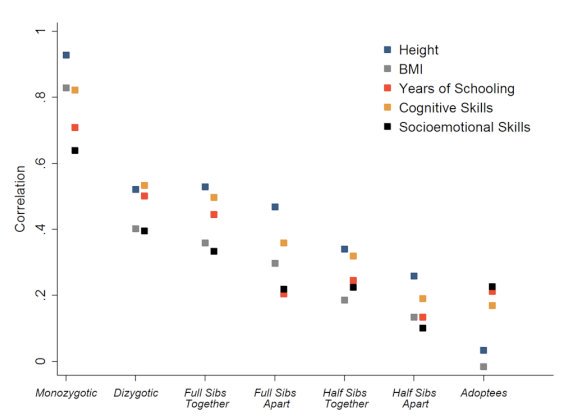
Note the position of the grey squares representing BMI

Right now, within this culture, variation in BMI is mostly genetic. This isn’t to say that non-genetic factors aren’t involved – the difference between 1800s America and 2017 America is non-genetic, and so is the difference between the perfectly-healthy Kitavans on Kitava and the one Kitavan guy who moved to New Guinea. But once everyone alike is exposed to the 2017-American food environment, differences between the people in that environment seem to be really hereditary and not-at-all-related to learned behavior. Guyenet acknowledges this:

Genes explain that friend of yours who seems to eat a lot of food, never exercises, and yet remains lean. Claude Bouchard, a genetics researcher at the Pennington Biomedical Research Center in Baton Rouge, Louisiana, has shown that some people are intrinsically resistant to gaining weight even when they overeat, and that this trait is genetically influenced. Bouchard’s team recruited twelve pairs of identical twins and overfed each person by 1,000 calories per day above his caloric needs, for one hundred days. In other words, each person overate the same food by the same amount, under controlled conditions, for the duration of the study.

If overeating affects everyone the same, then they should all have gained the same amount of weight. Yet Bouchard observed that weight gain ranged from nine to twenty-nine pounds! Identical twins tended to gain the same amount of weight and fat as each other, while unrelated subjects had more divergent responses…Not only do some people have more of a tendency to overeat than others, but some people are intrinsically more resistant to gaining fat even if they do overeat.

The research of James Levine, an endocrinologist who works with the Mayo Clinic and Arizona State University, explains this puzzling phenomenon. In a carefully controlled overfeeding study, his team showed that the primary reason some people readily burn off excess calories is that they ramp up a form of calorie-burning called “non-exercise activity thermogenesis” (NEAT). NEAT is basically a fancy term for fidgeting. When certain people overeat, their brains boost calorie expenditure by making them fidget, change posture frequently, and make other small movements throughout the day. It’s an involuntary process, and Levine’s data show that it can incinerate nearly 700 calories per day. The “most gifted” of Levine’s subjects gained less than a pound of body fat from eating 1,000 extra calories per day for eight weeks. Yet the strength of the response was highly variable, and the “least gifted” of Levine’s subjects didn’t increase NEAT at all, shunting all the excess calories into fat tissue and gaining over nine pounds of body fat…

Together, these studies offer indisputable evidence that genetics plays a central role in obesity and dispatch the idea that obesity is primarily due to acquired psychological traits.

These studies suggest that one way genetics affects obesity is by altering the tolerance level of the lipostat. Genetically privileged people may have very finicky lipostats that immediately burn off any extra calories they eat, and which never become dysregulated. Genetically unlucky people may have weak lipostats which fail to defend against weight gain, or which are too willing to adjust their set point up in the presence of an unhealthy food environment.

So, given how many people seem to have completely different weight-gain-related experiences to each other, the wishy-washyness here might be a feature rather than a bug.

One reason I’ve always found genetics so exciting is that there are all these fields – nutrition is a great example, but this applies at least as much to psychiatry – where everyone has wildly different personal experiences, and where there’s a large and vocal population of people who say that the research is exactly the opposite of their lived experiences. People have tried to shoehorn the experiences to fit the research, with various levels of plausibility and condescendingness. And for some reason, it’s always really hard to generate the hypothesis “people’s different experiences aren’t an illusion; people are genuinely really different”. Once you start looking at genetics, everything sort of falls into place, and ideas which seemed wishy-washy or self-contradictory before are revealed as just reflecting the diversity of nature. People who were previously at each other’s throats disputing different interpretations of the human condition are able to peacefully agree that there are many different human conditions, and that maybe we can all just get along. The Hungry Brain and other good books in its vein offer a vision for how we might one day be able to do that in nutrition science.

VI.

Lest I end on too positive a note, let me reiterate the part where happiness is inherently bad and a sort of neo-Puritan asceticism is the only way to avoid an early grave.

There’s a sort of fatalism to talking about “food reward”. If the enemy were saturated fat, we could just stick with the sugary sweetness of Coca-Cola. If the enemy were carbohydrates, we could go out for steak every night. But what do we do if the enemy is deliciousness itself?

A few weeks ago Guyenet announced The Bland Food Cookbook, a collection of tasteless recipes guaranteed to be low food-reward and so discourage overeating. It was such a natural extension of his philosophy that it took me a whole ten seconds to realize it was an April Fools joke. But why should it be? Shouldn’t this be exactly the sort of thing we’re going for?

I asked him, and he responded that:

If I thought enough people would actually be capable of following the diet, I would consider making such a cookbook non-ironically. The second point I want to make here is that there are many ways to lose weight, and deliberately reducing food reward is only one of them. You could also exercise, eat a low-calorie-density diet, eat a high-protein diet, restrict a macronutrient, restrict animal foods, restrict plant foods, eat nothing but potatoes. Most approaches overlap with a low-reward diet to varying degrees, but I don’t think the low reward value encapsulates everything about why every weight loss strategy works. BTW, low-carb folks often have a knee-jerk reaction to the low-reward thing that goes something like this: “I eat food that’s delicious, such as steaks, bacon, butter, etc. It’s not low in reward.” But it is low reward in the sense that you’re cutting out a broad swath of foods, and an entire macronutrient, that the brain very much wants you to eat. Eating more of a particular category of rewarding food doesn’t completely make up for the fact that you’re cutting out a whole other category of rewarding food that you would avidly consume if you weren’t restricting yourself.

So things aren’t maximally bad. And hunter-gatherers enjoy their healthy diets just fine. And certainly there are things like steak and wine and so on which are traditionally “good food” without being hyperprocessed hyperpalatable junk food. But if you really enjoy a glass of Chardonnay, is that “food reward” in a sense that’s potentially dangerous? Is anything safe? What about mongongo nuts? Is there anywhere we can get them?

At least the consolation of things making a little more sense. One thing that always used to bother me was the so-called “ice cream diet” – that is, if you eat a 700-calorie ice cream sundae for breakfast, lunch, and dinner every day, that’ll be only 2100 calories – around the average person’s daily requirement, and low enough for many people to lose weight. Why wouldn’t you want to do that? The idea of junk food being inherently damaging – while it has a bit of Puritan feel to it – at least fits our intuitions on these sorts of things and gives us a first step towards reconciling the conventional wisdom and the calorie math.

Overall I strongly recommend The Hungry Brain for everything I talk about here and for some other good topics I didn’t even get to (stress, sleep, economics). I would also recommend Guyenet’s other writing, especially his debate with Dr. David Ludwig on the causes of obesity (Part 1, Part 2, Part 3. I also recommend the list of diet tips that Guyenet gives at the end of the book. I won’t give them all away here – he’s been nice enough to me that maybe I should repay him by not reprinting the entire text of his book online for free. But it’s similar to a lot of standard advice for healthy living, albeit with more interesting reasoning behind it. Did you know that exercise might help stabilize the lipostat? Or that protein might do the same? Also, one piece of advice you might not hear anywhere else – potatoes are apparently off-the-charts in terms of satiety factor and may be one of the single best things to diet on.

And speaking of good things to diet on…

(note that this next part is my own opinion, not taken from The Hungry Brain or endorsed by Stephan Guyenet)

Slate Star Codex’s first and most loyal sponsor is MealSquares, a “nutritionally complete” food product sort of like a whole-foods-based, protein-rich, solid version of Soylent (it looks and tastes basically like a scone). I’m having some trouble writing this paragraph, because I want to recommend them as potentially dovetailing with The Hungry Brain‘s philosophy of nutrition without using phrases that might make MealSquares Inc angry at me like “bland”, “low food reward”, or “not hyperpalatable”. I think the best I can come up with is “unlikely to injure your hypothalamus”. So, if you’re looking for an easy way to quit the junk food and try a low-variety diet that’s unlikely to injure your hypothalamus, I recommend MealSquares as worth a look.

25 Apr 08:09

What a cheek! Harborough Conservatives use an image from this blog in an election leaflet

by Jonathan Calder
Take a look at the image above.

It is part of a leaflet that the Conservatives are currently delivering in one of the Market Harborough wards as part of their campaign for next month's Leicestershire County Council elections.

A sharp-eyed reader has pointed out to me that the photograph of the 'Welcome to Market Harborough' sign has been lifted from this blog.

You can find in my post The Great Market Harborough Gas Leak of 2016 on 13 May 2016.

Here it is again:

And if you are wondering where I got it from, it was cropped out of a slightly larger photo I took on 9 July 2011:


If any Conservative activists are reading this, please ask my permission before you use my photographs.

If it is for an election leaflet I will say no, but if it for some other purpose that will benefit the community then I am open to the idea.

And ask someone to brief you on the basics of copyright law before you run into someone who is less forgiving than I am.

Later. I have received a gracious, though private, apology from the candidate. I am still waiting for an explanation of how the photograph came to be used.

Even later. I did receive the apology. Then the other evening I found that the same candidate was using one of my photographs in his Twitter campaign.

I asked him to delete the tweet, which he did, though he did not reply of apologise.

You have to watch these Tories, don't you?
24 Apr 17:03

Reflections on the centre in France

by Nick

First, a disclaimer: I’m not an expert on French politics so I may be just blundering cluelessly in here. For a more informed take, try this from Rainbow Murray.

It’s not usually a good idea to try and explain one country’s politics in terms of another, so I’m not going to try and draw any great extrapolations for British politics and our upcoming election from the first round of the French election yesterday. It’s tempting to do so, given that on the surface it seems to share some of the same characteristics, but it’s wildly different beneath the surface with a heavily personalised and factionalised politics with much more fluid party structures. For instance, in my lifetime the ‘Gaullist Party’ has been through a succession of identities from Chirac’s Rally For The Republic to Sarkozy’s Republicans.

Personalisation and factionalism have been just as strong in the centre as they have on the right and left, though not as prominently because it’s rarely produced Presidents or serious Presidential contenders. Valery Giscard D’Estaing moved towards the centre to win in 1974 and Francois Bayrou almost broke through in 2007, but unlike Macron both of them were established figures within French politics and used established parties and movements in their campaigns. Even without looking at his positioning, Macron is different in having established En Marche! outside the existing structures and built it into an election-winning machine in such a short time.

The main barrier for the centre in the Fifth Republic has been the polarisation the system which has tended to reduce most contests into left-right battles, assisted by the majoritarian two-round electoral system. Centre parties and candidates suffered from the problem of being everyone’s second choice, but not enough people’s first. In 2007, polls were showing that Bayrou could beat either Sarkozy or Royal in the runoff, but he couldn’t get enough support to break past them and get into it. We saw the same in this year’s polling, with second round projections showing Macron comfortably beating everyone else, no matter how close the first round was. This came into play last night, as Fillon and Hamon quickly endorsed Macron for the second round as they conceded the race (Melenchon has yet to make any commitment on the second round, but I’ll address that later). In part, that’s the ‘republican front’ coming into play, defending the values of France against the extremist option, but it’s also perfectly in line with a Downsian political science explanation of how voters decide.

That sort of analysis presupposes that we’re still in a period where politics can be characterised as a simple straight line between left and right where everyone fits neatly on the line. The problem (and an especially acute one for someone like me who studies centre parties) is that competition is now much more multi-dimensional with a whole range of other issues just as salient as the traditional class and economic ones. I think that helps to explain Macron’s success as much as a traditional view of him as a centrist. Because the old left-right model has broken and politics is much more fractured around questions of identity, it was easier for a candidate from outside the traditional party bases to get into the second round, but it seems that Macron was also able to attract voters on the new axes of competition. This is interesting, because while we’ve seen parties and candidates able to draw support from what Hooghe et al call the Traditional/Authoritarian/Nationalist (TAN) side of competition, we’ve not yet seen those who motivate the Green/Alternative/Libertarian (GAL) side, and while Macron isn’t as far along the GAL axis as Le Pen is on the TAN side, it offers an interesting contrast. (Indeed, one reason for Macron’s second round polling lead is that he’s closer to the centre of opinion on this axis)

A quick word on Melenchon here. While he has received some flak for not making a second-round endorsement last night, it seems that he had always said that he would only do so after consulting with his supporters and once he’s done that, I expect he’ll make a statement that’s at the very least strongly anti-Le Pen, if not fully pro-Macron. The problem, I think, stems from a minority of his supporters (and their British counterparts) who push the idiotic ‘better an honest fascist than a slimy centrist’ line, and those who think that the whole system needs to be brought down and would switch to Le Pen as their preferred wrecking ball against the seeming establishment figure of Macron. I don’t hold with the ‘horseshoe theory’ of political alignment that says the far-left and the far-right are somehow adjacent, but I do think that some people’s reasons for supporting politicians of one or the other does mean that their next most likely preference is the seeming opposite.

What comes next? Obviously, we all look towards the second round on the 7th May when Macron should roll to a convincing victory, but it already appears to me that he’s looking at a longer strategy, beyond winning just the Presidency. His rhetoric last night saw him pitching himself very much as what we in Britain would call a ‘one nation’ candidate, appealing across the political divide to bring the traditional republican values of France together. It’s a strategy that’s not just focused on winning the next round but establishing a strong base of support for the legislative elections that are coming in June. We already know that En Marche! is planning to stand in all 577 National Assembly constituencies (with promises of a diverse range of candidates, including many newcomers to politics) and if Macron can use the contest against Le Pen to position himself as the figurehead of the nation, and then use that to argue for a Presidential majority in the Assembly election. If his appeal is enough to get En Marche! candidates into the second round in many of the contests, then the same electoral factors that have almost delivered him the Presidency should give him a strong enough base of support in the Assembly to put together a government of his choosing.

24 Apr 14:52

The geography of Emmanuel Macron’s first round victory

by Mike Smithson

So Le Pen isn’t going to be another Trump

As it has turned out the polling in the French presidential election has proved to be pretty accurate. Macron has, as I write, 23.9% of the first round votes with Le Pen on 21.4%.

The Betfair exchange betting now splits 88% to Macron with to 12% Marine Le Pen.

It is now very hard to envisage the circumstances that have anybody other than the young former investment banker as the next president of France.

What is striking about the Wikipedia map of how individual parts of France voted is the East-West divide with the former departments more likely to go for Le Pen.

As a betting event this has been huge even though French law makes it very difficult for those inside France to bet with online British bookmakers. This suggests a huge interest in this election in the UK.

The final round of voting takes place on May 7th three days after the British local elections which could provide a good guide to the general election on June 8th.

The polls have been proved very right in France – is that going to be the experience here or is Nate Silver right about his criticism of British polling?

Mike Smithson

Follow @MSmithsonPB

Tweet

24 Apr 14:51

Less than a week after Mrs. May’s GE2017 announcement YouGov’s Brexit “right/wrong” tracker moves to level-pegging

by Mike Smithson

It did have Brexit “right” 4% ahead

Given the overwhelming importance of the Brexit negotiations in Mrs May’s stated reason for the early General Election then it is important to continue to follow how voters now view that decision last June.

The one regular tracking poll on this is the YouGov question featured above and as can be seen the split has been fairly stable since the first poll to take place shortly after Theresa May entered number 10 Downing Street.

Now this might all be down to margin of error come up and we need to see other surveys, but less than a week after the prime minister’s big announcement we find a move to remain so that the tracker is totally split 44% thinking Brexit was wrong 44% thinking Brexit was right.

Some of the cross tabs are interesting. Just on a third, 32%, of Conservative voters at the last general election are in the Brexit was wrong camp. That seems a very high proportion given the huge emphasis being put on this by Mrs May and other polling that has the voting intention figures moving sharply to the Tories.

Mike Smithson

Follow @MSmithsonPB

Tweet

23 Apr 23:26

2017 General Election Diary day 5: Whatever you say, it’s wrong

by Nick

It must be great to be the person in charge of the Tory smear campaign, because you have to do so little work of your own. Just nudge out a little bit of disinformation and wait for the circular firing squad (motto: ‘the good is always the enemy of the perfect’) of the left to pick it up and deploy it far beyond any reach you might have managed yourself. Having tested out the appratus on Tim Farron, which has now – despite the voices of many LGBT people – got elements of the left denouncing him as though he spends his weekends out with Westboro Baptist Church, we’re probably getting close to the time when the opposition research they’ve been doing on Jeremy Corbyn for the past two years finally gets deployed. It’s not as if we didn’t know from the US that a well-coordinated smear campaign can turn everything about a candidate upside down, but the sheer amount of material they can dump on Corbyn.

In short, if you’ve been cheering on the attacks on Farron, then be prepared to experience the same thing happening to your leader. It’ll make what happened to Miliband last time and Clegg in 2010 look like nothing.

In other Lib Dem related news, Tim Farron has ruled out the possibility of joining a coalition with either Labour or the Tories, which you would think is what all those people who were saying the party would go into another coalition with the Tories would want to hear, but it turns out that just because he’s said something, that doesn’t mean anyone has to actually accept it. I’m starting to think there are some people out there who have decided that they’re not going to listen to anything he or the Liberal Democrats and will denigrate the party regardless. Like Clegg before him, he could come out tomorrow and announce a cure for cancer, and the legions of keyboard warriors would soon be at the barricades to tell us how it shows he hates people dying of heart disease.

Right, that’s enough Lib Dem ranting for now, let’s talk about polling instead. One thing that characterised the 2015 general election was the inordinate amount of time people took to discuss every new opinion poll as it came out. Every night on Twitter was a countdown to the day’s new polling coming out, which would be dissected in detail, plugged into one of the election calculators, while each of the seeming dozens on polling aggregators and prediction sites updated their figures, and we all discussed which of the models might be the most accurate. Then the result came in and it turned out that all the polls had been out throughout the campaign and all those hours we’d spent discussing them during the campaign had been a complete waste of time.

So, what with that and the referendum, you’d think we’d have learnt our lesson and to an extent we have as there aren’t (yet, at least) the plethora of sites devoted to election number-crunching but it’s still been interesting to watch political Twitter grind to a near halt as the latest polling results come out and everyone pounces on them to dissect them. Sure, there might be some interesting things in them (Scotland could be without a Labour MP for the first time since 1906, for instance) but turning the entire discussion about the election into a discussion about what the polls say about the election didn’t work out too well for us two years ago, so why are we content to watch it happen again?

OK, that’s all for today, time to catch up with the new series of Versailles so I can use it as an ill-advised metaphor for analysing the French Presidential results tonight. Does Louis XIV represent Macron, the young man challenging the way power is used in France; Fillon, the traditional Catholic values of the nation; Le Pen, the appeal to a France that controlled its borders; or Melenchon, because the Sun King wanted a France that was unsubmissive to the rest of Europe? Or is it merely a nicely-made TV programme, the background to which reveals interesting things about Franco-British media relations? All hot takes can be catered for, once we get an idea of the results come in.

23 Apr 14:36

Verity Holloway, Pseudotooth

by Wesley

I bought Pseudotooth not so much because I was interested in this specific book as because I was curious about its publisher. I might look into their other books because this was a good buy; Pseudotooth is one of the better books I’ve read this year. It’s a portal fantasy of a sort, but weird fiction, not epic fantasy–if I had to play the game of comparisons to more famous novels, I’d say there’s some Shirley Jackson and China Miéville here.

Cover of Pseudotooth

Pseudotooth had me from its first sentence. It’s one of those that in a few words tell a lot about the novel to follow: “And of course, the weather turned Dickensian.” That immediate “and of course” tells us we’re in the middle of something, and it’s gone on long enough to grow tiresome, and now on top of it we have this weather and it is the last straw. The word “Dickensian” evokes Dickens’s association (fair or not) with pathetic-fallacy weather, of the Bleak House variety. Longer-term, it prepares us for a story filled with characters who’ve lost or been rejected by parents, and an other-world Dickensian in its technological level and general aesthetic. The novel that follows is gorgeously written. Take the second sentence, with its Dickensian weather: “The East Anglian horizon was crowded with low, goitrous clouds, ballooning out like new bruises,” which at once freshly visualizes a particular type of cloud and resonates with a specific emotional feel.

The real literary influence here isn’t Dickens but William Blake, who’s quoted throughout the novel. Blake is the favorite poet of Pseudotooth’s protagonist, Aisling Selkirk, who turns to his poems in times of stress, of which she’s having a lot. In the wake of a traumatic experience with her mother’s latest boyfriend, Aisling has been suffering from pseudoseizures–seizures with no neurological cause–alongside the occasional blackout or hallucination. Aisling is a few months away from legal adulthood but is treated like an inconvenient child; as an alternative to an institution her mother sends her into the countryside and the care of a sneering aunt. There Aisling spends her time writing fiction in her journal about Feodor, the delinquent son of a Russian immigrant, and exploring her aunt’s old vicarage. There’s little to read except Within Reason: Treatment and Protection of the Defective Classes, a mouldering eugenics manual made especially awful by the pathetic marginal notes (“Whitewash is extremely moral”) of someone who judged himself “defective” and was desperate to cast out, like a rotten tooth, whatever “degeneracy” caused his illness.

The other world reveals itself slowly; not so much magical as ghostly, or perhaps–appropriately for a novel so preoccupied with Blake–visionary. There’s a gradual bleeding-over of the other world instead of a crossing-into. It starts with apparitions: a young man in the garden, an older, balder one on the stairs. When Aisling eventually wakes up to a deserted house she assumes she’s broken with reality altogether; outside is a nameless place ruled by “Our Friend” according to the precepts in the manual–whitewash the walls, cultivate “inner cleanness,” disappear the “defectives.” Aisling is taken in by an ad-hoc family of outcasts, and meets Feodor in the flesh, and uncovers the connected histories of Feodor and Our Friend and her aunt’s vicarage.

What Aisling doesn’t do is what a by-the-numbers portal fantasy might expect her to do: get involved in a revolution. Portal fantasy heroes aren’t “chosen ones” as often as the subgenre’s stereotype might lead you to believe, but it’s true they are with numbing regularity caught up in Big Events. It’s the default template, which sometimes obscures the fact that it isn’t an essential characteristic. (I would read the hell out of a portal fantasy set in Dungeons & Dragons land that was simply about finding a job and an apartment in a world where Adventurer is a career option and your roommate could be a Beholder.) Feodor, once he learned about Our Friend, thought he could be a hero; instead he caused a disaster. He warns Aisling off: “Look, I know what it’s like to think you’re the molten centre of the universe, but there’s history here, and people moulded by it.” (Another example of good writing, typical of Pseudotooth: you’d expect just “center of the universe,” but Holloway sidesteps the cliché by adding molten, segueing into the “moulded by” image.) Aisling still isn’t sure the other world isn’t in her head. Feodor thinks that will lead to her repeating his mistakes. The other world doesn’t revolve around Aisling, it’s more than a backdrop for her story; that’s a sign of its reality. Although the status quo shifts, Aisling isn’t an instigator but a witness. Her story isn’t about changing the world, it’s about understanding her own life.

Given the subjects it deals with, Pseudotooth is in constant danger of becoming one of those stories valorizing mental illness, connecting it to creativity or suggesting it’s actually some sort of unique and valuable insight. (As someone who’s experienced depression, I hate those things; it’s like telling people with thyroid problems or fibromyalgia they ought to accept and appreciate them.) Ultimately, though, Pseudotooth comes down on the right side of the line, even if it teeters precariously and has to windmill its arms around the point Aisling flushes her meds. (Not recommended, even with the suggestion her doctors gave her a half-assed diagnosis.)

A book review feels incomplete without some kind of thematic summing-up, so I’ll say Pseudotooth is less about mental or psychosomatic illnesses than about how people define and categorize the people who have them. Aisling’s mother thinks she’s weak, or faking it. Aisling’s aunt thinks she’s morally deficient. The head of the family who adopt Aisling thinks she needs to be protected from the world; Our Friend would lock Aisling away to protect the world from her. Within Reason’s annotator suffered from psychosomatic illnesses and believed everything his book told him about himself. Aisling’s story is about coming to understand she doesn’t have to accept any definitions. Her pseudoseizures aren’t part of her identity; they may affect her but don’t define her, and whether or not she gets over them she can still move forward with her life.

The main reason to recommend Pseudotooth is the writing, which is, as I said, great. (It’s coming from distinctly literary direction, without the TV or Hollywood or Video Game influences I detect in a lot of modern SF; that’s something I look for and appreciate.) As a small press release with no unusually vast or unrelenting marketing push behind it, it’s a book I’m afraid might slip under the radar of fantasy fans. That would be too bad–it deserves some attention.

23 Apr 13:15

Interesting Links for 23-04-2017


Can Global Britain Defy Gravity?

Probably not.

"Perhaps the boost to productivity from being able to use incandescent light bulbs while vacuuming with high-powered hoovers will be significant, but the above suggests new free trade agreements alone can’t do it."
(tags: ukpolitics brexit eu economics )

23 Apr 12:47

Why a 1997 style landslide or even a 1983 style landslide might not happen, but maybe a 2005 style majority of 66 could

by TSE

Judging by the polls, the political mood, the intuition of most political watchers, and pretty much everyone in the country, sans the Corbynites, are expecting Mrs May’s Tories to win so comprehensively the only thing in doubt is which three figure number will be the size of the Tory majority, but today I’ll explain why that might be wrong, and why Mrs May could end up with just a modest double digit majority.

But here are the reasons why I think the Tory majority won’t be as massive as people think

1) Tory complacency

It seems every day new record breaking polls come out implying that the Tories are going win a stonking landslide on June the 8th, whilst Jeremy Corbyn and Labour would suffer less punishment if they booked 400 dominatrices concurrently that night and chose ‘mower’ as their safe word.

This is likely to depress turnout as voters, especially Tories think the result is in the bag. This could see Labour holding on to seats they should be losing if the polls are accurate because of low turnout.

2) Shy Labour voters

With Jeremy Corbyn as leader, you can see why Labour voters would be shy about admitting voting for Labour, this isn’t just conjecture on my part, there’s actual evidence for it.

ICM’s spiral of silence adjustment is reducing Tory leads on a regular basis by a few per cent each time. It is entirely possible that ICM are underestimating it because of 3)

3) The Love Labour, hate Corbyn voters.

If you’re a long standing Labour voter who hates Corbyn but like your local Labour MP, such as Wes Streeting or John Woodcock for example, who happen to be a vocal critics of Corbyn, what are you going to do? A) Let in a Tory MP, or B) back that anti-Corbyn MP? It’s B isn’t it, a no brainer as some would say.

These are the sort of people I suspect tell pollsters they won’t vote Labour as way of trying to force Corbyn out.

4) Labour could get the ‘sympathy shag vote’

This is  the antonym of 1) There are lots of voters out there who like the Labour party as an idea, as a concept, as a force for good and who whilst might not like Jeremy Corbyn want neither a result so bad that Labour can’t ever recover from/or take decades to recover from, nor do they want the Tories to have such a huge majority so they can do whatever they wish. So these voters pity Labour’s plight in the polls and give them their vote out of sympathy.

5) Whisper it very carefully, Mrs May might not actually be that popular

First of all there’s the polling that shows her popularity is equally down to her not being Jeremy Corbyn nor would she be losing the majority of the Tory gains from the Lib Dems that her election strategist found, a PM with polling leads of 25% really shouldn’t be doing that.

People compare her to Mrs Thatcher, but what has Mrs May really achieved that is comparable to Mrs Thatcher had prior to her 1983 and 1987 landslides? No war won, no massive reform of the UK, so far only a slogan, ‘Brexit means Brexit.’

Plus Mrs May’s a crap campaigner, no wonder she’s frightened to meet real voters or to debate Corbyn, given her failure to consistently crush him at PMQs. Macavity May hid during the EU referendum, as PM she can’t hide during a general election campaign. Mrs May is a crap campaigner, this is a narrative I and others expect to develop, especially if she refuses to debate Corbyn and the other party leaders.

6) Sir Lynton Crosby might not have enough time to work his magic at this general election

In 2015 Sir Lynton spent two years polling, focus grouping, and message testing the hell out of what strategies and memes would win the election, such as the long term economic plan. This election he might have only a few weeks to do all that, and his end product might not be his best or even a match to his 2015 work product.

7) Perhaps Sir Lynton is overrated and not the master strategist we think he is

Yes he did help win the 2015 general election, and oversaw Boris Johnson’s two wins as London Mayor, but he also oversaw the Tory election defeat in 2005, and the less said about the his contribution in Zac Goldsmith’s unsuccessful campaign to be London Mayor last year. Even Zac’s sister criticised the whole approach, that’s how bad a campaign it was, with many describing it as “dog-whistle racism.”

Perhaps 2015 was won purely down to Cameron’s leadership, Osborne’s magnificent stewardship of the economy, and the fear of a Labour/SNP coalition government.

8) No Lord Ashcroft constituency polling to blindside the Tory opponents this time

One Tory activist I spoke to in the aftermath of the election victory in 2015 said the party owed Lord Ashcroft a debt of gratitude for his constituency polls, which inadvertently led the Lib Dems to feel more confident (and possibly) overconfident about their chances of holding their seats from the Tories.

Whilst the polls also reinforced Labour’s belief in the ground game, where the polls indicated Labour was doing better in the Lab/Con marginals.

This allowed the Tories to campaign under the radar and win whilst their opponents believed the Ashcroft polling.

9) That expenses saga might be game changers on two levels which doesn’t help the Tories

Given allegations from last time, I suspect we won’t see Tory activists being bussed in to key seats, this  might make the Tories  to lose seats they hold and fail to take the seats they are expected to gain.

Secondly if charges are brought during the campaign, as Hillary Clinton found out, things like this can change the polls.

10) After all the polling failures in recent years, is anyone 100% confident that the polls are accurate.

Just look at that (in)famous Guardian front page from two years ago, during the last general election campaign, and the failures some pollsters had during the EU referendum, is anyone truly confident the polling problems have been entirely sorted out, especially with the reasons listed above? Last night’s polls and the reactions therein had a similar feel at times, or even the Cleggasm, and we all know how those turned out.

I expect Mrs May will win a decent majority, and I know a few PBers who last night bought the Tories at 378 seats for £30 a seat, I’ll be joining them in the morning, but if come June 9th that bet becomes a loser, it’ll be for the reasons listed above. Success equals performance minus anticipation. Right now the anticipation is for a three figure majority, anything less will feel like a disappointing night for Mrs May, she should help lower expectations.

TSE


Follow @TSEofPB

Tweet

23 Apr 00:10

Manchester Rally for Chechnya

by noreply@blogger.com (Paul Magrs)


We've just been at the rally in the Gay Village for the Chechnya concentration camps. Jeremy gave an amazing impromptu speech!
22 Apr 22:09

2017 General Election diary Day 4: Breaking pledges before the vote

by Nick

So, about that whole one post a day thing during the election. I’d like to explain here that it was always an aspiration and never a firm commitment, but global circumstances have since arisen that will make it hard to meet that aspiration within the course of the campaign. Or in other words, I’m going to try and get an election post up here every day, but with lots of other things going on right now, there may well be more days like Thursday where I don’t quite get round to it, then Friday when I don’t have the time to write two posts, so we get slippage. The advantage of this approach is that there’s a good chance I’ll end up getting nowhere near 50 posts, and so this whole thing will end up seeming a lot shorter than it actually is in reality.

So what’s happened since yesterday morning? Well, Theresa May’s still yet to encounter a member of the public in anything other than a carefully controlled, almost hermetically sealed environment. And if your answer to that involves invoking something about the security of the Prime Minister, then please have an explanation for her happily pounding the streets during the Witney by-election. Just like Cameron in 2015, her plan is for a campaign that runs through a series of Potemkin villages, safe in the knowledge that the press is too craven or cowed to challenge her on it. If anyone ever does get the chance to ask her a question, can I suggest ‘if we can have an early election because you want to overturn the results of the last one, why can’t we have another referendum on the EU?’

Any excuse to drag out an old favourite.

In other news, the likelihood of biscuit-related headlines fell sharply with the news that Eric Pickles will be standing down at this election. One thought that crosses my mind in relation to the number of MPs stepping down here is that it might present some interesting problems for the Tories at the next election, when the number of MPs are set to go down to 600 from 650. I’ve argued for a while that that’s not the big problem some people think it is because a lot of the shrinkage will be taken up by retiring MPs and rearranging the remaining candidates to fill the gaps. If, however, all those MPs who would have retired then have now gone, and been replaced by keen young things wanting to hold on, then there might be the problem of trying to fit far too many MPs into far too few winnable seats. (That’s the sort of thing that can fall into the category of ‘nice problems to have’ if it comes about, though)

Also in potential nice problems to have, if this election was to end with a potential coalition on the table, and if the coalition was to involved the Lib Dems, then there’d need to be a Lib Dem conference to approve the deal. (This, of course, is one reason why any sort of coalition involving the Lib Dems is ridiculously unlikely to happen) The trouble is that the Lib Dems now have a system where all members can come to conference and vote, and with a party membership now around 100,000 it could make the choice of venue interesting. I’m assuming Wembley Stadium will be free in June if needed?

We’re still in somewhat of a phony war period, shown most notably by the fact I can’t yet start doing election leaflet of the day because everything on the site is still local elections related. Whoever uploads the first general election leaflet on there will be noticed, but until then the best we have is weird pictures from a UKIP candidate and a Scottish Conservative candidate yet again showing why most fashion designers shy away from the repeated Union Flag as a style statement. All very slim pickings so far, but still a long long way to go…

22 Apr 21:18

Opinium sees the Tory lead up 10% in a week to 19%. Labour are on course for an absolute hammering if the polls are right

by TSE

Since Theresa May announced the general election, we’ve had three polls, with leads of 21%, 24%, and now 19% for the blues. The trend is not Labour’s friend. We might need to come up with a new adjective for  just how rubbish Corbyn is.

This poll presages an absolute shellacking for Labour. If Labour had any sense they’d depose the voter repellent in the next week.

In the write up

Separate analysis by Opinium, which has been tracking the same 2,000 voters throughout this parliament, found that only 53% of those who had said they intended to vote Ukip in February are still planning to do so in the 8 May election, with 30% of them saying they will transfer allegiance to the Tories.

The crumbling of backing for Ukip appears to be the main reason for the dramatic surge in enthusiasm for May’s party. Labour’s fall may be the result of voters who were strongly in favour of Remain in the Brexit referendum last June deserting the party for the anti-Brexit Lib Dems.

When those who now choose the Lib Dems were asked to give the main reason they are deciding to back Tim Farron’s party, 50% said that it was because of its stance on Brexit. Just 6% of Labour voters said Jeremy Corbyn’s stance on Brexit was their main reason for backing Labour.

For me one of the most interesting aspects of this poll is the Lib Dems are on 11%. Due to the house of effects Opinium, the Lib Dems do quite poorly with this pollster, they had the Lib Dems on 4% last summer. So 11% with this pollster is very impressive for Tim Farron’s party.

Depending on the right odds I might fancy a bet on whether we will have at least one poll from a BPC registered pollster to see the Lib Dems ahead of Labour.

Tonight I’m also expecting a GB wide YouGov poll in The Sunday Times and a Scottish poll in one of the Scottish papers.

TSE

22 Apr 11:48

The French ban on opinion polls came into effect at midnight with Macron still ahead

by Mike Smithson

Will that hold good when real voting starts tomorrow morning?

France has some very tight laws on opinion polls including a complete ban on then being published on the day before an election. So the Wikipedia chart above represents all the polling that we will see until we get the exit polls tomorrow evening.

The young independent, Emmanuel Macron, is still in the lead and has seen it move up just a touch in the final few days. Le Pen is in second place with the Republican Fillon and the far-left Melenchon not that far behind.

There are a total of 11 candidates and the first round of voting involves narrowing this down to just to for the run-off a fortnight tomorrow

France has very high turnout rates usually around the 80% mark and there is no reason to think that it will be much lower this time. .

We should get news of the first French exit polls tomorrow evening after about 7 p.m. UK time.

The betting markets make Macron the strong favourite with a current 57% chance. Le Pen is down on 21% with Fillon at 17% and Melenchon at 5%.

The polling is so tight that it is within the margin of error for neither Macron not Le Pen to make it to the final.

UK betting interest has been the highest ever for a non-UK/US election. On Betfair alone £803k has been matched over the past 24 hours.

Mike Smithson

Follow @MSmithsonPB

Tweet

22 Apr 11:28

10.1 The Pilot

by Andrew Rilstone

The Pilot. The first proper episode in nearly 18 months. Partial reboot. New companion. Dalek

In some ways I liked it. I cheered a couple of times: the Movellans, the sonic screwdrivers, and (retrospectively) when it dawned on me what Bill’s girlfriend was called. I gurgled appreciatively at the Mary Celeste name plate; and at the two pictures on the desk; and at some of the banter, because, if there’s two things that Moffat can really do, one of them is banter; and at the Dalek. 

I went to the Doctor Who Experience a few years back with a couple of kids and we were beamed onto the bridge of a Dalek spaceship. When you went, you probably saw a very well constructed animatronic tableau but I promise you we were taken onto a real Dalek ship. I've wanted to go on a Dalek ship my whole life. So of course I loved the Dalek.

And that’s the problem, isn’t it. Daleks and sonic screwdrivers and supporting characters who appeared for one and a bit seasons half and century ago and jokes about the names of dead actors. All very frothy for us fans, but where's the, so to speak, beef?

Imagine if this were almost anything other than Doctor Who. The hero’s friend’s lover has become possessed by a shape shifting alien puddle and the hero pronounces that the only way to free her is with a special “remove alien puddle” ray, which one particular evil alien robot happens to have. So the hero and his new friend jump into the middle of a war and set up a situation where the alien robot zaps the alien puddle. And, so far as I can see, this doesn’t do any good whatsoever: the friend’s love isn’t freed, the puddle monster isn’t destroyed. It’s defeated a few minutes later by the power of love. 

No-one would write this kind of thing voluntarily; no-one would think that “deliberately getting caught in the cross fire of a war” was a sensible way of getting rid of an alien water demon; and (incidentally) no-one has ever remotely suggested that the Daleks gun is the hottest fire in the universe before. The scene is an exercise in shoehorning the Daleks into the wrong story; either so people like me can have a fangasm; or because nominal Whovians associate the show with Daleks and not much else, or (very probably) because if the BBC don’t use the Daleks every year they lose the rights to them. The Movellans were rubbish in 1979, part of a terrible script by a Terry Nation who had long since ceased to bother, But seeing them for 8 seconds forty years later is like, the coolest thing ever. 

This is dysfunctional television. Or else I am dysfunctional fan.

A very long time ago when the universe was black and white the Sonic Screwdriver was just a gadget. Then, in the 70s, it became the Doctor preeminent gadget. Then, in the reboot, it became the Doctor’s iconic gadget: as much a part of who he is as the TARDIS. Now, the fact that it’s the Doctor’s iconic accessory is the subject of a visual gag: it may be his magic wand, but he treats it like I treat my old biros. 

When Bill is introduced to the Doctor, she demands to know his True Name. "Doctor what?" This is funny because...well, for very obvious reasons. When she first goes inside the TARDIS she says everything apart from “It’s bigger on the inside than the outside” which is funny, because we know that is what companions normally say. When she finally does say it, the Doctor and Matt Lucas sort of high-five, because they know it, too. When the Doctor makes a weak joke and the Bill responds in kind, Matt Lucas points out that they are now bantering.

We’re not only laughing at the cliches but laughing at the fact that we’re laughing at them. 

I have completely forgotten who the Matt Lucas character is and what he is for. (Did he just pop up as a fait accompli, like Madam Vastra?) 

Every time there is a vacancy, I speculate about all the interesting things that a new Companion might be. Maybe a young boy, or a much older woman (as worked so well in the audio stories) or an alien or something historical — a Victorian governess, say, or an ancient Egyptian princess? The last six companions in the original series were, what — a delinquent biker chick with mother issues who liked exploding things; an annoying vegetarian dancer who thought she was in a panto; a shouty American; a naughty alien schoolboy who nearly betrayed the Doctor; a posh alien whose planet had been exploded by the Master; and a naughty maths nerd who can’t dance... But in the new series, it always turns out that the new companion is going to be a spunky twenty-something woman who the Doctor banters with. That’s the new definition: companions are spunky twenty-something women who the Doctor banters with. Granted, Bill is a Daily Mail baiting black lesbian spunky twenty-something woman and the first person to say “why didn’t they make her an amputee as well so they could have the set?” will be politely asked to leave the room.

If I were the sort of person who complained about this kind of thing, I would complain that race and sexuality are just being used as signifiers of difference, like a funny hat: the new companion is just like the old companion except with the twist, get this, that she fancies women. But other people complain about that kind of thing much better and at much greater length than I can. 

It would have been much more interesting if Bill’s sexuality hadn’t been trailed in advance as a selling point: look at us, we’re so clever, we’re introducing the first ever GAY companion, unless you count Captain Jack, who was probably not entirely straight, and Wonderful Clara who was strongly implied to swing both ways. It would have been much more interesting to introduce a spunky twenty something girl who dated other spunky twenty something girls and resolutely refused to mention it.

I liked the way her jacket was yellow and stripy like the chips she serves in the canteen, and that she uses “fat” as a verb. 

The Doctor has stopped traveling. Because of that bad thing which happened before. He has taken on a new role, which he quite likes, and hung about for what to us would be a life-time and sworn he would never take another companion. But then this spunky young thing with a tragic entanglement comes along, and he picks her out as special, but never intends to travel with her, but in the end he does. But then he has to part with her again, which leaves him sad, so he quits travelling again. But then...

That’s not the plot of this story or this season. That’s the plot of every story and every season.

There is nothing particularly wrong with formulas. A sonnet always has 14 lines and a haiku always as 17 syllables; Captain Kirk always falls in love with a pretty lady solves a moral dilemma which demonstrates why communism is wrong. But formula is the hook on which you hang the content. And what is now the content of Doctor Who? What are we watching for? Self-referential banter; references to old stories; and an endlessly recycled stream of autolacrymose sentiment?

What we have this week is one more possession-and-exorcism story, based around a Mills-and-Boon notion that you can be in LOVE with someone you don’t really know and have never really had a conversation with. Bill has a crush on Heather but Heather has a crush on a mysterious pool of water. Heather looks into the pool for too long, and the kelpie drags her inside. So from now on, whenever Bill looks into puddle of water, she will always see her lover’s reflection looking back at her from it.

No: that isn’t quite right. What actually happens is that Heather looks into the mysterious puddle of water for too long and the water somehow makes an exact copy of her. It, the puddle, can now follow Bill around, flowing under doors, through taps and shower fixtures, and then take on Heather’s form. A sort of wet, leaking Heather, a bit like the zombies in Waters of Mars. Liquid Heather is heavily coded as scary, although never does anything particularly frightening. 

But this isn’t quite right either. When the TARDIS travels instantaneously to Australia the puddle travels equally instantaneously after it, and when it travel instantaneously to a planet millions of years in the past, there seems to be a puddle waiting for it, and when it materializes in the middle of Destiny of the Daleks, there’s a Heather shaped pool of water waiting there as well. So all the flowing and dripping was just for show. It hardly flowed through a crack and along a pipe until it ended up on an alien planet eighty six million years in the past. It can just be wherever it wants to be. Which makes it far more powerful than the TARDIS. 

Clearly, we are engaged with what Freud would call primary and secondary dreamwork — an image, and an after-the-fact rationalizing of that image. Heather can spring up out of a pool on an alien planet because the primary idea is that Heather has been subsumed by a water elemental — wherever there is water, there she is too. The sciencey hand wave is that one little pool of water is somehow outrunning the TARDIS through time and space. 

Because the Puddle is actually a pool of super-intelligent oil from an alien space ship, and when Heather remarks that she would like to go run away, this somehow imprints on the Space Oil, so she gets whisked away through time and space, except that Bill told Heather “don’t ever leave me”, and that imprints on the space oil as well, so wherever Bill goes Heather goeth too. The Doctor’s first idea of getting Heather zapped with a Dalek death-ray doesn’t have any noticeable affect. Bill has to cast a spell of banishing: when Bill releases Heather, that is to say the replica Heather, from her promise, she goes away.

I get that the title, Pilot, is a double entendre, and I get that this episode is sort of kind of reintroducing Doctor Who after a long break, reselling the formula to people who may have forgotten what it is. So I get that it is in one way consciously revisiting Rose — note the alarm clock, the exaggerated rush through the day at work, and the fact that the new companion is called Billie. The episode coyly pretends that we might not have any more idea about who the Doctor is than Bill does, and has quite a fun time unravelling it. The best kinds of mysteries are the ones to which you already know the solution: they make you feel clever. Moffat makes us do some of the work ourselves. Bill says that she doesn’t have any pictures of her real Mum, and then finds a box of old photos in her wardrobe, and then notices that the Doctor’s reflection can be seen in one of them, and then realizes that the Police Box in the Doctor’s room has moved… But when we get to the big reveal — Capaldi standing in an exaggeratedly large TARDIS interior, looking positively regal, making his speech about “the gateway to everything which ever was or ever could be” Moffat feels the need to immediately under-cut it with some unfunny toilet humour. 

Pearl Mackie delivers the line about “You mean it can go anywhere…anywhere in the university?” as if she doesn’t quite get it. 

I also get that if you are reintroducing the Doctor, you might want to sell the idea of the show by having as much time and space travel as possible: from the university, to Australia, to the alien planet, to the Dalek war. (The only thing missing is a meeting with, say, Queen Elizabeth I or Christopher Columbus.) A surprisingly large chunk of the episode involves the Doctor explaining the concept of Time Travel, as if some people might not know what a time machine is, or might not think the idea was that exciting. This week, time is not a ball of wibbly wobbly timey wimey stuff so much as a city made up of all the different moments of your life; or possibly just a strip of movie film made up of thousands of still images. Moffat likes the idea of the simultaneity of time: one of his first contributions to Who, The Girl in the Fireplace, involved a spaceship which contained a number of “time windows” so Rienette’s life seemed to be laid out in a series of frames. Several times in Pilot, the camera appeared to pull back and show us Bill’s life as a grid of frozen moments, which is nothing is not audacious. And several times we get little flash back sequences showing Bill’s life and her relationship with heather in the little non-sequential moments.

In very, very old Who, we are asked to think of the TARDIS as being a bit like a television set; a little box that could potentially contain anything in the universe. Are we now being asked to think of the TARDIS as being a metaphor for memory? What we can all do in our heads — zoom backwards and forwards following interconnections and patterns to find the shape — the Doctor can do in the actual universe? Which is a not uninteresting idea.

The Doctor concludes his lecture about time being like a city by exclaiming “Time and relative dimension in space!” exactly like a vicar desperately hoping you’ll believe his sermon had something to do with his text when it patently didn't.

Look, we don’t know where we are going with this season yet. It might be that after the terminally impenetrable conclusion to Season 9, we have to sort of regress to the norm (Doctor, travelling, companion, banter, Daleks) before we can even consider telling any more stories. It might be that the pictures of Susan and River are just there so fans can stroke their beards and say “Ah, photos of Susan and River…” but it might also be that there is a plot brewing in which Susan turns out to River’s time-sister. There may be something really interesting locked in the vault, or at may turn out to be another monster which wants to destroy the universe for no adequately explored reason.

The idea that the Doctor has gone into semi-retirement and become an academic is really interesting (and not the worse for being a bit like Human Nature and a bit like School Reunion) but it isn’t clear if this is a recurrent sub-plot or a give away line in the first episode. Surely there is a whole season to be got out of the Doctor as a college lecturer? 

As so often, the best thing about the episode was the Doctor himself. How many terrible stories and seasons have we continued watching because Tom Baker or Sylvester McCoy were so compelling? There are too many long speeches about how brilliant the universe is and what a wonderful idea time travel is; but Capaldi does a very good job despite the overwritten material. I like the little flashes of Tom Baker when he grins. I like the way he looks at Susan’s photo when he first talks to Bill. I like his macho pride in the TARDIS. The scripts keep telling us that he is magnetic and charismatic and fascinating; but Capaldi manages to make him magnetic and charismatic and fascinating even when there isn’t dramatic music playing in the background. 

21 Apr 22:29

is this what it's like to hang out with me? why didn't anyone SAY anything??

archive - contact - sexy exciting merchandise - search - about
← previous April 21st, 2017 next

April 21st, 2017: Are the uses of "oh no" a stealth shout out to Webcomic Name? I DECLARE IT SO, I LOVE THAT COMIC

– Ryan

21 Apr 21:04

2017 General Election Diary Day 3: The Leavers’ chicken run

by Nick

Didn’t get a chance to write last night, so at some point over the next few days there’ll be two diary posts in a day to get me back on track. Or pressures of work mean I’ll just end up slipping even more and this diary continuing on an irregular basis until we reach the conclusion in July. In which case, I will ask for no spoilers of the result until I come to write my post about it. I’m sure that’s doable.

We’re at a stage where we’re getting more surprises at people not standing in the election than from any surprise announcements of people deciding to stand. Joining the march to permanent exit from the House of Commons yesterday was Douglas Carswell, who decided that as the Tories wouldn’t take him back his work was now done, he wouldn’t be standing for election in Clacton again. Speculation then centred around whether Nigel Farage would put himself up to the task of defending the only seat UKIP have won at a general election until he announced that although he would absolutely definitely honestly with no doubts whatsoever would have won the seat, he would instead be concentrating on his work in the European Parliament. Yes, the man who’s tried seven times to get elected to Parliament and views the job he’s actually been elected to do as little more than a source of funding that he hardly ever turns up to has suddenly had a Damascene conversion to the importance of his job. It’s an act so brazen it threatens to replace ‘killing your parents and demanding mercy because you’re an orphan’ as the definition of chutzpah. Still, the one thing we can thank Carswell and Farage for is making Arron Banks’s campaign for Clacton even more pointless and ridiculous, and throws more attention onto the Tory selection there, where previous Tory candidate Giles Watling (brother of Deborah, who was Victoria in Doctor Who) is being challenged by Tendring Council leader Neil Stock.

Away from the Sunshine Coast, Jeremy Corbyn was launching Labour’s campaign by threatening to tear up the rules and win a surprise victory. Rule-breaking by him would not be unexpected as it’s been a feature of his leadership with such rules as ‘Labour can’t drop below 25% in opinion polls’ and ‘leaders who don’t have the confidence of 80% of their MPs resign’ being thrown out of the window recently. A few people have pointed to the recent surge in support for Jean-Luc Melenchon in France as an exampleof how a Left candidate can do well, but it’s worth noting that Melenchon’s surge has taken him to just under 20% in the polls, which is the sort of level that’s very good for the Left, but would promise electoral disaster for Labour.

(And on a trivial point, was Corbyn’s launch at the Islington Assembly Rooms? I thought I recognised it as the venue where the 2015 Lib Dem leadership election was announced)

Elsewhere, Theresa May’s promise to campaign amongst the people saw her team not telling the media where she was going, then doing a few photo ops in a factory. As yet, there’s still no record of her being in a position where she might face anything at all spontaneous, challenging or risky nad the Guardian’s election blog has already taken to calling her ‘Theresa May of Mystery’.

Now the election’s upon us, a reminder that the Election Leaflets website exists, as in weeks to come it will be being relied upon quite frequently as a source of content for these diary posts. If you get something through your door, take a picture of it and upload it for all the world to see. It’s a good chance to see what’s being said in different places, or just to see what strange things candidates say and what odd images they choose to represent themselves.

Three days done and we’ve yet to descend into Quatermass and The Pit-style mass barbarism in the streets, let’s hope we can keep that streak going for a while.

21 Apr 20:50

“I have not sung this song”: Reviewing Infinite Tuesday by Michael Nesmith

by Sarah Clark

The Review:

Infinite Tuesday is the best and most compelling work of prose ever written by Michael Nesmith.

The Slightly Longer review…

2017-04-18 18.20.37The more I read Nez over the years, in songs or books or facebook updates, the more I noticed that the 10-dollar words seemed to crop up more often when discussing a vulnerable or tender subject. Neftoon Zamora, for instance, required me to keep another browser window open to a dictionary website. That 780 Verbal score I’d earned on the SAT a few years back and a vocabulary that inadvertently awed many of my peers didn’t protect me from having to look up at least three words every time he posted a new chapter. It seemed clear Nez was exploring tender spots of his psyche, especially in those earliest drafts that were somewhat dialed back in the final book, and the story read as though he might have felt more comfortable doing so with the protective armor of HTML experimentation and magical realism and baroquely florid descriptions of truck stops. (though seriously—I think of that passage every time we pull over on a road trip at a particularly glitzy travel plaza for gas and beef jerky.  The man nailed it. 😉 )

But 20 years later, I opened my kindle copy of Infinite Tuesday to find I only had to look up one word in the whole book. (“Sodality”, for the record) Either my vocabulary had gotten bigger, or one of my oldest role models, as the last few years had led me to suspect, was feeling a lot more comfortable in his skin. For all the talk of a non-linear series of “riffs” in the book’s preface, the book was pretty much the chronological story of his life, with only minor time jumps here and there in service of a particular theme, or occasionally to downplay the fact that he made no mention of any post-1969 Monkees activities, whether or not he was involved. (I would have been curious to read his side of the Justus story, but of course this is his telling of his life, viewed through his particular lens and with events of his choosing protected from our insatiable gaze). Some of it is familiar to those of you who have read Neftoon Zamora, and other anecdotes have previously been spotted in facebook updates or Gilbert Gottfried Interviews.

(Note to Zilchers: Yes, when I invoke Gilbert Gottfried I am referring to THAT ANECDOTE. My opinion from Zilch #34 is essentially unchanged, though I will now allow the very real possibility that both Nez AND Andrew Sandoval were telling the truth, and that Nez thought he was lying when he actually wasn’t–or rather that he made a ‘fact’ up out of whole cloth that turned out to be at least highly plausible based on available data, if not 100% provable. Something that ridiculously ironic almost has to be true. In any case, Nez owes Andrew a beer or something for having to talk down a bunch of more literally-minded fans who descended on his facebook page in a panic.)

However, much of the story of Infinite Tuesday is completely new, even to those of us who were following Videoranch decades before it was cool. I learned more about the secondary characters in his childhood, and his roundabout journey to Los Angeles. His few brutally frank and poignantly written words about his time with Phyllis spoke more eloquently than a long, detailed confession ever could. The Monkees were covered relatively briefly and dispassionately, but with the same bemused affection he’s exhibited toward that chapter of his life since 2012. His take on the “Palace Revolt” was a revealing missing piece of the puzzle that will reframe many fans’ understanding of those events, and his exquisitely understated retelling of the fist through the wall incident left me doubled over with laughter on my first reading until I was almost late for work. Learning of the Nez/Jack Nicholson “bromance” was a delight of course, but I actually was most taken in “The Monkees Chapter” by the insights Nez provided into Bob Rafelson and Bert Schneider as they stood on the verge of a Hollywood revolution. (I also would have loved to have been on that rooftop with Nez and Johnny Cash, but I digress. 😉 )

Nez was not immune to the same Post-Monkees collapse that his bandmates endured, and his descriptions of crippling self-doubt alternating with the bravado of celebrity psychosis made me both ache for him and wish I could give him a solid knock upside the head—much the same impulse that I felt when reading Micky and Davy’s memoirs. However, Nez had a wonderful eye for talent even then, and his search for true artists and true thinkers led Nez to the relationships that in turn led him out of the abyss. I admire Bette Nesmith as much as I do her son (more, in some ways), and learning more about the joys and challenges of their relationship was one of the most fascinating parts of the book.

I knew the rough outline of Nez’s career from the 1980s onward, having been a fan for most of it, but he shared remarkable insights about both the art and the craft of show business, his stint as a “hamburger movie tycoon”, his part in the MTV story, and his strengths and weaknesses as a producer that led to both the heights of Repo Man and the depths of the PBS lawsuit. Some may see this section as a belated confession that his reputation as a “business genius” was overblown—I see it as proof of an artistic stubbornness that kept him from throwing up his hands in defeat and going into the family office supply business.

The closing chapters, that take the reader from the high desert of New Mexico in the 1990s to a letter on Christmas, 2012 contain some of the facts most widely known to his current fans, but provide new depths of insight on those events, both from what was said and was unsaid. I was perhaps touched most by this section of Nez’s story and the lessons he learned in that time, and having been in similar situations over the years, I understood some of what he was describing. I have a great deal to say about those years, but I think it’s best to stay silent about that part of the book, and let you read them for yourself. This isn’t a spoiler alert, per se, more a concern that my perspective will color yours, and I expect people will have a wide range of reactions to it.

Everyone reading this review should read Infinite Tuesday, whatever your opinions of Michael Nesmith as an artist, a businessman, or a human being.  You will learn new things, and I’ll bet your opinion of Nez will shift in a more balanced direction—whichever direction that is for you.

The exploration: Infinite Tuesday as a Fandom Lens

Michael Nesmith is not always the Monkee I like the most, respect the most or even understand the most, but despite (because of?) those truths, I’ve intuitively suspected for a long time that he was the most similar to me, to the point I was scarcely surprised when I was a 19 year old in the fall of 1996 reading the first draft of Neftoon Zamora in a computer lab in the University of Dundee the day after I discovered Justus, nodding emphatically with every word. I sat in the exotically chilly braes of the Scottish Lowlands, yet his precise, lyrical descriptions almost made me feel a trickle of sweat on my back from the oppressive heat found in the 200-odd mile corridor of I-35 that stretched from his hometown to mine. And as much as I love Micky’s ability to belt out a show tune and Peter’s way with a Blues shuffle, I connect to Nez’s solo work on a much deeper, more soulful level. I have since that day in Dundee when I fell down the Nesmithian Rabbit Hole, and the intervening 20 years have not changed that.

However, even in that identification of a kindred intellectual and artistic spirit rooted in the same soil, I saw there was an essential difference between Nez and me, one that has moderated in recent years, but still lingers even in certain passages of Infinite Tuesday. There are turns of his thought I find exquisitely true, others that are viscerally troubling. His perspective is crystal clear in one moment, and in another pockmarked with blind spots about things that seem like basic truths of the universe to me. There has rarely been a middle ground for me when exploring his work—I either think he’s one of the greatest minds of his generation or an utter moron, occasionally both within the span of a single verse. For 20 years I’ve wondered: Why did I have this lasting push-pull relationship with Nez’s ideas that was both deeply cerebral and almost viscerally passionate, and what did it imply about his mind—or mine? It was a riddle I tried to solve over the years by parsing every lyric, every status update. We’ve had the obligatory meet and greet experience, of course, but sometimes I wish I could sit down and chat with him over a chicken fried steak like a normal human being, hear the story of his life and his mind, and share mine in return in the unlikely event he was so deluded as to care. But aside from the fact such a thing is impossible in several senses, I’m not sure anything would be learned from it. Yes, we share the same love of language, seemingly many of the same anxieties, and the same roots in a flat, hot strip of liminal territory stretching from Dallas to Oklahoma City that was both and neither the west and the south, too urban to be quaint and too rural to be sophisticated. Yet, the paths that each of us followed seemingly couldn’t have been more different. In my more self-important moments, I even sort of thought of us as two sides of the same “Redneck Geek” coin. But why the contrasts between the high school dropout and the overachieving scholarship kid?  There were a dozen possible reasons from age to gender to celebrity to even our probable Hogwarts Houses, but none quite fit.

Midway through my first reading of Infinite Tuesday, a warp-speed binge during coffee breaks, lunch, and the time I should have been at the gym, something finally clicked after 20 years of slightly confused admiration of his solo work. I FINALLY grok the coin, and I grok why I’m on the other side of it from the image of Nez that I had manufactured over the years. Once I looked past the times and dates, red letter events, holes in the wall, lawsuits, conversations with gurus and self-recriminations, I saw that Infinite Tuesday is a story of Nez running away from one constricting world after another, until he time and time again crash landed in the world of the High Lonesome, and looked for peace and fellowship in the wreckage before repeating the cycle again. I don’t mean that in a pejorative or judgmental way—but the cycle emerges over and over from his narrative, more early on but continuing in some ways till quite recently.  It’s possible it was unintentional, but I think it was a deliberate theme, even if it wasn’t framed by a Nez Neologism like Celebrity Psychosis.  Restlessness, Runaway, Overconfidence, Crash, High Lonesome, New ‘band’, Triumph, Restlessness, Shampoo, Rinse, Repeat.

As for me? Not so much. I am a child of the High Lonesome even though the phrase only entered my personal argot a few days ago. (Since childhood I’ve called it the Black Box, for reasons too obvious to belabor here). I brought the lonesome with me as I came into the world, created blue and defective by a God I tried to appease for years before I gave up Theism as a bad job, at least for me. My birth and early surgeries spread the Lonesome to my unsuspecting parents. They became members of a terrifying Band no parent wants to join and no parents outside it can truly understand, except in clucks of pity and accidentally overheard murmurings of “there but for the grace of God…”. There’s only one band more fearsome than to be the parent of a seriously ill child, and to this day I still feel guilt over how frighteningly close I brought them to joining *that* one.  Dad’s autoimmune disorder a few years after I was “fixed” and the near-daily seizures it caused only built the wall higher around our family during the years it took for them to figure out what was going on. Adults can’t understand what my parents endured, and there is no healthy 10 year old who can comprehend a playmate who finds herself worrying about premature death instead of making friends.

But paradoxically the High Lonesome, when shared, became a loving family home in those years. We circled the wagons and built a fortress. As I grew, I reframed the lonesomeness as solitude, pinned posters on the walls, gradually found the bravery to give a few very select friends and lovers the keys to the black box that protected my heart from the world (and vice versa), and settled down in my teens to read Douglas Adams (before I knew he and Nez were friends) and Margaret Atwood, write floridly terrible fiction, and play around with the earliest incarnations of the internet. I would occasionally try to run, like I did to Dundee in my sophomore year of College, but even when I didn’t get my foot caught in the door, something would always eventually cycle me back to the place I started, albeit with new wisdom or insights. Maybe because I was more aware I carried the High Lonesome in my heart everywhere I went, and that I had learned the only way I would survive physically or intellectually would be to accept that truth, and find family, friends, and colleagues that understood and were not frightened by the Lonesome and whom I could hold on to when things got REALLY bad.

Or maybe I just suck as badly at metaphorical running as I do at the literal kind. 😉

In any case, as I grew into adulthood I discovered that I had an affinity for my fellow brothers and sisters of the High Lonesome, and that its walls could become more permeable than I realized if one could be vulnerable enough to reach out to others traveling in their own valleys of the shadow.  Also, I care less about the grandeur and originality of the palaces I can create in my mind than that those palaces might be a place of shelter and nourishment to others. When my borrowed lifetime comes to an end, I hope to find a small measure of peace that I earned my existence by leaving my campsite better than I found it. That’s why I’ve stayed in Oklahoma long past the time wiser people would leave. It’s why I have no interest in pursuing a tenure track faculty job with my PhD. It’s why, though I’m beginning to get a little bit of a reputation in the library world, I’m ambivalent about opportunities that might expose me to my field’s version of Celebrity Psychosis. My need to be of use is why I find deep, hilarious irony in how every plan to change the subject at Fandom Lenses was foiled by another damn Monkees tour—and it’s why I spend so much energy on Zilch even though I am far more than a Monkees fan. Having found myself back where I began my fandom life through a confluence of increasingly impossible twists of fate in 2012 and the years that followed, I haven’t run away from the unnervingly throwback turn my life has taken, though there were moments where I was tempted. I think I and others have been rewarded because I stayed. I embrace my fandom, try to learn from it, and cultivate Zilch Nation as a space where bands can form, just as a similar fandom space gave rise to a sisterhood that was strong enough to outlive death. There are good people in this dorky little pop culture cul-de-sac, and I can be of service. And so, I will stay and tend the gardens at Zilch Nation with Ken and the rest of our merry band of Podcasters. And to be clear, all this doesn’t make me “smarter” or “dumber” than Nez. Just different.

That said, there are other paths of my life where I am feeling the urge to move along. Strange forces I haven’t felt in years are gathering. After the PhD and all the bustle of the 50th anniversary came a fallow period this winter and early spring that straddled the line between rejuvenation and depression. After an early struggle I just rolled with it, not wanting to force the creative energy before its time (There are numerous things I disagree with Nez on when it comes to spirituality, but that ain’t one of them).  But those energies are rising. Circumstances are shifting in new directions for my husband Kevin and me, and I sense we are on the verge of a major change in our lives. Maybe, finally, it’s time to take a note from my role model with the mirror intellect and roll with the flow wherever it goes. Or maybe I’ve been doing that the whole time, and it simply took this long to reach this bend in the river.

Watch this space.

PS– I realized some other stuff about my current mindset that could use some tweaking after sitting with Infinite Tuesday for a few days, related to how much weight I give certain aspects of my history, and how much weight I let those aspects of my history put on my soul. In fact, reading this book might have pushed me over the edge of a paradigm shift I’ve been teetering on for the last month or so. However, I decided not to publish that part of my view through this lens, even though I have long cultivated a writing style on this blog that teeters on the boundary between radical vulnerability and self-indulgent oversharing. However, I have total control over how I (consciously) tell my story, and I can decide what parts of it I do and do not want to share with readers/listeners for any reason I choose, and other people’s opinions really don’t matter. That’s the cool thing about writing, after all.

P.P.S—Any parallels you think you see between the last sentences of my postscript and my take on Nez’s choice to leave parts of his story unsaid were quite deliberate. 😉

20 Apr 21:44

my man jeeves

by Adam Englebright

As a child I spent many a pleasant summer afternoon in Cornish holiday cottages watching reruns of the Fry and Laurie adaptation of the Jeeves books on ITV3, but to my shame I’d never actually read any of the books until now. Unsurprisingly, they’re very good, this one consisting of a bunch of short stories, half of which weren’t about Jeeves and Wooster but instead some guy called Reggie Pepper who has basically the same authorial voice as Bertie—I guess he’s another character in the Wodehouse Cinematic Universe1.

The plots of the Jeeves stories are all almost identical: Bertie (who at this time is living in New York to avoid the wrath of Aunt Agatha) gets roped in to helping one of his friends with a problem2. At the same time, he makes a sartorial choice of which Jeeves disapproves. Jeeves makes a suggestion that appears to solve the problem, but doesn’t, but then does. Bertie renounces his fashion crime, Jeeves almost smiles, the end. But putting it like that is like condensing all the Sherlock Holmes stories down to “Someone goes to Baker Street and asks Sherlock Holmes to solve a crime, which he does through his powers of observation.” The fun is in the small details and, of course, the way the story is told. “Dry wit” as a descriptor is almost always an indicator of “someone who talks like an insufferable prick”, but for once, it’s relevant. The contrast between Jeeves’ understated precision and Bertie’s floridity is genuinely funny. The choice of language, the flow of the words, is genuinely funny. Every analogy that narrator-Bertie uses is wonderful, q.v.

I felt rather like Lot’s friends must have done when they dropped in for a quiet chat and their genial host began to criticise the Cities of the Plain.

It’s probably somewhat unnecessary to say Wodehouse is funny and good, but: Wodehouse is funny and good. I will definitely be reading more.


  1. But I don’t really care, so I skipped over those ones. 

  2. 90% of these problems are along the lines of “my wealthy relative is going to stop giving me money, what do I do?” 

20 Apr 21:42

Momentum’s cunning plan to change the narrative about LAB’s chances

by Mike Smithson

20 Apr 21:01

Keep the Tories out? Hell no! Keep the Brexiters out!!!!!

by noreply@blogger.com (Jae Kay)
What a difference two years make. The Tories campaigned as a safe pair of hands in 2015, against the rise of the SNP and a possible coalition with Labour. Not only was the stability of our economy at risk, so we were told, but the very Union teetered on the edge if Miliband got enough seats.

Now we know the Tories are anything but safe. Their radical and revolutionary agenda to remove Britain from the European Union has reinvigorated Nicola Sturgeon. Our economy has so many questions surrounding it that "stable" is about the only word one can't use to describe it. In a world dominated by crazy men like Putin, Erdoğan and Trump we're distancing ourselves from a block of peaceful neighbouring democracies and heading out on our own.

Now they have the gall to call those who oppose them a "Coalition of Chaos"! Theresa May claimed this country was coming together at Easter but proclaims we need this election due to continuing disunity. Division abounds. Partisan rhetoric continues everywhere.

Who stands against the Tories and their complete disregard for the United Kingdom and its standing in this world? Certainly not Jeremy Corbyn. He's allowed Brexit through and has no plans of overturning it. His party claim the snap election is somehow undemocratic... yet flipping well voted for it!!

This coming election is too important for partisan posturing. Those of us who believe in a United Kingdom and a European Union will need to make decisions constituency by constituency and candidate by candidate to help competent, reliable Remainers get into Parliament. That might mean a Conservative (well Kenneth Clarke) or a competent Labour MP who voted against Brexit (though not Ben Bradshaw who remarkably doesn't understand basic EU concepts like EU agencies needing to be based... in the EU). In other places that will almost certainly mean a Liberal Democrat. I hope, I really hope, the Lib Dems listen carefully to the Green party's request for an electoral pact in some constituencies.

Fighting for the continued existence of the UK against rising English nationalism that seeks to legitimise Scottish and Northern Irish nationalism is more important that partisan bickering. Tim Farron's comments (or lack of) on homosexuality and the fact he has utterly failed, after two years, to come up with a better answer to a question he got in his first week as leader? Who cares! This isn't business as usual. This is THE election of this generation. The odds are against us but we need to fight on regardless. 
20 Apr 12:49

The true purpose of GE2017 will be confirmed in the CON candidate choices in Thanet S and LD-CON battlegrounds

by Mike Smithson

The CPS could play a role like the FBI’s Comey in the closing campaign stages

The veteran Labour firebrand, Dennis Skinner, raised the Tory GE2015 campaign expenses investigation in usual style at PMQs yesterday. The prime minister responded in her usual style as well and appeared to back all the MPs involved.

But we do know that the Crown Prosecution Service have said that charges are being considered against 30+ individuals and the timescale of this means that there will have to be an announcement one way or the other before election day on June 8th.

It is likely that at least half of those those cases are under consideration are election agents from the last general election meaning that the number of MPs might be 15 or possibly fewer.

This presents a tricky problem for the party. Should the MPs be re-selected with the possibility, however remote, that they might not be able to serve a full term.

Whilst it is innocent until proven guilty, being charged doesn’t infer guilt, as Hillary Clinton can testify perceptions can matter more than the facts, just look at these tweets from some opposition MPs to the sort of attacks/coverage Mrs May could expect to see.

So much could depend on the CPS timetable. If the all clear was given before the date when election nominations have to be in then it would be a lot easier for the party.

What we do know, as reported here last week, is that prior to the general election decision the Prime Minister was give details of private constituency polling by Lynton Crosby’s firm that the party had commissioned. This indicated that only four or so of the seats taken from the Lib Dems two years ago would remain Conservative if by-elections had to be held.

There was a risk that Mrs May could have lost her majority.

Mike Smithson

Follow @MSmithsonPB

Tweet