
Andrew Hickey
Shared posts
14 Sep 11:31


People who Pirate eBooks Do Not Buy Them
by PG
From Good Ereader:
There are millions of pirated ebooks online and many publishers have begun to go after the pirates and either shut them down or block access to websites via an ISP. New research suggests that this might be futile, removing ebooks online does not influence sales. That is it say, pirates are not suddenly buying the book from an online retailer such as Amazon or Kobo.
Three researchers from Poland’s University of Warsaw conducted an analysis that covered some 240 books in the Polish market in 2016, with a range of genres represented by titles published by 10 companies that agreed to take part in the program.
“We signed an agreement with a professional agency that deals with such research activities,” Krawczyk told Ludwika Tomala from Poland’s news agency PAP. The agency removed pirated copies of some 120 books” from the Internet, Krawczyk said to Tomala. “Whether pirated copies were easy or difficult to obtain turned out not to have an actual impact on the sales of a given book.”
“While most of the publishers suspected a negative impact of piracy on legal sales,” the researchers wrote, “we find no evidence of a significant shift in sales because of pirated copies being available online.”
. . . .
It is estimated that pirated content costs the publishing industry over $315 million dollars in 2016.
Link to the rest at Good Ereader
11 Sep 13:56
Economic roots of post-truth politics
by chris
Here’s a conjecture: the rise of “post-truth” politics (defined by the OED as a process whereby “objective facts are less influential in shaping public opinion than emotional appeals”) is in part the product of deindustrialization.
What I mean is that in manufacturing, facts defeat emotions and opinions. If your steel cracks, or your bottles leak or your cars won’t start, all your hopes and fancy beliefs are wrong. Truth trumps opinion.
Contrast this with sales occupations. In these, opinion beats facts. If customers think a shit sandwich is great food, it’ll sell regardless of facts. And conversely, good products won’t sell if customers think they’re rubbish. Opinion trumps truth.
(Finance is a mix of these. In trading and asset management, beliefs are constantly defeated by cold hard facts. In asset gathering, sales and investor relations, however, bullshit works.)
Isn’t it therefore possible that a shift from manufacturing to other occupations will contribute to a decline in respect for facts and greater respect for opinions, however ill-founded? In 1966 – when employment in UK manufacturing peaked – 29.2% of the workforce were in manufacturing. This meant that millions more heard tales from fathers, husbands and friends about how brute facts had fouled up their day. A culture of respect for facts was thus inculcated. Today, however, only 7.8% of the workforce is in manufacturing and many more are in bullshit jobs. This is an environment less conducive to a deference to facts.
How people live shapes how they think. A world in which many people work in manufacturing might, therefore, have different beliefs to one in which they don’t.
You might object here that the UK has been deindustrializing since the 60s, so why should “post-truth” only have emerged so recently?
In part, it didn’t. Lies are as old as politics. Saatchi and Saatchi’s famous 1979 poster “Labour isn’t Working” was a picture not of jobless workers but of Tory party volunteers. And Kelvin Mackenzie’s Sun did in the 80s pretty much what Breitbart does now.
Also, culture can persist long after the economic circumstances which created it fade away.
And also, it is only recently that the technologies have emerged to facilitate a post-truth media. Breitbart or the Canary probably could not have emerged in a time when you needed to spend millions on printing presses and when the established press had strong brand loyalty.
So far, so much conjecture. What sort of facts would support or disconfirm this?
I can think of two supportive facts. One is that post-truth politics seems (I might be wrong) to be less strong in countries where manufacturing still looms large in culture if not in economics, such as in Germany or Japan.
The other is that pre-industrial societies tend to have less scientific cultures than industrial ones. For example, in 17th century England people believed some very strange things. It’s a commonplace that the Industrial Revolution grew from the scientific revolution and Enlightenment. But mightn’t the causality run both ways? Maybe the Industrial Revolution strengthened respect for facts and evidence, a respect that’s declining in our post-industrial age.
Now, I stress all this is just a theory. Feel free to offer some discorroborative evidence. But it has a worrying implication. What I’m saying implies that post-truth politics isn’t just a bad thing done by bad people and followed by silly ones. It might instead have a strong economic root and those who deny this and consider it merely a moral failing are guilty of what Phil calls structural naivete. If so, then we might be stuck with post-truth politics for a long time.
11 Sep 00:18

Len Wein, R.I.P.
by evanier
Photo by Bruce Guthrie
Comic book writer-editor Len Wein died this morning and it feels so odd to type those words even though I've known for a long time I would have to.
Len was a friend of mine — at times, a very good friend — for darn close to half a century. I can tell you exactly where and when we first met in person: It was in the hallway outside Julius Schwartz's office in the DC Comics offices back at 909 Third Avenue in July of 1970. So 47 years and two months…but we'd corresponded by mail (paper mail) for a year or two before that. We got along famously from the start, never quarreled and had many adventures together. I will probably spend the next week or two here remembering stories I can tell here and several I can't.
Len dying…that does not come as a shock. In those 47 years and change, I must have heard a dozen times that Len was at death's door and even before we met, there were times when his friends expected it to happen soon. I remember one day around 1975, our mutual friend Mark Hanerfeld phoned me to tell, in great seriousness, that Len was gravely ill and could not possibly make it to the end of that month. Not only did Len make it to the end of that month, he outlived Hanerfeld by a decade or two.
The last few times I saw him — the last at Comic-Con, the time before that in a hospital — he looked like it could happen any minute. I guess I'd gotten it into my head that no matter how bad it looked for Len, he'd bounce back. He always did until, this morning, he didn't. He was 69, I believe.
He was, of course, a fine writer who was responsible for co-creating many popular characters including Swamp Thing, the Human Target, Wolverine and many of the X-Men. I was also impressed with what he did with others' characters like Batman and Superman and Spider-Man and most of the major ones. If you read any of them, you know how well he could spin a story and think of clever things no one had thought of before. I feel like I should tell you more of the personal side of the guy…
The personal side was that he was a great guy of infinite good spirit. The two of us could sit and talk and laugh for hours and I find it hard to imagine that he couldn't do that with anyone. We'd talk about comics. We'd talk about friends. We'd talk about the world. We'd talk about "guy" things. For I-don't-know-how-many years, Len needed to spend several hours of an evening, several times a week on a dialysis machine. There was a clinic not far from me and sometimes, he'd call and ask me to come by and keep him company. If I could, I would….and I'd see the other patients there wondering why we were laughing and trying to outdo each other with hoary jokes. Only Len could make dialysis seem fun.
He was enormously devoted to his wife Chris and vice-versa. She took great care of him, especially when he was in need of great care. Sometimes, you resent when a buddy gets married because now he has less time for you. Seeing how well they functioned together, I didn't resent that one bit. She made him real happy and I really liked Len being happy.
I'll write more about him in the next few days. He was one of the good guys.
The post Len Wein, R.I.P. appeared first on News From ME.
10 Sep 19:58
“Tantalizing” is a strange word to choose: a cover could be tantalizing, or a splash page, or a clue to the Green Goblin's secret identity — but in what way does this story dangle a treat in front of us without letting us enjoy it? And the story isn’t particularly characterized unexpected twists. (Once Smythe has presented his robot in the Bugle offices, it is obvious how things have to develop.) The word's Lee uses to describe the comics -- "tantalizing", "unexpected", "puzzle" -- gives a big clue to how he felt about his working relationship with Steve Ditko.
Amazing Spider-Man #24 - 29 (Overview)
by Andrew Rilstone
The Long 1965
Maybe Spidey Strikes Back had provided such a satisfactory conclusion to the story of Peter Parker, that neither Lee nor Ditko could quite be bothered to think up new adventures for him. The first four stories of 1965 (#19-#23) are by no means dreadful; but they have a "so what?" quality to them.
But then, without warning, Lee and Ditko get their mojo back. Six terrific issues -- with perhaps a single off-note -- followed by valedictory tetralogy which is generally regarded as the best Spider-Man comic book (and therefore the best comic book) of all time.
What happened?
The glib answer would be “Stan handed the book over to Ditko, so we got an undiluted final year of Spider-Man as Steve had always wanted him to be.” It is, almost inevitably, more complicated than that.
It is certainly the case that, during that final year, Steve’s input was at it’s zenith. The credits of issue #25 still attribute the, er, swingin’ script to Stan Lee, and the, er, dazzlin’ drawings to Steve Ditko. But the Stan persona immediately cedes the spotlight to Steve:
“Sturdy Steve Ditko dreamed up the plot of this tantalizing tale and it’s full of unexpected surprises! So turn the page and see if you can guess what’s coming next…”
It is certainly the case that, during that final year, Steve’s input was at it’s zenith. The credits of issue #25 still attribute the, er, swingin’ script to Stan Lee, and the, er, dazzlin’ drawings to Steve Ditko. But the Stan persona immediately cedes the spotlight to Steve:
 |
“Tantalizing” is a strange word to choose: a cover could be tantalizing, or a splash page, or a clue to the Green Goblin's secret identity — but in what way does this story dangle a treat in front of us without letting us enjoy it? And the story isn’t particularly characterized unexpected twists. (Once Smythe has presented his robot in the Bugle offices, it is obvious how things have to develop.) The word's Lee uses to describe the comics -- "tantalizing", "unexpected", "puzzle" -- gives a big clue to how he felt about his working relationship with Steve Ditko.
During the final months of their collaboration the two men weren't talking to each other at all. Stan wasn't even providing one line story ideas. Ditko sent penciled pages to Lee by courier; Lee sent lettered pages back for Ditko to ink. Any interaction between them had to go through production editor Sol Brodsky. So Stan was scripting “blind”: writing captions and dialogue for stories into the creation of which he had no input. You only have to look at the letter columns to see that Stan Lee had no idea what Ditko was going to present him with from one month to the next:
“Our next issue is so utterly stupendous that we won’t even attempt to describe it here.”
“And now not a single word about next ish. We want every dizzy surprise you’ll find there to be completely unexpected”
“Instead of giving you a big pitch for our next ish, we’ll merely say that it’s written by Stan, drawn by Steve and produced in the usual Marvel manner”
“Here’s you chance to prove you loyal you are to ol’ Spidey. Without us telling you anything about next ish, let’s see if you’ll all be sure to buy it.”
It was a strange way of working. Stan Lee wasn’t some hack in a studio, being called on to ghost-write for the major talent: he was the face and voice of Marvel Comics, Ditko’s de facto boss. There were obvious communication breakdowns. Some can be written off as trivial continuity glitches – events which happened “yesterday” in one panel took place “weeks ago” in another; Spider-beams remain on rooftops even though Spider-Man has already retrieved them; major characters' names change. This stuff doesn't matter that much, and I probably wouldn't spot it if I wasn't repeatedly re-reading what both writer and artist regarded as ephemera. But some of the misunderstandings are so catastrophic that they amount to Lee sabotaging Ditko's work. Infamously, when some of the Master Planner’s goons turn up in issue #30 (to foreshadow the events of #31 - #33) Stan assumes that they work for the Cat Burglar. which makes. No. Sense. At. All.
So when Stan Lee describes Captured by J. Jonah Jameson! as “tantalizing”, “unexpected” and “surprising” and challenges us to “guess what’s coming up next” I think we are hearing the editor’s reaction to a pile of finished artwork which he didn’t commission, or even discuss. “OMG! What has Steve given me now!” Indeed, the caption might be regarded, not as Stan giving credit where credit is due, but as his desperately distancing himself from the material. “Just Steve’s idea, I promise you. Stan had nothing to do with this one.”
For Stan Lee, the words “dreaming up” denote the primary creative act. The whole of creation is contained in the original thought: everything else is legwork. So it must have been a hell of a thing for him to admit that Ditko dreamed up the plot of Spider-Man #25. He is not merely saying that Ditko decided that Spider-Man’s escape should take place “off stage” or that the high drama of Spider-Man's pursuit should be interrupted by the social comedy of Aunt May’s impromptu tea-party. He had always done that. That’s what being a Marvel comic book artist meant. But Lee is going further and acknowledging that the whole idea of robo-Jameson is Ditko’s. He is the onlie begatter of the tale.
Which doesn’t, incidentally, sit particularly well with the theory that Ditko wanted Spider-Man to remain realistic and objected to Stan putting magic, aliens, space-rockets and South American mummies into his saga.
We have argued that there are two kinds of Spider-Man tale: the one where an eight page build up is followed by a ten page battle; and the one where a skein of plot threads come together into a tragic or ironic knot. We’ve speculated that the former is typically a Stan Lee plot and the latter is typically a Steve Ditko plot. And certainly issues #24 - #27 all follow the "Ditko" model. It has also been said that Ditko wanted to maintain the focus on Peter Parker's life, while Lee wanted continuous Spider-action. And indeed, Parker features heavily in the whole sequence from #24 - #33. Remarkably, his high school graduation runs for a full 6 pages without being gate-crashed by a single supervillain!
These issues start to feel much more like a soap opera than a situation comedy: for the first time the comic has an issue to issue continuity. Parker finds a letter from Ned to Betty in issue #23, and one from Betty to Ned in issue #24. Ned returns from Europe in #29 and asks Betty a fairly important question in #30. Spider-Man washes his costume in issue #23, loses it in #25, disastrously wears a shop-bought one in #26 and #27 and tries to get the missing one back in #28. The scientist who designed the Jameson robot in #25 accidentally creates the Molten Man #28.
Stan Lee doesn't seem to be completely comfortable with this approach. Several times, what Ditko clearly intends to be a specific reference to a previous event becomes a generic reference to an unspecified past. So Peter doesn’t say “This must be Betty’s reply to the letter from Ned I stumbled on two issues ago”, he just says “I didn’t know she was still writing to him.” He doesn’t say “I need a new costume because I couldn’t follow Foswell two issues ago because I had washed it and it was still damp”; he says “I remember that time my Spider-suit got dripping wet and I couldn’t wear it when I wanted to.” It’s almost like Lee sees the story of Spider-Man happening in an eternal present tense (more characteristic of Superman and the Distinguished Competition) and Ditko sees it as an arrow thrusting forward to a definite conclusion. Perhaps he doesn’t want to make the comics too impenetrable to new readers; perhaps he just doesn’t reread old issues and doesn't always remember what happened last month. The final caption of issue #24 feels a lot like Stan Lee apologizing to the reader for Steve Ditko's unwillingness to wind up any sub-plots -- or maybe like an editor throwing his hands up in despair. "Nothing conclusive has been settled between Peter and Betty..or indeed between anyone. And yet, isn't that just the way of life? We never know what surprises are around the corner..."
Stan Lee doesn't seem to be completely comfortable with this approach. Several times, what Ditko clearly intends to be a specific reference to a previous event becomes a generic reference to an unspecified past. So Peter doesn’t say “This must be Betty’s reply to the letter from Ned I stumbled on two issues ago”, he just says “I didn’t know she was still writing to him.” He doesn’t say “I need a new costume because I couldn’t follow Foswell two issues ago because I had washed it and it was still damp”; he says “I remember that time my Spider-suit got dripping wet and I couldn’t wear it when I wanted to.” It’s almost like Lee sees the story of Spider-Man happening in an eternal present tense (more characteristic of Superman and the Distinguished Competition) and Ditko sees it as an arrow thrusting forward to a definite conclusion. Perhaps he doesn’t want to make the comics too impenetrable to new readers; perhaps he just doesn’t reread old issues and doesn't always remember what happened last month. The final caption of issue #24 feels a lot like Stan Lee apologizing to the reader for Steve Ditko's unwillingness to wind up any sub-plots -- or maybe like an editor throwing his hands up in despair. "Nothing conclusive has been settled between Peter and Betty..or indeed between anyone. And yet, isn't that just the way of life? We never know what surprises are around the corner..."
So. It is tempting to see these classic stories — the bogus psychiatrist, the anti-Spider-Man robot, the two part gangster tale, and of course the Very Famous Master Planner Saga — as being great precisely because Lee as got out of the damn way and ceded the stage to Dikto. But Stan Lee’s voice is as loud and as emphatic — maybe louder — in this final year as it had been in the previous two. The dialogue is bigger, punchier and funnier than ever before. The Scorpion issue, in particular, is sustained almost entirely by the three-way sparring between Spider-Man, Jameson and Ned Leeds. Perhaps J. Jonah Jameson is increasingly reduced to a comic foil: but no comic foil was ever funnier or sharper. Perhaps, having admitted that Ditko dreamed up the stories, Lee feels the need to shout “Me, me, me!” on every page. Or maybe he merely raised his game. And, in fairness, there are a number of panels where he impresses us by knowing when to shut the hell up. When it turns out that Ned Leeds and an unspecified female friend are taking care of the sick Betty, the crestfallen Peter says nothing more than “Tell her I called.”
"The narrator" remains a very distinct voices in all these stories; almost an invisible presence, as much a character as J.J.J or Flash. He keeps reminding us that this is a story which someone made up -- there is not the slightest attempt to present it as pseudo-history. ("Do you think it's easy to think up titles like this?"). But he never engages in meta-fiction. There is no sense of the characters being puppets who's strings "the narrator" can yank. When Flash Thompson fortuitously bumps into J. Jonah Jameson he assures us that it's the mysterious workings of Fate, not a clever twist by the Writer. If anything, "the narrator" is the avatar for the reader — the archetypal Marvel fan — in the front row, as breathlessly awaiting the next plot twist as we are. Which makes perfect sense if Ditko really did create all these stories without input from Lee. "The narrator" talks as if he doesn't know what is going to happen next...because he really doesn't. He presents the identity of the Crime Master as an unfathomable mystery...because Steve really hasn't told Lee yet. No other Marvel comic ever achieved quite this level of ironic detachment; because no writer and artist were ever crazy enough to work in this way again.
In the years and decades which followed, Spider-Man the publishing phenomenon would go from strength to strength. Ditko began his celebrated half-century sulk, and Lee settled into being a full time celebrity. Roy Thomas and John Buscema — and John Byrne and Mark Waid — did a pretty good job at producing second and third rate Stan Lee and Jack Kirby pastiches for the Fantastic Four and The Mighty Thor. But no-one ever recreated the magic of these issues of Spider-Man. No-one even tried. Lee without Ditko tended towards pure melodrama. And Ditko without Lee... Well, I am afraid we all know what Ditko without Lee tended towards. But somehow in these ten issues the barely disguised antagonism between Ditko the Dreamer-Upper and Stan Lee the Annotator gave us a year’s worth of the finest comics the industry has ever seen.

10 Sep 17:46
A bright and shiny hell
by Charlie Stross
(Apologies for blogging so infrequently this month. I'm currently up to my elbows in The Labyrinth Index, with a tight deadline to hit if the book's going to be published next July. Blogging will continue to be infrequent, but hopefully as provocative as usual.)
Remember Orwell's 1984 and his description of the world ahead—"if you want a vision of the future, imagine a boot stamping on a human face, forever"?
This is the 21st century, and we can do better.
George got the telescreens and cameras and the stench of omnipresent surveillance right, but he was writing in the age of microfilm and 3x5 index cards. Data storage was prodigiously expensive and mass communication networks were centralized and costly to run — it wasn't practical for amateurs to set up a decentralized, end-to-end encrypted shadow network tunnelling over the public phone system, or to run private anonymous blogs in the classified columns of newspapers. He was also writing in the age of mass-mobilization of labour and intercontinental warfare. Limned in the backdrop to 1984 is a world where atom bombs have been used in warfare and are no longer used by the great powers, by tacit agreement. Instead, we see soldiers and machine-guns and refugees and the presentation of inevitable border wars and genocides between the three giant power blocs.
Been there, done that.
What we have today is a vision of 1984 disrupted by a torrent of data storage. Circa 1972-73, total US manufacturing volume of online computer storage — hard drives and RAM and core memory, but not tape — amounted to some 100Gb/year. Today, my cellphone has about double that capacity. I'm guessing that my desk probably supports the entire planetary installed digital media volume of 1980. (I'm looking at about 10Tb of disks ...) There's a good chance that anything that happens in front of a camera, and anything that transits the internet, will be preserved digitally into the indefinite future, for however long some major state or corporate institution considers it of interest. And when I'm taking about large-scale data retention, just to clue you in, Amazon AWS already offers a commercial data transfer and storage service using AWS Snowmobile, whereby a gigantic trailer full of storage will drive up to the loading bay of your data center and download everything. It's currently good for up to 100PB per Snowmobile load. (1PB is a million gigabytes; 1EB is a billion gigabytes; ten snowmobile loads is 1EB, or about 10,000,000 1973's worth of global hard drive manufacturing capacity). Folks, Amazon wouldn't be offering this product if there wasn't a market for it.
These heaps and drifts of retained data (and metadata) can be subjected to analytical processes not yet invented — historic data is still useful. And some of the potential applications of neural network driven deep learning and machine vision are really hair-raising. We've all seen video of mass demonstrations over the past year. A paper to be presented at the IEEE International Conference on Computer Vision Workshops (ICCVW) introduces a deep-learning algorithm that can identify an individual even when part of their face is obscured. The system was able to correctly identify a person concealed by a scarf 67 percent of the time against a "complex" background. Police already routinely record demonstrations: now they'll be able to apply offline analytics to work out who was there and track protestors' activities in the long term ... and coordinate with public CCTV and face recognition networks to arrest them long afterwards, if they're so inclined.
It turns out that facial recognition neural networks can be trained to accurately recognize pain! The researchers were doubtless thinking of clinical medical applications — doctors are bad at objectively evaluating patients' expressions of pain and patients often don't self-evaluate effectively — but just think how much use this technology might be to a regime bent of using torture as a tool of social repression (like, oh, Egypt or Syria today). They also appear to be better than human beings at evaluating sexual orientation of a subject, which might be of interest in President Pence's Republic of Gilead, or Chechnya, or Iran. (There's still a terrible false positive rate, but hey, you can't build an algorithmic dictatorship without breaking heads.)
(Footnote: it also turns out that neural networks and data mining in general are really good at reinforcing the prejudices of their programmers, and embedding them in hardware. Here's a racist hand dryer — it's proximity sensor simply doesn't work on dark skin! Engineers with untested assumptions about the human subjects of their machines can wreak havoc.)
All of this is pretty horrific — so far, so 2017 — but I'd like to throw two more web pages in your face. Firstly, the Gerasimov Doctrine which appears to shape Russian infowar practices against the west. We've seen glaring evidence of Russian tampering in the recent US presidential election, including bulk buying of micro-targeted facebook ads, not focussing on particular candidates but on party-affiliated hot-button issues such as race, gay rights, gun control, and immigration. (I'm not touching the allegations about bribery and Trump with a barge pole — that way lies the gibbering spectre of Louise Mensch — but the evidence for the use of borderline-illegal advertising to energize voters and prod them in a particular direction looks overwhelming.) Here's a translation of Gerasimov's paper, titled e Value of Science Is in the Foresight: New Challenges Demand Rethinking the Forms and Methods of Carrying out Combat Operations. As he's the Russian army Chief of General Staff, what he says can be taken as gospel, and he's saying things like, "the focus of applied methods of conflict has altered in the direction of the broad use of political, economic, informational, humanitarian, and other nonmilitary [my emphasis] measures — applied in coordination with the protest potential of the population". This isn't your grandpa's ministry of propaganda. Our social media have inadvertently created a swamp of "false news" in which superficially attractive memes outcompete the truth because humans are lousy at distinguishing between lies which reinforce their existing prejudices and an objective assessment of the situation. And this has created a battlefield where indirect stealth attacks on elections have become routine to the point where savvy campaigns pre-emptively place bait for hackers.
There are a couple of rays of hope, however. The United Nations Development Program recently released a report, Journey to extremism in Africa: drivers, incentives and the tipping point for recruitment that pointed out the deficiencies in the Emperor's wardrobe with respect to security services. Religion and ideology are post-hoc excuses for recruitment into extremist groups: the truth is somewhat different. "The research specifically set out to discover what pushed a handful of individuals to join violent extremist groups, when many others facing similar sets of circumstances did not. This specific moment or factor is referred to as the 'tipping point'. The idea of a transformative trigger that pushes individuals decisively from the 'at-risk' category to actually taking the step of joining is substantiated by the Journey to Extremism data. A striking 71 percent pointed to 'government action', including 'killing of a family member or friend' or 'arrest of a family member or friend', as the incident that prompted them to join. These findings throw into stark relief the question of how counter-terrorism and wider security functions of governments in at-risk environments conduct themselves with regard to human rights and due process. State security-actor conduct is revealed as a prominent accelerator of recruitment, rather than the reverse." In fact, the best defenses against generating recruits for extremist organizations seemed to be things like reduced social and eonomic exclusion (poverty), improved education, having a family background (peer pressure), and not being on the receiving end of violent repression. Because violence breeds more violence — who knew? (Not the CIA and USAF with their typical "oops" response whenever a drone blows up a wedding party they've mistaken for Al Qaida Central.)
So, let me put some stuff together.
We're living in a period where everything we do in public can be observed, recorded, and will in future provide the grist for deductive mills deployed by the authorities. (Hideous tools of data-driven repression are emerging almost daily without much notice, whether through malice or because they have socially useful applications and the developers are blind to the potential for abuse.) Foreign state-level actors and non-state groupings (such as the new fascist international and its hive of internet-connected insurgents) are now able to use data mining techniques to target individuals with opinions likely to appeal to their prejudices and inflame them into activism. Democracy is directly threatened by these techniques and may not survive in its current form, although there are suggestions that what technology broke, technology might help fix (TLDR: blockchain-enabled e-voting, from the European Parliament Think Tank). And there are some signs that our existing transnational frameworks are beginning to recognize that repressive policing is one of the worst possible shields against terrorism.
Social solidarity. Tolerance. Openness. Transparency that runs up as well as down the personal-institutional scale. And, possibly, better tools for authenticating public statements such as votes, tweets, and blog essays like this one. These are what we need to cleave to if we're not going to live out our lives in a shiny algorithmic big data hellscape.

09 Sep 14:45
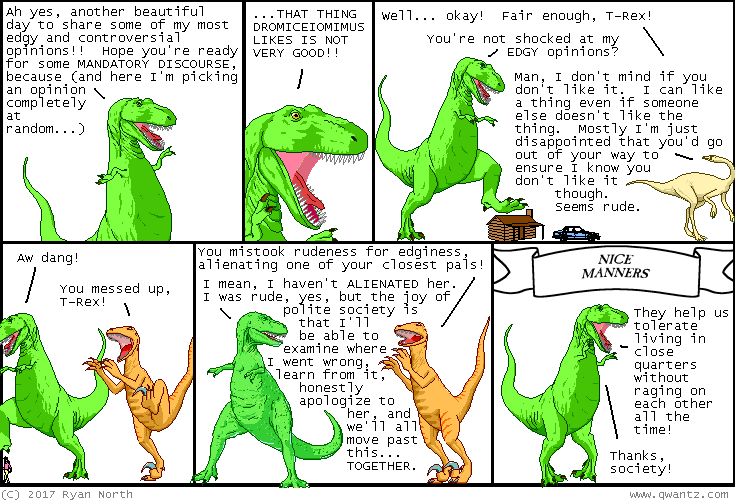
polite af comics
| archive - contact - sexy exciting merchandise - search - about | |||
 |
|||
| ← previous | August 30th, 2017 | next | |
|
August 30th, 2017: I am in Seattle, so sorry if these comics are posting late! In Seattle time, they're actually right on time! Seattle, man. I don't know what to tell you! – Ryan | |||
09 Sep 14:44
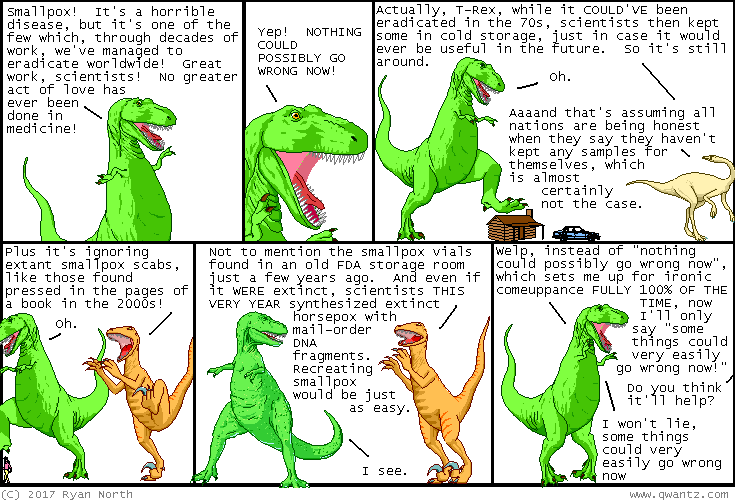
a small pox on both your houses
| archive - contact - sexy exciting merchandise - search - about | |||
 |
|||
| ← previous | September 1st, 2017 | next | |
|
September 1st, 2017: If you're wondering about that horsepox recreation, here you go. We Canadians did it; SORRY EVERYONE I am in Seattle, so sorry if these comics are posting late! In Seattle time, they're actually right on time! Seattle, man. I don't know what to tell you! – Ryan | |||
09 Sep 14:44
in writing this comic i started thinking about the challenges involved in building an airplane for t.rexes, and it is my new obsession
| archive - contact - sexy exciting merchandise - search - about | |||
 |
|||
| ← previous | September 4th, 2017 | next | |
|
September 4th, 2017: Now I'm back in my regular time zone! It's called "Eastern time" but to us it's just "regular time". – Ryan | |||
08 Sep 19:51
Day 6095: British Democracy is a Shambles
by Millennium Dome
Friday:
People think voting systems and constitutions are “boring”.
But it’s our unfair and antique voting system that has got us where we’ve got.
It goes back a long long loooog way.
Maybe to the 2015 election that took Liberal voices out of our politics.
Or to the Coalition years where Hard Labour and Conservatory combined to scupper reform of voting and Lords.
Or to the Coalition agreement when people lost their faith in the Liberal Democrats.
Or to Lord Blairimort.
Or even to the SDP who tried to break the mould but got broken by the voting system instead.
But we’ve got to start somewhere, so let’s start with that Referendum…
[Previously published, yes, I have tried my fluffy foot at an Twitter thread: https://twitter.com/millenniumdome/status/906127927292690433]
The Prime Monster, Mr Balloon, calls referendum on a whim, putting his personal interests and Tory Party internal differences ahead of the country.
Parliament fails to set proper rules on the assurance that it’s “only advisory”.
Shocking bias from media controlled by half-a-dozen billionaire’s who don’t even live in Britain.
Apart from the nepotist-ocracy of the Grauniad of course (how DID Polly “I have no qualifications apart from my relatives and defender of Tory slime” Toynbee get her job?).
Vote Leave campaign outright lies – and they admit it – and get away with it.
https://www.thelondoneconomic.com/news/vote-leave-director-admits-won-lied-public/08/02/
Mr Balloon resigns in a huff. New Prime Monster, Mrs Mayhem, anointed without an election as all other candidates shoot one another (or themselves!) in the back.
Unelected clique of hard-right Brexiteers seize control.
Wafer thin majority for leave is translated into “people voted for…” insert “hardest possible Brexit”, or “stopping immigration” or “an end to rule of law” as appropriate.
Any question raised over Brexit shouted down as “against the will of the people”.
Government tries to snatch control of Article 50 process – has to be told by Supreme Court that Parliament must have a say.
Opposition MPs (no, not including ours) give PM exactly what she wants anyway.
Prime Monster Mayhem repeatedly promises not to call a general election. Calls a general election anyway on a whim.
Opposition MPs (yes, including ours this time) give PM exactly what she wants anyway.
Shocking bias from media controlled by half-a-dozen billionaire’s who don’t even live in Britain.
Apart from the nepotist-ocracy of the Grauniad of course (how DID Owen “former intern for John McDonald and what’s my lifelong opinion this week?” Jones get his job?).
In spite of this, Prime Monster loses election – but carries on squatting in Downing Street.
https://www.theguardian.com/politics/2017/jun/10/the-snap-theresa-may-still-prime-minister-but-for-how-long
Apparently intending to lead the Conservatories to their next election defeat too
http://www.bbc.co.uk/news/av/uk-41100661/theresa-may-to-lead-conservatives-into-next-general-election
Government avoids scrutiny by not appointing standing committees.
As most important negotiation in our post-War history begin… Parliament goes on holiday for two months, leaving David Davis with no scrutiny at all.
Shocking bias from media leads to unaccountable misprint of “homophobic misogynist expelled from Tory Party” rendered as “touted as Tory leader”.
Government returns to introduce Bill to repeal European Communities Act 1974. Uses it to make grab for unprecedented unaccountable power.
Parliament’s own constitution committee says of the Withdrawal Bill that it “raises a series of profound, wide-ranging and inter-locking constitutional concerns”.
http://www.parliament.uk/business/committees/committees-a-z/lords-select/constitution-committee/news-parliament-2017/eu-withdrawal-bill-interim-report/
Worst of all, clause one of the Bill gives power to make “exit day” ““such day as a Minister of the Crown may by regulations appoint.”
https://waitingfortax.com/2017/08/31/what-happens-if-the-talks-break-down/
Effectively cutting Parliament out of scrutiny if David “Brexit Bulldog” Davies fails and walks away from negotiations.
Or if Liam “disgraced former Defence Secretary” Fox gets bored of waiting for having a real job.
Or if Bojo “Punishment Beatings” Johnson is short of a publicity stunt one afternoon.
Government tries to continue avoiding scrutiny by still not appointing standing committees – has to be told to “stop faffing about” by the Speaker of the House.
https://goo.gl/ahrpqP
Government announces that – by a simple motion – “the government will have a majority on standing committees”.
http://www.huffingtonpost.co.uk/entry/theresa-may-rigging-parliament-committee-of-selection-standing-committees_uk_59b1a514e4b0dfaafcf68a04?utm_hp_ref=uk&utm_hp_ref=uk&-ukThe%20Waugh%20Zone%20080917
Open Democracy reports that Tory MPs have diverted tens of thousands of pounds of taxpayer-funded “expenses” to the Hard Brexit “Party-within-a-Party” European Research Group.
https://www.opendemocracy.net/uk/brexitinc/james-cusick-adam-ramsay-crina-boros/revealed-tory-mps-using-taxpayers-cash-to-fund-sec
People think voting systems and constitutions are “boring”.
Our “boring” systems and constitution allow Tories (and Labour) to get away with stealing your democracy.
Democracy in the UK is a shambles.
Post script:
Shambles: historically – butchery. Same as the French word MASSACRE.
People think voting systems and constitutions are “boring”.
But it’s our unfair and antique voting system that has got us where we’ve got.
It goes back a long long loooog way.
Maybe to the 2015 election that took Liberal voices out of our politics.
Or to the Coalition years where Hard Labour and Conservatory combined to scupper reform of voting and Lords.
Or to the Coalition agreement when people lost their faith in the Liberal Democrats.
Or to Lord Blairimort.
Or even to the SDP who tried to break the mould but got broken by the voting system instead.
But we’ve got to start somewhere, so let’s start with that Referendum…
 |
| A Shambles, yesterday |
[Previously published, yes, I have tried my fluffy foot at an Twitter thread: https://twitter.com/millenniumdome/status/906127927292690433]
The Prime Monster, Mr Balloon, calls referendum on a whim, putting his personal interests and Tory Party internal differences ahead of the country.
Parliament fails to set proper rules on the assurance that it’s “only advisory”.
Shocking bias from media controlled by half-a-dozen billionaire’s who don’t even live in Britain.
Apart from the nepotist-ocracy of the Grauniad of course (how DID Polly “I have no qualifications apart from my relatives and defender of Tory slime” Toynbee get her job?).
Vote Leave campaign outright lies – and they admit it – and get away with it.
https://www.thelondoneconomic.com/news/vote-leave-director-admits-won-lied-public/08/02/
Mr Balloon resigns in a huff. New Prime Monster, Mrs Mayhem, anointed without an election as all other candidates shoot one another (or themselves!) in the back.
Unelected clique of hard-right Brexiteers seize control.
Wafer thin majority for leave is translated into “people voted for…” insert “hardest possible Brexit”, or “stopping immigration” or “an end to rule of law” as appropriate.
Any question raised over Brexit shouted down as “against the will of the people”.
Government tries to snatch control of Article 50 process – has to be told by Supreme Court that Parliament must have a say.
Opposition MPs (no, not including ours) give PM exactly what she wants anyway.
Prime Monster Mayhem repeatedly promises not to call a general election. Calls a general election anyway on a whim.
Opposition MPs (yes, including ours this time) give PM exactly what she wants anyway.
Shocking bias from media controlled by half-a-dozen billionaire’s who don’t even live in Britain.
Apart from the nepotist-ocracy of the Grauniad of course (how DID Owen “former intern for John McDonald and what’s my lifelong opinion this week?” Jones get his job?).
In spite of this, Prime Monster loses election – but carries on squatting in Downing Street.
https://www.theguardian.com/politics/2017/jun/10/the-snap-theresa-may-still-prime-minister-but-for-how-long
Apparently intending to lead the Conservatories to their next election defeat too
http://www.bbc.co.uk/news/av/uk-41100661/theresa-may-to-lead-conservatives-into-next-general-election
Government avoids scrutiny by not appointing standing committees.
As most important negotiation in our post-War history begin… Parliament goes on holiday for two months, leaving David Davis with no scrutiny at all.
Shocking bias from media leads to unaccountable misprint of “homophobic misogynist expelled from Tory Party” rendered as “touted as Tory leader”.
Government returns to introduce Bill to repeal European Communities Act 1974. Uses it to make grab for unprecedented unaccountable power.
Parliament’s own constitution committee says of the Withdrawal Bill that it “raises a series of profound, wide-ranging and inter-locking constitutional concerns”.
http://www.parliament.uk/business/committees/committees-a-z/lords-select/constitution-committee/news-parliament-2017/eu-withdrawal-bill-interim-report/
Worst of all, clause one of the Bill gives power to make “exit day” ““such day as a Minister of the Crown may by regulations appoint.”
https://waitingfortax.com/2017/08/31/what-happens-if-the-talks-break-down/
Effectively cutting Parliament out of scrutiny if David “Brexit Bulldog” Davies fails and walks away from negotiations.
Or if Liam “disgraced former Defence Secretary” Fox gets bored of waiting for having a real job.
Or if Bojo “Punishment Beatings” Johnson is short of a publicity stunt one afternoon.
Government tries to continue avoiding scrutiny by still not appointing standing committees – has to be told to “stop faffing about” by the Speaker of the House.
https://goo.gl/ahrpqP
Government announces that – by a simple motion – “the government will have a majority on standing committees”.
http://www.huffingtonpost.co.uk/entry/theresa-may-rigging-parliament-committee-of-selection-standing-committees_uk_59b1a514e4b0dfaafcf68a04?utm_hp_ref=uk&utm_hp_ref=uk&-ukThe%20Waugh%20Zone%20080917
Open Democracy reports that Tory MPs have diverted tens of thousands of pounds of taxpayer-funded “expenses” to the Hard Brexit “Party-within-a-Party” European Research Group.
https://www.opendemocracy.net/uk/brexitinc/james-cusick-adam-ramsay-crina-boros/revealed-tory-mps-using-taxpayers-cash-to-fund-sec
People think voting systems and constitutions are “boring”.
Our “boring” systems and constitution allow Tories (and Labour) to get away with stealing your democracy.
Democracy in the UK is a shambles.
Post script:
Shambles: historically – butchery. Same as the French word MASSACRE.
 |
| A Massacre, yesterday |
07 Sep 21:36


Yes, I’ve Heard About the New South Park Game’s Difficulty Settings
by John Scalzi
Andrew HickeyShared for comment in the thread below: "This must obviously be for white cis dudes. I a Black Woman who likes to have my characters look like me. Why would I want to put up with the same sort of sh*t in an RPG that I put up with irl?"
And yes, the game rather concretely makes the “lowest difficulty setting” point.
Here’s an article about it. And here’s the video showing it in action:
Before anyone asks, no, I had nothing to do with it, and no, I have no idea if the people who made the game read or knew about my article. And also, no, I’m not going to worry about whether or not I get credit for it. Remember that I myself was expanding on a comment writer Luke McKinney made in a Cracked article about straight male sexuality. This stuff gets around.
I am, however, amused to see it in an actual video game. All the dudes who whined about how the metaphor was all wrong will now have to grind their teeth when they set up their characters in this game. And that’s a lovely thought.
01 Sep 21:21
Aside from the EU how REMAIN and LEAVE voters differ on other issues
by Mike Smithson
Some newly released YouGov polling
Was Russia involved in last years US election?

Was Princess Diana ‘s death murder?

The child vaccine debate on whether it causes autism

The full list from YouGov Joe Twyman can be found here.
Mike Smithson


01 Sep 09:09
6.-8. Rounding off 2015
In this post I am reviewing three books which I actually read in 2015. I'm aware of how utterly ludicrous that is; just humour me. It's a thing I feel I need to do.
6. Conrad Russell (1999), An Intelligent Person's Guide to Liberalism
After the 2015 General Election, various Lib Dems shared lists of reading recommendations in the spirit of fuelling a #LibDemFightback. This one seemed the most universally-recommended, so I got it out of the University library and read it. It is indeed a very good articulation of what liberalism is about today (or was at the time of publication), and how it has evolved from its earliest recognisable origins in Whig opposition to James II’s interference in parliamentary autonomy through a series of different issues (religion, economics, personal freedoms, the environment etc.) as UK politics has changed over the centuries. I found the chapter on economics the most interesting and helpful for clarifying my own understanding of liberalism. Broadly, it points out that liberalism does not really have a clear default economic position in the way that (say) socialism does, because it initially evolved in a context where the main dividing lines in politics were not economic ones, but others – primarily religion. But because liberalism is essentially about the redistribution of power from those who are hoarding big chunks of it to those who don’t have any, it isn’t too hard to translate this to economic forms of power, and indeed there are plenty of early examples of liberals siding with the economically-exploited over their exploiters – e.g. Whig involvement in passing laws for the ten-hour working day in the mid-19th century. This in turn opens the door for a vision of liberal economics which is much more about cooperatives, mutuals, trade unions, breaking up monopolies and cartels, encouraging entrepreneurialism and ensuring level playing fields than the laissez faire approach often described as ‘classical liberalism’. I would love that vision to be more deeply embedded and widely understood in the Liberal Democrats today, never mind in wider politics – but unfortunately it is not. Meanwhile, back to the book, its big flaw is that it is unlikely to be at all accessible to anyone not already interested in liberalism and familiar with UK politics. Fair enough, it bills itself as being for the ‘intelligent person’, but that in itself is not very liberal really – hardly in keeping with the Liberal Democrats’ consitutional pledge (adopted verbatim from the Liberals before them) to ensure that no-one is enslaved by ignorance. And, as is often the case with similar riders, ‘intelligent’ is really just a synonym for ‘educated’ or ‘pre-informed’. So Russell will refer in passing to something François Mitterrand said in 1989 (I’m inventing the example, as I no longer have the text in front of me to provide a real one), without actually saying what it was or how it relates to the issue under discussion. A more accessible introduction to liberalism could certainly be written, then, and could do a lot of good by helping to ensure a broader understanding of what it actually is. As my friend Andrew Hickey, who also recently reviewed Russell's book points out, an awful lot of the people who are currently convinced that liberalism is a terrible scourge on society are actually working with a heavily distorted understanding of it, and would probably quite like the sort of thinking which Russell outlines if they knew about it. Attempting to communicate it is, of course, on us liberals, and clearly that is what Russell was trying to do. Until anyone can achieve a more accessible articulation of the same thinking, his book will probably remain the best introduction to liberalism we have.
7. Andrew Hickey (2015), Head of State
Talking of Andrew, he wrote a book of his own, and it's great! It is a novel, technically belonging to the Faction Paradox series, but I can personally attest that you do not need to have read any prior Faction Paradox stories, or really know anything about them, to enjoy it. It helps in particular that the story is very much set on Earth; though I don't know how much that is or isn't true for other FP stories – maybe they all are? Anyway, this one follows a surprise outsider's US presidential election campaign, which is clearly being manipulated by the Faction Paradox in some way, and which relates to traces of their activities also identifiable in the historical and mythic past. In order to tell this story, Andrew has used multiple interweaving narratives: different present-day perspectives on the presidential campaign, Victorian explorer Richard Burton, the 2002nd story of Scheherazade and various interpolations from non-human dimensions. This is not easy, but I thought he did it exceptionally well, capturing the various voices of his different characters distinctly and recognisably without making any of them seem over-mannered or cariacatured. For those reasons alone I enjoyed reading the novel and would recommend it to anyone. But there is of course an extra dimension of pleasure to reading a novel by a friend whose view on the world over-laps closely with your own. I recognised a lot of both the political and the online culture described, for example: in particular a female journalist blogging on a platform called 'dreamjournal', whom Andrew confirmed when I asked him was indeed based on the journalist I thought she was. He is even sweet enough to have included me in his acknowledgements at the end, although literally all I did was lend him a book of commonly-used Latin phrases with which he could pepper Richard Burton's prose. As for that presidential candidate – he's a Bernie Sanders, not a Donald Trump, but an awful lot about the campaign sections of this book did resurface in my mind during the latter part of 2016: high-level corruption and manipulation, people gradually realising that the 'no-hope' candidate is going to win, and a load of right-wing nutjobbery to boot. It's a pity real life has managed to turn out even more horrendous than what happens at the end of this book, but that's another matter. I'm really proud to know the author of such a great read.
8. John Buchan (1927), Witch Wood
I learnt of this book from the British Library's exibition, Terror and Wonder: The Gothic Imagination in autumn 2014, where it was presented as an example of folk horror and likened to Witchfinder General in particular. It's a reasonable comparison. This story deploys the classic folk horror motif of an educated outsider coming into a small, traditional village community: in this case a newly-ordained priest, David Sempill, assigned to a parish named Woodilee. It's also set during the Civil Wars, though in Scotland rather than in England, and involves accusations of witchcraft. After those face-value similarities, though, it's a pretty different kind of narrative: essentially a historical novel concerned with how the ideological conflicts of 17th-century Scotland translate into personal struggles for its main character. On the one side, Sempill owes loyalty to the Kirk and, through its Solemn League and Covenant, the parliamentary side of the Civil War. On the other, he increasingly finds that his efforts to help the sick and the needy put him at odds with his parish leaders and church elders, who are more concerned with personal reputation and formal doctrine than actual morals or spirituality, and that his sympathies are drawn instead towards royalists and aristocrats. Witches and indeed fairies are overlain onto this, in ways which allow Buchan to highlight the hypocrisies of the parishioners and tangle up Sempill's political leanings with romantic attraction. But there is nothing overtly supernatural in the book: only a bit of paganism-cum-Devil-worshippery and Sempill's hyper-romanticisation of his girlfriend. Most of the politics and religion I could take or leave to be honest, not having any great investment in either, but the novel does contain some very engrossing sequences: Sempill's terror journeying through the dark wood at night, the utter devastation of his village by the plague, or the tormenting of an obviously-vulnerable old woman by a witch-pricker. Those are what have stayed with me, and what made it worth reading.
6. Conrad Russell (1999), An Intelligent Person's Guide to Liberalism
After the 2015 General Election, various Lib Dems shared lists of reading recommendations in the spirit of fuelling a #LibDemFightback. This one seemed the most universally-recommended, so I got it out of the University library and read it. It is indeed a very good articulation of what liberalism is about today (or was at the time of publication), and how it has evolved from its earliest recognisable origins in Whig opposition to James II’s interference in parliamentary autonomy through a series of different issues (religion, economics, personal freedoms, the environment etc.) as UK politics has changed over the centuries. I found the chapter on economics the most interesting and helpful for clarifying my own understanding of liberalism. Broadly, it points out that liberalism does not really have a clear default economic position in the way that (say) socialism does, because it initially evolved in a context where the main dividing lines in politics were not economic ones, but others – primarily religion. But because liberalism is essentially about the redistribution of power from those who are hoarding big chunks of it to those who don’t have any, it isn’t too hard to translate this to economic forms of power, and indeed there are plenty of early examples of liberals siding with the economically-exploited over their exploiters – e.g. Whig involvement in passing laws for the ten-hour working day in the mid-19th century. This in turn opens the door for a vision of liberal economics which is much more about cooperatives, mutuals, trade unions, breaking up monopolies and cartels, encouraging entrepreneurialism and ensuring level playing fields than the laissez faire approach often described as ‘classical liberalism’. I would love that vision to be more deeply embedded and widely understood in the Liberal Democrats today, never mind in wider politics – but unfortunately it is not. Meanwhile, back to the book, its big flaw is that it is unlikely to be at all accessible to anyone not already interested in liberalism and familiar with UK politics. Fair enough, it bills itself as being for the ‘intelligent person’, but that in itself is not very liberal really – hardly in keeping with the Liberal Democrats’ consitutional pledge (adopted verbatim from the Liberals before them) to ensure that no-one is enslaved by ignorance. And, as is often the case with similar riders, ‘intelligent’ is really just a synonym for ‘educated’ or ‘pre-informed’. So Russell will refer in passing to something François Mitterrand said in 1989 (I’m inventing the example, as I no longer have the text in front of me to provide a real one), without actually saying what it was or how it relates to the issue under discussion. A more accessible introduction to liberalism could certainly be written, then, and could do a lot of good by helping to ensure a broader understanding of what it actually is. As my friend Andrew Hickey, who also recently reviewed Russell's book points out, an awful lot of the people who are currently convinced that liberalism is a terrible scourge on society are actually working with a heavily distorted understanding of it, and would probably quite like the sort of thinking which Russell outlines if they knew about it. Attempting to communicate it is, of course, on us liberals, and clearly that is what Russell was trying to do. Until anyone can achieve a more accessible articulation of the same thinking, his book will probably remain the best introduction to liberalism we have.
7. Andrew Hickey (2015), Head of State
Talking of Andrew, he wrote a book of his own, and it's great! It is a novel, technically belonging to the Faction Paradox series, but I can personally attest that you do not need to have read any prior Faction Paradox stories, or really know anything about them, to enjoy it. It helps in particular that the story is very much set on Earth; though I don't know how much that is or isn't true for other FP stories – maybe they all are? Anyway, this one follows a surprise outsider's US presidential election campaign, which is clearly being manipulated by the Faction Paradox in some way, and which relates to traces of their activities also identifiable in the historical and mythic past. In order to tell this story, Andrew has used multiple interweaving narratives: different present-day perspectives on the presidential campaign, Victorian explorer Richard Burton, the 2002nd story of Scheherazade and various interpolations from non-human dimensions. This is not easy, but I thought he did it exceptionally well, capturing the various voices of his different characters distinctly and recognisably without making any of them seem over-mannered or cariacatured. For those reasons alone I enjoyed reading the novel and would recommend it to anyone. But there is of course an extra dimension of pleasure to reading a novel by a friend whose view on the world over-laps closely with your own. I recognised a lot of both the political and the online culture described, for example: in particular a female journalist blogging on a platform called 'dreamjournal', whom Andrew confirmed when I asked him was indeed based on the journalist I thought she was. He is even sweet enough to have included me in his acknowledgements at the end, although literally all I did was lend him a book of commonly-used Latin phrases with which he could pepper Richard Burton's prose. As for that presidential candidate – he's a Bernie Sanders, not a Donald Trump, but an awful lot about the campaign sections of this book did resurface in my mind during the latter part of 2016: high-level corruption and manipulation, people gradually realising that the 'no-hope' candidate is going to win, and a load of right-wing nutjobbery to boot. It's a pity real life has managed to turn out even more horrendous than what happens at the end of this book, but that's another matter. I'm really proud to know the author of such a great read.
8. John Buchan (1927), Witch Wood
I learnt of this book from the British Library's exibition, Terror and Wonder: The Gothic Imagination in autumn 2014, where it was presented as an example of folk horror and likened to Witchfinder General in particular. It's a reasonable comparison. This story deploys the classic folk horror motif of an educated outsider coming into a small, traditional village community: in this case a newly-ordained priest, David Sempill, assigned to a parish named Woodilee. It's also set during the Civil Wars, though in Scotland rather than in England, and involves accusations of witchcraft. After those face-value similarities, though, it's a pretty different kind of narrative: essentially a historical novel concerned with how the ideological conflicts of 17th-century Scotland translate into personal struggles for its main character. On the one side, Sempill owes loyalty to the Kirk and, through its Solemn League and Covenant, the parliamentary side of the Civil War. On the other, he increasingly finds that his efforts to help the sick and the needy put him at odds with his parish leaders and church elders, who are more concerned with personal reputation and formal doctrine than actual morals or spirituality, and that his sympathies are drawn instead towards royalists and aristocrats. Witches and indeed fairies are overlain onto this, in ways which allow Buchan to highlight the hypocrisies of the parishioners and tangle up Sempill's political leanings with romantic attraction. But there is nothing overtly supernatural in the book: only a bit of paganism-cum-Devil-worshippery and Sempill's hyper-romanticisation of his girlfriend. Most of the politics and religion I could take or leave to be honest, not having any great investment in either, but the novel does contain some very engrossing sequences: Sempill's terror journeying through the dark wood at night, the utter devastation of his village by the plague, or the tormenting of an obviously-vulnerable old woman by a witch-pricker. Those are what have stayed with me, and what made it worth reading.
31 Aug 19:30
Against high CEO pay
by chris
Imagine we lived in a feudal society in which lords exploited peasants. A defender of the system might argue that wealthy lords perform a useful service; they protect their peasants from invasion and theft thus giving them security and a little prosperity. And competition between lords should improve these services; bad lords will find their lands and peasants seized by better lords who become wealthier as a result.
Such an argument would, however, miss the point. The case against feudalism is that the system as a whole is unjust and inefficient. The fact that good lords provide services and are richer than bad ones is quite compatible with this.
This analogy came to mind whilst reading Ben Ramanauskas’s defence of high CEO pay. The fact that good CEOs make a positive difference to a company does not in itself justify a system in which CEOs in aggregate – many of whom are far from good – get fortunes.
Two big facts suggest that such a system might well be inefficient.
One comes from Rene Stulz and Kathleen Kahle. They point out that there are now fewer stock market-listed companies than there were years ago, and most are less profitable than they were. This alerts us to the possibility that agency failures – the inability of shareholders to oversee managers – are damaging.
The second, bigger, fact is that as CEO pay has risen, productivity growth has fallen. This is consistent with the possibility that increased inequality between bosses and workers is inefficient (pdf). We have many theories as to why this might be. Inequality reduces trust, which is necessary for growth. High pay crowds out intrinsic motivations (pdf) and causes managers to focus (pdf) upon things that are monitorable (such as short-term earnings) rather than ones that are not, such as longer-term investments and innovations. Hierarchical systems lead to bad decisions because bosses lack complete information, and can demotivate junior staff. And high CEO pay encourages juniors to engage in office politics to seek promotion, and incentivize managers to strengthen their position by discouraging disruptive innovation and entrenching monopoly power.
But what of the argument that competition eventually eliminates bad bosses? True, it does sometimes; the relatively egalitarian John Lewis Partnership has done better than department stores such as House of Fraser or Debenhams, for example. But market forces are weak (and perhaps getting weaker).
One reason for this is simply state intervention; without this, almost all shareholder-owned banks with their high-paid CEOs would have vanished.
Another reason is that there isn’t really a properly-functioning market for CEOs. I own tens of thousands of pounds of shares, but I’ve never been asked to vote on a CEO’s pay. Instead, the vote is exercised by fund managers many of whom are more bothered by the relative performance of their funds than absolute performance. We have widespread agency failures in which mates pay each other. And as Milton Friedman said:
If I spend somebody else’s money on somebody else, I’m not concerned about how much it is, and I’m not concerned about what I get.
Unsurprisingly, then, there is little clear link between CEO pay (pdf) and corporate performance. It might be that high pay is better explained by rent-seeking than as a reward for maximizing shareholder value - though as it's almost impossible to know in most cases what constitutes maximal value, we might never know for sure.
In fact, my analogy with feudal lords is too generous to CEOs. Whereas (arguendo) a bad lord would pay for his incompetence perhaps with his life, bad CEOs walk away with fat pay cheques.
When so-called free marketeers try to defend bosses’ pay, they do the cause of free markets a huge dis-service by encouraging people to equate free markets with what is in effect a rigged system whereby bosses enrich themselves with no obvious benefit to the rest of us.
30 Aug 12:20
We're going to talk about a justification parents give today for basically every awful and questionable thing they do to their child, and to those around their child:
"No one will be here for my child when I die."
That is not an unfounded fear. You're probably right. No one will. Or very few people will.
Now you're going to get uncomfortable folks. We're going to talk about why that is. Spoiler: it's largely your fault. You engage every day in actions and attitudes and behaviors that are going to fuck over your child years down the line.
Let's start with the ButtServices!!! argument. Y'all say and do all sorts of things, many of them cruel, and blame your lack of services. You fight for services "for families". Ultimately, the fight is constantly for services that benefit the parent, that make their lives easier. Don't look at me like that. You're the ones saying that you don't get services or that families need more services. You are the ones centering yourselves in the fight for services.
So what that means is? Your child turns 18 or 21 and no longer has services! Because they were all about you! This whole time they were all about you! Adults are well and truly fucked in the developmental disability system because everything is geared at making the lives of the Real People around us easier. Disabled adults don't get much at all. Too much is parent centered. There are agencies that allegedly provide services through the lifespan that will only interface with parents. It's true!
So that's a thing to be proud of I guess. You've built a self fulfilling prophecy where services are concerned. Your child won't be able to access them without you, you're absolutely right, because that's how you & your cohort want it. That's how you fight for it. You don't get to tell me that's not what you want until you start fighting for disabled people, not "families touched by disability", to get services.
I'm not holding my breath on that one. I can't get most of you to understand that we grow up.
(A moment here for a shoutout for those of you who sincerely told me that we're all someone's child with autism & our parents always fight for us. And by shoutout I mean 'fuck you'. My parents never fought for me. They fought with me. Physically. To injury. So fuck you again!)
Then there's how you take the responsibility of modeling how people should interact with your child when they are an adult. People who aren't autistic and don't have autistic family members (and can't conceive of having autistic friends) are looking at you, yes you, for how to treat your child when they grow up.
They're looking at how you treat us, adults who are currently autistic.
Think real hard about how you treat autistic adults. Really hard. I've gotten death threats from parents. This isn't uncommon. Many of us get missives telling us explicitly to kill ourselves, again from parents. When we tell you about this, you go on to lecture us about 'judging you' (I'm getting back to this in a few paragraphs) and ignore that your cohort, yes yours, they are in fact your responsibility, treat us this way.
Y'all can claim to love your kid all day long but if this is how you want them to be treated, I question that claim. If this is not how you want them to be treated, why the blazing fuck do you treat us that way?
Out of one corner of the mouth "How dare you distrust me because of what your parents are like" and out of the other "here, let's see if I can break you in ways your parents didn't get to before you left". That's y'all.
Precious few neurotypical people are going to be there for your kid because not only did you center yourself in services, but also you demonstrated that you want Real People (TM) to treat your child like utter shit. "Do as I say not as I do" isn't a solid teaching strategy and you don't even bother to pretend you don't want us constantly abused by you and yours.
Then there's us. Autistic people. Autistic people provide most of the day to day support for other Autistic people, since as already discussed no one else does it. Services are for parents, and our parents make it very clear that we can be scraped off the bottom of your shoe and discarded.
We try to talk to you. You see, we're largely pretty fucked up. We don't have to be fucked up. But we are, between the compliance training and the bullying and the decades of misunderstanding. We want better for your children, & we see you making the same errors. Maybe you aren't making an error on purpose?
"HOW DARE YOU JUDGE ME"
Ok maybe you are making that error on purpose. See, that's a very you-centered perspective to take. (I have another post percolating on judging, since the high horse of nonjudgement has led to y'all being complacent in multiple murders, but since autism is all about you it's clear that isn't your priority).
We try to help you. We try and try. You send us missives encouraging us to kill ourselves. You threaten me in truly creative ways. Imagine if you spent half that creative energy on figuring out how to not treat people like shit! But I digress.
We try and try, but we are not impervious to your abuse. We want nothing to do with you. Our circles don't overlap. You scare off, beat off, torment off every autistic person and autistic friendly person in your orbit, until when you die your child is surrounded by people who hate them.
You're right! No one will be there for your child! You've isolated them from their subculture, you've taught every neurotypical to treat them like shit because that's what autistic adults are for, and you've made sure all services are accessible only by you, not by your child.
So you're not wrong in the words but you are wrong in every thing that matters. Only you can fix this, you've made very certain no one gives a shit what autistic adults say.
But that would involve decentering yourself, & you'd probably rather whine about your child's future than actually allow them to have one.
"No one will be here for my child when I die"...well why is that?
by Neurodivergent K
If you want to lecture me on notallparents this is not the time or place. Yes, every parent who was sending my friend unsolicited PMs that were really vile. Yes, every parent who knew about that but elected to yell at autistic people instead. Yes, every parent who is friends with parents who behave these ways. Yes, every parent who buys into these ideas. If you feel attacked that's a you problem, for you to solve. Taking out your bad feels on me proves my point better than any words I can use do. So don't live down to expectations, just this once.
We're going to talk about a justification parents give today for basically every awful and questionable thing they do to their child, and to those around their child:
"No one will be here for my child when I die."
That is not an unfounded fear. You're probably right. No one will. Or very few people will.
Now you're going to get uncomfortable folks. We're going to talk about why that is. Spoiler: it's largely your fault. You engage every day in actions and attitudes and behaviors that are going to fuck over your child years down the line.
Let's start with the ButtServices!!! argument. Y'all say and do all sorts of things, many of them cruel, and blame your lack of services. You fight for services "for families". Ultimately, the fight is constantly for services that benefit the parent, that make their lives easier. Don't look at me like that. You're the ones saying that you don't get services or that families need more services. You are the ones centering yourselves in the fight for services.
So what that means is? Your child turns 18 or 21 and no longer has services! Because they were all about you! This whole time they were all about you! Adults are well and truly fucked in the developmental disability system because everything is geared at making the lives of the Real People around us easier. Disabled adults don't get much at all. Too much is parent centered. There are agencies that allegedly provide services through the lifespan that will only interface with parents. It's true!
So that's a thing to be proud of I guess. You've built a self fulfilling prophecy where services are concerned. Your child won't be able to access them without you, you're absolutely right, because that's how you & your cohort want it. That's how you fight for it. You don't get to tell me that's not what you want until you start fighting for disabled people, not "families touched by disability", to get services.
I'm not holding my breath on that one. I can't get most of you to understand that we grow up.
(A moment here for a shoutout for those of you who sincerely told me that we're all someone's child with autism & our parents always fight for us. And by shoutout I mean 'fuck you'. My parents never fought for me. They fought with me. Physically. To injury. So fuck you again!)
Then there's how you take the responsibility of modeling how people should interact with your child when they are an adult. People who aren't autistic and don't have autistic family members (and can't conceive of having autistic friends) are looking at you, yes you, for how to treat your child when they grow up.
They're looking at how you treat us, adults who are currently autistic.
Think real hard about how you treat autistic adults. Really hard. I've gotten death threats from parents. This isn't uncommon. Many of us get missives telling us explicitly to kill ourselves, again from parents. When we tell you about this, you go on to lecture us about 'judging you' (I'm getting back to this in a few paragraphs) and ignore that your cohort, yes yours, they are in fact your responsibility, treat us this way.
Y'all can claim to love your kid all day long but if this is how you want them to be treated, I question that claim. If this is not how you want them to be treated, why the blazing fuck do you treat us that way?
Out of one corner of the mouth "How dare you distrust me because of what your parents are like" and out of the other "here, let's see if I can break you in ways your parents didn't get to before you left". That's y'all.
Precious few neurotypical people are going to be there for your kid because not only did you center yourself in services, but also you demonstrated that you want Real People (TM) to treat your child like utter shit. "Do as I say not as I do" isn't a solid teaching strategy and you don't even bother to pretend you don't want us constantly abused by you and yours.
Then there's us. Autistic people. Autistic people provide most of the day to day support for other Autistic people, since as already discussed no one else does it. Services are for parents, and our parents make it very clear that we can be scraped off the bottom of your shoe and discarded.
We try to talk to you. You see, we're largely pretty fucked up. We don't have to be fucked up. But we are, between the compliance training and the bullying and the decades of misunderstanding. We want better for your children, & we see you making the same errors. Maybe you aren't making an error on purpose?
"HOW DARE YOU JUDGE ME"
Ok maybe you are making that error on purpose. See, that's a very you-centered perspective to take. (I have another post percolating on judging, since the high horse of nonjudgement has led to y'all being complacent in multiple murders, but since autism is all about you it's clear that isn't your priority).
We try to help you. We try and try. You send us missives encouraging us to kill ourselves. You threaten me in truly creative ways. Imagine if you spent half that creative energy on figuring out how to not treat people like shit! But I digress.
We try and try, but we are not impervious to your abuse. We want nothing to do with you. Our circles don't overlap. You scare off, beat off, torment off every autistic person and autistic friendly person in your orbit, until when you die your child is surrounded by people who hate them.
You're right! No one will be there for your child! You've isolated them from their subculture, you've taught every neurotypical to treat them like shit because that's what autistic adults are for, and you've made sure all services are accessible only by you, not by your child.
So you're not wrong in the words but you are wrong in every thing that matters. Only you can fix this, you've made very certain no one gives a shit what autistic adults say.
But that would involve decentering yourself, & you'd probably rather whine about your child's future than actually allow them to have one.
28 Aug 09:54
Kirby at 100
by evanier

If he were still with us, Jack Kirby would have been one hundred years old today…but of course, an awful lot of Jack is still with us. Hundreds of characters he created or co-created are still appearing, many of them in hit movies that have made them more famous than ever. Back in the sixties, Jack predicted that there would someday be highly-successful, big budget motion pictures of Thor, Captain America, et al. He told me that when I first met him in 1969.
One of the reasons he never got his financial due out of Marvel was that the folks who ran Marvel back then never believed that. They had a limited idea of how much anything in Marvel Comics could ever be worth and didn't want to share those meager amounts with anyone. It was pretty simple math: The less they paid Jack and all the other folks who created their comics, the more they got to keep for themselves. When he told them what he saw as the potential value of the Fantastic Four, the X-Men and the rest, they nodded politely, refused him five-dollar raises and joked behind his back that he was out of his friggin' mind. And later, they sold the company for beads 'n' trinkets because they lacked the one thing Jack had by the tonweight: Imagination.
Jack's spirit and influence are also evident in 2017 in projects featuring characters and properties he never touched directly — and not just comic books. I see Kirby in movies and TV shows and advertising and videogames and animations and toy design and even in fine art. Anywhere someone makes a visual statement, you're likely to find at least some talent influenced — directly or indirectly — by Jack Kirby.

It is important to understand that when we, his fans and admirers, speak of the talent of Jack Kirby, we are not just speaking of the drawing. The drawing was great. The drawing was wonderful. We would be celebrating this man today just for the drawing. But the drawing was a function and a means of expression for Jack Kirby the Visionary — a man who dealt in concepts and creations and stories, and who always thought in bigger pictures than anything he could put down on a comic book page.
Jack was all about the story and the idea…and more importantly, the next story and the next idea. That was a key reason that so much of what appeared in Marvel comics of the sixties could later spin-off or be expanded upon. Someone else working on Fantastic Four might have come up with a new villain good for one issue and maybe a few repeat appearances down the line. With Jack, you got characters who could be brought back again and again and even stand on their own. That's why there is now an Inhumans TV series. That's why there have been Silver Surfer films and comics. Even his weakest ideas were worth building upon.
It was that way with the comics Jack wrote on his own. It was that way with the comics where Jack had a collaborator, even a collaborator who got sole writer credit. Kirby almost never drew what someone else told him to draw, nor did most of them even want him to. He almost always controlled how the story was told — what happened in each panel and on each page. That, some people do not seem to grasp, is writing. Devising or even just contributing to the plot is also writing.

He almost always added in new characters, new supporting players, new ideas. Two or three times when my then-partner Steve Sherman and I worked with him, he'd assign us to plot out some sequence in one of his comics. We'd sweat over the material and hand it in, and Jack would always tell us we'd done a great, fantastic, fine job…
…and then he'd use almost none of it — and by "almost none," I'm probably overstating how much he did use.
I felt at first like we'd failed but I came to understand that was just the way Jack worked and he could no more stop doing that than he could have started drawing left-handed. He didn't follow others' scripts and plots slavishly or sometimes at all. He didn't even follow his own stories. He'd tell me and/or Steve the plot of the next New Gods or Forever People he was slated to write and draw. It would be a brilliant tale and we would make our major contribution by saying something like, "That sounds terrific, Jack" and then we'd go home, which was our second most-important contribution.
Then the next week, we'd go back out to his home and read, right off the original art, what he'd written and drawn. On those pages might well be very little of the plot he'd told us not seven days before, the plot he'd started drawing as soon as we left. I'd say, "Uh, Jack, what happened to that story you told us last week?" and he'd be absolutely unaware of any shift.
As a professional writer of 48 years now — to some extent, due to this man — I understand that sometimes you sit down to write one thing and for good or ill, wind up writing something else…and sometimes, you really don't know how you got from there to here. With Jack, he always knew where he was going but he had the kind of brain that could find a dozen ways to get there. And of course, sometimes if you take alternate routes, they lead you to alternate destinations.
In the last year or two, as a result of a legal action — and also, I'm told, some folks at Disney who felt it was right — the credits on most of the properties Kirby launched with Stan Lee began to read "Created by Stan Lee and Jack Kirby." During his lifetime, this was something Jack only saw when someone at Marvel wasn't paying attention and the truth accidentally got through. Now, it is contractually guaranteed and everything Disney has put out to honor Jack has made it clear that this is not merely a way of saying Jack drew up Stan's ideas. Those comics were co-creations in every sense.

Fans can and will probably forever argue that a given comic was 70% one guy and 30% the other, or insist one particular character was mostly Stan or mostly Jack. Having worked myself in collaborations where the participants could sometimes not honestly separate who'd contributed what, I have a limited enthusiasm for those debates. I also have my own theories on what each contributed and I expound on them in the big, exhaustive bio of Jack that I hope to finish soon. (Hint: I believe that when Stan says "I wrote that comic" and Jack said, "I wrote that comic," those two men are not using the same definition of the word "write" but they both made significant contributions.)
The important thing is that Jack has been fully recognized as co-creator in time for his Centennial. I can't tell you how happy that makes me. He was a dear man…kind and generous. They may have called him "The King" but if you approached him, he was just a guy named Jack who was glad to talk to you about almost anything, including your work and your projects and your career. Just being around him made you feel smarter and more creative.
He inspired those he met and those he didn't. It was better if you did meet him but from afar and even since he passed in '94, many, many people have been motivated to write and/or draw, not necessarily in the same style and not necessarily in the same media. There are prose authors who've told me they were inspired by Jack, sculptors who've told me they were inspired by Jack, musicians who've told me they were inspired by Jack…I once even had a spot welder tell me he was inspired by Jack. I'm not sure I fully understood that last one but it had something to do with the maximum effort on every Kirby page motivating the spot welder to put maximum effort into every weld. Or something.

The photo above is of me sitting next to Jack at, I believe, a 1971 comic convention at the Disneyland Hotel. If it wasn't shot there, it was at some other con close to that date. I was 19 that year and well aware of the singular honor and boon of Jack Kirby — a man who needed no assistants — taking me on as one. With each passing year since, I increase my estimate of what that opportunity was worth. To just be around that man and his mind was/is a still-expanding privilege.
But I'll tell you: Though you can't sit with the man and hear his stories and his insights, you can get a helluva lot of them in the work he left us, particularly the stories he wrote, drew and edited in the seventies. Most of them are in print…and for the ones that aren't, just wait a year or two and they'll be back. They have an amazing staying power and a unique relevance to the world today. They're so rich that every time I read them, I see things that weren't there on previous readings. I get things that weren't there on previous readings.
And I pause and think, "Wow. He died in 1994 and I'm still learning from that man." Happy Jack Kirby Day, everyone. We were sure lucky to have him.
The post Kirby at 100 appeared first on News From ME.
27 Aug 20:30
free-form thoughts on john coltrane and how NOT to remember or talk about him next time, maybe
by pˆnk s lord sükråt cunctør
so a friend and i went to see the john scheinfeld coltrane doc at the the ica a couple of weeks back: that’s one JC-stan and one JC-sceptic…
… and we both agreed it’s bad and here’s why
 it does the usual documentary thing, of hunting out a bunch of talking heads — family, professional, the commentatative pundit — and then merely stitching them together with stills and live footage into the same version of the story we always already know… anything odd or interesting that pops out of someone’s mouth is not returned to or dwelt on or even apparently noticed
the shape it offers is utterly conventional: beginning times (where from, where first played); times with miles (interrupted by drugs); GIANT STEPS; break-up of marriage; A LOVE SUPREME; final tour of japan and sad early death
these mounting avant-garde milestones are all routinely invoked, but really no attempt is made to say what made them milestones — nearly a dozen musicians are presenting yabbing away, but nearly none of them say anything whatever about the changing content of the music, his technique, his approach, what was concretely at stake in the choices being made, on-stage or in the studio. there was no glimpse AT ALL abt what it is that JC actually did, that was new to and impressed other musicians — or bothered them. wayne shorter for example, a shrewd and highly intelligent man (as well as player), is on-screen for a little. I interviewed him once and got him to talk abt the effect the arrival of the beatles had on the scene in c.1964: he was funny and interesting abt how much they divided jazzers, how some pricked their ears up and others just said “more nonsense from whitey”. we know that jazz in the early 60s wasn’t a collegiate love-in, anything but… but JC has undergone retrospective MLK-ification, and the fights and fears are forgotten in the haze of blissed-in pro forma sanctification
 (i’m not really dissing shorter, sonny rollins, mccoy tyner, benny golson or jimmy heath here — the latter two, as perhaps not-stellar-musicians who were JC’s friends and colleagues in the early days, did give good backstage anecdote, even if mainly abt the junk-ambience everyone was battling with, and the first three were either asked dull questions or — as likely? — had their interesting answers consigned to the cutting-room floor)
(here’s who I am somewhat dissing however: carlos santana, wynton marsalis, cornel west, BILL fkn CLINTON)
(tho west clearly knows little abt music in the sense I’m thinking abt, and somewhat gave that away in a performance of twinkly down-with-the-streets bullshitting that was at least somewhat signalling that he knew this doc was trash and was playing along, for you to spot and the director not to)
(and santana and also john densmore were at least talking as fans responding to something on the way to their own music and sensibility: the former a notorious spiritual-hat guitarwank bore after his early records, the latter apparently a massive elvin jones nut as a teen)
 (cue for santana, the claim — do I believe this, I am not sure — that when he’s on tour he “purifies” every hotel room by burning incense and playing the whole of a love supreme) (cue for densmore lots of stills of JIM MORRISON, surely coltrane’s purest equivalent in the rock universe)
(also there were some historian-biographers and some embarrassed-seeming family members, who obviously love their dad but feel somewhat squinky abt this tin-eared project — their dad who I am happy to continue to believe was an unusually lovely and generous man, especially for a working musician) (scope for an ingenious approach: present JC as the anti-miles, and deal w/their journeys in compare-contrast parallel)
so yes, i was hoping at least to learn something or see or hear something that that wd help inch me in a little past my long-term JC-sceptic status: I get that people adore him and that he is considered important, but this very highly important contribution that none of us can put into words bores me, I find his tone entirely unappealing, and ditto the fetishisation of granite-hard everests of effort in the journey, like some kind of saxophonic rich piana. PEOPLE ONLY EVER TALK LIKE THIS ABOUT HIM — or if they don’t, they either weren’t selected for this doc or the relevant passages ending up unused
and I have no yen to push back on ppl’s veneration (much), but NOBODY TALKS ABOUT HIM WELL and I wish that could change: huckster-pundits clinton west and WYNTON FKN MARSALIS worst offenders in this respect. until the peerlessly maddening moment — my friend and and I p much turned to each other and shouted #SMDH — when EINSTEIN no less was wheeled out to explain and explore what GENIUS is, what it does and and how it work, completely with equations and everything floating past in the edit-collage.
of course they didn’t actually deploy the equations in any coherent or speculative or provocatising way, but they DID display them. the publisher’s motto is: every equation included in a popular science-writing book halves the readership…
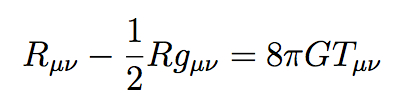 well, here we do get THIS —->> but nothing abt chords or scales or what gitler meant by “sheets of sound” or the west african sound of JC’s soprano in “naima”, the various things (political, “spiritual”) that the search for FREE actually meant to ppl. to coltrane or to anyone else…
(minor side issue: has relativity special or general even been used intelligibly to illuminate music? I think likely NO: i’d kind of love to see it pulled off somewhere, if only in the form of trolling, but — as an actual semi-credentialed mathematician w/a degree and everything, this was just halfwit piffle)
 in general — and the einstein moment entirely fits here — the interstitial work was just lazy garbage. it was an era of strong photography, so it could hardly help looking OK from the stills angle, despite very few pictures you hadn’t seen 30 times before (and every photo was panned and zoomed in the same dull way): some of the live footage was genuinely new (at least to me; tho I very much doubt to an actual hard-seeking fan). it rested a lot too on some (I thought) quite bad mystical afro-futurist art as the backdrop point of rest. whenever they recreated a newspaper splash w/headline and photo, if you looked carefully you could see that the paragraphs of text too small to read were ALL just lorem ipsum fkn dolor, which wtf you half-measures cheapskates (obviously the recent TSwift hommage to same was witty and cheeky in comparison)
(scope for a second ingenious approach: shape the whole thing round lorem ipsum dolor, and the idea that the blow-the-top-of-yr-head-off playing is designed — lol like metal lachine music — to reach a plateau of buzzing calm… )
and a final bad decision: denzel washington reading as coltrane’s actual voice, which just took away any quirky sense of the man himself and replaced it with humbug hollywood gravitas
(tbf this^^^ is a super-toucg ask for any actor I think: but I’d almost have preferred — since we’re anyway in wynton-propinquity — something more outrageously ken burnsy as a v/o. something that gave a sense of past times and lost sensibilities: a courteous gentlemanly black north carolinan at sea in the turbulent city) (one of the takeaways from the stream of stills is how melancholy and also how gawky he often looked; his ungainly country-boy goofiness: he was no dapper hipster, quite the opposite)
so the move ppl use to dodge talking abt the music is donning the spiritual hat by proxy: and then — having invoked spirituality — say nothing whatever about it, what it means, how coltrane deployed it (as mask, as weapon, as balm, as what the fuck ever). closest to achieving actual concrete comment is sonny rollins, gnomic as ever and resplendent in an amazing crimson suit: for a start he substitutes the word “celestial” for the word “spiritual”, and does so in a context that implies the JC’s self-constructed pan-faith religiosity was a way to step away — away away far far away — from planet earth’s grief and crimes and conflict, and explore how to see and sketch and perhaps fashion shared samenesses among the belief-systems and cultural sonics of the many warring clans. “the big picture,” rollins calls it, simply and directly enough: and of course the doc sweeps past this and makes no connections, and hints at no sense that they just heard what they heard…
 of course the word celestial (as slyboots rollins well knows) takes us to the jazz einstein who could (IMO) crack open all these issues, but we sweep past him entirely: this would be sun ra, whose chief sideman john gilmore is said to have inspired JC to exclaim “he’s got it! John’s got the concept!” ra is dead and so is gilmore, but marshall allen is (at time of posting) still alive and well and active!! why not get him in front of the camera? this film is after all clumsily named for a piece inspired by gilmore’s sound. “space music is an introductory prelude to the sound of greater infinity,” says ra. “it is a order of sounds synchronised to the different order of being”
yes this is opaque and riddling — hallo and welcome to the heliocentric worlds! — but ra’s sense of vaster hierarchies or orders and layered geometries as a recalibration of mere mundane perspective is at least a well enough trod approach to see coltrane’s journey somewhat from a side elevation: and ra’s bleak pessimism is also a help I think. instead of the somewhat numbing glad-hand positivity of (allegedly) achieved lovely oneness — which is what I’m most allergic to in the backward-looking coltrane discourse — there’s SR’s often-stated belief that the human race haven’t got the concept and won’t get it and it’s already after the end of the world, brother. i don’t believe JC believed this — or anyway couldn’t bear to concede it to himself — and all of his sound is a FIGHT against it, on the exact same battle, and a fight (I assume) against the elements in himself which were drawn to ra’s scornful (and invigorating) anti-humanism.
 instead of course we get wynton, riding the reverence trane with total chutzpah, given his known views on free: and — despite his endless ability to grab up his horn and demonstrate the rhythms of a king oliver joint — again saying nothing (good OR bad) abt the musical choices trane was making [EDIT: no, he says that the earliest recording of trane’s playing, from the late 40s, while he was still in the army i think, demonstrates he couldn’t really play yet — but we’re just supposed to be able to hear why they’re saying so, nobody stops to say “this bit is why it’s bad”]. It somewhat occurred to me to wonder whether his condition of involvement was the non-discussion of ra (who his mentor stanley crouch has dismissed as a pure charlatan). at least — speaking of charlatans, or anyway trickster-figures enjoying playing them on TV — cornel west has the grace to say of ASCENSION that he has no idea what the fuck is going on, but he’s happy to be long for the ride bcz no doubt one day he will (in other words, I’m kinda glad someone voice this sentiment and that it was someone embracing it not denouncing it) (I might as well say here that west is someone I’m super-ambivalent about, as observer and as troll)
(plus I quite like imagining how grumpy CW probably was at the screening to find himself alongside fellow huckster-pundit clinton, doing his own — different but equal — version of a similar hustle for would-be-woke but unwakaeble northern urban whitey)
so anyway it ends in a crazily aggravating place which (A) exactly — if timidly — approaches the pan-cultural sense of mourning and bearing witness, JC in japan on his final tour, visiting the temples at hiroshima and so on: and hunting for a celestial language that translates the feels and the meaning of this for him to lie interweaved with every other mode cultural expression, and then (B) inflects the entire story through the self-regarding narrative of an insane japanese collector-fan who lives in a room that’s a cave-shrine to the commodity god coltrane, just jam-packed with every single gatherable object. the fact of this guy at all is a tell; a symptom: except he of all people is the worst person to be telling it
(i mean, imaginably not: he might have had insightful perspective, it’s just that he very evidently — after just a few moments in his presence — doesn’t. meanwhile we’re watching JC touring and already — tho it’s not clear if he knows it yet — mortally ill: which is simultaneously moving and maddening)
 two last points (good moments thrown away):
• there was a colour shoot from the early 60s I’d never seen before where the photographer had directed him to look about in portentous male-model style in some backstage space full of ropes and ladders, which made me grin, bcz you can see his ugh-this-is-dumb look as he does it (this may be why the pictures aren’t well known of course)
• the tale of trane and miles feels thrice-told and yet the evident interesting friction of it feels to me endless sidestepped and elided: so of course the “how do you stop? just take the horn our of your mouth!” story is trotted out, but of course it’s also referred to as joke and in-studio banter, miles being incrutable his non-corny self, and not at all explored as an actual real aesthetic flashpoint between the two. there’s even revealing live 1959 footage of miles side of stage while trane solos in (apt title) “so what” and you can absolutely tell he’s thinking GET ON WITH IT JOHN
(originally created on THIS ILX POST)
27 Aug 10:19
If you look up "mate in 546" you can see the layout! The situation was discovered by exhaustively computing all possible outcomes with 7 pieces on the board, replacing the FRANKLY PITIFUL mate in 517 discovered in 2006.
| archive - contact - sexy exciting merchandise - search - about | |||
 |
|||
| ← previous | August 23rd, 2017 | next | |
|
August 23rd, 2017: One time my friend Joey Comeau of A Softer World dot com and I recorded a game we played so that we could share it for posterity and everyone could see how amazing we were, but after the game we destroyed our notes because it was A REAL EMBARRASSING GAME – Ryan | |||
27 Aug 10:17
and yet it exists
| archive - contact - sexy exciting merchandise - search - about | |||
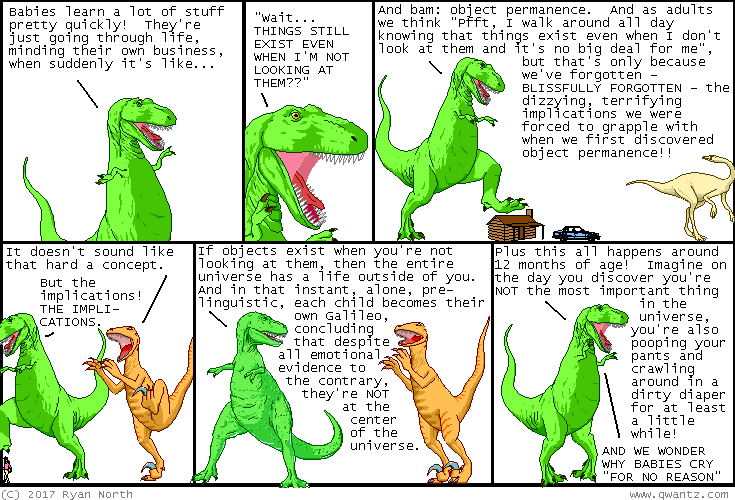 |
|||
| ← previous | August 25th, 2017 | next | |
|
August 25th, 2017: This comic is inspired by my nephew Davis who is REAL GOOD at object permanence!! And also my nephew Avery who is getting there but he's only had four months of existence so far so we should all cut him a little slack because it turns out there's lots to learn! – Ryan | |||
25 Aug 15:36
In defence of Laura Pidcock
by chris
Laura Pidcock’s claim that she has “absolutely no intention of being friends” with Tories because they are “the enemy” raises the question of whether tribalism in politics is a good thing. I suspect that, for her, it is.
This seems an odd thing to say. I don’t want politics to consist of a set of echo chambers in which people only talk to the like-minded, and I like to think this blog sometimes tries to speak to non-leftists. “My side right or wrong” has given us the ugly spectacle of some leftists supporting dictatorial or failed statist policies, and of supposed libertarians making common cause with fascists even though their philosophies should in principle be miles apart*.
On the other hand, though, there are some things to be said for tribalism.
First, it can be a useful cognitive short-cut. We all lack the knowledge and rationality to make good decisions, except in a very few spheres. Using others as a guide can therefore be what Gerd Gigerenzer calls a “fast and frugal heuristic”. For example, in 2010 I defended tribalism on the grounds that:
In being averse to having an Etonian as PM, I am taking a quick route to the judgment that such a man will take decisions about unknowable future events that I mightn't like.
Subsequent events have not discorroborated that view. Likewise, the fact that Brexit was supported by a bunch of cunts should have been a clue that it wasn’t a good idea**. Being on the opposite side of Farage is generally a comfortable position.
You might object that this isn’t always the case and that leftists have something to learn from Tories. There’s a little truth in this. Lefties should learn from Oakeshott, Burke and Hayek that individual wisdom and knowledge is bounded and that there is therefore something to be said for both markets (or decentralized decision-making) and tradition. And we should listen to thoughtful Tories such (pdf) as Jesse Norman.
But these are exceptions. The fact that the Tory manifesto was devoid of ideas tells us that the statist wing of the party has nothing useful to say, whilst the free market wing seems to consist of boilerplate Econ 101 which hasn’t progressed since Hayek (and what it learnt from him was wrong). And all sides have had their minds addled by Brexit. For the most part, Ms Pidcock isn’t missing anything by avoiding Tories.
She is also to be applauded for recognizing that politics is not a cosy game in which, after lively debate, jolly good chaps retire to the bar to have a laugh. It is instead a matter, literally, of life and death: Tory benefit cuts have driven people to suicide, and their threat to deport foreigners has caused genuine distress and uncertainty. In these senses, Ms Pidcock is right to call them the enemy. We live in a class-divided society in which the political question is ultimately Pete Seeger's (or Billy Bragg's): which side are you on?
There’s something else. There has always been a danger that Labour MPs would be seduced by the glamour and wealth of the people they meet in parliament: not just Tory MPs but lobbyists and businessmen. This is one of many ways in which their radicalism can be dissipated. It’s why the ending of Orwell’s Animal Farm has such force for the left:
The creatures outside looked from pig to man, and from man to pig, and from pig to man again; but already it was impossible to say which was which.
Ms Pidcock is awake to this danger. For that, I applaud her.
* Such an alliance, however, makes sense if you regard right libertarianism not as a coherent philosophy but merely as the voice of over-entitled white men. As a friend of mine said, “we’re all Robert Nozick on a bad day.”
** I’m not of course saying that all Brexiters are cunts.
25 Aug 15:34
John Darnielle, Universal Harvester
by Wesley
Sometimes a book clearly does not belong to a genre, but works so much like that genre it seems to belong in spirit. Take John Darnielle’s Universal Harvester. It has the story-shape and uncanny affect of weird fiction despite not, in the end, containing anything weird. And though it draws from the horror-fiction end of the genre more than the Borgesian, there’s nothing horrific about it; it is, instead, gentle and compassionate. It’s weird-fiction adjacent.
(I almost don’t want to say that much… I don’t usually worry about spoilers here; I’m writing responses to books, not the kind of book reviews you’d read beforehand to gauge your interest. But I so rarely go into a novel not even knowing what kind of story it’s telling, and that feeling of discovery is amazing, so if this novel sounds interesting just go read it. This essay will still be here when you’re done.)
Universal Harvester starts with Jeremy Heidt, a video rental clerk in Nevada, Iowa, in the 1990s. Customers are coming in perturbed; they report uncomfortably strange scenes spliced into their copies of Targets and She’s All That. Jeremy, his boss Sarah Jane, and their customer and enthusiastic investigator Stephanie (a teacher who maybe finds small-town Iowa a little boring after the University of Chicago) play back the tapes and see short, inexplicable flashes: the inside of a shed, people wearing canvas sacks over their heads, a woman fleeing a farm. Sarah thinks she recognizes the farmhouse.
Universal Harvester tells its story with the tools of found footage. Appropriately for a book about a video store, it’s a cinematic genre.[1] The point of found footage is that it’s incomplete. Most movies assume the camera is omniscient; it knows the whole story and can show the audience any part. The found footage camera narrates from inside the story. It asks us to reconstruct the story from incomplete data and a limited point of view. It’s often said of horror movies that what the audience doesn’t see is scarier than what it does: the images in the viewer’s imagination are wilder (and more specific to that viewer!) than anything the filmmakers could come up with. A good found footage movie extends this principle to the narrative logic. The story in the gaps is more uncanny than what’s on screen.[2]
Universal Harvester’s narrator seems omniscient. It tells us about Jeremy’s job and home life, how he’s considering a new job in Des Moines. About how his mother died, and his father’s tentative new relationship. It tells us what’s going through his head at times. Oddly, it also tells us things that could have happened prefaced by phrases like “in some versions of this story.” Did Jeremy have an argument with his father? Did he get a job at a soil-testing lab, or stay longer at the Video Hut? When a personal pronoun slips out it confirms what we already suspected: the narrator is inside the story. The narrator knows Jeremy pretty well but what we’re reading is, in places, just a version of his story, reconstructed from available information.
Adding to Universal Harvester‘s aura of found footage is a documentary feel helped by its strong sense of place. Nevada, Iowa is a real town, not far from where I grew up. Contrary to popular belief Iowa isn’t all rural; I’ve spent my entire life in university towns, so Jeremy’s culture isn’t mine. But I know enough to tell Universal Harvester has the atmosphere right. I recognize the characters’ affect, their reticence, the way the favorite topic at family gatherings is who’s moved where. The geography’s right, too; Darnielle seems to know the area from more than Google maps.
There’s a second horror influence contributing to Universal Harvester’s aura of the uncanny: folk horror, or whatever the American equivalent of folk horror might be (I’ve seen good arguments that it exists). This is a novel of rural landscapes, odd rituals, and new religions born from old, in this case not a European pagan revival but a Christian cult. The cult figures into the middle of the novel, which jumps back a couple of decades to tell the story of a woman who joins a seedy strip-mall church and disappears with it when it flees town, leaving behind a confused husband and daughter. They hire a detective. The daughter grows up following the cult from town to town, scanning the ever-increasing piles of surveillance tapes for some sign of a mother who, even after the cult leader is arrested and the last few members deprogrammed, never turns up again.
What happened to her? Well, there are different versions of that story.
Nobody knows you the way you know yourself. They see the pieces of your life that happen to occur in front of them. The you they know is a story they reconstruct from the fragments. The story your close friends and family know is probably pretty accurate! But the only person who knows your true, entire story is you.[3]
Universal Harvester’s narrator is reconstructing other people’s lives from the information available to her limited point of view. She’s piecing together fragments of video to find the story of a mother who disappeared. If she’s created strange rituals for herself they’re not so much attempting to reach back as out, to make connections. (Even for the mother, the cult was about connecting with something she was missing.) Universal Harvester is using weird fiction strategies to talk about the unknowability of other people’s lives, and how people reach out anyway in whatever way they know, however odd.
Most work in any genre is a bland mass of repetitious received ideas that blend into each other like gray soup. There are lots of reasons why a story might fail to rise above the general mass of forgettable oatmeal. One of the big ones is when creators never move past their first automatic assumptions about what genres, their tools, or their tropes, are for. Or what kinds of stories they could tell, whether they could be used for something new. Or whether they could bring in different tools altogether to serve the same purpose. Which is as good an argument as any for reading widely, and having a flexible concept of genre.
-
Though I’ve read horror stories formatted as collections of documents or, especially since found footage movies took off, descriptions of in-story videos. ↩
-
There are a lot of terrible found footage movies out there; they fail mostly because they failed to understand this. Most of them actually have two layers of thoughtless tropes. You can tell the filmmakers copied the style without thinking about what it’s doing because they’re using it to tell utterly rote, generic horror-movie stories: clearly defined character and thematic arcs, action climaxes, downbeat endings. There’s usually a point in these movies–maybe while the characters are running for their lives; maybe, alternately, while they’re having an argument that includes some important exposition but the characters themselves wouldn’t bother recording for posterity–when the audience asks why are these people filming this? The answer being because the filmmakers couldn’t conceive of a movie without the kind of scenes only an omniscient narrator would film. ↩
-
Even a well-documented historical figure is, to some extent, a mystery. Like, there’s enough on Lyndon Johnson for a multi-volume biography totaling thousands of pages. But there were still unwitnessed and unrecorded moments in his life. In most of them he was probably brushing his teeth or making a cheese sandwich or something. But could some moment have revealed him to be a completely different man? Who knows? ↩
24 Aug 20:00
Good news from the BBC:
What the young people will make of it I do not know. I think the humour of The League of Gentlemen was very much of its time.
But that time was not the 1990s.
For as I once blogged:
The League of Gentlemen to return for three new episodes
by Jonathan Calder
Good news from the BBC:
The League of Gentlemen is to return to BBC Two for three special new episodes.
This year marks the 20th anniversary of the comedy, which began on BBC radio before moving to TV from 1999 to 2002.At least I hope it's good news. Not every comedy that makes a return is a success.
What the young people will make of it I do not know. I think the humour of The League of Gentlemen was very much of its time.
But that time was not the 1990s.
For as I once blogged:
To someone who grew up in the provinces in the 1970s, it was not so much comedy or horror as documentary. Life as like that.
The Legz Akimbo Theatre Company, or at least a group remarkably like them, came to my school in 1974.
And one of the local butchers (he was a Conservative councillor when I was on Harborough District) hung rabbits and pheasants outside his shop as every lorry on its way from the West Midlands to Felixstowe rumbled past.
I am sure he would have sold you Special Stuff if you had asked.
24 Aug 20:00
Rather than oppose the Conservatives over substantial issues, the Corbynistas have decided to reopen Traingate.
You see, what matters to them above all is the moral purity of Jeremy Corbyn. Hearing that questioned is what hurts most.
Anyway, you can see the new video that is supposed to clear him above.
I always thought that Traingate was a botched media stunt, and nothing here changes my mind.
Like me, Jeremy Corbyn is a railway enthusiast. Like me, he is old enough to rather resent having to book a seat for your journey when you didn't have to under British Rail.
What I do when I get on the train and find lots of seats reserved is look at the details of the reservations. It is usually easy to find a seat where the person who booked it has not turned up or one that has not been reserved until later in the journey.
And I feel a little pleased with myself when I find somewhere I can sit down.
But Corbyn does none of that. He marches through the carriage as though he is on the way to a prearranged filming location elsewhere on the train.
Of course, there are plenty of trains that run "ram-packed" every day. If Corbyn's team was competent it would have chosen one of those to film on.

But then if his team was competent it would have booked Corbyn and his companion seats in the first place.
Why I never bought the Corbyn line on Traingate
by Jonathan Calder
Rather than oppose the Conservatives over substantial issues, the Corbynistas have decided to reopen Traingate.
You see, what matters to them above all is the moral purity of Jeremy Corbyn. Hearing that questioned is what hurts most.
Anyway, you can see the new video that is supposed to clear him above.
I always thought that Traingate was a botched media stunt, and nothing here changes my mind.
Like me, Jeremy Corbyn is a railway enthusiast. Like me, he is old enough to rather resent having to book a seat for your journey when you didn't have to under British Rail.
What I do when I get on the train and find lots of seats reserved is look at the details of the reservations. It is usually easy to find a seat where the person who booked it has not turned up or one that has not been reserved until later in the journey.
And I feel a little pleased with myself when I find somewhere I can sit down.
But Corbyn does none of that. He marches through the carriage as though he is on the way to a prearranged filming location elsewhere on the train.
Of course, there are plenty of trains that run "ram-packed" every day. If Corbyn's team was competent it would have chosen one of those to film on.
But then if his team was competent it would have booked Corbyn and his companion seats in the first place.
24 Aug 18:48
The weather/climate bias
by chris
Ben and Simon complain about the BBC’s unbalanced coverage of Patrick Minford’s Brexit fantasies. I sympathize. I suspect this was due to the BBC being so desperate to avoid the allegation of being biased against Brexit that it toppled over too far the other way. Such an error is in theory easily remediable.
I fear, though, that there might be a more insidious bias at the BBC, which arises from the very nature of news itself – a tendency to report the weather rather than the climate.
What I mean is that economic “news” consists of reports of high-frequency events: changes in share prices, inflation, unemployment and so on. What this ignores are slower moving changes which are in fact of much greater significance, such as: the decade-long stagnation in productivity and GDP per head; the slowdown in world trade; job (pdf) polarization; the combination of savings glut, shortage of safe assets and slowdown in capital spending that have led to negative long-term real interest rates; and the flat Phillips curve which signals that workers lack (pdf) bargaining power.
Under-reporting of these developments is not merely an intellectual error which creates a bias against understanding. It leads to systematic distortions. One is a failure to appreciate the extent to which the economy is failing ordinary working people. The other is excessive sympathy towards fiscal austerity, the case for which is gravely undermined by stagnant demand and negative real interest rates.
These biases are exacerbated by three others. One, as Jon Snow has said, is that senior broadcasters are out of touch with “ordinary” people. They don’t therefore understand the extent to which a few pounds make a huge difference to material and mental well-being, and so under-appreciate the importance of slow-moving developments which trap people into low incomes.
A second is a failure to make connections. People are generally bad at linking economic events. In particular, journalists have under-appreciated the tendency for economic stagnation to foster intolerance. The economic climate influences the political climate. In not making this connection, the importance of economics is under-rated.
A third is what I’ve called a bias against emergence. Journalists like human interest stories – somebody to praise or blame. But the developments I’m thinking of aren't such stories. No single person is to blame for stagnation, negative rates and job polarization. They are complex stories. Reporting them doesn’t fit the standard template of what constitutes journalism.
My point here is a simple one. Media bias isn’t simply due to reporters being incompetent or right-wing gits – though some are. It can also arise unintentionally.
24 Aug 08:40
A new capital?
by chris
What does capital do in the digital economy? This is the question posed by Phil in an important post. He says:
Capital is proving itself surplus to the requirements of social production and is therefore assuming ever more parasitical, rentier forms…How long can these parasitic relations last? When will Uber drivers call time on the very visible deductions made from their fares and replace the app with a cooperative effort? Is the time coming when Silicon Valley can no longer ponce off ad revenues generated from other people's content?
I certainly agree that a feature of modern capital is parasitism. Perhaps the most egregious examples of this are not so much social media firms using the free content provided by its users to generate ad revenue for themselves but the way in which bookies and doorstep lenders (the latter with mixed success) use their low cost of capital to exploit the desperate.
However, I’m not so sure that labour can yet be as autonomous as Phil claims.
Compare my job to the classic old-style industrial capitalist. The latter not only provided machinery and working capital but also in many cases the production process itself, as he had invented it. The IC gives me none of these things. I have all the physical capital I need at home. All the IC provides is a content management system which sometimes works.
But this does not mean the IC has little power over me. What it has is brand power. This allows it to extract money from readers, some of which comes to me. Its brand allows me to monetize my work in a way I can’t so easily do from blogging. From my point of view, the IC is a reliable and efficient alternative to Patreon. To get access to this, I must perform some mildly oppressive, exploited and alienating work.
Much the same is true for other immaterial workers. Working for a top accounting, law or advertising firm gives you a means of monetizing skills that are otherwise harder to monetize. (Not impossible, because workers do leave to set up on their own account. But the fact that many don't tells us that they are bound to the brand.)
A similar thing answers Phil’s question: why don’t Uber drivers leave to join a coop?
Some do. But there’s a big barrier here. Uber has a brand presence which links cabbies to millions of potential customers. Potential rivals lack this. And as David Evans and Richard Schmalensee show, it’s hugely expensive and risky to create good platform businesses: you suffer massive costs before getting the platform to sufficient critical mass – with people on both sell and buy sides – to be viable.
The fact that labour is immaterial is only part of the story of the new economy. Capital has become immaterial too. Intangible capital such as brand power ties us to capitalism. I need the IC’s brand to make a living, just as my ancestors needed cotton gins.
Perhaps, therefore, the shift to immaterial labour (insofar as it is happening) doesn’t much increase the autonomy of workers. Yes, the glue that binds us to capital has changed, but the social relationship is similar.
There’s a paradox here, and a question.
The paradox is that one early hope for the internet was that it would cut out the middleman by removing the information advantage he traditionally had. And yet it has enabled capital to become the middleman in more ways. The power of Uber, Facebook and brands generally come from being middlemen between workers and customers or writers and readers.
The question is: is intangible capital a social good or just a private one? Traditional machines are a social good; they increase aggregate output. But this is not so true of intangible capital. Coca-Cola’s brand is certainly an asset for Coca-Cola shareholders (and workers). But it’s a liability for Pepsi. Likewise, Uber’s brand is a barrier to entry for rivals. It’s what Warren Buffett calls an economic moat: it increases Uber’s value, but at the expense of making the economy less competitive. In this sense, perhaps Phil is very right: the new capitalism is parasitic.
It might be no accident that the growing importance of intangible capital has led to increased monopoly and less competition (in the US if not elsewhere) and hence to a strong stock market but weak economy and stagnant wages for most workers.
It might, therefore, be that capitalist stagnation and the shift to immaterial labour are related.
Another thing: Phil draws upon the work (pdf) of Hardt and Negri, but I suspect it can be translated into bourgeois social science. Years ago, Luigi Zingales was pondering (pdf) what the new economy and growing importance of human capital meant for the nature of the firm, for example.
23 Aug 07:23
Hung Parliaments are becoming the norm and we have to get used to it
by Mike Smithson

Inevitably it means governments that are weak and limited
The British political system has a reputation for producing strong governments. It is often seen as one of its virtues. For a long time, it was true. From December 1918, the first election in which women could vote, until February 1974, a single party had a majority in the House of Commons for all bar 3 years 3 months of that period.
Times have moved on, though many seem not to have noticed. Since February 1974, Britain has had hung Parliaments on five separate occasions. If this Parliament runs to full term, Britain will have had a hung Parliament for 10 years out of 12. Even during the interlude between 2015 and 2017, the Conservatives only had an ethereal majority.
We might well expect another hung Parliament at the next election too: it is rare for parties in government to gain seats at subsequent elections, particularly where that party has been in government for more than one term, while Labour would need a uniform national swing to them of more than 3% (they achieved half of that at the last election). So in a decade’s time the idea of an elected dictatorship that we used to hear so much about could be a distant memory.
We need to get out of the mindset of thinking of such governments being transient phenomena. They might well be the new normal. What does that mean for the nature of Britain’s government?
It doesn’t automatically have to mean weak government: from 2010-15 Britain had a strong and stable coalition. However, the fate of the junior partners in that coalition in 2015 will act as a powerful deterrent against future coalitions for many years to come. Outside times of national crisis, we can expect minority governments propped up with confidence and supply from minor parties whenever we have a hung Parliament.
So governments will be particularly vulnerable to being pushed around by flash mob opposition. This will be a particular problem for Conservative minority governments: because most of the other parties in Parliament dress to the left, Labour minority governments would often be able to rustle up support on an ad hoc basis even from parties outside the normal confidence and supply arrangements. Governments will struggle to keep finances under control: it is always easier to amass a majority in a hung Parliament for spending money than for saving it.
Policy-making will be chronically incoherent. What reaches the statute books will be driven less by what makes for a coherent policy framework and more by what can be steered through Parliament. Ministers will bring forward only legislation that they have some expectation of getting passed. Law-making will slow down. Eye-catching initiatives will be administrative steps taken under reference to existing laws rather than new legislation that might come under inconveniently harsh scrutiny.
Special interests with substantial backing in Parliament will do well. The DUP have already hauled home a swagload of booty for Northern Ireland in return for their limited support. They are trailblazers for untroubled pork-barrelling. The Lib Dems and the SNP might well reflect on what they might have been able to secure for their base if they had not been so resolutely opposed to dealing with the Conservatives. But this applies within the party of government as well as outside it when particular groups have points of principle to press. This will lead to the deepening of factions within parties of government.
A more positive way of summing up the last three paragraphs is to say that Parliament’s importance is increasing again. This should have the effect of increasing the relative importance of individual MPs, which might in turn help them re-evaluate which are the most important aspects of their role.
When crisis points are reached, major decisions with far-reaching consequences will be made in haste and through expediency or necessity. We have already seen examples of this. The West’s failure to intervene in Syria in 2013 can be traced directly to the then government’s failure to secure Parliamentary support for the idea.. Was this a good thing or a bad thing? That will no doubt be debated for many years to come. But it flowed from the Parliamentary arithmetic.
So to sum up, we are living through a period when governments are historically weak and limited, unable to move speedily or to impose coherence on policy, where major decisions will be taken without any central planning. Good job that Britain doesn’t face any major challenges any time soon then.