Shared posts

24 Aug 18:50

A better centrism

by chris

Several readers have complained about my criticism of centrism. “Your idea of centrism is not mine” they say.

To which I say: now you know how I feel when rightists claim that centrally planned economies discredit socialism; they are attacking a conception of socialism which isn’t mine.

I therefore sympathize with those offended centrists. In both cases, we have the same problem. Just as actually-existing socialism doesn’t discredit other notions of socialism, so the flaws in actually-existing centrism don’t discredit other conceptions of centrism.

So, what are these conceptions? Some I’ve seen on Twitter look like silly self-serving assertions that would fail any ideological Turing test - such as the claim that centrists base their views on evidence rather than ideology, for example on the question of how far markets work.

But pretty much everybody claims to base their views upon evidence. The difference between me and actually-existing centrists consists in which evidence we prioritize. For me, the load-bearing facts are that actually-existing capitalism give us too much inequality, oppression and stagnation. For actually-existing centrists such as Labour’s centre-left, the facts have been that the far left has been unelectable.

Equally, there has been too much of a tendency to define centrism by what it’s not rather than by what it is – that it is neither left not right. But as Nick Barlow says, this means it’s “a phrase that’s effectively meaningless, a political buzzword.” 

For me, a better centrism would be based upon four principles:

 - Cosmopolitanism Centrists should want an open economy with freeish immigration. Hostility to Brexit stems from this.

 - Social liberalism.

 - Rawls’ difference principle – in particular that inequalities are tolerable only to the extent that they are “to the greatest benefit of the least advantaged members of society.” This, I suspect would distinguish centrists from “neoliberals” who in Sam Bowman’s perhaps elastic conception of the term only “care about the poor.”

 - Devolving power. One attractive feature of some radical centrism (and part of the Liberal tradition)  is the desire to decentralize. Strengthening local government, attacking corporate monopolies and encouraging coops are all features of this. Perhaps it’s this principle that most sharply distinguishes better centrists from actually-existing centrists of New Labour and the Lib Dems in government.

I would hope that the centrists who took umbrage at my piece would subscribe to these principles.

Which poses the question. Why, then, am I not a centrist?

Partly, the difference is an empirical matter – of how far inequalities actually do benefit the worst off: I suspect they don’t very much. Also, I suspect that centrists don’t sufficiently appreciate the extent to which capitalism and class divisions are barriers to these principles – for example, that capitalist stagnation creates intolerance.

But perhaps there’s something else. Maybe the difference between me and centrists is tribal one. My cultural referents are leftist ones: I’m happy to sing the Red Flag and even Internationale. My intellectual influences are less Keynes and more Kalecki, Bowles, Roemer and Elster.  And perhaps above all, my working class background – retained in my accent – puts a barrier between me and even the most generous centrists. These differences aren’t wholly rational. But as Hume said, “reason is, and ought only to be, the slave of the passions.” He might have added that anybody who thinks this isn’t true of them is kidding themselves. My response to centrists who claim to be pure evidence-based pragmatists is the same as Dylan's response to the accuation, "Judas!": I don't believe you.  

23 Aug 07:23

Concern about immigration drops sharply although nearly 3 times as many CON voters raised it than LAB ones

by Mike Smithson

In a month which has seen almost no polls it is great that we have the regular Ipsos-MORI Issues Index which has been asked in the same format for four decades.

What makes it special is that those sampled are asked to name what they see as the main issues of the day without any prompting. There is no other poll like it and it has come to be regarded as one the best tests of salience – how important these are regarded.

The NHS remains top with Brexit second but notice the immigration trend and also the party split on the issue. Tory voters are much more likely to names it than LAB ones.

The continuing concern about the NHS, particularly during the summer when there is less pressure on the system, is a warning to ministers.

Mike Smithson

Follow @MSmithsonPB

Tweet

23 Aug 07:22

Trapped in the wrong trouser-leg of time

by Charlie Stross

So it's time I faced facts: I've been writing this blog for seventeen years and it is getting bloody difficult to come up with stuff to say. (At least, right now.)

My usual book launch promo stuff last month was derailed totally by family circumstances (that won't recur). I really don't feel like kvetching about politics, either the ongoing UK-specific slow-motion train wreck that is Brexit, or the equally bizarre theatre of the absurd and evil that is the current incumbent of the White House. The global neo-nazi resurgence might be another angle, but I'm not the ideal person to write a "why Nazis are bad, 101" for folks who haven't already got the message—I'm not patient enough and the subject strikes much too close to home for comfort. (I grew up attending a synagogue with older members who had numbers tattooed on their arms; I'm pretty sure that if I lived in the US right now then I'd be a gun owner by now, and stockpiling ammunition and escape plans.)

These are dangerous times in the anglophone lands, and worse is coming; the UK seems to be rushing headlong towards a private debt crisis (largely due to nearly a decade of misguided austerity policies, but with insane ramping of student loan debt on top) and the economic uncertainty induced by the Brexit-triggered recession we're entering isn't helping ... and the Tangerine Shitgibbon in Chief seems to have decided that, in comparison with a short victorious war with North Korea, sending the US army back into Afghanistan is a vote-winner.

Against such news headlines I don't much feel like prognosticating about the near future right now.

I'd like to be able to take comfort by speculating about how things might have turned out differently in another time-line, but that's not so good either. Imagine the Brexit referendum and the US Presidential election results were flipped: where would we be now?

Let's tackle the UK first. David Cameron would still in all probability be Prime Minister, Theresa May would still be Home Secretary, and Boris Johnson would still be a joke. I see no way the UK wouldn't have been hit by several terrorist attacks—Manchester, London Bridge, the same sorry litany—so the likely political response from Dave and Theresa would be the same (kiss your civil rights goodybye, oh, and we're going to censor the internet while we're about it). Osborne would still be Chancellor, so a continuation of his austerity program would be on-going, albeit with an economy not sinking into recession and a currency that isn't crashing to a 30 year low. So it'd all be fucking depressing for those of us on the "let's not starve poor people to death" left, but at least it'd be a familiar kind of depressing instead of an "oh god and by god I mean Cthulhu why are they flooring the accelerator towards that cliff edge?" depressing.

In the USA, let's suppose Hilary Clinton took the Electoral College—just—but the House and Senate seats landed the same way. By now we would for a certainty have a Kenneth Starr 2.0 investigating the Clinton White House on some pretext or other ("but her emails!" would be a good start, even if "Benghazi!" flopped), while a drunk and angry Donald Trump would be tweeting up a storm about how he was robbed and threatening to sue Crooked Hilary in the Supreme Court over those rigged votes she bought from (... insert nonsensical Trumpian rant here). There would probably be deadlock between the executive branch and legislature over Clinton's choice of a new Supreme Court justice, but the exploding clown car attempts at repealing the ACA would have broken down immediately on the inconvenient problem of a Democrat president. The US government would have competent civil service leadership in place, mostly inherited from the Obama administration. There'd be none of the chaotic misrule we've seen this year. But there would still be angst and drama and threats of impeachment, and a President tempted to use foreign military adventurism as a tool of distraction ... and unlike Trump, this alternate-45th POTUS would know exactly how to make that happen. I'm calling it for a US/Russian clash in Syrian airspace, or a disastrous North Korean miscalculation. (What doesn't happen is Clinton going after Iran: she was part of the team that brokered the deal. It's probably too early for a presidential visit and a formal apology for Operation AJAX, at least unless she makes it into a second term, but at least that particular pot would be off the boil.) And the neo-Nazis would still be rebranding themselves as the alt-right and getting their fangs into pop culture via social media and the Republican party via Breitbart Media and Fox.

Tentative diagnosis: we're in a deviant time-line, careering towards a catastrophe. But the time-line we branched off between last June and November held all the seeds of our current doom and we'd have ended up here sooner or later. The root cause is the breakdown of the beige dictatorship at a point where wholly new and frightening tools of propaganda have become available and the social media many people trust are themselves in thrall to toxic agendas. The progressive opposition is chaotic and scattered and racist rabble-rousers have pulled their jack boots on and gotten marching, and they seem to have a first-mover advantage (if only because most of our mass media is owned by chancreous cockstains like Rupert Murdoch).

23 Aug 07:08

My Personal Feminism, 2017

by John Scalzi

In the wake of Kai Cole’s piece about Joss Whedon, and some of the reaction to it, I’ve been thinking about what it means to be a man in the public sphere who considers himself to be a feminist. Part of this thought process was also spurred on by seeing some of the reaction to the news on Twitter by women:

I’ve talked before about my own personal feminism here on Whatever. In 2012 I noted why I was hesitant to call myself a feminist, and then a couple years later I explained why I was going to go ahead and call myself one. Here in 2017, I think it’s worth coming back around to it and thinking about it some more.

And at the moment, this is what I think about it: I consider myself a feminist because fundamentally, I believe that women should have and need to have the same rights, privileges and opportunities that men do — that I do — and I think it’s worth saying that out loud and working toward that goal. This feminism is part and parcel of believing that everyone should have the same rights, privileges and opportunities that I, a straight, white, well-off, gender-conforming man has, not just on paper but in the practical, mundane, day-to-day workings-of-the-world sense. We’re not there yet, and as we’ve seen in the last couple of weeks, there are a lot of people who never want to see that happen. I would be ashamed, especially now, not to stand up and be counted out loud as someone who believes in feminism, among all the other things I believe in.

But I am also deeply uncomfortable with feminism being part of my “brand,” for several reasons. The first is that I’m aware of my failings and imperfections, and I’m also aware that there are a number of failings and imperfections I’m not aware of. With regard to my feminism, I can work on the things I know about and listen when people point out the things I’m not aware of, but the general gist of it is that I’m aware my feminism is imperfect. I am loath to charge in saying behold, the male feminist! when I know there are lots of places where I fall down. I’m a feminist, in progress, and suspect I will be until I’m dead.

The second, following on the first, is that I’m also aware feminism doesn’t need me as a flagbearer. I’m not and shouldn’t be the vanguard of feminism (I mean, if I am, whoooo there’s trouble). What I can be is support, and occasionally a tank (i.e., someone being an obvious target and taking hits while other people get to work). One of the great gifts of getting older is the realization that you don’t have to lead every parade. Sometimes it’s enough to march along and have the backs of the people out in front.

The third, which is related to the second as the second is related to the first, is the awareness that I have the privilege of not being performatively feminist. Which is to say that I can — and sometimes do — decide to take a break from actively having to deal with issues and concerns of feminism, because I am busy, or distracted, or tired, or just decide I want to take a breather. My passive feminism is still there, my default belief in the equality of rights and opportunities, but I don’t have to do anything about it, and the personal consequences for my not engaging are very low.

Having the option to quit the field without penalty, and to engage only when you have interest, means some interesting things, not all of them good. It means, as an example, that you can choose to do only high-profile, high-impact flashy attention-getting things, and not the day-to-day grunt work that other people have to do. It’s not at all surprising that the reaction of the latter folks is irritation and frustration that you’re getting credit for something they see essentially as stunting for cookies.

I’m not going to deny that I’m aware that I have the ability, within my own little pond, to draw attention to issues and to make things visible by being loud and immovable in only the way someone with my advantages has, and in that way effect change. I try to be useful with that, and to make clear the fact that others have done work I’m essentially pointing to. And I try to do more than just the flashy, attention-getting, cookie-bearing stuff. But at the end of the day I’m aware that I have the option to engage, with feminism as with many issues, when other people are required to engage if they want their existence to be acknowledged as anything other than background noise. That makes a difference. I don’t think I can have feminism as part of my “brand” when I only have to engage with it at my whim.

(There’s also a fourth issue here, which is the disconnect between public and private lives. To be very clear, I’m not keeping any affairs — or, really, anything — secret from Krissy; we believe in communication and lots of it. But I’ve also been clear that while my public persona, including on this blog, is me, it’s a version of me tuned differently from the me who lives at home with my wife and daughter, away from the rest of the world. I don’t know that there’s anything in my private life to give someone pause re: feminism, but who knows? There might be. In which case, best to not lead with it as a brand identity.)

I consider myself a feminist. I am also 100% all right with being interrogated on that assertion, and to have people, and especially women, be skeptical until and unless I prove otherwise. I’m also aware that “feminist” is not a level-up — you don’t grind until you get the achievement badge and then don’t have to think about it ever again. I’ve said before that if your social consciousness is stuck in 1975, the 21st century is going to be a hard ride, and that continues to be a true thing. You have to keep engaging.

I’m also aware that I’m going to fail — that I’ll miss a step, or say or do something stupid, or otherwise show my ass, on feminism (among, to be sure, many other issues). And I can pretty much guarantee I’m not always going to take being called on that with initial good grace, because history suggests I’ll occasionally screw that up too. I can say that I do try to base my ego not on having to be right, but on doing the right thing. This is why I once did a primer on apologizing: because I need it in my own life.

So, yes. Here in 2017: I am a feminist, imperfectly to be sure but even so. I’m happy for it not to be part of my “brand.” I just want it to be part of me; of how I treat women, and others, and how I view the world for what it is and should be.


23 Aug 07:06

Everything before the "but" is bollocks...

by Andrew Rilstone
Yes, the Slave Trade was awful, an I am as much in agreement with that as any of the minority of people living in Bristol, who want the name of Colston Hall changed. However...

P. Collins

Who are these name changers? Are they Bristolians, born and bed here of Bristol families, educated in Bristol Schools, worked hard to buy their own houses, and pay council tax? How dare they come here from other cities and countries and tell us what to do?

also P. Collins
22 Aug 00:32

Is ‘centrist’ being used more often now?

by Nick

Following on from my Prospect article, I’ve been wondering about a perception that we seem to be using and discussing terms like ‘centrist’ and ‘centrism’ now, though there’s also the chance of it being selective perception on my part, given my PhD topic. So, as evidence that it’s not just in my head, here’s what Google has to say about it.

In all of these graphs, the blue line represents how much people are searching for ‘centrist’, the red line how much they’re searching for ‘centrism’. ‘Centrist’ is almost always the most searched of the two terms. The global graph is quite jittery (indicating it’s not searched very often so small ups and downs in the number of searches make big changes in the graph) but has two clear early peaks around the end of 2004 and 2008 (possibly connected to the US Presidential elections then) and then rises as we get closer to the present day.

Breaking it down by country…

We see the 2004 and 2008 peaks on the graph for the US, which are a bit more prominent than they are in the global trends, and the rise towards the present day isn’t as big as it is globally, but still above the 2004 and 2008 peaks.

The UK graph has a much more pronounced rise in recent months, with the only noticeable peak before that in February 2005 – and no, I can’t work out why that might be.

Canada gives us a slightly different picture, with a generally higher average trend than the US and UK, but still with the current rise. There is an earlier peak there, around the end of 2005, which might be linked to the Canadian federal election that took place in January 2006.

I’ve done those three as an example, but there definitely does seem to be a rise in searches for ‘centrist’ and ‘centrism’ over the last year or so, which is interesting, though for now I’m just going to leave it at presenting you with the data and seeing what theories you come up with to explain it, rather than putting forward my own.

21 Aug 18:43

Jerry Lewis, R.I.P.

by evanier

A top comedy writer just e-mailed me the following message: "When I saw the headline, I actually sighed to myself, out loud: 'Finally!' Does that make me a bad person?"

No. In fact, the few times I was around Jerry, I witnessed the great anger and death wishes he had for others he felt had somehow wronged him. He was a volatile, oft-furious man and that doesn't make him a bad person, either. To discuss him, it's necessary to hold two distinct thoughts in mind…

  1. He was often paranoid, controversial, almost criminally self-indulgent, and "mad" in several senses of that word. That was his way for most, maybe all of his professional life, though it was easier to ignore or rationalize when he was also making funny movies or was truly funny on stage or screen or his loyalists could blame it on the Percodan.
  2. Few people in the field of entertainment have ever made so many human beings laugh, and also raised so much money for people in need. He is also justly hailed as an important filmmaker in many technical senses and as a teacher of same.

The better films and the stage act — especially with Dean — lost their sparkle for some of us a long time ago and Jerry became two things. One was that he was one of the few remaining relics of a certain era of show business and/or a fond memory of our childhoods. Neither of those is a small matter. For the last few decades, one of his true pleasures was to make appearances around the country where he'd so some bits of his old act (especially the Typewriter Song) and answer questions from the audience. The shows were nearly always packed with folks over 40 and the questions were nearly always, "I just want to say how much we love you and you're a genius, Jerry!"

If you're under 40, I can't imagine why you'd think this person was so beloved by some. Most of the movies don't stand up all that well, either. The one that gets singled out — The Nutty Professor — strikes me as a masterpiece only in comparison to the other 50-60, depending on how you count. In today's New York Times in a pretty good obit, Dave Kehr writes…

The Nutty Professor, a study in split personality that is as disturbing as it is hilarious, is probably the most honored and analyzed of Mr. Lewis's films. (It was also his personal favorite.) For some critics, the opposition between the helpless, infantile Professor Julius Kelp and the coldly manipulative lounge singer Buddy Love represented a spiteful revision of the old Martin-and-Lewis dynamic. But Buddy seems more pertinently a projection of Mr. Lewis's darkest fears about himself: a version of the distant, unloving father whom Mr. Lewis had never managed to please as a child, and whom he both despised and desperately wanted to be.

I buy the latter interpretation and I would make it even simpler. Every time I was around Jerry, including the one time I worked with him, I saw a distinct Jekyll/Hyde dynamic. Every time, he would be very nice and human and compassionate to someone…and then, almost like someone had thrown a switch, he would be yelling and furious about some minor or even imaginary slight. You could not have predicted what would set him off but something always would.

Eventually, his fame was not as a brilliant comedian but as someone some said had been a brilliant comedian, though without a lot of evidence to back that up. Instead, he was famous for the outbursts, the intemperate quotes (Did you know no woman was ever truly funny?), the feuds and the tirades. So many tuned in his Muscular Dystrophy Telethons not for the entertainment but to wait for those moments when a sleep-deprived Jerry would devolve into self-pity and/or rage at his critics, the dollar figure on the tote board, the lack of appreciation of his friends and show people in general, etc.

The film his fans talk about the most is the one they've never seen, The Day the Clown Cried and they don't crave to see it because it's unavailable. Hundreds of movies are unavailable and no one cares about them. They aren't yearning to view it because they expect a masterpiece. They want to see it because they expect it to stink in a highly entertaining way.

Just before Christmas last year, I wrote a piece here about how Jerry's angry statements and odder philosophical ramblings had stopped being funny to me. I ended it by saying…

I always wanted to like Jerry Lewis but he's made it too difficult. Too difficult. I'm going to stop trying to convince myself or anyone that he was a great comedian and that his tirades are anything other than the ramblings of a bitter, angry man. If you want to continue to see him as someone to be admired, don't let me stop you…because he needs all the love he can get.

But you know what? No matter how much there has been — and he's been loved more than most people on this planet get to be loved — it has never been enough.

This is one time I really mean the "Rest in Peace" part of "R.I.P." He deserves a lot of peace and all the accolades he ever truly earned. I just was never able to be a real fan, no matter how hard I tried.

The post Jerry Lewis, R.I.P. appeared first on News From ME.

21 Aug 18:26

What is centrism?

by Nick

Because I like to take on the big questions of our time – and probably offend everyone in the process with my answers – I’ve a piece at Prospect magazine attempting to define centrism.

20 Aug 20:33

Dick Gregory, R.I.P.

by evanier

So I'm sitting here getting ready to write about comedian Dick Gregory, who died yesterday at the age of 84…and I'm thinking, "Well, he'll finally get some attention and recognition for his pioneering work." And then the news pops up on my iPhone that Jerry Lewis has died…

I don't have a great quip about this but I bet Dick Gregory would have. It would have been something about how the white guys can't let a brother have the spotlight for two minutes unless the cops have him in handcuffs or something.

I put up a picture of one of his records because I knew Dick Gregory primarily as a record comedian. He was also as a man who said things that were often quoted by others, often to the extent that no one knew who'd said them first. He was the one who said the line about how it wasn't true that NASA had selected no black astronauts…"They're just saving them for the first trip to the sun!"

He was important not only because he was one of the first prominent black stand-up comedians but because he didn't primarily play to black audiences the way Redd Foxx and "Moms" Mabley then did. He was also topical and politically astute at a time when the punch line to about half of Foxx's jokes was something like "You gotta wash your ass better." Another pioneer in black guys talking to mixed-race audiences about racial matters was Godfrey Cambridge but Gregory got there first.

I never saw him perform but his records were all funny and clever and very, very brave and they're a great record of what was going on at the time in this country with regards to segregation and the resistance to accepting all races — not just his — as equals. I was just talking on this blog about the death of Elvis Presley pulling focus away from the death of Groucho Marx. Let's make a little noise about Dick Gregory and remind everyone that his black life mattered as much as anyone's.

The post Dick Gregory, R.I.P. appeared first on News From ME.

20 Aug 13:20

2017 Hugo Voter’s Packet Debrief

(Note by Nicholas Whyte: In the log of Hugo Administrator decisions published a week ago, we referred to the debriefing document compiled by this year's Hugo packet coordinator, Jo Van Ekeren. I'm publishing the summary here at her request. The full debrief includes ten more documents, most of which are templates, and will be shared with future Hugo administrators.)

Mandatory tools for the Hugo Packet Coordinator:
  • Microsoft Word (or Word-compatible word processing software able to save files as PDFs; proficiency in advance recommended)
  • Calibre e-book conversion tool (free; can create a multitude of formats, including EPUB, MOBI, PDF, and RTF; proficiency in advance required)
  • Adobe Acrobat (not free; permits cropping, editing, and splicing of PDF documents; proficiency in advance helpful, but can be learned pretty easily)
  • Internet Speculative Fiction Database (ISFdb): fan-sourced website of SFF works, cross-indexed by Title, Author, and Publisher (this resource is not always perfectly up-to-date as there can be a delay in volunteers getting information entered; however, what is there is usually pretty meticulously accurate)
  • Master Contact List (this is a cumulative document which includes names and contact e-mail addresses for authors, artists, editors, and publishers from past Hugo Award years)
Things I wanted to change or improve, and how I did that:
  • Lack of instructions for e-book novices: to assist Hugo voters who may be relatively new to e-book formats and devices, I created and included a README file which provided descriptions of the various filetypes and the devices which use them,with links to free reader software for them, and included this file in every category packet. In the case of a Series entry which was provided through NetGalley, I created a special document with instructions on how to download and access those books.
  • Missing entries: not having at least an excerpt, if not the full work, of everything in the categoryhugely disadvantages the works which are missing. I was ultimately able to get either an excerpt or full text from all of the fiction and related work finalists – but if I hadn’t, I had intended to include for those works a 1-page PDF with a URL to an online excerpt if one was available.
  • PDF-only entries: not having readable – or any at all – EPUB, MOBI, and/or PDF versions, when they are not that hard to create if you have the right file to work from. In a few cases, I requested a DOC or an RTF from some of the Fan Writer and Fanzine finalists, and created EPUB, MOBI, and PDF from that.
  • Unreadable PDFs: the PDF versions of things, especially the print galley proofs, invariably have a lot of whitespace around the text, and are unreadable on any device smaller than a desktop computer, because PDFs do not "flow" in e-readers, so I did a lot of cropping, reformatting and/orconverting on the files I got. Often the EPUB and the MOBI will be well-formatted, with cover, but the PDF will be a poor-quality text document in typewriter font. In those cases, I archived the original PDF, and created a new version by converting from the EPUB. Adobe Acrobat was indispensable for this; PDFs are notoriously non-editable with anything else. If the PDF is protected by the creator, even Acrobat can refuse to allow changes, but I had few problems with this (possibly because I have a 15-year-old version which does not recognize newer forms of locks).
  • No covers: in the cases of PDF-only files for novels and related works, I put a cover on, but also a “Hugo Voter Packet Copy” declaration on that cover, so that the publisher would not be upset.Some of the short fiction had covers, and some did not; for those which did not, I prepared one using the cover of the magazine in which the story had appeared, added the title and author of the story, and then e-mailed it to the editor/publisher asking permission to use it. These covers were all approved by those people without hesitation.
  • Document Properties not being set on files: this has especially been a problem with PDFs, where the Title and/or Author which show up in e-readers are blank or wrong. I ensured that all files had the correct Properties (with the exception of 2 of thefiles, which were so locked-up that I couldn’t even do that).
  • Inconsistent file-naming standards: in the past, whatever name was put on the files was the name that went into the packet. I standardized the filenames on all works as
    Lastname, Firstname I – Work Title
    Within categories, the Work Title was also standardized:
    Lastname, Firstname – 2016 Editor Long Form Selections
    Lastname, Firstname – 2016 Editor Short Form Selections
    Lastname, Firstname – 2016 Semiprozine Selections
    Lastname, Firstname – 2016 Professional Artist Selections
    Lastname, Firstname – 2016 Fanzine Selections
    Lastname, Firstname – 2016 Fancast Selections
    Lastname, Firstname – 2016 Fan Writer Selections
    Lastname, Firstname – 2016 Fan Artist Selections
    The exception to this was when I got actual issues of Semiprozines and Fanzines, which were titled by their issuance month/year.
    Note that I labeled these “2016” because they were 2016 work, even though it was for the 2017 Hugos.
  • Different filetypes: in cases where I got a PRC file instead of a MOBI file (they are read by the same readers), I archived the PRC and created a MOBI file from the EPUB, so that all files would have the .mobi suffix and filetype, to avoid confusion.
  • Having to download more than necessary: to avoid voters having to download more than necessary, for most categories, separate packets were created for EPUB, MOBI, and PDF formats. (Voters had the option to download all 3 packets, if they wanted to do so.) In cases where only a PDF was provided, this was included in all 3 packets.
  • Unnecessary nested folders: I can see how this happens as part of the process of creating the various packet bundles and then zipping them, but it’s a pain for voters when they do the unzipping, so the only places I had subfolders was where they were really needed, such as in the Editor Short Form category, where several Finalists each submitted numerous works.
  • Excerpts not being clearly marked as such: voters not realizing that an excerpt is an excerpt instead of the full work, and getting unfairly upset at the work because of no advance warning that it's an excerpt. I put “Excerpt” labels on the covers of these works, and included “excerpt” as part of the filename.
  • Passwords on documents: this had been an issue in the past, because not all e-readers will open documents which have passwords. I was prepared to try to persuade publishers/editors to copy- and print-protect documents, but not use passwords; however, this issue thankfully did not come up. (I don’t recommend suggesting watermarks, which often impair readability, but some of them will include watermarks anyway, and that can’t be helped.)
  • Lack of substantive information on what the Short and Long Form Editors have actually done: I tried to remedy this by creating documents with lists of long and short works edited, pulled from ISFdb (in addition to whatever selections they submitted).
  • Accessibility issues, part 1: tinted backgrounds. I asked one Finalist to remove the tinted backgrounds from their various e-book formats. They were reluctant to do so because they liked the “artiness” of it. I pointed out that the tinted background reduced contrast and readability for people with vision impairment (as well as making the e-books 10 times as large as they would have been otherwise), and they did remove it.
  • Accessibility issues, part 2: text which cannot be “read” by text-to-speech software. There were a couple of files which included some images of text, rather than actual text. I edited these files and replaced the images with matching text to make them readable by text reading software.
  • Accessibility issues, part 3: watermarks. Several of the files had watermarks so dark that it impaired readability. Given that these were all files which had taken a lot of time and e-mail exchanges to get, and they were only received right before the release date we had chosen, I did not go back and ask the providers to make the watermarks lighter because I was concerned that we would not receive better versions in time for packet release (if at all). I recommend that future Packet Coordinators consider including a sentence or two in the work solicitation e-mail requesting that if watermarks are used, to please ensure that they are not so dark as to impair readability. However, I am concerned that this would prompt editors and publishers who had not previously inserted watermarks to start doing so. Perhaps this sentence could be included only in messages to editors and publishers who have inserted watermarks in the past.
  • No information for the Dramatic Presentation Finalists: I tried to remedy this by creating documents with a poster or screenshot from each work, followed by the credits, and links to trailers, websites, IMdb, and Wikipedia.
  • The new Series Category, and lack of a way to evaluate it: I created a “Reading Order” document for each Series containing both the long and short fiction titles, and sent these to the authors for approval/ corrections. (One finalist provided their own, along with their packet submission, so I just used that.)
  • Lack of consistency in how the Artist works are presented to voters: I think it's very important that the works be presented on as level a playing field as possible – so that it's the works themselves, and not the presentation, which is being judged. One Pro Artist who has been a Hugo Finalist many times always presents their work in a pretty impressive way. Other Finalists don't have the advantage of that experience, or of having seen how works have been presented in the past, and their work ends up looking less professional in comparison, simply because it doesn't have the nice framing. That's just needless disadvantage, and I tried to fix that this year by setting up a standard black background document on which each individual work is framed. To avoid a question of unfairness, I did offer the artist who provided their own framing the opportunity to have the same framing as everyone else; not surprisingly, they declined and chose to keep their own framing.
    Note: if this is going to be done for the artists, it has to be done well.
  • Small art sample packets: With the help of the ISFdb, I also pointed out to several of the Artists additional eligible works they did not include, because they don't understand the very complicated eligibility definitions, and let them add those works if they wished to do so, so that they could have a sufficiently representative portfolio.
  • Inconsistent and/or minimal information on Fancasts: I pulled a complete list of 2016 podcasts from all Finalists’ websites (with one exception; see next item). In their submissions, most of them provided info on 1 to 3 of their 2016 podcasts they wished to highlight. One of them provided a “Best of” podcast spliced from various 2016 podcasts, and a transcript of that – which I thought was a fantastic idea, and which should be suggested to future Finalists in the packet submission solicitation letter.
  • No submission received: The only Finalist which did not submit something was one of the FancastFinalists. I looked at their YouTube channel and realized that attempting to identify and create alist of their 2016 videos was going to be an hours-long, arduous task, and given that we had received no response to several e-mails from me and the Hugo Admin, figured that including a document with a logo image, a hyperlink to the YouTube channel, and a brief description of the podcast was sufficient additional information.
  • Eligibility Issues encountered: after consultation with the Hugo Admins, an explanation was sent to the Finalist of the issue and what the resolution was going to be, and the Finalists were all quite gracious about understanding:
    • Short Form Editor including stories they published but did not edit
      resolution: they resubmitted a document without those stories
    • Short Form Editor including a short Novel they edited
      resolution: the Novel was not included in the packet
    • Short Form Editor including an entire issue of a magazine in which they had an editorial published
      resolution: an extract with only the editorial was included in the packet
    • Professional Artist including two works from an non-eligible publication
      resolution: these were not included in the packet
    • Campbell Finalist requested inclusion of non-fiction work in the packet
      resolution: this was not included in the packet
    • Campbell Finalist including a story from a non-eligible market, and a poem
      resolution: these were not included in the packet
    • Fanzine creating a online web page with links toreviews of 2016 works which included a vast majority of reviews written in 2016, but a handful written in 2015 and 2017
      resolution: let them know that I was going to let it slide, but that a future Packet Coordinator might not, and if there had been more of them, I wouldn’t have either, and suggested this might be something they wish to take into consideration in future as far as the timing of posting reviews
    • Explicit Content: The porn novelette was placed inside a subfolder which included “Note - Explicit Content” in the folder name. The Fan Writer whose work included cartoon nudity and explicit verbiage agreed to create an online page on their website, and a document with a link to that webpage was included in the packet (at my recommendation, this URL was added to their robots.txt file, so that it would not be indexed by search engines).
    • Editor Long Form: My original e-mail to the finalists referred to novels edited during the year, and it was called to my attention that the definition actually specifies novel-length works which were published during the eligibility year, and that those works could be either fiction or non-fiction. I sent a revised e-mail to the Editor Long Form Finalists to reflect these changes
  • Packaging errors which had to be fixed:
    • The Design/Marketing team wanted to approve/change the README document after most of the zip files had already been uploaded
      resolution: DevOps went through and replaced the document in all the zip files
    • The Novel EPUB packet included a PDF of a different work instead of the EPUB of a missing work
      resolution: repackaged the correct set, and DevOps replaced the download file
    • A Series subfolder in the MOBI packet contained the EPUB files rather than the MOBI files
      resolution: repackaged the correct set, and DevOps replaced the download file
  • Recommendations for future years:
    • A tracking spreadsheet should be created in advance, which can be used to note Finalist position acceptances, dates e-mails are sent, dates content is received, what content is received, Hugo ceremony attendance and absentee Finalist representative information, etc.
    • The e-mails to the Finalists can all be prepared ahead of time and sent as soon as the public announcement of the Finalists has been made.These e-mails will have the same basic content, but need slight changes to be applicable to each specific category. I made a special effort to really tailor these e-mails with explanations and suggestions to guide the finalists in creating their submissions, both to help avoid past issues, and to ensure the best possible submissions which would aid voters in making their decisions.
    • The Dramatic Presentation Long and Short, Editor Short Form, Fancast, and Series credits can (and should) all be pulled in advance from various websites. Once the Finalists have been announced, the Series Reading Order should be sent with the packet submission invitation to the authors for review and corrections, if necessary.
    • As much as possible, files should be reviewed for eligibility, readability, and validity as soon as they are received. If a DOC, RTF, EPUB, MOBI, or PRC file is received, it is possible to create EPUB, MOBI, and PDF versions. If only a PDF is received, then it’s a case of either requesting one of the other types if you think you can get it, or just going with the PDF.
    • Persistence and patience are required. I think that around 60 e-mails were exchanged with 12different people from one publisher, just for 3 works, which we were finally able to get. People will forget that they need to prepare a submission, and some of them will have to be reminded more than once. Saying “We’d really like to have your work included in the initial packet release with the other Finalists” in the reminder generally helps, because they realize that not doing so may disadvantage them with voters.
    • In my last thank-you to them, I asked all of the comic execs and the publishers and editors to add @worldcon76.org to their Safe or Approved Senders list, to head off Hugo notification e-mails going to Junk Mailboxes next year. I recommend doing this every year with the following Worldcon’s domain URL.
    • The Master Contact Document should be updated to include any new people and contact information, and any changes to existing information, then forwarded to the following year’s Hugo Administrator.
19 Aug 09:27

Centrism: the problem, not the solution

by chris

There’s talk, much of sceptical, of the formation of a new centre party. For me, this misses the point – that centrists are the problem, not the solution.

Owen Jones is bang right to say:

It is the economic order centrists defend that produced the insecurity and stagnation which, in turn, laid the foundations for both the ascendancy of the left and its antithesis, the xenophobic right.

This is true in two senses.

First, centrists contributed to the financial crisis by under-estimating the fragility of the system. They over-estimated market rationality. As Martin Sandbu says, the lie of capitalism is that “market values of financial and other assets accurately reflect the economic value they represent.” They also failed to appreciate that top-down management unconstrained by effective oversight is dangerous: the banking crisis wasn’t just a market failure but also an organizational failure.

If that was an error of omission which is clearer with hindsight than it was at the time, centrists’ second error is less forgivable: fiscal austerity. The Lib Dems supported this in government, and Labour’s centre-right failed to oppose it vigorously enough.

These two errors have had disastrous effects. They have given us a decade of stagnant real wages. Not only is this terrible in itself, but it also led to Brexit. Stagnation bred discontent with the existing order and hence a demand for some sort of change, and also had the effect history told us it would – of increasing antipathy towards immigrants.

In this context, centrists made a third error. With a few exceptions, such as the heroic Jonathan Portes, they failed to make a robust case for immigration: remember Labour’s shameful “controls on immigration” mug? This might be no accident. Blaming immigrants for poor public services and low wages helped to deflect blame from where it really lies – with austerity, crisis and capitalist stagnation.

Centrists are right to oppose Brexit. What they don’t appreciate, however, is that they themselves helped to create the conditions which led to the vote to leave.

I don’t think these were idiosyncratic failures of individual politicians. I suspect instead they arose from three systemic failures of centrism:-

 - Insufficient scepticism about capitalism. Centrists have failed to appreciate sufficiently that actually-existing capitalism has led to inequality, rent-seeking and stagnation. New Labour’s deference to bosses fuelled their presumption that banks were in good hands and didn’t need to be on a tight leash.

 - A blindness to the importance of inequalities of power. Centrists take it for granted that elites should be in control, even if they lack the capacity to be so. This left them vulnerable to Vote Leave’s slogan, “take back control.”

 - Excessive deference to the media. Centrists were for years obsessed with a form of “electability” which consisted in accommodating themselves to media lies about austerity and immigration.

In these senses, then, centrists’ failure has been a structural one.

Which poses the question: why, then, does centrism seem so appealing?

I suspect the answer lies in the failure to appreciate the distinction between extremism and fanaticism. Centrism’s intuitive appeal lies in the tendency to associate it with the virtues of moderation and empiricism.

Such an association, however, is at least partly unwarranted. In failing to appreciate sufficiently the flaws in capitalist hierarchy, centrists are being ideologues more than empiricists.

19 Aug 09:21

Groucho Day

by evanier

Forty years ago today, Julius "Groucho" Marx died at the age of 86. His passing got way less notice than the death of Elvis Presley, who'd passed three days earlier — a source of great frustration to those of us who were way more influenced by Mr. Marx than we ever were by Mr. Presley. Then again, maybe it's understandable that Elvis's death at the age of 42 was far more unexpected and shocking and therefore newsworthy. Groucho, at more than double that age, had been in poor health for some time and was sadly past his performing years.

I met him three times and saw him perform (sort of) on stage once. I wrote about these brushes in this column and the one that follows it. A few years ago, I realized that I got the dates and sequence wrong and I've finally revised the columns so they're right.

The last encounter took place at Groucho's home on Hillcrest Road in the Trousdale section of Los Angeles. The visit was short — a friend and I were there about a half-hour — and Groucho didn't say much. It occurred a month or two after he showed up on the set of Welcome Back, Kotter when I was working on that show so it was around Christmas of '76. He was in such poor shape that I'm still amazed he lasted another eight months.

The friend who took me there had me along because he thought Groucho would enjoy being with a relatively young person (I was 24) who knew everything about his films and career. This seemed to be true. Groucho wasn't able to muster much in the way of answers to the questions I asked him but he liked that I knew all the names and all the films.

The most interesting thing I recall of that afternoon was that I got to see Erin Fleming in her native environment. She was the controversial actress (largely of the aspiring variety) who kept company with Groucho in his last years, doing some good for him and some bad as she attempted to do a lot of good for herself. She'd accompanied Mr. Marx to the set of Kotter where he was supposed to tape a cameo appearance but was too ill to do more than pose listlessly for some photographs. It was pretty obvious that the show's invite to appear was accepted not by Groucho, who couldn't have cared much less, but by Erin, who thought it might somehow lead to her making an appearance on a (then) hit TV show.

In Groucho's home, she stage-managed a series of celebrity drop-ins, getting stars (including Groucho) to get up and perform. At least during the thirty minutes or so I was at one of them, Groucho looked like he'd rather be in his bedroom, sound asleep. I suppose though there were times when he appreciated the company and attention.

That day, I did not meet a young man who worked in the house as a kind of secretary-archivist. His name was Steve Stoliar and if he was there, no one introduced us. A few decades later, we encountered one another and became good friends. If you're curious about what went on in The Last Days of Groucho, I recommend an utterly-accurate and quite entertaining book by Steve called Raised Eyebrows — My Years Inside Groucho's House. And if you're the kind of person who follows my recommendations — God help you — here's an Amazon link for it.

In a way, I wish my memories of Groucho stopped with the first time I met him. He was still lucid then, still able to stand on his own, still able to say witty things in a way that reminded you of the smartass in the movies and on the game show. That smartass was highly influential in a lot of our lives. He emboldened us. He inspired us. And he made us laugh to an extent that would make him a legend even if he hadn't emboldened and inspired us. He sure mattered a lot more to me than Elvis ever did.

The post Groucho Day appeared first on News From ME.

18 Aug 16:09

Left Behind and Trumpism

by Fred Clark
The Left Behind series sold more than 65 million copies. I can't offer a precise Venn diagram comparing those 65 million readers with the just-under 63 million Americans who voted for Donald Trump, but I would imagine the overlap in the middle would be pretty big. Their appeal is the same, and so is the audience.
18 Aug 14:45

#95 Dinah the Aspie Dinosaur and the Coffee Shop (4)

by Dinah
17 Aug 22:52

Merriam-Webster’s new etymology tool is both educational and terrifying

by PG

From the A.V. Club:

Every day, new words are added to the English language. Sometimes they’re good, sometimes they’re bad, and sometimes they’re codified as part of our cultural history by the fine folks updating our dictionaries.

. . . .

The dictionarists (est. 2017) at Merriam-Webster have released a new tool that allows users to pinpoint when, exactly, this process starts happening. Time Traveler is an exhaustive listing of the origin of nearly every word you can think of, their dates assigned through the first time a given term made its way into print.

While Merriam-Webster’s press release for the project cites use cases like looking up the words introduced the year you were born, what sticks out most from perusing Time Traveler is how a quick trip through the last few decades of new terms reveals seismic shifts in global culture. 2007, for example, sees “listicle” and “hashtag” alongside “sharing economy.” In 2004, “social media” and “waterboarding” are introduced. 1992 has “website,” “URL,” “HTML,” and a handful of other now-common internet terms next to “Taliban” and “Gulf War syndrome.”

Link to the rest at A.V. Club


Share

17 Aug 11:12

Fantasy or Science Fiction: Do You Know Your Stuff?

by Mike Glyer
[Republished as a post by permission of the author.] By Camestros Felapton: Materials classified as either fantasy or SF. A handy list so you can keep your novel from wandering off into the wrong genre. wood = fantasy metal = … Continue reading →
16 Aug 20:41

The U.S. Capitol has at least three times as many statues of Confederate figures as it does of black people

by Christopher Ingraham

The Capitol's Statuary Hall. (Michael Reynolds/European Pressphoto Agency)

Confederate monuments have once again become focal points for protests and unrest following a violent white nationalist demonstration in Charlottesville.

Most of the controversy has centered on the presence of confederate monuments in cities and states, such as the one protesters tore down Monday night in Durham, N.C. But monuments to the confederacy are well-represented at the federal level as well, particularly in the U.S. Capitol.

Consider this: In the Capitol's National Statuary Hall Collection there are three times as many statues of Confederate soldiers and politicians as there are statues of black people in the entire Capitol complex, according to records maintained by the Architect of the Capitol.

The Statuary Hall Collection comprises 100 statues, two from each state. It was created by an act of Congress in 1864 to allow each state to commemorate "deceased persons who have been citizens thereof, and illustrious for their historic renown or for distinguished civic or military services." Decisions about which individuals to memorialize are made by state legislatures and governors.

It took over a century for the states to fully populate the collection of statues, according to the Architect of the Capitol. Individuals memorialized include presidents, entertainers, soldiers and educators.

Twelve of the statues memorialize individuals who either fought for the Confederacy or were active in Confederate politics. But not a single black American is represented in the Statuary Hall Collection.

In recent decades federal lawmakers sought to address this disconnect. They couldn't add any statues to the official Statuary Hall Collection -- that power was given only to the states. So Congress commissioned its own works of art commemorating African Americans, to be placed alongside the statues in Statuary Hall.

The first was a bust of Dr. Martin Luther King Jr., added in 1986. Congress didn't create any additional statues of African Americans until the Obama administration, when in 2009 another bust, this one of Sojourner Truth, was placed in Emancipation Hall of the Capitol Visitor's Center.

There weren't any full-size statues of black Americans until 2013, when bronzes of Frederick Douglass and Rosa Parks were added.

Black Americans are represented in other works of art in and around the Capitol, such as paintings, murals and plaques. Of course, Confederate figures are, too. The offices of individual lawmakers may similarly be filled with artistic remembrances of historical figures not included in the Architect of the Capitol's official tally.

[How statues of Robert E. Lee and other Confederates got into the U.S. Capitol]

"For too long, the Capitol collection of statues and busts failed to include courageous African-Americans who inspired and led some of the most important movements in our nation’s history," Sen. Charles E. Schumer (D-N.Y.) said at the commemoration of the Douglass statue. "The installation of this statue in a place named Emancipation Hall is just one step toward correcting that glaring omission."

Confederate soldiers and politicians, on the other hand, have been part of the Statuary Hall Collection proper for over 100 years. They include Gen. Robert E. Lee, commander of the Northern Army of Virginia, who oversaw the abductions of hundreds of freed slaves during the Gettysburg campaign.

Statues also commemorate Jefferson Davis, the president of the confederacy, along with his vice president Alexander Hamilton Stephens, who declared "the great truth that the negro is not equal to the white man; that slavery, subordination to the superior race, is his natural and normal condition."

Two states, Mississippi and South Carolina, are represented in the Statuary Hall Collection exclusively by Confederate figures. Mississippi's delegation includes Davis and James Zachariah George, a Confederate colonel and member of the Mississippi Secession Convention.

South Carolina is represented by Wade Hampton, a Confederate cavalry officer who after the war became involved with the "Red Shirts," a white supremacist paramilitary group accused of murdering dozens of black Americans in 1876. The state's other representative is John Calhoun, a firebrand politician whose writings and speeches in favor of slavery and states' rights influenced the Confederacy long after his death in 1850.

The installation of Confederate leaders in the seat of American political power is neither accident nor oversight. In happened in the early years of the 20th century with the emergence of the so-called Lost Cause myth, which idealized and whitewashed the Confederacy's origins and existence.

That erasure of the South's racist path accompanied the era of Jim Crow segregationist policies enacted in the early 20th century. As monuments to Confederate figures went up in the Capitol and around the nation, segregationist Southern states began writing legislation to undo the policies of the postwar Reconstruction.

In 2000, Congress passed a law allowing states to update their statuary representation at the Capitol, and in recent years some Southern states have begun to do so. In 2009, Alabama removed Confederate officer Jabez Curry's statue and put Helen Keller in his place. Florida lawmakers are in the process of replacing Confederate general Edmund Kirby Smith with a substitute that has not been chosen.

Until a state decides to memorialize an African American in the official Statuary Hall collection, African Americans will be relegated to the margins of the Capitol's statuary history, adjacent to the collection but not of it.

Separate, and not equal.

16 Aug 19:11

UPDATED: On the face of it Vince Cable would be taking a risk doing anything with the Chapman “Democrats party” move

by Mike Smithson

The big development in the Chapman “Democrats party” move is the above Tweet from the ex-Mail political editor and former chief aids to DDavis.

There’s no doubt, as the YouGov polling above shows, that LD voters are much more likely to be pro-Remain than any other party and there would have been a risk for Cable in turning down the Chapman overtures.

But the LDs are a well established party where there are still bitter memories of the SDP in the 1980s with the eventual merger with the Liberal party to create the “Social and Liberal Democrats” in 1987. Cable comes from the SDP wing.

After that merger several leading SDPers, notably David Owen, didn’t join and remnants of the old party found itself often fighting battles with the new merged party. Back in 1989 when I ran for County Council as a Lib Dem my main opponent was from the continuity SDP and the fight was tough.

The LDs having been battered by the voters following the coalition are ultra sensitive to the dangers of a new party and a repetition of what happened in the 80s. They cannot allow themselves to be subsumed by Chapman.

I think Cable is well aware of the issues. The main thing is to impede the form of Brexit that TMay seeks.

UPDATE: The LDs have issued statement saying there is no question whatsoever of the party supporting the launch of a new party but that they will work with others to try to stop an “extreme Brexit”.

Mike Smithson

Follow @MSmithsonPB

Tweet

16 Aug 19:03

The Return of the Slow-Wave Trader

by Peter Watts

Excerpts from dinnertime conversation with a retired investment banker:

Angela Merkel emerges from a meeting with Donald Trump. “Yes,” she says in answer to a reporter’s question, “we had a provocative but productive discussion.”

She rolls her eyes.

We probably shouldn't have forgotten about this as soon as we did. Blame hyperbolic discounting.

We probably shouldn’t have forgotten about this as soon as we did. Blame hyperbolic discounting.

The market soars on hearing the good news. It soars because once again, after a brief hiatus in the wake of that scary Flash Crash of 2010, eighty percent of market trading is once again done by bots,  and bots don’t get sarcasm yet.  They only read the words they see online, take them at face value; they don’t understand that Merkel meant exactly the opposite of what she said.

We, however, do. Finally, thanks to Trump, traders who inhabit meat have a fighting chance against those who inhabit silicon. Until bots learn about sarcasm and deception, at least.

That window may be closing even as we speak. The machines are already picking up some of those nuances. Not the HFT bots with split-second memories; those are dumb fast algos, always will be.  But the deeper AIs, the nets with layered interneurons; they seem to be catching on. Trump’s tweets are already showing less of an impact on the markets than they did after his Merkel Meeting.

I asked my friend: are those tweets losing influence because the people writing the code said “Wow, Trump’s a fucking loon— we’d better go in and tweak those parameters”— or because the code itself is learning on its own?  I mean, if I was a trading net, I’d use some Bayesian thing to constantly update the weight I attributed to any given source: the more often it paid off when compared to independent data, the more seriously I’d take it next time, and vice versa. Maybe the AIs are doing that?

My friend didn’t know.

I’m hoping one of you might.

16 Aug 11:15

The behavioural economics paradox

by chris

People aren’t as daft as some behavioural economists would have us believe. This is the message of a new paper by Olivier Bargain and colleagues. They studied the choices of British workers of how long to work, and found that:

People behave on average as if they were maximizing SWB…A majority of individuals actually make decisions that are in line with the maximization of income-leisure satisfaction.

Of course, there are exceptions to this. But many of these are because people are constrained by labour market institutions and policies: some people work too much because they can’t find decent part-time work, and others too little because they can’t find work at all.

Granted, there’s a caveat here. Perhaps people’s preferences have adapted to their circumstances and prior choices. Nevertheless, this is evidence that people aren’t as stupid as paternalists claim. Perhaps workers are badly off not so much because they make bad choices, but more because they are the victims of inequality and bad policies.

Bargain’s finding is consistent with some other evidence. For example, Marc Fleurbaey and Hannes Schwandt found that only a minority of Americans could think of easy changes to their lives that would increase their subjective well-being – which is what we’d expect if most people were maximizing their well-being. And people’s spending decisions do seem rational and forward-looking on average, in the important sense that ratios of consumer spending to wealth predict subsequent stock market and economic fluctuations.

How can we reconcile all this with the claim that voters are ill-informed and irrational?

Easy.

Our spending and working decisions are made regularly, so we can learn from experience to make better ones. And we have a strong incentive to do so: if we’re wrong we end up poor and unhappy.

In voting, however, neither of these conditions is met. Even general elections are one-off events (let alone referenda) so we don’t get the relevant feedback that would help us make better decisions in future. And we’ve little incentive to do so; if I make a stupid decision in the voting booth, I’ll not suffer.

This brings me a paradox about behavioural economics, at least as it is used in politics. It invites us to distrust people when they should be trusted – when they make regular decisions about their everyday lives. But it trusts people when they should be distrusted – for example by deferring too much to unfiltered and unreflective public opinion*.

Downing Street’s “nudge unit” should have worried less about the irrationalities of consumers, and more about the reckless overconfidence of David Cameron which gave us austerity and Brexit.

* There’s a stronger case for worker democracy than there is for referendums.

16 Aug 11:14

#1334; In which a Reverie is disturbed, Part 2

by David Malki

Mom + Pop's Old-Tyme Hardware Mart only stays afloat anyway because the 5 kids tend the till and stock the shelves.

16 Aug 11:12

Hacking a Gene Sequencer by Encoding Malware in a DNA Strand

by Bruce Schneier

One of the common ways to hack a computer is to mess with its input data. That is, if you can feed the computer data that it interprets -- or misinterprets -- in a particular way, you can trick the computer into doing things that it wasn't intended to do. This is basically what a buffer overflow attack is: the data input overflows a buffer and ends up being executed by the computer process.

Well, some researchers did this with a computer that processes DNA, and they encoded their malware in the DNA strands themselves:

To make the malware, the team translated a simple computer command into a short stretch of 176 DNA letters, denoted as A, G, C, and T. After ordering copies of the DNA from a vendor for $89, they fed the strands to a sequencing machine, which read off the gene letters, storing them as binary digits, 0s and 1s.

Erlich says the attack took advantage of a spill-over effect, when data that exceeds a storage buffer can be interpreted as a computer command. In this case, the command contacted a server controlled by Kohno's team, from which they took control of a computer in their lab they were using to analyze the DNA file.

News articles. Research paper.

16 Aug 09:28

Companies House and Charities Commission advice on former names

by Zoe O'Connell

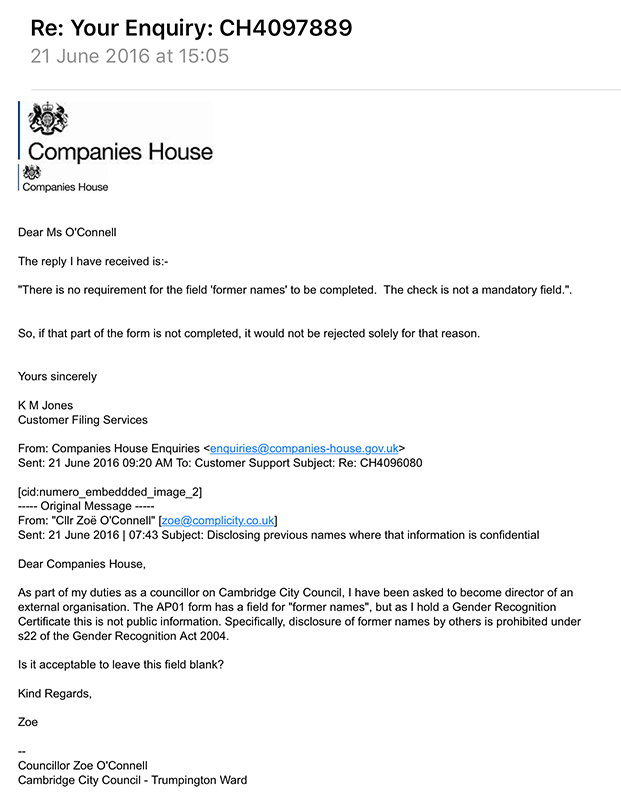
Companies House advice on dead names
A topic that comes up frequently in Trans circles is the problem of “Dead” (I.e. pre-transition) names, something that many trans people are reluctant to make public for a whole variety of reasons. Unfortunately, many forms ask for this information with the assumption that most people who have changed names have only done so because they have married.

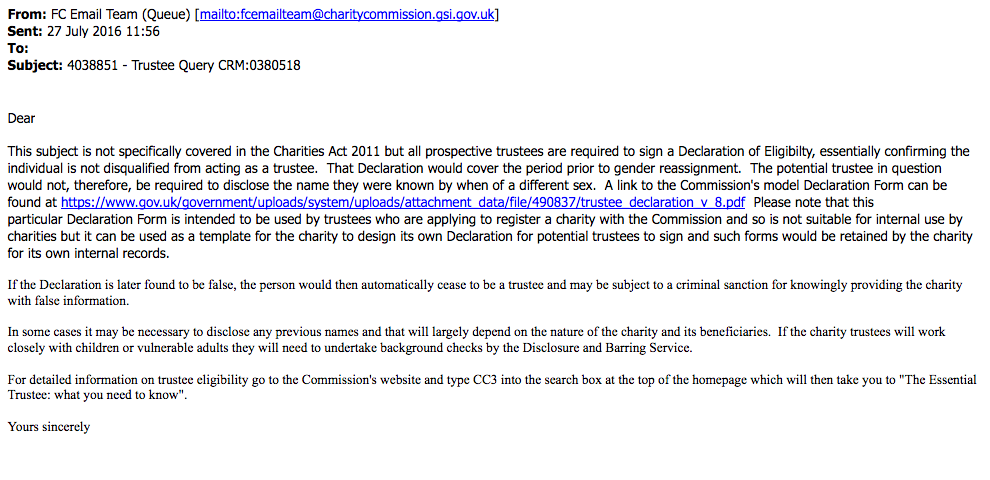
I ran into this problem myself just over a year ago, in the context of a charity I became trustee of as a result of my role as a councillor. Neither Companies House nor the Charities Commission actually require this information but that is not made clear, and when holding public office it is often necessary to dot the i’s and cross the t’s on paperwork to avoid unforeseen repercussions later on. I asked both organisations for confirmation, and I reproduce both their responses complete with reference number in the hope that it helps others in future.

Charity Commission advice on Dead Names Click the images for full size versions, and plain text versions of the respones from Charity Commission and Companies House are also available if anyone needs them.

The post Companies House and Charities Commission advice on former names appeared first on Complicity.

14 Aug 16:44

The social mobility lie

by chris

Sonia Sodha writes:

if we care about social mobility, then we should care about reducing assortative mating. 

To which Tim Worstall replies that this requires serious infringements of freedom.

I agree with Tim. Social mobility is the enemy of freedom. Enforcing it would require governments to prevent parents from doing their best for their children to stop them falling below the glass floor, and it would prevent firms from hiring whom they wanted.

It seems, then, that we have a conflict of values.

Except we don’t, because there’s nothing valuable about social mobility.

A simple thought experiment tells us this. Imagine a dictatorial society split into three classes - slave labour, guards, and rich and powerful oligarchs - in which children of the slaves have good chances of entering the higher classes either through education or perhaps lottery. We’d then have social mobility. But the society would nevertheless be unfree and unjust. Social mobility, then, is no sign of a good society.

In fact, there’s something downright dishonest about it. Social mobility pretends that if people from poor homes do well at school and work hard then they can escape their class. But they can’t. Four facts tell us this.

One is that people from poor homes are more likely to die early, even if they get a decent job later in life. In Status Syndrome Michael Marmot writes:

Where you come from does matter for your health…Family background, measured as parents’ education and father’s social class, are related to risk of heart disease.

A second piece of evidence comes from a study of Swedish stock market investors. Henrik Cronqvist and colleagues show that people whose parents were poor are less likely to hold growth stocks than people from richer backgrounds, even if they have the same current wealth. This doesn’t mean they make worse investment choices. (Quite the opposite – value stocks tend to beat growth stocks). But it does suggest that growing up poor makes you more anxious and less optimistic in later life. This chimes in with my experience.

Thirdly, people from working class backgrounds earn less than those from professional ones, even if they have similar jobs and qualifications. This might be because they have less access to social networks and good connections.

 Fourthly, the IFS shows that men from poor homes are less likely to be married in later life, even controlling for their own incomes. This is consistent with a more general pattern for the upwardly mobile to be lonely. We no longer belong to the class we come from, but don’t fit in to the one we join – in part because that class is chock full of twats who were born on third base but who think they hit a triple. As the great Jason Isbell sings:

Tried to go to college but I didn’t belong. Everything I said was either funny or wrong.

The truth is, then, that we cannot overcome the harm done by a class society. Scars don't completely heal. Waffle about hard work, merit and mobility are lies which function to legitimate inequalities and to give the rich and powerful the illusion that they deserve their fortune. The left should think less about how to increase social mobility, and more about how to abolish class divisions.

14 Aug 16:40

i don't want no scrubs, a scrub is a scifi space race i just made

archive - contact - sexy exciting merchandise - search - about
← previous August 14th, 2017 next

August 14th, 2017: Sorry if Star Trek isn't actually about stars treking all over people!! I'm PRETTY SURE it is though

– Ryan

13 Aug 23:01

The state of ebooks: Anti-DRM sentiments at Worldcon 75

by PG

From TeleRead:

The “State of Ebooks” panel at Worldcon 75 was one of the smaller but more eagerly followed panels at the con, with almost every seat taken.

. . . .

Irene Vartanoff became a convert to ebooks and self-publishing, she said, due to the portability of ebooks, and the economics and lead times of self-publishing, which underlined that writers no longer needed to wait around for traditional publishers. Nielsen Hayden recalled the early experimental days of ebook publishing in the late 1990s as a time when people joked about the huge number of man-hours of meetings spent on the medium compared to the few dollars of profit. “Things have changed since then.”

For piracy and DRM, Nielsen Hayden said that Tor has seen no loss of sales or business since it went fully DRM-free. He cited Bain Books’s policy of keeping books DRM free, and piracy as essentially a tolerable cost-of-doing-business. And if a show of (clapping) hands from the audience is any proof, the argument over DRM just isn’t an argument any more. No one wants DRM. When someone from the floor asked why publishers still insist on DRM, Nielsen Hayden said: “you’re asking the wrong publisher.”

. . . .

Nonetheless, publishers have come round to ebooks. “Publishers like them. They have fewer materials costs,” said Nielsen Hayden, though he also pointed out, “they’re not free to make; they’re certainly not free to make well.” And he maintained that books should still come out, and remain core to the business, while “to do something in e only is going to bring a kind of stigma.” Self-publishers of ebooks only, however, can still succeed, especially those writing in “a narrow but intense niche,” instancing “narrowly defined romance tastes… that appeal to a few people, but to those, it appeals a lot.”

. . . .

One strong argument for continued quality print publication everyone buys into is avoiding obsolescence of formats. Nielsen Hayden noted that a book published around 1600 could be dropped into the sea, left for hundreds of years, retrieved, and would still be readable.

Link to the rest at TeleRead

“One strong argument for continued quality print publication everyone buys into is avoiding obsolescence of formats.”

PG suggests obsolescence of traditional publishers is a much more likely issue.

Share

13 Aug 22:25

The Moral Shambles That is Our President

by John Scalzi

Denouncing Nazis and the KKK and violent white supremacists by those names should not be a difficult thing for a president to do, particularly when those groups are the instigators and proximate cause of violence in an American city, and one of their number has rammed his car through a group of counter-protestors, killing one and injuring dozens more. This is a moral gimme — something so obvious and clear and easy that a president should almost not get credit for it, any more than he should get credit for putting on pants before he goes to have a press conference.

And yet this president — our president, the current President of the United States — couldn’t manage it. The best he could manage was to fumble through a condemnation of “many sides,” as if those protesting the Nazis and the KKK and the violent white supremacists had equal culpability for the events of the day. He couldn’t manage this moral gimme, and when his apparatchiks were given an opportunity to take a mulligan on it, they doubled down instead.

This was a spectacular failure of leadership, the moral equivalent not only of missing a putt with the ball on the lip of the cup, but of taking out your favorite driver and whacking that ball far into the woods. Our president literally could not bring himself to say that Nazis and the KKK and violent white supremacists are bad. He sorely wants you to believe he implied it. But he couldn’t say it.

To be clear, when it was announced the president would address the press about Charlottesville, I wasn’t expecting much from him. He’s not a man to expect much from, in terms of presidential gravitas. But the moral bar here was so low it was on the ground, and he tripped over it anyway.

And because he did, no one — and certainly not the Nazis and the KKK and the violent white supremacists, who were hoping for the wink and nod that they got here — believes the president actually thinks there’s a problem with the Nazis and the KKK and the violent white supremacists. If he finally does get around to admitting that they are bad, he’ll do it in the same truculent, forced way that he used when he was forced to admit that yeah, sure, maybe Obama was born in the United States after all. An admission that makes it clear it’s being compelled rather than volunteered. The Nazis and the KKK and the violent white supremacists will understand what that means, too.

Our president, simply put, is a profound moral shambles. He’s a racist and sexist himself, he’s populated his administration with Nazi sympathizers and white supremacists, and is pursuing policies, from immigration to voting rights, that make white nationalists really very happy. We shouldn’t be surprised someone like him can’t pass from his lips the names of the hate groups that visited Charlottesville, but we can still be disappointed, and very very angry about it. I hate that my baseline expectation for the moral behavior of the President of the United States is “failure,” but here we are, and yesterday, as with previous 200-some days of this administration, gives no indication that this baseline expectation is unfounded.

And more than that. White supremacy is evil. Nazism is evil. The racism and hate we saw in Charlottesville yesterday is evil. The domestic terrorism that happened there yesterday — a man, motivated by racial hate, mowing down innocents — is evil. And none of what happened yesterday just happened. It happened because the Nazis and the KKK and the violent white supremacists felt emboldened. They felt emboldened because they believe that one of their own is in the White House, or at least, feel like he’s surrounded himself with enough of their own (or enough fellow travelers) that it’s all the same from a practical point of view. They believe their time has come round at last, and they believe no one is going to stop them, because one of their own has his hand on the levers of power.

When evil believes you are one of their own, and you have the opportunity to denounce it, and call it out by name, what should you do? And what should we believe of you, if you do not? What should we believe of you, if you do not, and you are President of the United States?

My president won’t call out evil by its given name. He can. But he won’t. I know what I think that means for him. I also know what I think it means for the United States. And I know what it means for me. My president won’t call out evil for what it is, but I can do better. And so can you. And so can everybody else. Our country can be better than it is now, and better than the president it has.


13 Aug 10:31

Where's your compassion for us?

by Neurodivergent K
Folks, do not do this:

If an autistic adult, in autistic space, says that something happened that was painful, don't diminish that. To take an example completely at random, say that I, on a friends only facebook post, from an airplane, say "I recognize children have a right to fly but the one behind me is kicking and screaming RIP me", there is literally no need to say "but what if that child has autism?"

What about what if that child has autism? Does that mean I no longer have Ehlers-Danlos and my back won't be fucked up for days? Does that mean I am no longer sound sensitive? Does that mean lack of sleep no longer triggers seizures? Because autistic children exist?

Every autistic adult you encounter knows damn well that autistic children exist. We are, generally, in the habit of compassion for children having a hard time in public.

The thing is though? "That kid causing you pain may have theoretically been neurodivergent so shut your hole about the very definite, documented pain and harm done to you"? That's not serving anyone. You're saying that only autistic toddlers have needs. You're fucking over your own children, if you're a parent (it is usually parents who decide to cape for Schrodinger's Autistic). They won't be toddlers forever.

We generally do have compassion for kids who are having a hard time. The thing is, you have none for us. If we cover our ears you all throw an utter fit. How dare we? We are not allowed to be in pain. If we melted down the way that the pain Precious BeighBee is putting us in makes likely? We'd get shot. That is a way for us to die, being autistic in public. But you can't muster an ounce of compassion for us, can you? Because how dare we remind you that autistic adults exist.

Our pain is real. Our pain matters. Acknowledging it isn't going to hurt you or anyone else. Promoting this idea that only toddlers are autistic, and no one else has access needs or sensory pain or anything else? That is bigoted and it is unacceptable. Your children are going to suffer for it.

But hey that child whose parents brought no toys on the plane, and who was using language patterns autistic toddlers tend to not use? You sure defended him against attacks that weren't even happening.

Your contempt for autistic adults is showing. Might wanna see to that.
12 Aug 22:32

Hugo Notes 2017

by John Scalzi

To begin, for informational purposes, the list of 2017 Hugo winners, the document of how the voting went, and the document of what and who got nominated and what just missed the ballot.

Got it? Okay!

1. I’m both super pleased with the list of winners and even more pleased that the ballot could have fallen differently and that in nearly all cases I still would have been happy. There was so much great work and so many great people celebrated this year that it was almost impossible to go wrong (there were a couple of troll attempts in there too, but they were never really a factor in the actual finalist voting. I’ll talk more about that in a bit).

2. I discovered that The Dispatcher was number seven in terms of the nomination tally for the Novella category, a category with six finalist spots. How do I feel about that? Pretty darn good. The Dispatcher was in audio form for the entire nomination period, which is not the usual format for works considered for the Hugo ballot. So I think it’s pretty cool it got close. Also, you know. It was a finalist for the Locus and three separate Audie awards (winning the Best Original Work category), so it was certainly honored enough. And I happen to think that all the finalists in the Hugo category were excellent. No complaints!

3. And, why yes, women won in nearly every category. Good for them. Their work certainly deserved it.

4. This was the first year nominations for the finalist ballot were run through the “E Pluribus Hugo” process, a complicated procedure involving fractional votes that aimed specifically to blunt the effect of “slating,” i.e., jackholes trying to swamp the ballot via lockstep nominations. It’s also the first year of “5/6,” in which people could nominate five people/works in each category but six people/works were on the final ballot — again, to minimize the effects of slating.

And how did it work? For the purposes of defeating slating — pretty well! To the extent that the jackholes who have been slating work for the last few years were able to get on the ballot at all, they were confined to one finalist out of six. All those jerkhole-related finalists were dealt with appropriately in the voting — most appearing below “no award” (i.e., we’d rather not give an award than have it given to this finalist). The signal-to-noise ratio of the Hugo ballot was much closer to the mean this year than it’s been in the last few, and that’s a good thing.

Which is not to say EPH in particular doesn’t have its issues — there were people/works this year that would have gotten on the ballot under the old system that missed out in this one (not The Dispatcher, I note, which would have been in the #7 position in either system). And I think some people noted that the jerkhole movement was muted this year in any event, so factoring for it might not even have been necessary — there was a motion at the WSFS business meeting to have EPS lifted next year.

My own thinking on this is that it was muted because the jerkholes knew the Hugos were that much harder to game, and given the scope of the slating nonsense — which lingered over four years of Hugo voting — maybe dropping anti-slating measures after just a year is a little precipitate. It does appear that others agreed with me on that, since the motion to suspend it for next year failed. Good.

5. Speaking of the jackholes, I did like that when when voting process sorted everything down, the chief jackhole got outvoted by “no award” in his category by a ratio of about 12:1. That seems about right to me. Aaaaand that’s all the mental energy I’m expending on that dude.

6. Overall, a very fine year for the Hugos. Congratulations to all! Let’s do this again next year.


12 Aug 10:14

James Chapman’s Democrats notion is a doomed distraction

by David Herdson

The existing parties are the only ones that can stop Brexit

James Chapman is not a name that many people will have been aware of before this week. Some will remember him as the Political Editor of the Daily Mail; a few might recall that he became George Osborne’s Director of Communications after the 2015 election; fewer still will have known that he was briefly Chief of Staff at David Davis’ Brexit Department. He has, however, now burst back onto the political scene with what is for now still very much a one-man crusade for a new party – The Democrats – to save Britain from herself and from Brexit.

The as-yet unanswered question is who is lurking behind Chapman’s twitter-shower. There can be little doubt that there are enough wealthy Remainers who would be happy to help fund a meaningful anti-Brexit party for it to be financially viable. Much bigger questions remain, however, about personnel. Parties need candidates, they need support staff (plus the infrastructure and data to work in and with), and above all, they need a visible and capable leader and, ideally, elected representatives. Unless there are to be defections, the personnel question will doom the Democrats from the start.

Two quick examples of the growth of start-up parties should suffice to illustrate the point. UKIP – the party which the Democrats would most closely resemble politically (albeit in mirror image) – was founded in 1991 as the Anti-Federalist League. A decade later, despite having established a place for itself in the political firmament, it was still winning only 1.5% of the vote and it would be 23 years after their formation before they gained their first elected MP (and that following a defection). The Greens had an even slower growth, taking 37 years to win representation at Westminster. By contrast, Brexit Day is scheduled for only a little over a year and a half.

The parallel that Chapman is no doubt keener to emulate and exceed is that of the SDP, formed not as a grass-roots insurgent party but, via defections, born mature: with a high-profile, experienced leader and a sizable Commons contingent and which found itself (in alliance with the Liberals – a crucial distinction) polling well into the 40s only a year after launching. If so, he can dream on.

    For all the overtures to Europhile Tory MPs (who?) or Corbyn-sceptic Labour Remainers, the fact is that neither group has any incentive to defect. If Tory Europhiles did want to disrupt the Brexit process, they could do so just as effectively by rebelling from within – May’s majority remains on a knife-edge either way.

Again, by one of history’s little ironies, the Tory Maastricht rebels provide the best template. Yet no such organised rebellions have occurred since the referendum; there is no desire to go down that road, still less to take the fatal step of splitting.

Labour Europhiles have even less cause to switch. They remain by far in the majority in both their party at large and in the Commons. They know that despite their leader’s ambivalence on the subject, they might still be able to control the effective policy simply by taking advantage of Corbyn’s lack of interest in Brexit (and, perhaps, by working with Starmer behind the scenes). They also know that in terms of the leadership, time is on their side: Labour’s pro-European majority will long outlast Corbyn.

But that fact also hints at another reason as to why the Democrats are (or would be – it hasn’t even launched yet) doomed: there is much more to politics than Brexit. Even if a determination to remain within the EU (or to leave on the softest terms, or to rejoin at the earliest opportunity), unites some MPs across parties, much more divides them. What would its Education policy be? Defence? Welfare? Health? Energy? Transport? These are bread-and-butter issues that matter on the doorstep and which those with experience of elections pay great attention. Given the Tories’ experience this Spring, I doubt it’s likely that defecting MPs would be happy to subcontract policy in these critical areas to a sometime-journalist/advisor with no electoral experience.

That assumes that Chapman would continue to play the leading role he’s delighted in so far, which he may not if the concept ever gets beyond the confines of his laptop. One intriguing question, which he was happy to play up, is whether George Osborne is involved in some way. Indeed, ConHome ran an article on Thursday asking that very question and answering why he might be.

ConHome is not, of course, without its own agenda. For my part, I find it difficult to believe that Osborne would want to return to front-line politics so soon after leaving it, and to return in such an unorthodox manner. Perhaps he has spoken with Chapman and given him advice but even if so, that is a long way from committing to lead a new minor party. His involvement would bring credibility, contacts and money; what it wouldn’t do is bring MPs – indeed, it would actively put off many Labour MPs from getting involved.

Besides, there is an elephant in the room – or at least, a bird of liberty. What would the Democrats offer that the Lib Dems don’t? Chapman would say (and has said) that the Lib Dems are tainted by their coalition years. That’s true though they’re not terminally tainted, any more than Labour was terminally tainted by the Winter of Discontent or Iraq, or the Tories were by the Three Day Week, the Poll Tax, the ERM or the Corn Laws. Cable can never entirely disassociate himself from the coalition (and in particular, tuition fees) but those arguments do seem from another era now: an awful lot has happened since 2010.

No, the bigger problem the Lib Dems face as far as making Brexit a core vote-driver – and an even bigger problem the Democrats would face – is that even now, it simply isn’t that big a driver and is likely to be still less so in 2022. The Lib Dems fought the 2017 election as the pro-EU party, against the pro-Brexit Tories and a deeply divided Labour. Much good it did them: they won their lowest vote-per-candidate score since 1886. The public simply decided that other things mattered more, or that if, as a Remainer, making a stand on Brexit was important, then Labour was an adequate vehicle through which to do it.

The Democrats may or may not launch. My guess will be that they do: Chapman would look pretty silly if after all his tweeting (including about the Democrats forming governments: talk about hubris!), nothing at all came of it. But whether or not they make a fleeting impression, their cause is doomed: they are neither needed nor wanted.

David Herdson

Follow @DavidHerdson

Tweet