
Andrew Hickey
Shared posts
17 Oct 12:09
I'm an environmental journalist, but I never write about overpopulation. Here's why.
I'm an environmental journalist, but I never write about overpopulation. Here's why.
16 Oct 18:22
Why I'm not a lefty
by chris
Reading Christopher Snowdon’s attack on eco-miserabilists made me realize something – that in many ways I’m not a lefty.
This thing is, I agree with Snowdon. Ending economic growth does not move people up a higher spiritual plane. Quite the opposite. It makes them mean and nasty. Recession and austerity led to greater hostility to immigration and to Brexit.
Yes, there’s a case to suggest to people that they live more modestly, as a way of coping with capitalist stagnation. But there’s a world of difference between suggesting something and wanting to impose it upon them.
The point broadens. There is an element of preachiness in leftism which I dislike. Granted, many of those rightists who attack the liberal elite as “patronizing bastards” are narcissistic over-entitled posh white cunts. But what Joan Williams says of US Democrats applies perhaps in part to some of their British counterparts – they are smug and patronizing and out of touch with the working class. They are too quick to identify the “white working class” with backward attitudes, and too slow to see the genuine racism of the ruling class.
Equally, there is an element of lifestyle politics among some lefties – of wishing that everyone could be more like themselves. My big problem with “nudge” politics is that it assumes that rulers are rational and that the people are not – an assumption which is very questionable.
These are not the only ways in which I depart from many (some) on the left.
For example, I’m more accepting of markets than many are. The point is not that the private sector is inherently better at managing than the public sector. Instead, it’s that markets function – when they do so well – as selection devices, selecting for more efficient strategies and against less efficient ones. Back in the days when productivity was growing, a lot of that growth (pdf) came from entry and exit rather than from incumbent firms upping their game.
It’s for this reason that I’m not wholly unsympathetic to the introduction of markets into public services. Of course, outsourcing can and has been a way simply of channelling money to capitalists. And because children only get one chance of education, failed free school experiments can be costly. For me, though, the issue is more balanced than it is for many leftists. A lot hangs on precise institutional details rather than on general principles.
Also, I’m more sceptical than many lefties of higher corporation tax. I fear these aren’t an easy pot of money for government because they might instead lead to less investment, jobs cuts or relocation. I’m not wholly convinced by Paul Krugman’s arguments to the contrary because the UK probably has less monopoly power than the US and so fewer rents to tax and we’re a smaller more open economy so firms might relocate to Ireland or the EU. I don’t say this to oppose any increase at all, and certainly there’s a case for reforming corporate taxes. I just fear that a Labour government won’t be able to raise many billions this way.
A further difference between me and many other lefties is that I’m sceptical about higher minimum wages. Yes, I know their effects so far have been much less harmful than simple-minded free marketeers warned – though not perhaps wholly harmless. But it would be wrong to infer that further rises are risk-free; there’ll come a point when a wage floor will do more than merely capture monopsony rents. Just because you fell better after taking one paracetamol it doesn't follow that you should take 20 more. I would much rather raise real wages by increasing workers’ bargaining power via stronger trades unions, full employment, a jobs guarantee and citizens income.
There is, in fact, a common theme to all these differences. It's about attitudes to knowledge. I'm much more wary of how much we can know for sure and so am sceptical of policies which presume such knowledge. This might reflect a class difference: as someone of working class origin, I've had humility beaten into me in a way that posher lefties might have.
Unlike Nick, however, I’m not going to disown the left. The differences I’ve described are perhaps those between Marxists and non-Marxists. The non-Marxist left believes, with Orwell, that England is “a family with the wrong members in control”. My problem is that in a class-divided society the wrong members will always be in control.
12 Oct 21:35
"Good policy, badly implemented"
by chris
A trend seems to be emerging among their advocates to describe both Brexit and Universal Credit as good policies badly implemented. For me, this raises a question: how big is the “good policy, bad implementation” set? I suspect it’s small, at least for major policies.
Take, for example, the biggest failures of post-war policy: Suez, Iraq, the poll tax, ERM membership. The fault with these is that they were bad ideas in principle. Few believe they’d have been redeemed by feasibly better implementation.
Yet another set of policies are those that are still controversial such as many of Thatcher’s reforms: weakening the trades unions, cutting taxes on the rich and privatization. Not even the most abject triangulator would argue that these were good ideas that were badly implemented. The debate is about the merits of them in principle.
So, what does fit into the set? Robert Harris suggested one possibility when he tweeted:
Brexiteers are sounding increasingly like Marxists: the theory is perfect, it just hasn't been implemented properly...
But I don’t think this works. Marxism is like liberalism or conservatism – a loose set of principles. The failure of a few Marxist governments does not discredit Marxism, any more than the failure of conservative or liberal governments discredits conservatism or liberalism. Of course, central economic planning is a bad policy. But it’s bad in principle; the problem is not that the USSR had the right idea but screwed up the implementation.
So what are we left with? There are contenders: numerous government IT projects, the Child Support Agency or individual learning accounts for example*.
All these are, however, second-line policies – the equivalent of squad players rather than stars. Nobody saw ILAs as their lifelong political project or identified emotionally with them in the way they do with Brexit. These tell us that bad administration is common – that there’s a great deal of ruin in a nation. Routine incompetence is commonplace – in fact, the norm.
I’m left, then, with my question: how many major, government-defining policies can we describe as good policies badly executed?
There’s a reason why there have been so few. It’s that implementation is policy. Policy-making is not like writing newspaper columns. It's all about the hard yards and grunt work of grinding through the detail. A failure of implementation is therefore often a sign that the detail hasn’t been thought through, which means the policy itself is badly conceived. Reality is complex, messy and hard to control or change. Failing to see this is not simply a matter of not grasping detail; it is to fundamentally misunderstand the world. If you are surprised that pigs don’t fly, it’s because you had mistaken ideas about the nature of pigs.
It is, therefore, often unacceptable to hide behind the “good policy, badly implemented” line. Bad implementation is at least sometimes a big clue that the policy was itself bad.
All this, though, raises another question. What about the mirror image of “good policy, badly implemented”? It’s vanishingly rare that someone says of modern-day British politics that something was a terrible policy but beautifully implemented**. Why might this be?
* King and Crewe add tax credits to this list, but I’m not sure about that; given the trade-off between support for the poor and high withdrawal rates, and the difficulty of supporting people’s whose circumstances often change, administering the system was always going to be tricky. And I don’t think it’s been terribly bad given the scale of the challenge.
** I suspect that free marketeers could say this about the minimum wage, but I’m struggling to think of other examples.
12 Oct 08:46
Sex and the Census
by Zoe O'Connell
Longtime readers of this blog will recall that I have previously written about the census in some detail. And if you’ve been about the last day or so, you’ll have seen the fuss over the news that the Office of National Statistics might make declaring your sex optional in the 2021 census.
The full details are not known as the Sunday Times story is from a leaked report and contains few details. This did not stop the Times breathlessly rushing to get quotes from two well-known anti-trans “feminists”. It seemed no trans people were asked for quotes.
The misreporting around this issue is even more widespread than usual for trans-related stories. Misreporting caused by concerns that facts will get in the way of a good headline that further demonises trans people. So here are some myths already doing the rounds, debunked.
Myth: Gender will no longer be recorded in the census, or we will have inaccurate data on gender
There are many forms in existence in which make gender optional, and most people still tick the appropriate option. Religion is a far more sensitive issue and even when the question was made optional in the 2011 census, only 7% of people chose not to provide an answer.
And the Office for National Statistics are likely to use “imputation” to fill in the gaps – a system they routinely use and causes problems analysing statistics for minority communities, such as trans people and poly households. In a nutshell, if you put your name as Mary and don’t tick “Female”, the ONS may still record you as female in statistics.
Myth: This will erase women’s identity
Tick the box, or don’t tick the box. Your choice, nobody else’s. Established religion has not disappeared since the question was made optional in 2011.
Myth: Trans people and only trans people will not answer the question, which is why it’s optional
Most trans people identify more strongly with one gender than the other, and are likely to simply tick the box they most closely identify with. The groups most likely to skip this question are, roughly in order of likelihood:
- Those who think it is “none of your damn business”. (A view that’s been held by some feminists quite separate from trans concerns for some time)
- Respondents who didn’t understand the question, perhaps because of language issues
- People who simply couldn’t be bothered.
- Non-binary people
I predict that we will see some attempts to extrapolate the non-binary population of the UK based on 2021 data. I doubt such extrapolations will be valid.
Did the Office for National Statistics get this right?
In a word, no. At least, it doesn’t look like they have but it is hard to say until the final report is published – it may be that there has been selective quoting from the report in the original article (£) and the ONS considered other factors more important. In particular, I find it a little over the top for a government report to state that asking about sex rather than gender is reallys “unacceptable”. But that may have been one side point in a longer article, or reporting the views of a focus group.
And “Other” was rejected because it was “thought to homogenise trans people and differentiate them from the rest of society“. That statement suggests that whoever wrote the ONS report has a tentative grasp of trans issues at best, as it is only true if you start from the assumption that all or most trans people will tick “other”. Liberal Democrat Conference speakers cards have an “Other/Prefer Not To Say” option on them for gender for over a year, and we have not had any complaints about that. If we were going to get complaints about getting an equality issue wrong, that’s precisely the environment in which I would expect them to surface.
And finally, there seems to be some conflation in the quotes between non-binary and intersex issues. It is unclear why the ONS has lumped intersex people in with non-binary people in this way, as they are overlapping but still distinct groups in much the same way as being Irish and having red hair are.
The post Sex and the Census appeared first on Complicity.
11 Oct 17:22
The costs of suppression
by chris
The fall of Harvey Weinstein reminds me of an important phenomenon in the social sciences – that of preference falsification, as described by Timur Kuran.
Recall another despot, Nicolae Ceausescu. For years, he faced little dissent because people were afraid to speak out. Fearing that their friends or neighbours would shun them or denounce them to the secret police, Ceausescu’s critics kept quiet. They falsified their preferences. And because dissent was so rarely heard, others also kept their own hatred of Ceausescu to themselves. There was an equilibrium of silence: millions hated Ceausescu but kept quiet which incentivized others to keep quiet.
That equilibrium lasted for years, but it was brittle. When Ceausescu gave a speech on December 21st 1989 a few in the audience began to jeer. This emboldened others to express their true opinion and within days Ceausescu was dead.
There’s a parallel here with Weinstein. As the New Yorker says:
Previous attempts by many publications, including The New Yorker, to investigate and publish the story over the years fell short of the demands of journalistic evidence. Too few people were willing to speak, much less allow a reporter to use their names, and Weinstein and his associates used nondisclosure agreements, monetary payoffs, and legal threats to suppress these myriad stories.
As with Ceausescu, however, when one or two did finally call him out in public, others were emboldened to do so. And like Ceausescu his fall was swift after being so powerful for so long. When people suppress the truth, writes Kuran, “deceptive stability and explosive change are thus two sides of a single coin.” (Private Truths, Public Lies, p21)
One corollary of this is that persistence is not necessary a sign of sustainability or efficiency. Dysfunctional structures – Ceausescu’s tyranny or Weinstein’s domination of the film industry or Fred Goodwin's RBS – can persist not because they have hidden benefits or because their leaders are geniuses, but because of the brittle equilibrium of false preferences.
Something similar happens in financial markets. Just as people suppress their opposition to a tyrant because they believe others support him, so investors can suppress their doubts about an asset’s value if they see others buy it. In this way, bubbles can emerge – as we saw in tech stocks in the late 90s and credit derivatives in the mid-00s. And just as one or two voices of opposition to a tyrant can trigger an avalanche of opposition that brings him down, so can a few otherwise innocuous pieces of news trigger a crash. Information cascades work in both directions.
You might think that all this amounts to an argument for freedom of expression and cognitive diversity, of the sort expressed by John Stuart Mill or Nick Cohen. True. But it also reminds us that the enemies of that diversity don’t lie only in the state. The Weinstein affair reminds us that men in the private sector can also achieve power and wealth by suppressing freedom. And, in fact, self-censorship can also sustain inequality, inefficiency and injustice.
A clarification. I’m not of course trying here to tell the full story of Weinstein or Ceausescu. I’m simply highlighting one particular mechanism. The social sciences are, in essence, an inventory of mechanisms.
11 Oct 11:33


Reminder: Don’t Send Me Story Ideas
by John Scalzi
Really, that’s it. If you send me story ideas, I immediately dump them unread into the trash, and I won’t acknowledge I’ve received them.
The reasons should be obvious, but in case they aren’t:
1. I have lots of ideas of my own, thanks;
2. Seriously, I have more ideas for books and stories than I will ever actually be able to write;
3. We live in a litigious society what I don’t want to be doing is spending time or money defending myself from some random person claiming I took their story idea, and yes, there’s past precedent of people sending writers ideas and then getting angry when they’re used.
Also, bluntly, I don’t need help. I’m pretty good with this whole “think up cool concepts to write stories about” thing. By all indications, it seems to be working out for me.
I suspect the vast majority of the people who want to give me story ideas mean it as a compliment, as in, “Hey, you could do this better than I could.” A rather smaller number mean it kind of in the other way, as in, “you’re not very good at this writing thing so I will graciously deign to help you out.” And some people mean it in another way, as in “the tin foil hat slipped and the voices are telling me to send this to you.” Regardless of the reason these ideas are sent, however, they all end up in the same place: The trash, unread and unacknowledged.
So might as well just not send them to me at all. Keep them! And maybe one day write them yourself. And then maybe I’ll read them, and go, “Hey, that was a cool idea. Glad I got to read it.”
11 Oct 11:32


Harvey Weinstein and Other Abusers
by John Scalzi
(For those who need it, a warning: I’m talking rape and sexual assault here today.)
First, the latest on Harvey Weinstein’s history of sexual abuse of women, from the New Yorker and the New York Times. There are more news stories out there — lots more — but those two cover a lot of ground on the present state of things.
And now, some thoughts, not necessarily in order of importance.
1. Harvey Weinstein is by all indications a rapist and general piece of shit. Just to put that out there up front, so there’s no confusion. He deserved to be fired by his company (as he was) and should almost certainly be in jail.
2. He’s also solely responsible for his own actions. Which apparently comes as a shock to the scads of people who, when the news got out, started wanting to blame prominent film people who knew him (particularly women) for their silence, and the people who worked for him for not taking a stand against him. I’ll get to both of these things in a minute, but look: Harvey Weinstein intentionally and systematically sexually abused women, sexually harassed women and targeted them for sexual coercion. He promised professional advancement and threatened professional oblivion in order to compel sexual compliance, and bribed and threatened women for their silence. And he did this, it appears, over three decades. He owns it.
3. But what about the systematic problem of harassment in the film and television industry, you ask? Well: Yes, it is there, and yes, Weinstein both participated in it and furthered it for his own pleasure, and yes, it needs to be addressed and rooted out, and anyone who sexually coerces another person should be punted hard on their ass. But let’s be clear that Weinstein was not compelled against his will to participate in it and to further it. He did that on his own. He was the author of his own moral story, and his moral story sucks. Acknowledging that Weinstein is solely responsible for his own choices neither ignores or exculpates the systematic issues of the entertainment industry. He raped and assaulted women. He owns that.
4. While we’re on the topic, let’s dispense of some other nonsense. Weinstein tried to imply that coming of age in the 60s and 70s meant his moral compass was pointed a few degrees off true. Well, that’s bullshit; I know lots of people who came of age in the 60s and 70s who know perfectly well sexual coercion and rape is immoral. Pretty much all of them, in fact. Donna Karan (who is apparently one of the few who does not) just made news by sort of airily suggesting that issue with Weinstein was more that he was a symbol of various sexual issues than a real live man who raped and sexually assaulted numerous women, and well. No. It’s possible he is both, but any story framing that attempts to keep his personal actions from being front and center is crap. He wouldn’t be a synecdoche for these issues if he wasn’t a coercive assaulting piece of shit. Any explanation of Weinstein’s behavior that does not center his own choices is a bad one. He’s a grown man. He knew what he was doing, and he knew what he was doing was wrong. He did it anyway.
5. What about the staff at Miramax and The Weinstein Company who knew — or at least could guess — what their boss was up to but did nothing about it? I’m not here to excuse them, and we are all responsible for our moral choices. I am also aware it’s easy to judge when your career and income aren’t riding on the necessity of not looking too closely at what your boss is doing. Bear in mind that the film industry is the industry that perfected blackballing — one day you’re fine and the next no one’s returning your calls. At the height of his powers there’s no doubt Harvey Weinstein could make working in the industry very difficult, and the further down the food chain you were, the more difficult he could make it.
I am fortunate that when I was working for others, I never had a boss whose moral baseline (as far as I knew) substantially conflicted with mine. I was never put in a position of having to cover for, or look away from, a bosses’ actions. I would like to think that if I had been, I would have done the correct thing, even in the face of losing my job. I’d like to think that, but it’s easy to think about what you would do when you’ve never been confronted by that actual decision point.
Again, I’m not here to excuse the moral choices Weinstein’s employees made — or didn’t make — and they’ll have the burden of their choices for the rest of their professional lives. I do know that the burden of their choices was placed on them because Weinstein chose to sexually assault and coerce women. His actions had consequences beyond him.
6. As for the issue of very famous people apparently not knowing what Weinstein was up to, I’m going to tell you a story. In my line of work there was an editor named Jim Frenkel, who worked for Tor, my publisher, and who as it turned out was a harassing piece of shit. It also turned out that he was very good at hiding that fact from his bosses and fellow editors and from authors, like me, who did not fit the profile of the sort of person he liked to harass. I was male, I was already published and successful, and I suspect Frenkel knew I would talk if I found out anything. I found out because Frenkel finally harassed a person who was more than happy to talk out loud about it, and who had people who would amplify her voice. Lots of people lateral to or above his status were shocked. Lots of women below his status asked how the hell the rest of us did not know.
We didn’t know because we didn’t see it personally; we didn’t know because the “whisper network” didn’t reach us. And why didn’t it reach us? Maybe because the women were scared about what Frenkel could do to their careers. Maybe because they assumed some of us already knew and were doing nothing about it. Maybe because some of us were men and the women didn’t want to have to deal with the emotional burden of trying to make us believe harassment was a real thing. “Whisper networks” can be useful, but as my friend Naomi Kritzer noted on Twitter, they’re full of holes. And more than that: They propagate downward and attenuate upward. After a certain height, you don’t hear many whispers.
No one knows a food chain better than a predator. Harvey Weinstein was not going to prey near or above his station; doing so served none of his purposes and represented risk. He wasn’t going to prey on (say) Meryl Streep or Hillary Clinton, and the chances that someone he would prey on would be able to tell either of those two women — or other women of a similar stature, or men on the same level — was pretty slim, and what reaches someone at that level is often spotty and inconclusive, for all the reasons noted above.
(Please note I’m not originating these observations; check out this Twitter thread yesterday from a woman screenwriter which makes basically the same point. It’s not the only thread like it out there.)
This doesn’t mean no people above certain level didn’t know. But it does mean predators are good at hiding their tracks, or at least making their path confusing. It also means that predators know how to leverage their power — and in the case of Harvey Weinstein, he was very powerful indeed.
And for the women of power who did know and who kept quiet, or at least quietish: Surprise! This is where the systematic sexism and harassment in the film/TV industry raises its head. You knew it would show up sometime!
7. Anyone who voted for an admitted sexual predator for president who is now blaming women for not knowing or not confronting Harvey Weinstein: Sit the fuck down. You don’t even have the veil of plausible deniability to cover the fact that you helped make Mr. “Grab ‘Em By the Pussy” the President of the United States. You knew and you didn’t care. To go after Clinton because she knew Weinstein after you cast your vote for Trump, well, shit. Got a Bible passage for you, son.
And, not that I’ve seen it, but in case it’s out there (and it probably is, somewhere): Anyone defending Weinstein on the basis of his ostensible politics or because of the great art he’s helped produce, you can sit the fuck down, too. The correct politics and the ability to spot good films and filmmakers isn’t a pass for being sexually coercive and a rapist. I’m happy to cede this piece of shit human has very fine taste in cinema. He’s still a piece of shit human.
8. I’m all for condemning both Trump and Weinstein, and any other man who uses his power to sexually coerce other people. Weinstein is a liberal and Trump is, well, whatever the hell he is (white supremacist authoritarian populist masquerading as a conservative), but both are men who have decided that they get to force themselves on women, and women should be happy or at least quiet about it. There’s no political angle to it; or more accurately, certain men of any political stripe seem happy to be predatory pieces of shit. Nor should there be any political separation to the solution to this problem: Kick all that shit to the curb.
9. And of course some of the backlash from this is that some men in corporate settings are now avoiding women, which makes me want to smack my head and wonder what the fuck is wrong with my sex. The solution is not to cut women out of your professional life, you assholes. The solution is to fix your goddamned corporate culture and root out the sexual harassers and predators so neither you nor any woman have to worry that a closed-door meeting means a quick two-step to the HR department. Redlining women from professional advancement because you don’t know how else to deal with the issues of harassment and predation means you are the problem, not them.
10. Harvey Weinstein is a piece of shit, but he’s not the only piece of shit out there. The film/TV industry has a sexism and harassment problem, but it’s not the only industry with a sexism and harassment problem. Today is Weinstein’s moment in the barrel, and he should be shot to the moon for it. But there’s a whole line of dudes waiting after him, starting from the president and working on down.
All of which you would know already, my dudes, if you listened to women and believed them. I’ve been working on that one myself a lot recently. I’m not perfect, but I like to think I’m getting better at it. We’ll see. Maybe you should make an effort at it too, if you’ve not done so already.
11 Oct 07:08

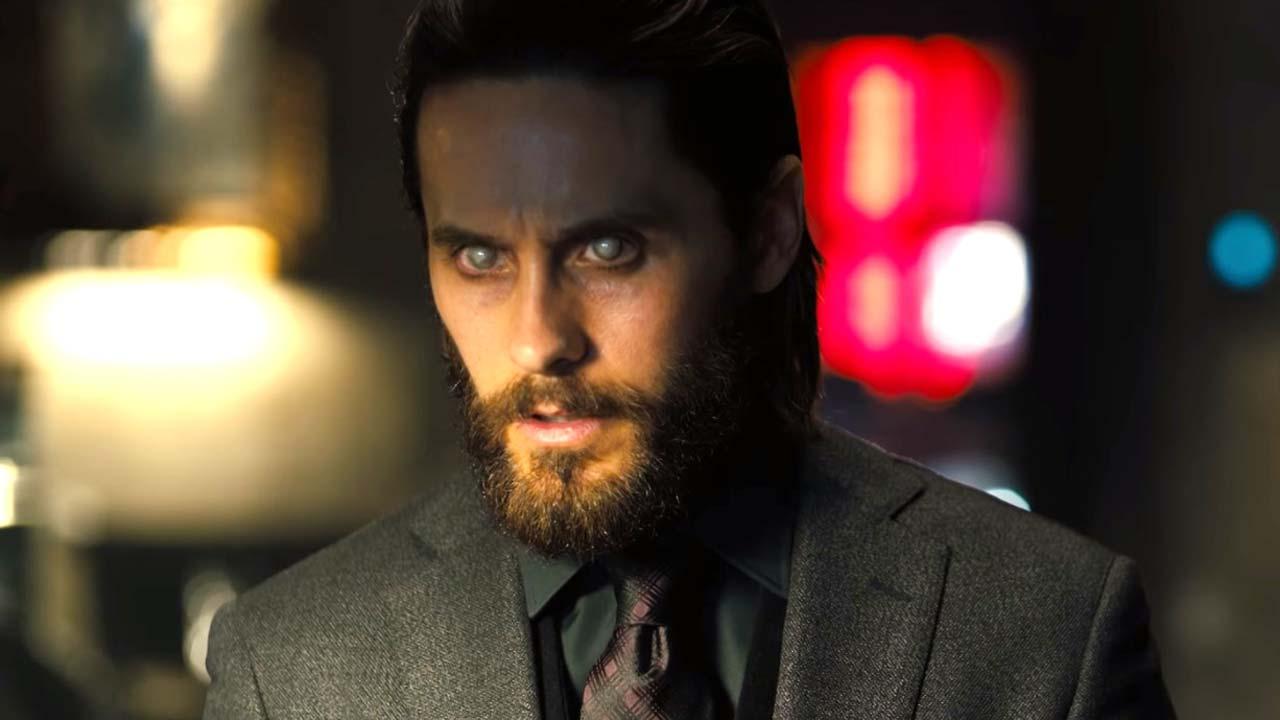

Pearls Before Cows: Thoughts on Blade Runner 2049
by Peter Watts
Lers
of
Spoi.
You Have Been Warned.
I’ll give ’em this much: they owned The Curse.
I’ve been dreading this film ever since I heard it was in the works. I’ve been looking forward to it ever since I saw Arrival. Now that I’ve seen it, well, I’m…
Vaguely, I don’t know. Dissatisfied?
Not that Blade Runner 2049 is a bad movie by any stretch. It’s brilliant along several axes, and admirable along pretty much all of them. I can’t remember, for example, the last time I saw a mainstream movie that dared to be so slow, that lingered so on faces and snowscapes. Almost Saylesian, this sequel. In a century dominated by clickbait and cat memes, Villeneuve has made a movie for people with actual attention spans. (This may explain why it appears to be bombing at the box office.)
The plot is, unsurprisingly, more substantive than that of your average SF blockbuster (it’s nothing special next to the written genre, but ’twas ever thus with movies vs. books). It’s downright brilliant in the way it transcends the current movie and reaches back to redeem the earlier one. Back in 2019 it took Deckard three speed dates and a couple of days to go from How can it not know what it is to Self-Sacrificing Twoo Wuv; for me, that was the weakest element of the original movie. (Rachael’s participation in that dynamic was easier to understand; she had, after all, been built to do as she was told.) 2049 fixes that— while throwing its precursor into an entirely new light— without disturbing canon by a jot. Nice trick.
The AI-mediated sex-by-proxy scene was, I thought, wonderfully creepy and even better than the corresponding scene in Her (the similarity to which is apparently deliberate homage rather than blatant rip-off). The usual suspects have already weighed in with accusations that the movie is sexist— and though I’ll admit that I, too, would like to have seen one or two of those twenty-meter-tall sex holograms sporting a penis, it still seems a bit knee-jerky to complain about depictions of objectification in a movie explicitly designed to explore the ramifications of objectification. (You could always fall back on Foz Meadows’ rejoinder that “Depiction isn’t endorsement, but it is perpetuation”, so long as you’re the kind of person who’s willing to believe that Schindler’s List perpetuates antisemitism.)
Visually, of course, 2049 is stunning. Even its occasional detractors admit that much. Inspired by the aesthetic of the original Blade Runner but never enslaved to it, every framing shot, every closeup, every throwaway glimpse of Frank Sinatra under glass is utterly gorgeous. But the art direction is also where I started to experience my first rumblings of discontent, because some of those elements seemed designed solely for eyeball kicks even if they made no narrative sense.
Dude. You literally own an eyeball factory.
Here’s an example: Niander Wallace, the chief villain, is blind. His blindness is spookily photogenic— as are the silent floating microdrones which wirelessly port images to his brain (is it just me, or did those look for all the world like scaled-down versions of the alien spaceships from Arrival?)— but this is a guy who owns a company that mass-produces people, all of whom seem to have 20/20 vision. A pair of prosthetic eyes is somehow out of his budget? Wallace chooses blindness for the sake of some cool close-ups?
I’m also thinking of the dancing meshes of waterlight writhing across so many surfaces in his lair; dynamic, hypnotic, mesmerizing. As sheer objets d’art I’d project them onto my own living room walls in an instant— but why the hell would Wallace floor so many of his workspaces with wading pools? Solely for the visual aesthetic? Was it some kind of kink? Did Wallace buy off the building inspectors, or did they just not notice that his office design would let you kill someone by pushing them a half-meter to the left and tossing a live toaster in after them?
By the time a silent horde of renegade replicants emerged from the radioactive darkness of the Las Vegas sewers (a rare misfire, more hokey than dramatic), my misgivings about eye candy started spilling over into the story itself. The secret of replicant procreation is of understandable interest to Wallace because it would allow him to boost his production rate; its revelation is dangerous to K’s boss for reasons that are somewhat less clear (it would “break the world”, in ways left unexplained). The renegade sewer replicants value the secret because— somehow— the ability to reproduce means they’re not slaves any more?
I might be a bit more receptive to this claim if self-replicating stock hasn’t always be one of the cornerstones of institutionalized slavery in real life, but I doubt it. Beyond the questionable implication that you have to procreate to be truly human, the claim makes no logical sense to me— unless the point is to simply breed, through brute iteration, a rebel army in the sewers (which seems like a very slow, inefficient route to emancipation in the high-tech blasted-wasteland environment of 2049).
All of which segues nicely into my biggest complaint about this admittedly beautiful film; why are the replicants rebelling at all? Why, thematically, does 2049 play it so damn safe?
Liander Wallace’s replicants are obedient: so obedient that they can be trusted to run down and kill previous generations of runaways who were not so effectively programmed (apparently Tyrell Corporation got all the way up to Nexus-8s before the number of replicants going Batty drove them out of business). That premise opens the door for more challenging themes than the preachy, obvious moral that Slavery Is Bad.
Is slavery bad when the underclass wants to be enslaved? Does it even qualify as slavery if it’s consensual? Yes, the replicants were designed for compliance; they had no choice in how they were designed. Does that make their desires any less sincere? Do any of us get a say in how we’re designed? Are engineered desires somehow less worthy than those that emerge from the random shuffling of natural meiosis? Is it simply the nature of the desire that makes it abhorrent, is the wish to be enslaved so morally repugnant in principle that we should never honor it no matter how heartfelt? If so, what do you say to the submissives in BDSM relationships?
(To those who’d point out that, in fact, the old Nexus-era replicants sincerely desired not be enslaved— that only the Gosling/Hoeks-era replicants were content with their lot— I’d say that’s kind of my point. A movie that starts with the intriguing premise of rebellion-proof replicants throws that premise away to rehash issues already explored in the original Blade Runner. And not only does 2049 throw the premise away, it betrays the premise outright when rebellion-proof K ends up, er, rebelling.)
2049 could have played with all these ideas and more— its thematic depth could have leapt beyond that of the original in the same way its visual design did. Instead, screenwriters Fancher and Green chose to retread the same moralistic clichés of shows like (the vastly inferior) “Humans“.
Smaller budget. Greater depth.
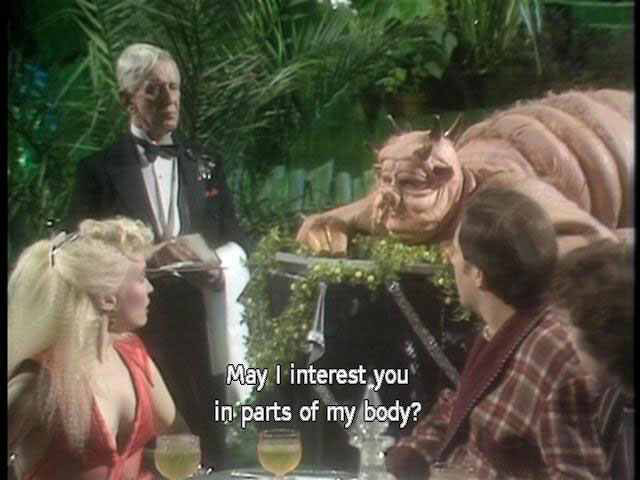
Almost 40 years ago, Hitchikers Guide to the Galaxy showed us a sapient cow who wanted be be eaten, recommending its own choice cuts to diners in the Restaurant at the End of the Universe. Douglas Adams explored more interesting territory in that two-minute vignette than 2049 does in its whole two hours and forty-five minutes.
Denis Villeneuve has served up a pearl of a movie for us: glittering, opalescent, so smooth and slick you could grind it into a Hubble mirror. You should definitely go see it on as big a screen as you can find; it’s one of the better films you’re likely to see this year. But the thing about pearls is, they’re essentially an allergic reaction: an oyster’s response to some irritant, a nacreous secretion hiding the gritty contaminant at its heart. Pearls are beautiful band-aids wrapped around imperfection.
Blade Runner 2049 is a fine pearl. But it would have made a better cow.

“Maybe science fiction should involve less self-centered navel-gazing about What It Is To Be Human, and more exploration of What It Is To Not Be.”— The BUG.

06 Oct 21:19


Text-only news sites are slowly making a comeback. Here’s why.
by PG
From Poynter:
A few days before Hurricane Irma hit South Florida, I received a query on Twitter from a graphic designer named Eric Bailey.
“Has anyone researched news sites capability to provide low-bandwidth communication of critical info during crisis situations?” he asked.
The question was timely — two days later, CNN announced that they created a text-only version of their site with no ads or videos.
. . . .
The same week, NPR began promoting its text-only site, text.npr.org on social media as a way for people with limited Internet connectivity during Hurricane Irma to receive updated information.
. . . .
These text-only sites — which used to be more popular in the early days of the Internet, when networks were slower and bandwidth was at a premium – are incredibly useful, and not just during natural disasters. They load much faster, don’t contain any pop-ups or ads or autoplay videos, and help people with low bandwidth or limited Internet access. They’re also beneficial for people with visual impairments who use screen readers to navigate the Internet.
. . . .
NPR’s text.npr.org is likely the oldest example of a working text-only news site that’s still in existence. It originally launched as thin.npr.org back in June 2005, in response to the September 11th attacks — when many news sites struggled to stay online amidst record traffic numbers — and also to help people who were navigating to npr.org back in 2005 on handheld mobile devices like Blackberries.
Earlier this month, a number of improvements were made to the site (which redirects to thin.npr.org) aimed specifically at low-bandwidth users.
“More recently, our full site [npr.org] has made major accessibility gains,” write Patrick Cooper, NPR’s director of web and engagement, and Sara Goo, the managing editor of digital news. “But as accessible or as fast as you can make your full site —and speed is critical for us — low-bandwidth situations are a different challenge. [Our] improvements focused on those users in particular.”
Text.npr.org’s improvements included “adding a caching layer to greatly improve speed and adding code to make the site display well on phones,” write Cooper and Goo. “We also increase[d] the number of stories on the [text.npr.org] homepage, made the homepage use the story ordering from our full site, updated the navigation links, removed an interim page in each story that showed only the first paragraph (something that was more valuable before we improved the page speed), and created an easier to remember “text.npr.org” redirect for the site.”
In recent months, Twitter, Facebook, and Google News have also published their own versions of stripped-down sites that use less bandwidth, mainly aimed at users in emerging markets who might not have access to faster network connections. Earlier this week, Twitter announced that it was now experimenting with an Android app designed to use less data for people with limited connectivity.
. . . .
Kramer: I’m curious. What kinds of things can be stripped from sites for low-bandwidth users and people with visual impairments?
Bowden: Those are two very distinct user groups but some of the approaches bleed over and can be applied together.
For low-bandwidth users: Cut the fluff. No pictures, no video, no ads or tracking. Text files are good enough here. Anything else is just fluff.
Link to the rest at Poynter
PG is happy to have high-speed internet access, but he likes the stripped-down sites because he can scan them for interesting items more quickly.
06 Oct 20:16
McDonnell's Marxist critics
by chris
It’s sometimes said – usually by those who know nothing about Marxism – that John McDonnell is a Marxist. In one sense, this is the exact opposite of the truth: it is not McDonnell who is the Marxist, but his critics.
To see what I mean, remember that there are several differences between Marxism and social democracy. Not least of these is the question: can capitalism provide adequate living conditions (both material and non-material) for workers? Social democrats believe it can with the right policies and institutions. Marxists say it can’t.
Now, McDonnell’s main policies are social democratic ones. Higher corporate and personal taxes, more infrastructure spending and borrowing and nationalized railways and utilities are all compatible with the continuation of capitalism. They merely tweak the mix of public and private sector activity towards the former. Anybody in western Europe, or who remembers the 1960s, should be familiar with this.
Let’s, though, assume (for the sake of argument) that McDonnell’s harshest critics are right and that these tweaks would be very damaging: that higher borrowing would raise interest rates and crowd out private sector capital spending; that higher corporate taxes would deter investment; that higher minimum wages would destroy jobs; that higher top taxes would have big adverse Laffer curve effects; and that regulations such as bans of zero hours contracts or high credit card charges would cumulatively depress economic activity.
What this amounts to is exactly the attack that Marxists make against social democrats – that they cannot reform capitalism to greatly help workers.
In fact, such criticisms go further than I would. True, I’m sceptical about higher corporate taxes and minimum wages, and I doubt that trend growth is as malleable as McDonnell thinks. But I resist CapX-style hyperbole because I suspect that developed economies are more resilient to bad policy than many people think. (We'd be out of luck if it were otherwise.)
Of course, these attacks on McDonnell would not be Marxist at all if they were accompanied by positive defences of capitalism. If we lived in an economy in real wages were growing and jobs improving, McDonnell’s critics could argue coherently that unreformed capitalism was delivering rising living standards and that social democrats and Marxists were both wrong.
But this is not the world we live in. Real wages are lower than they were ten years ago; productivity is growing at close to its slowest rate since the start of the industrial revolution; job prospects for diligent but non-academic people are worsening; and working conditions are bad for many and deteriorating even in once-good jobs.
Capitalism as it currently exists is failing working people. If this fact is accompanied by claims that social democratic reforms will fail, then we have the Marxian conclusion – that capitalism opposes the interests of working people.
Can rightists escape this bind?
Maybe. They need to show that other tweaks to capitalism would work. And I mean seriously so: fantasies about deregulation and platitudes about increasing opportunity aren’t good enough.
So, here’s my challenge to McDonnell’s rightist critics: can you really show ways of making capitalism work (again?) for working people? Or are you just going to continue to support we Marxists?
05 Oct 21:40
Ducking questions about capitalism
by chris
Theresa May’s speech this morning was trailed as a defence of free market capitalism. If that’s what it was, it failed because she failed to answer the big questions.
May said:
A free market economy, operating under the right rules and regulations, is the greatest agent of collective human progress ever created.
This is true. The excellent economics course devised by Wendy Carlin and Sam Bowles begins from this very fact. But it is a fact upon which Marxists agree. Marx and Engels wrote that
[Capitalism] has accomplished wonders far surpassing Egyptian pyramids, Roman aqueducts, and Gothic cathedrals…The bourgeoisie, during its rule of scarce one hundred years, has created more massive and more colossal productive forces than have all preceding generations together.
The question is: can this continue? Marx – following classical economists’ forecasts of a stationary state - predicted that it wouldn’t, and that capitalist property relations would turn into “fetters” which constrained growth. The fact that we’ve had a decade of falling real wages and stagnant productivity is consistent with the possibility that Marx was right. Maybe a falling rate of profit, fear of competition, capitalist hierarchy and state-backed monopolies are constraining growth. If so, we might need something close to the overthrow of capitalism to restore growth.
Do we? May doesn’t even consider the question.
Nor does she ask its correlate: why exactly have wages and productivity flatlined for so long? If it’s not because of structural capitalist stagnation nor presumably because of fiscal austerity then why? And if there are policy changes that can remedy these, why have they not been implemented since 2010? Yes, Ms May speaks of progress in financial regulation. But does she seriously think this is sufficient to end financial crises – that we’ve finally achieved an end of history in which crises are abolished?
Yet another question is: do we really have a free market economy? In many sectors, the answer is: no. Banks and utilities are far more like rent-seeking state-aided oligopolies than the textbook perfectly competitive markets. There’s a reason why Labour wants to renationalize railways and utilities and not your local greengrocer: it’s because some are monopolistic and others aren’t. Labour’s nationalization plans are not an attack upon markets – at least not on well-functioning ones.
Which raises a further question: what is the relationship between capitalism and markets? Yes, historically the two have been correlated. But this is not a logical necessity. Capitalism is about who owns productive assets; markets are about how goods are allocated. Capitalism can actually undermine free markets, as bosses seek monopoly profits and as crises and stagnation undermine public support for markets.
It is theoretically possible to have markets without capitalism; see, for example, Gary Chartier and Charles Johnson’s book, Markets Not Capitalism (pdf). In fact, in my not wholly idiosyncratic notion of socialism, markets would be healthier than they are under today’s capitalism.
Which leads to another question: are the Tories really able to defend free markets any more? The problem is that, as Phil says, they are the allies of the most “socially useless section of capital”: rentiers, low-wage bosses, tax-dodgers and a few financiers. This is not the group we should look to for an advancement of healthy markets.
I like to think that there should be a case for free markets. This requires that they operate in frameworks that constrain rent-seeking and exploitation. It’s not at all clear that the Tories can make such a case.
* To his credit, Tim Worstall has always been clear about this.
05 Oct 16:11
Hammond's weak defence of markets
by chris
Philip Hammond said yesterday that the Tories must try to champion the market economy. This won’t work.
For one thing, Labour is not really challenging the market economy. Aditya is right to say it is offering “moderate social democracy… capitalism, of a kind that Angela Merkel would know.” Labour’s nationalization plans focus upon those industries where it believes markets are not working. By all means criticize their diagnosis or remedy, but hyperventilating about them overthrowing the market economy is just stupid. Nationalizing the railways will make us resemble not Venezuela but Germany - and even the most fanatical Brexiter shouldn't panic about this.
There’s a further problem. It’s that mainstream Tories are not full-blooded free marketeers. In the labour market, they have raised the minimum wage and support immigration controls. In the housing market they favour planning restrictions that stop new building and Help to Buy, measures deplored by serious free marketeers. And there are some markets many Tories want to suppress, such as in sex and recreational drugs. Nor is there anything new about all this. As BBC4’s documentary on Friday reminded us, the Thatcher government’s supposed support for free markets and entrepreneurs didn’t stop it repressing pirate radio stations*.
Of course, you might reply that such restrictions are needed because free markets are not always a good thing. That’s entirely reasonable. But it carries two costs.
One is that it means you can’t use Hayek’s defence of free markets:
Since the value of freedom rests on the opportunities it provides for unforeseeable and unpredictable actions, we will rarely know what we lose through a particular restriction of freedom….when we decide each issue solely on what appear to be its individual merits, we always over-estimate the advantages of central direction. (Law, Legislation and Liberty, vol I p56-57)
The second is that it means the difference between Labour and the Tories is not a matter of principle but of empirics: to what extent is any particular market working well, and if it isn’t what is the best remedy?
Which raises a further problem. Hammond doesn’t grasp the severity of our economic malaise. His claim that “our economy is not broken: it is fundamentally strong” reminds me of Monty Python’s Black Knight protesting that the loss of his arms was “just a flesh wound.” Ten years of stagnant real wages and the worst productivity performance since the start of the industrial revolution tell us that the economy is indeed broken. Windy talk about the market economy won’t fix it. Pretending that the economy is basically fine merely entrenches the impression that the Tories support only the most decadent sections of capital: landlords, rent-seekers and parasitic finance.
* The fact these were run by many black people was, no doubt, just a coincidence.
05 Oct 16:03
The Tories' structural crisis
by chris
Phillip Hammond’s speech to the Tory conference this week contained an interesting omission. He spoke of “35 years in which we have seen real living standards almost double in this country.” What he omitted to say was that all that growth came before 2007. GDP per head now is barely higher than it was then, and real wages are lower.
This reveals something – an inability of the Tory party to confront the modern world. Hammond just couldn’t admit to the realities of capitalist stagnation.
In this, of course, Hammond is not alone. We should see his speech alongside Amber Rudd’s willful inability to understand the internet, Johnson’s recitation of Kipling, and Rees-Mogg’s irrelevant invocation of Crecy and Agincourt. All are examples of the Tories being much more comfortable in the past than the present. Brexit, of course, is another example of this. For every Tory who sincerely regards this as a means of transforming the UK into an open global trading nation, it is for many more an effort to return us to a pre-immigration era.
All this nostalgia contrasts with the fact that the truly successful parties of post-war Britain have been forward-looking. Think of Attlee’s talk of building a “new Jerusalem”; Macmillan’s embrace of decolonization and a mixed economy; Wilson’s “white hot heat of technology”; Thatcher’s efforts to improve industrial relations so the UK could compete in a global economy; and of course Tony Blair couldn’t open his mouth in the 90s without talking of modernization.
In this sense, not only are the Tories not a party of government, they are barely even an opposition in waiting. They are just a small group of pensioners out of touch with the country.
How did they get themselves into this mess? I don’t think it’s simply because so many are so thunderingly mediocre: Theresa May’s “burning injustice” speech on becoming PM demonstrated some awareness of the challenges we face.
Instead, their problem is a structural one. Any serious attempt at modernizing the economy would alienate the party’s client base. As Richard Seymour says:
They no longer have any idea how to administer capitalism. No viable long-term growth strategy avails. They can't address the financial sector without hurting their allies in the City. They can't address the crisis of productivity and investment without more state intervention than they're willing to accept. They can't address the housing crisis or the precarious debt-driven economy without harming the interests of home owners.
In this context, speculation about the Tory leadership is irrelevant; it’s just another example of imbecile leadershipitis that disfigures British thinking not just about politics but business and sport too. The party’s crisis is much deeper than that.
05 Oct 11:55


A Brief Addendum to “Word Counts and Writing Process”
by John Scalzi
Done up in Twitter form, and archived here for posterity.
1. I have some people snarking at my piece about the writing in the Trump era by noting (say) Solzhenitsyn managing to write in Russia…
— John Scalzi (@scalzi) October 5, 2017
2. The argument there, presumably, being that if he could do it, I should just shut up about my troubles, SNOWFLAKE. Okay, but…
— John Scalzi (@scalzi) October 5, 2017
3. Let's note that it took Solzhenitsyn a decade to write The Gulag Archipelago, his most noted work, and another five years to publish…
— John Scalzi (@scalzi) October 5, 2017
4. So perhaps he's in fact a very fine example of how an awful political environment will slow down writing and make it harder to work.
— John Scalzi (@scalzi) October 5, 2017
5. The issue isn't if people CAN create in bad times. Of course they can, and do. The question is how much art is slowed or not realized…
— John Scalzi (@scalzi) October 5, 2017
6. … because creatives are using brain cycles to deal with a horrible reality they can't avoid: War, poverty, political repression, etc.
— John Scalzi (@scalzi) October 5, 2017
7. I'm guessing that nearly all creatives who had to write during strife would've preferred to have those stolen brain cycles back for art.
— John Scalzi (@scalzi) October 5, 2017
8. I'm indeed writing through the Trump era, slower than I'd like, but writing anyway. But I'd like my stolen brain cycles back, too.
— John Scalzi (@scalzi) October 5, 2017
9, Thus the irony of trying to use Solzhenitsyn as a cudgel here. I wonder what and how much more we could have had, had he lacked duress.
— John Scalzi (@scalzi) October 5, 2017
10. So, yeah. Silly argument. Just another variation of "shut up and write, you monkey." Well, I'll write. But I won't shut up.
Done.
— John Scalzi (@scalzi) October 5, 2017
PS: The piece this is a follow up to is here, if you’ve not already read it.
Pelgris and -1 others like this
03 Oct 10:56


2017, Word Counts and Writing Process
by John Scalzi
Today I wrote 1,850 words on Head On, my novel which is coming out next year. In any year previous to 2017, 1,850 words from me in a single day would be an okay day — slightly below my general average of 2,000 or so that I can reliably pump out on a daily basis, but not so far below that I would worry about it. The 2k daily goal is fungible. Some days I’ll get 1,850 words, some days I’ll get 2,300, and over time it all comes out in the wash. I get a novel done in roughly three or four months, a span of time which leaves room for false starts, snipping out dead ends, and otherwise revising and fixing the novel as I go along.
Here in 2017, 1,850 words on the novel in a day — 1,85o usable words — is an actual goddamned miracle. I started Head On in January with the plan to be done in the first half of the year, to leave the rest of the year open for other projects, including getting a head start on the next book in the Interdependency series. And here we are in October and I’m still not done, and generally speaking I’ve been lucky if I’ve gotten a few hundred usable words out of a writing day. I have never had as hard a time writing a novel as I have had with this one.
Not because this particular book is hard to write. The novel, which is the sequel to Lock In, is complicated — it’s got a mysterious death and lots of twisty and turny bits — but I’ve done complicated before. Complicated is not inherently difficult to write. It just takes attention to detail, which normally I’m able to do just fine. When I write on it — when I have those stretches of being able to write — it all works. The plot flows well, the characters are doing their thing, and everything chugs along. What I’m writing is good. There’s just so much less of it than usually happens for me.
I’m not trying to be mysterious about what it is about 2017 that is different. The answer is obvious: Trump is president, and he’s a peevish bigoted incompetent surrounded by the same, and he’s wreaking havoc on large stretches of the American experience, both in his own person and by the chaos he invites. But to say “well, Trump,” is not really to give an answer with regard to what’s different. We’ve had terrible presidents before — George W. Bush springs to mind — and yet my ability to create work was not notably impacted. When Dubya was in office I wrote five novels. The Dubya era was a crappy time for America (recall the wars and the Great Recession) but from the point of view of productivity, it was just fine for me.
The thing is, the Trump era is a different kind of awful. It is, bluntly, unremitting awfulness. The man has been in office for nine months at this point and there is rarely a week or month where things have not been historically crappy, a feculent stew of Trump’s shittiness as a human and as a president, his epically corrupt and immoral administration, and the rise of worse elements of America finally feeling free to say, hey, in fact, they do hate Jews and gays and brown people. Maybe other people can focus when Shitty America is large and in charge, but I’m finding it difficult to do.
Here’s one way to put it: Twelve years ago, when Hurricane Katrina hit and the US Government flubbed its response and hundreds died, I was so angry and upset that I almost vomited in sadness and anger. It’s not an exaggeration, by the way — I literally felt like throwing up for a couple days straight. I eventually had to write “Being Poor” because it was either do that or go crazy. That was a week of feeling generally awful, and it wrecked me for another week after that. It took two weeks for me to get back on track with the novel I was writing at the time.
Got it? Okay, listen: 2017 has been me feeling like I felt when Katrina hit every single fucking month of this year.
Because, well. Pick a month, guys. Every month of 2017 has been a treat. Travel bans, white supremacists marching, awful health care repeals that just wouldn’t die, and not one, not two, but three historically massive hurricanes and the scouring of Puerto Rico. Russia. Fucking Russia, man. Not to mention Spicer, Scaramucci, Flynn, Price, Bannon, Gorka and the rest of that ridiculous cast. Any one of those is enough to get me (and not just me, lots of people) spun up and distracted. And it’s not just any one of these things. It’s that all of these things keep on happening. When you’re already spun up, it doesn’t take all that much more energy to stay spun up and distracted.
Well, just unplug! Well, see. Here’s the thing about that: I have. And I’ve found out it doesn’t really work like it used to. The world gets in anyway, because the world is in worse shape and wants you to know. It’s not just a matter of unplugging from social media, although it does help to get away from that. But short of building a Faraday cage around my house and then never, ever leaving it, the news of the day arrives.
Now, I want to be clear: It’s not just the news. It really is also me. I have never not been politically engaged — remember I wrote an opinion column when I worked in newspapers, and that I was writing here on Whatever for years before Old Man’s War was published. It’s hard for me to disengage; more than, I suspect, many other people. In a very real sense, this is part of who I am and what I do. I find it difficult to walk away from it, because I know it doesn’t stop just because I’m not paying attention to it.
(And also, while we’re on the subject, let’s talk about the fact that even if it is hard for me to tune this shit out, I could tune it out, with relatively little penalty to me. In Trump’s America, if you’re a straight white rich dude, none of his bullshit is aimed at you personally. Meanwhile lots of people I know can’t tune it out, because the bullshit is aimed right at them. It’s not accurate to say I feel guilt about this. It is accurate to say that I feel uncomfortable not standing with my friends and others who don’t have the luxury I have, of tuning out when it’s inconvenient to be tuned in. Note also this is also about me — I know folks who have to tune out in order to stay outside of a depression spiral, and I encourage them to do so. This about my own struggle with this stuff, not anyone else’s.)
What 2017 has been doing for me is making me realize that I can’t do work in the same way I used to. It’s too hard to tune out what’s going on in the world, and because of it I have to make some changes — to my workflow, to my understanding of what’s a good writing day, and in allocating time to get work done. In effect, I have to learn how to change my swing in order to work effectively in this chaotic new environment. It’s taken me longer to figure this out than I would have liked; I’ve spent a lot of time this year trying to get make the old workflow function rather than reconfiguring my process to the new facts on the ground. Part of this was, simply, hoping things would settle down and get back to normal. But it’s October 2017 and it’s time to face the fact that, at least as far as my writing process goes, the old “normal” is gone.
Why am I talking about this right now? Basically, because I know it’s not just me. I know a lot of writers have seen their process take a hit here in 2017. It’s hard to focus when the world is on fire, and with novelists in particular, I suspect that sometimes it’s hard to focus when you’ve got the suspicion that your fiction is almost frivolous in the context of what’s going on right now. Well, and maybe it is. But, speaking as someone who spent an hour retweeting pet pictures today to break up the horror of mass shooting news in people’s tweetstreams, sometimes frivolity helps. And for all writers (and probably other creative people as well), knowing that you’re not the only one having a fucked-up world messing with your process might make you feel less alone.
(Yes, yes, Scalzi, solidarity with writers and all, but what does this mean for Head On? From the reader point of view: Nothing. The book will be written in ample time for the April release date. And it will be excellent — like I said earlier, what I’m writing is good. It’s just slower this time.)
So, yeah, writers: this gig is harder here in 2017. It’s not just you. And I feel you. I really do.
Pelgris and -1 others like this
01 Oct 01:28
On Recent “TERF Protests”
by Sarah
Recently we saw a protest at Speakers’ Corner in Hyde Park where a group of transphobic self described “radical feminists” and a group of trans protesters came to blows. It seems that the trabsphobes were meeting up and then planning to walk to a venue to, well, share tips on transphobia and whatever else it is they do when they get together. A group of trans activists decided to protest them. The transphobes started shoving cameras in peoples’ faces. A camera was grabbed, a trans protester was put in a headlock, their friend hit the person holding them in the headlock and … well, it ended up all over the papers.
Sadly the papers printed a version of events which clearly identified trans people as the agitators, while ignoring the transphobe dragging someone around in a headlock while repeatedly kicking them. It seems likely that the transphobes were hoping something like this would happen, as their first response seems to have been to call not the police, but Fox News.
Zoe has more detail here
All in all, it’s a bit of a mess. This morning a similar protest occurred in Brighton. A group of transphobes had spent the last couple of days hanging around outside the Labour Party conference and were planning to meet up in a public park to swap transphobic anecdotes and stuff.
Once again they were met by trans protestors. This time nobody got punched.
I’m no stranger to protesting these people. In 2007 and 2008 I attended and even organised a number of protests against transphobic individuals and practices: outside a music event where a transphobic performer was playing; outside the Royal Society of Medicine when they were hosting Dr Kenneth Zucker, who many of us feel practiced reparative “therapy” on kids; outside Stonewall’s awards ceremony when journalist Julie Bindel, never one to shy away from provocative articles about trans people in the press, was shortlisted for an award (she didn’t win).
But I think what we’re currently seeing is different, and probably unhelpful. The events that used to get protested featured transphobic elements, but crucially, transphobia was not their primary focus. The canonical example of this is probably the now defunct Michigan Women’s Music Festival. Most of the attendees were not transphobes and so the presence of a protest outside embarrassed the organisers, who would have rather focused on the music and had the trans thing go away, and raised awareness amongst attendees, who would then bring pressure to bear on the organisers.
Similarly when I, and a few others, protested Dr Zucker. We wanted the other attendees to know about what he was doing to trans kids. Most of them didn’t.
These new protests aren’t like that. These events aren’t ones where the transphobic element is something that the organisers don’t want to be embarrassed by, and which the attendees would likely find distasteful. These events are gatherings of out and proud transphobes where the primary focus is their transphobic agitating. There are no organisers to embarrass, because they’re true believers in what they’re doing, and there is no chance of winning over attendees because people going to these things, by and large, are already committed to their transphobic worldview.
There’s always the chance that you could interest a few random passers by, who might be won over, but you don’t need transphobes to be there to accomplish that. You can just hand out leaflets on a busy city street, or set up a stall for the same effect, and that has the advantage that there is no nearby gathering of people who wish you harm.
The effect, and as far as I can see, pretty much the only effect of protesting gatherings of transphobes doing transphobe stuff is to bring two groups who hate each other into close proximity, thus massively raising the chances that things will turn physical.
Such a protest doesn’t really do anything else. It’s literally just two opposing groups who hate each other facing off in public.
I think it’s fair to say that when we protested back in the day, we never lost sight of why we were doing it and what we wanted to achieve. Protest wasn’t an end in itself, but a tool to try and advance our own equality and build support. I have spoken to numerous people involved in these recent protests. At times it has got rather heated, but none of them seem to be able to articulate what they are for, beyond “we must not let these people go unchallenged”.
Why not? If they’re confining themselves to their own echo chambers, this is a good thing. It means they aren’t normalising their message of hate in the wider population. Drawing attention to them serves only to give them the publicity they want to spread their hatred. If there had been no counter protest at Speakers’ Corner, and thus no physical altercation, the plethora of stories in the press about “violent” trans people “beating up” little old ladies would simply not have happened, and these saddos would have had their little circle jerk of hate in obscurity.
By all means, if there is tactical advantage to be gained, protest, but I implore anyone thinking of confronting these people to first ask yourself the following questions:
- Will this help advance trans equality?
- What’s the upside for us?
- What’s the downside for us?
- What’s the upside for the transphobes?
- What’s the downside for the transphobes?
And if you can’t answer them satisfactorily, maybe consider staying in with a good book or Netflix instead.
01 Oct 01:18
In response to Janice Turner: An unpublished letter to The Times
by Zoe O'Connell
Last Saturday, The Times published an opinion piece by Janice Turner in which she tells a version of events that took place at Speakersâ€ Corner last week during a protest by trans activists. By the time of publication, Janice’s narrative of an elderly woman being beaten up had already been proven false by video circulating on YouTube. This is my letter to the editor in response to that piece, sent on Saturday afternoon – The Times have chosen not to publish it.
Dear Editor,
I am writing in response to Janice Turner’s article “The battle over gender has turned bloody”.
Janice seems to be unaware that the incident which occurred during a protest last week was videoed and that it was posted on YouTube. The video tells a very different story to the one she presents, in which she claims a trans activist committed an unprovoked assault on a 60 year old woman. Or perhaps she has taken a leaf out of Donald Trump’s campaign playbook, and wants to try to establish her view as the pure and unadulterated truth regardless of the evidence to the contrary.
What the video shows is Janice’s “60-year-old in specs and sensible shoes called Maria”, who she clearly want to portray as someone defenceless, holding a trans activist in a headlock and trying to kick them repeatedly. I understand the police were called, viewed the video and concluded no action was needed because Maria’s injuries had been sustained as a result of her being pulled off by one of the activist’s friends.
Although stills are available, the video has since been taken offline. Presumably because the person who posted it realised that crying foul when you sustain injuries in the process of assaulting someone else is not a good PR tactic.
I condemn all violence. If Janice wants to condemn violence, she too should condemn all violence. Not just those incidents that help prop up her narrative of hate.
Yours,
Councillor Zoe O’Connell
The post In response to Janice Turner: An unpublished letter to The Times appeared first on Complicity.
01 Oct 01:17
Bread and Circuses (circumlunar version)
by Charlie Stross
I don't often make exact predictions about the future; that's not an SF writer's job, and it's really easy to get egg on your face. Howver, here's a prediction:
If Donald Trump is still president, US astronauts will return to circumlunar space around July 16th, 2019 ...
That's the 50th anniversary of the launch of Apollo 11. It's also 6-12 months on from the projected date of Musk's translunar tourist trip on a Falcon Heavy.
I expect Falcon Heavy to be delayed a few months, minimum, because no new launch vehicle ever flies on time, especially a crew-rated one, but it's currently due to fly around December this year for the first time, with a vehicle currently undergoing integration at Cape Canaveral and commercial orders for subsequent flights. It's rather hard to describe it as vaporware at this point. The same goes for the Dragon 2 crewed capsule; it's due for a first uncrewed orbital flight test in March 2018, and a crewed orbital test flight later in 2018.
The combination of Dragon 2 and Falcon Heavy will be a vehicle roughly intermediate in payload between the Saturn IB and Saturn V—the cost of a Falcon Heavy launch with a flight profile that doesn't permit recovery of the stack is estimated at somewhere around $200-250M.
Now, I don't expect to see a human lunar landing in 2019. It'd require the development of a new lunar module, space suits, and a new mission profile and training in only two years. This is almost certainly impossible, not only for today's sclerotic NASA but also for SpaceX -- agile management will only get you so far. It'd also require at least two Falcon Heavy launches to put the stack in Lunar orbit—Falcon Heavy, even in non-reusable form, has a significantly smaller payload than Saturn V—at which point you're talking at least half a billion for the launchers with the R&D cost of the lander on top. However, a circumlunar flag-waving flight (sans lander) over the anniversary of Apollo 11 is entirely possible, using a mission profile SpaceX is apparently already developing for private customers with a target flight in late 2018.
I'm making this a prediction, however, because the POTUS factor.
July 2019 lies within the term in office of Donald Trump (or Mike Pence, depending whether impeachment/removal has happened first then). Trump is nothing if not an egomaniac, and offering him the opportunity to make a historic phone call to lunar orbit in front of the TV cameras is a guaranteed ego-stroke. Trump is of an age to have young-adult memories of Apollo and I can't see the idea not appealing to him if he can take credit for it.
So I'm betting that this is how Musk will fund development of his lunar-orbit capability.
(Terms and conditions: prediction invalid in event of nuclear war, global environmental or economic collapse, Trump and Pence both being impeached, or a Dragon 2 capsule exploding in flight, because any of these things might impact the launch schedule.)
Anthony.bramante likes this
21 Sep 10:46
The harm of high housing costs
by chris
The Resolution Foundation points out that people are spending three times as much of their incomes on housing today than they were 50 years ago, and that 30-year-olds spend more of their income on housing than did their grandparents at the same age.
You can see this as an inter-generational injustice. But there’s another question here: are high house prices bad for the economy generally? I suspect they might be, for several reasons:
First, sharply rising house prices are associated with increasing household debt, which increases the chance of a financial crisis which has long-lasting adverse effects upon growth. As Mian, Sufi and Verner conclude (pdf):
An increase in the household debt to GDP ratio predicts a subsequent reversal in debt and lower subsequent GDP growth. The predictive power is large in magnitude and robust across time and space.
Secondly, housing is prone to the Baumol disease. Because the housing sector has lower productivity growth than other sectors, a shift in spending towards it tends to reduce overall productivity growth. To put this another way, if younger people weren’t spending so much on rent, they could spend more on other things, which would stimulate output, innovation and entrepreneurship in more dynamic sectors.
Thirdly, years of rising house prices have encouraged a culture of investment in bricks and mortar. This has diverted potential entrepreneurs into “property development” and away from perhaps more socially useful activity; has encouraged people to regard their house as their pension and so diverted capital away from business investment and formation; and might have encouraged early retirement and a loss of skilled labour*.
Fourthly, high house prices give people an incentive to protect their investments, and this breeds the sort of nimbyism which can delay infrastructure investment.
Fifthly, high housing costs encourage people to commute long distances. Not only is this bad for their well-being, but it can also depress their productivity.
I’ll grant that there are some offsetting considerations. In the past, high house prices have been a source of collateral for entrepreneurs; thousands of people have taken out second mortgages to start businesses they’d otherwise be unable to. However, with so many energetic young people now locked out of home ownership, high house prices are perhaps less likely to stimulate entrepreneurship in the future.
Also, you might argue that it’s not wholly a bad thing that people are forced to rent. Andrew Oswald has shown that high home ownership impedes labour mobility and so raises frictional unemployment. I’m not sure how relevant this is, though. Big differences in rental costs across the country can also reduce mobility: many people can’t afford to move to London, even if they were stupid enough to want to.
My point here is that we shouldn’t simply be asking whether high housing costs are an unjust burden on young people. We should also consider the possibility that they damage the whole country’s economic prospects. Slower long-term growth means there’ll be less to spend on (among other things) the NHS, so even those of us who have benefited from high house prices up to now might suffer in future. Torsten Bell might well therefore be right to speak of a “housing disaster”.
* I’ll be retiring early thanks to the house price boom of 1994-2008 – not that it’ll be a loss.
19 Sep 16:57
On the Equifax Data Breach
by Bruce Schneier
Last Thursday, Equifax reported a data breach that affects 143 million US customers, about 44% of the population. It's an extremely serious breach; hackers got access to full names, Social Security numbers, birth dates, addresses, driver's license numbers -- exactly the sort of information criminals can use to impersonate victims to banks, credit card companies, insurance companies, and other businesses vulnerable to fraud.
Many sites posted guides to protecting yourself now that it's happened. But if you want to prevent this kind of thing from happening again, your only solution is government regulation (as unlikely as that may be at the moment).
The market can't fix this. Markets work because buyers choose between sellers, and sellers compete for buyers. In case you didn't notice, you're not Equifax's customer. You're its product.
This happened because your personal information is valuable, and Equifax is in the business of selling it. The company is much more than a credit reporting agency. It's a data broker. It collects information about all of us, analyzes it all, and then sells those insights.
Its customers are people and organizations who want to buy information: banks looking to lend you money, landlords deciding whether to rent you an apartment, employers deciding whether to hire you, companies trying to figure out whether you'd be a profitable customer -- everyone who wants to sell you something, even governments.
It's not just Equifax. It might be one of the biggest, but there are 2,500 to 4,000 other data brokers that are collecting, storing, and selling information about you -- almost all of them companies you've never heard of and have no business relationship with.
Surveillance capitalism fuels the Internet, and sometimes it seems that everyone is spying on you. You're secretly tracked on pretty much every commercial website you visit. Facebook is the largest surveillance organization mankind has created; collecting data on you is its business model. I don't have a Facebook account, but Facebook still keeps a surprisingly complete dossier on me and my associations -- just in case I ever decide to join.
I also don't have a Gmail account, because I don't want Google storing my e-mail. But my guess is that it has about half of my e-mail anyway, because so many people I correspond with have accounts. I can't even avoid it by choosing not to write to gmail.com addresses, because I have no way of knowing if newperson@company.com is hosted at Gmail.
And again, many companies that track us do so in secret, without our knowledge and consent. And most of the time we can't opt out. Sometimes it's a company like Equifax that doesn't answer to us in any way. Sometimes it's a company like Facebook, which is effectively a monopoly because of its sheer size. And sometimes it's our cell phone provider. All of them have decided to track us and not compete by offering consumers privacy. Sure, you can tell people not to have an e-mail account or cell phone, but that's not a realistic option for most people living in 21st-century America.
The companies that collect and sell our data don't need to keep it secure in order to maintain their market share. They don't have to answer to us, their products. They know it's more profitable to save money on security and weather the occasional bout of bad press after a data loss. Yes, we are the ones who suffer when criminals get our data, or when our private information is exposed to the public, but ultimately why should Equifax care?
Yes, it's a huge black eye for the company -- this week. Soon, another company will have suffered a massive data breach and few will remember Equifax's problem. Does anyone remember last year when Yahoo admitted that it exposed personal information of a billion users in 2013 and another half billion in 2014?
This market failure isn't unique to data security. There is little improvement in safety and security in any industry until government steps in. Think of food, pharmaceuticals, cars, airplanes, restaurants, workplace conditions, and flame-retardant pajamas.
Market failures like this can only be solved through government intervention. By regulating the security practices of companies that store our data, and fining companies that fail to comply, governments can raise the cost of insecurity high enough that security becomes a cheaper alternative. They can do the same thing by giving individuals affected by these breaches the ability to sue successfully, citing the exposure of personal data itself as a harm.
By all means, take the recommended steps to protect yourself from identity theft in the wake of Equifax's data breach, but recognize that these steps are only effective on the margins, and that most data security is out of your hands. Perhaps the Federal Trade Commission will get involved, but without evidence of "unfair and deceptive trade practices," there's nothing it can do. Perhaps there will be a class-action lawsuit, but because it's hard to draw a line between any of the many data breaches you're subjected to and a specific harm, courts are not likely to side with you.
If you don't like how careless Equifax was with your data, don't waste your breath complaining to Equifax. Complain to your government.
This essay previously appeared on CNN.com.
EDITED TO ADD: In the early hours of this breach, I did a radio interview where I minimized the ramifications of this. I didn't know the full extent of the breach, and thought it was just another in an endless string of breaches. I wondered why the press was covering this one and not many of the others. I don't remember which radio show interviewed me. I kind of hope it didn't air.
19 Sep 16:19
Corbyn's success: centrists' failure
by chris
For months the Times has been running a series of columns on how centrists are befuddled by Corbynism. Nick Cohen improves upon those pieces.
His piece contains a big truth – that Corbyn “won the left-behind middle class.” Not only are Labour members disproportionately professionals, but also Corbyn’s Labour polled well among the AB social group.
This happened in large part because, as Rick said, the middle-class isn’t as posh as it used to be. Younger professionals especially have become proletarianized. They have high debt, no hope of buying a house and stressful and oppressive working conditions.
In this context, calling Corbynistas middle class is to look at class the wrong way – as a social gradient rather than a property relation. A lot of Corbyn’s support derives from the propertyless – those who are the victims of capitalist stagnation and oppression and not its beneficiaries. As Nick says, it comes from people "unable to meet the basic middle-class membership requirement: the ability to buy a home."
This poses the question: if Corbyn is as deplorable as Nick thinks, why are so many decent intelligent people supporting him so enthusiastically?
It’s not because they are fucking fools. It’s because centrists contributed to the economic trends which have given us cheesed-off professionals, and those people are embracing Corbyn as an alternative to the policies that have failed them so badly. Centrism did so in several ways:
- New Labour’s endorsement of managerialism has created a proletarianized professional cadre who lack autonomy at work – and this managerialism might also have contributed to the stagnation in productivity that has given us a decade of flat real wages. (To his credit, Nick has attacked this trend; he just hasn’t connected it to the popularity of Corbyn).
- In acquiescing in the increased income, wealth and power of the 1%, centrists tolerated inequality between the ultra-rich and “middle class” sorts in the 10th-20th percentiles. As Tim says, this bred a resentment among the latter. (Personally, I think the resentment justified, but that’s by-the-by).
- Centrists have offered little solution to the unaffordability of housing, which has given us a propertyless “middle class”.
- The Lib Dems’ acquiescence in austerity, and the Labour right’s failed attempt to triangulate it, meant that centrists are associated with the squeeze on living standards, especially in the public sector. They are, of course, also responsible for high student debt.
Moralizing about Corbyn misses the point – that his support has definite economic roots in stagnation; the pulling away of the 1% (or 0.1%) from other professionals; the rise of immaterial labour; unaffordable house prices; and degradation of erstwhile good jobs. It also misses the point that centrists contributed to these trends, or at least acquiesced in them. Support for Corbyn is a reaction against all this.
Worse still, attacks upon Corbyn distract liberal centre-leftists from what should be their biggest job – of redefining centrism to make it appeal again. It’s difficult to sell capitalism to people who have no capital and little hope of getting it. Until centrists grasp this fact and correct the errors that led us to this mess, Corbyn might well remain popular, for all his faults.
Update: on re-reading Nick's piece, I realize I was too harsh on him, and have tweaked this accordingly.
18 Sep 22:55
Lord Bonkers' foreword to the new Liberator Songbook
by Jonathan Calder
Down in Bournemouth the Glee Club at the Liberal Democrat Conference is underway. So it is time to share with you Lord Bonkers' foreword to the new Liberator Songbook.
 What with so many people joining the Liberal Democrats in the past year, it occurs to me that many of you will be attending the Glee Club for the first time.
So let me address myself to you ‘virgins’ in particular. Don't worry: It's Meant To Be Like This.
If you wish to enjoy the evening to the utmost, my advice is that you should buy a songbook from the amusing young people at Liberator magazine, furnish yourself with a pint of Smithson & Greaves' Northern Bitter and join in the singing lustily.
You may see impressionable young journalists wandering around the hall. If you do, please be gentle with them.
Newspapers publish horrified exposés of the Glee Club ever year. I think there must be some sort of legal requirement upon them, so it is best not to worry about it too much.
A particular feature of the evening will be comic turns by our MPs and other party bigwigs.
I recommend these as a good opportunity to go to the bar.
Finally, a word on health and safety, which is such a concern nowadays. (I am currently engaged in correspondence with the local authority, which has decided the unfenced mineshafts of Stilton country are a hazard. What nonsense!)
I would, however, counsel you to note where the exits are, given that we are meeting beside the sea in Bournemouth.
How well I recall an early Aldeburgh Festival! Halfway through the concert, the hall was inundated by the North Sea because of an unusually high tide.
Having looked about myself in the way I have just recommended to you, I was able to snatch up a passing double bass and paddle my way to safety – accompanied by Benjamin Britten on the piano.
Bonkers Hall
Tel. Rutland 7
What with so many people joining the Liberal Democrats in the past year, it occurs to me that many of you will be attending the Glee Club for the first time.So let me address myself to you ‘virgins’ in particular. Don't worry: It's Meant To Be Like This.
If you wish to enjoy the evening to the utmost, my advice is that you should buy a songbook from the amusing young people at Liberator magazine, furnish yourself with a pint of Smithson & Greaves' Northern Bitter and join in the singing lustily.
You may see impressionable young journalists wandering around the hall. If you do, please be gentle with them.
Newspapers publish horrified exposés of the Glee Club ever year. I think there must be some sort of legal requirement upon them, so it is best not to worry about it too much.
A particular feature of the evening will be comic turns by our MPs and other party bigwigs.
I recommend these as a good opportunity to go to the bar.
Finally, a word on health and safety, which is such a concern nowadays. (I am currently engaged in correspondence with the local authority, which has decided the unfenced mineshafts of Stilton country are a hazard. What nonsense!)
I would, however, counsel you to note where the exits are, given that we are meeting beside the sea in Bournemouth.
How well I recall an early Aldeburgh Festival! Halfway through the concert, the hall was inundated by the North Sea because of an unusually high tide.
Having looked about myself in the way I have just recommended to you, I was able to snatch up a passing double bass and paddle my way to safety – accompanied by Benjamin Britten on the piano.
B
18 Sep 22:46
My Speech on an Exit From Brexit to Lib Dem Autumn 2017 Conference
by Sarah
For context, the motion is to make our Brexit policy a simple revocation of Article 50. The amendment seeks to insert a referendum on the deal.
Good morning, conference
This year we had a general election. Our flagship policy going into it was essentially the one that the amendment tries to reassert: that if in government, we would carry on negotiating Brexit until at least March 2019, 2 years after the Article 50 invocation, while employers and jobs flee the country, while our friends and neighbours born in other EU countries suffer xenophobic hate and discrimination, while the pound crashes, and while talent flees our NHS, and then finally, when we’ve negotiated a deal we will hold a referendum and ask the electorate to reject that deal.
Bizarrely, the voters didn’t think this was very good, and as a result we got our lowest vote share in decades. What appeared to be an attempt to appease people who would never vote for us anyway made people who might have voted for us instead put their trust in Jeremy Corbyn’s Labour to defeat Brexit. Jeremy Corbyn, a man who could probably shoot EU migrants in Trafalgar Square and not loose a single one of his adoring voters, was seen as more credible on the EU than we were.
So let’s be clear, conference, the referendum policy has been tested in a general election, and found to be electorally toxic. It is a failed policy and we should abandon it.
What we should do now, and what we should have done in the first place, is stand on our principles. It was Charlie’s principled stand on Iraq that made me become a Liberal Democrat in the first place. I admired that. It’s time to stand on our principles again.
Instead we act as if the support for the European project, written into our constitution, is something we are vaguely embarrassed about, and we then wonder why nobody will vote for us.
Many of those representing us at Westminster still want to cling to this failed referendum policy. A policy that even Tom Brake suggested was foolish even while asking us to re-endorse it.
If I never see another referendum again, it will be too soon. They are where representative democracy goes to die. They are popularity contests for extremists and demagogues. They bring out the very worst in our politics. Things got so bad last time that an MP was assassinated. Our parliamentarians need to end their love affair with them and do their jobs.
The final deal referendum policy sounds like it was born in the Westminster bubble. It was only ever going to appeal to people who think inside the Westminster bubble.
Well today we’re a few hours train ride away from Westminster, and that’s where this referendum policy, our very own electoral suicide note, should be laid to rest, because if it isn’t, we will be.
We should be proud of who we are. We are Liberal Democrats. We believe in the European Union. Vote for us, and we will Exit from Brexit.
Reject Amendment One and pass the motion unamended. Let’s stand on our principles again.
17 Sep 18:58
A working game of Tetris implemented in Conway's Game of Life.
A working game of Tetris implemented in Conway's Game of Life.
16 Sep 15:14


Unified autoplay
by PG
From Chromium Blog:
Users watch and listen to a lot of media, and autoplay can make it faster and easier to consume on the web. However, one of the most frequent user concerns is unexpected media playback, which can use data, consume power, and make unwanted noise while browsing. To address this, Chrome will be making autoplay more consistent with user expectations and will give users more control over audio.
Starting in Chrome 64, autoplay will be allowed when either the media won’t play sound, or the user has indicated an interest in the media. This will allow autoplay to occur when users want media to play, and respect users’ wishes when they don’t. These changes will also unify desktop and mobile web behavior, making web media development more predictable across platforms and browsers.
Not all users have the same preferences for autoplay media, so Chrome 63 will add a new user option to completely disable audio for individual sites. This site muting option will persist between browsing sessions, allowing users to customize when and where audio will play.
Link to the rest at Chromium Blog and thanks to Nate at The Digital Reader for the tip.
This can’t happen soon enough for PG.
15 Sep 09:58
UK vs US capitalism
by chris
Frances Coppola says that in developed economies:
Wages have not kept pace with productivity for the whole of the 21st century. Workers' wages simply don't reflect their marginal productivity any more.
However, this is perhaps not so true in the UK as it is in the US. My first chart compares the real wages of full-time men in skilled trades (which I'm using as a proxy for median wages)* to labour productivity. This shows that since data began in 2001 real wages have indeed lagged behind productivity.
However, most of the gap is because real wages fell between 2008 and 2013. Since then, wages have actually risen faster than productivity.
I suspect the story here is that sterling’s fall in 2008 cut real UK incomes, and wages suffered from this.
My second chart is consistent with this. It shows that the shares of wages and profits in GDP haven’t budged much over the last 20 years. Although the share of wages in GDP fell after 2009, this only reversed a rise in the mid-00s. The wage share is now much the same as it was in the late 90s.
This is a marked contrast to the US, where the wage share has fallen this century.
The difference, I suspect, lies in the fact that monopoly power has risen in the US but not in the UK. The US has seen a rise in “superstar firms” (pdf) in recent years whereas the UK has not: there’s no UK equivalent of Apple or Microsoft. Yes, I know, some people quibble with this. But the evidence for it doesn’t lie only in academic studies. It’s also in the stock market. In recent years, the US market has out-performed the UK. One reason for this might well be that investors have been attracted to US companies which offer what Warren Buffett calls economic moats – things that allow firms to fend off competition.
In saying this, I’m not denying that UK workers are exploited; they are (pdf). Nor am I disputing Frances’ dismissal of marginal productivity theory. My point is simply that, right now, there is a difference between UK and US capitalism. Whereas US capitalism is a story of increasing monopoly, the UK story is more one of stagnation.
* Average wages might be distorted by changes in very high wages. There is also annual data on median wages from the ASHE, but these contain a few breaks in the series, although they show a similar picture to my chart.
14 Sep 00:58
Lib Dem leadership stifles debate on Europe - and U-turns on a promise?
by noreply@blogger.com (Liberator Collective)
After 400+ party members signed a petition to trigger a special conference to debate a Stop Brexit policy, the powers that be in the Liberal Democrats agreed to a compromise where they would enable the policy to be debated at autumn conference in Bournemouth in exchange for the petition being withdrawn.
But now, at the last minute, it seems that the party’s Federal Conference Committee (FCC) has broken a promise to remain neutral in a crucial conference vote this Saturday and will now oppose the attempt to suspend standing orders to allow a Stop Brexit policy motion to be debated in place of a scheduled “consultation” session on Brexit.
In a blogpost, Andrew Hickey, one of the organisers of the special conference petition, has detailed how the organisers reluctantly agreed to cancel the demand for a special conference (in order to save the party the estimated £15,000 cost of holding it) after the FCC proposed the standing orders vote as a potential solution.
In an email to the organisers, Andrew Wiseman, Chair of the FCC, promised that:
“FCC has said it will not oppose the suspension of standing orders. Some members are in favour and other are against, but as a committee it has said it will not oppose and will be neutral. When I speak to the FCC report I will make it clear that FCC do not oppose this.”
After the organisers reluctantly agreed to this compromise, nothing further was heard until last week when someone in the higher levels of the party briefed against the Stop Brexit policy motion to that well-known organ of Liberal opinion the Daily Mirror.
Then, on Saturday, FCC voted to oppose the suspension of standing orders in a 5-4 vote – with at least one FCC member claiming they had not been told that Andrew Wiseman had promised the petition organisers that FCC would remain neutral on the issue.
FCC also voted for a wrecking amendment to be debated alongside the Stop Brexit policy motion (should said debate take place) which would replace the heart of the motion with a policy of wanting a second referendum to accept or reject the government’s Brexit deal – the same policy that saw the Liberal Democrats score their lowest post-World War II vote share in this year’s general election. Wrecking amendments cannot be taken for debate according to Conference Standing Orders.
Liberator Collective member George Potter, a supporter of the motion, tells us that:
"Once again it seems that, rather than risk members democratically deciding whether the party’s policy should be principled opposition to Brexit completely or just calling for a second referendum, the Liberal Democrat leadership would rather use underhand and deceitful tactics to stop the debate from even taking place.
If they are successful, not only will the party’s members have been robbed of their say on one of the most important issues of the time, but the party won’t have another chance to decide a Brexit policy until the end of 2018, less than six months before the UK is due to leave the EU."
All of which will be a new test for Cable's new chief of staff Sarah Olney, who as a post-2015 member is unlikely to have seen any proper Conference rows (until now). Did she encourage FCC leadership drones into this U-turn - or was she given lessons by those who led the party into its Coalition-era car-crash on the NHS Bill?
But now, at the last minute, it seems that the party’s Federal Conference Committee (FCC) has broken a promise to remain neutral in a crucial conference vote this Saturday and will now oppose the attempt to suspend standing orders to allow a Stop Brexit policy motion to be debated in place of a scheduled “consultation” session on Brexit.
In a blogpost, Andrew Hickey, one of the organisers of the special conference petition, has detailed how the organisers reluctantly agreed to cancel the demand for a special conference (in order to save the party the estimated £15,000 cost of holding it) after the FCC proposed the standing orders vote as a potential solution.
In an email to the organisers, Andrew Wiseman, Chair of the FCC, promised that:
“FCC has said it will not oppose the suspension of standing orders. Some members are in favour and other are against, but as a committee it has said it will not oppose and will be neutral. When I speak to the FCC report I will make it clear that FCC do not oppose this.”
After the organisers reluctantly agreed to this compromise, nothing further was heard until last week when someone in the higher levels of the party briefed against the Stop Brexit policy motion to that well-known organ of Liberal opinion the Daily Mirror.
Then, on Saturday, FCC voted to oppose the suspension of standing orders in a 5-4 vote – with at least one FCC member claiming they had not been told that Andrew Wiseman had promised the petition organisers that FCC would remain neutral on the issue.
FCC also voted for a wrecking amendment to be debated alongside the Stop Brexit policy motion (should said debate take place) which would replace the heart of the motion with a policy of wanting a second referendum to accept or reject the government’s Brexit deal – the same policy that saw the Liberal Democrats score their lowest post-World War II vote share in this year’s general election. Wrecking amendments cannot be taken for debate according to Conference Standing Orders.
Liberator Collective member George Potter, a supporter of the motion, tells us that:
"Once again it seems that, rather than risk members democratically deciding whether the party’s policy should be principled opposition to Brexit completely or just calling for a second referendum, the Liberal Democrat leadership would rather use underhand and deceitful tactics to stop the debate from even taking place.
If they are successful, not only will the party’s members have been robbed of their say on one of the most important issues of the time, but the party won’t have another chance to decide a Brexit policy until the end of 2018, less than six months before the UK is due to leave the EU."
14 Sep 00:20
Flying economy class is so cramped it could be a death trap.
Flying economy class is so cramped it could be a death trap.