Andrew Hickey
Shared posts
Jerry Maren
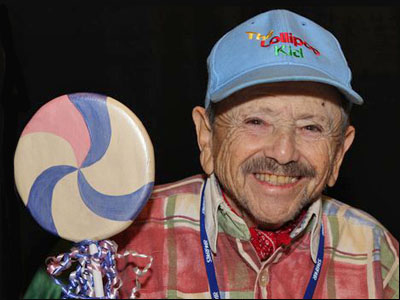
Sigh. Another obit. Jerry Maren, who apparently was the last surviving actor to play a Munchkin in The Wizard of Oz, has died at the age of 98. Being in that film was an impressive credit but some of us are equally impressed that the same year, he appeared in At the Circus with The Marx Brothers.
And he worked his entire life, though you may not have always known it was him inside some rather odd costumes — like portraying denizens of McDonaldland in many commercials. Jerry stood 4'3" but he wasn't just hired for his height or lack thereof. He was a real good actor.
He was one of several "little people" who played the character of Little Oscar for the Oscar Mayer company. He was the main guy who played Buster Brown for the Buster Brown shoe company. He was a kind of mascot on the original Gong Show. He was in the famous film Superman and the Mole Men starring George Reeves. He really had an impressive career.
I met and talked with Jerry on several occasions, mainly when we both showed up for one of Frank Ferrante's performances as Groucho Marx. The last twenty years or so, Jerry was one of the few people you could meet who'd actually been in a Marx Brothers movie…but that was just one of hundreds of great name-drops he had. He'd worked with half of show business, being active in the business from around 1938 to 2010.
His career and life took a definite downturn in 2011 when Elizabeth Barrington, his wife since 1975, passed away. She was around the same height and often worked in films as a stand-in or stuntwoman for child actors. They were a delightful couple.
Thinking about Jerry reminds me of a moment at one of those Hollywood Shows where one can meet movie and TV stars and buy autographs. Mickey Rooney was a featured guest and he was behaving like Mickey Rooney, meaning that he was yelling and getting upset about nothing and yammering about things that no one else could understand. At one point, for reasons invisible to others, he announced he was leaving and stormed out of the hall. Someone said, "There goes the oldest, shortest great actor in the room."
And someone else pointed to Jerry Maren, barely visible behind a table where he was sitting and signing photos…and the someone else (who I think was me) said, "Wrong both times."
The post Jerry Maren appeared first on News From ME.
Tossed Out A Book…
Strunk and White… The Elements of Style…
Yup, tossed it without hesitation into a garbage can. And I own a bookstore and never toss away books. But that book is so evil to fiction writers, I felt dirty even touching it.
I was cleaning and packing Kris and my nonfiction library to bring some of the books to Vegas last week. There, tucked between two other books and hiding on a lower shelf was a copy of the book of evil. I saw it, grabbed it and without a thought flipped it into a garbage can.
Why? Because that book can do more damage to a writer’s voice than pretending to follow the Chicago Manual of Style. I was afraid that some of the stupidity in the small thing would seep through my fingers and I would starting writing boring, plain characters.
Now, before I get fifty letters from nonfiction writers about how important that grammar stuff is, I get it. For nonfiction.
But my focus is fiction.
Creative fiction with real characters.
Characters that do not speak in grammatically perfect sentences. I learned all those grammar lessons early and have been working my entire fiction career to forget and break them.
Perfect grammar is perfect for nonfiction. Really boring nonfiction. Voiceless, plain old nonfiction.
Grammar for fiction writers is a tool to use and not use, to understand and then forget. And to break in a different way with every character.
Characters just don’t speak that perfect English crap. At least not and have a voice or accent.
So if you happen to run across a copy of that horrid little book, toss it away. It will be the only book I will ever suggest you do that to. Don’t let it poison one more possible fiction writer.
And for heaven’s sake, don’t open it.
————————
Both of the new workshops, The Indie Game and Fear have started on Sunday.
The first week’s webinars will be a week from Sunday for both.
We did both workshops originally as the weekend workshops. We are not changing out the videos because other than a mention of a day instead of a week, the teaching is fine in them. And the live webinars will really add to the learning.
Sign up on Teachable at www.wmg-publishing-workshops-and-lectures@teachable.com.
————————-
Also starting on Tuesday and Wednesday…
June Regular Workshops
All twelve June Regular six-week workshops are now available on Teachable for sign-ups. The few of you who have signed up through me using credits please write me again if you haven’t gotten a code to get into the workshop.
Class #61… June 5th … Think Like a Publisher
Class #62… June 5th … Endings
Class #63… June 5th … Point of View
Class #64… June 5th … Writing Mysteries
Class #65… June 5th … Speed
Class #66… June 5th … Teams in Fiction
Class #67… June 6th … Depth in Writing
Class #68… June 6th … How to Edit Your Own Work
Class #69… June 6th … Character Development
Class #70… June 6th … Writing Secondary Plot Lines
Class #71… June 6th … Advanced Depth
Class #72… June 6th … Novel Structure
July-October Schedule coming shortly.
Britain's open borders policy
Whilst cycling the other day, I crossed the Leicestershire-Rutland border. And I was shocked to see…nothing. No border controls, no passport checks, no customs officials. Here in Rutland we have an open borders policy. Any riff-raff can move in. I know: I was that riff-raff.
This is weird. A lot of the adverse effects that are claimed for migration into the UK should also apply to migration into Rutland. If people who move to the UK depress the wages of natives (they don’t, mostly) then surely people moving into Rutland depress Raddlepeople’s pay. Migration into Rutland also increases congestion (getting out of my road takes longer than it used to); puts pressure on local services (it’s harder to see a doctor); and has led to a combination of higher house prices and to new builds on greenfield sites.
What’s more, Rutland is a smaller fraction of the UK’s population than the UK is of the world’s population, so on this count there’s more danger of us being swamped.
Despite all this, however, there is absolutely no demand in Rutland for immigration controls. Nor is there any hostile environment policy: even people from Peterborough are tolerated.
Which poses the question: why the difference between Rutland and the UK?
It’s not, I think, because we are a lightly-populated county that won’t miss one or two fields, or that we have especially good ways of adapting to immigration. What’s true of Rutland is true of most areas. Mancs don’t want to control immigration into Manchester, except perhaps from Liverpool; people in Staffordshire don’t oppose migration from Derby; and so on.
Yes, a few areas have bans on people buying second homes. But that’s a complaint about a lack of immigration. And Cornwall and the Isle of Wight have faintly derogatory terms for outsiders – but these are regarded by most other people as expressions of a backward, even inbred, outlook.
Mostly, we have an open borders policy within the UK and almost everybody is happy with this.
Why, then, have migration controls between the UK and other countries when we don’t have them between Rutland and other counties?
You might say it’s because the UK has much higher incomes than much of the rest of the world which means that we’d simply attract too many migrants. This, however, doesn’t explain why the numbers of high-skilled migrants is limited: such people could earn good money in other countries. Nor does it explain why so many support controls on immigrants from other wealthy countries
Instead, of course, there are simple reasons for the difference. One is a fear that high immigration will somehow change the character of the country whereas Raddlepeople aren’t much bothered that folk from Nottingham will change the character of Rutland. The other is that people want governments to be in control; this explains the popularity of Brexit and even perhaps austerity. Nobody, though, wants Rutland council to be in control of very much.
I don’t want to take a view on the merits of these feelings here: they are, I think, feelings more than articulated arguments but that alone doesn’t make them wrong. What is the case, though, is that economics is not the issue. Economicky arguments for migration controls are just distractions and, I suspect, often dishonest ones.
DeDRM Tools 6.6.1 Released
Version 6.6.1 of the tools is now available. Please update to the latest version if you are having issues.
DeDRM_tools_6.6.1.zip can be downloaded from
https://github.com/apprenticeharper/DeDRM_tools/releases/tag/v6.6.1
First release using the new directory structure and release script. Hopefully fixes the problem with KFX and the stand-alone tools.
To leave a comment, see the previous post: DRM Removal Tools for eBooks.
Decrypting KFX
Thanks to work by several people, the tools can now decrypt KFX format ebooks from Amazon.
If using the calibre plugin, install the KFX Input Plugin to automatically locate all of the files that make up a KFX format book and gather them into a KFX-ZIP. After the DeDRM plugin removes the DRM, then the KFX Input Plugin will package it into a single KFX file.
If using one of the stand-alone apps, create a KFX-ZIP file by creating a ZIP archive of all of the files in a book subfolder within the main Kindle for PC/Mac content folder and then changing the file extension from “.zip” to “.kfx-zip”.
How copyright law hides work like Zora Neale Hurston's new book from the public.
A job building software to kill people, but don't get distracted by that.
no longer a debate? lennon’s REVOLUTIONS 50 years on
[This post originally went up at my PATREON: subscribers get to read posts and hear podcasts early — and help offset costs and time and help me do more of this kind of thing]
“The blues are beautiful because it’s simpler and because it’s real. It’s not perverted or thought about: It’s not a concept, it is a chair; not a design for a chair but the first chair. The chair is for sitting on, not for looking at or being appreciated. You sit on that music.” (John Lennon to Jann Wenner, 21 January 1971)
 When Jack Hutton quit Melody Maker in 1970, to set up what became Sounds, he told Richard Williams, who stayed behind, that it would be a “left-wing Melody Maker”. Hutton’s no longer with us, so I suppose if I get the chance I’ll have to ask Williams one day what exactly was meant by “left-wing” here. My guess — based on what Sounds actually turned out like — is that Hutton meant the new paper would be centred on rock. Even though both papers covered rock and pop and everything else, MM’s moral centre was arguably still jazz at that point. Even though the jazz fan-base always had a left-wing in the UK, with old-school communists solid among its supporters and chroniclers, it was a music (or so many seemed to feel) whose time was past. Rock was new and rock was now, the very voice of youth — but beyond this, rock had had, for a while by then, a tangled relationship with politics, radical left politics in particular.
This tangle reached to the very top of the charts. In 1968, as the tremors spread from the May insurrection in Paris — when everything turned upside down, and pop became art and vice versa — three versions of the Beatles song ‘Revolution’ were recorded. The first and last (the long musique concrète Bonzo-skit sound poem ‘Revolution #9’) were on the White Album, which came out in November. The re-recorded version of the first came out a little earlier, in August, as the B-side of ‘Hey Jude’. Perfect for exploring street politics as a fact and a possibility, and post-split the song was still being picked over three years on, in editor Jann Wenner’s gargantuan two-part interview with John Lennon for Rolling Stone (some 36,000 words long in toto) and in Tariq Ali’s Red Mole. The former was exactly what “the Stone” had been devised to do. The existence of the latter, a serious-minded conference with actual frontline radical activists (Robin Blackburn joining Ali for the occasion) is more surprising, an index at the very least of how wild and mixed up the times actually were.
Wenner always saw his role as chief courtier to the big new voices in music, less cautious investigator than loyal amplifier : which means Lennon is nowhere pushed or tested. It also means he’s comfortable: he unwinds deep into confessional mode, hinting at the worst of the group’s untold stories. Clean-cut to all the world, the real Beatles on the rise were “bastards”, he says — “you can’t be anything else in such a pressurised situation” — and the tours were “like the Fellini film Satyricon”, orgies and “junk and whores and who-the-fuck-knows-what…”
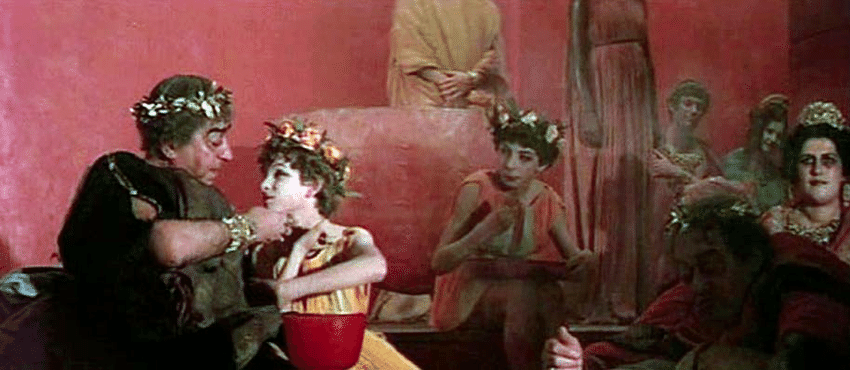
This is no longer virgin terrain, of course. Freighted with his huge authority for rock-readers at this complicated, confusing moment, swathes of this much-cited interview have simply entered pop history’s DNA. “The dream is over,” he sang on John Lennon/Plastic Ono Band, his disenchantment with the counterculture at large growing as much anything out of his own personal exhaustion, and how we all feel when a relationship fails and a fellowship breaks. With Rolling Stone at the centre of how the music was started to understand itself critically and politically, Lennon’s many stances in this conversation were a deep permission as well a disenchanted retrenchment. Pre-Beatles rock and roll is the truest, best music, he now appeared to insist, and if we followed his charismatic lead, we’d be shunning McCartneyish Pepperish pop artifice on one side, proto-prog jazz-muso virtuosity on the other, ideally so as to re-enter a space of of undeluded unadorned therapeutic naturalism.
The most immediately startling thing about the Red Mole piece, from today’s perspective, is that it happened at all: startling that Lennon agreed to it, even more startling that the revolutionary organ of the International Marxist Group — a Trotskyist splinter maybe 1,000 strong at its peak — decided so publicly to engage with the thoughts of a colossally well off former frontman of a recently dissolved boyband-stroke-chartband. It’s a clue to how tiny and village-like the London scene still was, of course (despite Lennon’s recent relocation to New York) — but it’s also a clue to how much music and changes in the music mattered to the underground then, political or otherwise. Quotes from Beatles, Stones and Dylan songs routinely supplied headlines and speed-read slogans: this was a lingua franca and a badge of identity; not just a shared backdrop but a speed-read signal where you thought things were at, and the ways you belonged — or didn’t — to any relevant micro-constituency.
The Red Mole encounter began in late 1968 with anti-war activist John Hoyland’s disgruntled Beatles fan-letter (scroll down) to Black Dwarf (the paper Ali had helmed before Mole, which is to say before a micro-sectarian split in the relevant editorial). As a Beatles B-side. ‘Revolution’ was sour and suspicious and not at all in step with the movement: “if you’re talking about destruction/minds that hate/Chairman Mao… count me OUT!” Fanboy Hoyland was dismayed: a former idol was misperforming, the song closer to Mrs Dale’s Diary than to the Rolling Stones [Footnote 1]. Hitching from Keele to interview Lennon a few weeks later, students Maurice Hindle and Daniel Wiles show Lennon this letter, which clearly nettles him. He reads and rereads it more than once, shows it crossly to Ono, and in early 1969, he sends an angry reply (scroll down)…
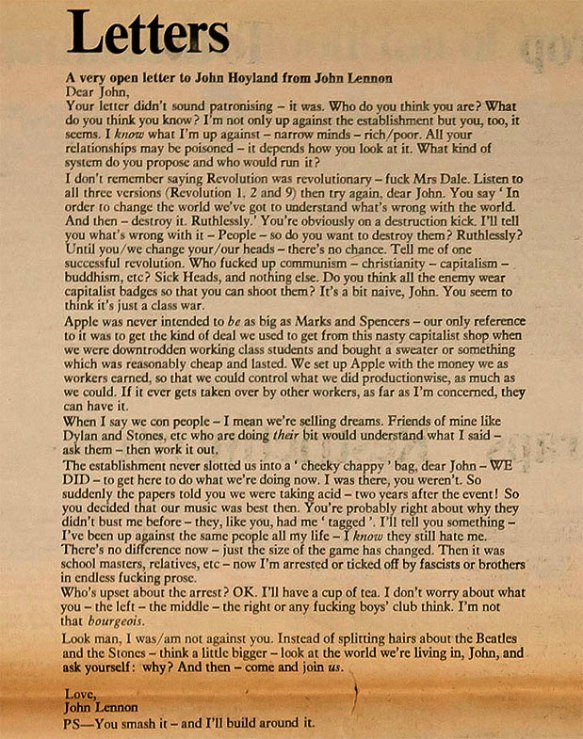
That set the stage: in the wake of the final two-year Beatles meltdown and then the Wenner juggernaut — which is cited in the opening Red Mole question — the showdown. No fireworks, though: Lennon handwaves his way around current world politics unchallenged (Ali earnestly corrects him on Yugoslavia and Tito, but tolerates his apparent renewed enthusiasm for Mao’s Cultural Revolution). As for shifts and values in music in recent years, Blackburn in particular pads gamely through the critical nostra of the day, and – as the seasoned professional in this area — Lennon doesn’t challenge him. Much of it is commonplace stuff, but — in among all the busted myths, unmoored generalisations, snap judgments, settled scores and dick moves — these two conversations platform a wounded musician busy quilting a revised aesthetic from the rubble.
How to sum it up? Pop is bad and you should feel bad: let’s get naked and rock and roll! Naked emotionally, naked intellectually and politically, naked, well, yes, kit off for the LP sleeves lads, and fuck the squares if this bothers them… Rock and roll, especially black rock and roll, speaks urgently to the white working classes precisely because it comes from a soulful place of unrepressed, undiluted honesty and self-knowledge free of all possible bullshit. We have forgotten to know ourselves and act accordingly; this music is revolutionary for teaching us to turn once more to both — and this is happening and that’s the way forward.
(Narrator’s voice: it was not and it was not.)
And yes, it’s very easy to mock all this now! And to read it as early mass-cultural steps — disguised as urgent critical recalibration — down the long road to centrist dadrock and the present-day so-called authentocrat hegemony blah blah. Blackburn’s and Ali’s credulity seems a bit of a shocker, from our wised-up times — but Amiri Baraka had not yet published his rueful tales of the Black Arts Movement, and the contradictions within cultural nationalism were still confusedly working themselves out in 1971. Black Power was still a concept that amazed and enthused people, white and black — and of course “Black is beautiful” remains a counterstrike today against disabling self-hatreds and self-erasures.
The excitement of the encounter with rock and roll had begun with the shock of realisation that you can learn as much or more from people far outside your own neighbourhoods: that cultures not your own are not by dint of this lesser than your own — a valuable discovery — and that it’s good to choose to be encouraged to enjoy life more and to be a better deeper person in your understanding and actions. But the inspiration had gradually congealed into a habit and even a religion, of the projection of the desired angelic image (of pleasure and depth and goodness) onto these same cultural others. It’s no fun at all to be trapped at the other end of this projection— made a cultural-political saviour without being asked — and doubly grim when the projection insists that being your natural self is the only acceptable forward-looking politics. This was the high era of the method-acting delusion, in which — unless truth comes from deep within your own personal pain— everything is just lies and fantasy.
Some of the time, Lennon knew better. And so, as long-time operators in the flyspeck viper-pit of far left politics, did Ali and Blackburn now and then. They knew that performative ambiguities are essential to coalition-making and keeping different interest groups onside together. But 60s revolutionary socialism was still very much under the moral spell of Sartre’s existentialism, a philosophy never especially smart about the value of drama and of fiction beyond simple agit-prop. Besides, British class identification in the borderlands between lower and middle class is the murkiest of kaleidoscopes at the best of time, and neither Blackburn nor Ali was well placed to gauge this, let alone push back [2]. When Lennon titles a song ‘Working Class Hero’ (and despite things he casually claims in both interviews), it’s as much angry disavowal as self-declaration, and in any case it’s ambiguous: is he a hero who’s working class himself, or a pop-star hero to the working class? (Ans acc.him = combination neither and both…)
Either way — despite his unimaginable wealth — it’s allowed to stand both times. And yet there’s so much here to ask hard questions about. As Wenner allows him to demonstrate, letting him talk on at such length without interruption, he’s anything but a natural soulful authentic angel undivided from himself and free of bullshit, but rather a torn and hurting mess of complexity, contradiction, evasive cunning, irony, play-acting and, well, self-misdirection. Free to explain himself, to present a self-portrait, he’s at once bolshy and timid, arrogant and bewildered, confident in his snap-summaries yet still beguiled by curiosity — and, like every bright pop-star, unendingly caught between the will to rile and the will to please (including pleasing revolutionaries who should be quicker to spot this).
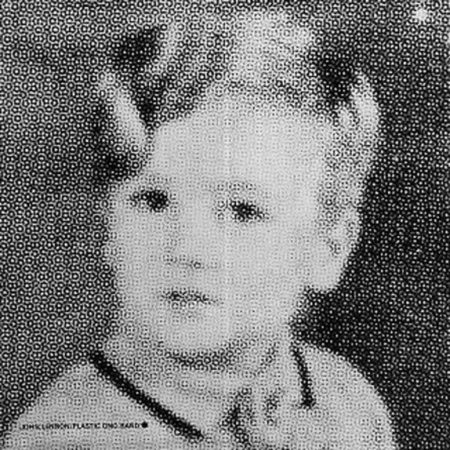 And stripped of all this, he might have been happier — except he’d also be unknown, not to mention poor. In an era when more people of working class background were entering tertiary education than ever, the Beatles counter-narrative was by contrast one of ferocious self-education and mastered expertise, very much an alternative and anti-official model for intellectual self-mobilisation. His dismissal of almost the entire trajectory as myth — we were best on-stage, he says, before we ever came into the studio — is also a kind of a disavowal of any of this possibility. And — as upper middleclass college kids themselves —his interlocutors seem to embrace it, though it’s surely strangely antipathetic to the politics of possibility they want him to sign on to, to manifest and broadcast. Again — profoundly unsure of what they want from the exchange — they decline to challenge him, to follow through where he’s half-pointing.
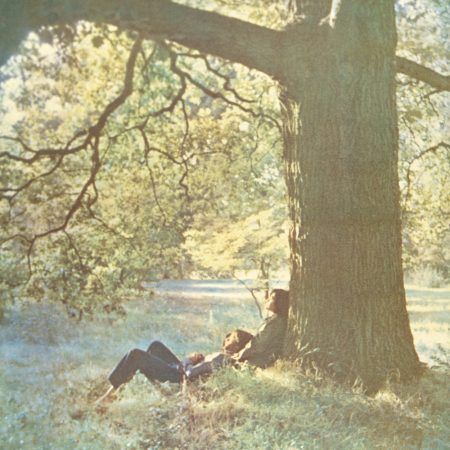 The Lennon/Ono LP ends, or nearly ends [3] with a list of things he no longer believes in — Jesus, Buddha, Elvis, Beatles — and the plain declaration: “I believe in me, Yoko and me, and that’s reality.” It’s like coming home, he tells Wenner: “I’ll never change much from this.” The leisure of space and time to become uncomplicatedly yourself, to feel and and believe in and know home this way, is afforded very few people — and this, if you like, is how a mark of how far his stratospheric wealth has taken him from his birth-town, his roots, his class. Meeting Yoko as the breakthrough key to self-discovery in this best of matching companionships — of course it’s a tell that she’ was from the other side of the world, the other side of the arts, from a comfortable Japanese family, well travelled, well schooled. The many claims don’t add up — and neither interview presses him on any of this.
Epilogue: An LP a year until 1975, and his collection of rock and roll standards, then a five-year sabbatical — long aeons in 70s pop time — before Lennon returned to recording in 1980. By now the conversation that began when Sounds split off from Melody Maker in 1970 had changed deeply (not least as a consequence of these exchanges). There’d been wide revolt against the the leisured, over-wealthy aristocrat entertainers who’d shaped the recent past and seemed to clog up the present: punk rock, the revolt was called. Radical politics still had a toe-hold in the pop press — but the critical factions closest to it mostly took the line rock is now bad and you should feel bad. The lingua franca was increasingly contested. Lennon was still welcome, unconfronted, in the pages of Rolling Stone, but his long absence from the UK conversation ensured few was overawed by his re-emergence. In the post-punk and new pop years, almost everything he had seemed in the early 70s to stand for would be questioned.
And then of course in December 1980 he was shot dead, by someone deep-lost in the labyrinth of a megastar’s unkeepable promises. Suddenly changeless in death and embalmed in grief-stricken nostalgia, he was removed from all useful reassessment, as everything round him went cold and congealed. Home, he’d said, but just as he set out once more, he was stopped. There are clues where he might have gone; how he might have evolved. His recording with Bowie, for instance — because he too was always a kind of proto-glam quick-change artist, forever negotiating the obstacle course his own throwaway comments had strewn before him. As for the blues, its potency was never of course a function of its unadorned primitive simplicity. Quite the opposite: it always involved reflection, and its energy and value came from the sheer layered density of all competing histories hurtling through it.
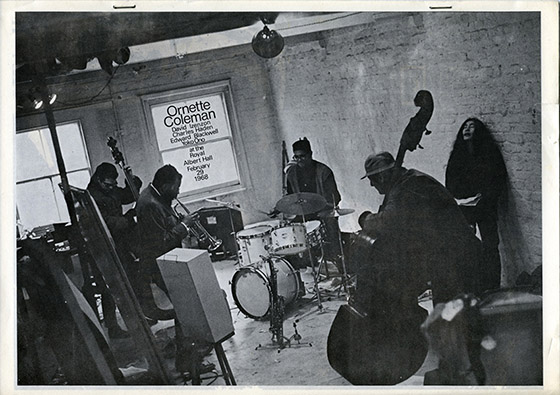 And of course there was the work Yoko had made with him in the late 60s, the be-ins and the bed-ins and the bag-ins, these high-visibility celebrity stunts whose purpose was to import go-slow bafflement and blockage into the flow of mass-media communication: the spectacle, but discursively on strike. The most heartening surprise twist in the Wenner conversation — in both conversations — is his belief in Yoko as artist-musician, his commitment to the idea that everyone should take proper note of her. Besides Warhol, that ineffable blank, he celebrates Fluxus and nods to Ornette Coleman as two unimpeachable stages in Yoko’s past, her rock and roll.
Warhol aside, the prankish avant garde before 1968 had seemed an individualised, out-of-reach luxury, supported by and therefore aimed at the wealthy and the over-educated. Pre-Beatles rock and roll is the truest, best music, he may have been arguing — but to say so and to foreground her, he has also to argue that she’s rock and roll — which complicates and expands the definition, to say the least. By refashioning the story to include her — even in a sense to re-begin with her — Lennon was quietly re-weaponising his art-school inventiveness and tossing it out into the wider world, the widest world thinkable, in topsyturvied form. He opened the doors of imagination and possibility even in the pop music trade press: no intellectual luxury is too good for the working class… this would after all be a pretty good motto for the toughest strands of post-punk…
Footnotes 1: It’s weird to recall how much of a free pass the Stones still had with the most rigorous 68-ers. Though of course they were carefully solicitous of this touchy part of the market: the song ‘Street Fighting Man’, about the May riots in Paris, was widely enough thought to refer to Tariq Ali himself that he brazenly named his memoirs for it.
2: Ali is from the higher-born Pakistani aristocracy, and extremely engaging and perceptive about it (subscription needed).
3: Actual closing song: 52 seconds of ‘My Mummy’s Dead’ sung down a telephone to a nursery-rhyme style tune (which isn’t ‘Three Blind Mice’ even though everyone for some reason says it is).
If you like this post, please support my PATREON which will help me write more! Also let other people know that you think might enjoy it…
European Data Protection Board backs ban on 'cookie walls'.
If LAB gets within 10% of its GE17 Lewisham vote it’ll be a vindication for Corbyn’s Brexit approach

A bigger drop would be problematical
At the General Election the strongly anti-Brexit LAB MP, Heidi Alexander, came out with a share of 67.9% and a margin of 44.8% over the second place Conservatives in Lewisham East. The question, on which Ladbrokes have a market, is how the party will do on votes in the by-election two weeks on Thursday.
-
The big fear of the Labour hierarchy was that the Lib Dems, who’ve done particularly well in Remain seat by-elections since the Brexit vote, could make this into a referendum on Corbyn’s approach to leaving the EU.
That danger could be partly alleviated by the choice of an anti-Brexit LAB candidate but that has not stopped the LDs making this the key point of their messaging. In the closing 16 days of the campaign the theme of Lewisham “sending a message to Corbyn” will become increasingly intense. The party is running a campaign on the scale of Witney and Richmond Park which means they are throwing everything at it.
It is hard from outside to assess the potency of this approach and what Labour GE voters will actually do on the day. Given that the government of the country is not, as in a general election, at stake could enough of them go with this as a means of influencing party policy?
Certainly I’d expect strongly anti-Brexit LAB MPs, of which there are many, to seize on a poor Lewisham performance to help ratchet up the pressure on the leadership. I wouldn’t be surprised if some of them are secretly hoping for the party to hold the seat but on a much reduced majority.
With the YouGov tracker regularly showing that 70% of LAB voters think the referendum vote of Brexit was wrong there is a divide between Team Corbyn and party supporters something which Labour’s opponents are seeking to exploit.
A feature of this election is that it is seen as a foregone conclusion and is now getting relatively little media attention. This means that party messaging becomes the prime source of information for voters.
These are the current Ladbrokes LAB vote share odds.

I quite like the 5/1 40-50% band and would be backing it if I wasn’t in Spain where I’m barred from accessing my Ladbrokes account.
Mike Smithson
A very British coup. A way back for the defeated centre?

These have been dark times for pragmatic politicians. Both the Conservative party and the Labour party have been taken over by politicians pursuing projects for ideological reasons, uninterested in any evidence as to whether those projects were actually beneficial for the nation. In both parties, moderates have been marginalised as the extremists compete to apply purity tests for their projects.
Since the election last year, neither group of ideologues has yet established a decisive polling lead. In the wake of the election, Labour appeared to move ahead a little. Earlier this year, the polls swung back the other way, with the Conservatives establishing a small lead. Just possibly there has been a fresh oscillation: the last two polls have shown the two main parties dead level.
This Parliament has potentially another four years to play out. In that time, the Conservatives could make a success of Brexit, establishing a decisive lead. Or they might see their coalition fall apart as the reality of Brexit alienates one or more groups. Labour could collapse into internecine warfare. Or Jeremy Corbyn’s campaigning could see them surge to success at the next election.
So far as we can tell anything at the moment, it seems that the two main voting blocs look surprisingly sturdy: the differences are at the margins. It’s entirely possible that the current deadlock could continue to the next election. There has to be a good chance that Britain will have a fourth successive close election.
What might this mean in practice? Let’s use the most recent Ipsos-MORI poll as a base. In that poll, Labour and the Conservatives were tied on 40%, the Lib Dems were on 7%, the Greens were on 5% and UKIP were on 2%. Electoral Calculus predicts that this would translate into the following tallies in the House of Commons:
Conservatives: 298
Labour: 276
Lib Dems: 14
SNP: 39
Greens: 1
Plaid Cymru: 4
Northern Ireland: 18 (I’m assuming the DUP again get 10)
As you can see, this would be what is technically known as a gigantic heaving mess. Labour, the Greens and the nationalists would get to 320, while the Conservatives and the DUP would get to 308. Neither of these constitute a working majority. In each case, it cannot be assumed that these blocs would coalesce.
The role of the Lib Dems would potentially be crucial. They could work with either bloc to establish an unstable working majority. Or they could work against either bloc.
Who would they choose to work with? The Conservatives would have lost seats but would remain the largest party. Labour would have gained seats but would remain very much second. Neither line-up looks particularly stable. Both main parties’ leaderships look very distant from the Lib Dems’ policy position.
The Lib Dems would no doubt pursue policy objectives. This would make the Conservatives hard to work with, given how hostile the recent Lib Dem members have been towards Brexit (their past experience of coalition with the Conservatives would also not be likely to make the idea of a repeat particularly appealing). They would no doubt seek to drag Labour in a more pro-EU policy direction.
But they might be bolder. It is no secret that many Labour MPs have little time for their current leader: they failed to oust him in 2016 and have since retreated into a sullen silence. In the main they have not obviously been converted to his merits since. In 2010, Nick Clegg told Labour that he would not countenance a deal with them unless Gordon Brown was replaced as Prime Minister. Might the 2022 Lib Dem leader try the same trick?
The Labour membership would be incandescent. But after the election their leverage would be limited. Above all, they cannot control the Lib Dems, who could vow to vote no confidence in any attempt at a government headed by someone who they believed did not have majority support in the House of Commons.
If matters were forced to such a vote and the Commons indeed passed a vote of no confidence, then at that point, things would get interesting. The House of Commons would then have 14 days to pass a vote of confidence in a government or a fresh general election would be held. Would the present Labour leadership acquiesce in the Lib Dems’ replacing their candidate for Prime Minister? Would Labour Parliamentary party discipline hold if the leadership set its face against such a demand? Would the Conservatives try their luck?
Politics would be a white knuckle ride for those two weeks. One of the more likely outcomes would be that a fresh Labour candidate for Prime Minister (not necessarily a fresh Labour leader) would emerge, probably from the soft left to keep as wide a span of support in Parliament as possible.
And suddenly the moderates could have got hold of the reins of power again.
This is of course just one scenario. But it illustrates a wider point. Ideologues can and have taken control of the main political parties. But in a hung Parliament, the preponderance of moderates on the Parliamentary benches can make themselves felt.
However, we may not need to wait for the next election. The Brexit bills are returning to the House of Commons next month. That preponderance of moderates in a hung Parliament have their opportunity to take back control from the government. They should have the courage of their convictions and grab that opportunity.
Alastair Meeks
Adolfo Bioy Casares, The Invention of Morel
1.
We think of spoilers as a recent concern. That’s not necessarily the case. Witness the preface to Adolfo Bioy Casares’s The Invention of Morel. None other than Jorge Luis Borges explains why he wants readers to discover the novella’s plot for themselves: “To classify it as perfect,” says Borges, “is neither an imprecision nor a hyperbole.” Spoilers aren’t the only concept this book anticipates. Morel, first published in 1940 (though not translated until 1964) plays with ideas science fiction wouldn’t pick up on for decades: transhumanism, virtual reality, audiences’ relationships with media. To explain, I’ll have to reveal everything. Sorry, Jorge!
Seriously, though, maybe you should read this book before reading my reaction. That feeling of discovery is one of the best things about it.
2.
The Invention of Morel is efficient, packing a novel’s worth of ideas into 100 pages. The first line is already laying clues to what’s coming: “Today, on the island, a miracle happened: summer came ahead of time.” Morel’s nameless and disreputable narrator is a fugitive. He’s fled to a deserted island with a hotel (called, for reasons he doesn’t yet understand, a “museum”) and a lot of diseased trees. He insists he’s wrongly accused–of what, he refuses to say. Footnotes from a puzzled editor suggest we shouldn’t entirely trust him. Among other things, the narrator is obsessed with Thomas Malthus’s ideas on overpopulation. You get the sense that, for all his intellectual pretensions, he just doesn’t like people much and wishes there weren’t so many.
Rumor has it the island’s last visitors died of plague. Still, as the story opens our antihero is hiding from a sudden materialization of tourists. As sometimes happens in old novels the narrator falls in Love at First Sight with a vacationer named Faustine. As does not happen often enough in old novels, it occurs to him a strange man popping out of the wilderness to declare undying love may disconcert the object of his affection. He starts a garden to attract her attention. When she seems to ignore him he doesn’t immediately approach. So it takes a while to dawn on the narrator that she can’t see or hear him at all.
The tourists are simulations. The island runs on hydroelectric engines. When they’re working a week-long recording of the tourists runs in loops. These aren’t images, they’re physical. So are recordings of the museum, the trees, and even the weather. (Summer came early when recorded sunshine superimposed itself on reality.) Somebody’s invented a holodeck, like on Star Trek: The Next Generation.
That somebody is Morel, the mad scientist whose island and whose party this is. His guests are all friends, but as the loops repeat it becomes clear Morel just invited them as a pretext to get close to Faustine. A few iterations later the narrator is in the right place at the right time to watch Morel calmly explain to his friends how he murdered them.
Morel has invented a new kind of camera. Like film, it records and plays back images. Like a gramophone, it records and plays back sound. Unlike either, it records and plays back everything else–temperature, odor, physical matter. In fact, insists Morel, his invention records everything so exactly it captures thoughts. The recordings played back by the invention of Morel are conscious, but it’s consciousness without free will or memory. Morel and his friends can’t think new thoughts. With each playback they relive the same thoughts and experiences, as though for the first time. But they are real experiences. A pity that the process destroys any living thing it records! Trees or people, all waste away as though diseased. Morel has, nonetheless, spent the last week recording himself and his closest friends. They’ll die, but Morel’s invention guarantees him an afterlife eternally reliving a perfect vacation with his friends. Especially Faustine, whether she likes it or not.
Morel is scary. He’s a mild, unspectacular character. But he’s mildly and unspectacularly an utter sociopath. I thought Dr. Moreau was bad but, as island-owning mad scientists whose names start with “More” go, Morel has him beat.
He’s also a transhumanist uploading his brain into a personal Matrix, which is impressive for 1940.
3.
Early in 2018 the internet paused to gawk at a startup company called Nectome. Nectome offers to record your mind. They’ll store your consciousness–at least, if you believe the optimistic view. Someday, maybe, someone will be both able and willing to run it in a computer, granting you new life as an artificial intelligence in a simulated world. The catch is that Nectome stores, like, your brain. As a cofounder quoted in the MIT Technology Review puts it:
The product is “100 percent fatal,” says McIntyre. “That is why we are uniquely situated among the Y Combinator companies.”
(A line that cries out to be followed up with “Beep Boop. I am a robot.”)
Fatal or not, mind uploading is a popular idea in science fiction and among Transhumanists. Morel sees no problem in trading lives for digital afterlives, though Morel’s simulation runs in the real world instead of on a computer. The narrator considers the implications: what if there’s a way to find and gather “vibrations” long since dispersed? Everyone who ever existed could return to replay their lives. The narrator imagines simulated afterlives crowding out living humans. (At this point the weary editor claims to have removed a long, incoherent rant on Malthus.)
This is basically physicist Frank Tipler’s Omega Point. Tipler imagines a future society with near-infinite computational resources simulating every possible universe containing everyone who ever lived. Less cosmically, yet even less convincingly, some think we could recreate people by combining conscious software with biographical and psychological profiles. To be fair to Tipler and friends, at least they’re imagining an afterlife for everybody. When transhumanists talk about “life extension,” I often get the sense they’re really talking about “life extension for me, the silicon valley billionaire!” without caring how accessible those extended lives will be to the rest of us peons.
4.
This raises questions. Obvious questions, asked many times, without dampening transhumanist interest in mind uploading at all.
-
Assuming you can copy your mind onto a hard drive, and it’s conscious, is it really you? Is there continuity between you and the you in the computer? Most people (myself included) would say no. You’ve created a parallel version of yourself, a mental twin whose identity immediately diverges from yours. Although from the twin’s point of view it may feel like you. It has all your memories up to the point of upload, and if you had your brain freeze-dried the original you isn’t hanging around to raise awkward questions. Maybe for some people that’s close enough.
-
Maybe it’s okay your upload is someone else–maybe you just want to leave behind a digitally conscious offspring. The next question: Is it conscious? I’m assuming you made the decision after some due diligence. Presumably whoever sold you on the process let you talk to an AI who assured you everything was great. But were you talking to a conscious mind, or an extraordinarily sophisticated Eliza? Not being inside a computer yourself, how can you be sure?
-
What kind of afterlife is this? Do you have an interface to the real world? Can a computer run more than one mind? Can you network with those other minds? If you’re one of the first uploads, will you be spending decades by yourself in a low-polygon-count video game?
These are questions The Invention of Morel doesn’t ask, except implicitly: the narrator doesn’t ask, but we’re not meant to trust his judgement. The nature of uploading in Morel makes these questions especially important. The recordings can’t do or think anything new. But they’re (at least theoretically) conscious within those limits. And they don’t know they’re limited: each run feels like it’s happening for the first time.
If they can’t think new thoughts, are they alive? If they don’t know it, from their own point of view does it matter? Morel doesn’t stop to ask. What kind of person would take this deal?
5.
In Morel’s case, the answer is obvious. He’s a type of sociopath we’re all too familiar with, fueled by toxic masculinity and a bloated sense of entitlement. Other people are supporting characters in the movie of his life. If Faustine won’t play the role he’s laid out for her he’ll cancel production. Morel sacrifices his whole cast to replace uncooperative reality with a perfect eternal image.
There have been a lot of debates over the years about how media influence audiences, for good or bad. I’m increasingly convinced the most pernicious influences in popular culture are stories that value protagonists’ self-actualization, emotional fulfillment, or personal goals over the supporting cast’s safety or emotional health. I’m thinking, for instance, of all the action movies where the plot puts the lives of innumerable extras at stake but the emotional through-line is about nothing more than the hero’s conflict with a father-figure.
Our culture needs more heroes who care about other people’s self-actualization and fulfillment.
6.
What’s more interesting is the fate of the narrator. He never knew these people. They no longer exist in his world. They’re characters in a television series or a giant video game. It’s media–a documentary, but it might as well be fiction for all the narrator can affect anything. Still, he turns on Morel’s invention and records himself walking among the tourists. He inserts himself into their conversations, choreographs his actions so they seem to interact. An outside observer would never know he wasn’t part of the original group. The narrator will waste away; his copy will spend eternity pretending to have friends.
At this point it’s worth noting Bioy Casares based Faustine on the actress Louise Brooks–that’s her on the cover of the NYRB Classics edition of the novel. As a young man Bioy Casares had a crush on Brooks. The Invention of Morel is in part dissecting his adolescent self’s attraction to a woman he knew he’d never meet.
What Bioy Casares felt for Brooks is an example of a parasocial relationship. That’s the technical term for the one-sided relationship people have with fictional characters who feels like “old friends.” People can have parasocial relationships with media figures or celebrities, too. But as with explicitly fictional characters they’re only mental simulations of those people. A real relationship goes two ways; both sides engage with the other person’s point of view. In a parasocial relationship the feelings are all on one side. The second party isn’t aware of the first, and can’t be. The second party is fictional.
A horror movie’s audience feels fear they know is nothing like real fear. A tragedy’s audience feels sadness distinct from the sadness they feel when sad things happen in real life. Parasocial relationships are like that, with friendship; they’re not necessarily unhealthy. The devoted fans who check in with their favorite TV show every week have feelings analogous to the emotions associated with real friendships while understanding they aren’t the same.
If they’re healthy. If not, you get the proverbial soap opera fan accosting the villain’s actor on the street. Or a celebrity stalker. Or Reg Barclay, the character on Star Trek: The Next Generation who got so lost in his holodeck sessions he couldn’t deal with reality. Or the narrator, who has the same problem, except Counselor Troi isn’t around to stage an intervention.
The narrator can’t deal with people. I don’t mean he’s an introvert, drained by social interaction. That, I could sympathize with–no one’s more introverted than me! No, the narrator can’t deal with people because he’s a self-absorbed misanthrope. Instead, he’ll spend time with phantoms who can’t surprise him because they’re completely predictable, and ask nothing of him because they don’t know he’s there. For him, that’s close enough.
7.
In the social media age it’s become common for creators (they’re usually women) to get death threats when some cartoon or video game or movie franchise takes a turn its “fans” don’t like. As far as these guys (they’re always men) are concerned, their parasocial relationships with fictional characters are more important than real people’s emotional health and feelings of safety.
I sometimes wonder how many people have, without admitting it to themselves, on some subconscious level convinced themselves other people aren’t real.
8.
Compared to Morel, the narrator may seem merely pathetic. But the novel draws a direct parallel between them! Even the narrator notices, and he’s not especially self-aware. Both claim to be in love with Faustine, but neither know anything about her. They’re not thinking of her as another human with interiority like their own. They look at her and see fictional characters they invented to support stories in which they’re the protagonists.
For the narrator a simulated person is close enough to a real person that a parasocial relationship and a real relationship are almost interchangeable. He’s willing to murder himself for an afterlife surrounded by images. At this point, remember the narrator is a fugitive, and still hasn’t told us what he was accused of. Who is he, really? What’s he capable of? Given the chance, could he have been another Morel? Bioy Casares seems to think the narrator and Morel are different more in degree than kind.
If there’s any hope for the narrator, it’s that at the end he hopes for some future gatherer of vibrations to unite him with Faustine’s consciousness. Maybe he’s starting to realize other people have their own stories, and it might be a good idea to listen.
9.
The official history of science fiction looks like a list of books that aged badly–who can read Asimov anymore without occasionally laughing? Or Heinlein? It’s easy to assume aging badly is an inherent property of the genre, that very little SF more than a generation old is worth reading.
In forgotten corners of the shelves is an alternate history of SF. There are books less celebrated (sometimes forgotten) by dedicated SF readers that still have something to say to us today. The Invention of Morel is one of those. Transhumanism, virtual reality, the merging of real life with media, and destructive, entitled misogyny? This is all very current, if not always current in the way we’d want.
What the world's fascination with nüshu, a female-only Chinese script, says about cultural appropriation.
Does economics matter?
Does economics matter? I ask because I suspect I would understand political debate better if I realized that it doesn’t.
Everybody tends to over-rate the importance of their profession: it’s part of deformation professionelle. Lawyers over-rate the importance of the law, artists of the arts and so on. Maybe economists do the same. Perhaps we should realize that most people who are interested in politics just aren’t interested in economics.
If we adopt this perspective, a lot falls into place. It helps explain centrists’ hostility to Corbyn. If you’re not interested in capitalist stagnation and responses to it – Ian Austin, for example, never mentions the economy in this piece – you’ll not see much to admire in Corbynism: all that will stand out are associations with ant-Semites and Stalinists, student leftist politics and a rejection of conventional Westminster methods. For such people, the enthusiasm people like me have for Corbyn and McDonnell’s attempts to build an alternative to neoliberalism look as eccentric as would an actor endorsing Corbyn because of an attractive policy towards theatres.
Rightist politics also become more comprehensible once we recognise that economics doesn’t matter. The strongest case for austerity and immigration controls is that these have nothing to do with economics. Like Brexit, they are instead attempts to assert that governments have control over social affairs. Their supporters just don’t care about their economic consequences because other things matter more: sovereignty and an assurance that the government is on top of things.
Brexiters talking about economics are like dogs walking on their hind legs. One partly admires the gymnastic trickery, but the job is badly done and the animal’s heart isn’t really in it.
Of course, the right and the media do talk about “the economy.” But by this they mean something very different from what I understand by it. To them, the economy is not about real people struggling to make a living. It is a reified hyper-reality, a means through which politicians try to establish credibility. This is why “the economy” has often been equated with the public finances.
You might object that the right certainly do care about economics when it comes to opposing Corbyn’s call for higher taxes on the rich. I’m not so sure. Opposition to tax rises is perhaps instead like land-owners shouting at ramblers: “get orf my land”. They are motivated less by fears of material loss but by the violation of (perceived) property rights.
And here’s the thing. There is some justification for this denial of economics. The link between income growth and subjective (pdf) well-being is weak and even many of the worst off feel they are living comfortably. Granted, this might be a sign of adaptive expectations. But it also tells us that things other than economic growth are important: community, autonomy, physical and mental health and so on. From this perspective, perhaps it’s understandable that politicians should want to offer a sense of security – as in various ways austerity, Brexit and immigration controls do – rather than higher incomes.
But, but, but. As Benjamin Friedman has shown, economics does matter. Growth makes people more open-minded and tolerant whilst stagnation makes them meaner: it’s no accident that a decade of stagnation has led to a rise of reactionary populism. John Stuart Mill claimed that a stationary state of incomes provides “as much scope as ever for all kinds of mental culture, and moral and social progress”. Subsequent history, however, suggests he was wrong.
It might be the case that most politically-engaged people don’t care about economics. But nevertheless, economics does matter.
Nick Palmer ponders: What should a Brexiteer do next?

I don’t think it’s a secret that I’m not just a Remainer but a Europhile. I like the EU. I admire the work of the European Parliament. I would cheerfully sign up to a single European country.
Nonetheless, it’s always important to see politics from different viewpoints. Suppose you are a keen Brexiteer Tory MP. You’re delighted that we voted Leave. However, it appears that the Government is inching towards a very soft Brexit. Lots of money will be paid with no guarantee of a trade deal. Transitional arrangements will reach far into the future. The power to control European immigration may be only lightly exercised. Something objectively resembling a customs union will probably be agreed. Trade deals with the US and other countries may be elusive.
What do you do next? It is possible that these things will not come to pass, and we will head into a hard Brexit or indeed a no deal outcome. But if they do?
You could join UKIP. However, UKIP is at present a near-bankrupt joke. Rivals have stopped bothering to attack it – they just smile tolerantly. It’s a waste of your time and career suicide.
You could support the deal, for want of better. But on the above scenario they have undermined almost everything you wanted from Leave. Do you want to show that you are blindly loyal and all future threats to defect can be ignored?
You could join Labour. But Labour opinion about Leave ranges from unenthusiastic acceptance to fanatical opposition. Not very promising for you, and you don’t like Corbyn.
You could join the LibDems. This is fanatical opposition HQ. Are you a masochist?
You could help set up a new UKIP. New parties in Britain are almost always doomed.
Or you could stay in the Tories but vote down the EU deal, allying with Labour who will no doubt be saying that they accept Leave but this particular deal is rubbish. You could bring down Mrs May while you’re at it, or not, but that’s actually a separate issue: it might be wise to proclaim loyalty to May, while disagreeing with this particular deal.
We then get No Deal. What happens then? Possibly a new leader. Possibly a new election. Or, quite possibly on her record, May grimly soldiers on, and makes the best of the situation. Whatever – elections come and go, some good, some bad. But Britain is decisively free from entanglements, and out there is the world on its own, for better or worse.
I wouldn’t like that. You might not be keen. But is there really a better alternative that doesn’t make Leave almost completely pointless?
I’ve always thought that May and the EU will reach a deal. I still think so. But, given this analysis, I really wonder if the Parliamentary arithmetic will work.
Nick Palmer (Ex LAB MP and longstanding PB poster)
Rid of it
It was heartwarming to see the news from Wales yesterday where the Lib Dem / Labour coalition is striking out in the opposite direction from Section 28, giving young people age-appropriate information to give them information and skills around gender, sexuality, consent and bodily autonomy. I grew up in Wales at the height of clause mania and it is nigh impossible to imagine such things. Yet here we are: hurrah.
For Scotland, the clause went three years before the rest of the UK, reflecting how the Lib Dem / Labour coalition government there had different priorities from the Labour majority government at Westminster. One of the frustrations of the 2010-2015 Lib Dem / Tory coalition was that it was almost always critiqued against what had been before, rather than what would have happened had the Brown government won another term. That's a misleading prism to look at things through - a logic that would wind up with asking why the 1974 Labour government did so little to roll out broadband internet access to rural areas - but with the SNP running Scotland and Labour running Wales there was no easy and direct comparison. But with tuition fees, the evil clause and a smattering of other things, from 1999 we got a clear reflection of exactly what difference the Liberals were making compared to having a single party administration.
For the rest of us it took another three years, and I'd forgotten that when it was at last brought to an end by an amendment tabled by Ed Davey - one of those Liberal MPs who lost their seat in the big lurch right of 2015 but who is now back in parliament. There's a neat symmetry that both sides of the border it was kicked out by Liberals, as the only party to have opposed it in those early days of 87/88.
Food: a class issue
I’m pleased to see Phil McDuff joining free marketeers in complaining that anti-obesity strategies of the sort promoted by Jamie Oliver will hurt the poor. For me, though, there’s a deeper and nasty question here: if we can’t trust the poor to feed themselves properly, what can we trust them to do?
Yes, there are mechanisms whereby the poor might choose bad diets.
One is the fact that coping with poverty is so stressful that it depletes (pdf) cognitive bandwidth.
The other is a form of ego depletion. After a long soul-destroying day, people seek relief in drink or junk food. As James Bloodworth writes:
When we walked through the door at midnight at the end of a shift, we kicked off our boots and collapsed onto our beds with a bad of McDonalds and a can of beer. We did not – and nor have I met anyone in a similar job who behaves this way – come home and stand about in the kitchen for half an hour boiling broccoli. Regularity of dietary habit is simply incompatible with irregularity of work and income (Hired, p52)
There is, however, no reason to suppose that bad choices will be confined to diet. Quite the opposite. The poor face tight budget constraints and so have an incentive to look for the best value food, and we all know that bad diet can kill us. On both counts, they face strong incentives. Also, buying food is something we do regularly, which means we should eventually learn from experience how to do the job well. Yes, people can make mistakes. But cognitive biases apply most when we are making judgments under uncertainty: there’s a clue in the title of Kahneman and Tversky’s first book. But this is not the case with food: we all know what chips taste like.
If people make bad decisions about their diet, therefore, they are likely to make bad ones elsewhere. If we can’t trust them with their food choices, why should we trust them to vote, given that ignorance of basic political facts is widespread?* In this sense, anti-obesity policies are a slippery slope.
But as Phil says, there is an alternative here. One way to improve people’s diets is to increase their incomes so they can afford healthier food and to reduce the poverty, insecurity and bad working conditions that drive people to bad food. The problem is capitalism, not the poor.
Some of you might have an inkling as to why the millionaire Jamie Oliver and old Etonian Hugh Fearnley-Whittingstall don’t choose this route. But why don’t others?
Phil’s right. It’s partly due to classism – “a deeply rooted belief that the poor are feckless and make bad choices.” Also, there’s an element of what Nick Cohen called vice signalling. Governments that impose pain upon people look tough, strong and manly – even if (as in the case of benefit sanctions) those policies are counter-productive.
These, though. Are both symptoms of a deeper condition – a belief that the iron fist of the state must be used against the poor, and never against capitalism. Diet, like everything, is a class issue.
* We can’t rely upon the law of large numbers to ensure that errors cancel out. The point about cognitive biases is that they are, well, biases.
Corbyn: the heir to Blair
It’s not 1997 any more. This shouldn’t need saying, but attacks on Jeremy Corbyn such as this from Ian Austin suggests it does. He accuses Corbyn of wanting to turn Labour into “something very different” from its traditional mainstream social democracy.
What this misses is that Labour must reinvent itself, because the economic challenges we face now are very different from those of the 1990s. Take four examples:
1. In the 90s, real interest rates were high: longer-dated index-linked gilt yields were over 3.5% when Labour took power. Such high yields meant that the fiscal arithmetic worked against government borrowing; even modest deficits would have meant an ever-rising debt-GDP ratio. There was therefore a good reason for Labour to be “fiscally responsible”. Today, however, real yields are negative so the fiscal arithmetic means deficits are compatible with debt sustainability. And with Bank rate close to the zero bound (whereas it was 6% when Blair was first elected), there’s a much stronger case for looser fiscal policy.
2. Labour productivity and investment were growing OK in the 90s. That meant the job of economic policy was largely to keep the show on the road – to offer business a stable policy framework within which confidence to invest and innovate would be maintained. Today, of course, things are very different. Productivity has pretty much flatlined for years, and the share of business investment in GDP was a percentage point lower last year than it was in 1997. This suggests a case for governments to take a more active role to raise productivity and investment.
3. New Labour thought that a stable policy framework was sufficient to ensure macroeconomic stability. We know now that this is not the case and that even with stable policy, capitalism can generate severe crises.
4. In the 90s, the inequality that bothered Labour was the 90/10 ratio. It was reasonable to ameliorate this through tax credits, a minimum wage and university expansion. Today, though, even once middle-class people are struggling, especially those too young to have bought a house. Instead, the inequality that matters most is the share of incomes going to the very top. In the 90s, this was just over 10%, but rising, whilst today it is over 14%. It’s plausible that this inequality – and the inequality of power that generates it – has contributed to our poor economic performance.
Even the most narrow-minded technocrat must therefore see that our changed economy requires a changed response (and in fact many technocrats in the Bank of England or IMF do see this). As Joe Guinan and Martin O’Neill write:
If we are serious about addressing real economic challenges then we need a different set of institutions and arrangements capable of producing sustainable, lasting, and more democratic outcomes.
Such arrangements mean not just looser fiscal policy but, as they say, measures to increase investment and oppose managerialism, such as worker coops. Measures such as more public ownership, a state investment bank and more co-ops are things any European would recognise as social democratic. Yes, it’s a different from of social democracy from New Labour’s. But a different economy requires different policies.
This is not to say that Corbynism is perfect. Far from it. I’m not keen on its student politics anti-imperialist posturing,and have my doubts about its economic plans: I’m not sure whether it can raise billions more in corporate taxes; its desire for more coops requires tons of detailed work; and I’d like to see more acknowledgement that there is still a big role for markets and entrepreneurship to play.
My gripe with Labour’s centrists, however, is that they seem oblivious even to the basic fact of capitalist stagnation and the challenges it poses: Austin writes as if a decade of falling real wages hadn’t happened.
And herein lies a paradox. Corbyn and McDonnell are, from this perspective, the true heirs to Blair. They recognise – as Blair did in the 1990s – that a new economy requires a new form of social democracy. And their critics, like Blair’s critics in the 90s, seem unaware of this fact.
If it’s good enough for Andre Braugher, it’s good enough for me
Andrew HickeyGood to see Slacktifred finally looking to move off Patheos. I never liked that site anyway...
Rejection, Part 23

This is a series of articles I've written about writing, specifically about the problems faced by (a) the new writer who isn't selling enough work yet to make a living or (b) the older writer who isn't selling as much as they used to. To read other installments, click here.
Portions of this column are cribbed from earlier articles I've posted here. So if you feel some déjà vu, that's the reason.
As I've probably mentioned more than once in past installments of this series, I'm not a big fan of a piece of advice that is often dispensed to wanna-be writers and actors and musicians and all sorts of folks who aspire to the careers that many covet. It's the old "Never give up, keep at it, don't let anyone discourage you and you'll eventually get your dream" advice. I don't think that's true.
When you hear that, you're almost certainly hearing it from someone who did achieve their dream. If people don't, they don't tell you that. So in a way, it's like someone who won the lottery telling you, "Hey, if I won, so can you! Spend every cent you can on lottery tickets." That may be good advice for two or three people per lottery but not for most. The odds of winning one recent PowerBall were one in 292 million and they rarely get much better than that.
The odds of you or anyone attaining a dream in the creative arts will, of course, depend a lot on what that dream is, how suited you are for the position and what kind of access you may be able to get to those who hire. Included in the "what that dream is" factor is the question of specificity. If you say "I want to be a working actor," you stand a better shot than if you say "I want to be a working actor who takes over playing James Bond, wins many Academy Awards and earns $20 million per movie."
And sometimes, the dream can be so narrow that nobody can see it happen. At the Baltimore Comic-Con last year, I had a brief conversation with a reader of this series who wants to write Marvel Comics…but not just any Marvel Comics. He wants to write all the Marvel Comics. This is approximately what he told me — and remember, this is a person who has never written even one comic book of any note. Nothing for Marvel, nothing for DC, nothing for Dark Horse or IDW or Boom or any of those…
"I want to do a run on Fantastic Four. I've read it for years and I have great ideas about how it should be done. This will be the definitive series, the one everyone will point to and say, 'That's how F.F. should be handled!' And then I'll do a run on Spider-Man and show everyone how that book should be done, a run on Thor, a run on The Avengers and so on…"
This is not going to happen. And even if it could happen, it's a pretty unhealthy way to approach a new career. This guy's goal should be to get to write one issue of one comic for anyone. If he can achieve that, he can aspire to writing a second something somewhere.
All writers, even the lousy ones, are real good at fantasizing. Often, we're too good at it. Dreams are great but making a dream into a reality requires dealing with that reality.
You can have an idea for the greatest movie ever and, hey, maybe it really is that. But it still has to be written and marketed and even if some big, legitimate producer says he wants to make it, you're still only about 15% of the way to the start of principal photography and light years from opening at the IMAX. I've known writers who didn't have their breakthrough screenplay finished but they'd done eight drafts of the Oscar acceptance speech to go with it.
There's nothing wrong with aiming high as long as you remember that high targets are harder to hit…and when you aim for them and miss, you're not aiming for the ones you might be able to hit.
A story. I've been fortunate to meet and work with a number of my Show Biz heroes — folks whose work I loved when I was a kid. It's great when you can become pals with someone like that but it had its downsides. There have been a few — just a few — I wish I'd gotten to know a little less. For one thing, it's hard to say no to those people.
One called me one day and said he has a friend who'd written a screenplay and would I please read it and give its author some advice? Pretty please? As I've probably mentioned here, I don't like doing this. The writers who ask you to do this aren't really asking for your advice. I mean, they'll be okay if you say, "I think the scene in the bar could stand to lose a page or so" but that's only if you say everything else is perfect and (big "and" here) you know someone they can send it to who'll quickly arrange a six-figure contract for it.
But I was stuck so the writer sent his script over. This was the guy's first attempt at writing a script and, I suspect, darn near his first attempt at writing anything in a professional arena. It arrived with one of those amateurish, paranoid attitudes: The script was registered with every agency in the world, I was expected to sign a confidentiality form with the assurance that he could sue and take my house away from me if I plagiarized him, etc. Don't you just love it when you agree to do someone a favor and they respond with threats?
When I opened the package, I glanced at the accompanying warnings and then noticed something about the script itself. It was sealed in plastic with a warning label that said something like, "By breaking this seal, you agree to abide by the terms of the enclosed form," etc. And the script itself was huge. It had to be over 300 pages. In which case, I would not be reading it so there was no point in breaking that seal.
I called the guy and asked him how long it was. I don't remember the precise number but let's say it was 325. It was around that.
I told him I had my first comment: Cut it by two-thirds. "There are very few people in this business who will read a script that's over around 120 pages," I said and I added, "I am not one of them."
He said, "I'm not cutting a word of it. Not now, not ever. I have a copy here of the screenplay to Apocalypse Now and it's 325 pages." (I'm not sure it is but that's what the man said.)
I said, "Maybe it is but this is not Apocalypse Now and you are not Francis Ford Coppola and John Milius."
He said, "What difference does that make? This script is just as important."
I said, "I doubt that…but the script you have is not a script they wrote to try and impress a producer into taking on the project. Everything was probably committed well before they wrote that draft, maybe before they wrote any draft. What you have there is a shooting script. You need to produce a selling script. Do you understand the difference?"
He said, "Sure…but a perfect shooting script can be a selling script. All a producer has to do is read this and he'll see it's perfect and ready to go. All my friends who've read it agree."
That was pretty much the end of that conversation. Oh, sure…I went on and told him that had never happened in the history of Hollywood and he told me he'd be the first and I told him his fantasy was predicated on producers reading the script at all and they wouldn't and he told me he'd be the first and you can see why this script was never made. It was probably also never read by anyone besides his closest friends. It certainly wasn't by me.
Could this guy have succeeded if he'd aimed lower? I dunno. I never read a word he wrote…but I'm also guessing that his main problem was attitude. It's hard enough finding a way to fit into Show Business the way it is. If you're going to expect them to remodel the industry so it works the way you want it to work, you're going to wait a long time.
The post Rejection, Part 23 appeared first on News From ME.
GDPR compliance notice
Some of you might be aware of the GDPR (General Data Protection Regulation) that comes into force throughout the EU on May 25th. (For a broader lay person's introduction, see this essay by Jacques Mattheij.)
Here's what you need to know about this website and GDPR:
This may look like a personal blog, and as such you might think it's exempt from GDPR (Article 2 states that the regulation doesn't apply to processing of personal data "by a natural person in the course of a purely personal or household activity"). However, this blog is an adjunct to my business (writing novels) and is used for marketing purposes from time to time (carrying marketing information about my books, and links to third parties selling them). Prudence dictates that I should comply with the requirements of the GDPR—not to mention ethics: GDPR is about protecting individuals' privacy, and I'm all in favour of that.
I do business on such a small scale that, essentially, I'm responsible for everything on this website. (I sometimes pay other folks consultancy fees to do design or technical maintenance tasks I'm not competent to do myself.) Thus, all the corporate roles and responsibilities outlined in GDPR (such as the Data Protection Officer) devolve to me.
This website retains blog entries and blog comments. By posting an entry on this blog, or by commenting on an entry, you are implicitly agreeing to let me republish your material around the world. (This is mentioned in the moderation policy which you were advised to read before commenting, and I make it clear to the invited guest bloggers in their intro email.)
EDIT Spamming is a violation of the moderation policy of this blog and strictly forbidden. The blog uses external third-party services (specifically Akismet) to identify and reject spam comments that have been posted to multiple blogs. Because this is not a Typepad system, I have no access to Akismet-collected metadata about your comments. The content of your comments is publicly accessible, and is made visible to Akismet's service at the time of posting, as a precondition for posting on my blog. If for some reason you don't want your comment to be shared with Akismet, (a) stop commenting, and (b) contact me to have your earlier comments removed.
This website runs on top of a software stack using the Apache web server. Yes, Apache saves logfiles. These are only digested for statistical analysis of overall traffic. It also uses cookies to maintain your login session if you create a username and password so that you can comment (or post blog entries). Stuff it knows about you includes the IP address your browser request came from, the page requested, the referrer page (if any), and your browser identification string (if any). If this worries you, you're welcome to use a VPN and obfuscate or anonymize any or all of these things: you won't be blocked (although it may make posting comments problematic if you block cookies and/or javascript).
This website does not attempt to track you, does not knowingly feed your personally identifiable information to any other business or advertising affiliate or network—I don't even use Google Analytics—and I don't intend to start collecting or processing personal identifiable information.
This website may leak information about your session to third parties if you allow it to load content in the sidebar from Zazzle.co.uk (hint: the merchandise links), and if you view it with image loading enabled (I sometimes post image links that direct to websites I don't control).
Many years ago I ran a mailing list; this is now discontinued/deleted. More recently I set up a Google Group (antipope-storm-shelter or some such), so long ago I've lost track of it. That is covered by Google's GDPR compliance policy. If I ever decide to relaunch my author mailing list, I will do so by outsourcing operations to a third party organization that is GDPR compliant, and I will only ever operate a mailing list on a strict opt-in basis: I will never harvest your email address from your blog login for my own, or a third party's, mailing list.
If you want to exercise your right to be forgotten, or have personal information removed from this site, Contact me via this link if you don't already have my email address, or DM me on Twitter (@cstross). I do not use Facebook: requests made via Facebook will probably be missed. Note that I am not a corporation with a dedicated IT support staff and I spend 4-10 weeks of each year traveling, frequently without a laptop. If you don't get a reply within a week, email me again—I probably didn't get your request or I was swamped by other stuff.
Once I receive a GDPR request I will comply with it promptly, but bear in mind I'm a human being with a day job, and this blog is a peripheral pursuit. If your requests become an irritant (e.g. if you request multiple fiddly comment deletions or edits across multiple threads) I may just erase all your content and ban you from the blog in future. (GDPR gives you a right to be forgotten; it does not impose an obligation to be remembered.)
Any questions? Ask below. Use this link for GDPR requests
On neoliberalism
Is neoliberalism even a thing? This is the question posed by Ed Conway, who claims it is “not an ideology but an insult.” I half agree.
I agree that the economic system we have is “hardly the result of a guiding ideology” and more the result of “happenstance”.
I say this because neoliberalism is NOT the same as the sort of free market ideology proposed by Friedman and Hayek. If this were the case, it would have died on 13 October 2008 when the government bailed out RBS. In fact, though, as Will Davies and Adam Curtis have said, neoliberalism entails the use of an active state. A big part of neoliberalism is the use of the state to increase the power and profits of the 1% - capitalists and top managers. Increased managerialism, crony capitalism and tough benefit sanctions are all features of neoliberalism. In this respect, the EU’s treatment of Greece was neoliberal – ensuring that banks got paid at the expense of ordinary people.
I suspect, though, that measures such as these were, as Ed says, not so much part of a single ideology as uncoordinated events. Tax cuts for the rich, public sector outsourcing and target culture, for example, were mostly justified by appeals to efficiency, and were not regarded even by their advocates as parts of a unified theory. To believe otherwise would be to subscribe to a conspiracy theory which gives too much credit to Thatcher and her epigones.
In this sense, I mostly agree with Paull Mason:
Neoliberalism is a time-limited global system sustained by coercive imposition of competitive behaviour, parasitic finance & privatisation.
I'm not sure about that word “system”. Maybe it attributes too much systematization to neoliberals: perhaps unplanned order would be a better phrase. But it's better to think of neoliberalism as a bunch of arrangements ("system" if you remove connotations of design) rather than as an ideology. Ed has a point when he says that almost nobody fully subscribes to “neoliberal ideology”: free market supporters, for example, don’t defend crony capitalism.
And it’s useful to have words for economic systems. Just as we speak of “post-war Keynesianism” to mean a bundle of policies and institutions of which Keynesian fiscal policy was only a small part, so we can speak of “neoliberalism” to describe our current arrangement. It’s a better description than the horribly question-begging “late capitalism”.
This isn’t to say that “neoliberalism” has a precise meaning. There are varieties of it, just as there were of post-war Keynesianism. Think of the word as like “purple”. There are shades of purple, we’ll not agree when exactly purple turns into blue, and we’ll struggle to define the word (especially to someone who is colour-blind). But “purple” is nevertheless a useful word, and we know it when we see it.
If neoliberalism is a system rather than an ideology, what role does ideology play?
I suspect it’s that of post-fact justification.
Put it this way. In the mid-80s nobody argued that the share of GDP going to the top 1% should double. Of course, many advocated policies which, it turns out, had this effect. Some of them intended this. But those policies were justified on other grounds, often sincerely. Instead, the belief that the top 1% “deserve” 15% of total incomes rather than 7-8% has mostly followed them getting 15%, not led it. A host of cognitive biases – the just world illusion, anchoring effect and status quo bias underpin an ideology which defends inequality. John Jost calls this system justification (pdf). You can gather all these biases under the umbrella term “neoliberal ideology” if you want. But it follows economic events rather than is the creator of them.
So, I half agree with Ed that neoliberalism isn’t a guiding ideology. But I also agree with Paul, that it is a way of describing a particular economic system.
I don’t, however, want to get hung up on words: I’d rather leave such pedantry to the worst sort of academic. What’s more important than language is the brute fact that productivity and hence real incomes for most of us have stagnated for years. In this sense, our existing economic system has failed the majority of people. And this is true whatever name you give it.
On guilt by association
When is guilt by association not a fallacy? I ask because of two things I’ve seen recently.
The first is Daniel Hannan’s fear that we’re heading for “absolutely the most harmful outcome imaginable” of Brexit, “namely leaving the Single Market while keeping the Customs Union.” He tries to blame everybody but himself for this, to which Jonn Elledge replies: “it is not enough to blame your opponents for the world’s failure to live up to your fantasies.”
The second example is David Goodhart’s claim that the treatment of Windrushers is an outrage. To this, Jonathan Portes accuses him of “astonishing hypocrisy” as Goodhart was “one of the most vocal cheerleaders for the "hostile environment" from the beginning, knowing full well what it would mean.”
In both cases, their opponents accuse Hannan and Goodhart of a form of guilt by association. Hannan’s support for Brexit, his opponents say, associates him with the fiasco we have, whilst Goodhart’s anti-immigrationism, it is alleged, implicates him in the Windrush scandal; Goodhart denies this by saying he’s not responsible for bad implementation.
Let’s take an obvious example of the guilt by association fallacy: “how can you be a vegetarian? Hitler was a vegetarian!” This has exactly the same structure as: “how can you support Brexit when it is also supported by little Englanders and racists and will be implemented by buffoons?” Or: “how can you support the hostile environment policy when it’s supported by racists and implemented by [insert derogatory adjective here]?”
So, if my first example is an obvious fallacy, why aren’t by second and third examples?
The answer is that sometimes association has information value. When it does, guilt by association is not a fallacy.
“Hitler was a vegetarian” tells us nothing about the merits or demerits of vegetarianism. However, the fact that a policy is supported by racists and will be implemented by people who fall well short of angelhood does have information value: it alerts us to the type of policy we’ll get.
In saying this, I’m not using hindsight. Just before the referendum I wrote:
Some of you have a vision of a Britain outside the EU that is a free, liberal, socialistic country. These are ideals with which I have sympathy. But we are kidding ourselves if we think a vote for Leave will be a move towards such a society. Instead, it’ll be a mandate for Farage and the inward-looking, reactionary mean-spirited philistinism he embodies.
And later in 2016 I said of immigration targets that:
if you give power to the state it’ll be misused, because the actually-existing state is a stupid bully. Just as “anti-terror” laws have been used to harass journalists and peaceful protestors, so immigration controls will hurt decent people. And for the same reason - because they are the softest targets.
If someone of my limited cognitive skills could see this, I’d expect others to do so.
Critics of Hannan and Goodhart, therefore, are right. The fact that their causes are associated with bad people was a strong clue that they were indeed bad ideas.
Many of you, I guess, will be with me so far.
But here’s the thing. You can make exactly the same criticism of me. I support much of Labour’s economic policy, especially anti-austerity and backing for coops. To this, some will ask: how can I do so, given that such policies are also supported by anti-Semites, big staters and various cranks and fanatics?
My answer is that these are a much smaller fraction of Labour supporters than were (say) little Englanders and neo-racists of Brexit, and so the information value of crankish support for such policies is low. But I’m not 100% confident in this answer.
Actually, I don't regret it: Mother's day without a mother
These well meaning friends, when you say "nothing" or "Netflix with my cats" or "hiking alone where I won't have to put up with brunch traffic" will often ask confused. They may express bafflement that you aren't doing something for your mom.
Many many people, even well meaning, empathetic people, cannot understand what it takes to cut off a parent. Even if they know why, even if they agree that your parent is toxic, they can't grok why that means "I don't do mom-centric holidays". It's like there is a disconnect because that diverts from their experience of the world.
And then they may say the thing that is borderline unforgiveable: "she's your mom. You'll regret this when she's dead."
So, those of you who are well meaning people with good parents: never say that.
But this post isn't for you. Maybe later I'll write a post on how to not be shitty to your friends who disconnected from their parents.
This post is for you, the brave person who got free.
I'm so proud of you. You had an opening. You did what was right for your safety. You did it in spite of growing up inundated with "but family" messages. You left.
Maybe you took a long time to get free. Maybe you did the reconciliation/estrangement spiral before reaching escape velocity. Maybe you will have a reconciliation that sticks, on your own terms. Maybe you won't. It's okay if you don't.
Really. You don't need to tolerate someone just because they're family. And you don't have to reunite. Ever. If that's what you want, I wish you the best of luck, but it's not a requirement.
Everyone knows someone who knows someone whose third cousin's brother's tutor's veterinarian regretted removing a toxic mom from their life. This is the dominant narrative. There's so few narratives about people who don't. It makes people uncomfortable.
Allow me to use my superpower of "making people uncomfortable" for you: I got out, and I have never regretted it. Not even for a moment.
My mother died several years ago. Recently enough that I panic when I see someone who looks like her in public, long enough ago that if I was going to have regrets they'd have set in. I don't regret it at all. I don't regret missing her birthdays, I don't regret missing mother's days, I don't regret skipping her funeral. I don't regret the years of gaslighting, nastiness, and unpredictability that I escaped. Getting out was hard. Staying out had some really rough, touch and go moments. But I have never regretted it.
Now, I have had moments of mourning for the mother I didn't have. All the stories people have of their good times with their moms, the supportive things apparently a parent does? I have gotten wistful. But that wasn't my mother. That was never going to be my mother. She isn't the mom she needed to be to be worth continuing a relationship with. The mom who had my back stopped existing when I was still very small. I can be sad about the alternate universe where things were different, without ever regretting leaving.
Maybe you're wistful like that too. Maybe you had good times so feel like it's not "bad enough" to justify skipping mother's day. But you know the society you live in and you chose to not put yourself through that. It was bad enough. You don't have to put up with abuse of any kind for the comfort of others. You've already done the math. You chose the path that people don't understand because you needed to.
If you, like me, are going to be struggling with the thoughtless "all moms are great no matter what", be gentle with yourself. Do something nice for yourself. Lots of us basically parented ourselves, after all, or we're basically going back through & doing as adults what our parents should have done for us as children. Celebrate getting out.
And don't let anyone tell you that we all regret leaving. We don't. The hard part about today has nothing to do with regretting escaping. It has everything to do with people who supposedly care about me trying to make me do so. I'm pretty sure I'm not alone in this--how many of those regrets were expressed to shut up people who say "but she's your mom."?
If you, like me, are spending today without your mom, I salute you. You took care of yourself in getting out. That's amazing. You're amazing. I wish society would reexamine its collective prejudices and see how much it takes to cut off a parent. Maybe if they did they'd not be twisting the knives that are already driven into people who can't be around their mothers.
<3,
K
On Britain's intellectual decline
The commemorations of Marx’s 200th birthday have done at least one thing: they’ve reminded me of Britain’s abject intellectual decline.
Listen, for example, to this debate about Marx (34 min in); Paul Mason’s interlocutor couldn’t tell the difference between Marx and a bucket of fish.
Contrast this with a few decades ago. Then, if you wanted a critical assessment of Marx, you might reasonably have asked Leszek Kolakowski, Samuel Hollander or Isaiah Berlin – men who, agree with them or not, knew what they were talking about. Today, his most high-profile critics are ignorant gobshites.
This, however, is but one example of the intellectual decline of public life. For me, the BBC’s recent series, Civilisations, contrasted horribly with Clark’s version. Most programmes seemed to be random observations with no narrative flow – and directors who lacked the courage to have the camera linger on the art as Clark’s did.
In the same vein, compare Jacob Bronowski’s The Ascent of Man to, say, Brian Cox.
More strikingly, can you image the BBC devoting 50 minutes to two old white men discussing Wittgenstein, as it did in 1976?
This is mirrored in our politics. On both front benches today there are pitifully few people one could call intellectuals (as distinct from intelligent): Jesse Norman and Barry Gardiner are the only ones I can think of immediately. The 60s and 70s, however, gave us Crosland, Foot, Jenkins and Crossman among others. And although Thatcher was considered no great intellectual in her time, she peppered her speeches with references to Hayek, Friedman or Popper. Can you imagine Theresa May citing similar men? Are there even any?
I know, I know, I know. You might think this is a very selective reading of history: there have always been lots of buffoons in politics (some Scottish miners on the Labour side and landed oafs on the Tory) and lots of crap on TV. Nor of course is the BBC an intellectual desert: any organization employing Jim al-Khalili and Helen Castor is doing something right. But I suspect there is at least a grain of truth here, even before mentioning the obvious dumbing down of the Today programme. (I’ll leave others to say whether this applies to other fields such as literature, music and other arts.)
This poses the question. Assuming I’m roughly right, why might this be?
It could be a legacy issue. Back in the 80s, academia was demoralized and in decline. Several good judges told me that if I got a PhD I would be unemployable in the UK. I wouldn’t have been a great academic, but I’m confident that many people who might have been got the same advice and went into finance, the law or other jobs.
And those who did become academics have faced another problem. The effect of the Research Assessment Exercises (and I suspect the intention) was to force academics to publish unreadable and unreplicated papers rather than to think or to engage with the public. (I gather that their successor, the REF, is a little different but its long-term effect is yet to be evident).
The upshot of these developments has been a loss of public intellectuals. Just look at the people who appeared on Bryan Magee’s Men of Ideas: are there even equivalents today?
Perhaps, though, there’s something else – the rise of consumer culture. There was a time when politicians and the BBC considered what was best for the country – which of course wasn’t wholly incompatible with their self-interest. “The man in Whitehall [and Broadcasting House] knows best.” Long debates about philosophy might not have been what the public wanted, but BBC bosses thought they were good for us. Equally, whilst Thatcher and Attlee disagreed about almost everything they had at least one thing in common – a loathing of referenda. They thought political decisions should be taken by the people paid to do so. And because such decisions were tricky, they required people of intellect.
Today, though, that ethos has been replaced by the idea that the customer is king and that giving punters what they want is all that matters. If political and TV programming decisions are determined by opinion polls and focus groups – and failing that by some image of a narrow-minded voting and viewing public with no attention spans– there’ll be no room for the high-minded. Debate will be replaced by an exchange of sound-bites.
Now, this shift isn’t wholly wrong: there are times when we should indeed trust the public. But I wonder: in abandoning the “Man in Whitehall knows best” attitude, might we have lost something, especially when it has coincided with other social trends.
Today's Political Comment
I'm seeing a batch of discussions on the web about racism at the moment, more specifically about whether — to quote Kevin Drum — "liberals call out racism too often, which just alienates conservative white people and makes them even more sympathetic to racist arguments."
I don't have a strong opinion about that. I would guess some folks are unfairly accused and some folks aren't and some of the people who are sympathetic to racist arguments were going there anyway and didn't need to be driven there. I just thought I'd toss out a thought I've had over the years. It's that there are some folks in this world who are fingered as racists when the truth is that they're just bigoted towards anyone who isn't them. They just aren't capable about giving a damn about anyone but themselves. They might be able to fake concern for others on occasion if and when it seems advantageous…but really, down deep, they simply don't care.
I'm recalling a fellow who worked in an animation studio wherein I once labored. There had been one of those stories in the news — the kind we now see with appalling frequency — where a bunch of white police officers had beaten the crap out of some poor black guy. The poor black guy had done something to warrant arrest but it was, like, shoplifting a Mars bar or a crime of equal severity. It wasn't anything to warrant the kind of beating that leaves permanent damage.
The incident was talked-about at the studio and everyone was appalled…everyone except this one artist. He just kind of just shrugged and said, "Well, he probably deserved it." Or maybe it wasn't even that bad.
People started making remarks about this guy being a bigot. Some took to calling him Archie Bunker. Someone else said he'd rushed to see the movie The Great Race because he assumed it was all about Caucasians. Comments like that. Me, I thought the guy was just the kind of alleged human being who wouldn't have cared if it had been a white guy or an Asian or anyone else, just so long as it wasn't him — one of those "somebody else's problems are somebody else's problems" kind of person.
Calling him out as a racist did no good because he knew he wasn't one; that he had no particular feelings about one race over another. I wonder how many other seeming racists fall into this category…and please understand that I am not saying anyone's any better or worse a human being because what looks like racism is actually a combination of self-obsession and misanthropy. I'm just suggesting that if you're going to deal with assholes, it might be helpful to understand just what kind of assholes they are. We have a great many species.
The post Today's Political Comment appeared first on News From ME.
How Corbyn’s LAB compares with predecessors on local election performance
Chart from @markpack showing LAB leaders' average national vote share in local elections while in opposition pic.twitter.com/JbMepPJH4r
— Mike Smithson (@MSmithsonPB) May 8, 2018
The above chart was published earlier by the Lib Dem blogger Mark Pack who has compared the LAB party shares in all local elections while in opposition going back to Jim Callaghan’s time.
It doesn’t make comfortable reading for those JC supporters who seem to think that their man can do no wrong. For all their noise on social media the chart is pretty clear – Corbyn is even below Miliband on this metric.
I publish this here because of the extraordinary effort and extraordinary claims that some of the leader’s most enthusiastic supporters seem to be making to prove JC’s electability.
Mike Smithson
Reader Request Week 2018 #6: The Fall(?!?!?) of Heinlein

Here’s a question sure to be fun for everyone! Gottacook asks:
Does it seem to you that consciousness of Robert Heinlein as a singularly influential SF writer has precipitously faded in the past several years? (Not that this would be a surprise, as the 30th anniversary of his death is next week.)
Well, and I think you pretty much answered your own question, there, Gottacook. Heinlein passed away 30 years ago yesterday, his last book was published the year before that, and his three most critically and culturally significant works (Starship Troopers, Stranger in a Strange Land and The Moon is a Harsh Mistress) were published 59, 57 and 52 years ago, respectively. That’s a lot of time passed, even for a giant of the field. It’s also a lot of time passed for the people who read him when the works originally came out. Realistically, someone who read Troopers and Stranger when they were fresh are in their 70s (or late 60s at the most precocious). I read Friday, which I consider Heinlein’s last major work, when it came out, when I was 13. I’ll be 49 tomorrow.
Which is not to say that people don’t still read Heinlein, obviously. He’s still very much read and recommended, and he’s also taught, which is a non-trivial thing for the longevity of a novel. And science fiction, for better or worse, is a genre and fandom which traditionally has set great store in reading the classics. Finally, some works get rediscovered, or time catches up to them — Philip K Dick is more widely read and regarded than he was when he died in 1982 — and there’s certainly no reason this can’t happen for Heinlein, either. The Trump years have caused some Heinlein fans to mutter about Nehemiah Scudder. So, and to be clear, I don’t think Heinlein is going to disappear. That seems highly unlikely.
But the question wasn’t whether Heinlein is going to disappear; it’s whether he’s declined as an influence. I think it’s fair to say he has, if for no other reason than that in the last 30 years, the scene in SF/F has changed. For one thing, fantasy and fantasy writers are much more influential in the field and on emerging writers than they were when Heinlein was alive; there’s an entire generation now edging into their 30s who grew up at Hogwarts, and for whom people like Robert Jordan (with an assist from Brandon Sanderson) and George RR Martin loom large in their landscape. Over on the SF side William Gibson, Neal Stephenson and Lois McMaster Bujold (not to mention Suzanne Collins) are much nearer influences, to name just three.
Also, as hinted above, YA authors are much more significant influences now than they were three decades ago. I can’t tell you how many younger authors count people like Tamora Pierce and Scott Westerfeld as significant in their development, and why wouldn’t they? And, yes, Heinlein wrote juvies, but the fact he wrote them is not the same as them currently being widely read and being influential. They’re not, which is not entirely surprising, as almost all of them are now sixty years old and the world they were written in doesn’t exist any more.
Aside from this is the fact that science fiction and fantasy, as a general field, is more diverse in terms of writers than it ever has been before, and that changes the calculus on who are rising and who are waning influences. Right now, it’s more likely that for non-male, non-white, non-straight writers, people like Octavia Butler and Ursula K. LeGuin are more significant and formative influences than Heinlein (or Asimov, or Clarke, who was not straight but who wasn’t exactly out about that). And again, why wouldn’t that be the case? This certainly isn’t a bad thing for science fiction and fantasy to have a new generation of creators whose influences are not the same small pantheon of writers.
Every writer comes with their own set of influences; every generation of writers has their general pantheon. And yes, Heinlein and Clarke and Asimov and etc were and are titans. But remember that the titans were overthrown by newer gods — and that those gods themselves were supplanted over time. No influence lasts forever. If you’re lucky then you get become an influence on an influence, and younger readers (who then become writers) work their way back to you.
But I don’t want Heinlein to be an influence to an influence! I want him to remain relevant now and forever exactly as he always was! Well, fine. Then the answer is to get him heavily back into film and television. Heinlein purists like to grouch about Paul Verhoeven’s insufficiently respectful 1997 film adaptation of Starship Troopers (which, to be fair, is a perfectly reasonable position to take; I love the film but take the position that it coincidentally has the same title as the novel), but I would argue it likely bought Heinlein another decade in the common cultural consciousness. It certainly helped sales of that novel, and likely several others. If an HBOesque take on Stranger in a Strange Land ever manages to get off the ground (and it, too, would almost certainly need to be heavily adapted for modern audiences), you would see that novel and Heinlein come roaring back. Because Heinlein would be new to a whole new audience, for whom he had otherwise always been dead.
Which I would be fine with! As almost all of you know, Heinlein was a direct influence on me and my writing; it’s not for nothing that for years my elevator pitch of Old Man’s War was “Starship Troopers with old people,” and why I freely credited his influence on that book, and on me as a writer, in OMW’s acknowledgements. But I would warn old-line Heinlein fans that even if there’s suddenly a new legion of fans, they won’t like, love, or look at Heinlein the way you did. Coming to Heinlein at 20 in 2018 (or later) is a hugely different thing than coming to him at 20 in 1968, particularly if you’re not a white straight dude. Especially later Heinlein. I mean, come on, people. Time Enough For Love is one of my favorite books of his, but the protagonist’s literal motherfucking is still a squick and a half, and the fact Heinlein keeps it up for another few books? Yeah, that’s not something the kids are gonna let slide.
Which I am also fine with! If you actually want a writer to remain relevant, you have to accept that every reader and every generation is going to take that writer on their own terms. Heinlein can’t be the same influence that he was 30 or 50 or (yes) 80 years ago. New readers are going to accept some things, reject others, and approach still other things in a new way. Hell, this has already happened; in the 60s and early 70s, Heinlein was considered by the hippies to be something of a free love spiritual guru and Stranger in a Strange Land was the holiest of the Heinlein texts. For the last couple of decades, the libertarians have clutched Heinlein to their bosoms and don’t seem to have much time for anything other than Starship Troopers and The Moon Is a Harsh Mistress (with the occasional longing glance at Farnham’s Freehold). Who is to say that in another decade, I Will Fear No Evil won’t be looked upon as an ur-text of gender fluidity and early Heinlein — you know, the one that was all for Social Credit — won’t all be the rage? The street will find its own uses for Heinlein, if they find a use for him at all.
But, yes, if you want Heinlein still in the conversation: Get him on the screen, and do it regularly. Short of that, it’s likely that Heinlein — like most writers, no matter how significant and important they were in their own time, and Heinlein certainly was, and for a fair amount of time afterward — will continue to fade and diminish as a direct influence on new writers. There will always be a place for Heinlein at the grand table of Science Fiction and Fantasy, to be sure. It’s just that this place will be further and further away from where at the table the actual conversation is going on.
Happy Birthday to Me, Here’s a Story For You: “Regarding Your Application Status”

When I went out on tour for Head On last month, I wrote a new, funny short story to perform for the audiences, on the thinking that since they went out of their way to come see me, usually on a weeknight, they should get something special that no one else gets: in this case, to hear a short story I wrote before anyone else in the world does. This is one reason to come see me on tour, folks! You get sneak peaks! In any event, the tour is now over, and now I’m happy to share it with everyone. Consider this my gift to you, on my 49th birthday.
The idea of the story is simple: There’s a galaxy-spanning federation of planets out there, and we humans of Earth are super excited about it. And we say “Can we join?” And they say, “Well, you can apply.” And this is what happens when we apply. Enjoy!
REGARDING YOUR APPLICATION STATUS
by John Scalzi
Dear Humanity:
Thank you so much for your application to join the Intergalactic Federation of Civilizations (henceforth abbreviated as the IFC). We regret to say that after careful consideration by our Admissions Committee, we are currently unable to offer you admission, either as a full or probationary member of the IFC. Indeed, I have to confess there was serious consideration as to whether we should refer your application to the Containment Committee as possible evidence of the need for a quarantine of your planet and sequestration of your species. But after a close vote, we decided simply to table the matter and move on.
I understand that this news will come as a disappointment to many of you. While it is not the practice of the Admissions Committee to offer detailed explanations of its decisions to reject applicants, I understand that, as this is your first attempt at an application, you may benefit from a few hints, tips and pointers that will put your civilization in better stead if and when you ever choose to apply for IFC membership again. So in the spirit of helpfulness, and to give you something productive to do with your time, here are some of the reasons committee members gave for rejecting your application.
1. You don’t have a single viable planetary government. Seriously, you have at least two hundred political entities talking smack about each other all the time. It’s tiring to hear you squabble. One of the committee members compared it to a nest of Vlendor in molt, which is a comparison you won’t understand but which means that you’re basically all angry and sticky and unpleasant to be around (and even when the Vlendor are done molting they’re still mostly sticky, so take that as you will). Yes, we know about the UN. Come on, dudes. Pull another of our appendages. You really need to sort this out amongst yourselves. Pick a government! Any government! Well, not any government. Be choosy. Sweden’s system seems nice. We’re not telling you what to do, though. We know you have that oppositional thing going on. Just figure it out.
2. Somewhat related to point one, you folks still spend an unseemly amount of time killing the hell out of each other, which strikes many of our committee members as a really bougie thing to do. I think these particular committee members may not actually have a good grasp on what the term “bougie” means in this particular case but I think the basic concept comes through — it’s not a great look. If you can’t control yourselves at home, how can you be trusted to control yourselves out in the universe, and so on. Have you ever tried not killing the hell out of each other? Maybe give it a spin! You might like it! We know you’re really good at coming up with excuses for why you really just need to kill each other, but I have to be honest: We don’t grade on a curve with this one.
3. Also your various bigotries, hatreds, inequalities, blah blah blah, jeez, you people are really terrible to each other. Until you get over that, no one’s going to want to hang out with you at parties, if you know what I mean, and I think you do. Look, I don’t want to belabor the point, and I know you all really hate being lectured, but you all also kind of have cosmic moral halitosis, and it’s just not polite not to tell you. Get some gum, if you get my drift. A lot of gum. Like, a pallet of gum. I know, I know, but come on.
4. Okay, this point is a little confusing, but one of the committee members says that you have produced far too much plastic, and another says that you’ve not produced nearly enough of it. The gist of it is that you’re doing plastic wrong. Pick which way you want to go with that one and get back to us.
5. You may wish to stop beaming your television shows into space; they’re not putting you in the best light. For example, one of our committee members said, “They must be punished for what they did to Gilligan.” It was pointed out to this committee member that, one, Gilligan’s Island was a fictional television series and, two, that it being employed as a shorthand for alien civilizations not understanding the concept of television series was so overused as to be both trite and offensive. To which this committee member replied, “Did I type ‘Gilligan’? Sorry, I meant Gillian. They must be punished for wasting Gillian Anderson in those last two seasons of The X-Files.” Which is both fair and accurate.
6. Your sports make us angry and confused. A small list of specific problematic issues for us include the two-point conversion, the designated hitter, why there is no relegation in Major League Soccer, why the WNBA is not more popular, the entire sports of Cricket and Australian Rules Football, how rhythmic gymnastics differs in any relevant manner from dancing, and why curling is not just called “frosty shuffleboard.” Fix all of these, please.
7. Your decision to declassify Pluto as a planet is deeply offensive to at least a couple of committee members who hail from ice planets. While one of these committee members would be satisfied by the reinstatement of Pluto as a quote-unquote “real” planet, another one requests that you also launch Neil deGrasse Tyson into the sun, not only for being the instigator of the removal of Pluto, but also for, and these are their words, “Being so damn literal on the Internet all the time.” I will note that per point two above, this committee member speaks only for themselves and not the entire committee on this matter, but yeah, Neil should maybe lighten up.
8. You should floss more. When I asked the committee member who made this complaint to whom this was directed, they simply said, “all of them,” and refused to say anything further. However, this complaint was endorsed by literally all the other members of the committee, so, well. There it is. Also, we mean really floss, not just sort of swipe at your teeth. You have to get under the gumline, people.
9. This line-item is a grab bag of things we want for you to consider, and in no particular order: Be kinder to each other, feed the poor, stop heating up your planet, hydrate, exercise a little more, eat meat a little less, put out Half-Life 3 because we think that story is hilarious, give George RR Martin a break on his writing schedule, canonize Prince, David Bowie and Janelle Monae, more pictures of pets on the Internet, sell Lin-Manuel Miranda on Hamilton 2: The Quickening, tell your friends and family you love them and for God’s sake stop electing so many exasperating, venal and greedy people, it’s really not a great long-term plan.
10. Finally, you should probably be aware that humanity wasn’t the only group from Earth petitioning to be let into the IFC; we also have applications from the cetaceans, the corvids and a joint application from the cephalopods and the blattodeans, where the octopus and squid handle the oceans and the cockroaches and termites deal with the land. I have to tell you that each of these applications got a lot further along than yours, and not just because they are neither actively warming up the planet nor wasting the talents of Gillian Anderson. Maybe you humans should take a look at what they’re all doing right. Or don’t, we’re not the boss of you. Just don’t act all surprised and upset when you’re ruled by whales, crows or cuttlefish. You can’t say you weren’t warned.
So, there you are. Incorporate these findings into your next application, when the IFC opens up for another round of submissions in twelve hundred of your years. Hope you’re still around then! Good luck!
Sincerely,
Klob Munsob,
Admissions Committee Head, IFC
—
And, should you want to have it read to you by the author, well, here it is, from my stop at the Strand bookstore, in NYC (also, a Q&A follows, where I get discursive on several questions).