Andrew Hickey
Shared posts
Saturated fat does not clog the arteries: coronary heart disease is a chronic inflammatory condition.
Why I’m voting Liberal Democrat tomorrow
On Thursday, 3 May — tomorrow — I am planning to vote in the local elections. As a resident of West End Ward, Westminster, I’ll be voting for the Liberal Democrat candidates. I will be doing this in order to make the strongest statement I possibly can against the self-induced disaster that is Brexit.
In the unlikely event that anyone wants to follow my thought process in doing so, my reasoning is explained below.
For many decades, I was a Tory. I am no longer a Tory, though, for reasons mostly if not entirely related to Brexit, set out at absolutely shocking length here.
There are many reasons, of course, not to vote Tory in these local elections. In Westminster, specifically, there are almost countless reasons to challenge the Tories’ hegemonic and apparently eternal control of the local council. At a micro-level — yes, now that I’m virtually a Lib Dem, let’s talk about bins, shall we? — the council seems unable to inspire its contractors to show an interest in collecting rubbish from our very central West End street, and yet blames residents for the consequent buildup of rat-infested rubbish. Police resources are over-stretched and all too often reactive — effective when they are having one of their periodic, showy blitzes on drug dealing, for instance, but then apparently unable to tackle the problem until it once again reaches crisis proportions. The council goes through the motions of dealing with complaints about excessive and anti-social noise, but nothing ever really changes. Very often, the council appears to forget that there are any actual residents in the West End, as opposed to businesses.
Then at the macro-level, there is pretty much everything wrong with Westminster Council’s attitude towards developers — whether this is construed as giving a green light to every high-value, charmless and inappropriate development out there, or allowing the demolition of world-famous landmarks such as the old Foyles building, or condemning West End residents to live in an ever-changing hellscape of dusty and ear-splitting destruction and construction, or indeed simply as a matter of wrecking the historic character of our own utterly distinctive, irreplaceable corner of London. And here, the blame falls squarely on the Tories. The situation is now so bad that one long-serving Tory councillor, having been deselected, has now announced her intention to leave the party, specifically for reasons relating to the mess the Westminster Tories have made of planning policy. It takes a lot for a lifelong Tory to do this sort of thing — believe me, I know. But the relationship between the council and developers may well be a scandal awaiting the right investigative journalist, which might explain why people who have observed these things up close are now increasingly anxious to distance themselves from them.
In any event, as far as I can see, the only reason why anyone in West End Ward would vote Tory hinges on sheer habit, coupled perhaps with inattention to the circumstances of their own everyday lives and also habitually lowered expectations.
Labour, in contrast — whatever their many and varied travails at the national level — have, in the West End Ward at least, run a smart, impressive campaign. There have been plenty of well-designed campaign materials, door-to-door survey canvassing conducted with both enthusiasm and professionalism, and lots of Labour placards appearing in neighbours’ windows. They have also secured the support of genuine, long-time local activists including Andrew Murray, whose blog is here. [I don’t agree with all Andrew’s views by any means, but he genuinely knows and cares about Soho and all Soho’s people, and deserves a respectful hearing.] Westminster is, of course, one of a number of perpetually Tory councils that might, by Friday morning, have slipped out of Tory control. While it is marginally less likely to do so than some, the goal is very much within reach. What an affront to May and all she stands for it would be to lose a Tory flagship council like Westminster!
Why, then, given how much I dislike May, am I planning to vote Liberal Democrat rather than Labour?
One part of this argument is harder to make than it ought to be. The Liberal Democrats, while they have conducted a very strong campaign in parts of London and indeed Westminster, have admittedly been a bit thin on the ground in West End Ward. This puzzles me, as I am personally aware of several potential Liberal Democrats voters in the area, which of course voted strongly ‘Remain’ in the 2016 referendum on EU membership. With the Lib Dems’ traditional interest in local accountability, transport issues, Green initiatives and most of all, continued EU engagement, they would seem an obvious choice for many voters here. Also, an old friend of mine is standing as what’s usually known as a ‘paper candidate’ in a hopelessly unwinnable south London ward, in the Lib Dem interest — but has conducted a spirited, focused campaign on social media, which requires literally no financial expenditure and has still left him with plenty of time to work the doorsteps for Lib Dem colleagues elsewhere who stand a better chance of winning. Why didn’t we have that in West End Ward? It’s a missed opportunity, especially as the Lib Dems’ policies are, in general, so strong and appealing, and as our own local candidates have incredibly impressive CVs. As it is, the Lib Dems are very unlikely to do very well in the West End. But I shall vote for them all the same.
The reason I am doing so can be summed up in a single, predictable word: Brexit. Both the Tories and the Labour Party support Brexit. Whereas, I am still committed to fighting Brexit — today, tomorrow and always.
Yes, I know these are local council elections. Yes, I know that local government is incredibly important. (Trust me on this: anyone who’s personally taken a local government body to the High Court over a dud planning decision really does feel strongly about competence and integrity in local government.) And yes, I know that my vote tomorrow is unlikely, in itself, to overturn what is literally the worst decision in the history of British democracy.
And yet compared with the manifest and egregious enormity that is Brexit, virtually none of these things matter. Britain’s impulsive, inept, self-harming and strangely pathetic divorce from the EU isn’t just a national and an international tragedy. In Soho, it is a distinctively local tragedy, too.
There can be few parts of the UK as insistently European as Soho.
Soho has always been a magnet for immigrants, refugees, outcasts and indeed the ‘citizens of the world’ so despised by our present Prime Minister. In the 17th and 18th centuries, it was home to thousands of Huguenots — French protestants, fleeing religious persecution. As this helpful article explains, in 1720, 40 percent of Soho occupants were French speakers. Three centuries on, Soho retains a French accent, present in the odd street name, hallowed institutions like Maison Bertaux and the French pub, and indeed London’s extremely beautiful French protestant church.
In contrast, I only learned of Soho’s rich European Jewish heritage a decade or so ago when an elderly woman stopped me in Dean Street one morning and asked whether I knew where the Dean Street synagogue had been, as her family had a connection with it. A synagogue? In Dean Street? I literally had no idea that such a thing had existed in Soho. Yet it turns out that from the 17th century to the 20th century, Soho was indeed a major centre for London’s Jewish community, as described here. There was a time when Soho included a variety of synagogues, Jewish schools, Jewish shops, garment workshops and restaurants. Sadly, very little evidence of Jewish Soho remains, if only because most of the Jewish residents did well enough for themselves to be able to move out to the suburbs. That’s nice for them, perhaps, but I still think the lack of historical memory in Soho is a great pity. Surely, at the very least, it would be possible to put up plaques showing where the synagogues used to be? So much of Europe’s Jewish heritage has been lost, more often than not amid unimaginable violence and suffering — it seems wrong not to commemorate it whenever and wherever we all can.
And then there’s Soho’s Italian heritage, still very much alive in places like Lina Stores, Camissa, Bar Italia and Bar Bruno — and audible, too, whenever Italy wins a major football trophy. From the 1860s onwards, a combination of political upheaval and economic disaster encouraged hundreds of thousands of Italians to make new lives for themselves in London. The West End’s burgeoning hospitality industry, desperate for labour, was quite a magnet for Italian young men in search of a better life.
The Italian connection is particularly close to home. My own house in Soho, built c. 1720, is tall but thin. Today, it comfortably houses myself, my husband and our son. Yet census records show that in 1914, it sheltered no fewer than 27 souls, virtually all of them adults, and indeed most of them men in their teens and 20s from the same little village in the north-east of Italy, not far from the Austrian border. They all worked in a hotel near Piccadilly Circus. One can, with a bit of effort, imagine the narrative: one or two of these men came to London, found a decent job, then wrote home, in longhand in a letter that took days to arrive, to tell their friends the good news.
To fit that number into our house, these young immigrant must have occupied a ‘hot bed’ system, whereby there was always someone sleeping, and someone else out working. The kitchen downstairs, presumably, was shared, and there was a little privy in the tiny yard outside. This setup must have been incredibly, pungently squalid, yet to the men who lived here it was clearly a much better option than the place they had left. So it was a pleasant surprise to learn, entirely by accident, that the direct descendant of one of these men is now a senior figure in an internationally-prominent West End art gallery — a gallery, incidentally, set up by refugees, selling pictures mostly created by refugees and the children of refugees. It is, all in all, a very Soho sort of story.
And then there are all the other groups, once shunned by many as ‘foreign’ or otherwise transgressive, that have historically found shelter in my part of the West End. My London-based daily wanderings take me past a Dutch pub, restaurants recalling Greece and Switzerland and Hungary, as well as the whole magnificently opaque complexity of Chinatown. Further, my house is two streets away from Old Compton Street, London’s LGBT+ centre of operations. I’ll never forget coming back from picking my son up from school in June 2016 and walking back with him through Soho, on the night of the vigil for the victims of the Pulse nightclub massacre. There was the most tremendous feeling of solidarity across boundaries of every sort, from sexuality to nationality, as many thousands of decent people, many of whom probably remembered our own appalling 1999 Admiral Duncan tragedy, stood up for the right of other people to go about their business without being murdered. I felt very proud of the West End right then — proud of its inclusiveness, its generosity of spirit, its instinctive and innate internationalism.
But then I am also proud of Soho when it just gets on with being Soho. On a normal day I might nod good morning to our grumpy, taciturn, conscientious street-sweeper, who is, like me, an immigrant. My local coffee shop is staffed mostly with Hungarians, although the sublime Greg — with whom I used to discuss the weather in Budapest, gardening and the progress of his tiny baby daughter — gave up on the UK after June 2016. The builders from the Brewer Street building site, in contrast, all appear to be Poles — rather courtly ones, too, from whom, in the course of our shared pursuit of coffee, I have learned literally my only words of Polish, ‘Dzień dobry‘. Meanwhile, the people who live on my street have family backgrounds, partners and careers that connect them with, quite literally, most of the world.
Are my neighbours, then, part of the ‘liberal elite’ so hated by Theresa May? One might as well be honest about this. One or two of them are that extraordinarily rare thing, native-born Soho people, and a few others got in before Soho property became expensive. But the West End Ward is not a place of cheap real estate and many of my neighbours are, well, citizens of the world. Most of them, indeed, have connections with the City of London and its financial services industry. In 2016, the financial services industry contributed 11.5 percent of the tax take in the entire UK. This, of course, does not fully reflect what the City of London contributes to the UK economy, which may run closer to 20 percent, through its impact on other service sectors and indeed the skilled labour force it attracts. People like my neighbours are generally very clear about the benefits of immigration — it provides opportunity, economic and cultural enrichment and generally makes life more interesting — rather than seeing it as some sort of existential threat. They generally cherish the EU, not least because its free movement of goods and services is what makes their lives possible. And at some level, yes, they are broadly liberal, in the sense that they think it’s quite good when people are able to get on with doing what they want to do, perhaps with a bit of help, provided that what they want to do isn’t a massive nightmare for everyone else. Is this a bad thing? Unlike Mrs May, I am not at all sure it is.
Consider what Brexit will mean for Soho. A loss of passporting rights for the City of London will mean that a great deal of the financial services industry will decamp to Paris, Frankfurt, Amsterdam. Without the City, who will spend money in Soho’s bars and restaurants? Who will buy advertising? Who will want niche trainers, small slices of ham, or 1990s retro haircuts, created by the most charming people in Soho? Meanwhile a weakened pound sterling may boost tourism in the very short run, but the harder it is to travel between the UK and the EU — and it is also difficult to see how Brexit will have a positive impact on air travel to and from the UK — the fewer tourists will bother to turn up. Property prices will sink, which at least will kill off unsympathetic development, but at the same time, it seems unlikely that old Soho stalwarts like the film and media industries will stick around, when it is surely so much easier just to relocate within the EU. Tax receipts will drop, nationally and locally, and the funding of local services will suffer accordingly. As the UK becomes poorer and inequalities of wealth ever more obvious, levels of crime, substance abuse and homelessness will rise, while the resources to deal with all these issues will be sharply limited. And once EU migration becomes more difficult, not only will there be fewer bankers and lawyers — there will be fewer people manning Soho’s medical centres, teaching in Soho’s parish school, sweeping Soho’s streets, serving coffee, preparing meals, or working on what’s left of Soho’s half-finished building sites. In short, the Soho I know and love, and also occasionally curse, will become totally unworkable.
And yes, there are people out there who will read this and think ‘well, perhaps that’s no bad thing — perhaps the economic devastation of Brexit will take Soho back to the Good Old Days, before it became so commercialised. Perhaps poverty and lack of opportunity will somehow cleanse Soho of all the things I personally don’t like about it, making it more authentic and valid.’
But that’s a stupid argument, for the reasons set out above. Soho has, by definition, always been about immigration, commercial activity and, tout court, about not being what most of the UK thinks it ought to be — always a little too foreign, too busy, too shady at the margins — possibly too much fun, too.
No, I don’t think that Brexit, for all its immigrant-hating, Little Englander cringing defensiveness, can kill Soho, but I don’t want to watch it try, either. So for me, Brexit is far and away the most important local issue. Nothing else even comes close.
And that, in short, is why I’ll be voting Liberal Democrat tomorrow — to send an unequivocal signal that leaving the EU would be a massive mistake not only for the UK in general, but for my own part of London in particular.
Voting Labour would, alas, not send this signal.
And it’s for that reason that I’d urge all my friends who care deeply about the threat posed by Brexit, wherever you live, to consider what sort of message your own vote is going to send to those charged with shaping our common future.
PS. If you want to complain that my blog is called ‘News from Norfolk’, and I have a photo of a Norfolk walled garden as a header, but at the same time I am writing about Soho — it’s because I am a registered voter in Soho, but also live in Norfolk part of the time. Yes, there are people who live in more than one place. If you can’t deal with this concept, it might be worth broadening your reading a bit, or perhaps getting a bit of fresh air and contemplating the marvellous diversity of our electorate.
Business Musings: Cultural Change And The Traditional Writer
It’s been a heck of a year. Or two years. Or three. So much has been happening—not just in my life, but in the world—that it’s almost impossible to keep up. And here, in the United States, the news cycle moves so fast that a short story I wrote and sold as science fiction almost a decade ago about updating news features every thirty minutes or so seems remarkably quaint. Every thirty minutes? Some days, the breaking news stories pile on top of each other in the space of minutes.
We cannot keep up, and a lot gets lost in the noise. The rapidity of change is part of that noise. We’re getting used to this frenetic pace, and forgetting how things were as recently as five years ago.
Yet, because we’re human beings and because we have lives, we sometimes miss the memo. Or the piece of news that puts everything together. Or we forget the initial assumption that makes the change visible.
And…we don’t always change either. Not right away. We get stuck in something we were told by professors or by our best friend or by our parents. We get stuck in dreams and hopes and desires, and we don’t realize that those things might no longer be possible in the world of 2018.
Or we think that the dream we formed in our twenties is still attainable twenty years later. That dream might not be attainable, and that’s not because we’re older and somewhat different. It’s because the world in which that dream was formed is no longer the world of today.
I’m as susceptible to this as the next person. It took me until I reached my fifties to realize what nostalgia actually is. It’s not a rosy-eyed longing for what used to be; it’s a sad and somewhat hopeless wish for a world we thought we understood. If you actually look beneath the surface of that nostalgia, you’ll find that old world was as complex as this one, and what we thought we understood was only the superficial surface of that world.
That superficial surface is getting scraped off. Sometimes visibly and rapidly scraped. The whole appalling Harvey Weinstein mess scraped a lot of lies off the surface of some actress’s careers in Hollywood.
Esquire, a magazine for men, whose subtitle is “Man at His Best,” is trying to deal with all of the #MeToo revelations in a thoughtful and fascinating way. One of the things that editor Jay Felden has been trying to do is wrap his brain around a world he thought was completely different than it is. He’s having those conversations in public, while many men (and women) are only having them with good friends or in private.
He assigned one of his writers, Adam Grant, to interview actress Ashley Judd. The article begins with a paragraph about Judd and her career, and what caught my attention the most wasn’t the accolades she’d won for her acting nor was it the humanitarian work she had done. It wasn’t the fact that she first revealed in 2015 the sexual harassment she suffered in Hollywood at the hands of a major producer, or the non-surprise the producer was Harvey Weinstein, whose name she revealed in 2017.
No. What caught my attention was this:
In the past decade, she has earned a bachelor’s degree in French at the University of Kentucky and a master’s of public administration at Harvard, and she’s working on a doctorate in public policy at UC Berkeley.
I read that, and realized she had given up (more or less) on her acting career. She was going in a completely different direction, because that’s what driven survivors do when they can no longer do what they want.
I read that line more than once, thinking about what I knew. I knew that Weinstein had sabotaged Judd’s career (along with the careers of most of the women he harassed), and he did so aggressively. (This week, Judd filed a civil suit against Weinstein accusing him, essentially, of destroying her career.) As I was searching for the recent story (the one I linked too is from December of 2017), I found this appalling piece published in Newsweek in 2004.
In an article titled “Career Intervention: Ashley Judd,” the writer Sean Smith gave Judd some “advice.” He told her to stop making “Ashley Judd movies,” as if she had control of the roles she was being offered, rather than choosing the best of the worst. A lot of nasty “helpful” anonymous quotes appear in the article including one from “the head of an indie company.”
How much you want to bet that “head of an indie company” was Harvey Weinstein?
From the perspective of 2018, that article is clear proof, like the whisper campaign that Peter Jackson talks about in the other article I linked to, of the sabotage that Ashley Judd’s career went through in Hollywood. From the perspective of 2004, that article seems like a slightly catty look at a career in decline because the artist was making bad choices.
Imagine how painful that article was to Judd, who knew about the whisper campaign behind it. Imagine how helpless she felt as her dreams vanished one by one.
Entertainment Weekly’s Oscar issue this year was filled “great untold stories of Hollywood’s biggest night.” And a lot of those stories sound like Judd’s. Luise Rainer, who won back to back Oscars in 1936 and 1937, eventually left the business because Louis B. Mayer deliberately tanked her career. (It was easier then. He controlled the actors at his studio. No whisper campaign was needed.)
The paragraph about her decision to leave Hollywood could have been about a dozen actresses in the past twenty years who had to deal with Weinstein:
The more Rainer succeeded, the more Mayer seemed to resent that success. She was unwilling to bend to his will, which only made him angrier and more petty. As Mayer vindictively put her in a string of toothless unimportant films, her marriage…crumbled. By 1940 [at age 30], she was divorced and essentially done with Hollywood…
The entire Oscar Issue of EW is filled with stories like Rainer’s. Or things you can see from hindsight or with just a little squint sideways. Like the article on the year that Sidney Poitier did not get nominated for an Oscar—the year that he was the biggest box office draw in the entire country, the year that he made two seminal classic films—In The Heat of the Night and Guess Who’s Coming To Dinner—the year those films got nominated, but the man who made them possible did not.
Or the article about the only Asian actor to ever win an Oscar—Miyoshi Umeki…sixty years ago. (And in the end, she was relegated the playing the housekeeper on The Courtship of Eddie’s Father, speaking terrible English and weekly being forced into a stereotype.)
These articles wouldn’t have been published in this way—in an entire issue of a major magazine—as recently as 2015. And people are starting to pay attention.
Literally, as I type this, my phone beeped with a notification from The New York Times that reads: Before #MeToo, a jury deadlocked in an assault case. This time, the decision was swift: Guilty. The culture has changed and Bill Cosby is proof.
Maybe. I wouldn’t say that the culture “has changed.” I would say that it’s opening its eyes, and the change is starting. Slowly.
The older attitudes still abound. Black Panther’s release date, set a few years ago, was in February, because the idiot suits in Hollywood did not believe that an all-black superhero film could succeed. This, despite the evidence that also abounded that non-whites saw a lot of movies.
Look at these statistics from a 2015 article in The Washington Post:
The industry is ignoring a gold mine. Every year for the past half-decade, the average white American has bought a ticket to fewer films than the average black, Hispanic or Asian moviegoer, industry data shows. Though 37 percent of the U.S. population, minorities bought 46 percent of the $1.2 billion in tickets sold in the United States last year.
I’m hopeful that Black Panther will, once and for all, be the death of the all-white Hollywood system. I’m hopeful that when the new generations coming up become the generation in power, they will actually act on the diversity that they’re demanding of the suits right now. (My generation failed miserably at this, and, in fact, went backwards when it came to parity in the non-white world.)
But I also know that the people in power tend to want to continue the dance what brung them the power. They don’t want to open doors or take risks. And, let’s be brutal here, they make hideous, awful, and horrible mistakes.
Industry-killing mistakes.
An article on I09 about comics retail stores caught my attention, in part because of the business stuff, which I will deal with later, but also because of the following analysis about the dismal twelve months between the summer of 2015 and the summer of 2016.
The two major comics publishers, Marvel and DC, did most of the damage, with many new series that did not catch on, relaunches of existing series that often failed to energize sales, and a months’ long delay for one of the top-selling titles, Marvel’s Secret Wars. The notable failures were almost all tied to periodical comics, single issues that are sold mainly to people who shop as a weekly habit. In other words, the leading publishers spent the year pissing off some of their most loyal customers and undermining their retailers. [emphasis mine]
I had a whole list of articles with sentences just like that one, some from publishing, many from Hollywood, a bunch from other entertainment industries as well. It’s not easy to curate taste or, as Chris Rock said in an important essay that he wrote on Hollywood in 2014:
But look, most movies suck. Absolutely suck. They just do. Most TV shows suck. Most books suck. If most things were good, I’d make $15 an hour.
It’s the suits’ job to guess what will make a profit in the entertainment industry. But those profitability decisions shouldn’t be based on skin color or gender or a whisper campaign. Even “positive” things aren’t always positive in the eye of the artist.
I’ll never forget the day my brand-new editor called me to tell me good news about my very first novel. He was relieved, he said, to discover that I was pretty. So many female fantasy writers weren’t, according to him. And because I was pretty, they were going to promote me and my book heavily, so could I send him a stunning photograph to make his job easier?
I didn’t want to. I was heartbroken, to tell the truth. I wanted the money behind my book because the book was good, not because I hit some physical cultural ideal. I actually said that to him (because I’m not the quiet sort.) Oh, I said as politely as I could, I thought you wanted the book because it’s a strong novel.
It is, he replied. The fact that you’re pretty just means we can market it properly.
I didn’t send a cheesecake photo, although I sent an okay photo. I didn’t let a photographer take a cheesecake photo of me for a major photography book on fantasy authors either, even though that had been her orders from her editor. (The exact orders? Kris is pretty, so make sure the photo of her is sexy—even though I was a major editor and award-winning, bestselling writer at the time, jobs that had nothing to do with my looks.)
That was how decisions were made than, and often how they’re still made now. The Deciders, to use a term that I find somewhat laughable, make hideous horrible mistakes based on all of the wrong things—or worse, based on some kind of whisper campaign, something the person who is being whispered about might not even know is going on.
And yet…and yet…
Here’s what I don’t understand.
As more and more of these stories are coming out, not just in the entertainment industry, but in every industry, writers aren’t applying what they’ve learned across to their own careers.
So many writers still want that traditional “validation.” They want someone else to take control of their career. They want someone else to praise their book and make it a bestseller.
They want to put their entire artistic and creative future into a machine that’s designed to chew people up and spit them out—even if those people aren’t on some blacklist.
I see writer after writer after writer who wants to sell their books to traditional publishers or who want to go into Hollywood with a “free” option or who willingly give away the rights to something just for “the opportunity” to play in this shark tank.
Here’s what you have to remember: the people that I’m reading about and mentioning here—the Luise Rainers and Ashley Judds, the Chris Rocks and the Miyoshi Umekis—are the ones who became famous enough to get written up in some national magazine. For each person like that, there are hundreds who never got the chance to succeed.
The film industry hasn’t yet gone through the full-fledged transition that book publishing and comics are going through right now. It’s not easy to make a film without big money backing and get it distributed worldwide. It is possible to write a book and get it distributed worldwide now.
That self-published book just won’t get the attention that a handful of books got thirty and forty years ago. But that 2018 book will stay on the virtual shelves while the older books rarely stayed on any shelf.
There’s a lot of upside to indie. A bit of downside too, which we’ll be discussing in the next few weeks. But the biggest upside to me is that we are not subject to the whims of someone who will only spend money to market a book on a writer because she’s pretty or because she meets the current cultural norm.
(I just got offered a big quick turn-around tie-in novel this past month, for which I would have been paid in the low six-figures. When I said I wasn’t interested and offered to give the person a list of writers who might have the time to write this project, she asked if any of them were female. I said no, none of them were. [I wasn’t looking at gender; I was looking at availability for a rush job.] Well, to be honest, she said, we only picked you because you were the most visible female tie-in author we could find. We don’t want men at all. Again, that flash of disappointment rose in me. I was chosen, not because my work is good, but because I’m female. I understand the corrective urge in the marketplace, but jeez, that comment felt as insulting as having my book marketed because I was considered pretty 25 years ago.)
Writers who choose to take their novels and their nonfiction books into traditional publishing are choosing to give their careers to the “tastemakers” who sometimes make their decisions based on their prejudices, their “understanding” of a marketplace that (in reality) does not exist, and who will do their best to destroy anyone who questions them.
Think I’m exaggerating? I’m not. I’ve been through my share of whisper campaigns too, including one that went on for nearly thirty years—from the moment that guy lost a big prestigious job to me until the day he died.
I used to tell writers that you need a tough skin to be in this business. And you still do. Although not a scaly hide that nothing can penetrate. These days, if you’re going indie, you need to be tough enough to handle the ups and downs of owning your own business. You need to be tough enough to weather bad reviews and low sales. You need to be strong enough to keep moving forward in the face of disappointment.
If you’re going traditional, you need to be made of alligator skin. You need a hide so thick that nothing can pierce it, or if something does, you need to have a system to deal with the pain so you can get up and move forward again.
Just because we’re having these conversations in the culture right now doesn’t mean that everything has changed for the better. This kind of change doesn’t happen overnight, no matter how it feels.
Remember, the news cycle is on overdrive right now, and what might seem too big and important to ignore might vanish in the wake of yet another scandal or large catastrophe that we can’t even imagine right now.
I’m hoping this kind of change we’re seeing is not a bubble. But I’ve been through enough bubbles to know that’s a risk.
Is becoming a traditionally published author so important to you that you’re willing to succeed on any terms? Is becoming a traditionally published author so important to you that you’re willing to put your career (and your copyrights) in the hands of people who still haven’t figured out that diversity means more than publishing a few books about discrimination?
And if your answer is yes, then do this: Use your imagination.
Imagine how you would feel if you had been in Ashley Judd’s shoes. Or Luise Rainer. Or anyone of a hundred people whose stories are hitting the news these past few months. Take their life story and imagine yourself in that same position. Could you survive it? Could you have the courage to speak out? Would some of those behaviors crush you?
Because those are the risks you’re taking when you go traditional, in addition to the risks you take with your income and your name and your copyrights. You’re also walking into an industry that self-polices and does so poorly.
If you go in with your eyes open, you might be all right. Or you might be one of the lucky ones who has a good editor, a sterling publisher, and the right book for the current moment.
But imagine if you’re not—and do a solid analysis. Can you and your writing survive emotionally through all the trauma that these other artists have been through? Would you come out the other side and still be able to write, not to mention being able to handle all the ups and downs in the business of indie publishing?
If your answer is yes, then more power to you. Figure out contracts and negotiation and put on your armor before heading into traditional publishing.
If your answer is no, then respect that in yourself, and stay as far away as you can.
Because, as a friend of mine once said, becoming a professional writer is easy (relatively speaking). Remaining one is hard.
Your job is to have a writing career, not to publish a single book. So be careful who you partner with over the years. Make sure that person, that company, the conglomerate is trustworthy. And if you can’t make sure of that, then guard yourself as best you can.
Hope for the best, but prepare for the worst.
Because, in truth, that’s the only way to survive the traditional publishing jungle. Even now. Even as the stories are starting to come out.
Because the change is just beginning. We have a whole lot of reckoning to go through yet. And I’m not sure we, as a culture, are ready for all of it, no matter how much I hope we are.
Just be honest with yourself as you move forward.
And good luck.
******
I just started digging into all the changes in indie publishing that occurred in the past three months as I moved across country. Some of those changes I had heard of and others hit me like a truck. What? Really? That happened? Okay. I’ll follow up.
So you’ll see a lot more in-depth pieces in the next few weeks as I get my sea legs under me. Or my desert legs as the case may be.
Please remember that this blog is reader supported. If you want to throw a few bucks into the kitty to keep the blog alive, then please do so via the PayPal link below.
If you want to sustain the blog in a long term way, then please head to my Patreon page.
Thanks so much for all the support over the past few months. I greatly appreciate it.
Click paypal.me/kristinekathrynrusch to go to PayPal.
“Business Musings: Cultural Change and the Traditional Writer,” copyright © 2018 by Kristine Kathryn Rusch. Image at the top of the blog © Can Stock Photo / EllieStark.


An Actual Conversation I Had This Morning
Me (answering the phone): This is John Scalzi.
Person on the other end: Mr. Scalzi, I’m from your doctor’s office. We have the results of the cholesterol test you took earlier this week. The doctor wanted to tell you that your cholesterol is within the acceptable range, that you’re at slightly lower-than-average risk, and that at this time no medications will be needed.
Me: Well, that’s very good news.
Other person: Yes it is.
Me: I’m going to eat an entire stick of butter to celebrate.
Other person: Oooooooh, noooo, I really wouldn’t do that.
Today's Video Link
My favorite performers of all time are and probably always will be Stan Laurel and Oliver Hardy…and I'm sure you're quite familiar with Mr. Hardy's famous catchphrase. It was "Well, here's another fine mess you've gotten me into!" Right?
No, not right. What he actually said in their films was "Here's another nice mess…" He did say "fine mess" in one radio appearance but you probably never heard that. And they did make one film called Another Fine Mess but even in that one, he said "nice mess." He also said in other films, "Well, here's another nice kettle of fish you've pickled me in" and "Well, here's another nice bucket of suds you've gotten me into."
But the line was "nice mess." Here's a compilation of every time it was said on screen…
The post Today's Video Link appeared first on News From ME.
Not dead but dreaming
Stop me if you've heard this before:
Hobby Lobby, the American arts and crafts stores owned by anti-contraception Christian fundamentalists the Green family (who most famously sued for exemption from the Affordable Care Act because it required them to provide health insurance covering contraception for female as well as male employees) have been at it again.
The Museum of the Bible in Washington DC opened in November 2017; claiming to have one of the largest collections of biblical artefacts and texts in the world, it's primarily funded by donations from the Green family (owners of Hobby Lobby) and the National Christian Foundation. (You can take a biblical literalist view of history—young earth creationism—as a given.)
It now appears that a large number of artifacts in the museum, donated by Hobby Lobby, were smuggled out of Iraq via the UAE, as part of the extensive archaeological looting of historic sites that took place in the wake of the Iraq invasion. (Hobby Lobby was forced to relinquish 5,500 artifacts for repatriation to the Iraq Museum, and paid a $3M settlement.)
Anyway, the latest update: hundreds of the looted 4000-year-old cuneiform tablets in the Hobby Lobby collection appear to come from the lost Sumerian city of Irisagrig: they've been identified as legal and administrative texts between 3600 and 4100 years old, although a few contain religious/magical incantations.
So: dubious Protestant fundamentalist cultists, 4000 year old lost cities, looted archaeological sites, magic spells ... does this remind you of anything?
Politics as risk management
There’s one point about politics which seems to me to be childishly obvious but which is under-appreciated, and which helps illuminate a number of policy issues.
It’s that we don’t live in a wholly knowable deterministic world in which setting policy is a matter of pulling the right levers with predictable effects. Instead, policy operates upon a distribution of uncertainties*. In some cases, the best policy is not so much one that achieves the best outcome but one which reduces the risk of bad outcomes – either the small risk of something really bad or the larger risk of moderately bad outcomes.
We should think of policy as risk management. Just as investors don’t try to maximize returns but also pay some heed to avoiding risk, so too should policy-makers.
As I say, this should be childishly obvious. But let’s apply it to some current issues.
- Anti-semitism in the Labour party. It seems this is mostly a matter of a few (though too many) idiots. This is low-level stuff: idiots spouting shit is normal in politics. Tolerating it, however, carries a big risk. Anti-semitic words might help to normalize anti-semitic behaviour: attacks and harassment of Jews. Low-level anti-semitism might therefore escalate. It’s reasonable then to demand that Labour have zero-tolerance of anti-semitism not so much because current levels of it are a big problem, but rather as a means of reducing the risk of something worse developing.
- Calls for military action in Syria. The problem here is that we know that military ventures carry huge risks. The rule “don’t start wars” might not be correct in every case. But it’s a good minimax rule of thumb. It’s a way of avoiding very heavy losses – of lives and money as well as political capital. Yes, interventionists are wholly right to say that inaction has consequences too. But it’s not clear to me that inaction is often as potentially catastrophic as action. This is especially the case because in foreign policy William Goldman’s maxim seems to apply: nobody knows anything. And Brainard’s principle – that policy should be cautious where there is uncertainty – should apply to all policy, not just monetary policy.
- Cuts to police numbers. Amber Rudd claims there’s no evidence these have led to rising violent crime in London. But if crime were wholly insensitive to police numbers, we could abolish the police entirely without crime rising. That seems absurd. There must therefore be some point at which fewer police leads to more crime. And we have at least one piece of evidence here that we might be around that point. Stephen Machin and colleagues show that when police were redeployed from outer London to central London after the 7/7 terrorist attacks “crime fell significantly in central London relative to outer London.” That suggests police numbers do matter. Granted, we cannot prove that people have been killed as a result of police cuts. But it is surely plausible that the cuts have increased the risks some people face of suffering crime.
- Fiscal policy. Again, this is a matter of risk management. As Simon has said, the problem with austerity is that it is risky. It increases our reliance upon uncertain monetary policy – policies which our low rate of growth show to have been inadequate. On the other hand, its advocates claim that austerity reduced the risk of a bond market crisis and rising borrowing costs. Personally, I think that risk was small and manageable by QE. But the point is that the debate is about risk management.
I could of course go on: one case against Brexit, for example, is that it increases uncertainties for (to me) no offsetting benefit. Conversely, the virtue of many policies aimed at increasing productivity – better education, stronger competition policy, better financing of start-ups and so on – is not so much that they will definitely work but that they are free hits: even if they don’t raise productivity they’ll do little harm and perhaps some good.
Although the general principle here should be obvious to all adults (though you may well disagree with my applications of it) I fear it is under-appreciated in the media. Columnists are more often than not overconfident gobshites who fail to grasp the extent of uncertainty and boundedness of their knowledge: how often do they attach confidence intervals to their claims?
And imagine – if you can - the improbable event of a politician appearing on (say) the Today programme and saying “We cannot know the precise effects of this policy, but we hope it will at least avoid serious harm.” John Humphrys would give her a horrible time. Our dumbed-down media, with its demand for certainty where none is possible, mitigates against sensible politics. “We don’t know” is a phrase that should be used more often.
* I mean uncertainties in the Knightian sense: often, we cannot quantify probabilities or know their precise distribution.
The Windrush scandal: myths exposed
The appalling spectacle of Windrush generation immigrants being hounded and deported should help to dispel two great myths about politics.
Myth one is that racism is confined to the “white working class”. Of course, some of these have backward attitudes which they express crudely. But equally, very many or more have lived happily with and alongside Windrushers. The harassment of them has been authorized by nice posh people who probably wouldn’t dream of using “politically incorrect” language.
Racism is not just about words. It’s about actions. In particular, it’s about the actions of those in power. As I complained months ago, we hear too much about the racism of the white working class and too little about that of the ruling class.
Only a few days ago the BBC and other right-wing media were hyperventilating about the (yes, disgraceful) anti-semitism of a few idiots. They were doing so whilst ignoring a more harmful form of racism being conducted by those in office.
Myth two is the myth of perfectibility – the idea that it’s possible to conduct a perfect policy with no ill-effects.
It is the case that most voters want immigration controls. As with Brexit, Theresa May interpreted this as meaning that they wanted a harsh and extreme version thereof. Hence her creation of a “hostile environment” for migrants: Ian Dunt and Stephen Bush are right to note that the deportations of Windrushers are the natural effect of this.
But this is not what voters wanted. They don’t want Windrushers expelled, just as they don’t want cuts in the numbers of foreign students. When voters want immigration controls, they are thinking of unskilled migrants and criminals, not French doctors, Chinese students or elderly Brits.
Maybe in theory it’s possible to distinguish between “good” and “bad” migrants. And maybe some governments somewhere do have the ability to do so. But the UK does not have that ability. As Amber Rudd said, the Home Office “sometimes loses sight of the individual.” (She’ll be livid when she finds out who’s running the department).
In practice, then, perfect immigration controls are impossible. This means we have to choose which mistake we make. Do we have a “hostile environment” which will hurt decent people? Or do we have a more liberal regime which will bring in some people voters would rather exclude? I’d prefer the latter. As I wrote months ago:
if you give power to the state it’ll be misused, because the actually-existing state is a stupid bully. Just as “anti-terror” laws have been used to harass journalists and peaceful protestors, so immigration controls will hurt decent people. And for the same reason - because they are the softest targets.
The case for liberty is, in large part, that the state is not to be trusted with extensive powers.
It’s tempting to conclude with some bromide hoping that lessons will be learned. This, though, is too optimistic. Politicians and the media rarely learn deep lessons from evidence.
The media closed shop
I suspect that Owen Jones gets even more abuse when he’s right than when he’s wrong. So it has been with his claim that national newspapers and broadcasters are “full of people who made it because of connections and/or personal background rather than merit.”
This is true. As he points out, there’s lots (pdf) of evidence (pdf) that columnists and top journalists are disproportionately from posh backgrounds. Of course, some of these have merit. But the fact is that background does matter.
Owen gives some reasons for this: the decline of local newspapers as a stepping stone for talented journalists from poor backgrounds; the reliance on internships which are (mostly) only accessible to those from rich families; and the sheer expense of living in London.
I want to add something, though. It’s that there are strong economic mechanisms whereby even well-meaning senior journalists might prefer to hire people from posh backgrounds.
They need people they can trust – to file reports on time, spell names right and avoid libel actions; they do not want to have to rewrite copy moments before deadline. And who are they most likely to trust? It’s people they know – not necessarily family and friends (though as Owen says that happens), but those who have been working as interns. That’s one bias to posh applicants. Failing that, they’ll hire those like themselves: we’re more inclined to trust people who look and sound like us (affinity fraudsters trade on this). Again, this creates a bias to the posh.
Now, there’s nothing unique to the media here. Like hires like in any occupation, simply because it’s a way of mitigating the principal-agent problem.
It’s for this reason that the fact that MI5 used to vet BBC employees matters even today. The men who were selected as “sound” in the 70s and 80s hired the senior people who work there today. And they are likely to have had a bias towards people like themselves - “sound” people. Path dependence thus generates a bias against subversives even if overt vetting has ended.
There’s something else – overconfidence. People from posh backgrounds are more likely to be confident and overconfident than those from poorer ones (the correlation isn’t one, but it’s greater than zero). We all know that overconfident people are more likely to be hired because hirers mistake overconfidence for actual ability.
And this might be perfectly sensible, as Jung Hoon Lee and Shyam Venkatesan point out in a new paper. Overconfident people, they say, are more likely to work hard because they believe doing so will pay off. And these are the sort of people you want. The posh boy who thinks he can become editor (not least because posh boys do) might well work hard in junior jobs in order to get there. As Arsene Wenger said, “if you do not believe you can do it then you have no chance at all.”
On the other hand, whereas some poor kids do have a hunger for success, others lose motivation when they realize they can pay the bills (I know: I’m one). This creates a double selection against such people: they might not get hired in the first place, and even if they do they might stop climbing the greasy pole. Posh people will then be disproportionately in top jobs because those from poorer backgrounds have dropped out: this is perhaps even more true in finance and law than in the media. And because like hires like, so this pattern perpetuates itself.
My point here is that journalism looks like a closed shop not just because bad people hire their mates, but because rational people make rational decisions. This is consistent with the fact that even “liberal” employers such as the Guardian and the art world are biased towards posh white people.
All this is to mostly agree with Owen. Journalism (of the sort he’s discussing) is disproportionately populated by posh people, and this massively distorts political debate. I fear, however, that it is very difficult to change this. Perhaps our best hope is simply that the mainstream media continues to decline.
Where I Am Now
I'm in the council room of Los Angeles City Hall, awaiting the commencement of today's session. First item on the docket: The designation of today as Leonard Maltin Day in L.A. I'm guessing he'll give it three and a half stars and say he saw the ending coming.
The post Where I Am Now appeared first on News From ME.
Travelling whilst white? How to enter Africa
Mwango Moragia turns some of the questions she’s had at western airports back on the questioners
 LOCATION LOCATION: Madame, do you know WHERE in Africa you are?
No worries if you don’t know. Just name 5 African countries, their capitals and their geolocation to progress onto the next stage of questioning.
 LANGUAGE DISADVANTAGED: You speak fluent English and nothing else?
Oh. It’s just that over here most of us speak an average of three languages fluently. I guess we need to allow your education system time to catch up?
JUMP THROUGH SOME HOOPS: You’ve come here to study? Fine, please prove your language skills.

You say you’ve been speaking Swahili all your life because you grew up with a Tanzanian nanny?
In order to obtain a Pointless Bureaucracy Certificate to enrol at the University of Dar es Salaam, please pay a sum of $300 to the government to officially test your alleged Swahili language skills, when you have done so please come back.
Also, we don’t take imperialised education systems receipts to justify language skills, thanks.
VOLUNTOURISTS, PROOF OF INTENT NEEDED: Are you here for volunteer work?

Are you here to go into orphanages to sexually abuse orphans under the guise of [insert western charity] and then hide under foreign powerful jurisdictions?
You’re here to build schools? Are you qualified to build schools? Where is your contracting degree/qualifications
SHOPPING FOR CULTURE: Are you here to walk into the marketplace?

Will you take photos of jewellery, then commodify and appropriate ideas to Aldo, Topshop, Harrods and Zara as ‘tribal chic’ without giving credit to the African women and men who designed them?
AN EXOTIC GETAWAY: You’re here on holiday?
 Are you here to stay at expensive hotels and not interact with any locals? Stare at everybody on your one ‘excursion’ to a village then proceed to go back to [insert western city] to inform your friends and family that they should be thankful for everything they have because now you’ve seen the real Asia/Africa and you guys have it so good with your shoebox-sized houses and ready meals?
BABIES ARE NOT FOR SELFIES: Are you here to randomly take selfies with other people’s children as they walk home from school?

Do you randomly take selfies with other people’s children as they walk home from school in your home country?
Are you here to take pictures with other people’s children to put on your Tinder profile and show all the nice girls and boys in Europe/America/Canada you check the philanthropy box?
SAVIOUR’S DAY: You are here to visit the child you donate $1 a month to? What is his/her name?
WORK ABROAD: You are here to work? You have 10+ years of managerial experience working at Gap HQ in the US?
 Unfortunately , we do not recognise your qualifications from your country but what you can do is enrol in school and complete your undergraduate and masters from our institutions and try to reenter the job market after a couple of years.
Yes, I know Kenyan nationals arrive with no qualifications in London and get better jobs and paid more than locals but that’s something to take up with the UK, not us.
You have a family to feed? Perhaps work as a cleaner or a taxi driver part-time as you redo your entire education. It’s really easy, everyone does it and you’ll be back on your feet in no time!
GAP YUH: Are you on your gap year? To find yourself? How did you lose yourself?
What makes you think you’ll find yourself here? I think maybe you should look for yourself at home. Maybe you’re under the sofa?
 COLONIAL FANTASY: Are you here to shoot commercials for swimwear or music videos using our beautiful landscapes and wild animals but intentionally exclude using any local Africans?
Unfortunately this breaks our “Colonial Fantasy’ clause precedented by Taylor Swift and her ‘Wildest Dreams’ music video.
Unfortunately we cannot grant you a visa and we are going to have to put you on tight security watch.

This is what we call an ‘Iggy Azealia Alert’ and you will be detained in the ‘Department of Stealing Cultures and Appropriating Narratives’
It’s usually quite full so please expect a lengthy wait.
TOXIC: You are here to donate blood? No. You cannot.
Laws clearly state if you have ever lived in countries outside of Africa, ever had intercourse with non-Africans you are not allowed to donate blood.
HOME SICK: Lastly are you here to learn about and appreciate the country and the people of the country you are in or are you here to tell people about the land of genetically modified milk and honey?
All right, thank you for your cooperation.
Let me just run a quick background check, get some fingerprints, a urine sample and a kidney for insurance, and we’ll have your visa ready.
The fee today is $900.62
Yes, I know I only asked you questions today but all Canadians/Americans/Europeans pay $900.62 for temporary visas.
Yes I know Africans pay just $12 for their visas into the UK but these are just the rules. I don’t make them. I just enforce them.
Thank you for your payment Madame, here is your single-entry visa. Have a lovely stay!
Although comically presented, these questions are illustrative of the harmful profiling, invasive badgering and discrimination immigrants go through on a daily basis to try and ‘prove’ themselves to institutions and countries that continue to systemically undervalue them.
 If you enjoyed this, and want more like it, then please consider making a donation, it can be anything from £2 and takes no time at all. Or give what you can afford from £2 per month and become an MD member.
Mwango Moragia is a masters student studying Global Media and Communications at the London School of Economics and Political Science. She is a community organiser, editorial assistant, photographer and in her free time -a spoken word artist.
All work published on MD is the intellectual property of its creators, and requires permission to be republished. Contact us if you have any questions.

Voter ID – a list, with snarky commentary
I didn’t know, until I had the misfortune to be watching BBC Parliament today (I hate how that happens) that my manor Bromley is one of only five boroughs to be piloting a scheme of asking voters for ID in the local elections on 3 May. No ID, no vote.
All ID-related schemes bear the aspect of a solution looking for a problem, and they’re not fussy about the size of the problem. Shadow Minister Cat Smith pointed out today that electoral fraud was minimal, and only one case had been prosecuted following the last election. She was obviously hampered in this noble truth-speaking by Labour’s papers-please record in government, which a few of us perhaps mentioned at the time might come back to bite them on the arse, and this is exactly what happened as the ominously titled Minister for the Constitution, Chloe Smith, dwelt gloatingly on previous Labour pronouncements.
“And are the Labour party really saying that there is any amount of crime that is “too small” to tackle?” she smirked on, as if this was an unthinkable lunacy as opposed to an essential metric in criminal justice resource allocation.
She also claimed that few people should need to buy ID, and a long list of the choices available were on the polling card.
I have one and it’s true, they are. Let’s take a look at it.
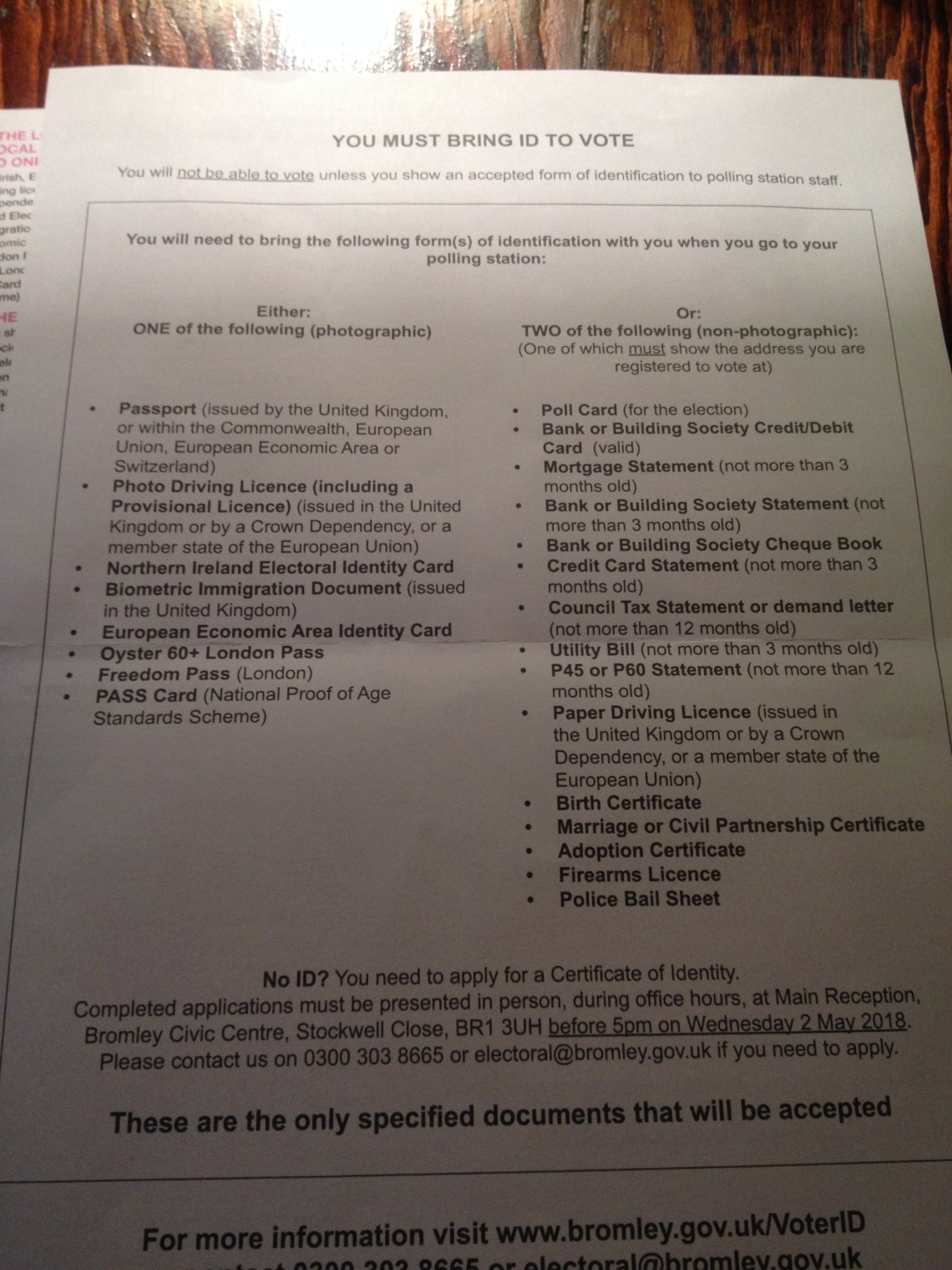
The big ticket item here is the passport which in the UK costs a minimum of £75.50 provided you apply online and take your own digital pictures to HM Passport Office’s unsmiling requirements.
If you unsurprisingly don’t want to chance getting this wrong (say, if there are shadows anywhere in your home), you can shell out another tenner at a high street photographer to get some pictures taken, then if you’re a complete idiot you can go back the following week (to a different branch obviously) and get some more taken because you forgot the first time to specify you wanted them emailed to you, and walked blithely out with your cute little 90s-style wallet of paper pictures, and then two days later in the front of the queue at the butcher’s slapped your forehead and said “Oh fucking hell.” It costs more if you apply by post, and it costs more if you use the Post Office’s Check You’re Not a Complete Plum And Send service.
I don’t know the cost of the other items, and I don’t know what the “Freedom Pass (London)” is at all (it sounds wonderful), but on the assumption that all of them either cost money or are limited to certain groups, let’s pass without further incident to Column B.
I actually can do this without a piece of photo ID, but I’d be very surprised if everyone could:
The poll card itself counts as an item. If you’ve lost that you’re presumably doomed because it tells you what you need to bring – so already that’s one more piece of admin responsibility over previous elections.
Bank card (valid) – this would be my first pairing. Obviously no good if you don’t have a bank account, and this circumstance would suggest a relative lack of privilege.
Mortgage statement (not more than 3 months old) – see above with bells on re privilege. Also, they’re annual, so only 25% of the privileged will have a valid one.
Bank, Building Society, Credit Card statement (not more than 3 months old) – mine are all paperless, because, 2018. I suppose I could tick the ticky box in my internet banking to say “I’d like a paper statement next month please” provided I (a) had the foresight to do this in time and (b) had internet banking or else (c) time and leisure during working hours to phone the bank and hold my way through the ABBA back catalogue. Privilege, privilege, privilege.
Cheque book – lol.
Council tax statement or demand (not more than 12 months old) – if it’s in your name, sure – privilege again. One of the most hassly things about house sharing was always making sure everyone’s name was on something, and then having to periodically switch them around because someone wants to join a gym that thinks internet provider bills are all iniquitous forgeries and only gas will do, or similar.
Utility bill (not more than 3 months old) – see above re names. Also, my water bills are annual and my gas and electricity provider doesn’t even give me the option of paper bills any more, because, 2018. Honestly, admin is like continually slipping between two universes identical in every way except for their vastly different cultural beliefs around paper, one set of organisations positively boasting about the fact that it doesn’t weigh you down with it, while the other set of organisations chastises you for not having any.
(I wouldn’t fancy your chances of printing out an online bill either, I bet they won’t like that. I got round this when I joined the library, that other fierce examiner of personal identity, by using the printer at work and then folding it into thirds like business mail. Show them what they’re expecting to see, etc.)
P45 or P60 – if you work, sure.
Paper driving licence – presuming this also costs money. It certainly costs admin time.
Birth certificate – I’m amazed mine has survived this long and this many house moves, but I’m sure not everyone’s has.
All the rest of the list – limited by circumstance.
Most of the above is about privilege one way or another, the privilege of being worthy of receiving (non)paper in some capacity, and of having an identity that hasn’t changed over the period when all this (non)paper has accumulated. But it’s also about the wider privilege of having the health, time, foresight, and ability to wrangle officialdom to read that list and assemble the correct items from it. There’s just no way round the fact that this scheme asks voters to do more work and meet more standards to vote, and any kind of barrier of that nature is going to exclude some people.
I got my passport renewed, mostly because I needed to anyway, but also because this is not my first rodeo in turning up to desks and timidly submitting bits of crumpled paper to stern ladies. Basically, I have a hunch this will go wrong. There are too many items on that list to effectively train polling staff in all the little ins and outs and possibilities, and for them to retain it all day as hundreds of faces, names and circumstances present themselves. What was once a process has become a set of judgement calls, and inevitably some of them will be close. Somebody will call something wrong, and somebody will be unable to vote. And going on the “Minister for the Constitution”‘s own logic, even one person turned away would be a problem in urgent need of remedy.
Upon which, they’ll introduce ID cards like they wanted all along.
From the E-Mailbag…
Back in this blogpost, I made some points about the colorizing of old movies and TV shows. It brought the following message from my pal Glenn Hauman…
How can you write about this and not discuss recoloring old comics? Would Jack Kirby have wanted his stuff recolored the way it has been over the years?
Recoloring old comics is done a lot these days because so many are being reprinted on much better, whiter paper than was available for their first printings, and with much more sophisticated coloring tools available. In some cases, if you precisely replicate the original coloring on the whiter paper, it looks too loud and garish. That coloring wasn't designed for that paper. And the original line art wasn't designed for all the extra modeling and rendering and gradations and textures that it's now possible to add.
To me, it's a case-by-case thing. Some of the older comics look better with flatter color and the colorist is not being faithful to the work try and add in the coloring, musculature and form-shaping that the original artist(s) did not intend. But following the original color schemes may not be faithful either because you start by changing the underlying paper color and that changes everything.
In the case of Mr. Kirby, he generally liked the way his art was colored before 1970 and generally disliked the way his work was colored after 1970. There were exceptions to that but not a lot. Among the many ways in which he clashed with the management at DC Comics when he began working for them in '70 was that they thought they were doing the best coloring ever in comics and he thought they were doing the worst.
So when I was asked, as I was for some reprints, if Jack would have wanted them to follow the original colorings, my answer was no — because he didn't like the original colorings and maybe the folks who did it back then would have done different things if they knew the work would be printed on whiter paper with brighter inks. But I also think Jack would have wanted a limited use of the new tools…not a lot of figure modeling and added textures. He'd want most of it to be flat coloring but better flat coloring. I think.
By the way: Glenn Hauman is one of the folks who's helped me keep this blog up and running, assisting with tech advice and even doing some of the configuration. I'm glad he sent that question in so I have this opportunity to thank him again for his aid and assistance.
The post From the E-Mailbag… appeared first on News From ME.
Alastair Meeks looks ahead to next month’s local elections
Every year, the politically engaged pore over the local elections, seeking to make deductions about what they mean for national politics. They do so undeterred by the fact that the relationship between local elections and national elections is not all that strong and they disregard the fact that local elections have an independent purpose from acting as a proxy national opinion poll. It’s usually a largely fruitless exercise that serves only to keep wonks occupied until Eurovision hits our screens.
On this occasion, however, the local elections may have some useful things to tell us about national politics. Both main parties’ coalitions of voters were remade in last year’s general election. This is the first large scale test of whether that change might endure. So here are some things to keep an eye on.
What is the par result?
At the 2017 general election, we saw a swing of 2% from the Conservatives to Labour. Many commentators are getting very excited to see whether Labour can build on those swings at the local elections this year. This is a triumph of Conservative expectations management, because the last time these seats were contested was in 2014, not 2017.
In 2014, Labour were slightly ahead in the national polls – a YouGov poll from the day of the general election had Labour on 34% and the Conservatives on 33%. At present, the Conservatives look to have their noses in front – the pollsters differ on the current state of play and I am going to use the split at the last election where the Conservatives scored 43% and Labour 40%. So all things being equal we should see a swing from Labour to the Conservatives of 2% or so between 2014 and 2018.
The Conservatives should, in normal circumstances, be feeling quietly confident.
Are all things equal? Well, no, and for more than one reason.
Was there anything unusual about the 2014 local elections?
Yes, lots. They were held on the same day as the Euro-elections. This ensured that large numbers of people who felt intensely strongly about the EU were lured to the polling booths. UKIP topped the poll in the Euro-elections. Many, probably most, of those determined Europhobes in the local authorities with elections taking place will have gone on to vote in the local elections too. UKIP tallied a national equivalent vote share in the local elections of 17%, a record. The Lib Dems tallied an unusually low national equivalent vote share of 13% (they did far better in both 2016 and 2017 at a local level).
No Euro-election is taking place this year so that cohort will be deprived of that additional motivation. UKIP have collapsed and are not far off asterisk status in the national opinion polls. 2014 Euro-kippers’ voters are up for grabs and the vote share attributable to them is up for grabs. Who is going to benefit? And what will that mean for seat counts?
Is there anything unusual about the seats up for election?
Yes. The seats up for election are skewed towards London and the other metropolitan areas, where Labour has historically performed well.
Did anything unusual happen in the 2017 general election?
Yes, lots. Both main parties increased their vote share substantially and very unevenly. Different parts of the country swung in different directions between the two. Labour did especially well in London and other metropolitan areas.
We don’t know whether these new coalitions formed last year will continue to hold together in the current election round. The working assumption must be that they will.
So what should the adjusted par expectation be?
You will note that there is a happy coincidence (for Labour) between the last two observations. There has been a lot of commentary to this effect, particularly about London. Some data would be helpful.
I previously looked at the swings in each constituency at the 2017 election. I have now estimated the swings in 2017 (from 2015) in each council where elections are taking place – see the map at the top of the page. I hope that it is fairly intuitive. The key is as follows:
A – no swing (less than 1% either way)
B – swing of under 5% to Labour
C – swing of 5-10% to Labour
D – swing of over 10% to Labour
E – swing of under 5% to the Conservatives
F – swing of 5-10% to the Conservatives
G – swing of over 10% to the Conservatives
H – swing of under 5% to the Lib Dems
I – swing of 5-10% to the Lib Dems
J – swing of over 10% to the Lib Dems
K – swing to the Greens
L – swing to others
You can zoom in to inspect the detail.
Because Parliamentary constituencies and council boundaries are drawn differently, the map is more useful in general impression than in specific detail – and you certainly should not place bets on specific councils without conducting further investigations. Nevertheless, the general picture is clear enough. These are indeed areas where in general Labour did well last year, but there are quite enough areas that the Conservatives will be eager to face the polls in.
You would expect the Conservatives to see a favourable swing in any council where the swing from 2015 to 2017 was less than 4% to Labour (or the Lib Dems). So if the new coalitions are holding together, the only councils that Labour can expect to make substantial progress in on current polling are those in the deeper shades of red.
The councils shaded pink are to be expected to be fairly neck and neck. Don’t be surprised if the Conservatives get the better of these exchanges.
The deep grey and blue councils should all be happy hunting grounds for the Conservatives this time round, as they look to take advantage of the swing to them since 2014. If so, the Conservatives can expect to see gains in some councils even in London, even as they are getting pummelled elsewhere in the capital.
What else should we look out for?
UKIP will almost certainly lose more or less all of their seats and vote share. Who is going to profit by their absence? It is conceivable that all the other parties might pick up vote share and seat counts. Everyone else might legitimately be able to claim to have made progress.
The Lib Dems historically have outperformed their national polling in local elections. 2014 was a bad year for them. They will be hoping that the absence of a Euro-election will assist them this time. If they do better this time, will this be at Labour’s or the Conservatives’ expense?
Will the new voting coalitions lead to different voting practices? Historically Labour have had to work harder to get their vote to the polls. Will this continue?
Summary
Don’t believe the hype. Labour should do well in London but the Conservatives have many opportunities for gains and quite possibly might make more than Labour does.
Alastair Meeks
The commentators blaming TMay for the Windrush affair are right – she not ARudd but should be carrying the can
The Windrush scandal is Theresa May’s creation, borne of an innate inability to equate ‘immigrant’ with ‘person’. It’s a hefty accusation, I know, but it makes sense of almost everything she’s done since 2010. Lying about a cat; Go Home vans; subsuming Ukip; EU citizens as cards.
— James O'Brien (@mrjamesob) April 17, 2018
The arbitrary imprisonment of Paulette Wilson, aged 61, who lived lawfully in UK for 50 years is chilling. It could never happen in UK. That it happened as a matter of deliberate policy is appalling. There must be price paid by minister responsible. https://t.co/eKwTjzmccb
— Charlie Falconer (@LordCFalconer) April 16, 2018
If the Home Office is making all these cock-ups over the Windrush generation, how can they possibly hope to register the more than 3m EU citizens living here? I suspect that this is just a tiny taste of what is to come post-Brexit
— Michael Crick (@MichaelLCrick) April 16, 2018
This could be very dangerous for the woman who lost the Tories their majority last June
As those who watch politics closely will know who it is very common for ministers to blame the previous administration when things go wrong on their patch.
There’s a problem though, as the Home Secretary, Amber Rudd, found yesterday when under pressure in the Commons, if the person she wanted to blame was her boss the Prime Minister.
We had this ridiculous situation where the Home Secretary was telling MPs that the problem was caused by the Home Office. That, surely, was Mrs Rudd’s way of getting over the fact that this wasn’t her fault but her predecessor.
A huge problem for the Government and particularly the PM is that the public is very much on the side of the immigrants. YouGov yesterday found 78% saying they should be allowed to stay against 9% that they shouldn’t.
All this comes at a time when the Tories have Mr Corbyn over a barrel following his response to Salisbury and Syria. He is very much on the wrong side of public opinion.
-
My sense is that Mrs. May is pushing her luck at the moment: agreeing to the Syria attacks without recalling parliament, her handling of immigration while Home Secretary and of course the divides within her party over Brexit. Her Salisbury boost in the polls has fizzled out.
Remember it only requires 48 CON MPs to send letter to Graham Brady for her to face a confidence vote. On Betfair it 3/1 that she won’t surive 2018.
Mike Smithson
Syria: the knowledge problem
There’s a danger that the question of whether we should intervene in Syria is becoming a left-right issue. Not only is this false, it’s a means of (deliberately?) ignoring the basic issue – one that is much more general than merely the conjunctural question of Syria.
It’s false because there are many rightists who have doubted the case for military intervention, such as John Baron, Julian Lewis and, I gather, Kate Andrews on Question Time last night. I don’t think this is wholly because they are little Englanders who care only about British interests. It’s because of their stance towards a key general question in politics: how much can governments know?
The case against bombing Syria is not that we should support Russia or Assad or that a “political solution” can be found. It’s that we do not know enough about the country to be confident that intervention will work. Yes, the situation is awful. But it’s quite possible that bombing will make it worse.
Faced with uncertainty, we must err on the side of doing nothing: if in doubt, do nowt. The Brainard principle should apply to all policy, not just monetary policy.
To put this another way, bombing Syria is an irreversible decision. We cannot unbomb the country if we decide that we were wrong to do so. If we don’t bomb, though, we can bomb later if we decide that the case for doing so has become strong. Bog-standard economics tells us that when we have uncertainty and irreversible investment opportunities, we should wait and see. (Dan Davies, has, as usual been good on this).
This is one lesson of the Chilcot report. He wrote (par 863):
Ground truth is vital. Over‑optimistic assessments lead to bad decisions.
Can we really be confident we have sufficient “ground truth”?
The contrary case to all this has been put by Johnny Mercer:
On issues of sensitive intelligence and national security, the PM sees the whole picture, and we should not constrain her
This, though, begs the question: does the PM really have the whole picture?
From this perspective, it’s no surprise at all that some rightists oppose military action. Free marketers such as Kate think the government doesn’t know enough about the economy to intervene successfully. By the same token, they might doubt whether governments can know enough to intervene militarily in other countries. This is a consistent scepticism about what policy-makers can know. Hayek’s famous essay on the limits of knowledge doesn’t just apply to economics.
Much of New Labour had the opposite view. I suspect that Blair’s decision to go to war in Iraq was the product of his overall ideology – an overconfidence about what top-down leaders could know.
In this sense, the Syria question should not be a left-vs-right one at all. Free market rightists and market socialists like me agree that centralized knowledge is often insufficient and so are intervention-sceptics. Those who are more optimistic about state capacity disagree*.
The debate we should have – not just in the Syria context but more generally – is: how much can we know? But because many politicians and columnists have built careers upon being overconfident, this is a question they don’t want asked. As Upton Sinclair said, “It is difficult to get a man to understand something, when his salary depends upon his not understanding it".
* You might object that this is not Corbyn's motive for opposing intervention. Maybe not. But doing the right thing for the wrong reasons isn't entirely to be deplored.
Lovesick Indeed
This fleeting moment’s viral video involves an 11 year old kid from rural Illinois, Mason Ramsey, who apparently likes to go to Walmart and sing in what the internet is calling an old-fashioned country style. Here’s Mason, and an article on Mason in Slate.
The kid is singing an imitation of Hank Williams, who recorded “Lovesick Blues” in 1948.
Here’s Hank’s version
And here’s the really interesting part: Hank himself was doing an almost note for note imitation of a blackface minstrel from the 1920s, Emmett Miller, who recorded the song in 1928. Miller’s version has 50 seconds of minstrel bit before he starts singing.
It’s pretty much unmistakeable: America’s latest viral sensation is an 11 year old white kid in a bow tie channeling, probably without knowing it, a blackface minstrel performer from the 1920s. In other words, Mason is singing a 100 year old version of what white people pretended black people sounded like. He’s appearing on the Ellen DeGeneres show: Walmart has come up with a college scholarship for him.
Good for him, I guess: I doubt he has any idea of the minstrel origins of this singing, but Hank surely did. It seems worth calling attention to the half life of American racism, how a singing style designed to mock black Americans became one of the bedrock songs of classic country music and then the voice of charming white rural authenticity. As I often say in class, “you can’t make this stuff up.”
eagle-god turned trickster gremlin
This was originally published in The Wire in 1999, in their EPIPHANIES section. RIP Cecil T 1929-2018
It began in 1977, at second-hand: I knew before I heard a note of it that I’d love Cecil Taylor’s music. In a jazz encyclopaedia I’d already read of a pianist “zipping and unzipping the keyboard” — but first contact came from a sideways leap out of bent chartpop. Across Bowie’s Aladdin Sane, Mike Garson’s cocktail piano clichés mutate towards cancerous splinters, which rock reviewer Charles Shaar Murray approvingly compared to Taylor. I needed to know more.
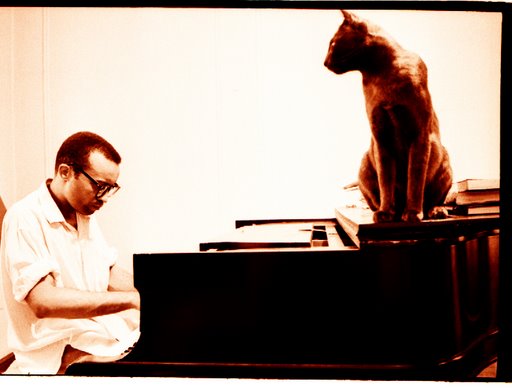
Photograph @ Charles Rotmil, 1960s
With other princes of the Utterly Out — Ornette, Coltrane, Beefheart — I was, I confess it, puzzled by how tame they seemed against the buzz of advance promo. But Cecil — on Black Lion/Freedom’s 1975 Silent Tongues, his 1974 Montreux Festival solo performance — did not disappoint. Perversely, far more subsequent time was spent addressing Coleman and the good Captain, battling to discover ways to hear their sound as deranged delight, learning tolerance for the well-meant overreactions of enthusiasts. And so my response to these others to this day sometimes seems suspect, post-fabricated out of a need to be wowed, or to seem weird; the pianoman, by contrast, I always knew I could trust, to swoop in, connect instantly, and transfigure. With Cecil, no need to fake it.
So I didn’t visit often, though I dallied with his less demanding children — Von Schlippenbach, Tippett, Crispell, Shipp — and all too soon I was taking him for granted. The affair turned second-hand again, and stalled. Modernism’s dirty secret: avant-garde work requires the survival of the order it first flared against, or its full radicalism no longer properly registers. Mind switched to low, just like those Black Cultural Nationalists who voiced concern about Taylor’s ‘European’ influences — because deep, deep beneath their political bluster, they doubted an African-American artform could wrestle white tradition and win — I projected my own baffled timidity, and even dismay, onto an oeuvre I was no longer regularly checking.
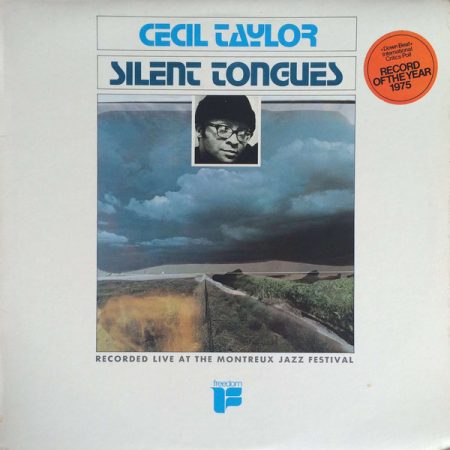 The counter-force epiphany for me came with a CD full of what Stefan Jaworzyn has described as “Teletubbies-style verbal gibberish”: Chinampas (Leo, 1987). At which point, things I’d known for years – but been too nervous to accept – came suddenly clear. Like so many sympathetic yet humour-free interviewers down the years, catching the edge of a Cecil tease but missed its meaning, I’d overlooked countless clues. The cover to Silent Tongues — featuring Cecil, winsome in glasses and woolly hat – I’ve now felt joy towards for some 20 years: in retrospect, the gulf between this absurdly cute sad-little-boy mugshot and the record itself expresses nothing if not irreverent glee. In the sleevenotes to Blue Note’s Unit Structures (1966), dry crypto-Darmstadt analysis mutates into cut-ups, and wicked Burroughsian war on grammar. On Soul Note’s small-orchestra set Winged Serpent (Sliding Quadrants) (1985), on A&M’s impishly superb In Florescence (1990), on Chinampas, Taylor invokes Aztec gods — gorgeous, jagged, murderous deities more outrageously unsuited to worship even than the much-bothered Egyptian pantheon. Their presence among the grunts, rumbles and oblique exclamations punctuating In Florescence suggest a musician whose absolute confidence in his work frees him to kid, to plant the worry that it’s a giant joke. Indeed, this is more than just flirtation — again and again he soars, eagle-god turned trickster gremlin, way out over the abyss of the possible put-on, and never more gloriously than with the high-fired aztèque concrète that makes up the piano-free Chinampas.
Of course, the ‘whitest’ concert-hall piano virtuosos – and the composers that encouraged them – have courted official unrespectability when they became too flamboyant, too romantically individual, too inhumanly extreme or unplayable, from Liszt to Xenakis, from robot-lover Nancarrow to Glenn übernerd Gould. But when piano-play turns into self-absorbed callisthenic work-outs, when the musician presents as some superfit but otherwise daffy street-person, mazed into his own asides, gestures and solo dances, when the compositions are like architectural design-brainstorm sessions for the living city-of-the-future, and this unlikely idiot-savant dervish is busily, dizzily solving every urban conundrum there could ever be, we may begin to realise why most orthodox Cecil-crit favours lulling solemnity. For art-fraud on so titanic a scale – so vastly vivid, so elaborately detailed, so whirlingly learned – is no less startling than the ‘straight’ work it seems to send up. Indeed, it’s far more staggering, and even scary, in its implications — what kind of madman devotes his entire life-energies to the merely unserious? For me, the only works in the avant-garde canon that match Taylor’s serene, omniscient cheek are Finnegans Wake, and Vexations, Satie’s vast day-long hymn to absolute simpleton repetition.
As it was, Coltrane, all bruised earnestness and cosmic quest, became the poster-child for the New Thing, the model for what ‘being taken seriously’ would come to mean. Nobility? Self-denial? Avant-garde transformation as a solemn, lonely, painful, search? Well, yes — yet a glance at the lives of most known questers (knights errant, polar explorers) reveals quests as monuments to anti-domestic panic, with most seekers fleeing as much personal duty as they’re pursuing. All across the slopes of art’s Everests, a great deal of immature selfishness continues to mistake itself for the austere sublime. Much celebrated (rightly celebrated), Coltrane’s natural grace of spirit and vast generosity served mostly to obscure (A) how little imitated this was in Cultural Nationalist circles, and (B) how repressed, repressive and reactionary the CultNat version of radicalism quickly became.
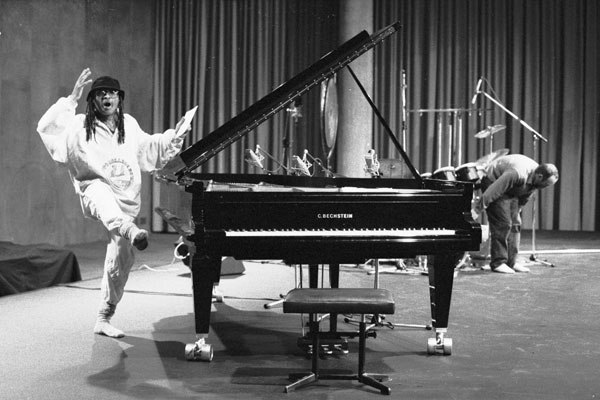
@ Dagmar Gebers | FMP-Publishing
By temperament, Taylor had chosen ‘Out’ before Ayler, Coltrane or even Coleman, playing ‘free’ years before this became the term for the play, his example encouraging each of them to take similar steps. He was always already Out; it was always already Play. His work — in its mischief-making badboy totality — has from the outset been not a quest but a masque, wherein the daunting modernist massif and its pervasively silly, naughty, niggling parody coincide. I love this music because it makes me happy — and it makes me happy because it refuses to sidestep, to underrate or even to disrespect the tireless teasing perversity at the core of human behaviour, because even if it wanted to shill for pompous fraudulence, self-seriousness or fast-track fake enlightenment, it just couldn’t.
Let Me See If I Have This Right… #4

Porn Star Stormy Daniels says she and Donald Trump had an affair. Donald Trump says they did not.
Just before the election, she accepted $130,000 from Donald Trump's attorney Michael Cohen to deny that the alleged affair ever happened. After that, she sometimes denied it and sometimes did not. More recently, she has said they did have the affair and she is suing to have the agreement declared void so she can talk about it all she wants. Cohen is suing her for violating the agreement.
The $130,000 was put up by Cohen who mortgaged his home to raise it because he cared about his client Trump, who he says did not know anything about this. Cohen was not reimbursed for this amount by Trump or the Trump campaign. Various other sums paid to him which seem to total around $130,000 were not for that purpose. Trump also says he knew nothing about this.
The agreement was between a "David Dennison" and a "Peggy Peterson" and a side letter identified David Dennison as Donald Trump and Peggy Peterson as Stephanie Clifford, which is the real name of Stormy Daniels. The use of the aliases was to outsmart anyone who might get hold of a copy of the agreement but not a copy of the side letter, which in some cases was probably in the same envelope.
Among the terms of the agreement is a section wherein Cohen and his client (that would be the client who says he knew nothing about the agreement) require the lady to turn over any evidence she might possess of this affair which they say never occurred.
The lawyer for Ms. Peterson/Clifford/Daniels insists the agreement between her and Mr. Trump/Dennison is invalid because the latter never signed it. Cohen and Trump are insisting it is valid even though Trump never signed it and did not know of its existence.
Cohen insists the agreement is valid because he is Trump's attorney and therefore can sign for his client and commit him to his side of this agreement that he didn't know about.
Meanwhile, Cohen's own lawyer, David Schwartz, says that when Cohen drew up the agreement and forked over the $130,000, he [Cohen] was acting as a friend, not as Trump's lawyer. Trump says that if anyone has any questions about the matter, they should take them up with his lawyer, Michael Cohen.
And Cohen is still Trump's attorney even though if we believe Trump's side of it, his trusted attorney went behind his back to enter into an extremely embarrassing agreement with a porn star to cover up an affair that never happened.
The lady's lawyer, Michael Avenatti, wants this whole matter settled in open court. Trump's lawyer (?) Michael Cohen wants it settled in a closed-door arbitration because his client (?) is completely innocent and when you're found innocent, it's always better to have that happen in secret. Do I have this right?
The post Let Me See If I Have This Right… #4 appeared first on News From ME.
I Can Neither Confirm Nor Deny That I Am A Timeless Goofy Immortal
So @laurenalexg and I both did a double take last night, thinking we saw a photo @scalzi hanging in a restaurant. This is some serious Altered Carbon shit. pic.twitter.com/hSIMwLwuFi
— Peter V. Brett (@PVBrett) April 5, 2018
No comment. NO COMMENT I SAID.
This Should Not Be

Photo by Bruce Guthrie
Here's a sad story about the current financial condition of a very good guy, William Messner-Loebs. Here's what I wrote about Bill last year when we presented him with the Bill Finger Award for Excellence in Comic Book Writing…
Bill Messner-Loebs has been a cartoonist and writer since the 1970s. He has worked for DC, Marvel, Comico, Power Comics, Texas Comics, Vertigo, Boom!, Image, IDW, and the U.S. State Department (for which he produced a comic about the perils of land mines). He has written Superman, Flash, Aquaman, Mr. Monster, Hawkman, Green Arrow, Wonder Woman, Dr. Fate, Jonny Quest, Spider-Man, Thor, and the Batman newspaper strip. He wrote and drew Journey: The Adventures of Wolverine MacAlistaire and Bliss Alley, and he co-created The Maxx and Epicurus the Sage. He has also delivered pizzas, done custom framing, been a library clerk, sold art supplies, and taught cartooning.
A guy like this should not be in the precarious situation he's in. Everyone reading this who reads current comic books can name a whole bunch that would be better written if the editors had hired Bill Loebs to craft some of his always-fine stories. If I were a publisher right now, I'd seize on this chance not just to help someone down on his luck but for strictly selfish reasons — to get more good books into my line by grabbing onto this fine and available resource.
Read the story. Think if there's anything you can do to help. A donation to the organization helping people in his predicament would be nice but what Bill needs is good, steady employment. Anyone out there got any?
The post This Should Not Be appeared first on News From ME.
Riding the Tiger: or, Flirting with the Antivaxxers.
[PreProda: Yeah, after some really enlightening discussion in the Comments section, I’m walking back about 90% of this post. But I’m leaving it posted both because the comments are so interesting, and as a kind of historical artefact to remind me of what happens when I don’t take the time to think things through.]
[Proda: OK, now I’m having third thoughts, since a big chunk of the following argument derives from a) a discussion conducted over too many beers and b) my apparently-erroneous belief that flu vaccines have grown less effective over time. In fact, they apparently were never very effective. For details, check out the mea culpa down in Comment 43.
I’m having second thoughts about vaccination. [Update: But not just vaccination. See coda.]
Not because of autism or mercury or any of that Gwyneth Paltrow bullshit. Not even because I think vaccination is a bad idea— at this stage at least, we pretty much have to stick with the programs.
I am wondering, though, if it might have been a bad idea to have started down this road in the first place.
It all comes down to beers and budworms.
Beers. I had lunch the other day with my favorite Cassandra and fictionalized antihero, Dan Brooks. He drops through every now and then in the course of his travels, usually bearing bad news. This time was no different; we talked about the future, and the increasing statistical likelihood that by mid-century we’ll have lost both half the world’s species and half the world’s human population (not that one of those things is any great loss). We talked about Cape Town, and Lincoln, and LA— all those places where local water wars are just around the corner. The imminent draining of the Great Lakes to water the gardens of millionaires in Palm Springs. The near-ubiquitous use of mouth guards by climate-change scientists. And by the way, have you heard the news? Cholera’s moved back into Canada.
Dan’s an evolutionary biologist. He takes the long view. (When I pointed out the obvious fact that only a few weedy, super-resilient species are likely to survive the Anthropocene, he shrugged and said “So what? Recovery after every major extinction event starts with only a few weedy species, and they’re always enough to get us back up to high biodiversity in only ten or twenty million years.”) He’s also a parasitologist: comfortable talking about epidemiology, the parameter values of the rolling pandemics that’ll start hollowing out our urban centers sometime in the next ten or twenty years. My own background (putting aside the marine mammal thing) is more along the lines of general ecology— so when Dan started talking about outbreaks and countermeasures it was ecology, not epidemiology, that clicked.
“You’re talking about the spruce budworm,” I said.
A quick backgrounder for those who weren’t around in the back half of the Twentieth Century: the spruce budworm is a kind of caterpillar that wreaked havoc on coniferous forests throughout eastern Canada from the sixties at least through the eighties (it may be wreaking still for all I know, but I unfriended the little beggars once I left grad school). The logging industry of the time, as is the wont of logging industrialists everywhere, responded to the infestation by spraying the shit out of the forests with chemical insecticides. The budworm (as is the wont of fast-breeding life-forms everywhere) counter-responded in three ways:
- Most of them died.
- The few who didn’t bred back an army of Mk-2 budworms who weren’t quite as easily impressed by malathion.
- They cranked up their reproductive rate to compensate for increased mortality.
Before long we were faced with a budworm population that we could keep sort of under control, but only if we never stopped spraying. What had once been a purely intermittent event was now a continual, low-level outbreak kept barely in check by pesticides. The moment we let up on the chemicals, those resistant, faster-breeding budworms would tear through the forest like a billion little chainsaws.
What Dan made me consider was the proposition that mass-vaccination programs have done pretty much the same thing to us.
For generations now, we’ve been vaccinating ourselves against (for example) the flu. It used to work really well; vaccination is just a way of programming the immune system with a target-lock for invaders, and it’s pretty easy to do that when all the invaders have a common immunological profile:
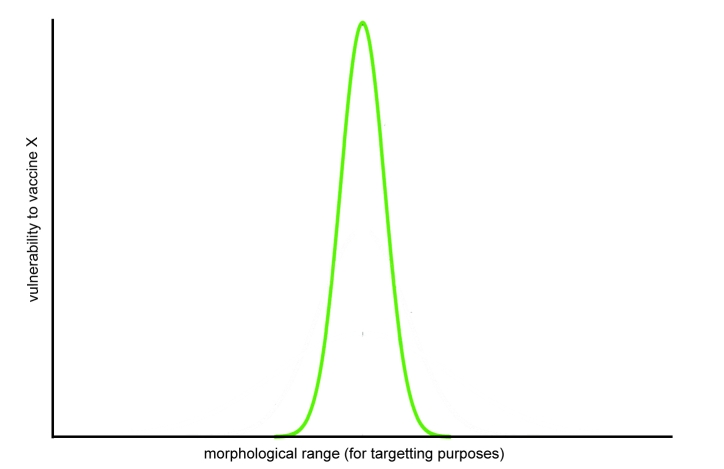
Innocent, naive virus.
Of course, the moment you do that, you’ve provoked a Red Queen scenario. The flu doesn’t just sit there like a candyass: you target that peak long enough, it’ll diversify:
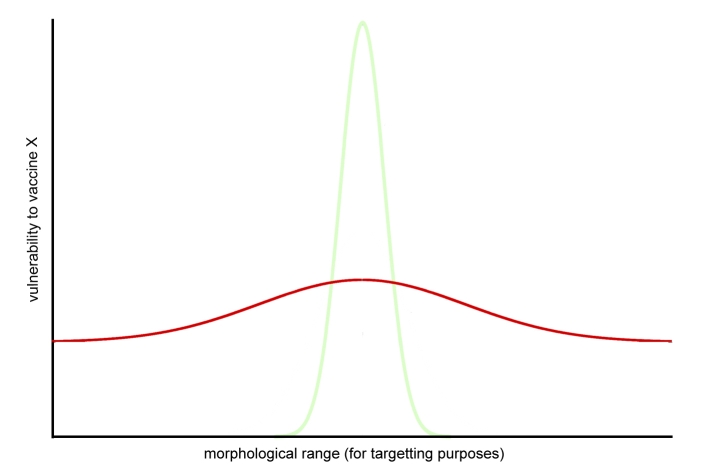
Experienced, world-weary, 5th-degree-black-belt-don’t-fuck-with-me virus.
This is how you go from Praise Be It’s A Miracle Everyone Should Get This! to Well, this year’s vaccine is only about 20% effective but you should get a flu shot anyway because we don’t know what else to recommend. At the same time, vaccination has been protecting people with weak immune systems, people who would otherwise have died. (Of course that’s what we’ve been doing; that’s the whole damn point of vaccination programs.) But since we’ve so greatly reduced the selection pressure that would otherwise weed out the immunological weaklings, vaccinated populations have, over time, become inherently less resistant genetically to the bugs that vaccines protect them against. We’ve outsourced our immune response to the pharmaceutical industry.
Tl;dr? We’ve been making the disease stronger while making ourselves weaker at the same time. It’s the spruce budworm all over again.
And now, like the spruce budworm, we don’t dare stop vaccinating. We’ve built such a tough suite of microbial motherfuckers that if we ever take our foot off the gas, they’ll tear through us like a brush fire. In terms of disease resistance, our genetic load is now far far higher than it would have been if we’d just let nature take its course a hundred years ago. Dan calls it riding the tiger—except we’re talking about a tiger that’s been pumped full of steroids since cub-hood, and a rider that’s turned into a 98-lb weakling in the meantime. It’s only a matter of time before that damn cat throws us off and has us for dinner.
I’m guessing this is partly where the rolling-pandemics-in-ten-years thing comes from. I don’t know what we can do about it at this point. I suppose we could try a CRISPR fix— engineer genetic resistance back into our species before it’s too late. But I don’t know how easy it’ll be to scale that (relatively new) technology up to species-wide deployment.
I suspect Dan’s right. Nature will take care of the problem as it always has. Although there’s one sliver of hope I might summon:
Far as I know, we still have spruce forests in New Brunswick.
Coda: On second thought, I probably shouldn’t have limited this argument to vaccination; I should have explicitly included drug-based countermeasures as well. They’re different approaches— one targets the invader, the other reprograms the immune system— but in both cases, the next generation favors those who get around the countermeasures (either by being resistant to the drug, or having a shape that differs from the target profile programmed by the vaccine). Different tools, but same principle. That’s the point I’m making. I’m not actually confused about the difference between drugs and vaccines.
It’s just that drug-resistant diseases are old news, hardly worth the alarm. The idea that vaccines are subject to the same processes is one of those things that seems obvious in hindsight, but I’d never thought about it before.
The socialism of moralizing fools
How can the Labour party have gotten into such a mess that it can be credibly accused of anti-Semitism? An under-appreciated part of the answer, I suspect, lies in the fact it is dangerous for politics to be seen as a moral project.
I mean this in three senses.
One is that some of the left has adopted the cause of Palestinian rights in the way my generation became active in the anti-Apartheid movement – as a moral crusade, a simple matter (in their minds) of right and wrong. Of course, it is trite to say that there’s a distinction between anti-Zionism and anti-Semitism, and rationally there is. But an interest in Israel-Palestinian affairs does not often enhance one’s rationality. Some of the most passionate pro-Palestinians have blurred the distinction.
Secondly, there’s a form of moral self-licensing. If you believe you’re the good guy acting for a good cause, you can sub-consciously give yourself a license (pdf) to behave badly: this was one psychological mechanism behind the Oxfam debacle. This, I suspect, has been Corbyn’s problem. His belief in Palestinian rights and his active anti-racism has led him to be insufficiently sensitive to some anti-Semitic tropes on the left.
There’s something else. That notorious mural contained a big truth – that, in capitalism, some are the oppressed and some are the oppressors. This would be just as true, though, if the oppressors had been depicted as George Clooney lookalikes rather than hook-nosed Shylocks.
The point here is that capitalist oppression is structural. Workers are not exploited because capitalists are bad people. Instead, exploitation is an emergent process – it arises from the nature of capitalism, independently of anybody’s intentions. Marx was clear on this. The worker’s unhappy condition, he wrote “does not, indeed, depend on the good or ill will of the individual capitalist.” Instead, he continued:
Free competition brings out the inherent laws of capitalist production, in the shape of external coercive laws having power over every individual capitalist. (Capital Vol I Ch 10, part 5)
The problem with capitalism, in other words, is a systemic one. It has little to do with the character of individual capitalists. In fact, they, like workers, are constrained by the system. Capitalism is about structures and processes, not (primarily) morality. Inequality hasn’t increased since the 80s merely because bosses have become greedier. It’s because of processes such as financialization (pdf), technical change, globalization and the decline of trades unions and atomization of labour.
It is very easy for leftists to forget this (I do so myself sometimes) or not to know it in the first place and instead to adopt a moralistic account in which workers are exploited by greedy bosses and bankers. This, however, opens the door to anti-Semitism; once you start talking about greed you are only a few steps away from anti-Semitic clichés. Of course, many don't take those steps, but a few do.
Moralizing about capitalism carries another danger. It’s that economic systems rarely collapse simply because they are immoral. It was the guns of the Union army that defeated slavery more than the words of Frederick Douglass. And feudalism did not give way to capitalism because it was morally inferior. The job of replacing capitalism with socialism, by this reckoning, requires much more than moralizing. It requires the creation and expansion of socialistic institutions. Bleating about morality is little help here.
It has become common in the last few days to quote August Bebel: anti-Semitism is the socialism of fools. I’d add that it’s the socialism of moralizing fools.
Private Parts
I don't have much of an opinion about privacy concerns on Facebook. To the extent I have concerns about my privacy these days, they're more about things like credit reporting, which seems to me like a swampland where private companies can collect any kind of data they want about you — including the erroneous kind — and share it with anyone who pays them. And there's very little you can do about it and very little the government wants to do about it.
Whatever concerns I have about Facebook flow from reports that Mark Zuckerberg believes that privacy is a bad thing and we should all have unfettered access to anything we want to know about anybody. I'm not sure if that's him believing what's good for his business model or if he has a deep-down belief similar to one held by a long-ago lady friend of mine named Sandra. I don't even know if those claims about Mr. Zuckerberg are true but he's the last person on the planet whose privacy we should worry about.
Sandra — not her actual name — is a lady I dated briefly several decades ago…and by "briefly," I think it was like four dates. I am about to tell you why we didn't make five.
One evening when she was here, we wanted a pizza from my then-fave place to get one and they weren't delivering at that moment due to a paucity of delivering people. So I left Sandra here and went to fetch our dinner and when I returned, I found her browsing through my filing cabinet, calmly reading any folder with a tab that caught her eye. She did not act at all like I'd caught her spying or nosing around where her nose did not belong. To her, this was the most natural thing to do.
I asked her what she was looking for. She replied, "Anything you wouldn't want me to see."
As politely as I could, I asked her to remove her nose from my personal papers…and in so asking, I had incriminated myself. She asked, "What don't you want me to see?" The pizza got ice-cold as we discussed her theory that if I had anything to hide, she had the right to see it for her own protection. "What if you were once a serial killer and your parole papers are in here?"
Keep in mind that as she asked that, she was rummaging through folders of scripts I'd written for the Daffy Duck comic book.
I said, "I don't think serial killers have parole papers…or at least, they shouldn't. Secondly, you shouldn't be with anyone you even suspect might be a serial killer. I haven't run a check on you. It's just that there's stuff in there I'd rather no one ever saw…half-finished manuscripts, documents relating to business matters I'd rather forget…letters people sent to me with the understanding that I'd be respectful of their privacy. Some of the worst writing I ever did is in there…"
She said, "You write for the public."
I said, "I write for myself. Only when I think it's finished and good enough do I let anyone else see it." I've always had a strong reticence to let anyone view a work-in-progress. It would inhibit me greatly as a writer if I couldn't write with the belief that I can go wherever I want with it and that it's For My Eyes Only until I decide otherwise.
This conversation went on a long time, during which our relationship and the pizza got colder and colder. I did get her to stop ransacking my files then and there for evidence of my past serial killing. I did not get her to concede that I had any right to control my own work or what parts of my past I wanted to share and when. She only called off the search because she decided she didn't want to hang around someone who had something — doubtlessly, nefarious — to hide. Thereafter, she did not.
Whenever I see discussions of privacy, I think of Sandra and the right she felt she had for me to not have any. But then the other day, I was on Mr. Zuckerberg's little online world and I chanced to spot the name of a lady I dated back in college. That is, I recognized her first and old last names, followed by the addition of her married name. She had some old photos posted, several of which confirmed for me it was indeed the same lady. On a whim, I decided to drop her a message and say howdy —
— but then I read a little of what she'd posted. There was a lot there about how we should thank the lord that the gay Kenyan Barry Sotero "Obama" is out of the White House along with his two rented children and the transgender black man who fools no one passing for his wife. Partway through a screed about all the bogus "false flag" school shootings, I found myself thinking, "Maybe I won't re-establish contact with this person."
So I guess I have Mark Zuckerberg to thank for that. There's a difference between privacy and reading what people choose to make public.
The post Private Parts appeared first on News From ME.
Test Case
So it finally happened: a self-driving car struck and killed a pedestrian in Arizona. And, of course, the car was an Uber.
(Why Uber? Well, Uber is a taxi firm. Lots of urban and suburban short journeys through neighbourhoods where fares cluster. In contrast, once you set aside the hype, Tesla's autopilot is mostly an enhanced version of the existing enhanced cruise control systems that Volvo, BMW, and Mercedes have been playing with for years: lane tracking on highways, adaptive cruise control ... in other words, features used on longer, faster journeys, which are typically driven on roads such as motorways that don't have mixed traffic types.)
There's going to be a legal case, of course, and the insurance corporations will be taking a keen interest because it'll set a precedent and case law is big in the US. Who's at fault: the pedestrian, the supervising human driver behind the steering wheel who didn't stop the car in time, or the software developers? (I will just quote from CNN Tech here: "the car was going approximately 40 mph in a 35 mph zone, according to Tempe Police Detective Lily Duran.")
This case, while tragic, isn't really that interesting. I mean, it's Uber, for Cthulhu's sake (corporate motto: "move fast and break things"). That's going to go down real good in front of a jury. Moreover ... the maximum penalty for vehicular homicide in Arizona is a mere three years in jail, which would be laughable if it wasn't so enraging. (Rob a bank and shoot a guard: get the death penalty. Run the guard over while they're off-shift: max three years.) However, because the culprit in this case is a corporation, the worst outcome they will experience is a fine. The soi-disant "engineers" responsible for the autopilot software experience no direct consequences of moral hazard.
But there are ramifications.
Firstly, it's apparent that the current legal framework privileges corporations over individuals with respect to moral hazard. So I'm going to stick my neck out and predict that there's going to be a lot of lobbying money spent to ensure that this situation continues ... and that in the radiant Randian libertarian future, all self-driving cars will be owned by limited liability shell companies. Their "owners" will merely lease their services, and thus evade liability for any crash when they're not directly operating the controls. Indeed, the cars will probably sue any puny meatsack who has the temerity to vandalize their paint job with a gout of arterial blood, or traumatize their customers by screaming and crunching under their wheels.
Secondly, sooner or later there will be a real test case on the limits of machine competence. I expect to see a question like this show up in an exam for law students in a decade or so:
A child below the age of criminal responsibility plays chicken with a self-driving taxi, is struck, and is injured or killed. Within the jurisdiction of the accident (see below) pedestrians have absolute priority (there is no offense of jaywalking), but it is an offense to obstruct traffic deliberately.
The taxi is owned by a holding company. The right to operate the vehicle, and the taxi license (or medalion, in US usage) are leased by the driver.
The driver is doing badly (predatory pricing competition by the likes of Uber is to blame for this) and is unable to pay for certain advanced features, such as a "gold package" that improves the accuracy of pedestrian/obstacle detection from 90% to 99.9%. Two months ago, because they'd never hit anyone, the driver downgraded from the "gold package" to a less-effective "silver package".
The manufacturer of the vehicle, who has a contract with the holding company for ongoing maintenance, disabled the enhanced pedestrian avoidance feature for which the driver was no longer paying.
The road the child was playing chicken on is a pedestrian route closed to private cars and goods traffic but open to public transport.
In this jurisdiction, private hire cars are classified as private vehicles, but licensed taxis are legally classified as public transport when (and only for the duration) they are collecting or delivering a passenger within the pedestrian area.
At the moment of the impact the taxi has no passenger, but has received a pickup request from a passenger inside the pedestrian zone (beyond the accident location) and is proceeding to that location on autopilot control.
The driver is not physically present in the vehicle at the time of the accident.
The driver is monitoring their vehicle remotely from their phone, using a dash cam and an app provided by the vehicle manufacturer but subject to an EULA that disclaims responsibility and commits the driver to binding arbitration administered by a private tribunal based in Pyongyang acting in accordance with the legal code of the Republic of South Sudan.
Immediately before the accident the dash cam view was obscured by a pop-up message from the taxi despatch app that the driver uses, notifying them of the passenger pickup request. The despatch app is written and supported by a Belgian company and is subject to an EULA that disclaims responsibility and doesn't impose private arbitration but requires any claims to be heard in a Belgian court.
The accident took place in Berwick-upon-Tweed, England; the Taxi despatch firm is based in Edinburgh, Scotland.
Discuss!
valarhalla: valarhalla: boopsandswoops: lifelessordinary0: ...

Temple of Horus, Egypt
its horus he’s here
Guys no, it gets so much better.
A small fat bird, like the above, is the hieroglyph used in Ancient Egyptian to mean “wicked” or evil”.
The phrase above him (the inscription should be read from the top down) is “Nb s3″ or “Lord of the son of”. Genitive is usually implied in this sort of phrase without a connecting word, meaning:
This birb has literally created the sentence and declared himself “ Lord of the Son of Evil”
God dammit, I realised I made a mistake doing this from memory- the first sign is “k” for “your”, not “nb” for “lord”. So this birb has declared himself “your evil son”, not “the lord of the son of evil”. Which is not quite as dramatic, but still very menacing. You go bird.
The Source
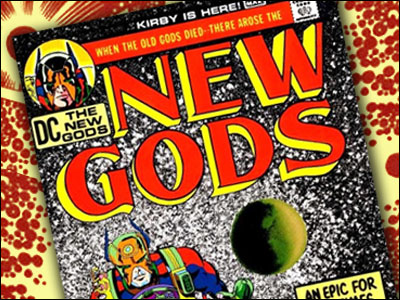
Bazillions of people have written to ask if I've heard the announcement that Ava DuVernay, who directed the film A Wrinkle in Time, will helm a mega-budget feature based on Jack Kirby's The New Gods. Sure. They want to know if I'm excited about it. Yeah. I don't ever get too excited about this kind of thing but I'm sure glad they're doing it.
As seems to always happen when these kinds of thing are announced, there are already folks on the 'net proclaiming it a huge hit and others who are sure it's going to suck. Not one role has been cast. Not one frame of film has been shot. They may not even have started on a script. But the fate of the movie has been sealed for some, which I guess saves time. Me, I think I'll wait to decide how good it is until they actually make it. I may even be so non-intuitive about judging films that I'll need to wait until I see the trailer if not the entire movie.
But like I said, I'm glad they're making it — for two reasons. One is that I think it was a wonderful creation even if its abrupt termination as a comic book caused it to never reach its full potential. The other reason is more personal.
Just in case there's anyone reading this who doesn't know, I was privileged to be on the premises when the New Gods happened. My then-partner Steve Sherman and I had very little to do with the contents of these comics when we worked as Jack's assistants but we suffered along with him when DC Management, after first telling him the books were doing well, abruptly canceled them. One reason that was given was that the folks who handled DC licensing decreed that there would never be any interest whatsoever in those characters for toys or film adaptations or movies or television or anything of the sort.
Jack is no longer here and even if he was, he was too classy to point out how wrong they were. I, however, am here and I'm nowhere near as classy as he was.
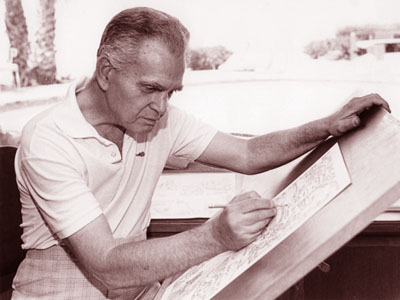
The other reasons had to do with allegedly poor sales…but New Gods was selling better than a lot of comics they didn't ax, and DC at the time was a pretty dysfunctional company, launching new books and quickly canceling them, launching new books and quickly canceling them. Anyone remember Bat Lash? Or The Secret Six? Or Beware the Creeper or The Hawk and the Dove or Anthro or the Green Lantern/Green Arrow series by Denny O'Neil and Neal Adams or many, many others?
Some of those comics lasted six or seven issues, meaning that the decision to cancel came about the time they were getting final sales figures on issue #3. I never understood how they expected to find a new audience when they kept giving up right away on a new audience finding them. When Marvel launched Conan the Barbarian as a comic book — about the same time DC launched New Gods — Conan initially got the kind of sales figures that usually warranted termination at either company…but it stuck around, found an audience and flourished.
Back then, DC's distribution channels were atrophying and there was rampant fraud in the tallying of unsold copies versus sold ones. Also, around the time New Gods was just getting going, they moved to a new, larger size for all their comics, leaping from 32 pages for 15 cents to 48 for 25 cents. Not many industries can suddenly raise prices — what is that, like 62%? — without losing customers. It was especially bad for comic books because young readers have limited funds, and Marvel was at 20 cents.
Sales plunged on every single DC title and only when they abandoned the idea did some books rebuild their audience. Jack's rebuilt slower and I honestly believe he paid a price for being viewed as a guy who could create whole new books in an instant. DC was losing a few bucks — and really, only a few — on his titles when someone got the idea of "suspending" them (that was the term used at the time) and seeing if he could come up with something else that would suddenly change the whole dynamic of the marketplace.
In hindsight, that looks more and more like it was a bad idea. New Gods and its allied titles have had great value to DC over the years. I don't know how many times they've reprinted that material. I should because I'm called on to write forewords for most of the new repackagings…but the characters have since been seen in revival series and on toy shelves and TV and, inevitably now, movies.
I'll bet — heck, I know because some there have told me — the current management wishes Jack had done a few dozen more issues of Orion, Lightray, Darkseid, Mister Miracle, The Forever People and all the rest. He was adding new characters and concepts to the book at a breakneck pace. Who knows what new wonders would have appeared?
I have very little skin in this reckoning. No one blamed his assistants when the books were terminated and labeled as failures. But I loved Jack and I love his work. (Full Disclosure: I wasn't as unreservedly wild about his Fourth World series at the time because it didn't read like what everyone else was doing…but the more and more I re-read it, the more I love it and that's in large part because it doesn't read like what everyone else was doing.)
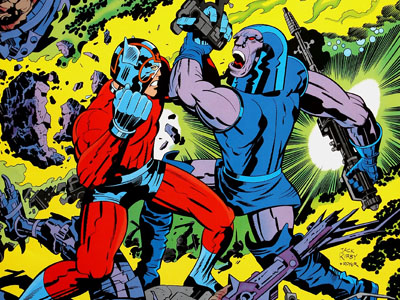
There's an unfortunate tendency in the creative arts that when a film or a book or a TV show succeeds, everyone involved is a hero, everyone involved claims a large chunk of that success. The producers, the publishers, the marketing people, the publicists, the wholesalers, the retailers, the assistants, the assistants' assistants…every one of them did their job well…
But when something fails, there's usually only one reason: The creative people screwed up.
The director made a bomb. The writer did a lousy script. That's where the blame always falls, even if that director wasn't allowed to make the film he or she wanted or the writer had her or his work trampled and rewritten. Kirby took a lot of abuse for the New Gods being branded a flop when it first came out. Everyone kind of forgot that Marvel's three biggest successes — Spider-Man, the Hulk and the X-Men — were all considered failures on first publication. The Hulk lost his comic after six issues and Spider-Man went away after one.
It makes you wonder how many comics that didn't get a second chance could have been just as big.
Speaking now as maybe the only person posting to the Internet who isn't sure how successful the New Gods movie will be, I'm glad they're doing one. I'm also pleased that most of the announcements are reminding people that Jack was not only the co-creator of most of the Marvel heroes who are now doing so well on the screen, but that he was not merely a guy who drew someone else's ideas and stories for them.
And maybe this will make more people realize that when something gets canceled — a movie, a TV series, a comic book, whatever — the blame might lie with the folks who created it but it might also lie with those who canceled it. Or those who were supposed to market it better than they did.
I'm going to wrap this up even though I'm having enormous fun writing it. Since I started on it yesterday, I've gotten a couple of e-mails asking me what I think Jack would have thought of the news that New Gods was about to become a movie with a budget of something like a hundred million bucks. That's a real easy question. people. He would have smiled and asked, "What took them so long?" But he wouldn't have gloated. Like I said, he was a lot classier than I am. Probably a lot classier than you, too.
The post The Source appeared first on News From ME.
Cultural costs of high house prices
Much has been written about how high house prices are reducing (pdf) home ownership and depressing real incomes. This is an economic menace: it depresses productivity and increases economic instability (pdf). But I wonder: does it also retard cultural and technological change?
I ask because the emergence of youth culture as we know it in the 1950s was the product of the fact that the post-war economic boom put money into the pockets of young people. As Billy Bragg says:
What happened in 1955, '56 was the first generation of British kids who were born during the war left school. And they left school at a time of high employment. So they were able to find work pretty quickly. So they were getting paid more, sometimes more than their parents. And they, you know - the only expense they had was giving housekeeping to their mom. So they had a lot of money to spend things on. So sales of cosmetics, of records, of clothes kind of took off in the mid-'50s. And this generation really is the first generation to identify themselves as distinct teenagers.
Friedrich Hayek said a similar thing. In The Constitution of Liberty he wrote that economic progress takes place “in echelon fashion.” New goods at first are “the caprice of the chosen few” and they then spread. He thought the “chosen few” were the rich. But they can equally well be younger people who are more open to new products and experiences: grandparents, for example, have iPads because their children and grandchildren got them first.
All this implies that if the incomes of the young are squeezed by high housing costs then we’ll see less cultural or technical progress. And this, I suspect, is just what we’ve got. The distinctive products and experiences we associate with millennials are small beer – literally so in the craft beers served in what we oldsters call short measures: coffee, avocado toast and free apps. This is not the stuff of cultural dynamism.
There’s more. Art and culture, as much as industry, benefits from agglomeration effects – the ability of creative people to live near each other. In the 60s and 70s countless musicians moved into rundown New York apartments where they could live cheaply whilst they honed their craft and waited for their break. Today, this is no longer possible in New York or London unless you have rich parents. As Chris Stein has said:
The biggest shame is that everybody’s gotta have a job to live in the city now. There’s no time to make art. How can you keep your credibility if you have some stupid job you hate and still be a radical?
Cheap housing gave us Blondie and Philip Glass. Expensive housing gives us Mumford and Sons*.
What it gives us in greater numbers, though, are drones - commute, work, sleep: repeat for 50 years. I know that PR-based surveys are unreliable, but it’s not wholly surprising that so many millennials are suffering quarter-life crises.
In this sense, expensive housing has totalitarian tendencies: it enforces uniformity. For some, this might be a feature not a bug. For those of us who value diversity, however, it is certainly not.
Now of course, all this is necessarily speculative. It’s a story about what hasn’t happened. But then, that is the very nature of opportunity cost: we don’t see the road not taken. And the road closed by high housing costs might well have been a pleasant one.
* I’m not saying that a rich background precludes musical genius; Nick Drake and Townes van Zandt are obvious counter-examples. It’s just that if you draw your talent only from the rich then you have much thinner pickings.
RIP Kate
Kate Wilhelm Has Left Us…
I just want to spend a minute tonight remembering one of my mentors and a fantastic person. (No reason to send me sympathy. Save that for her family at this point. And go buy her books, the greatest way to honor a writer.
I first met Damon Knight and Kate Wilhelm at a convention in 1981. And then again in the summer of 1982 at Clarion writers workshop in Michigan. Then later that summer Nina Kiriki Hoffman and I made the sixteen hour round-trip drive from Moscow, Idaho to Eugene, Oregon, to sit in Damon and Kate’s living room every month for a workshop they held there.
We made that drive every month for over a year without missing, including through snowstorms and weather we should never have been driving in. (We couldn’t afford hotel rooms so when the workshop was over around 10 we drove back to Idaho.)
Kris and I saw Damon and Kate regularly after we moved to Eugene in 1987. They were always welcoming and even though both Damon and Kate thought us slightly nuts, they both supported Pulphouse Publishing in spirit and with their writings.
I wouldn’t want to try to count the wonderful hours and hours I spent listening to Kate in her living room. For a young writer like me, I loved her honest approach and ability to see a story like no one I had met before. She taught me most of all that I knew very little about the craft of writing at that point in time and she helped point the way for me to learn.
And as a fan, I loved her writing.
I know there are many who were much closer to Kate than I ever was. I think it has been a good decade since we spoke, actually, but to me, she was always a guiding light in the darkness of confusion that we call fiction writing.
And I will always remember when she said to me (while sitting at Clarion in her and Damon’s apartment), “Just keep doing what you are doing. You are on the right track.”
Those words over the decades just kept me going through some very discouraging times. I have no idea what she saw, but I am glad she saw something.
Thanks, Kate, for helping a young writer like me move forward. And to all that you did in fiction writing and to help other writers like me over the decades. You are remembered and honored.
Thoughts on A Wrinkle in Time

“So, why were you crying through the entire film?”
— my daughter Athena, who was mildly concerned.
There are several answers to this, most of which boil down to the fact that I am a father who remembers being the ten-year-old boy who fell in love with Madeleine L’Engle’s book, and the movie engaged both of these states. I cried because the casting and performance of Meg (played by Storm Reid) is immensely good — such a stubborn, willful, doubt-filled girl — and because I could see both myself as a child and my daughter in her. I cried because I remember being a fatherless child and being a father who would never want to leave his daughter. I cried because the film has empathy not only for bright but difficult children but for all children, and because it wants so much for Meg to see herself, just as I would want to be seen and would want my own child to see her value. I cried because I remembered being lost like Meg was lost, and remembered everyone who helped me find myself, as everyone in this film does so for Meg, and as I hope I have helped my own daughter become who she is meant to be.
I cried because this film has an enormous amount of empathy, as the book did, and that essential core remains intact, even as the film takes liberties with the source material. It would have to, 56 years after the book’s initial publication, to speak to the audience it’s intended to speak to, which is not me, a 48-year-old white dude, although it clearly and so obviously did. I cried because this film gets the book right, because it sees the book, just as the book saw me when I came to it almost four decades ago, and has seen so many other children since. Director Ava DuVernay’s love of the material, and her willingness to put the work into it to make it speak today, is self-evident and appreciated.
It is not a perfect film, in itself or in its adaptation of the source material. Lots is truncated, changed and elided, some new stuff is put in to middling effect. The commercial needs of a $100 million film mean that some tropey elements get past the gate, and on more than one occasion the special effects become the tail wagging the dog. In the end I didn’t see much of this as a problem. The film is not perfect, and also, this is a film about faults, and how our own faults ultimately may give us power to save ourselves and others. While I’m not going to say this film’s faults ultimately give it power, I can say that none of the film’s faults are that important to me when the film’s core is solid, and intact, and so powerfully on point. It’s not perfect, nor does it have to be to work.
(And, you may ask, what do I think about the film’s multicultural and feminine viewpoint and aesthetic? I think it works very well, and it’s a reminder that things that are not designed specifically for one in mind may still speak significantly and specifically to one, if one is open to it. I would not have imagined A Wrinkle in Time the way DuVernay has — I seriously doubt I could have imagined it this way — and yet there I was crying my eyes out all the same. I do not need the world to be imagined as I would have imagined it. I want the world and the things in it to exceed my imagination, to show me things I cannot make for myself but can take into myself, hold precious, and make my imagination that much wider from that point forward. As I noted before, this movie was not, I think, made for me, and still here I am, loving it as much as I do.)
Should you see this film? Well, I think you should. I also think you should see it on a big screen, because it’s visually impressive enough to warrant it and because films still have their most potent power on a big screen, in front of an audience. Maybe it won’t have the same effect on you that it had on me — in fact, it probably won’t, because you are not me. But I’m willing to believe it will have some effect. Whatever that effect is, it’ll be worth getting yourself to a theater for, and maybe taking a kid or two along with you, too.
As for me, I can honestly say that I don’t think I’ve been this affected by a film in years. Part of that is because I loved the book as a child, but I’ve loved other books before, and their adaptations, and yet didn’t spend their entire running time in tears. I think, in the end, it’s what Ava DuVernay, her team and her actors (especially Storm Reid) brought to it: Empathy, joy, optimism and their own point of view that brings A Wrinkle in Time into modern times. No one needs me to tell them that DuVernay is a major director; that much was evident with Selma and 13th. What I can say is that DuVernay, rare among directors, is now someone whose vision I trust — not to give me what I think I want, but to give me what I didn’t know I needed, until she showed it to me.
I knew I was probably going to like A Wrinkle in Time. I didn’t know I was going to love it this much. I certainly didn’t know I was going to find myself crying all the way through it. That’s on DuVernay and her team. And for that, I say: Ava DuVernay, thank you. I don’t think it’s possible for your film to have moved me more than it has.