Shared posts

12 Jul 05:41

Narnia: The Magician's Neighbor

by Ana Mardoll
[Narnia Content Note: Child Abuse, Animal Abuse, Ableism, Mental Illness]

Narnia Recap: Welcome to the start of a fresh new day!

The Magician's Nephew, Chapter 1: The Wrong Door

The ending to The Horse and His Boy was so abrupt that I actually had to go back through the archives to check to see if I'd actually finished the book. Apparently I have! And as there is not yet a THAHB movie of any sort (at least that I know of), we have no intermission. On to the next book!

The Magician's Nephew is one reason why I tackled the books in publishing order rather than canonical order: I remember not being a fan. We'll see if time and distance have mellowed me, but as a kid this was one of the books in the series that I didn't much care for. When I grew up and saw that Harper-Collins was actually packaging and marketing the series with TMN as "book one", I had a hearty bitter laugh and predicted that the kids they were marketing to would never read past the "first" book. The Lion, the Witch, and the Wardrobe may have problems, but you can see what Lewis was going for and can fill in the gaps, often without even noticing that you're doing so. The Magician's Nephew is often just... surreal and not nearly so easy to aid with imagination-spackle.

And, if I recall correctly, the women get the short end of all the sticks. But now I'm jumping ahead.

   THIS IS A STORY ABOUT SOMETHING that happened long ago when your grandfather was a child. It is a very important story because it shows how all the comings and goings between our own world and the land of Narnia first began.

I mean! This is the first paragraph of the book, and what is Harper-Collins even thinking? The narrative clearly supposes the reader knows and cares about Narnia, enough so that they'd be interested in a backstory about the place. When you package this as "book one" in a series, you're completely misunderstanding how a reader--

No. Okay. I'm calm.

   In those days Mr. Sherlock Holmes was still living in Baker Street and the Bastables were looking for treasure in the Lewisham Road. In those days, if you were a boy you had to wear a stiff Eton collar every day, and schools were usually nastier than now. But meals were nicer; and as for sweets, I won’t tell you how cheap and good they were, because it would only make your mouth water in vain. And in those days there lived in London a girl called Polly Plummer.

This is interesting because we're almost setting up Polly to be the protagonist. Lewis has attempted female protagonists before--Lucy was an important character in both Lion and Dawn Treader, and Jill was ostensibly the protagonist of Silver Chair before being eclipsed by all the male characters--but he never quite seems able to stick with them before abandoning them mid-narrative for a more interesting (to him) male character. Then, too, there's the fact that the book itself is named after a boy (Digory, the titular nephew) than the girl we're being set up to follow.

But let's see. Maybe the sixth time's the charm.

   She lived in one of a long row of houses which were all joined together. One morning she was out in the back garden when a boy scrambled up from the garden next door and put his face over the wall. Polly was very surprised because up till now there had never been any children in that house, but only Mr. Ketterley and Miss Ketterley, a brother and sister, old bachelor and old maid, living together. So she looked up, full of curiosity. The face of the strange boy was very grubby. It could hardly have been grubbier if he had first rubbed his hands in the earth, and then had a good cry, and then dried his face with his hands. As a matter of fact, this was very nearly what he had been doing.
   “Hullo,” said Polly.
   “Hullo,” said the boy. “What’s your name?”
   “Polly,” said Polly. “What’s yours?”
   “Digory,” said the boy.

Digory and Polly have some antagonistic back-and-forth because Digory's face is dirty and he's been crying. He can't hide that he's been crying so instead he defensively blurts out that she would cry too if she used to live in the country and had a pony and a river and now his father has gone off to India and he has to live in London with his aunt and uncle because his mother is gravely ill and about to die.

   “I didn’t know. I’m sorry,” said Polly humbly. And then, because she hardly knew what to say, and also to turn Digory’s mind to cheerful subjects, she asked:
   “Is Mr. Ketterley really mad?”
   “Well either he’s mad,” said Digory, “or there’s some other mystery. He has a study on the top floor and Aunt Letty says I must never go up there. Well, that looks fishy to begin with. And then there’s another thing. Whenever he tries to say anything to me at meal times—he never even tries to talk to her—she always shuts him up. She says, ‘Don’t worry the boy, Andrew’ or ‘I’m sure Digory doesn’t want to hear about that’ or else ‘Now, Digory, wouldn’t you like to go out and play in the garden?’”
   “What sort of things does he try to say?”
   “I don’t know. He never gets far enough. But there’s more than that. One night—it was last night in fact—as I was going past the foot of the attic-stairs on my way to bed (and I don’t much care for going past them either) I’m sure I heard a yell.”
   “Perhaps he keeps a mad wife shut up there.”
   “Yes, I’ve thought of that.”
   “Or perhaps he’s a coiner.”
   “Or he might have been a pirate, like the man at the beginning of Treasure Island, and be always hiding from his old shipmates.”
   “How exciting!” said Polly. “I never knew your house was so interesting.”
   “You may think it interesting,” said Digory. “But you wouldn’t like it if you had to sleep there. How would you like to lie awake listening for Uncle Andrew’s step to come creeping along the passage to your room? And he has such awful eyes.”

I feel all this works only if Polly and Digory are very young, which is why it's a touch frustrating to me that we don't get a strong indicator of age thus far. Are these children actually meant to be this young, or is this another Shasta situation where the protagonist is supposed to be 14 or 15 but reads like they're 5 or 6? (Lewisian children in general tend to sound much younger than they actually are.)

From an adult standpoint, this passage is also absolutely terrifying. We'll later learn that Uncle Andrew is abusive in "evil scientist" ways (he uses the children as test subjects in his experiments) but right now I'm worried about Digory for other reasons. I know that Lewis was something of an innocent and I am aware of the difference in time periods, but did no one involved in the publishing of this book toss up red flags regarding an uncle who creeps outside his nephew's room at night, such that the boy is afraid of this older man and his awful eyes? Whilst meanwhile the uncle's sister keeps desperately trying to prevent the uncle from spending any time whatsoever with their nephew?

   That was how Polly and Digory got to know one another: and as it was just the beginning of the summer holidays and neither of them was going to the sea that year, they met nearly every day.
   Their adventures began chiefly because it was one of the wettest and coldest summers there had been for years. That drove them to do indoor things: you might say, indoor exploration. It is wonderful how much exploring you can do with a stump of candle in a big house, or in a row of houses. Polly had discovered long ago that if you opened a certain little door in the box-room attic of her house you would find the cistern and a dark place behind it which you could get into by a little careful climbing. The dark place was like a long tunnel with brick wall on one side and sloping roof on the other. In the roof there were little chunks of light between the slates. There was no floor in this tunnel: you had to step from rafter to rafter, and between them there was only plaster. If you stepped on this you would find yourself falling through the ceiling of the room below. Polly had used the bit of the tunnel just beside the cistern as a smugglers’ cave. She had brought up bits of old packing cases and the seats of broken kitchen chairs, and things of that sort, and spread them across from rafter to rafter so as to make a bit of floor. Here she kept a cash-box containing various treasures, and a story she was writing and usually a few apples. She had often drunk a quiet bottle of ginger-beer in there: the old bottles made it look more like a smugglers’ cave.
   Digory quite liked the cave (she wouldn’t let him see the story) but he was more interested in exploring.

I'm quoting this part in full because--credit where it is due--I think this is the most proactive a female protagonist has been in a Lewis novel. I mean, yes, it's partly scenery-setting porn (which he loves) more than outright characterization, and yes, it's feminine characterization to an extent (she's nesting and decorating) but it's still active and not passive. I appreciate that. It's a weird feeling to run into a female character doing things in a Narnia book. I like it. More, please.

Digory asks Polly about the tunnel and she tells him that the walls don't meet the roof, which means the tunnel goes all the way down the row of houses to the very end. Polly has an idea that they could crawl past her house and past Digory's house into the next house down the line, which is abandoned and maybe haunted. Digory loves the idea (although he's kind of a jerk about it, and I'm reminded that one reason I didn't like this book as a kid was Digory's jerky treatment of Polly), and they do some maths to see how far they should go in the tunnel so they don't end up in the wrong house.

   When they had measured the attic they had to get a pencil and do a sum. They both got different answers to it at first, and even when they agreed I am not sure they got it right. They were in a hurry to start on the exploration.

Uh? Again, these may be very small children, but the "sum" is "take the length of Polly's attic, then double it because Digory's attic, then we should be there". I'm tempted to let this pass as a tiny plot hole not worth worrying about, except that Lewis keeps railing on about schools being the end of everything good. Lewis, I have my own issues with schools and schooling but your characters can't even double a number without getting a different answer four times.

   “We mustn’t make a sound,” said Polly as they climbed in again behind the cistern. Because it was such an important occasion they took a candle each (Polly had a good store of these in her cave).
   It was very dark and dusty and drafty and they stepped from rafter to rafter without a word except when they whispered to one another, “We’re opposite your attic now” or “this must be halfway through our house.” And neither of them stumbled and the candles didn’t go out, and at last they came where they could see a little door in the brick wall on their right. There was no bolt or handle on this side of it, of course, for the door had been made for getting in, not for getting out; but there was a catch (as there often is on the inside of a cupboard door) which they felt sure they would be able to turn.
   “Shall I?” said Digory.
   “I’m game if you are,” said Polly, just as she had said before. Both felt that it was becoming very serious, but neither would draw back. Digory pushed round the catch with some difficulty. The door swung open and the sudden daylight made them blink. Then, with a great shock, they saw that they were looking, not into a deserted attic, but into a furnished room. But it seemed empty enough. It was dead silent. Polly’s curiosity got the better of her. She blew out her candle and stepped out into the strange room, making no more noise than a mouse.

Reader, I am as astonished as you are that Polly is still getting to do things. First, she had the presence of mind to make the "smuggler's cave" in the first place. Then she had the knowledge that the little tunnel went all the way to the far end of the house. And while the narrative says Digory was the one who wanted to explore, it was Polly who thought up the idea of invading the empty house. Now here Polly is the one stepping into the room and blowing out her candle. Doing things!

Back in plot-hole-land, the two kids know that Digory's attic lies between Polly's attic and the abandoned house they're aiming for. Did they just assume Digory's attic didn't have a door? Because I feel like my first thought on seeing a door would be "ok, there's Digory's door, now we just have to open the next door." Anyway, spoilers: they're about to tumble out into Uncle Andrew's attic office.
  
   It was shaped, of course, like an attic, but furnished as a sitting-room. Every bit of the walls was lined with shelves and every bit of the shelves was full of books. A fire was burning in the grate (you remember that it was a very cold wet summer that year) and in front of the fireplace with its back toward them was a high-backed armchair. Between the chair and Polly, and filling most of the middle of the room, was a big table piled with all sorts of things—printed books, and books of the sort you write in, and ink bottles and pens and sealing-wax and a microscope. But what she noticed first was a bright red wooden tray with a number of rings on it. They were in pairs—a yellow one and a green one together, then a little space, and then another yellow one and another green one. They were no bigger than ordinary rings, and no one could help noticing them because they were so bright. They were the most beautifully shiny little things you can imagine. If Polly had been a very little younger she would have wanted to put one in her mouth.

One more point in the column under "these children are very, very young". (Again, credit where it is due: the turn of phrase there is evocative. I understand that impulse of "shiny thing goes in the mouth".)

   The room was so quiet that you noticed the ticking of the clock at once. And yet, as she now found, it was not absolutely quiet either. There was a faint—a very, very faint—humming sound. If vacuum cleaners had been invented in those days Polly would have thought it was the sound of a Hoover being worked a long way off—several rooms away and several floors below. But it was a nicer sound than that, a more musical tone: only so faint that you could hardly hear it.
   “It’s all right; there’s no one here,” said Polly over her shoulder to Digory. She was speaking above a whisper now. And Digory came out, blinking and looking extremely dirty—as indeed Polly was too.
   “This is no good,” he said. “It’s not an empty house at all. We’d better leave before anyone comes.”
   “What do you think those are?” said Polly, pointing at the colored rings.
   “Oh come on,” said Digory. “The sooner—”
   He never finished what he was going to say for at that moment something happened. The high-backed chair in front of the fire moved suddenly and there rose up out of it—like a pantomime demon coming up out of a trapdoor—the alarming form of Uncle Andrew. They were not in the empty house at all; they were in Digory’s house and in the forbidden study! Both children said “O-o-oh” and realized their terrible mistake. They felt they ought to have known all along that they hadn’t gone nearly far enough.

Well, yeah, on account of you taking the first door you saw. But okay.

I spend a lot of time criticizing Lewis and rightfully so, but I'll say that this whole attic scene is deeply evocative and I like it. If he'd put this much care into the rest of his books, I think they'd have been better for it. I'm thinking of all the fantastical scenes we've read together where we were like "wait, where is everything in relation to each other" and "what's the scale here" and yet this study is really well done. Maybe Lewis was better at describing things he could see and feel, such that we get this deeply descriptive passage about books and journals and microscopes, but things like how tall the giants were in Silver Chair become this glossed over blur.

   Uncle Andrew was tall and very thin. He had a long clean-shaven face with a sharply-pointed nose and extremely bright eyes and a great tousled mop of gray hair.
   Digory was quite speechless, for Uncle Andrew looked a thousand times more alarming than he had ever looked before. Polly was not so frightened yet; but she soon was. For the very first thing Uncle Andrew did was to walk across to the door of the room, shut it, and turn the key in the lock. Then he turned round, fixed the children with his bright eyes, and smiled, showing all his teeth.
   “There!” he said. “Now my fool of a sister can’t get at you!”

AHHHHHHHHHHHHHHHHHHHHHHHHHHHHHHHHHHHHHHHH.

RUN AWAY DEAR GOD RUN AWAY NOW.

   It was dreadfully unlike anything a grown-up would be expected to do. Polly’s heart came into her mouth, and she and Digory started backing toward the little door they had come in by. Uncle Andrew was too quick for them. He got behind them and shut that door too and stood in front of it. Then he rubbed his hands and made his knuckles crack. He had very long, beautifully white, fingers.
   “I am delighted to see you,” he said. “Two children are just what I wanted.”

SCREAMING THERE IS ONLY SCREAMING NO NO NO NO.

   “Please, Mr. Ketterley,” said Polly. “It’s nearly my dinner time and I’ve got to go home. Will you let us out, please?”
   “Not just yet,” said Uncle Andrew. “This is too good an opportunity to miss. I wanted two children. You see, I’m in the middle of a great experiment. I’ve tried it on a guinea-pig and it seemed to work. But then a guinea-pig can’t tell you anything. And you can’t explain to it how to come back.”
   “Look here, Uncle Andrew,” said Digory, “it really is dinner time and they’ll be looking for us in a moment. You must let us out.”
   “Must?” said Uncle Andrew.
   Digory and Polly glanced at one another. They dared not say anything, but the glances meant “Isn’t this dreadful?” and “We must humor him.”
   “If you let us go for our dinner now,” said Polly, “we could come back after dinner.”
   “Ah, but how do I know that you would?” said Uncle Andrew with a cunning smile. Then he seemed to change his mind.

Three points to Polly for cleverness.

   “Well, well,” he said, “if you really must go, I suppose you must. I can’t expect two youngsters like you to find it much fun talking to an old buffer like me.” He sighed and went on. “You’ve no idea how lonely I sometimes am. But no matter. Go to your dinner. But I must give you a present before you go. It’s not every day that I see a little girl in my dingy old study; especially, if I may say so, such a very attractive young lady as yourself.”
   Polly began to think he might not really be mad after all.

Minus thirty points from Polly (and Lewis) for being mollified by such a weak and transparent compliment. Also, it has to be said: This ableism thing where Andrew is supposed to be mentally ill instead of evil is really gross and it can stop at any time, thank you.

   “Wouldn’t you like a ring, my dear?” said Uncle Andrew to Polly.
   “Do you mean one of those yellow or green ones?” said Polly. “How lovely!”
   “Not a green one,” said Uncle Andrew. “I’m afraid I can’t give the green ones away. But I’d be delighted to give you any of the yellow ones: with my love. Come and try one on.”
   Polly had now quite got over her fright and felt sure that the old gentleman was not mad; and there was certainly something strangely attractive about those bright rings. She moved over to the tray.
   “Why! I declare,” she said. “That humming noise gets louder here. It’s almost as if the rings were making it.”
   “What a funny fancy, my dear,” said Uncle Andrew with a laugh. It sounded a very natural laugh, but Digory had seen an eager, almost a greedy, look on his face.
   “Polly! Don’t be a fool!” he shouted. “Don’t touch them.”
   It was too late. Exactly as he spoke, Polly’s hand went out to touch one of the rings. And immediately, without a flash or a noise or a warning of any sort, there was no Polly. Digory and his Uncle were alone in the room.

That's the end of Chapter 1. It's a surprisingly good chapter for a Lewis book. I mean, it's terrifying and Uncle Andrew is eleven different kinds of creepy danger, but it's clearly meant to be terrifying so well done, mission accomplished. Though you do have to wonder at whether this was really appropriate for children, but then again when has this series ever stopped to ask itself that question?

But still, a strong opening chapter. Much better than Dawn Treader where we had to learn about how Eustace's parents were awful because of their food- and underwear-choices. Uncle Andrew has been established as a terrifying villain not because he's a feminist or a vegetarian but because he traps children in his study and hurts small animals. I think we can all agree that's an improvement.
04 Jul 14:03

The Surprising Stories Behind the Pen Names of 10 Famous Authors

by PG

From The Literary Hub:

 Some authors become so iconic that they cease, in some sense, to be people—especially once they’re dead, and have passed securely into the realm of our collective imagination. But there’s much to be gained from digging a little deeper into those writers, or at the very least, scratching off that first surface: the names (and personas) they invented for their writing careers.

. . . .

I have to admit, I had no idea that Toni Morrison was a pen name—but it’s true. The “Toni” came from her saint’s name, Anthony, which she took at 12 after converting to Catholicism. Toni soon became her nickname. “Morrison” was her first husband’s name—they married in 1958 and divorced in 1964. “To this day,” wrote Boris Kachka in a 2012 profile of Morrison, “she deeply regrets leaving that now world-famous name on her first novel, The Bluest Eye, in 1970.”

“Wasn’t that stupid?” she says. “I feel ruined!” Here she is, fount of indelible names (Sula, Beloved, Pilate, Milkman, First Corinthians, and the star of her new novel, the Korean War veteran Frank Money), and she can’t own hers. “Oh God! It sounds like some teenager—what is that?” She wheeze-laughs, theatrically sucks her teeth. “But Chloe.” She grows expansive. “That’s a Greek name. People who call me Chloe are the people who know me best,” she says. “Chloe writes the books.” Toni Morrison does the tours, the interviews, the “legacy and all of that.” Which she does easily enough, but at a distance, a drama-club alumna embodying a persona—and knowing all the while that it isn’t really her. “I still can’t get to the Toni Morrison place yet.”

“Myself is kind of split,” she told The Guardian the same year. “My name is Chloe. And the rest is . . . that other person.”

. . . .

Of all the writers on this list, John le Carré probably has the coolest reason for using a pseudonym—spies can’t use their own names when they publish books. I mean, obviously! He wrote his first novel, Call for the Dead, while an MI5 agent, but it didn’t print until he had moved to MI6. As le Carré explained:

I was what was politely called “a foreign servant.” I went to my employers and said that I’d written my first novel. They read it and said they had no objections, but even if it were about butterflies, they said, I would have to choose a pseudonym. So then I went to my publisher, Victor Gollancz, who was Polish by origin, and he said, My advice to you, old fellow, is choose a good Anglo-Saxon couple of syllables. Monosyllables. He suggested something like Chunk-Smith. So as is my courteous way, I promised to be Chunk-Smith. After that, memory eludes me and the lie takes over. I was asked so many times why I chose this ridiculous name, then the writer’s imagination came to my help. I saw myself riding over Battersea Bridge, on top of a bus, looking down at a tailor’s shop. Funnily enough, it was a tailor’s shop, because I had a terrible obsession about buying clothes in order to become a diplomat in Bonn. And it was called something of this sort—le Carré. That satisfied everybody for years. But lies don’t last with age. I find a frightful compulsion towards truth these days. And the truth is, I don’t know.

Trust a spy to keep the real story close to his chest. Well, at least he didn’t go with “Chunk-Smith.”

Link to the rest at The Literary Hub

04 Jul 10:14

Reclaiming RSS.

Reclaiming RSS.
04 Jul 10:12

Fake "radical feminist" group is actually a paid political front for anti-LGBT religious right organization.

Fake "radical feminist" group is actually a paid political front for anti-LGBT religious right organization.
04 Jul 09:48

My responses to the government GRA consultation

by Sarah

The government finally started its consultation on reform of the Gender Recognition Act in England and Wales today.

These are my responses. Feel free to nick bits for your own if you want.

Please do respond to this if you’re trans, or a cis ally. Transphobes will be attempting to drown us out in the volume of their responses.

About the Consultation

Additional information (as published in the consultation document)

Questions 1 and 2 – Experiences of Trans Respondents

Question 1: If you are a trans person, have you previously applied, or are you currently applying, for a Gender Recognition Certificate?

Yes

If yes, please tell us about your experience of the process. If no, please tell us why you have not applied?:

I applied in 2009. I was hesitant because it meant my 8 years of marriage would no-longer be recognised but I felt it important as, at the time, the GRA affected my equality in law as a woman. The Equality Act and Same Sex Marriage Act rendered these points largely moot (in particular, the Equality Act made it clear that a GRC no-longer guaranteed my treatment as female in situations where I might face discrimination). I feel like I have had part of my marriage stolen from me for a bargain which the government has not upheld its end of.

The process was bureaucratic and long-winded. The decision of the panel felt arbitrary. I felt like I was operating in an information vacuum. The Act talked of the ability to be able to have civil partnership ceremony and annulment on the same day, but in reality this was a logistical impossibility.

The court paperwork was byzantine and assumed we were having a hostile divorce. Even though my wife and I were standing next to each other when we handed the paperwork in, the other party had to be “served” by post. The court didn’t seem to know what they were doing.

Question 2: If you are a trans person, please tell us what having Gender Recognition Certificate means, or would mean, to you.

Initially: that my identity was recognised by the government and that I had some protections in law against discrimination because of it.

After 2010: very little, mostly that 8 years of marriage were taken from my wife and me under duress and we got essentially nothing in return.

Questions 3 and 4 – Medical Reports

Question 3: Do you think there should be a requirement in the future for a diagnosis of gender dysphoria?

No

Please explain the reasons for your answer.:

Medical care for transition is incredibly difficult to obtain in the UK, with waiting lists lasting many years. Some GPs will not refer trans people in any circumstances. A diagnosis of gender dysphoria has less to do with someone being trans than it does to do with their ability to wait many years under a system of institutionalised neglect and to “win” a postcode lottery.

Many trans people medically transition using “grey-market” hormones and ad-hoc medical care. Cases where someone has literally turned up to their first GIC appointment after having already had sex reassignment surgery are not unheard of. The current situation makes getting a diagnosis and hence a gender recognition certificate harder than actually getting genital surgery. This is absurd.

Question 4: Do you also think there should be a requirement for a report detailing treatment received?

No

Please explain the reasons for your answer.:

I have encountered many trans people who are unable to obtain any such report, often because their doctor has retired, or because of administrative incompetence within the NHS. Some people have treatment abroad and are either unable to obtain such evidence, or have such evidence rejected when they do obtain it.

Question 5 – Evidence

Question 5: (A) Do you agree that an applicant should have to provide evidence that they have lived in their acquired gender for a period of time before applying?

No

Please explain the reasons for your answer. :

I literally used a gas bill as part of the evidence to obtain my GRC. It’s now 2018, and I receive almost no paper bills or bank statements. I own my own house, which many do not. If someone was renting in a house of multiple occupation, as so many now do, even if they did receive paper utility bills, which are almost extinct amongst anyone under the age of 70, they likely wouldn’t be addressed to them anyway.

(D) If you answered no to (A), should there be a period of reflection between making the application and being awarded a Gender Recognition Certificate?:

Any such reflection would simply encourage people to apply early, before they felt ready, so that it was “in process”. Deterrent from making a frivolous application should be based on making the gravity of what someone is doing, and the consequences of making a false application abundantly clear.

Question 6 – Statutory Declaration

Question 6: (A) Do you think this requirement should be retained, regardless of what other changes are made to the gender recognition system?

Yes

Please explain the reasons for your answer.:

Transphobes have recently tried to create press suggesting a reformed GRA would allow anyone to receive recognition in frivolous or nefarious circumstances.

Making a false statutory declaration is perjury. The consequences of this should be clear to anyone applying. This should protect trans people, showing that they are committed to their identity, and deter transphobic pranksters eager to play silly games in the media.

Question 7 – Spousal Consent

Question 7: The Government is keen to understand more about the spousal consent provisions for married persons in the Gender Recognition Act. Do you agree with the current provisions?

No

Please explain the reasons for your answer. If you think the provisions should change, how do you think they should be altered?:

At present, a spouse is presumed to veto a GRC unless they explicitly waive that veto. This puts them in a position of power over a transitioning partner. If a GRC grants any legal rights at all (and the extent to which it does that is questionable post EA2010), then giving one person veto over the equality before the law of another is offensive and unjust.

The spousal veto provisions were clearly intended to empower a presumed cis partner to prioritise their feelings over the identity and equality of the transitioning partner. This assumption is not always valid, however:

– a marriage between two trans people, which are not uncommon, would result in each one being able to veto the other’s GRC.

– the partner holding the veto, be they cis or trans, may not be in a position to revoke it. In a situation where someone was in coma, or suffering from dementia, they would be unable to give consent and the trans partner would either have to divorce the person they love and are caring for, or wait for them to die. This is a horrible situation to put someone in.

The idea that a veto is even necessary contains the implicit assumption that a marriage that is officially same-sex is somehow a less desirable state that one which is mixed-sex (even though the veto applies the other way round, it’s clear the scenario envisaged in the Same Sex Marriage Act was a previously “straight” marriage “becoming gay”). This is not only homophobic; it enshrines homophobia in English law.

Refusal to waive the veto is one partner throwing down the gauntlet to the other, daring them to initiate divorce proceedings. If the partner weaponising their veto in this way has such a problem with being seen to be “officially gay”, then they should be the one to initiate a divorce, rather than mobilising the full weight of the law to passively aggressively make their partner do it. In any other situation, we expect the spouse who is unhappy with the state of the marriage to start the divorce process. It is inappropriate for the government and courts to assist someone to emotionally blackmail their partner into starting divorce proceedings.

In the event you decide to keep this morally objectionable veto, then at least modify an interim GRC so that it automatically converts to a full GRC after 6 months, thus making the veto temporary and allowing the vetoing spouse time to pursue a divorce.

But ideally, just get rid of it. It’s an affront to the idea that LGBT people are equal before the law.

Question 8 – The Cost of Legal Gender Recognition

Question 8: (A) Do you think the fee should be removed from the process of applying for legal gender recognition?

Yes

(C) What other financial costs do trans individuals face when applying for a gender recognition certificate and what is the impact of these costs?:

If the veto is invoked, they face the cost of a messy divorce and potentially the loss of their home and children.

Obtaining the medical reports is often very expensive – it can be more than the £140 fee for the application.

Question 9 – Privacy and Disclosure of Information (Section 22)

Question 9: Do you think the privacy and disclosure of information provisions in section 22 of the Gender Recognition Act are adequate?

No

If no, how do you think it should be changed? :

Section 22 as it exists is essential unenforceable. There have been very few cases even considered to my knowledge, and I am unaware of any successful prosecutions. Enforcement of S22 relies on the CPS being willing to take the case. The reality is that anyone can violate someones S22 protections and be reasonably confident that they will not be subject to any penalty at all. A law which is not enforced or enforceable is a bad law.

Questions 10 and 11 Impact of Legal Gender Recognition Process (Protected Characteristics)

Question 10: If you are, and you have one or more of the protected characteristics, which protected characteristics apply to you? You may tick more than one box.

Age, Gender reassignment, Marriage and civil partnership, Race, Sex, Sexual orientation

Please give us more information about how your protected characteristic has affected your views on the GRC application process.:

This question is a little odd. Everyone has an age, sex and race, and arguably a sexual orientation.

Question 11: Is there anything you want to tell us about how the current process of applying for a GRC affects those who have a protected characteristic?

Enter your answer below.:

The Equality Act is interpreted by the EHRC and others on the understanding that a trans person’s sex, for the purposes of the Equality Act, is their acquired gender and that any treatment contrary to this must be done on a case by case basis and be a proportionate means of achieving a legitimate aim.

The Equality Act’s explanatory notes suggest that a GRC makes no difference to this.

However, many of a transphobic intent are keen to interpret the Equality Act as if a trans person’s sex, for the purposes of equality law, is immutably the one assigned at birth.

When updating the GRA, the opportunity should be taken to amend the Equality Act to make it clear what the existing practice actually is, rather than leaving it open to finding EHRC guidance and interpreting it through a lawyer, that is: trans women are women, trans men are men and non binary people are valid.

This is of more than academic interest. Trans women in particular are a highly vulnerable group, at significantly elevated risk of poverty, domestic violence and sexual assault. The law needs to be far clearer than it is that these women are entitled to the same assistance that any other woman is.

Women’s organisations have been negotiating this issue for decades. There is no risk that a man with nefarious intent will pretend to be a woman to enter a DV shelter, for two reasons: firstly, there are far easier ways to do that (e.g. pretend to be a maintenance worker), and secondly, DV shelters already have the ability to throw out anyone they regard as operating dishonestly, and because they can apply this policy equally (they would still refuse access to the abusive female partner of a woman in a same sex relationship), the issue of sexual discrimination need not arise.

Furthermore, pretty much all a GRC does now is reissue a birth certificate. A birth certificate is clear that it is not evidence of identity, and so an abusive male partner of a woman in a DV shelter proves nothing by turning up with a birth certificate that says “female”. It’s not an identity document.

Introduction to Wider Considerations of Impact (Equality Act)

More information (as published in the consultation document)

Question 12 – Impact on Sport (Equality Act)

Question 12: Do you think that the participation of trans people in sport, as governed by the Equality Act 2010, will be affected by changing the Gender Recognition Act?

No

Please give reasons for your answer.:

Why would it? This consultation is quite clear in that it isn’t changing the provisions set forth in the Equality Act.

Sport governing bodies already navigate this issue based on hormone levels, length of transition and suchlike. Equalities law has not proven a barrier to them doing this until now and there is no reason why it should in the future.

Question 13 – Impact on Single-sex and Separate-sex Service (Equality Act)

Question 13: (A) Do you think that the operation of the single-sex and separate-sex service exceptions in relation to gender reassignment in the Equality Act 2010 will be affected by changing the Gender Recognition Act?

No

Please give reasons for your answer.:

Gender recognition reissues the birth certificate. Nobody ever showed their birth certificate to access, e.g., a leisure centre changing room. I refer to my answer to Q11 for further information here. The existing gatekeeping around the GRC application process is not acting as any kind fo safety mechanism or barrier to entry for accessing DV services, so relaxing said gatekeeping should make no appreciable difference.

(Sexual assault question) Please give reasons for your answer.:

I have been subject to sexual assault. I did not report it because as a trans woman I do not have confidence in the authorities or other organisations to treat me appropriately, and fear that reporting it would make my experience worse.

Question 14 – Impact on Occupational Requirements (Equality Act)

Question 14: Do you think that the operation of the occupational requirement exception in relation to gender reassignment in the Equality Act 2010 will be affected by changing the Gender Recognition Act?

No

Please give reasons for your answer.:

The EA2010’s explanatory notes clearly state that this exception is not affected by the issue of a GRC.

I would like to take this opportunity to note, however, that the way the EA is drafted makes it unlawful to require an applicant for a position *is* transgender.

This seems like a curious omission. Practically it effectively makes it impossible to set up services for trans people operated by trans people.

Question 15 – Impact on Communal Accomodation (Equality Act)

Question 15: Do you think that the operation of the communal accommodation exception in relation to gender reassignment in the Equality Act 2010 will be affected by changing the Gender Recognition Act?

No

Please give reasons for your answer.:

See my answer to Q11. I would note, however, that in practice such exemptions have more often than not been used to deny service to “butch” cis women because someone thinks they look a bit trans.

The language in the Equality Act needs tightening up here. The EHRC did what they could when drafting their guidelines, but the source material constrained them. The presumption should be one of inclusion, not exclusion. The current law is not at all clear on this.

Question 16 – Impact on the Armed Forces (Equality Act)

Question 16: Do you think that the operation of the armed forces exception as it relates to trans people in the Equality Act 2010 will be affected by changing the Gender Recognition Act?

No

Please give reasons for your answer.:

As you state in the preamble to this question, a GRC has no bearing on someones combat effectiveness.

The armed forces have been navigating this issue for years.

Question 17 – Impact on Authorising or Solemnising Marriages (Equality Act)

Question 17: Do you think that the operation of the marriage exception as it relates to trans people in the Equality Act 2010 will be affected by changing the Gender Recognition Act?

Yes

Please give reasons for your answer.:

It may. The current exception is effectively that a priest may refuse to solemnise a marriage, essentially if they genuinely believe that one of the people involved “looks trans”.

Increased publicity around this issue, regardless of what the government ends up doing, may result in this issue coming to the fore.

Previous experience suggests that if and when it does, the person who “looks trans” will most likely actually be cis.

I’m not religious and am already married (to the same person 3 times, thanks largely to this act!), so there is an extent to which this is not a problem that directly concerns me, butI believe it represents an other area in which the EA2010 is not properly thought though in this area.

Question 18 – Impact on Insurance Operation (Equality Act)

Question 18: Do you think that the operation of the insurance exception as it relates to trans people in the Equality Act 2010 will be affected by changing the Gender Recognition Act?

No

Please give reasons for your answer.:

I know very little about this area, and will take your word for it.

Question 19 – Impact on Other Public Services (beyond the Equality Act)

Question 19: Do you think that changes to the Gender Recognition Act will impact on areas of law and public services other than the Equality Act 2010?

No

Please give reasons for your answer. :

The practical consequence of obtaining a GRC is that you get 2 bits of paper: a gender recognition certificate and (if you were born in the UK), a birth certificate.

Nobody knows what the first one looks like (well, I do because I have one. They’re quite underwhelming in the flesh), and I have never encountered a public toilet, leisure centre, etc. where anyone ever asks to see a birth certificate.

The prison service operate their own guidelines, and place difficult cases in certain accommodation regardless of sex anyway. The Equality Act is full of

exemptions for religions to engage in sexual and other forms of discrimination.

The only issue I can think of where it might make a difference is with respect to the succession of hereditary titles. The current situation around that is sexist and in need of more reform than can be accomplished by just changing the GRA.

Question 20 – Non-binary Gender Identities

Question 20: Do you think that there need to be changes to the Gender Recognition Act to accommodate individuals who identify as non-binary?

Yes

If you would like to, please expand more upon your answer.:

Non binary people are currently in a situation where they have to lie about who they are pretty much every time they engage with the government.

We can wait to be dragged kicking and screaming into the modern world by what other nations do, and then find ourselves back here doing this again in another 14 years, or we can lead the world in making a statement that non binary identities are valid, and we recognise and support non binary people.

A good start would be issuing X passports on demand. The current intransigence to do this, given it is allowed by international treaty, seems petty and mean spirited.

The world won’t end if we stop pretending non binary people don’t exist.

Question 21: Experiences of Intersex Respondents

Question 21: (A) Do you have a variation in your sex characteristics?

No

Question 22 – Any further comments?

Question 22: Do you have any further comments about the Gender Recognition Act 2004?

Yes

If you answered yes, please add your comments.:

The delay in this consultation has been unfortunate. It has allowed a climate to exist in which trans people have faced weekly demonisation in the press and allowed transphobe groups to thrive and spread misinformation, sending “resource packs” to schools that are reminiscent of the dark days of Section 28, and creating a narrative where several major newspapers started talking about the possibility of banning trans women from public toilets; a conversation hitherto unimaginable in the UK.

This has been very hard on trans people and has largely exhausted our resilience. Statements of support made by the government have been very welcome. A comprehensive review of the GRA done in such a way as to show that transphobes shouting loudly does not influence government policy would also be welcome, even if they have been comprehensively misinterpreted by the press. The tidal wave of hate that has been unleashed against trans people is not going to be easy to put back in its bottle (excuse the mixed metaphor), but we need resolution on this.

I appreciate the government is busy with Brexit, and the political situation in the UK is not wholly stable, but please do not allow this to be delayed further. Trans people are desperate.

Finally, there are not many of us, but those of us who’ve had our marriages taken under duress , and arguably under false pretences, have not been well treated. This is an open sore and you should address it.

04 Jul 09:11

The Electoral Commission decision on Vote Leave should make TMay’s task on Friday a bit easier

by Mike Smithson

It gnaws away at the democratic legitimacy of Brexit

Two days before the critical cabinet meeting at Chequers on Brexit the Electoral Commission report on Vote Leave that is being published looks set to state that the officially designated Leave campaign broke electoral law.

This has the potential to take the debate to a new stage and could provide the peg for those wanting to take further legal action to try to impede the process of the UK leaving the EU.

On the political front it provides the ammunition for those trying to undermine the argument that the referendum outcome legitimately reflects the “will of the people”.

This should strengthen TMay’s hand with her cabinet hardliners at the critical cabinet meeting at Chequers on Friday. This is because the more the referendum outcome itself is questioned the harder it is to to interpret the June 2016 result in a manner that those wanting a hard Brexit have been asserting.

In recent days it has been said that Mrs May is not herself convinced of Brexit but is only proceeding out of a sense of duty.

What could ease the pressure a touch is that the meeting is likely to be overshadowed in the media by the England’s quarter final in the World Cup the following day. There’d be less point in BoJo/DDavis/Foxy quitting if what’s dominating the news is the football.

Mike Smithson

Follow @MSmithsonPB

Tweet

03 Jul 12:23

The danger for LAB is that its equivocation over Brexit could be alienating its GE2017 tactical voters

by Mike Smithson

LAB drops to a its lowest share this parliament

There’s a new YouGov poll out this morning that has LAB down at 37% which equals its lowest share in any public poll since GE2017. That this should happen while the Tories are in almost total internal war over the Brexit negotiations might seem surprising.

This is just one poll but the overall trend is very clear – we’ve moved from a situation when there were almost solid Labour leads to one where the blue team is on top.

    Maybe a reason that this is happening is that Corbyn’s LAB is finding it hard retaining the tactical anti Brexit voters of June 8th last year.

For one of the key dynamics of a GE2017 was that in spite of its ambivalent approach to Brexit it was still able to attract the anti-Brexit tactical vote. There’s a good analysis here.

In the large sample Ashcroft poll taken in June 2017 8% of LAB voters said Brexit was the main reason why they’d voted for Corbyn’s party. That potentially is a large slab of voters who could move away from the party.

On a personal note I was one of those tactical voters in a tight marginal and helped LAB make one of its gains from the Tories. I can’t see myself supporting a Corbyn-led party next time.

Today’s YouGov has 71% of LAB voters saying they believe that Brexit was wrong with just 21% saying it was right.

Mike Smithson

Follow @MSmithsonPB

Tweet

02 Jul 21:02

Alan Longmuir, R.I.P.

by evanier

Alan Longmuir, a founding member of the Bay City Rollers music group, has died at the age of 70. Once upon a time, the Rollers sold — depending on which account you believe — somewhere between 120 and 170 million records. Even the low-end estimate qualifies them as one of the most successful acts of their day.

A very minor footnote in their career is that in 1978, they hosted thirteen episodes of The Krofft Superstar Hour for American television and I was the Head Writer. There are all sorts of stories around about the Rollers then and since, some of them creepy or sad…and I have no idea how much truth, if any, there is to such tales.

I just wanted to say, in case it matters in the slightest, that during our long-ago four (or so) month association, Alan was an absolute professional and the cause of zero problems. In fact, when there were problems within the group, he was the guy who solved them. I have nothing but good memories of the man. Sorry to see he's left us.

The post Alan Longmuir, R.I.P. appeared first on News From ME.

02 Jul 17:13

What I Learned

by dwsmith

A Very Quick List of the Main Thing I Learned from Different Writers…

Just the main thing I learned from each of them that sticks with me… I learned much more from each one, of course, but this is the main thing from each that shaped me into the writer I am today.

Why I remember each of these lessons is because I learned them deep. Very deep.

Ray Bradbury… I learned from Ray that writing stories one-a-day or one-a-week does not lower the quality of the story or its value.

Harlan Ellison… As I said last night, I learned it is possible to write clean, one-draft award-winning fiction.

Algis Budrys… I learned to not let my critical voice and all the knowledge I have about the craft of writing ever stop me or my writing (as his knowledge did to him).

Jack Williamson… I learned that never stopping (decade after decade) is the real success in being a writer.

Damon Knight and Kate Wilhelm… I learned that it is important to pay forward what you have learned.

John D. MacDonald… That is is possible to write very complex fiction that feels simple to the readers and yet holds a ton of entertainment and meaning.

Fred Pohl… Taught me that no matter what you do in this business, failure or success, you will make enemies and have friends that stick with you.

Robert (Bob) Sheckley… He taught me the real meaning of the word prolific and that just spending time behind a keyboard was the real key to everything.

Julius (Julie) Schwartz… He taught me that kindness and having fun and laughing won most battles and the ones that it didn’t win flat didn’t matter.

Those are my main mentors in this crazy writing life. All are now gone.

I never got a chance to meet MacDonald, and only had drinks with Bradbury three times. The rest I was lucky enough to consider friends and mentors.

You take all of those one sentence lessons from each, put them all together, and you can understand where I am coming from in my writing and the teaching I do.

02 Jul 13:47

More Things I Don’t Miss

by John Scalzi

Eight years ago I wrote a piece on the subject of things about the past that I didn’t miss today. Since then I’ve thought of a few more things I’m sincerely glad we’ve consigned to the trash heap of history. Here they are.

1. Having to remember to save documents I’m writing. Like most people my age I have memories of forgetting to save whatever document I’m working on and then having the power go off, or the computer crash, or a program freeze and then staring dumbfounded at a screen for several seconds, trying to absorb the fact that sometimes hours of work — or entire chapters, or term papers, or whatever — were now nothing but virtual memories. These usually happened on hard deadlines for an extra level of I’m fucked to the already massive level of frustration of seeing so much effort just punted into the ether. I don’t think I know anyone my age who can’t remember screaming in disbelief and anger about it.

Fast forward to today, and I think it’s been three or four years since I’ve had to think about saving a document. This is because the two word processing programs I use the most — Microsoft Word and Google Docs — automatically save whatever you’re writing on a regular and frequent basis. I’m pretty sure Google saves, like, every thirty seconds or so, and I’m pretty sure Word saves almost as often (even WordPress, which I write these blog posts on, saves drafts of whatever I’m writing every minute or so). And both programs now automatically save remotely, so if something happens to the computer I’m typing on, the document still exists.

Yes, yes, privacy, huge multinational corporations mining my data, etc. On the other hand, I haven’t lost a document in years, and for someone like me, that’s huge. Now when the power cuts off, I don’t scream and have an urge to take a bat to my desktop computer. I just go, “huh, power’s down” and then have a soda while I wait for it to come back up, and then continue from where I left off, give or take a paragraph. That’s a friggin’ miracle, is what that is.

2. Paper maps. I am so tied into using Google Maps to get me where I need to go these days that I honestly can’t remember what it’s like to use a paper map anymore. I mean, I know I did use them — I got to places before 2007 — but my brain has apparently blocked the memory of their actual use. It’s like my brain said, welp, here’s a bunch of memories that have no purpose anymore and just chucked them out, but meanwhile I can remember the lyrics of all the songs on my daughter Jumpstart educational CD ROMs. My brain is weird.

Another thing I don’t miss: Having to get directions from friends, because I don’t know if you know this, but humans are fucking terrible at giving directions. I remember one friend in particular who would make giving directions into an avuncular and not-in-anyway-precise radio monologue (“and then you turn past Old Man Gilbert’s place, he’s been dead these 20-aught years but we never really took a shine to the new owners, especially after they painted the house yellow”) and I was all, just give me the goddamned cross streets, you garrulous ninny. Now I don’t even need the cross streets. Praise the technology gods!

3. Having to wait to listen/hear music. So, when I was 13, there was this song that came on the radio that I immediately fell in love with, but I missed the title of, and it was electro-pop and all my friends listened to heavy metal so they were no help, and there was nothing I could do but wait to see if the radio station would play it again, and they did, but I missed the intro and they didn’t identify the song at the end, so I had to wait again for them to play it, and it wasn’t like a hugely popular hit in the US at the time, and I had to go to school and all, so it took a week before I learned the song was called “Only You” by this group called Yaz, and the album it was on wasn’t in stock at my local music store, not that I really had the money to buy it anyway, so it took another week of me skulking by the radio in my room waiting for it to come on again so I could lunge at the tape recorder I had set up when it started, which meant that for a couple of years the only version of the song I had was one missing the first ten seconds and an interlude where my mom came in and told me dinner was ready.

And now, Only You:

See, isn’t that so much easier?

Also these days when I don’t know the band or the name of the song, but I do know a snippet of the lyrics, I can put them into the Googles and bam, there’s the whole song. I’m not a delayed gratification sort of person. I like this way much better. I do think today you have to remind people that if they like a song/album/artist they need to actually buy the work and support the musical artist, more than you had to do back in the day. But I do that (I have a rule that if I go out of my way to listen to a song/album three times, I buy it), so I’m good on that score. I’ve bought “Only You” on cassette and CD and electronically, so there’s that.

4. Film. Prior to owning a digital camera, I think I may have personally taken a couple hundred pictures or so in my lifetime (not counting the very brief time I was a yearbook photographer in high school). Since owning a digital camera, I expect I’ve taken at least a hundred thousand photos, and possibly more than that. Just today I’ve taken thirty, mostly of the new kitten and also of a pair of goldfinches hanging out on my windowsill.

What is the cause of this vast difference? Not the digital camera, per se; it’s the fact that before digital cameras, one had to buy film, put film into a camera, take film out of a camera, send it away to be processed, remember to go pick up the processed pictures, and then pay for the photos (or alternately, build a darkroom and develop photos one’s self, which was not cheaper, and you still had to buy film). Basically, getting photos out of your camera took effort and money, and I was both lazy and cheap (and sometimes poor), so there were lots of places for things to fall down, there.

Digital cameras were not better than film cameras back in the day, but they were no worse than the cheap disposable cameras I could afford way back, and I didn’t have to wait or pay extra to see the photos I was taking. For me that made all the difference.

Tangentally, I also don’t miss film in movie theaters, because sometimes it was scratchy and out of focus and every once in a while it would unspool weirdly and the sound would get muffled and honestly, what a pain in the ass. These days everything is digitally projected and film nerds will tell you that you’re missing the deep blacks and authentic film experience, but you know, in the years since digital took over movie theaters, I have yet to have to go complain that the show I’m watching is out of focus or is poorly framed or all sorts of other things I had to do, and I don’t miss having to be the guy who does that (because I was always the guy who did that).

In sum: film sucks.

5. Saturday morning cartoons. It’s hard to explain to the Kids These Days™ just how much animated cartoon shows from the 70s and 80s blew. Six frames per second animation! Hanna-Barbera shows that were three or four teenagers + [insert wacky animal/object/caveman] playing in a band and/or solving “crimes”! Everything having a terrible “moral” segment tacked on to the ending! The Bugs Bunny cartoons, except they censored the violence! And that was the good stuff.


You what I felt the first time I watched Spongebob Squarepants? I felt angry. Spongebob was better than every Saturday morning cartoon I had ever watched from age three to age thirteen, combined*. Even the crappiest of cartoons my daughter grew up on were better written, better animated, and less openly contemptuous of the intelligence of their audience than anything I had grown up on. I want a goddamned actual refund on every single Saturday morning I sat in front of the TV. That seems only fair.

*Except for the School House Rock bits. Those are still cool.


02 Jul 13:43

thequantumwritings: Sometimes i think about the idea of Common as a language in fantasy settings. On...

thequantumwritings:

Sometimes i think about the idea of Common as a language in fantasy settings.

On the one hand, it’s a nice convenient narrative device that doesn’t necessarily need to be explored, but if you do take a moment to think about where it came from or what it might look like, you find that there’s really only 2 possible origins.

In settings where humans speak common and only Common, while every other race has its own language and also speaks Common, the implication is rather clear: at some point in the setting’s history, humans did the imperialism thing, and while their empire has crumbled, the only reason everyone speaks Human is that way back when, they had to, and since everyone speaks it, the humans rebranded their language as Common and painted themselves as the default race in a not-so-subtle parallel of real-world whiteness.

In settings where Human and Common are separate languages, though (and I haven’t seen nearly as many of these as I’d like), Common would have developed communally between at least three or four races who needed to communicate all together. With only two races trying to communicate, no one would need to learn more than one new language, but if, say, a marketplace became a trading hub for humans, dwarves, orcs, and elves, then either any given trader would need to learn three new languages to be sure that they could talk to every potential customer, OR a pidgin could spring up around that marketplace that eventually spreads as the traders travel the world.

Drop your concept of Common meaning “english, but in middle earth” for a moment and imagine a language where everyone uses human words for produce, farming, and carpentry; dwarven words for gemstones, masonry, and construction; elven words for textiles, magic, and music; and orcish words for smithing weaponry/armor, and livestock. Imagine that it’s all tied together with a mishmash of grammatical structures where some words conjugate and others don’t, some adjectives go before the noun and some go after, and plurals and tenses vary wildly based on what you’re talking about.

Now try to tell me that’s not infinitely more interesting.

29 Jun 23:19

Answering Machine Messages of the Stars

by evanier

…and by that, I mean the stars recorded the messages, not that these messages appeared on stars' machines.

You may remember answering machine messages. Nowadays, it's unfashionable and downright geeky to have your voice mail say anything more than "Hi, I'm not in right now. Leave a message." It's insulting to the caller if you even say "wait for the beep" because everyone with a third of a brain in their heads knows you're supposed to wait for the beep.

But back when we all first got answering machines, we were all producing these elaborate, amusing outgoing messages to put on them. Cecil B. DeMille did not work as hard on some of his movies as acquaintances of mine did on their outgoing announcements…and frankly, some of what Mr. DeMille produced was not as entertaining. I wrote an intricate poem for my first machine, and I knew people who recorded songs or incorporated sound effects. Occasionally, professional recording studios were even involved. It was almost a sign of achievement to be able to say, "My friends just call to hear the message. They're disappointed if I'm home and I answer."

My current message is as bland and quick as can be…but back in the eighties, I had a series of messages recorded by the great voices of the cartoon business. Since I consider these some of their greatest performances, I'm going to share them with the world. Here's the first one…

The post Answering Machine Messages of the Stars appeared first on News From ME.

29 Jun 23:18

Harlan Ellison, R.I.P.

by evanier

Writer Harlan Ellison died in his sleep this morning at the age of 84. For what feels like forever but was probably more like ten years, we who knew him had been hearing that he was dying. It seemed impossible that he could go away but more believable when we also heard that he was not writing.

Harlan was a writer who made other writers proud to be writers. He celebrated and exalted the profession…and would have winced at the inevitable obits that are already describing him as "science-fiction writer Harlan Ellison" or, worse, "sci-fi writer Harlan Ellison." He was a writer who wrote many things, some of which belonged on the same shelves as unabashed science-fiction writers. One time I startled him when I, perhaps insensitively, told him I wished he'd write more that in no way belonged on those shelves — and his instant reaction made me think for a sec that I was in for a scolding and tirade from which I might never recover. To my relief, he sighed and said he wished that too.

I'm having real trouble writing this because I knew Harlan from 1969 on and was proud to be among his many, many friends…but in the last couple decades, I came to feel that the friendship was best served by maintaining distance. I admired the man greatly for most of what he did and most of what he stood for. I saw him perform many warm, human acts of kindness and benevolence. Most of the time when he mounted one of his many campaigns against injustice and/or insanity, I was with him all the way. But…

Well, having written and deleted and rewritten this paragraph ten times now, I'm thinking this is not the time or place to sort out my mixed feelings. That discussion would be as much about me as it would be about him and this is a time to remember him and to bond with others whose lives were changed by knowing this extraordinary man. I'm looking at that ominous "but…" I typed a half-hour ago and thinking, "Not now."

He was a great writer. He was, at times, a great human being…and if the "at times" seems like faint praise, think of all the people on this planet who never seize the opportunity to be great human beings at any time. I will miss him…but I guess I already have for about ten years. So have a lot of other folks even if some of them didn't know it 'til today.

The post Harlan Ellison, R.I.P. appeared first on News From ME.

28 Jun 13:08

Centrists against freedom

by chris

Manu Macron’s plan to reintroduce forced labour – which is what national service is - reminds us of an awkward fact - that many (some?) centrists are no friends of freedom.

We can read his proposal alongside some UK facts such as New Labour’s creation of thousands of new criminal offences and big increase in the prison population, the Lib Dems support for a sugar tax and minimum alcohol price, “Blairite” Caroline Flint’s recent call for “an end to freedom of movement”, and the fact that Chris Leslie’s recent description (pdf) of six core values of centrism contained much more talk of responsibilities than of freedom.

Of course, this is not to say that all centrists hate freedom. They don’t. But it does show that there is an illiberal strand within many versions of centrism – more so than in my (not that idiosyncratic) conception of Marxism.

Why? Here’s a theory. One feature of centrism has long been a blindness to the less pleasant aspects of inequalities of power. Keynes, for example, thought the notion of class struggle to be a “frightful muddle”, and his theory that full employment was a matter of technocratic macroeconomic management served to displace earlier ideas such as guild socialism and hence maintain hierarchical capitalism.  

In a similar vein, centrist thinking – from New Labour’s forgotten Respect Action Plan (pdf) through the Taylor report to Leslie’s proposals – has tended to neglect ways of empowering ordinary people and workers, especially collectively. Sure, centrists sometimes want people to have more say as individuals – to be more like customers in public services. But generally, people are regarded as passive objects of policy, not active creators of it (except, perhaps when we must heed their “legitimate concerns” which are always about immigration and never anything else.) For centrists, politics is usually about what “we” can do for (or to!) “them”.

There is of course a class aspect here. If you have the mindset of the ruling class, you will assume that power will be exercised wisely as long as the right people are in charge. Blair and Brown consistently fawned over bosses because they believed that leadership was generally benign.

From this perspective, centrists don’t worry about giving lots of power to governments, any more than they worry about bosses’ power over workers.

But they should.

27 Jun 13:39

the eight-and-a-half pillars of true punk

by mark sinker

(disclaimer: some of them are false)
[This post originally went up at my PATREON: subscribers get to read posts and hear podcasts early — and help offset costs and time and help me do more of this kind of thing]

A fun thing about the podcast is the way Hazel’s questions rattle away inside my most ancient, unexamined opinions — things I think that I no longer quite remember starting to think. When I pop-quizzed her on the groups that played in the 100 Club Festival, 20-21 September 1976, I wasn’t surprised she’d heard of almost all of them: it was a tiny two-day event more than a decade before she was born, but (a) she is knowledgable and full of curiosity and obsessed with music past and present, and (b) it was the founding event for “rock at the end of rock”, when you were required, as an index of your commitment to the necessity of the splintering, to take implacable sides within your own splinter. To this Shropshire-based punk noob — I didn’t move to London for another six years, I hadn’t yet started reading the music weeklies — the festival mapped what punk had been in its first (some say only) year, and what it was going to have to become as it expanded and divided and dissolved. Above all, it’s the moment of division, forming lines that can just about still be traced, if you look carefully in the right places.

100 CLUB PUNK SPECIAL, 100 OXFORD STREET W1D 1LL: SET LIST
Monday, 20 September 1976
• Subway Sect (first ever show, some prior rehearsal) [1]
• Suzie and the Banshees (first ever show, no prior rehearsal) [2]
• The Clash [3]
• Sex Pistols [4]

Tuesday, 21 September 1976
• Stinky Toys [5]
• The Vibrators (first ever show, some prior rehearsal) [6]
• Chris Spedding with The Vibrators [7]
• The Damned [8]
• Buzzcocks [9]

FOOTNOTES
1: Oblique songs, flatness of affect and style, militant refusal of clichéd stage habits: “Off the course of 20 years and out of rock and roll” is how they went on to put it in ‘A Different Story’ (Rough Trade B-side to ‘Ambition‘, 1978). Punk as an end to something — itself and what went before — which we were some of us young and naive enough to pretend was an end to everything. Even if the Sect sorta kinda (to be very mean) invented indie, I love love love Vic Godard, the way he looks, the way he thinks, the way he sings…

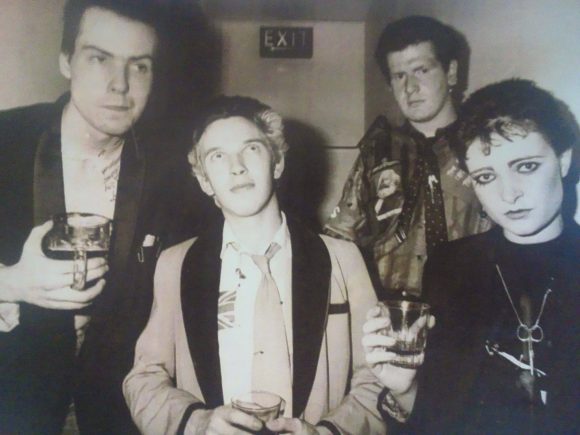
2: Strong Women versus the Desedimentation of Stupid. That first year was a compressed tale of extreme opposites: it’s emblematic that the Banshees — who became one of the longer-lasting non-retread units — debuted by stepping up across the footlights out of the crowd, the archetypal fan-turned-challenger move. Sid Vicious on drums, a volatile mix of bored headfuck game and moronic violent cartoon; not yet a Pistol. Viv Albertine (to this day a loyal friend to the best of Sid’s memory) says he had a lively mind, at least until the character he chose to cosplay sock-puppeted his entire life. Might-have-beens: until he quit them for this one-off, he’d been a Flower of Romance, alongside Albertine and Palm Olive (soon of The Slits) and Keith Levene (ditto Public Image). As for Sioux, all 1920s flapper frame and expressionist make-up, I likely thought of her then as a tomboy. As a term it’s probably more suffocating than accurate, looking back, but it was absolutely meant approvingly: gender was on the move and we didn’t yet have the words, only the inexpressible excitement…

3: There was beef on the night because Sid and Sioux were still sporting swastikas: The Clash wouldn’t let them use their nice pink-sprayed guitar amps because of this. Left politics would be a core element of one wing of punk, and The Clash — brandishing a radio-set instead of between-song chat, tuning it to discussions of bombs in Northern Ireland — made the earliest running. With its ruthless excludings, with their horrible entourage, Clash politics itself was maddening, and many ended up not liking it or them much: for all their energised leather-clad sexiness and finger-stabbing, for every friendly or human gesture, there was always something pointlessly ugly or self-regarding or obfuscatory, or, well, rock and roll. Rock and roll was bad. In the podcast, Hazel rightly celebrates the strain of doubt and unmacho confusion that’s also there, under-emphasised and under-utilised. But if you wanted to think yr way through and out of the tangles around us, the weird-left contradiction-led pranksterism infesting the Pistols seemed much more valuable to some (to me). Too much Clash self-mythology was a mask against the mess they actually (and more interestingly) always were. The contradiction is the hook: and so here among the rest of it began (to be more unkind still) the Blairish “Only Way is Up” multicultural dad-rock posture…

[ADDING: OK i’ll unpack that last sentence some other time lol. The other thing I shd add abt The Clash is that they REFUSED TO GO ON TOP OF THE POPS, and this is yet another reason why they weren’t and aren’t punk…]

4: In a month or so’s time, when ‘Anarchy’ is released, McLaren will somewhere announce that “The REAL fans aren’t buying the records” — a declaration of authenticity that’s a riddle and a paradox and a fuck-you. Till now a writhing muscle-knot of distinct social layers and friction-difference within 2nd-Gen Mod Pop, held together by irritability and inertia, The Pistols will shortly deliquesce from fascinating conflicted local focal point-source into one-note National Tabloid Outrage. Their purpose and value in (music-press) print had been to be a clot of gurning louts, who somehow — in the right minute, and without McLaren’s approval — always also mixed intellect and discernment into the aggression. As Self-Destructo the Cartoon Bassist, Sid will be the capstone of McLaren’s not understanding rock culture (and not even slightly caring). [Adding: Glen Matlock is of course on bass tonight.] As the media canvas abruptly changes after Grundy, as the scale of the game switches and McLaren switches with it, residual traces of countercultural resistance flatten into unusability for him. For Lydon, the only way out is back and down into a fully refashioned version of the prog underground. For Sid, it’s upward into the pantheon of uselessly dead young idiots.

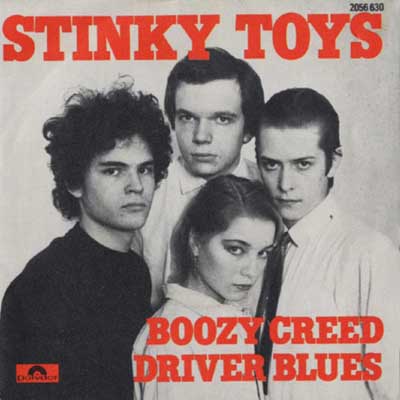
5: Meanwhile, one-time 68-er McLaren invites over some young Parisians to demonstrate that punk is international (lead shrieker Elli Medeiros is from Uruguay). Due to play after the Pistols when everyone’s gone home, Stinky Toys refuse, are bumped to first slot second day, and more or less vanish from history. Tho actually two LPs follow, the second a pleasingly sophisto-scratchy world-pop type thing. On the night, however, Stinky Toys (so legend says) mainly played Stones/Dolls/Bowie knock-offs and covers. But The Banshees had utterly upped the ante…

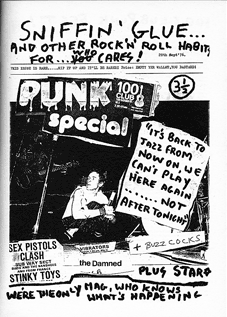
… pausing to note that according to the Sniffin’ Glue special 100 Club issue write-up, The Damned played before The Vibrators. I’m working with the running order in Wikipedia, more fool me…

6: I kind of like that I have nothing at all to say about The Vibrators, my dislike still impressively crisp despite being based on almost nothing at all. For whatever reason, they were fake punk. Singer Knox was 31, had been knocking around the pub rock circuit for years. They had formed just for this event. They are OLD: if nothing else, the time for the past is past. The demand in the air was that we pick Yays and Nays and fiercely stick with them (no one imagined it would still shape things 40-plus years on). So yes, The Vibrators are bad not good (because someone had to be and it was them). Sorry Knox, sorry all — it’s not you, it’s er structural is what it is.

7: Instant counterpoint: Spedding is a year older than Knox, a grizzled session man whose resumé includes Mike Batt’s Wombles, the Alan Parsons Project, Harry Nilsson, Bryan Ferry, Elton John, Art Garfunkel and (possibly relevant) the early Pistols demos, had had a single in the charts in 1975: ‘Motorbikin’. It’s OK at best and he too has more or less vanished from history, but — even with The Vibrators as his backing band — in some ineffable way far more honourably.

8: Has anyone ever tracked down or talked to the girl who got bits of smashed beer glass in her eye during The Damned’s set? The Damned were the third of the original punk trinity, in the wake of The Pistols wake-up call, an offshoot, just like The Clash, of The London SS. Goofy, harmless, a bit clownish, a bit arsey, they were somehow the first to get records out. Drummer Rat Scabies had a v poor rep with women, possibly a reason there was already beef with The Banshees. Like The Clash, they too had beef with The Pistols, except it seemed (at the time) somehow second-tier, neither calculated nor world-historical nor consequential. Now I kind of like their silliness and hapless lack of cultural import (also tbf some of their songs). Of course the beer glass was thrown by Sid Vicious.

9: From Manchester, three gentle boys and one egghead (Howard Devoto). More even than the Banshees and Subway Sect, Buzzcocks were a glimpse of the immediate future — the thing that came (anachronistically, unhelpfully) to be called “post-punk”. They were from Manchester and for reasons this mattered tremendously. In a movement that deplored love songs they wrote little else. Of course they were modern and non-gender-specific bcz hurrah (Pete Shelley was bisexual and so — as far as I was concerned then — was everyone else). Their sound had this gleaming bevelled edge, like bauhaus furniture made of controlled pop noise. Their high-colour sleeves would be designed by the peerless Malcolm Garrett, and somehow for a season they embodied everything fluidly anti-hierarchical about this time. New Music Night and Day, as the Bowie LP hadn’t ended up being called…

So yes, these were the maps…
… laid cross-ply across one another at subatomic size — diachronic AND synchronic, as the clever kids learned shortly to say (I was one, and proud to be). Here, squirming against one another were history and psychology, geography and gender: here in the distributed space after this teenytiny Big Bang were all the forces in play (for an obsessive reader to pick up and glom onto and decode in the months and years to come; for outsiders to remain entirely baffled by). I was a quiet-souled Buzzcocks boy, to be sure — but I always had eyes for the harsh glamour of the hard-body Banshee type, imperious and witty and non-nonsense. Here was youthful year-zero impatience and rigorous democratic praxis, kindness and curiosity and nihilism, damage and surprises and (now and then) fun. As a great monkey once wrote, It was the best of times, it was the blurst of times.

If you like this post, please support my PATREON which will help me write more! Also let other people know that you think might enjoy it…

23 Jun 15:49

Phone-y Support

by evanier

Like most of you I'm sure, I call some company about something and then I'm asked to rate the quality of that service. Sometimes, I'm asked to stay on the line and take a brief survey. Sometimes, a computer voice asks if they can call me back to take that brief survey. And sometimes they don't ask if they can call. They just call.

A few days ago, I called my cable provider (Spectrum) with a tech problem. The gent I reached on the phone was friendly and reasonably well-informed. If I was running a company, I'd want all my employees to be like that guy…but he didn't solve my problem. He tried but finally concluded that it out of his area of expertise or maybe his jurisdiction so he's arranged for a senior member of Tech Support to phone me. Okay, fine. You can't always call a company and get the most knowledgeable person who works there.

Then came the survey and I only got as far as Question One: "Were you satisfied that the representative was knowledgeable and able to solve your problem? Press 1 for Yes and 2 for No."

I hung up because I didn't know how to answer it. "Yes, he knew enough to pass me on to someone else?" Or "No, I still have my problem" Mostly, I didn't want to give a negative rating about the nice guy on the phone who spent a fair amount of time trying to help me.

That's how I feel about most of those surveys. They're asking me to evaluate the employee and maybe get them in trouble…but they never seem to want my opinion about the company. If I have a problem with phone support, that's usually where it is. I'd like to see them ask questions like…

  • "Did you feel your call was answered promptly? Press 1 for Yes and 2 for No, I was on hold for what seemed like hours listening to bad music and the same annoying ads over and over and it's especially annoying to wait that long and keep hearing that my call is very important to you."
  • "Before calling, did you try to use our online help? Press 1 for Yes and 2 for Of course, you idiot! I wouldn't have spent all that time on hold if your online help was of any help whatsoever!"
  • "If you were unhappy with our employee, did you also feel that he or she was in some other country far from our company and that all we cared about was finding the cheapest possible people who could answer a phone and read a little list of pre-scripted answers, none of which applied to your problem? Press 1 for Yes and 2 for I'm not sure because I don't understand English any better than your phone bank."
  • "Is the core of your problem that the advertising for our product was misleading and so you were led to believe it did something that it doesn't do? Press 1 for Yes and 2 for No, I'm too embarrassed to admit that."
  • "Or is the problem that we just make a shoddy product and you're really foolish enough to think that there's some way you're going to get a refund? Press 1 for Yes and 2 for No, I know I'm outta luck that way and I'm just calling to take a little of my frustration out on anyone who works for you even though I know that person isn't the one who took my money."

And of course, there's no follow-up.  It's been three days and the senior member of Tech Support has yet to call…so that's my complaint with that call.  But they aren't calling to gauge my satisfaction now.

The post Phone-y Support appeared first on News From ME.

17 Jun 15:48

Sunday favorites

by Fred Clark
Birmingham 12:7-14 You express a great deal of anxiety over our willingness to break laws. This is certainly a legitimate concern. Since we so diligently urge people to obey the Supreme Court’s decision of 1954 outlawing segregation in the public schools, at first glance it may seem rather paradoxical for us consciously to break laws. […]
17 Jun 15:29

Tipping point. Why Scotland’s ultimate independence now looks inevitable

by TSE

Wednesday was not one of those days when it was difficult to tell the difference between a ray of sunshine and a Scotsman with a grievance.  The SNP launched a choreographed flounce from the House of Commons following a spat between their leader Ian Blackford and the Speaker over the treatment of Scotland’s position in the Brexit debates.

The government was quick to accuse the SNP of pulling a stunt and of manufacturing discontent.  It’s certainly true that the SNP haven’t exactly gone out of their way to seek concord with Westminster in the past.  When copies of the SNP’s staging notes were discovered, the Conservatives claimed that the stunt had backfired. 

The following day, however, the SNP announced that they had signed up 5,085 new members in the previous 24 hours.  The former editor of the Daily Record, Murray Foote, who had been instrumental in 2014 in putting together the unionist Vow in the last week of the referendum campaign, announced that he was now a supporter of independence.  Stunt or no stunt, the SNP have struck a chord with some.

What’s the deal?  Well, the Speaker had allotted just 15 minutes in the Brexit debates on Tuesday to discuss post-Brexit devolution concerns.  Given that the Scottish Parliament had not accepted the Westminster government’s approach to devolved matters in Brexit, the SNP felt that this was wholly inadequate.  Ian Blackford had asked the Speaker to extend the debate, and the Speaker had refused: hence the walkout.

We now enter constitutional niceties that are of no interest at all to the English.  (This uninterest, incidentally, is an important point that I will come back to.)  Devolution, as the word suggests, is a devolving of power from Westminster to Holyrood.  It means that in theory at least Westminster can overrule Holyrood when push comes to a shove.  This makes Holyrood’s power contingent on Westminster’s goodwill.

At the time, it was recognised by the government that devolution needed more entrenchment.  So a constitutional convention was created at the instigation of Lord Sewel, Parliamentary Under-Secretary of State for Scotland at the time of the passage of the Scotland Act 1998, under which the UK government would not normally seek to legislate on devolved matters except with the agreement of the devolved legislature.  

This convention, which applies to the devolved assemblies in Wales and Northern Ireland as well, was reaffirmed by the UK government as recently as 2013.  Unusually for a constitutional convention, it is referred to in legislation.  Section 28(8) of the Scotland Act 1998 provides:

“But it is generally recognised that the Parliament of the United Kingdom will not normally legislate with regard to devolved matters without the consent of the Scottish Parliament.”

In practice, the devolved assemblies have rarely refused consent. So far they have done so just ten times in aggregate.  The Scottish Parliament has done so only twice (the Welsh have been much more awkward in practice).  The European Union (Withdrawal) Bill is the second time on which it has done so.  So it can hardly be said in reality that the SNP government in reality has been fomenting discontent on a routine basis.

The Scots took a very different view of the EU referendum from the English. The Scottish government has a genuine concern that Westminster might seek to use the repatriation of powers from Brussels as the opportunity for a power grab at Holyrood’s expense. 

Theresa May’s government has been desultory in addressing these concerns.  No doubt its attention span for Scottish matters has been sharply diminished, given its need to negotiate with the EU, the hardline Brexiters, the rebellious Remainers and the DUP and, for that matter, to reach an agreed position itself.  Nevertheless, the strong impression has been given of a government that is intending to steamroller its way past the rebellious Scots by the use of its residual power and forcing a settlement on its terms.

It is against this background that the battle between Holyrood and the UK government came to be considered this week in Parliament.  For English MPs, this is a complete sideshow.  For the Scots, however, it goes to the heart of devolution.  For Parliament to allocate just 15 minutes to discuss the impact of Brexit on the constitutional framework of devolution was an insult to the Scots.

At such points it is usual to say that the optics of such a dismissive approach to devolution are appalling.  But that wouldn’t be correct on this occasion: it is the dismissive approach itself that is appalling.  

The fact that devolution throws up some very difficult problems in relation to Brexit does not mean that devolution should be treated as a disposable luxury: those difficult problems should have been engaged with and considered properly by the House of Commons.

It is this fundamental unseriousness of the English towards devolution which is going to doom the current constitutional settlement.  When the architect of the Vow gives up on unionism, it is likely that many others will follow.

The economics of Scottish independence continue to look daunting.  But where there’s a will there’s a way.  Scots will not indefinitely accept a grace-and-favour devolution.  This week may well have been the week when Scottish independence became an inevitability.

Alastair Meeks

Follow @AlastairMeeks

Tweet

16 Jun 18:05

Between the coats: a sensitivity read changed my life.

Between the coats: a sensitivity read changed my life.
16 Jun 18:02

A convenient excuse: tech's discrimination problem.

A convenient excuse: tech's discrimination problem.
16 Jun 17:43

according to google this is the first time "aphantasical" has appeared on the internet, so i'm a regular bill shakespeare over here, all inventing new words like it isn't even a thing

archive - contact - sexy exciting merchandise - search - about
← previous June 15th, 2018 next

June 15th, 2018: GUESS WHAT I HAVE A NEW BOOK!! It's coming out this September and it's called HOW TO INVENT EVERYTHING and I really hope you like it!

– Ryan

16 Jun 13:52

Britain’s brittle stalemate

by David Herdson

Lewisham East reveals the essential weakness of all three national parties

Interpreting by-election results is very much in the eye of the beholder. Some, it’s true, are unambiguous in their outcome for one party or another. Lewisham East is not one such.

Labour can happily chalk up that they got the job done without fuss. They won the seat and no clear challenger arose. However, it was nothing like a ringing endorsement. The turnout was dire (only the 16th occasion since WW2 that the turnout in a by-election was less than half the previous general election, as Matt Singh notes in his excellent summary of the by-election). That alone is good evidence that there was no great enthusiasm for any of the competing parties (nor of any great desire to punish any of them either). With Labour’s vote share slumping by more than 15%, this was no great result to write home about. Much has been written about the gains by the Lib Dems but it should also be noted that the Greens and WEP took about 6% between them. Corbyn’s Labour should not be shipping votes to those sort of parties.

Not that the Tories can celebrate. There was the potential to do reasonably well in Lewisham, where the Party’s vote has been solid over the years. A low turnout combined with a 35% Leave share to go at while Labour and the Lib Dems fought on strongly Remain platforms should have formed the basis for holding more share than they did and for making a better fist of fighting for second place. As it happened, Labour’s troubles meant that there was a nominal Lab-to-Con swing of more than 4% but that’s small comfort (that said, Rod Crosby, once of this parish, would have said that fact pointed to a Con majority next election; I remain of the view that such methodology is overly deterministic). The best that can be said of the Tory performance is that there was no embarrassment, which is a low bar.

And the Lib Dems? Surely they had an outstanding result? Well, it depends on how you look at it. On the one hand, yes, they gained a swing of nearly 20% – the largest for 35 years against a Labour defence while Labour was in opposition – and they quintupled their vote share. However, on the other, these achievements were a consequence of not quite reversing the disasters of 2015 and 2017. Despite throwing the kitchen sink at the campaign, the Lib Dem vote share failed to match their general election share in the seat in 2010. A resurgence, yes, but expensively bought and not one that holds many lessons for broader elections.

The simple truth is that all the parties have serious weaknesses; something which shows up equally well in the opinion polls. There’s surely little doubt that were Labour led by a Blair, not only would the Conservatives not be polling in the forties but they wouldn’t even be in the thirties. Likewise, against a government easily comparable to John Major’s beleaguered administration, Labour doesn’t even have a lead and the Lib Dems are in single figures.

Digging below the voting intention questions gives even better evidence for the general lack of enthusiasm in the options on offer. In the most recent YouGov poll (11-12 June; Con lead +3), some 66% responded that they thought the government’s Brexit negotiations were going badly, including 40% of Tory voters; the net score of -45 for the well/badly balance was the worst yet recorded. Despite that, the Conservatives still had a lead of 10% over Labour as to which party would handle Brexit best.

On the face of it, the impression is of two immutable blocks of voters stuck in mutual hostility: the voting intention figures have barely shifted since the 2017 general election (there was a small swing to Labour immediately after it, which gave Labour a small lead, but that has now dissipated). However, to the extent that that’s true, it’s surely only so because of the number who are locked in because of fear of the other. Were that fear to lessen, not only would some be attracted directly but others, who felt the need to back the Tories out of fear of Corbyn, or Labour out of fear of the Tories and Brexit – for example – could explore other parties or abstaining. The stalemate is hard but brittle.

David Herdson


15 Jun 13:32

Lewisham East: Five take aways

by Mike Smithson

Voters tend to avoid avoidable by-elections

The most striking statistic from the overnight result was the turnout which dropped from 69% at the general election just over a year ago to 33% yesterday. This is one of the biggest falls compared with the previous General Election on record and simply underlines what has been observed before. If a vacancy is avoidable, the incumbent MP has not died or become incapacitated, then voters tend to be less keen to participate and also punish the incumbent party. This effect was exacerbated here because the former LAB MP went less than a year after the general election.

The Tory vote is hard to squeeze
The LDs put a lot of effort into trying to persuade Tory voters to vote for them as the party most likely to beat Labour. Although the blue team saw a decline it was nothing like on the scale LAB in Richmond Park in December 2016 when the total Labour vote was fewer than the number of members in the constituency.

The LD canvas projection yet again proved to be remarkably predictive

When the party first issued one of these, before the Richmond by-election, I thought it would undermine their credibility if the result proved it to be wrong. Well Lewisham East has given further credence to this means of working out how the by-election will go. I put this down to the sheer size of the party’s voter contact effort and their skill at processing it.

Getting 50%+ is not too bad for Corbyn

All the talk beforehand was that Labour voters might wish to punish the leadership for having a broadly different view on Brexit to what most of them feel. Well Corbyn’s party vote went down a fair bit but nothing on the scale of that which was predicted and maybe we are overstating the impact on brexit on party allegiances.

The LDs have got their by-election mojo back
Being 65 percentage points behind Labour at the June 2017 election meant that the task facing the party was pretty massive and the chances of a shock victory were really very remote. But they did well pulling up 21 points on GE2017 most of it at the expense of LAB. The campaign A-team was running this election and this will give them a lot of encouragement.

Mike Smithson

14 Jun 12:02

#101 Dinah the Aspie Dinosaur and the Invitation

by Dinah
11 Jun 21:20

The Pivot

by Charlie Stross

Something huge is happening in the UK right now, and I wonder where it's going.

Brexit requires no introduction at this point. Nor, I think, do the main UK media players. With the exception of two newspapers (The Daily Mirror and The Guardian) the national papers have been uniformly pro-Brexit to the extent of attacking national institutions seen as being soft on Brexit. The BBC news programs have also broadly pushed a pro-Brexit line, from Question Time (which gave Nigel Farage a semi-permanent slot but not once invited a guest speaker from the Green Party or the SNP—both pro-Remain by policy), to the Today Program (Radio 4's news flagship), whose John Humphrys pushes a hard Brexit line.

Although the referendum was framed as advisory and limited to leaving the European Union, it was received as a mandate by the Conservative hard right and their hard-left opposite numbers in Labour (who have their own reasons for disliking what they see as a neoliberal right-wing institution), and the current in-cabinet debate appears to be over whether to leave all European institutions immediately, or to provide an adjustment period for leaving organizations like the Customs Union (which wasn't on the ballot in the first place).

Here in the real world the drumbeat of bad economic news continues. Jaguar Land Rover to move production of Discovery from UK to Slovakia, because of course they're owned by Tata, most of their output is exported, and why would an Indian company want to invest in a UK beset by pre-Brexit uncertainty? UK manufacturing output is falling at its fastest rate since 2012. And the rest of the economy is doing so well that Poundworld (the equivalent of a US dollar store chain) has collapsed and is in bankruptcy administration.

Then, last week, something happened. Or several somethings. (From the outside it's hard to be sure.)

One of those somethings was the retirement of Daily Mail editor Paul Dacre and his replacement by Mail on Sunday editor Georgie Greig, a pro-European journalist. Newspaper owner Lord Rothermere remains the same, but an unattributed source described Greig's appointment as part of a process of "detoxifying the Daily Mail".

Next, the Murdoch press began an extraordinary about-face on Brexit. For about a year now Carol Cadwalladr of The Guardian has been digging into Cambridge Analytica, the Leave.EU campaign, and possible links to Russian state agencies and oligarchs. These links were known to some pro-leave journalists as much as two years ago, but they're only now coming to public view. Aaron Banks is one of the main bankers of the Brexit campaign and appears to have very cordial relations with the Russian government, not to mention half a dozen Russian gold mines; he's been called to testify before a House of Commons committee tomorrow and last week was refusing to attend. This week he appears to be on the back foot, with The Times going after him Revealed: Brexit backer Arron Banks's golden Kremlin connection. Indeed, The Observer reports that Arron Banks 'met Russian embassy officials multiple times before Brexit vote'. The newspaper goes on to say, "Towards the end of last year, Banks issued a statement saying his contacts with "the Russians" consisted of "one boozy lunch" at the Russian embassy. Documents seen by the Observer, suggest a different version of events." (Note that Banks has a net worth in the ~£100M range: you don't print anything about him in an English newspaper without getting a legal opinion first.) Oh, and the Fair Vote Project is going after him in court in the US, following allegations that two companies owned by Banks may have illegally exported information on British voters to the USA (in violation of UK data protection rules) for purposes of data mining (Banks had negotiated with Cambridge Analytica prior to this move).

Here's a summary of what we know so far, by way of Vice: verything you need to know about the bombshell report linking Russia to Brexit. Shorter version: Banks had extensive meetings with the Russian ambassador to the UK, who is also named on the indictment of ex-Trump campaign aide George Papadopoulos; Banks also passed contact information for Trump's transition team to the Russians. So he's a critical link in the Brexit/Trump/Russia connection.

He's not the only Brexiteer in trouble in the press. Hedge fund manager and Brexiteer Crispin Odey is accused of shorting the British stock market to the tune of £500M, effectively betting that Brexit will cause the market to fall and these companies to do badly. Brexit ultra and possible Conservative party leadership challenger Jacob Rees-Mogg is under siege by the formerly-friendly Daily Mail: Mogg's Moscow Millions: Brexiteer's firm has poured a fortune into a string of Russian companies with links to the Kremlim but has invested next to nothing in Britain. And finally Neo-Nazi MEP Nigel Farage's EU pension is to be held in escrow pending the completion of ongoing fraud investigations (and, as the icing on the cake, apparently the FBI have named him as a person of interest in their ongoing investigation into Russian slush money and false news).

Let me put forward a hypothesis:

In the real world (outside the pages of fiction) only two types of conspiracy generally take place: cover-up and collusion. A cover-up generally happens when several people or groups stand to lose money or be politically embarrassed if an uncomfortable truth becomes public knowledge. See, for example, the Home Office shredding of historical records relating to the Windrush scandal lest they embarrass the Prime Minister, who was the Home Office minister who brought in the hostile environment immigration policy. And collusion generally takes place when a group of individuals or organizations stand to benefit from a course of action.

Brexit was a classic example of a collusion conspiracy. Many of the named politicians and businessmen above stand to gain millions of pounds from a hard Brexit that causes the British stock market to fall. Others stand to make millions from juicy investment opportunities they were offered in Russia. We cannot know for certain what the quid pro quo for those investment deals were at this time, but I strongly suspect that support for Brexit (and more general socially-authoritarian right-wing policies) was part of it.

And now we're seeing a rival collusion conspiracy surface. Not all billionaires stand to profit from seeing the remains of British industry sink beneath the waves, and not all of them are in the pocket of the Kremlin's financial backers. There are a bunch of very rich, rather reclusive men (and a handful of women) who probably thought, "well, let's sit back and see where this thing leads, for now" about 18 months ago. And now they can see it leading right over a cliff, and they are unhappy, and they have made their displeasure known on the golf course and in the smoke-filled rooms, and the quiet whispering campaign has finally turned heads at the top of the media empires.

If I'm right, then over the next four to eight weeks the wrath of the British press is going to fall on the heads of the Brexit lobby with a force and a fury we haven't seen in a generation. There may be arrests and criminal prosecutions before this sorry tale is done: I'd be unsurprised to see money-laundering investigations, and possibly prosecutions under the Bribery Act (2010), launched within this time frame that will rumble on for years to come.

Even if the momentum behind Brexit proves un-stoppable at this point, the Remain faction—in the shape of the corporate and political power groups who stand to lose their fortunes as a result—will seek revenge.

And in the large, I think it's no coincidence at all that this broke out in the same week as Donald Trump's epic tantrum at the G7 summit.

09 Jun 14:45

The Cybersecurity Campaign Playbook, European Edition

Second paragraph of third chapter:
Some campaigns have more time and money for cybersecurity than others. That’s why our recommendations offer two tiers of protection: “good” and “enhanced.” The “good” tier represents everything a campaign must do to have a minimum level of security. You should always aspire to do more as time, money, and people allow, which is why we recommend using the “enhanced” level whenever possible. If you have the resources to get reputable, trained IT support, it’s money well spent. Threats are constantly evolving and professional IT services will help get you beyond what this playbook provides and keep you abreast of the latest threats and solutions for your situation.
A nice little booklet, downloadable here, produced by the Defending Democracy Project at Harvard and adapted for European use by my former employers NDI and their Republican rivals IRI.

I have actually experienced this problem myself. You may recall that I was one of the external advisers to the Georgian Dream's successful 2012 election campaign. As David Ignatius wrote at the time, many of the computers in our headquarters were infected with sophisticated malware which could turn on their cameras and microphones, capture screen shots every 10 seconds, and record keystrokes and passwords, all transmitted to whoever installed the malware. My own laptop crashed irretrievably, beyond repair (hopefully because it successfully resisted the malware, though the damage was so great that one can't be sure). There is some poetic justice in that the chief of staff of our campaign became interior minister after we won. The Democratic National Committee, of course, was not so fortunate.

Not all campaigns will face an opponent with that level of resources and vindictiveness. But not all campaign managers are familiar with the problems of today's technical environment. There are also particular structural problems for political campaigns, which are often ephemeral and depending on unscreened volunteers to perform vital functions. This booklet outlines some elementary and low-cost steps to take for protection of digital resources, including the very important point that responsibility has to be seen to start at the top and that the human element is often the most vulnerable part of a campaign. A lot of the suggested measures make sense for one's non-political online life as well. The booklet is free and well worth a look.
08 Jun 21:39

Measuring competition

by chris

How do you measure competition? I ask because on yesterday's PM programme Lynsey Hooper claimed (15 min in) that Amazon's broadcasting of some Premier League games next season means that "competition is now fierce."

I'm not sure this is right. Amazon will broadcast all ten Boxing Day games, This means it is a monopoly provider of live coverage then: if you want to watch a live match  on that day, you've no choice but to pay Amazon. Similarly, today Sky and BT are monopoly providers of live coverage of particular games. If you get cheesed off with the inane chunterings of Robbie Savage or Michael Owen you can't switch to watching the game on Sky. Nor, in many cases, are games substitutes for each other: West Ham vs Bournemouth is no substutite for the Manc derby, for example.

Yes, broadcasters are competing. But they do so via bidding wars for the right to particular monopolies - much like rail franchises. That's great for Premier League clubs and players who get higher revenues.But it's not obvious that customers get a good deal. It's quite possible that by the time you've paid Amazon, BT and Sky you are paying more to watch football than you would if Sky broadcast all games*.

The point here is one that competition economists have known for some time - that you cannot necessarily measure competition by the number of firms in an industry: the Herfindahl index, for example, can be a bad measure.

One reason for this can be that industries are actually hard to define. If we think of Premier League broadcasting as an industry, there'll be five firms in it from August 2019; three live broadcasters, plus BBC showing highlights and BBC and TalkSport offering live radio commentary. But if we think instead of live TV broadcasting of the Liverpool vs Arsenal game, there's only one provider.

This can matter. It doesn't much matter if there's monopoly in one industry if that industry faces competition from another. if the tinned pilchard industry wre a monopoly we wouldn't worry if it faced competition from sellers of tinned sardines or sild, but we would if it didn't. Similarly, if fans were happy to wait to see only highlights of a game, monopoly provision of live coverage would not be so bad. More seriously, rail monopolies would be more tolerable if buses were a decent substitute for rail, or if it were easy for commuters to respond to bad service by moving nearer to work.

A single provider can be acceptable if the market is contestable - that is, if there are potential entrants or substitutes. Equally, more providers needn't be evidence than customers get a better deal. For example, a market of (say) ten sellers in which switching is difficult can be less competitive than one of (say) five providers where it is easy.

But if you cannot measure competition by the number of firms, how can you?

One alternative, proposed (pdf) by Jan Boone, is profits elasticity. The idea here is that if profits fall sharply in response to a rise in marginal costs then the industry is competitive but if they don't then it isn't. A competitive market is one which punishes inefficiency.

Even this, however, has problems. What if marginal costs don't change much? What if there's uncertainty about whether a firm's cost and price rises are permanent or not, which deters potential entrants from entering the market? Or what if there are threshold effects such that customers will tolerate small price rises but not larger ones?

The point here is simple. Competition is hard to define and measure. For this reason, I fear, the word can be misused in popular discourse, with "competition" being used to justify what is in fact a near-monopoly.

* One could argue that multiple broadcasters have led to an improvement in the quality of its coverage, but most of this, I suspect, came when Sky first entered the market in 1992.

08 Jun 14:34

General Election 2017 : One year on

by Harry Hayfield

At 10.00pm this evening, a year ago, the Prime Minister’s gamble backfired. Whether this was due to the polls being misleading from the start (indicating a Con lead of 25% at the start of the campaign), the so called “youthquake” (identified by the Britsh Election Study) or reasons best summed up by Brenda from Bristol of “Oh, no, not another one!” we simply cannot tell, but we do know this. The Conservative overall majority was lost and if it had not been for saving grace of twelve Conservatives gains in Scotland (all from the SNP), the Prime Minister would not have been able to govern with the DUP and the whole history of the UK from that moment could have changed.

But what has happened in that year since? Well, completely unnoticed by everyone (save us who have a vested interest) 397,562 real votes have been placed into no fewer than several hundred real ballot boxes across the United Kingdom electing no less than 255 real councillors, and in those 255 by-elections the people of the United Kingdom have told us this: “Thank you, UKIP, and good night”

Yes, if proof was ever needed that the age of UKIP is over, then here it is. UKIP in the year since the general election, have seen their vote share fall by 10.48% compared to last time.In fact it is even worse than that for them. Last time, in these 255 by-elections, UKIP had a candidate in 88 of them (35%), now they only had a candidate in 69 of them (27%).

It is now that I am expecting those surviving UKIP supporters to declare “Now come on, all parties have problems fielding candidates in the year after a general!” to which I would reply “Then please explain why there are 90 more Conservatives, 89 more Labour, 110 more Liberal Democrats, 50 more Greens, 21 more Independents and even 9 more Local Independents standing than last time” and add that compared to last time UKIP are the only major party who are fielding fewer candidates than last time.

And what of the main parties? Well, it’s clear that the Labour and the Liberal Democrats are picking up the UKIP spoils, to which of course Labour supporters in Mansfield will be screaming “But we lost Mansfield to the Conservatives!” and Conservative supporters will be screaming “But we lost Oxford West to the Lib Dems!” so let’s look at those changes through the prism of the referendum.

In those councils that voted REMAIN Con +2%, Lab +5%, Lib Dem +6%, UKIP -6%, in those councils that voted LEAVE Con +3%, Lab +6%, Lib Dem +7%, UKIP -11% and yet these changes have a very marked difference in seat changes

Well, there’s your answer. I cannot say what answer it is but that’s the answer the UK is giving a year since that general election.

Harry Hayfield

07 Jun 09:30

Business Musings: What It Feels Like To Have An Agent

by Kristine Kathryn Rusch

My heart is breaking.

Michael Peck sent me a link to an article in The Guardian about Chuck Palahniuk. Palahniuk is one of the clients of Donadio & Olson, the agency that had a bookkeeper embezzle a minimum of $3.4 million from writers over the past seven years. Palahniuk is one of those writers.

I blogged about this agency and the embezzlement in last week’s post.  Unfortunately, as I have been telling you all for years now, embezzlement and financial negligence is rampant at big name agencies. Almost none have systems set up to prevent it. Of the four agencies I worked with over the decades, two actively embezzled from me. I was anal with the latter two by constantly monitoring money, so I know they didn’t embezzle. They didn’t have the chance.

But the agencies that did are probably still stealing some of my money. Licensed properties (tie-in books) are tougher to get to switch the paperwork/finances switched away from the agent, so those royalties from some of the smaller companies have never shown up.

At some point, when I’m feeling litigious, I’ll have my attorney and a forensic accountant go after them. (The last time I threatened one of those agencies with a forensic accountant they threw me out of the agency overnight. By the time I got up in the morning, they had severed my relationship with them and informed all of my publishers that the payments should go directly to me. Just the threat of an audit did that. This is one of the biggest agencies with some of the biggest names in the world. Ask yourself why they were afraid of a standard business practice. You know the answer.)

Anyway, this morning, I received a link to The Guardian piece. And in that piece was a link to Chuck Palahniuk’s blog post on the theft. The post breaks my heart.

Palahniuk says he’s “close to broke” because of this. The “close to broke” situation is not something he discovered just this week. He’s been struggling financially for years now.

And, as a result, he apologized to his fans. That’s what breaks my heart. He’s apologizing because someone stole from him and lied to him, and he’s apologizing for believing the lies. Poor man.

Here’s what he wrote:

So on the minus side, I apologize for cursing my publishers.  And I apologize for any rants about piracy.  My publishers had paid the royalties.  Piracy, when it existed, was small scale.

     I do hereby humbly apologize.

Palahniuk has published 24 books that I can see on his site. One of them became a major film (Fight Club). I’m sure there are ancillary rights sales that I’m not seeing here.

But as bestsellers go, he’s not that prolific. Nora Roberts publishes a minimum of four books per year, sometimes more. Jeffrey Deaver and Michael Connelly publish a minimum of two per year, sometimes more.

When you have a cushion of dozens upon dozens of published books, and those books have sold ancillary rights and a few have been made into TV shows and films, and the sales continue, then you are making a boatload of money.

If your agent is stealing from you and still paying some of the money, then you might be making a small boatload and to you it feels like a ton of money. If the agent wasn’t there, you would be making a fleet-of-yachts money. But to most writers, most of whom have been poor, a small boatload is a great deal.

I’m not going to pick at Palahniuk’s post. I’ve been where he is, although not to that extreme. He trusted his agents and the agency deeply. When his publishers told him they had sent the money they owed, and his agent said the money never arrived, he believed the agent.

I would have believed neither, and asked for proof of the money being sent. Then I would have tracked it down…the first time it happened.

When Dean and I hired the big agency that embezzled from us, we demanded that our money come to us the moment it cleared the agency’s account, no more than ten days after it arrived. Then we monitored. Those were expected funds—advances, timely royalty payments. So, the agency got creative. When it stole from us, it did so with things we had no way of knowing about, payments that were actual surprises—something selling better than expected in, say, Germany, for example, so that a company that had paid no royalties in the past (but sent statements) suddenly paid thousands. And we were told that “this year, they forgot” to send royalty statements, but there was no payment  just like previous years.

See how easy that is? Even when someone is monitoring the agent?

It feels terrible to be the victim of theft. When I was 18, someone broke into my dorm room and stole the quarters my roommate and I had saved up for laundry. I was more concerned about my wallet, which the thief had tossed in the bushes near my dorm. Once I found the wallet, I was fine, but my roommate never got over the feeling of violation. She would put a chair in front of the door every night, worried that someone would break in.

That was a one-time theft. We learned from it. We checked to make sure our door was locked whenever we left it.

But the on-going continual thefts? Embezzlement? That leaves you feeling like a fool. You should have seen it. You should have known. Especially once all the signs fall into place, all the little things that bothered you.

Palahniuk writes about that feeling so eloquently. And I feel for him. Because I felt all of those things too.

It’s one of the reason I blog so strongly about agents. Don’t hire them, people. They’re not regulated. They have sloppy business practices. They probably aren’t insured against this kind of thing.

As Palahniuk acknowledges at the end of the post, going after them legally (which it seems that he’s doing) is an iffy financial proposition. I decided not to sue the first embezzler so I can give you his name and the name of his agency. I do, when I teach in-person workshops. I tell anyone who asks.

You see, many of my friends have gone after him legally, and have gotten a settlement—which he paid out of funds he stole from other clients. He also demanded a nondisclosure agreement as terms of the settlement. I refused to participate in either of those things.

As for the second embezzler, I wanted out of the agency. So when they threw me out after I threatened them with an audit, I got what I wanted. But it’s clear to me that they’re continuing to steal from me. So, as I said above, they will be facing legal action from me eventually. I get to pick the time and place. I’ll be doing it so that I can blog about it, not to get money from them. (It’s thousands, not tens of thousands, these days.) But I’ve told a number of their clients that I caught them embezzling and they all say a version of what Palahniuk said:

I’ve worked with the same team of people since 1994.  To suspect anyone was stealing, I had to be crazy.

I’ve been accused of having a “bad breakup.” I’ve been accused of “being crazy about agents.” I’ve been accused of lying about this.

Sorry, folks. I’m not crazy. I didn’t have a bad break-up. This type of financial mismanagement, the kind that led to the embezzlement, is common in these agencies. It’s becoming visible now, because traditional book sales have declined, and so it’s harder for an agency to pay one complaining client with another (non-complaining) client’s advance.

But here’s what I want you to see. I want you to look again at Palahniuk’s apology.

I apologize for cursing my publishers.  And I apologize for any rants about piracy.  My publishers had paid the royalties.  Piracy, when it existed, was small scale.

Now, I want you to think about how many big-name writers you’ve seen railing against piracy and how it’s cutting into their book sales. I want you to think about how many big-name writers blame Amazon (!) for ruining the book business and causing book sales to decline.

I want you to think about how many big-name writers who have said there’s no money in writing, not like there used to be.

All of those writers have agents. All of them.

All of those agents pay New York rents. All of those agents have lifestyles to maintain. All of those agents have unfettered access to millions of dollars.

Look at Palahniuk’s apology again.

The publishers paid. Piracy was small.

As I said, this breaks my heart. Because on top of the financial loss and the hurt and the difficulty, there’s a major betrayal. Embezzlers create friendships, but aren’t friends. They’re thieves.

They don’t break into a dorm room and steal quarters. They pocket hard-earned cash from a writer’s dream. They destroy success. And they smile and smile and smile when they do it.

Here’s how Palahniuk puts it:

He seemed like a good guy.  Like a prince of a guy.  Like man-crush material.  And then he wasn’t.

Yeah. That. Over and over again. It’s heartbreaking.

And I’m sorry all these writers are going through it.

So I blog about this.

Don’t hire literary agents for anything. Not foreign rights. Not movie rights. Do not hire them at all.

Get an attorney to do a single job. Learn the business yourself.

Or you will experience what Palahniuk is experiencing.

And believe me, that’s not an experience you want.

Ever.

******

I love going directly to my readers for support. This entire post comes from a link that a reader sent me. Thank you! You folks keep the blog going, through links, shares, and financially as well. I greatly appreciate all of it.

If you feel like supporting the blog on an on-going basis, then please head to my Patreon page.

If you liked this post, and want to show your one-time appreciation, the place to do that is PayPal. If you go that route, please include your email address in the notes section, so I can say thank you.

Which I am going to say right now. Thank you!

Click paypal.me/kristinekathrynrusch to go to PayPal.

“Business Musings: What It Feels Like To Have An Agent,” copyright © 2018 by Kristine Kathryn Rusch. Image at the top of the blog © Can Stock Photo / dmitrimaruta.


patreon

07 Jun 08:48

Today's Video Link

by evanier

Everyone mourning Jerry Maren today is mentioning how amazing it is that he was a part of The Wizard of Oz. But I was at least as impressed by another role he had on the same lot that same year…

The post Today's Video Link appeared first on News From ME.