Andrew Hickey
Shared posts
The Finkbeiner Test: a tool for writing about women in their professions.
The politics of discovery
Here’s a theory. There are two different ways of thinking about politics and policy which are insufficiently distinguished; we can call them politics as imposition versus politics as discovery.
Most people think of politics as the former: how can I impose my will upon others? We can, however, think of it differently – as a discovery process.
This, I think, is what Paul Evans is doing when he calls upon us to rethink democracy. He’s asking: what institutions and practices do we need to discover what people really want? Simple referendums, conducted against the background of an inadequate media, are not the answer.
But it’s not just the political process that is or should be a discovery process. So too are some particular policies.
We lefties are sometimes accused of wanting to impose a system upon the economy. For me at least, this is the exact opposite of the truth. For me, socialism consists in part of creating means of discovering what works best.
Democratising public services, for example, is a way of discovering from workers and users how best to improve them. And encouraging various forms of coops – via public procurement, a national investment bank or tax breaks – is a way of discovering what forms of post-capitalist firms work best – a form of what Erik Olin Wright calls interstitial transformation (pdf). It’s not at all obvious to me that actually-existing capitalism does an unimprovable job of discovering better forms of ownership and control, given credit constraints, path-dependency and capture by a managerialist elite*.
I’d put a citizen’s basic income into this category: the question of the appropriate level, and any add-ons it needs, is one that could be discovered as we go along. It need not, and maybe cannot, be imposed in perfect form from the start.
This isn’t to say that the politics of discovery is purely a leftist exercise. It’s not. Michael Gove’s free schools policy was in this vein – a way of experimenting to see what sorts of school work best.
And one under-rated argument for devolution and stronger local authorities is that they would facilitate discovery: if they follow different policies, we can see what works best.
We think of markets as discovery and selection mechanisms (pdf) – albeit ones that often don’t work as well as they might. But a healthy political process would have such mechanisms too.
Which brings me to Brexit. Everybody is discussing the Brexit deal with the mindset of the politics of imposition – as if the deal will permanently settle in stone our relationship with the EU for ever more.
This of course is to misrepresent human life. Relationships change. The “transitional period” won’t end in 2020. It’ll carry on for as long as the UK and EU exist.
This is no mere pedantry. One of the key aspects of good negotiations is to see that agreements can be provisional, not final. Theresa May should be saying to all sides in the Tory party: “This isn’t the final word. Let’s give this a go. And if it proves to be as bad as you claim, we can change it.” (Maybe she is saying this in private.) I’ll grant, however, that this is more feasible for hardline Leavers than Remainers, as the EU might not want to renegotiate closer ties with so fractious and febrile a counterparty**.
If there is anything in what I say, it poses the question: why do we hear so much about the politics of imposition and so little about the politics of discovery?
One answer is that political discourse is dominated by those who believe they know the answers, and so don’t need to discover them – which is of course a symptom of overconfidence. We do not sufficient self-police and self-criticize our views. And perhaps we lack the mechanisms and institutions to incentivize us to do so.
* It’s odd how some rightists are so keen to point out that state functions are prone to bureaucratic capture and so silent on the possibility that private companies can be too.
** Yes, I know that we Brits tend to under-estimate the extent to which the EU is a rules-based organization (which I think is an argument for the Leave side). But rules can and do change.
Not debating immigration
Some new neighbours recently moved in next door to me. They seem nice, but the point is that I had no say whatsoever in the matter. And yet almost everybody believes that, together with my fellow Brits, I have a right to stop people moving into the UK. This is weird. Why should I have a right to stop people moving into, say, London when I have no right to stop them moving next door, even though I don’t care who lives in London but do care whether I have good neighbours or not? And how can a group of people acquire rights that individual members don’t have?
Chris Bertram’s new book Do States Have The Right To Exclude Immigrants? tackles such questions.
His key point, derived from Kant, is:
Claims of right, in order to be other than mere assertions of power against others, have to be justifiable to everyone…nobody should simply impose their will on someone else unilaterally.
Instead, there needs to be an implicit bargain, whereby everybody has a reason to obey the rules.
Such reasoning justifies why I have no right of veto over who moves in next door. My lack of right in this regard is compensated for by the fact that nobody else has a veto over my moving where I want. Most of us think this is a reasonable bargain.
But this doesn’t apply to immigration. Why, asks Bertram, should would-be immigrants respect our claim to exclude them?
The answer is: they shouldn’t:
A world in which states simply assert their right to unilaterally exclude would-be migrants…is a world in which a kind of tyranny is imposed upon the excluded.
He argues that if we were behind a Rawlsian-style “veil of ignorance” we wouldn’t agree to draconian restrictions of free movement as they might trap us into horribly oppressive governments or condemn us to a life of poverty: John Gibson at the University of Waikato has estimated (pdf) that migrants from Tonga to New Zealand, for example, earn three times as much as comparable people remaining in Tonga. Behind such a veil of ignorance, he says, we’d pick open borders.
Now, I’m sympathetic to this. Which means I’m not the sort of person who should be reading it. It should instead be read by those who favour migration controls.
I asked myself: how might a reasonable defender of migration controls respond to it?
One possibility is to deny the appropriateness of the veil of ignorance thought experiment. Maybe our nationality isn’t something we can slough off but is instead an inherent part of who we are. Perhaps, as Michael Sandel said in Liberalism and the Limits of Justice, we are “radically situated subjects” with loyalties that are deeper than mere contingent accidents.
I would have liked Chris to have done more to tackle this. I myself don’t know what to make of it. It gains credence from the fact that people die for their country. But on the other hand, nations are “imagined communities” and, as Chris says, historically quite recent ones: for most of our history, humans have not considered themselves defined by nationality.
My criticism of Chris on this point, however, is minuscule compared to my criticism of our political-media culture. Alasdair MacIntyre complained – rightly – that we lack the intellectual resources for serious moral enquiry, and also the institutions that would permit it. No, the Moral Maze does not count. The sort of world in which Chris might have been seriously grilled by a Bryan Magee-type is long gone. Instead, “debate” about moral questions (not just immigration) is more commonly merely an exchange of self-righteous shrieks and politics merely a haphazrd way of discerning the "will of the people". Much as I enjoyed Chris’s book, I fear it is wasted in this climate.
A Little More On Recent Worldcon Stuff
I just did a tweetstorm about the recent contretemps involving Worldcon. As many of you know, there was a dustup about programming (among other issues) for which the head of the Worldcon apologized and took action on, including bringing in a team headed up by Mary Robinette Kowal to help fix things. Here’s what I wrote about that, formatted here in essay form.
—
Also, while I’m on the subject of the Hugo and Worldcon, I see some various turdlings out there are gleeful about the recent dustup re: the Worldcon program. “The SJWs are eating themselves!” is the basic line of the turdlings. In fact, something entirely different happened.
Which was: When the problems cropped up (and they did) and people started to complain (and they did), the Worldcon, within a day, acknowledged that various mistakes had happened and actively moved to correct those mistakes. Not perfectly or instantly, but it still happened.
Which is what you want to happen! In an ideal world, mistakes don’t get made, but we don’t live in an ideal world and none of us is our ideal self. The next best thing is, when mistakes are pointed out, you move to fix them and to learn from them.
The turdlings who are gleeful at the Worldcon’s temporary woes don’t care about anything other than an institution they dislike and tried (or are still trying) to sabotage having a stumble. That’s because they’re basically awful, whiny menchildren. No surprise there.
Many folks who like or feel invested in Worldcon weren’t pleased about the stumble, and moved prior to the Worldcon itself to help address the problem by offering up their programming slots to folks who didn’t have them. This exemplifies the best aspects of the SF/F community.
What is not laudable about people saying “it’s important that we have more and different voices in the mix, and I’m ready to share my time and space to make it happen”? Is this not what you would want to see?
“It’s just virtue signaling!” One, it’s okay to signal that you support bringing new people and perspectives into the genre’s mainstream. Two, giving up your space to make space for others isn’t just signaling, it’s action. Yay, virtue actioning!
Equally as important, the folks running this year’s Worldcon, the premier lit-focused convention in the genre, listened and followed up with action of their own, and took help offered to change for the better. Mistakes were made, but action to improve is worth noting.
This action is not caving or retreating or [insert other negative spin here]. It’s *learning*. There’s more work to be done, and not everything will be done perfectly, but the situation is already better than what it was a few days ago. Worldcon 76 wants to be better. Good.
We all stumble, and the test is what we do after. We’re seeing some people point and laugh, because that’s who they are. We’re seeing others use their position to help, because that’s who they are. And we’re seeing an organization trying to improve, because that’s what IT is.
So, yeah. A lot of people in science fiction and fantasy have revealed themselves in the last few days. It’s been instructive. For myself, I can say I’m supporting Worldcon 76 trying to be better, and supporting those working to make it happen.
Business Musings: Sometimes I Just React…
I don’t get it. I really don’t.
You’d think they all started out wanting to tell their own stories. You’d think they identified themselves as writers first, not book stuffers or algorithm gamers.
But I have no idea, really, and I’ve been part of the indie movement almost from the beginning.
You see, at lunch today, I finally had a chance to read Sarah Jeong’s article in Verge titled “Bad Romance.” She beautifully lays out the games that writers have played on Kindle Unlimited, from the dawn of Kindle Unlimited.
She finally put #cockygate into context for me. I had been out of it this spring, and missed how that entire debacle came about. That it sprang from one of those lists where writers who gamed the system gathered did not surprise me. What surprised me was that I had missed the beginning entirely.
If you haven’t read her piece, you should. It takes the entire Kindle Unlimited experience and codifies it. All of those changing algorithms, all of the ways to game the system, all of the scams and desperate schemes get mentioned here—and more importantly, get put into context.
When you live through them, context means very little.
Back when I started blogging on publishing in 2010 (after writing The Freelancer’s Survival Guide on this site in 2009), I had the lovely experience of being trashed repeatedly by the Kindle Unlimited folks. Only there wasn’t Unlimited—not yet. There was just the Kindle Boards, where writers gathered to talk.
And what they talked about was what professional writers everywhere talk about—how to make money. (We don’t dare discuss craft with each other for fear that we’ll insult our peers. We all have friends who have great writing careers, whom we believe {in our heart of hearts} can’t write their way out of a paper bag. And, we know, that some of our friends think the same thing about us. It’s better to discuss quantifiable things, like money, instead of qualitative things, like craft. {See my post on “Taste” from last week.})
That “how to make money” thing took on a life of its own on the Kindle Boards. It wasn’t about how to improve your storytelling to make money. It wasn’t about those old-fashioned systems like agents or traditional publishers or contracts, although there occasionally was talk like that.
Instead, it was about which subgenres sold, and how many books you had to write and publish each month to stay ahead of the algorithms. It was about writing short so that you had more books published (in the early days) or putting the table of contents at the end so that the algorithm would think someone who clicked there had read the whole book.
Then things got even crazier. Book stuffing—filling your book with random junk so that you could be credited with 3,000 pages read. Hiring ghost writers at $700 a pop (which is cheap, considering I live with one of the best ghost writers of the 1990s—and he never ghosted for less than 20K on a short project) so that the writer can maintain her weekly publication schedule.
Writer groups deciding which sub-sub-subgenre should ascend to the heights of the Amazon algorithms by writing a bunch of shapeshifter stories (erotica, mostly, and um, ick—I can’t help but think of bestiality) or writing about mountain men or whatever the current sub-sub-sub-genre is this week.
Lost in all of this is a love for writing. For storytelling. For being the best at your craft that you can possibly be.
And that’s what I don’t understand.
Once upon a time, these writers had to have a dream about being published. Or being known as a great writer. Or writing the great American novel.
What happened? Was it too hard? Did they get sucked into the vortex of sales and algorithms and games instead of doing the hard work of learning to improve with each story?
Some of you are going to write to me and say that these folks never were writers. And while I agree that there were a number of scammers who jumped on board when Amazon started its Kindle program, there were also a lot of wannabe writers who wanted to make a living at their fiction.
A lot of those writers—including many of you who have followed my blog for years—tried some of the early techniques and decided that those techniques destroyed all the great aspects about being an artist.
A number of the Kindle Board writers made a boatload of money every single month…for a while. Then Amazon changed the algorithms or the way it paid, and a lot of those writers vanished. Some of the writers changed with the algorithm, probably to continue the lifestyle they had cultivated when they were earning mid-five figures per month. (Note 7/27: See David Vandyke’s comment below about the changes in the Kindle Boards.)
At some point, though, that hamster wheel had to get really tiring. Writers jumped off and went to other things. New writers jumped on, though.
And I still don’t get why.
I guess I would rather be a writer first, and a business person second. I know how to make a lot more money at my writing; I refuse to make the compromises necessary to do so.
Full disclosure, though: when Dean and I were repaying the Pulphouse debt through the 1990s, we did so with writing. Which meant that we took on a lot of work-for-hire projects in TV and gaming and movie universes, but we still had a rule. Those universes had to be ones we liked (at worst) and loved (at best). Many of those books were fun, and had the added benefit of paying a lot of money for only a few weeks worth of work.
It is a hamster wheel, though. At some point, you have to leave that kind of writing or you will burn out. The writing ceases to be something you enjoy, and it becomes sheer drudgery.
Which brings me back to those writers, the ones in the “Bad Romance” article, the ones who still hang on, chasing trends, even after years of unsatisfying work. I don’t get it.
Don’t they value writing? Book stuffing tells me that they don’t. Or that some of them don’t.
I feel for these writers, though. Because I think that, buried beneath the numbers and the terror about Amazon changing its system yet again and the constant scramble, there’s a disappointed artist. A writer who wanted to tell great stories, and is instead writing in sub-sub-subgenres they don’t even like.
But I could be wrong.
Because, as I said, I don’t get this.
And I’m not sure I want to.
***
I like writing these nonfiction blog posts about the publishing industry, or I wouldn’t work so hard to hit my deadline.
A lot of what I love about these posts, though, is the interaction with all of you. Thanks for the emails, comments, social media shout-outs, and tips. Thanks too for the financial support.
If you feel like supporting the blog on an on-going basis, then please head to my Patreon page.
If you liked this post, and want to show your one-time appreciation, the place to do that is PayPal. If you go that route, please include your email address in the notes section, so I can say thank you.
Which I am going to say right now. Thank you!
Click paypal.me/kristinekathrynrusch to go to PayPal.
“Business Musings: Sometimes I Just React…,” copyright © 2018 by Kristine Kathryn Rusch. Image at the top of the blog © Can Stock Photo / kit8.


Yet Another Harlan Ellison Story
Over in a comment thread on the 13th Dimension site, a fellow named Scott Rogers posted the following and a lot of folks have sent it to me to ask about it. By "SDCC," he means San Diego Comic-Con, which is now known as Comic-Con International. The events he'd recalling took place back when it was at the old San Diego Convention Center…
When I was about 7 years old, I was attending SDCC. The show was so small that it pretty much fit into one large ballroom. I remember seeing a man sprinting across the room holding something under his arm. Suddenly Harlan (I didn’t know it was him at the time) stood up, and shouted. "The son of a bitch just stole Jack Kirby’s Inkpot Award! GET HIM!" The entire room turned as one. That thief never had a chance!
Mr. Rogers, being around seven at the time, can certainly be forgiven for not recalling or knowing quite what happened. What happened was that Jack had been given an award…and it was not an Inkpot. He got his Inkpot years before the first con Harlan attended. I believe it was a plaque indicating that Jack had been initiated into the Hall of Fame, which is now known as the Eisner Hall of Fame. He received it during an afternoon ceremony.
A bit later, Jack, his wife Roz and a daughter or two were roaming the exhibit hall and Jack was occasionally being stopped for an autograph. A kid of about fourteen asked for one and Jack was happy to oblige.
I never knew this young man's name but we'll call him Tom here. He had a stack of comics and purchases with him. Jack had an armload of books he was carrying around with him and the plaque was somewhere in that armload. Both Jack and Tom put down their piles, Jack signed whatever it was that Tom wanted signed and thanked him. Jack always thanked you if you asked him for an autograph. He thanked you for almost everything.
Jack and Tom then picked up their respective piles and somehow, Jack's plaque transferred from his armload to Tom's stack of goodies. Neither noticed.
Five or ten minutes later, Jack ran into Harlan and they had a nice conversation full of mutual respect and compliments. In the middle of it, Jack noticed that his plaque was missing. He rummaged through the armload and there was no sign of it. Harlan immediately sprinted for the entrance to the room and grabbed up a microphone which the staff used to make announcements to all present. I cannot quote to you exactly what he said but it went roughly like this…
This is Harlan! Some son-of-a-bitch scumbag just stole Jack Kirby's award and he's not getting away with it! I am going to stand in the doorway and nobody's leaving this room until we find Jack Kirby's award and when I get my hands on the depraved degenerate who would do something like that, I'm going to make that pissant sorry he was ever born!
That's not the precise wordage but it is, I assure you, the precise rhetoric.
No one in the hall knew quite what to make of it and you could hear many pairs of eyes rolling. Following it, Harlan indeed stood in the doorway and everyone else went about their business.
About five minutes later as I walked through the hall, a young man came up to me. I didn't know him but he said, "Excuse me. Aren't you Jack Kirby's assistant?" I told him I had been that and he asked me to follow him behind a nearby dealer's display to a spot where we could not be seen. There was a kid standing back there, trembling and sobbing. It was the lad I'm calling Tom and he was holding Jack's award. "I didn't steal it," he told me. "I swear to God, I didn't! I guess I accidentally picked it up or something! Can you help me, please?"
I took the award and assured Tom he would not be arrested or forced by Harlan Ellison to regret being born. He was even more worried about Jack Kirby being mad at him and I promised him that would not be the case, either. Then I returned the plaque to Jack, who (of course) thanked me and never for a second imagined anyone had stolen it. It was just missing, that's all. Then I went over and told Harlan it had been found and he could stop standing in the doorway almost threatening to strip-search anyone who tried to leave. He seemed…disappointed.
A bit later, Tom had it together and I took him over to Jack, who couldn't have been sweeter or nicer. Tom apologized. Jack told him no apology was necessary and since he could see the kid was shaken and honestly upset, he offered to do Tom a little sketch of his favorite character. When Tom then chose The Hulk, Jack didn't flinch even though at that point in his life, he had left that character behind at his former employer. (I could see a couple of folks who witnessed the whole exchange start trying to figure out how they could steal Jack's award and then return it for the free sketch.)
I haven't told this story for a long time and I think the last time I told it, it was in a discussion with someone about how in life, if you meet someone you admire and respect, you naturally try to take a little something from them, looking at what they do well and hoping you can emulate even a smidgen of it. I learned many things from Jack and from Harlan but I've tried to learn more from Jack.
Which is not to say I did not admire many, many things about Harlan. Start with his writing and his constant demands for dignity (including proper payment) for his/our profession.
Toss in his childlike, unrestrained glee when things went super-right or even just right. I wrote about that in the previous piece about him.
And then let's not forget how sensitive and benevolent he could be to some people. At times, I was one of those people and others have posted many stories about his compassion and desire to make things better. If you never experienced that side of him, you would not have an accurate sense of him as a human being.
But I came to be really, really uncomfortable at his tendency to turn minor differences (or in the case of the above story, a simple misunderstanding that righted itself within minutes) into all-out war, threatening to chew on someone's eyeballs. That he usually did it with colorful, clever language only mitigated it a tad or, I dunno, maybe it made it worse. When I'd hear him rage and speak of violence by fists or lawyers, I'd think a guy that smart and that clever ought to be able to come up with a different ending to most stories besides staging a big fight scene.
I don't enjoy screaming matches, don't like loud confrontations, don't have rosters of people I yearn to punch out or otherwise get revenge upon…and yes, I know some people are entertained by that kind of thing or even enjoy participating. I don't…and as I get older, I see less and less reason to overlook or forgive it. Most of our mutual friends would tell you — some with a certain odd pride — of that time Harlan was an unbelievable asshole to them. Then they might or might not add something like, "Hey, if you want to be Harlan's friend, you have to put up with a certain amount of this."
At some point in our friendship of nearly fifty years — I can't tell you precisely when — I decided that I didn't want to put up with a certain amount — I can't tell you how much — of that. I decided it would prolong that friendship if I didn't see him too often. That may have been my loss because he was a brilliant man and — as I said and I don't want this overlooked — he could be the sweetest, most considerate person on the planet. But I decided I just couldn't take the times when he was that other guy.
The post Yet Another Harlan Ellison Story appeared first on News From ME.
That sinking feeling
We are now 25 months on from the Brexit referendum. Theresa May filed notice of departure from the EU under Article 50 of the Lisbon Treaty on 29 March, 2017: on 29 March, 2019 (in 8 months' time—approximately 240 days) the UK, assuming nothing changes, will be out of the EU.
In the intervening time, the UK has undergone a disastrously divisive general election—disastrous because, in the middle of an unprecedented (and wholly avoidable and artificial) national crisis, it returned to power a government so weakened that it depends on an extreme right-wing sectarian religious party to maintain its majority. The DUP (Democratic Unionist Party) stands for Union with the United Kingdom, and hostility towards Ireland (in the form fo the Irish Republic); they will veto any Brexit settlement that imposes a customs border between Northern Ireland and Great Britain. However, this implies that a customs border must exist between Northern Ireland and Ireland, and the two economies are so entangled that this is impractical. (The border between north and south cuts across roads, railways ... and also through farms, living rooms, and business premises.) Creating a hard border in Ireland is anathema to the government of Ireland, which will therefore veto any Brexit agreement with the UK that posits one. (It would also violate the Good Friday Agreement, but hey, nobody in Westminster today cares about that.)
The Electoral Commission has uncovered evidence of electoral spending irregularities in the Leave.UK and Vote Leave campaigns serious enough to justify criminal investigation and possible prosecution; involvement by Cambridge Analytica is pretty much proven, and meddling by Steve Bannon and Robert Mercer has also been alleged in testimny before the US Senate judiciary committee. There's also an alleged Russian Connection with Aronn Banks (the main financial backer of Brexit) having been offered too-good-to-be-true investment opportunities in a Russian gold mine (according to The Observer newspaper).
But not to worry, the will of the people has spoken! (Although it's actually the will of these peope—a mixed bunch of right-wing Atlanticists, hedge fund managers, warmed-over neo-Nazis, and disaster capitalists. Never mind, I'm certain they have only our best interests at heart.)
For added fun and optimism, back in the summer of 2016 it looked reasonably likely that over the next few years we would see business continue as usual, on a global scale. This was before the election of Donald J. Trump as president of the USA. Trump doesn't understand macroeconomics—he's convinced that trade is a zero-sum game, that for every winner there must be a loser, and that trade tariffs and punitive sanctions are good. He's launched attacks on the World Trade Organization (as well as NATO) and seems intent on rolling back the past 75 years of post-WW2, post-New Deal global free trade. The prospects for a favourable post-Brexit trade deal with the United States went out the window on January 20th, 2017; Trump perceives isolation as weakness, and weakness in a negotiating partner as an opportunity to screw them. (So much for the Conservative Atlanticists and the Special Relationship.)
The EU is the UK's largest trading partner, with roughly 44% of all our foreign trade going through our EU siblings. This includes food—the cramped, densely populated UK hasn't been self-sufficient in food since the 19th century, and we import more than 50% of what we eat.
A customs union with the EU has been ruled out unless the UK agrees to cooperate with certain EU "red line" requirements—essentially the basis for continuing free trade: for reasons too preposterous and stupid to go into this is unacceptable to the Conservative party even when national food security is in jeopardy. In event of a no-deal Brexit, Operation Stack will become permanent, causing gridlock on motorway routes approaching Channel ports. Perishable goods and foodstuffs will be caught up in unpredictable protracted delays, resulting in dairy produce (including infant formula) becoming 'very scarce'. Large manufacturing concerns with cross-border supply chains such as BMW, Airbus, and Toyota are threatening to shut down production in the UK in event of a hard Brexit; Amazon's UK manager warns of civil unrest in event of a no-deal Brexit, and in event of a no-deal that doesn't include services (as well as goods) it's hard to see how the Amazon supply chain can continue to function in the UK.
(Note: Online sales account for 18% of all UK retail and Amazon is the proverbial 500lb gorilla in this sector. UK customers who purchase from Amazon.co.uk are, however, doing business with Amazon SarL in Luxemburg, who then subcontract fulfillment/delivery to a different Amazon company in the UK—Amazon SarL takes advantage of one of the lowest corporate tax regimes in the EU. This is obviously not a sustainable model in event of a hard brexit, and with shipping delays likely as well as contractual headaches, I think there's a very good chance of Brexit shutting down Amazon.co.uk and, thereby, close to 20% of the British retail distribution system.)
Current warnings are that a no-deal Brexit would see trade at the port of Dover collapse on day one, cutting the UK off from the continent; supermarkets in Scotland will run out of food within a couple of days, and hospitals will run out of medicines within a couple of weeks. After two weeks we'd be running out of fuel as well.
Note that this warning comes from the civil service, not anti-Brexit campaigners, and is a medium-bad scenario—the existence of an "Armageddon scenario" has been mooted but its contents not disclosed.
In the past month, the Health Secretary has admitted that the government is making plans to stockpile vital blood products and medicines in case of a no-deal Brexit, and the Brexit secretary is allegedly making plans to ensure there are "adequate food supplies" to cover a no-deal exit.
But before you say "well, then it's going to be all right, we'll just go back to 1939-54 era food ration books and make do and mend", we need to factor in not only Donald Trump's latest bloviations, but Global Climate Change! Europe is facing one of the most intense regional droughts in living memory this summer, with an ongoing crisis-level heat wave. Parts of the UK have had the least rainfall in July since 1969, with a severe heat wave in progress; Greece is on fire: Sweden is having a wildfire problem inside the Arctic circle this summer).
A Hard Brexit, on its own, would be a very dubious but probably long-term survivable scenario, with the UK economy taking a hit not much worse than the 10% downsizing Margaret Thatcher inflicted on it in 1979-80. But a hard Brexit, coinciding with the worst harvest failures in decades, ongoing climate destabilization, a fisheries collapse, and a global trade war being started by the Tangerine Shitgibbon in the White House is ... well, I'm not optimistic.
Right now, the British cabinet seems to be locked in a suicide pact with itself. Theresa May is too weak to beat back the cabal of unscrupulous opportunists within her own party who want the worst to happen—the disaster capitalists, crooked market short-sellers, and swivel-eyed imperialist revenants of the European Research Group. Any replacement Conservative PM would face exactly the same impedance mismatch between reality and his or her back bench MPs. On the other side of the house, Jeremy Corbyn's dislike for the EU as a capitalist entity has combined with his fear of alienating the minority of "legitimate concerns" racist voters in Labour's base so that he's unwilling or unable to adopt an anti-Brexit stance. Brexit cuts across traditional party lines; it's a political Outside Context Problem that has effectively paralysed the British government in a time of crisis.
So I'm not optimistic that a no-deal Brexit will be avoided.
What happens next?
On a micro scale: I'm stockpiling enough essential medicines to keep me alive for six months, and will in due course try and stockpile enough food for a couple of weeks. I'm also going to try and move as much of my savings into other currencies as possible, preferably in financial institutions accessible from but outside the UK. (I expect a Sterling crisis to follow promptly in event of NDB. We saw Sterling drop 10% the day after the referendum—and certain people made a fuck-ton of money by shorting the stock market; I expect it to go into free fall if our trade with the EU is suddenly guillotined.)
On a macro scale:
Airports and the main container freight ports for goods entering the UK will shut down on day 1. There will be panic buying. I expect widespread rioting throughout the UK and sectarian violence in Northern Ireland (contra public received wisdom, NI is never quiet and this summer has been bad.)
A currency crisis means that goods (notably food) entering the UK will spike in price, even without punitive trade tariffs.
There will be mass lay-offs at manufacturing plants that have cross border supply chains, which means most of them.
You might think that as an author I'd be immune, but you'd be wrong: although paper editions of my UK books are printed in the UK, you can bet that some elements of the wood pulp and the ink that goes on it and the glue that binds them are imported. About 90% of my UK ebook sales are made as (contractually speaking) services via Amazon.co.uk (see above), the fuel that powers the trucks that ship the product to the bookstores is imported, my publishers (Orbit and Tor) are subsidiaries of EU parent companies (Hachette and Holtzbrink), and anyway, people are going to be spending money on vital necessities during the aftermath, not luxuries.
(Luckily for me, many of my sales come from other EU territories—in translation—and from the USA. Unfortunately, getting paid in foreign currency may become ... problematic, for a while, as Brexit jeopardizes both currency exchange and the UK retail banking sector's ability to exchange funds overseas.)
After week 1 I expect the UK to revert its state during the worst of the 1970s. I just about remember the Three Day Week, rolling power blackouts, and more clearly, the mass redundancies of 1979, when unemployment tripled in roughly 6 months. Yes, it's going to get that bad. But then the situation will continue to deteriorate. With roughly 20% of the retail sector shut down (Amazon) and probably another 50% of the retail sector suffering severe supply chain difficulties (shop buyers having difficulty sourcing imported products that are held up in the queues) food availability will rapidly become patchy. Local crops, with no prospect of reaching EU markets, will be left to rot in the fields as the agricultural sector collapses (see concluding remarks, section 5.6).
Note that during her time as Home Secretary, Theresa May presided over 30% cuts in police numbers. During the recent state visit by Donald Trump, virtually every police force in the UK had to cancel all leave just to maintain cover for those officers temporarily assigned to POTUS' security detail (the policing operation was on a scale comparable to the 2011 summer riots ... when there were many, many more officers available). Also, police and emergency service workers will be trying to source food, medicines, and the necessities of life for themselves and their own families: there may be significant absenteeism from critical posts just as everything comes to a head.
I expect the government will collapse within 1-4 weeks. There will be a state of emergency, managed under the Civil Contingencies Act (2004) (which replaced earlier civil defense emergency legislation). Emergency airlifts of medicines, food, and fuel may take place—but it's hard to see the current US administration lending a hand.
Most likely the crisis will end with the UK crashing back into the EU, or at least into Customs Union and statutory convergence—but on EU maximalist terms with none of the opt-outs negotiated by previous British governments from Thatcher onwards. The negotiating position will most likely resemble that of Greece in 2011-2015, i.e. a vastly weaker supplicant in a state of crisis and near-collapse, and the British economy will take a generation to recover—if it ever manages to.
(This is, by the way, not the worst scenario I can envisage. The worst case is that the catastrophic collapse of the world's sixth largest trading economy, combined with a POTUS whose understanding of economics is approximately as deep as that of Louis XVI, will lead to a global financial crisis on the scale of 2007-08—but without leadership as credible as, say, George W. Bush and/or Gordon Brown to pull our collective nuts out of the fire. In which case we're looking at a global banking collapse, widespread famine due to those crop shortages, and a wave of revolutions the like of which the planet hasn't seen since 1917-18. But hopefully that won't happen, right? Because only a maniac would want to burn everything down in order to provide elbow room for a new white supremacist ethnostate world order. Oops, that would be Steve Bannon.)
Anyway: the most likely historical legacy of a no-deal Brexit will be the final refutation of the common British misconception that the UK is still a global superpower, possibly accompanied by Scottish secession and re-entry to the EU, Irish reunification in some sort of federal system, re-acquisition of Gibraltar by Spain, and the disintegration of the Conservative (and possibly Labour) parties at the next general election.
I just hope I'm still alive at the end of it.
Thoughts?
Being Seen at Worldcon
A Twitter thread on the recent contrempts at Worldcon 76, where many newer writers (including some Hugo finalists) were not represented on the initial programming slate:
1. A thought about new(er) writers and Worldcons: My first Worldcon (and indeed convention) was in 2003. My novel Old Man's War wouldn't be published for two years. No one knew me. I was literally no one in the community.
I was on six program items and given a reading.
— John Scalzi (@scalzi) July 23, 2018
2. On those six panels, I met writers who I am still friends with today. They were, literally, the start of my community in science fiction and fantasy. After my first ever reading, @cstross gave me advice on presentation that I still follow today.
— John Scalzi (@scalzi) July 23, 2018
3. Equally important, it was SF/F fandom's first chance to take a look at me and see what they thought. Again, I wouldn't have a book out until 2005 — but being at the 2003 Worldcon (and the 2004 one as well) meant when my book came out, I wasn't a complete stranger to them.
— John Scalzi (@scalzi) July 23, 2018
4. I'm not sure why the 2003 Worldcon programmers put me on so much damn stuff, but I know they did me a favor. I got to be seen, and being seen makes a difference.
— John Scalzi (@scalzi) July 23, 2018
5. With this year's Worldcon, we're having discussion about who gets to be seen on programming. As someone now who is *definitely* seen, I think it's important that we continue to pay it forward — to give new voices, new people and new perspectives a literal seat at the table.
— John Scalzi (@scalzi) July 23, 2018
6. It *matters* to writers and to fandom to see newer and different writers, and for those writers, to *be* seen. It matters to *me* as a writer and fan to see those coming up, who write and do things differently than I would. It matters that we give them space.
— John Scalzi (@scalzi) July 23, 2018
7. And if that means that some of us who are *already* seen need to offer up our seat at the table here and there, well, I think that's worth doing. I won't be hard to find elsewhere. Paying forward is what we do in SF/F. It's in the essence of who we are.
— John Scalzi (@scalzi) July 23, 2018
8. I want to go to Worldcon 76 this year and see the future of the genre. I want to be *part* of that future. And I want to see the new faces at the table, because I remember being the new face at the Worldcon table, and being told, "welcome."
That's all.
(/end)
— John Scalzi (@scalzi) July 23, 2018
On the initial schedule, I was programmed for a panel and for a kaffeklatsch; I’ve written to the programming folks to let them know I was taking myself off programming to let other folks who were not previously on programming have a shot. I’ll still be around.
Update, 7:27pm: Read this Twitter thread from the head of Worldcon 76: “We will do better.”
After just a year in the job Cable comes under pressure
Mail reporting LD plot to swap Vince Cable, 75, for Layla Moran, 35 https://t.co/BwUBULHXuN via @MailOnline
— Mike Smithson (@MSmithsonPB) July 22, 2018
Could he be the first party leader out?
I have no idea whether the Mail story linked to in the tweet above is correct but there’s little doubt that Cable’s failure to participate in one of the key Commons votes of this Parliament has raised a few eyebrows something that’s been exacerbated by the narrowness of outcome.
But is the report right that there is a plot to replace him with the woman of Palestinian descent who took Oxford West and Abingdon back from the Tories at the last election?
There’s little doubt that when the Lib Dems do choose a successor to Cable that Moran together with the former minister, Jo Swinson appear to be the strong favourites.
The problem for the Lib Dems is that since dropping to just 8 seats at the 2015 General Election they’ve simply been ruled out of political discourse. At the last election that seat total was increased to 12 and at the local elections in May they gained control the four councils which compares with labour’s net total of zero.
My guess is that Moran or Swinson would be able to command more media attention and that is something that is urgently needed by the yellow team.
As to the first leader out betting Theresa May remains the strong odds on favourite.
Mike Smithson
A week is a long time in politics

Corporeal wonders just what we’ve done to deserve our current political situation.
History repeats itself, first as tragedy, then as farce. Then after that, and if we are being punished for some serious crimes committed in a previous life, it descends into whatever this is.
I’ve been trying to crowbar an article around a Groundhog day analogy, since every week recently has seemed so depressingly familiar. Theresa May has established herself (for lack of a worse word) as a career substitute teacher ruling with a cotton fist. The monkey house she ‘presides’ over remains in full swing while the collection of stereotypes stuffed into a ventriloquist dummy that is known as Jacob Rees-Mogg pokes his head out to further blur the line between reality and performance art.
Then this last week happened, and is still happening. Boris Johnson’s fittingly self-publicised departure has done nothing to shake the sense of watching Jeffrey Archer’s adaptation of a P.G. Wodehouse novel.
As a short recap. Donald Trump departed at the end of his eventful trip (even if he wasn’t always sure about what country he was in) having declared Britain as being in turmoil, a remark that depressingly doubled as being plausibly a line written for him by Putin and the most truthful moment of his presidency.
Thankfully he later moved back onto more familiar ground by declaring he didn’t say something there was published audio of him saying before accusing someone else of spreading fake news. The parting revelation of his suggestion to sue the EU triggered both a flurry of googling from Brexiteers and a horrifyingly comforting vision of how things could in fact be more embarrassing for the UK.
On Monday the Prime Minister announced a new and improved plan for Brexit. This prompted some well-practised EU eye-rolling, multiple cabinet resignations (Boris’ letter was slightly delayed by the photographer needing to get the lighting right for his thoughtful stare into nothingness), and a demonstration of her power by accepting all four of the ERG amendments.
Her triumphant transition from captain to figurehead has been accompanied by the backbench Brexiteers flexing muscle enough to show that while they didn’t have the power to steer the ship their ability to sink it was very effective (but not productive). Theresa May showed her steel and negotiating skills to gain the key agreement that they could have everything they wanted as long as they didn’t celebrate too loudly.
Tuesday evening this led to a dramatic showdown when a couple of hours before the crucial votes came up when Labour (or their leadership of shy Brexiteers) decided that they were tired of their firm and principled tactic of opposition by inaction and decided to see if voting against something was more effective than abstaining. Suddenly the game was on and the whips were dusting off their calculators and oiling up their thumbscrews for a good old-fashioned contest that was going to be a razor thin vote.
The Lib Dems were so shocked by the sudden possibility of being relevant again fell back on what they knew best by screwing up, apologising, and taking a lot of blame without having much general influence. Their two previous leaders (and probably next one) all failed to vote. Vince Cable couldn’t be reached in time for him to return from a confidential political meeting (it’s unconfirmed as to if the confidentiality was to protect the other party from admitting to still meeting with the Lib Dems).
Tim Farron somehow managed to provide parliamentary sketch writers, the sharp-tongued twitterati, and lovers of tortured metaphors with more fuel by giving a speech on faith in politics and “what happens when my truth is not yours” that placed him too far away from Parliament to be effective. (If anyone in attendance can confirm whether he addressed the official belief that Theresa May commands a majority in the Commons it would be appreciated).
Jo Swinson’s absence was discovered to be due to something between conspiracy and cock up. She was paired with the Conservative chairman Brandon Lewis who, in a very unfortunate mistake, managed to remember to abstain in the unimportant vote but completely forgot when it came to the crucial votes. Thankfully it was all cleared up as an innocent mistake, albeit one that the Chief Whip Julian Smith ordered five Tory MPs to make.
Still that series of innocent mistakes in the desperate times of keeping a government afloat is so far no reason for him to resign (and I’m sure the applications to replace him in such a desirable job would come flooding in). Theresa May reportedly still had confidence in him and didn’t need to speak to him when the story broke, presumably to avoid him accidentally telling her that what she’d told the Commons was utterly false (but not really misleading since no-one believed her anyway).
And so the May ministry staggered on
Labour followed up this tentative foray into fighting people outside the party by hastily retreating into the comfortable and familiar territory of internal warfare,. They flirted with the idea of adopting the internationally standard IHRA definition of anti-Semitism, then decided no-one would mind if they just tweaked a few parts of it. When this lead to Margaret Hodge calling Jeremy Corbyn an anti-semite and a racist it was a real sense of things returning to business as usual.
So Theresa May headed to Northern Ireland to spend some time enjoying a sense of unity and togetherness with the DUP (cheap at a paltry billion pounds) and so far her tactic of awkwardly clasping her hands together has kept her trouble at bay (it is less noticeable than the wide legged power stance we wrongly thought was gone forever). There is at least still time for her to return to take part in the hilarious Benny Hill chase around the Houses of Parliament (presumably featuring John Bercow, Dennis Skinner, and a waved mace) that feels somehow inevitable.
Is it time to mourn for the bastardarchy of years gone by. The blandly teflon technocrats versed in all the dark arts and despicable practices of power. They may not have had much resembling integrity but at least they were good at it. Valence politics didn’t breed great principled divides (whereas now our two major parties are divided between an impossibly vague deal or a vaguely impossible one) but gave you the sense that in some ominously lit bunker a secret cabal at least knew what was going on.
And if you have to get a divorce (for some reason you can’t really remember but you’re not going back on it now) don’t you at least wish you had a really good snake for a lawyer. Or at least one you could trust to hold a briefcase the right way up.
Still there’s always next week to look forward to.
Corporeal
Corporeal is a long standing contributor to PB
Brexit as neoliberal politics
Many leftist remainers accuse Brexiters of being neoliberal. In one sense, this is questionable: "fuck business" is not a neoliberal sentiment, and nor is a desire for harsh immigration controls. In another sense, however, I suspect it is true: the Brexit campaign represents a triumph for a view of politics as mere marketing.
To see my point, start with an idealized conception of politics as the management of the public sphere. On this view, politicians are motivated by a sense of public service and they debate rationally and honestly about different conceptions of the public good and how to implement those conceptions.
(Many) Brexiters, however, have a different conception. To them, politics is simply about getting what you want by whatever means you can, regardless of cost. Politicians with a sense of public service would not have broken electoral law on spending limits, or lied about immigration or about the economic effects of Brexit. We could have had a rational debate in the referendum about the trade-off between sovereignty and prosperity. But we didn’t. Those Brexiters who now privately claim that the loss of ‘hundreds of thousands of jobs’ would be worth it didn’t say so at the time. For them, getting what they wanted trumped duties of honesty. Of course, the Brexiters might have won an honest and legal campaign, but they never took that chance.
In this sense, Brexit is like spivs mis-selling financial products. All that matters is that the sale gets booked, that the seller gets his bonus. The cost of achieving those sales – the future fines that’ll be paid by some other mugs - doesn’t matter
Nor does it matter whether those sales represent the interests of the customer. The “will of the people” must be obeyed regardless of how that will is formed or at what cost to the public realm. It is only after you’ve convinced people to buy your snake-oil that the customer is king.
Nor do practicalities such as the difficulty of achieving Brexit matter. Implementation requires hard work and a diligent regard for the public good. Such virtues fit uneasily with the mentality of the salesman. In this sense, there’s an analogy between Brexit and Build-A-Bear’s recent “pay your age” promotion. Both were great marketing tricks marred only by a neglect of whether one could actually deliver the offer. But who cares when marketing is all that matters? Delivery is somebody's else's problem.
I call this neoliberal because one feature of that much-abused idea is the belief that all of society must be dominated by the crudest conception of corporate behaviour – that of the spiv conning his punters regardless of consequences - rather than by any sense of public duty.
It’s neoliberal in another sense. For me, one feature of neoliberalism is the elevation of the goods of effectiveness over the goods of excellence, to use MacIntyre’s distinction. An excellent politician would be one capable of rational persuasion and good administration. For the effective politician, all that matters is winning, achieving power however you do so.
It’s in this context that we should understand Brexiters contempt for the Electoral Commission, experts and civil servants. All of these are (imperfectly of course) custodians of the public good. But this doesn’t matter: the sale is everything.
Here, I’d distinguish sharply between Thatcher and Thatcherite Brexiters. Thatcher might have subscribed to what we now call neoliberal ideas. But she didn’t use the neoliberal methods I’m discussing here. Although I disagree with almost everything she did, I wouldn’t call her dishonest nor heedless of the difficulties of implementing her ideas. These huge differences between her and her epigones tell us how far politics has declined during my adult lifetime.
On justifying policies
Much as I like Ash Sarker, I’m not happy with this recent thread of hers:
Lots of people have asked what I mean when I say I’m a communist. What I mean is that in the next 15 years, 1 in 5 jobs in the UK will be automated (1 in 3 in the North, and 40% in Hayes & Harlington). What does that mean for workers? it means that *either* 1 in 5 people are excluded from the means of survival, are consigned to the scrapheap and increasingly authoritarian and violent means are employed by the state to manage surplus populations. Or... we find a means to distribute the abundance generated by fixed capital for the good of all. We say that it’s bollocks that something as arbitrary as ownership can dictate whether homes, land, technology are for people, or for profit. in the past, we called that communism.
I’ll leave quibbles about her definition of communism to boring pedants. Instead, I have another problem: we should not – as far as possible – base our policy ideas upon economic forecasts. This is because forecasts, especially about the pace and direction of technical change, can be wildly wrong. To take just examples from Nobel laureates:
“The Soviet economy is proof that, contrary to what many skeptics had earlier believed, a socialist command economy can function and even thrive” – Paul Samuelson, 1989.
“Macroeconomics… has succeeded: its central problem of depression prevention has been solved, for all practical purposes” – Robert Lucas (pdf), 2003.
“The growth of the Internet will slow drastically…By 2005 or so, it will become clear that the Internet's impact on the economy has been no greater than the fax machine's” – Paul Krugman, 1998.
The notion that robots will take our jobs might fall into this category. Certainly, there’s little sign of it happening now; business investment has flatlined in recent years whilst employment has grown and the OECD says (pdf) the UK has fewer robots than most developed countries. And it might not happen at all. As Acemoglu and Restrepo point out, any incipient tendency for employment to fall would tend to reduce wages and so incentivize employers to create jobs.
I don’t say this to dismiss Ms Sarker’s point. She’s bang right to highlight a risk. This matters because good policy-making (older readers might recall such a thing) requires policy-makers to heed the distribution of risks, not just central scenarios.
Let’s take a brief detour to another example. The OBR warned this week that “the public finances are likely to come under significant pressure over the longer term, due to an ageing population and further upward pressure on health spending.” As a central forecast this is questionable. But it’s surely a risk. So what to do about it?
The answer isn’t to jack up taxes immediately: we shouldn’t trash the economy on the basis of a dubious long-term forecast. Instead, one way to address the risk is to adopt policies to raise productivity: the more productive we are, the more we can afford of everything, including healthcare. Here there are countless possibilities even ignoring the obvious (ditch Brexit): better education and training; more infrastructure investment; better planning policy; stronger competition policy; better financing for entrepreneurs. And so on.
And here’s the thing. Most policies such as these can be justified on different bases: they are good things in themselves (education); they create jobs; they give customers a better deal. And so on. You can kick away fiscal forecasts and still justify them.
Which brings me back to Ash. “Communist” policies should be defensible on bases other than a forecast. Take for example a citizens income. Ash might support this as a way of “distributing the abundance generated by robots”. But we could also justify it as: a way of supporting part-time workers or those in training; as a way of sustaining aggregate demand; or of empowering women and workers to walk away from exploitation; as a way of removing the stigma of being a “benefit claimant”; or as a way of cutting the administrative cost of the welfare state. And so on. This does not mean the scheme is a magic bullet. It's not. It’s just that it can be defended from many perspectives: left, right, feminist and so on. Sure, it might also be a solution to the job losses and inequality caused by robotization. But to argue on those grounds alone is to horribly under-sell it.
I’d argue that workers’ democracy also fits this bill: it’s not just egalitarian in itself, but a way of improving well-being and productivity.
Of course, in saying this I’m not attacking Ash at all. I’m making a general point about policy-making. Good policies should be defensible on many grounds, simply because any single ground might give way (especially if it’s a forecast). To argue for a policy therefore requires you to adopt more than just one perspective.
Another Harlan Ellison Story
One time in the seventies, I was at his house with, as I recall, the writer Mike Friedrich. Mike (if indeed it was Mike) and I were talking. Harlan was in his office pounding away on some essay — for what, I do not recall. He was wearing only a towel, which was his usual writing uniform in those days. And this doesn't matter much in the era of Microsoft Word but he was working on a manual typewriter — as he did all his life — and producing the cleanest, typo-free copy I ever saw. It was a skill somehow linked to his ability as a writer to choose words with great precision.
So like I said, Mike and I were sitting there talking and we suddenly heard Harlan whoop and shout to no one in particular, "I have just written the greatest fuckin' sentence I have ever written!" He bolted from his chair and began running madly around his house and even out into the street, losing the towel in the process. Like a nine-year-old on a Frosted Flakes high, he was sprinting and dancing and working off a rush of joyous, supercharged energy.
Mike and I looked at each other and one of us said, "That must be some sentence."
So while Harlan danced nude on his front porch, we rushed into his office for a peek at the greatest fuckin' sentence Harlan Ellison had ever written.
You may be crushed to hear that I cannot recall what it was; only that Mike and I agreed it wasn't notably superior to the fuckin' sentence before it or the fuckin' sentence before that or the fuckin' sentence before that or any of the many fuckin' sentences already on that page. It was a fine fuckin' sentence, a good fuckin' sentence, a fuckin' sentence worthy of the name Ellison…
…but not a particularly outstanding fuckin' sentence. An hour or so later when Harlan had completed the piece and he made us both read it, I don't think either Mike or I could even pick out which one it was and I'll lay you even money that Harlan couldn't either. By then, he might even have preferred several other fuckin' sentences in the article.
Next July, I will have been a professional writer for fifty years — or as Harlan would say, fifty fuckin' years. I have written a great many sentences. I wrote two just now for this paragraph. Make that three. I may even have written more sentences than my late friend, Harlan Ellison. Not better ones, certainly, but more.
I have definitely never written one that caused me to run out into the street for a naked victory dance…and since I am presently in a hotel room near the San Diego Convention Center, that is probably a very good thing. Not one sentence has made me do that, although that last one wasn't bad. That day at Harlan's, I think I got a bit of insight as to one thing that made his writing so exceptional.
As a longtime reader of everything he wrote that I could get my paws on, I guess I already knew he wrote with such passion, throwing himself into every noun, verb, adjective and adverb. I just hadn't seen and heard it before. I marveled at that passion, envied it at times and felt reassured that when I felt it on a page of his, it was really and truly there.
When used for good, that passion could be an awesome force and it was one thing…probably the main thing that made his books stand out for me from the work of so many others on the same shelves.
I have one more story I want to post here about Harlan. I'll try and get to it in the next week or so. You may already have guessed what it'll be about.
The post Another Harlan Ellison Story appeared first on News From ME.
Extinction and the Reset Button
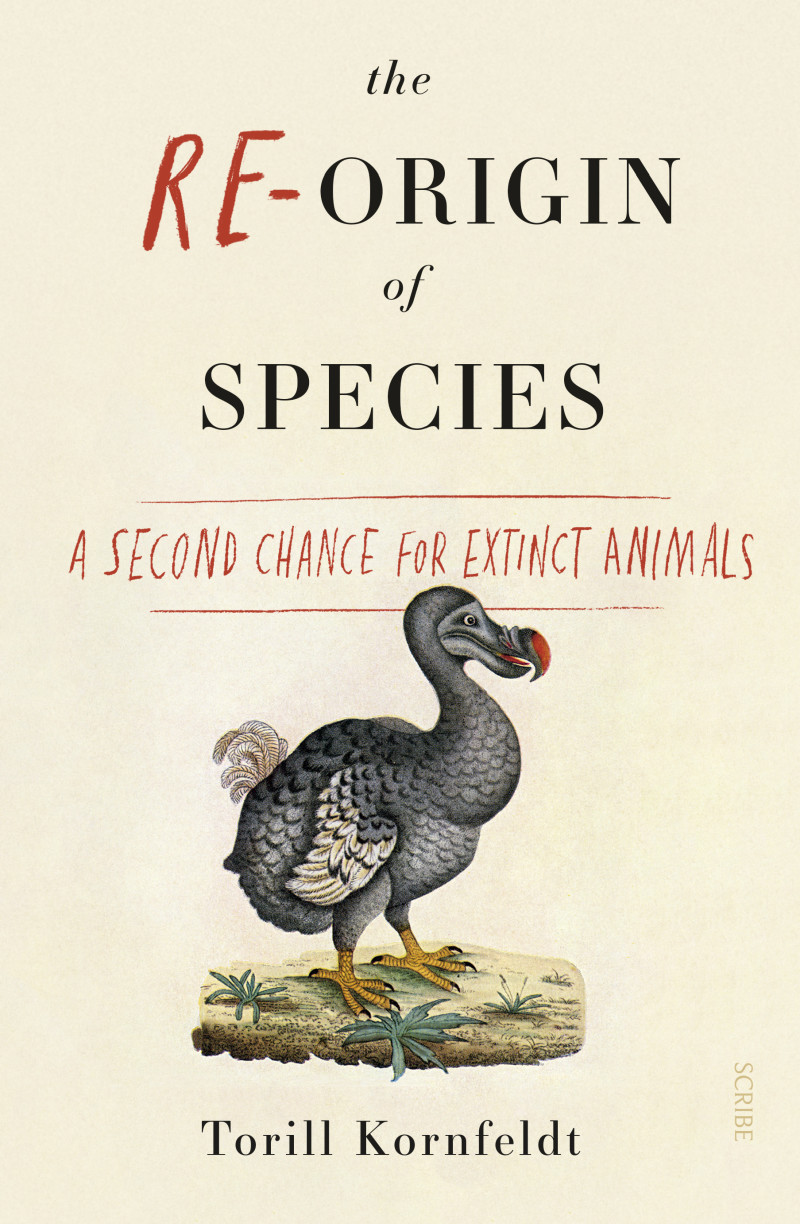
I’ve just finished reading The Re-origin of Species, by Torill Kornfeldt (2016 in the original Swedish). The English translation is just barely out in Australia and the UK; here in North America it’s slated for a November release. (I scored an early copy from a publisher eager for blurbs.) Re-origin is about the burgeoning de-extinction— well, movement seems too coherent a term for what appears to be a few dozen labs scattered around the world, more often than not operating on shoestrings budgets and shoehorned in around the edges of other more respectable projects, laboring towards goals that range from transmuting chickens into velociraptors all the way over to inundating parking lots with bird shit. Maybe cause. Maybe revolution.
Anyway, it’s a good book. It was easy to blurb. I learned a lot of new stuff, and was reminded about a lot of old stuff— because as it happens, I wrote a column for Nowa Fantastyka on this very subject, way back in 2014. Strangely I can’t find it anywhere on the ‘crawl; I don’t think I ever recycled it here.
Until now.
The Reset Button
(A Nowa Fantastyka remix, now with Recent Insights!)
Resurrection is a wonderful thing in video games. No matter how many zombies eat your brains, no matter how many skyscrapers fall on you, no matter how many times the Big Daddy smacks you across the room with skeleton-shattering force, you’re always back in the game for the price of a 30-second reload and the few minutes since your last save. Sure, it may make you a bit reckless— you end up taking chances and trying insane Hail-Mary strategies you’d never risk in real life— but it’s only a game, right? And what’s the alternative: being cautious, being careful? Acting as though one life is all you’ll ever have? Give me backups, every time. When immersed in a video game, the Reset button is a godsend.
In real life, maybe not so much.
It’s been nearly thirty years since Gregory Benford first advocated the collection of DNA from the world’s endangered species, a genetic Noah’s Ark to serve as a fallback measure for those inevitable and myriad cases when conservation didn’t work (or more likely, when it wasn’t even attempted). It may have seemed fringe then— the essay actually appeared in The Magazine of Fantasy and Science Fiction— but these days, so-called “de-extinction” is all over the news. We’re bringing back the mammoth and the passenger pigeon (something like them, anyway). We’ve already resurrected the Pyrenean ibex— for seven minutes at least, before its collapsed lungs caused it to suffocate in agony. England’s Frozen Ark project is on track to store DNA samples from twenty thousand of the world’s most endangered animals; Norway maintains a vast underground seed vault to do the same for crops. The New York Times had an extensive profile of the whole de-extinction thing in their Sunday Edition a few years back. De-extinction is all over TEDx.
As you might imagine, the very premise is controversial (back in 2014 PLoS Biology reviewed the debate swirling around the subject; it swirls still[1]). Proponents point out the myriad sins that can be undone, the vital ecological nodes that can be restored. The dodo, the sabre-tooth cat, all those species we’ve wiped out over the centuries: brought back not from the brink, but from the very grave. Detractors point to items on their own lists: the thing that comes back won’t be the same as the thing that went away, for one thing. The need to gestate the resurrectee within the womb of a related (non-extinct) creature introduces a host of developmental complications; the injection of its nuclear DNA into the egg of a living relative means that its mitochondrial DNA will belong to the extant mother, not the extinct father. We wouldn’t be bringing back the dead, some argue; we’d be creating some new hybrid of extinct and extant, some bastard fusion never before seen on the planet.
Others point out that ecosystems which have equilibriated to some new state might be thrown out of kilter all over again by the reintroduction of long-absent species (how would the Arctic respond to the reappearance of thousands of woolly mammoths stomping across the tundra?). And what about the ethics of bringing something back using techniques which only work in once in a while? What about the suffering and death inflicted upon all those also-rans who die convulsing at birth because their parts didn’t link up the right way? And perhaps the most profound misgiving: if extinction isn’t forever, why even worry about it? If we wipe something out, we can just hit the reset button; bring it back again.
I’m not convinced by the Hybrid objection. The point of de-extinction is not to recreate a pristine snapshot of the past, but to restore functional ecological relationships; if an elephant-mammoth hybrid occupies the same niche as a purebred mammoth once did, who cares about racial purity? And the Ethics Argument seems legitimate only in terms of the current state-of-the-art, which is bound to improve. Arguing that we shouldn’t ever use these techniques because they cause pain and suffering today is tantamount to arguing against cell phones because you can’t fit a rotary dialer into your pocket.
As for the disruptive effect of of reintroducing old species into extant ecosystems— well, that’s actually the point of the exercise. Extant ecosystems— impoverished, weedy— could benefit from a bit of disruption. Adding predators to a system changes the behavior of the herbivores, motivates them to avoid some areas and frequent others; this allows the untouched patches to go their own way, increasing the overall dimensionality of the habitat. Massive storms of resurrected passenger pigeons would process and redistribute seeds and nutrients all over the place (including your windshield, but we all have to make sacrifices). Mammoths— get this— mammoths would knock over trees, keep forests in check, and allow more productive steppe-lands to make a comeback. (Out in Siberia, even as we speak— according to Kornfeldt’s book— Soviet biologists are joyriding around in an old armored Soviet personnel carrier, bashing into trees as a kind of ecological mammoth-surrogate.)

Multiply by 300,000. Save the planet.
The most mind-boggling ecological justification for bringing back mammoths, though, has to be the claim that they could help mitigate climate change. We’re in for a world of hurt when the carbon currently locked in the melting permafrost gets out, you see; and one way to slow that melting is to reduce the insulative effect of the snow that shelters the ground from the bitter cold of Arctic winters. And one way to do that is— wait for it— trample the snow flat under the piledriver feet of thousands upon thousands of mammoths, resurgent upon the Arctic landscapes of Canada and Russia.
(Hey, I’m not saying I buy it. I’m just saying people have put it out there. Apparently they’ve even run the numbers.)
The Reset Argument carries more weight for me— but not because of some video-game scenario where we boot up endless backups to keep things humming along. My fear is the exact opposite— because at some point, extinction won’t be such a big deal any more. So we’ve wiped out another species. So what? Just squirt a dab of DNA from the dearly departed into an egg from a close relative, roll the stone away, command Lazarus to come forth. As one of Blindsight‘s epigraphs puts it: “Species used to go extinct. Now they go on hiatus.” Nothing dies forever. We can bring it back again, any time we feel like it.
Just not today.
The economy’s a bit weak right now, you see. The mortgage bubble looks like it might burst again; wouldn’t want to start something and then run out of funding halfway through, would we? Or maybe we should wait until we know a bit more about how climate change is going to rearrange our coastlines— no point in bringing back the Florida panther if its habitat is going to be wiped out by rising sea levels anyway. But no problems, no hurry; we have the technology. We’ll get around to it. Eventually.
Here in the real world, I fear, the natural tendency to restore from backup will be the exact opposite of what it is in Fallout or Witcher 3. It’s not that we’ll hit the Reset button too often. It’s that— complacent and comfortable in the knowledge that it’s always there— we won’t use it at all.
[1] Be sure to read the comments, in which the scientist Powledge takes her shots at fires back a few of his own.
The role of personality, authoritarianism, and cognition in Brexit.
Cambridge Analytica is what happens when you privatise military propaganda.
Steve Ditko 1927 - 2018
It lingered in things like Machine Man and Captain Universe and Speedball and oh god he did a run on Rom Space Knight, a comic about an Action Man accessory. It felt strange. Magical but strange. Comics that were almost, but not quite, like the ones I first fell in love with. The man who drew Spider-Man, still drawing like the man who drew Spider-Man.
So why the hell wasn't he drawing Spider-Man?
The sad but simple answer was "because he didn't want to." Which is fair enough.
Ditko never did anything else as good as Spider-Man. But everything Ditko did reminded us of Spider-Man. Yes, he did Doctor Strange and if we hadn't had Doctor Strange we wouldn't have had Sandman, not in quite the same way. And yes, he did The Question and Mr A and without the Question and Mr A we wouldn't have had Rorschach, and everyone has already quoted the anecdote about him saying that Rorschach is "Like Mr A, but insane." But it is those 33 issues he will be remembered for. Surely the best 33 issue run anyone ever did?
So anyone can pick up The End of Spider-Man or The Sinister Six and still be blown away by its idiosyncrasy and its weirdness and its distance from anything else there has ever been. There could never be anything else like The Amazing Spider-Man because there was no-one else like Steve Ditko.
And yet... Ayn Rand taught us that no man has any duty to any other man; but Spider-Man believes that with great power comes great responsibility. Why did the arch disciple of the rational conservative create a character who was, if anything, a Christian Socialist? (A Jewish Christian Socialist but let's not go there today) I am convinced that this contradiction is what makes the Very Early Spider-Man so un-repeatably, so quintessentially great. Perhaps there are two contradictory creative visions, two creators battling for the soul of Spider-Man in the actual pages of the comic book. Perhaps we are literally watching Ditko's belief that to be true to yourself is the only law colliding with Stan Lee's belief that you are responsible for every good deed at you fail to do. But perhaps Ditko intended that Peter Parker should start out believing that with great power came great responsibility so that he could spend the next 30 issues realizing what a foolish, unlivable creed that was. Perhaps Ditko created a miserable, neurotic liberal crushed by the impossible demands of liberalism so he could finally show him throwing off that unbearable burden and becoming his own man.
There are not many characters who have persisted for 50 years and who we can be fully certain will persist for another 50, but Spider-Man is one of them. (So is the alien with the red cloak and the problem with his underwear; so is the guy from Baker Street with the pipe and the attitude problem. The person in the blue box with the screwdriver is reaching the end of their natural life. I will be proved right about this.)
I don't know if Ditko would have taken comfort from that. Probably not. I think his attitude was that he did a job of work 50 years ago to the best of his ability at the time, and got paid the going rate, and that's all anyone has any right to. He would have certainly been pleased that his obituarists, without exception, and in the face of decades of corporate Stanology, took it for granted that Steve Ditko was the creator, if not quite the onlie begatter of one of the most famous fictional characters in the world.
Ditko died; Spider-Man will live forever.
Please read my critical study of Steve Ditko's original Spider-Man graphic novel.
Listen, Bud....!
Please consider supporting this blog
Patreon
Brexit equivocator Corbyn isn’t doing too badly with Remainers but he’s doing appallingly with leavers

TMay drops to her lowest favourability level yet
I am really glad that YouGov has returned to doing favorability ratings because I believe that this is the best measure of how leaders, in particular, are being viewed. I can also take some ownership for the format because these were first initiated by the firm following suggestions from me a couple of years ago.
Favorability ratings, of course, are the main measure used by American posters to test the political water.
The table above is very revealing and shows Theresa May really struggling with with her core base, those who voted Conservative. The polling, of course, took place against a background of great controversy and ministerial resignations following the big cabinet meeting last weekend on the government’s brexit policy.
The result is that in net terms Corbyn now has better ratings than Theresa May. I can’t help but feel that given the backing he gets from remain voters that at some stage this is going to cause him problems.
Interestingly for all the equivocation that the Labour leader has had over Brexit he is not getting much recognition for this from those who voted leave. In fact his net negative of -59 is greater than the -49 that Lib Dem leader Vince Cable has with this segment.
Mike Smithson
The Voice of Labor
We may be about to see a strike by members of SAG-AFTRA who provide voices for animated projects for streaming services like Netflix and Hulu. Here are some more of the details.
Whenever we see one of these show-biz labor actions, I invariably get e-mails asking me to explain to the best of my ability, what's going on, what's the central issue, who's in the right, etc. The answer is almost always pretty simple: It's about money. One side wants more than they're getting. The other side wants to pay as little as they can for the same reasons that when you go shopping for a new car, you want to find the cheapest possible price.
Sometimes, people clutter these disputes with phony "issues" like when the Writers Guild was demanding a piece of the profits when our work was sold for home video. The producers did not refuse us saying, "No, we just want to keep as much of that money for ourselves and not share." The CEOs did not say, "Hey, if I can get away without giving you guys any part of that loot, I can get a multi-million dollar bonus and buy a bigger condo in Hawaii!" Instead, they said things like this…
While we respect the vital contributions of the writers, they are obviously unaware of the uncertainty of this new, unexplored means of revenue. Rather than risk destroying the nascent home video market by loading it down with burdensome costs, we prefer to wait and see if there even are revenues to share. This is not the time to be demanding a share of a pie that might never exist. As it is, it may never be more than a way for us to recoup some of the massive and increasing deficits we now encounter on traditional film and television production. If it turns out that home video does provide new profits and even a market for expanded production, we will certainly be open to some adjustment to share that revenue with not just the writers but all the hard-working members of our industry.
That of course translates to "I want that bigger condo in Hawaii." That's pretty much what all these disputes are about.
General rule of thumb: Any time an employer or a politician for that matter says, "Now is not the time to do what you want," they mean "No time is or will ever be the right time."
I am, of course, on the side of the actors. And if you're someone who dreams of someday being one of them, you should be. Right now, doing voice work for that kind of material does not generate a living wage. That has to change.
The post The Voice of Labor appeared first on News From ME.
Recommended Reading
The Institute on Taxation and Economic Policy is a non-profit, non-partisan "think tank" that works on tax issues and identifies what this or that tax cut or hike means for the economy. They tend to get cited a lot by both Democrats and Republicans when either party can use the group's findings to support what they want to do.
As Kevin Drum notes, they recently analyzed the numbers on all the G.O.P. tax cuts since the year 2000 and concluded that most of the benefits went to the rich. Well, duh. Is there anyone reading this who couldn't have told them that without crunching any digits? But what's interesting is that as Drum notes…
ITEP figures that total taxes paid in 2018 are about $600 billion less than they would be if we had just left the tax code alone. That's nearly the entire federal deficit projected for this year.
Just to make sure you get that: Republican tax cuts since 2000 are responsible for nearly the entire federal deficit. Repeal them all and the budget would be almost balanced.
I would imagine that if you went to any Republican leader and said, "You've always said deficits are bad and we should have a balanced budget so what about this?", the answer would be something about how, yes, "Maybe the numbers do break down that way but these cuts will stimulate the economy and eventually, we'll have not only that balanced budget but a surplus!" And then that will never happen. Because no one ever cares about deficits when they're the ones running them up. My deficits are fine. It's your deficits that will destroy America.
The post Recommended Reading appeared first on News From ME.
The Man Behind the Infodump: Denis Lynn, 1947-2018.
There’s a chapter three-quarters of the way through Maelstrom— “Mug Shot”, it’s called. It’s an executive summary of the apocalyptic microbe βehemoth. It contains such gems as
βehemoth enters the cell via receptor-mediated endocytosis; once inside it breaks down the phagosomal membrane prior to lysis, using a 532-amino listeriolysin analog. βehemoth then competes with the host cell for nutrients. Host death can occur from any of a several dozen proximal causes including…
It goes on like that for almost four pages. Some might even say it stops the plot dead, but after two decades I still kinda like it. Maybe the issue it addresses would only ever occur to one reader in ten thousand— assuming I even had ten thousand readers— but that’s what makes this SF hard, right? Respect for the science. Respect for the fine print. Coming up with cell entry via receptor-mediated endocytosis (thanks to its Blachford genes, βehemoth can fool steroid receptors on the host cell membrane) is actually something to take pride in.
The man, and one infinitesimal sliver of his legacy.
Or it would be, if I’d come up with it myself. As it is, I have to thank a dude called Denis Lyn for making me even think about it in the first place.
Denis died a couple of weeks ago. Apparently he was collecting samples from a tide pool out on the west coast and a freak wave took him out, which makes no fucking sense whatsoever. He was 71.
Denis assumed a faculty position at the University of Guelph about the same time I arrived there as a student. Rumors kicking around the department said that just a few years earlier he’d been a real hippie— hair down to his ass, marched on Washington at the height of the Viet Nam protests. By the time I met him, though, the man was Dr. Ciliate: he went on to be President of the International Society of Protistologists, and Editor-in-Chief of The Journal of Eukaryotic Microbiology. He was an impossibly nice, generous, helpful guy, strangely out of place in a department loaded with backstabbers and infighters. (At least one online memorializer remarked that they’d never heard Denis utter an unkind word about anyone. I can’t say the same; down at the St. Andrews field course one summer, upon hearing that UoG’s widely reviled president Donald “Ducky” Forster had snuffed it, Denis raised his beer and softly toasted “Ding dong, the Duck is Dead!”. Honestly, though, that only made me like him more.)
I fell out of touch with him when I headed west to do my Ph.D. Fell out of touch with pretty much everyone else when political bullshit sent me screaming from academia entirely. But Denis looked me up when the release of Starfish was imminent— a mutual friend had pointed him to the first home-built edition of this very website— and I, of course, didn’t hesitate to ask if I could pick his brain about the sequel. And of course he said yes. And his responses to my (frankly naïve) thoughts about my fake microbe were, well…
… what happens once the vesicle is internalized? Usually, these vesicles are destined for the GERL pathway (Golgi, Endoplasmic Reticulum, Lysosome) and end up fusing with lysosomes and digestion occurs. Can B subvert the signal molecules on the outside (=cytoplasmic side) of the vesicle so that the vesicles don’t fuse with lysosomes? This would be a trick much like Toxoplasma uses to survive in the parasitiphorous vesicle…
…detailed. The man also sent me a free copy of Lodish et al‘s Molecular Cell Biology— a real doorstop, 1400 pages. Twenty years later I still use it.
Denis’s last email to me was sent on January 21, 2002. It ends: “P.S. I wouldn’t turn down a beer even in the daytime, but NOT BEFORE 1130h.”
I don’t remember if we ever had that beer. All I know is, that’s the last documented contact I had with him. After that he retired from Guelph, moved to the west coast, became an adjunct professor at UBC. And got killed, absurdly, by a stupid wave while sampling stupid mussels from a tide pool, leaving our species— by his absence— just a tiny bit more deserving of extinction.
I can’t claim to have ever been close to the man. That’s kind of my point, though; far as he was concerned I was just another dumb student passing through the system— ultimately, someone who didn’t even stay in the system— and still he bent over backward to lend a hand. He was that way to everyone. Now that he’s gone, I think it’s kind of cool that a teensy bit of his essence has been uploaded into Maelstrom.
And if you find that maudlin, well, I can just say fuck you. Because Denis Lynn never would.
On class separation
The Times obituary of Lord Carrington says:
More commonly, he found himself sleeping in a hole beneath his tank with his four crew who came from poor backgrounds and had suffered hardship during the pre-war years. The experience shaped his politics, he said later. “You could not have got a finer or better lot than they were. They deserved something better in the aftermath of the war.
This was a common sentiment. In exposing posh men to the working class, military service increased their sympathy for the poor – and as Adam Smith said, sympathy is the basis of our sense of justice. For this reason (among many others discussed by Walter Scheidel in The Great Leveler) the war led to big fall in inequality.
Herein, though, lies perhaps an under-appreciated social change in recent decades – an increased separation of the classes. I don’t just mean geographic separation, though this is important. I mean separation in the workplace. Years ago, the classes would meet at work. In offices, posh men would meet less educated women in the typing pool: think of the Mad Men office. In manufacturing, middle class managers would rub shoulders with workers. And even in investment banks, there really were “barrow-boy”-type traders alongside old school tie-types.
This now is now longer so much the case. Many of us are in occupations where we only meet folk of similar class. And thanks to a lack of social mobility, posh people are unlikely too meet many from a different class origin. The only working class person a journalist might meet at work is the cleaner. For all the talk of diversity, many posh people now work in homogenous offices. As Daniel Cohen writes:
Only recently, workers, foremen, engineers and owners were connected by relationships that, though sometimes antagonistic, allowed each group to evaluate where it belonged in a shared industrial world. Now, engineers are in consulting firms, maintenance workers are in service companies, and industrial jobs are subcontracted, mechanized or relocated. (The Infinite Desire for Growth, p148)
I suspect this has contributed to increased inequality.
One obvious route is via increased assortative mating; middle-class men now marry other middle-class women rather than their (working-class) secretaries. That has increased inequality (pdf).
Another mechanism is the “out of sight, out of mind effect”. If the poor never see the rich, they’ll never appreciate just how great inequality is. For example, Sorapop Kiatpongsan and Michael Norton have shown (pdf) that in 16 countries, the ratio of CEO to workers’ pay is massively greater than people estimate it to be.
By the same token, if the rich are out of sight, envy and resentment will be directed instead at the people who are in sight, such as benefit claimants.
But there’s also the reverse Carrington effect: greater class separation means less sympathy and so less taste for redistribution among the rich.
One aspect of this consists of the othering of workers. Because posh people have so little direct knowledge of working people, they impute all sorts of bad habits to them, such as lack of aspiration, poor diet and racism – even though the latter especially is also found in posher people.
Such imputation also serves a reactionary function, as the belief that workers have “legitimate concerns” helps to popularize anti-immigration policy and to displace more radical agendas. There’s just one problem with this. It’s not true. Attitude to immigration have softened markedly in recent years (table 6 of this pdf). And in new research Matthijs Rooduijn concludes (pdf):
There is no consistent proof that the voter bases of populist parties consist of individuals who are more likely to be unemployed, have lower incomes, come from lower classes, or hold a lower education.
Ignorance of workers, then, might well contribute to both inequality and a misreading of politics.
All this said, things aren't so clear. Mere proximity to workers doesn’t necessarily give you great knowledge of them: David Astor, the mega-rich editor of the Observer in the 50s, for example was shocked to discover that his staff had mortgages. Nor does it always generate sympathy. Perhaps the opposite. One reason for Thatcher’s popularity among much of the middle class in the 1970s was that managers knew workers well and saw them to be lazy, bolshy and greedy.
All I’m suggesting is a possibility – that there has been increased separation of the classes since (say) the 1970s; that this might have political and social effects; and that all this is under-appreciated.
Right-libertarians as counter-advocates
Daniel Hannan tweeted recently:
Libertarians want to break oligarchies, expand opportunity and let wealth spread. I can’t think of any political movement where the gap between what its supporters believe and what they are imagined to believe is wider.
Now, if people widely and persistently misunderstand you, the failing is likely to be yours as well as theirs. Mr Hannan should therefore ask: what are we right-libertarians doing wrong?
For one thing, they are keeping bad company. Bryan Caplan once wrote that there is a “libertarian penumbra” – a set of beliefs that are logically separate from libertarianism but which many libertarians happen to believe. One of these, for example, is an (excessive?) interest in IQ research – despite the fact that no correlation between IQ and life-outcomes suffices to justify our social system. For some leftists, this alone helps discredit right-libertarians.
In the same vein, right-libertarians are seen as shills for the rich – an image reinforced by the refusal of the IEA and Adam Smith Institute to say who funds them.
If being on the side of workers were to become a criminal offence, there’d not be enough evidence to convict many right-libertarians, Certainly, few are guilty by association.
Yet other associations are much worse. At least a few right-libertarians have supported Trump, others border upon the racist, and Christopher Freiman says many favour immigration controls despite the fact that the liberty to live where one wants or hire whom one wants must be important freedoms. And yet others take an interest in the sex redistribution cause.
Of course, this isn’t true of all or perhaps even most right-libertarians. But a few (some? many?) cases makes them look like a tribe of cranks. This matters, because when you are espousing views a long way from the mainstream, people are apt to think you cranky anyway so such examples reinforce that belief.
Just as significant as the associations some right-libertarians have are those they don’t have. Take for example the #Metoo movement. This is essentially expressing women’s Nozickean right of self-ownership. You’d expect, therefore, libertarians to be enthusiastic supporters of the movement. Similarly they should be vocal advocates of gay rights and of Black Lives Matter; being killed by a cop is a significant infringement of freedom. For every self-professed libertarian who is, however, there is perhaps another bleating about identity politics.
Yet another reason is that right-libertarians have some asymmetric sensibilities. On the one hand, many seem highly attuned to the dirigisme of Brussels, so much so that they took money from that noted libertarian Vladimir Putin to escape it. And yet they are blind to the much greater infringements of freedom that occur in workplaces. It’s as if they actually want to conform to Corey Robin’s description of conservatives as those who want to entrench private sector hierarchies, rather than break them as Hannan claims to want. I sense they would rather defend property than freedom
In this context, there’s another curious blindspot. Right-libertarians often channel Hayek to argue that the virtue of markets is that they aggregate the fragmentary information of dispersed individuals. Often they are right. But markets are not the only technology for doing this. Democratic control of workplaces can do a similar thing. Logically, right-libertarians should therefore support worker coops. But this is not exactly what we see.
Yet another blindspot is the failure to see that a sustainable market economy requires particular pre-conditions, such as rough equality of bargaining power; anti-monopoly policy; obstacles to cronyism; and measures to encourage socially useful innovation.
Without such pre-conditions, a “free market” economy will be dysfunctional and unpopular. Too many right-libertarians don’t get this. Like Brexiters – they are in many cases the same people – they will the end but not the means.
Hannan is right to say that freedom entails the breaking of oligarchies and spread of wealth: I suspect the causality runs both ways. The problem is that right-libertarians are terrible at arguing for this. In fact, I suspect they are even counter-advocates: they are so bad at making their case that their efforts to do so weaken support for freedom. Of course, you can point me to exceptions to this. My impression, though, is that that’s just what they are – exceptions.
Twice Upon A Time: The Novel
For the third time in my life, Paul Cornell has written exactly the words I needed to read.
The first time was early in 1992, when the blazing hot prose of Timewyrm: Revelation kept me awake — sitting in a hotel bathroom to finish devouring the book long after my roommate had wanted to go to sleep, compelled to keep reading by the feeling that a flower was opening in my head, a first glimpse of just how layered and human and emotionally true one of these Doctor Who adventures could be. That the same crafting of words and motifs that I'd been learning to appreciate in Steinbeck could be turned to flesh out the characters at the heart of my own personal mental landscape, and find something rich and real to say with them. It's one of the many moments where I think I learned how to write.
The second was the summer of 1995. The girl I'd thought I was going to marry had just dumped me, and I was adrift. Out of college, working an entry-level job, seemingly cut off from most of the life I'd built up at school — I had no idea how I was going to manage to get from where I was to a place where I'd be happy again, and not alone. But then, while curled up and recovering, I settled down with a good book: Human Nature. And Paul's deft painting of those moments as John Smith and Joan Redfern were drawn together — that sense of heart-opening possibility, the realisation that once in a while the stars could align and the most romantic thing you could imagine actually could happen — filled my heart with the knowledge that everything actually was all right. That even the wrong bits wouldn't have to stay wrong forever.
(Just a couple of months later, it happened to me and Kate.)
Fast forward: it's 2018, and we're bloody exhausted on every level. Kate and I are holding on to each other for dear life, as two years of ever-escalating political horrors are now coming pretty much daily: a wave showing no sign of breaking. Surely stealing children from their parents will be the last straw. Surely when I point out that seeking asylum is perfectly legal, and that innocent refugee families who have followed all the rules and committed no crime at all are having their children taken from them, and being told that the best way to see them again is to confess to a crime and go back to where they're likely to be killed — people will realise the pure Kafka madness of America's new policy. Surely my own mother won't ignore it when I tell her about this... Surely my heart won't break. Surely I won't despair.
And in the depths of this soul-weariness, Paul Cornell comes back to Doctor Who for one last time, to novelise the farewell of a Doctor I loved. A story which, onscreen, left me cold — simultaneously glib and wordy, with shrugged-off sentimentality in place of the genuine hard-won triumph which characterised Peter Capaldi's Doctor for me. (Neither Doctor's motivation for refusing to regenerate rang true for me on-screen.) But Paul Cornell had been finding depth in dashed-off raw material ever since he took a brief Terrance Dicks description of the Doctor and turned it into a heartfelt principle worth clinging to. Perhaps he might just pull it off again.
Twice Upon A Time starts out fairly ordinary, as Paul once again channels his lifelong ambition to be Terrance Dicks — which is all well and good, but I'd really much rather he be Paul Cornell. He does a polished, swift job of leading us through the setup of the story... but it's got none of the showy packedfullness of those early novels, which were bursting with ideas and imagery in every moment. Not even a "long ago in an Antarctic winter". Paul's in a different place now, as are we all. He's slower, he's older, he's writing this book for his son (to whom it's dedicated) at least as much as for his peers — it's got none of the raw "adolescent energy" (as Paul once referred to it) which powerd his first novels.
But what he has — in common with the Doctor he's writing for — is grown-up insight.
And gradually, through the course of the book, he gets further into the heads of the characters... and that's where the book comes to life, as he fleshes out the Doctor and his reactions, twice over. To start with, he finesses the meaning of the Doctors refusing to regenerate, in a way that's never explained in the script: they're not seeing it as an immediate death sentence, but that eventually the regeneration energy will stop surging and fade away, leaving them to live the remainder of their life and die naturally as themselves. Not so much suicide as refusing to be reincarnated. (Hartnell's parting line of "It's far from being all over" becomes an expression not of his impending regeneration, but of his defiance of it.) The first Doctor's reaction in refusing to change is a combination of classic Hartnell-style stubbornness, and fear of the unknown — fears which are exacerbated by the sight he gets of his future. And the further we get into the story, the more different layers to the twelfth Doctor's motivations we see.
There are lovely extra exchanges (many presumably deleted bits from the original script) which flesh out both their attitudes: both the twelfth Doctor as the older, more experienced self (First Doctor: "I wish I'd thought of that." Twelfth Doctor: "You will, Doctor, you will!"), and the first as the one who remembers crucial things his later self would forget. The first also gets a wonderful internal monologue about his own Ghost of Christmas Future: "In his case it merely meant several things of which he very much disapproved, including nonsense, frippery, and seemingly not being in possession of a comb."
Paul also gets to do a fair bit of what he said he always loved Terrance for in his novelizations — the plugging of plotholes and the subverting of weak bits. You can see him enjoying his deft retcons, like his suggestion that the reason why the Doctor left the TARDIS interior as white for so long was because he simply hadn't worked out how to change it. He suggests a bunch of reasons why the first Doctor is showing his most chauvinist side — the twelfth Doctor is appalled that his younger self had forgotten how Barbara would never stand for this, and wonders if he's just acting up to embarrass his future self. Or this throwaway gem:
"Time and Relative Dimension In Space." Bill said it with him. And she hadn't even gone for the plural on the D word, like he sometimes did when he decided to flirt with the translation circuits.
But a novel has to reach deeper than that. And where the story really begins to come to life is when he starts letting us into the characters' heads: giving the on-screen events context and resonance. In the end we both get a rationalization for why Bill didn't remember her own fate (the Testimony wanted to judge the Doctor through her eyes, and that meant her eyes at the time when the Doctor was still fresh in her mind, so they blocked everything after that at first), and eventually the full story of her life with Heather. The Doctor's reluctance to accept the reappearance of Bill — because she represents both a sense of hope and the possibility that that hope could be betrayed — gets fleshed out with more nuances; he can feel both the reasons to believe her and to resist her. ("She was like his conscience made flesh.") Nardole gets his story too, and it's charming and eccentric and utterly in-character. And Paul even just about manages to wring some poetry out of the vision of Clara at the end... rather than just an obligatory happy-ending of the sort I admired Russell T Davies for not giving to Donna, it becomes an explicit step which tips the balance towards convincing the Doctor to regenerate after all.
It was like she was dancing through his neurons. The sound of her voice and the things they'd done together were in so many associations, so many connections to other things that he'd been shying away from lately, because they'd seemed so... dull. They had been dull because they had been without her. To see her again was to see hope. Because after all wasn't the lesson of her story, the story he had been without, that there was always hope?
(Well, actually, the lesson of her story onscreen was that you could just shrug off any and all consequences of appallingly irresponsible actions, and head off to commit another one for a punchline, if the writer wanted you to have a happy ending regardless. But Paul tells the lie so well that for this story I'll believe him. Especially since he also indicates that this appearance means Clara did go back and face her raven in the end.)
He repeatedly focuses in on the fact that this is a Doctor who has finished his business; the straight-line human life he'd never understood, he's now had, both with River and in the fifty-odd years afterwards. At last he has a sense of completeness... such that it's too hard to bear the thought of going on without it. This is a Doctor who's lived his life, has felt its satisfaction, and simply doesn't want to be cut off from it and live it again. "This time, if he allowed the regeneration to happen, he wouldn't just be sacrificing some iconic hero, he would be losing a life. He would be losing it anyway."
(Ironically, that sense of completion works as a callback to Steven Moffat's very first broadcast Who story. The fact that the Doctor has to go on beyond the point where he is ready to let go makes regeneration the curse of non-fatal death. Appropriately, that story ended in much the same way as this one...!)
And his ambivalence about Bill's authenticity becomes central to his own crisis, because Bill is exactly what he fears becoming: no more than a filed-away collection of memories to be viewed by someone else. He refuses to hope that she could be really alive, because "in hope you are at your weakest" — the statement which the first Doctor reminds him he's been misquoting. ("'In hope you are at your weakest... In strength you are at your worst.' It wasn't weakness he was warning us about.")
But then Paul Cornell digs deeper.
What he does, is call back to some of the fiercest, most determined moments of this Doctor, and show us the weakness inside their strength. This Doctor's focus on virtue in extremis — a motif throughout series 10 from Extremis onwards — crucially depends on there being no hope, and yet doing the right thing anyway: as close as the show has gotten in recent years to a new angle on the Doctor's heroism, one well suited for those of us who have become more battered and cynical over the years but refuse to stop fighting.
But what that idea has hidden in plain sight is, this is a Doctor who has given up on hope.
He believes he's won all the battles he's going to win, seen everything he wants to see, lived the life he always wanted to (his twenty-four years of married life with River), and that he has at last done enough.
And that rings all too true. As Kate said the other day... I've had a good run. She and I have made it nearly fifty years without a profound disaster in our lives, and the temptation to just walk away from the things we fight for is ever present. Because it only gets harder to believe that the big victories would ever come. I've had more than one friend say lately that if not for their children, they'd retire from their fight and just look after themselves comfortably... and Kate and I don't even have that to keep us going. We've had to rely on sheer cussedness to keep standing up.
By cutting himself off from hope, from his memories of Clara, from the possibility of something further — the Doctor has frozen himself. Gone cold, in exactly the way Nardole fears the universe will without him. As still as that frozen moment in the Antarctic wastes, or the battlefield when they return there. He has kept fighting for what's right, but from a place of bleak determination rather than one of hope.
I have gone so cold over these past two years.
I've had my belief in people, in human empathy, in common sense, in the power of kindness, in law and fairness, battered almost beyond recognition. I have not resigned myself to accepting the cruelties and profiteering of the powerful few — but I have become embittered. I have fought on for the sake of continuing to fight, without feeling any belief that this week's battles can actually be won. (Not until November, at least. Vote, and get everyone you know voting.)
I have not let myself recognize hope, even in the small things. I have survived just on strength, and thus been at my worst.
But in the succession of little turning points Paul has brought out in this book... he's showed the ways hope can creep back in. To start with, he actually lets us in on a moment Steven Moffat kept offscreen: the moment when the Doctor, resigned to having to return the Captain to his fate (and feeling compelled to do so, because otherwise he'd be a hypocrite for being ready to die himself), suddenly realises that there is a chance to avoid the Captain's end after all. Then Paul underlines the sheer improbability of the fact that the Christmas armistice happened at all — lifting the date out of the realm of lucky coincidence, and into that of a statement of possibility:
What a fantasy. What a fairy tale. Lives saved by a story, by songs.
Crucially, he lets enough harsh reality into this picture that we don't see this as a magical cure for everything: pointing out the reasons why such an armistice never happened again, how people were executed for it the following year. Emphasizing that this moment's power is just that of a single moment of grace... so those of us whose cynicism curdled over Clara's easy-out in Hell Bent get pulled back from the brink.
And he still allows the Doctor to see both sides of what he's presented with — through reinstated dialogue and new internal monologue, we see how the Doctor can both feel the hope around him and still want to resist it. ("I can't do this forever. There has to be an end." "But does it have to be today?" "Why not? Why not right here, at the only war that ever turned into a Christmas party? I could do worse.") For every step towards acceptance, we get to see why he wants to not accept it as well: the hope he gains from rediscovering his memories of Clara are played against the fact that he hasn't actually got her back, and he tells the memory ghosts of his friends that his life is "a battlefield where everyone has fallen."
All these overlapping elements move the Doctor's state of mind away from feeling glib and sketchily-defined, and into the murky realm of real human motivations. As with many people facing depression, or resignation, or despair, it doesn't just take an epiphany to shift their mind, but a thousand and one little epiphanies, over and over again.
But what Paul does is give us enough of them that we can see what makes him hope again despite himself. And thus keeps us standing beside the Doctor as he faces his final decision.
He felt so... old. So completed. He had wondered, in this incarnation, about every aspect of himself, about his worth, his beliefs, his meaning in a universe that seemed to have forgotten everything he'd learned and didn't see the need to consult him as it was learning those harsh lessons for itself, over and over.
I'm right there with you, Doctor.
He had known lasting love, he had found peace, he had died a good death, to save others, already. What more could there be for him to learn? He would not be merely the sum of his memories, something to be collected in the Matrix, he would put a proper full stop at the end of his life, like... well, he'd been about to think 'like humans did', but... but he'd just discovered they didn't do that, hadn't he? He'd just discovered something... new.
This damned universe, mocking him at his moment of greatest fear.
But what finally tips the balance at last, in Paul's telling, is a new moment that's simultaneously in character as one of those Terrance-Dicks-style slipped in retcons, a Steven Moffat bit of timey-wimey cleverness, and a pure Paul Cornell piece of heart: the Doctor finally remembers the words we've only just see Bill tell him, a few hours and twelve lifetimes ago. A gift which makes its way through the fog of forgetting which has previously hidden his first self's encounter with him. "Perhaps there's just some bloke, wandering around, putting everything right when it goes wrong."
He almost laughed. He almost laughed a laugh so big it nearly brought on the change on its own. Oh. Oh! He had learned another new thing, although really he had already known it. He was such... an idiot. A complete idiot — or at least, an idiot who had been completed by this realisation of his own stupidity. Because he had learned new things, had changed twice, in the space of the last few minutes.
Testimony was a human system. It would not save them all. It would not save them from pain and horror. It would not see where lives did not have to end, where change was possible. It was just something else instead of death. Someone still had to save people. Someone still had to help them. But... not someone who was pleased with the life he had completed.
He was satisfied. He had done the best he could. Change was required, because it always was.
Where the episode on screen failed to bring me to that point of acceptance, except with a sort of shrug, the novel makes me believe both in the Doctor's despair and finally in his release.
And the way he does this is sort of the antithesis of young Paul's heart-on-his-sleeve prose... he lets the idea sneak up on you. It's only when looking back through the book that you realise just how many different contexts the word hope has appeared in. (From the opening sentence of chapter 1 — "It was hopeless, to begin with" — up through "In hope you are at your weakest," all the way to the battlefield and beyond.) What Paul has done here is take one more thought from Letts and Dicks — "while there's life, there's hope" — and weave a whole tapestry around it to show us, while never once telling us that specific phrase.
And all those other words are the words I needed to hear, to take that thought out of the realm of cliche and into inspiration. There is still hope, even if you've stopped listening to it.
And as the perfect capper, Paul even brings subversive little shadings to the Doctor's final oration to himself. Onscreen, this speech sat really wrong with me — not only was it interminable, but the image of the Doctor mansplaining himself to his next self rankled. But Paul, elegantly, keeps the words of the monologue while shifting its flavour — making the Doctor determined to finish his sentences because they're the final statements on his life, the life he's been so proud of. And then wonderfully, towards the end, he realises that this whole my-house-my-rules attitude is exactly what he's supposed to be letting go of.
And what finally gets him to let go, is a glimpse of who he's going to turn into.
He stood there. He adjusted his cuffs. It was all going to be all right. Of course it was. Seeing who he was going to be, he was suddenly filled with... hope.
But an even better punchline — when she finally takes his place, she shrugs the whole monologue off!
Change was possible. Change was here. What had she been worrying about just now? No idea.
And that, that moment, is where Paul Cornell most clearly achieves his dream of being more Terrance than Terrance. Again, by finding the depth. By elegantly layering his own meaning atop the original author's — but doing so in a way which isn't a jab at the original, but an enrichment of it. A way that is kind.
After two relentless years on the battlements, I needed all of this. I needed the acknowledgement of despair and the myriad little reasons to hope. These words reminded me that we don't have to win every battle, or even the big ones; any battle we win is a victory. Even after a loss, there is always a chance to win something else. Any moment of decency can be the one to come back to save you.
Somewhere in the distance, I can still hear TARDIS music.
what even is a review?
[This post originally went up at my PATREON: subscribers get to read posts and hear podcasts early — and help offset costs and time and help me do more of this kind of thing. Please share widely and encourage participation in the comments!]
 It’s 1971, and here’s Nick Tosches reviewing Black Sabbath’s Paranoid in Rolling Stone. A friend (hi Kerr!) linked it on Facebook, alongside the cheerful question Is this the worst ever review of all time? Almost all of the 500 words are mood-conjuring the look and hideous feel of an occult orgy, little to nothing is said about the LP in question, or any other, and in fact the piece ends by misidentifying the singer as Kip Treavor, misspelled frontman of Sabbath’s rival satanic-themed rock band Black Widow (it’s actually Kip Trevor): “The boy whips out a 10″ personal vibrator, adorned in waterproof acrylics with the image of the Nazarene. He intones the words NUK KHENSU TENTEN NEBU and approaches her intendant fundament… impletion… across the room the fresh corpse of an illegitimate hippie baby is dis-impaled from the ceremonial sword of Baphomet. The myrrh is extinguished with the collected saliva of priests listening to tales of carnal abuse in warm, dark confessionals. The Shadaic numinae are chalked over with the mirrored sign of Ariael, the 11 rubies returned to the vessel of Dione.”
But all the same I’m going to say, no, there are many many MANY worse reviews, and here’s why.
Richard Meltzer, Lester Bangs, Nick Tosches: when James Wolcott dubbed them the Noiseboys, he did everyone (as so often) a disservice, including them, by collapsing them into just one wild-style jerk-store project and mislabelling it to match. They were friends in mischief, to be sure, but they were none of them particularly like one another in style or even tactic. What they did in fact share was a perverse attitude towards deep cultural knowledge, a feel for how to write and how to play and what was out there besides just rock [footnote 1]. Elsewhere rockwrite was already sleepwalking uneasily — so they felt — towards a narrow pedantry, autodidact learning as a mode of borrowed bad authority. One escape route: knowledge as all-purpose bust-it-wide toolkit, as weaponry on behalf of the militant mutant grotesque that was rockthink’s earliest best contribution.
 Let’s unpack this a bit. By slightly winding route, the word “grotesque” has the same root as “grotto”: it referred to the old Roman paintings rediscovered during the Renaissance in Italian ruins, and in particular to the unnatural beasts and plant-life found in Neronian pleasure caves, part stag, part shark, part writhing snake, or whatever. Fabulous decoration as objective correlative of perversity, the joy of this and the darkness [2]. The meaning drifted, as meanings do — it often ends up closer to merely absurd-with-an-unpleasant-aftertaste — but as a strategy, a pressure, the Grotesque has always renewed itself. And in its earliest days rockwrite absolutely became a species of the Grotesque, an alt-space symbolic bestiary that recognised (or pled for) the marriage of the trash aesthetic with utopian social transformation. Meanwhile flying music fragment A bred with fleeing music fragment B in the tavern boudoir-dungeons of music survivor C… this was what rock was, in those first days, a militantly irresponsible mongrelism, and also space for just this hybridity.
So: could such a gleeful fusion of inflows be wrangled towards a wider readership? These were smart kids more or less trained to the mandarin manner, after all. With additional aesthetic tics adapted from jazz — music as speculation, music as intensification. How to maintain and cultivate and send these wide? One solution was a species of shitposting, quick-witted and unpindown-able, social and culturally if not descriptively thick [3]: throw open the portals of a lovecraftian quilt-form hell-garden writhing with chimeras. A glitchcore, as my friend Tom Wootton described it, bent on defying (among other things) all the journalistic category shorthands and shortcuts. And it’s catching: I’m at it now, beckoning the giant Wicker Man forward and calling for the torches to be lit…
Back to my friend’s FB thread: the phrase “creative writing” is deployed (hi Sundar!) as explanation with vaguely negative implication: as if to say “It’s not a review really, it’s more an exercise in creative writing.” Now it’s certainly true that the vast bulk of consumer reviews at all times have been the very epitome of uncreative writing: a cliché description, a genre-location, a borrowed evocative indication, a mark out of 3 or 5 or 10. From a very narrow descriptive palette, functionally repetitive compare-and-contrast work that presumes to identify a reader’s pre-existing taste zones and to toss the item in question into same, or else bin it.
 Back in the bold dawn of rock culture, people had higher aspirations. We were remaking the world. A description fashioned merely to the interests of commercial exchange was as far as could be from the spirit of the moment. And not just the spirit: as Frank Kogan wrote of Meltzer nearly 20 years ago, “Yes, spirit is nice (rah-rah), but Meltzer also – once – aspired to the mind of rock’n’roll, chose rock’n’roll as his intellectual activity – chose to do rock’n’roll on the page, since what rock’n’roll did was to mix up, flummox, challenge, test everyone’s sense of what was relevant or irrelevant in the world; to create a space where just anything could be pertinent. (Isn’t this what real thinking is: to test what’s pertinent? To question what matters? To act out your questions? To flummox, test, reinvent social relations? And if you’re a thinker, isn’t testing your own ideas what rocks you?)”
And that acting out, that testing could be (should be?) prankish or weird or fuck-you, or (now and then) a full-on shamanic journey as quest for what a song does to you, enhanced or otherwise — and where you might meet be when you arrived, and who you might by then be too.
And a lot of this writing was bad, of course: a lot of all writing is bad. Even strong ideas can suffer inadequate execution when they’re seen to be popular: hacks will gather in abundance. And bad habits are already in abundance, and the mechanics of magazine production — pressure of speed, consumer-directed conventions and separations pre-established everywhere, with intended and unintended consequences — are a spawning ground for more of the same, and for worse. All the same, “This is a bad review” is an ambiguous sentence. It might mean “The reviewer did badly the job of reviewing” and it might mean “The reviewer disliked a record everyone now knows is great” and it might just mean “This is just bad WRITING whatever the intention”. Those invested in the excellence of the record under review are not unlikely (and often happy) to confuse these meanings. Evidently someone who fails to share their tastes will be an incompetent in every other human dimension: lol this rock hack twerp who didn’t recognise greatness in real time, we so much know better now…
Of course nothing will have ambushed the likely prank here [4] more than the turn in Sabbath’s critical fortunes. And it’s sadly true that few US rock-writers took the Sabs particularly seriously at first — and that that’s what this squib is about, intentionally and also inadvertently. It’s a description of what a Black Hippie Sabbath might entail. By taking seriously the idea of “taking the idea seriously” it ramps up the absurdity: it gets the gap between [band name] and [pretentious rape-murder drugs party] down on the page.
 So is this done well? If (here 50-odd years later) we don’t feel fully clued in to this move, is this his failing or ours? Does “us” include the many readers at the time also shut out of the possibility of satire? Well, even Flaubert’s Salambbô sometimes seems to need to have the word “parody” slapped on it, to ensure it doesn’t just get folded in with every other excess-ridden orientalist historical romance, and ditto Eyes Wide Shut for the ways it gets maybe (justly?) misread — and no one even tries with Gérome, who this probably reminds me of most, at least till the moment when Tosches slides out of the perfectly held pose into the final-para reveal.[5]
Another way bad works is as implied transferred epithet: “This is a nasty piece of writing — making the writer a bad man.” As Appalled of Upper Park Slope avers, “For moral reasons, this kind of scene should not be depicted” (and “depicted in this context” slides into “depicted anywhere ever”). So yes, Tosches is calling Black Sabbath’s bluff, and Black Widow’s too, and the bluff of anyone casually or cheaply invoking satanist ideas and imagery, not that many months after Manson. But the grotesque is as much aesthetic tactic as moral spasm: a movement towards the things in the world that go unseen, because we so busily (not least per journalistic conventions and separations) avoid looking, including juxtapositions always right there in front of us. As with “creative writing”, “satire” is often a get-out clause — a loaded and anxiously dweeby act of attempted redemption and in fact content-gutting — and the only thing that stops the “Grotesque” being the same is maybe the embedded admission that it remains, in fact, grotesque. It combines and deliberately confuses “This is what a Sabbat orgy actually is — and you who flirt with it should take ownership” with (at the opposite pole, morally speaking ) “In the cultural space we share, this is where we could be taking these dreams — why are yours so meagre?” [6]
The task of the review is a path-determined set of constraints: some writers will use these creatively, and some will consciously push out beyond them, and a few will now and then be able to act as if they don’t exist. It’s also — by definition — border territory. As an editor, I absolutely want reviews that find and activate the imaginative spaces the music took the writer into, or pushed them away from — even (or especially) when these are fragmented or contradictory or short-lived. Even in pure consumer guide terms it’s a ton more useful than a million “nimble basslines” and “angular guitars” and “heavy riffage” and (obviously worst of all) “influenced by”. In terms of the read experience, more imagination is just so much better than less, and if it risks occluding the record under review — however great that record — well, better yet.
Footnotes
1: Meltzer, free jazz nut, fresh from the Fluxus-mindfuck 60s New York conceptual art world, Allen Kaprow his mentor, had his roots in Yale philosophy, absorbing it all before he pushed against it. Tosches the future novelist is a scholar in deep early R&B and country cuts. Even Bangs had his vast secret librarians’ dream: that cellar full of all archived riot, plus every other record ever made.
 2: It’s worth reading in full, so definitely click thru, but here’s a taster: “And it was through Rome that a Dionysian grotesque became incorporated — based on the dynamic Nodier introduced to the theatre — into Hugo’s aesthetic of modernity. The story behind its appearance depends not on writers, artists, or philosophers, but Roman boys at play on the Esquiline hill where the earth opened beneath them and one fell into a cave, a grotta, realm of Plouton, that is, Dionysus. The boy, rescued, brought back news that the cavern walls were covered with strange signs. The cavern turned out to be Nero’s pleasure palace, the Domus Aurea, hastily buried along with all memories of the despised tyrant. The fantastic decorative elements unseen in 1500 years attracted subterranean visits by Raphael, Michelangelo, and other Florentine artists working in high-Renaissance Rome, initiating a fashion for the grotesque. The grotesque established several expressions, one concerned bands of playful graphic elements, arabesques, often organised by cartouche-delineated nodes, linking fantastic forms, vegetable, animal, human, and divine, through orgiastic swirling tendrils that seem possessed of sexual energy. Another concerned surfaces that were encrusted with lumps and bumps, pumice and sea shells, called spunga and scali. A passion for spunga-covered artificial caves consumed the high and mighty. Both tracks of grotesqueries became essential parts of the Neoclassical counterpoint to the Romantic and Gothic, and continue to thrive. Both effects are notably Dionysian and emerge from a classical pagan, not a Gothic, imagination.”
3: “In the fields of anthropology, sociology, religious studies, human-centred design and organisational development, a thick description of a human behaviour is one that explains not just the behavior, but its context as well, such that the behaviour becomes meaningful to an outsider.” Except what I’m getting at here is probably very unlike the texts this extract has in mind. Mine assume (and fleetingly indicate) relevant behaviours and contexts, surface details and potential responses — that is, they are aware of them — without actually ever getting bogged down in setting out the connections publicly, or doing more than cheekily gesturing in mid-flight at the doors you’d have to go through to understand more.
4: Yes, it’s certainly a prank. The Masked Marauders episode is a slightly laboured example of the RS reviews section under Greil Marcus in the late 60s. In the early 70s (can’t lay my hand on my copy of The Rolling Stone Story, so I’m not sure exactly when), Marcus handed over to Jon Landau, certainly a more sober-minded chronicler of rock’s dadrockish essence (he became Springsteen’s manager) — but both were entirely committed to critical professionalism and factual accuracy on the page. Right down to the deliberate misspelling of Trevor’s name, these aren’t errors.
5: All of which is a roundabout way of acknowledging that where this review doesn’t work — where it fails to engage with Iommi et al’s strengths — is that it’s kind of an élite joke, pasting the ethos of a film like I guess Performance (with all its in-set hints and Bowlesian-Borgeisan depths) over the junk-heap Hammer Horrors and Dennis Wheatleys that Sabbath and its then UK audience shared as unquiet tonal reference. So yes, in the end Tosches does trip over his own knowledge a bit, because he just walks serenely away from what it is that Ozzy and chums know that he doesn’t, about not-so-well-read midlands UK life during cultural wartime.
6: I guess my judgment here is that the shared imaginative space in which musicians, listeners and critics lived — actual and potential, unified and fracturing, always evolving, always contested — was potentially much wider open and less constrained in the late 60s and early 70s than it is today. Routinely you see the fans of challenging music so-called becoming hotly offended when the necessary non-rule-breaking layers don’t conform to their consumer rules. Fan-logic: [A] “Most Rolling Stone writers didn’t get Sabbath” hence [B] “Rolling Stone didn’t get Sabbath” hence [C] “*This* Rolling Stone writer didn’t get Sabbath”. But Tosches was a standout writer in the context of Rolling Stone exactly because he spotted what other writers were doing and, hugely bored with its demands. pushed in other directions. He really didn’t approach the task of writing about music the same way many others did. Even if this perhaps no longer achieves what it aimed for, and maybe never did, the extent to which it might even be considered a “very bad review” is really just the extent to the open possibilities narrowed and congealed.
If you like this post, please support my PATREON which will help me write more! Also let other people know that you think might enjoy it…
The Big Idea: Mary Robinette Kowal
Elsewhere online I’ve been talking about how The Calculating Stars is one of my favorite science fiction novels of the year, and how I expect it’s likely to be remembered when “best of” lists and award nominations crop up. But here, today, author Mary Robinette Kowal is here to tell you about her book, and the Big Idea behind it… which may involve a very large rock.
MARY ROBINETTE KOWAL:
The Big Idea for The Calculating Stars is pretty simple. Apollo-era science-fiction with women astronauts.
But the real Big Idea actually starts before I wrote the duology, with a story called “Lady Astronaut of Mars.” In that story, I wanted to capture the sheer wonder of what we accomplished during the Apollo era. This is a time when Bradbury was putting civilizations on Mars, and my dad was programming with punch cards. I mean, we put people on the moon in a craft that looked like a jiffy-pop container when the entire mechanical computing power of the world was less than in your cell phone.
The Calculating Stars is set in that world and begins about 30 seconds before a meteorite slams into the Earth in 1952.
This is before mechanical computers are prevalent or reliable. The word computer still meant “a person who computes” and those people were predominately women. Computers came up with equations, the algorithms, calculated trajectories, and shaped the early days of space travel. But…men with equivalent degrees and experience became engineers with higher rates of pay and status. The more things change, and all that….
My main character, Dr. Elma York, is a computer. She’s also a pilot, which isn’t a combination that I needed to make up.
You probably know about Hidden Figures, so let me tell you about the Mercury 13. These were a group of women who were put through the same tests as the original astronauts. All of them were pilots, and many were also computers, chemists, or business owners. The people running the program were interested in the fact that women were lighter than men.
At a time when weight factors were a big consideration in the space program, this was very appealing. After WW2 there were over a 1000 Women Airforce Service Pilots, who typically had more logged flight time than their male counterparts. So they called up some of the WASPs to see what they could withstand. When they got into the actual testing, they discovered that women could handle g-forces better, and generally performed better on stress testing. (Since one of them was a mother of eight, I imagine that stress testing was like a vacation.)
But, the testing was shut down by Lyndon B. Johnson because he didn’t think women should go into space. What would have happened if he hadn’t shut that down? What if, say, I dropped a giant rock on D.C.?
Now, if you’ll notice there are actually two big ideas in this book. The first is women astronauts. The second is an accelerated space program.
Here’s the thing… Wernher von Braun, widely regarded as the father of modern rocketry, had a plan to go to Mars in 1947. A viable plan. The principal barrier was funding. To be clear, if executed exactly as written, everyone would have died because he based it on a flawed understanding of Mars’s atmosphere. But if the plan had gone ahead, they would have sent orbiters and probes to the planet and revised it.
He wrote this plan in an era before we’d even gotten a satellite off the planet, much less a person. He wrote this before punchcards. He wrote it when all the math was done by hand.
What would have happened if we had continued to throw money at the space program at the rate we did during the space race? What could we have accomplished if it was an international cooperative effort? What if there was a strong imperative to get off the planet?
What if I dropped a giant rock on D.C.?
So that’s the big idea. Drop a giant rock and get off the planet in jiffy pop-container spaceships guided by smart women with sliderules.
—-
The Calculating Stars: Amazon|Barnes & Noble|Indiebound|Powell’s
Read an excerpt. Visit the author’s site. Follow her on Twitter.
Nanette, Hannah Gadsby and Me

You don’t need me to tell you that Nanette, a new Netflix comedy special by Hannah Gadsby, is an unexpected landmark in stand-up performance, because so many others will tell you that. But I’m going to anyway (before I go on to make a tangential point): For the first fifteen minutes or so, Nanette is a pleasant enough show, with Gadsby talking, in a winningly self-deprecating fashion, about growing up “a little bit lesbian” in Tasmania in a time when being such was actually and literally illegal. And then, having established this winningly self-deprecating mode for making her audience comfortable with who and what she is, Gadsby spends the rest of the special angrily and righteously deconstructing those first few minutes, not sparing herself, her audience or the culture at large.
I had heard about the special from friends who were discussing it in detail, so I knew a little bit about the outlines of what I was going to see when I flicked it on. But hearing about it and watching it are two entirely different things. I hadn’t heard of Gadsby before literally five days ago, and at this point I have two thoughts about her: One, I’m not sure I can go back and watch anything she did before this without knowing what it cost her, as she describes it in Nanette; Two, if in fact she doesn’t do stand-up comedy again (as she suggest she might not in the special), she’s quite possibly already changed how stand-up gets done. It seems nearly impossible to me that anyone who does stand-up comedy, or wants to, won’t see this special and realize how much it changes the game.
Well, let me back up on that. People are human, they like jokes; comedians are human, they like the attention they get from jokes. People aren’t going to stop performing comedy, some of it easy and simple; people aren’t going to stop going to comedy shows, many of them pleasant and disposable. Comedy is mostly entertainment, and not all entertainment is challenging or meant to be, and not every entertainer will want to push their audience to the edge of their comfort zone (and of course there’s more than one “audience”). Stand up as we know it will survive Gadsby and Nanette, for better or worse.
But I think that practitioners and audiences who are interested in how the stand-up sausage gets made are going to realize that Gadsby has raised the bar for them with this special. She’s given the game away, and made the point that the self-deprecation of comedy, the easy comfortableness of it, isn’t harmless to comedians from the margins of society, which still is anyone who is not straight and white and male. You can make the same jokes if you want, but you can’t go back from that understanding. Gadsby may or may not want the responsibility for that; ultimately with Nanette, as she says, she wants to tell her own story from where the focus of the story is not harmful to her. It’s her story, and it’s personal. But I’m pretty sure it will have implications outside of her personal life, particularly with comedians. Gadsby and Nanette has given them all homework.
I found Nanette a remarkable piece of writing and performance, and tangentially, in watching it I found Gadsby illuminated something for me about my own recent writing and thinking. I write a lot of humor and I’m pretty good at it, and over the years I’ve written quite a bit of humor about current events. I find myself rather less inclined to write humor about current event these days, particularly in a format longer than a Tweet (I’m having no problem being tweet-length snarky). It can still be done, and brilliantly — look at Alexandra Petri in the Washington Post — but I have a harder time doing it right now.
In Nanette, Gadsby makes the point that a punchline is the end of a joke but not the end of a story; she argues it’s often in the middle of a story, and focusing on the punchline comes at the expense of what comes after, which is usually more important for the people living the story (she illustrates this in the special in a way I won’t tell you now but I imagine will affect you deeply when she recounts it). I think one can quibble with this formulation in all sorts of ways, but I think for me it’s well on point as to why I feel restless and dissatisfied merely cracking jokes about what’s going on in the US right now. I’m less concerned about the punchline and more concerned about what’s coming after that. I don’t get much joy out of writing humorously about what’s going on today, because after the punchline is a miserable state of affairs that’s going to need more than jokes to get clear of.
I say my own observation is tangential to what Gadsby is on about in Nanette because it is, not in the least because Gadsby and I are coming from different places when we write funny stuff. We are different people and one of us isn’t in fact in the cultural margin. And I don’t know that this will stop me entirely from writing humorously about current events; I’m me. But it does help me understand why it hasn’t been making me happy: Basically, because it feels incomplete to me. I think it’s all right to write humorously about what’s going on in the world right now. But it’s not sufficient in itself. There’s more to be done, and more to be done by me, and I’ve got some thinking to do on that.
In this respect, Gadsby and Nanette is giving me homework, too. I can’t say I’m 100 percent happy about this. I’m lazy and I don’t necessarily want to do the work. But I also can’t pretend that I don’t know this about myself now. That’s a real thing.
On egocentric framing
We had great weather on the May Day bank holiday. This meant that pretty much everybody around here decided to drive to Rutland Water, with the result that there were hours of gridlock on our usually empty roads.
This was a common mistake. It’s what David Navon calls the egocentric framing error – the tendency to think only from one’s own perspective. It seemed a good idea to each person to drive to Rutland Water. Thousands of these, however, failed to ask: “won’t everybody else have the same idea?” And so they spent hours of a beautiful day stuck in a car.
You might well have made a similar mistake if you’ve been stuck in traffic on a motorway. You decide to change lanes only to see the lane you’ve left move faster because other people had the same idea as you and so emptied a lane.
This costs people real money as well as time. One of the strongest mispricings in stock markets is the tendency for newly-floated stocks to be over-priced and so fall (pdf) in the months after they were issued: to take just three cases that immediately spring to mind, AA, Pets at Home and Saga are all lower now than when they were floated, despite a strong rise in the overall market.
One reason for this, I suspect, is egocentric framing. Investors think “hey, this is a great investment” without stopping to consider things from the seller’s point of view. They don’t ask: if this is such a good business, why are the folk who know most about it so keen to sell?” Exactly the same error can cause people to trade stocks too much. In fact, it can cause people to become money pumps as they fall into the “two envelopes” error.
Bad chess or (I gather) poker players often make the same mistake. They pay too much attention to their own next move and neglect to consider their opponents’ strategy.
A variant of this error is our tendency to be insufficiently self-critical of our own ideas. Like photographers, we fall in love with our models because we don’t sufficiently ask: how do these ideas look to others? We’re especially prone to this if we associate ourselves with like-minded people. When I recently complained about centrists not seeing that they are ideologues like the rest of us I was, in effect, charging them with the egocentric framing error.
There’s a reason why I say all this today. Many people agree with Ian Dunt in thinking the EU will “undoubtedly reject” Theresa May’s plan to have, in effect, membership of the single market for goods but not services. One reason why they believe rejection is likely is that the government has spent so much time negotiating among itself that it has neglected the question: what might be acceptable to the EU? As Jonathan Lis says:
The UK and EU are not speaking different languages, they are occupying different mental universes.
This, though, is egocentric framing – the inability to put yourself in the other guy’s shoes. I fear that in this case the error is magnified by our national self-delusions – our belief that we are an exceptional nation, for example that we are uniquely open to trade (despite the fact we export much less than the Germans) or that they need us more than we need them. (And of course, it's possible that the same error helps explain why ministers have not yet found a compromise among themselves).
It’s here that I lose patience. In a complex and unknowable world, it is impossible for us to optimize. Some “errors” of policy are therefore inevitable and forgivable. What we should expect of policy-makers, however, is that they avoid obvious mistakes, of which egocentric framing is one. The government, however, seems unable to do this.
Jobs, technical progress & productivity
Tim Worstall writes:
The aim, point, and process of economic advance is to kill jobs— to get the task done with the use of less human labour…Economic advance is about using less labour to do any one task. This is why we obsess over productivity. It’s not so that we can gain more from the same amount of labour either. It’s so that some labour is freed up to go and do something else, which is the important matter.
This was true once, but it’s more questionable now.
To see why, let’s take a simple example*. Imagine there are two sectors in the economy, each employing 100 people. Sector A produces 100 units (productivity is one) whilst sector B produces 300, so total output is 400. Now imagine that sector A sees technical progress so that those 100 units can now be produced by just ten workers. The other 90 go to work in sector B.
In this example, output rises to 670 units. That’s growth of 67.5%. And because those 90 workers are more productive in sector B than they were in sector A, their real wages are higher.
This demonstrates Tim’s point. Labour in sector A is freed to do something more productive. That’s progress.
This is not a contrived example. You can think of it as being a simple description of the shift from agriculture to industry in the 19th century west or in China more recently. Workers stopped working with spades and hoes as agriculture became mechanized and moved into factories where they worked with more machinery and so were more productive.
Let’s consider another example. Again, we start with 100 workers in sector A and 100 in sector B. The difference is that this time sector B is a low-productivity sector; it produces only 50 units. Now imagine that sector A becomes fully automated so its 100 workers must move into sector B. Total output now rises by only one-third. That’s half the rate of my first example. This is despite the fact that technical progress in sector A is faster in this case than in the first.
Note that I’m conceding a lot to Tim here, as I’m assuming full employment.
And here’s the thing. Just as my first example was reasonably realistic, so is the second. It’s consistent with a point Acemoglu and Restrepo make – that any incipient downward pressure on wages due to workers being displaced by technology can be offset by employers having an incentive to create low-productivity jobs.
You can think of the displaced workers in this example as being those in good manufacturing jobs who have to take less productive work in shops or call centres.
Alternatively, because trade and technology are essentially the same things (as David Ricardo pointed out) you can think of this example as a stylized description of the impact on US manufacturing of trade liberalization. Yes, the economy is bigger in period 2 than in period 1. But those workers who moved from sector A to sector B saw their productivity halve – and by extension their real wages. This illustrates Dani Rodrik’s point (pdf) – that even if globalization has net benefits, it can also have awkward local effects (pdf)**.
My point here is merely that technical progress and destroying jobs are not sufficient to achieve good economic growth, even where markets are functioning well. As Daniel Cohen says: “if a worker’s individual productivity does not increase, growth is necessarily weak.”
* I’m borrowing here from Daniel Cohen, who in turn borrowed from Alfred Sauvy.
** My example overstates the actual effects of globalization, which has been only one of many causes of increased inequality (pdf).