Shared posts

21 Feb 18:31

Next Generation of Fluorine-Containing Pharmaceuticals, Compounds Currently in Phase II–III Clinical Trials of Major Pharmaceutical Companies: New Structural Trends and Therapeutic Areas

by Yu Zhou, Jiang Wang, Zhanni Gu, Shuni Wang, Wei Zhu, José Luis Aceña, Vadim A. Soloshonok, Kunisuke Izawa and Hong Liu

TOC Graphic

Chemical Reviews
DOI: 10.1021/acs.chemrev.5b00392
07 Feb 17:21

Chemists Merge Two Fundamental Reactions To Achieve A New Cross-Coupling Scheme

by Steve Ritters
Organic Chemistry: Combining a Suzuki-Miyaura catalytic cycle with a stoichiometric metallate rearrangement yields a novel synthetic platform
24 Dec 20:21

Exclusive Csp3–Csp3 vs Csp2–Csp3 Reductive Elimination from PtIV Governed by Ligand Constraints

by Eric G. Bowes, Shrinwantu Pal and Jennifer A. Love

TOC Graphic

Journal of the American Chemical Society
DOI: 10.1021/jacs.5b10993
08 Dec 03:59

New Technique Could Help Personalize Nanomedicine

by Judith Lavelle
Drug Delivery: Tracer nanoparticles may predict which tumors will respond to nanomedicine
08 Dec 03:58

U.S. Bans Sulfoxaflor Pesticide

by Britt E. Erickson
Agriculture: After court order, EPA stops sale of chemical to protect bees
08 Dec 03:58

Pfizer, Allergan To Combine

by Lisa M. Jarvis
Pharmaceuticals: Tax-advantaged deal will create the world’s largest drug company
08 Dec 03:45

Better Carbon Capture Through Chemistry

by Janet Pelley
Naoko Ichiishi

carbon grabber

Climate Change: Researchers design materials to capture carbon dioxide emissions before they hit the atmosphere.
21 Nov 08:08

Boronic acid-DMAPO cooperative catalysis for dehydrative condensation between carboxylic acids and amines

Chem. Sci., 2016, 7,1276-1280
DOI: 10.1039/C5SC03761A, Edge Article
Open Access Open Access
Creative Commons Licence&nbsp This article is licensed under a Creative Commons Attribution 3.0 Unported Licence.
Kazuaki Ishihara, Yanhui Lu
Arylboronic acid and DMAPO cooperatively catalyse the dehydrative condensation reaction between carboxylic acids and amines to give the corresponding amides under azeotropic reflux conditions. This cooperative use is much more effective than their individual use as catalysts.
The content of this RSS Feed (c) The Royal Society of Chemistry
21 Nov 07:11

China From Above (27 photos)

A collection of recent aerial images showing the vast diversity of landscapes across China, from cities to mountains, desert to sea shores, and much more.
Aerial view of an abandoned Chinese fishing village overtaken by green vines on Shengshan Island, one of hundreds that make up Shengsi Islands, in east China's Zhejiang Province, on June 12, 2015. Vines climb the old stone walls, weave through the windows and doors, and creep along the crumpling paths in the village which has been reclaimed by Mother Nature. (Hei Jiaoshi / Imaginechina / Corbis)
17 Nov 02:09

Synthesis of [18F]Arenes via the Copper-Mediated [18F]Fluorination of Boronic Acids

by Andrew V. Mossine, Allen F. Brooks, Katarina J. Makaravage, Jason M. Miller, Naoko Ichiishi, Melanie S. Sanford and Peter J. H. Scott

TOC Graphic

Organic Letters
DOI: 10.1021/acs.orglett.5b02875
11 Oct 15:01

Platinum-Catalyzed, Terminal-Selective C(sp3)–H Oxidation of Aliphatic Amines

by Melissa Lee and Melanie S. Sanford
Naoko Ichiishi

Melisssa

TOC Graphic

Journal of the American Chemical Society
DOI: 10.1021/jacs.5b09099
10 Oct 23:36

Rapid, Regioconvergent, Solvent-Free Alkene Hydrosilylation with a Cobalt Catalyst

by Chi Chen, Maxwell B. Hecht, Aydin Kavara, William W. Brennessel, Brandon Q. Mercado, Daniel J. Weix and Patrick L. Holland

TOC Graphic

Journal of the American Chemical Society
DOI: 10.1021/jacs.5b08611
10 Oct 23:35

Cp*Co(III)-Catalyzed Annulations of 2-Alkenylphenols with CO: Mild Access to Coumarin Derivatives

by Xu-Ge Liu, Shang-Shi Zhang, Chun-Yong Jiang, Jia-Qiang Wu, Qingjiang Li and Honggen Wang

TOC Graphic

Organic Letters
DOI: 10.1021/acs.orglett.5b02728
10 Oct 14:30

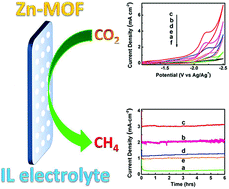
Highly efficient electrochemical reduction of CO2 to CH4 in an ionic liquid using a metal-organic framework cathode

Chem. Sci., 2015, Advance Article
DOI: 10.1039/C5SC03291A, Edge Article
Open Access Open Access
Creative Commons Licence&nbsp This article is licensed under a Creative Commons Attribution 3.0 Unported Licence.
Xinchen Kang, Qinggong Zhu, Xiaofu Sun, Jiayin Hu, Jianling Zhang, Zhimin Liu, Buxing Han
It has been discovered that Zn metal-organic framework (Zn-MOF) electrodes and ionic liquids are an excellent combination for the efficient and selective reduction of CO2 to CH4.
To cite this article before page numbers are assigned, use the DOI form of citation above.
The content of this RSS Feed (c) The Royal Society of Chemistry
25 Sep 03:18

[Perspective] Expanding the chemical space for redox flow batteries

by Mike L. Perry
Redox flow batteries (RFBs) have many advantages for grid-level energy storage, a key requirement for implementing intermittent renewable sources. Like other rechargeable batteries, a flow battery uses reversible electrochemical couples on two electrodes to store chemical energy (1). However, instead of storing the active materials within the electrodes, the reactants are dissolved in two electrolyte solutions and stored in external tanks (see the figure). This configuration allows their cost to scale better as size increases compared to conventional batteries. To date, the redox-active species have often been transition-metal ions, which can have limited electrochemical potential range. On page 1529 of this issue, Lin et al. (2) report on the use of transition-metal complexes and organic molecules as redox species that are both low in cost and relatively nontoxic. Author: Mike L. Perry
25 Sep 01:54

Palladium-Catalyzed Desilylative Acyloxylation of Silicon–Carbon Bonds on (Trimethylsilyl)arenes: Synthesis of Phenol Derivatives from Trimethylsilylarenes

by Keisuke Gondo, Juzo Oyamada and Tsugio Kitamura

TOC Graphic

Organic Letters
DOI: 10.1021/acs.orglett.5b02336
14 Sep 23:19

Nucleophilic Aromatic Substitution Reactions in Water Enabled by Micellar Catalysis

by Nicholas A. Isley, Roscoe T. H. Linstadt, Sean M. Kelly, Fabrice Gallou and Bruce H. Lipshutz

TOC Graphic

Organic Letters
DOI: 10.1021/acs.orglett.5b02240
13 Sep 18:03

Michael F. Croisant, Ryan Van Hoveln, Jennifer M. Schomaker

Naoko Ichiishi

Dyotropic rearrangement..something I don't hear every day.

  • Michael F. Croisant, Ryan Van Hoveln, Jennifer M. SchomakerFormal Dyotropic Rearrangements in Organometallic Transformations Organometallic dyotropic rearrangements involve interchange of two groups on a stationary scaffold by breaking and reforming of two σ bonds. They proceed through various different mechanisms and yield a diverse array of products. This microreview traces recent developments and applications of formal dyotropic rearrangements involving both stoichiometric and catalytic amounts of transition metals. [Microreview]
  • [Review]

September 10, 2015

Angewandte Chemie 38/2015: Volatility and Confinement

In this issue, H. Haick et al. review hybrid volatolomics and disease detection. How can volatile organic compounds be identified in biological cells? In a Minireview, E. Balaraman et al. discuss catalyzed hydrogen-transfer annulations as a means to access heterocyclic scaffolds. The Highlight deals with host materials for sulfur cathodes (H.-J. Peng and Q. Zhang). M. Daub and H. Hillebrecht contribute a Correspondence article on the structure of perovskite phases, and A. K. H. Hirsch summarizes the symposium that was recently held to commemorate the achievements of Nobel Laureate J.-M. Lehn's group

In the Communications section, A. Katz et al. show how weak-acid sites catalyze the hydrolysis of crystalline cellulose to glucose (see picture). E. P. Balskus et al. succeeded in the biosynthesis-assisted structure elucidation of chlorinated glycolipids from cyanobacteria. J. Mack et al. found an inexpensive and recyclable catalyst for the cyclopropanation of alkenes, and W. Schnick et al. obtained rare-earth-metal nitridophosphates through high-pressure metathesis.

Browse issue 38/2015 now


This post has been generated by Page2RSS
30 Aug 13:48

Proton-Coupled Electron Transfer in the Reduction of Arenes by SmI2–Water Complexes

by Tesia V. Chciuk and Robert A. Flowers

TOC Graphic

Journal of the American Chemical Society
DOI: 10.1021/jacs.5b07518
30 Aug 13:40

A [2 + 3] Reductive Cyclodimerization of Quinoline by SmI2

by Ramesh Yella, Hugo E. Gottlieb and Shmaryahu Hoz

TOC Graphic

The Journal of Organic Chemistry
DOI: 10.1021/acs.joc.5b01572
29 Aug 14:21

Mono-, Di-, and Trifluoroalkyl Substituent Effects on the Torquoselectivities of Cyclobutene and Oxetene Electrocyclic Ring Openings

by Kazuya Honda, Steven A. Lopez, K. N. Houk and Koichi Mikami

TOC Graphic

The Journal of Organic Chemistry
DOI: 10.1021/acs.joc.5b01361
24 Aug 01:00

Visible Light Photorelease of Carboxylic Acids via Charge-Transfer Excitation of N-Methylpyridinium Iodide Esters

by David J. Kunsberg, Allison H. Kipping and Daniel E. Falvey

TOC Graphic

Organic Letters
DOI: 10.1021/acs.orglett.5b01490
24 Aug 00:41

Direct Interconversion of BINOL and H8-BINOL-Based Chiral Brønsted Acids Using Single-Step Red/Ox Manipulations

by Jia-Hui Tay, Alonso J. Arguelles and Pavel Nagorny

TOC Graphic

Organic Letters
DOI: 10.1021/acs.orglett.5b01754
24 Aug 00:38

Evidence that Additions of Grignard Reagents to Aliphatic Aldehydes Do Not Involve Single-Electron-Transfer Processes

by Douglas A. L. Otte and K. A. Woerpel

TOC Graphic

Organic Letters
DOI: 10.1021/acs.orglett.5b01893
24 Aug 00:36

Sterically Controlled Pd-Catalyzed Chemoselective Ketone Synthesis via N–C Cleavage in Twisted Amides

by Guangrong Meng and Michal Szostak

TOC Graphic

Organic Letters
DOI: 10.1021/acs.orglett.5b02209