Naoko Ichiishi
Shared posts
Palladium-Catalyzed Negishi Coupling of α-CF3 Oxiranyl Zincate: Access to Chiral CF3-Substituted Benzylic Tertiary Alcohols
Is Magnetic Bistability of Carbenes a General Phenomenon? Isolation of Simple Aryl(trifluoromethyl)carbenes in Both Their Singlet and Triplet States
Naoko Ichiishidiazirine reactivity
Water-Soluble Palladium Reagents for Cysteine S-Arylation under Ambient Aqueous Conditions
Combinatorial Nickel-Catalyzed Monofluoroalkylation of Aryl Boronic Acids with Unactivated Fluoroalkyl Iodides
Naoko IchiishiThe advantage of Ni catalysis!
Discovery of a Covalent Kinase Inhibitor from a DNA-Encoded Small-Molecule Library × Protein Library Selection
Naoko IchiishiPresented at GRC chem bio! nicely put together
Enantioselective Total Synthesis of Nigelladine A via Late-Stage C–H Oxidation Enabled by an Engineered P450 Enzyme
Asymmetric Hydrogen Bonding Catalysis for the Synthesis of Dihydroquinazoline-Containing Antiviral, Letermovir
Pd-Catalyzed Decarbonylative Cross-Couplings of Aroyl Chlorides
Understanding the Unusual Reduction Mechanism of Pd(II) to Pd(I): Uncovering Hidden Species and Implications in Catalytic Cross-Coupling Reactions
Structural, Kinetic, and Computational Characterization of the Elusive Arylpalladium(II)boronate Complexes in the Suzuki–Miyaura Reaction
Post-translational modification of ribosomally synthesized peptides by a radical SAM epimerase in Bacillus subtilis

Nature Chemistry. doi:10.1038/nchem.2714
Authors: Alhosna Benjdia, Alain Guillot, Pauline Ruffié, Jérôme Leprince & Olivier Berteau
Radical SAM enzymes are versatile enzymes catalysing chemically challenging reactions. Now, a radical SAM enzyme that post-translationally modifies ribosomally synthesized peptides to contain D-amino acids has been discovered in Bacillus subtilis, and its mechanism has been deciphered. These peptides, called epipeptides, efficiently inhibit bacterial growth.
Parameterization of phosphine ligands demonstrates enhancement of nickel catalysis via remote steric effects

Nature Chemistry. doi:10.1038/nchem.2741
Authors: Kevin Wu & Abigail G. Doyle
Ligand development underlies many advances in Pd-catalysed cross coupling but has seen limited application in the growing field of Ni catalysis. Now, a phosphine framework is shown to enable Ni-catalysed Suzuki coupling of acetals. Parameterization studies provide structural insight into ligand success and a quantitative model to facilitate further ligand design.
[Report] Principles for designing proteins with cavities formed by curved β sheets
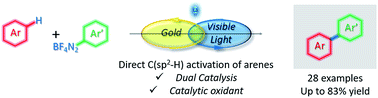
Dual gold and photoredox catalysed C-H activation of arenes for aryl-aryl cross couplings
DOI: 10.1039/C6SC05469B, Edge Article
Open Access
  This article is licensed under a Creative Commons Attribution 3.0 Unported Licence.
A mild and fully catalytic aryl-aryl cross coupling via gold-catalyzed C-H activation has been achieved by merging gold and photoredox catalysis.
The content of this RSS Feed (c) The Royal Society of Chemistry
Direct C–H Cyanation of Arenes via Organic Photoredox Catalysis
Polymer-Supported Chiral-at-Metal Lewis Acid Catalysts
Synthesis of an Uncharged Tetra-cyclopeptide Acting as a Transmembrane Carrier: Enhanced Cellular and Nuclear Uptake
Naoko Ichiishi3-azidocourmarin (152711-55-2) is readily available...perfect opportunity for click chemistry.
Formal Total Synthesis of l-Ossamine via Decarboxylative Functionalization Using Visible-Light-Mediated Photoredox Catalysis in a Flow System
Naoko IchiishiNice application of recent photoredox system! :)
Photoredox activation of carbon dioxide for amino acid synthesis in continuous flow

Nature Chemistry. doi:10.1038/nchem.2690
Authors: Hyowon Seo, Matthew H. Katcher & Timothy F. Jamison
Although the synthetic chemistry of carbon dioxide has generally been limited to two-electron pathways, single-electron mechanisms would open avenues to new reactivity. Now, the coupling of carbon dioxide and amines to produce α-amino acids can be achieved by an organic photoredox catalyst in continuous flow.
Activation and discovery of earth-abundant metal catalysts using sodium tert-butoxide
Naoko Ichiishitertbutoxide is a magic base!

Nature Chemistry. doi:10.1038/nchem.2697
Authors: Jamie H. Docherty, Jingying Peng, Andrew P. Dominey & Stephen P. Thomas
NaOtBu — an alkoxide salt — enables simple access to low-oxidation-state catalysis using sustainable first-row transition metals (Fe, Co, Mn, Ni). The approach works across a wide range of reductive alkene and alkyne functionlization reactions including hydroboration, hydrosilylation, hydrogenation, hydrovinylation and [2π+2π] cyclization reactions.
[Research Article] CRISPRi-based genome-scale identification of functional long noncoding RNA loci in human cells
Effects of Co-solvents on Reactions Run under Micellar Catalysis Conditions
Enantioselective 2-Alkylation of 3-Substituted Indoles with Dual Chiral Lewis Acid/Hydrogen-Bond-Mediated Catalyst
Naoko Ichiishiasymmetric beta 2-alkylation:)
Selective C-H Trifluoromethylation of Benzimidazoles Through Photoredox Catalysis
DOI: 10.1039/C6CC08975E, Communication
This protocol presented a new strategy for visible-light induced C-H trifluoromethyltion at C4 of benzimidazoles using Togini's reagent in the presense of fac-Ir(ppy)3. It's Highlighted by its operational simplicity, mild...
The content of this RSS Feed (c) The Royal Society of Chemistry
Monodentate coordination of the normally chelating chiral diamine (R,R)-TMCDA
Naoko Ichiishilol
DOI: 10.1039/C6CC07190B, Communication
Open Access
  This article is licensed under a Creative Commons Attribution 3.0 Unported Licence.
Contrary to previous studies, this work shows that the chiral diamine (R,R)-TMCDA can bind to a metal in a monodentate manner.
The content of this RSS Feed (c) The Royal Society of Chemistry
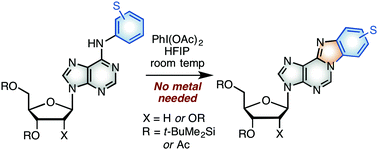
Benzimidazopurine nucleosides from N6-aryl adenosine derivatives by PhI(OAc)2-mediated C-N bond formation, no metal needed
Naoko IchiishiI wonder how the choice of HFIP works out.....
DOI: 10.1039/C6CC07722F, Communication
N 6-Aryl 2[prime or minute]-deoxyadenosine and adenosine derivatives are readily cyclized to benzimidazopurine nucleoside analogues by simple exposure to PhI(OAc)2 in 1,1,1,3,3,3-hexafluoro-2-propanol.
The content of this RSS Feed (c) The Royal Society of Chemistry
Aldehydes as alkyl carbanion equivalents for additions to carbonyl compounds

Nature Chemistry. doi:10.1038/nchem.2677
Authors: Haining Wang, Xi-Jie Dai & Chao-Jun Li
Methods utilizing renewable feedstocks are critical to accessing molecules of industrial importance in light of the present ecological and economic climate. Here, it is shown that umpolung reactivity of carbonyl compounds can be used for nucleophilic additions to yield a diverse array of valuable alcohols as an alternative to using stoichiometric organometallic reagents.
Entomopathogenic bacteria use multiple mechanisms for bioactive peptide library design

Nature Chemistry. doi:10.1038/nchem.2671
Authors: Xiaofeng Cai, Sarah Nowak, Frank Wesche, Iris Bischoff, Marcel Kaiser, Robert Fürst & Helge. B. Bode
Nature has evolved a variety of different mechanisms to generate chemical diversity, however the reactions responsible for generating such diverse chemical libraries are often not clear. Now, the mechanisms employed by entomopathogenic bacteria for the biosynthesis of a large family of bioactive peptides have been identified. These include substrate promiscuity, enzyme cross-talk and enzyme stoichiometry.