06 Jan 12:54
by Bo Wu, Yuanyuan Zhou, Guichuan Xing, Qiang Xu, Hector F. Garces, Ankur Solanki, Teck Wee Goh, Nitin P. Padture, Tze Chien Sum
Sn-based perovskites are promising Pb-free photovoltaic materials with an ideal 1.3 eV bandgap. However, to date, Sn-based thin film perovskite solar cells have yielded relatively low power conversion efficiencies (PCEs). This is traced to their poor photophysical properties (i.e., short diffusion lengths (<30 nm) and two orders of magnitude higher defect densities) than Pb-based systems. Herein, it is revealed that melt-synthesized cesium tin iodide (CsSnI3) ingots containing high-quality large single crystal (SC) grains transcend these fundamental limitations. Through detailed optical spectroscopy, their inherently superior properties are uncovered, with bulk carrier lifetimes reaching 6.6 ns, doping concentrations of around 4.5 × 1017 cm−3, and minority-carrier diffusion lengths approaching 1 µm, as compared to their polycrystalline counterparts having ≈54 ps, ≈9.2 × 1018 cm−3, and ≈16 nm, respectively. CsSnI3 SCs also exhibit very low surface recombination velocity of ≈2 × 103 cm s−1, similar to Pb-based perovskites. Importantly, these key parameters are comparable to high-performance p-type photovoltaic materials (e.g., InP crystals). The findings predict a PCE of ≈23% for optimized CsSnI3 SCs solar cells, highlighting their great potential.

Pb-free CsSnI3 single crystal possesses superior optoelectronic properties compared to its polycrystalline thin film counterparts for photovoltaic application, uncovered using detailed optical spectroscopy, with a bulk carrier lifetimes of around 6.6 ns, doping concentrations of ≈4.5 × 1017 cm−3, minority-carrier diffusion lengths approaching 1 µm, and surface recombination velocity of <2 × 103 cm s−1.
04 Jan 07:27
by Shengqiang Xiao, Qianqian Zhang, Wei You
The device efficiency of polymer:fullerene bulk heterojunction solar cells has recently surpassed 11%, as a result of synergistic efforts among chemists, physicists, and engineers. Since polymers are unequivocally the “heart” of this emerging technology, their design and synthesis have consistently played the key role in the device efficiency enhancement. In this article, the first focus is a discussion on molecular engineering (e.g., backbone, side chains, and substituents), then the discussion moves on to polymer engineering (e.g., molecular weight). Examples are primarily selected from the authors contributions; yet other significant discoveries/developments are also included to put the discussion in a broader context. Given that the synthesis, morphology, and device physics are inherently related in explaining the measured device output parameters (Jsc, Voc and FF), we will attempt to apply an integrated and comprehensive approach (synthesis, morphology, and device physics) to elucidate the fundamental, underlying principles that govern the device characteristics, in particular, in the context of disclosing structure-property correlations. Such correlations are crucial to the design and synthesis of next generation materials to further improve the device efficiency.

Recent progress (2012–2016) in polymer:fullerene bulk-heterojunction solar cells is reviewed. The intrinsic complexity of such solar cells urges the community to apply an integrated and comprehensive approach – including synthesis, morphology, and device physics – to elucidate the fundamental underlying principles that govern the device performance, in particular, in the context of disclosing structure–property correlations.
04 Jan 07:26
by Yu Yan, Feilong Cai, Liyan Yang, Jinghai Li, Yiwei Zhang, Fei Qin, Chuanxi Xiong, Yinhua Zhou, David G. Lidzey, Tao Wang

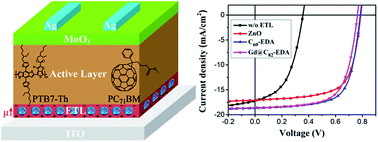
In article 1604044, T. Wang and co-workers report compositional and surface modifications to low-temperature-processed TiO2 films as electron transport layers in inverted polymer solar cells. This approach not only increases the power conversion efficiency of photovoltaic devices to 10.5%, but more importantly, eliminates the light-soaking problem that is commonly observed in polymer solar cells employing metal oxides as the charge-transport layers.
22 Dec 14:21
by William R. Mateker, Michael D. McGehee
Understanding the degradation mechanisms of organic photovoltaics is particularly important, as they tend to degrade faster than their inorganic counterparts, such as silicon and cadmium telluride. An overview is provided here of the main degradation mechanisms that researchers have identified so far that cause extrinsic degradation from oxygen and water, intrinsic degradation in the dark, and photo-induced burn-in. In addition, it provides methods for researchers to identify these mechanisms in new materials and device structures to screen them more quickly for promising long-term performance. These general strategies will likely be helpful in other photovoltaic technologies that suffer from insufficient stability, such as perovskite solar cells. Finally, the most promising lifetime results are highlighted and recommendations to improve long-term performance are made. To prevent degradation from oxygen and water for sufficiently long time periods, OPVs will likely need to be encapsulated by barrier materials with lower permeation rates of oxygen and water than typical flexible substrate materials. To improve stability at operating temperatures, materials will likely require glass transition temperatures above 100 °C. Methods to prevent photo-induced burn-in are least understood, but recent research indicates that using pure materials with dense and ordered film morphologies can reduce the burn-in effect.

Understanding the degradation mechanisms that reduce the long-term stability in organic photovoltaics is imperative. The present understanding of degradation mechanisms and the strategies researchers can use to identify them in new materials are reviewed. Some of the relevant materials properties that can be tuned to improve the long-term performance of organic photovoltaics are identified.
22 Dec 10:22
by Ziming Chen, Chongyang Zhang, Xiao-Fang Jiang, Meiyue Liu, Ruoxi Xia, Tingting Shi, Dongcheng Chen, Qifan Xue, Yu-Jun Zhao, Shijian Su, Hin-Lap Yip, Yong Cao

Adding 2-phenoxyethylamine (POEA) into a CH3NH3PbBr3 precursor solution can modulate the organic–inorganic hybrid perovskite structure from bulk to layered, with a photoluminescence and electroluminescence shift from green to blue. Meanwhile, POEA can passivate the CH3NH3PbBr3 surface and help to obtain a pure CH3NH3PbBr3 phase, leading to an improvement of the external quantum efficiency to nearly 3% in CH3NH3PbBr3 LED.




 Open Access