Ligang Yuan
Shared posts
Highly Efficient and Stable Perovskite Solar Cells by Interfacial Engineering Using Solution-Processed Polymer Layer
Photogenerated Carrier Mobility Significantly Exceeds Injected Carrier Mobility in Organic Solar Cells
Charge transport in organic photovoltaic (OPV) devices is often characterized by space-charge limited currents (SCLC). However, this technique only probes the transport of charges residing at quasi-equilibrium energies in the disorder-broadened density of states (DOS). In contrast, in an operating OPV device the photogenerated carriers are typically created at higher energies in the DOS, followed by slow thermalization. Here, by ultrafast time-resolved experiments and simulations it is shown that in disordered polymer/fullerene and polymer/polymer OPVs, the mobility of photogenerated carriers significantly exceeds that of injected carriers probed by SCLC. Time-resolved charge transport in a polymer/polymer OPV device is measured with exceptionally high (picosecond) time resolution. The essential physics that SCLC fails to capture is that of photogenerated carrier thermalization, which boosts carrier mobility. It is predicted that only for materials with a sufficiently low energetic disorder, thermalization effects on carrier transport can be neglected. For a typical device thickness of 100 nm, the limiting energetic disorder is σ ≈71 (56) meV for maximum-power point (short-circuit) conditions, depending on the error one is willing to accept. As in typical OPV materials the disorder is usually larger, the results question the validity of the SCLC method to describe operating OPVs.
Detailed comparison of steady-state and ultrafast time-resolved experiments reveals that photogenerated carrier mobility in organic solar cells is significantly higher than that probed by space-charge limited currents (SCLCs). The SCLC method is only valid for materials with a sufficiently low energetic disorder, where photogenerated carrier thermalization can be neglected. The over-simplified use of quasi-equilibrium mobility data in literature requires re-evaluation.
A facile deposition method for CuSCN: Exploring the influence of CuSCN on J-V hysteresis in planar perovskite solar cells
Source:Nano Energy, Volume 32
Author(s): Gaveshana A. Sepalage, Steffen Meyer, Alexander R. Pascoe, Andrew D. Scully, Udo Bach, Yi-Bing Cheng, Leone Spiccia
Inorganic hole–transporting materials (HTMs) are a promising class of compounds for improving the long-term stability of perovskite solar cells. In this study, copper(I) thiocyanate (CuSCN) has been applied as an HTM in planar-structured thin film perovskite solar cells based on methylammonium lead(II) triiodide. A common obstacle associated with the deposition of inorganic HTMs in perovskite-based solar cell devices is the damaging effect of polar solvents, required during the solution-processed deposition step, on the underlying perovskite film. Here we describe a novel fabrication method that allows the deposition of a CuCSN layer on perovskite film, achieving a maximum power conversion efficiency of 9.6%. The magnitude of J-V hysteresis is found to be strongly dependent on the HTM used, with the phenomenon being much more prevalent in the CuSCN- and spiro-OMeTAD-based devices compared to CuI-based devices. Interestingly, CuSCN and CuI showed significantly different J-V hysteresis behaviors despite their similar physicochemical properties. Further characterization by open circuit voltage decay (OCVD) measurements revealed that the relaxation of the perovskite polarization depends on the light intensity and the adjacent HTM layer. We propose that the stronger J-V hysteresis in CuSCN compared to CuI is a result of defects generated during the deposition process and possible degradation at the material interfaces while other possibilities are also discussed.
Graphical abstract

Formation of pristine CuSCN layer by spray deposition method for efficient perovskite solar cell with extended stability
Source:Nano Energy, Volume 32
Author(s): In Seok Yang, Mi Rae Sohn, Sang Do Sung, Yong Joo Kim, Young Jun Yoo, Jeongho Kim, Wan In Lee
By employing CuSCN, a low-cost inorganic hole transporting material (HTM), CH3NH3PbI3 perovskite solar cell (PSC) devices with high efficiency and extended stability were successfully fabricated in this work. In particular, we developed a facile method of depositing CuSCN layer reproducibly by a simple spray deposition technique, which allows the formation of the CuSCN layer without any significant damage of the underlying CH3NH3PbI3 layer. The fabricated PSC with ~50nm-thick pristine CuSCN layer exhibits the photovoltaic conversion efficiency (PCE) of 17.10% with J SC of 23.10mA/cm2, V OC of 1,013mV and FF of 0.731. Compared with conventional PSCs based on spiro-OMETAD HTM, the PSC employing CuSCN exhibits higher value of J SC , suggesting that CuSCN transports holes more efficiently than spiro-OMETAD. Furthermore, PSCs employing the pristine CuSCN demonstrate a remarkable long-term stability at ambient condition with the decrease of PCE by only 5.8% after 100 days. In addition, the PCE decrease during the encapsulation process at 120°C was merely 13%, which is much lower value than ~70% observed for the conventional device based on spiro-OMETAD, indicating excellent thermal stability of the CuSCN-based PSCs.
Graphical abstract

Two-Step Sequential Deposition of Organometal Halide Perovskite for Photovoltaic Application
Organometal halide perovskite materials have become a superstar in the photovoltaic (PV) field because of their advantageous properties, which boost the power conversion efficiency (PCE) of perovskite solar cells (PSCs) from about 3.8% to above 22% in just seven years. Most importantly, such promising achievement is mainly based on its low-cost and solution-processed fabrication technique. One of the most promising and famous approaches to fabricating perovskite is a two-step sequential deposition method because precursor (e.g., PbI2) deposition is controllable, versatile, and flexible. Due to tremendous efforts, great progress has been achieved on the two-step sequential deposition method, which helps to promote the development of PSCs. Herein, the progresses on the two-step sequential deposition method of perovskite layers is reviewed thoroughly. At first, the reaction process and principle is introduced and discussed. Then, the research on the deposition techniques, structures, and compositions of precursors (the first step) is presented. Subsequently, the developments on the conversion techniques, conversion solutions, and growth of large crystals at the second step are introduced. Finally, four important issues on the two-step sequential deposition method will be stated, accompanied with proposed solutions.
The two-step sequential deposition method is one of the most important deposition methods for the organometal halide perovskite layer in photovoltaic application. So far, great progress has been made on this method, which helps to promote the development of PSCs. Herein, its recent achievements are reviewed and the important issues are highlighted while proposing the corresponding solutions.
Cooperative Effect of GO and Glucose on PEDOT:PSS for High VOC and Hysteresis-Free Solution-Processed Perovskite Solar Cells
Embedding Perovskite Nanocrystals into a Polymer Matrix for Tunable Luminescence Probes in Cell Imaging
Lead halide perovskite nanocrystals (NCs) with bright luminescence and broad spectral tunability are good candidates as smart probes for bioimaging, but suffer from hydrolysis even when exposed to atmosphere moisture. In this paper, a strategy is demonstrated by embedding CsPbX3 (X = Cl, Br, I) NCs into microhemispheres (MHSs) of polystyrene matrix to prepare “water-resistant” NCs@MHSs hybrids as multicolor multiplexed optical coding agents. First, a facile room-temperature solution self-assembly approach to highly luminescent colloidal CsPbX3 NCs is developed by injecting a stock solution of CsX⋅PbX2 in N,N-dimethylformamide into dichloromethane. Polyvinyl pyrrolidone (PVP) is chosen as the capping ligand, which is physically adsorbed and wrapped on the surface of perovskite NCs to form a protective layer. The PVP protective layer not only leads to composition-tunable CsPbX3 NCs with high quantum yields and narrow emission linewidths of 12–34 nm but also acts as an interfacial layer, making perovskite NCs compatible with polystyrene polymers and facilitating the next step to embed CsPbX3 NCs into polymer MHSs. CsPbX3 NCs@MHSs are demonstrated as multicolor luminescence probes in live cells with high stability and nontoxicity. Using ten intensity levels and seven-color NCs@MHSs that show non-overlapping spectra, it will be possible to individually tag about ten million cells.
A strategy to overcome the inherent vulnerability of perovskites to water is demonstrated by embedding CsPbX3 nanocrystals (NCs) into microhemispheres (MHSs) of polystyrene matrix to prepare “water-resistant” NCs@MHSs hybrids. NCs@MHSs are demonstrated as multicolor luminescence probes in live cells with high stability and nontoxicity. Using ten intensity levels and seven-color NCs@MHSs, it will be possible to individually tag about ten million cells.
Perovskite Photovoltaics: Hybrid Perovskite Thin-Film Photovoltaics: In Situ Diagnostics and Importance of the Precursor Solvate Phases (Adv. Mater. 2/2017)
The solidification of hybrid perovskite (MAPbX3, X = I, Br, Cl) inks is studied in situ by A. Amassian and co-workers in article 1604113, revealing a remarkably complex process mediated by strong solvent-solute interactions, the outcome of which is halide-dependent. The ink is shown to solidify within 15–20s of spinning, forming a highly solvated (60–70 vol%) precursor phase. Crystalline order of the precursor, or lack thereof, strongly impacts the morphological outcome of thermal conversion and the reproducibility of solar cells.
Band alignment and enhancement of the interface properties for heterojunction solar cells by employing amorphous-nanocrystalline hierarchical emitter layers
DOI: 10.1039/C6TC04930C, Paper
Band alignment and interface passivation of heterojunction devices have been enhanced by employing nanocrystalline/amorphous silicon hierarchical emitter layers.
The content of this RSS Feed (c) The Royal Society of Chemistry
Fabrication of high coverage MASnI3 perovskite films for stable, planar heterojunction solar cells
DOI: 10.1039/C6TC05069G, Paper
A high coverage MASnI3 perovskite film was obtained employing a modified solvent bathing method to realize stable photovoltaic properties.
The content of this RSS Feed (c) The Royal Society of Chemistry
Vacuum-process-based dry transfer of active layer with solvent additive for efficient organic photovoltaic devices
DOI: 10.1039/C6TC04743B, Paper
PTB7:PC71BM-based organic photovoltaic cell with solvent additive fabricated by transferring a BHJ layer via stamping transfer. This photovoltaic cell exhibited enhanced long-term stability and similar cell performance as compared with those of the spin-coated cells.
The content of this RSS Feed (c) The Royal Society of Chemistry
Influence of polymer side chains on the photovoltaic performance of non-fullerene organic solar cells
DOI: 10.1039/C6TC04983D, Paper
The side chains of polymers had a great influence on their molecular packing, energy level, blend morphology and photovoltaic performance. The PCEs of 7.28% and 1.55% were obtained for alkoxy and alkylthio-substituted polymer based non-fullerene solar cells, respectively.
The content of this RSS Feed (c) The Royal Society of Chemistry
Recent progress in non-fullerene small molecule acceptors in organic solar cells (OSCs)
DOI: 10.1039/C6TC05066B, Review Article
The power conversion efficiencies (PCEs) of non-fullerene small molecule acceptors based on different donors have been compared and summarized.
The content of this RSS Feed (c) The Royal Society of Chemistry
Modifying the valence state of molybdenum in the efficient oxide buffer layer of organic solar cells via a mild hydrogen peroxide treatment
DOI: 10.1039/C6TC04461A, Paper
Simple solution process were developed to fabricate efficient MoOx based HTLs for organic solar cells.
The content of this RSS Feed (c) The Royal Society of Chemistry
Annealing-free perovskite films based on solvent engineering for efficient solar cells
DOI: 10.1039/C6TC04944C, Paper
A new approach based on solvent engineering is developed to obtain annealing-free perovskite films and the corresponding device displays 17.09% efficiency.
The content of this RSS Feed (c) The Royal Society of Chemistry
Polypyrrole-assisted oxygen electrocatalysis on perovskite oxides
DOI: 10.1039/C6EE03501A, Communication
The overpotentials of the oxygen reduction on perovskite oxide catalysts were significantly reduced simply by mixing the catalyst particles with polypyrrole/carbon composites (pPy/C).
The content of this RSS Feed (c) The Royal Society of Chemistry
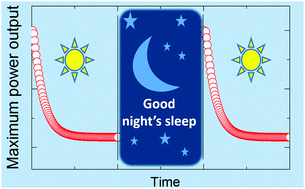
Migration of cations induces reversible performance losses over day/night cycling in perovskite solar cells
DOI: 10.1039/C6EE03352K, Paper
Perovskite cells benefit from a good night's sleep.
The content of this RSS Feed (c) The Royal Society of Chemistry
Hexagonal mesoporous silica islands to enhance photovoltaic performance of planar junction perovskite solar cells
DOI: 10.1039/C6TA09709J, Communication
Wormhole-like hexagonal mesoporous silica (HMS) can modify the perovskite morphology and increase the light path length in a planar junction perovskite solar cell to improve the average PCE to 17.6% over 30 devices.
The content of this RSS Feed (c) The Royal Society of Chemistry
A TiO2 embedded structure for perovskite solar cells with anomalous grain growth and effective electron extraction
DOI: 10.1039/C6TA10418E, Communication
The embedded structure of perovskite solar cells (PSCs) is a novel structure, which possesses excellent photovoltaic performance and better long-term stability than the mesoporous or planar structure.
The content of this RSS Feed (c) The Royal Society of Chemistry
Long lifetime stable and efficient semitransparent organic solar cells using a ZnMgO-modified cathode combined with a thin MoO3/Ag anode
DOI: 10.1039/C6TA10981K, Paper
Long-term stable and efficient semitransparent organic solar cells with good color perception are demonstrated by combining a transparent ZnMgO-modified cathode with thin MoO3/Ag anodes.
The content of this RSS Feed (c) The Royal Society of Chemistry
Highly efficient perovskite solar cells with crosslinked PCBM interlayers
DOI: 10.1039/C6TA08799J, Communication
PCBM crosslinked with 1,6-diazidohexane (DAZH) was introduced to solve the solvent incompatibility of depositing a solution processed perovskite layer onto it.
The content of this RSS Feed (c) The Royal Society of Chemistry
A review on triphenylamine (TPA) based organic hole transport materials (HTMs) for dye sensitized solar cells (DSSCs) and perovskite solar cells (PSCs): evolution and molecular engineering
DOI: 10.1039/C6TA08449D, Review Article
Development of triphenylamine (TPA) based hole-transporting-materials (HTMs) leading to high Tg, higher morphological stability and longevity of dye-sensitized and perovskite solar cells.
The content of this RSS Feed (c) The Royal Society of Chemistry
Hematite electron-transporting layers for environmentally stable planar perovskite solar cells with enhanced energy conversion and lower hysteresis
DOI: 10.1039/C6TA09174A, Communication
Hematite electron transporting layer based planar perovskite cells were developed with reduced hysteresis and good stability in ambient air.
The content of this RSS Feed (c) The Royal Society of Chemistry
Nematic liquid crystal materials as a morphology regulator for ternary small molecule solar cells with power conversion efficiency exceeding 10%
DOI: 10.1039/C7TA00211D, Paper
Highly efficient ternary SMSCs with a PCE of 10.05% are reported by employing the nematic liquid crystal small molecule BTR as the second donor and morphology regulator.
The content of this RSS Feed (c) The Royal Society of Chemistry
All Inorganic Halide Perovskites Nanosystem: Synthesis, Structural Features, Optical Properties and Optoelectronic Applications
The recent success of organometallic halide perovskites (OHPs) in photovoltaic devices has triggered lots of corresponding research and many perovskite analogues have been developed to look for devices with comparable performance but better stability. Upon the preparation of all inorganic halide perovskite nanocrystals (IHP NCs), research activities have soared due to their better stability, ultrahigh photoluminescence quantum yield (PL QY), and composition dependent luminescence covering the whole visible region with narrow line-width. They are expected to be promising materials for next generation lighting and display, and many other applications. Within two years, a lot of interesting results have been observed. Here, the synthesis of IHPs is reviewed, and their progresses in optoelectronic devices and optical applications, such as light-emitting diodes (LEDs), photodetectors (PDs), solar cells (SCs), and lasing, is presented. Information and recent understanding of their crystal structures and morphology modulations are addressed. Finally, a brief outlook is given, highlighting the presently main problems and their possible solutions and future development directions.
All inorganic halide perovskite nanosystems are expected to be promising materials for next generation lighting, display, and many other applications. Within two years, lots of interesting results have been observed. The synthesis and progresses on optoelectronic devices and optical applications, such as LEDs, photodetectors, solar cells, and lasing, are summarized. Future directions, challenges and possible applications are also put forward.
Constructing Post-Permeation Method to Fabricate Polymer/Nanocrystals Hybrid Solar Cells with PCE Exceeding 6%
A post-permeation method is constructed for fabricating bulk-heterojunction hybrid solar cells. Porous CdTe film is prepared by annealing the mixture solution of aqueous CdTe nanocrystals and cetyltrimethyl ammonium bromide, after which the post-permeation of polymer is employed. By this method, kinds of polymers can be applied regardless of the intermiscibility with the nanoparticles. The inorganic nanocrystals and the polymer can be treated under respective optimized annealing temperatures, which can facilitate the growth of nanocrystals without damaging the polymers. A high power conversion efficiency of 6.36% in the polymer/nanocrystals hybrid solar cells is obtained via systematical optimization.
Polymer/nanocrystals hybrid solar cells are made by a post-permeation method. By this method, various polymers can be applied regardless of the intermiscibility with the nanoparticles. The inorganic nanocrystal layer and the polymer layer can be treated under their optimized annealing temperatures, respectively. A high power conversion efficiency of 6.36% in polymer/nanocrystals hybrid solar cells is achieved.
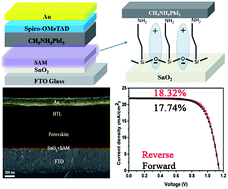
Interface engineering in planar perovskite solar cells: energy level alignment, perovskite morphology control and high performance achievement
DOI: 10.1039/C6TA08783C, Paper
APTES-SAM as an efficient interfacial layer in planar perovskite solar cells, optimizing the interface and enhancing performance.
The content of this RSS Feed (c) The Royal Society of Chemistry
Non-planar perylenediimide acceptors with different geometrical linker units for efficient non-fullerene organic solar cells
DOI: 10.1039/C6TA08739F, Paper
Three perylenediimide (PDI) acceptors (P2O2, P2N2 and P4N4) functionalizing the bay positions of PDI with different geometrical linker units were synthesized and applied in efficient non-fullerene organic solar cells.
The content of this RSS Feed (c) The Royal Society of Chemistry
Cerium oxide standing out as an electron transport layer for efficient and stable perovskite solar cells processed at low temperature
DOI: 10.1039/C6TA07541J, Paper
Low-temperature, solution-processed cerium oxide can serve as a promising electron transport layer to replace commonly used TiO2 in planar perovskite solar cells, with high efficiency and enhanced stability.
The content of this RSS Feed (c) The Royal Society of Chemistry
Successive surface engineering of TiO2 compact layers via dual modification of fullerene derivatives affording hysteresis-suppressed high-performance perovskite solar cells
DOI: 10.1039/C6TA07876A, Paper
A new successive surface engineering method via a dual modification of TiO2 compact layer by PC61BM and C60-ETA was developed, affording dramatic efficiency enhancement with suppressed-hysteresis current-voltage response.
The content of this RSS Feed (c) The Royal Society of Chemistry