03 Jul 02:48
by So-Huei Kang, Tanya Kumari, Sang Myeon Lee, Mingyu Jeong, Changduk Yang
Dithienyldiketopyrrolopyrrole (DPP2T) and thieno[3,2-b]thiophene (TT) building blocks, enabling a large intermolecular overlap through π–π stacking, into an amorphous-like polymer composed of benzo(1,2-b:4,5-b′)dithiophene (BDT) and fluorinated thieno[3,4-b]thiophene (QTT), are introduced. Herein, through the variation of relative compositions of DPP2T-TT and BDT-QTT in the polymer backbone, the synthesis and characterization of a series of condensed random 2D-2A “quarterpolymers” with two reference alternating copolymers are reported. The best power conversion efficiency (PCE) of 9.45% is achieved for the optimum composition due to the synergistic effects such as improved photon absorption and reduced recombination loss, and optimized blend morphology via a change in the crystallinity and orientation of the blend films compared to the alternating copolymers. Moreover, by isolating higher molecular weight and narrower polydispersity fractions of the quarterpolymer via a marginal solvent-soaking technique, the PCE is further boosted to 10.30%, which is among the highest PCE reported to date for random polymer-based PSCs. Therefore, this simple 2D-2A strategy, reported for the first time, should be extended to numerous quaterpolymer systems, greatly accelerating random polymer systems toward further improving PSCs.

A set of quarterpolymers composed of dithienyldiketopyrrolopyrrole, thieno[3,2-b]thiophene, benzo(1,2-b:4,5-b′) dithiophene, and fluorinated thieno[3,4-b]thiophene building blocks is synthesized. This simple 2D-2A strategy obtains a high power conversion efficiency of 10.30% with the synergistic effects of four monomers such as improved charge transport, reduced recombination loss, and optimized blend morphology.
03 Jul 02:48
by Priscilla D. Antunez, Douglas M. Bishop, Yun Seog Lee, Tayfun Gokmen, Oki Gunawan, Talia S. Gershon, Teodor K. Todorov, Saurabh Singh, Richard Haight
The thin-film photovoltaic absorber Cu2ZnSn(S,Se)4 (CZTSSe) holds considerable promise for large scale conversion of sunlight into electricity. CZTSSe is composed of Earth-abundant elements that exhibit low-toxicities, but improvements in device efficiency have been hampered by difficulties in increasing open circuit voltages (VOC) due, at least in part, to disorder induced band tailing. We present a method to increase VOC through direct modification of the back contact; our approach involves the separation of fully functioning devices from their Mo/glass substrate to reveal the back CZTSSe surface. Formation of a new back contact consisting of a thermally deposited high work function material (MoO3), together with a higly reflective (Au) capping layer, creates an electrostatic field that drives electrons to the front p-n junction and leads to a decrease in electron-hole recombination. Model simulations indicating an increase in VOC with decreasing absorber thickness are borne out by experiments with devices of varying thicknesses (0.7–2.0 μm). We report VOC increases of up to 49 mV for a 1 μm thick absorber, with even greater increases up to 61 mV when the back CZTSSe surface is etched with bromine-methanol.

High performing kesterite photovoltaic devices show improved efficiency parameters after exfoliation and back contact engineering. The use of a high work function material (MoO3) and a reflective back contact (Au) results in higher open circuit voltage (VOC) and short circuit current (JSC), which closely match model simulations.
03 Jul 02:47
by Tiankai Zhang, Mingzhu Long, Keyou Yan, Minchao Qin, Xinhui Lu, Xiaoliang Zeng, Chi Man Cheng, Kam Sing Wong, Pengyi Liu, Weiguang Xie, Jianbin Xu
The mixed perovskite (FAPbI3)1−x(MAPbBr3)x, prepared by directly mixing different perovskite components, suffers from phase competition and a low-crystallinity character, resulting in instability, despite the high efficiency. In this study, a dual ion exchange (DIE) method is developed by treating as-prepared FAPbI3 with methylammonium brodide (MABr)/tert-butanol solution. The converted perovskite thin film shows an optimized absorption edge at 800 nm after reaction time control, and the high crystallinity can be preserved after MABr incorporation. More importantly, it is found that the threshold electrical field to initiate ion migration is greatly increased in DIE perovskite thin film because excess MABr on the surface can effectively heal structural defects located on grain boundaries during the ion exchange process. It contributes to the over-one-month moisture stability under ≈65% room humidity (RH) and greatly enhanced light stability for the bare perovskite film. As a result of preserved high crystallinity and simultaneous grain boundary passivation, the perovskite solar cells fabricated by the DIE method demonstrate reliable reproducibility with an average power conversion efficiency (PCE) of 17% and a maximum PCE of 18.1%, with negligible hysteresis.

A dual ion exchange (DIE) method is developed for mixed perovskite thin films by treating trigonal FAPbI3 with MABr in tert-butanol. This DIE method can preserve the initial high crystallinity and passivate vacancies/defects at grain boundaries, leading to enhanced moisture and illumination stability and reduced ion migration. The solar cell device using the DIE method achieves the highest power conversion efficiency of 18.1%, with negligible hysteresis.
29 Jun 00:23
Energy Environ. Sci., 2017, 10,1306-1319
DOI: 10.1039/C7EE00826K, Review Article
Jeyakumar Ramanujam, Udai P. Singh
Copper indium gallium selenide (CIGS) based solar cells are receiving worldwide attention for solar power generation.
The content of this RSS Feed (c) The Royal Society of Chemistry

29 Jun 00:22
Energy Environ. Sci., 2017, 10,1443-1455
DOI: 10.1039/C6EE03051C, Paper
Seo-Jin Ko, Quoc Viet Hoang, Chang Eun Song, Mohammad Afsar Uddin, Eunhee Lim, Song Yi Park, Byoung Hoon Lee, Seyeong Song, Sang-Jin Moon, Sungu Hwang, Pierre-Olivier Morin, Mario Leclerc, Gregory M. Su, Michael L. Chabinyc, Han Young Woo, Won Suk Shin, Jin Young Kim
A new series of wide band gap photovoltaic polymers based on a fluorinated phenylene-alkoxybenzothiadiazole unit with an optical band gap of over 1.90 eV are designed and utilized for high-performance single- and multi-junction bulk heterojunction polymer solar cells.
The content of this RSS Feed (c) The Royal Society of Chemistry

10 May 00:41
by Ning Zhou, Yiheng Shen, Yu Zhang, Ziqi Xu, Guanhaojie Zheng, Liang Li, Qi Chen, Huanping Zhou
Engineering the chemical composition of organic and inorganic hybrid perovskite materials is one of the most feasible methods to boost the efficiency of perovskite solar cells with improved device stability. Among the diverse hybrid perovskite family of ABX3, formamidinium (FA)-based mixed perovskite (e.g., FA1−xCsxPbI3) possesses optimum bandgaps, superior optoelectronic property, as well as thermal- and photostability, which is proven to be the most promising candidate for advanced solar cell. Here, FA0.9Cs0.1PbI3(Cl) is implemented as the light-harvesting layer in planar devices, whereas a low temperature, two-step solution deposition method is employed for the first time in this materials system. This paper comprehensively exploits the role of Cs+ in the FA0.9Cs0.1PbI3(Cl) perovskite that affects the precursor chemistry, film nucleation and grain growth, and defect property via pre-intercalation of CsI in the inorganic framework. In addition, the resultant FA0.9Cs0.1PbI3(Cl) films are demonstrated to exhibit an improved optoelectronic property with an elevated device power conversion efficiency (PCE) of 18.6%, as well as a stable phase with substantial enhancement in humidity and thermal stability, as compared to that of FAPbI3(Cl). The present method is able to be further extended to a more complicated (FA,MA,Cs)PbX3 material system by delivering a PCE of 19.8%.

A modified two-step processing approach based on CsI pre-intercalation in the inorganic framework is developed to fabricate an FA1−xCsxPbI3(Cl) perovskite thin film and pertinent devices. Film growth (including the crystal orientation) and the defect property of FA0.9Cs0.1PbI3(Cl) are thoroughly investigated via precursor chemistry.
08 May 00:34
by Lianfeng Zhao, Jia Gao, YunHui L. Lin, Yao-Wen Yeh, Kyung Min Lee, Nan Yao, Yueh-Lin Loo, Barry P. Rand
Organic–inorganic hybrid perovskite materials are emerging as semiconductors with potential application in optoelectronic devices. In particular, perovskites are very promising for light-emitting devices (LEDs) due to their high color purity, low nonradiative recombination rates, and tunable bandgap. Here, using pure CH3NH3PbI3 perovskite LEDs with an external quantum efficiency (EQE) of 5.9% as a platform, it is shown that electrical stress can influence device performance significantly, increasing the EQE from an initial 5.9% to as high as 7.4%. Consistent with the enhanced device performance, both the steady-state photoluminescence (PL) intensity and the time-resolved PL decay lifetime increase after electrical stress, indicating a reduction in nonradiative recombination in the perovskite film. By investigating the temperature-dependent characteristics of the perovskite LEDs and the cross-sectional elemental depth profile, it is proposed that trap reduction and resulting device-performance enhancement is due to local ionic motion of excess ions, likely excess mobile iodide, in the perovskite film that fills vacancies and reduces interstitial defects. On the other hand, it is found that overstressed LEDs show irreversibly degraded device performance, possibly because ions initially on the perovskite lattice are displaced during extended electrical stress and create defects such as vacancies.

High-efficiency CH3NH3PbI3 perovskite light-emitting devices are demonstrated. The external quantum efficiency is boosted from 5.9% to 7.4% by subsequent electrical scans, which is related to excess ion motion reducing nonradiative decay channels, while overstressing the device will degrade device performance due to nonexcess ion migration.
08 May 00:31
by Yunpeng Qin, Yu Chen, Yong Cui, Shaoqing Zhang, Huifeng Yao, Jiang Huang, Wanning Li, Zhong Zheng, Jianhui Hou
Tandem organic solar cells (TOSCs), which integrate multiple organic photovoltaic layers with complementary absorption in series, have been proved to be a strong contender in organic photovoltaic depending on their advantages in harvesting a greater part of the solar spectrum and more efficient photon utilization than traditional single-junction organic solar cells. However, simultaneously improving open circuit voltage (Voc) and short current density (Jsc) is a still particularly tricky issue for highly efficient TOSCs. In this work, by employing the low-bandgap nonfullerene acceptor, IEICO, into the rear cell to extend absorption, and meanwhile introducing PBDD4T-2F into the front cell for improving Voc, an impressive efficiency of 12.8% has been achieved in well-designed TOSC. This result is also one of the highest efficiencies reported in state-of-the-art organic solar cells.

Simultaneously improving the open-circuit voltage (Voc) and short current density (Jsc) is a particularly tricky issue for tandem organic solar cells (TOSCs). By employing the low-bandgap nonfullerene acceptor, IEICO, in the rear cell to extend absorption, and meanwhile introducing PBDD4T-2F into the front cell for improving Voc, an impressive efficiency of 12.8% is achieved in TOSCs. This result is also one of the highest efficiencies reported in state-of-the-art organic solar cells.
08 May 00:30
by Marcos A. Reyes-Martinez, Ahmed L. Abdelhady, Makhsud I. Saidaminov, Duck Young Chung, Osman M. Bakr, Mercouri G. Kanatzidis, Wole O. Soboyejo, Yueh-Lin Loo
The ease of processing hybrid organic–inorganic perovskite (HOIPs) films, belonging to a material class with composition ABX3, from solution and at mild temperatures promises their use in deformable technologies, including flexible photovoltaic devices, sensors, and displays. To successfully apply these materials in deformable devices, knowledge of their mechanical response to dynamic strain is necessary. The authors elucidate the time- and rate-dependent mechanical properties of HOIPs and an inorganic perovskite (IP) single crystal by measuring nanoindentation creep and stress relaxation. The observation of pop-in events and slip bands on the surface of the indented crystals demonstrate dislocation-mediated plastic deformation. The magnitudes of creep and relaxation of both HOIPs and IPs are similar, negating prior hypothesis that the presence of organic A-site cations alters the mechanical response of these materials. Moreover, these samples exhibit a pronounced increase in creep, and stress relaxation as a function of indentation rate whose magnitudes reflect differences in the rates of nucleation and propagation of dislocations within the crystal structures of HOIPs and IP. This contribution provides understanding that is critical for designing perovskite devices capable of withstanding mechanical deformations.

Dynamic mechanical response of hybrid organic–inorganic and inorganic perovskite crystals suggests that the time-dependent mechanical properties of lead–halide perovskites are independent of the chemical character of the A-site cation. Moreover, significant viscoplastic behavior is revealed through creep and stress-relaxation measurements. These phenomena are interpreted as direct results of the crystal structures and how dislocations propagate within them.
08 May 00:29
by Yuze Lin, Bo Chen, Fuwen Zhao, Xiaopeng Zheng, Yehao Deng, Yuchuan Shao, Yanjun Fang, Yang Bai, Chunru Wang, Jinsong Huang
Efficient wide-bandgap (WBG) perovskite solar cells are needed to boost the efficiency of silicon solar cells to beyond Schottky–Queisser limit, but they suffer from a larger open circuit voltage (VOC) deficit than narrower bandgap ones. Here, it is shown that one major limitation of VOC in WBG perovskite solar cells comes from the nonmatched energy levels of charge transport layers. Indene-C60 bisadduct (ICBA) with higher-lying lowest-unoccupied-molecular-orbital is needed for WBG perovskite solar cells, while its energy-disorder needs to be minimized before a larger VOC can be observed. A simple method is applied to reduce the energy disorder by isolating isomer ICBA-tran3 from the as-synthesized ICBA-mixture. WBG perovskite solar cells with ICBA-tran3 show enhanced VOC by 60 mV, reduced VOC deficit of 0.5 V, and then a record stabilized power conversion efficiency of 18.5%. This work points out the importance of matching the charge transport layers in perovskite solar cells when the perovskites have a different composition and energy levels.

One major limitation of open-circuit voltage (VOC) in wide-bandgap (WBG) perovskite solar cells comes from the nonmatched charge extraction contact. WBG perovskite solar cells with indene-C60 bisadduct-tran3 isomer with higher-lying lowest-unoccupied-molecular-orbital and reduced energy disorder show enhanced VOC , and then a record stabilized power conversion efficiency of 18.5%.
08 May 00:28
by Yikun Guo, Yunke Li, Omar Awartani, Han Han, Jingbo Zhao, Harald Ade, He Yan, Dahui Zhao
A new polymer acceptor, naphthodiperylenetetraimide-vinylene (NDP-V), featuring a backbone of altenating naphthodiperylenetetraimide and vinylene units is designed and applied in all-polymer solar cells (all-PSCs). With this polymer acceptor, a new record power-conversion efficiencies (PCE) of 8.59% has been achieved for all-PSCs. The design principle of NDP-V is to reduce the conformational disorder in the backbone of a previously developed high-performance acceptor, PDI-V, a perylenediimide-vinylene polymer. The chemical modifications result in favorable changes to the molecular packing behaviors of the acceptor and improved morphology of the donor–acceptor (PTB7-Th:NDP-V) blend, which is evidenced by the enhanced hole and electron transport abilities of the active layer. Moreover, the stronger absorption of NDP-V in the shorter-wavelength range offers a better complement to the donor. All these factors contribute to a short-circuit current density (J
sc) of 17.07 mA cm−2. With a fill factor (FF) of 0.67, an average PCE of 8.48% is obtained, representing the highest value thus far reported for all-PSCs.

A new polymer acceptor NDP-V is designed and applied in all-polymer solar cells (all-PSCs). With this polymer acceptor, a new record power conversion efficiency of 8.59% is achieved for all-PSCs, with an open-circuit voltage (Voc) of 0.74 V, a short-circuit current density (Jsc) of 17.07 mA cm−2, and a high fill factor (FF) of 0.67.
08 May 00:28
by Runnan Yu, Shaoqing Zhang, Huifeng Yao, Bing Guo, Sunsun Li, Hao Zhang, Maojie Zhang, Jianhui Hou
High-performance ternary organic solar cells are fabricated by using a wide-bandgap polymer donor (bithienyl-benzodithiophene-alt-fluorobenzotriazole copolymer, J52) and two well-miscible nonfullerene acceptors, methyl-modified nonfullerene acceptor (IT-M) and 2,2′-((2Z,2′Z)-((5,5′-(4,4,9,9-tetrakis(4-hexylphenyl)-4,9-dihydros-indaceno[1,2-b:5,6-b′]dithiophene-2,7-diyl)bis(4-((2-ethylhexyl)oxy)thiophene-5,2-diyl))bis(methanylylidene))bis(3-oxo-2,3-dihydro-1H-indene-2,1-diylidene))dimalononitrile (IEICO). The two acceptors with complementary absorption spectra and similar lowest unoccupied molecular orbital levels show excellent compatibility in the blend due to their very similar chemical structures. Consequently, the obtained ternary organic solar cells (OSC) exhibits a high efficiency of 11.1%, with an enhanced short-circuit current density of 19.7 mA cm−2 and a fill factor of 0.668. In this ternary system, broadened absorption, similar output voltages, and compatible morphology are achieved simultaneously, demonstrating a promising strategy to further improve the performance of ternary OSCs.

Ternary organic solar cells show over 11% power conversion efficiency by using two compatible nonfullerene acceptors with complementary absorption spectra, similar chemical structures, and similar lowest unoccupied molecular orbital levels. Broadened absorption, similar output voltages, and compatible morphology are achieved simultaneously, demonstrating a promising strategy to improve the performance of OSCs.
08 May 00:22
J. Mater. Chem. C, 2017, 5,5356-5364
DOI: 10.1039/C7TC01166K, Paper
Yu-Qing Zhao, Biao Liu, Zhuo-Liang Yu, JianMin Ma, Qiang Wan, Peng-bin He, Meng-Qiu Cai
The sub-band gap absorption in the ferroelectric lead-free hybrid perovskite.
The content of this RSS Feed (c) The Royal Society of Chemistry
08 May 00:20
J. Mater. Chem. C, 2017, 5,5143-5153
DOI: 10.1039/C7TC00711F, Paper
Mylene Le Borgne, Jesse Quinn, Jaime Martin, Natalie Stingelin, Yuning Li, Guillaume Wantz
A series of donor-acceptor-donor (D-A-D) organic semiconductors, with 3,3[prime or minute]-(ethane-1,2-diylidene)bis(indolin-2-one) (EBI) as building block coupled with various end-capping moieties were synthesized and characterized for use in solar cells.
The content of this RSS Feed (c) The Royal Society of Chemistry
08 May 00:19
J. Mater. Chem. C, 2017, 5,5193-5198
DOI: 10.1039/C7TC00966F, Paper
Shih-Hao Peng, Tzu-Wei Huang, Ganesh Gollavelli, Chain-Shu Hsu
PQT, PBTTT, PDQT and PDBT-co-TT were used to replace spiro-OMeTAD as efficient hole transporting layers in perovskite solar cells.
The content of this RSS Feed (c) The Royal Society of Chemistry
08 May 00:16
J. Mater. Chem. A, 2017, 5,11071-11077
DOI: 10.1039/C7TA02228J, Paper
Jie Cao, Hui Yu, Shuang Zhou, Minchao Qin, Tsz-Ki Lau, Xinhui Lu, Ni Zhao, Ching-Ping Wong
A new strategy is introduced to fabricate NiOx films over perovskite layers to achieve highly stable perovskite solar cells.
The content of this RSS Feed (c) The Royal Society of Chemistry
08 May 00:14
J. Mater. Chem. A, 2017, 5,9418-9420
DOI: 10.1039/C7TA90087B, Correction

Open Access
Hui Huang, Lei Yang, Bigyan Sharma
The content of this RSS Feed (c) The Royal Society of Chemistry
28 Apr 00:45
J. Mater. Chem. A, 2017, 5,12310-12321
DOI: 10.1039/C7TA01825H, Paper
Yamuna Ezhumalai, Byunghong Lee, Miao-Syuan Fan, Boris Harutyunyan, Kumaresan Prabakaran, Chuan-Pei Lee, Sheng Hsiung Chang, Jen-Shyang Ni, Sureshraju Vegiraju, Pragya Priyanka, Ya-Wen Wu, Chia-Wei Liu, Shuehlin Yau, Jiann T. Lin, Chun-Guey Wu, Michael J. Bedzyk, Robert P. H. Chang, Ming-Chou Chen, Kuo-Chuan Ho, Tobin J. Marks
New branched alkyl tetrathienothiophene (TTAR)-based organic sensitizers with power conversion efficiency up to 11%.
The content of this RSS Feed (c) The Royal Society of Chemistry
27 Apr 00:56
J. Mater. Chem. A, 2017, 5,9852-9858
DOI: 10.1039/C7TA01752A, Paper
Qing-Dan Yang[double dagger], Jia Li, Yuanhang Cheng, Ho-Wa Li, Zhiqiang Guan, Binbin Yu, Sai-Wing Tsang
We demonstrated highly efficient and stable perovskite solar cells with a simple solution and room temperature-processed GO as hole-transporting materials.
The content of this RSS Feed (c) The Royal Society of Chemistry
27 Apr 00:56
J. Mater. Chem. A, 2017, 5,10154-10160
DOI: 10.1039/C7TA02427D, Communication
Zhiyang Liu, Wang Li, Ruixiang Peng, Weigang Jiang, Qian Guan, Tao Lei, Rongjuan Yang, Amjad Islam, Qiang Wei, Ziyi Ge
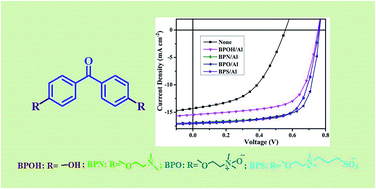
A series of novel benzophenone-based molecules with different polar groups as cathode interfacial materials were synthesized for polymer solar cells.
The content of this RSS Feed (c) The Royal Society of Chemistry
27 Apr 00:41
J. Mater. Chem. A, 2017, 5,10206-10219
DOI: 10.1039/C7TA01665D, Paper
Tiantian Cao, Ning Chen, Guangxin Liu, Yingbo Wan, Jose Dario Perea, Yijun Xia, Zhaowei Wang, Bo Song, Ning Li, Xiaohong Li, Yi Zhou, Christoph J. Brabec, Yongfang Li
A complete regioisomer separation of indene-C60 bisadduct (IC60BA) for polymer solar cell (PSC) applications was conducted for the first time.
The content of this RSS Feed (c) The Royal Society of Chemistry
27 Apr 00:40
J. Mater. Chem. A, 2017, 5,10591-10598
DOI: 10.1039/C7TA02655B, Paper
Xinzheng Yue, Shasha Yi, Runwei Wang, Zongtao Zhang, Shilun Qiu
The well-designed Mo2C/TiO2 hierarchical configuration exhibits extremely high photocatalytic H2 production activity from water splitting.
The content of this RSS Feed (c) The Royal Society of Chemistry
27 Apr 00:40
J. Mater. Chem. A, 2017, 5,10430-10436
DOI: 10.1039/C7TA01994G, Paper
Dakang Ding, Jiuxing Wang, Zurong Du, Feng Li, Weiye Chen, Fushuai Liu, Haiyan Li, Mingliang Sun, Renqiang Yang
Introducing alkoxynaphthyl into benzodithiophene (BDT) is more effective in improving the photovoltaic properties of BDT-based polymers.
The content of this RSS Feed (c) The Royal Society of Chemistry
27 Apr 00:39
J. Mater. Chem. A, 2017, Advance Article
DOI: 10.1039/C6TA08140A, Communication
Linyi Bai, Liqun Sun, Yang Wang, Zhizhou Liu, Qiang Gao, Huijing Xiang, Haiming Xie, Yanli Zhao
Two hybrid heterojunctions consisting of black phosphorus and phenyl-C61-butyric acid methyl ester were developed for the first time and showed high performances in solar cells.
To cite this article before page numbers are assigned, use the DOI form of citation above.
The content of this RSS Feed (c) The Royal Society of Chemistry
27 Apr 00:38
J. Mater. Chem. A, 2017, 5,10517-10525
DOI: 10.1039/C7TA02391J, Paper
Hongliang Zhong, Long Ye, Jung-Yao Chen, Sae Byeok Jo, Chu-Chen Chueh, Joshua H. Carpenter, Harald Ade, Alex K.-Y. Jen
Regioregular PTB7-Th with pre-designated repeat units achieves over 10% efficiency in thick-film solar cells without the assistance of a solvent additive.
The content of this RSS Feed (c) The Royal Society of Chemistry
27 Apr 00:36
J. Mater. Chem. A, 2017, 5,9514-9522
DOI: 10.1039/C7TA01636K, Communication
Jiexuan Jiang, Zhiwen Jin, Jie Lei, Qian Wang, Xisheng Zhang, Jingru Zhang, Fei Gao, Shengzhong (Frank) Liu
With ITIC-modified TiO2, the planar perovskite solar cell performance has been dramatically increased from 17.12% to 20.08%.
The content of this RSS Feed (c) The Royal Society of Chemistry
20 Apr 02:12
J. Mater. Chem. A, 2017, 5,9859-9866
DOI: 10.1039/C7TA02723K, Paper
Benzheng Xia, Liu Yuan, Jianqi Zhang, Zaiyu Wang, Jin Fang, Yifan Zhao, Dan Deng, Wei Ma, Kun Lu, Zhixiang Wei
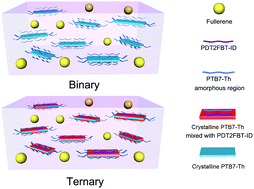
Alloy-like domain structure and energy transfer coexist in the ternary system, in which the maximum PCE of 11.1% is obtained.
The content of this RSS Feed (c) The Royal Society of Chemistry
20 Apr 00:32
J. Mater. Chem. C, 2017, 5,4852-4857
DOI: 10.1039/C7TC01310H, Paper
Guangchao Han, Yuan Guo, Xiaoxian Song, Yue Wang, Yuanping Yi
Three-dimensional molecular packing and isotropic charge transport can be achieved through local [small pi]-[small pi] stacking between terminal acceptor units for A-[small pi]-A electron acceptors toward high-performance non-fullerene organic solar cells.
The content of this RSS Feed (c) The Royal Society of Chemistry
20 Apr 00:28
J. Mater. Chem. A, 2017, 5,9217-9232
DOI: 10.1039/C7TA02037F, Paper
Stephen Loser, Sylvia J. Lou, Brett M. Savoie, Carson J. Bruns, Amod Timalsina, Matthew J. Leonardi, Jeremy Smith, Tobias Harschneck, Riccardo Turrisi, Nanjia Zhou, Charlotte L. Stern, Amy A. Sarjeant, Antonio Facchetti, Robert P. H. Chang, Samuel I. Stupp, Mark A. Ratner, Lin X. Chen, Tobin J. Marks
Understanding the effects of molecular shape on active layer charge transport in OPVs.
The content of this RSS Feed (c) The Royal Society of Chemistry
20 Apr 00:27
J. Mater. Chem. A, 2017, 5,9897-9906
DOI: 10.1039/C7TA01651D, Paper
U. W. Paetzold, M. Jaysankar, R. Gehlhaar, E. Ahlswede, S. Paetel, W. Qiu, J. Bastos, L. Rakocevic, B. S. Richards, T. Aernouts, M. Powalla, J. Poortmans
All-thin film perovskite/CIGS multijunction solar modules, combining a semi-transparent perovskite top solar module stacked on a CIGS bottom solar module, are a promising route to surpass the efficiency limits of single-junction thin-film solar modules.
The content of this RSS Feed (c) The Royal Society of Chemistry