07 Aug 02:07
J. Mater. Chem. C, 2017, 5,8355-8360
DOI: 10.1039/C7TC02137B, Communication
Ying Li, Zhi-Feng Shi, Sen Li, Ling-Zhi Lei, Hui-Fang Ji, Di Wu, Ting-Ting Xu, Yong-Tao Tian, Xin-Jian Li
High-performance perovskite photodetectors based on solution-processed all-inorganic CsPbBr3 thin films were fabricated with a high photoresponsivity and on/off photocurrent ratio.
The content of this RSS Feed (c) The Royal Society of Chemistry
07 Aug 02:04
J. Mater. Chem. C, 2017, 5,7207-7214
DOI: 10.1039/C7TC02109G, Paper
Lifei Xi, Chris B. Boothroyd, Teddy Salim, Sven Borghardt, Yeng Ming Lam, Beata E. Kardynal
This paper presents a simple in situ approach for controlled synthesis of organic-inorganic lead halide perovskite NPs in polymer matrix.
The content of this RSS Feed (c) The Royal Society of Chemistry
07 Aug 02:03
J. Mater. Chem. C, 2017, 5,7441-7445
DOI: 10.1039/C7TC02108A, Communication
Fei Cao, Dejian Yu, Xiaoming Li, Ying Zhu, Zhiguo Sun, Yalong Shen, Ye Wu, Yi Wei, Haibo Zeng
We propose a novel configuration of photodetectors (PDs) using solution-prepared low dimensional CsPbBr3 microcrystals, pencil-drawn graphite and paper as the active materials, electrodes and substrates, respectively.
The content of this RSS Feed (c) The Royal Society of Chemistry
30 Jul 08:32
by Hyojung Cha, Jiaying Wu, Andrew Wadsworth, Jade Nagitta, Saurav Limbu, Sebastian Pont, Zhe Li, Justin Searle, Mark F. Wyatt, Derya Baran, Ji-Seon Kim, Iain McCulloch, James R. Durrant
A comparison of the efficiency, stability, and photophysics of organic solar cells employing poly[(5,6-difluoro-2,1,3-benzothiadiazol-4,7-diyl)-alt-(3,3′″-di(2-octyldodecyl)-2,2′;5′,2″;5″,2′″-quaterthiophen-5,5′″-diyl)] (PffBT4T-2OD) as a donor polymer blended with either the nonfullerene acceptor EH-IDTBR or the fullerene derivative, [6,6]-phenyl C71 butyric acid methyl ester (PC71BM) as electron acceptors is reported. Inverted PffBT4T-2OD:EH-IDTBR blend solar cell fabricated without any processing additive achieves power conversion efficiencies (PCEs) of 9.5 ± 0.2%. The devices exhibit a high open circuit voltage of 1.08 ± 0.01 V, attributed to the high lowest unoccupied molecular orbital (LUMO) level of EH-IDTBR. Photoluminescence quenching and transient absorption data are employed to elucidate the ultrafast kinetics and efficiencies of charge separation in both blends, with PffBT4T-2OD exciton diffusion kinetics within polymer domains, and geminate recombination losses following exciton separation being identified as key factors determining the efficiency of photocurrent generation. Remarkably, while encapsulated PffBT4T-2OD:PC71BM solar cells show significant efficiency loss under simulated solar irradiation (“burn in” degradation) due to the trap-assisted recombination through increased photoinduced trap states, PffBT4T-2OD:EH-IDTBR solar cell shows negligible burn in efficiency loss. Furthermore, PffBT4T-2OD:EH-IDTBR solar cells are found to be substantially more stable under 85 °C thermal stress than PffBT4T-2OD:PC71BM devices.

A high efficiency, burn-in-free nonfullerene-based PffBT4T-2OD:EH-IDTBR solar cell is reported, fabricated without processing additives. Transient absorption and optoelectronic analyses elucidate the causes of this high efficiency and stability, with the superior stability compared to PC71BM devices being correlated with increased crystallinity and reduced photogeneration of trap states.
29 Jul 07:30
Energy Environ. Sci., 2017, 10,1792-1800
DOI: 10.1039/C7EE01096F, Paper
Jun Peng, Yiliang Wu, Wang Ye, Daniel A. Jacobs, Heping Shen, Xiao Fu, Yimao Wan, The Duong, Nandi Wu, Chog Barugkin, Hieu T. Nguyen, Dingyong Zhong, Juntao Li, Teng Lu, Yun Liu, Mark N. Lockrey, Klaus J. Weber, Kylie R. Catchpole, Thomas P. White
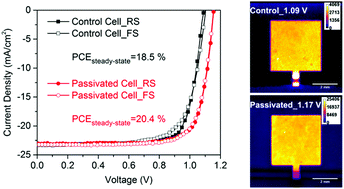
Reducing interface recombination boosts the Voc for perovskite solar cells.
The content of this RSS Feed (c) The Royal Society of Chemistry

13 Jul 00:57
by Matthew P. Lumb, Shawn Mack, Kenneth J. Schmieder, María González, Mitchell F. Bennett, David Scheiman, Matthew Meitl, Brent Fisher, Scott Burroughs, Kyu-Tae Lee, John A. Rogers, Robert J. Walters
Abstract
In this work, a multijunction solar cell is developed on a GaSb substrate that can efficiently convert the long-wavelength photons typically lost in a multijunction solar cell into electricity. A combination of modeling and experimental device development is used to optimize the performance of a dual junction GaSb/InGaAsSb concentrator solar cell. Using transfer printing, a commercially available GaAs-based triple junction cell is stacked mechanically with the GaSb-based materials to create a four-terminal, five junction cell with a spectral response range covering the region containing >99% of the available direct-beam power from the Sun reaching the surface of the Earth. The cell is assembled in a mini-module with a geometric concentration ratio of 744 suns on a two-axis tracking system and demonstrated a combined module efficiency of 41.2%, measured outdoors in Durham, NC. Taking into account the measured transmission of the optics gives an implied cell efficiency of 44.5%.

In this work, a mechanically stacked multijunction solar cell which encompasses the spectral range containing more than 99% of the available power from the direct-beam terrestrial solar spectrum is demonstrated. A mini-module constructed using the cell produces an efficiency of 41.2%, measured outdoors. This implies an outdoor cell efficiency of 44.5% when taking into account the transmission of the optics.
13 Jul 00:56
by Md Azimul Haque, Arif D. Sheikh, Xinwei Guan, Tom Wu
Abstract
Over the past few years, hybrid halide perovskites have emerged as a highly promising class of materials for photovoltaic technology, and the power conversion efficiency of perovskite solar cells (PSCs) has accelerated at an unprecedented pace, reaching a record value of over 22%. In the context of PSC research, wide-bandgap semiconducting metal oxides have been extensively studied because of their exceptional performance for injection and extraction of photo-generated carriers. In this comprehensive review, we focus on the synthesis and applications of metal oxides as electron and hole transporters in efficient PSCs with both mesoporous and planar architectures. Metal oxides and their doped variants with proper energy band alignment with halide perovskites, in the form of nanostructured layers and compact thin films, can not only assist with charge transport but also improve the stability of PSCs under ambient conditions. Strategies for the implementation of metal oxides with tailored compositions and structures, and for the engineering of their interfaces with perovskites will be critical for the future development and commercialization of PSCs.

Hybrid perovskites are emerging as promising materials for low-cost photovoltaic technologies with high performance. Wide-bandgap metal oxides in the forms of nanostructures and compact thin films have been extensively applied as electron and hole transporters in perovskite solar cells. This review elucidates their crucial role in assisting perovskite solar cells to achieve optimal performance and stability.
13 Jul 00:34
by Xiaojun Yin, Guohua Xie, Yuhao Peng, Bowen Wang, Tianhao Chen, Shuqi Li, Wenhao Zhang, Lei Wang, Chuluo Yang

In article number 1700695, a self-doping cathode interfacial layer (CIL) of Tm-TfOH screened from a variety of pyridinium salts is reported by Lei Wang, Chuluo Yang, and co-workers, which enables both high electron mobility and powerful work functions tunability simultaneously. The resulting light-emitting diodes achieve a very low driving voltage of 2.9 V at 1000 cd m−2, and high external quantum efficiency of 3.5 % even in up to 85 nm thick films of CIL.
13 Jul 00:32
by Bin Yang, Chance C. Brown, Jingsong Huang, Liam Collins, Xiahan Sang, Raymond R. Unocic, Stephen Jesse, Sergei V. Kalinin, Alex Belianinov, Jacek Jakowski, David B. Geohegan, Bobby G. Sumpter, Kai Xiao, Olga S. Ovchinnikova

In article number 1700749, Kai Xiao, Olga S. Ovchinnikova, and co-workers investigate a hybrid perovskite films by advanced band-excitation Kelvin probe force microscopy and molecular dynamic simulations. It is revealed that incorporation of PCBM or mobile Cl- ions into the grain boundaries of the film causes suppression or enhancement of ion immigration.
10 Jul 08:07
J. Mater. Chem. A, 2017, 5,16559-16567
DOI: 10.1039/C7TA04943A, Communication
Donglei Zhou, Dali Liu, Junjie Jin, Xu Chen, Wen Xu, Ze Yin, Gencai Pan, Dongyu Li, Hongwei Song
Semiconductor plasmon-sensitized broadband upconversion was used to enhance the power conversion efficiency of perovskite solar cells.
The content of this RSS Feed (c) The Royal Society of Chemistry
10 Jul 07:59
J. Mater. Chem. A, 2017, 5,15923-15931
DOI: 10.1039/C7TA04445C, Paper
Sora Oh, Sachin Badgujar, Da Hun Kim, Wang-Eun Lee, Nasir Khan, Muhammad Jahandar, Shafket Rasool, Chang Eun Song, Hang Ken Lee, Won Suk Shin, Jong-Cheol Lee, Sang-Jin Moon, Sang Kyu Lee
Highly efficient and stable BDT2TR:PNDI-2T organic solar cells are investigated. Although this system shows a PCE of 4.43%, significant enhancements are observed in the thermal stability, high thickness tolerance, and flexibility as compared with the PC71BM-based organic solar cells.
The content of this RSS Feed (c) The Royal Society of Chemistry
10 Jul 07:59
J. Mater. Chem. A, 2017, 5,16702-16711
DOI: 10.1039/C7TA04098A, Paper
Jisoo Shin, Min Kim, Boseok Kang, Jaewon Lee, Heung Gyu Kim, Kilwon Cho
The control of the molecular energy levels of the highest occupied molecular orbital (HOMO) and the lowest unoccupied molecular orbital (LUMO) is crucial to the design of highly efficient polymer solar cells (PSCs).
The content of this RSS Feed (c) The Royal Society of Chemistry
10 Jul 07:58
J. Mater. Chem. A, 2017, 5,15714-15723
DOI: 10.1039/C7TA03103C, Paper
Michael Wong-Stringer, James E. Bishop, Joel A. Smith, David K. Mohamad, Andrew J. Parnell, Vikas Kumar, Cornelia Rodenburg, David G. Lidzey
PCDTBT conductivity is 105 times higher when doped with LITFSI & TBP, perovskite devices employing doped PCDTBT achieve 15.9% PCE.
The content of this RSS Feed (c) The Royal Society of Chemistry
10 Jul 07:42
by Youhei Numata, Atsushi Kogo, Yosuke Udagawa, Hideyuki Kunugita, Kazuhiro Ema, Yoshitaka Sanehira and Tsutomu Miyasaka

ACS Applied Materials & Interfaces
DOI: 10.1021/acsami.7b02924

10 Jul 07:41
by Yijie Xia, Jie Fang, Pengcheng Li, Bangmin Zhang, Hongyan Yao, Jingsheng Chen, Jun Ding and Jianyong Ouyang

ACS Applied Materials & Interfaces
DOI: 10.1021/acsami.7b02443

10 Jul 07:27
by Marinos Tountas, Yasemin Topal, Ermioni Polydorou, Anastasia Soultati, Apostolis Verykios, Andreas Kaltzoglou, Theodoros A. Papadopoulos, Florian Auras, Kostas Seintis, Mihalis Fakis, Leonidas C. Palilis, Dimitris Tsikritzis, Stella Kennou, Matroni Koutsoureli, George Papaioannou, Mustafa Ersöz, Mahmut Kus, Polycarpos Falaras, Dimitris Davazoglou, Panagiotis Argitis and Maria Vasilopoulou

ACS Applied Materials & Interfaces
DOI: 10.1021/acsami.7b04600

10 Jul 07:22
by Xufeng Ling, Jianyu Yuan, Dongyang Liu, Yongjie Wang, Yannan Zhang, Si Chen, Haihua Wu, Feng Jin, Fupeng Wu, Guozheng Shi, Xun Tang, Jiawei Zheng, Shengzhong (Frank) Liu, Zhike Liu and Wanli Ma

ACS Applied Materials & Interfaces
DOI: 10.1021/acsami.7b05113

10 Jul 07:21
by Seojun Lee and Dong-Won Kang

ACS Applied Materials & Interfaces
DOI: 10.1021/acsami.7b04011

08 Jul 11:35
by Michiel L. Petrus, Johannes Schlipf, Cheng Li, Tanaji P. Gujar, Nadja Giesbrecht, Peter Müller-Buschbaum, Mukundan Thelakkat, Thomas Bein, Sven Hüttner, Pablo Docampo
Hybrid metal halide perovskites have become one of the hottest topics in optoelectronic materials research in recent years. Not only have they surpassed everyone's expectations and achieved similar performance as tried and true polycrystalline silicon photovoltaic devices, but they are also finding applications in a variety of different fields, including lighting. The main advantages of hybrid metal halide perovskites are simple processability, compatible with large-scale solution processing such as roll-to-roll printing, and abundance of ingredients, all coupled to materials properties reminiscent of GaAs. On the road to this remarkable success, a series of challenges have been overcome, while some still remain. In this review, some of these challenges and possible solutions are described. In particular, understanding of the perovskite crystallization process and how this knowledge can be harnessed to enable better performing devices, how to overcome reproducibility issues and mitigate hysteresis, and the long-term prospects of the technology in terms of stability and sustainability will all be discussed.

This review of perovskite solar cells discusses the current understanding of the perovskite crystallization process, and how this knowledge can be harnessed to enable better performing devices; how to overcome reproducibility issues and mitigate hysteresis; and the long-term prospects of perovskite solar cell technology in terms of stability, cost, and sustainability.
08 Jul 11:27
by Qidong Tai, Feng Yan
Semitransparent solar cells can provide not only efficient power-generation but also appealing images and show promising applications in building integrated photovoltaics, wearable electronics, photovoltaic vehicles and so forth in the future. Such devices have been successfully realized by incorporating transparent electrodes in new generation low-cost solar cells, including organic solar cells (OSCs), dye-sensitized solar cells (DSCs) and organometal halide perovskite solar cells (PSCs). In this review, the advances in the preparation of semitransparent OSCs, DSCs, and PSCs are summarized, focusing on the top transparent electrode materials and device designs, which are all crucial to the performance of these devices. Techniques for optimizing the efficiency, color and transparency of the devices are addressed in detail. Finally, a summary of the research field and an outlook into the future development in this area are provided.

Recent developments of semitransparent organic solar cells, dye-sensitized solar cells, and perovskite solar cells are reviewed with a focus on different device design, transparent top electrode materials, and the corresponding device fabrication techniques. Key issues related to the optimization of the efficiency, color, and transparency of the semitransparent photovoltaic devices are discussed in detail.
08 Jul 11:25
by Nicola Gasparini, Michael Salvador, Sebastian Strohm, Thomas Heumueller, Ievgen Levchuk, Andrew Wadsworth, James H. Bannock, John C. de Mello, Hans-Joachim Egelhaaf, Derya Baran, Iain McCulloch, Christoph J. Brabec
Abstract
Organic solar cells that are free of burn-in, the commonly observed rapid performance loss under light, are presented. The solar cells are based on poly(3-hexylthiophene) (P3HT) with varying molecular weights and a nonfullerene acceptor (rhodanine-benzothiadiazole-coupled indacenodithiophene, IDTBR) and are fabricated in air. P3HT:IDTBR solar cells light-soaked over the course of 2000 h lose about 5% of power conversion efficiency (PCE), in stark contrast to [6,6]-Phenyl C61 butyric acid methyl ester (PCBM)-based solar cells whose PCE shows a burn-in that extends over several hundreds of hours and levels off at a loss of ≈34%. Replacing PCBM with IDTBR prevents short-circuit current losses due to fullerene dimerization and inhibits disorder-induced open-circuit voltage losses, indicating a very robust device operation that is insensitive to defect states. Small losses in fill factor over time are proposed to originate from polymer or interface defects. Finally, the combination of enhanced efficiency and stability in P3HT:IDTBR increases the lifetime energy yield by more than a factor of 10 when compared with the same type of devices using a fullerene-based acceptor instead.

Organic solar cells based on a nonfullerene acceptor are presented that are free of burn-in, the commonly observed rapid performance loss under light. The combination of enhanced efficiency and stability increases the lifetime energy yield by more than a factor of 10 when compared with the same type of devices using a fullerene-based acceptor instead.
03 Jul 02:37
by Jia-Wen Xiao, Lang Liu, Deliang Zhang, Nicholas De Marco, Jin-Wook Lee, Oliver Lin, Qi Chen, Yang Yang
Abstract
The halide perovskite (PVSK) materials (with ABX3 formulation) have emerged as “dream materials” for photovoltaic (PV) applications due to their remarkable physical properties such as high optical absorption coefficient, carrier mobility, long carrier diffusion lengths, etc. These properties have enabled the PV devices to reach higher than 20% power conversion efficiencies (PCE) in record time. The further pursuit of higher PCE and improved stability brings forth increasing interests in so-called “mixed composition” PVSK materials, consisting of partial substitution of the A, B, and/or X-sites with alternative elements/molecules of similar size. Herein, we highlight the recent advances in developing mixed PVSK for PVs and their relevant optoelectronic properties. We mainly focus on mixed PVSK materials in the form of polycrystalline thin films, but also discuss nanostructured and two-dimensional (2D) PVSK materials due to the increasing interest of broad readership. Efforts are exerted to elucidate the design principles of mixed PVSK and fabrication techniques for high performance optoelectronic devices, which help deepen our fundamental understanding of mixed PVSK systems. We hope this review will shed light onto the design and synthesis of mixed PVSK materials to further the progress of PVSK photovoltaics towards higher efficiencies and longer lifetimes.

Perovskite solar cells (PSCs) employing metal halide perovskites with mixed composition as light absorbers generally show high device performance. The recent progress of PSCs based on mixed perovskites is reviewed, trying to shed light onto the design and synthesis of mixed perovskite materials to further improve the device performance on both efficiency and stability.
03 Jul 02:35
by Mingzhu Long, Tiankai Zhang, Wangying Xu, Xiaoliang Zeng, Fangyan Xie, Qiang Li, Zefeng Chen, Fengrui Zhou, Kam Sing Wong, Keyou Yan, Jianbin Xu

In article number 1601882, Keyou Yan, Jianbin Xu, and co-workers report a simple intermediate halide exchange reaction between nonstoichiometric FAI and unstable intermediate HPbI2Br to produce high-quality FAPbI3-xBrx thin films with crystal domain up to 2-3 μm, eliminating the use of antisolvent dripping process. And it demonstrates outstanding opto-electronic performances as well as enhanced stability under moisture and heat stress.
03 Jul 02:35
by Theresa Linderl, Thomas Zechel, Michael Brendel, Daniel Moseguí González, Peter Müller-Buschbaum, Jens Pflaum, Wolfgang Brütting
After intense research and development organic solar cells have matured among the family of thin-film photovoltaic technologies. On the laboratory scale they reach power conversion efficiencies in excess of 10%. Together with other attractive features, like transparency or the compatibility with low-cost, large area processing, they open reasonable perspectives for their commercialization. However, in order to close the gap to established inorganic technologies, primarily crystalline silicon, the fundamental understanding of loss processes has to be improved. First and foremost, this concerns the energy loss between the optical gap for light absorption and the open-circuit voltage of the cell. Here, the scientific background for the different mechanisms of energy losses in organic photovoltaic cells together with current approaches toward their reduction is presented.

The energy loss between the optical gap and the open-circuit-voltage is one of the primary reasons why the efficiency of organic photovoltaic cells lags behind their inorganic counterparts. This research news highlights the scientific background and presents strategies to improve on this issue.
29 Jun 00:28
by Ilario Gelmetti, Lydia Cabau, Núria F. Montcada and Emilio Palomares

ACS Applied Materials & Interfaces
DOI: 10.1021/acsami.7b06638

29 Jun 00:28
by Chunyu Liu, Dezhong Zhang, Zhiqi Li, Xinyuan Zhang, Wenbin Guo, Liu Zhang, Shengping Ruan and Yongbing Long

ACS Applied Materials & Interfaces
DOI: 10.1021/acsami.7b06235

29 Jun 00:27
by Jie Zhang, Yinan Zhang, Tao Song, Xinlei Shen, Xuegong Yu, Shuit-Tong Lee, Baoquan Sun and Baohua Jia

ACS Applied Materials & Interfaces
DOI: 10.1021/acsami.7b02140

fen and -1 others like this
29 Jun 00:26
by Xinxin Ban, Aiyun Zhu, Tianlin Zhang, Zhiwei Tong, Wei Jiang and Yueming Sun

ACS Applied Materials & Interfaces
DOI: 10.1021/acsami.7b04146

29 Jun 00:26
by Haoxu Wang, Jie Lei, Fei Gao, Zhou Yang, Dong Yang, Jiexuan Jiang, Juan Li, Xihong Hu, Xiaodong Ren, Bin Liu, Jing Liu, Hairui Lei, Zhike Liu and Shengzhong (Frank) Liu

ACS Applied Materials & Interfaces
DOI: 10.1021/acsami.7b03081

29 Jun 00:25
by Like Huang, Xiaoxiang Sun, Chang Li, Jie Xu, Rui Xu, Yangyang Du, Jian Ni, Hongkun Cai, Juan Li, Ziyang Hu and Jianjun Zhang

ACS Applied Materials & Interfaces
DOI: 10.1021/acsami.7b04392