29 Aug 17:08
by Avijit Kumar, Kaustuv Banerjee, Adam S. Foster, Peter Liljeroth

Nano Letters
DOI: 10.1021/acs.nanolett.8b02062

22 Aug 17:13
by Qing Li, Haiping Lin, Ruitao Lv, Mauricio Terrones, Lifeng Chi, Werner A. Hofer, Minghu Pan

Nano Letters
DOI: 10.1021/acs.nanolett.8b01798

21 Aug 09:46
by Qiang Zhang, Jin Yu, Philipp Ebert, Chendong Zhang, Chi-Ruei Pan, Mei-Yin Chou, Chih-Kang Shih, Changgan Zeng, Shengjun Yuan

ACS Nano
DOI: 10.1021/acsnano.8b04444

20 Aug 09:13
by Xuelei Su, Zhijie Xue, Gang Li, Ping Yu

Nano Letters
DOI: 10.1021/acs.nanolett.8b02356

17 Aug 11:55
Chem. Commun., 2018, 54,10256-10259
DOI: 10.1039/C8CC05353G, Communication
Rafal Zuzak, Jesus Castro-Esteban, Pedro Brandimarte, Mads Engelund, Agustín Cobas, Piotr Piątkowski, Marek Kolmer, Dolores Pérez, Enrique Guitián, Marek Szymonski, Daniel Sánchez-Portal, Szymon Godlewski, Diego Peña
A nanographene formed by the fusion of 22 benzene rings has been prepared by combining in-solution cycloaddition reactions and on-surface cyclodehydrogenations.
The content of this RSS Feed (c) The Royal Society of Chemistry

16 Aug 10:50
by A. Kamlapure
Engineering the spin couplings in atomically crafted spin chains on an elemental superconductor
Engineering the spin couplings in atomically crafted spin chains on an elemental superconductor, Published online: 14 August 2018; doi:10.1038/s41467-018-05701-8
Magnetic atomic chains assembled on the surface of superconductors are a potential platform for engineering topological superconducting phases. Here the authors step towards this by manipulating magnetic atoms at interstitial sites to tune interatomic interactions and control the Yu-Shiba-Rusinov states that form.

13 Aug 17:13
by Shigeki Kawai, Ondrej Krejcí, Adam S. Foster, Rémy Pawlak, Feng Xu, Lifen Peng, Akihiro Orita, Ernst Meyer

ACS Nano
DOI: 10.1021/acsnano.8b05116

yjdlut and -1 others like this
10 Aug 09:37
by Cornelius Krull
Iron-based trinuclear metal-organic nanostructures on a surface with local charge accumulation
Iron-based trinuclear metal-organic nanostructures on a surface with local charge accumulation, Published online: 10 August 2018; doi:10.1038/s41467-018-05543-4
Polynuclear metal-organic coordination complexes are often inaccessible by traditional synthetic chemistry methods. Here, the authors use on-surface supramolecular chemistry to form a planar trinuclear Fe complex, in which an accumulation of electrons around the positive mixed-valence polynuclear centre suggests a catalytically active core.

20 Jul 12:47
by Hai Xu, Dong Han, Yang Bao, Fang Cheng, Zijing Ding, Sherman J. R. Tan, Kian Ping Loh

Nano Letters
DOI: 10.1021/acs.nanolett.8b01953

12 Jul 08:57
by Alexandre Artaud, Laurence Magaud, Kitti Ratter, Bruno Gilles, Valérie Guisset, Philippe David, Jose Ignacio Martinez, Jose Angel Martin-Gago, Claude Chapelier, Johann Coraux

Nano Letters
DOI: 10.1021/acs.nanolett.8b01379

10 Jul 14:42
Phys. Chem. Chem. Phys., 2018, 20,20188-20193
DOI: 10.1039/C8CP01356J, Paper
Jian Gou, Long-Juan Kong, Wen-Bin Li, Shao-Xiang Sheng, Hui Li, Sheng Meng, Peng Cheng, Ke-Hui Wu, Lan Chen
The lowest unoccupied states with Rashba splitting of β-√3 × √3-Bi are proved to be contributed by surface bismuth atoms.
The content of this RSS Feed (c) The Royal Society of Chemistry

10 Jul 13:28
by Sock Mui Poh, Xiaoxu Zhao, Sherman Jun Rong Tan, Deyi Fu, Wenwen Fei, Leiqiang Chu, Dan Jiadong, Wu Zhou, Stephen J. Pennycook, Antonio H. Castro Neto, Kian Ping Loh

ACS Nano
DOI: 10.1021/acsnano.8b04037

04 Jul 11:12
by Peter H. Jacobse, Mark J. J. Mangnus, Stephan J. M. Zevenhuizen, Ingmar Swart

ACS Nano
DOI: 10.1021/acsnano.8b02770

03 Jul 17:42
by Moritz Will, Nicolae Atodiresei, Vasile Caciuc, Philipp Valerius, Charlotte Herbig, Thomas Michely

ACS Nano
DOI: 10.1021/acsnano.8b02127

25 Jun 08:36
by Yuhang Jiang
Inducing Kondo screening of vacancy magnetic moments in graphene with gating and local curvature
Inducing Kondo screening of vacancy magnetic moments in graphene with gating and local curvature, Published online: 14 June 2018; doi:10.1038/s41467-018-04812-6
Observing and tuning the Kondo effect in graphene is experimentally challenging. Here, the authors identify the spectroscopic signature of Kondo screening in graphene, along with a quantum phase transition between screened and unscreened phases of vacancy magnetic moments.

25 Jun 08:30
by Michael
Lepper
,
Julia
Köbl
,
Dr.
Liang
Zhang
,
Manuel
Meusel
,
Helen
Hölzel
,
Dr.
Dominik
Lungerich
,
Prof. Dr.
Norbert
Jux
,
Prof. Dr.
Abner
de Siervo
,
Prof. Dr.
Bernd
Meyer
,
Prof. Dr.
Hans‐Peter
Steinrück
,
Dr.
Hubertus
Marbach
Angewandte Chemie International Edition, EarlyView.
25 Jun 08:17
by Nerea
Ruiz del Árbol
,
Irene
Palacio
,
Gonzalo
Otero‐Irurueta
,
José I.
Martínez
,
Pedro L.
de Andrés
,
Oleksander
Stetsovych
,
María
Moro‐Lagares
,
Pingo
Mutombo
,
Martin
Svec
,
Pavel
Jelínek
,
Albano
Cossaro
,
Luca
Floreano
,
Gary J.
Ellis
,
María F.
López
,
Prof.
José A.
Martín‐Gago
Angewandte Chemie International Edition, EarlyView.
20 Jun 13:59
by Agustin Schiffrin, Martina Capsoni, Gelareh Farahi, Chen-Guang Wang, Cornelius Krull, Marina Castelli, Tanya Roussy, Katherine A. Cochrane, Yuefeng Yin, Nikhil V. Medhekar, Michael Fuhrer, Adam Q. Shaw, Wei Ji, Sarah A. Burke

ACS Nano
DOI: 10.1021/acsnano.8b01026

19 Jun 18:21
by Shijie Zhen, Jin-Chuan Mao, Long Chen, Siyang Ding, Wenwen Luo, Xiao-Shun Zhou, Anjun Qin, Zujin Zhao, Ben Zhong Tang

Nano Letters
DOI: 10.1021/acs.nanolett.8b01082

13 Jun 10:04
by Y. Pavlyukh, E. Rentschler, H. J. Elmers, W. Hübner, and G. Lefkidis
Author(s): Y. Pavlyukh, E. Rentschler, H. J. Elmers, W. Hübner, and G. Lefkidis
Electronic and magnetic properties of molecular nanomagnets are determined by competing energy scales due to the crystal field splitting, the exchange interactions between transition metal atoms, and relativistic effects. We present a comprehensive theory embracing all these phenomena based on first...
[Phys. Rev. B 97, 214408] Published Fri Jun 08, 2018
13 Jun 10:02
by Qitang Fan, Simon Werner, Jalmar Tschakert, Daniel Ebeling, André Schirmeisen, Gerhard Hilt, Wolfgang Hieringer, J. Michael Gottfried

Journal of the American Chemical Society
DOI: 10.1021/jacs.8b01658

13 Jun 09:47
by Lee A. Walsh, Avery J. Green, Rafik Addou, Westly Nolting, Christopher R. Cormier, Adam T. Barton, Tyler R. Mowll, Ruoyu Yue, Ning Lu, Jiyoung Kim, Moon J. Kim, Vincent P. LaBella, Carl A. Ventrice , Jr., Stephen McDonnell, William G. Vandenberghe, Robert M. Wallace, Alain Diebold, Christopher L. Hinkle

ACS Nano
DOI: 10.1021/acsnano.8b03414

04 Jun 12:36
by K.M. Bastiaans, T. Benschop, D. Chatzopoulos, D.H. Cho, Q. Dong, Y. Jin, M.P. Allan
Conventional scanning tunneling microscopy (STM) is limited to a bandwidth of
circa 1kHz around DC. Here, we develop, build and test a novel amplifier
circuit capable of measuring the tunneling current in the MHz regime while
simultaneously performing conventional STM measurements. This is achieved with
an amplifier circuit including a LC tank with a quality factor exceeding 600
and a home-built, low-noise high electron mobility transistor (HEMT). The
amplifier circuit functions while simultaneously scanning with atomic
resolution in the tunneling regime, i.e. at junction resistances in the range
of giga-ohms, and down towards point contact spectroscopy. To enable high
signal-to-noise and meet all technical requirements for the inclusion in a
commercial low temperature, ultra-high vacuum STM, we use superconducting
cross-wound inductors and choose materials and circuit elements with low heat
load. We demonstrate the high performance of the amplifier by spatially mapping
the Poissonian noise of tunneling electrons on an atomically clean Au(111)
surface. We also show differential conductance spectroscopy measurements at
3MHz, demonstrating superior performance over conventional spectroscopy
techniques. Further, our technology could be used to perform impedance matched
spin resonance and distinguish Majorana modes from more conventional edge
states.
30 May 10:18
Chem. Commun., 2018, 54,7085-7088
DOI: 10.1039/C8CC03516D, Communication
Alexander F. R. Kilpatrick, Fu-Sheng Guo, Benjamin M. Day, Akseli Mansikkamaki, Richard A. Layfield, F. Geoffrey N. Cloke
The pentalene-ligated dysprosium complex [([small eta]8-Pn[dagger])Dy(Cp*)] (1Dy) (Pn[dagger] = [1,4-(iPr3Si)2C8H4]2-) and its magnetically dilute analogue are single-molecule magnets, with energy barriers of 245 cm-1.
The content of this RSS Feed (c) The Royal Society of Chemistry

28 May 17:23
by Shuang Wu, Bing Liu, Cheng Shen, Si Li, Xiaochun Huang, Xiaobo Lu, Peng Chen, Guole Wang, Duoming Wang, Mengzhou Liao, Jing Zhang, Tingting Zhang, Shuopei Wang, Wei Yang, Rong Yang, Dongxia Shi, Kenji Watanabe, Takashi Taniguchi, Yugui Yao, Weihua Wang, and Guangyu Zhang
Author(s): Shuang Wu, Bing Liu, Cheng Shen, Si Li, Xiaochun Huang, Xiaobo Lu, Peng Chen, Guole Wang, Duoming Wang, Mengzhou Liao, Jing Zhang, Tingting Zhang, Shuopei Wang, Wei Yang, Rong Yang, Dongxia Shi, Kenji Watanabe, Takashi Taniguchi, Yugui Yao, Weihua Wang, and Guangyu Zhang
The determination of the electronic structure by edge geometry is unique to graphene. In theory, an evanescent nonchiral edge state is predicted at the zigzag edges of graphene. Up to now, the approach used to study zigzag-edged graphene has mostly been limited to scanning tunneling microscopy. The ...
[Phys. Rev. Lett. 120, 216601] Published Tue May 22, 2018
28 May 12:53
by Mohammad Rashidi, Robert A. Wolkow

ACS Nano
DOI: 10.1021/acsnano.8b02208

21 May 15:10
by J. Brand, S. Gozdzik, N. Néel, J. L. Lado, J. Fernández-Rossier, and J. Kröger
Author(s): J. Brand, S. Gozdzik, N. Néel, J. L. Lado, J. Fernández-Rossier, and J. Kröger
The interplay of magnetism and superconductivity gives rise to the emergence of various interesting phenomena in condensed matter physics, such as the Yu-Shiba-Rusinov in-gap modes created by local magnetic moments in superconducting hosts. Using normal-metal and superconducting tips the authors have formed contacts to an individual magnetic molecule adsorbed on a conventional superconductor. Spectroscopy of the differential conductance with tunable junction transparency has unveiled the crossover from quasiparticle tunneling, which probes the Bardeen-Cooper-Schrieffer energy gap as well as the Yu-Shiba-Rusinov levels, to the contact range where multiple Andreev reflection takes over.
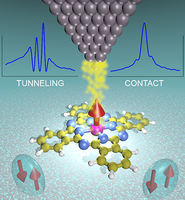
[Phys. Rev. B 97, 195429] Published Thu May 17, 2018
21 May 15:05
by Costello, T. J.
21 May 14:59
by Mohamed Elsherif, Mohammed Umair Hassan, Ali K. Yetisen, Haider Butt

ACS Nano
DOI: 10.1021/acsnano.8b00829

21 May 01:12
by Yibo Zhu, Yijun Li, Ghidewon Arefe, Robert A. Burke, Cheng Tan, Yufeng Hao, Xiaochi Liu, Xue Liu, Won Jong Yoo, Madan Dubey, Qiao Lin, James C. Hone

Nano Letters
DOI: 10.1021/acs.nanolett.8b01091


