Shared posts

08 Sep 05:44

Martin O’Malley Is Right: America Should Be Taking More Syrian Refugees

by James Fallows
A Syrian baby sleeping in Greece (Yannis Behrakis / Reuters)

I haven’t been writing about Syria, either the horrific war of the past four years or the ongoing refugee crises, because it is one of many topics about which I feel I don’t know enough to offer useful comment.

But over the past two years, I have several times posted guest analyses from someone in a very good position to know: the distinguished international-affairs practitioner and scholar William Polk. In 2013 he offered a two-part backgrounder on why things had gone so tragically wrong in Syria, with a heavy emphasis on ramifications of the years-long drought. His accounts are here, the first and then the second; two subsequent Polk assessments are here and here.

Now I offer another guest perspective, on the consequences of ongoing war. It’s from Dr. Ramy Arnaout of MIT and Harvard Medical School, who is now at the Beth Israel Deaconess medical center in Boston. He describes himself, as you will see, as “a born-and-bred, die-hard New Englander who happens to be the child of Lebanese immigrants.” He argues that it’s time for the U.S. to move aggressively in making room for more of the people displaced by the horrors in Syria.

I agree. I’ll explain why after we hear from Dr. Arnaout. Then I’ll explain why I’m mentioning Martin O’Malley in the headline.

Now, from Ramy Arnaout:

I (and about 40,000 others at last count) have been on Facebook spreading the word about a White House petition to allow Syrian refugees to resettle in the U.S. You can read the petition at the link above.

Several people have asked me why we should do anything when the regional powers, Iran and especially (as a richer and Arab country) Saudi Arabia, have done little, and whether we shouldn’t prefer to send money to support “safe zones” inside Syria instead.

This felt like it was missing the point... This is not either-or but both-and—even if you trust Riyadh to lead anything, or Riyadh and Tehran to agree on anything, or safe havens to stay safe in war zones—an oxymoron about which Yugoslavs, Rwandans, Afghans, Iraqis, and Sudanese might opine.

Personally I might suggest Riyadh and Tehran donate to tiny Lebanon, a country with an actual (but increasingly shaky) government and 30% refugees—20% of the Syrian total—than to Syria itself, but that is beside the point.

The point is, we are not Riyadh—thankfully—nor Tehran. We do not elect their leaders.

We write our Congressmen. We petition our White House. We are the United States. That should mean something.

The inscription on the Statue of Liberty reads:

“Give me your tired, your poor,
Your huddled masses yearning to breathe free,
The wretched refuse of your teeming shore.
Send these, the homeless, tempest-tost to me,
I lift my lamp beside the golden door!”

These words welcomed millions. By our alchemy this “wretched refuse” helped spawn the Greatest Generation and powered the engine of the 20th century. The mantle of that legacy now falls to us. Syria’s huddled masses yearn not to breathe free—a luxury in war—but to breathe at all. Do the words with which we caption our defining monument not include these people?

Syria gave us Steve Jobs and Jerry Seinfeld. “The business of the American people is business,” said Calvin Coolidge. As Americans, we should know a bargain when we see one. Syria is a fire sale. Lady Liberty's “golden door” should be open with Syrian refugees first in line.

The alternative is we keep that door shut—and consider outsourcing our conscience to oil sheikhs and mullahs.

Do we want to trust the future of the world we used to lead to the mercy, generosity, and tolerance of the Saudis? Are we content to play second fiddle to the Germans and Greeks? Or can we begin to salvage our tattered reputation and sense of self by demonstrating some basic human kindness?

“You break it, you bought it,” said Colin Powell of our Iraq misadventure, one of the first dominos in the Syrian crisis. We are not the bull in this china shop, but we fed it and let it in. We owe the shopkeepers.

Reads an open letter from Icelanders to their welfare minister, pleading the good sense of neighborliness: “Refugees are our future spouses, best friends, or soulmates, the drummer for the band of our children, our next colleague, Miss Iceland in 2022, the carpenter who finally finished the bathroom, the cook in the cafeteria, the fireman, the computer genius, or the television host.”

Has the flame in Lady Liberty’s lamp burned so low that the City on a Hill has to be shown the way by Reykjavik? … Let us not be shown up by the Old World or let the least charitable among us define for us what is right. Let us open our door.

In the US we’re now talking about settling 1,500 refugees so our number now rounds to “2” on the plot above. Germany, meanwhile, says its capacity is unlimited. That’s pretty incredible. Merkel must know many—most?—of those people aren’t going back. Her country has uneasy history not just re-integrating the East but with a Turkish population. Fingers crossed that the German people keep behind her—and that the refugees, while not losing their history, become fully German.

Which, as a born-and-bred, die-hard New Englander who happens to be the child of Lebanese immigrants, I think would be a truly great thing.

* * *

As I said, while not a Syria expert, I agree that America should open itself to more of this latest wave of refugees. My reasons, in summary:

  • I am skeptical of the view that America should always “do something” about international disasters by intervening militarily, since the people urging that rarely have answers to the, “OK, what happens then?” question. But the “something” we can effectively and humanely do is take in some of those dislocated by chaos and cruelty.
  • Absorbing immigrants and refugees is always disruptive—for any nation, for any kind of refugees. But looking back, the United States has reason to feel better about those it has absorbed—from Hungary in the 1950s, from Vietnam and Cambodia and Laos in the 1970s, from Cuba and Russia in the 1980s, from Congo, Somalia, Burma, Nepal, Afghanistan, Iraq, etc recently, and other zones before and since—than about those it has turned away. Most notable in the second category are the Jewish refugees from Nazi-dominated Europe whom the United States declined to admit when there was still time.
  • Traveling around the country these past two years on the American Futures project, my wife Deb and I have been impressed by the opposite of what we hear from the Trump campaign. That is, the ongoing assimilation of immigrants and, particularly, refugees in unexpected locales across the country. You can read reports about Sioux Falls, S.D., and Burlington, Vt. here and here. If Germany with its 80 million people can stand this disruption, so can the more-diverse United States, with four times as large a population and 25 times as big a land mass.

And why do I mention Martin O’Malley? Because, according to The Guardian, of the 4,000 (actually only 22) Republican and Democratic candidates for president who were asked, only O’Malley said unambiguously that the United States should make room for more people from Syria.

From The Guardian’s article on presidential candidates’ views on Syria.

Martin O’Malley is right, and so is Ramy Arnaout. If the United States wants to “do something” about a humanitarian disaster, it can best help them, and help itself, by welcoming more of them here.

UPDATE People following the Cruz, Rubio, and Kasich campaigns have written in to say that, with varying degrees of caution, these three have also said some positive things about admitting refugees. Eg this from Kasich: “ ‘I think we do have a responsibility in terms of taking some more folks in — making sure they assimilate, and at the same time, helping people to actually be safe as they move — that’s logistical support,’ he told ABC. ‘But this is fundamentally an issue that Europe has to come to grips with.’ ” Rubio has also said that he would favor taking some in, once we had made sure they weren’t terrorists.

Noted. But I’ll say again, as the Guardian did, that O’Malley was the one making the point “unequivocally,” which is why I singled him out.

* * *

Housekeeping note: The Atlantic’s new Notes section is a great innovation, which we have not yet completely integrated with our preexisting site. Thus for the record I will provide links here to several recent Notes items: two on the Chinese Victory Parade last week, here and here; one on a very interesting Iran-deal panel last week in Washington; and one late last night on a renaissance of California-based magazines.

This article was originally published at http://www.theatlantic.com/international/archive/2015/09/martin-omalley-is-right-the-united-states-should-be-taking-more-syrian-refugees/404131/





07 Sep 18:44

Some Jerks Used a 56-Year-Old Anti-Discrimination Law to Shut Down “Women in Tech” Group

by Jessica Lachenal

shutterstock_127216079

Chic CEO is a free online platform geared towards female entrepreneurs, which enables them to do things like network or find helpful resources for starting a business. CEO Stephanie Burns regularly secured space for these female entrepreneurs by organizing networking events and mixers for women. That all came to an end when two men, Allen Candelore and Rich Allison, tried to enter one of the female-focused events.

In a video posted to YouTube, Burns said, “These men came uninvited and the venue was over capacity,” so she turned them away. The next thing she knew, she was hit with a lawsuit from the two men, claiming they were being discriminated against based on their gender. They were represented by Alfred G. Rava, who is notorious for carrying out lawsuits against organizations who have any kind of event geared towards women. In fact, he sued the Oakland Athetics Baseball organization for not giving him a hat during their Mother’s Day promotional event.

How much did that lawsuit end up costing them? $510,000.

It’s not clear how much the out-of-court settlement cost Chic CEO, but it was enough to virtually drive them out of business.

But how does Rava win these (clearly ridiculous) cases? He cites the Unruh Civil Rights Act, a California anti-discrimination law from 1959. He seems to target events that are geared towards women, or events in which women are apparently preferred over men. The law was originally intended to protect marginalized groups from discrimination. But Rava–as well as National Coalition for Men president Harry Crouch, and the two plaintiffs in the Chic CEO case Candelore and Allison–have been leaning on the Unruh Act in lawsuits for quite some time now.

Frankly, the lawsuits are ridiculous. But more than that (so much more than that), there’s a special kind of insult in taking an anti-discrimination law intended to protect marginalized people and twisting it to “protect” those least in need of protection. It’s sad, to be honest, that men’s rights activists (ughh) can exploit something like that to effectively shut down organizations and companies like Chic CEO trying to improve female representation in tech and other industries.

The threat of a lawsuit is usually enough to shut a company down, even if the company stands a good chance of winning in court, simply for one reason: it costs less to settle than it does to fight in court. With the knowledge of a likely easy settlement, plus precedent on their side, how messed up is it that this is a weapon that can be used to stamp out organized attempts at improving representation before it even begins?

According to Yahoo! News, Rava “doesn’t see the value in women-focused events, even if they have no discriminatory intent. He calls the desire to hold them ‘strange and sad.'”

Most telling of all, though, is Rava’s e-mail reply to Yahoo! News reporter Alyssa Bereznak, who originally broke the story. He said to her:

I hope you print all sides to your story, because I am sure you would not want someone to publish a story about you on the Internet labeling you a ‘predator,’ a ‘gigantic bitch,’ an ‘elitist,’ a ‘soulless harpie,’ a ‘narcissist,’ and a ‘dumb woman,’ without that story presenting facts or opinions to the contrary.

Huh. Subtle.

(via Business Insider)

—Please make note of The Mary Sue’s general comment policy.—

Do you follow The Mary Sue on Twitter, Facebook, Tumblr, Pinterest, & Google +?

01 Sep 20:33

Saturday Morning Breakfast Cereal - Natural Selection

by admin@smbc-comics.com

Hovertext: Now, if you'll excuse me, I'm going to go kill off some weak baby gazelles.


New comic!
Today's News:
28 Aug 16:11

Bill That Was Supposed To Limit Police Drone Activity Changed By Lobbyist To Enable Weaponized Drones

by Mike Masnick
North Dakota state representative Rick Becker had a good idea with his House Bill 1328, which would forbid the use of drones by law enforcement in the state without a warrant. A few other states have been looking at similar proposals, after there have been growing concerns about police using drones for surveillance activities. Virginia, for example, recently passed a law that requires a warrant for police drone use. So, good idea, Rep. Becker.

Except... in stepped Bruce Burkett, a lobbyist from the North Dakota Peace Officer's Association, who "was allowed by the state house committee to amend HB 1328" to now make it about legalizing weaponized drones for police. Yes, a "peace officer" representative just made it possible to weaponize drones. The trick? He amended the bill to make it only about "lethal weapons," which now opens the door to what police like to refer to as "less than lethal" weapons like "rubber bullets, pepper spray, tear gas, sound cannons, and Tasers" -- some of which have a history of leading to deaths, despite their "less than lethal" claims.
Even “less than lethal” weapons can kill though. At least 39 people have been killed by police Tasers in 2015 so far, according to The Guardian. Bean bags, rubber bullets, and flying tear gas canisters have also maimed, if not killed, in the U.S. and abroad.
Meanwhile, local police are still freaking out about the need to require a warrant. Check out this bit of police state nonsense:
Grand Forks County Sheriff Bob Rost said his department’s drones are only equipped with cameras and he doesn’t think he should need a warrant to go snooping.

“It was a bad bill to start with,” Rost told The Daily Beast. “We just thought the whole thing was ridiculous.”

Rost said he needs to use drones for surveillance in order to obtain a warrant in the first place.
Yes, we need to spy on your first, to then see if we should get a warrant to spy on you some more. That's not how this works.

And, now, while there will be warrant requirements for some uses -- though with broad exceptions including within 25 miles of the US/Canada border and for "exigent circumstances" -- the bill will (thanks to a lobbyist) allow the police to also experiment with weaponizing drones. If you thought the militarization of police wasn't screwed up enough, now you might need to worry about stun guns and rubber bullets hailing down from the sky...

Permalink | Comments | Email This Story


21 Aug 15:52

A Wonderfully Clear Explanation of How Road Diets Work

by Eric Jaffe
Jeff Speck: Four Road Diets from Cupola Media on Vimeo.

A road diet is a great way for cities to reclaim some of the excess street space they’ve dedicated to cars—generally preserving traffic flows while improving safety and expanding mobility to other modes. But just as food dieters have Atkins, South Beach, vegan, and any number of options, road diets come in many flavors, too. Urban planner and Walkable City author Jeff Speck, in collaboration with graphic artist Spencer Boomhower, takes us on a tour of four types of street diets in a deliciously clear new video series. Here’s a taste.

Three lanes to two

(Jeff Speck / Spencer Boomhower)

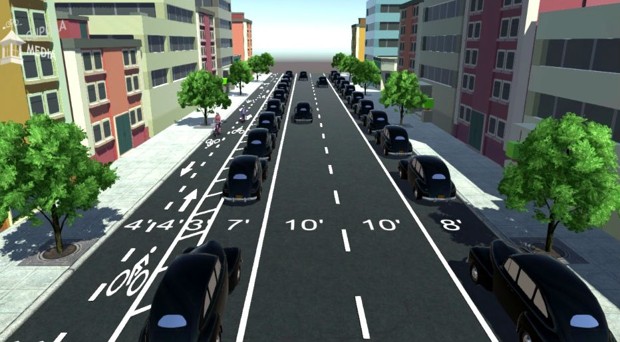
In this case we have three traffic lanes flanked by two parking lanes. That’s an awful lots of city street space for cars, so here Speck proposes a “3-to-2” road diet: by removing one traffic lane and narrowing one parking lane, a city can make room for a protected two-way cycle track beside the curb. The 3-to-2 diet preserves travel times while increasing safety; as Speck point out, a similar design change made in Brooklyn reduced injury crashes by 63 percent.

Four lanes to three

(Jeff Speck / Spencer Boomhower)

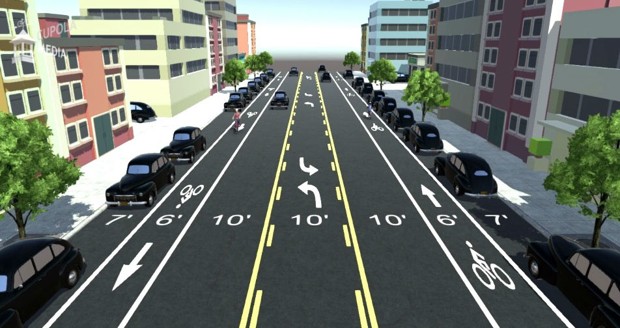
The most classic road diet converts four lanes of traffic into three lanes: one in each direction, plus a left-turn lane in the middle. By eliminating one full car lane, the “4-to-3” diet also leaves room for bike lanes on both sides of the street—though this extra space can be used for sidewalk extensions or even dedicated transit lanes, too. A 2013 study of 4-to-3 diets found major safety benefits: a 47 percent drop in crashes in small metros, and a 19 percent dip in big cities.

Bike lanes to cycle tracks

(Jeff Speck / Spencer Boomhower)

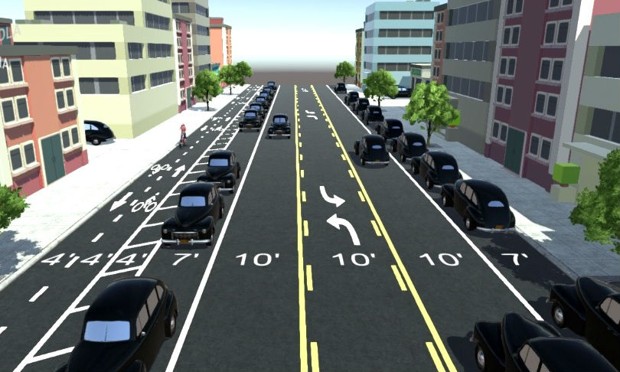
"Bike lanes are good; a cycle track is better, and requires no more roadway,” says Speck in the road diet’s voiceover. Take the road that we ended up with after the 4-to-3 diet, for instance. In this design, bike lanes run beside car traffic on either side of the street, increasing the potential for collision. But by sliding one parking lane off the curb, this diet makes room for a two-way cycle track protected from moving traffic by a buffer strip as well as a lane of street parking.

40-footer lane insertion

(Jeff Speck / Spencer Boomhower)

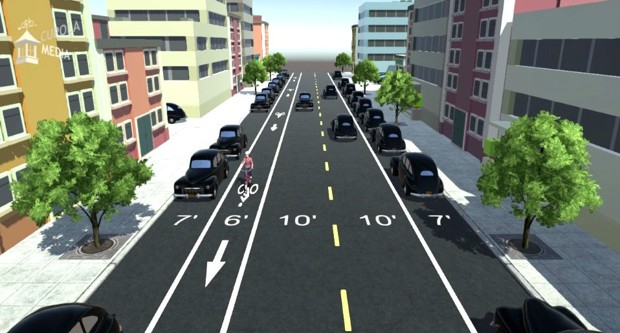
This time we focus on a 40-foot street with two 12-foot lanes of opposing traffic and two parking lanes at the curb. Many cities have adopted 12-foot lanes with the assumption that they move more traffic; in fact, as Speck has argued at CityLab before, they present a major safety hazard for cities by encouraging faster driving. He recommends slimming them down to 10 feet—a design configuration that leaves room for a bike lane and makes the street safer, even as it more or less preserves traffic flows.


20 Aug 15:18

The Unlikely Reanimation of H.P. Lovecraft

by Philip Eil
Will Hart / Flickr

American history is filled with writers whose genius was underappreciated—or altogether ignored—in their lifetime. Most of Emily Dickinson’s poems weren’t discovered and published until after her death. F. Scott Fitzgerald “died believing himself a failure.” Zora Neale Hurston was buried in an unmarked grave. John Kennedy Toole won the Pulitzer Prize 12 years after committing suicide.

But no tale of posthumous success is quite as spectacular as that of Howard Phillips Lovecraft, the “cosmic horror” writer who died in Providence, Rhode Island, in 1937 at the age of 46. The circumstances of Lovecraft’s final years were as bleak as anyone’s. He ate expired canned food and wrote to a friend, “I was never closer to the bread-line.” He never saw his stories collectively published in book form, and, before succumbing to intestinal cancer, he wrote, “I have no illusions concerning the precarious status of my tales, and do not expect to become a serious competitor of my favorite weird authors.” Among the last words the author uttered were, “Sometimes the pain is unbearable.” His obituary in the Providence Evening Bulletin was “full of errors large and small,” according to his biographer.

Nowadays, it’s hard to imagine Lovecraft faced such poverty and obscurity, when regions of Pluto are named for Lovecraftian monsters, the World Fantasy Award trophy bears his likeness, his work appears in the Library of America, the New York Review of Books calls him “The King of Weird,” and his face is printed on everything from beer cans to baby books to thong underwear. The author hasn’t just escaped anonymity; he’s reached the highest levels of critical and cultural success. His is perhaps the craziest literary afterlife this country has ever seen.

Which isn’t to say Lovecraft’s reanimation is simply a feel-good story. His rise to fame has brought both his talents and flaws into sharper focus: This is a man who, in a 1934 letter, described “extra-legal measures such as lynching & intimidation” in Mississippi and Alabama as “ingenious.” On the 125th anniversary of Lovecraft’s birth on August 20, 1890, the author’s legacy has never been more secure—or more complex. Stephen King calls him “the 20th century’s greatest practitioner of the classic horror tale,” and yet Lovecraft was also unarguably racist—two distinct labels that those studying and enjoying his works today have had to reconcile.

***

Lovecraft never really held an office job; he was too proud, or possibly too fragile. (Various anxieties and ailments precluded him from attending college or participating in World War I.) He spent much of his time writing, and, as a child prodigy who continued scribbling until his “death diary,” he left behind a mountain of work. He wrote hundreds of poems and scores of essays, the most famous beginning, “The oldest and strongest emotion of mankind is fear, and the oldest and strongest kind of fear is fear of the unknown.” He wrote tens of thousands of letters—nearly 100,000, according to some estimates.

But it’s Lovecraft’s fiction—70 stories, plus a number co-written with other authors—that provide the basis for his reputation. The spirit of these tales is perhaps most aptly conveyed by the meme with his face and the caption, “AND THEY LIVED HAPPILY EVER AFT—JUST KIDDING, THEY’RE ALL DEAD OR INSANE.” The titles of his stories also give a sense of the mood: “The Lurking Fear,” “The Terrible Old Man,” “The Rats in the Walls.”

Everyday scenarios held little allure for Lovecraft. “I could not write about ‘ordinary people’ because I am not in the least interested in them,” he once wrote. And so, he wrote about the bizarre: cannibalism, reanimation, self-immolation, murder, madness-inducing meteors, human-fish hybrids, aliens, and, in the case of “The Festival,” a “horde of tame, trained, hybrid winged things that no sound eye could ever wholly grasp, or sound brain ever wholly remember.” Another tale, 1924’s “The Shunned House,” offers a vaguely happy ending: an image of birds returning to an “old barren tree.” But that’s only after the narrator’s uncle transforms into a “dimly phosphorescent cloud of fungous loathsomeness ... who with blackening and decaying features leered and gibbered at me, and reached out dripping claws.”

Lovecraft sold these stories for paltry sums to pulp magazines like Weird Tales and Astounding Stories. He also made a bit of money revising the work of other authors. But it never amounted to much. Leslie Klinger, the editor of The New Annotated H.P. Lovecraft, describes him as the “quintessential starving artist.” And, though Lovecraft developed a devoted cult followinghe corresponded with a young Robert Bloch, decades before Bloch wrote Psycho—critical acclaim eluded him, too. A few years after he died, the New Yorker critic Edmund Wilson wrote, bluntly, “Lovecraft was not a good writer,” adding, “The only real horror in most of these fictions is the horror of bad art and bad taste.”

But even as Wilson derided his work, the author’s fans and friends hustled to get his work into print. As the Lovecraft biographer S.T. Joshi recounted in a 2013 speech, one young fan took a bus ride from Kansas to Rhode Island after Lovecraft’s death to ensure that the author’s papers were donated to Brown University. Other friends launched a publishing house, Arkham House, with the express purpose of publishing Lovecraft’s stories.

These efforts kept his legacy alive and, as Joshi describes, events over the next half-century gave it even more weight. The French embraced Lovecraft, just as they had previously embraced his idol, Edgar Allan Poe;  horror fiction rose in popularity and stature in the ’60s and ’70s thanks to books like Rosemary’s Baby and The Exorcist; and Lovecraft’s work found increasing favor among filmmakers and academics. By 1977, a crew of devotees had raised money to buy the author a proper headstone in the Lovecraft family plot in Providence—a now-iconic gravestone inscribed with a quote from one of his letters: “I AM PROVIDENCE.” (Last year, New York magazine covered Game of Thrones author George R.R. Martin’s pilgrimage to the site.) In 1999, Penguin published its first “Penguin Classics” collection of Lovecraft’s work, and, in 2005, the Library of America published its own volume. This, Joshi says, marked the author’s “ultimate canonization.”

“He was in the canon of American literature right there with Poe and Hawthorne and Melville and Henry James and Willa Cather and Edith Wharton,” he said. “He had made it.”

* * *

But Lovecraft’s critical comeback is only half of the story. The other is his conquest of popular culture.

Lovecraft ranks among the most tchotchke-fied writers in the world. Board GamesCoins. Corsets. Christmas wreaths. Dice. Dresses. Keychains. License-plate frames. Mugs. Phone cases. Plush toys. Posters. Ties. Enterprising fans have stamped the name “Cthulhu” (Lovecraft’s most famous creation; a towering, malevolent, multi-tentacled deity) or other Lovecraftian gibberish on nearly every imaginable consumer product.

And it’s not just merchandise. It’s apps and movies and podcasts. It’s a bar in New York City called Lovecraft. It’s a parody musical called “A Shoggoth on the Roof.” It’s a celebrity fan club that includes Guillermo Del Toro, Neil Gaiman, Junot Diaz, and Joyce Carol Oates. It’s Lovecraft festivals in Stockholm, Sweden; Lyon, France; Portland, Oregon; and Providence.

Speaking of Providence, where I live, the town has recently shaken off decades of apathy toward its literary superstar. Providence now has an intersection named for Lovecraft, a Lovecraft bust, Lovecraft walking tours, Lovecraft read-a-thons, a Lovecraft story-writing contest, and an endowed fellowship at Brown University “for research relating to H. P. Lovecraft, his associates, and literary heirs.” Last month brought the opening of a Lovecraft-themed “weird emporium and information bureau,” where you can buy “CTHULHU FHTAGN” t-shirts and “I AM PROVIDENCE” bumper stickers.

The store’s co-owner, Niels Hobbs, also runs the NecronomiCon Providence convention where S.T. Joshi delivered his 2013 speech. He recently told me that the balloon of Lovecraft’s popularity is bound to burst. “I just can’t see how it can continue to sustain itself at this rate,” he said. “But, that being said,” he added, “it doesn’t seem to slow down.”

***

So, why does any of this matter? Well, in Providence, 2013’s convention brought an estimated $600,000 to city businesses. And this year’s festival, from August 20 through 23, promises to be even bigger. There will be concerts, bus tours, art exhibitions, board games, readings, LARPing, a costume ball, and panels with titles like “Mechanics of Fear,” and “Oh, The Tentacles!” If you’re someone who keeps track of events celebrating American authors—Hemingway Days, in Key West; Twain on Main, in Hannibal, Missouri; or The Tennessee Williams/New Orleans Literary Festival—mark down the NecronomiCon as the one featuring a “Cthulhu Prayer Breakfast.”

But, more broadly speaking, Lovecraft’s ascendance has also brought an uncomfortable truth into the spotlight: He was a virulent racist. The xenophobia and white supremacy that burble beneath his fiction (which may have gone unnoticed, had he remained anonymous) are startlingly explicit in his letters. Flip through them and you’ll find the author bemoaning Jews as “hook-nosed, swarthy, guttural-voiced aliens” with whom “association ... was intolerable”; New York City’s “flabby, pungent, grinning, chattering niggers”; and New England’s “undesirable Latins—low-grade Southern Italians and Portuguese, and the clamorous plague of French-Canadians.” In 1922, he wrote that he wished “a kindly gust of cyanogen could asphyxiate the whole gigantic abortion” of New York City’s Chinatown, which he called “a bastard mess of stewing mongrel flesh.” In another letter, he wrote, “In general, America has made a fine mess of its population and will pay for it in tears amidst a premature rottenness unless something is done extremely soon.”

These writings leave Lovecraft fans in an uncomfortable spot. Leeman Kessler, who plays Lovecraft in the popular “Ask Lovecraft” YouTube series, has written an essay, “On Portraying a White Supremacist,” in which he says, “As long as I take money for playing Lovecraft or accept invitations to conventions or festivals, I think it is my moral duty to stare unflinchingly at the unpleasantness.” In 2011, the World Fantasy Award-winning novelist Nnedi Okorafor wrote a blog post calling attention to Lovecraft’s poem, “On the Creation of Niggers.” “Do I want ‘The Howard’ (the nickname for the World Fantasy Award statuette...) replaced with the head of some other great writer?” she wrote. “Maybe ... maybe not. What I know [is] I want ... to face the history of this leg of literature rather than put it aside or bury it.”

Last year, a petition demanding Octavia Butler replace Lovecraft as the face on WFA trophies received more than 2,500 signatures. A counter-petition soon followed, titled, “Keep the Beloved H.P. Lovecraft Caricature Busts (‘Howards’) as World Fantasy Award Trophies, Don’t Ban Them to be PC!” Similar exchanges play out regularly on the many social media pages dedicated to Lovecraft.

But as vexing as Lovecraft’s racism is for fans, his views are also one of the most useful lenses for reading his work. In March, Leslie Klinger delivered a lecture on Lovecraft at Brown University’s Hay Library, home to the world’s largest collection of Lovecraft papers and other materials. Toward the end of his remarks, Klinger—without excusing or defending Lovecraft’s racism—refused to separate it from his achievements. Lovecraft “despised people who weren’t White Anglo-Saxon Protestants,” he said. “But that powers the stories ... this sense that he’s alone, that he’s surrounded by enemies and everything is hostile to him. And I think you take away that part of his character, it might make him a much nicer person, but it would destroy the stories.”

The comics writer Alan Moore picks up this subject, as well, in the introduction to Klinger’s book. But first he reminds readers of the seismic social changes that occurred during Lovecraft’s life: women’s suffrage, advances in mankind’s understanding of outer space, the Russian revolution, new highly visible LGBT communities in American cities, and the largest wave of migrants and refugees the U.S. had ever seen. Moore writes,

In this light it is possible to perceive Howard Lovecraft as an almost unbearably sensitive barometer of American dread. Far from outlandish eccentricities, the fears that generate Lovecraft’s stories and opinions were precisely those of the white, middle-class, heterosexual, Protestant-descended males who were most threatened by the shifting power relationships and values of the modern world.

My feelings on Lovecraft—as a bibliophile, a lover of Providence history, a Jew, a fan of his writing, a teacher who assigns his stories—are complicated. At their best, his tales achieve a visceral eeriness, or fling the reader’s imagination to the furthest depths of outer space. Once you develop a taste for his maximalist style, these stories become addictive. But my admiration is always coupled with the knowledge that Lovecraft would have found my Jewish heritage repugnant, and that he saw our shared hometown as a haven from the waves of immigrants he saw as infecting other cities. (“America has lost New York to the mongrels, but the sun shines just as brightly over Providence,” he wrote to a friend in 1926.)

I haven’t made peace with this tension, and I’m not sure I ever will. But I have decided that perhaps he’s the literary icon our country deserves. The stories he conjured, in many ways, say as much about his bigotry as they do his genius. Or, as Moore writes, “Coded in an alphabet of monsters, Lovecraft’s writings offer a potential key to understanding our current dilemma.”

This article was originally published at http://www.theatlantic.com/entertainment/archive/2015/08/hp-lovecraft-125/401471/


19 Aug 15:59

Board Game

Yes, it took a lot of work to make the cards and pieces, but it's worth it--the players are way more thorough than the tax prep people ever were.
18 Aug 19:13

The Real Downtown 'Parking Problem': There's Too Much of It

by Eric Jaffe
Image Nathaniel Hood
Nathaniel Hood

To hear USA Today describe it, the Lowertown district in downtown St. Paul, Minnesota, is officially “up and coming.” In addition to some great restaurants and a year-round Farmers’ Market, the neighborhood is now home to Nice Ride bike-share stations and the new Green Line light rail. The St. Paul Saints, the city’s indy pro baseball club, started playing at the new CHS Field in Lowertown this spring.

But to hear the local papers describe Lowertown, the area’s emergence at a downtown destination has come with a severe parking shortage. Here are two city officials speaking to the Pioneer Press this spring:

Jack Gerten, who manages the Farmers' Market for the city, said he was trying to balance the needs of residents, potential area business patrons and the Saints.

"Lowertown's coming alive, but unfortunately, there's consequences," Gerten said.

City parking manager Gary Grabko added: "The development happening, private and public, has totally changed the parking situation ... especially in Lowertown. That's the reality of the problem.

Local transportation planner and blogger Nathaniel Hood sees things a bit differently. In several recent posts he’s pointed out that there is a parking problem in Lowertown—there’s too much of it. To help make his case, Hood took his camera to Lowertown on a recent “bustling Saturday afternoon” and photographed the shortage. Behold:

Nathaniel Hood
Nathaniel Hood
Nathaniel Hood
Nathaniel Hood

A couple years ago, during a period of heated local debates about Lowertown parking, he mapped the abundance of off-street lots and parking garages (below, in blue) to further spotlight the “problem”:

Nathaniel Hood

It’s not unusual for people to worry about parking in places where they totally don’t need to worry about parking. The consultancy Nelson\Nygaard recently surveyed parking availability in 27 mixed-use districts across the U.S. and found that parking supply exceeded demand by an average of 65 percent. In nine areas where parking was thought to be scarce, the oversupply ranged from 6 to 82 percent.

That misperception seems to apply to Lowertown, too. If Hood’s visual evidence doesn’t convince you, take the results of a recent parking study commissioned by the city. Turns out there are nearly 29,000 spots in downtown St. Paul, with a daytime occupancy rate of 73 percent and an evening occupancy rate of 30 percent. The lots are “a bit fuller—but still well below capacity” on weekends, too, according to the Pioneer Press.

The reasons for the gap between parking reality and parking perception can vary. As Hood points out in another piece, some locals likely base their judgment of the Lowertown parking situation on peak periods, like dinner on Saturday night, or special events, like the 50-some Saints home games. “They are not present when spaces sit vacant 90 percent of the time,” he writes.

“Nobody in St. Paul likes to walk.”

If quotes given to local papers are any indication, walking habits (or a lack thereof) also play a role. One Lowertown resident spoke of a “suburban expectation” of the home run parking spot right in front. Another resident, who spoke to a reporter while walking her dog, complained of walking “two extra blocks” for parking. One developer said: “Nobody in St. Paul likes to walk.” Writing at Streets.mn, Bill Lindeke says Lowertown’s “parking problem” is really the area’s “walking opportunity.”

Residents and visitors might embrace that opportunity yet. The new Green Line offers free rides for fans to CHS Field and lets off just a few blocks from the stadium. The city parking study also recommended several ways to make drivers more aware of existing spots, including better signage and central management of area lots. And Hood recently offered a four-step guide to combating the perception of a parking problem—in Lowertown and beyond.

Spoiler alert: it involves taking pictures.


17 Aug 20:35

Pronto adds low-income housing partner + L.A. may offer transit/bike transfers

by Tom Fucoloro
A plan to expand Pronto aims to reach "vulnerable" populations. Map from Seattle's pending TIGER grant application.

A plan to expand Pronto aims to reach “vulnerable” populations. Map from Seattle’s pending TIGER grant application.

Pronto Cycle Share announced a new partnership with Bellweather Housing last week, expanding the number of low-income residents who have access to reduced cost Pronto memberships to nearly 5,000.

Bellweather joins Capitol Hill Housing in providing residents access to annual memberships as low as $20 for people making 30 percent of median income or less (prices increase based on income: $30 for people making 50 percent or less, $40 for people making 80 percent or less), according to a story by Josh Cohen at Next City. And remember, the full price of $85 for a year is already a screaming deal. The lowest price would get you one year for less than the cost of just three day passes at full price.

The new partnerships will be great for people who live in the right buildings and have the chance to learn about the program and sign up. But experience from other cities and Pronto’s first couple months offering subsidized memberships show that it’s going to take a lot more work and investment to reach large numbers of low-income Seattleites (Cohen reports that only 34 subsidized passes have been sold since they first started offering them three months ago, though there has been limited outreach).

Transportation is a huge cost for people trying to scrape by in Seattle, so an affordable bike share system could be a huge boost for affordability. Partnering with affordable housing providers is one way to reach people and vet their income levels, but it only scratches the surface.

The ORCA Lift low-income transit card program requires people to go to certain locations to sign up in person. You need to bring any of a list of documents to prove you qualify, but you don’t need to be in subsidized housing. Even this process may be burdensome or confusing enough to miss many potential users, but it’s much easier to access than Pronto’s low-cost passes.

As Cohen reports, Pronto knows its work is not done:

[Pronto Executive Director Holly] Houser says subsidized memberships are just “one part of a larger menu of ways we [plan to] address equitable access to bike-share.”

Among the ideas being considered: reciprocity for Seattle residents with the reduced-fare regional transit pass Orca Lift; increased resources to help unbanked residents get bank cards through nonprofit Bank On; and potentially, establishment of a cash payment option, though Houser says that requires a huge investment in equipment.

Another idea entering the American bike share world comes from Los Angeles: Allow transfers between bikes and transit. Rather than charge for day or annual passes with unlimited 30-minute trips (the pay model for Pronto and nearly every other US bike share system), Los Angeles is considering a system that would charge a per-trip fare that allows transferring to and from transit. So someone who already paid for the bus wouldn’t have to pay again to complete their trip on a bike and vice versa.

The good news is that Seattle is already planning to integrate a dramatically-expanded Pronto system into ORCA, paving the way for transit transfers. But that expansion and remake of the fare system currently depends on a competitive TIGER grant from the Feds. We should learn the outcome of that grant next month.

A fare-based system with transit transfers is much more easily accessible to people without much cash to spare. Today, the $8/day rate is a bit steep for someone only looking to make one or two trips, especially if they also need to pay for the bus. Plus, there’s no need to sign people up for any new programs: ORCA Lift enrollees could just get their reduced rate on bikes as well as transit (though annual memberships might still make sense, too. Seattle’s Pronto grant says they are studying the options).

But in the meantime, affordable housing managers should email Pronto’s Sean Conroe at sean (at) prontocycleshare dot com to become a partner and help get residents a great deal on bike share memberships.

13 Aug 21:06

US Army Soldier Chelsea Manning Could Face Solitary Confinement for Some Really Stupid, Trumped-Up Reasons - Her toothpaste is expired? WHOSE FAULT IS THAT, PRISON?!

by Teresa Jusino


Usable Chelsea Manning photo

Apparently, “disrespecting” people by sweeping food onto the floor, having copies of I Am Malala and Out Magazine, and letting your toothpaste expire, are all behaviors deserving of the mental torture that is solitary confinement in prison. At least, they are according to the US Army.

Chelsea Manning, the US Army Soldier who in May 2010 was arrested for violating the Espionage Act by releasing 700,000 classified or sensitive military and diplomatic documents to WikiLeaks, may be facing solitary confinement. According to The Guardian, for whom Manning writes a column from prison:

[Manning] has allegedly been charged with four violations of custody rules that her lawyers have denounced as absurd and a form of harassment. The army private is reportedly accused of having showed “disrespect”; of having displayed “disorderly conduct” by sweeping food onto the floor during dinner chow; of having kept “prohibited property” – that is books and magazines – in her cell; and of having committing “medicine misuse.”

The maximum punishment for such offences is an indeterminate amount of time in a solitary confinement cell.

The fourth charge, “medicine misuse”, follows an inspection of Manning’s cell on 9 July during which a tube of anti-cavity toothpaste was found. The prison authorities noted that Manning was entitled to have the toothpaste in her cell, but is penalizing her because it was “past its expiration date of 9 April 2015”.

The “prohibited property”… included the memoir I Am Malala by Nobel Peace Prize laureate Malala Yousafzai, a novel featuring trans women called A Safe Girl to Love, the LGBT publication Out Magazine, the Caitlyn Jenner issue of Vanity Fair and a copy of Cosmopolitan that included an interview with Manning.

Also confiscated was the US Senate Report on Torture. It is not clear why any of these publications were considered violations of prison rules – a request by the Guardian to the army public affairs team for an explanation of the charges received no immediate response.

Does any of this make sense to any of you? Because it doesn’t to me. It doesn’t make sense to her lawyers either, and they are fighting it, as they consider it harassment on the part of those running the brig at Fort Leavenworth, Kansas, because of who she is. Because she’s well-known? Because she’s transgender? Because she won’t shut up and continues to write about important issues and be an activist even from prison? Or, more likely, a combination of all of those things.

Regardless, it’s shameful that a prisoner, any prisoner, would be singled out in this way. It goes to show how in-need of reform our prison system is, and how important it is to have more oversight over the US military.

Who_watches_the_watchmen_uno

(via Jezebel; Manning image via mathew lippincott on Flickr)

—Please make note of The Mary Sue’s general comment policy.—

Do you follow The Mary Sue on Twitter, Facebook, Tumblr, Pinterest, & Google +?

13 Aug 20:56

cenobite for president

by kris

20150813_cenobite

“say what you want about his policies — ”

he wants every human being on earth murdered and cast into a torture dimension

” — but he’s definitely got an opinion and he’s not afraid to say it. that’s admirable in a leader.”

12 Aug 18:28

Could the Internet Age See Another David Foster Wallace?

by Megan Garber
Steve Rhodes / Wikimedia

Here is an extremely incomplete list of things I would like to know David Foster Wallace’s thoughts on:

selfie sticks
man buns
farmers’ markets
the Starbucks S’mores Frappuccino®
The League
professional football
college football
trigger warnings
Ferguson
media coverage of Ferguson
Netflix
Breaking Bad
Uber
Mars One
Donald Trump
Facebook
the “personal brand”
Ashley Madison
Instagram
Snapchat
the film The End of the Tour

I would especially love to know his thoughts on that last one, since the movie, being pretty much a filmic love letter to the late author, could well fall into the category of Praise That Made David Foster Wallace Itchy and Squirmy. The conventional wisdom about Wallace—an idea put forth during the nascent days of his fame, and reiterated in a good portion of the approximately 512,246 essays and novels and Tumblr posts that came as that fame crystallized into something closer to canonization—is that Wallace, the person, was extremely ambivalent about Wallace, the persona. He wanted, on the one hand, to join the ranks of DeLillo and Pynchon and Updike (though the latter he famously denigrated as “just a penis with a thesaurus”). But the fame that accompanied literary achievement during the time he was doing all his achieving made him, he insisted, “want to become a recluse.” There’s being celebrated, and then there’s celebrity. Celebrity, in all its tentacular forms, was one of the things Wallace’s work most consistently mocked.

And so, after Infinite Jest came out to effusive acclaim (the book so surpassed its peers, Walter Kirn wrote, effusively, it was as though “Paul Bunyan had joined the NFL, or Wittgenstein had gone on Jeopardy!”), Wallace began changing his phone number every few months, to prevent unsolicited calls from fawning fans. He began making restaurant reservations under fanciful pseudonyms. He made a performance of his ambivalence. When a friend wrote to congratulate actual-Wallace on Infinite Jest's success, the writer replied, “WAY MORE FUSS ABOUT THIS BOOK THAN I’D ANTICIPATED. ABOUT 26% OF FUSS IS WELCOME.”

The irony in all this—and there are always a kind of parfait of irony where David Foster Wallace is concerned—is that Wallace’s protestations against the fuss ended up serving to justify the fuss. Wallace the World-Weary Celebrity became a trope in the literary subgenre of writing-about-Wallace not just because it was partially true, but because it lent a kind of ethical tolerability to fame’s economic transactions: He deserved his celebrity, the logic went, specifically because he had not sought it.

There’s a scene in a New York Times profile of Wallace, published during the Infinite Jest tour, in which Wallace, eating a bologna sandwich, is orally accosted by his two rambunctious dogs. “They pretend they’re kissing you,” Wallace tells the journalist Frank Bruni, “but they're really mining your mouth for food.” This is disgusting and elegant and, as such, a perfect metaphor for the slobberingly ravenous demands the public can place on the people it patronizes. It suggests that Wallace, who was above all a media critic, understood that you can’t have the “celebrity” without the “sell.” But it also suggests the divide between Wallace and the people who hunger for and around him—that Wallace, even as he was a part of his own fame, was somehow detached from it. And somehow above it.

The End of the Tour manages both to reiterate the old trope and to ignore it. The movie portrays Wallace as genuinely conflicted about his fame, resisting what actual-Wallace called “the big Attention eyeball” and what movie-Wallace calls “being a whore,” but it also finds him book-touring and radio-interviewing and, of course, agreeing to the epic Rolling Stone interview that the movie is based on. It also, however, engages in the kind of postmodern hagiography that treats its subject’s averageness—in this case, Wallace’s love of Alanis Morissette, his penchant for candy bars, his reliance on Clearasil, his obsession with TV and movies and malls and McDonald’s value meals—as a primary source of his heroism.

So Wallace—itch, squirm—has been casually canonized, turned into what he once dubbed, disapprovingly, “a Mask, a Public Self, False Self or Object-Cathect.” He has been transformed from David Foster Wallace, the author and human (the “Foster” Wallace added at the suggestion of an editor, to distinguish him from the many already-famous people who shared his name), into “DFW,” the literary symbol and Lifestyle Brand. Wallace, Jason Segel, who plays him in The End of the Tour, told me, was not just “a dude”; he is also one of those celebrities who we want—and in some sense need—to idolize. “You want to deify them,” Segel says. “You want them to be something other than you.”

So when movie-Wallace chides movie-journalist David Lipsky (Jesse Eisenberg) to “just be a good guy,” there’s a moral valence to the goodness. There’s a sense that Wallace knew, as a function of his sweeping intellect and his gentle genius, better than the rest of us what “goodness” entails.

But Wallace himself, it’s worth noting, was not always a good guy. He told a men’s group he was involved in that he looked at getting women into bed as “a physics problem,” and once wondered to a friend whether his purpose was simply “to put my penis in as many vaginas as possible.” He once threatened, his biographer D.T. Max writes, to murder the husband of a love interest, The Liar's Club author Mary Karr; he also, Max alleges, once pushed Karr from a vehicle and, during another fight, threw a coffee table at her. He could be self-absorbed (“I’m massively selfish about my work,” Wallace told Bruni in the Times profile, “and I don't seem to be able to be very polite or considerate about other people's feelings”). He could be deceptive (he blamed a year he took away from college on the suicide of a friend when, in reality, it was his depression—which he variously described as “the black hole with teeth” and “the festering pus-ridden chancre at the center of my brain” and “the Bad Thing”—that had kept him away). As Wallace himself summed it up in a 1999 interview: “I could be a prick.”

These are human shortcomings, the kind any human, marred and messy, will relate to; the thing is, though, that the Wallace Industrial Complex doesn’t tend to allow them to color the man who is its principal and its principal product. #Brands don’t tend to appreciate the nuance of banality. “Something I’ve noticed since Wallace’s suicide in 2008,” Glenn Kenny wrote in The Guardian, on the occasion of the End of the Tour release, “is that a lot of self-professed David Foster Wallace fans don’t have much use for people who actually knew the guy. For instance, whenever Jonathan Franzen utters or publishes some pained but unsparing observations about his late friend, Wallace’s fan base recoils, posting comments on the Internet about how self-serving he is, or how he really didn’t ‘get’ Wallace.”

* * *

Wallace died before Facebook went mass-market, before Twitter exploded onto the scene, before the web came, fully, to saturate our habits of life and social interactions. Could the kind of transcendent celebrity he both enjoyed and resented have survived life on the Internet? Could Wallace, had he lived on into the brave new world of Facebook and Twitter and small pieces loosely joined, kept his carefully calibrated mask intact? Would his cult have been able to continue as it has in a world of sound bites and personal brands and #hottakes, a world in which the demands on an author are so much more constant and insistent than book tours and occasional TV interviews?

It’s hard—strictly, it’s impossible—to tell. Wallace was deeply suspicious of the media infrastructure that was, when he died, still largely known as “the Net”—“I allow myself to Webulize only once a week now,” he once told a grad student—and he remarked to his wife, as they were moving computer equipment into their house, “thank God I wasn't raised in this era.” Having written his first big stories on a Smith Corona typewriter, Wallace disliked digital drafts and e-publishing in general. (“Digital=abstract=sterile, somehow,” he wrote to Don DeLillo in 2000.) He liked to write long-hand, usually with cheap Bics he nicknamed his “orgasm pens.” He took particular pleasure in the fact that his house in Indiana, the one recreated in The End of the Tour, had the elegantly atavistic address of “Rural Route 2.” He preferred to file his students’ work not on computers, but in a pink Care Bears folder.

And he insisted that Infinite Jest, for all its obsession with commercialized communication and connection, was not about the web. When Valerie Stivers asked Wallace why the novel didn't specifically mention “online services,” he replied that “to do a comprehensive picture of what the technology of that era would be like, would take 3,500 pages, number one.” And when the Chicago Tribune asked whether Infinite Jest was meant to reflect life in the Internet age, the author rejected the reading. “This is sort of what it's like to be alive,” Wallace insisted. And “you don't have to be on the Internet for life to feel this way.” (Another reading, however: “The book is not about electronic culture,” Sven Birkerts, writing in the magazine then known as The Atlantic Monthly, noted, “but it has internalized some of the decentering energies that computer technologies have released into our midst.”)

And yet who better than Wallace to comment on the crazy world that is springing up both on and around the web? Who better than Wallace to help us make sense of Google and Snapchat and the far-reaching sociological experiment that is being conduced under the auspices of the “selfie stick”? Not only, as Maud Newton noted in a 2011 essay, has his writing style—its flippancy and its formality and its word-invention and its run-on sentences and its aggression and its passivity and its indolence and its urgency and its Ironical Creation of Capitalized Categories and its philosophy and its whimsy—been dissolved into a generation of Internet writers; his philosophical preoccupations also lend themselves to the Internet as a medium. Wallace seemed to have had a kind of preternatural (savant-garde, he might have called it) appreciation of what the web would bring as it made its way from “invention” to “infrastructure.” As he told Lipsky in Although of Course You End Up Becoming Yourself, referencing the web-service-esque InterLace Grid from Infinite Jest,

… This idea that the Internet’s gonna become incredibly democratic? I mean, if you’ve spent any time on the Web, you know that it’s not gonna be, because that’s completely overwhelming. There are four trillion bits coming at you, 99 percent of them are shit, and it’s too much work to do triage to decide.

So it’s very clearly, very soon there’s gonna be an economic niche opening up for gatekeepers. You know? Or, what do you call them, Wells, or various nexes. Not just of interest but of quality. And then things get real interesting. And we will beg for those things to be there. Because otherwise we’re gonna spend 95 percent of our time body-surfing through shit that every joker in his basement—who’s not a pro, like you were talking about last night. I tell you, there’s no single more interesting time to be alive on the planet Earth than in the next twenty years. It’s gonna be—you’re gonna get to watch all of human history played out again real quickly.

What Wallace didn’t say, but what may well prove true, is that the overload he’s describing may come to apply to people as well as information. The Internet is composed, Soylent Green-style, of people—formerly atomized humans who, through their updates and posts and curiosities and contributions and selfies, are transforming themselves into media. We are just now figuring out what that might mean when it comes to the interplay of commercialism and human connection—the relationship that preoccupied Wallace in his writing. And authors, from Jonathan Franzen to Margaret Atwood to Joyce Carol Oates, are doing that figuring, too. As Meghan Tifft put it recently, discussing the demands on the writer to be introverted and extroverted at the same time, the writer is expected to engage in a “variety show of readings, interviews, conferences, and Q&As”—not just as a way of finding commercial viability, but as “a way of talking back, creating and sustaining a community around writing that matters.”

What this means is that we, the public, have access to our authors—as people, rather than personas—in ways we never did before. What is also means is that we are, more often than we were before, confronted with their humanity. Or, put less sweepingly, with their banality. (“Literary Legends: They’re Just Like Us.”) We see them engaging in hashtagged political causes; we see them fighting with other writers. We see them battling writers’ block. We see them being … them.

That could be a very minor thing, or it could be a very major one. We have gone, after all, through much of human history celebrating people not for who they were, but for what they accomplished and contributed: Darwin’s theory. Newton’s law. And that has meant that we have tended to prioritize the things people contributed over the kinds of people they were. Was Shakespeare kind of a douche? Was Jane Austen sort of awkward? Was Wittgenstein a total delight at dinner parties?

We don’t know, really. But that is, perhaps, simply an accident of history. Being an author in the age of Facebook and Twitter and Tumblr might mean something very different from what being an author meant in, and to, previous eras—something more conversational, more collaborative, more communal. The death of the author, if you buy into that stuff, may be giving way to something at once more hopeful and more sad: the diffusion of the author. The treatment of the author as someone to be, in every sense, “gotten.” The kind of detached sanctification alternately enjoyed and resented by David Foster Wallace—DFW to those in the know—may no longer be possible in an age that insists that its authors be that most brilliant and boring of things: human.

This article was originally published at http://www.theatlantic.com/entertainment/archive/2015/08/david-foster-wallace-the-end-of-the-tour/400928/


10 Aug 21:01

Artist Charles Young Completes Work on Daily Paper Model Project After Designing 365 Structures

by Christopher Jobson

700_group3

It’s daunting to witness the labor poured into a 365-day creative project, be it taking a daily photo, doing a quick sketch, or even writing a few lines. Edinburgh-based artist Charles Young (previously) gets particularly high marks for completing his daily paper model project that he started a year ago today as a way to explore design, architecture, and model building.

Every single one of his 365 models were designed, cut, and assembled daily using 220gsm watercolour paper and PVA glue, with many of the structures incorporating moving components that Young photographed to create quick animations. The pieces are frequently infused with bits of whimsy and ingenuity, probably the result of any undertaking requiring so many different random ideas. Although he’s now stopped working, Young hopes to eventually display the cityscape somewhere in its entirety. You can find more of his paper architecture on Etsy.

zeppelin-small small-chopper

700_group4

carousel-small wind-small

models-wow

08 Aug 03:19

News Corp. Makes Copyright Claim Over News Corp's Live Video Stream Of The GOP Debate

by Mike Masnick
As you may have heard, there was a Republican Presidential debate last night -- and it was so much fun they actually did two of them. I happen to be in a hotel which had Fox News on the TV (at home I haven't had any TV service for many years), so I was watching some of it, just for the fun of it. A few people also pointed out that you could watch the stream live via Sky News' YouTube livestream. The debate was officially the "Facebook/Fox News" debate, so it seems odd enough that it wasn't streaming anywhere on Facebook, but we'll leave that aside for now. Yet, with about 15 minutes left in the debate, the livestream on YouTube suddenly disappeared and you got this: In short, Fox News issued a copyright takedown to YouTube over Sky News' streaming the debate. While that might sound perfectly reasonable, it seems worth pointing out that both Fox News and Sky News are owned by the same company: News Corp.. Yes, News Corp. effectively DMCA'd itself. Because that's how copyright works.

Permalink | Comments | Email This Story


06 Aug 18:08

Hollywood Actresses Oppose Amnesty International Sex Worker Vote; Sex Workers and Their Supporters Tell Them Kindly to STFU - "I urge Ms. Dunham to reconsider her support of this petition, and to listen to the voices of sex workers." - Molly Crabapple

by Teresa Jusino

prostitute

Later this month, Amnesty International will be taking a vote on a new policy regarding sex work. They will be deciding whether or not to support the decriminalization of the sex trade—which is very different from legalizing it, bee-tee-dubs. A bunch of Hollywood actresses, including Lena Dunham, Meryl Streep, Emma Thompson, and Kate Winslet, have signed a petition opposing this change in AI’s policy, conflating decriminalization of sex work with legalizing human trafficking or pimping, seemingly not realizing that making something a criminal activity also allows for violence against the most vulnerable, not only from the people buying sex, but from law enforcement itself. However, sex workers and their supporters are speaking out, and one of their most fervent supporters is artist Molly Crabapple.

Check out this video Crabapple made to clarify the ways in which criminalizing sex work is harmful, and not at all the solution to the problem of coerced sex trafficking:

Meanwhile, decriminalization means removing legal bans on sex work—meaning that neither a person willingly selling sex, nor the person buying it, would be treated like a criminal. “Legalizing” would mean that state regulation would be imposed on sex work. Those are two very different discussions and goals. And yet, the signers of the above-mentioned petition are acting under the misguided belief that keeping sex work illegal will stop all the problems that these primarily female and primarily of color sex workers face. But if it did, wouldn’t those problems be over already?

Recently, Lena Dunham’s reps approached Crabapple to work on a new web project of Dunham’s. However, Crabapple declined because of Dunham’s stance on the potential AI policy change. Crabapple ended up writing an open letter to Dunham and her people on her Tumblr:

Dear Lenny,

Thank you for getting in touch and the kind words on my work.

However, I can’t be involved in any project helmed by Lena Dunham as long as she supports that petition condemning Amnesty International’s decriminalization of sex work.

Many of my closest friends are sex workers. The roots of my own activism lie in sex worker activism, and when I was young I worked in a legal branch of the sex industry. Amnesty International’s support of decriminalization is a hopeful, vital thing. Whether we’re speaking of the Bronx or of Cambodia, police enact violence on sex workers and trafficking victims alike. They rape, steal from, beat, extort, and arrest both sex workers and trafficking victims.

Decriminalization is an important step to stopping this.

Undoubtedly, Ms. Dunham believes the petition she signed only calls for the criminalization of clients and managers, not workers. However, this model, called the Swedish Model. is far from benign. It thwarts any attempts by sex workers to control their own working conditions. It leads to stigma, impoverishment, sex workers being evicted from their homes, and sex workers charged with “pimping” when they choose to work together for security. Most importantly, it involves often corrupt, violent police in the lives of women they have a history of enacting violence upon.

This article by Molly Smith for the New Republic does a great job explaining the problems with the Swedish model. Ms. Smith is a sex worker in her own right, as well as an activist and writer.

Many famous, renowned actresses signed the anti-Amnesty petition. However, Ms. Dunham is more than an actress. She’s a proud, prominent young feminist. Indeed, to many people, she is one of feminism’s most visible faces. Yet she is taking a political stand that harms and endangers other women around the world.

I urge Ms. Dunham to reconsider her support of this petition, and to listen to the voices of sex workers. Unfortunately, as long as she supports the anti-Amnesty petition, I won’t be able to work on any projects with her.

Best,
Molly

As is the case with every marginalized group, sex workers are not a monolith, and there are indeed former sex workers who support and have signed the petition. However, it is unclear as to whether those sex workers were forced into the sex trade or not, and there are willing workers in all branches of the sex trade who oppose sex work being treated like a crime.

I hope that when Amnesty International has its vote, that they vote to fight for the decriminalization of sex work everywhere, while also doubling down on their fight against human trafficking and coerced sex work. Sex workers are people, and they—just like every other human being on the planet—deserve respect and the right to design their lives the way they see fit without having to fear violence or a criminal record that will follow them until the day they die, because we have hang-ups as to when it is or isn’t OK for a woman to have sex of her own free will.

I also hope that Dunham reconsiders her stance, as I’d love to see what feministy, artsy goodness she and Crabapple could cook up together.

—Please make note of The Mary Sue’s general comment policy.—

Do you follow The Mary Sue on Twitter, Facebook, Tumblr, Pinterest, & Google +?

06 Aug 17:52

The Multi-Level, No-Visible-Cars NYC That Might Have Been

On Saturday morning I had to run down to Bed Bath & Beyond in TriBeCa to pick up some kitchen stuff. As I hit the CitiBike station a block away and unlocked my ride, I found the journey downtown much easier than normal because it was Summer Streets.

NYC Summer Streets is an annual event where for three Saturday mornings in a row, the city shuts down all of Lafayette Street and Park Avenue to vehicle traffic. No cars allowed. They thus create an enormous, safe boulevard for bicycles and runners, who can travel all the way from the Brooklyn Bridge up to 72nd Street without having to worry about getting clipped by a Tahoe.

As I traveled down Lafayette, I looked across Collect Pond Park at the enormous New York City Criminal Courts Building, which was designed in the 1930s by architect Harvey Wiley Corbett and still does a brisk business today.

Corbett would have loved the idea of Summer Streets, because if he'd had things his way, all of New York City would look like Lafayette Street on Saturday. Under his concept, pedestrians and bicycles could claim ground level for themselves, while trucks and cars would be with the subways, down underground. 

Way back in 1925 Corbett, who designed and loved skyscrapers, gave an interview to Popular Science magazine. They asked him to look 25 years in the future to talk about what NYC ought to look like in 1950, and here are some of his predictions:

Unlike many other experts, Mr. Corbett does not believe that the future will bring the "decentralization" of our big cities. On the contrary, long study of modern trends in architecture, city planning, and business and social life has convinced him that our cities will become more and more crowded.

Check.

...Facing this contingency, he believes, we of this generation should begin now to plan buildings and highways with an eye on the problem of handling people and traffic of the future.

Oh, why didn't they listen to him.

The streetcar and elevated railway [Editor: Manhattan once had much-used "Els," or elevated subway lines, like Chicago], Mr. Corbett says, will disappear.

Check.

Streets will consist of four or more levels, respectively for pedestrians, slow motor traffic, fast motor traffic, and electric trains, the uppermost level being raised above the present street level.

That would be awesome! Bikes and people in open air, while taxis, Ubers, delivery trucks and subway cars would be underground. Here's a rendering of his concept:

Great blocks of terraced skyscrapers half a mile high will house offices, schools, homes, and playgrounds in successive levels, while the roofs will be aircraft landing-fields, according to the architect's plan.

To be fair to Corbett, 1925 was twelve years before the Hindenburg disaster, in an era when dirigibles were seen to be the future. And for those of you who have had to journey from Manhattan to JFK, how awesome would it be to bike into midtown and take a "spiral escalator" up to your blimp? Sure the air journey would be slower, but it's got to be more pleasant than today's hellish air travel.

Corbett went on to chair the architectural committees for both the 1933 World's Fair in Chicago and the 1939 World's Fair. And he designed the aformentioned NYCCCB in 1941, at the age of 68, his final project prior to retirement.

Harvey Wiley Corbett died in 1954, aged 81, four years after his predicted 1950 NYC never came to pass. I hope he wasn't as disappointed as I am that no one listened to him.

04 Aug 16:32

Celebrate/Mourn the Death of Flash With Its Biggest Icons: Homestar Runner and Strong Bad

by Dan Van Winkle

Adobe’s Flash is finally getting put out of its misery, but those long familiar with it—or those created by it—may have some mixed feelings about the end of the outdated, frequently annoying technology.

—Please make note of The Mary Sue’s general comment policy.—

Do you follow The Mary Sue on Twitter, Facebook, Tumblr, Pinterest, & Google +?

01 Aug 17:03

The Last Bullfight

by Jim Glade
Protesters from an animal-rights organization at an anti-bullfighting rally in Medellín (Fredy Builes / Reuters)

MEDELLÍN, Colombia—On a scorching Saturday in February, hundreds of young men and women in Medellín stripped down to their swimsuit bottoms, slathered themselves in black and red paint, and sprawled out on the hot cement in Los Deseos Park in the north of the city. From my vantage point on the roof of a nearby building, the crowd of seminude protesters formed the shape of a bleeding bull—a vivid statement against the centuries-old culture of bullfighting in Colombia.

It wasn’t long ago that Colombia was among the world’s most important countries for bullfighting, due to the quality of its bulls and its large number of matadors. In his 1989 book Colombia: Tierra de Toros (“Colombia: Land of Bulls”), Alberto Lopera chronicled the maturation of the sport that Spanish conquistadors had introduced to South America in the 16th century, from its days as an unorganized brouhaha of bulls and booze in colonial plazas to a more traditional Spanish-style spectacle whose fans filled bullfighting rings across the country.

But in recent years, the popularity of what spectators call the fiesta brava has waned in Colombia, and an anti-bullfighting movement has grown. Bullfight fans and animal-rights activists have told me that large-scale bullfights are now only performed in four Colombian cities, and attendance is slipping. According to Luis Alfonso Garcia Carmona, the executive director of the Association for the Defense of Bullfighting (Asotauro) in Medellín, the quality of Colombian bulls and matadors has declined—and with them, Colombia’s stature among the seven or so countries in Europe and Latin America where Spanish-style bullfighting is still practiced.

Bullfights in this style consist of three tercios, or stages, in which the bull first endures repeated stabbings from horsemen wielding lances; then piercings by banderilleros carrying colorfully decorated, barbed sticks called banderillas. In the final stage, the tercio de muerte, the matador aims to kill the bull by piercing its heart with a sword thrust between the shoulder blades. Bullfight fans I’ve interviewed attribute the blow to the sport’s popularity to growing international awareness of animal-cruelty issues, as well as rising ticket prices, a lack of innovation in the sport, and even Walt Disney films that make animals seem like human characters.

The Colombian case is just one example of a worldwide decline. Spain’s Catalonia region banned bullfights in 2010; Panama did the same in 2012, as did the state of Sonora in Mexico in 2013. Ecuador hasn’t banned fights altogether, but the capital city of Quito no longer permits killing the bull as part of the event. France, too, has stopped short of banning bullfights, but in June a French court ruled that bullfighting should be taken off the country’s cultural-heritage list.

In Colombia, as elsewhere, the sport’s fate reflects a tension between local traditions and international values. As the columnist Julian Lopez de Mesa Samudio wrote in the Colombian newspaper El Espectador:

Bullfighting is the battlefield of two value systems that are seemingly mutually exclusive: On one side is the undeniable cultural heritage of Hispanidad [the Spanish]; on the other hand are the newest animal rights and ecological and environmental values whose importance has increased over the past decade. We are at a crucial moment; a moment that almost never occurs so brutally. We are witnessing the disappearance of a tradition, questionable or not, but after all, a cultural tradition that for many years has been part of being Colombian.

* * *

Across town that Saturday, at Medellín’s La Macarena bullring, the city’s 70th annual Fair of Bulls ended with a whimper. The last of the eight days of fights had been canceled due to problems with Colombia’s matadors’ union. (The protesters had come out even so.) Attendance at the previous days’ fights had been low in any case; Juan Jose Arias, the commercial director for Cormacarena, the organization that promotes bullfights in Medellín, told me he believed the organization would lose money on the fair, just as it had the year before. And the fair would get no support from the city; Medellín’s mayor, Anibal Garivia, cut municipal funding for bullfighting in 2012. The same year, Gustavo Petro, the mayor of Colombia’s capital city of Bogotá, went further and tried to ban bullfighting altogether. Colombia’s Constitutional Court, however, overturned the ban after finding that it violated bullfighters’ rights to artistic expression.

Protests at bullfights are now commonplace, and Colombians have flocked to Twitter to take part in the debate. Ahead of the Constitutional Court decision on Bogotá’s ban, anti-bullfighting tweets outnumbered their pro-bullfighting counterparts by the thousands. A 2012 poll reported on Colombian television news at the height of the debate in Bogotá found 87 percent of Colombians in favor of Petro’s ban. Some 43 percent of Colombians are younger than 25, and it’s from this younger generation that much of the opposition to bullfighting is drawn. This is also a generation that stands a chance of being the first in decades to see a major decline in the violence that has plagued the country, home to the world’s longest continuous civil war, for over half a century.

Lying facedown on the sweltering stone of Los Deseos Park in Medellín, one protester painted in red told me the story of going to her first bullfight with her uncle when she was 10. Now 17, she recalled the experience: “I thought it was horrible to see the suffering of the bull. It hurt me when the bull tried to get up and the matador kept taunting it. And the people applauded. It made a mark on me.” Of the uncle who brought her, she said, “He’s a very closed-minded person. He thinks that humans have no responsibility to animals. He doesn’t believe that the bulls feel pain.” She said her generation “will not torture for tradition.”

* * *

Colombia’s most famous anti-bullfighting politician, Medellín city councillor Alvaro Munera, grew up in a family of bullfight lovers, or taurinos as they’re known in Spanish. He was 12 when he picked up his first capote (cape); at 18 he won a contract to be a matador in Spain—a major achievement for a boy from Colombia. In the 1980s, “I never entered an arena [as a bullfighter] and had people call me an assassin, a torturer,” Munera told me. “We were heroes. People wanted to take photos with us, get our autographs.” Munera said that changed with the rise of anti-animal cruelty movements in the 1990s; today, the matador is not the hero he once was.

But Munera had left the ring permanently long before animal rights became an international issue. On September 22, 1984, Munera was fighting in the Plaza de Toros de Munera in Albacete, Spain—an arena that, curiously enough, bore his last name—when a bull named Terciopelo gored him in the left leg and tossed him into the air. When he fell to the dirt, the bull hooked him again, damaging his spine and paralyzing him at the age of 18.

During his four-year physical rehabilitation in the United States, Munera also underwent what he calls a “spiritual rehabilitation”that changed his perspective on bullfighting. In Florida, a friend introduced Munera to his aunt as a former bullfighter who now had to use a wheelchair because of his injuries. “She stood there looking right into my eyes,” Munera said, “and without a tremble she said, ‘You know what? I love that you are in a wheelchair. I hope you never get up from there because you are a barbarian ... a cruel assassin.’”

It occurred to Munera that many people in the United States probably felt similarly about his former job. “That’s when I realized that the person who was wrong was me,” he told me. Then, just 10 months after Munera’s accident, his best friend in Spain was killed when a bull gored him through the heart. Munera saw that the injuries he and his friend had suffered resembled those that they themselves had inflicted on bulls. In the tercio de muerte, if the matador doesn’t manage to kill the bull on the first try, he uses a second sword to break the animal’s spinal cord. “It was like the bulls were telling us, ‘Look what you do to us, we’ll do it to you to see if you like it.’”

Munera returned to Medellín from the United States and became a city councillor in 1998. He has held the post off and on ever since, running on a platform of animal rights and services for the disabled. His efforts have led to the formation of an animal-cruelty police unit that investigates animal abuse claims around the city, and the creation of what he claims is the first animal shelter in Latin America where animals are not euthanized.

* * *

Bullfighting has its high-profile supporters, in Colombia and elsewhere. The French philosopher Francis Wolff wrote an entire treatise in defense of the tradition, taking issue in particular with anti-taurinos’ claims that bullfighting is torture. Wrote Wolff:

The objective of torture is to inflict suffering. That the corrida [bullfight] implies the death of the bull as a consequence of his wounds is undeniably part of its definition. But this does not signify that the objective be the suffering of the bull—no more than fly fishing, hunting, the consumption of lobster, the sacrifice of a lamb during the Feast of [Eid], or during any religious ritual. ... To torture a man, or even an animal, is to attack a being which has been restrained or ... deprived of all possible defenses. Not only is this not the case of the corrida, but completely contrary to its meaning, its spirit and its values. … If the bull were either passive or disarmed, the corrida would make no sense.

Supporters among Colombia’s political elite include ex-President and current Senator Alvaro Uribe Velez and Vice President German Vargas Lleras. Inspector General Alejandro Ordoñez has stated that “Bullfighting is a civilizing act. … The suffering of the bull must be understood in its nature. The bull is a warrior and its nature ordered it to die in the fight and because of this you can assume that it would suffer more dying in a slaughterhouse than dying in the bullfighting ring.” Taurinos also have strongholds in Colombia’s third-largest city, Cali, and Manizales, the coffee-producing city of nearly 350,000, where close to 100,000 people attended its Fair of Bulls in January.

But all this may have no lasting consequence if taurinos fail to influence the next generation of Colombians.

One week after Medellín’s Fair of Bulls ended, the local pro-bullfighting organization Asotauro met in a dimly lit Spanish restaurant in the city’s upper-class Poblado neighborhood. Between sips of sangria, bullfight fans took turns criticizing the handling of this year’s fair and sharing ideas about what could be done to save the culture of the corridas. The gathering of 100 people or so visibly lacked a strong youth presence.

When I asked the organization’s silver-haired executive director, Luis Alfonso Garcia Carmona, about the absence of young people, he said, “The kids … you have to approach through social media.” Carmona may be right—of Colombia’s 46 million inhabitants, 21 million use Facebook. “Unfortunately,” he said, “the anti-taurinos are better organized because they receive funds from international animal-rights organizations.” Rough measures of social-media success are so far not encouraging for the bullfighters. To date, Asotauro’s Facebook page has 922 likes, while the local Medellín Anti-Taurina page tallies nearly 11,000.

But beyond Facebook likes, Colombia’s new generation may be in the midst of a broader societal change as the government undertakes negotiations to end a conflict that has killed more than 200,000 people and displaced 5 million since 1962. Should President Juan Manuel Santos ultimately strike a peace deal with the FARC guerrillas that the government has been fighting, this generation could be the first in a long time to live in a Colombia not at war.

“I think there is a new generation that is tired of [all the violence in Colombia],” Jennifer Rivera, a young Colombian professional and admitted animal lover, told me. “The society needs to change, to transform. … This isn’t just a discussion about whether an animal dies or not. It has to do with [our society] turning life into a spectacle. … If we want our country to be without violence, then we have to start with the most minimal of things, and this begins with respecting all living beings.”

This article was originally published at http://www.theatlantic.com/international/archive/2015/08/bullfighting-colombia-animal-rights/400076/


01 Aug 16:54

In Search of the Anti-Uber

by Nancy Cook
Rebecca Cook / Reuters

This past March, in an up-and-coming neighborhood of Portland, Maine, a group of residents rented a warehouse and opened a tool-lending library. The idea was to give locals access to everyday but expensive garage, kitchen, and landscaping tools—such as chainsaws, lawnmowers, wheelbarrows, a giant cider press, and soap molds—to save unnecessary expense as well as clutter in closets and tool sheds.

The residents had been inspired by similar tool-lending libraries across the country—in Columbus, Ohio; in Seattle, Washington; in Portland, Oregon. The ethos made sense to the Mainers. “We all have day jobs working to make a more sustainable world,” says Hazel Onsrud, one of the Maine Tool Library’s founders, who works in renewable energy. “I do not want to buy all of that stuff.”

So, the founding group started an online donation campaign and raised roughly $13,000, mostly at $20 or $25 a pop. The startup capital paid for tools and the steeply discounted rent of a warehouse.

So far, about 50 people have joined the Maine Tool Library, after showing proof of Maine residency and paying $50 for a year’s membership. This allows them to borrow up to eight tools at a time for a week. The library is open twice a week, for a few hours each time, staffed by volunteers who work in occupations ranging from farming to nonprofits to web design.

These tool-lending libraries are just one example of an often-overlooked part of the sharing economy: networks of people who share resources to cut down on their purchases and to make better use of the stuff they already have. This was the original conception of the sharing economy when it first truly emerged in 2008—to harness websites, apps, and other technology that put people in contact so they can get more mileage (and maybe even make money) from their underutilized cars, homes, and other assets. Think of City Car Share, the not-for-profit car-sharing service in the San Francisco Bay area that hopes to reduce traffic and congestion. Or, the free bookstore (“You can only take 150,000 [books] per day, per person,” says its website) in a gritty neighborhood of Baltimore.

This is a much different version of the sharing economy than the prevailing model of sprawling young companies—Airbnb, Lyft, Postmates, Uber—that are more akin to Silicon Valley’s next, new thing. The evolved version isn’t to everyone’s liking. “The frame of the sharing economy has been destroyed or radically challenged by people who are just trying to maximize their profits as their primary, sole goal,” says Adam Werbach, a former Sierra Club national president who co-founded Yerdle, a website and mobile app conceived as a means of encouraging people to give away their used goods. “When I think about the true sharing economy, I see libraries, parks, and common roads.”

Yerdle is just one example of this stratum of the sharing economy that is focused less on consumption than on its opposite. Werbach thought of the idea after visiting Mumbai, India, and learning about “saving circles”: groups of Indian women without formal credit who pool their savings to buy items they need. With two friends—veterans, respectively, of Walmart and Zipcar—he started the Internet-based company in 2012. They launched it on the day after Thanksgiving, the traditional start of the Christmas shopping season, with the goal of reducing by 25 percent the amount of stuff that people buy—to promote, as the company calls it, “unshopping."

Yerdle posts a photo of the item—clothes, toys, candlesticks, whatever—on its website, and anyone who has signed up can claim it. Membership is free, and Yerdle even pays for part of the shipping costs if the object weighs less than 10 pounds. The company, according to Werbach, has signed up a half-million members and averages 42,000 transactions a month. Yerdle received some of its estimated $5 million in startup funding from the investment fund associated with Patagonia, the outdoor-sportswear company. (Patagonia also donates some of its returned items of clothing to Yerdle for members to claim.) “We have a pretty large, lofty goal to try to displace what is being sold on Amazon and Walmart,” he says.

There are local groups with similar intentions. Look at NeighborGoods, based in New York, an online platform that has created more than 100 community-based groups around the country that help neighbors share, give away, or sell household items. People take photos of their goods and connect with prospective borrowers and buyers through a confidential messaging system.

Alan Berger, the organization’s executive director, runs one of the neighborhood groups in Brooklyn, whose members have recently posted gardening books, a spade, an ice bucket, and a baby gate as items to share. He laments that these “true” sharing platforms haven’t taken off at a greater rate and a larger scale, in part because they don't offer investors much promise of profit. One of his ideas for circumventing this obstacle is for neighborhood-based groups to join with local governments to help people lend or donate items, instead of pouring them into what he calls the “waste stream.”

In this niche of the sharing economy, one without capitalism at its core, succeeding is even trickier than it first appears. The Maine Tool Library, for instance, is run entirely by volunteers, an arrangement hard to sustain if jobs and family responsibilities interfere. Nor does everyone feel comfortable borrowing items from strangers. Yerdle has found that people prefer to donate items rather than to lend them.

This suggests another limit to these purer forms of the sharing economy: human nature. Anyone who has reared children knows that sharing isn’t a natural behavior—that it often requires incentives or threats. Companies that don’t offer either may well emerge and thrive, but they’re likely to grow only so much.

This article was originally published at http://www.theatlantic.com/business/archive/2015/08/uber-sharing-economy-roots/400187/


31 Jul 15:31

Feds Hand Out Funds To Be Used For 'Traffic Safety;' Local Agencies Buy License Plate Readers Instead

by Tim Cushing

The National Highway Transportation Safety Association (NHTSA) is supposed to be focused on one thing: safety. For crying out loud, it's right in the middle of its cumbersome name. But the federal funding it hands out to state and local governments is being used for surveillance devices with no discernible "safety" purpose: automatic license plate readers.

The NHTSA is funding license plate readers for highway safety purposes only, but it’s far from clear how law enforcement agencies are interpreting this and whether they are using the funding to buy license plate readers for non-safety uses. The NHTSA should not be funding police technology for surveillance purposes and it should not let law enforcement apply for funding to decrease traffic fatalities and then turn around and use those funds to track people not suspected of any crime.
This is how things are supposed to run versus how things actually run. This funding dodge is pretty much indiscernible from law enforcement agencies obtaining DHS/DoD grants for Stingrays and Bearcats to combat "terrorism," and then using the equipment to do banal, routine policework, like tracking down drug dealers.

So, in the name of "safety," local agencies are asking for federal funding, and then using the subsidization to deploy new surveillance tech. Standard operating procedure. And the companies manufacturing this equipment clearly recognize these exploitable funding opportunities and target prospective purchasers accordingly.
Private license plate reader manufacturers have further facilitated NHTSA granting funds for license plate reader systems by connecting state and local law enforcement agencies with the funding streams. In one 2012 email exchange, an employee of an ALPR maker advises the Florida Department of Highway Safety and Motor Vehicles that “NHTSA funding is available for traffic safety” and provides contact information. Indeed, the company has a whole page of its website devoted to connecting law enforcement agencies with sources of funding.
In essence, the companies are telling agencies this equipment is pretty much free. And it is, as long as you don't think too hard about the original source of the funding: taxpayers. Exploiting this federal funding allows agencies to claim safety is a priority while not actually moving towards that goal. Instead, they get the location tracking technology they want and allow the public to pick up the tab. Then this equipment is turned around and pointed at the same people paying for it, sometimes literally as a tool of tax collection.

And it looks as if this broken, abused system will only get worse. The ACLU reports the NHTSA is soliciting bids for a study into the use of license plate readers to improve driver safety. That this obviously arrives well after NHTSA funds have been used to purchase plate readers is already problematic. Beyond that, any conclusions drawn from the report will simply provide law enforcement agencies with handy citations to use when requesting funding for equipment they have no interest in using for "public safety" reasons.

Permalink | Comments | Email This Story


31 Jul 15:20

Ex-GOOG diversity boss promised "UK's 1st women's history museum," built a Jack the Ripper "museum"

by Cory Doctorow


Former Google diversity officer Mark Palmer-Edgecumbe promised the Tower Hamlets council "the first women’s museum in the UK" if they would approve a zoning change that let him add three storeys and an extra floor, but what he built was a Jack the Ripper "museum." Read the rest

30 Jul 16:09

Athletes at Rio Olympics to compete in 'basically raw sewage', study reveals

Athletes in next year’s Summer Olympics will be swimming and boating in waters so contaminated with human feces that they risk becoming violently ill and unable to compete in the games, an Associated Press investigation has found.

An AP analysis of water quality revealed dangerously high levels of viruses and bacteria from human sewage in Olympic and Paralympic venues – results that alarmed international experts and dismayed competitors training in Rio, some of whom have already fallen ill with fevers, vomiting and diarrhea.

Related: Rio Olympics organisers face pollution ‘challenges’, says IOC president

It is the first independent comprehensive testing for both viruses and bacteria at the Olympic sites.

Brazilian officials have insisted that the water will be safe for the Olympic athletes and the medical director of the International Olympic Committee said all was on track for providing safe competing venues. But neither the government nor the IOC tests for viruses, relying on bacteria testing only.

Extreme water pollution is common in Brazil, where the majority of sewage is not treated. Raw waste runs through open-air ditches to streams and rivers that feed the Olympic water sites.

As a result, Olympic athletes are almost certain to come into contact with disease-causing viruses that in some tests measured up to 1.7m times the level of what would be considered hazardous on a Southern California beach.

Despite decades of official pledges to clean up the mess, the stench of raw sewage still greets travelers touching down at Rio’s international airport. Prime beaches are deserted because the surf is thick with putrid sludge, and periodic die-offs leave the Olympic lake, Rodrigo de Freitas, littered with rotting fish.

“What you have there is basically raw sewage,” said John Griffith, a marine biologist at the Southern California Coastal Water Research Project. Griffith examined the protocols, methodology and results of the AP tests.

“It’s all the water from the toilets and the showers and whatever people put down their sinks, all mixed up, and it’s going out into the beach waters. Those kinds of things would be shut down immediately if found here,” he said, referring to the US.

Vera Oliveira, head of water monitoring for Rio’s municipal environmental secretariat, said officials are not testing viral levels at the Olympic lake, the water quality of which is the city’s responsibility.

The other Olympic water venues are under the control of the Rio state environmental agency.

Diego Nazario, back, and Emanuel Dantas Borges, train in the Rodrigo de Freitas Lake, surrounded by dead small silvery fish.
Diego Nazario, back, and Emanuel Dantas Borges, train in the Rodrigo de Freitas Lake, surrounded by dead small silvery fish. Photograph: Felipe Dana/AP

Leonardo Daemon, coordinator of water quality monitoring for the state’s environmental agency, said officials are strictly following Brazilian regulations on water quality, which are all based on bacteria levels, as are those of almost all nations.

“What would be the standard that should be followed for the quantity of virus? Because the presence or absence of virus in the water ... needs to have a standard, a limit,” he said. “You don’t have a standard for the quantity of virus in relation to human health when it comes to contact with water.”

Olympic hopefuls will be diving into Copacabana’s surf this Sunday during a triathlon Olympic qualifier event, while rowers take to the lake’s water beginning Wednesday for the 2015 World Rowing Junior Championships. Test events for sailing and marathon swimming take place later in August.

More than 10,000 athletes from 205 nations are expected to compete in next year’s Olympics. Nearly 1,400 of them will be sailing in the waters near Marina da Gloria in Guanabara Bay, swimming off Copacabana beach, and canoeing and rowing on the brackish waters of the Rodrigo de Freitas Lake.

The AP commissioned four rounds of testing in each of those three Olympic water venues, and also in the surf off Ipanema Beach, which is popular with tourists but where no events will be held. Thirty-seven samples were checked for three types of human adenovirus, as well as rotavirus, enterovirus and fecal coliforms.

The AP viral testing, which will continue in the coming year, found not one water venue safe for swimming or boating, according to global water experts.

Instead, the test results found high counts of active and infectious human adenoviruses, which multiply in the intestinal and respiratory tracts of people. These are viruses that are known to cause respiratory and digestive illnesses, including explosive diarrhea and vomiting, but can also lead to more serious heart, brain and other diseases.

The concentrations of the viruses in all tests were roughly equivalent to that seen in raw sewage – even at one of the least-polluted areas tested, the Copacabana Beach, where marathon and triathlon swimming will take place and where many of the expected 350,000 foreign tourists may take a dip.

“Everybody runs the risk of infection in these polluted waters,” said Dr. Carlos Terra, a hepatologist and head of a Rio-based association of doctors specializing in the research and treatment of liver diseases.

Kristina Mena, a US expert in risk assessment for waterborne viruses, examined the AP data and estimated that international athletes at all water venues would have a 99% chance of infection if they ingested just three teaspoons of water – though whether a person will fall ill depends on immunity and other factors.

Besides swimmers, athletes in sailing, canoeing and to a lesser degree rowing often get drenched when competing, and breathe in mist as well. Viruses can enter the body through the mouth, eyes, any orifice, or even a small cut.

The Rodrigo de Freitas Lake, which was largely cleaned up in recent years, was thought be safe for rowers and canoers. Yet AP tests found its waters to be among the most polluted for Olympic sites, with results ranging from 14m adenoviruses per liter on the low end to 1.7bn per liter at the high end.

By comparison, water quality experts who monitor beaches in Southern California become alarmed if they see viral counts reaching 1,000 per liter.

“If I were going to be in the Olympics,” said Griffith, the California water expert, “I would probably go early and get exposed and build up my immunity system to these viruses before I had to compete, because I don’t see how they’re going to solve this sewage problem.”

However, Dr Richard Budgett, the medical director for the International Olympic Committee, said after seeing the AP findings that the IOC and Brazilian authorities should stick to their program of testing only for bacteria to determine whether the water is safe for athletes.

“We’ve had reassurances from the World Health Organization and others that there is no significant risk to athlete health,” he told the AP on the sidelines of an IOC meeting in Malaysia.

He went on to say that “there will be people pushing for all sorts of other tests, but we follow the expert advice and official advice on how to monitor water effectively.”

Many water and health experts in the US and Europe are pushing regulatory agencies to include viral testing in determining water quality because the majority of illnesses from recreational water activities are related to viruses, not bacteria.

A “huge risk” for athletes

Ivan Bulaja, the Croatian-born coach of Austria’s 49er-class sailing team, has seen it firsthand. His sailors have lost valuable training days after falling ill with vomiting and diarrhea.

“This is by far the worst water quality we’ve ever seen in our sailing careers,” said Bulaja.

Training earlier this month in Guanabara Bay, Austrian sailor David Hussl said he and his teammates take precautions, washing their faces immediately with bottled water when they get splashed by waves and showering the minute they return to shore. And yet Hussl said he’s fallen ill several times.

“I’ve had high temperatures and problems with my stomach,” he said. “It’s always one day completely in bed and then usually not sailing for two or three days.”

It is a huge risk for the athletes, the coach said.

A discarded sofa litters the shore of Guanabara Bay in Rio de Janeiro.
A discarded sofa litters the shore of Guanabara Bay in Rio de Janeiro. Photograph: Silvia Izquierdo/AP

“The Olympic medal is something that you live your life for,” Bulaja said, “and it can really happen that just a few days before the competition you get ill and you’re not able to perform at all.”

Dr. Alberto Chebabo, who heads Rio’s Infectious Diseases Society, said the raw sewage has led to “endemic” public health woes among Brazilians, primarily infectious diarrhea in children.

By adolescence, he said, people in Rio have been so exposed to the viruses they build up antibodies. But foreign athletes and tourists won’t have that protection.

“Somebody who hasn’t been exposed to this lack of sanitation and goes to a polluted beach obviously has a much higher risk of getting infected,” Chebabo said.

An estimated 60% of Brazilian adults have been exposed to hepatitis A, said Terra, the Rio hepatologist. Doctors urge foreigners heading to Rio, whether athletes or tourists, to be vaccinated against hepatitis A. The US Centers for Disease Control and Prevention also recommends travelers to Brazil get vaccinated for typhoid.

Under a microscope

The AP commissioned Fernando Spilki, a virologist and coordinator of the environmental quality program at Feevale University in southern Brazil, to conduct the water tests.

Spilki’s testing looked for three different types of human adenovirus that are typical “markers” of human sewage in Brazil. In addition, he tested for enteroviruses, the most common cause of upper respiratory tract infections in the young. He also searched for signs of rotavirus, the main cause of gastroenteritis globally.

The tests so far show that Rio’s waters “are chronically contaminated,” he said. “The quantity of fecal matter entering the waterbodies in Brazil is extremely high. Unfortunately, we have levels comparable to some African nations, to India.”

Griffith, the California expert, said the real concern isn’t for what Spilki actually measured, noting that “there are very likely to be nastier bugs in there that weren’t searched for and that are out there lurking.”

There is no lack of illness in Rio, but there is a severe shortage of health data related to dirty water, medical experts said.

The maladies often hit people hard, but most don’t go see a doctor, so no data is collected.

Globally, however, rotavirus accounts for about 2m hospitalizations and over 450,000 deaths of children worldwide each year, according to the World Health Organization.

The AP testing found rotavirus on three separate occasions at Olympic sites – twice at the lake and once at a beach next to the Marina da Gloria, where sailors are expected to launch their boats.

Mena, an associate professor of public health at the University of Texas Health Science Center at Houston and an expert in water quality, conducted what she called a “conservative” risk assessment for Olympic athletes participating in water sports in Rio, assuming they would ingest 16 milliliters of water, or three teaspoons – far less than athletes themselves say they take in.

She found “an infection risk of 99%,” she said.

“Given those viral concentration levels, do I think somebody should be exposed to those amounts? The answer is no.”

The AP also measured fecal coliform bacteria, single-celled organisms that live in the intestines of humans and animals. Fecal coliforms can suggest the presence of cholera, dysentery, hepatitis A and typhoid.

In 75% of the samples taken at the Olympic lake, the number of fecal coliforms exceeded Brazil’s legal limit for “secondary contact,” such as boating or rowing – in two samples spiking to over 10 times the accepted level. The Marina da Gloria venue exceeded the limit only once, while at Rio’s most popular tourist beach, Ipanema, fecal coliforms tested at three times the acceptable level in a single sample. At Copacabana, the AP tests found no violations of fecal coliform counts.

The sun rises over Guanabara Bay, site of sailing events.
The sun rises over Guanabara Bay, site of sailing events. Photograph: Matthew Stockman/Getty Images

Fecal coliforms have long been used by most governments as a marker to determine whether bodies of water are polluted because they are relatively easy and cheap to test and find. Brazil uses only bacterial testing when determining water quality.

In Rio, the fecal coliform levels were not as astronomical as the viral numbers the AP found. That gap is at the heart of a global debate among water experts, many of whom are pushing governments to adopt viral as well as bacterial testing to determine if recreational waters are safe.

That’s because fecal coliform bacteria from sewage can survive only a short time in water, especially in the salty and sunny conditions around Rio. Human adenoviruses have been shown to last several months, with some studies even indicating they can last years.

That means that even if Rio magically collected and treated all its sewage tomorrow, its waters would stay polluted for a long time.

“A wasted opportunity”

In its Olympic bid, Rio officials vowed the games would “regenerate Rio’s magnificent waterways” through a $4bn government expansion of basic sanitation infrastructure.

It was the latest in a long line of promises that have already cost Brazilian taxpayers more than $1bn – with very little to show for it.

Rio’s historic sewage problem spiraled over the past decades as the population exploded, with many of the metropolitan area’s 12m residents settling in the vast hillside slums that ring the bay.

Waste flows into more than 50 streams that empty into the once-crystalline Guanabara Bay. An eye-watering stench emanates from much of the bay and its palm-lined beaches, which were popular swimming spots as late as the 1970s but are now perpetually off-limits for swimmers.

Tons of household trash – margarine tubes, deflated soccer balls, waterlogged couches and washing machines – line the shore and form islands of refuse.

Starting in 1993, Japan’s international cooperation agency poured hundreds of millions of dollars into a Guanabara cleanup project. The Inter-American Development Bank issued $452m in loans for more works.

A culture of mismanagement stymied any progress. For years, none of four sewage treatment plants built with the Japanese funds operated at full capacity. One of the plants in the gritty Duque de Caxias neighborhood didn’t treat a drop of waste from its construction in 2000 through its inauguration in 2014. For 14 years, it wasn’t connected to the sewage mains.

By then, the Japanese agency rated the project as “unsatisfactory,” with “no significant improvements in the water quality of the bay.”

As part of its Olympic project, Brazil promised to build eight treatment facilities to filter out much of the sewage and prevent tons of household trash from flowing into the Guanabara Bay. Only one has been built.

The fluorescent green lagoons that hug the Olympic Park and which the government’s own data shows are among the most polluted waters in Rio were to be dredged, but the project got hung up in bureaucratic hurdles and has yet to start.

“Brazilian authorities promised the moon in order to win their Olympic bid and as usual they’re not making good on those promises,” said Mario Moscatelli, a biologist who has spent 20 years lobbying for a cleanup of Rio’s waterways. “I’m sad but not surprised.”

As the clock ticks down, local officials have dialed back their promises. Rio Gov. Luiz Fernando Pezao has acknowledged “there’s not going to be time” to finish the cleanup of the bay ahead of the games.

Rio Mayor Eduardo Paes has said it’s a “shame” the Olympic promises wouldn’t be met, adding the games are proving “a wasted opportunity” as far as the waterways are concerned.

But the Rio Olympic organizing committee’s website still states that a key legacy of the games will be “the rehabilitation and protection of the area’s environment, particularly its bays and canals” in areas where water sports will take place.

27 Jul 15:41

One Head, Two Brains

by Emily Esfahani Smith
Yuya Shino / Reuters

In 1939, a group of 10 people between the ages of 10 and 43, all with epilepsy, traveled to the University of Rochester Medical Center, where they would become the first people to undergo a radical new surgery.

The patients were there because they all struggled with violent and uncontrollable seizures. The procedure they were about to have was untested on humans, but they were desperate—none of the standard drug therapies for seizures had worked.

Between February and May of 1939, their surgeon William Van Wagenen, Rochester’s chief of neurosurgery, opened up each patient’s skull and cut through the corpus callosum, the part of the brain that connects the left hemisphere to the right and is responsible for the transfer of information between them. It was a dramatic move: By slicing through the bundle of neurons connecting the two hemispheres, Van Wagenen was cutting the left half of the brain away from the right, halting all communication between the two.

In a paper he and a colleague published in the Journal of the American Medical Association in 1940, Van Wagenen explained his reasoning: He had developed the idea for the surgery after observing two epilepsy patients with brain tumors located in the corpus callosum. The patients had experienced frequent convulsive seizures in the early stages of their cancer, when the tumors were still relatively small masses in the brain—but as the tumors grew, they destroyed the corpus callosum, and the seizures eased up.

“In other words, as the corpus callosum was destroyed, generalized convulsive seizures became less frequent,” Van Wagenen wrote in the 1940 paper, noting that “as a rule, consciousness is not lost when the spread of the epileptic wave is not great or when it is limited to one cerebral cortex.” Based on the cases of the cancer patients—and some other clinical observations—Van Wagenen believed that destroying the corpus callosum of his patients would block the spread of the electrical impulses that lead to seizures, so that a seizure that began in the left hemisphere, for example, stayed in the left hemisphere.

The surgery worked for most of the patients: In his paper, Van Wagenen reported that seven of the 10 experienced seizures that were less frequent or less severe.

Between 1941 and 1945, Van Wagenen’s colleague, the University of Rochester psychiatrist A. J. Akelaitis, tested the patients to see if they had experienced any cognitive or behavioral changes as a result of the invasive procedure. After giving the patients a series of assessments—an I.Q. test, a memory test, motor-skills assessments, and interviews—he reported that most of the patients had the same levels of cognitive functioning after the surgery as before, and displayed no behavioral or personality changes. Though the brain hemispheres of split-brain patients had been disconnected, he wrote in a 1944 paper in the Journal of Neurosurgery, they were otherwise normal.

Or so it seemed.

* * *

When Michael Gazzaniga first learned about the Rochester patients as an undergraduate research intern in 1960, he was curious—and skeptical.

Gazzaniga’s timing was fortuitous: Roger Sperry, who headed the neuroscience lab where Gazzaniga worked at the California Institute of Technology, had begun split-brain research on cats and monkeys just a few years earlier. Sperry found that severing the corpus callosum of those animals had affected their behavior and cognitive functioning.

In one experiment with split-brain cats, for example, Sperry would cover one of the animal’s eyes and then teach it to differentiate between a triangle and a square. Once the cats learned to do that, Sperry switched the covering from one eye to the other and tested the them to see if they recalled their new knowledge. They didn’t. “The split-brain cat,” as one neurosurgeon wrote in an overview of Sperry’s work, “has to learn all over again.” As Sperry noted, this suggested that the two hemispheres were not communicating with each other, and that each was learning the task on its own.

If the Rochester patients’ left and right brains were also no longer communicating, Sperry and his colleagues believed, then they must be experiencing some sort of change, too.

The question was still bothering Gazzaniga by the time he returned to Sperry’s lab as a graduate student in 1961: What kind of change was it? Would human brains react the same way as those of the animals in Sperry’s lab?

“In monkeys,” Gazzaniga told me, “sectioning the corpus callosum led to the right hand not knowing what the left hand was doing. I wanted to know if we would see a similar result in humans.”

The researchers didn’t have to wait long to begin looking for the answer. In the summer of 1961, as Gazzaniga was preparing to return to Sperry’s lab as a graduate student, a young neurosurgeon at Caltech named Joseph Bogen approached Sperry about the opportunity to study a split-brain patient—and Sperry, who had been working exclusively with animals, seized the chance to work on his first human case.

The patient Bogen had in mind was a man in his late forties named William Jenkins, a World War II veteran who had been hit in the head with the butt of a German officer’s rifle after parachuting behind enemy lines. Jenkins’ doctors believed that this was the likely origin of the uncontrollable seizures he later developed; when he returned to the U.S. after the war and sought treatment, he discovered that no drugs worked to contain the seizures.

In 1961, as a last-ditch effort, Bogen suggested that he have split-brain surgery. Sperry assigned Gazzaniga to conduct some standard pre-operative neurological tests, and Bogen and a colleague performed the procedure in February of 1962. After a few months of post-surgery monitoring, Bogen found that the severity and frequency of Jenkins’ seizures had abated, but he still did not know if the surgery had produced other unintended consequences. So about a month after the surgery, Bogen sent Jenkins to Sperry and Gazzaniga for cognitive testing. In doing so, he kicked off a line of work that would turn the two men into pioneers of split-brain research, eventually earning Sperry a share of the Nobel Prize in 1981—and causing scientists to reconsider long-held ideas about the brain and the self.

The cognitive tests performed on the 10 original Rochester patients hadn’t tested each brain hemisphere separately; believing that this was one reason why the patients hadn’t shown any changes after surgery, Sperry and Gazzaniga decided to run tests for both the left and right sides of Jenkins’s brain.

In one of the first split-brain studies that the pair designed, published in August 1962 in the Proceedings of the National Academy of Sciences, Gazzaniga invited Jenkins into the lab and had him stare straight ahead at a dot. As he was staring ahead, Gazzaniga flashed a picture of a square on a screen to the right of where his eyes were staring, meaning the image would be processed by Jenkins’ left brain. (Because of the way the brain is wired, if a patient looks straight ahead, something quickly flashed to the left of his gaze will be processed by the right side of the brain, and vice versa. The brain’s hemispheres control activity mainly on the opposite side of the body—the left hemisphere controls the action of the right hand, for example, while the right hemisphere moves the left hand.)

When Gazzaniga asked Jenkins what he saw, Jenkins was able to describe the square. Then Gazzaniga tried the same thing on the other side, flashing the same image to the left of Jenkins’ gaze. When he asked Jenkins again what he saw, though, Jenkins said he saw nothing.

Intrigued, Gazzaniga pulled another image, this time of a circle, to flash on Jenkins’s right and left sides separately, as he had done with the square.

Instead of asking Jenkins to describe the object, though, he asked him to point to it. When the image was on Jenkins’ right side (left brain), he lifted his right hand (controlled by the left brain) to point to it. When the circle flashed on his left side (right brain), he lifted his left hand (controlled by the right brain) to point to it.

The fact that Jenkins was able to point to the circle with both hands told Gazzaniga that each of Jenkins’ hemispheres had processed the sight of the circle. It also meant that in the previous trial, both of Jenkins’s hemispheres had processed the square—even though Jenkins said, when his right brain processed the sight, that he saw nothing. At that point, scientists had known for about a century that language arises from the left hemisphere; given that, the researchers later reasoned, Jenkins could only talk about the square when its picture was flashed to his right eye (left brain). On the other side, even though Jenkins had seen the square, he could not speak about it.

Between 1962 and 1967, Sperry and Gazzaniga worked together to perform dozens of additional experiments with Jenkins and other split-brain patients. In one set of studies conducted in 1962 and 1963, Gazzaniga presented Jenkins with four multicolored blocks. Then, he showed Jenkins a picture of the blocks arranged in a certain order, and asked him to make the same arrangement with the blocks in front of him.

Because the right brain handles visual-motor capacity, Gazzaniga was unsurprised to see that Jenkins’ right hemisphere excelled at this task: Using his left hand, Jenkins was immediately able to arrange the blocks correctly. But when he tried to do the very same task with his right hand, he couldn’t. He failed, badly.

“It couldn’t even get the overall organization of how the blocks should be positioned, in a 2x2 square,” Gazzaniga later wrote of Jenkins’ left hemisphere in his memoir, Tales from Both Sides of the Brain. “It just as often would arrange them in a 3+1 shape.”

But more surprising was this: As the right hand kept trying to get the blocks to match up to the picture, the more capable left hand would creep over to the right hand to intervene, as if it realized how incompetent the right hand was. This occurred so frequently that Gazzaniga eventually asked Jenkins to sit on his left hand so it wouldn’t butt in.

When Gazzaniga let Jenkins use both hands to solve the problem in another trial, he again saw the two brain hemispheres at odds with one another. “One hand tried to undo the accomplishments of the other,” he wrote. “The left hand would make a move to get things correct and the right hand would undo the gain. It looked like two separate mental systems were struggling for their view of the world.”

* * *

The more information the split-brain researchers discovered, the more they wondered: If the two sides of the brain functioned so independently of each other, how do people—ordinary people and split-brain patients alike—experience a single, cohesive reality?

In a 1977 study with a 15-year-old split-brain patient from Vermont identified as P. S., Gazzaniga (then a professor at Dartmouth) and his graduate assistant Joseph LeDoux performed a visual test similar to the one Jenkins had undergone years earlier. The researchers asked P. S. to stare straight ahead at a dot, and then flashed a picture of a chicken foot to the brain’s left hemisphere and a picture of a snowy scene to the brain’s right hemisphere. Directly in front of the patient—so that he could process the sight with both hemispheres—was a series of eight other pictures. When the researchers asked him to point to the ones that went with the images he saw, P. S. pointed to the picture of a chicken head and a picture of a snow shovel.

So far, the results were as expected: Each hemisphere had led P. S. to choose an image that went along with the one that he had seen from that side moments earlier. The surprise came when the researchers asked him why he chose these two totally unrelated images.

Because the left hemisphere, which controls language, had not processed the snowy scene, they believed P. S. wouldn’t be able to verbally articulate why he chose the snow shovel. “The left brain doesn’t know why,” Gazzaniga told me. “That information is in the right hemisphere.” Neither hemisphere knew what the other had seen, and because the two sides of his brain were unable to communicate, P.S. should have been confused when Gazzaniga asked him why he had picked the two images he did.

But as Gazzaniga recalled in his memoir, P. S. didn’t skip a beat: “Oh, that’s simple,” the patient told them. “The chicken claw goes with the chicken, and you need a shovel to clean out the chicken shed.”

Here’s what happened, as the researchers later deduced: Rather leading him to simply say, “I don’t know” to Gazzaniga’s question, P.S.’s left brain concocted an answer as to why he had picked those two images. In a brief instant, the left brain took two unconnected pieces of information it had received from the environment—the two images—and told a story that drew a connection between them.

Gazzaniga went on to replicate the findings of this study many times with various co-authors: When faced with incomplete information, the left brain can fill in the blanks. Based on these findings Gazzaniga developed the theory that the left hemisphere is responsible for our sense of psychological unity—the fact that we are aware of and reflect upon what is happening at any given moment.

“It’s the part of the brain,” Gazzaniga told me, “that takes disparate points of information in and weaves them into a storyline and meaning. That it’s central gravity.”

* * *

In addition to answering questions of brain specialization, split-brain research also examined some of the ways in which the left and right hemispheres are autonomous agents. Jenkins’ left and right hands started fighting over how to arrange the blocks, for example, because the two hemispheres are—as Gazzaniga told me—“two separate minds, all in one head.”

As he further explained in Tales from Both Sides of the Brain: “The notion that there is an ‘I’ or command center in the brain was an illusion.”

Among psychologists, the idea wasn’t exactly new; figures like Sigmund Freud and William James had previously theorized about a “divided self,” with Freud arguing that the mind is divided into the ego, the superego, and the id. But split-brain research was arguably one of the first scientific demonstrations that the divided self has a real, physical basis—a demonstration that, in turn, raised new questions about the relationship between the mind and the brain.

“The demonstration that you could in effect split consciousness by splitting anatomy—by just making a tiny change in anatomy … It was one of the most remarkable results in neuroscience, with huge implications,” said Patricia Churchland, a philosopher at the University of California, San Diego, whose work focuses on the relationship between philosophy and neuroscience. “If you thought that consciousness and mental states were independent of the brain, then this should have been a real wake-up call.”

Helping to illuminate the relationship between the mind and the brain, according to the cognitive psychologist Steven Pinker, is one of split-brain research’s most important contributions to modern psychology and neuroscience. “The fact that each hemisphere supports its own coherent, conscious stream of thought highlights that consciousness is a product of brain activity,” he told me. “The notion that there is a single entity called consciousness, without components or parts, is false.”

* * *

Today’s therapies for seizures are more advanced than those of the mid-20th century, and split-brain surgery is now exceedingly rare—Michael Miller, a neuroscientist at the University of California at Santa Barbara who did graduate work with Gazzaniga, told me the last one he heard of was performed around 10 years ago. Many of the split-brain patients that Gazzaniga, Sperry, and their colleagues studied have passed away.

Though the research on split-brain patients has slowed dramatically, Miller believes that the field still has something left to offer. He’s currently working on a study currently working with a patient to answer the question: Does each hemisphere of the brain reflect on and evaluate itself in a unique way?

“We know that the two hemispheres have different strategies for thinking,” Miller told me, “and we’re curious about how that might change their reflection of themselves. Does the left hemisphere think of itself as a sad person while the right one think of itself as a happy person? We are having each hemisphere evaluate itself to find out.”

Miller’s study uses a test called the “trait-judgment task”: A trait like happy or sad flashes on a screen, and research subjects  indicate whether the trait describes them. Miller has slightly modified this task for his split-brain patients—in his experiments, he flashes the trait on a screen straight in front of the subject’s gaze, so that both the left and right hemispheres process the information. Then, he quickly flashes the words “me” and “not me” to one side of the subject’s gaze—so that they’re processed only by one hemisphere—and the subject is instructed to point at the trait on the screen when Miller flashes the appropriate descriptor. (For example, if the screen reads “happy,” an unhappy left hemisphere would lead a subject to point when Miller flashes “not me” to the right side of the subject’s gaze, and to stay still when he flashes “me.”) If the subject reacts differently on each side—in this example, if the subject points to the screen when “me” is flashed to the right hemisphere—then Miller believes there must be a disconnect between the self-concept contained in each side of the brain.

Miller’s research is ongoing. But, he said, if the study finds that each hemisphere evaluates itself differently from the other, it could add a new layer of understanding to how divided the mind really is.

“Split-brain patients give you a unique glimpse into a state of consciousness you wouldn’t see otherwise,” Miller told me.

“There is something quite unique in interacting with a split-brain patient,” he added. “All the interactions you are engaging in are with left hemisphere, and you can suddenly manipulate things to interact with right hemisphere and it’s a completely different experience. A completely different consciousness.”

This article was originally published at http://www.theatlantic.com/health/archive/2015/07/split-brain-research-sperry-gazzaniga/399290/


24 Jul 21:38

All of Seattle's Development Projects in One Map

by Vicky Gan
Image Ted S. Warren/AP
Construction in South Lake Union, February 2015. (Ted S. Warren/AP)

Seattle is in the midst of a historic construction boom—that’s obvious to anyone who’s seen the city’s crane-obscured skyline. The Downtown Seattle Association reported earlier this month that there are 106 active development projects just in and around downtown, the highest number since tracking began in 2005. Now the city is giving residents a mobile-friendly way to put names to all those glass facades going up.

This week, the Seattle Department of Planning and Development launched “Shaping Seattle: Buildings,” an interactive online map of rising projects across the city. The biggest construction cluster is, naturally, in the neighborhood of South Lake Union—otherwise known as Amazon HQ.

Each dot represents an active project under design review.

Users simply click on a project to view or download specifics, including the design proposal, project timeline, permit statuses, and renderings. The app even allows you to submit comments and scope out upcoming public meetings about the development.

This concept isn’t new—back in November 2014, an independent developer named Ethan Phelps-Goodman created a similar app to raise awareness of the city’s housing issues. But “Shaping Seattle” is distinctive because it comes straight from the city government. The tool is a step toward transparency in an age when it’s virtually impossible to keep up with the city’s development. While debate continues to rage over Seattle’s transformation into a brogrammer playground, this app at least levels the playing field by making construction details more visible than ever.

[H/T Puget Sound Business Journal, West Seattle Blog]


24 Jul 17:26

Why Atlantic City Should Trade in Its Casinos for Research Institutes

by Kriston Capps
Image Mark Makela/Reuters
Letters come off Atlantic City's Trump Plaza Casino in October 2014. (Mark Makela/Reuters)

It’s been five years now since New Jersey Governor Chris Christie uttered this sentence: “Atlantic City is dying.” The governor’s 2010 plan to turn Atlantic City into “Las Vegas East”—what was it before?—has failed. In 2014, four major casinos shuttered, including the Revel Casino Hotel, which was built in part with state money. Three of the casinos declared bankruptcy.

There’s some indication that the bleeding may have slowed. The Associated Press reports that four of the eight surviving Atlantic City casinos enjoyed a better June than they did one year ago. Three saw big gains, even, although one casino—the Trump Taj Mahal, which is mired in a fierce union struggle—suffered a double-digit decline. Signs of life notwithstanding, from January to June, the year-over-year benefits of decreased competition slipped significantly.

Has the sun finally set on the Boardwalk Empire? Not quite yet. As it stands now, the sea may rise to reclaim it first.

A prominent global architecture firm is pitching a plan to make Atlantic City into a research center for climate change and coastal resiliency.

That’s why a prominent global architecture and design firm has a different future in mind for Atlantic City, something far from the realms of tourism and entertainment and yet very close to the heart of the Jersey Shore. The firm, Perkins+Will, is pitching a plan to make Atlantic City into a research center for climate change and coastal resiliency.  

This scheme aims to turn Atlantic City into Defense Post One in the battle to turn back the rising tide. The firm’s brief recommends repurposing the Atlantic City Convention Center as a “civic-scale academy” for training leaders from around the world on resiliency standards, techniques, and doctrine.

A diagram showing what an integrated resilience-research campus in Atlantic City might look like. (Perkins+Will)

“We’re not suggesting that Atlantic City is doomed and they should fold in their cards,” says Daniel Windsor, senior urban designer and senior associate at Perkins+Will. “We’re just thinking there’s a lot of alignment between what’s happening in Atlantic City and the gap in resiliency preparedness.”

Windsor says the campaign was devised by Janice Barnes, a planning principal and chair of the firm’s Resiliency Task Force. Barnes has worked with the Rockefeller Foundation’s Capacity-Building Academies on training leaders who work on climate and sustainability. Chief resilience officers, for example. Windsor says that this work has uncovered a niche, an unfilled gap, in the discussion about preparing the world for climate change. Resilience needs a hub—a headquarters.

Atlantic City is four square miles, roughly the size of a medium college campus, and at present it suffers from a glut of large hotel buildings with flexible spaces for conferences and presentations. The windowless basement rooms currently reserved for slots machines could be transformed as wind tunnels and labs for other experiments. There’s little that the city would need to do structurally to re-jigger these buildings as research institutions, according to the Perkins+Will brief.

“Two things aligned in Atlantic City: Its current economic state and its climate vulnerability.”

Building research institutions requires more than buildings, though. It takes research and researchers, for example. By partnering with universities from around the world, an Atlantic City 2.0 would consolidate the physical-space needs of a variety of research centers. The city’s former casinos would serve as enterprise coordination centers. That’s the idea, anyway, borne out of a pro-bono charrette session at Perkins+Will to think about the future of the city.

“Two things aligned in Atlantic City,” Windsor says. “Its current economic state and its climate vulnerability.”

Rising sea levels pose an imminent threat to Atlantic City and other coastal communities on the Jersey Shore. (Perkins+Will)

Ultimately, it is within Atlantic City’s own best interests to make sure this work happens, and that it happens in Atlantic City. It took months to convince a majority of people that Superstorm Sandy didn’t completely destroy Atlantic City’s boardwalk, according to polls. In fact, the city avoided the worst of the storm, reopening for business about a week later. That’s not always going to be the case.

Increasingly ferocious storms and rising sea levels will threaten the Atlantic coast sooner rather than later, according to a terrifying new report by James Hansen, the former lead climate researcher for NASA. The paper was just released in Atmospheric Chemistry and Physics Discussions.

“Humanity faces near certainty of eventual sea level rise of at least Eemian proportions, 5–9 m, if fossil fuel emissions continue on a business-as-usual course,” the paper concludes. “It is unlikely that coastal cities or low-lying areas such as Bangladesh, European lowlands, and large portions of the United States eastern coast and northeast China plains could be protected against such large sea level rise.”

Authorities in Atlantic City are already shifting gears away from casinos. This week, the Casino Reinvestment Development Authority—the zoning and regulatory body within Atlantic City’s Tourism District—approved plans to convert a former casino into an 81-000-square-foot hotel and waterpark. The CRDA also approved a mixed-use corporate and academic center called the Gateway, per The Press of Atlantic City.

A focus on family-friendly entertainment may save the city economically (maybe), but a fate worse than financial straits looms over Atlantic City.

"The economic and social cost of losing functionality of all coastal cities is practically incalculable,” Hansen et al. write. “We suggest that a strategic approach relying on adaptation to such consequences is unacceptable to most of humanity, so it is important to understand this threat as soon as possible.”

Changing course from vice to research represents a risk for Atlantic City. Extend the timeline out long enough, though, and the odds that the city can afford to do nothing grow quite long. Against Mother Nature, the house always wins.


24 Jul 17:17

A Safe, Easy, Illegal Abortion

by Cari Romm
Frank de Kleine / Flickr

“Few women, gossips or not, discuss their abortions at the bridge table,” a woman identified only as Mrs. X wrote in The Atlantic in 1965. “Any woman of childbearing age who knows a reliable man in this field has a stake in keeping him in business. She may need him herself, or have a close friend who will.”

So when Mrs. X—a married, middle-class mother of three living in a large East Coast City—found herself with an unwanted pregnancy at age 46, “I started out by going through my address book and selecting five close friends who had the following in common: All were intelligent, well educated, sympathetic, and discreet.”

And all five, as it turned out, had doctors’ names they could offer her. The rest of her account details a series of surprises: the cleanliness of the office, the speed of the procedure, and most importantly, the ease with which she found someone willing to perform it. “Five people, of my limited acquaintance, knew five different abortionists within a few square miles of each other,” she marveled, and “four of the five abortionists recommended to me were duly licensed physicians. Is this extraordinary?”

She went on to answer her own question: “There must be hundreds like me from coast to coast, who for sober and considered reasons daily undergo the same fears, search for the same kinds of operative resources, and find the money necessary to terminate the pregnancy. I am sure that my experience is not unique.”

That much is true: Her experience was not unique. But nor was it universal. Mrs. X’s story illuminates a relationship between class and abortion that, 50 years later, is no less complicated.

In the decade before Roe v. Wade, 44 states allowed abortion in cases where a pregnancy would put a woman’s life in danger, according to the Guttmacher Institute. Four more states and the District of Columbia also had exemptions for health, and one for rape; only one state, Pennsylvania, outlawed abortion in all cases. In Mrs. X’s (unnamed) state, she discovered, so-called “therapeutic” abortions were limited to women with cancer, ectopic pregnancies, heart conditions, or severe mental illness, rendering her ineligible. But in many places, even a woman who met the health criteria for a legal abortion would need her doctor to help her make a case to a hospital review board. In some states, she would have needed a psychiatrist or second doctor to examine her and sign off on the need for the procedure.

Consequently, most legal abortions at the time were performed on women who had private insurance or could otherwise afford the review process—and, more than that, on women who could lay the groundwork for it. Whether a pregnancy constituted a “danger” was often a subjective call; the chance of securing a diagnosis was greater if a woman went to a doctor she knew well, skewing the odds against those who didn’t have the funds for regular healthcare.

“Of therapeutic—that is, in-hospital—abortions in New York City in the early ’60s, the majority of them for ‘psychiatric’ reasons, 93 percent were performed on white patients, 91 percent in private rooms,” the lawyer and women’s rights activist Harriet Pilpel wrote in The Atlantic in 1969, four years after Mrs. X described her experience. “The ratio of in-hospital abortions to live births in New York City was approximately one to 360 for private patients and something like one in 10,000 in municipal hospitals.”

Even among women unable to secure a therapeutic abortion, Pilpel observed, those with sufficient means could often still find a safe way to terminate their pregnancies. “The out-of-hospital abortions performed by doctors are obtained by the same group which accounts for the bulk of in-hospital abortions,” she noted: “the middle- and upper-class white women who can afford the hundreds or thousands charged for medical service outside the law.” Those who could swing an overseas trip could also choose to travel to Japan, Sweden, or the U.K., where abortion laws were more relaxed. (By the early 1970s, some travel agencies had package deals specifically for that purpose.)

At the same time, poor minority women—most of whom obtained illegal abortions from someone other than a doctor, or attempted to do it themselves—made up only a small percentage of in-hospital abortions, but comprised the majority of abortion-related deaths.

Today, the relationship between class and abortion access is no less messy. Since Roe v. Wade was decided in 1973, poor and minority women have come to represent a growing share of the abortions performed in the U.S. each year, in part because low-income women are at higher risk of unintended pregnancy than their wealthier peers. Even so, as of 2011, only 22 percent of abortion clinics were located in minority-dominant neighborhoods, and as my colleague Olga Khazan reported earlier this year, the recent wave of laws instating waiting periods (among other restrictions) has made abortion into a greater logistical hassle that may disproportionately deter low-income women. According to a 2013 Guttmacher report, the average cost of a first-trimester abortion was $470, not counting the other costs associated with getting to and from the procedure: an average of $198 in lost wages, $57 in childcare expenses, and $44 in transportation expenses.

“Is this extraordinary?” X wondered of her experience in 1965.

Then, as today, the answer is: It depends who’s being asked.

This article was originally published at http://www.theatlantic.com/health/archive/2015/07/abortion-1960s/399443/


24 Jul 16:40

Bees in Massachusetts Are Riddled With Pesticides

by John Metcalfe
Image Shutterstock.com
Shutterstock.com

The U.S. and Europe have recently taken steps to limit the use of neonicotinoids, pesticides that might be involved in the bee-decimating phenomenon known as Colony Collapse Disorder.

Yet in parts of New England, the toxic substances still appear all over the land. Researchers testing honey and pollen samples in Massachusetts found neonicotinoids every month at every site they checked—“suggesting that bees are at risk of neonicotinoid exposure any time they are foraging anywhere in Massachusetts,” according to a Harvard press release.

The scientists worked with beekeepers to monitor 62 hives across the state during the spring and summer of 2013. Nearly three-quarters of the pollen and honey samples they analyzed contained at least one kind of neonicotinoid. “Levels of neonicotinoids that we found in this study fall into ranges that could lead to detrimental health effects in bees, including [Colony Collapse Disorder],” says Chensheng “Alex” Lu, one of the authors of their study in Environmental Chemistry.

Neonicotinoids are a relatively new class of pesticide that can be applied in the soil. They are absorbed into plant parts—including nectar and pollen—to provide a ubiquitous, long-lasting armor that destroys the nervous systems of insects. The E.U. has banned them until December (with the occasional break) to allow scientists to study their effects on bees. This spring, the EPA put a moratorium on issuing new neonicotinoid permits for similar reasons (though people who already have permits are free to use them).

The Harvard researchers hope their findings will prod governments into curtailing neonicotinoids to protect bees… and maybe humans, too, they say:

The most commonly detected neonicotinoid was imidacloprid, followed by dinotefuran. Particularly high concentrations of neonicotinoids were found in Worcester County in April, in Hampshire County in May, in Suffolk County in July, and in Essex County in June, suggesting that, in these counties, certain months pose significant risks to bees.

The new findings suggest that neonicotinoids are being used throughout Massachusetts. Not only do these pesticides pose a significant risk for the survival of honey bees, but they also may pose health risks for people inhaling neonicotinoid-contaminated pollen, Lu said. “The data presented in this study should serve as a basis for public policy that aims to reduce neonicotinoid exposure,” he said.

Top image: l i g h t p o e t/Shutterstock.com


24 Jul 16:25

Talking to Yourself While You Work Can Boost Your Cognitive Ability

by Kristin Wong

Whether it’s finishing a report or searching for lost keys, if you want to get through a task, focus is everything. Distractions are everywhere, and they can really slow you down. If you find yourself lagging through something because you’re distracted, try talking yourself through the process out loud.

Read more...


22 Jul 19:31

The $7.80 Dollar Bill — Women on the $10 Bill Is Just More Under-Compensation

by Eleanor Thibeaux

6242455757_5a881e9376_z

Even in my single-digit years, I really wanted a job. It didn’t matter what it was – teacher, waitress, office assistant – pretty much as soon as I figured out that I needed money to obtain more beanie babies, and money was acquired through having a job, I wanted in on the game. I asked my dad about it, and he explained to me that I had to work for money. He said it was something a person earned.

“So let me work, then,” I said.

“School is your work,” he answered.

“Well, OK. Pay me for school.”

“That’s not…” he started, stopped, and sighed. “…No.”

I told him the job system was rigged, and he told me to go to bed because I was giving him a headache. This is how my father and I spent most of my formative years, actually: eternally locked in a battle of “pay me for school because I want money” pitted hopelessly against his “no, that’s not how any of this works. Go to your room; I’m trying to watch the news.”

It wasn’t until the summer after my sophomore year of high school that I finally got my wish. On and off for three months in the middle of a humid, flesh-melting southern summer, I was paid to help install double-paned windows inside the cavernous, suburban homes of Houston, Texas. I earned $100 a day, and I worked on a per house (per project) basis. While it was incredibly uninspiring work, I got to punch out the glass from the old windows with my fist and snoop through strangers’ homes without it being illegal. Plus, I walked away at the end of every day with cash.

When you first start working, a stack of paper money is one of the most gratifying feelings in the world. I can’t say I ever had a moment though, while watching various monetary denominations pile up in my sock drawer, that I wondered where all my girls were at. Lincolns, Jacksons, Hamiltons – it didn’t matter to me. Money was money. During the summer, I worked with a male boss and male colleagues punching out windows, and during the school year, I was a sound technician for the theater department with several other male technicians. As only girl with two brothers, I had been long accustomed to male representation in both positions of authority and of equal status. Being the only girl didn’t faze me, in fact – it was preferred. It made me different, which made me special. And being special is a good thing, right?

Well, maybe special is the wrong word, but I was special. I was the 67% kind of special. When I succeeded the graduating male senior as the lead sound technician my junior year of high school, I found out that he had been making $15 an hour to my newly offered $10. At first I was confused – the job hadn’t changed, why had the pay? After I presented an argument on the matter, the school administrator explained to me, in that careful, measured sort of way I’m lamentably familiar with now, that the rules had changed, and that no one would be making $15 an hour anymore.

He said there wasn’t anything to be done; it was just the way it was going to be. I accepted this answer, and I did the job to the best of my abilities. I figured I should be happy to have the $10 an hour that I had been offered because $10 an hour was better than nothing. I wanted to work so I could earn money, and I had found someone willing to pay me. All of my experience to that date had left me with a single conclusion: just be grateful for what you can get. I was 67% special, and any opportunity I could trick someone into giving me should be considered good fortune.

It didn’t occur to me until much later on in life that I might have been able to circumvent some of the obstacles I faced on the road to professional confidence and self-respect if I had been surrounded with more female representation as a child. If I had been stacking up Tubmans instead of Jacksons next to my spirit socks, would it have felt more natural to seek employment in the STEM fields I was interested in? Would my employers have been more inclined to pay me a full rate if Harriet Beecher Stowe had been just as equally celebrated as George Washington? If I hadn’t watched the media marginalize both Hillary Clinton and Monica Lewinski during President Clinton’s cheating scandal, would I have known inherently that I didn’t deserve to be marginalized either?

In 2009, about five years after my first encounter with the wage gap, the US House of Representatives approved a bill called the Paycheck Fairness Act, written to be an extension of the laws created by the Equal Pay Act of 1963. Less than a year later, it fell dormant on the floor of the US Senate. The bill had three major components: to make wages more transparent, require businesses to prove that wage discrepancies were tied to legitimate qualifications and not gender, and prohibit companies from retaliating against employees who raise concerns about gender-based wage discrimination. Two more times the bill was presented to the Senate, in 2012 and 2014, and two more times it died under the inexplicably obtuse weight of a Republican filibuster. Critics of the Paycheck Fairness Act argue that the wage gap exists for a multitude of reasons, and can not be blamed entirely on gender discrimination. It’s said that the bill gives employees the unjust opportunity to blame their poor negotiating skills on gender discrimination, instead of taking ownership for being bad at asking for more money. As someone who had been asking for money since the age of 6, I can promise it wasn’t my negotiating skills that lost me that $5 an hour. Insofar as I could see, the wage gap existed because that’s just how it was going to be.

So a few months ago, when the US Treasury declared that, in 2020, they would put a woman’s portrait on the new printing of the $10 bill, my eyes began to roll in that way that my mom used to tell me they’d get stuck if I didn’t cut it out. I had just watched Ellen Pao lose her gender discrimination case in Silicon Valley, and I had just finished lamenting Time Magazine’s botched attempt to ban the word “feminist” from our 2015 vocabulary. And here comes the Treasury Department to save the day and give us all hope for a better future. <Insert Heroic Trumpet Noise Here> In true American fashion, the timing and choice of bill for this breakthrough in gender equality is wholly a matter of convenience, and therefore almost entirely inconsequential; 2020 was already set as the year for the new printing, and the $10 was already set as the bill to be redesigned.

The media, doing what the media does best, immediately heralded this announcement as a win for gender equality and the women of the United States. Finally, progress was being made. The Daily Show, doing what The Daily Show does best, immediately heralded this as, “Who cares? No one even carries cash anymore.” For weeks following this news, countless people asked me who I thought should be on the bill, and every time I asked them the same question in return: What does it matter? It’s only going to be worth $7.80 anyway.

I sound pessimistic, I know. It’s not that I don’t think it’s a cool idea, but my point is this: If women still won’t be paid the same as men for doing the same work in our country, does the face on the money actually count as progress?

Progress in political and social movements is hard to measure from the middle. The successes are minor, advancements are halting, and often it feels that for every step forward, we’re digging our heels in the dirt to keep from moving two steps back. For every Sheryl Sandberg who leans in, we watch an Ellen Pao get pushed out. I don’t believe for one second that we shouldn’t bother with increasing the representation of women in our culture, because the very concept of equality demands it. What I believe is that we shouldn’t allow this occurrence, whether it be progress or not, to assuage our frustrations with the wage gap and the existence of gender inequality in our culture and in our workplace. If Eleanor Roosevelt ends up in my wallet, then great, but that isn’t nearly enough.

Mark Ruffalo wrote an open letter on his Tumblr account this year to the girls and women posting images and messages for the “Women Against Feminism” campaign. In his letter, he reminds us of the women who fought for the basic freedoms we have today, freedoms taken for granted by most of the Women Against Feminism contributors, such as the right to own property, to vote, to divorce, even to work. He remarked that claiming to be against feminism was spitting on their legacies, on everything they fought to acquire, if not for themselves, for us. I don’t recommend spending much time on the Women Against Feminism hashtag or Tumblr accounts, especially not if you have a history of rage blackouts, because the majority of it is uniformed, contradictory nonsense. (“I don’t need feminism because I believe men and women are equal.” I’m going to start buying dictionaries in bulk and mailing them out like penny saver flyers one of these days.) In the last 100 years, those who have marched before us have established foundations on which to stand, but not to rest. Whether or not we call the new face on the $10 bill progress is as inconsequential as the Treasury Department’s timing. If anything, we should use it only as another step in the on-going fight to actualize gender equality.

In a piece for the New York Times that David Brooks wrote, entitled, “The Moral Bucket List,” he offers the concept that people of genuine character have committed themselves to a task that is greater than what can be achieved in a single lifetime. He says, to fight for something that is greater than the span of our own mortality requires a web of relationships, of support, and of unconditional loves.

This individualist worldview suggests that character is this little iron figure of willpower inside. But people on the road to character understand that no person can achieve self-mastery on his or her own. Individual will, reason and compassion are not strong enough to consistently defeat selfishness, pride and self-deception. We all need redemptive assistance from outside.

Maybe that’s what the new $10 bill can give us: a source of continued connectedness. It will be a link that joins us to the suffragettes who were imprisoned, force-fed, and beaten for demanding a political voice equal to their male peers, a link to the 28 women who banded together in 1967 to form the National Organization for Women, and a link for future generations to our Hillary Clintons, to our Ellen Paos, to all of us who know that this is a fight worth fighting, even if we never get to see the win.

One of my greatest joys in life, still, is to work – though not for the superficial, monetary reasons as before. I work because I believe in what I do, because I believe it serves a greater purpose, and because I want to contribute to establishing a normalcy that represents all walks of life. I work to be that female representation that I lacked. In all likelihood, my work will never be more than a small wave in the ocean, but I will fight to be part of the current that pushes our culture towards a new future, where ten dollars is ten dollars to anyone, no matter who is on the bill, and that’s just how it’s going to be.
The 7.80 Dollar Bill 7.18.15

(featured image via Eli Christman)

Eleanor Thibeaux is a San Francisco Bay Area-based writer and audio post-production engineer originally from the Lone Star State. A tech geek, science fiction/fantasy fanatic, and dessert enthusiast, Eleanor is the kind of Type A person who puts “finish season 4 of Battlestar Galactica” on her to-do list. It’s important to have priorities. You can find her other works via her website, or follow her every important thought on Twitter: @ethibeaux

—Please make note of The Mary Sue’s general comment policy.—

Do you follow The Mary Sue on Twitter, Facebook, Tumblr, Pinterest, & Google +?

22 Jul 06:17

Peeing Is Not a Crime

by Daniel Denvir
Image AP Photo/Mark Lennihan
AP Photo/Mark Lennihan

New York City officials are considering downgrading public urination to a mere violation instead of a misdemeanor offense, in an effort to roll back excessive broken-windows policing. Reducing criminal penalties, however, fails to address the root of the peeing in public problem.

That would be the lack of public places to pee.

Citing people for public urination criminalizes someone for doing something that society, the state and the market effectively encourages by making public restrooms scarce. That's a hallmark of broken windows policing: punish low-level crimes that are born of necessity or, sometimes, just understandable convenience—including people hustling to sell loosies, drinking on stoops instead of at a pricy cafe's outdoor seating and, yes, those who pee where they must because there is a woeful dearth of places to urinate lawfully.

People who pee outside often would prefer to pee inside. Anecdotally speaking.

The number of public restrooms, however, is insufficient in many places. According to New York Mayor Bill de Blasio's office, there are 600 public bathrooms in city parks. But considering New York's population of 8.4 million, and that those park restrooms mostly close at 8 p.m., that’s clearly nowhere near enough. It's easy to malign boozy people bathing shrubs and alley walls with their urine, but moralizing doesn't add up to an actual public policy solution: adults drink at night and, if we don't want them to pee on the street, we must provide alternatives.

If we don't want them to pee on the street, we must provide alternatives.

Though broken windows enforcement has been criticized for unfairly targeting poor and nonwhite people, the NYPD cite public urinators citywide, especially in areas crowded with bars, according to The New York Times. As NYPD spokesperson Stephen Davis told the paper: “This is not stop-and-frisk...This is: ‘That guy is pissing in the street. You’re not supposed to be doing that. Let me see your ID.’”

As with stop-and-frisk, however, there are rationales for a renaissance in public restroom construction grounded in questions of social justice. The most obvious: homeless people who have no home in which to urinate or defecate are punished effectively for being homeless (though some, as de Blasio's office reminds me, may also be urinating on the streets because they are mentally ill).

Public restroom austerity is also sexist, exacerbating the lack of "potty parity," an upshot of architectural sexism, witnessed in long women's restroom lines at any major concert or event.

"Women might get equal square footage, but given their greater needs, they have less access at the individual level," emails Harvey Molotch, a prominent New York University sociologist who edited the the essay collection Toilet: Public Restrooms and the Politics of Sharing.

The lack of public restrooms likewise harms women, as Tahmima Anam recently wrote in a New York Times op-ed about Bangladesh, forcing men to pee on the street but giving women no option at all.

Finally, people who suffer from inflammatory bowel diseases like Crohn's or colitis need restrooms as a medical necessity, and the difficulty of finding a place to go can result in suffering and humiliation. Some states have passed legislation requiring that businesses with employees-only restrooms increase access to people with a medical necessity, and New York's state legislature is considering a bill to do so now.

*****

Public restrooms were once more plentiful, including in public transit systems. They were the result, says Molotch, of the 19th Century sanitation movement that sought to rid fetid industrial cities of diseases like cholera. But many have long since been shuttered thanks in part to crime concerns, and more generally, because of the expansion of facilities in private businesses and homes (there was also a successful nationwide movement against pay toilets, true story). Cities in particular suffered as suburbanization and capital flight helped send public services into decline.

"City cores empty out and public restrooms, many superbly managed until then, fall into neglect (along with most everything else)," emails Carol McCreary, co-founder of the Portland, Oregon, group PHLUSH (Public Hygiene Lets Us Stay Human).

New York mayors have tried and failed over the decades to build more restrooms, as the Times has detailed. Former Mayor Michael Bloomberg spent nearly a decade building just three of 20 planned self-cleaning public toilets. Mayor de Blasio has two under construction and one "scheduled to be implemented in the near future."

"They had a difficult time getting them built, as have we," says Karen Hinton, the mayor's press secretary. “Sometimes the community board opposes, or the local elected officials think that there might be a better place for the site location. So it's a lengthy process to get one through, and constructed, and under way."

Hinton says that three separate sites in the Bronx have failed to secure community approval, and that a community board whose territory includes Sheepshead Bay and Manhattan Beach has stated there is not a single acceptable site. Community Board Chairperson Theresa Scavo says that neighbors worried they would become filthy, living quarters for homeless people, or drug dens.

The American Museum of Natural History, which did not respond to a request for comment, also opposed placing one near their building, says Hinton.

The Portland Loo's defense-first design has freed it from becoming a haven for illegal activity. (Courtesy The Portland Loo/Madden Fabrication)

"We hear more voices opposing the installation of them than we do supporting them," says Hinton.

Other cities are looking at alternatives, including the Portland Loo model, which solves the security problem with "an interior design that would make tinklers want to get out of there as fast as humanly possible." That means putting a spigot outside instead of a sink inside so people don't wash their clothes in it, leaving out mirrors that could be smashed, and using only bars instead of walls at the top and bottom of the structure to make it more difficult to hide drug use or sexual activity.

MARTA, Atlanta's public transit agency, earlier this year opened a "a high-tech, hands-free, self-cleaning, vandal-resistant, loiter-proof bathroom built to address every mass transit agency concern and offer safe and sanitary service to the fare-paying public." There is a "virtual restroom attendant" with a video feed of the bathroom's exterior who buzzes people in and uses a two-way intercom to usher them out after 10 minutes.

In the San Francisco Bay Area, the Tenderloin Public Toilet Project (aka, PPlanter), is "a cheap and mobile street urinal with sink that doubles as a planter and was built for $2,000."

Mostly, however, elected officials don't seem too interested in solving a problem that most everyone encounters. And neither do their constituents. Restrooms are a site of social and sexual anxiety, a place where rigid gender norms are reproduced—witness the push to force trans people to use a facility that is not aligned with their gender identity. The toilet is where our most animal selves roar to the fore, sometimes unexpectedly. Shit, after all, is a bad word.

Those who want to talk about toilets are few. People like the plainly dispirited Robert Brubaker of the American Restroom Association.

"Fear of Other," emails Molotch. "Lack of social consciousness and regard for public welfare. Fear of talking about the disgusting: shit, piss, blood."

It's also the result, he says, of an "inverse relation between economic/political/social power and need."

Those with more power need public restrooms less, and those with less power need them more. Women need to use the restroom more than men because of menstruation or childcare, and they need more space once inside because they don't use urinals. The wealthy can often pee in private businesses even if they aren't shopping, whereas people who work or live on the streets like newsstand workers, sex workers, cabbies, street vendors, and homeless people have to make do creatively.

"'Flush-and-forget,'" emails McCreary, "operates at individual, household and societal levels."

Those who want to talk about toilets are few. People like the plainly dispirited Robert Brubaker of the American Restroom Association.

"Well, we're pretty darn small," he says. "It's a subject a lot of people care about, a subject a lot of people were willing to give us verbal attaboys on." But "right now we're a minimally resourced organization" that just "keeps the website up."

The lack of public restrooms in the United States is a microcosm of a global sanitation crisis that in poor countries can mean death, as the Singapore-based World Toilet Association (the other WTO) points out.

"Around one billion people in our world today face the indignity of defecating in the open," according to their website. "A lack of clean and safe toilets at schools leads to higher dropout among girls once they reach puberty. Diarrhoeal diseases – a direct consequence of poor sanitation – kill more children every year than AIDS, malaria and measles combined. Clean and safe toilets are prerequisites for health, dignity, privacy and education."

One of the most universal signs in cities across the U.S. (Aranami / Flickr)

Poo and pee are mostly either disgusting or funny. But in 2010, the United Nations General Assembly declared sanitation to be a basic human right. And some countries seem to take the problem more seriously. Australia has an online National Public Toilet Map, a "project of the National Continence Program," which, apparently, is part of the Australian Department of Social Services. In 2009, London Mayor Boris Johnson launched "Open London," recruiting businesses to open their restrooms to the general public.

According to The Guardian, the number of public toilets in London had declined 40 percent since 1999.

"Severe austerity cuts," according to Raymond Boyd Martin, who directs the British Toilet Association Ltd., has "resulted in many [local] councils making decisions to completely close all facilities."

Law-and-order types might worry that downgrading public urination offenses will take New York back to the crime-infested, graffiti-covered and urine-soaked 1980s. But it's unclear whether the elimination of misdemeanor penalties will have much of an effect.

As it is, few people appear to be actually getting arrested for public urination in New York. The NYPD tells CityLab that those who urinate in public can rest assured that arrests are only made if the pee-er has a warrant out or perhaps if one does not have identification—most get let go with a summons. And Jason Stern, an attorney who represents many public urinators, says that people can generally plead guilty and get a misdemeanor charge knocked down to a violation.

But a violation, like a misdemeanor, can still be a big problem because it can lead to a bench warrant for failure to appear in court—which can get in the way of jobs and travel, or get you arrested. The problem with broken windows enforcement is that it creates just too many ways for people to make contact with the criminal justice system in the first place. Once that contact is made, even at a low level, it can spiral out of control.

As with so many social problems, it is wiser to prevent them from occurring in the first place instead of using the criminal justice system to address them after they've occurred. No, America can't hold it ‘til we get there. Let a thousand restrooms bloom. Peeing is not a crime.