Shared posts

03 Nov 13:16

Wie du deine tägliche Routine mit einem 100-Block-Gitter optimieren kannst

by Andreas Weck

Du hast eine Vorstellung, wie ein optimaler Tag auszusehen hat? Mit einem 100-Block-Gitter kannst du diesen Tag illustrieren und ihn am Ende im Vergleich mit deinem realen Alltag auf den Prüfstand stellen.

Der Tag hat 24 Stunden. Doch abzüglich der Bettruhe bleiben häufig nur 16 bis 18 Stunden, um den Rest davon mit Leben zu füllen. Für Productivity-Nerds und Orga-Junkies könnte das 100-Block-Gitter eine spannende Möglichkeit sein, diese Zeit bestmöglich zu nutzen. Wir erklären dir, was das ist und wie du die Methode anwenden kannst, um deine tägliche Routine zu überwachen und zu optimieren.

100-Block-Gitter: Ein Block entspricht jeweils 10 Minuten deines Tages

Das 100-Block-Gitter hilft bei der Frage, wie zufrieden du mit dem Verlauf deines Tages bist? (Grafik: t3n.de)

Ein durchschnittlicher Tag abzüglich Schlaf hat rund 1.000 Minuten.

Gehen wir von aus, dass ein durchschnittlicher Tag abzüglich Schlaf rund 1.000 Minuten hat. In einem 100-Block-Gitter sind diese Minuten zerstückelt in jeweils 100 Blöcke, die zehn Minuten darstellen. Es ist illustriert durch eine Matrix, die 10 x 10 Kästchen enthält (siehe Abbildung). Diese Kästchen bilden also deinen Tag ab. Und deine Aufgabe ist es, sie entsprechend deiner Vorstellung eines optimalen Tages farblich markiert mit Aufgaben oder Zwecken zu füllen – beispielsweise rot für den Job, blau für die Familie, gelb für die Freunde oder grün für eigene Interessen beziehungsweise Hobbies.

Anschließend solltest du im Laufe des Tages ein zweites 100-Block-Gitter aufsetzen und darin den tatsächlichen IST-Stand nachzeichnen. Wie haben sich die Job-, Familien-, Freunde und Hobby-Blöcke verändert? Hast du dein Optimum erreicht? Oder warst du nah dran beziehungsweise meilenweit entfernt? Schlussendlich die Frage, bist du zufrieden mit dem Verlauf deines Tages?

Wie zufrieden bist du mit dem Verlauf deines Tages?

Mit der 100-Block-Gitter-Methode, lässt sich dein Zeitmanagement sowohl allgemein als auch im Detail auf den Prüfstand stellen und bei Bedarf verbessern. Die Blöcke können auch ganz andere Inhalte abbilden.

Weitere Möglichkeiten könnten sein, dass einige Blöcke etwa die Zeit abbilden, die genutzt wird, um große Ziele zu erreichen. Etwa einer selbstauferlegten Weiterbildung. Möglich wäre auch, sich kreative Zeit freizuschaufeln, in der beispielsweise etwas kreiert wird. Oder Blöcke, die sich mit deiner Gesundheit beschäftigen – Wellness, Sport oder Meditation zum Beispiel. Oder Blöcke, die dafür da sind, etwas Neues auszuprobieren – ein neues Buch lesen oder ein neues Gericht kochen beispielsweise.

Versuch es einmal!

Übrigens, auch dieser Beitrag könnte dich interessieren: Produktivität im Job – diese Angewohnheiten solltest du dringend bleiben lassen

via waitbutwhy.com

03 Nov 13:15

Thoughts on Australia’s New MH370 Report — UPDATED

by Jeff Wise

end-of-flight

Earlier today, the Australian Transport Safety Board released a document entitled “MH370 — Search and debris examination update.” Perhaps occasioned by the recent completion of the towfish scan of the Indian Ocean seabed search area, the document updates earlier ATSB reports and offers some intriguing insights into what may have happened to the plane. Some thoughts:

— The first section of the report expands upon an assertion that the ATSB made in an earlier report: that the BFO values recorded at 0:19 indicate that the plane was in an increasingly steep dive. Indeed, the newly published calculations indicate that the plane was in an even steeper dive than previously reckoned: between 3,800 and 14,600 feet per minute at 00:19:29, and between 14,200 and 25,000 feet per minute at 00:19:37. On the lower end, this represents an acceleration along the vertical axis from 37.5 knots to 144 knots in eight seconds, or 0.7g. On the higher end, this represents an acceleration along the vertical axis from 140 knots to 247 knots, likewise about 0.7g. If the plane were freefalling in a vacuum, its acceleration would be 1.0g; given that the airframe would be experiencing considerable aerodynamic drag, a downward acceleration of 0.7 would have to represent a near-vertical plunge, which a plane would experience near the end of a highly developed spiral dive.

— The second section describes end-of-flight simulations carried out in a Boeing flight simulator in April of this year. These tests were more detailed than others carried out previously. Evidently, modeled aircraft were allowed to run out of fuel under various configurations of speed, altitude, and so forth, and their subsequent behavior observed. Thus, the exercise modeled what might have happened in a “ghost ship” scenario. Notably, it was found to be possible for the plane to spontaneously enter the kind of extremely steep dive described in the previous section. This being the case, the report states, the plane “generally impacted the water within 15 NM of the arc.” This is not surprising, considering that the plane had already lost altitude and was plummeting straight downward. This offers a tight constraint on where the plane could plausibly be if the 0:19 BFO analysis is correct.

— The third section describes the results of debris drift modeling that has been informed by tests involving replica flaperons “constructed with dimensions and buoyancy approximately equal to that of the recovered flaperon.” An important point not addressed by the report is the fact that the French investigators who tested the buoyancy of the flaperon were unable to reconcile its observed behavior with the observed distribution of the Lepas anatifera barnacles found growing on it. So when the French ran their own drift models, they had to run them twice, one for each buoyancy condition. Apparently the Australians overcame this paradox by discarding one of the states.

— The third section notes that, according to modeling carried out by the CSIRO, debris which entered the ocean in the southern half of the current search area would not likely reach Réunion by the time the flaperon was recovered. Meanwhile, debris that entered the water significantly north of the current search area would reach the shores of Africa much earlier than the time frame in which pieces were actually discovered there. Using this logic, the report concludes that the northern part of the current search area is probably correct. However, this seems dubious reasoning to me: one would expect a gap between the time debris arrives in Africa, and the moment when it is discovered. Also, debris can move quickly across the ocean, only to be trapped in a local gyre and move around randomly before beaching. Therefore I think the argument that the pieces couldn’t have originated further north is flawed.

— The fourth section, describing the damage analysis of the flap and flaperon, is the most interesting and newsworthy of all. In short, it makes a persuasive case that the flaperon and the inboard section of the right-hand outboard flap (which, rather remarkably, turn out to have been directly adjacent) were in the neutral, non-deployed state at the moment of impact. Assuming this is correct, this eliminates the IG’s flutter theory, as well as the widely discussed theory that the flap was deployed and therefore indicative of a pilot attempting to gently ditch the plane. Proponents of these theories will continue to argue on their behalf but in my opinion they were dubious to begin with (given the shredded condition of much of the recovered debris) and are now dead men walking.

— No mention was made of Patrick De Deckker’s exciting work with Lepas shells.

— Overall, the thrust of this report is that the plane went down very close to the seventh arc in a manner consistent with a “ghost ship” flight to fuel exhaustion, exactly as the ATSB has assumed all along. There is, however, one very large elephant in the room: the fact that Australia has spent two years and $180 million demonstrating that the plane’s wreckage does not lie where it would if this scenario were correct. Therefore it is not correct. The ATSB’s response to this conundrum is rather schizophrenic. On the one hand, it has recently floated the idea of raising another $30 million to search further—presumably the small remaining area where a plane just might conceivably have come to rest in a ghost-ship scenario, as I described in an earlier post. On the other, it has today convened a “First Principles Review” consisting of experts and advisors from Australia and around to world to scrap their previous assumptions and start with a clean sheet of paper. This implies an understanding that they have proven themselves wrong. I wonder how many assumptions they will scrap. Perhaps, as Neil Gordon mused in his interview with me, that the plane wasn’t really traveling south at 18:40? Or perhaps they’ll dare to go even deeper, and contemplate the provenance of the BFO data… ?

— A postscript: Richard Cole recently posted an update of the seabed search (below). I’m intrigued by the fact that the Fugro Equator has deployed its AUV near the northern end of the search zone. When I interviewed him for my last blog post, Fugro’s Rob Luijnenburg told me that the northern end of the search zone was flat enough that it could be scanned by the towfish alone; there was no need for an AUV scan to infill the craggy bits. So why is the AUV looking there now? Especially given that it’s very close to an area just reinspected by Dong Hai Jiu 101’s ROV. Another MH370 mystery.

UPDATE 11-2-16: I emailed Rob Luijnenburg and he immediately responded: “The AUV is scanning in a section in the north part of the priority search area in the very rugged terrain south of Broken Ridge (the east -west mountain range at approximately the 33rd parallel)… Generally the AUV is deployed in spots of extremely rugged seabed to complete the 120,000 sq km priority area survey.” Worth noting is that if the search gets expanded northeastward, it’s going to be into very rough terrain indeed.

richard-cole-11-2-16

courtesy of Richard Cole

03 Nov 13:15

Studienstart: Sie leben im Flachland! Sie haben keine Ahnung!

by ZEIT ONLINE: Campus - Stephan Porombka
Oh Gott, das kleine Kind an der großen Uni! Professor Porombkas Rat für schnappatmende Helikoptereltern: Bleiben Sie locker, lassen Sie los, lesen Sie den "Zauberberg".
02 Nov 17:33

Microsoft Teams: Slack-Konkurrent offiziell angekündigt

by Albert Jelica

microsoft-teams

Microsoft hate nach mehreren Wochen der Leaks und Spekulationen den Slack-Konkurrenten Microsoft Teams offiziell angekündigt. Hierbei handelt es sich um ein Tool zur Kollaboration in Teams, welches das Office 365-Paket für Unternehmen um ein wichtiges Tool erweitern wird.

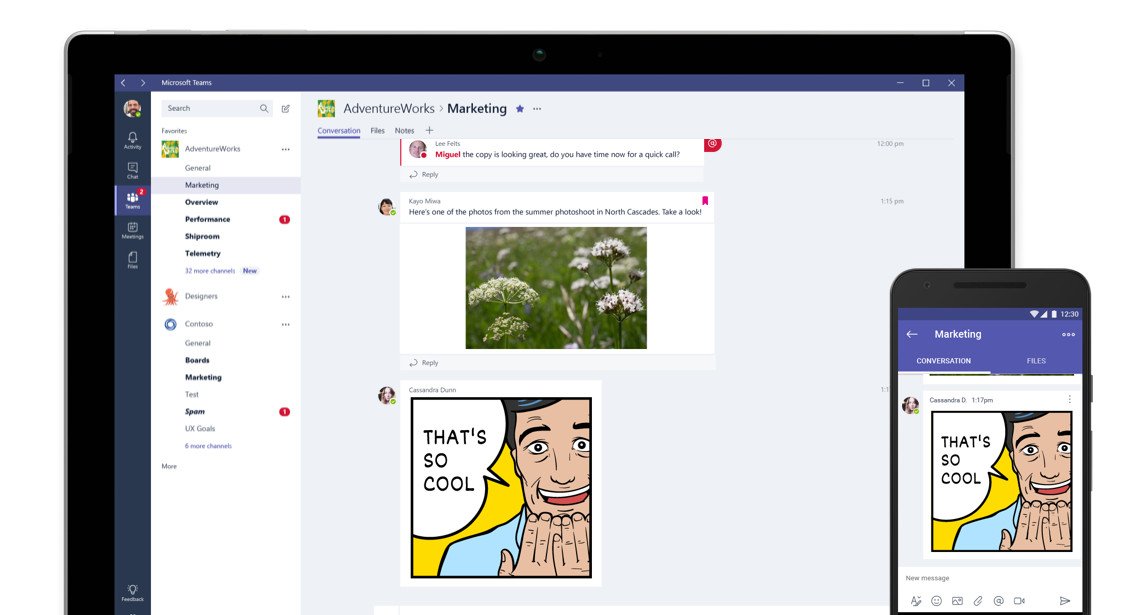
Microsoft Teams ist, wie Slack auch, ein Chatroom für Unternehmen, der es erleichtern soll, in Teams zu arbeiten und diese zu organisieren. Microsoft Teams soll das perfekte Werkzeug dafür werden und den Grundstein dafür hat Microsoft bereits gelegt. Selbstverständlich kann mit dem Tool mit Outlook, OneDrive, Skype und anderen Office-Diensten interagiert werden, die in sehr vielen Unternehmen unverzichtbar sind. Dokumente können so schneller gefunden und verschickt werden. Microsoft Teams wird bereits als „Slack-Killer“ gehandelt und das zurecht. Man hat Slack im Prinzip kopiert, es aber um zahlreiche Funktionen erweitert, beispielsweise, um die Möglichkeit auf Nachrichten zu antworten, wie es von Telegram bekannt ist oder Videoanrufe zu tätigen und Meetings zu organisieren.

Slack freut sich über Konkurrenz

Slack hat bereits heute Früh in einem Blogpost auf Microsofts Ankündigung reagiert, welche bis dahin noch nicht einmal offiziell war. Man sei wirklich erfreut über die Konkurrenz und gab den Redmondern einige Tipps mit auf den Weg. Demnach reiche es nicht, einfach die Funktionen reihenweise zu kopieren, wichtiger sei, das Produkt mit Liebe zu gestalten und Kommunikation ernst zu nehmen. Slack ist da, um zu bleiben, heißt es abschließend und man sei bereit dafür, falls Microsoft auch mit einer eigenen Idee aufhorchen lassen sollte. Es klingt dennoch nicht gerade so, als würde man Microsofts Dienst etwas abgewinnen können, wenn man auch die Konkurrenz sicherlich nicht unterschätzen sollte.

Office 365 als Paket ist besser denn je

Microsoft Office 365 ist ein zweifellos großartiger Dienst für Unternehmen und mit einer integrierten Plattform zur Organisation von Teams ist diese stärker denn je. Wenn Microsoft eine Sache kann, dann ist es Arbeitsprozesse zu verstehen und Produkte anzubieten, welche diese erleichtern. Slack wird es zweifellos sehr schwer haben, mit Microsoft Teams zu konkurrieren und vor allem neue Kunden werden sich die Frage stellen, ob es sich neben Office 365 überhaupt noch lohnt, Slack zusätzlich zu bezahlen anstatt einfach das integrierte Microsoft Teams zu nutzen.

Die Einrichtung von Microsoft Teams ist absolut unkompliziert und es ist bei Office 365 Unternehmenskunden standardmäßig dabei. Um Microsoft Teams nämlich zu aktivieren, müssen Nutzer einfach ins Admin Center im Office 365 Portal navigieren, dort die Einstellungen öffnen und unter Dienste & Add-ins Microsoft Teams auswählen und einen Schalter auf „Ein“ umlegen. Die Preview ist ab heute in 18 Sprachen erhältlich für Office 365 Enterprise- und Business-Nutzer. Offiziell ausgerollt wird die Funktion im ersten Quartal 2017.


Quelle: Microsoft

Der Beitrag Microsoft Teams: Slack-Konkurrent offiziell angekündigt erschien zuerst auf WindowsArea.de.

02 Nov 17:33

Check out this detailed overview of Microsoft Teams

by Dan Thorp-Lancaster

If you're curious about getting a more in-depth look at Microsoft Teams, Microsoft has released video overview at the app's setup process and features.

02 Nov 17:33

Urteil des Bundesarbeitsgerichts: Kranke müssen nicht zum Personalgespräch

by ZEIT ONLINE: Karriere -
Ein Krankenpfleger wurde abgemahnt, weil er während einer Krankheit nicht zum Mitarbeitergespräch kam. Er zog vor Gericht und bekam Recht. Es gibt aber Ausnahmefälle.
02 Nov 17:33

Microsoft Teams Enters Preview

by Paul Thurrott
Microsoft Teams Enters Preview

Microsoft's long-awaited Slack alternative is finally here: The software giant announced the preview version of Microsoft Teams today at an event in New York.

The post Microsoft Teams Enters Preview appeared first on Thurrott.com.

02 Nov 17:33

Get LastPass Everywhere: Multi-Device Access Is Now Free!

by Joe Siegrist

I’m thrilled to announce that, starting today, you can use LastPass on any device, anywhere, for free. No matter where you need your passwords – on your desktop, laptop, tablet, or phone – you can rely on LastPass to sync them for you, for free. Anything you save to LastPass on one device is instantly available to you on any other device you use.

From day one here at LastPass, we’ve been on a mission to help you simplify your online life, and make it a whole lot easier to achieve strong password security. By offering LastPass for free across all your devices, we’re making it that much easier for everyone to make good password habits the norm. Because when you have a password manager that goes everywhere you do, you have a strong foundation for securing and taking control of your identity.

It was a different world when we launched LastPass back in 2008. The iPhone had just arrived in 2007, without an App Store, and Android didn’t exist yet. Now, nearly every aspect of our lives, both at home and in the workplace, is connected to the cloud and available across many devices. There is no “online” life and “offline” life – it’s just life, with technology seamlessly weaving in and out of our everyday experiences. In today’s connected world, we believe the best way to benefit from the security and convenience of LastPass is to have it on all your devices. And because security is so fundamental, we want to offer a frictionless experience that makes it easy to connect safely and use strong passwords everywhere.

Too many of us are still struggling to build a strong security foundation, at work and at home. So far in 2016, there were more than 1 billion passwords publicly leaked due to poor password practices. We want to empower our users to take back control of their online security, and no longer feel powerless against the next wave of breaches. The more convenient we make password management the better we will be able to solve this problem. We want our users to bring LastPass with them everywhere – including the workplace because accessing the sites, apps, and services you use every day doesn’t end because you checked in at the office.

We’re still on a mission to be the last password you need to know, and in the future, maybe even eliminate our own master password, so there’s no password to remember at all. When that leap comes, we’ll be there to help tackle the next generation of security challenges.

Be secure,
Joe Siegrist
Founder, VP & GM of LastPass

Here’s how the new personal plans work:

If you’re already using LastPass Free, no action is required to start enjoying LastPass on all your devices. You can simply download LastPass to any of your browsers or grab the mobile app for your smartphone or tablet, and login with your LastPass account. Everything in your vault will be available, automatically, anywhere you login.

If you’re already a LastPass Premium subscriber, you’ll still enjoy the additional value that Premium offers, including priority customer support, family password sharing with up to 5 others, and additional two-factor authentication options like YubiKey. You can also safeguard important documents with 1GB of encrypted file storage. We’re hard at work developing even more useful features for power users like you, so stay tuned! Thank you for investing in LastPass and helping us build a better product, for you.

Get LastPass Free!

personalpricingFor more information, please see our customer FAQs.

02 Nov 17:32

Take an in-depth look at Microsoft Teams—now in preview

by Office 365 Team

Microsoft Teams is the chat-based workspace in Office 365 that helps teams achieve more together. On the heels of today’s preview announcement, Microsoft Mechanics catches up with Dan Stevenson, principal group program manager for Microsoft Teams, who demonstrates step by step how to get started—from user experiences for chat and collaboration to what Office 365 administrators need to do to enable and manage Microsoft Teams.

Dan explains how Microsoft Teams brings together people, conversations, content and the tools teams need with a real focus on teams, and built around chat. The Microsoft Teams chat workspace integrates with all the familiar Office apps and capabilities, such as SharePoint document libraries, OneNote, Planner, Power BI, team calendar and more.

We walk through the process to launch Microsoft Teams in Office 365 in the browser, how to download the app and everything you can do within the apps for the desktop and mobile. Microsoft Teams works in the browser and apps are available for Windows, Mac, Android and iOS platforms. Dan also demonstrates the specifics on how to get Microsoft Teams running using the Office 365 admin center and the controls available for configuring and managing the experience for your organization. Check out today’s show to learn more.

—Jeremy Chapman

The post Take an in-depth look at Microsoft Teams—now in preview appeared first on Office Blogs.

02 Nov 17:32

Introducing Microsoft Teams—the chat-based workspace in Office 365

by Kirk Koenigsbauer

Today’s post was written by Kirk Koenigsbauer, corporate vice president for the Office team.

Today, at an event in New York City, we announced Microsoft Teams—the new chat-based workspace in Office 365. Microsoft Teams is an entirely new experience that brings together people, conversations and content—along with the tools that teams need—so they can easily collaborate to achieve more. It’s naturally integrated with the familiar Office applications and is built from the ground up on the Office 365 global, secure cloud. Starting today, Microsoft Teams is available in preview in 181 countries and in 18 languages to commercial customers with Office 365 Enterprise or Business plans, with general availability expected in the first quarter of 2017.

At Microsoft, we are deeply committed to the mission of helping people and organizations achieve more—and reinventing productivity for the cloud and mobile world is core to our ambition. We built Microsoft Teams because we see both tremendous opportunity and tremendous change in how people and teams get work done. Teams are now more agile and organizational structures more flat to keep communications and information flowing. With Microsoft Teams, we aspire to create a more open, digital environment that makes work visible, integrated and accessible—across the team—so everyone can stay in the know.

Microsoft Teams delivers on four core promises to create a digital workspace for high performing teams.

Chat for today’s teams

First and foremost, Microsoft Teams provides a modern conversation experience for today’s teams. Microsoft Teams supports not only persistent but also threaded chats to keep everyone engaged. Team conversations are, by default, visible to the entire team, but there is of course the ability for private discussions. Skype is deeply integrated, so teams can participate in voice and video conferences. And everyone can add personality to their digital workspace with emojis, stickers, GIFs and custom memes to make it their own.

1

A hub for teamwork

Second, Microsoft Teams brings together the full breadth and depth of Office 365 to provide a true hub for teamwork. Word, Excel, PowerPoint, SharePoint, OneNote, Planner, Power BI and Delve are all built into Microsoft Teams so people have all the information and tools they need at their fingertips. Backed by the Microsoft Graph, intelligent services are surfaced throughout the workspace to help with information relevancy, discovery and sharing. Microsoft Teams is also built on Office 365 Groups—our cross-application membership service that makes it easy for people to move naturally from one collaboration tool to another, preserve their sense of context and share with others.

2

Customizable for each team

Third, since all teams are unique, we’ve invested deeply in ways for people to customize their workspace, with rich extensibility and open APIs available at general availability. For example, Tabs provides quick access to frequently used documents and cloud services. Microsoft Teams also shares the same Connector model as Exchange, providing notifications and updates from third-party services like Twitter or GitHub. Further, we are including full support for the Microsoft Bot Framework to bring intelligent first- and third-party services into your team environment.

3

Today, we are also announcing the Microsoft Teams Developer Preview program, allowing developers to extend Microsoft Teams. We will have integrations with over 150 partners at general availability—including our early partners Zendesk, Asana, Hootsuite and Intercom. This is the first step in providing the customization users want and the tools and support our developer community will need to integrate with Microsoft Teams.

Security teams trust

Finally, Microsoft Teams provides the advanced security and compliance capabilities that our Office 365 customers expect. Data is encrypted in transit and at rest. Like all our commercial services, we have a transparent operational model with no standing access to customer data. Microsoft Teams will support key compliance standards including EU Model Clauses, ISO 27001, SOC 2, HIPAA and more. And, as customers would expect, Microsoft Teams is served out of our hyper-scale global network of data centers, automatically provisioned within Office 365 and managed centrally, just as any other Office 365 service.

4

Microsoft Teams joins the Office 365 universal toolkit

Microsoft Teams joins the broadest and deepest portfolio of collaboration applications and services to help solve the diverse needs of people and organizations globally. As we’ve learned from our 85 million active monthly users, all groups have a diverse set of needs when it comes to working together. Office 365 is designed for the unique workstyle of every group and includes purpose-built applications, all deeply integrated together.

  • SharePoint provides intranets and content management solutions to more than 200,000 organizations and 190 million people.
  • Yammer is the social network for work, enabling cross-company discussions for 85 percent of the Fortune 500.
  • Skype for Business provides real-time voice, video and conferencing and hosts more than 100 million meetings a month.
  • Office 365 Groups is our cross-application membership service that makes it easy for people to move naturally from one collaboration tool to another.

Turn on Microsoft Teams today

Early private preview customers are seeing benefits in using Microsoft Teams. “Based on our early use of Microsoft Teams in Office 365, we believe it is the digital cockpit we’ve been waiting for,” said Andrew Wilson, CIO of Accenture. With the public preview available today, administrators can enable Microsoft Teams through the Office 365 admin center. Ready to get started—see Microsoft Teams in action in our Microsoft Mechanics video.

—Kirk Koenigsbauer

Frequently asked questions

Q. Which Office 365 plans will include Microsoft Teams?

A. Microsoft Teams is available to Office 365 commercial customers with one of the following plans: Business Essentials, Business Premium, and Enterprise E1, E3 and E5. Microsoft Teams will also be available to customers who purchased E4 prior to its retirement.

Q. What action do Office 365 IT admins need to take to access the preview of Microsoft Teams?

A. To turn on Microsoft Teams, IT admins should go to their Office 365 admin center, click Settings > Services & Add Ins > Microsoft Teams.

Q. When will Microsoft Teams roll out broadly to all eligible Office 365 customers?

A. Microsoft Teams is available in preview to eligible Office 365 commercial customers beginning November 2, 2016. We expect the service to become generally available in the first quarter of calendar year 2017.

Q. What platforms does Microsoft Teams support?

A. Microsoft Teams runs on Windows, Mac, Android, iOS and web platforms.

Q. What level of security and compliance does Microsoft Teams support?

A. Microsoft Teams is expected to be Office 365 Tier C compliant at launch. This broad set of global compliance and data protection requirements includes ISO 27001, ISO 27018, EUMC, SOC 1 Type I & II, SOC 2 Type I and II, HIPAA and FERPA. Microsoft Teams also enforces two-factor authentication, single sign on through Active Directory and encryption of data in transit and at rest.

Q. What trainings are available to help Office 365 admins learn about Microsoft Teams?

A. We have two different trainings currently available for our IT admins. To view the trainings, visit the Microsoft Virtual Academy website. We have a video on Microsoft Mechanics and more information on the Microsoft Teams Tech Community.

The post Introducing Microsoft Teams—the chat-based workspace in Office 365 appeared first on Office Blogs.

02 Nov 17:31

5 tips to better engage your meeting attendees

by Skype for Business Team

Meetings have always been a pillar of the business world, and they’re not going anywhere. According to Bain & Company, as reported by the Harvard Business Review, 15 percent of an organization’s collective time is spent in meetings. But as technologies change, workloads increase and attention spans shorten, truly reaching your audience can be a challenge.

One major hurdle is addressing an audience across multiple locations. From attendees sitting in a conference room to participants tuning in from various enterprise or home connections, your audience should feel involved and that their time and efforts are appreciated. With sentiments like 18 percent of employees saying they’d rather take a trip to the DMV than attend a status meeting (according to Clarizen), this sometimes feels like an uphill battle.

5-tips-to-better-engage-your-meeting-attendees-1

Reaching your meeting attendees shouldn’t be a struggle. Use these tips to master the necessary techniques to keep your meeting attendees engaged and happy. Who knows? Maybe your next meeting will be the most productive.

Tip 1: Make joining pain-free—Downloads, lost audio PINs, information missing from calendar invites: Everyone’s stumbled across these hurdles to join a meeting. Streamline the process with convenient meeting invites that include all the necessary information attendees need to join your meeting. To make things simple, find a meeting solution that offers automatic authentication for your organization and supports a smooth, one-click meeting join experience.

Tip 2: Allow for multiple presenters—Give everyone who needs to present the ability to do so, regardless of where they are. Meeting solutions that offer seamless presenter transitions make this possible, and provide an uninterrupted flow to keep everyone’s attention on the content being presented.

Tip 3: Show, don’t tell, important information—Effective visual communication is key to employee engagement in meetings. Show videos, presentations, websites, pictures and presenters themselves—instead of a static image that’s easy to ignore. On-site employees shouldn’t get a different meeting experience or information from people tuning in from other locations. Online meeting and broadcast solutions enable you to present to everyone, without interruption.

Tip 4: Allow for feedback, comments and engagement—If employees feel that they can’t ask questions or get involved in a meeting, they’re likely to tune it out. From Q&A sections in your meeting solution software to instant polls, questions and group instant messaging within the online meeting, give your attendees the opportunity to chime in so you know they’re still following along.

Tip 5: Use multi-device access—Giving meeting attendees the freedom to choose which devices they use to tune in is also more likely to hold their engagement through the duration of your meeting. It gives everyone the freedom to participate however works best for them: on-the-go, at their desk or from anywhere their devices are connected to the internet.

Interested in learning more about how to hold the best meeting or online broadcast? Skype for Business and Skype Meeting Broadcast give meeting organizers and attendees everything they need. Check out The Ultimate Meeting Guide and discover how to host large-scale virtual meetings like a pro to create the best possible meetings for your organization.

The post 5 tips to better engage your meeting attendees appeared first on Office Blogs.

02 Nov 17:31

Register now for “Bridging the Generation Gap: How to create cohesive teams” on Modern Workplace

by Office 365 Team

For the first time in history, many organizations now have five distinct generations in the workplace, according to Forbes.com. From Gen-Xers and Millennials, to Baby Boomers and beyond, how can you ensure your multi-generational teams are collaborating and communicating effectively?

Join us for the next episode of Modern Workplace,Bridging the Generation Gap: How to create cohesive teams,” airing November 15 at 8 a.m. PST / 4 p.m. GMT, and learn how to leverage the skills and knowledge from each team member to maximize productivity.

  • Asha Sharma, chief operating officer at Porch.com, shares how to create a dynamic workforce through empowering integrated and diverse teams.
  • Haydn Shaw, author of “Sticking Points,” highlights the twelve most common points of friction among team members and explains how they can either weaken your organization or, if leveraged properly, be the keys to its success.

Plus, get an exclusive look inside Microsoft’s latest collaboration tool—Microsoft Teams—and find out how you can improve communication and revolutionize the way your teams work.

Register now!

Related content

The post Register now for “Bridging the Generation Gap: How to create cohesive teams” on Modern Workplace appeared first on Office Blogs.

02 Nov 16:45

Computer Virus Cripples UK Hospital System

by BrianKrebs

Citing a computer virus outbreak, a hospital system in the United Kingdom has canceled all planned operations and diverted major trauma cases to neighboring facilities. The incident came as U.K. leaders detailed a national cyber security strategy that promises billions in cybersecurity spending, new special police units to pursue organized online gangs, and the possibility of retaliation for major attacks.

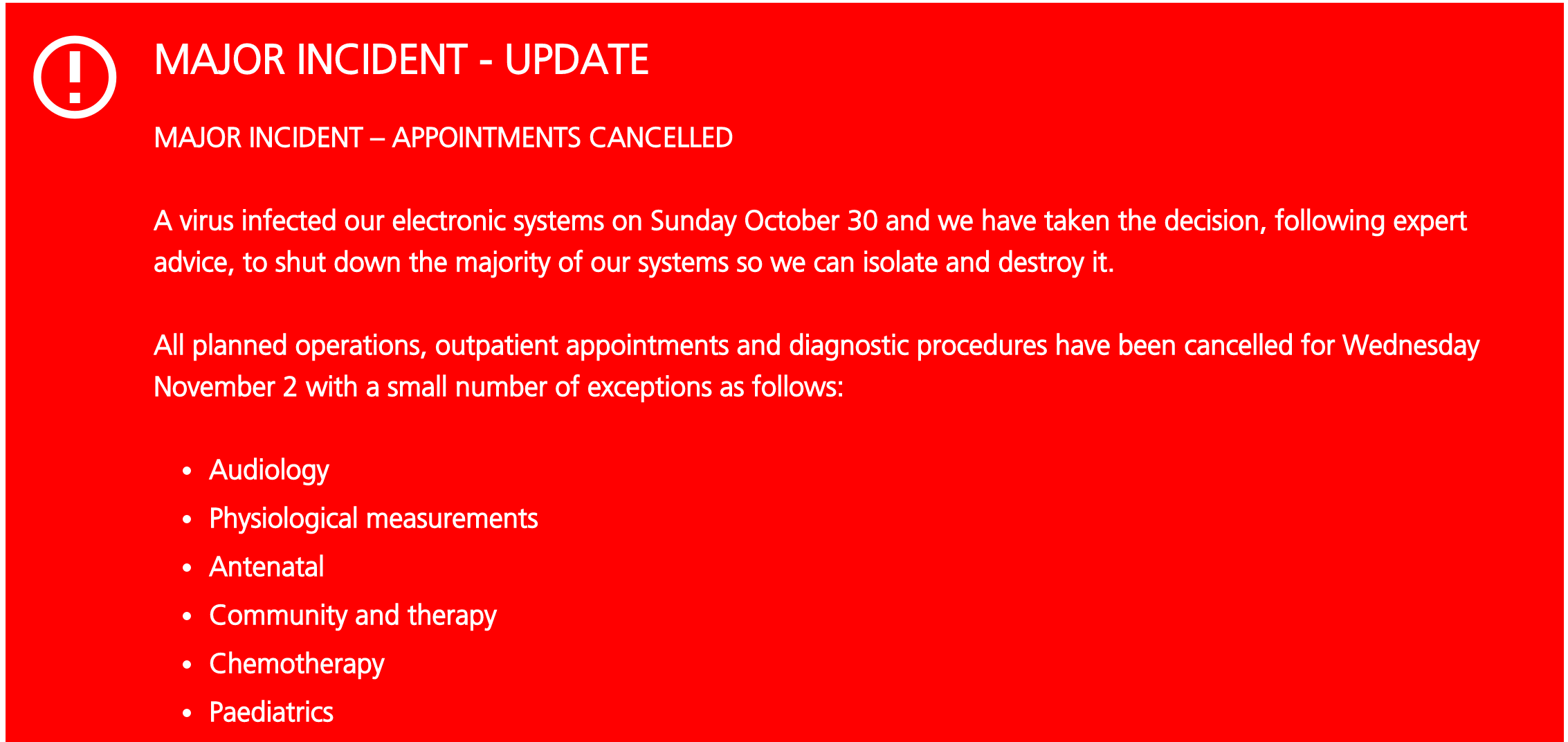
In a “major incident” alert posted to its Web site, the National Health Service’s Lincolnshire and Goole trust said it made the decision to cancel surgeries and divert trauma patients after a virus infected its electronic systems on Sunday, October 30.

A portion of an alert posted to the NHS's home page.

A portion of the alert posted to the NHS’s home page.

“We have taken the decision, following expert advise, to shut down the majority of our systems so we can isolate and destroy it,” the NHS said, of the unspecified malware infection. “All planned operations, outpatient appointments and diagnostic procedures have been cancelled for Wednesday, Nov. 2 with a small number of exceptions.”

The advisory continued:

“Inpatients will continue to be cared for and discharged as soon as they are medically fit. Major trauma cases will continue to be diverted to neighboring hospitals as will high risk women in labour.”

Although the NHS didn’t say what kind of virus infected its systems, it is likely an infestation of ransomware — a malware scourge whose purveyors have taken to targeting hospitals and healthcare facilities.

Ransomware scours an infected computer for documents, audio files, pictures and other things likely to be of value to the system’s owner, and then encrypts that data with very powerful encryption software. Most ransomware variants also scour the local network for other systems or network shares to infect. Victims usually can only get their files back after paying a specified ransom demand using a virtual currency, such as Bitcoin.

Earlier this year, experts began noticing that cybercriminals were using ransomware to target hospitals — organizations that are heavily reliant on instant access to patient records. In March 2016, Henderson, Ky.-based Methodist Hospital shut down its computer systems after an infection from the Locky strain of ransomware. Just weeks before that attack, a California hospital that was similarly besieged with ransomware paid a $17,000 ransom to get its files back.

According to a recent report by Intel Security, the healthcare sector is experiencing over 20 data loss incidents per day related to ransomware attacks. The company said it identified almost $100,000 in payments from hospital ransomware victims to specific bitcoin accounts so far in 2016.

As dependent as healthcare systems are on computers and information technology, the notion that a computer virus could result in bodily injury or death is no longer the stuff of Hollywood movie scripts. Unfortunately, the healthcare industry is for the most part still catching up in its ability to anticipate, prevent and respond to these types of cyber attacks.

As macabre as it may sound, perhaps people dying because of poor cybersecurity is exactly what it will take for more organizations to dedicate the necessary resources toward adequately defending the systems upon which they so heavily rely.

In 2010, I was interviewed by Team Cyrmu‘s Steve Santorelli as part of their ongoing Who and Why Show. Santorelli gave me a few minutes to answer the question, “What keeps you up at night?” My answer was basically that I worry what will happen to the Internet as we know it when people start to die in a measurable way because of computer and Internet security vulnerabilities and attacks. Here’s the entire interview if anyone cares to have a listen.

The crippling of NHS’s systems came as U.K. Chancellor Philip Hammond unveiled a national cybersecurity strategy, warning that hostile “foreign actors” were developing techniques that threaten the country’s electrical grid and airports, among other critical infrastructure.

“If we want Britain to be the best place in the world to be a tech business then it is also crucial that Britain is a safe place to do the digital business,” Hammond said Tuesday as he described the National Cyber Security Strategy in London. “Trust in the internet and the infrastructure on which it relies is fundamental to our economic future.”

What can businesses do to lessen the chances of having their critical infrastructure crippled by malware like ransomware? The FBI has the following tips:

  • Regularly back up data and verify the integrity of those backups. Backups are critical in ransomware incidents; if you are infected, backups may be the best way to recover your critical data.
  • Secure your backups. Ensure backups are not connected to the computers and networks they are backing up. Examples might include securing backups in the cloud or physically storing them offline. It should be noted, some instances of ransomware have the capability to lock cloud-based backups when systems continuously back up in real-time, also known as persistent synchronization.
  • Scrutinize links contained in e-mails and do not open attachments included in unsolicited e-mails.
  • Only download software – especially free software – from sites you know and trust. When possible, verify the integrity of the software through a digital signature prior to execution.
  • Ensure application patches for the operating system, software, and firmware are up to date, including Adobe Flash, Java, Web browsers, etc.
  • Ensure anti-virus and anti-malware solutions are set to automatically update and regular scans are conducted.
  • Disable macro scripts from files transmitted via e-mail. Consider using Office Viewer software to open Microsoft Office files transmitted via e-mail instead of full Office Suite applications.
  • Implement software restrictions or other controls to prevent the execution of programs in common ransomware locations, such as temporary folders supporting popular Internet browsers, or compression/decompression programs, including those located in the AppData/LocalAppData folder.

Additional considerations for businesses include the following:

  • Focus on awareness and training. Because end users are often targeted, employees should be made aware of the threat of ransomware, how it is delivered, and trained on information security principles and techniques.
  • Patch all endpoint device operating systems, software, and firmware as vulnerabilities are discovered. This precaution can be made easier through a centralized patch management system.
  • Manage the use of privileged accounts by implementing the principle of least privilege. No users should be assigned administrative access unless absolutely needed. Those with a need for administrator accounts should only use them when necessary; they should operate with standard user accounts at all other times.
  • Configure access controls with least privilege in mind. If a user only needs to read specific files, he or she should not have write access to those files, directories, or shares.
  • Use virtualized environments to execute operating system environments or specific programs.
  • Categorize data based on organizational value, and implement physical/logical separation of networks and data for different organizational units. For example, sensitive research or business data should not reside on the same server and/or network segment as an organization’s e-mail environment.
  • Require user interaction for end user applications communicating with Web sites uncategorized by the network proxy or firewall. Examples include requiring users to type in information or enter a password when the system communicates with an uncategorized Web site.
  • Implement application whitelisting. Only allow systems to execute programs known and permitted by security policy.

Further reading: SC Magazine UK’s take on the attack.

02 Nov 16:45

Jetzt patchen! Angriffe auf über 30.000 Joomla-Webseiten

Joomla Patch

Sicherheitsforscher warnen, dass es Angreifer derzeit vermehrt auf Joomla-Webseiten abgesehen haben. Admins sollten zügig die jüngst erschienene abgesicherte Version installieren.

02 Nov 16:45

Datenpanne: Wenn das iPhone die Geheimnummer der Nationalratspräsidentin kennt

Datenpanne: Wenn das iPhone die Geheimnummer der Nationalratspräsidentin kennt

Offenbar durch einen Fehler bei AppleCare sind die Telefonbucheinträge mehrerer iPhone-Nutzer an andere übertragen worden, berichten der "Stern" und das österreichische Magazin "News".

02 Nov 16:45

„Das war erst der Anfang“: Am großen DDoS-Angriff waren vermutlich nur 50.000 Geräte beteiligt

by Kim Rixecker

Die große DDoS-Attacke vom Oktober 2016 könnte von nur 50.000 Geräten durchgeführt worden sein. Demnach könnten uns noch weit größere Angriffe bevorstehen.

Sophos: Sicherheitsexperte Chester Wisniewski über die DDoS-Attacke

Im Oktober 2016 sorgte eine massive DDoS-Attacke auf DNS-Server dafür, dass viele bekannte Websites wie Twitter, Airbnb oder Github für Stunden nicht erreichbar waren. Der Angriff ging von einem Botnet aus, das dazu vor allem auf Geräte aus dem sogenannten Internet der Dinge, wie beispielsweise vernetzte Kameras, zurückgegriffen hat. Das Botnet könnte aus weiter weniger Geräten bestanden haben, als bislang vermutet wurde.

Manche Geräte müsste man wegschmeißen, weil es gar keine Option ist, ein Update einzuspielen

„Level 3 geht davon aus, dass es nur 50.000 Geräte waren“, sagte Chester Wisniewski, Senior Security Advisor bei dem Sicherheitsunternehmen Sophos, t3n.de. Level 3 ist einer der Anbieter, der direkt von der DDoS-Attacke betroffen war. Wisniewski kann die Anzahl zwar selbst nicht verifizieren, rein mathematisch sei es aber plausibel, weil die eingesetzte Botnet-Software über die Fähigkeit verfüge, von jedem infizierten Gerät aus mit jeweils etwa 1.000 gefälschten IP-Adressen anzugreifen.

„Das war erst der Anfang“: Die Attacke hätte noch deutlich größer sein können

„Wenn 50.000 von hundert Millionen schlecht geschützter Geräte sowas anrichten können, was können dann hunderttausend, oder eine Million oder zehn Millionen anrichten?“, so Wisniewski. Tatsächlich war der Oktober-Angriff für den IT-Sicherheitsexperten erst der Anfang. Zukünftig könnte es „hundert verschiedene Kriminelle mit jeweils 50.000 Bots“ geben, wenn jeder von ihnen sich auf unterschiedliche IoT-Geräte konzentriert.

Laut Chester Wisniewski könnte der Oktober-Angriff von nur 50.000 Geräten durchgeführt worden sein. (Foto: Sophos)

Problematisch ist vor allem der Umstand, dass es sich bei dem Botnet um IoT-Geräte handelt, und nicht um herkömmliche PCs. Den Besitzer eines infizierten Computers könnte man theoretisch vom Netz abschneiden, und ihm dann bei der Beseitigung des Problems unterstützen. „Wir können das bei IoT nicht machen, weil wir nicht wissen, wem das Gerät gehört, wo sie sich befinden; die meisten Geräte haben nicht einmal notwendigerweise einen Update-Mechanismus integriert. Manche Geräte müsste man wegschmeißen, weil es gar keine Option ist, ein Update einzuspielen.“

Sophos-Experte Wisniewski: Regulierung ist keine Lösung

Das wiederum wirft die Frage auf, wie mit dem Problem umgegangen werden kann. „Die natürliche Reaktion für viele Menschen wäre: Regulierung. Aber du kannst es nicht regulieren, wenn es in China hergestellt, in Taiwan entwickelt und dann in 135 Länder ausgeliefert wird.“ Würde die EU beispielsweise Vorschriften einführen, die den Import von extrem unsicheren IoT-Geräten verbieten, würde das laut Wisniewski trotzdem nur etwa 20 Prozent des gesamten Bot-Traffics betreffen. Und auch wenn wir in der westlichen Welt eine Regulierung einführen wollten, könnten wir uns laut dem Sicherheitsexperten vermutlich nicht auf einheitliche Sicherheitsstandards einigen.

02 Nov 16:35

LastPass Makes Multi-Device Access Free to All

by Paul Thurrott
LastPass Makes Multi-Device Access Free to All

LastPass announced today that you will no longer need a paid Premium account to access the service on multiple devices. This feature is now free for everyone.

The post LastPass Makes Multi-Device Access Free to All appeared first on Thurrott.com.

02 Nov 16:33

Introduction video outs Microsoft Teams ahead of official announcement

by Dan Thorp-Lancaster

We're expecting Microsoft to introduce its Slack competitor, Microsoft Teams, imminently at its November Office event. However, if you can't wait, an introduction video for the service has leaked out just ahead of the event, courtesy of avid leaker WalkingCat on Twitter

02 Nov 16:32

Microsoft is taking on Slack with Teams collaboration group chat

by Zac Bowden

After several weeks of rumors and leaks, Microsoft has officially announced Microsoft Teams; a new Slack competitor that aims to make team-collaboration easy and quick. Powered by Office and Skype, Microsoft Teams is aimed at businesses using Office 365, and has a wide array of features.

Microsoft's goal with Teams is to empower every team to achieve more. With direct integration with OneDrive, Outlook, Skype, and other Office related products, making it an excellent choice over the likes of Slack and HipChat for those using Office 365.

From Microsoft's official Teams website:

Get flexible communication in the moment and keep everyone in the know. See content and chat history anytime, including team chats with Skype that are visible to the whole team. Private group chats are available for smaller group conversations.

Many will be ready to compare Microsoft Teams with Slack, another popular team-collaboration tool that boasts 4 million daily active users. Slack even went so far as to write an open letter to Microsoft, encouraging them to break into the team-collaboration market whilst simultaneously showing that they're worried for what Microsoft has to offer.

02 Nov 15:32

Deutsche Telekom: Paketbutler steht bundesweit zur Verfügung

Der Paketsack mit SIM-Karte kann jetzt bundesweit bestellt werden. Der Kunde verankert den Gurt zwischen Zarge und Tür. Die Indoorlösung funktioniert nur in Mehrparteienhäusern. (Packstation, RFID)
02 Nov 15:31

Maker: Wazer schneidet mit Wasser

Ein neues Gerät für die Maker-Labore: US-Wissenschaftler haben einen Wasserstrahlschneider für den Hausgebrauch entwickelt. Bei Kickstarter ist das Gerät sehr beliebt. (Technologie)

02 Nov 15:27

US-Wahl: "Wann hören Homosexuelle endlich auf, Demokraten zu wählen?"

by ZEIT ONLINE: Ausland - Kerstin Kohlenberg
Amerikas extreme Rechte fördert eine neue intolerante, rassistische Jugendkultur. Die Bewegung steht hinter Trump. Ihr Star ist der schwule Milo Yiannopoulos.
02 Nov 15:27

Debris analysis of MH370: controlled ditching not likely

by Harro Ranter
Inboard section of outboard flap of MH370 (ATSB)

Inboard section of outboard flap of MH370 (ATSB)

The Malaysia Airlines Boeing 777 missing since March 2014, MH370, likely came down at an increasing rate of descent and without deployment of flaps according to analysis published by the Australian Transport Safety Bureau (ATSB).

The ATSB report provides an update to the MH370 search area definition. An analysis was made of the burst frequency offsets associated with the final satellite communications to and from the aircraft. These results were consistent with the aircraft being in a high and increasing rate of descent at that time. Additionally, the wing flap debris analysis “reduced the likelihood of end-of-flight scenarios involving flap deployment,” according to the ATSB. Thus, a scenario where a controlled ditching was carried out seems unlikely.

To assist with the underwater search for the aircraft, the Commonwealth Scientific and Industrial Research Organisation (CSIRO) undertook an analysis of existing ocean drifting and currents data. Preliminary results of the drift analysis indicated it was unlikely that debris originated from south of the current search area. The northernmost simulated regions were also found to be less likely. Drift analysis work is ongoing and is expected to refine these results.

The report also stated that currently, more than 20 items of debris are under investigation. The items have been located along the east and south coast of Africa, the east coast of Madagascar and the Islands of Mauritius, Reunion and Rodrigues in the Indian Ocean. A list of items recovered was published by the Malaysian investigation team (PDF).


The post Debris analysis of MH370: controlled ditching not likely appeared first on ASN News.

02 Nov 15:26

Microsoft's reimagining of the PC for creators heralds a new generation of computer

by Jason Ward

Microsoft, during its Oct 26th event, made known its venture into a space traditionally acknowledged as Apple's forte: creative professionals.

If you ask any creative professional, such as an artist or musician Apple's iMac is the preferred tool for most, hands down. For artists of varying disciplines, Apple's high-end and expensive hardware have been the industry standard for anyone serious about their craft. That is not to say the non-artistic consumer will not find value with a Mac. Apple's desktop computer has simply set itself head and shoulders above other PCs for the artistic professional.

Conversely, Microsoft's productivity focus has made it the go-to tool in the enterprise. Furthermore, Redmond's allegiance with hardware partners helped push the PC to bargain basement price points and thus into 90% of homes in the market.

The contrast between the Mac and the PC has seen the two placed at opposite ends of the spectrum at times. Apple's high pricing and the Macs appeal to professionals has given it an elite and luxury branding. Microsoft's reliance on manufacturing partners who have represented Windows on both high end, but more visibly for the masses on low-end, hardware has positioned Redmond to contend with a "generic" perception of PCs. Windows dominance in the market on 90% of PCs and the familiarity of the Office productivity suite has reinforced the polarization between the Mac and PC.

Surface Studio and Creators Update is aimed at mainstreaming creative tools for everyone

With the introduction of the Windows Creators update and the Surface Studio, Microsoft is looking to make its platform more appealing to all creators. The company is also aiming to make its hardware the ideal tool for content creation. Moreover, in line with the first-party Surface line, Redmond is positioning the Studio to "rebrand" Windows desktop PCs. As a high-end, high-priced $3000 aspirational device the Studio (and other Surfaces) combat the low-end legacy perception associated with PCs when compared to the iMac (and MacBook).

02 Nov 15:26

Microsoft Flow is Now Available

by Paul Thurrott
Microsoft Flow is Now Available

Microsoft Flow---the software giant's answer to IFTTT---is now available, following about six months in beta.

The post Microsoft Flow is Now Available appeared first on Thurrott.com.

02 Nov 15:22

DDoS-Rekord-Botnetz Mirai ließe sich bekämpfen – allerdings illegal

DDoS-Rekord-Botnetz Mirai ließe sich bekämpfen, illegalerweise

Forscher haben einen konkreten Vorschlag gemacht, wie das IoT-Super-Botnetz Mirai angegriffen werden könnte. Allerdings würde sich derjenige, der den Plan durchführt, sehr wahrscheinlich gleich mehrmals strafbar machen.

02 Nov 15:22

Reporter ohne Grenzen: Erdoğan zum "Feind der Pressefreiheit" erklärt

by ZEIT ONLINE: Ausland -
Reporter ohne Grenzen wirft dem türkischen Präsidenten eine "aggressive Diktatur unter dem Schleier der Demokratie" vor. Auch Kanzlerin Merkel hat ihre Kritik verschärft.
02 Nov 15:21

Elektromobilität: Elektroautos auf die Überholspur

by ZEIT ONLINE: Mobilitaet - Matthias Breitinger
Arndt Dibi

Doch doch, das ist der ganz richtige Weg.

Die deutsche Autolobby läuft Sturm gegen strengere Emissionsregeln, ob in China oder in der EU – und deutsche Minister unterstützen sie dabei. Das ist der falsche Weg.
02 Nov 15:20

LastPass is now free to use across unlimited devices

by Dan Thorp-Lancaster

LastPass users have something to be excited about, as the password manager is now free to use on an unlimited number of PCs, phones and tablets.

02 Nov 15:20

Kreative sind glücklicher und verdienen mehr – aber Deutschland lässt Potenzial liegen

by Stefan von Gagern

Der Softwarehersteller Adobe hat eine umfassende Studie veröffentlicht, die tiefe Einblicke ins weltweite Kreativ-Business verschafft. Demnach leidet Deutschland unter einer „Kreativitäts-Schere.“

Anlässlich der Kreativ-Konferenz Adobe Max in San Jose stellt der Softwarehersteller Adobe in diesen Tagen eine neue weltweite Studie rund um Kreativität vor. Sie liegt t3n.de mit ausführlichen deutschen Kennzahlen vorab vor. Für die Studie befragten die Macher von Photoshop, Indesign und Creative Cloud 5000 Teilnehmer in den starken Wirtschaftsnationen USA, Großbritannien, Deutschland, Frankreich und Japan. Ziel der Studie war es, die Rolle der Kreativität in der Wirtschaft und Gesellschaft zu identifizieren. Die große Erkenntnis: Kreativität wird hoch angesehen und zahlt sich bei allen Unternehmen, die Kreativität fördern, in barer Münze aus – wird aber tatsächlich oft verhindert statt gefördert.

Deutschen ist gutes Design überdurchschnittlich wichtig

Laut der Studie zahlt sich Design direkt für den Unternehmenserfolg aus. Marken-Loyalität und Reputation von Unternehmen hängen stark vom Design ab. Für Deutsche ist das im internationalen Vergleich sogar überdurchschnittlich wichtig. 61 Prozent der Deutschen würden ein Produkt oder einen Service der Konkurrenz vorziehen, wenn er gutes Design anbietet. Gerade bei der jungen, wie auch bei der kaufkräftigen Zielgruppe kommt gutes Design an: Befragte von 18-50 Jahren gaben an, im letzten Jahr gerne mehr für Produkte bezahlt zu haben, weil sie sich durch gutes Design auszeichneten.

Unternehmen, die in Deutschland wachsen wollen, sollten also Design eine wichtige Rolle beimessen und Kreativität im Unternehmen fördern. Das ist laut der Studie aber kein lokales Phänomen: Weltweit hält die große Mehrheit (rund 80 Prozent) Kreativität für den Schlüssel zum Wirtschaftswachstum. Und es geht nicht nur um Geld und Umsatz: 83 Prozent der Deutschen sind zum Beispiel überzeugt, dass Kreativität einen wichtigen Beitrag zur Gesellschaft leistet.

Deutsche möchten kreativer arbeiten, als sie dürfen

Im Gegensatz zum guten Image der Kreativität klafft in der Realität eine große „Kreativitäts-Schere“. Nur die Hälfte gab an, überhaupt kreativ arbeiten zu dürfen. Nur einer von vier Befragten hat zum Beispiel das Gefühl, dass er sein kreatives Potenzial voll ausnutzen darf. Zudem herrscht allgemein das Gefühl des Drucks, immer produktiver zu müssen. Dabei bleibt gefühlt die Kreativität auf der Strecke.

Kreativität als Schlüssel zum Wirtschaftswachstum

Das sei laut der Studie besonders in Deutschland der Fall: Nur ein kleiner Teil findet, dass er das Optimum seines kreativen Leistungsvermögens abrufen kann. Arbeitsbedingungen und gesellschaftliche Strukturen würden dies verhindern. So ist der Großteil der Befragten mehr außerhalb der Arbeitszeit kreativ, als am Arbeitsplatz.

Kreativität zahlt sich für Arbeitnehmer und –geber aus

Alle Befragten, die sich selbst als kreativ bezeichnen, verdienen im Vergleich zu nicht kreativ arbeitetenden mehr (13 Prozent). Zudem sind sie glücklicher: Sie bezeichnen sich selbst als im Vergleich deutlich öfter als innovativ (+25 Prozent), selbstbewusst (+22), Problem-Löser (+22) und glücklicher (+19). Und Kreativität lohnt sich auch aus Sicht des Arbeitgebers: Weltweit geben Unternehmen, die Kreativität fördern, an, dass sich die Produktivität der Mitarbeiter und ihre Zufriedenheit gesteigert haben. Zudem haben kreativ arbeitende Firmen zufriedenere Kunden und betreiben mehr Innovation.