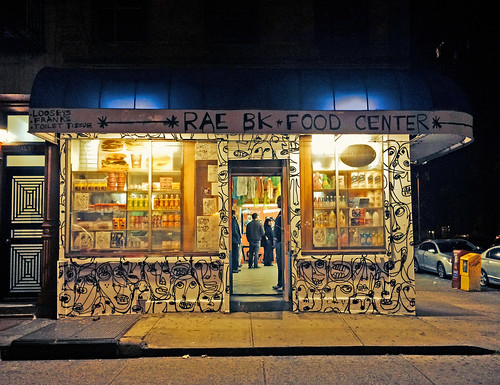
And for one brief, shining moment, the zombie ghost of the counterculture prevails: The 7-Eleven on St. Marks Place, a street we've heard was once thought of as cool, has closed, temporarily delaying the bodega killer's inevitable New York City takeover. The squatters should hurry up and move in before ... More »
Shared posts
Local Bodegas Drive Massive Corporate Chain From Neighborhood
And for one brief, shining moment, the zombie ghost of the counterculture prevails: The 7-Eleven on St. Marks Place, a street we've heard was once thought of as cool, has closed, temporarily delaying the bodega killer's inevitable New York City takeover. The squatters should hurry up and move in before ... More »
Craft services for 'The Cobbler' on East 7th Street
Elliot Boblitthere it is!

Filming continued today near and around Tompkins Square Park for the Adam Sandler feature, "The Cobbler."
Bobby Williams spotted the crew in action late this afternoon on East Eighth Street between Avenue B and Avenue C…

Help Tamarack Hollow Farm Move Out of a Flood Zone
Elliot Boblitt!!!! my farm!!!!!!!!

[Photograph: Ben Fishner]
If you're a fan of Union Square Greenmarket vendor Tamarack Hollow Farm's pasture-raised bacon and organic produce (see our profile here), now's the time to lend a helping hand. The farm is raising money to move to higher ground, out of a flood plain that's seen three major and costly floods in the last three years.
The most recent was this past summer, when the farm's 12 acres of pasture were repeatedly flooded in May, June, and July. "We cannot survive another season in this new climate," the Kickstarter's note explains, which is why they're looking to move to a 20-acre plot of land in Plainfield, Vermont.
Tamarack Hollow has three more days to reach their funding goal of $25,000, for which they need a final push of $2,500. They'll use the funds to dig a well and irrigation pond, build new storage structures, and handle the costs of moving the farm. In the meantime they plan to keep selling produce, meat, poultry, and eggs at the Greenmarket all winter long. More details on their Kickstarter.
Bake the Book: Cinnamon Sugar Scones
Elliot Boblitti want these
[Photograph: Evan Sung]
Is there anything better than warm cinnamon and sugar on a cold winter day? One Bowl Baking uses both as the filling for moist, crumbly cinnamon sugar scones. They come together in no time, making this recipe suitable for both weekdays and the weekend.
Tips: As is recommended in the book, using a pastry cutter with heavy-duty blades makes cutting the butter into the flour much easier. Hand-held pastry cutters can be purchased at a kitchen supply store, or in a well-stocked kitchen aisle of your local grocery store.
Tweaks: Since cinnamon is the star ingredient of these scones (followed closely by butter), make sure both are as fresh as can be. Vietnamese cinnamon, or Saigon cinnamon, is sweet and spicy, and due to its high oil content, permeates strongly through your baked goods. Look for it next to regular cinnamon in the spice aisle. Or, buy it online.
As always with our Bake the Book feature, we have five (5) copies of One Bowl Baking to give away.
Get the Recipe!Thousands of Parachuting Mice Not Nearly As Adorable As It Sounds
The 2,000 mice that drifted to earth over Guam Sunday hung from tiny paper parachutes, attached to cardboard, which sounds absolutely adorable until you learn their deadly truth: The dead mice, infused with acetaminophen, were being used as bait to kill brown tree snakes, an invasive species threatening Guam's birds. ... More »
A Sinking State
Goldberg reports from the South Pacific island nation of Kiribati, a “flyspeck of a United Nations member state” where locals are nervously eyeing the rising waters:
If scientists are correct, the ocean will swallow most of Kiribati before the end of the century, and perhaps much sooner than that. … Before the rising Pacific drowns these atolls, though, it will infiltrate, and irreversibly poison, their already inadequate supply of fresh water. The apocalypse could come even sooner for Kiribati if violent storms, of the sort that recently destroyed parts of the Philippines, strike its islands. For all of these reasons, the 103,000 citizens of Kiribati may soon become refugees, perhaps the first mass movement of people fleeing the consequences of global warming rather than war or famine.
This is why [Kiribati's president Anote] Tong visits Fiji so frequently. He is searching for a place to move his people. The government of Kiribati recently bought 6,000 acres of land in Fiji for a reported $9.6 million, to the apparent consternation of Fiji’s military rulers. Fiji has expressed no interest in absorbing the I-Kiribati, as the country’s people are known. A former president of Zambia, in south-central Africa, once offered Kiribati’s people land in his country, but then he died. No one else so far has volunteered to organize a rescue.
More bad news for the I-Kiribati: New Zealand recently denied a Kiribati citizen’s high-profile bid f0r refugee status.
(Photo: A scene in South Tarawa, the capital of Kiribati. By Australian Aid)
Did You Know The First Panda In America Lived In A NYC Apartment?
Fashion designer and New York socialite-turned-explorer, Ruth Harkness, traveled to China in 1936 in search of one of the rarest animals of the time: the panda. She succeeded in not just finding one, but she brought it back to America in her arms (getting it through as a dog). That kind of seems like a terrible idea! But Harkness was met back in the States with applause. [ more › ]For those about to shop
Per the EVCC website:
Spending your money locally helps small businesses thrive in the East Village.
Local shopping also:
• Keeps more money in our community
• Creates local jobs with fair wages
• Sustains small business owners who defend our neighborhood’s identity
• Spending your money locally helps small businesses thrive in the East Village.
The newly available 7th Edition lists more than 450 local merchants and is available in shops and cafes in the neighborhood.
It Works! Before & After of Using an Iron to Remove Water Rings from Furniture
F.D.A. Shuts Down Personal Genetic-Testing Site
Elliot Boblittisn't this what they talked about / tried out on on the media?
By offering inexpensive genetic testing kits, the Google-backed startup, 23andMe, promised the world that we could take charge of our DNA destinies. They said they could provide information on a person's susceptibility to 250 diseases and health conditions, including identify potential life-threatening illnesses before it's too late. But now, the Food and Drug Administration has quashed their efforts, saying there's not enough science to back up their claims.The F.D.A. asserts that only tests that have been approved by the government can tell customers whether or not they're at risk for any disease. Because 23andMe's test has not been evaluated by the government, the F.D.A. has ordered them to halt selling it. They fear that unnecessary medical procedures might result. But, should the F.D.A. be regulating whether an individual has access to information about their own genetic material?
23andMe has 15 days to respond to the F.D.A.'s decision. For now, their $99 DNA tests are no more. (ABC News)
Like what you see? How about some more R29 goodness, right here?
The '60s Wellness Lessons We Still Use Today
Corporations Can Refuse To Cover Your BC? The Supreme Court Is Deciding
Press This Button To Find Out What's In Your Food...Instantly!
Yo-Ho Brewing: A Window Into Craft Beer in Japan
Elliot Boblittwell these couldn't be cuter

Japan is the world's 7th largest beer producer, and beer and beer-like beverages accounted for 67% of Japan's 9 billion liters of alcohol consumption in 2006. Until 1994, Japanese tax laws, enacted to protect domestic brewing, set minimum production limits that instead ensured the dominance of the big four breweries Kirin, Asahi, Sapporo and Suntory. Combined, they account for 99% of all beer sold nationally.
However, when those minimums were lowered from two million liters/year to 60,000 liters/year, it opened the door for craft brewing to emerge in the land of the rising sun. Since then, a fledgling, but vibrant scene has developed, and Yo-Ho Brewing in Nagano is a leading player.
Yo-Ho was founded in 1996 by Keiji Hoshino, who drank his first craft beer in the United States while he was an exchange student, and quickly discovered how bad most Japanese beer was. According to Yo-Ho's president, Naoyuki Ide, the brewery sees itself as being more like an American craft brewery than any of its Japanese counterparts. Their focus has been almost entirely on ale production since the first batch was brewed in 1997, and their intended customer is "the general beer drinking consumer," as opposed to other small breweries which primarily sell locally to tourists.
Many of the brewery's current styles were developed by former head brewer Toshi Ishii, who honed his craft at Stone Brewing in California. He has since left Yo-Ho, and started his own brewery, Ishii Brewing Company, in Guam.
According to Ide, Yo-Ho maintains a very strong emphasis on quality control, focusing on natural carbonation and the use of their own yeast strands in the brewing process. The brewery uses slightly harder water than most, since it's located on the foothills of volcanic Mt. Asama, which Ide claims "adds to the depth of our beer flavors."
The company is expanding its presence in Japan and abroad. Many larger Japanese retailers have started selling craft beer, and Yo-Ho will also soon be opening a brewpub in Tokyo's Akasaka district. According to Toshi Kojima of Seattle-based importer BeverageTraders (who also kindly provided translations for this article,) Yo-Ho currently exports to Singapore, Australia, Hong Kong, and the United States, where they primarily ship to the west coast, but are in the process of signing on with a new east coast distributor.
What do the beers taste like? I sampled a few, including their newest release, a Belgian White called Suiyoubi no Neko. My thoughts are below.
Suiyoubi no Neko

Fairly smooth, faintly fruity, with hints of banana and citrus, Suiyoubi no Neko is a simple and unassuming Belgian Wheat. In addition to the fruit, it tastes yeasty and unfiltered, as is common for the style, despite not being very cloudy (I could see my fingers through the glass.) I wouldn't necessarily seek this out over, say, Hoegaarden, but it's light, refreshing, and well-executed, just right for serving with sashimi or salads. Also, I really like the cat on the can (Suiyoubi no Neko translates to "Wednesday Cat.")
Yona Yona

Yo-Ho's American-style Pale Ale is fairly hoppy and bitter. But it's smooth and it has a certain sweetness, with some hints of citrus, and even a little maple and honey. Yona Yona translates to "Every Day," and indeed, this beer was intended to be drinkable on a regular basis. Like Suiyoubi no Neko, it's not a tremendously innovative beer, but it's a really well-excecuted version of the style. Drink it with katsu curry or ramen.
Aooni

Aooni, which translates to "Blue Demon of India', is an English-style IPA, and a bit stronger than Yona Yona at 7% instead of 5.5% ABV. It's a bit less sweet than the pale, with lingering earthy hops, though fans of American IPAs won't find it super hoppy. Drink it with a big cheeseburger and French fries.
Tokyo Black

The first note I wrote down when I started drinking this was "f***ing outstanding porter." There's really not that much more that needs saying. This one is black as night; a heavy, sludgy pour even though it's only 5% alcohol. It's smooth, smoky, and roasty—the beer tastes bittersweet, with a lot of coffee and a little bit of chocolate and vanilla in the mix. This is a porter of the highest order, in my opinion. Pair it with smoked meats or cheeses, or try it with a steak.
What's Next for Japanese Beer?

If anyone reading knows Japanese, we'll be your best friend if you can translate this all for us.
Most of Yo-Ho's beers wouldn't really stand out in today's vibrant American craft beer scene, but in the Japanese beer market, they're miles beyond what's commonly sold. And when you consider that America's first popular craft beers debuted long before Japanese deregulation and Yo-Ho's first batches, the future looks very bright for Japanese beer and this unique Nagano brewery. Now please, beer me a Tokyo Black.
About the author: Ben Jay is an editorial intern at Serious Eats, photographer, carnivore, beer and whisky drinker, and music nerd. Special thanks to Toshi Kojima for translating and everything. You can follow him on Twitter and Instagram.
Snowflakes, close-up


Alexey Kljatov takes amazing photographs of snowflakes. Infinite beautiful variation. The large versions are worth checking out.
Tags: Alexey Kljatov photography snowparsley leaf potatoes
Why slow down? If you’re like me, at the outset of a holiday, you’re brimming with ideas: dry-brined, braise-roasted and deep-fried turkeys! homemade stuffing from homemade bread! individual miniature pies for every person at the table. As the holiday gets closer — not unlike the progression of this week for me — real life begins to creep in. There are day jobs, flu-like symptoms, traffic jams and extremely dull things like dentist appointments doing everything in their power to interrupt. There are only so many hours in the day, and days left in which one can cook. There are only so many hours of those hours in which one can cook that they actually want to.
... Read the rest of parsley leaf potatoes on smittenkitchen.com
© smitten kitchen 2006-2012. | permalink to parsley leaf potatoes | 119 comments to date | see more: Budget, Herbs, Photo, Potatoes, Side Dish, Thanksgiving, Vegetarian
This GIF Will Turn You Into An Environmentalist

Environmentalism, much like feminism, is an excellent and worthy cause that sometimes suffers from bad PR and an unfortunate reputation. In essence, there's no reason not to support a movement that simply asks that we not destroy what is, as far as we know, the only inhabitable planet in this universe. But, hey, sometimes it's not that simple. There are politics involved, there are smear campaigns, there are fanatics on both sides who miss the point and leave us more divided than united.
However, we will humbly say that this GIF may have the power to remind us all what it's really about when it comes to conservation. It's so pure, so evocative, and it gets the message across in a very straightforward way that you can't really argue with. Reminds us of this Are You A Feminist quiz, actually!
NYC dwellers may not have much choice, but for the rest of us, perhaps this little moving picture will stick in our minds the next time we have the chance to carpool or take public transit to the office. The Internet is a powerful thing! (Gizmodo)
Like what you see? How about some more R29 goodness, right here?
Girls' Season 3 Trailer Is Here! (Kind Of)
Cara D. Is Recording An Album With RiRi's Producer!
The Scandal Recap Ridiculist: Vermont Is For Lovers
Garden Visit: Dr. Sun Yat-Sen Classical Chinese Garden
On a recent trip to Vancouver, I paid a visit to the Dr. Sun Yat-Sen Classical Chinese Garden. It's situated in the heart of Chinatown, with views of the city's skyline peeking above the garden's walls and structures. This garden was built to represent the 15th century garden home of a scholar-official's family, and is the first of its kind to be built outside of China.
Dirt Candy will be moving to Allen Street; will hold on to E. 9th St. space

Last night, CB3's SLA subcommittee OK'd a liquor license application for a Dirt Candy outpost at 86 Allen St. (BoweryBoogie has more on the meeting here.)
Chef Amanda Cohen has also signed the lease for No. 86, which will provide her team with much more space for their well-regarded vegetarian fare. We asked Cohen for a few details on what's next.
"We are hoping to open late next fall. We are planning on serving the same food that we served at the 9th Street location — it will be a vegetable restaurant," she said via email.
And what will become of the East Ninth Street location?
"We aren't sure what we are going to do with the old space. We are definitely going to keep it, but for now all we know is that it won't be a full-service restaurant."
Meanwhile, brokers for the nearby 119 Orchard St. were apparently quite excited about the new Dirty Candy. We spotted this listing back on Oct. 22 that names Dirt Candy as a (coming soon) neighbor even though Cohen hadn't signed at lease yet at Allen Street or secured liquor-license approval...

Giveaway: Win A Ski And Snowboard Trip For Two In Killington, Vermont!

Get out of NYC this winter and head to Vermont for some of the best skiing and snowboarding on the East Coast.
We're teaming up with Trip Tribe and Need 2 Know to give away a prize package to one lucky winner, including: a trip for two on the Trip Tribe's Ski and Snowboard Weekend Adventure, four days and three nights of lodging, two-day lift tickets, a welcome party, and nightly happy hours and events. You won't need anything else to tear up the slopes like you were meant to do! Check out more info here, and enter below for a chance to win.
[ more › ]
More about Big Dirt Candy
Elliot Boblittso THAT'S what's going on.
As for the current Dirt Candy home on East Ninth Street, Cohen told us: "We aren't sure what we are going to do with the old space. We are definitely going to keep it, but for now all we know is that it won't be a full-service restaurant."
Later yesterday, Cohen had more to say about all this at the Dirt Candy website:
What will happen at Big Dirt Candy? It’ll be Dirt Candy, only bigger! There will be a bar where you can wait for your table! There will be ice! No more two month wait for tables! There will be more than one non-alcoholic drink on the menu! The chairs will have four legs! Most importantly, everything I’m doing, from the design, to the menu, to the kitchen layout, is being built to preserve the best things about Little Dirt Candy.
Sure, this restaurant is tiny, but there’s a fun atmosphere here where the line between the kitchen and the dining room is gone and where you don’t feel like a bunch of isolated tables scattered across the floor of an eat-a-torium where no one cares about you, but where, on its best nights, it feels like you’re all guests in my house having a party. That’s what makes Dirt Candy special, and that’s what’s it’s still going to be, whether it’s Little or Big.
Cohen is looking at a Fall 2014 opening for the Allen Street locale.
New Yorkers Debate Bloomberg's Food Legacy at Talking Transition
Elliot Boblitthey!! i went to this! but not the food one. i should have.

The panel. [Photographs: Chris Crowley]
"We need to decentralize these opportunities for civic engagement and get up into the hood," said Raymond Figueroa-Reyes, Jr., President of the New York City Community Garden Coalition at a panel discussion on Sunday. "We need to get out into the South Bronx, Bed-Stuy, El Barrio."
He was speaking at the Future of Food Policy in the Post-Bloomberg Era, one of many discussions at the ongoing town hall-style Talking Transition tent that was erected in Duarte Park. There's an open invite to all New Yorkers to visit the tent and attend panels on city issues while relaying their concerns, needs, and desires to the incoming DeBlasio administration. The tent is open from 9 a.m. to 9 p.m. with daily programming; at the end, organizers will present Mayor-Elect DeBlasio a white paper summarizing attendees' viewpoints.
Figueroa-Reyes made his point during his opening comments, in which the five members of the panel were asked, "What do you think the Bloomberg administration did right with regards to food policy?"
Other members of the panel, which included Kady Ferguson of the Brooklyn Food Coalition, Professor Jan Poppendieck of the NYC Food Policy Center at Hunter College, Joel Berg of the New York Coalition Against Hunger, and Diana Robinson of Food Chain Workers Alliance, spoke to issues equally close to their hearts.
Professor Poppendieck had two positive comments about food policy during Bloomberg's tenure, the first that the administration appointed a director of food policy. "It got us thinking about the consequences of how we eat, and it instituted universal free school breakfasts, which is a step in the right direction. We need to make [breakfast] a shared meal in order to remove the stigma and make it more convenient."

NYCCAH's Joel Berg, however, believes the administration was an unequivocal failure by the measures it judges itself by: statistics.
"1.4 million of our neighbors live in homes that can't afford food. One in five New York City children live in food-insecure homes. A lot of people think the reason we have so much hunger in New York is because we have too much food waste or we don't distribute food well enough. No," Berg said.
In a later email, he continued, "Poverty is the main cause of hunger in New York City, and inequality is the main cause of poverty. New York can't completely end these problems on its own, but it can lead the way and make a real difference here by ensuring that the wealthiest pay more of their fare share of city taxes."
Berg's organization has proposed the incoming administration with Food Secure NYC 2018, a citywide plan aimed at addressing food insecurity and policy. In addition to confronting the inadequacy of the minimum wage and taxation inequality, their plan calls for strengthening New York's food industry by making food jobs a central component of the city's job creation strategy and by encouraging the growth of manufactured food in the city.
During her opening statements, Poppendieck harped on the need to create good food jobs as well, suggesting we train home health aids to become skilled cooks for people with diabetes and other dietary restrictions.
"For farmers and producers to be successful and stay on their land, they need consumers who can afford to buy the food. And consumers need farmers and producers in order to have healthy, nutritious, and affordable food," Berg said during the panel.
Figueroa-Reyes, Jr., the last of the panelists to speak, emphasized the importance of community gardens in disaster relief. This is something we saw in the wake of Hurricane Sandy, when Added Value Farm reorganized itself to address and aid food issues in a devastated Red Hook, Shore Soup established the Rockaway's first urban farm, and GrowNYC supplied soup kitchens across the city with farmer and consumer donated local produce.
Community gardens, Figueroa-Reyes, Jr. said, have to the present day been a "resiliency strategy for communities to organize themselves against the man-made disasters of unemployment and poverty." He cited the victory gardens of World War Two, organized by communities when war rations were insufficient. With the economy still struggling and unemployment rates especially high in inner city and minority communities, cuts to food stamps programs—already insufficient for a reasonable diet—highlight the need for supplemental food sources.
"The mayor's Interagency Task Force On Urban Agriculture, that was good. We got agencies very interested in how they could deploy their resources in support of community agriculture," Figueroa-Reyes, Jr. said.

After the conclusion of his statements, audience members were asked to come onstage to share issues in their community that concerned them. One such group formed around the issue of community gardening, and after a 20 minute discussion advocated for greater support and protection of community gardening. The concerns, issues, and policy issues of all 16 groups formed will be forwarded to DeBlasio's office for consideration.
"Our group talked about creating a more symbiotic relationship between developers and community gardens," said Eddie Shumard of Good Eggs. "It starts with empowering citizens to take over their communities, and eventually we can move into changing zoning policy to recognize community gardens as a development project and not as a stopgap between an empty lot and an apartment complex."
About the author: Chris Crowley is the author of the Bronx Eats and Anatomy of A Smorgasburg Pop Up columns. Follow him on Twitter, if you'd like. In person, your best bet is the window seat at Neerob, or waiting in line at the Lechonera La Piranha trailer.
Andy's Vintage Industrial Timber Loft — House Call
Dan & Sarah's Songbird Church House — House Tour
Elliot Boblittcray!
Name: Dan Horton, audio engineer & Sarah Prowse, kinesiologist
Location: Kawartha Lakes, Ontario, Canada
Size: 7 bedrooms, 5,000 square feet
Years lived in: 4 months; owned
When kinesiologist Sarah Prowse and audio engineer Dan Horton were ready to take the leap from their rented loft to purchasing their first house together, they discovered that affordable homes in good condition are few and far between in Toronto’s hot real estate market. The quest for ample space in a good location kept them exploring the messy frontier of city real estate to no avail, as they found themselves struggling to justify the asking prices of the fixer-uppers that fell within their budget but not their aspirations. That’s when a phone call from Dan’s sister changed everything.
Tree spared from death by cement on Avenue C
Elliot Boblittphew!

[Via EVG reader Ann]
Last week, we noted that someone filled up the above tree well with about 500 pounds of cement on Avenue C… as an update, by this past weekend, the cement was gone…

Now can the tree survive the Sunburnt Cow's all-you-can-drink brunch crowd?
Late-afternoon 1936 break

Here we are looking south on First Avenue from the East 14th Street El Station circa 1936 ... via EVG Facebook friend Michael Paul
It was actually the IRT Second Avenue Line ... From Houston Street, the line went north on First Avenue, where it turned left on 23rd Street ... and ran north on Second Avenue to 129th Street, per Wikipedia.

Per Wikipedia Commons: "The Second Avenue El, looking south on First Avenue from 13th Street during its demolition in September 1942."
About Whale and Crown, a new exhibition space in a former deli on Avenue C

[Photo by Mark White.]
You may have seen the transformation of the former deli on Avenue C at East 12th Street … it was turned into a gallery space late last month for Brooklyn-based artist RAE. The show opened on Oct. 26.
Turns out the space is the idea of East Village resident Jim Chu, the longtime owner of several bars at 145 E. Houston St., most recently White Rabbit, which closed in August.
"It didn't take long for me to come up with something more fun and less commercial," he said of what he's calling Whale & Crown, a space for art and exhibitions at 656 E. 12th St. at Avenue C.
We asked Chu a few questions about the space.
Were you purposefully looking for something less commercial after White Rabbit... or did this just kind of fall into place?
I didn't know what exactly I was going to do after White Rabbit, but I needed something more organic, without the pressure to be commercial. The business I left on Houston Street in 2013 was very different than the one I started on 11th street between B and C in 1992. I have never been the person to build 'coolness,' make a scene or any of that. I ran places where my neighbors came in and my neighbors were doing cool things so cool things were happening on their own.
When my rent got to $15,000, there isn't room for anything organic. About a month after I closed White Rabbit my friend approached me about the bodega around the corner from my apartment, and it encapsulated all of these ideas.
What's the thinking behind Whale & Crown?
Although the opportunity originally came to me through a neighbor, Whale & Crown is a shared opportunity. There's no way it was possible to do this on my own — so I called on a great group of designers, entrepreneurs and artists and everything came together in less than a month. We lucked into an amazing space that is in limbo, but perfect for experimentation. RAE had mentioned an idea of this installation he wanted to do in a bodega more than two years ago. I always told him it was impossible, but this was a perfect fit.
What kinds of events/exhibits do you want to see in the space?
The space is a resource. We have ideas and sometimes we'll use it for them. The rest of the time the space will be occupied by people we know, people we meet, friends of friends, strangers that reach out to us with the kind of idea that we latch onto. In many ways it's like an exquisite corpse — each contributor adds their part to the conversation.
Meanwhile, you can still catch RAE's exhibit through Saturday.
Exhibition hours:
Thursday - Saturday 2 pm-7 pm.
James Murphy Wants To Turn NYC's Subway Into A Symphony
In a recent interview on Sound Opinions, the LCD Soundsystem singer-songwriter and producer shared his plans for the NYC subway system. Murphy has been fighting for 14 years — and counting! — to "make all the subway turnstiles make music." He explains, "I want to make every station in New York have a different set of dominant keys so that people who grow up will later on in life might hear a piece of music and be like, 'Wow! That's like Union Square!'"
Murphy was hoping that Mayor Bloomberg would lend him support but had difficulty getting through. Maybe, he'll find a friend in Mayor de Blasio. After all, as Murphy puts it, "it's such a brutal city, and I love it, but I think one little gift of kindness would be really nice." We're just left wondering what the music at the Times Square station will sound like. (NME)
Photo: MediaPunch Inc/REX USA.
Like what you see? How about some more R29 goodness, right here?
Hipster Living As Explained By Chicago's Dining Scene
The Noah Trailer Is As Epic As Expected
Why Is The New York Times Losing So Many Editors?
Game Of Thrones: The Best "Secret" Bathrooms In Manhattan
Unless you subscribe to the Mayor Bloomberg School Of Holding It In, you've likely encountered some public urination crises. Peeing in New York is tough. Starbucks can be a pretty decent option, but can you hold it for 20 minutes waiting on line? Or what if it's one of those Starbucks that locks its bathroom randomly? Or what if Starbucks goes through with previous threats to eliminate their public bathroom policy entirely? [ more › ]A look at the 'Hip young crowd planting roots at Bloom 62'
Elliot Boblittuggh.

[EVG file photo]
Real Estate Weekly files a puff piece on Bloom 62, Ben Shaoul's newish luxury rentals on Avenue B and East Fifth Street. According to REW, the 81-unit building is 82 percent leased some six months after making its debut.
To the article, titled "Hip young crowd planting roots at Bloom 62":
On a recent Friday, a group of young tenants was lounging on the terrace’s garden chairs, enjoying one of the last warm days of the year.
The smell of barbecue coming from the built-in outdoor grills and the blooming hydrangea summed up the building’s message: Just because you’re in Manhattan, doesn’t mean you can’t live as if you’re out in the country.
And what's the point of living in Manha... aw, forget it!
And!
The building’s brand new, polished exterior provides a stark contrast to its run-down East Village surroundings. Neighboring buildings are showing their age and sport the occasional graffiti over rusty fire escapes, leftovers of a time when the area was known more for its punks and basement clubs than for its fine dining.
But times have changed: “East Village” and “luxury rental” can now be said in the same sentence with a straight face. Coffee shops and restaurants are in abundance, and the Lower East Side, with its numerous clubs and bars, is just blocks away.
Oh boy.
The building's previous tenant was the 240-bed Cabrini Center for Nursing and Rehabilitation, sponsored by the Missionary Sisters of the Sacred Heart of Jesus, which provided health care for low-income elderly residents in the East Village. The center opened in 1993 and served 240 patients and employed nearly 300 employees. Cabrini closed for good on June 30, 2012.
Now excuse us while we throw ourselves on the built-in outdoor grills.
Updated 10:22
Here Curbed's headline on this REW piece:
Ben Shaoul's Bloom 62 Dances on the East Village's Grave
Previously on EV Grieve:
Claim: Ben Shaoul is the new owner of Cabrini nursing home, will convert to condos
Report: Local politicians reach out to Ben Shaoul as re-sale of the Cabrini Nursing Center seems likely
More details on Cabrini's closing announcement
Q-and-A with Patricia Krasnausky, president and CEO of Cabrini Eldercare
A Slice of Kenya: Building a Pizzeria in Nairobi, Part 3
Elliot Boblittmaybe if you have to live in kenya i can just start a motorino there. or work with these guys. yummmm.
Editor's Note: For 100 days, San Diego pizza maker Matt Lyons (aka Mattivore) will be living in Kenya, consulting and training staff for the opening of a Neapolitan-style pizzeria in Nairobi. In this series, Matt will chronicle his journey from start to finish.

A Margherita pie in progress. [Photographs: Matthew Lyons]
First, a note from Matthew. I apologize that I haven't been in touch in quite a long time. After Westgate, keeping a lower profile seemed wise, and that coincided with having little-to-no time to write during a crazy schedule leading up to getting the restaurant open. That occasion has now come and gone, intentionally without much fanfare or publicity, and we're now hitting our stride. I feel like things are back to normal, except everyone is still so vigilant, and the military and local police are stationed with machine guns everywhere, including right outside of our building. The situation seems calmed enough, or the automatic weapons comforting enough to share the next chapter in this adventure.
Generally I and Nairobi were in very good understanding, and at one time I drove through the town and thought: There is no world without Nairobi's streets. —Karen Blixen, Out of Africa
Nairobi is wild, especially its streets that nearly define my world these days. It's such an energetic place—a city of 3 million, and it feels like it has ten times that—everyone is out and about all at once, a sprawling Manhattan in East Africa.
There are hawkers selling bananas and dresses and knock-off Ray Bans in the street, vendors selling late edition newspapers at busy intersections at midnight on a Sunday, and men with veritable RedBox selections of counterfeit DVDs, (only these guys make excellent recommendations and replace discs that don't work). There's amazing ethnic cuisine all over, from the Kenyan standard of ugali and sukumawiki that's as comforting as grilled cheese and tomato soup; to the one-portion-but-actually-three-portions of incredible tastes-like-burning Tikka Masala for $6; to the best falafel I've ever had from a dingy "Taste of Lebanon" place in a food court.
Even the Nairobi traffic deserves superlatives. Imagine encountering the worst traffic jam you've ever seen in Los Angeles or New York. Then, take out the traffic lights and right of way laws, and add roundabouts where you go on red and stop on green, along with a healthy portion of near-suicidal private minibuses and darting-and-weaving motorcycle-taxis, and you've got everyday transportation in Nairobi. And I'm loving every second of it. I'm buying those DVDs, and I'm taking those minibuses, and more than once, those motorcycle taxis. Of course, like any stranger to a new city, I've encountered challenges, but it speaks well of this place that my biggest complaint—besides the handling of the Westgate terrorist attack—is the fact that it took three weeks to figure out that the lack of water pressure in my shower was caused by a kink in the garden hose that feeds the head.

The 360 Degrees team on opening day.
This is my new home, and the home of 360 Degrees Artisan Pizza. I've met about a thousand people here, and I couldn't ask for a better thousand, let alone the close circle of my immediate team that I work with everyday. There's Joy, the sharp and witty executive chef, and Gilbert, the hopelessly-romantic head pizzaiolo, who both trained under Enzo Coccia in Naples. There's sous chef Dan, wildly talented and hysterical, and destined for greatness, and Alyson, the other American consultant with Chez Panisse and Pizzaiolo on her resume, who is working on great homemade pastas, apps, salads, and desserts out of the back kitchen. And there's Robert, who was my driver and then my driving teacher. Even though I've graduated to driving myself around and venturing out on the frenetic public transit system, Robert is still my Kenyan ambassador and guide, perhaps the kindest and most patient person I've ever met.
After meeting the stellar team, I toured the space, and got to work. The first thing on the list? Eat as much of the local pizza as I could manage, in order to see what we were up against and get a feel for the Kenyan pizza culture. Within my first week here, I'd eaten pizza at about as many places in Nairobi as I had when I was on a slice marathon in New York earlier this year. I chatted up waiters, owners, and pizzaioli about their products. At each subsequent pizzeria, I became less and less discreet with my industrial espionage. I weighed pies, counted pepperonis, poured wine into measuring cups, took bake times and even oven temperature readings with my infrared thermometer. And I ate, at some places more than at others.

A typical Kenyan pie.
What I've come to learn is that there's a distinctive and pervasive style of pizza here, which I've coined, unimaginatively, "Kenyan Pizza."
"Kenyan Pizza" means extremely thin crust, rolled out with a pin or more often, a pasta sheeter.
It's over-extended and cut to exact shape and size by taking a pizza wheeler around an inverted plate. It's always topped all the way to edge, and as a result of the rolling method, usually has a uniform thickness with no cornicione. There's a shocking percentage of wood-fired ovens—I spotted them in about 80% of the pizzerias I visited—but they're maintained at about 350º F; the pizzas hang out next to the bed of wood coals until crispy for 5-8 minutes.
Kenyan pizza is exactly that—a style native to this region, born from what's available close by. It's made with flour better suited to a chapati-like flatbread than a long-fermented, high-hydration dough. The tomatoes are better heavily herbed and spiced than standing on their own, and the cheese, made from the milk of grass-fed dairy cows, is, well, grassy. For most Kenyans, this is pizza, and that's that. This is the way it looks, this is the thickness and texture of the crust, these are tomatoes, this is cheese.

Another Kenyan pie, topped to the very edge.
Given these pizzas, I see the opportunity here, the niche we hope to fill, and the rationale that inspired something different, from our Stefano Ferrara oven to the shipping containers of Caputo and Gustorosso tomatoes. It's an opportunity to introduce something different, a second style of pizza in a major global city. It's an opportunity to influence the pizza culture, not only by offering something different to our customers at a competitive rate, but also by creating demand for our vendors. We're signaling that we want fresher, milkier local cheese; that we want sun-grown and fully ripened tomatoes, and maybe eventually, flour that's grown, milled, and blended to a more exacting specification. And, of course, that we're more than willing to pay for a superior product.
But by importing some of those items at a ridiculous logistical and financial expense in the interim, we're also declaring to the entire network of local purveyors and producers that no matter how much we'd prefer to buy from them, we're uncompromising when it comes to our standards. It's exciting to see that change already happening.

A whole lot o' tomatoes.
When we started, the local greengrocer's basil was either absent from their shelves, or, almost as frustrating, gone to flower. Since we've insisted on quality and quantity on a daily basis, they've come to demand the same from their vendors. Our daily basil delivery is fresh and unwilted, with none of the bitterness or toughness that comes from being overgrown. We've found an Australian expat named Stephen (or did he find us?) who grows red, ripe and sweet tomatoes, and we're supporting him. We've found a lettuce grower who takes pride in their greens—they arrive in as good a condition as when they were pulled from the ground, and we're supporting that farmer, too.
I met Benson, my employer's brother-in-law, who has several farms in different microclimates in and around around Nairobi for different types of produce. He's growing several items from imported seeds. His squash blossoms are simply perfect, and his escarole is just the thing for a tribute to a calzone by Enzo Coccia—one with kalamata olives and anchovies, coming soon. He's got Calabrian peppers and San Marzano varietals in the ground, too. We sampled every mozzarella and fresh mozzarella made in Nairobi before selecting an imported one, but we've gotten ahold of some amazingly fresh raw milk, which, thanks to Alyson's skill as a cheesemaker, is destined to become homemade fior di latte. And we've made good friends with Flavio, a Roman who owns a well-stocked Italian market, who's sourcing a lot of hard-to-get items (most impressively, a consistent and fresh supply of mozzarella di bufala Campania).

City Park Hawkers Market.
For some more exotic produce, we visited City Park Hawkers Market, an outdoor farmer's market in a wide shanty hut with a potato-sack-and-tarp roof that is home to hundreds of vendors with amazingly vibrant fruits and veggies. It was a strange reminder that I was in the Tropics and that these items were exotic only to me, because there were more local bananas, passion fruits, guavas, melons, and pineapples than apples or oranges. With that inspiration, we developed a ham and Mombasa pineapple pizza, called The Obama (Kenyan origin, Hawaiian birth certificate), but it didn't make it very far into the menu development process.
We tasted wines, sometimes more than necessary, and conducted firewood experiments in the chemenia in our boss's backyard, also while tasting wine.
We tried one wood that Benson recently planted 30 acres of, and then decided another wood burned hotter and longer, so he's now planting 30 acres of that firewood, too.
We went to every restaurant supply store in town, to find the right pots and pans and ladles and spatulas. From our sourcing around town, we developed ideas, conducting recipe tests, and recipe test revisions, had tastings with the bosses, and settled on a menu. The contractors moved out of the space, and we moved in...and then the contractors moved back in. But eventually, we took complete possession of the restaurant. We cleaned the construction out, and got our initial deliveries. We figured out our huge Mecnosud fork mixer, and made dough. We hired a staff and trained them, and eventually, we made pizza. And then all we did was make pizza.

Open, at long last!
We've been open for dinner for two weeks now, and, in the next few days, we'll start serving lunch seven days a week. We've had some crazy busy nights, and some slow weekday nights, too. We've received some amazing compliments, along with some much-appreciated criticism. It was a whirlwind, but it all came together, I'm happy to say: We're in business!
About the author: In addition to my posts here every two weeks or so, you can also follow my daily activity on Instagram, Facebook and Twitter. And if any of you happen to be in or travelling to Nairobi, I hope you'll stop by and say hello!
Currently Trending: Doge Wins the Internet
What's new and fresh online, you ask? Stealing our hearts (and a bone here and there) is the funniest meme we've seen in a while: Doge. This lovable Shiba with the questionable grammar seems to have opinions about every part of culture these days: sports, politics and last but not least, home design.
New Waterfront Park Planned For East Side Esplanade
Elliot Boblittif you work at the un nyc office you'll be able to enjoy this lovely new park on the east river!
Today, the city announced a new plan for a waterfront park along the East Side of Manhattan. The East Side esplanade will feature floating paths, canopies and amphitheater seating from 38th Street to 60th Street along the FDR Drive. And we know exactly how these esplanade deals come together: cigars, back room trades, and little hookers giving little blowjobs: [ more › ]