
Shared posts
26 Oct 18:22


Video: The Story Behind Wes Anderson’s ‘The Darjeeling Limited’ and ‘Moonrise Kingdom’
by Peter Sciretta

Earlier this month, we wrote about Matt Zoller Seitz‘s new book The Wes Anderson Collection, a book examining the work of writer/director Wes Anderson. The Pulitzer Prize finalist has been following Anderson’s career since the very beginning, and has teamed up with editor Steven Santos to bring the book to the web in a documentary/video essay format. A couple weeks back we posted the first two chapters, on Bottle Rocket and Rushmore. Last week we featured The Royal Tenenbaums and The Life Aquatic With Steve Zissou. Matt has now released Chapter 5 and 6 which cover The Darjeeling Limited and Moonrise Kingdom. Both are online and available to view after the jump.
Chapter 1: Bottle Rocket
Chapter 2: Rushmore
Chapter 3: The Royal Tenenbaums
Chapter 4: The Life Aquatic With Steve Zissou
Chapter 5: The Darjeeling Limited
Chapter 6: Moonrise Kingdom
Additional video chapters will be released in the coming weeks on RogerEbert.com.
The 336 page book takes an “in-depth overview of Anderson’s filmography, guiding readers through his life and career.” It features:
Previously unpublished photos, artwork, and ephemera complement a book-length conversation between Anderson and award-winning critic Matt Zoller Seitz. The interview and images are woven together in a meticulously designed book that captures the spirit of his films: melancholy and playful, wise and childish—and thoroughly original.
Watch a trailer below:
The book was released on October 8th 2013 and there is currently a deal for 39% off the $40 cover price. So if you’re a Wes fan or know one that could use a cool gift this holiday season, nows the time to pick this one up!.

- /Film Interview: Wes Anderson Talks About ‘Moonrise Kingdom’s’ Themes, End Credits, His Dark Next Movie, Fan Art And More
- Read the Interactive ‘Moonrise Kingdom’ Script
- ‘Looper’, ‘The Master’, ‘Perks of Being a Wallflower’, and More Nominated for Writers Guild of America Awards
- The Alamo Drafthouse Picks the Top 10 Films of 2012
- Cool Stuff: The 3rd Annual Bad Dads Art Exhibit Featuring The Work of Wes Anderson
- Cool Stuff: Spoke Art’s NYCC Exclusive Art Including Wes Anderson and The Simpsons
Reven likes this
26 Oct 15:47
LinkedIn's New Mobile App Called 'a Dream For Attackers'
by timothy
An anonymous reader writes with a link to the New York Times' summary of a security and privacy disaster that's been inspiring angry posts on various social networks, including LinkedIn itself: "Security researchers are calling LinkedIn's new mobile app, Intro, a dream come true for hackers or intelligence agencies... Intro redirects e-mail traffic to and from users' iPhones and iPads through LinkedIn's servers, then analyzes and scrapes those e-mails for relevant data and adds pertinent LinkedIn details... Researchers liken that redirection to a so-called man-in-the-middle attack in which hackers, or more recently, intelligence agencies, intercept Internet traffic en route to its destination and do what they will with it." 


Read more of this story at Slashdot.
26 Oct 15:46


Earth's Water Likely Came From Very Early Asteroid Strikes
by LiveScience
Earth got most of its water from asteroid impacts nearly 4.6 billion years ago, shortly after the solar system first took shape, a new study suggests.
Researchers studying a meteorite that fell to Earth in 2000 found evidence that the water in its parent asteroid disappeared soon after the space rock formed, when its insides were still warm. Asteroids that slammed into Earth several hundred million years after the solar system's birth were thus probably relatively dry, scientists said.
"So, our results suggest that the water [was] supplied to Earth in the period when planets formed rather than the period of late heavy bombardment from 4.1 billion years to 3.8 billion years ago," study lead author Yuki Kimura, of Tohoku University in Japan, told LiveScience via email Read more...
More about Space, Earth, Science, Water, and Asteroids
26 Oct 15:43
 The Nintendo Wii is now discontinued in Europe, joining Japan in halting shipments of the massively popular game console. North America is the Wii's final holdout, with Nintendo of America telling GameSpot, "There is no change in the status of Wii in the United States and it is available for ...
Nintendo Wii's last holdout is the United States as European shipments end
by Ben Gilbert
The Nintendo Wii is now discontinued in Europe, joining Japan in halting shipments of the massively popular game console. North America is the Wii's final holdout, with Nintendo of America telling GameSpot, "There is no change in the status of Wii in the United States and it is available for ...
26 Oct 15:23
Amazing Hellraiser Stained Glass Shows Pinhead in 3D
by John Farrier


Pinhead is remarkably lifelike in this stained glass piece by Nicole Cantú. The 2 by 3 foot sculpture is mounted in a light box. “Lord of Leviathan,” as she calls the piece, is her contribution to “Something Spooky,” a horror-themed art show currently on display at the Guzu Gallery in Austin, Texas.
-via Obvious Winner
26 Oct 15:14


Zombie TED Talk Brings Inspiration Back to Life
by Neha Prakash
TED Talks are all fine and dandy if you need some inspiration on education, healthcare or living your life to the fullest. But the TED Talk we could all benefit from is how to survive the human apocalypse — you know, if you're already a zombie
Official Comedy takes a stab at teaching zombies some important life — or afterlife? — lessons in this hilarious TED parody
See also: 5 Facts You Didn't Know About Zombies
One important takeaway, zombies: Trust no one, not even your food
Have something to add to this story? Share it in the comments.
Image: YouTube, OfficialComedy Read more...
More about Viral Videos, Zombies, Watercooler, Videos, and Official Comedy
26 Oct 15:00
Watch All 13 Saturn V Rocket Launches in One Jaw-Dropping Video
by Robert Sorokanich
The Saturn V is the tallest, heaviest, and most powerful rocket humans have ever built. In 13 missions, it took 24 astronauts beyond earth's orbit, including all 12 who ever set foot on the moon, without a single loss of life. Watch in awe as its entire career launches before you.

26 Oct 13:26
If You Strike at a King, You Must Kill Him
by John Farrier
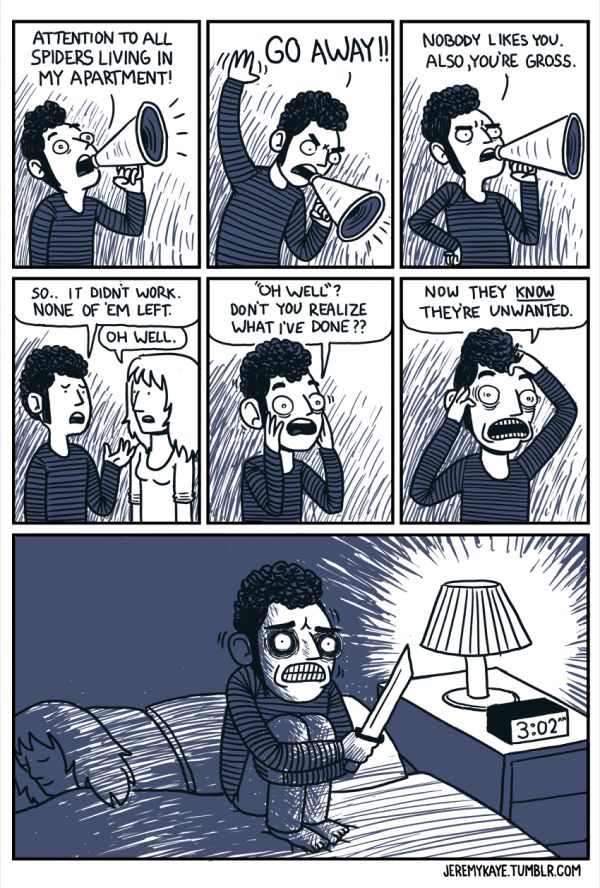
Jeremy Kaye of the webcomic Up and Out should be worried. That knife doesn’t have nearly the reach that he needs.
Pro tip: got spiders in your house? You need a flamethrower.
26 Oct 13:22


10 Reasons You Aren’t Who You Think You Are
by JFrater
Ask most people to name the universe’s greatest mystery and they’ll probably answer “Donald Trump’s hair.” But for all that it’s fun to make snide remarks about national laughingstocks, the real answer is something far, far stranger—you. Yes, you. Even though you may think you know yourself completely, the truth is that you’ve been sharing […]
The post 10 Reasons You Aren’t Who You Think You Are appeared first on Listverse.


25 Oct 16:22
Can Nintendo Survive Gaming's Brave New World?
by Soulskill
Nerval's Lobster writes "Jon Brodkin talked to indie developers (including the creator of Super Mario Bros. Crossover), former Nintendo employees, and a number of others about where exactly Nintendo went wrong over the past few years. Their conclusions? Nintendo made a number of mistakes, including a lack of an indie-developer ecosystem, a refusal to license out core properties such as Super Mario to other gaming platforms (or even iOS and Android), and platforms that don't appeal to hardcore gamers. While the developers suggest Nintendo is taking steps to broaden its horizons, such as by reaching out to smaller studios, it's questionable whether such efforts will succeed in a world where the PS4 and Xbox One are about to enter the market, and iOS and Android are swallowing up mobile gamers' time and dollars. What do you think?" 


Read more of this story at Slashdot.


24 Oct 02:44
Undead Teddy Ruxpin and Elmo: Thrift Shop
by Andrew Tarantola
If Furbies have taught us anything, it's that felt-covered animatronics are not to be trusted—they are to be feared. Especially when two of your childhood icons are revived as hip-pop-spouting zombies, as they are in this nightmare-inducing cover of the Macklemore and Ryan Lewis hit.
24 Oct 02:39
 Midnight Star is the new name of Industrial Toys' ambitious mobile FPS, changed from Morning Star after studio founders Tim Harris and Alex Seropian discovered an existing trademark of the same name. They're creative guys - Harris founded the studio Seven Lights and Seropian helped create Halo - so they were able to insert the new name into the game's lore. They're also lucky - the logo for the game is an M with a star under it, and rarely do its assets say the full "Morning Star." Welcome, Midnight Star.
Industrial Toys has been pitching Midnight Star as an innovative shooter for mobile platforms; AAA on iOS. Harris tells me over Skype what this means for the game's controls: Tap one finger to shoot, two to bring up a shield and other common gestures for specific weapons, such as pinch to zoom in a sniper rifle.
The game is technically on rails, but it offers players the ability to control the camera. Two hexagons on either side of the screen light up with the number of enemies surrounding the battlefield, and the indicators change colors as foes prepare to attack. Players can tap the hexagons to swing the camera that way and take care of business.
The aiming reticle is positioned above the player's finger so it's always obvious where it's pointing, and the enemy AI system is dynamic, "not unlike Halo," Harris says. Enemies respond to a player's actions, ducking for cover when a sniper zooms in on them, staying back in one playthrough and charging forward for a melee attack in another.
Halo co-creator's mobile FPS now called 'Midnight Star'
by Jessica Conditt
Industrial Toys has been pitching Midnight Star as an innovative shooter for mobile platforms; AAA on iOS. Harris tells me over Skype what this means for the game's controls: Tap one finger to shoot, two to bring up a shield and other common gestures for specific weapons, such as pinch to zoom in a sniper rifle.
The game is technically on rails, but it offers players the ability to control the camera. Two hexagons on either side of the screen light up with the number of enemies surrounding the battlefield, and the indicators change colors as foes prepare to attack. Players can tap the hexagons to swing the camera that way and take care of business.
The aiming reticle is positioned above the player's finger so it's always obvious where it's pointing, and the enemy AI system is dynamic, "not unlike Halo," Harris says. Enemies respond to a player's actions, ducking for cover when a sniper zooms in on them, staying back in one playthrough and charging forward for a melee attack in another.
Continue reading Halo co-creator's mobile FPS now called 'Midnight Star'
 Halo co-creator's mobile FPS now called 'Midnight Star' originally appeared on Joystiq on Wed, 23 Oct 2013 20:45:00 EST. Please see our terms for use of feeds.
Fragenhaben likes this
24 Oct 02:38
Can a Sponge Absorb Mercury?
by Casey Chan
A sponge is a sponge because its porous material is able to absorb liquid of any kind. But what about liquid metal? Can a sponge actually absorb the heavy quicksilver material known as mercury? Not at all. At best, a little bit of mercury goop gets caught on top of the sponge and slides away like its T-1000 shaping itself back together. [Tao Fledermaus via The Awesomer]
24 Oct 02:35


The Hyphen in 'E-Mail' Just Lost a Major Ally
by Chris Taylor
Still use a hyphen in the word email? Mashable does not, as you can see — and as of Monday, neither does the New York Times
"By popular demand, we're going to remove the hyphen from e-mail," declared the Grey Lady's editor of "news presentation," Patrick LaForge, in a post on the newsroom's internal blog. He later confirmed the news in a tweet, along with some other tech word style changes:
More about Email, Dictionary, Media, Us World, and UsA few NYT stylebook revisions coming on Monday: email (no hyphen), website and web, a tweet entry (it was never banned).
— Patrick LaForge (@palafo) October 23, 2013
24 Oct 02:32

Path of Exile is now officially released and on Steam
by Patrick Hancock
Path of Exile, the extremely well-crafted Diablo-like ARPG is finally officially released! It's a weird transition for a free-to-play game to go from "open beta" to "released," but it happens all the time. Now that it's "released," it can also be played through Steam! The first time you try to log in through Steam, it will ask you to link your existing account if you've played in the beta.
Path of Exile is clearly influenced by Diablo II, but does enough unique (and wonderful) things to separate it from being too Diablo II. It feels familiar, yet fresh, and that's what I love about it. And don't let the fact that it's free scare you away, either. Grinding Gear Games has created the most unintrusive free-to-play game outside of Valve's own offerings. It really is an entire game for free.

23 Oct 21:35
During the last 4 months, Apple paid out $25 million per day to iOS developers
by Yoni Heisler

During yesterday's media event, Tim Cook gave us his typical update on all things App Store. Specifically, Cook informed us that the App Store now houses more than 1 million apps and has seen more than 60 billion downloads. But there's one data point in particular that's worth some extra attention, namely that Apple has thus far paid out US$13 billion to iOS developers.
Now anytime you're talking about "billions," you're clearly talking some serious business. Indeed, the $13 billion figure is so large it's easy to casually gloss over its significance. To help put the figure into perspective, here are some facts about Apple's App Store payouts to developers over the past five years.
1. The App Store has grossed $18.57 billion, with Apple keeping $5.57 billion of that.
With the $13 billion figure, and Apple's 70/30 revenue split, it's easy to deduce how much money Apple has grossed and netted. Since the App Store first opened up for business in July of 2008, Apple has netted $18.57 billion. Of that total, $13 billion was paid out to developers with Apple keeping the remaining $5.57 billion.
2. Apple's monthly payout to developers are not just increasing, they're also accelerating.
It took Apple nearly two years (June of 2010) to reach the $1 billion payment threshold to developers. Since then, the number of iOS devices has exploded, and naturally, the payouts to developers have increased at an accelerated rate.
From January 2012 to January 2013, Apple's payout to developers increased from $4 billion to $7 billion. That payout comes out to an average of $250 million a month to developers over the 12-month timeframe.
From June 2012 to June 2013, Apple's payout to developers increased from $5 billion to $10 billion, representing a cool $5 billion in payments in 12 months. That comes out to about $416 million per month in developer payouts during the 12-month timeframe.
From June 2013 to October 2013, Apple's payout to developers jumped from $10 billion to $13 billion. That's an increase of $3 billion in just four months. Translation? During the last fourth-month period, Apple has been paying out an average of $750 million per month to developers.
3. Over the last four months, Apple has paid out $25 million PER DAY to developers.
An average of $750 million per month comes out to $25 million per day in developer payouts. Again, that's $25 million every single day.
4. In one month, Apple pays to developers more money than the cumulative 2013 payroll of the three Major League Baseball teams with the highest payrolls.
The 2013 payroll for the New York Yankees was $228 million. The Dodgers come in second with $216 million, while the Phillies come in third with $165 million. If you add that all together, Apple could cover those teams' entire 2013 payroll with just one month of developer payouts.
During the last 4 months, Apple paid out $25 million per day to iOS developers originally appeared on TUAW - The Unofficial Apple Weblog on Wed, 23 Oct 2013 16:00:00 EST. Please see our terms for use of feeds.
23 Oct 21:33


Healthcare.gov Ignores Birthdates, Dramatically Underestimates Prices
by Gregory Ferenstein
Healthcare.gov's newest feature is presenting consumers with disturbingly misleading health insurance prices. CBS uncovered how the beleaguered federal insurance marketplace website is underestimating the actual cost of insurance by 50% or more, because–and I'm not making this up–it forgets to ask users their birth date.
CBS found (and TechCrunch confirmed) that Healthcare.gov estimates that a 48-year-old North Carolina resident ineligible for government subsidies will pay $231/month for a “Silver” plan. But, the website for Blue Cross Blue Shield, the actual insurance provider, reveals a price tag of $360 (few cost estimates are pictured below. healthcare.gov's cheapest prices are pictured in the top image. Blue Cross's cheapest price is bottom picture).
See, on Healthcare.gov's new “Shop and Browse” feature, users are only asked whether they are under 49 years of age. Problem is, the calculator appears to be averaging in the cost of consumers who are also in their 20s, some of whom are eligible for steeper discounts.
The shocking oversight gets even worse. While Healthcare.gov is exceedingly careful to note that the prices are just estimates, it only says that plans are likely to be cheaper.
Healthcare.gov and the state-run websites have been making headline news for ongoing issues with crashes and logins. President Obama chided the press for being impatient, saying that even Apple has glitchy rollouts. True, companies have troubled launches, but I'm pretty sure Apple never mislead users into thinking they could get an iPhone for $200, when it was actually $400.
We've noted before that the government's calculator can be seriously misleading and is better done by tech startups offering sophisticated calculators which accounts for individuals' unique needs. However, the Affordable Care Act lets states optionally partner with tech startups; California and New York have chosen to delay partnerships for roughly 2 years.
Another day, another government screw-up.
23 Oct 13:19
Coexistence of Vampires and Humans Is Possible: Proofs Based on Models Derived from Fiction, Television, and Film
by Miss Cellania
The following is an article from The Annals of Improbable Research.

by Wadim Strielkowski (Charles University, Prague), Evgeny Lisin (MPEI, Moscow), and Emily Welkins (University of Strasbourg)
Our paper describes intertemporal interactions between vampires and humans based on several types of vampire behavior described in popular fiction, films, and television series. Our main research question is: If vampires were real and lived among us, would their existence be possible? We draw several scenarios of vampire–human equilibria and use models with differential equations to test under what provisions vampires could have existed amongst humans. Mathematical modeling reveals that several popular culture sources outline the models describing plausible and peaceful coexistence.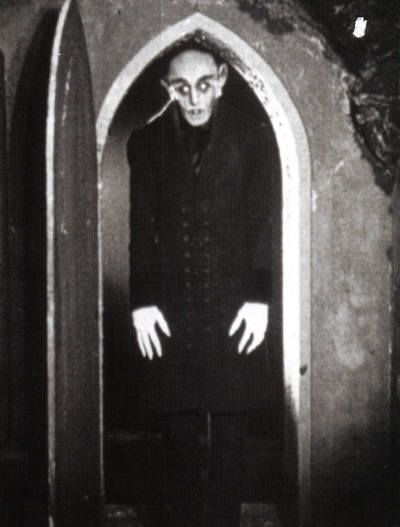 Recent Research About Vampires
Since the 1980s, such topics as behavior of vampires, economic significance of vampirism, and optimal bloodsucking strategies (e.g. preventing the depletion of renewable human resources) have found their way into the research literature, becoming an inspiration for several academic papers (Hart and Mehlmann, 1982, 1983; Hartl, Mehlmann and Novak, 1992; Neocleus, 2003; Efthimiou and Gandhi, 2007).
Vampires are often described in legends and folklore. The word "vampire" comes from the Hungarian language. The first myths and legends about vampires can be found in Mesopotamian texts dating back to 4000 B.C.E. (Campbell Thompson, 1904).
Consider introducing vampires into the model of population growth denoted by dx/dt = kx. The vampire population is denoted by the function y(t), y0=1. Vampires act as natural predators for humans. The human population dynamics can therefore be presented as the following function: dx/dt = kx-v(x)y, where v(x) is the rate at which humans are killed by vampires.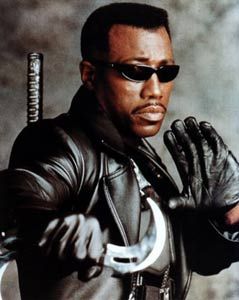 Assume that the number of any vampire's victims is growing proportionally. Thence, the function v(x) can be presented as the following: v(x)=ax, where a > 0 is the coefficient of the human's lethal interaction with a vampire (a human is either killed by a vampire or is turned into a vampire). As a result, the differential equation describing the growth rate of human population can be formulated as the following: dx/dt = x(k-ay). Assume the dynamics of vampire's population change to be y(t). The growth of vampire population will be determined by the quality and quantity of interactions with humans.
After selecting its victim, any vampire can kill it by draining its blood, turn it into a new vampire, or feed on it but leave it to live.
Let us also introduce vampire slayers into the model. The slayers regulate the population of vampires by periodically killing vampires. The equation will then be modified to be dy/dt = baxy-cy, where 0 < b ≤ 1 is the coefficient reflecting the rate with which humans are turned into vampires and c ≥ 0 is the coefficient of lethal outcome of the interaction between a vampire and vampire slayer.
In order to solve this, we need to consider a Lotka-Volterra system, or a "predator–prey" type model (Volterra, 1931). The system allows for the stationary solution, meaning that there is a pair of solutions for the system that creates a state when human and vampire populations can coexist in time without any change in numbers. The size of human population is determined by the effectiveness of slaying vampires by vampire hunters c and the number of cases when the humans are turned into vampires ba. The size of vampire population depends on the growth rate of human population k and vampires' thirst for human blood a. The stationary solution shows that when vampires are capable of restraining their blood thirst, the size of both populations can be rather high in mutual co-existence. The system is held in balance by the existence of vampire slayers.

Bram Stoker's Dracula and Stephen King's Salem's Lot describe interactions between vampires and humans in the following way: A vampire selects a human victim and gets into the victim's proximity. This typically happens after dark. Sometimes the vampire needs the victim to invite the vampire in, but often the vampire does not require permission to enter the victim's premises and attacks the sleeping victim (Stoker, 1897; McNally and Florescu, 1994). The vampire bites the victim and drinks the victim's blood and returns to feed for 4–5 consecutive days, whereupon the victim dies, is buried, and rises to become another vampire (unless a wooden stake is put through the new vampire's heart). Vampires usually need to feed every day, so more and more human beings are constantly turned into vampires (Stoker, 1897; King, 1975).
Assume the events described in Dracula were real. How would things evolve given the Stoker-King model dynamics described in both sources? Let us take 1897 as the starting point (the year Stoker's novel was published). In 1897, the world population was about 1.65 billion people (UN, 1999). The model is presented on Diagram 1.

Let us calibrate the parameters of this specific case of predator–prey model. The calculation period is set at 1 year with a step of 5 days (t = 0 ... 73). The coefficient of human population growth k for the given period is very small and can be neglected, therefore k = 0. The coefficient of lethal outcome for humans interacting with vampires can be calculated according to the scenario presented in the Stoker-King model y0(t) = y0qt, where y0 = 1, q = 2. The probability of a human (who interacts with a vampire) being turned into a vampire is very high, thence b = 1. Jonathan Harker and Abraham van Helsing could not be considered very efficient vampire slayers; therefore we can put c = 0.
The resulting simplified model is presented in a form of a Cauchy problem. Due to the fact that the total sum of humans and vampires does not change in time (human population does not grow and humans gradually become vampires), the predator-prey model is diminished to a simple problem of an epidemic outbreak (Munz et al., 2009).
The solution to this problem is presented in Chart 1. It is clearly visible that the human population is drastically reduced by 80% by the 165th day from the moment when the first vampire arrives. At the end of our one-year study window, the world will be inhabited by 1,384 million vampires and 266 million people.
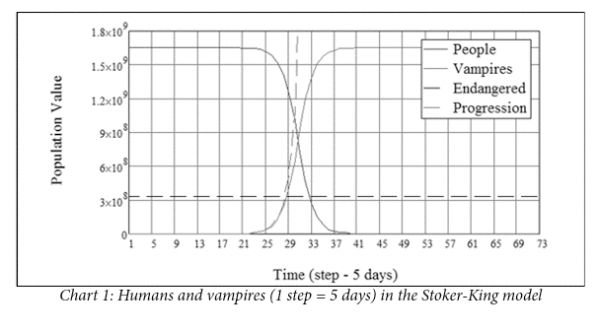 It is obvious that the growth of vampire population is extreme: at first, the number of vampires jumps up abruptly, but then slows down and declines. The maximal growth of the number of vampires (infected humans) will be observed on the 153rd day, when the number of vampires is the highest and equals 825 million with 286 million newly turned vampires every day. It is apparent that the increase in one population (vampires) inevitably leads to the decrease in another (humans). The presence of vampires in the Stoker– King model brings the mankind to the brink of extinction and the model becomes very similar to an epidemic outbreak caused by a deadly virus (e.g. Ebola or SARS). According to the Stoker–King model, vampires need just half a year to take up man's place on Earth.
The Harris-Meyer-Kostova model
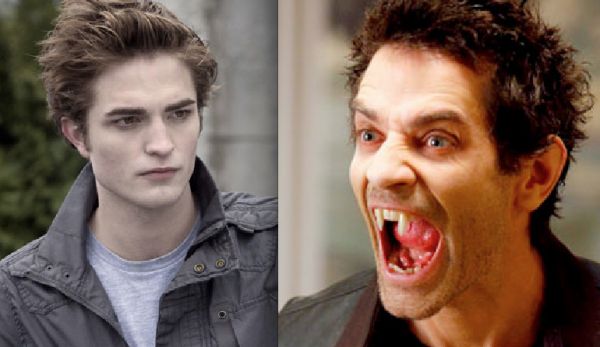
Stephenie Meyer's Twilight series of books, Charlaine Harris's Sookie Stackhouse (Southern Vampire) series of books (turned into the True Blood television series), and Elizabeth Kostova's novel The Historian show worlds where vampires peacefully coexist with humans.
In Meyer's Twilight series, vampires can tolerate the sunlight, interact with humans (even fall in love with them), and drink animal blood to survive (Meyer, 2005), but they have to live in secrecy and pretend to be human beings. In the Sookie Stackhouse books and True Blood television series, however, vampires and humans live side by side and are aware of each other. Vampires can buy synthetic human blood of different blood types that is sold in bottles and can be bought in every grocery store, bar, or gas station (Harris, 2001). They cannot walk during daytime, so they usually come out at night. Vampire blood is a powerful hallucinogenic drug that is sought by humans and traded on the black market. (Sometimes humans capture vampires with the help of silver chains or harnesses and then kill them by draining their blood.) Some humans seek sex with vampires, as vampires are stronger and faster than humans and can provide superb erotic experiences. There is a possibility to turn a human being into a vampire, but it takes time and effort.
In The Historian, vampires are rare and do not reveal themselves to humans too often. Their food ratios are limited and they spend lots of time brooding in their well-hidden tombs (Kostova, 2005).
In Harris's series, vampires have decided to reveal themselves to humans and coexist with them, peacefully exerting their citizens' rights (Harris, 2001). Assume that at the time of the events described in the first book of the series, Dead Until Dark (2001), the world's vampire hypothetical population was around 5 million, the population of the state of Louisiana in 2001 (Maddison, 2006). The initial conditions of the Harris-Meyer-Kostova model are therefore the following: 5 million vampires, 6159 million people, organized groups of vampire "drainers". The model is presented in Diagram 2.
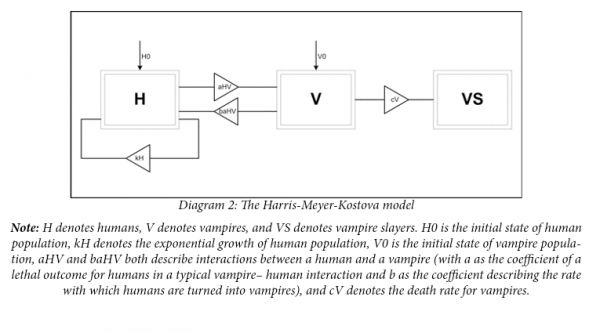 Humans almost always come out alive from their encounters with vampires, hence the coefficient of lethal outcome a = 0.01. The probability of a human being turned into a vampire is b = 0.1. There are numerous groups of vampire drainers (although the number of drained vampires is relatively low and would not lead to their total extinction), so we can put c > 0 (c is calculated similarly to the coefficient k). The model allows for a stationary solution: there are system parameters (xs, ys) that would stabilize the populations of humans and vampires in time. In order to find the stabilized populations of both species, xs and ys, the equality is: (xs, ys) = (7704.8) million individuals. Chart 2 shows us the stationary solution presented on a logarithmic scale.
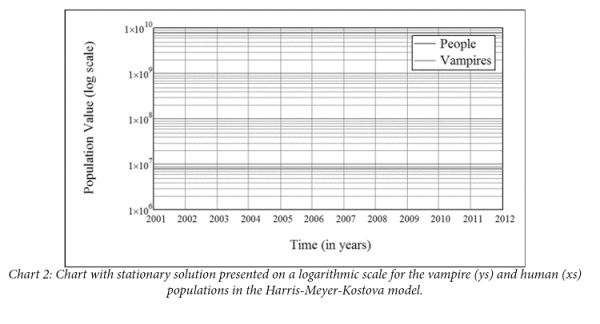 This stationary solution for 2001 cannot be found with the chosen population growth coefficient k and can be reached applying some conditions only after 2012. The deviations in the number of people and vampires from the stationary state at the initial period of time are quite small, which points at the fact that the system might be stable and auto-cyclical.
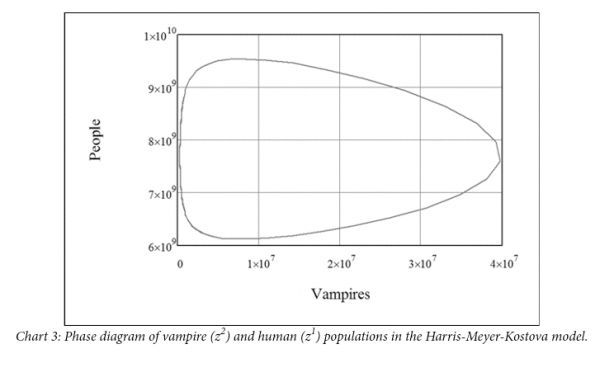
Our calculations yield that the human population will be growing until 2046 when it reaches its peak of 9.6 billion people, whereupon it will be declining until 2065 until it reaches its bottom at 6.12 billion people. This process will repeat itself continuously. The vampire population will be declining until 2023 when it reaches its minimum of 289 thousand vampires, whereupon it will be growing until 2055 until it reaches its peak at 397 million vampires. This process will repeat itself continuously. Chart 3 shows the phase diagram of the cyclical system of human–vampire co-existence. Under certain conditions, the Harris-Meyer- Kostova model seems plausible and allows for the existence of vampires in our world. Peaceful coexistence of two species is a reality.
 The Whedon model
The television series Buffy the Vampire Slayer, created by Joss Whedon, presents the most simplistic, yet the most dreadful doomsday scenario of vampire–human interaction (similar to zombie infection outbreak in movies like 28 Days Later or Resident Evil and described in Munz et al. (2009)). The vampire bites its victim, who (in a very short period of time) rises as another undead vampire and, in turn, bites another human victim, and so on. Luckily enough for humans, the world is populated by an unknown (but considerably large) number of vampire slayers, with a girl named Buffy Summers being their most remarkable representative, and killing a vampire is relatively easy.
The Whedon model is a modified version of the Harris-Meyer-Kostova model. It uses the higher coefficient of vampire-slaying effectiveness, c. The initial conditions of the Whedon model are: 5 million vampires, 6159 million people, organized groups of vampire slayers. The model is presented in Diagram 3.
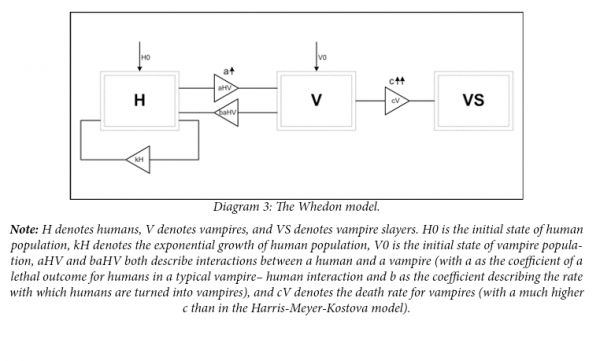 Let us calibrate the parameters of the model. The calculation period is set at 10 years with a step of 1 year, and the coefficient of human population's growth is calculated as k = ln(x1/x0)/t1-t0 where x1 = 7000 million people in 2012, x0 = 6150 million people at time t0 = 2001. Humans are always turned into new vampires after their encounters with vampires, so the coefficient of lethal outcome a is high. The probability of a human being turned into a vampire is b = 0.1. There are groups of vampire slayers, therefore we put c = 10. The resulting model is presented in Chart 4.
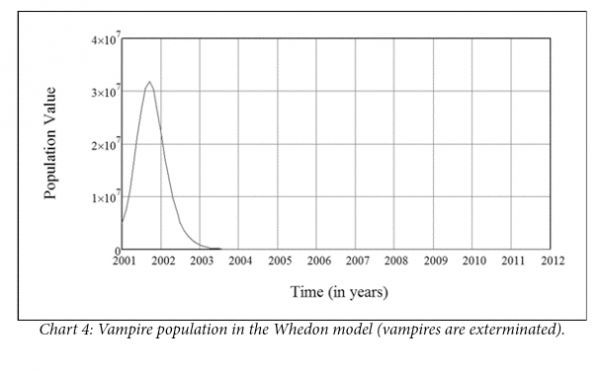
Although the Whedon model's structure theoretically allows for coexistence of humans and vampires, the laborious vampire slayers contribute to putting the system out of balance by killing all vampires. The human population recovers from the damage caused to it by vampires and continues to grow steadily.
Conclusions
Overall, it appears that although vampire–human interactions would in most cases lead to great imbalances in the ecosystems, there are several cases that might actually convey plausible models of coexistence between humans and vampires.
The Stoker-King model described the explosive rate of growth in vampire population that would lead to exterminating 80% of the human population on the 165th day of the first vampire's arrival. The scenario is similar to severe epidemic outbreaks and would lead first to the complete extinction of humans and then to the death of all vampires. The Harris-Meyer-Kostova model allows for the peaceful existence of vampires in our world. The Whedon model allows for the coexistence of humans and vampires, but in this case vampires become one of the endangered species due to the existence of super-effective vampire slayers. Unless the slayers calm their rigor, the vampire goes extinct.

References
Campbell Thompson, R. (1904), The Devils and Evil Spirits of Babylonia, 1st edition, Vol.2, Luzac, London, 504 p.
Efthimiou, C.J., Gandhi, S. (2007), "Cinema Fiction vs. Physics Reality: Ghosts, Vampires and Zombies", Sceptical Inquirer, Vol. 31.4, July/August, p. 27
Frayling, C. (1992), Vampyres: Lord Byron to Count Dracula, 1st edition, Faber & Faber, London, 429 p.
Harris, C. (2001), Dead Until Dark. Ace Books, New York, 260 p.
Hartl, R. F. and A. Mehlmann, A., (1983), "Convex- Concave Utility Function: Optimal Blood Consumption for Vampires". Applied Mathematical Modelling, Vol. 7, pp. 83-88
Hartl, R. F., Mehlmann, A. (1982), "The Transylvanian Problem of Renewable Resources," Revue Francaise d'Automatique, Informatique et de Recherche Operationelle, Vol. 16, pp. 379-390
Hartl, R.F., Mehlmann, A. and Novak, A. (1992), "Cycles of Fear: Periodic Bloodsucking Rates for Vampires," Journal of Optimization Theory and Application, Vol. 75, No. 3 (December), pp. 559-568
King S. (1975), Salem's Lot, Doubleday, 439 p.
Kostova E. (2005), The Historian, New York: Little, Brown and Company, New York, 734 p.
Maddison, A. (2006), The World Economy. Historical Statistics (Vol. 2), OECD 2006, 629 p.
McNally, R. T., Florescu, R. (1994), In Search of Dracula. Houghton Mifflin Company, 320 p.
Meyer, S. (2005), Twilight saga, 1st edition, New York: Little, Brown and Company, New York, 544 p.
Munz, P. Hudea, I., Imad, J., and Smith?, R.J. (2009), "When zombies attack!: Mathematical modelling of an outbreak of zombie infection", In Tchuenche, J.M. and Chiyaka, C. (eds,), Infectious Disease Modelling Research Progress, University of Ottawa Press, pp.133-150
Neocleous, M. (2003), "The Political Economy of the Dead: Marx's Vampires," History of Political Thought, Vol. XXIV, No. 4. pp. 668-684
Rice, A. (1997), Interview with the Vampire, Vampire Chronicles, Random House Publishing, 352 p.
Stoker, B. (1897), Dracula, 1st edition, Archibald Constable and Company, London, 390 p.
UN (1999), "The World at Six Billion", Population Division, Department of Economic and Social Affairs, UN, New York, 63 p.
Volterra V. (1931), "Variations and fluctuations of the number of individuals in animal species living together". In Chapman R. N. (ed.), Animal Ecology, New York, NY: McGraw Hill, pp. 409–448.
Whedon, J. (1997), Buffy the Vampire Slayer, television series, Mutant Enemy Production
_____________________
 This article is republished with permission from the January-February 2013 issue of the Annals of Improbable Research. You can download or purchase back issues of the magazine, or subscribe to receive future issues. Or get a subscription for someone as a gift!
Visit their website for more research that makes people LAUGH and then THINK.

23 Oct 13:07


Pirate Bay Downloaders Trolled By Movie Director’s Shaven Balls
by Andy
 In years gone by downloading material from file-sharing applications could be a risky occupation. Traditional file-sharing networks such as FastTrack (Kazaa) and Gnutella (LimeWire) became dumping grounds for millions of junk files, many incorrectly named, to the point where shutting them down was the only thing that could save them.
These days things are very much different. Although BitTorrent sharing is carried out mainly in software clients, torrent files themselves are generally obtained from indexes, or torrent sites as most people know them. Not only do these sites carry comments from users which can be read in order to avoid downloading trash, many are policed by teams of moderators who remove junk, fake and malicious files.
But despite the superior moderation of today’s ecosystem, it is still entirely possible to get a file onto a torrent site that isn’t entirely what it seems. That has just been achieved to hilarious effect by film director Johan Kaos, who got past the moderators on the world’s most infamous torrent site to play a never-seen-before prank on its users.
The joke involved Kaos’ just released movie ‘Pornopung‘ (Norwegian slang for “shaven balls”), a Norwegian comedy featuring two pick up artists who share their tricks with a ‘novice’ called Christian, enabling him to become more attractive to the opposite sex.
Those downloading the movie from The Pirate Bay got a decent copy to begin with, but little did they know that it was Kaos himself seeding the video. The director had heavily modified the rest of the movie, as they would soon discover. As can be seen below, after the first 10 mins or so the camera switches to Kaos who filmed himself chatting in his bathroom. Then things get very much worse.
“Hehe. I thought the movie was going to end up on The Pirate Bay sooner or later anyway, so why not be a little ahead?” Kaos told Aftenposten.no.
“The film clip was recorded as an impulse once I sat on the toilet. Actually, I considered filling the remaining 80 minutes by filming my butt, but then I realized how exceptionally bad it was going to be, aesthetically that is.”
So, confronted with the problem of filming something more pleasing to the eye than his own rear end, Kaos said he landed on an idea to delight file-sharers for the remaining 80 minutes of the movie.
“I created a clean-shaven scrotum,” Kaos said. “A little more thematically relevant and easily more aesthetically pleasing, it seems, at least in my opinion.”
Despite his memorable cultural contribution to The Pirate Bay, Kaos says he bears no animosity towards file-sharers.
“In no way do I bear any grudges against people who download my film. It’s just a compliment that people want to see it. I would obviously prefer it if they chose to see it in theaters, since for me as a director it has the most to do with the movie and the best movie experience,” he said.
The director, who is currently backpacking in Laos, says that reaction to the prank has been largely positive.
“Most of the feedback I’ve gotten so far has been from people who have laughed themselves to death, but there have also been some who have been pissed. Well, they certainly can’t accuse me of having given them something they didn’t ask for, when they download a movie called Pornopung,” Kaos concludes.
Anyone wanting to see a 10 min promo of Pornopung followed by 80 mins of Kaos’ shaven extremities can do so here. Have fun.
Source: Pirate Bay Downloaders Trolled By Movie Director’s Shaven Balls