08 Jan 08:35
by Chunhai Yin, Alexander E. M. Smink, Inge Leermakers, Lucas M. K. Tang, Nikita Lebedev, Uli Zeitler, Wilfred G. van der Wiel, Hans Hilgenkamp, and Jan Aarts
Author(s): Chunhai Yin, Alexander E. M. Smink, Inge Leermakers, Lucas M. K. Tang, Nikita Lebedev, Uli Zeitler, Wilfred G. van der Wiel, Hans Hilgenkamp, and Jan Aarts
In LaAlO3/SrTiO3 heterostructures, a still poorly understood phenomenon is that of electron trapping in back-gating experiments. Here, by combining magnetotransport measurements and self-consistent Schrödinger-Poisson calculations, we obtain an empirical relation between the amount of trapped electr...
[Phys. Rev. Lett. 124, 017702] Published Tue Jan 07, 2020
16 Dec 09:20
by Mauro Fanciulli, Jakub Schusser, Min-I Lee, Zakariae El Youbi, Olivier Heckmann, Maria Christine Richter, Cephise Cacho, Carlo Spezzani, David Bresteau, Jean-François Hergott, Pascal D'Oliveira, Olivier Tcherbakoff, Thierry Ruchon, Jan Minár, Karol Hricovini
We combined a spin-resolved photoemission spectrometer with a high-harmonic
generation (HHG) laser source in order to perform spin-, time- and
angle-resolved photoemission spectroscopy (STARPES) experiments on the
transition metal dichalcogenide bulk WTe$_2$, a possible Weyl type-II
semimetal. Measurements at different femtosecond pump-probe delays and
comparison with spin-resolved one-step photoemission calculations provide
insight into the spin polarization of electrons above the Fermi level in the
region where Weyl points of WTe$_2$ are expected. We observe a spin
accumulation above the Weyl points region, that is consistent with a
spin-selective bottleneck effect due to the presence of spin polarized
cone-like electronic structure. Our results support the feasibility of STARPES
with HHG, which despite being experimentally challenging provides a unique way
to study spin dynamics in photoemission.
12 Dec 09:33
by Ajit C. Balram, Karsten Flensberg, Jens Paaske, and Mark S. Rudner
Author(s): Ajit C. Balram, Karsten Flensberg, Jens Paaske, and Mark S. Rudner
Two-dimensional topological insulators (TIs) host gapless helical edge states that are predicted to support a quantized two-terminal conductance. Quantization is protected by time-reversal symmetry, which forbids elastic backscattering. Paradoxically, the current-carrying state itself breaks the tim...
[Phys. Rev. Lett. 123, 246803] Published Wed Dec 11, 2019
09 Dec 12:52
by Dominik Christiansen, Malte Selig, Ermin Malic, Ralph Ernstorfer, Andreas Knorr
Time- and angle-resolved photoemission spectroscopy (trARPES) is a powerful
spectroscopic method to measure the ultrafast electron dynamics directly in
momentum-space. However, band gap materials with exceptional strong Coulomb
interaction such as monolayer transition metal dichlacogenides (TMDC) exhibit
tightly bound excitons, which dominate their optical properties. This rises the
question whether excitons, in particular their formation and relaxation
dynamics, can be detected in photoemission. Here, we develope a fully
microscopic theory of the temporal dynamics of excitonic time- and angle
resolved photoemission with particular focus on the phonon-mediated
thermalization of optically excited excitons to momentum-forbidden dark exciton
states. We find that trARPES is able to probe the ultrafast exciton formation
and relaxation throughout the Brillouin zone.
09 Dec 10:20
by E. Prat, P. Dijkstal, M. Aiba, S. Bettoni, P. Craievich, E. Ferrari, R. Ischebeck, F. Löhl, A. Malyzhenkov, G. L. Orlandi, S. Reiche, and T. Schietinger
Author(s): E. Prat, P. Dijkstal, M. Aiba, S. Bettoni, P. Craievich, E. Ferrari, R. Ischebeck, F. Löhl, A. Malyzhenkov, G. L. Orlandi, S. Reiche, and T. Schietinger
The transverse emittance of the electron beam is a fundamental parameter in linac-based x-ray free-electron lasers (FELs). We present results of emittance measurements carried out at SwissFEL, a compact x-ray FEL facility at the Paul Scherrer Institute in Switzerland, including a description of the ...
[Phys. Rev. Lett. 123, 234801] Published Fri Dec 06, 2019
06 Dec 12:04
by Xiang Hu, Timo Hyart, Dmitry I. Pikulin, and Enrico Rossi
Author(s): Xiang Hu, Timo Hyart, Dmitry I. Pikulin, and Enrico Rossi
By tuning the angle between graphene layers to specific “magic angles” the lowest energy bands of twisted bilayer graphene (TBLG) can be made flat. The flat nature of the bands favors the formation of collective ground states and, in particular, TBLG has been shown to support superconductivity. When...
[Phys. Rev. Lett. 123, 237002] Published Thu Dec 05, 2019
05 Dec 08:22
by H. Beyer, G. Rohde, A. Grubišić Čabo, A. Stange, T. Jacobsen, L. Bignardi, D. Lizzit, P. Lacovig, C. E. Sanders, S. Lizzit, K. Rossnagel, P. Hofmann, and M. Bauer
Author(s): H. Beyer, G. Rohde, A. Grubišić Čabo, A. Stange, T. Jacobsen, L. Bignardi, D. Lizzit, P. Lacovig, C. E. Sanders, S. Lizzit, K. Rossnagel, P. Hofmann, and M. Bauer
We employ time- and angle-resolved photoemission spectroscopy to study the spin- and valley-selective photoexcitation and dynamics of free carriers at the K¯ and K¯′ points in singly oriented single-layer WS2/Au(111). Our results reveal that in the valence band maximum an ultimate valley polarizatio...
[Phys. Rev. Lett. 123, 236802] Published Wed Dec 04, 2019
24 Nov 11:00
by Brian Kiraly, Elze J. Knol, Klara Volckaert, Deepnarayan Biswas, Alexander N. Rudenko, Danil A. Prishchenko, Vladimir G. Mazurenko, Mikhail I. Katsnelson, Philip Hofmann, Daniel Wegner, and Alexander A. Khajetoorians
Author(s): Brian Kiraly, Elze J. Knol, Klara Volckaert, Deepnarayan Biswas, Alexander N. Rudenko, Danil A. Prishchenko, Vladimir G. Mazurenko, Mikhail I. Katsnelson, Philip Hofmann, Daniel Wegner, and Alexander A. Khajetoorians
Electronic screening can have direct consequences for structural arrangements on the nanoscale, such as on the periodic ordering of adatoms on a surface. So far, such ordering phenomena have been explained in terms of isotropic screening of free electronlike systems. Here, we directly illustrate the...
[Phys. Rev. Lett. 123, 216403] Published Thu Nov 21, 2019
14 Nov 08:30
by Xin-Yang Zhu, Shi Wang, Zhen-Yu Jia, Li Zhu, Qi-Yuan Li, Wei-Min Zhao, Cheng-Long Xue, Yong-Jie Xu, Zhen Ma, Jinsheng Wen, Shun-Li Yu, Jian-Xin Li, and Shao-Chun Li
Author(s): Xin-Yang Zhu, Shi Wang, Zhen-Yu Jia, Li Zhu, Qi-Yuan Li, Wei-Min Zhao, Cheng-Long Xue, Yong-Jie Xu, Zhen Ma, Jinsheng Wen, Shun-Li Yu, Jian-Xin Li, and Shao-Chun Li
Metallization of 1T−TaS2 is generally initiated at the domain boundary of a charge density wave (CDW), at the expense of its long-range order. However, we demonstrate in this study that the metallization of 1T−TaS2 can be also realized without breaking the long-range CDW order upon surface alkali do...
[Phys. Rev. Lett. 123, 206405] Published Wed Nov 13, 2019
14 Nov 08:27
by Lutz Waldecker, Archana Raja, Malte Rösner, Christina Steinke, Aaron Bostwick, Roland J. Koch, Chris Jozwiak, Takashi Taniguchi, Kenji Watanabe, Eli Rotenberg, Tim O. Wehling, and Tony F. Heinz
Author(s): Lutz Waldecker, Archana Raja, Malte Rösner, Christina Steinke, Aaron Bostwick, Roland J. Koch, Chris Jozwiak, Takashi Taniguchi, Kenji Watanabe, Eli Rotenberg, Tim O. Wehling, and Tony F. Heinz
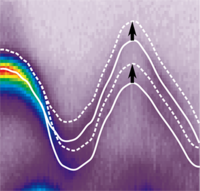
Valence and conduction bands exhibit rigid shifts in a monolayer of the dichalcogenide WS2 when it is exposed to spatially separated dielectric environments.
[Phys. Rev. Lett. 123, 206403] Published Wed Nov 13, 2019
11 Nov 08:36
by Raffaele Battilomo, Niccoló Scopigno, and Carmine Ortix
Author(s): Raffaele Battilomo, Niccoló Scopigno, and Carmine Ortix
It has been recently established that optoelectronic and nonlinear transport experiments can give direct access to the dipole moment of the Berry curvature in nonmagnetic and noncentrosymmetric materials. Thus far, nonvanishing Berry curvature dipoles have been shown to exist in materials with subst...
[Phys. Rev. Lett. 123, 196403] Published Fri Nov 08, 2019
08 Nov 09:18
by G. William Burg, Jihang Zhu, Takashi Taniguchi, Kenji Watanabe, Allan H. MacDonald, and Emanuel Tutuc
Author(s): G. William Burg, Jihang Zhu, Takashi Taniguchi, Kenji Watanabe, Allan H. MacDonald, and Emanuel Tutuc
We present a combined experimental and theoretical study of twisted double bilayer graphene with twist angles between 1° and 1.35°. Consistent with moiré band structure calculations, we observe insulators at integer moiré band fillings one and three, but not two. An applied transverse electric field...
[Phys. Rev. Lett. 123, 197702] Published Thu Nov 07, 2019
01 Nov 11:57
by Hridis K. Pal, Stephen Spitz, and Markus Kindermann
Author(s): Hridis K. Pal, Stephen Spitz, and Markus Kindermann
So far the physics of moiré graphene bilayers at large, incommensurate rotation angles has been considered uninteresting. It has been held that the interlayer coupling in such structures is weak and the system can be thought of as a pair of decoupled single graphene sheets to a good approximation. H...
[Phys. Rev. Lett. 123, 186402] Published Thu Oct 31, 2019
22 Oct 20:54
by Johann Riemensberger, Stefan Neppl, Dionysios Potamianos, Martin Schäffer, Maximilian Schnitzenbaumer, Marcus Ossiander, Christian Schröder, Alexander Guggenmos, Ulf Kleineberg, Dietrich Menzel, Francesco Allegretti, Johannes V. Barth, Reinhard Kienberger, Peter Feulner, Andrei G. Borisov, Pedro M. Echenique, and Andrey K. Kazansky
Author(s): Johann Riemensberger, Stefan Neppl, Dionysios Potamianos, Martin Schäffer, Maximilian Schnitzenbaumer, Marcus Ossiander, Christian Schröder, Alexander Guggenmos, Ulf Kleineberg, Dietrich Menzel, Francesco Allegretti, Johannes V. Barth, Reinhard Kienberger, Peter Feulner, Andrei G. Borisov, Pedro M. Echenique, and Andrey K. Kazansky
We report measurements of the temporal dynamics of the valence band photoemission from the magnesium (0001) surface across the resonance of the Γ¯ surface state at 134 eV and link them to observations of high-resolution synchrotron photoemission and numerical calculations of the time-dependent Schrö...
[Phys. Rev. Lett. 123, 176801] Published Mon Oct 21, 2019
18 Oct 07:28
by Ashish Arora, Thorsten Deilmann, Till Reichenauer, Johannes Kern, Steffen Michaelis de Vasconcellos, Michael Rohlfing, and Rudolf Bratschitsch
Author(s): Ashish Arora, Thorsten Deilmann, Till Reichenauer, Johannes Kern, Steffen Michaelis de Vasconcellos, Michael Rohlfing, and Rudolf Bratschitsch
We discover an excited bound three-particle state, the 2s trion, appearing energetically below the 2s exciton in monolayer WS2, using absorption spectroscopy and ab initio GW and Bethe-Salpeter equation calculations. The measured binding energy of the 2s trion (22 meV) is smaller compared to the 1s ...
[Phys. Rev. Lett. 123, 167401] Published Thu Oct 17, 2019
03 Oct 08:08
by H. Mine, A. Kobayashi, T. Nakamura, T. Inoue, S. Pakdel, D. Marian, E. Gonzalez-Marin, S. Maruyama, S. Katsumoto, A. Fortunelli, J. J. Palacios, and J. Haruyama
Author(s): H. Mine, A. Kobayashi, T. Nakamura, T. Inoue, S. Pakdel, D. Marian, E. Gonzalez-Marin, S. Maruyama, S. Katsumoto, A. Fortunelli, J. J. Palacios, and J. Haruyama
Identifying the two-dimensional (2D) topological insulating (TI) state in new materials and its control are crucial aspects towards the development of voltage-controlled spintronic devices with low-power dissipation. Members of the 2D transition metal dichalcogenides have been recently predicted and...
[Phys. Rev. Lett. 123, 146803] Published Wed Oct 02, 2019
30 Sep 11:30
by J. Bertinshaw, N. Gurung, P. Jorba, H. Liu, M. Schmid, D. T. Mantadakis, M. Daghofer, M. Krautloher, A. Jain, G. H. Ryu, O. Fabelo, P. Hansmann, G. Khaliullin, C. Pfleiderer, B. Keimer, and B. J. Kim
Author(s): J. Bertinshaw, N. Gurung, P. Jorba, H. Liu, M. Schmid, D. T. Mantadakis, M. Daghofer, M. Krautloher, A. Jain, G. H. Ryu, O. Fabelo, P. Hansmann, G. Khaliullin, C. Pfleiderer, B. Keimer, and B. J. Kim
The electric-current stabilized semimetallic state in the quasi-two-dimensional Mott insulator Ca2RuO4 exhibits an exceptionally strong diamagnetism. Through a comprehensive study using neutron and x-ray diffraction, we show that this nonequilibrium phase assumes a crystal structure distinct from th...
[Phys. Rev. Lett. 123, 137204] Published Fri Sep 27, 2019
11 Sep 11:16
by Riccardo Pisoni, Tim Davatz, Kenji Watanabe, Takashi Taniguchi, Thomas Ihn, and Klaus Ensslin
Author(s): Riccardo Pisoni, Tim Davatz, Kenji Watanabe, Takashi Taniguchi, Thomas Ihn, and Klaus Ensslin
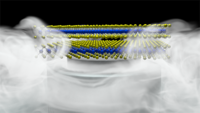
Detailed low temperature magnetotransport measurements of encapsulated bilayer MoS2 reveal that, in contrast to bilayer graphene, in this system the two layers behave as independent electronic systems with no tunnel coupling.
[Phys. Rev. Lett. 123, 117702] Published Tue Sep 10, 2019
11 Sep 09:24
by Taishen Li, Tao Yu, Xuefeng Cui, Kaixuan Zhang, Jianyi Liu, Qiushi Meng, Hongbing Cai, Nan Pan, Bing Wang, Zhenchao Dong, Xiaoping Wang
Manipulating and reserving the valley pseudospin of excitons is one core aim
in the two-dimensional transition metal dichalcogenides (TMDs). However, due to
the strong electron-hole exchange and spin-orbit coupling interactions, the
exciton recombination lifetime is subject to picosecond timescale
intrinsically, and the valley polarization is hardly modulated by a moderate
magnetic field. It is fortunate that interlayer and defect-localized excitons
promise to overcome these difficulties by suppressing the above interactions.
Here we clearly reveal that the valley polarization can be reversed and revived
in the defect-localized excitons with a microsecond lifetime in AB-stacked
WSe2-WS2 heterobilayer. Specifically, for the interlayer defect-localized
exciton, the valley polarization is reversed and can be efficiently enhanced by
a weak out-of-plane magnetic field (<0.4 T). In sharp contrast, the valley
polarization of the intralayer defect-localized exciton can revive after a fast
decay process and follows the direction of the moderate out-of-plane magnetic
field (<3 T). We explain the reversed valley polarization with highly magnetic
sensitivity by the delocalization of defect-localized holes under a weak
magnetic field and the revival of valley polarization by the valley Zeeman
effect under a moderate magnetic field. Our results demonstrate that the valley
pseudospin of defect-localized excitons can be efficiently modulated by the
external magnetic field and enrich both the understanding and the technical
approaches on manipulating the valley dynamics in TMDs and their
heterostructure.
10 Sep 09:03
by Guorui Wang, Zhaohe Dai, Junkai Xiao, ShiZhe Feng, Chuanxin Weng, Luqi Liu, Zhiping Xu, Rui Huang, and Zhong Zhang
Author(s): Guorui Wang, Zhaohe Dai, Junkai Xiao, ShiZhe Feng, Chuanxin Weng, Luqi Liu, Zhiping Xu, Rui Huang, and Zhong Zhang
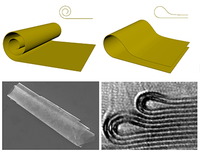
Direct measurement of the bending rigidity of multilayer graphene, molybdenum disulfide, and hexagonal boron nitride, shows a response of the multilayers consistent with nonlinear plate theory.
[Phys. Rev. Lett. 123, 116101] Published Mon Sep 09, 2019
02 Sep 09:10
by M. R. Molas, A. O. Slobodeniuk, T. Kazimierczuk, K. Nogajewski, M. Bartos, P. Kapuściński, K. Oreszczuk, K. Watanabe, T. Taniguchi, C. Faugeras, P. Kossacki, D. M. Basko, and M. Potemski
Author(s): M. R. Molas, A. O. Slobodeniuk, T. Kazimierczuk, K. Nogajewski, M. Bartos, P. Kapuściński, K. Oreszczuk, K. Watanabe, T. Taniguchi, C. Faugeras, P. Kossacki, D. M. Basko, and M. Potemski
Monolayers of semiconducting transition metal dichalcogenides are two-dimensional direct-gap systems which host tightly bound excitons with an internal degree of freedom corresponding to the valley of the constituting carriers. Strong spin-orbit interaction and the resulting ordering of the spin-spl...
[Phys. Rev. Lett. 123, 096803] Published Fri Aug 30, 2019
02 Sep 09:09
by T. M. R. Wolf, J. L. Lado, G. Blatter, and O. Zilberberg
Author(s): T. M. R. Wolf, J. L. Lado, G. Blatter, and O. Zilberberg
Twisted graphene bilayers provide a versatile platform to engineer metamaterials with novel emergent properties by exploiting the resulting geometric moiré superlattice. Such superlattices are known to host bulk valley currents at tiny angles (α≈0.3°) and flat bands at magic angles (α≈1°). We show t...
[Phys. Rev. Lett. 123, 096802] Published Fri Aug 30, 2019
30 Aug 13:58
by Alfred Zong, Pavel E. Dolgirev, Anshul Kogar, Emre Ergeçen, Mehmet B. Yilmaz, Ya-Qing Bie, Timm Rohwer, I-Cheng Tung, Joshua Straquadine, Xirui Wang, Yafang Yang, Xiaozhe Shen, Renkai Li, Jie Yang, Suji Park, Matthias C. Hoffmann, Benjamin K. Ofori-Okai, Michael E. Kozina, Haidan Wen, Xijie Wang, Ian R. Fisher, Pablo Jarillo-Herrero, and Nuh Gedik
Author(s): Alfred Zong, Pavel E. Dolgirev, Anshul Kogar, Emre Ergeçen, Mehmet B. Yilmaz, Ya-Qing Bie, Timm Rohwer, I-Cheng Tung, Joshua Straquadine, Xirui Wang, Yafang Yang, Xiaozhe Shen, Renkai Li, Jie Yang, Suji Park, Matthias C. Hoffmann, Benjamin K. Ofori-Okai, Michael E. Kozina, Haidan Wen, Xijie Wang, Ian R. Fisher, Pablo Jarillo-Herrero, and Nuh Gedik
Complex systems, which consist of a large number of interacting constituents, often exhibit universal behavior near a phase transition. A slowdown of certain dynamical observables is one such recurring feature found in a vast array of contexts. This phenomenon, known as critical slowing-down, is wel...
[Phys. Rev. Lett. 123, 097601] Published Thu Aug 29, 2019
14 Aug 07:55
by Bruno Schuler, Diana Y. Qiu, Sivan Refaely-Abramson, Christoph Kastl, Christopher T. Chen, Sara Barja, Roland J. Koch, D. Frank Ogletree, Shaul Aloni, Adam M. Schwartzberg, Jeffrey B. Neaton, Steven G. Louie, and Alexander Weber-Bargioni
Author(s): Bruno Schuler, Diana Y. Qiu, Sivan Refaely-Abramson, Christoph Kastl, Christopher T. Chen, Sara Barja, Roland J. Koch, D. Frank Ogletree, Shaul Aloni, Adam M. Schwartzberg, Jeffrey B. Neaton, Steven G. Louie, and Alexander Weber-Bargioni
Atomic force and scanning tunneling microscopy correlate the structure and electronic properties of single-atom defects in the transitional metal dichalcogenide WS2.

[Phys. Rev. Lett. 123, 076801] Published Tue Aug 13, 2019
24 Jul 12:20
by M. Milićević, G. Montambaux, T. Ozawa, O. Jamadi, B. Real, I. Sagnes, A. Lemaître, L. Le Gratiet, A. Harouri, J. Bloch, and A. Amo
Author(s): M. Milićević, G. Montambaux, T. Ozawa, O. Jamadi, B. Real, I. Sagnes, A. Lemaître, L. Le Gratiet, A. Harouri, J. Bloch, and A. Amo
Experiments show how a honeycomb lattice of photonic resonators produces exotic photon transport behavior with properties that go beyond those found in existing Dirac materials.

[Phys. Rev. X 9, 031010] Published Tue Jul 23, 2019
22 Jul 08:05
by Wen Zhang*†, Lei Zhang†, Ping Kwan Johnny Wong*‡, Jiaren Yuan†, Giovanni Vinai§, Piero Torelli§, Gerrit van der Laan?, Yuan Ping Feng†, and Andrew T. S. Wee*†

ACS Nano
DOI: 10.1021/acsnano.9b02996

22 Jul 07:33
by M. Chávez-Cervantes, G. E. Topp, S. Aeschlimann, R. Krause, S. A. Sato, M. A. Sentef, and I. Gierz
Author(s): M. Chávez-Cervantes, G. E. Topp, S. Aeschlimann, R. Krause, S. A. Sato, M. A. Sentef, and I. Gierz
Charge density waves (CDWs) are symmetry-broken ground states that commonly occur in low-dimensional metals due to strong electron-electron and/or electron-phonon coupling. The nonequilibrium carrier distribution established via photodoping with femtosecond laser pulses readily quenches these ground...
[Phys. Rev. Lett. 123, 036405] Published Fri Jul 19, 2019
19 Jul 07:26
by Joolee Son, Kyung-Han Kim, Y. H. Ahn, Hyun-Woo Lee, and Jieun Lee
Author(s): Joolee Son, Kyung-Han Kim, Y. H. Ahn, Hyun-Woo Lee, and Jieun Lee
The Berry curvature dipole is a physical quantity that is expected to allow various quantum geometrical phenomena in a range of solid-state systems. Monolayer transition metal dichalcogenides provide an exceptional platform to modulate and investigate the Berry curvature dipole through strain. Here,...
[Phys. Rev. Lett. 123, 036806] Published Thu Jul 18, 2019
16 Jul 11:47
by Jimmy C. Kotsakidis*†, Quianhui Zhang‡, Amadeo L. Vazquez de Parga§?, Marc Currie?, Kristian Helmerson†, D. Kurt Gaskill?, and Michael S. Fuhrer*†

Nano Letters
DOI: 10.1021/acs.nanolett.9b01599

16 Jul 07:18
by Kun Zhao
Nature Physics, Published online: 15 July 2019; doi:10.1038/s41567-019-0570-0
Disorder present in monolayer NbSe2 is found to be able to enhance its superconductivity. A systematic study reveals the origin—disorder-induced multifractality of the electron wavefunctions strengthens the local interactions.


