23 Dec 10:00
by Koloman Wagner, Edith Wietek, Jonas D. Ziegler, Marina A. Semina, Takashi Taniguchi, Kenji Watanabe, Jonas Zipfel, Mikhail M. Glazov, and Alexey Chernikov
Author(s): Koloman Wagner, Edith Wietek, Jonas D. Ziegler, Marina A. Semina, Takashi Taniguchi, Kenji Watanabe, Jonas Zipfel, Mikhail M. Glazov, and Alexey Chernikov
We experimentally demonstrate dressing of the excited exciton states by a continuously tunable Fermi sea of free charge carriers in a monolayer semiconductor. It represents an unusual scenario of two-particle excitations of charged excitons previously inaccessible in conventional material systems. W...
[Phys. Rev. Lett. 125, 267401] Published Mon Dec 21, 2020
23 Dec 10:00
by T. Wakamura, N. J. Wu, A. D. Chepelianskii, S. Guéron, M. Och, M. Ferrier, T. Taniguchi, K. Watanabe, C. Mattevi, and H. Bouchiat
Author(s): T. Wakamura, N. J. Wu, A. D. Chepelianskii, S. Guéron, M. Och, M. Ferrier, T. Taniguchi, K. Watanabe, C. Mattevi, and H. Bouchiat
We demonstrate the enhanced robustness of the supercurrent through graphene-based Josephson junctions in which strong spin-orbit interactions (SOIs) are induced. We compare the persistence of a supercurrent at high out-of-plane magnetic fields between Josephson junctions with graphene on hexagonal b...
[Phys. Rev. Lett. 125, 266801] Published Mon Dec 21, 2020
03 Dec 12:25
by Wei Yang, Chong-Jie Mo, Shi-Bin Fu, Yu Yang, Fa-Wei Zheng, Xiao-Hui Wang, Yuan-An Liu, Ning Hao, and Ping Zhang
Author(s): Wei Yang, Chong-Jie Mo, Shi-Bin Fu, Yu Yang, Fa-Wei Zheng, Xiao-Hui Wang, Yuan-An Liu, Ning Hao, and Ping Zhang
Recent experiments have tuned the monolayer 1T′−WTe2 to be superconducting by electrostatic gating. Here, we theoretically study the phonon-mediated superconductivity in monolayer 1T′−WTe2 via charge doping. We reveal that the emergence of soft-mode phonons with specific momentum is crucial to give ...
[Phys. Rev. Lett. 125, 237006] Published Wed Dec 02, 2020
02 Dec 12:29
by Yang Gao, Xianqing Lin, Thomas Smart, Penghong Ci, Kenji Watanabe, Takashi Taniguchi, Raymond Jeanloz, Jun Ni, and Junqiao Wu
Author(s): Yang Gao, Xianqing Lin, Thomas Smart, Penghong Ci, Kenji Watanabe, Takashi Taniguchi, Raymond Jeanloz, Jun Ni, and Junqiao Wu
Graphene interfacing hexagonal boron nitride (h−BN) forms lateral moiré superlattices that host a wide range of new physical effects such as the creation of secondary Dirac points and band gap opening. A delicate control of the twist angle between the two layers is required as the effects weaken or ...
[Phys. Rev. Lett. 125, 226403] Published Wed Nov 25, 2020
02 Dec 12:28
by Davide Curcio, Alfred J. H. Jones, Ryan Muzzio, Klara Volckaert, Deepnarayan Biswas, Charlotte E. Sanders, Pavel Dudin, Cephise Cacho, Simranjeet Singh, Kenji Watanabe, Takashi Taniguchi, Jill A. Miwa, Jyoti Katoch, Søren Ulstrup, and Philip Hofmann
Author(s): Davide Curcio, Alfred J. H. Jones, Ryan Muzzio, Klara Volckaert, Deepnarayan Biswas, Charlotte E. Sanders, Pavel Dudin, Cephise Cacho, Simranjeet Singh, Kenji Watanabe, Takashi Taniguchi, Jill A. Miwa, Jyoti Katoch, Søren Ulstrup, and Philip Hofmann
The presence of an electrical transport current in a material is one of the simplest and most important realizations of nonequilibrium physics. The current density breaks the crystalline symmetry and can give rise to dramatic phenomena, such as sliding charge density waves, insulator-to-metal transi...
[Phys. Rev. Lett. 125, 236403] Published Tue Dec 01, 2020
19 Nov 08:19
by Eva Y. Andrei
Nature Materials, Published online: 18 November 2020; doi:10.1038/s41563-020-00840-0
Magic-angle twisted bilayer graphene plays host to many interesting phenomena, including superconductivity. This Review highlights key research results in the field, points toward important open questions, and comments on the place of magic-angle twisted bilayer graphene in the strongly correlated quantum matter world.
12 Nov 13:14
by Michael Schüler, Umberto De Giovannini, Hannes Hübener, Angel Rubio, Michael A. Sentef, Thomas P. Devereaux, and Philipp Werner
Author(s): Michael Schüler, Umberto De Giovannini, Hannes Hübener, Angel Rubio, Michael A. Sentef, Thomas P. Devereaux, and Philipp Werner
Circularly polarized light could be used to induce and detect topological states in graphene, a long-sought goal for studying the interplay between these two powerful platforms for investigations of quantum effects.
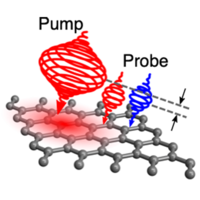
[Phys. Rev. X 10, 041013] Published Mon Oct 19, 2020
03 Nov 14:43
by Zhaodong Chu, Emma C. Regan, Xuejian Ma, Danqing Wang, Zifan Xu, M. Iqbal Bakti Utama, Kentaro Yumigeta, Mark Blei, Kenji Watanabe, Takashi Taniguchi, Sefaattin Tongay, Feng Wang, and Keji Lai
Author(s): Zhaodong Chu, Emma C. Regan, Xuejian Ma, Danqing Wang, Zifan Xu, M. Iqbal Bakti Utama, Kentaro Yumigeta, Mark Blei, Kenji Watanabe, Takashi Taniguchi, Sefaattin Tongay, Feng Wang, and Keji Lai
We report the nanoscale conductivity imaging of correlated electronic states in angle-aligned WSe2/WS2 heterostructures using microwave impedance microscopy. The noncontact microwave probe allows us to observe the Mott insulating state with one hole per moiré unit cell that persists for temperatures...
[Phys. Rev. Lett. 125, 186803] Published Fri Oct 30, 2020
27 Oct 08:30
by Philipp Rosenzweig, Hrag Karakachian, Dmitry Marchenko, Kathrin Küster, and Ulrich Starke
Author(s): Philipp Rosenzweig, Hrag Karakachian, Dmitry Marchenko, Kathrin Küster, and Ulrich Starke
New experiments with doped graphene take the two-dimensional material beyond its “Van Hove singularity” to regions that may host exotic states of matter.
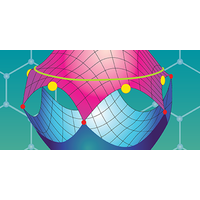
[Phys. Rev. Lett. 125, 176403] Published Mon Oct 19, 2020
27 Oct 08:30
by Meng-Kai Lin, Joseph A. Hlevyack, Peng Chen, Ro-Ya Liu, Sung-Kwan Mo, and T.-C. Chiang
Author(s): Meng-Kai Lin, Joseph A. Hlevyack, Peng Chen, Ro-Ya Liu, Sung-Kwan Mo, and T.-C. Chiang
Single layers of transition metal dichalcogenides are of interest for emergent properties; an often-neglected issue is substrate effects. Our experiments show that the charge density wave in a single-layer TiTe2 grown on PtTe2 films is strongly suppressed by increasing the PtTe2 substrate thickness....
[Phys. Rev. Lett. 125, 176405] Published Thu Oct 22, 2020
27 Oct 08:29
by Võ Tiến Phong and E. J. Mele
Author(s): Võ Tiến Phong and E. J. Mele
The electronic bands of twisted bilayer graphene (TBLG) with a large-period moiré superlattice fracture to form narrow Bloch minibands that are spectrally isolated by forbidden energy gaps from remote dispersive bands. When these gaps are sufficiently large, one can study a band-projected Hamiltonia...
[Phys. Rev. Lett. 125, 176404] Published Thu Oct 22, 2020
13 Oct 07:50
by Jonathan Karp, Max Bramberger, Martin Grundner, Ulrich Schollwöck, Andrew J. Millis, and Manuel Zingl
Author(s): Jonathan Karp, Max Bramberger, Martin Grundner, Ulrich Schollwöck, Andrew J. Millis, and Manuel Zingl
Sr2MoO4 is isostructural to the unconventional superconductor Sr2RuO4 but with two electrons instead of two holes in the Mo/Ru−t2g orbitals. Both materials are Hund’s metals, but while Sr2RuO4 has a van Hove singularity in close proximity to the Fermi surface, the van Hove singularity of Sr2MoO4 is ...
[Phys. Rev. Lett. 125, 166401] Published Mon Oct 12, 2020
09 Oct 08:34
by Gaofeng Xu, Tong Zhou, Benedikt Scharf, and Igor Žutić
Author(s): Gaofeng Xu, Tong Zhou, Benedikt Scharf, and Igor Žutić
In many atomically thin materials, their optical absorption is dominated by excitonic transitions. It was recently found that optical selection rules in these materials are influenced by the band topology near the valleys. We propose that gate-controlled band ordering in a single atomic monolayer, t...
[Phys. Rev. Lett. 125, 157402] Published Thu Oct 08, 2020
09 Oct 08:34
by Shenyang Huang, Fanjie Wang, Guowei Zhang, Chaoyu Song, Yuchen Lei, Qiaoxia Xing, Chong Wang, Yujun Zhang, Jiasheng Zhang, Yuangang Xie, Lei Mu, Chunxiao Cong, Mingyuan Huang, and Hugen Yan
Author(s): Shenyang Huang, Fanjie Wang, Guowei Zhang, Chaoyu Song, Yuchen Lei, Qiaoxia Xing, Chong Wang, Yujun Zhang, Jiasheng Zhang, Yuangang Xie, Lei Mu, Chunxiao Cong, Mingyuan Huang, and Hugen Yan
The temperature dependence of the band gap is crucial to a semiconductor. Bulk black phosphorus is known to exhibit an anomalous behavior. Through optical spectroscopy, here we show that the temperature effect on black phosphorus band gap gradually evolves with decreasing layer number, eventually tu...
[Phys. Rev. Lett. 125, 156802] Published Thu Oct 08, 2020
24 Sep 08:57
by Huy Quang Ta,
Alicja Bachmatiuk,
Rafael Gregorio Mendes,
David J. Perello,
Liang Zhao,
Barbara Trzebicka,
Thomas Gemming,
Slava V. Rotkin,
Mark H. Rümmeli

Graphene flakes, nucleated over a polycrystalline graphene film, are shown to synchronize during growth, so as to ultimately yield a common crystal orientation at the macroscale, namely, large‐area single‐crystal growth. The work also demonstrates that graphene synthesis can be advanced to control the nucleated crystal shape, registry, and relative alignment between graphene crystals for wafer‐scale areas.
Abstract
In 1665 Christiaan Huygens first noticed how two pendulums, regardless of their initial state, would synchronize. It is now known that the universe is full of complex self‐organizing systems, from neural networks to correlated materials. Here, graphene flakes, nucleated over a polycrystalline graphene film, synchronize during growth so as to ultimately yield a common crystal orientation at the macroscale. Strain and diffusion gradients are argued as the probable causes for the long‐range cross‐talk between flakes and the formation of a single‐grain graphene layer. The work demonstrates that graphene synthesis can be advanced to control the nucleated crystal shape, registry, and relative alignment between graphene crystals for large area, that is, a single‐crystal bilayer, and (AB‐stacked) few‐layer graphene can been grown at the wafer scale.
23 Sep 15:04
by Umberto De Giovannini, Hannes Hübener, Shunsuke A. Sato, and Angel Rubio
Author(s): Umberto De Giovannini, Hannes Hübener, Shunsuke A. Sato, and Angel Rubio
Time- and angular- resolved photoelectron spectroscopy is a powerful technique to measure electron dynamics in solids. Recent advances in this technique have facilitated band and energy resolved observations of the effect that excited phonons, have on the electronic structure. Here, we show with the...
[Phys. Rev. Lett. 125, 136401] Published Mon Sep 21, 2020
11 Sep 07:21
by Yu Zhang, Ying Su, and Lin He
Author(s): Yu Zhang, Ying Su, and Lin He
Chiral quasiparticles in Bernal-stacked bilayer graphene have valley-contrasting Berry phases of ±2π. This nontrivial topological structure, associated with the pseudospin winding along a closed Fermi surface, is responsible for various novel electronic properties. Here we show that the quantum inte...
[Phys. Rev. Lett. 125, 116804] Published Thu Sep 10, 2020
09 Sep 08:01
by Xuefei Feng, Shawn Sallis, Yu-Cheng Shao, Ruimin Qiao, Yi-Sheng Liu, Li Cheng Kao, Anton S. Tremsin, Zahid Hussain, Wanli Yang, Jinghua Guo, and Yi-De Chuang
Author(s): Xuefei Feng, Shawn Sallis, Yu-Cheng Shao, Ruimin Qiao, Yi-Sheng Liu, Li Cheng Kao, Anton S. Tremsin, Zahid Hussain, Wanli Yang, Jinghua Guo, and Yi-De Chuang
The exciton-phonon coupling in highly oriented pyrolytic graphite is studied using resonant inelastic x-ray scattering (RIXS) spectroscopy. With ∼70 meV energy resolution, multiple low energy excitations associated with coupling to phonons can be clearly resolved in the RIXS spectra. Using resonanc...
[Phys. Rev. Lett. 125, 116401] Published Tue Sep 08, 2020
31 Aug 09:32
by Jinwon Lee, Kyung-Hwan Jin, Andrei Catuneanu, Ara Go, Jiwon Jung, Choongjae Won, Sang-Wook Cheong, Jaeyoung Kim, Feng Liu, Hae-Young Kee, and Han Woong Yeom
Author(s): Jinwon Lee, Kyung-Hwan Jin, Andrei Catuneanu, Ara Go, Jiwon Jung, Choongjae Won, Sang-Wook Cheong, Jaeyoung Kim, Feng Liu, Hae-Young Kee, and Han Woong Yeom
Effects of electron many-body interactions amplify in an electronic system with a narrow bandwidth opening a way to exotic physics. A narrow band in a two-dimensional (2D) honeycomb lattice is particularly intriguing as combined with Dirac bands and topological properties but the material realizatio...
[Phys. Rev. Lett. 125, 096403] Published Fri Aug 28, 2020
19 Aug 08:53
by D. Perconte, K. Seurre, V. Humbert, C. Ulysse, A. Sander, J. Trastoy, V. Zatko, F. Godel, P. R. Kidambi, S. Hofmann, X. P. Zhang, D. Bercioux, F. S. Bergeret, B. Dlubak, P. Seneor, and Javier E. Villegas
Author(s): D. Perconte, K. Seurre, V. Humbert, C. Ulysse, A. Sander, J. Trastoy, V. Zatko, F. Godel, P. R. Kidambi, S. Hofmann, X. P. Zhang, D. Bercioux, F. S. Bergeret, B. Dlubak, P. Seneor, and Javier E. Villegas
Recent experiments have shown that proximity with high-temperature superconductors induces unconventional superconducting correlations in graphene. Here, we demonstrate that those correlations propagate hundreds of nanometers, allowing for the unique observation of d-wave Andreev-pair interferences ...
[Phys. Rev. Lett. 125, 087002] Published Tue Aug 18, 2020
10 Aug 08:20
by Alfred J. H. Jones,
Ryan Muzzio,
Paulina Majchrzak,
Sahar Pakdel,
Davide Curcio,
Klara Volckaert,
Deepnarayan Biswas,
Jacob Gobbo,
Simranjeet Singh,
Jeremy T. Robinson,
Kenji Watanabe,
Takashi Taniguchi,
Timur K. Kim,
Cephise Cacho,
Nicola Lanata,
Jill A. Miwa,
Philip Hofmann,
Jyoti Katoch,
Søren Ulstrup

In article number https://doi.org/10.1002/adma.2020016562001656, Jyoti Katoch, Søran Ulstrup, and co‐workers apply nanoscale angle‐resolved photoemission (nanoARPES) to measure the superlattice van Hove singularity formed by the Dirac cones of twisted bilayer graphene. The photoemission experiment is performed on a device architecture that permits electrostatic tuning of the doping level, revealing the doping dependence of the singularity over a wide energy range.
30 Jul 08:22
by Mason J. Gray, Narendra Kumar, Ryan O'Connor, Marcel Hoek, Erin Sheridan, Meaghan C. Doyle, Marisa L. Romanelli, Gavin B. Osterhoudt, Yiping Wang, Vincent Plisson, Shiming Lei, Ruidan Zhong, Bryan Rachmilowitz, He Zhao, Hikari Kitadai, Steven Shepard, Leslie M. Schoop, G. D. Gu, Ilija Zeljkovic, Xi Ling, K. S. Burch
The exploration of new materials, novel quantum phases, and devices requires
ways to prepare cleaner samples with smaller feature sizes. Initially, this
meant the use of a cleanroom that limits the amount and size of dust particles.
However, many materials are highly sensitive to oxygen and water in the air.
Furthermore, the ever-increasing demand for a quantum workforce, trained and
able to use the equipment for creating and characterizing materials, calls for
a dramatic reduction in the cost to create and operate such facilities. To this
end, we present our cleanroom-in-a-glovebox, a system which allows for the
fabrication and characterization of devices in an inert argon atmosphere. We
demonstrate the ability to perform a wide range of characterization as well as
fabrication steps, without the need for a dedicated room, all in an argon
environment. Connection to a vacuum suitcase is also demonstrated to enable
receiving from and transfer to various ultra-high vacuum (UHV) equipment
including molecular-beam epitaxy (MBE) and scanning tunneling microscopy (STM).
22 Jul 07:39
by Danliang Zhang,
Zhouxiaosong Zeng,
Qingjun Tong,
Ying Jiang,
Shula Chen,
Biyuan Zheng,
Junyu Qu,
Fang Li,
Weihao Zheng,
Feng Jiang,
Hepeng Zhao,
Lanyu Huang,
Kai Braun,
Alfred J. Meixner,
Xiao Wang,
Anlian Pan

Enhanced SHG intensity with near‐unity polarization from inversion‐symmetry‐broken 2D TMDC atomic layers, spiral structures, and heterostructures are realized at room temperature. It is found that there is no significant effect of multilayer interlayer interaction on SHG polarization.
Abstract
With unique valley‐dependent optical and optoelectronic properties, 2D transition metal dichalcogenides (2D TMDCs) are promising materials for valleytronics. Second‐harmonic generation (SHG) in 2D TMDCs monolayers has shown valley‐dependent optical selection rules. However, SHG in monolayer TMDCs is generally weak; it is important to obtain materials with both strong SHG signals and a large degree of polarization. In the work, a variety of inversion‐symmetry‐breaking (3R‐like phase) TMDCs (WSe2, WS2, MoS2) atomic layers, spiral structures, and heterostructures are prepared, and their SHG polarization is studied. Through circular‐polarization‐resolved SHG experiments, it is demonstrated that the SHG intensity is enhanced in thicker samples by breaking inversion symmetry while maintaining the degree of polarization close to unity at room temperature. By studying TMDCs with different twist angles and the spiral structures, it is found that there is no significant effect of multilayer interlayer interaction on valley‐dependent SHG. The realization of strong SHG with high degree of polarization may pave the way toward a new platform for nonlinear optical valleytronics devices based on 2D semiconductors.
22 Jul 07:37
by Sobhit Singh, Jinwoong Kim, Karin M. Rabe, and David Vanderbilt
Author(s): Sobhit Singh, Jinwoong Kim, Karin M. Rabe, and David Vanderbilt
MoTe2 has recently attracted much attention due to the observation of pressure-induced superconductivity, exotic topological phase transitions, and nonlinear quantum effects. However, there has been debate on the intriguing structural phase transitions among various observed phases of MoTe2 and thei...
[Phys. Rev. Lett. 125, 046402] Published Tue Jul 21, 2020
14 Jul 07:49
by Jiho Sung
Nature Nanotechnology, Published online: 13 July 2020; doi:10.1038/s41565-020-0728-z
Domain-resolved spectroscopy reveals the impact of local atomic registry and crystal symmetry on the exciton properties of individual domains in near-0°-twist-angle MoSe2/MoSe2.
14 Jul 07:48
by Paulina Plochocka
Nature Nanotechnology, Published online: 13 July 2020; doi:10.1038/s41565-020-0744-z
Breaking the mirror symmetry in twisted bilayer MoSe2 results in large scale exciton dipole oriented domains in a two-dimensional homostructure.
07 Jul 08:26
by Tommaso Cea and Francisco Guinea
Author(s): Tommaso Cea and Francisco Guinea
We analyze the phase diagram of twisted graphene bilayers near a magic angle. We consider the effect of the long-range Coulomb interaction, treated within the self-consistent Hartree-Fock approximation, and we study arbitrary band fillings. We find a rich phase diagram, with different broken symmetr...
[Phys. Rev. B 102, 045107] Published Mon Jul 06, 2020
07 Jul 07:11
by Stephane Boubanga-Tombet, Wojciech Knap, Deepika Yadav, Akira Satou, Dmytro B. But, Vyacheslav V. Popov, Ilya V. Gorbenko, Valentin Kachorovskii, and Taiichi Otsuji
Author(s): Stephane Boubanga-Tombet, Wojciech Knap, Deepika Yadav, Akira Satou, Dmytro B. But, Vyacheslav V. Popov, Ilya V. Gorbenko, Valentin Kachorovskii, and Taiichi Otsuji
Paving the way for new tunable plasmonic THz amplifiers, experiments show the first observation of energy transfer from dc current to plasmons, leading to THz amplification.

[Phys. Rev. X 10, 031004] Published Mon Jul 06, 2020
24 Jun 11:49
by Alfred J. H. Jones,
Ryan Muzzio,
Paulina Majchrzak,
Sahar Pakdel,
Davide Curcio,
Klara Volckaert,
Deepnarayan Biswas,
Jacob Gobbo,
Simranjeet Singh,
Jeremy T. Robinson,
Kenji Watanabe,
Takashi Taniguchi,
Timur K. Kim,
Cephise Cacho,
Nicola Lanata,
Jill A. Miwa,
Philip Hofmann,
Jyoti Katoch,
Søren Ulstrup

An electrostatically gated van der Waals heterostructure composed of twisted bilayer graphene is investigated using nanoscale angle‐resolved photoemission during device operation. The dispersion of the superlattice bands and the energy of the associated van Hove singularities are tuned by varying the charge carrier density in the two twisted graphene layers using the back‐gate voltage.
Abstract
The possibility of triggering correlated phenomena by placing a singularity of the density of states near the Fermi energy remains an intriguing avenue toward engineering the properties of quantum materials. Twisted bilayer graphene is a key material in this regard because the superlattice produced by the rotated graphene layers introduces a van Hove singularity and flat bands near the Fermi energy that cause the emergence of numerous correlated phases, including superconductivity. Direct demonstration of electrostatic control of the superlattice bands over a wide energy range has, so far, been critically missing. This work examines the effect of electrical doping on the electronic band structure of twisted bilayer graphene using a back‐gated device architecture for angle‐resolved photoemission measurements with a nano‐focused light spot. A twist angle of 12.2° is selected such that the superlattice Brillouin zone is sufficiently large to enable identification of van Hove singularities and flat band segments in momentum space. The doping dependence of these features is extracted over an energy range of 0.4 eV, expanding the combinations of twist angle and doping where they can be placed at the Fermi energy and thereby induce new correlated electronic phases in twisted bilayer graphene.
15 Jun 11:22
by Joseph A. Hlevyack, Sahand Najafzadeh, Meng-Kai Lin, Takahiro Hashimoto, Tsubaki Nagashima, Akihiro Tsuzuki, Akiko Fukushima, Cédric Bareille, Yang Bai, Peng Chen, Ro-Ya Liu, Yao Li, David Flötotto, José Avila, James N. Eckstein, Shik Shin, Kozo Okazaki, and T.-C. Chiang
Author(s): Joseph A. Hlevyack, Sahand Najafzadeh, Meng-Kai Lin, Takahiro Hashimoto, Tsubaki Nagashima, Akihiro Tsuzuki, Akiko Fukushima, Cédric Bareille, Yang Bai, Peng Chen, Ro-Ya Liu, Yao Li, David Flötotto, José Avila, James N. Eckstein, Shik Shin, Kozo Okazaki, and T.-C. Chiang
Massive attenuation of surface superconductivity in (Bi1−xSbx)2Te3/Nb compared to Bi2Se3/Nb suggests that quantum-mechanical coupling between bulk and surface states largely dominates the proximity effect in topological insulator films on Nb.

[Phys. Rev. Lett. 124, 236402] Published Fri Jun 12, 2020

