24 Jun 08:23
by Bingnan Han,
Yuxuan Lin,
Yafang Yang,
Nannan Mao,
Wenyue Li,
Haozhe Wang,
Kenji Yasuda,
Xirui Wang,
Valla Fatemi,
Lin Zhou,
Joel I.‐Jan Wang,
Qiong Ma,
Yuan Cao,
Daniel Rodan‐Legrain,
Ya‐Qing Bie,
Efrén Navarro‐Moratalla,
Dahlia Klein,
David MacNeill,
Sanfeng Wu,
Hikari Kitadai,
Xi Ling,
Pablo Jarillo‐Herrero,
Jing Kong,
Jihao Yin,
Tomás Palacios

Microscopy data of nanomaterials often contains rich yet complicated information that reflects the material properties, but is mostly overlooked by researchers. Deep learning is an ideal approach to finding these highly correlated and non‐linear features. As a case study, a neural network model called “2DMOINet” is trained for optical identification and characterization of exfoliated 2D materials.
Abstract
Advanced microscopy and/or spectroscopy tools play indispensable roles in nanoscience and nanotechnology research, as they provide rich information about material processes and properties. However, the interpretation of imaging data heavily relies on the “intuition” of experienced researchers. As a result, many of the deep graphical features obtained through these tools are often unused because of difficulties in processing the data and finding the correlations. Such challenges can be well addressed by deep learning. In this work, the optical characterization of 2D materials is used as a case study, and a neural‐network‐based algorithm is demonstrated for the material and thickness identification of 2D materials with high prediction accuracy and real‐time processing capability. Further analysis shows that the trained network can extract deep graphical features such as contrast, color, edges, shapes, flake sizes, and their distributions, based on which an ensemble approach is developed to predict the most relevant physical properties of 2D materials. Finally, a transfer learning technique is applied to adapt the pretrained network to other optical identification applications. This artificial‐intelligence‐based material characterization approach is a powerful tool that would speed up the preparation, initial characterization of 2D materials and other nanomaterials, and potentially accelerate new material discoveries.
04 Jun 07:17
by Asger K. Pedersen, Satoru Ichinokura, Tomoaki Tanaka, Ryota Shimizu, Taro Hitosugi, and Toru Hirahara
Author(s): Asger K. Pedersen, Satoru Ichinokura, Tomoaki Tanaka, Ryota Shimizu, Taro Hitosugi, and Toru Hirahara
We investigated the superconducting transport properties of the one-unit-cell FeSe ultrathin films epitaxially grown on undoped SrTiO3(001) (STO) with a well-defined surface structure by in situ independently-driven four-point-probe measurements. Our results unambiguously revealed the detection of t...
[Phys. Rev. Lett. 124, 227002] Published Wed Jun 03, 2020
02 Jun 07:24
by Giovanni Scuri, Trond I. Andersen, You Zhou, Dominik S. Wild, Jiho Sung, Ryan J. Gelly, Damien Bérubé, Hoseok Heo, Linbo Shao, Andrew Y. Joe, Andrés M. Mier Valdivia, Takashi Taniguchi, Kenji Watanabe, Marko Lončar, Philip Kim, Mikhail D. Lukin, and Hongkun Park
Author(s): Giovanni Scuri, Trond I. Andersen, You Zhou, Dominik S. Wild, Jiho Sung, Ryan J. Gelly, Damien Bérubé, Hoseok Heo, Linbo Shao, Andrew Y. Joe, Andrés M. Mier Valdivia, Takashi Taniguchi, Kenji Watanabe, Marko Lončar, Philip Kim, Mikhail D. Lukin, and Hongkun Park
The twist degree of freedom provides a powerful new tool for engineering the electrical and optical properties of van der Waals heterostructures. Here, we show that the twist angle can be used to control the spin-valley properties of transition metal dichalcogenide bilayers by changing the momentum ...
[Phys. Rev. Lett. 124, 217403] Published Thu May 28, 2020
22 May 07:58
by Chaoyu Guo (郭钞宇), Xiangzhi Meng, Huixia Fu, Qin Wang, Huimin Wang, Ye Tian, Jinbo Peng, Runze Ma, Yuxiang Weng, Sheng Meng, Enge Wang, and Ying Jiang
Author(s): Chaoyu Guo (郭钞宇), Xiangzhi Meng, Huixia Fu, Qin Wang, Huimin Wang, Ye Tian, Jinbo Peng, Runze Ma, Yuxiang Weng, Sheng Meng, Enge Wang, and Ying Jiang
Critical role of the atomic environment in polaron dynamics is revealed by a study of the relaxation of photoexcited single polarons on the atomic scale.

[Phys. Rev. Lett. 124, 206801] Published Tue May 19, 2020
22 May 07:57
by M. Puppin, S. Polishchuk, N. Colonna, A. Crepaldi, D. N. Dirin, O. Nazarenko, R. De Gennaro, G. Gatti, S. Roth, T. Barillot, L. Poletto, R. P. Xian, L. Rettig, M. Wolf, R. Ernstorfer, M. V. Kovalenko, N. Marzari, M. Grioni, and M. Chergui
Author(s): M. Puppin, S. Polishchuk, N. Colonna, A. Crepaldi, D. N. Dirin, O. Nazarenko, R. De Gennaro, G. Gatti, S. Roth, T. Barillot, L. Poletto, R. P. Xian, L. Rettig, M. Wolf, R. Ernstorfer, M. V. Kovalenko, N. Marzari, M. Grioni, and M. Chergui
Lead-halide perovskite (LHP) semiconductors are emergent optoelectronic materials with outstanding transport properties which are not yet fully understood. We find signatures of large polaron formation in the electronic structure of the inorganic LHP CsPbBr3 by means of angle-resolved photoelectron ...
[Phys. Rev. Lett. 124, 206402] Published Wed May 20, 2020
18 May 07:56
by Erfu Liu, Jeremiah van Baren, Ching-Tarng Liang, Takashi Taniguchi, Kenji Watanabe, Nathaniel M. Gabor, Yia-Chung Chang, and Chun Hung Lui
Author(s): Erfu Liu, Jeremiah van Baren, Ching-Tarng Liang, Takashi Taniguchi, Kenji Watanabe, Nathaniel M. Gabor, Yia-Chung Chang, and Chun Hung Lui
Excitons and trions (or exciton polarons) in transition metal dichalcogenides (TMDs) are known to decay predominantly through intravalley transitions. Electron-hole recombination across different valleys can also play a significant role in the excitonic dynamics, but intervalley transitions are rare...
[Phys. Rev. Lett. 124, 196802] Published Thu May 14, 2020
12 May 07:33
by Long Yuan
Nature Materials, Published online: 11 May 2020; doi:10.1038/s41563-020-0670-3
Interlayer exciton dynamics in a van der Waals heterostructure is found to be modulated by the twist angle between the atomically thin layers, elucidating the effect of moiré potentials on exciton motion and providing guidelines to design quantum photonics devices based on 2D materials.
11 May 08:28
by J. González and T. Stauber
Author(s): J. González and T. Stauber
Linear resistivity at low temperatures is a prominent feature of high-Tc superconductors which has also been found recently in twisted bilayer graphene. We show that due to an extended van Hove singularity (VHS), the T-linear resistivity can be obtained from a microscopic tight-binding model for fil...
[Phys. Rev. Lett. 124, 186801] Published Fri May 08, 2020
04 May 07:58
by L. Banszerus, B. Frohn, T. Fabian, S. Somanchi, A. Epping, M. Müller, D. Neumaier, K. Watanabe, T. Taniguchi, F. Libisch, B. Beschoten, F. Hassler, and C. Stampfer
Author(s): L. Banszerus, B. Frohn, T. Fabian, S. Somanchi, A. Epping, M. Müller, D. Neumaier, K. Watanabe, T. Taniguchi, F. Libisch, B. Beschoten, F. Hassler, and C. Stampfer
We report on measurements of quantized conductance in gate-defined quantum point contacts in bilayer graphene that allow the observation of subband splittings due to spin-orbit coupling. The size of this splitting can be tuned from 40 to 80 μeV by the displacement field. We assign this gate-tunable...
[Phys. Rev. Lett. 124, 177701] Published Fri May 01, 2020
23 Apr 07:44
by Yusong Liu, Spencer L. Horton, Jie Yang, J. Pedro F. Nunes, Xiaozhe Shen, Thomas J. A. Wolf, Ruaridh Forbes, Chuan Cheng, Bryan Moore, Martin Centurion, Kareem Hegazy, Renkai Li, Ming-Fu Lin, Albert Stolow, Paul Hockett, Tamás Rozgonyi, Philipp Marquetand, Xijie Wang, and Thomas Weinacht
Author(s): Yusong Liu, Spencer L. Horton, Jie Yang, J. Pedro F. Nunes, Xiaozhe Shen, Thomas J. A. Wolf, Ruaridh Forbes, Chuan Cheng, Bryan Moore, Martin Centurion, Kareem Hegazy, Renkai Li, Ming-Fu Lin, Albert Stolow, Paul Hockett, Tamás Rozgonyi, Philipp Marquetand, Xijie Wang, and Thomas Weinacht
The combination of computer simulations and two powerful experimental methods for following molecular change on femtosecond timescales offers an unprecedented view of how a photoexcited molecule breaks apart.

[Phys. Rev. X 10, 021016] Published Wed Apr 22, 2020
23 Apr 07:43
by Patrick Knowles, Bo Yang, Takaki Muramatsu, Owen Moulding, Jonathan Buhot, Charles J. Sayers, Enrico Da Como, and Sven Friedemann
Author(s): Patrick Knowles, Bo Yang, Takaki Muramatsu, Owen Moulding, Jonathan Buhot, Charles J. Sayers, Enrico Da Como, and Sven Friedemann
The evolution of the charge carrier concentrations and mobilities are examined across the charge-density-wave (CDW) transition in TiSe2. Combined quantum oscillation and magnetotransport measurements show that a small electron pocket dominates the electronic properties at low temperatures while an e...
[Phys. Rev. Lett. 124, 167602] Published Wed Apr 22, 2020
23 Apr 07:43
by Ramon Cuscó, James H. Edgar, Song Liu, Jiahan Li, and Luis Artús
Author(s): Ramon Cuscó, James H. Edgar, Song Liu, Jiahan Li, and Luis Artús
The phonon linewidth of isotopically controlled hexagonal boron nitride (h-BN) single crystals has been determined by Raman scattering. The scattering by isotopic mass disorder induces a phonon broadening that is largest for boron 11 fractions around 0.65. Lowest-order perturbation theory does not s...
[Phys. Rev. Lett. 124, 167402] Published Wed Apr 22, 2020
23 Apr 07:43
by Yi-Wen Liu, Zhe Hou, Si-Yu Li, Qing-Feng Sun, and Lin He
Author(s): Yi-Wen Liu, Zhe Hou, Si-Yu Li, Qing-Feng Sun, and Lin He
Berry phase, the geometric phase accumulated over a closed loop in parameter space during an adiabatic cyclic evolution, has been demonstrated to play an important role in many quantum systems since its discovery. In gapped Bernal bilayer graphene, the Berry phase can be continuously tuned from zero...
[Phys. Rev. Lett. 124, 166801] Published Wed Apr 22, 2020
02 Apr 13:54
by Jongjun M. Lee, Chenhua Geng, Jae Whan Park, Masaki Oshikawa, Sung-Sik Lee, Han Woong Yeom, and Gil Young Cho
Author(s): Jongjun M. Lee, Chenhua Geng, Jae Whan Park, Masaki Oshikawa, Sung-Sik Lee, Han Woong Yeom, and Gil Young Cho
We propose a new principle to realize flatbands which are robust in real materials, based on a network superstructure of one-dimensional segments. This mechanism is naturally realized in the nearly commensurate charge-density wave of 1T−TaS2 with the honeycomb network of conducting domain walls, and...
[Phys. Rev. Lett. 124, 137002] Published Wed Apr 01, 2020
25 Mar 10:25
by Yongjin Lee, Angelika Knothe, Hiske Overweg, Marius Eich, Carolin Gold, Annika Kurzmann, Veronika Klasovika, Takashi Taniguchi, Kenji Wantanabe, Vladimir Fal’ko, Thomas Ihn, Klaus Ensslin, and Peter Rickhaus
Author(s): Yongjin Lee, Angelika Knothe, Hiske Overweg, Marius Eich, Carolin Gold, Annika Kurzmann, Veronika Klasovika, Takashi Taniguchi, Kenji Wantanabe, Vladimir Fal’ko, Thomas Ihn, Klaus Ensslin, and Peter Rickhaus
A method to tune the valley splitting in bilayer graphene using gate electrodes might lead to a useful tool for quantum information processing.
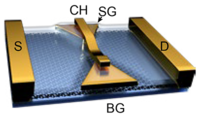
[Phys. Rev. Lett. 124, 126802] Published Tue Mar 24, 2020
25 Mar 10:25
by Gustav Bihlmayer, Jonas Sassmannshausen, André Kubetzka, Stefan Blügel, Kirsten von Bergmann, and Roland Wiesendanger
Author(s): Gustav Bihlmayer, Jonas Sassmannshausen, André Kubetzka, Stefan Blügel, Kirsten von Bergmann, and Roland Wiesendanger
As a heavy analog of graphene, plumbene is a two-dimensional material with strong spin-orbit coupling effects. Using scanning tunneling microscopy, we observe that Pb forms a flat honeycomb lattice on an Fe monolayer on Ir(111). In contrast, without the Fe layer, a c(2×4) structure of Pb on Ir(111) ...
[Phys. Rev. Lett. 124, 126401] Published Tue Mar 24, 2020
03 Mar 08:26
by Ming Xie and A. H. MacDonald
Author(s): Ming Xie and A. H. MacDonald
We use self-consistent Hartree-Fock calculations performed in the full π-band Hilbert space to assess the nature of the recently discovered correlated insulator states in magic-angle twisted bilayer graphene (TBG). We find that gaps between the flat conduction and valence bands open at neutrality ov...
[Phys. Rev. Lett. 124, 097601] Published Mon Mar 02, 2020
27 Feb 08:53
by Xing-Ju Zhao, Yang Yang, Dong-Bo Zhang, and Su-Huai Wei
Author(s): Xing-Ju Zhao, Yang Yang, Dong-Bo Zhang, and Su-Huai Wei
The existence of Bloch flat bands of electrons provides a facile pathway to obtain exotic quantum phases owing to strong correlation. Despite the established magic angle mechanism for twisted bilayer graphene, understanding of the emergence of flat bands in twisted bilayers of two-dimensional polar ...
[Phys. Rev. Lett. 124, 086401] Published Wed Feb 26, 2020
26 Feb 08:20
by Jinhua Hong, Ryosuke Senga, Thomas Pichler, and Kazu Suenaga
Author(s): Jinhua Hong, Ryosuke Senga, Thomas Pichler, and Kazu Suenaga
Excitons, as bound electron-hole paired quasiparticle, play an essential role in the energy transport in the optical-electric properties of semiconductors. Their momentum-energy dispersion relation is a fundamental physical property of great significance to understand exciton dynamics. However, this...
[Phys. Rev. Lett. 124, 087401] Published Tue Feb 25, 2020
25 Feb 15:04
by P. Wahl, U.R. Singh, V. Tsurkan, A. Loidl
We report on an apparent low-energy nanoscale electronic inhomogeneity in
FeSe$_{0.4}$Te$_{0.6}$ due to the distribution of selenium and tellurium atoms
revealed through unsupervised machine learning. Through an unsupervised
clustering algorithm, characteristic spectra of selenium- and tellurium-rich
regions are identified. The inhomogeneity linked to these spectra can clearly
be traced in the differential conductance and is detected both at energy scales
of a few electron volts as well as within a few millielectronvolts of the Fermi
energy. By comparison with ARPES, this inhomogeneity can be linked to an
electron-like band just above the Fermi energy. It is directly correlated with
the local distribution of selenium and tellurium. There is no clear correlation
with the magnitude of the superconducting gap, however the height of the
coherence peaks shows significant correlation with the intensity with which
this band is detected, and hence with the local chemical composition.
20 Feb 10:30
by Lin Miao, Shouzheng Liu, Yishuai Xu, Erica C. Kotta, Chang-Jong Kang, Sheng Ran, Johnpierre Paglione, Gabriel Kotliar, Nicholas P. Butch, Jonathan D. Denlinger, and L. Andrew Wray
Author(s): Lin Miao, Shouzheng Liu, Yishuai Xu, Erica C. Kotta, Chang-Jong Kang, Sheng Ran, Johnpierre Paglione, Gabriel Kotliar, Nicholas P. Butch, Jonathan D. Denlinger, and L. Andrew Wray
The compound UTe2 has recently been shown to realize spin triplet superconductivity from a nonmagnetic normal state. This has sparked intense research activity, including theoretical analyses that suggest the superconducting order parameter to be topologically nontrivial. However, the underlying ele...
[Phys. Rev. Lett. 124, 076401] Published Wed Feb 19, 2020
20 Feb 10:30
by Y. J. Hu, W. C. Yu, Kwing To Lai, D. Sun, F. F. Balakirev, W. Zhang, J. Y. Xie, K. Y. Yip, E. I. Paredes Aulestia, Rajveer Jha, Ryuji Higashinaka, Tatsuma D. Matsuda, Y. Yanase, Yuji Aoki, and Swee K. Goh
Author(s): Y. J. Hu, W. C. Yu, Kwing To Lai, D. Sun, F. F. Balakirev, W. Zhang, J. Y. Xie, K. Y. Yip, E. I. Paredes Aulestia, Rajveer Jha, Ryuji Higashinaka, Tatsuma D. Matsuda, Y. Yanase, Yuji Aoki, and Swee K. Goh
The bulk electronic structure of Td-MoTe2 features large hole Fermi pockets at the Brillouin zone center (Γ) and two electron Fermi surfaces along the Γ−X direction. However, the large hole pockets, whose existence has important implications for the Weyl physics of Td-MoTe2, has never been conclusiv...
[Phys. Rev. Lett. 124, 076402] Published Wed Feb 19, 2020
20 Feb 10:29
by Yang Gao, Yinhan Zhang, and Di Xiao
Author(s): Yang Gao, Yinhan Zhang, and Di Xiao
Circularly polarized light at normal incidence is predicted to induce a static out-of-plane dipole moment in twisted bilayer structures.
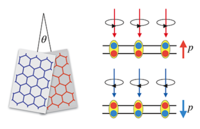
[Phys. Rev. Lett. 124, 077401] Published Wed Feb 19, 2020
12 Feb 08:57
by C. J. Sayers, L. S. Farrar, S. J. Bending, M. Cattelan, A. J. H. Jones, N. A. Fox, G. Kociok-Köhn, K. Koshmak, J. Laverock, L. Pasquali, and E. Da Como
Author(s): C. J. Sayers, L. S. Farrar, S. J. Bending, M. Cattelan, A. J. H. Jones, N. A. Fox, G. Kociok-Köhn, K. Koshmak, J. Laverock, L. Pasquali, and E. Da Como
We examine the charge density wave (CDW) properties of 1T−VSe2 crystals grown by chemical vapor transport (CVT) under varying conditions. Specifically, we find that upon lowering the growth temperature (Tg<630∘C), there is a significant increase in both the CDW transition temperature and the resi...
[Phys. Rev. Materials 4, 025002] Published Tue Feb 11, 2020
11 Feb 08:20
by Emily M. Smith, Martin M. Stein, Cole Walsh, and N. G. Holmes
Author(s): Emily M. Smith, Martin M. Stein, Cole Walsh, and N. G. Holmes
Traditional physics labs can have a negative impact on student learning, whereas nontraditional inquiry-based labs improve performance and engagement while maintaining exam scores.

[Phys. Rev. X 10, 011029] Published Mon Feb 10, 2020
10 Feb 08:13
by Y. K. Song, G. W. Wang, S. C. Li, W. L. Liu, X. L. Lu, Z. T. Liu, Z. J. Li, J. S. Wen, Z. P. Yin, Z. H. Liu, and D. W. Shen
Author(s): Y. K. Song, G. W. Wang, S. C. Li, W. L. Liu, X. L. Lu, Z. T. Liu, Z. J. Li, J. S. Wen, Z. P. Yin, Z. H. Liu, and D. W. Shen
Topological nodal-line semimetals with exotic quantum properties are characterized by symmetry-protected line-contact bulk band crossings in the momentum space. However, in most of identified topological nodal-line compounds, these topological nontrivial nodal lines are enclosed by complicated topol...
[Phys. Rev. Lett. 124, 056402] Published Fri Feb 07, 2020
27 Jan 11:35
by Meng-Kai Lin, Rovi Angelo B. Villaos, Joseph A. Hlevyack, Peng Chen, Ro-Ya Liu, Chia-Hsiu Hsu, José Avila, Sung-Kwan Mo, Feng-Chuan Chuang, and T.-C. Chiang
Author(s): Meng-Kai Lin, Rovi Angelo B. Villaos, Joseph A. Hlevyack, Peng Chen, Ro-Ya Liu, Chia-Hsiu Hsu, José Avila, Sung-Kwan Mo, Feng-Chuan Chuang, and T.-C. Chiang
Platinum ditelluride (PtTe2), a type-II Dirac semimetal, remains semimetallic in ultrathin films down to just two triatomic layers (TLs) with a negative gap of −0.36 eV. Further reduction of the film thickness to a single TL induces a Lifshitz electronic transition to a semiconductor with a large p...
[Phys. Rev. Lett. 124, 036402] Published Fri Jan 24, 2020
23 Jan 11:46
by C. J. Sayers, L. S. Farrar, S. J. Bending, M. Cattelan, A. J. H. Jones, N. A. Fox, G. Kociok-Köhn, K. Koshmak, J. Laverock, L. Pasquali, E. Da Como
We examine the charge density wave (CDW) properties of 1$T$-VSe$_{2}$
crystals grown by chemical vapour transport (CVT) under varying conditions.
Specifically, we find that by lowering the growth temperature ($T_{\mathrm{g}}$
$<$ 630$^{\circ}$C), there is a significant increase in both the CDW transition
temperature and the residual resistance ratio (RRR) obtained from electrical
transport measurements. Using x-ray photoelectron spectroscopy (XPS), we
correlate the observed CDW properties with stoichiometry and the nature of
defects. In addition, we have optimized a method to grow ultra-high purity
1$T$-VSe$_{2}$ crystals with a CDW transition temperature, $T_{\mathrm{CDW}}$ =
(112.7 $\pm$ 0.8) K and maximum residual resistance ratio (RRR) $\approx$ 49,
which is the highest reported thus far. This work highlights the sensitivity of
the CDW in 1$T$-VSe$_{2}$ to defects and overall stoichiometry, and the
importance of controlling the crystal growth conditions of strongly-correlated
TMDs.
15 Jan 09:26
by Lu Wang†, Zdenek Sofer‡, and Martin Pumera*‡§?

ACS Nano
DOI: 10.1021/acsnano.9b00184

14 Jan 11:05
by Glenn Wagner, Dung X. Nguyen, and Steven H. Simon
Author(s): Glenn Wagner, Dung X. Nguyen, and Steven H. Simon
Using the semiclassical quantum Boltzmann equation (QBE), we numerically calculate the dc transport properties of bilayer graphene near charge neutrality. We find, in contrast to prior discussions, that phonon scattering is crucial even at temperatures below 40 K. Nonetheless, electron-electron scat...
[Phys. Rev. Lett. 124, 026601] Published Mon Jan 13, 2020


