10 Aug 07:27
by Koloman Wagner, Jonas Zipfel, Roberto Rosati, Edith Wietek, Jonas D. Ziegler, Samuel Brem, Raül Perea-Causín, Takashi Taniguchi, Kenji Watanabe, Mikhail M. Glazov, Ermin Malic, and Alexey Chernikov
Author(s): Koloman Wagner, Jonas Zipfel, Roberto Rosati, Edith Wietek, Jonas D. Ziegler, Samuel Brem, Raül Perea-Causín, Takashi Taniguchi, Kenji Watanabe, Mikhail M. Glazov, Ermin Malic, and Alexey Chernikov
Dark excitons, living for over hundreds of picoseconds as opposed to short-lived bright ones, enable the study of exciton diffusion in 2D transition-metal dichalcogenides under thermal equilibrium conditions.
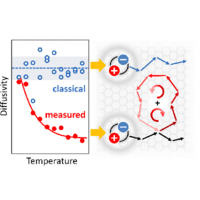
[Phys. Rev. Lett. 127, 076801] Published Mon Aug 09, 2021
09 Aug 07:15
by Shuangping Han, Xilong Liang, Chengbing Qin, Yan Gao, Yunrui Song, Shen Wang, Xingliang Su, Guofeng Zhang, Ruiyun Chen, Jianyong Hu, Mingyong Jing, Liantuan Xiao, and Suotang Jia

ACS Nano
DOI: 10.1021/acsnano.1c01787

09 Aug 07:12
by Zhiwei Li, Liwang Ren, Shiyu Wang, Xinxin Huang, Qianyuan Li, Zheyi Lu, Shuimei Ding, Hanjun Deng, Pingan Chen, Jun Lin, Yuanyuan Hu, Lei Liao, and Yuan Liu

ACS Nano
DOI: 10.1021/acsnano.1c05734

09 Aug 07:06
by Erfu Liu, Takashi Taniguchi, Kenji Watanabe, Nathaniel M. Gabor, Yong-Tao Cui, and Chun Hung Lui
Author(s): Erfu Liu, Takashi Taniguchi, Kenji Watanabe, Nathaniel M. Gabor, Yong-Tao Cui, and Chun Hung Lui
We have measured the reflectance contrast, photoluminescence, and valley polarization of a WSe2/WS2 heterobilayer moiré superlattice at gate-tunable charge density. We observe absorption modulation of three intralayer moiré excitons at filling factors ν=1/3 and 2/3. We also observe luminescence modu...
[Phys. Rev. Lett. 127, 037402] Published Fri Jul 16, 2021
09 Aug 07:05
by Carolin Gold, Angelika Knothe, Annika Kurzmann, Aitor Garcia-Ruiz, Kenji Watanabe, Takashi Taniguchi, Vladimir Fal’ko, Klaus Ensslin, and Thomas Ihn
Author(s): Carolin Gold, Angelika Knothe, Annika Kurzmann, Aitor Garcia-Ruiz, Kenji Watanabe, Takashi Taniguchi, Vladimir Fal’ko, Klaus Ensslin, and Thomas Ihn
Studying the current that flows in bilayer graphene, researchers have isolated electron jets associated with specific valley states.
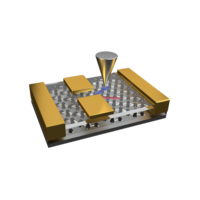
[Phys. Rev. Lett. 127, 046801] Published Tue Jul 20, 2021
09 Aug 07:03
by Diego Guzmán-Silva, Gabriel Cáceres-Aravena, and Rodrigo A. Vicencio
Author(s): Diego Guzmán-Silva, Gabriel Cáceres-Aravena, and Rodrigo A. Vicencio
The first experimental and numerical characterization of interorbital coupling coefficients over distance offers a new tool to investigate transport and localization in lattices.
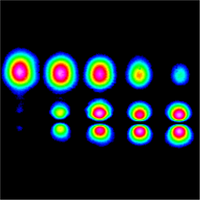
[Phys. Rev. Lett. 127, 066601] Published Fri Aug 06, 2021
16 Jul 08:21
by Xiahong Zhou and Gui Yu

ACS Nano
DOI: 10.1021/acsnano.1c02985

14 Jul 13:57
by Kai‐Qiang Lin,
Johannes Holler,
Jonas M. Bauer,
Philipp Parzefall,
Marten Scheuck,
Bo Peng,
Tobias Korn,
Sebastian Bange,
John M. Lupton,
Christian Schüller

Moiré superlattices produced through artificial stacking are often quite inhomogeneous and are challenging to characterize noninvasively. In this work, interlayer-breathing mode and moiré phonons are proven to be highly susceptible to the moiré period, and enable large-scale mapping of moiré superlattices by hyperspectral Raman imaging.
Abstract
Moiré superlattices can induce correlated-electronic phases in twisted van der Waals materials: strongly correlated quantum phenomena emerge, such as superconductivity and the Mott-insulating state. However, moiré superlattices produced through artificial stacking can be quite inhomogeneous, which hampers the development of a clear correlation between the moiré period and the emerging electrical and optical properties. Here, it is demonstrated in twisted-bilayer transition-metal dichalcogenides that low-frequency Raman scattering can be utilized not only to detect atomic reconstruction, but also to map out the inhomogeneity of the moiré lattice over large areas. The method is established based on the finding that both the interlayer-breathing mode and moiré phonons are highly susceptible to the moiré period and provide characteristic fingerprints. Hyperspectral Raman imaging visualizes microscopic domains of a 5° twisted-bilayer sample with an effective twist-angle resolution of about 0.1°. This ambient methodology can be conveniently implemented to characterize and preselect high-quality areas of samples for subsequent device fabrication, and for transport and optical experiments.
08 Jul 08:11
by Carla Boix-Constant, Samuel Mañas-Valero, Rosa Córdoba, José J. Baldoví, Ángel Rubio, and Eugenio Coronado

ACS Nano
DOI: 10.1021/acsnano.1c03012

02 Jul 11:21
by Eva A. A. Pogna, Xiaoyu Jia, Alessandro Principi, Alexander Block, Luca Banszerus, Jincan Zhang, Xiaoting Liu, Thibault Sohier△, Stiven Forti, Karuppasamy Soundarapandian■, Bernat Terrés■, Jake D. Mehew, Chiara Trovatello, Camilla Coletti, Frank H. L. Koppens■⬢, Mischa Bonn, Hai I. Wang, Niek van Hulst■⬢, Matthieu J. Verstraete△, Hailin Peng, Zhongfan Liu, Christoph Stampfer, Giulio Cerullo, and Klaas-Jan Tielrooij

ACS Nano
DOI: 10.1021/acsnano.0c10864

01 Jul 11:21
by Brendan D. Faeth, Saien Xie, Shuolong Yang, Jason K. Kawasaki, Jocienne N. Nelson, Shuyuan Zhang, Christopher Parzyck, Pramita Mishra, Chen Li, Christopher Jozwiak, Aaron Bostwick, Eli Rotenberg, Darrell G. Schlom, and Kyle M. Shen
Author(s): Brendan D. Faeth, Saien Xie, Shuolong Yang, Jason K. Kawasaki, Jocienne N. Nelson, Shuyuan Zhang, Christopher Parzyck, Pramita Mishra, Chen Li, Christopher Jozwiak, Aaron Bostwick, Eli Rotenberg, Darrell G. Schlom, and Kyle M. Shen
The observation of replica bands by angle-resolved photoemission spectroscopy has ignited interest in the study of electron-phonon coupling at low carrier densities, particularly in monolayer FeSe/SrTiO3, where the appearance of replica bands has motivated theoretical work suggesting that the interf...
[Phys. Rev. Lett. 127, 016803] Published Wed Jun 30, 2021
30 Jun 09:43
by Elias Diesen et al.
Author(s): Elias Diesen et al.
We use a pump-probe scheme to measure the time evolution of the C K-edge x-ray absorption spectrum from CO/Ru(0001) after excitation by an ultrashort high-intensity optical laser pulse. Because of the short duration of the x-ray probe pulse and precise control of the pulse delay, the excitation-indu...
[Phys. Rev. Lett. 127, 016802] Published Tue Jun 29, 2021
25 Jun 14:02
by Chenhaoping Wen, Jingjing Gao, Yuan Xie, Qing Zhang, Pengfei Kong, Jinghui Wang, Yilan Jiang, Xuan Luo, Jun Li, Wenjian Lu, Yu-Ping Sun, and Shichao Yan
Author(s): Chenhaoping Wen, Jingjing Gao, Yuan Xie, Qing Zhang, Pengfei Kong, Jinghui Wang, Yilan Jiang, Xuan Luo, Jun Li, Wenjian Lu, Yu-Ping Sun, and Shichao Yan
Here we use low-temperature scanning tunneling microscopy and spectroscopy to reveal the roles of the narrow electronic band in two 1T−TaS2-related materials (bulk 1T−TaS2 and 4Hb−TaS2). 4Hb−TaS2 is a superconducting compound with alternating 1T−TaS2 and 1H−TaS2 layers, where the 1H−TaS2 layer has a...
[Phys. Rev. Lett. 126, 256402] Published Wed Jun 23, 2021
22 Jun 13:34
by Shiming Lei,
Samuel M. L. Teicher,
Andreas Topp,
Kehan Cai,
Jingjing Lin,
Guangming Cheng,
Tyger H. Salters,
Fanny Rodolakis,
Jessica L. McChesney,
Saul Lapidus,
Nan Yao,
Maxim Krivenkov,
Dmitry Marchenko,
Andrei Varykhalov,
Christian R. Ast,
Roberto Car,
Jennifer Cano,
Maia G. Vergniory,
N. Phuan Ong,
Leslie M. Schoop

A charge density wave (CDW) is proposed as a tool to engineer an idealized Dirac semimetal. The CDW gaps all bands at the Fermi level except the Dirac cone, which is protected by non-symmorphic symmetry. Antiferromagnetic compounds of GdSb
x
Te2−x−δ are designed and synthesized to test this proposed mechanism. Unusual transport behavior is discovered and points to a new regime.
Abstract
New developments in the field of topological matter are often driven by materials discovery, including novel topological insulators, Dirac semimetals, and Weyl semimetals. In the last few years, large efforts have been made to classify all known inorganic materials with respect to their topology. Unfortunately, a large number of topological materials suffer from non-ideal band structures. For example, topological bands are frequently convoluted with trivial ones, and band structure features of interest can appear far below the Fermi level. This leaves just a handful of materials that are intensively studied. Finding strategies to design new topological materials is a solution. Here, a new mechanism is introduced, which is based on charge density waves and non-symmorphic symmetry, to design an idealized Dirac semimetal. It is then shown experimentally that the antiferromagnetic compound GdSb0.46Te1.48 is a nearly ideal Dirac semimetal based on the proposed mechanism, meaning that most interfering bands at the Fermi level are suppressed. Its highly unusual transport behavior points to a thus far unknown regime, in which Dirac carriers with Fermi energy very close to the node seem to gradually localize in the presence of lattice and magnetic disorder.
03 Jun 13:30
by Alfred J. H. Jones, Ryan Muzzio, Sahar Pakdel, Deepnarayan Biswas, Davide Curcio, Nicola Lanatà, Philip Hofmann, Kathleen M. McCreary, Berend T. Jonker, Kenji Watanabe, Takashi Taniguchi, Simranjeet Singh, Roland J. Koch, Chris Jozwiak, Eli Rotenberg, Aaron Bostwick, Jill A. Miwa, Jyoti Katoch, Søren Ulstrup
A mismatch of atomic registries between single-layer transition metal
dichalcogenides (TMDs) in a two dimensional van der Waals heterostructure
produces a moir\'e superlattice with a periodic potential, which can be
fine-tuned by introducing a twist angle between the materials. This approach is
promising both for controlling the interactions between the TMDs and for
engineering their electronic band structures, yet direct observation of the
changes to the electronic structure introduced with varying twist angle has so
far been missing. Here, we probe heterobilayers comprised of single-layer
MoS$_2$ and WS$_2$ with twist angles of $(2.0 \pm 0.5)^{\circ}$, $(13.0 \pm
0.5)^{\circ}$, and $(20.0 \pm 0.5)^{\circ}$ and investigate the differences in
their electronic band structure using micro-focused angle-resolved
photoemission spectroscopy. We find strong interlayer hybridization between
MoS$_2$ and WS$_2$ electronic states at the $\bar{\mathrm{\Gamma}}$-point of
the Brillouin zone, leading to a transition from a direct bandgap in the
single-layer to an indirect gap in the heterostructure. Replicas of the
hybridized states are observed at the centre of twist angle-dependent moir\'e
mini Brillouin zones. We confirm that these replica features arise from the
inherent moir\'e potential by comparing our experimental observations with
density functional theory calculations of the superlattice dispersion. Our
direct visualization of these features underscores the potential of using
twisted heterobilayer semiconductors to engineer hybrid electronic states and
superlattices that alter the electronic and optical properties of 2D
heterostructures.
10 May 06:57
by R. C. Vidal, H. Bentmann, J. I. Facio, T. Heider, P. Kagerer, C. I. Fornari, T. R. F. Peixoto, T. Figgemeier, S. Jung, C. Cacho, B. Büchner, J. van den Brink, C. M. Schneider, L. Plucinski, E. F. Schwier, K. Shimada, M. Richter, A. Isaeva, and F. Reinert
Author(s): R. C. Vidal, H. Bentmann, J. I. Facio, T. Heider, P. Kagerer, C. I. Fornari, T. R. F. Peixoto, T. Figgemeier, S. Jung, C. Cacho, B. Büchner, J. van den Brink, C. M. Schneider, L. Plucinski, E. F. Schwier, K. Shimada, M. Richter, A. Isaeva, and F. Reinert
Dirac-like dispersion in topological surface states is strongly perturbed by hybridization with valence-band states for Bi2Te3-terminated surfaces, but remains preserved for MnBi2Te4-terminated surfaces.
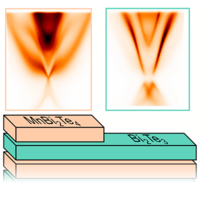
[Phys. Rev. Lett. 126, 176403] Published Wed Apr 28, 2021
10 May 06:56
by M. Maekawa, A. Miyashita, S. Sakai, S. Li, S. Entani, A. Kawasuso, and Y. Sakuraba
Author(s): M. Maekawa, A. Miyashita, S. Sakai, S. Li, S. Entani, A. Kawasuso, and Y. Sakuraba
The energy spectrum of positronium atoms generated at a solid surface reflects the electron density of states (DOS) associated solely with the first surface layer. Using spin-polarized positrons, the spin-dependent surface DOS can be studied. For this purpose, we have developed a spin-polarized posi...
[Phys. Rev. Lett. 126, 186401] Published Tue May 04, 2021
14 Apr 09:17
by Zhenglu Li, Meng Wu, Yang-Hao Chan, and Steven G. Louie
Author(s): Zhenglu Li, Meng Wu, Yang-Hao Chan, and Steven G. Louie
First-principles calculations based on GW perturbation theory explain the long-standing “kink” structure of photoemission spectra of high-Tc cuprate superconductors as a consequence of enhanced electron-phonon coupling.
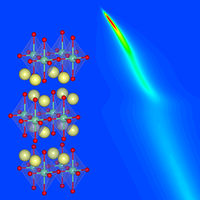
[Phys. Rev. Lett. 126, 146401] Published Thu Apr 08, 2021
14 Apr 09:16
by M. Jo, P. Brasseur, A. Assouline, G. Fleury, H.-S. Sim, K. Watanabe, T. Taniguchi, W. Dumnernpanich, P. Roche, D. C. Glattli, N. Kumada, F. D. Parmentier, and P. Roulleau
Author(s): M. Jo, P. Brasseur, A. Assouline, G. Fleury, H.-S. Sim, K. Watanabe, T. Taniguchi, W. Dumnernpanich, P. Roche, D. C. Glattli, N. Kumada, F. D. Parmentier, and P. Roulleau
A nanoscale, graphene-based device takes advantage of the wave nature of electrons and provides a level of control that will be useful for quantum computers.
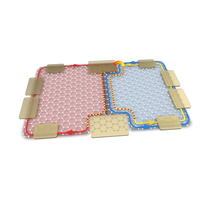
[Phys. Rev. Lett. 126, 146803] Published Fri Apr 09, 2021
14 Apr 09:16
by Tianyi Han, Jixiang Yang, Qihang Zhang, Lei Wang, Kenji Watanabe, Takashi Taniguchi, Paul L. McEuen, and Long Ju
Author(s): Tianyi Han, Jixiang Yang, Qihang Zhang, Lei Wang, Kenji Watanabe, Takashi Taniguchi, Paul L. McEuen, and Long Ju
Monolayer graphene aligned with hexagonal boron nitride (h−BN) develops a gap at the charge neutrality point (CNP). This gap has previously been extensively studied by electrical transport through thermal activation measurements. Here, we report the determination of the gap size at the CNP of graphe...
[Phys. Rev. Lett. 126, 146402] Published Fri Apr 09, 2021
21 Mar 12:52
by Lingjie Du, Ziyu Liu, Shalom J. Wind, Vittorio Pellegrini, Ken W. West, Saeed Fallahi, Loren N. Pfeiffer, Michael J. Manfra, and Aron Pinczuk
Author(s): Lingjie Du, Ziyu Liu, Shalom J. Wind, Vittorio Pellegrini, Ken W. West, Saeed Fallahi, Loren N. Pfeiffer, Michael J. Manfra, and Aron Pinczuk
Flat bands near M points in the Brillouin zone are key features of honeycomb symmetry in artificial graphene (AG) where electrons may condense into novel correlated phases. Here we report the observation of van Hove singularity doublet of AG in GaAs quantum well transistors, which presents the evide...
[Phys. Rev. Lett. 126, 106402] Published Fri Mar 12, 2021
21 Mar 12:51
by Jue Wang, Qianhui Shi, En-Min Shih, Lin Zhou, Wenjing Wu, Yusong Bai, Daniel Rhodes, Katayun Barmak, James Hone, Cory R. Dean, and X.-Y. Zhu
Author(s): Jue Wang, Qianhui Shi, En-Min Shih, Lin Zhou, Wenjing Wu, Yusong Bai, Daniel Rhodes, Katayun Barmak, James Hone, Cory R. Dean, and X.-Y. Zhu
Charge separated interlayer excitons in transition metal dichalcogenide heterobilayers are being explored for moiré exciton lattices and exciton condensates. The presence of permanent dipole moments and the poorly screened Coulomb interaction make many-body interactions particularly strong for inter...
[Phys. Rev. Lett. 126, 106804] Published Thu Mar 11, 2021
04 Mar 08:40
by Priya Tiwari, Saurabh Kumar Srivastav, and Aveek Bid
Author(s): Priya Tiwari, Saurabh Kumar Srivastav, and Aveek Bid
We report the discovery of electric-field-induced transition from a topologically trivial to a topologically nontrivial band structure in an atomically sharp heterostructure of bilayer graphene (BLG) and single-layer WSe2 per the theoretical predictions of Gmitra and Fabian [Phys. Rev. Lett. 119, 14...
[Phys. Rev. Lett. 126, 096801] Published Tue Mar 02, 2021
16 Feb 11:09
by Camille Lagoin, Stephan Suffit, Kenneth West, Kirk Baldwin, Loren Pfeiffer, Markus Holzmann, and François Dubin
Author(s): Camille Lagoin, Stephan Suffit, Kenneth West, Kirk Baldwin, Loren Pfeiffer, Markus Holzmann, and François Dubin
We study two-dimensional excitons confined in a lattice potential, for high fillings of the lattice sites. We show that a quasicondensate is possibly formed for small values of the lattice depth, but for larger ones the critical phase-space density for quasicondensation rapidly exceeds our experimen...
[Phys. Rev. Lett. 126, 067404] Published Fri Feb 12, 2021
08 Feb 08:35
by Tarik P. Cysne, Marcio Costa, Luis M. Canonico, M. Buongiorno Nardelli, R. B. Muniz, and Tatiana G. Rappoport
Author(s): Tarik P. Cysne, Marcio Costa, Luis M. Canonico, M. Buongiorno Nardelli, R. B. Muniz, and Tatiana G. Rappoport
It has been recently shown that monolayers of transition metal dichalcogenides (TMDs) in the 2H structural phase exhibit relatively large orbital Hall conductivity plateaus within their energy band gaps, where their spin Hall conductivities vanish [Canonico et al., Phys. Rev. B 101, 161409 (2020); B...
[Phys. Rev. Lett. 126, 056601] Published Fri Feb 05, 2021
30 Jan 12:28
by Junho Choi, Matthias Florian, Alexander Steinhoff, Daniel Erben, Kha Tran, Dong Seob Kim, Liuyang Sun, Jiamin Quan, Robert Claassen, Somak Majumder, Jennifer A. Hollingsworth, Takashi Taniguchi, Kenji Watanabe, Keiji Ueno, Akshay Singh, Galan Moody, Frank Jahnke, and Xiaoqin Li
Author(s): Junho Choi, Matthias Florian, Alexander Steinhoff, Daniel Erben, Kha Tran, Dong Seob Kim, Liuyang Sun, Jiamin Quan, Robert Claassen, Somak Majumder, Jennifer A. Hollingsworth, Takashi Taniguchi, Kenji Watanabe, Keiji Ueno, Akshay Singh, Galan Moody, Frank Jahnke, and Xiaoqin Li
Varying the twist angle between layers of a 2D semiconductor can prolong the duration of resonances that give the material its unique optoelectronic properties.
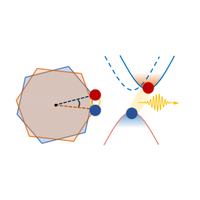
[Phys. Rev. Lett. 126, 047401] Published Tue Jan 26, 2021
18 Jan 08:40
by Kun Ni, Jinxiang Du, Jin Yang, Shujuan Xu, Xin Cong, Na Shu, Kai Zhang, Aolei Wang, Fei Wang, Liangbing Ge, Jin Zhao, Yan Qu, Kostya S. Novoselov, Pingheng Tan, Fuhai Su, and Yanwu Zhu
Author(s): Kun Ni, Jinxiang Du, Jin Yang, Shujuan Xu, Xin Cong, Na Shu, Kai Zhang, Aolei Wang, Fei Wang, Liangbing Ge, Jin Zhao, Yan Qu, Kostya S. Novoselov, Pingheng Tan, Fuhai Su, and Yanwu Zhu
We perform femtosecond pump-probe spectroscopy to in situ investigate the ultrafast photocarrier dynamics in bilayer graphene and observe an acceleration of energy relaxation under pressure. In combination with in situ Raman spectroscopy and ab initio molecular dynamics simulations, we reveal that i...
[Phys. Rev. Lett. 126, 027402] Published Wed Jan 13, 2021
11 Jan 08:27
by L. X. Yang, G. Rohde, K. Hanff, A. Stange, R. Xiong, J. Shi, M. Bauer, and K. Rossnagel
Author(s): L. X. Yang, G. Rohde, K. Hanff, A. Stange, R. Xiong, J. Shi, M. Bauer, and K. Rossnagel
Impulsive optical excitation generally results in a complex nonequilibrium electron and lattice dynamics that involves multiple processes on distinct timescales, and a common conception is that for times shorter than about 100 fs the gap in the electronic spectrum is not seriously affected by lattic...
[Phys. Rev. Lett. 125, 266402] Published Wed Dec 30, 2020
11 Jan 08:27
by M. Spera, A. Scarfato, Á. Pásztor, E. Giannini, D. R. Bowler, and Ch. Renner
Author(s): M. Spera, A. Scarfato, Á. Pásztor, E. Giannini, D. R. Bowler, and Ch. Renner
Charge density waves (CDWs) are understood in great detail in one dimension, but they remain largely enigmatic in two-dimensional systems. In particular, numerous aspects of the associated energy gap and the formation mechanism are not fully understood. Two long-standing riddles are the amplitude an...
[Phys. Rev. Lett. 125, 267603] Published Thu Dec 31, 2020
11 Jan 08:27
by Sayed Ali Akbar Ghorashi, Tianhe Li, and Taylor L. Hughes
Author(s): Sayed Ali Akbar Ghorashi, Tianhe Li, and Taylor L. Hughes
We investigate higher-order Weyl semimetals (HOWSMs) having bulk Weyl nodes attached to both surface and hinge Fermi arcs. We identify a new type of Weyl node, which we dub a 2nd-order Weyl node, that can be identified as a transition in momentum space in which both the Chern number and a higher ord...
[Phys. Rev. Lett. 125, 266804] Published Thu Dec 31, 2020
