
Nano Letters
DOI: 10.1021/acs.nanolett.1c04081
Author(s): Zhipeng Song, Jierui Huang, Shuai Zhang, Yun Cao, Chen Liu, Ruizi Zhang, Qi Zheng, Lu Cao, Li Huang, Jiaou Wang, Tian Qian, Hong Ding, Wu Zhou, Yu-Yang Zhang, Hongliang Lu, Chengmin Shen, Xiao Lin, Shixuan Du, and Hong-Jun Gao
TiSe2 is a layered material exhibiting a commensurate (2×2×2) charge density wave (CDW) with a transition temperature of ∼200 K. Recently, incommensurate CDW in bulk TiSe2 draws great interest due to its close relationship with the emergence of superconductivity. Here, we report an incommensurate s...
[Phys. Rev. Lett. 128, 026401] Published Mon Jan 10, 2022
Author(s): E. Perfetto, Y. Pavlyukh, and G. Stefanucci
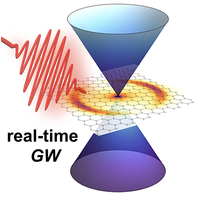
The GW method, a popular tool to calculate electronic and optical properties of correlated ground states, is extended to the time domain to study ultrafast quantum phenomena in 2D materials.
[Phys. Rev. Lett. 128, 016801] Published Tue Jan 04, 2022


Author(s): Soohyun Cho, Haiyang Ma, Wei Xia, Yichen Yang, Zhengtai Liu, Zhe Huang, Zhicheng Jiang, Xiangle Lu, Jishan Liu, Zhonghao Liu, Jun Li, Jinghui Wang, Yi Liu, Jinfeng Jia, Yanfeng Guo, Jianpeng Liu, and Dawei Shen
Quantum materials with layered kagome structures have drawn considerable attention due to their unique lattice geometry, which gives rise to flat bands together with Dirac-like dispersions. Recently, vanadium-based materials with layered kagome structures were discovered to be topological metals, wh...
[Phys. Rev. Lett. 127, 236401] Published Wed Dec 01, 2021


Author(s): S. Ideta, S. Johnston, T. Yoshida, K. Tanaka, M. Mori, H. Anzai, A. Ino, M. Arita, H. Namatame, M. Taniguchi, S. Ishida, K. Takashima, K. M. Kojima, T. P. Devereaux, S. Uchida, and A. Fujimori
Hybridization of Bogoliubov quasiparticles (BQPs) between the CuO2 layers in the triple-layer cuprate high-temperature superconductor Bi2Sr2Cu2Cu3O10+δ is studied by angle-resolved photoemission spectroscopy (ARPES). In the superconducting state, an anticrossing gap opens between the outer- and inne...
[Phys. Rev. Lett. 127, 217004] Published Fri Nov 19, 2021

Author(s): Petr Stepanov, Ming Xie, Takashi Taniguchi, Kenji Watanabe, Xiaobo Lu, Allan H. MacDonald, B. Andrei Bernevig, and Dmitri K. Efetov
The discovery of a correlated Chern insulator state in twisted bilayer graphene without hBN alignment makes it possible to tune between the superconducting and the quantum anomalous Hall state by simply applying a gate voltage.

[Phys. Rev. Lett. 127, 197701] Published Tue Nov 02, 2021


Author(s): Young Woo Choi and Hyoung Joon Choi
Graphene moiré superlattices are outstanding platforms to study correlated electron physics and superconductivity with exceptional tunability. However, robust superconductivity has been measured only in magic-angle twisted bilayer graphene (MA-TBG) and magic-angle twisted trilayer graphene (MA-TTG)....
[Phys. Rev. Lett. 127, 167001] Published Mon Oct 11, 2021
Author(s): Sophia Helmrich, Kevin Sampson, Di Huang, Malte Selig, Kai Hao, Kha Tran, Alexander Achstein, Carter Young, Andreas Knorr, Ermin Malic, Ulrike Woggon, Nina Owschimikow, and Xiaoqin Li
While valleys (energy extrema) are present in all band structures of solids, their preeminent role in determining exciton resonances and dynamics in atomically thin transition metal dichalcogenides (TMDC) is unique. Using two-dimensional coherent electronic spectroscopy, we find that exciton decoher...
[Phys. Rev. Lett. 127, 157403] Published Fri Oct 08, 2021

Author(s): Ahmed M. Khalifa, Ribhu K. Kaul, Efrat Shimshoni, H. A. Fertig, and Ganpathy Murthy
We propose a device in which a sheet of graphene is coupled to a Weyl semimetal, allowing for the physical access to the study of tunneling from two- to three-dimensional massless Dirac fermions. Because of the reconstructed band structure, we find that this device acts as a robust valley filter for...
[Phys. Rev. Lett. 127, 126801] Published Thu Sep 16, 2021
Author(s): Florie Mesple, Ahmed Missaoui, Tommaso Cea, Loic Huder, Francisco Guinea, Guy Trambly de Laissardière, Claude Chapelier, and Vincent T. Renard
The moiré of twisted graphene bilayers can generate flat bands in which charge carriers do not possess enough kinetic energy to escape Coulomb interactions with each other, leading to the formation of novel strongly correlated electronic states. This exceptionally rich physics relies on the precise ...
[Phys. Rev. Lett. 127, 126405] Published Fri Sep 17, 2021


Author(s): I. R. Lavor, D. R. da Costa, L. Covaci, M. V. Milošević, F. M. Peeters, and A. Chaves
The moiré pattern observed in stacked noncommensurate crystal lattices, such as heterobilayers of transition metal dichalcogenides, produces a periodic modulation of their band gap. Excitons subjected to this potential landscape exhibit a band structure that gives rise to a quasiparticle dubbed the ...
[Phys. Rev. Lett. 127, 106801] Published Tue Aug 31, 2021


Moiré Superlattices
Moiré superlattices produced through artificial stacking are often quite challenging to characterize noninvasively. In article number 2008333, Kai-Qiang Lin, Christian Schüller, and co-workers present a hyperspectral Raman imaging method to achieve large-scale mapping of moiré superlattices. The method is based on the finding that both interlayer-breathing mode and moiré phonons are highly susceptible to the moiré period.
Author(s): Jianwei Huang, Sheng Li, Chiho Yoon, Ji Seop Oh, Han Wu, Xiaoyuan Liu, Nikhil Dhale, Yan-Feng Zhou, Yucheng Guo, Yichen Zhang, Makoto Hashimoto, Donghui Lu, Jonathan Denlinger, Xiqu Wang, Chun Ning Lau, Robert J. Birgeneau, Fan Zhang, Bing Lv, and Ming Yi
Experiments provide clear signs of a weak topological insulator (TI) state, in which select surfaces conduct while the interior insulates, as well as hints of a higher-order TI state, where conduction is confined to hinges.

[Phys. Rev. X 11, 031042] Published Tue Aug 24, 2021

