10 Mar 16:15
by Takao Fujikawa, Yasutomo Segawa and Kenichiro Itami

Journal of the American Chemical Society
DOI: 10.1021/jacs.6b01303

02 Mar 21:44
by Jung-Ho Hong, Adil S. Aslam, Masatoshi Ishida, Shigeki Mori, Hiroyuki Furuta and Dong-Gyu Cho

Journal of the American Chemical Society
DOI: 10.1021/jacs.6b01063

01 Mar 21:59
Chem. Sci., 2016, Advance Article
DOI: 10.1039/C5SC04748J, Edge Article

Open Access
Norihito Fukui, Seung-Kyu Lee, Kenichi Kato, Daiki Shimizu, Takayuki Tanaka, Sangsu Lee, Hideki Yorimitsu, Dongho Kim, Atsuhiro Osuka
Oxidation of 10,15,20-triaryl Ni(II)-porphyrins bearing an electron-withdrawing substituent at the 5-position with DDQ and FeCl3 gave 10,12- and 18,20-doubly phenylene-fused Ni(II)-porphyrins regioselectively.
To cite this article before page numbers are assigned, use the DOI form of citation above.
The content of this RSS Feed (c) The Royal Society of Chemistry

01 Mar 21:51
by Qian Wu, Yi Luo, Aiwen Lei and Jingsong You

Journal of the American Chemical Society
DOI: 10.1021/jacs.5b10945

28 Feb 21:39

The time is ripe: The seasonal disappearance of chlorophyll has been a long-standing and striking biological enigma. In higher plants, chlorophyll is broken down by a largely common, regulated pathway to linear tetrapyrroles—phyllobilins—which are related to heme catabolites. They accumulate in degreened leaves and vegetables, as well as in ripening fruit, and are presumed to have relevant physiological functions.
[Review]
Bernhard Kräutler
Angew. Chem. Int. Ed., February 26, 2016, DOI: 10.1002/anie.201508928. Read article
26 Feb 21:59
by Nirmal K. Mitra, Rolande Meudom, Hector H. Corzo, John D. Gorden and Bradley L. Merner

Journal of the American Chemical Society
DOI: 10.1021/jacs.6b00538

23 Feb 16:15
by Benjamin J. Coe, Daniela Rusanova, Vishwas D. Joshi, Sergio Sánchez, Jan Vávra, Dushant Khobragade, Lukáš Severa, Ivana Císařová, David Šaman, Radek Pohl, Koen Clays, Griet Depotter, Bruce S. Brunschwig and Filip Teplý

The Journal of Organic Chemistry
DOI: 10.1021/acs.joc.5b02692

23 Feb 12:17
by Junzhi Liu, Akimitsu Narita, Silvio Osella, Wen Zhang, Dieter Schollmeyer, David Beljonne, Xinliang Feng and Klaus Müllen

Journal of the American Chemical Society
DOI: 10.1021/jacs.5b10399

23 Feb 12:16
by Antoine Maurin and Marc Robert

Journal of the American Chemical Society
DOI: 10.1021/jacs.5b12652

23 Feb 12:16
by Mei-Yan Gao, Fei Wang, Zhi-Gang Gu, De-Xiang Zhang, Lei Zhang and Jian Zhang

Journal of the American Chemical Society
DOI: 10.1021/jacs.6b00613

19 Feb 22:24

The selective and predictable synthesis of structurally uniform carbon nanotubes (CNTs) represents a long-standing goal in both nanocarbon science and synthetic organic chemistry. This Review focuses on the studies toward controlled synthesis of CNTs with single chirality through the organic synthesis of CNT segments and the organic template-assisted growth of CNTs.
[Review]
Yasutomo Segawa, Akiko Yagi, Katsuma Matsui, Kenichiro Itami
Angew. Chem. Int. Ed., February 18, 2016, DOI: 10.1002/anie.201508384. Read article
18 Feb 15:15
Chem. Commun., 2016, 52,4084-4087
DOI: 10.1039/C6CC00019C, Communication
K. M. Zwolinski, J. Eilmes
The first known cofacial dimers, based on covalently linked dibenzotetraaza[14]annulenes, were synthesized in reasonable 35-40% yields, without recourse to high-dilution techniques.
The content of this RSS Feed (c) The Royal Society of Chemistry

18 Feb 15:07
Chem. Sci., 2016, 7,3681-3688
DOI: 10.1039/C5SC04218F, Edge Article
Open Access
Thomas J. Sisto, Lev N. Zakharov, Brittany M. White, Ramesh Jasti
Upon exposure to Scholl reaction conditions, cycloparaphenylenes undergo facile strain-relieving rearrangements and ring-openings.
The content of this RSS Feed (c) The Royal Society of Chemistry

15 Feb 17:25
by Davide Curcio, Luca Omiciuolo, Monica Pozzo, Paolo Lacovig, Silvano Lizzit, Naila Jabeen, Luca Petaccia, Dario Alfè and Alessandro Baraldi

Journal of the American Chemical Society
DOI: 10.1021/jacs.5b12504

10 Feb 10:01
Elijah E. Gordon, Ke Xu, Prof. Dr. Hongjun Xiang, Prof. Dr. Annette Bussmann-Holder, Dr. Reinhard K. Kremer, Prof. Dr. Arndt Simon, Prof. Dr. Jürgen Köhler and Prof. Dr. Myung-Hwan Whangbo

Under ultrahigh pressure (>110 GPa), H2S is converted into a metallic phase that becomes superconducting with a record Tc of approximately 200 K. It is proposed that in this phase a dissociation of 2 H2S into H3S+ and SH− is present, leading to the perovskite structure (SH−)(H3S+). This phase consists of corner-sharing SH6 octahedra with SH− ions at the center of each S8 cube.
Read more now
10 Feb 09:50
by Timothy D. Lash

Accounts of Chemical Research
DOI: 10.1021/acs.accounts.5b00523

10 Feb 09:37
by Josep Cornella, Jacob T. Edwards, Tian Qin, Shuhei Kawamura, Jie Wang, Chung-Mao Pan, Ryan Gianatassio, Michael Schmidt, Martin D. Eastgate and Phil S. Baran

Journal of the American Chemical Society
DOI: 10.1021/jacs.6b00250

Tuo, XJ and 7 others like this
08 Feb 14:04
Chem. Soc. Rev., 2016, 45,2024-2031
DOI: 10.1039/C5CS00712G, Tutorial Review
D. M. Weekes, C. Orvig
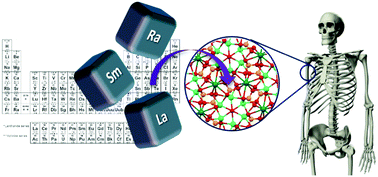
In this tutorial review, we explore how a special relationship between metal ions and bones has been exploited to target therapeutic agents.
The content of this RSS Feed (c) The Royal Society of Chemistry

06 Feb 20:04
by Uttam Dutta, David W. Lupton and Debabrata Maiti

Organic Letters
DOI: 10.1021/acs.orglett.6b00147

05 Feb 08:14
by Anon Bunrit, Supaporn Sawadjoon, Svetlana Tšupova, Per J. R. Sjöberg and Joseph S. M. Samec

The Journal of Organic Chemistry
DOI: 10.1021/acs.joc.5b02581

05 Feb 08:13
by Seokjoon Oh, James R. Gallagher, Jeffrey T. Miller and Yogesh Surendranath

Journal of the American Chemical Society
DOI: 10.1021/jacs.5b13080

05 Feb 08:11
by Johannes M. Wiest, Alexander Pöthig and Thorsten Bach

Organic Letters
DOI: 10.1021/acs.orglett.6b00141

04 Feb 21:49
J. Mater. Chem. C, 2016, 4,3726-3737
DOI: 10.1039/C6TC00151C, Paper
Open Access
Adam F. Henwood, Ashu K. Bansal, David B. Cordes, Alexandra M. Z. Slawin, Ifor D. W. Samuel, Eli Zysman-Colman
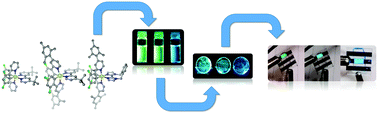
Combining a sterically bulky, electron-deficient cyclometalating C[logical and]N ligands with an electron rich, highly rigidified N[logical and]N ligand gives an iridium complex, that achieves extraordinarily bright blue emission ([capital Phi]PL = 90%; [small lambda]max = 459 nm in MeCN) for a cationic iridium complex.
The content of this RSS Feed (c) The Royal Society of Chemistry
03 Feb 15:39
by Guo-Lin Gao, Wujiong Xia, Pankaj Jain and Jin-Quan Yu

Organic Letters
DOI: 10.1021/acs.orglett.5b03712

29 Jan 15:45
by Peter T. Kaplan and David A. Vicic

Organic Letters
DOI: 10.1021/acs.orglett.6b00032

28 Jan 21:19
by Chiara Colletto, Saidul Islam, Francisco Juliá-Hernández and Igor Larrosa

Journal of the American Chemical Society
DOI: 10.1021/jacs.5b12242

28 Jan 15:59

BODIPY sees red: para- and meta-quinodimethane-bridged BODIPY dimers (see example) absorb strongly around λ=1100 nm and have a small amount of diradical character (y). The dyes were found to have large two-photon-absorption cross-sections in the NIR region and showed selective fluorescence turn-on for the hydroxyl radical over other reactive oxygen species.
[Communication]
Yong Ni, Sangsu Lee, Minjung Son, Naoki Aratani, Masatoshi Ishida, Animesh Samanta, Hiroko Yamada, Young-Tae Chang, Hiroyuki Furuta, Dongho Kim, Jishan Wu
Angew. Chem. Int. Ed., January 25, 2016, DOI: 10.1002/anie.201511151. Read article
22 Jan 21:09
by Bun Chan, Yukio Kawashima, Michio Katouda, Takahito Nakajima and Kimihiko Hirao

Journal of the American Chemical Society
DOI: 10.1021/jacs.5b12518

17 Jan 15:05
Chem. Sci., 2016, 7,2883-2887
DOI: 10.1039/C5SC04158A, Edge Article
Open Access
Xiaofu Sun, Xinchen Kang, Qinggong Zhu, Jun Ma, Guanying Yang, Zhimin Liu, Buxing Han
We report the first work on the electrocatalytic reduction of CO2 to CH4 using metal-free N-doped carbon electrodes.
The content of this RSS Feed (c) The Royal Society of Chemistry

14 Jan 17:31
by Kecheng Wang, Xiu-Liang Lv, Dawei Feng, Jian Li, Shuangming Chen, Junliang Sun, Li Song, Yabo Xie, Jian-Rong Li and Hong-Cai Zhou

Journal of the American Chemical Society
DOI: 10.1021/jacs.5b10881

   This article is licensed under a Creative Commons Attribution-NonCommercial 3.0 Unported Licence.


   This article is licensed under a Creative Commons Attribution 3.0 Unported Licence.