Shared posts

11 Aug 17:57

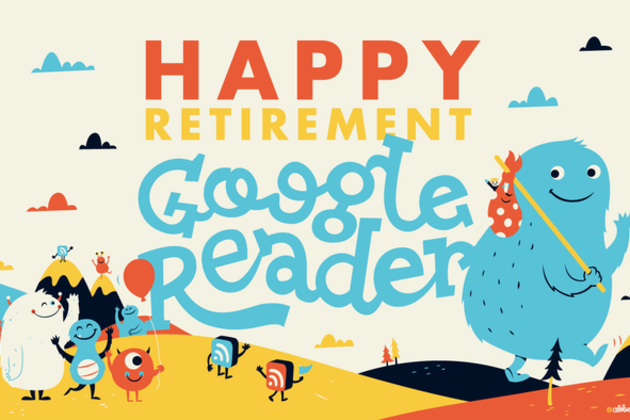
A month after Google killed its beloved Reader, the market for paid RSS tools is booming

by Ben Popper
Happy-retirement-gr_large

It's been a month since Google Reader shut down, breaking users' hearts and bringing an end to a nearly eight-year run of RSS dominance. As soon as word came of Reader's impending doom, third parties like Digg, Feedly, and others sprung into action, eager to replace the old guard. At the time, they looked like a rescue team, gallantly swooping in to save us from regular old web browsing. But after a month, the squad of reader replacements has turned into a set of regular products trying to keep up with user demands. So how well have these replacements done in Google Reader’s absence?

It turns out it's hard to make an RSS reader. Feedly switched over to its own servers with just a few weeks to spare and Digg launched mere days before...

Continue reading…

11 Aug 03:30

Final 'Ender's Game' trailer puts space battle front and center

by Bryan Bishop
Endersgame_trailerscreencap_large

The film adaptation of Orson Scott Card's novel Ender's Game is just a few months away, and Summit Entertainment has just released the final trailer for the film. It's heavy on the sci-fi spectacle; while the movie's trailers up to this point have offered fleeting glimpses of its visual effects and battles, we get an even better look here. When we sat down with director Gavin Hood and producer Roberto Orci at Comic-Con they cited the story's melding of dynamic sequences with deeper, more probing moral questions as one of the things that drew them to Ender's in the first place. We'll be able to see how they did in bringing that to the big screen when the movie opens later this year — but in the meantime, check out the trailer below.

Continue reading…

10 Aug 22:27

Kids can't use computers and this is why it should worry you (2013)

10 Aug 22:11

Every second on the internet, these things happen

by Sean Hollister

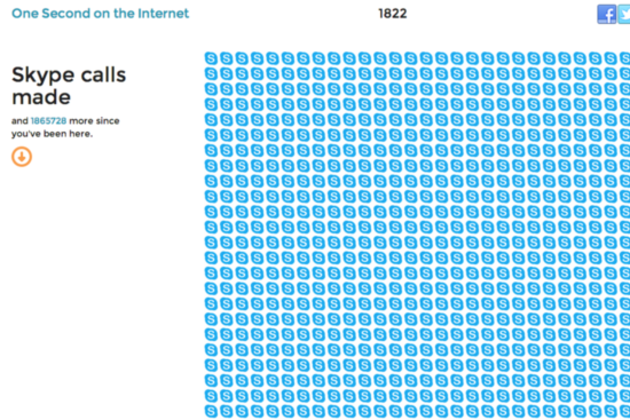
Every second, an incredible number of interactions take place on the internet, and "One Second on the Internet" gives you a real sense of their scale. It's a website which displays an icon for every single Facebook like, Google search, YouTube video watched, email sent, and so on, over the course of a single second. Just scroll down the page, if you have the patience, to get an idea of just how quickly the web moves, and how quickly it continues to move while you watch. It's not nearly as humbling as, say, seeing the Earth from space, but it's definitely worth seeing once.

Continue reading…

10 Aug 21:56

The Pirate Bay celebrates 10th anniversary with release of blockade-busting browser

by Nathan Ingraham
gdenning

Nice!

The piracy landscape has changed a lot in the last decade. Prominent peer-to-peer services have been abandoned due to legal threats, torrenting emerged as the gold standard for grabbing content without paying, and lots of relatively inexpensive legal alternatives have sprung up (at least for music). There's been one constant in that landscape, however: The Pirate Bay. Perhaps the most notorious torrent-tracking site of our age is celebrating its 10th birthday; on its blog, those behind TPB have posted a message commemorating "a decade of agression [sic], repression, and lulz." It goes on to say that TPB team didn't think they'd "make it this far" — not because of "cops, mafiaa [sic], or corrupt politicians," but because they thought...

Continue reading…

04 Aug 07:28

The New Old Reader

image

We’re pleased to announce that The Old Reader will officially remain open to the public! The application now has a bigger team, significantly more resources, and a new corporate entity in the United States. We’re incredibly excited to be a part of this great web application and would like to share some details about its future as well as thank you for remaining loyal users. We’re big fans and users of The Old Reader and look forward to helping it grow and improve for years to come.

First off we want to say that it’s rare to have an application that inspires as much passion as The Old Reader has as of late. We think that’s a sign of greatness and all credit for that goes to the wonderful team that has been running the show including Dmitry and Elena. We’ve gotten to know them pretty well this past week and they are smart, honest, and passionate people. We’re happy to announce that they are still a part of the team and we hope they will be for a long time to come.  The new team will be managing the project and adding to the engineering, communications, and system administration functions.

So now for the future. The Old Reader is going to retain all of its functionality and remain open to the public. Not only that, we’re going to do everything in our power to grow the user base which will only accentuate the things that make this application special. To facilitate these improvements, we’re going to be transitioning The Old Reader to a top tier hosting facility in the United States this coming week. It’s going to require some downtime and for that we sincerely apologize, but it’s also going to mean A LOT more servers, 10x faster networks, and long-term stability. We realize that doesn’t make the downtime easy but rest assured that things are looking up.

Over the coming weeks we’ll talk more about the new team of The Old Reader. We’re looking forward to introducing ourselves and making significant improvements to this incredible application. Thanks for reading and thanks for using The Old Reader!

01 Aug 21:28

Desperate times call for desperate measures

gdenning

Noooooooooooo!!!

UPD: We have received a number of proposals that we are discussing right now. Chances are high that public The Old Reader will live after all

image

Since we launched first public version almost a year ago up until March 2013 we have been working on The Old Reader in “normal” mode. In March things became “nightmare”, but we kept working hard and got things done. First, we were out of evenings, then out of weekends and holidays, and then The Old Reader was the only thing left besides our jobs. Last week difficulty level was changed to “hell” in every possible aspect we could imagine, we have been sleep deprived for 10 days and this impacts us way too much. We have to look back.

The truth is, during last 5 months we have had no work life balance at all. The “life” variable was out of equation: you can limit hours, make up rules on time management, but this isn’t going to work if you’re running a project for hundreds of thousands of people. Let me tell you why: it tears us to bits if something is not working right, and we are doing everything we can to fix that. We can’t ignore an error message, a broken RAID array, or unanswered email. I personally spent my own first wedding anniversary fixing the migration last Sunday. Talk about “laid back” attitude now. And I won’t even start describing enormous sentimental attachment to The Old Reader that we have.

We would really like to switch the difficulty level back to “normal”. Not to be dreaded of a vacation. Do something else besides The Old Reader. Stop neglecting ourselves. Think of other projects. Get less distant from families and loved ones. The last part it’s the worst: when you are with your family, you can’t fall out of dialogues, nodding, smiling and responding something irrelevant while thinking of refactoring the backend, checking Graphite dashboard, glancing onto a Skype chat and replying on Twitter. You really need to be there, you need to be completely involved. We want to have this experience again.

That’s why The Old Reader has to change. We have closed user registration, and we plan to shut the public site down in two weeks. We started working on this project for ourselves and our friends, and we use The Old Reader on a daily basis, so we will launch a separate private site that will keep running. It will have faster refresh rate, more posts per feed, and properly working full-text search — we are sure that we can provide all this at a smaller scale without that much drama, just like we were doing before March.

The private site?

Accounts will be migrated to the private site automatically. We will whitelist everybody we know personally, along with all active accounts that were registered before March 13, 2013. And of course, we will migrate all our awesome supporters and people who donated to keep the project running (if you sent us bitcoins, please get in touch to get identified). Later this week your account will get a distinct indication whether it will be migrated to the private site or not. If you see that message and believe that it’s wrong, or if all your friends are getting migrated and you are left behind — please, drop us a line.

Give me my data!

You will have two weeks to export your OPML file regardless of our decision. OPML export link is located at the bottom of the Settings page — use the top-right menu to get there. All posts that you saved for later by using Pocket integration will obviously remain in your Pocket account.

But you could…

For those who would like to start the usual “VC, funding, mentor” or “charge for the damn thing” mantras — please, spare it. We’re not in the Valley where it might be super-easy, and, after all, not everyone wants to be an entrepreneur. We just love making a good RSS reader.

We really want The Old Reader to be a big and successful project, with usable free accounts. But this is not possible to achieve with what we have, so unless someone resourceful takes over the project and brings it to the next level, it is not gonna happen. We had over 2 000 new registrations after the blackout last week. This is amazing and sad at the same time.

If anyone is interested in acquiring The Old Reader and making it better, we are very open and accepting proposals at hello@theoldreader.com. We would be waiting for them for two weeks, supporting and maintaining The Old Reader as usual. Please don’t write us if you don’t have resources to maintain a site used by tens of thousands of people every day, or if you don’t know how you would improve The Old Reader. And please spare our time if you just want to buy the domain name and park a bunch of silly ads there — it’s not going to happen.

We value our community very much, and we will either pass the project to somebody who we know is going to take a good care of it, or we will switch it to private mode.

What next?

From one point of view, it’s not a big deal: “RSS is obsolete”, nobody died, we don’t owe anybody anything, you name it. Also, there are a lot of good readers around to choose from, a large part of them is smaller than The Old Reader and had not experienced growing pains of 80 000 daily active users in no time. But for us, it’s heartbreaking.

I will finally get back to work on my small studio — Bespoke Pixel — which has been run by my awesome partner all this time. Dmitry will keep being bright young software developer, making scalable and beautiful projects. Our team will stay together, and will keep working on making the private version of The Old Reader awesome.

We feel great responsibility for the project. We’d rather provide a smooth and awesome experience for 10 000 users than a crappy one for 420 000.

Sorry, each and everyone if we failed you. You are an incredible, supportive and helpful community. The best we could possibly hope for.

All the love,
Elena Bulygina and Dmitry Krasnoukhov

27 Jul 03:32

SkyBalls

by Lambert V.

SkyBalls

To raise awareness about testicular cancer, the nonprofit organization Male Cancer Awareness Campaign hopes to raise about $150,000 to build the world’s largest – and only – flying scrotum. It’s an immature stunt for a good cause.

26 Jul 23:49

COSMOS (Trailer)

by The Awesomer
gdenning

This looks great, but I'm surprised it's being aired on Fox.

COSMOS (Trailer)

A reboot of Carl Sagan’s classic series, this epic 14-part documentary stars astrophysics badass Neil deGrasse Tyson – and is produced, surprisingly, by Seth MacFarlane. Coming to FOX in 2014. (Thanks, Wille from Feber!)

26 Jul 19:11

Uncontacted Tribes

by The Awesomer
gdenning

My god, I didn't know uncontacted tribes actually still existed.

Uncontacted Tribes

Footage of one of the last known uncontacted tribes on the planet in the Brazilian forest. A zoom lens provides a glimpse without disturbing them, while we learn about the threat the “civilized” world poses to them.

26 Jul 15:32

Making the Tesla Model S

by The Awesomer

Making the Tesla Model S

Wired takes us inside the Tesla Model S factory. It still amazes us that raw coils of sheet metal can transformed into such a beautiful and functional vehicle. While the plant employs 3000 humans, robots are the true star of the show.

26 Jul 15:16

Gravity: Detached

by Lambert V.
gdenning

This looks really good.

Gravity: Detached

This clip from Alfonso Cuarón’s upcoming movie Gravity shows rookie astronaut Dr. Ryan Stone (Sandra Bullock) get separated from astronaut Matt Kowalsky (George Clooney) as their space shuttle is destroyed by debris.

25 Jul 21:17

Choosing an Open Source License

by Haacked

It’s easy to get caught up in code. Sharing your code isn’t everything, though: it’s also important to tell people how they can use that code.

Choosing an open source license can be confusing. We’ve created ChooseALicense.com to help you make that decision.

choosealicense

You can see a breakdown of what’s required, what’s permitted, and what’s forbidden for each license:

breakdown

When you’ve made your choice, copy it to your clipboard with one click:

copy

Have any suggestions? ChooseALicense.com itself is open source. Send us a Pull Request with your changes.

Licenses on GitHub.com

Now that we have all these licenses in one happy home, we want to help people choose their licenses on GitHub, too. When you create a new repository you’ll see a new license picker:

choose-a-license

To get started, simply point your browser at choosealicense.com, or for more information, you can dive into the full documentation. Happy licensing!

10 Jul 20:14

Elon Musk: San Francisco to L.A. in 30 Mins. With New Transportation System

10 Jul 03:38

The Budget

by Lambert V.

The Budget

Comedian Jay Larson recently guested on Conan and talked about the time someone mistakenly dialed his number. Like Norm Macdonald and John Mulaney, Larson’s strength comes not in the punchline but in the setup.

30 Jun 22:03

Photo


30 Jun 22:02

theclearlydope: Sweep the leg! entropybegets: FINISH...

gdenning

Kid probably deserved it.


theclearlydope:

Sweep the leg!

entropybegets:

FINISH HIM !!!!!!!

Kids these days.

30 Jun 16:08

Sunday Cinema: Dr. Easy

by John DeNardo

From the Vimeo description: “Michael is a broken man with a gun. He is surrounded by armed police. A robot with medical training is dispatched to negotiate – but can it save him?”

30 Jun 00:34

The War of the Closes

by Jay Hanlon

It pains me when I hear people say that our sites are unfriendly, or that we chase new users away. But it’s a hard problem, because our highest priority has always been the quality of content on our sites.  And it still is. We can’t lower our standards. We won’t.

But we have been working hard to make our sites more welcoming, reminding users that feedback can be clear and nice, and helping new users learn the ropes before they get frustrated.  And, as of today, we’ve completely overhauled closing. 

Closing, we just can’t quit you.game-of-thrones-recap-jon-snow-ygritte-600x337 2

Oh, closing.  You are the watcher on the walls. You are the shield that guards the realms of men. Okay, so it’s possible that I may be thinking of the Night’s Watch. No matter.

Closing is a big part of what separates us from other, um… less focused Q&A sites. It’s what ensures that our sites remain the kind of places that experts want to be. Closing… was working. But it wasn’t perfect.

Closing wasn’t clear.

Our close reasons were designed for experienced users, but did little to help the author of the question understand what the heck was going on. Over time, as we tried to make five close reasons address hundreds of question types, they became too broad to actually convey what’s wrong.  Identifying the common factors of poor questions was a good idea, but we took it a little too far.

It’s confusing ask for help solving a specific programming problem, only to be told that it’s”not about programming”. Or to ask which router to buy, just to learn that you’re likely to solicit “debate, arguments, polling, or extended discussion.” Really?  You guys take routers pretty seriously here.

Now, it’s not that we want those questions, but we need to convey exactly why we don’t want them.  Imagine if police could give out summons that, rather than, “failure to stop at a signal,” just read, “behavioral violation”. When feedback isn’t specific, it’s impossible to fix the problem, but easy to write it off as probably coming from a bunch of grumpy old jerkfaces who’d rather make you look like an idiot than actually help you.

Closing wasn’t nice.

Having your question closed feels lousy; there’s no doubt about it.  Now, we don’t care as much about nice as we do about qualitybut that’s not a real dichotomy.  We can be more constructive in conveying our standards without lowering them one bit.   And we need to, because whether we liked it or not:

Having your question closed feels like a personal attack.

2013-06-16_15-31-27

It is off-putting to be told that your question is “not constructive”.  To the poster, “not constructive” doesn’t sound like polite feedback; it sounds like something a slightly detached guidance counselor might say to a child.  And,”not a real question”?  Does that make the listener want to get “realer” or to snarkily link to a definition of the word “question”?

Ironically, we picked those terms explicitly because they were nicer ways to convey what we meant. And they were nicer than, “You’re kind of ranting and being a jackass,” or, “No one can answer that ambiguous nonsense.”  But so is prefacing my feedback to my wife with:

It could be just me, but I feel like you’re acting completely nutballs crazy.

In both cases, we’ve gotten nicer than we started, but we’re still pretty far shy of where someone might actually accept our feedback.

Fixing your closed question didn’t work

The goal was always for some closures to drive an edit, improve, re-open cycle. The user gets helped, gets better at asking, and the community gets useful content. Unfortunately, since there was no way to know when a question had been improved, this almost never happened.

We can do better.

We’re not going to lower our standards.  But if we want to educate new users, we need get better at three things:

  1. make users want to improve questions, not argue about them – “terminated as too sucky; re-submit when less so,” and, “needs more information, add detail to move forward” are different. One makes you want to work your way to the next stage. One makes you want to kick someone’s shins.
  2. make it clear exactly what needs to be fixed, or is problematic, without relying on information on another page.
  3. provide a clear path for to get questions re-opened –  questions that are brought up to our standards should get reopened.

Here’s how:

  1. “On hold” will replace “closed” on newly closed posts
    zq0SL 2The word “closed” sounded final. Think about “closed” discussions, real estate deals, or job applications. In each case,”closed” means,
    a) additional revisions are not welcome, and b) the matter won’t be further considered.We led with a word that sounded final, so when we eventually told users they could edit their post, they weren’t listening; they were dusting off the old debate uniform to argue their case.“on hold” better conveys what we always meant:

    If you can edit your question to better fit our model, we can get you the help you need.

    Questions not re-opened within five days will revert to displaying as “closed,” to serve as a clearer signpost going forward.

  2. New close reasons are nicer and clearer
    1. “not constructive” and “not a real question” are replaced by:

      too broad – There are either too many possible answers, or good answers would be too long for this format. Please add details to narrow the answer set or to isolate an issue that can be answered in a few paragraphs.

      unclear what you’re asking - Please clarify your specific problem or add additional details to highlight exactly what you need. As it’s currently written, it’s hard to tell exactly what you’re asking.

      primarily opinion based - Many good questions generate some degree of opinion based on expert experience, but answers to this question will tend to be almost entirely based on opinions, rather than facts, references, or specific expertise.

      They’re much less likely to make the reader defensive, and much more specific about exactly what to fix.

    2. “Off-Topic” now includes site-specific close reasons
      Many communities have decided that some questions that sound like they fall under the topic “headline” (“cooking”,  “photography”, etc.) should be explicitly disallowed:
      • On our cooking site, recipe requests are off-topic, (but recipe replacements questions are allowed).
      • On photography – “fix my picture” questions are off topic, (but specific technique requests are allowed).
      • Stack Overflow is about programming, but programming questions you’d solve on a whiteboard or that ask what’s wrong with a large block of code are no good.

      Each example seems on-topic, but the community definition of what’s allowed has been adjusted to exclude them. These nuanced definitions have always been in each site’s help center (formerly the FAQ,) and are also the new user About page.

      And, as of today, they are also available to “off-topic”  close-voters right in the close dialogue. Users can pick one from the site’s list, or if none apply, they can enter a free-form one which will appear as a comment and as a choice for others voting to close the same question:

      “Your question appears to be about ferret grooming, which is off-topic for Stack Overflow”.

      These site-specific reasons will also address situations previously covered by “General Reference” and “Too Localized”. Those were the least used and most misused reasons – moderator and team sampling found a huge percentage of their application to be erroneous. (References to location in a question were particularly dangerous – never mind that a couple of billion people might live there.)  But they did have some important uses:

      • Questions that could be answered with a single dictionary search on English, and
      • Unguided requests to debug huge blocks of code on Stack Overflow

      In almost all of their good uses, they were clarifying what a community, over time, had deemed to be off-topic for their site. Programming questions, but not code dumps. English language questions, but not single search definitions.  

    3. Duplicates now focus on redirection to the answers you need
      All dupes now must point to an answered question, and the new language focuses on getting you answers:

      marked as [duplicate] – this question has been asked before and already has an answer. If those answers do not fully address your question, please edit this question to explain how it is different, or ask a new question.

  3. Questions edited by the original poster automatically go to the re-open queue
    Once there, other users will review and can re-open improved posts.  No more flagging your own question, or going to Meta to  request a formal appellate review. If you make meaningful edits to your question within five days of being put on hold, it gets considered for re-opening.

Oh, one last thing.

Thank you. A ton of work has gone into this, and as usual, the best ideas came from user input on Meta, so we hope you’re as proud of these changes as we are. We truly appreciate your feedback, and you’ve been incredibly vocal in your support for almost all of the changes.  We know some of you have concerns about moving the good parts of “too localized” into the off-topic menu. We’re listening, and are going to keep a close eye on it as we roll it out network-wide.  In particular, we want to know if you’re finding things that you can’t close now, but could before, and we’ll continue to adjust and iterate based on what we learn.

It really seems like there should be some kind of badge for reading something this long, but the devs shot that idea down.  Hard.  Apparently we “will never ever offer badges to promote your endless ramblings, Jay.”

It would have felt nicer if they’d told me the idea was on hold.

30 Jun 00:21

Java EE 7 support in Eclipse 4.3

by arungupta
gdenning

Some nice JPA and Maven support built into the new version of Maven!


Eclipse Kepler (4.3) features 71 different open source projects and over 58 million LOC. One of the main themes of the release is the support for Java EE 7. Kepler specifically added support for the features mentioned below:
  • Create Java EE 7 Eclipse projects or using Maven
  • New facets for JPA 2.1, JSF 2.2, Servlet 3.1, JAX-RS 2.0, EJB 3.2
  • Schemas and descriptors updated for Java EE 7 standards (web.xml, application.xml, ejb-jar.xml, etc)
  • Tolerance for JPA 2.1 such as features can be used without causing invalidation and content assist for UI (JPA 2.1)
  • Support for NamedStoredProcedureQuery (JPA 2.1)
  • Schema generation configuration in persistence.xml (JPA 2.1)
  • Updates to persistence.xml editor with the new JPA 2.1 properties
  • Existing features support EE7 (Web Page Editor, Palette, EL content assist, annotations, JSF tags, Facelets, etc)
  • Code generation wizards tolerant of EE7 (New EJB, Servlet, JSP, etc.)

A comprehensive list of features added in this release is available in Web Tools Platform 3.5 - New and Noteworthy.

Download Eclipse 4.3 and Java EE 7 SDK and start playing with Java EE 7!

Oracle Enterprise Pack for Eclipse was released recently that uses Eclipse Kepler RC3 but will be refreshed soon to include the final bits.

29 Jun 21:31

Bicycling: The SAFEST Form of Transportation

by Mr. Money Mustache
bikenight

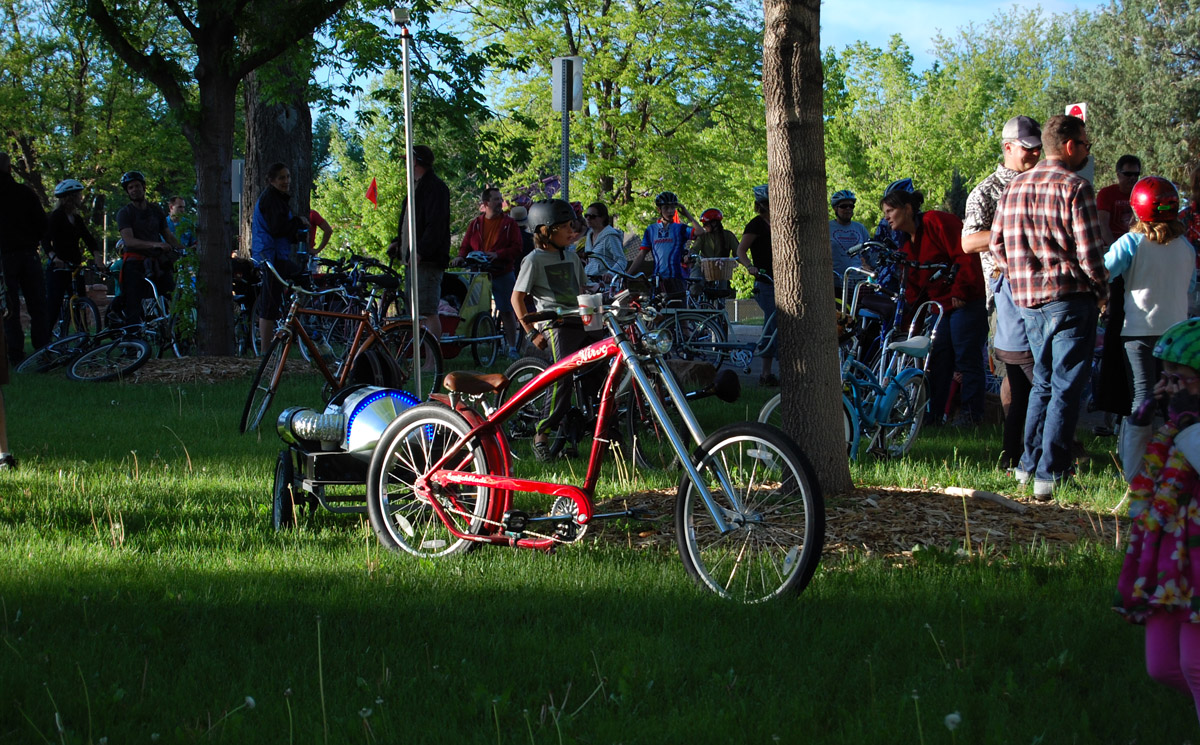
Bikemont, Colorado

Of all the objections I get from people about why they can’t ride a bike to get around, perhaps the most frustrating is the claim that bicycling is too dangerous. According to this line of reasoning, we all need the protection of a two-tonne steel cage in order to survive the trip to the office or the grocery store.

I’ve always felt that this was complete bullshit, but I admit that my emotions may have been playing a part in this rapid condemnation as well. I started riding bikes about 32 years ago, and I just never stopped. To me, bicycling is being alive, and I’d rather run any necessary risk of death than be condemned to a life where cars were the only way to get around, because that sort of soggy dependence wouldn’t be much of a life to me.

But luckily for all of us, we don’t have to choose between safety and freedom. They both come together perfectly in the form of bicycle transportation, and once we work our way through the statistics of the matter, all talk of choosing cars over bikes because of safety can be banished from the face of the Earth – forever.

There’s going to be a bit of math involved, so for busy people we’ll begin with the final answer, then work through how we got there below.

Riding a bike is not more dangerous than driving a car. In fact, it is much, much safer:

Under even the most pessimistic of assumptions:
  • Net effect of driving a car at 65mph for one hour: Dying 20 minutes sooner. (18 seconds of life lost per mile)
  • Net effect of riding a bike at 12mph for one hour: Living 2 hours and 36 minutes longer (about 13 minutes of life gained per mile)

In engineering and math, one method we use to prove a case is to define the boundary condition. If you can prove that your design holds up even in the worst possible case, it is guaranteed that it will work in all situations. So the box above is as bad as it gets. It’s already pretty good, so let’s see how we got there.

First of all, in the entire United States (Population about 310 million), there were only 623 cyclist deaths in the year 2010. For perspective, there were about 26,000 deaths due to each of “falls” and “alcohol”, and 35,000 caused by car crashes.  So for every cyclist who dies on a bike, 56 die in cars. Out of the MMM readership alone (roughly 0.1% of the US population), 3 people die in car accidents every month. 

But of course, we are a nation of Car Clowns, so as ridiculous as it seems, we cover a lot more miles in cars than on bikes. Still, we cyclists put in a good show given our small numbers, pumping out about Nine Billion Miles on our rippling leg muscles.

Dividing 623 into 9,000,000,000, we end up with a cycling fatality rate of about 6.9 per 100 million miles. According to the NHTSA, that same statistic is 1.11 for cars in 2010.

So on the surface, it looks like cycling in the US is about 6.2 times more dangerous than car-driving per mile (note that this is dropping as cycling grows in popularity – in the Netherlands, cycling risk is way down around 1 per 100 million). One of the goals of this blog is to help make the same thing happen here.

But we’re not done yet. First of all, let’s compare a cyclist at a comfortable commuting pace of 12MPH,  with a car driver on the interstate at 75MPH. Now, the risk per hour is equal, because the car is covering 6.2 times more miles than the cyclist. So the accident risk per hour of the two activities is roughly equal.

Exactly how big is the risk in a typical hour of cycling or driving? Let’s calculate it this way: the average MMM reader probably has about 55 years left in his or her expected lifetime (1.73 billion seconds) . Dividing this by the chance of trouble in each activity, each hour of driving or biking subtracts between 20 and 24 minutes from your expected lifetime due to the risk of accident.

But wait – we’ve so far neglected the whole reason I even talk about bicycling on this blog: because it is extremely good for you, and it saves you a shitload of money. It is not an exaggeration to say that a bicycle is a money-printing fountain of youth, probably the single most important and highest-yielding investment a human can possibly own.

How powerful is this effect? Consider this: for every hour of exercise you do, you extend your lifespan somewhere between 3 and 9 hours. So while the fatality rate above suggests that riding at 12MPH for one hour would shorten your expected lifespan by 24 minutes, you more than counteract that with a gain of at least 3 hours*. The net benefit of 2:36 is what you see in my box above. And that’s the worst case – it only gets better from there.

The years you do live will not only be greater in number. They’ll be healthier ones. How would you like to be packed with energy every day, rarely get sick, and be able to climb mountains and lift heavy things without fear of injury? What about being more attractive to the opposite sex, more desirable to employers, having a clearer mind, and the ability to work harder? All of these are gifts that the bicycle giveth, even as the car taketh away.

What about money? Each hour of 12MPH bicycling also saves you about $5.00 in car operation costs (figuring cars at $0.50 per mile and bikes at $0.05). So that’s a minimum of $5.00 per hour of after-tax salary based on mileage alone.

Studies show that even mild exercise like riding 2 miles a day also saves you from missing about two sick days of work per year. Assuming your days are worth about $300, you spent 60 hours riding to earn $600. An additional $10 per hour. And how do we account for those extra 2.5 hours of life you gained? Since one of my rules is that your spare time is worth more than $25 per hour, you get another $62.50 in pay for each hour you ride your bike.

All-told, the net benefit is probably over $100 per hour, given the fact that being a cycling athlete makes you more productive, more attractive, more sexually capable, and better in every way than your old car-dependent self. And then there’s the joy of just getting out of that ridiculous clown apparatus and being a real human, powering your own transportation as you should be.

So that’s the worst possible case. It gets even better from here. Are you ready for a few final rounds of ammunition to fire into the limp corpses of the whining anti-bicycling complainers?

  •  Remember the US cycling fatality ratio of 6.9 per 100 million miles? That’s with our current group of cyclists: a disproportionate number of children under 14 with no driver training, homeless people, DUI-convicts who have lost their license, competitive road racers and downhill mountain bikers, and the less than 1% of adults who actually ride bikes to work like they should be doing. When you and I ride our bikes, we stop at the red lights and stop signs, obey the lane markings and use arm signals, use bright lights and reflective clothing at night. We plan our routes to pick the safest roads and paths. By following these steps, our own crash rate can be much lower than the national average. Probably even safer than the average for cars.
  • In the box above, I used the minimum 3 hours for the life-extension estimate. In reality, it is probably closer to 5.
  • While already much safer than car-driving, cycling gets even safer as more people join in. Drivers become more aware of cyclists, and more bike lanes and dedicated paths get approved and built by the taxpayers. So you win, AND you change the world – every time you ride.
  • “But I’m still afraid. How about I drive my car to the gym, and then work out really hard there to extend my lifespan?” – not a terrible idea, but you’re missing the math here. Car driving shortens your lifespan. Bike riding extends it. You’ll be safer if you ride your bike to the gym and do that same workout.
  • By saving so much money through biking, you are able to retire years earlier, potentially cutting out thousands of additional car-commuting trips to work. This improves your safety statistics even more.
  • And all this without even getting into the whole “Planet” issue. Sure, biking also solves most of the biggest problems facing developed countries – energy consumption, carbon output, climate change, urban sprawl, obesity, heart disease, depression, even wussypants mentality. But isn’t it amazing that the case is so strong even if you don’t give the slightest shit about the Earth?

Given these final adjustments to the data, I close the article with my own best estimates:

Biking vs. Driving

Driving a car at 70MPH for one hour:

  • 20 minutes of lifespan erased
  • $35.00 per hour of money burned

Riding a bike at 12MPH for one hour:

  • 4.5 hours of lifespan gained
  • $100 of monetary gains secured


On a Per-Mile Basis:

  • Car: Lose 50 cents and 18 seconds of life
  • Bike: Gain $8.33 and 1350 seconds of life


Regardless of how you tweak the stats for your own personal situation, the case for cycling over driving is so enormous that it would be difficult to even put them on the same level. Can you afford to take the risk of NOT riding a bike?


*Obviously, the life-extending benefits of exercise have limits, otherwise we could all live forever just by exercising enough to extend our lives by at least 24 hours each day. If you dig deeper into the linked articles and studies, you’ll find that the limit is somewhere in the 1-2 hours per day range, depending on exercise intensity (cycling is pretty low intensity, so let’s say two hours to max out the benefits).

I don’t know about you, but even as a retired person with a bike, I still don’t always get 2 hours of exercise every day. For the average modern citizen, the stats tell us that the average level is far, far lower – many people get ZERO exercise beyond walking between the car,  office, fridge, and couch. Maybe a visit to the gym or yoga a few times a week. For the average person, getting up to an hour a day will deliver spectacular benefits, and when you rule out “car clown” behavior (using a car for any trips less than 2-3 miles), it happens automatically.

Your situation might be different, but remember the intent of this blog is to change the behavior of a big swath of smarter-than-average people stuck in average situations. So I stand by the general accuracy of this part of the argument.

Further Reading: a random collection of bike stats at bikesbelong.org: http://www.bikesbelong.org/resources/stats-and-research/statistics/safety-statistics/

Today’s Dilbert is appropriate for this: http://www.dilbert.com/2013-06-14/