Jakienle
Shared posts
Hoover steps up Patachou expansion

Bill Hudnut, who bolstered city's confidence and revived downtown, dies at 84

REVISIONIST HISTORY: What if the Hoosiers still rostered all of its transfers from seasons past?

A look at how former Hoosiers who had abbreviated stints in Bloomington are faring in their new endeavors in 2016-17.
Note: Yes, I realize some of these players would not still be eligible in 2016-17 if they had not transferred to begin with, and no, I do not care.
Tom Crean is a trendsetter.
For obvious reasons during his first few years at Indiana, the construction of IU’s roster was a constantly-shifting assembly line of moving parts and players. Hell, at one point in the dark season of 2008-09, Crean gave actual playing time to a team manager. Rebuilding an entire identity from the ground up at a high-profile school like Indiana is an insanely difficult thing to do, and is bound to be chock-full of both recruiting hits and misses. When the misses came, Crean did not hesitate to cut them loose.
Every single year, it seemed as if multiple transfers were not only likely, but inevitable. The term “spring Creaning” became commonplace lingo amongst Indiana fans, and many wondered whether Joani Harbaugh’s husband really had a master plan, or whether he was slinging mud at the wall just to see what stuck. The criticism he took was harsh but warranted, because since he took over in 2008, 18 players have transferred from IU under Crean’s watch.
While that number is staggering, in the one-and-done era of college basketball 4-year players are becoming increasingly more rare. Because of this, teams all across the NCAA have taken the transfer market from a rebuilding tactic into the mainstream as coaches seek to maximize efficiency by squeezing out what little eligibility many of these players have left. Now, transfer numbers are at all-time highs, with over 700 in 2015-16 alone, and another 600 prior to this season.
For the Hoosiers, only a select few still hurt to think about after the benefit of hindsight (looking at you, Luke Fischer). Some have moved on to high majors in which they find themselves in important roles for relevant teams, and some have carved out roles of varying sizes at smaller schools. All in all, there are 10 players who started their careers in Bloomington who are still currently active on NCAA rosters.
Because a little revisionist history never hurt anyone, and also because it’s somewhat inspirational to see that the vast majority of these kids didn’t let an unfortunate situation get the best of them as they waited for the other shoe to drop, let’s see how they are faring in 2016-17 and imagine what a bizarro-world team that consists solely of former Hoosier misfits would look like.
Guards
Ron Patterson - After being bounced from IU before ever stepping foot on campus, the first member of “The Movement” in 2012 played two years at Syracuse in a reserve role before transferring yet again back to his hometown to suit up for IUPUI. He seems to have found a comfort level now, and is a key contributor for the Jaguars this year in extended minutes.
2016-17 Stats: 25.6 MPG, 8.9 PPG, 38% 3P, 1.5 APG, 1.4 SPG
Stan Robinson - A member and solid contributor of that bizarre 2013-14 IU team that seemed to be stuck in a perpetually hostile environment, Robinson regressed in his sophomore year before transferring to Rhode Island, where he has settled into a niche role in his first year of action for the Rams.
2016-17 Stats: 17 MPG, 5.0 PPG, 3.0 RPG, 1.3 SPG
Wings
Jeremy Hollowell - The second coming of Christian Watford’s astounding lack of expression, Hollowell never was able to put it together on the court in Bloomington. It wasn’t for a lack of opportunity, though, as he had every chance to become an impact player during his time with Indiana. Whether high-major D1 basketball was too tall a task, or possibly the pressure of playing close to home getting to him, this member of “The Movement” finally found a home away from home with Georgia State, where he is the Panthers’ leading scorer for the second straight year.
2016-17 Stats: 13.5 PPG, 5.5 RPG, 1.8 APG
Devin Davis - Man, I really wanted this one to work out. A career that never really get off the ground at Indiana, Devin Davis never was able to get the chance to make amends with his home-state school. After a bizarre car accident involving another player on this list and another incident in which he became a casualty of Indiana’s newly-instituted zero-tolerance policy involving run-ins with the law, Davis was dismissed from the team in 2015. He has rebounded nicely, though, after a year at Odessa JC, and is now a major contributor for the 7-2 Houston Cougars.
2016-17 Stats: 11.1 PPG, 6.5 RPG, 1.4 APG
Max Hoetzel - Under normal circumstances, Max Hoetzel would have never been an Indiana Hoosier. However, due to decisions of other players on this list, there was wide-open roster spaces available in 2014-15. Hoetzel finished out his freshman year with a few highlights, but transferred in hopes of finding a place that allowed him to make a bigger impact on the court. It seems that being back near home at San Diego State, he has found just that.
2016-17 Stats: 8.8 PPG, 4.8 RPG, 38% 3P
Big Men
Luke Fischer - This one hurts a lot, because Luke Fischer’s fit basketball-wise at Indiana was picture perfect. Maybe if that 2013-14 team wasn’t so damn dysfunctional, Fischer would’ve never gotten as homesick as he did, and would have stuck out his tenure in Bloomington. A perfect prototype for bigs in Tom Crean’s system, Fischer left before Big Ten play even started in his freshman year, and has developed into a big-time player, exactly what people expected him to be all along, in his new digs closer to home at Marquette.
2016-17 Stats: 13.6 PPG, 6.2 PPG, 1.2 BPG, 75% FG (!)
Emmitt Holt - Another painful one, because while some of the players on this list made decisions that warranted being dismissed, Emmitt Holt truly feels like a victim of circumstance. Both of his “incidents” involved some incredibly unclear details in which it’s extremely easy to place Holt as being in the wrong place at the wrong time. A very good kid with a bright future, Holt is now realizing his potential with Providence in the Big East this year, where, in his first year with the Friars, he is putting up big numbers in a power conference.
2016-17 Stats: 14.0 PPG, 5.6 RPG, 1.1 BPG, 52% FG
Hanner Perea - What a whirlwind of a career Hanner had at IU, huh? The final member of “The Movement” on this list, Mosquera-Perea had a steady career that was building toward an important Senior year role on the 2015-16 team when a foolish decision resulted in him being swiftly booted from the team. The insane athlete out of Colombia licked his wounds for a year and landed on his feet at East Tennessee State, where he currently plays an important role for the Buccaneers.
2016-17 Stats: 9.0 PPG, 5.3 RPG, 1.3 BPG
Jeremiah April - Sign me up as a private investigator, because nothing can be harder than finding the whereabouts of Jeremiah April’s community college box scores. A very late offseason addition to the Indiana team in 2014-15 purely as roster filler, April was a non-factor for the Hoosiers, and is much more suited to his current situation at Wabash Valley CC.
2016-17 Stats: 5.8 PPG, 3.7 RPG, 57% FG
Peter Jurkin - Rounding out the all-transfer squad is Peter Jurkin, who although was a part of the 2012 recruiting class, will not get the luxury of being acknowledged as a part of “The Movement”, despite the header photo. A Tom Crean pet project that never materialized, Jurkin only saw garbage time minutes in his two seasons at IU before transferring to East Tennessee State, where he is a teammate of Hanner Mosquera-Perea.
2016-17 Stats: 2.0 PPG, 1.8 RPG, .5 BPG
Honorary members
Remy Abell, Austin Etherington, Maurice Creek, Jonny Marlin, Bawa Muniru, Bobby Capobianco, Malik Story, Nick Williams
City to scrutinize Ballard's contenders for justice center site
Ind. Law - ABA censures Valpo Law School
Denver Hutt Legacy Foundation to support entrepreneurism
What to Expect: Kansas
Indiana opens the 2016-17 regular season tonight in Honolulu, Hawaii against Kansas in the Armed Forces Classic. The Jayhawks are ranked No. 3 in the preseason Associated Press top 25 poll. The game will be broadcast at approximately 9:30 p.m. ...
The post What to Expect: Kansas appeared first on Inside the Hall | Indiana Hoosiers Basketball News, Recruiting and Analysis.
Carmel phone retailer Round Room acquires 357-store chain
East-side St. Clair Place surging to housing revival milestone

Ad agency execs create app for sharing items
Is New York Too Expensive for Restaurateurs? We Do the Math
Restaurant group planning changes to 'Devour' events
Wine School: Your Next Lesson: Montsant
This Law School Had Only One Student Pass the Bar. Will It Lose Accreditation?
Dateline/Chicago: A Food Hall Lures the Lunch Crowd in Chicago
Oliver Hart and Bengt Holmstrom Win Nobel in Economics for Work on Contracts
80 Years Ago Today, the Ohio State University Marching Band Performed Script Ohio for the First Time
Ohio State football oozes tradition. Whether you're talking Gold Pants, the iconic Buckeye Leafs placed on helmets, Senior Tackle, Ohio Stadium's Victory Bell or Buckeye Grove, the rich history of the football program is unrivaled in collegiate athletics.
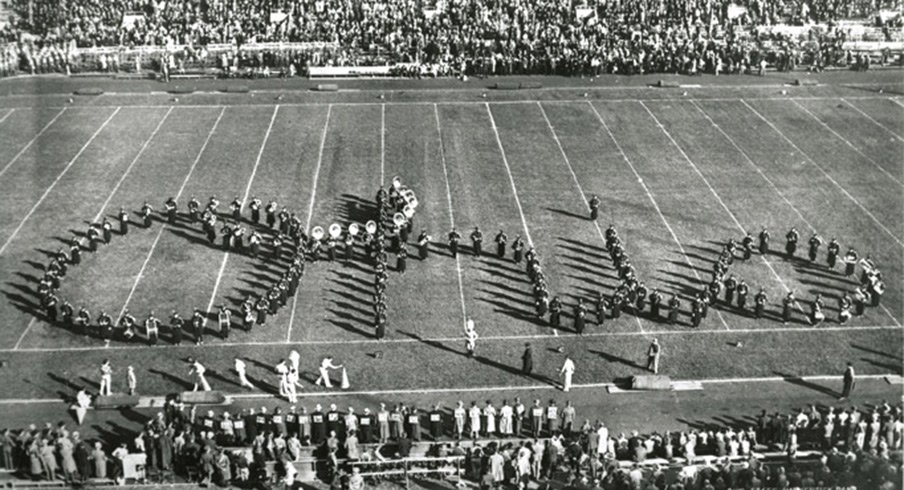
Few traditions, however, induce the chills Ohio State fans get when witnessing “Script Ohio” performed by the school's marching band. Today, that tradition turns 80.
Although the University of Michigan Marching Band pioneered an “Ohio” formation in 1932, the flowing script adored by generations of Buckeye fans was first performed on Oct. 10, 1936 by the Ohio State University Marching Band.
Script Ohio was the brainchild of then band director Eugene J. Weigel, who took his inspiration from Loew's Ohio Theater in Columbus. The script comes to life to Robert Planquette's “Le Régiment de Sambre et Meuse,” which, if you've always wanted to connect Ohio State to the French Third Republic, there you go.
Trumpet player John W. Brungart of Coshocton holds the distinction of being the first person to “dot the i” in the script that day – at halftime of a 6-0 loss to Pittsburgh – though today, the honor goes to a fourth- or fifth-year sousaphone player.
In the years since, 14 people from outside of the band have had the honor of dotting the i, including Bob Hope, Woody Hayes, Jack Nicklaus and John Glenn.
Nine days ago, former Ohio State coach Earle Bruce become the most recent dignitary to dot the i at halftime during the Rutgers game.
Happy 80th, Script Ohio.
That’s Amaro: One Man’s Love Affair With Bitter Liqueurs
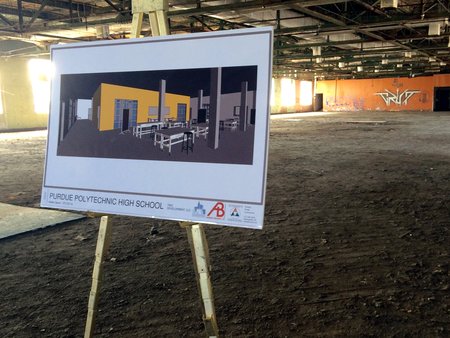
Abandoned P.R. Mallory factory to get new life as Purdue high school
Retooling the American Metropolis
 Last year the Manhattan Institute commissioned a group of academics to author urban policy papers targeting the challenges facing the American city. We published this collection last fall as The Next Urban Renaissance.
This year we did it again, and have just released our new collection Retooling Metropolis, available for free download. It features papers from Donald Shoup, Mike Luca, Jeff Liebman, and others.
In the first essay, Harvard Business School’s Michael Luca discusses the innovative work that he and his team did in partnership with Yelp, a customer-review website, and the cities of San Francisco and Boston. Traditional urban-data applications have involved either making better internal use of government data or posting government data to an online portal to allow private users to take advantage of it. In Luca’s work, there is a bidirectional flow of data and more collaboration between private firms, such as Yelp, and cities.
Luca examined public-health inspection scores in San Francisco and helped get that information onto Yelp—a useful thing for the many diners who peruse it before selecting a restaurant to visit. He also discovered that reviews posted on Yelp can be used to predict which restaurants will subsequently fail health inspections. Luca worked with the city of Boston to run a contest to create an algorithm to apply that insight to Boston, which could potentially allow health inspectors to more efficiently target restaurants that are likely to have violations.
In the second essay, UCLA’s Donald Shoup outlines better ways for cities to manage their on-street real estate. Demand for parking is growing with cities, and new technology offers new ways of managing parking. He suggests that cities should use market-based pricing for parking meters, varying the price by time of day to reflect the variation in demand for parking spaces. He outlines the concept, and then reviews the results achieved when San Francisco implemented his policy for its new SFpark system.
Shoup also describes how market-based pricing could be extended to residential street parking. His plan: allow neighbors to petition for a uniform price auction to allocate spaces to homeowners. The money raised would then be spent in the neighborhood itself. Rich and poor neighborhoods would both benefit through a “power-equalization system” of financial allocation.
In the third essay, Alex Armlovich and I address the problem of soaring housing prices in many U.S. cities. To help ease this burden, we suggest more aggressive permitting of so-called microunits—apartments that are smaller than conventional studios.
We highlight a number of the barriers to microunit construction, including minimum unit-size regulations, a lack of multiunit zoning generally, and other de facto restrictions, such as density caps. We then review the experience of microunits in Seattle and other cities, as well as the political barriers to them, including legacy opinions shaped by the history of single-room-occupancy hotels.
In the final essay, Jeffrey Liebman and Hanna Azemati, both at Harvard’s Kennedy School, discuss ways to help cities improve their contracting. Virtually everything that cities do involves some type of contracted purchase from the private sector. In Boston alone, contract purchasing totals $1.2 billion per year. But the contracts themselves often have not been changed in many years. Instead, they are simply rolled over as they expire. There is little high-level focus on pursuing strategic contracts, either.
Liebman and Azemati recommend that cities assign a senior member of the mayor’s inner circle to be responsible for strategic management of the city’s contract portfolio; and that cities explicitly define their goals for major procurement efforts, structure the contracts correctly (such as by bundling or unbundling items) to achieve those goals, and investigate innovative types of contracting, such as problem-based procurement.
These essays address diverse topics. But they all cover themes that directly speak to the problems, as well as the opportunities, that today’s city leaders face.
Click through to read the whole thing.
Veteran TV reporter Jim Shella to retire from WISH, 'Indiana Week in Review'

Wines of The Times: In California, Grenache Packs More Than Power
Sprawling east-side RCA site finally could be ripe for redevelopment

Another hidden T.C. Steele painting discovered
A Restaurant’s Sales Pitch: Know Your Lobster
Indiana University freshmen set record GPA, test scores
McNamara hopes $2.5M bet on HQ will help Mass Ave industrial corridor flower

Bill Evans and The Ivy Look

In 1953, during the heydays of Ivy Style, The New York Times surveyed a group of college grads to find out what they thought of the Ivy Look. Opinions were decidedly mixed – with pro and anti views somewhat falling along gender lines (men liked it; women didn’t). The main criticism seemed to be that the sack suit and soft-shouldered tweed made men look like Madison Avenue lemmings. One women said, “They’re so enslaved by conformity that when up and about, they all look as they’d been hacked out by the same die.” Another: “If we are all going to be tailored in the same pattern, we shall end up as dull, dreary, and disappointing as the man in the gray flannel suit.”
Although that’s probably true by and large, there are lots of jazz musicians who would serve as nice counter examples. My favorite is Bill Evans, who like many of his contemporaries during the ‘50s and ‘60s, dressed head-to-toe in Ivy. When he performed, he wore soft-shouldered sack suits (sometimes with Brooks Brothers’ signature two-button cuffs), along with dark ties and spread-collar white shirts. No pocket square or loud patterns, just the occasional tie clip. Despite the anonymity of his uniform, Evans looked anything but.
A lot of this can be chalked up to Evans’ good looks and talent. He was one of the most legendary jazz pianists of the 20th century, playing alongside such greats as Miles Davis and Cannonball Adderley. Non-jazz fans will probably know him from Kind of Blue (the soundtrack of every coffee shop), although I like him most for his work with Scott LaFaro and Paul Motian. In fact, I started wearing browline glasses ten years ago partly because of Portrait in Jazz (the trio’s first album), where Evans sported a pair.

There’s also the fact that Evans wasn’t a conformist, which affected how his clothes looked. The painfully shy pianist dealt with his anxieties – which were fueled by his feelings of inadequacy, as well as his brother’s suicide following a long struggle with schizophrenia – with a lifetime of drug use. Evans was saddled with a heavy heroin addiction for most of his life, but it was cocaine that killed him in the end. In his book, Peter Pettinger writes about how Evans once played Johnny Mandel’s “Theme From M*A*S*H” in a San Francisco nightclub, remarking that the song was also known as “Suicide is Painless.” “Debatable,” he then dryly added.
Two weeks later, he was dead. Canadian music critic Gene Lees would later describe Evans’ struggle with drugs as the longest suicide in history.
I don’t mean to romanticize drug use or mental health issues, only to say that Evans is a good example of fashion’s most elusive tenets – that style is ultimately about attitude. Evans sported the uniform of every clean-cut, IBM drone, but his look was that of a tortured artist. I like how Christian Chensvold put it once: “Two men wearing the same outfit do not produce the same effect. A square in hip clothing is still a square, while a hipster in square clothing is still hip.”