Shared posts

17 Apr 03:12

Blood Orange: "Uncle Ace (a/jus/ted Remix)"

by Andy Beta

One of 2013's highlights, Blood Orange's "Uncle Ace" detailed the plight of NYC's LGBT homeless youth, loosed to drift through the city at the witching hour. With Dev Hynes' sympathetic eye and ear, it was a song at once "mysterious, desperate, empathetic" (as Ryan Dombal's review triangulated it), set against a fierce disco number full of tireless hi-hats and a stinging guitar riff. For this remix of "Uncle Ace," Hynes called on NYC DJ/dance music legend Justin Strauss, who has touched up dance tracks for over thirty years and works with Teddy Stuart as a/jus/ted. The duo expand the original to a glorious nine minutes, switching out the euphoric Bohannon groove of the original for an electronic throb more kin to a dark alleyway, the melody of the original is now conveyed via piano chords that serve as beacon for the dark matter at the song's core. Strauss and Stuart tease it all out ever so slowly, judicious in their use of handclaps, cowbells, the 80s-era synths that linger at the edges, making for one of this year's most evocative remixes.

11 Apr 04:30

Total Control: "Flesh War"

by Evan Minsker

On their great 2011 LP Henge Beat, Melbourne's Total Control managed to offer both deadpan vocals and wonderfully erratic accompanying instruments. On "Flesh War", the first single from their sophomore album Typical System (out June 24 via Iron Lung), they've cleaned up quite a bit. While the song's title would suggest a 25-second hardcore cut, the song is actually very calm, controlled, and streamlined. There are these glowing, beatific synths that hang over everything else when the chorus hits. It's a track with momentum and warmth. The song might require an adjustment for fans who carried a torch for Henge Beat, but Human League stans will be pleased.

26 Mar 17:56

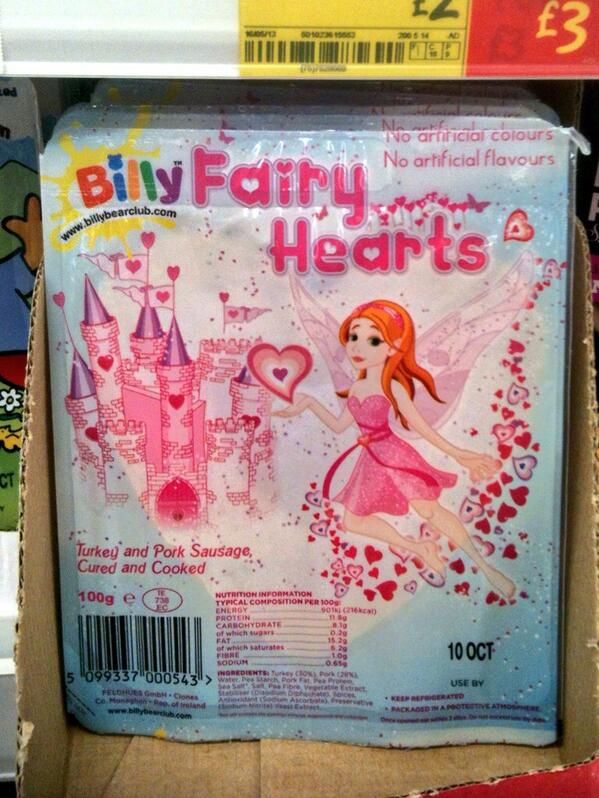
The most pointlessly gendered products

by Maya
mansize kleenex

Because Real Men’s tears are too big and strong for regular tissues.

Sociological Images has pulled together a collection of the most pointlessly gendered products their readers have come across recently.

Of course, most gendered advertising, especially when geared towards kids, is not just pointless but harmful — reinforcing gender stereotypes and limiting imaginations. But when it comes to products like “mansize” Kleenex, it’s really getting absurd. This is the kind of lazy advertising that would earn Don Draper’s withering scorn.

Check out more images — from ”men’s bread” to pet shampoo “for him” and “for her” – after the jump. The eggs are my favorite. 

gendered pet shampoo

Because how embarrassed would poor little Rover be if you got him that girlie stuff?

men's bread

Hey, I like pumpkin seeds too…

gendered eggs

I’m assuming the actual eggs are traditional egg-colored on the inside, but, honestly, who knows.

gendered wrist support

And here I thought the wrist was possibly the most androgynous body part.

Maya DusenberyYou seriously couldn’t pay Maya enough to try those sausages.

25 Mar 21:09

Idaho Campaigns Look to Protect LGBTQ People From Discrimination, Bigots Look to Stop Them

by Mey
In Idaho several campaigns have started up to make sure that the few protections LGBTQ people have remain and that more are added. They are currently facing strong opposition, but haven't given up the fight yet.
20 Mar 04:19

Stand By Me: Historically Black Churches and LGBTQ Allyship

by Helen
The question of homophobia in historically Black churches is way more nuanced than conversations about Christianity and queerness often take into account. If the Black church and LGBTQ movements joined forces, they would be a force to reckon with.
18 Mar 23:29

Daily Feminist Cheat Sheet

by Maya

Jocelyn Elders

An oldie but goodie from former Surgeon General Joycelyn Elders, who was removed because she was an outspoken advocate for contraception and sex ed and believed that masturbation was a healthy part of sexuality.

I’m a little tired of talking about feminism to men too.

Well-known designer, stylist, and former model L’Wren Scott passed away yesterday. But the way the media told it, “she was first and foremost ‘Mick Jagger’s girlfriend.‘”

The gender politics of “My Husband’s Stupid Record Collection.”

Eight stories of everyday sexism experienced by female journalists.

The originator of the “what were you wearing when you were assaulted?” Twitter convo: “We can’t lose sight of the fact that an incredible thing happened that night.”

The Independent is refusing to review any books marketed to only one gender.

17 Mar 17:16

100 serial rapists identified after Detroit finally processes untested rape kits

by Maya
evidence boxes

There are an estimated 400,000 untested rape kits in the US. (Photo credit: Lonnie Timmons III, Plain Dealer)

Back in 2009, over 11,000 kits were found abandoned in a Detroit Police storage facility. After processing just 1,600 of them so far, Detroit has identified about 100 serial rapists and ten convicted rapists. Those perpetrators have moved on from Michigan to commit similar crimes in 23 other states.

Of course, Detroit is not alone. Nationwide, there are an estimated 400,000 untested rape kits. One of our favorite actress/activists Law and Order: SVU’s Mariska Hargitay (read her Feministing Five interview here) has been raising awareness about this issue for awhile now. Her organization, The Joyful Heart Foundation, has launched a project called End The Backlog to pressure cities and states to prioritize testing their kits. (She’s also producing a documentary about the problem.) And thankfully, 17 states have proposed new legislation to address their backlogs.

There’s a ton of reasons that the rape kit backlog is national shame. For one thing, as Hargitay notes, “One would assume that if someone endures a four- to six-hour invasive examination, that that evidence would be handled with care.” And while police departments say testing evidence is expensive and they just don’t have the resources, they’re making choices about which cases they believe are worth moving forward. Sarah Tofte, the director of policy and advocacy for Joyful Heart, explained to ThinkProgress, “They’re making subjective judgments about whether they’re likely to get a conviction, what this rape looks like, whether the victim is credible, and what the victim’s worth to society is…Ultimately, it’s about, does this victim deserve justice?”

In other words, if we didn’t live in a rape culture in which all but the most “perfect victims” are doubted, you can bet your ass there wouldn’t be such a backlog. As Hargitay said, “To me, this is the clearest and most shocking demonstration of how we regard these crimes.”

Of course, the most urgent and concrete reason we should be testing rape kits is that they can identify rapists. (That’s kinda the point.) And since most rapists are serial rapists, that helps prevent future assaults. The stats from Detroit are similar to those in other cities and states that have tackled their backlogs: Once New York City processed its 17,000-kit backlog in 2001, the arrest rate for rape cases jumped from 40 percent to 70 percent. After working through 2,000 untested kits, Ohio has found nearly 200 matches with DNA in a criminal database.

A couple weeks ago, the White House announced they’d devote $35 million in next year’s budget to grants for processing unopened kits. We’ll be watching closely to see if congressional Republicans block that modest effort to help communities bring rapists to justice and prevent sexual violence.

Maya DusenberyMaya Dusenbery is an Executive Director of Feministing.

08 Mar 23:25

We Have Corporations To Thank For the Veto of Arizona’s Anti-Gay SB 1062

by Cara
And it's hard to know how to feel about it.
06 Mar 23:40

How to Dress Well: "Words I Don't Remember"

by Ian Cohen

"This song for me is about love, trust, commitment..." This could be Tom Krell describing basically every song he's made as How to Dress Well. But this is the statement he used to introduce "Words I Don't Remember," a title which is also applicable to nearly every song he's made. Krell is an artist defined by an inexact grasp of his own memories, recounting painful familial relationships and recalling spiritually nourishing R&B songs both explicitly ("Ready For The World") and implicitly (the Ashanti interpolation of Total Loss' "Running Back"). "Words I Don't Remember" initially appears to be no different, its opening synth chords a glitzier take on Diana Ross' "Missing You," which many people Krell's age first experienced through Notorious B.I.G.'s "Miss U." 

But even compared to the pristine clarity of Total Loss, there's a bracing presence in both Krell's vocal performance and his unadorned language, as he wonders how two people can be connected while allowing the necessary time to be alone with their thoughts. More so than on his previous work, you hear how Krell is establishing a new vanguard for "singer-songwriter" with peers like Autre Ne Veut and Majical Cloudz, as "Words I Don't Remember" is as performative and emotionally legible as the old idea of someone confessing over a piano or guitar while embracing the showmanship and sonic possibilities of all forms of pop and electronic music (check the vocal manipulations during the midsection). From his introduction, you sense Krell knows there's something already definitive about "Words I Don't Remember," and once you get to its coda, he wordlessly expresses how love remains even in the face of total loss.

05 Mar 00:57

Movement: "Like Lust"

by Ian Cohen

If you think "post-rock" is a phrase that's meant to have some kind of literal interpretation, Movement are the sort of band it applies to: they're still a band, one with distinct roles and reliant on rhythmic interplay, but completely removed from the strictures of verse/chorus and the power trio setup of guitar/bass/drums. The Sydney trio have already toured with Solange and Darkside, and somewhere between those two acts, you'll find "Like Lust": it's not R&B, it's not electronic, it's not pop, it's certainly not "rock", but it is strangely psychedelic and very much body music. As with previous single, "Us", "Like Lust" gets physical with a sinuous groove that remains just taut enough, as milky keys and properly loud, echoing drums supporting a half-heard line: "When it feels like lust."

01 Mar 08:41

Fire -- 6th Ave. & 18th, 1916 (LOC)

by nobody@flickr.com (The Library of Congress)

The Library of Congress posted a photo:

Fire -- 6th Ave. & 18th, 1916 (LOC)

Bain News Service,, publisher.

Fire -- 6th Ave. & 18th, 1916

1916.

1 negative : glass ; 5 x 7 in. or smaller.

Notes:
Title from unverified data provided by the Bain News Service on the negatives or caption cards.
Forms part of: George Grantham Bain Collection (Library of Congress).

Format: Glass negatives.

Rights Info: No known restrictions on publication.

Repository: Library of Congress, Prints and Photographs Division, Washington, D.C. 20540 USA, hdl.loc.gov/loc.pnp/pp.print

General information about the Bain Collection is available at hdl.loc.gov/loc.pnp/pp.ggbain

Higher resolution image is available (Persistent URL): hdl.loc.gov/loc.pnp/ggbain.21837

Call Number: LC-B2- 3868-10

28 Feb 04:11

100 LGBTQ Black Women You Should Know: The Epic Black History Month Megapost

by Riese
This epic megapost is your glorious opportunity to meet 100 amazing black LGBT women who've made their mark over the last 150 years.
21 Feb 02:37

Sample, Mix, and Remix

by Aki and Alex


Sampling and remixing is an art form. This version of Brian Williams rapping "Rapper's Delight" from The Tonight Show starring Jimmy Fallon is brilliant and inspirational. Watch it just because we guarantee it will put a smile on your face.


Years Past

February 20, 2013

February 20, 2012

February 20, 2011

February 20, 2010

February 20, 2009

February 20, 2008

February 20, 2007

February 20, 2006

February 20, 2006 (2)

February 20, 2005

16 Feb 21:46

Todd Osborn: "5thep"

by Mike Powell

Ypsilanti, Michigan’s Todd Osborn is one of those mildly chameleonic producers who pops up in different places under different names making different sounds, most of them in the orbit of disco and house. (His “arena metal” project, Musk, is strictly cassette-only.) “5thep” is from the Michigan Dream EP, his first release since last July’s "Hold Up", a pining, mid-tempo collaboration with Hot Chip's Joe Goddard. As is Osborn’s m.o., it’s a shift in tone, from something spare and lonely to something bruising and compact, trading the mellow upper register of Goddard’s voice for a slurry of samples and brash acid-house keyboards. Like Tessela’s addictive “Hackney Parrot”, “5thep” is a recent highlight from the dance/techno world that forgoes smoothness for music that sounds big, blocky and covered in seams—an approach that in 1994 would’ve been a byproduct of software but in 2014 is a decisive choice.

Todd Osborn: "5thep" on SoundCloud.

16 Feb 21:35

Frankie Cosmos: "Birthday Song"

by Paul Thompson

It's Greta Kline's birthday, and she's not about to spend it counting candles. "Just because I am a certain age," Kline matter-of-factly sings at the top of "Birthday Song," "Doesn't mean that I am any older than I was yesterday." At just 68 seconds, "Birthday"—our second taste of Zentropy, the first studio LP from Kline's prolific-ain't-the-half-of-it Frankie Cosmos project—never seems to be in any particular hurry to get where it's going. Atop a subtly shifting tempo, Kline ambles her way around town, lost in thought: "I think/ How repulsive to you it must be when I refuse to do the things you want me to." Pristine but frazzled, "Birthday Song" manages to cram a whole lot of song—and a year's worth of worry—into just a few short seconds. But the inexorable march of time seems like the last thing Kline oughta be sweating when she's getting this much out of a minute and change.

Frankie Cosmos: "Birthday Song" on SoundCloud.

10 Feb 19:01

Todd Terje: "Delorean Dynamite"

by Andy Beta

Slotted as it is after the ecstatic "Strandbar" on Todd Terje's forthcoming full-length, It's Album Time, "Delorian Dynamite" is tasked with maintaining a high energy level. So Terje, master DJ that he is, ups the beat ever so carefully, the streamlined surges of "Delorian" clocking in at 124 BPMs. From there, cosmic disco, Italo, Balearic guitar lines, Model 500 basslines and more converge on this delirious, skyward track.

Todd Terje: "Delorean Dynamite" on SoundCloud.

08 Feb 19:34

Saturday Morning Cartoons: X-Rated Roots

by Sarah Rosenblatt
Welcome to Saturday Morning Cartoons! This week, we explore queer & lesbian porn.
08 Feb 00:49

Mean Girls Online: Can We Draw A Line In Social Media?

Mean Girls Online: Can We Draw A Line In Social Media?

by Tell Me More Staff

Feminists criticizing feminists online: How does it impact the movement?i i

Feminists criticizing feminists online: How does it impact the movement?

iStockphoto

Last week, an article about online feminist activism set off a heated debate. The Nation's Michelle Goldberg examined criticism aimed at feminists by other feminists. "Is it good for the movement? And whose movement is it?" Goldberg asked.

She wrote:

"Yet even as online feminism has proved itself a real force for change, many of the most avid digital feminists will tell you that it's become toxic. Indeed, there's a nascent genre of essays by people who feel emotionally savaged by their involvement in it — not because of sexist trolls, but because of the slashing righteousness of other feminists."

Michel Martin of NPR's Tell Me More hosted a conversation with Goldberg and some of the writers involved in the debate: Mikki Kendall, a writer and media critic with HoodFeminism.com; Anna Holmes, founder of Jezebel.com; and Brittney Cooper, a professor at Rutgers University and co-founder of the Crunk Feminist Collective.

Below are some highlights from the interview; click on "Transcript" above for the full text or listen to the conversation.


Interview Highlights

On what compelled Michelle Goldberg to write the piece

Michelle Goldberg: I think it's something that I had heard people talking about privately for a long, long time and nobody wanted to talk about publicly. But I constantly was hearing feminists — including feminists who've been involved in online activism for a long time — saying that there was nowhere that they felt more intimidated, more afraid to speak, than online. And at first, I thought, you know, if this is just a problem of kind of white middle-class women, maybe it's not even worth writing about.

Maybe it really is just about people feeling threatened that their place in the hierarchy is being challenged. But as I started to hear about it also from women of color — there's a woman I cite in my piece who's a trans Puerto Rican woman activist who has written widely about the hatred that she receives from ... various racists and misogynists but [who] wrote that she actually feels in a lot of ways most threatened and most intimidated by people in her own community who she knows are going to come down on her if she steps over one of these invisible ideological tripwires. ... And so that's what convinced me that it was something worth delving into.

On the line between examining ongoing privilege and bullying

Michelle Goldberg: To be honest, I don't know that I can — I don't know that I or anyone else can really draw that line. I do think that, you know, when you kind of — when people tweet explicitly, you know, let's make this person cry, that is, I would think, crossing the line. And I also think there's a kind of consistent twisting of people's words and people's intentions. One of the examples I give in the piece is when the actress Martha Plimpton was organizing or tweeting about a fundraiser that had the title "vaginas" in the name. It was a fundraiser for a group of abortion funds. And people really came down on her for using the word vagina and saying that this excludes trans men who may have vaginas and need abortions but don't want their genitals referred to by female words.

It was this sort of very rigid and sort of recondite form of political correctness that is very difficult not to step into because I think a lot of people don't know where the rules are. But people automatically assumed, not just that she had defended them, but that she was this terrible transphobe, that she was somebody who could no longer be taken seriously as an ally. That's the sort of thing that I'm talking about.

On whether Mikki Kendall considers herself a bully

Mikki Kendall: I think that I am someone whose anger can be intimidating. Do I think that I can be someone's bully in their mind? Yes. I can't control how people feel about what I have to say. Do I think that it is as cut and dry as, well, I don't like the way you speak to me? Everyone's coming into this big umbrella from different cultural contexts. Do I think from the standards of my community that I'm a bully? No. But I'm not doxing anyone. I'm not calling up trans women's employers. I'm not leaving comments to undermine their businesses, calling their doctors to interfere with their health care. And these are things that are actually happening to people. I am not saying in large articles and national syndicated columns that, oh, well, we're going to talk about toxic culture, but we're not going to talk about all aspects of that culture. ... And we're certainly not going to talk about how people who are feminists and in power can upset, anger and bully someone, and then say, well, I am a victim, when the people they have said something to respond.

Michel Martin: Well, you know, people can be both.

Kendall: People don't have to like everything...

Martin: People can be both.

Kendall: Yeah.

On whether bullies and victims are sometimes the same

Brittney Cooper: I'm in this as a person who is very concerned about the way that we're having this conversation online. So I want to be clear that, as I said in the piece, I think that there has been real injury on the part of white feminists, particularly dealing with black feminists online. But I am also a person that cares about what kind of world we're building, and that means that there have to be some ethics of engagement and also a sort of concession that we deal with people giving them the benefit of the doubt. And that doesn't mean from my vantage point that we have to put up with things that we know are unjust, are racist, are sexist, are problematic. I think we can call them out, but I don't want the history of this moment, particularly in black and women of color feminisms, to be written as a history in which — where black feminists, particularly online feminists of which I'm a part, spent their time doing was primarily calling out white women for racism. I want this to be a moment where we're talking about the kinds of worlds that black women are building online through our progressive social justice activism. ...

On whether Anna Holmes would have started a women's blog today

Anna Holmes: I don't know that I would start a women's blog or a women's blog that focused on feminism, but — and there are a lot of reasons for that. I mean, I think I already did, and I wouldn't want to repeat myself. But I think that the discourse has become, as I said to Michelle, somewhat brittle and myopic and not particularly constructive, at least what I'm seeing on Twitter. And, I mean, listen, that's really the only social media platform that I'm on. I can only handle one at a time, so I'm not really on Facebook. I'm not really on Tumblr, I don't tend to read websites and blogs the way I used to. I tend to come to things from Twitter. So that's where I'm seeing the majority of this sort of behavior play out. And I found it pretty troubling. I mean, I'd say probably for the — probably about a year ago is when I started noticing that there were these call-outs going on.

And I really couldn't wrap my head around what the point of them was because if you want to build bridges between communities, like-minded communities, who have similar or — I won't say the same goals, but have similar goals — I don't see what is productive about an assumption or a starting point where you assume bad faith or equate disagreement with enemy-making. And that's what I've been seeing — again, I'm talking only about Twitter. I cannot speak about other social media platforms. You know, some people might argue that Twitter isn't that important. It isn't as widely used as Facebook. But there are a lot of journalists and activists and commentators and thinkers who are on Twitter, and that's why I have a particular criticism of the way the discourse is going on.

Copyright 2014 NPR. To see more, visit http://www.npr.org/.
05 Feb 04:10

We Need Help: Seeking New Fashion Writers

by the team
Anja

clare, i'm sure they don't pay, but... are you gonna do this anyway?

If you've ever felt like Autostraddle could be the perfect place to put your words about fashion, style & beauty for a smart queer lady audience, your time has come!
29 Jan 00:17

RIP Pete Seeger

by Katie

Pete Seeger, one of the world’s most well-known, prolific and influential folk singers, died yesterday at the age of 94. Famous for his anti-war music, pro-economic justice  and environmental music, Seeger also used his voice to raise awareness about gender norms and patriarchy. Here he is singing I’m Gonna be an Engineer, a song written by his sister Peggy Seeger. Lyrics and links after the jump.

Learn more about Pete on this Democracy Now special, which aired today.

Here’s Pete singing This Land is Your Land at President Obama’s inauguration.

President Obama on Pete’s death.

Something I wrote on going to his 90th birthday concert at Madison Square Garden.

A really moving performance of Pete’s anti-war ballad Bring Them Home at the Madison Square Garden concert, featuring Tao Rodriguez-Seeger, Warren Haynes, Band of Horses’ Ben Bridwell and Tyler Ramsey, Drive By Truckers’ Patterson Hood and Preservation Hall Jazz Band and the New York City Labor Chorus.

94 Reasons Pete Seeger Matters.

Pete Seeger being a total badass in the face of McCarthyism and the House Un-American Activities Committee.

I’M GONNA BE AN ENGINEER

When I was a little girl I wished I was a boy
I tagged along behind the gang and wore my corduroys.
Everybody said I only did it to annoy
But I was gonna be an engineer.

Mamma said, “Why can’t you be a lady?
Your duty is to make me the mother of a pearl
Wait until you’re older, dear
And maybe you’ll be glad that you’re a girl.

Dainty as a Dresden statue, gentle as a Jersey cow,
Smooth as silk, gives cream and milk
Learn to coo, learn to moo
That’s what you do to be a lady, now.

When I went to school I learned to write and how to read
History, geography and home economy
And typing is a skill that every girl is sure to need
To while away the extra time until the time to breed
And then they had the nerve to ask, what would I like to be?
I says, “I’m gonna be an engineer!”

“No, you only need to learn to be a lady
The duty isn’t yours, for to try to run the world
An engineer could never have a baby
Remember, dear, that you’re a girl”

She’s smart — for a woman.
I wonder how she got that way?
You get no choice, you get no voice
Just stay mum, pretend you’re dumb.
That’s how you come to be a lady, today.
Well, I started as a typist but I studied on the sly
Working out the day and night so I could qualify
And every time the boss came in, he pinched me on the thigh
Said, “I’ve never had an engineer!”
“You owe it to the job to be a lady
The duty of the staff is to give the boss a whirl
The wages that you get are crummy, maybe
But it’s all you get, ’cause you’re a girl”

Then Jimmy came along and we set up a conjugation
We were busy every night with loving recreation
I spent my days at work so he could get an education
And now he’s an engineer!

He said: “I know you’ll always be a lady
The duty of my darling is to love me all her life
Could an engineer look after or obey me?
Remember, dear, that you’re my wife!”

As soon a Jimmy got a job, I studied hard again
Then busy at me turret-lathe a year or two, and then
The morning that the twins were born, Jimmy says to them
“Your mother was an engineer!”
“You owe it to the kids to be a lady
Dainty as a dish-rag, faithful as a chow
Stay at home, you got to mind the baby
Remember you’re a mother now!”

Every time I turn around there’s something else to do
Cook a meal or mend a sock or sweep a floor or two
Listening to Jimmy Young – it makes me want to spew
I was gonna be an engineer.

I only wish that I could be a lady
I’d do the lovely things that a lady’s s’posed to do
I wouldn’t even mind if only they would pay me
Then I could be a person too.

What price for a woman?
You can buy her for a ring of gold,
To love and obey, without any pay,
You get a cook and a nurse for better or worse
You don’t need a purse when a lady is sold.

Oh, but now the times are harder and me Jimmy’s got the sack;
I went down to Vicker’s, they were glad to have me back.
But I’m a third-class citizen, my wages tell me that
But I’m a first-class engineer!

The boss he says “We pay you as a lady,
You only got the job because I can’t afford a man,
With you I keep the profits high as may be,
You’re just a cheaper pair of hands.”

You got one fault, you’re a woman;
You’re not worth the equal pay.
A bitch or a tart, you’re nothing but heart,
Shallow and vain, you’ve got no brain,

Well, I listened to my mother and I joined a typing pool
Listened to my lover and I put him through his school
If I listen to the boss, I’m just a bloody fool
And an underpaid engineer
I been a sucker ever since I was a baby
As a daughter, as a mother, as a lover, as a dear
But I’ll fight them as a woman, not a lady
I’ll fight them as an engineer!

Words and music by Peggy Seeger
(c) 1970  Stormking Music, Inc.

24 Jan 22:00

What Sami Discovered On The Way To Becoming A Man Of Color

What Sami Discovered On The Way To Becoming A Man Of Color

by Erica Yoon

  • Sami Younes, 26, began his physical transition three years ago.
    Hide caption
    Sami Younes, 26, began his physical transition three years ago. "Transition didn't solve everything for me. I still have a lot of growing to do as person. But I think I'm in a better position to face it now," he said. One of the things that Younes navigates now is how people react to him as a transgender Lebanese and Puerto Rican man.
    Erica Yoon/NPR
  • Younes holds a senior portrait picture of himself in high school when he was formerly Mariam. Being beautiful equated to becoming a good daughter in Younes' experiences with his family.
    Hide caption
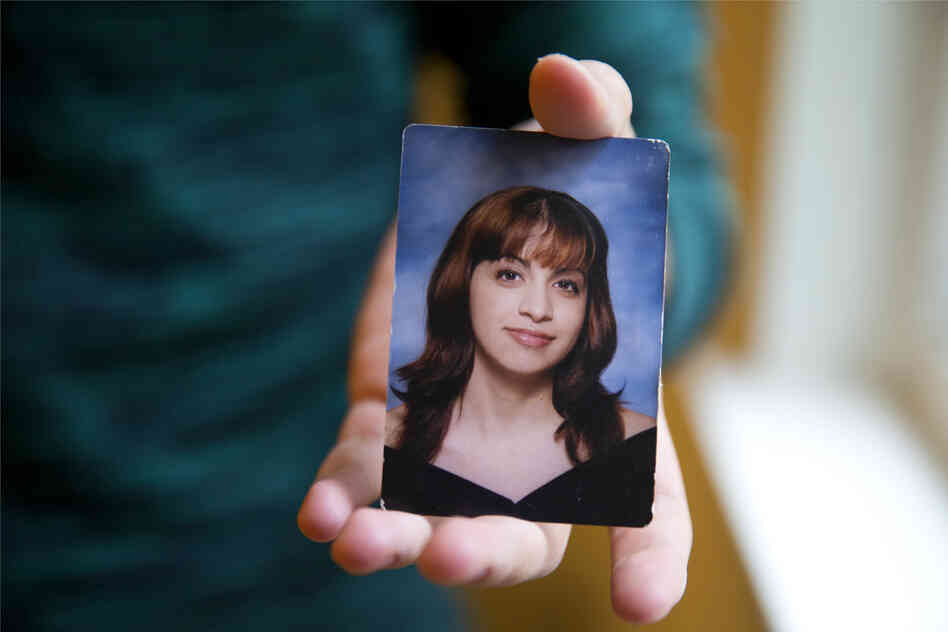
    Younes holds a senior portrait picture of himself in high school when he was formerly Mariam. Being beautiful equated to becoming a good daughter in Younes' experiences with his family. "All I knew was that I was a girl and I had to be a girl and inside, I didn't feel that way," he said.
    Erica Yoon/NPR
  • Younes relaxes in the morning with one of his cats, Beans, at home. He shares an apartment with a roommate, Angelica Martinez. As a Lebanese and Puerto Rican transgender man, Younes has yet to find somebody like himself. He has attempted to form social groups for trans men of color but they never successfully materialized.
    Hide caption
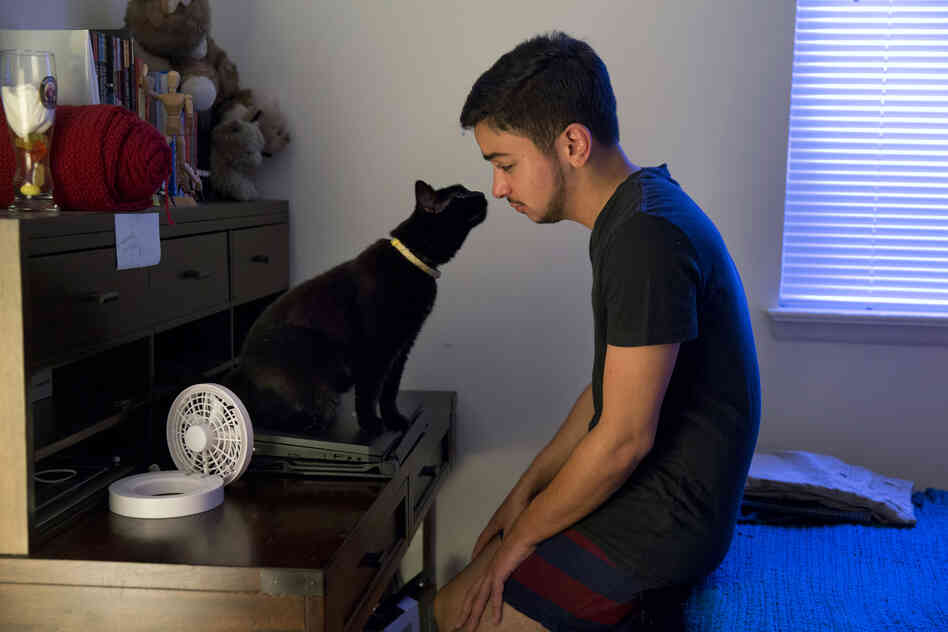
    Younes relaxes in the morning with one of his cats, Beans, at home. He shares an apartment with a roommate, Angelica Martinez. As a Lebanese and Puerto Rican transgender man, Younes has yet to find somebody like himself. He has attempted to form social groups for trans men of color but they never successfully materialized. "I do feel a bit alone," Younes said.
    Erica Yoon/NPR
  • Younes drives in D.C. to meet his parents for lunch. Initially apprehensive about his transition, Younes' parents are now supportive of him as their son.
    Hide caption
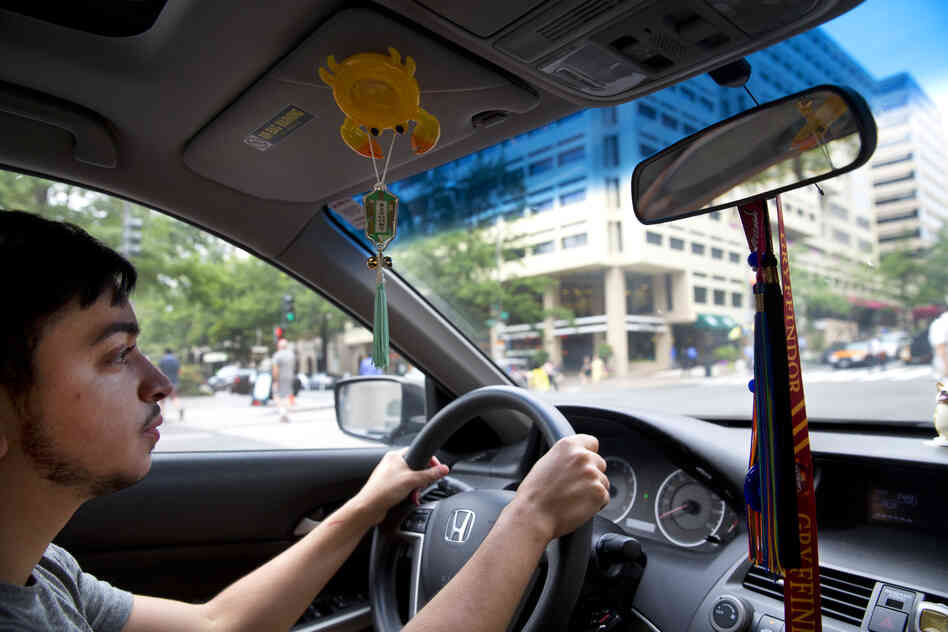
    Younes drives in D.C. to meet his parents for lunch. Initially apprehensive about his transition, Younes' parents are now supportive of him as their son.
    Erica Yoon/NPR
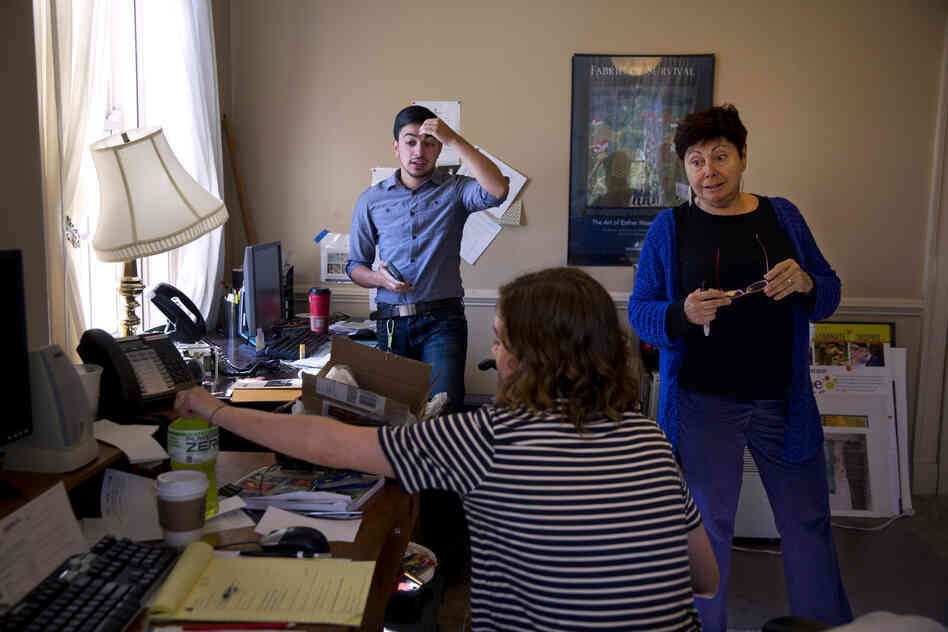
  • Younes talks with a current intern and Harriet Lesser, the 2012-2013 season curator, at The Mansion at Strathmore during work. He previously interned at the gallery when he was female and had a smooth transition when he returned. He was a visual arts assistant there but has since changed jobs.
    Hide caption
    Younes talks with a current intern and Harriet Lesser, the 2012-2013 season curator, at The Mansion at Strathmore during work. He previously interned at the gallery when he was female and had a smooth transition when he returned. He was a visual arts assistant there but has since changed jobs.
    Erica Yoon/NPR
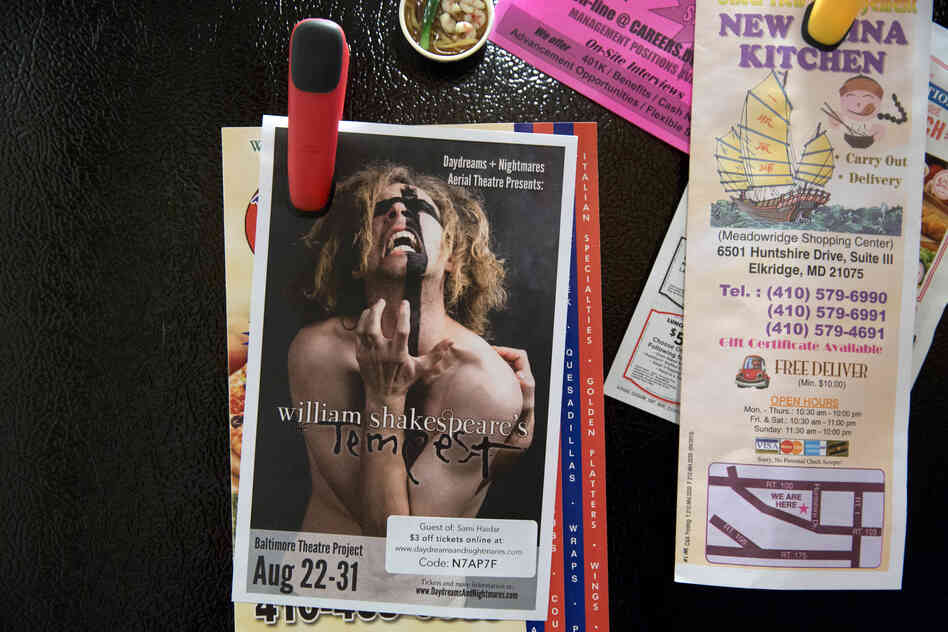
  • A flier for a production of The Tempest hangs on Younes' refrigerator. He will play the part of Alonso with the DNA Theatre in Baltimore. After his transition, theater became a big part of Younes' life, a way for him to express himself and socialize with other people.
    Hide caption
    A flier for a production of The Tempest hangs on Younes' refrigerator. He will play the part of Alonso with the DNA Theatre in Baltimore. After his transition, theater became a big part of Younes' life, a way for him to express himself and socialize with other people.
    Erica Yoon/NPR
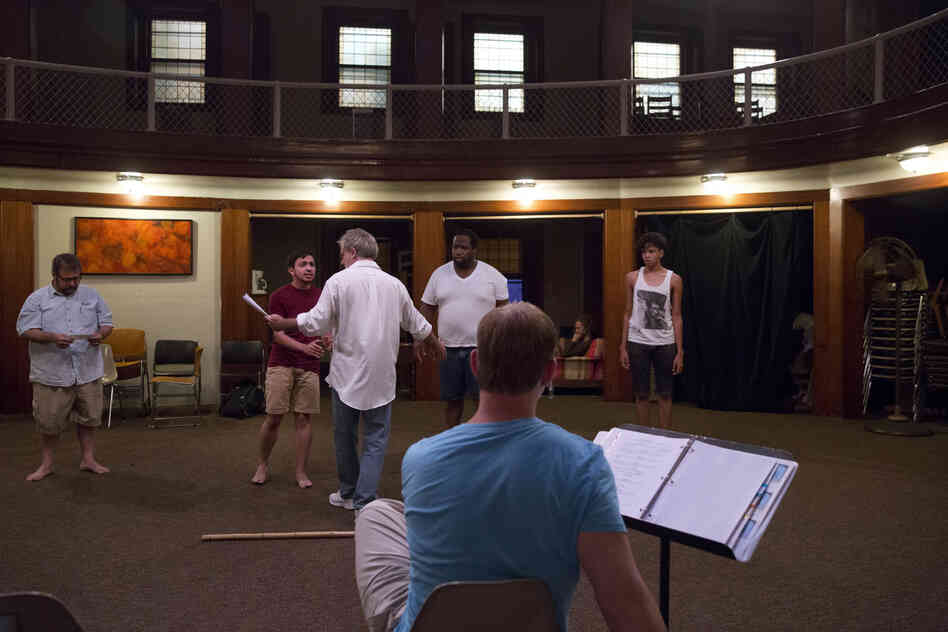
  • Younes rehearses a scene for The Tempest with his castmates at St. Mark's Evangelical Church in Baltimore.
    Hide caption
    Younes rehearses a scene for The Tempest with his castmates at St. Mark's Evangelical Church in Baltimore.
    Erica Yoon/NPR
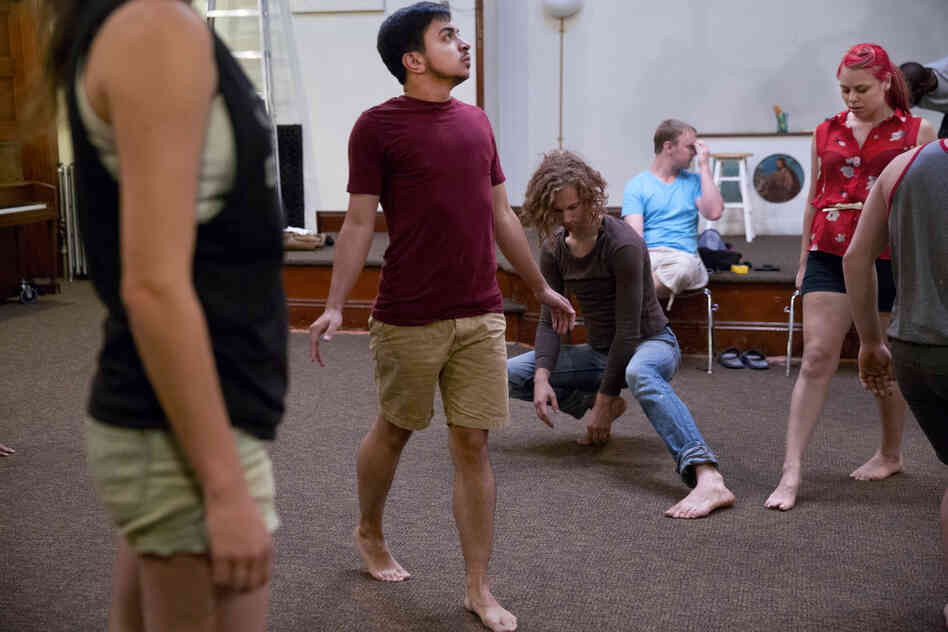
  • Younes participates in theater rehearsal. Most of the people he interacts with know of his transition, but there are several people who he knows may not.
    Hide caption
    Younes participates in theater rehearsal. Most of the people he interacts with know of his transition, but there are several people who he knows may not.
    Erica Yoon/NPR
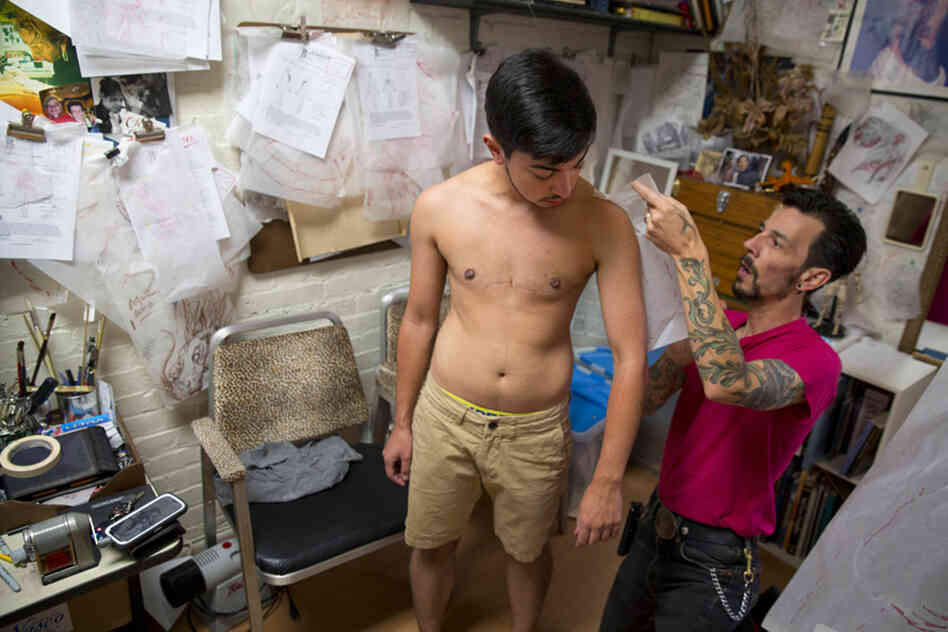
  • Younes lets Paul Roe, owner and artist at Britishink Tattoos in Washington, D.C., outline his body for a preliminary tattoo design. Younes plans to receive a fairly elaborate tattoo, including a lion and a sun, that will cover the majority of his body. The lion and the sun are two symbols often used in Iranian culture and have ties to Islam. Younes' middle name, Haidar, also means lion.
    Hide caption
    Younes lets Paul Roe, owner and artist at Britishink Tattoos in Washington, D.C., outline his body for a preliminary tattoo design. Younes plans to receive a fairly elaborate tattoo, including a lion and a sun, that will cover the majority of his body. The lion and the sun are two symbols often used in Iranian culture and have ties to Islam. Younes' middle name, Haidar, also means lion.
    Erica Yoon/NPR
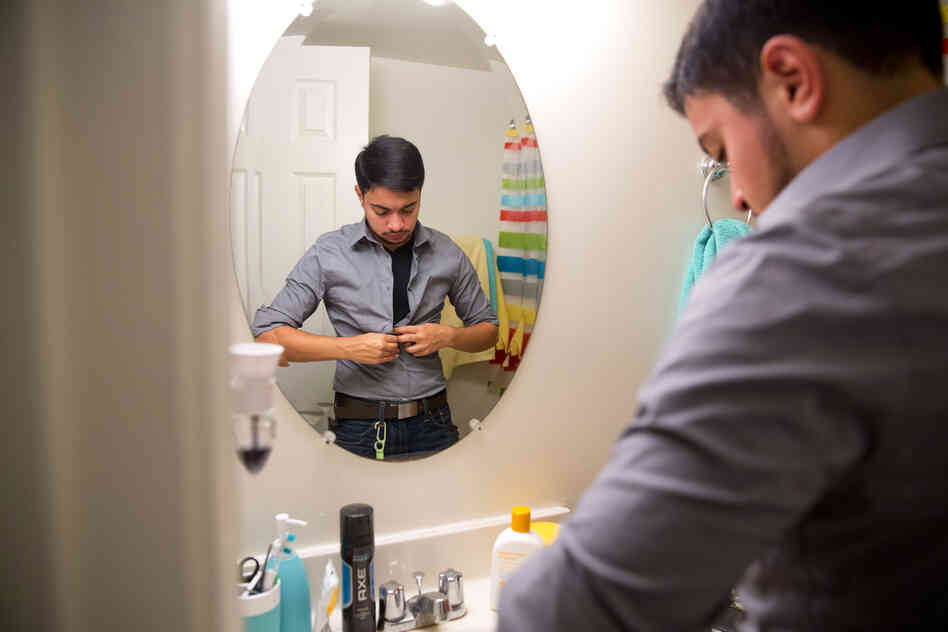
  • Younes dresses for work in the morning. He says that while telling his story will be his way of putting himself out there, that doesn't make it
    Hide caption
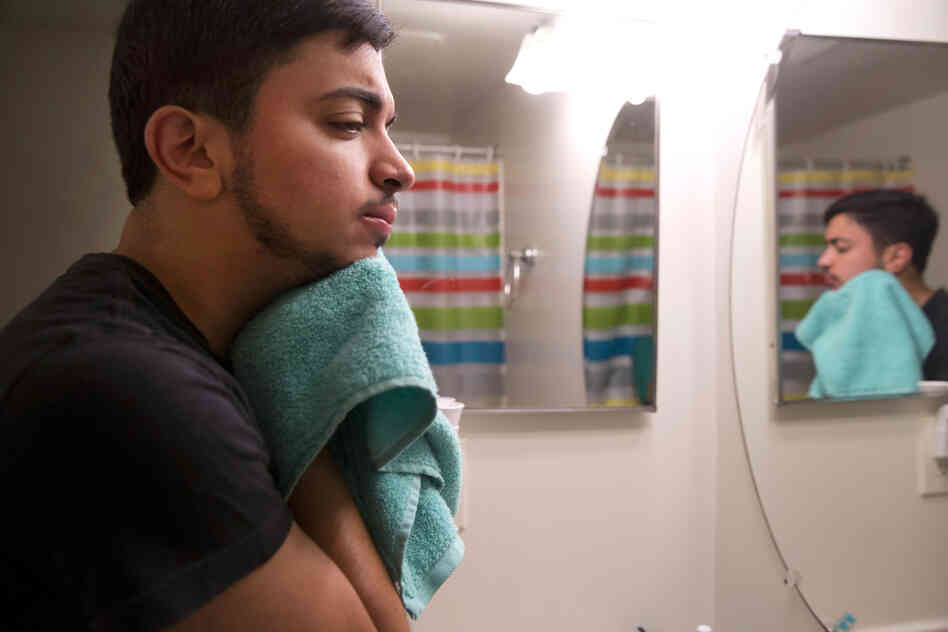
    Younes dresses for work in the morning. He says that while telling his story will be his way of putting himself out there, that doesn't make it "open season" for strangers to bluntly ask about personal things like his sexuality. "Everyone's got a different story. There's no cut and dry mold for being transgender," he said.
    Erica Yoon/NPR
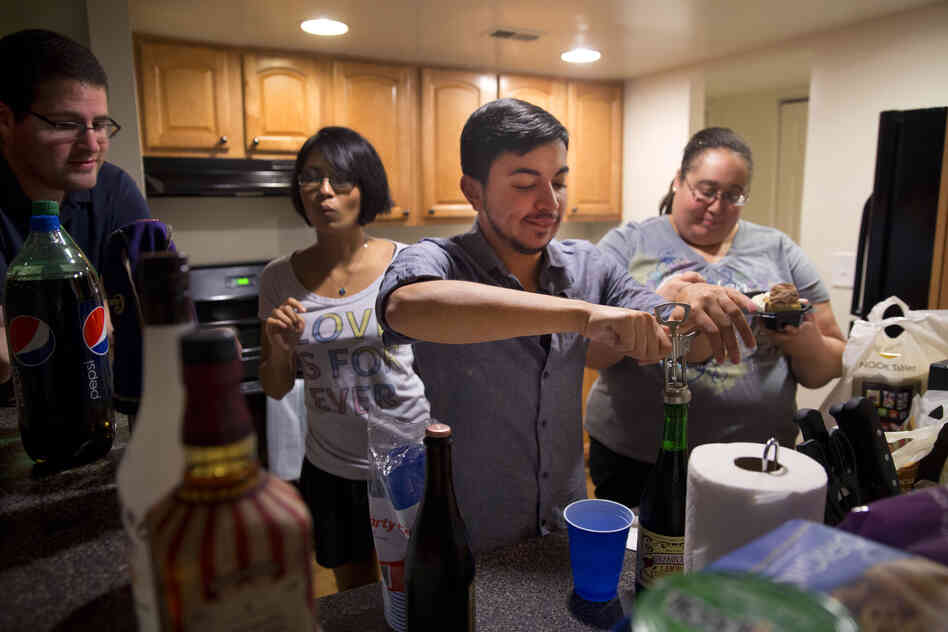
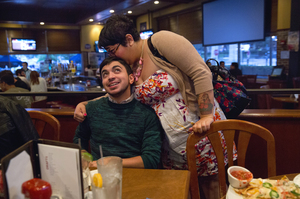
  • Younes celebrates his birthday with Martinez (second from left) and several of their friends at their apartment on a Saturday night.
    Hide caption
    Younes celebrates his birthday with Martinez (second from left) and several of their friends at their apartment on a Saturday night.
    Erica Yoon/NPR
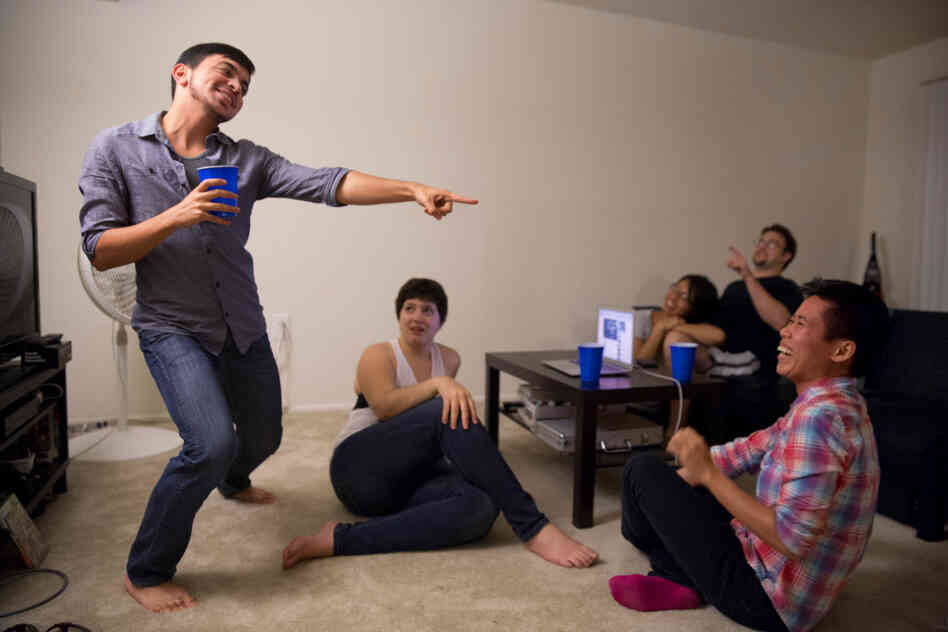
  • Younes lip syncs during the joint birthday party.
    Hide caption
    Younes lip syncs during the joint birthday party. "Sam is happy now. That really means a lot to us," Younes' mother, Lina, said.
    Erica Yoon/NPR

1 of 12

View slideshow i

Not many people can say they've experienced the world both as an Arab-Latino woman and as an Arab-Latino man. Sami Younes can.

Younes, 26, was once Mariam, a Lebanese and Puerto Rican woman. When he began his physical transition three years ago to become a man, the way people reacted to his change surprised him.

"This never happened to me before my transition," Younes said. "I'll be walking down the street and I'll see someone coming toward me. And if they're alone, they'll just change to the other side of the street. They look at me and they get afraid, and I see the fear in their eyes.

"I'm not going to hurt anybody ... but people walk away from me now."

Younes said he had experienced racial remarks in the past, ranging from someone complimenting his spoken English to a stranger telling him that he was evil because of his race. But as a man, he's gained a new awareness of the stereotypes that people might associate with him, many based on race and sex.

"While I would not regret my transition for a second, I've stepped into a position now where I'm perceived as a terrorist or an Islamic extremist," he said. "I didn't deal with that when I was a woman and now I'm dealing with it."

"People don't outright say anything to me but it's the fear that speaks the loudest. People are suddenly afraid of me and they weren't before."

Transitioning for him is an ongoing process.

"I think everybody loses something when they transition. ... [It can be] their sense of security, their family ... and I think everybody gains something too, or they wouldn't do it," said Mara Keisling, founding executive director of the National Center for Transgender Equality. Keisling is a transgender woman who transitioned when she was 40 years old. After transitioning, she said, she experienced a new sense of vulnerability that she never felt before as an athletic, 6-foot-2-inch white male.

Younes' sister gives him a kiss during his birthday party.i i

Younes' sister gives him a kiss during his birthday party.

Erica Yoon/NPR

For Younes, however, that vulnerability was compounded by being a transgender man of color.

Transgender and gender nonconforming people of color experience higher levels of employment discrimination, economic insecurity, homelessness and housing discrimination in comparison with their white counterparts, according to a nationwide survey of 6,450 people conducted in 2011 by the National Center for Transgender Equality and the National Gay and Lesbian Task Force. (Respondents of Asian descent were the exception to these findings. They reported slightly lower levels of discrimination, except in regard to housing discrimination and homelessness.)

Younes has yet to meet another individual who shares his unique cultural and personal background — a half-Lebanese, half-Puerto Rican transgender man. He has attempted to form social groups for transgender men of color, but they never successfully materialized. Instead, most of the trans spaces he navigates are predominantly white.

Culture At Home

Celebrating his birthday one evening, Younes was surrounded by friends; his roommate, Angelica Martinez; and his sister, Leila. Even his friend from California, Emily Karram, traveled all the way to Maryland to celebrate her birthday with him. The festivities turned to several rounds of the game Cards Against Humanity, along with spontaneous lip syncing from Younes. He balled his fist into an imaginary microphone, mouthing soundlessly while music played in the background.

The second oldest of four children, Younes was born in Silver Spring, Md., to a Puerto Rican/Spanish mother and a Lebanese father. He remembers being surrounded by a culture where femininity was respected and praised. He was encouraged to be beautiful, to grow his hair long and wear dresses.

"Goodness and being an obedient daughter was intrinsically linked to being beautiful," Younes recalled. Younes was nurtured to pursue what he calls traditionally feminine interests — learning how to cook instead of playing sports. While attempting to fit in and be a good daughter, Younes felt the beginnings of a tension within himself.

"All I knew was that I was a girl and I had to be a girl," he said, "and inside, I didn't feel that way."

He primped his hair, did his makeup and took care of his appearance. "I started to fit in more, and it didn't make me any happier with myself. I just didn't like myself ... I never felt like I belonged," he said. "It was really difficult."

The tension continued to build. Younes said he was bullied and picked on when he was a child. He said he tried to kill himself when he was in the sixth grade. Although he began expressing these feelings at a very young age, he said, therapists had reassured him that he was "going through a phase and that medication could help correct [him]."

While attending DePaul University in 2005, Younes began to meet gay people who were "out and happy," as well as transgender people for the first time. He mixed with the drag king crowd, people who identify as female but perform in male character.

"I never fully blended with that ... because it was very ingrained with the lesbian subculture there. And I am not a lesbian so I didn't really fit in," he said. He realized he didn't have to be "ultra-feminine," and that it would be fine to present his gender in a different way.

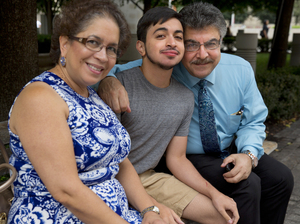
Younes with his mother, Lina, and father, Badri. i i

Younes with his mother, Lina, and father, Badri. "At certain moments, we thought, 'Why us? Why us? You know, God, we didn't need this,' " his father said. "But I say it now, thank God it was us."

Erica Yoon/NPR

It was at this point, he said, that he realized that he was, in fact, transgender.

Younes revealed this to his girlfriend at the time, he said, and the relationship turned abusive. Out of money and wanting to exit the relationship after two years, he decided to go back home.

He then started his physical transition to become a transgender man. His parents were not happy.

"At certain moments, we thought, 'Why us? Why us? You know, God, we didn't need this,' " said Younes' father, Badri. Badri is a practicing Muslim who comes from a religious family. "But I say it now, thank God it was us."

Sami's sisters — Nadia, Leila and Alia — were supportive from the beginning. It was this support that eventually led to Badri's change.

Leila, 27, said that Sami was fluid in his gender expression before transitioning. "He didn't conform to our idea of 'feminine,' nor did he conform to our idea of 'masculine,' " she said. "He was somewhere in the middle."

Sami revealed to Leila his attraction to women several years before he finally told her that he was transgender, she said. She immediately accepted him and helped him to figure out a way to come out to his parents.

Sami's parents eventually began to come around. But as a man in his Arab-Puerto Rican family, there was now a different set of expectations for Sami to uphold.

Sami knew that his father had finally accepted him when he asked for help with stuff like rebuilding the deck. "He wanted me to do all this manual labor that a man is typically expected to do. And I'm not a very big guy. It's not sort of my forte ... but he wanted me to do it," he said.

But one of the things that didn't change for Sami was a wish from his father for him to keep up his appearance and eventually marry.

"We feel so bad that he had to go through it for so long, alone. ... At the end we had to assess, what's more important? Our son or others? You have to put things into perspective," Badri said.

Family acceptance of an individual's transgender identity diminishes the risk of homelessness, incarceration, suicide, smoking, drugs or alcohol, doing sex work or underground work for income, and all sorts of adverse outcomes, according to the 2011 survey. Overall, 43 percent of the individuals surveyed had "maintained most of their family bonds, while 57 percent experienced significant family rejection."

It took a little bit longer for Sami's mother, Lina, a Roman Catholic, to accept him and fully lend her support with Badri. "You know in Spanish there's a common expression," Lina said, " 'El qué dirán?' What will people say? What will people think?"

For a while, Lina just thought Sami was a tomboy. She thought it was a phase. She recalls knowing that he never seemed completely happy when he was younger, wanting to forgo dresses or flowery prints and that he kept wanting to cut his hair. There might have been signs of his gender identity, but she says she was blind to them. But once Badri was encouraged by their daughter Nadia to read more about being transgender, he was slowly able to persuade Lina to accept Sami.

Just as the daughters persuaded Badri, Badri was slowly able to persuade his wife.

"I think as a parent you want to be protective," Lina said. "Sometimes you've been overly protective. By keeping him like he was ... we would have been harming him more."

And just as Sami was surprised to discover the new ways people interacted with him in the world, Lina encountered some surprises, too.

She recalls a conversation that her son had with a Puerto Rican neighbor at the grocery store — a neighbor who'd seen Sami grow up female. Younes had just gone through surgery to remove his breasts and was in the store with his sister when the neighbor recognized him. After the initial small talk, she asked quite openly, without missing a beat, when he started hormones.

Several transgender people I spoke with said this kind of questioning would be unwelcome. It's the type of personal detail many would not want to discuss with an acquaintance. But for Sami, the neighbor's reaction was a welcome one.

"I just sort of looked at her," Sami says, smiling, "and she's like, 'Honey, I'm not blind.' And ever since then, she's just been, like, awesome."

Erica Yoon is a staff photographer at the Roanoke Times.

Copyright 2014 NPR. To see more, visit http://www.npr.org/.
24 Jan 00:34

Daily Feminist Cheat Sheet

by Verónica Bayetti Flores

By Vero and Maya

Race Forward just put out a report on how the media covers race (SPOILER ALERT: it’s not great!). Jay Smooth tells us a bit about the report in the video above!

Pro wrestling pioneer Mae Young passed away.

“They forgot mammy had a brain”: tips for women of color in academia.

On women as targets of Islamophobia.

Check out the trailer for NO HOMO, a documentary by Ja’Tovia Garyat about rapper Cakes Da Killa (who we love here at Feministing!).

“Revenge-porn king” Hunter Moore has been indicted.

The ridiculous Hillary Clinton covers just keep coming.

23 Jan 03:31

TED: Shereen El Feki: A little-told tale of sex and sensuality - Shereen El Feki (2013)

by TEDTalks
“If you really want to know a people, start by looking inside their bedrooms," says Shereen El Feki, who traveled through the Middle East for five years, talking to people about sex. While those conversations reflected rigid norms and deep repression, El Feki also discovered that sexual conservatism in the Arab world is a relatively new thing. She wonders: could a re-emergence of public dialogue lead to more satisfying, and safer, sex lives?
09 Jan 05:09

Wild Beasts: "Wanderlust"

by Ian Cohen

Photo by Klaus Thymann

As haunted coldwave synths and lo-fi drums echo throughout Wild Beasts' new single "Wanderlust", Hayden Thorpe introduces the band's first song in nearly three years by cooing, "We are decadent beyond our means." Makes sense: by 2011's Smother, Wild Beasts' sensuous art-funk had been pared down to such a pinpoint exactitude that anything short of an a cappella album would sound like a shift towards opulence.

Wild Beasts have always involved themselves in all matters of lust and the opening track from their new LP Present Tense does sound like a return to the swinging, libertine lyricism of earlier singles like "All The King's Men" and "Brave Bulging Buoyant Clairvoyants", Thorpe defining the title by rhyming, "Where does the world feel voluptuous?" But that's all a feint for the subtle essentialism at work on this slow burner, where Wild Beasts rid themselves of their guitars and figuratively cut strings with a mantra of bristling minimalism: "Don't confuse me with someone who gives a fuck."

08 Jan 00:58

Flashers, sexual violence, and racism: SNL’s new cast member, Sasheer Zamata, takes on serious issues

by Katie
photo by Cate Hellman http://www.catehellman.com

photo by Cate Hellman http://www.catehellman.com

Joining the cast of Saturday Night LiveSasheer Zamata will become the first African-American woman to grace the show in six years. You mean there are actually funny people who are simultaneously female and African American? Who knew? (Not SNL, apparently.) It’s truly mind-blowing! Where did SNL find this person? Really, though, SNL got the memo that their lack of diversity–which Syreeta and Juliana have written about recently–was unacceptable and in no way a reflection of the lack of talent of people of color. Because there is no lack of talent among people of color; there is just lack of opportunity, thanks to places like…SNL, to come full circle.

Anyway, not only is Zamata hilarious, but she’s a smart cookie and talented writer and uses humor to tackle serious issues. Here are three videos that bring the funny to the… racist-capitalist-patriarchy.

1. “White White Ad Execs Make Commercials for Black People” is a video by UCB Comedy, which Zamata wrote and appears in. As you’ll see, it addresses white businesses’ attempts to capitalize on and commodify black people and exposes the racist homogenization and dumbing down of African Americans. Unlike my description, however, it’s funny and enjoyable.

2. Written by Zamata and made by UCB Comedy, “Be Blacker” takes on racism, and in–a life imitating art imitating life je ne sais quois–shows how white Hollywood either doesn’t cast black actors and, when it does, attempts to minstrelize them.

3. “Sasheer Meets Her Flasher” is a video directed by Chioke Nassor and written by Zamata. It looks at street harassment, flashers, sexual assault, masculinity and…”dicks.”

Fingers crossed, we’ll see a lot more of Zamata’s  biting social commentary and satire and a lot less of the white dude bro-ishness plaguing Saturday Night Live lately.

If anyone is able to add transcripts in the comments, I’d be very grateful it.

Screen Shot 2013-10-28 at 11.13.50 PMKatie Halper is also available for SNL auditions.

08 Jan 00:49

Eight Reasons Why The Rent Is Too Damn High

Eight Reasons Why The Rent Is Too Damn High

by Aboubacar Ndiaye

In the comments section of a recent Code Switch post, a reader named Aboubacar Ndiaye gave a long but thoughtful explanation for the many reasons why housing costs are rising, and why there's no easy solution to the problem. He was gracious enough to expand on his thoughts in this commentary.

A report released last month by the Joint Center for Housing Studies at Harvard found that in an environment of increasing rent and home prices, low- and middle-income Americans were seeing a larger portion of their take-home pay going to cover the cost of rent, making their dreams of homeownership seem like a mirage.

Many commentators used the findings to highlight the need for relief and to offer explanations for the increasing cost of housing in American metro areas.

Housing costs keep climbing, and outpacing many people's ability to afford them. But the reasons why are complex and interrelated, which means it's a problem with no simple solution.i i

Housing costs keep climbing, and outpacing many people's ability to afford them. But the reasons why are complex and interrelated, which means it's a problem with no simple solution.

Kevin Dooley/Flickr

But while the problem of both rental and buying prices squeezing middle- to low- income earners is complicated, there's one issue in particular that is the main driver of unaffordable housing.

But first, here's a list of some of the other factors that contribute to this problem.

Government Regulation

Many well-intentioned policies like housing-choice vouchers, affordable housing mandates, rent control, height regulations, historic designations, and protective zoning laws contribute to the creation of a bifurcated, distorted market — one in which a $500 apartment can exist next door to a $3,000 one. Though housing choice vouchers — also known as Section 8 vouchers — allow millions of low-income people to stay out of poverty and stave off homelessness, they also gobble up a huge portion of a city's affordable housing stock. Most perniciously, Section 8 users are likely to be concentrated in a city's most marginalized neighborhoods, contributing to economic and racial disparities between white and minority residents of a city.

Affordable housing mandates, which usually require a developer to set aside a small percentage of new units for affordable housing, sound good in theory. But developers simply pass on the cost of the affordable units to other residents, driving up the cost of market-rate rents. And in cities like San Francisco and Washington, D.C., height regulations — which forbid buildings from surpassing certain thresholds in height — make it tougher to create more housing through denser development.

All of these raise the costs for renters in the open market, but rent control, at least as it is practiced in New York, Washington, and San Francisco, is the most inefficient. In San Francisco, it's leading to a wave of evictions as landlords convert their rental units into condominiums to get around rent-control legislation. In Washington, the system is so dysfunctional that an Urban Institute study could not find the total number of units subject to rent control. In New York, a lottery-based system, as well as a large contingent of legacy residents, leads to "housing misallocation" — that is, where one person lives in a three-bedroom apartment and pays little for it. Instead of instituting city-wide rent stabilization, cities now have a patchwork rental market: The very poor live in public housing, the rich pay exorbitant rents and middle-income earners vie for the few affordable apartments left over.

New Mortgage Rules

After the last financial crash, new tighter lending standards made it next-to-impossible for people with middle incomes to afford to buy homes. Even for government-backed loans from the Federal Housing Administration that sometimes only require small down payments, the new rules make it harder for people with recession-battered credit scores to obtain mortgages. Even if their post-crisis incomes could support a mortgage.

In a report released last year, Shaun Donovan, the secretary for HUD, emphasized that "only those with stronger credit scores are eligible for FHA-insured mortgages with the minimum 3.5 percent down payment." Ironically, because of historically low interest rates and lower home prices, buying is much more attractive than renting in many places. But because of the newly raised barrier of entry for homeownership, cities are full of relatively high-income renters who might have otherwise owned a home. That's another reason there's so much demand for rental units.

Less Crime

As crime rates have plummeted, more people are willing to live within cities. Even in cities and neighborhoods where the poverty rate stayed the same, where every other factor stayed constant, the crime rate dropped. Crime rates have been dropping internationally at rates consistent with the decreases in the United States.

That decrease in crime, coupled with a cultural move away from suburbanization, reversed the wealth/population flight that marked the second half of the 20th century. (Many cities are now close to, or exceeding, their 1950 population highs.) You can see a positive correlation between rising rents and house prices and falling crime rates in places like Atlanta, Washington, New York, Los Angeles, and Chicago. (Some researchers have suggested that the influx of higher income individuals helped push crime down in cities, but as is shown here, here, and here, there is no consensus on just why crime rates have dropped so much.) It's likelier that the end of the burning cities of the 1960s and '70s and the violent crime epidemics of the '80s and early '90s provoked younger generations to move to newly safe central areas. A Brookings Institution study from 2005 showed that the revitalization of downtown areas coincided almost exactly with the end of the crime spikes of the Reagan-Bush era.

Social Stratification

Along with high unemployment, and stagnant and falling wages for bottom- and middle-income earners, the hollowing out of the middle class brought with it a geographic realignment. As the economy required higher levels of education, a lot of cities, especially on the coasts, became hubs for a lot of well-paid people who could afford higher rents and higher house prices. As was reported in The New York Times, hyper-gentrification in New York and San Francisco driven by the financial and tech industries have pushed average rents to astronomical levels. Cities like Washington, Chicago, Los Angeles and Boston are now magnets for young, childless, often-cohabitating college-educated professionals whose economic clout has pushed rents higher. The reason why someone in those places can afford a $750,000 house or $3,000 a month in rent is because they get paid enough to afford it. That's more of an issue of structural income inequality than simply a housing policy problem.

Hipsters

Many studies show that one of the crucial steps to gentrification — Disneyfication, some might say — is the presence or creation of artist/creative communities. In Phillip Clay's four-step model of gentrification, a form of economic succession occurs as first starving artists, "marginals," and "urban pioneers" move into low-cost communities. The first generation of artists help make the neighborhood attractive for more well-off "parent scholarship" students and creative types. Those people then attract more established professionals whose quality-of-life demands, like renovated buildings and higher-end retail and dining, drive up housing prices. That was the trajectory for places such as New York City's SoHo, Atlanta's Midtown section, Montrose, Houston; Silver Lake, Los Angeles; the Mission District in San Francisco, Chicago's Wicker Park and Columbia Heights, Adams Morgan, and Logan Circle, in Washington, D.C.

Market Speculation

According to a piece in The New York Times back in November, an Australian real estate investment firm basically now owns the Bushwick neighborhood of Brooklyn. This is one of the most hidden factors to high housing costs: mega-landlords and investors who can afford to buy up huge swaths of the available housing stock, reducing the natural elasticity of the market. Investor-driven developments are catalysts, speeding up the pace at which neighborhoods change. Ingrid Gould Ellen, a professor of urban policy at New York University, said in The Wall Street Journal that while "it can take generations for neighborhoods to change," big investors have the means "to purchase lots of homes at once, even in tight credit markets."

Race

On a recent episode of This American Life and in an investigative series for ProPublica, Nikole Hannah-Jones outlined in meticulous detail the way the federal government essentially created and codified racial segregation in the aftermath of the Great Depression. The result of that hyper-segregation is still with us today. As Hannah-Jones said, while all-white communities are now largely non-existent, all-black neighborhoods still exist. As more well-to-do African-Americans have moved out of these all-black neighborhoods because of crime, worsening schools, or simply for the warmth of suburban suns, the populations left behind became poorer and poorer. Neighborhoods like East New York in Brooklyn, College Park in Atlanta, and Houston's Fifth Ward are full of housing projects, large percentages of people on public assistance, and higher crime rates than the rest of their cities.

So what does this have to do with rent prices? The result of all this concentrated poverty is that housing in mostly-white neighborhoods now comes at a premium. Decades of benefiting from better city services, infrastructure, better transportation, better access to financial services, better policing, better school-funding, better health services and better retail options have created a situation in which "good neighborhoods" cost much more to live in than if services had been more equally distributed.

Some might read this and think that this is the result of economic and not racial segregation. But a Brown University study from 2011 and a 2012 report from the Pew Research Center, showed that even if you control for income, communities will remain racially homogeneous. The Brown study showed that in all but two communities in the United States, black households with incomes of $75,000 lived in poorer neighborhoods than white families who earned $40,000 a year.

Another popular argument is that African-Americans might prefer to live in black communities and that this is just a case of self-segregation, but investigation after investigation has proved that Realtors show fewer homes and apartments to black prospective renters/buyers than to white people with the same income and credit scores, steering them into poorer neighborhoods. Banks and other lenders routinely charged African-Americans and Latino households higher interest rates and fees than white borrowers with the same credit profiles, making buying in more expensive, white areas harder. I can't overstate the extent to which this contributes to high rents and home prices.

But the Number One reason why the rent is too damn high and why more folks can't afford to buy a house:

People with money want to live there.

It really doesn't matter what the other factors are. We can talk all day about how San Francisco is only 50 square miles and yet every residential building is only 3 stories high. We can say that if more people were willing to move to Southeast D.C., maybe Dupont Circle wouldn't be as expensive. I can talk about the dirt cheap rent in Brownsville, Brooklyn and Englewood, Chicago or the mansions available in South Atlanta. But if you did away with every housing regulation and every rent-controlled apartment from San Diego to Sag Harbor, people with money will segregate themselves and drive up housing prices in the best parts of their cities. And as a result, they'll drive up everyone else's rents, too.

There's a reason people don't complain about the rising rents in Omaha or Pittsburgh or Buffalo. People with money don't live there. Rents will match people's ability to pay them, no matter where you are. We saw this happen in the oil and natural gas communities in North Dakota. One-bedroom apartments went for $2,100 a month in Williston, N.D. This is not an American thing. The residents of London, Paris, Moscow and Sydney can tell you about their rising rents too.

There's very little you can do about that. To paraphrase the researcher Robert Beauregard, the chaos and complexity of cities do not lend themselves to easy answers.

Aboubacar Ndiaye is a writer based in Houston, Texas. His work has appeared in McSweeney's, The Atlantic, and The Billfold.

Copyright 2014 NPR. To see more, visit http://www.npr.org/.
21 Dec 00:55

On cynicism, calling out, and creating movements that don’t leave our people behind

by Verónica Bayetti Flores

woodcut image of a pointing finger


Lately, I’ve been thinking about the ways that the movements for social justice of which I am a part deal with mistakes folks make publicly. I’ve been thinking and talking with my friends about how quickly we shun and publicly shame our folks that are in a different place from us politically, how our cynicism is serving to limit us. And then Ngọc Loan Trần at Black Girl Dangerous gave us Calling IN: A Less Disposable Way of Holding Each Other Accountable:

We have to let go of treating each other like not knowing, making mistakes, and saying the wrong thing make it impossible for us to ever do the right things.

And we have to remind ourselves that we once didn’t know. There are infinitely many more things we have yet to know and may never know.

We have to let go of a politic of disposability. We are what we’ve got. No one can be left to their fuck ups and the shame that comes with them because ultimately we’ll be leaving ourselves behind.

Can I get an amen?

Now some folks will say that this is about the internet – just after I wrote most of this piece, a whole discussion sprung up under the #twitterfeminism hashtag in response to a piece deeming twitter feminism toxic – but I’ve been seeing this dynamic play out in our movements for social justice long before I was ever on twitter. Sure, the internet can be rough. Yes, we have a lot to learn about treating each other with dignity when we aren’t experiencing each other in person. But internet feminism, including twitter, has also given a platform to voices we would rarely have heard from otherwise, has created community for folks in places or circumstances where finding each other is difficult, and has catapulted historically marginalized conversations into the mainstream. This is a fact that cannot be ignored, and to suggest that a feminist space that has fostered and amplified the voices of women of color is toxic in its entirety is misguided at its very best. And let’s not pretend like folks consistently see each others’ full humanity in person either. This is about our movements everywhere.

I am so ready to let go of the America’s Next Top Radical model of social justice; it’s unsustainable, unproductive, and frankly a pretty bad strategy. It seems as though some of us – us being folks invested in the advancement of social justice in some way or another – are calling folks out sometimes not to educate a person who’s wrong, but to position themselves a rung above on the radical ladder. What’s worse, both in real-world organizing and online, this behavior is often rewarded: with pats on the back, social status, followers. We’re waiting and ready to cut folks out when they say the wrong thing. We’ve created an activist culture in which the worst thing we can do is to make a mistake.

Of course, it’s not all so simple.

A while back, I was reading a piece somewhere I can’t recall about tools of survival that no longer serve us well. Cynicism, I think, is one of these tools. For folks doing activism on the margins – women of color, queer and trans folks, sex workers, disabled folks, immigrants, those of us that fall in several or all of these or more marginalized categories – I know that our being so guarded comes from a place of being repeatedly and consistently hurt. Hurt by activism that works to further marginalize us. Hurt by projects that leave our communities behind. Hurt by good intentions that never were and never will be enough. We’ve become cynics in order to shield ourselves from hurt we can’t afford, to not waste time on folks that never included the full liberation of our people in their agenda. We’ve become cynics because, in order to survive, we’ve had to shut some folks out.

The thing is, survival is not enough. We need and deserve so much more than mere survival: we deserve to thrive. And to thrive, we have to do something scary: we have to get a little (selectively) vulnerable. We have to make an effort to be a little less guarded.

I’m not here to suggest that I’m not implicated in this dynamic, or that I have it figured out. It’s hard to move away from it. To not get a little more jaded every time I hear a cis person say that they don’t care what pronoun you use with them when I know for a fact that shit ain’t true. To not become more of a hater every time someone tells me I speak really great English even though I just got done telling them I’ve been here the better part of two decades. To not just give up every time a person of color gets asked where they’re really from.

Nor am I suggesting that folks living in marginalized identities owe education or anything else to folks who hold power over them. You’ll catch me swallowing broken glass before you see me personally addressing the racism of a white person I don’t know and am not invested in (a girl can only take so much). But I’ve been guilty of writing off folks because they said something transphobic, or something ableist, when as a cis person and an able-bodied person the better thing to do may have been to address it honestly, with an open mind, and head on. Not writing off our people, folks that are part of our communities, because they fucked up once? Spending time educating someone on an issue that you’ve had the privilege to get educated on? That’s what operating in solidarity looks like. This is about investing in folks with whom we are in community, resisting the urge to walk away from a nasty comment not because it hurts you deeply or rehashes personal trauma, but because confrontation is awkward and you’ll get cred enough for writing that person off.

Calling folks out in good faith – or calling in – is absolutely necessary. We cannot stand by as people leave the most marginalized folks in our communities out of the conversation, say things that are hurtful, and create projects that continue historical legacies of oppression. It’s important not just because folks need to be educated, but because the ways we organize and the stories we tell affect the lived realities and material conditions of everyone around us. To not confront oppression when you’re in a position to do so is to be complicit in its perpetuity. But it’s also important to ask ourselves why we’re jumping in. It’s cool to be angry – I’m angry as hell, and in a world in which there is so much to hate, I tend to be a hater – but when we’re trying to advance a conversation, it’s important to think about what’s going to be constructive. On the same tip, we need to learn how to react when being called out – how to meaningfully apologize, and how to move forward with new knowledge. To realize that making a mistake does not make us the living worst, and that we can move forward if we take critiques seriously and acknowledge the serious hurt our mistakes have caused.

It’s hard, and a consistent battle, but I don’t see a way out of it. We’ve long been really good at critiquing and saying what we don’t want, but to get to a world we DO want, we have to be able to dream really big. I fear that the ways that cynicism operates in our call-outs (and activism more generally) is limiting our ability to do so. How can we dream utopias if we are so afraid of being wrong? We have to be able to make mistakes. We have to experiment, we have to fail spectacularly, and we have to be able to trust that our community will let us know with tolerance when we’ve done so. I’m not sure that I am all the way there yet, but I don’t think there is another way.

Don’t be in such a hurry to condemn a person because he doesn’t do what you do or think as you think or as fast. There was a time when you didn’t know what you know today. – Malcolm X


1bfea3e7449eff65a94e2e55a8b7acda-bpfullVerónica is a hater, but she’s working on it.

20 Dec 04:57

Three Reasons: Grey Gardens

Gg_current_large
20 Dec 04:31

Brittani’s Video Party: Hannah Hart and Samira Wiley Ride a Bike to Broad City

by Brittani
Anja

Is anyone else captivated by the Youtube 2013 rewind video?

Samira Wiley has a new film, Hannah Hart is Miley Cyrus, lesbian "SNL" writer Paula Pell's webseries, a teaser for "Broad City" and the people that reinvented the wheel have a party involving videos.
20 Dec 04:14

Seeking Wonderful Young Adult Novels That Deal With Race

Seeking Wonderful Young Adult Novels That Deal With Race

What books about race or culture would you recommend to a not-so-bookish teen?i i

What books about race or culture would you recommend to a not-so-bookish teen?

iStockphoto

At Code Switch, we receive a whole bunch of emails and messages from readers and listeners. And many times, folks ask questions that get us buzzing during our editorial discussions.

One Code Switch reader sent us a note seeking book recommendations for a multiracial teen. The emailer described the teen as not very "bookish" but still a good reader.

What books do you recommend that feature race in a way that a teen would find compelling? Nothing preachy or earnest or heavy. Shout us out in the comments, or holler at us on Twitter at @NPRCodeSwitch using #codeswitchbooks.

We turned to NPR's books team and contributors to the Backseat Book Club series for suggestions. Here's our list:

American Born Chinese

American Born Chinese

by Gene Luen Yang

•
Paperback, 233 pages, Feiwel & Friends, $9.99, published December 23 2008 | purchase
close

Purchase Featured Books

  • American Born Chinese
  • Gene Luen Yang
Your purchase helps support NPR Programming. How?

Graphic novelist Gene Luen Yang's funny and sensitive drawings weave together the stories of Jin Wang, a Chinese-American kid who just wants to fit in at his new school; basketball player Danny, whose life is bedeviled by his stereotypical cousin Chin-Kee; and the mythical Monkey King, whose desire to become a god gets him in rather a lot of trouble.

News and Reviews
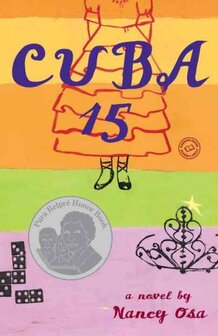
Cuba 15

Cuba 15

by Nancy Osa

•
Paperback, 16 pages, Random House Childrens Books, $8.99, published March 8 2005 | purchase
close

Purchase Featured Books

  • Cuba 15
  • Nancy Osa
Your purchase helps support NPR Programming. How?

Violet is about to turn 15 and is unsure what to make of the looming quinceañera party planned by her Cuban grandma. Half Polish and half Cuban, Violet feels more American than anything else.

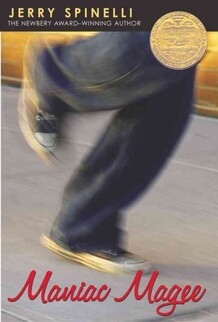
Maniac Magee

Maniac Magee

by Jerry Spinelli

•
Paperback, 184 pages, Little Brown & Co, $8, published November 1 1999 | purchase
close

Purchase Featured Books

  • Maniac Magee
  • Jerry Spinelli
Your purchase helps support NPR Programming. How?

Jeffrey Lionel Magee, also known as "Maniac Magee," is an orphan and a runaway. He ends up in a small Pennsylvania town torn apart by racial strife, and astounds everyone with his extraordinary athletic feats as he works to heal the painful divide between the town's black and white citizens.

News and Reviews
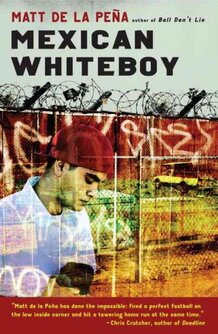
Mexican Whiteboy

Mexican Whiteboy

by Matt De La Pena

•
Paperback, 249 pages, Random House Childrens Books, $8.99, published January 12 2010 | purchase
close

Purchase Featured Books

  • Mexican Whiteboy
  • Matt De La Pena
Your purchase helps support NPR Programming. How?

As the child of a Mexican father and blond, blue-eyed mother, Danny finds it difficult that everyone thinks they know who and what he is just by the color of his skin. So goes to spend time with his father in Mexico in the hopes of getting in touch with his roots, and the person he believes himself to be.

News and Reviews
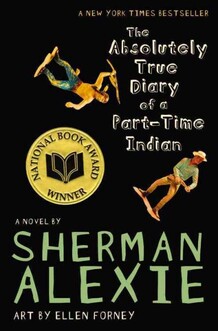
The Absolutely True Diary of a Part-Time Indian

The Absolutely True Diary Of A Part-Time Indian

by Sherman Alexie

•
Paperback, 229 pages, Little, Brown Books for Young Readers, $12.99, published April 1 2009 | purchase
close

Purchase Featured Books

  • The Absolutely True Diary of a Part-Time Indian
  • Sherman Alexie
Your purchase helps support NPR Programming. How?

Sherman Alexie's humorous, semiautobiographical novel, illustrated by Ellen Forney, follows 14-year-old Junior — poor, skinny and with a freakishly big head — as he leaves his school on the Spokane Indian Reservation for a mostly white school in a nearby town. Alexie captures the pain and awkwardness of adolescence while also meditating on the devastation that poverty, racism and alcoholism have wreaked on Native American communities.

News and Reviews
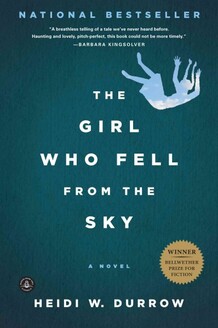
The Girl Who Fell from the Sky

The Girl Who Fell From The Sky

by Heidi W. Durrow

•
Paperback, 264 pages, Workman Pub Co, $13.95, published January 11 2011 | purchase
close

Purchase Featured Books

  • The Girl Who Fell from the Sky
  • Heidi W. Durrow
Your purchase helps support NPR Programming. How?

After a family tragedy orphans her, Rachel, the daughter of a Danish mother and a black G.I., moves into her grandmother's mostly black community in the 1980s, where she must swallow her grief and confront her identity as a biracial woman.

News and Reviews
The Latte Rebellion

The Latte Rebellion

by Sarah Jamila Stevenson

•
Paperback, 328 pages, Llewellyn Worldwide, $9.95, published January 8 2011 | purchase
close

Purchase Featured Books

  • The Latte Rebellion
  • Sarah Jamila Stevenson
Your purchase helps support NPR Programming. How?

When high school senior Asha Jamison is called a "towel head" at a pool party, she and her best friend, Carey, start a club to raise awareness of mixed-race students that soon sweeps the country. But the hubbub puts her Ivy League dreams, friendship and beliefs to the test.

News and Reviews
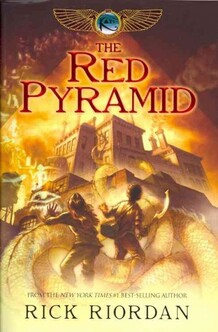
The Red Pyramid

The Red Pyramid

by Rick Riordan

•
Paperback, 516 pages, Disney Press, $9.99, published August 16 2011 | purchase
close

Purchase Featured Books

  • The Red Pyramid
  • Rick Riordan
Your purchase helps support NPR Programming. How?

Egyptologist Dr. Julius Kane accidentally unleashes the Egyptian god Set, who banishes the doctor to oblivion and forces his two children to embark on a dangerous journey to save him.

News and Reviews
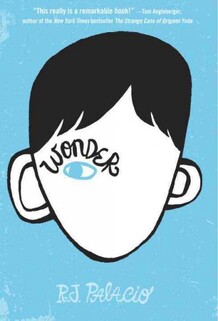
Wonder

Wonder

by R.J. Palacio

•
Hardcover, 315 pages, Knopf Books for Young Readers, $15.99, published February 14 2012 | purchase
close

Purchase Featured Books

  • Wonder
  • R.J. Palacio
Your purchase helps support NPR Programming. How?

Born with a facial deformity that initially prevented his attendance at public school, August "Auggie" Pullman enters the fifth grade at Beecher Prep and struggles with the dynamics of being both new and different in this tale about acceptance, self-esteem and the transformative power of human kindness.

News and Reviews

*Some of the language in the summaries above has been provided by publishers.

P.S. If you're looking for book suggestions in general, our friends over at NPR Books came up with this really neat, lovely, awesome tool that's essentially a genius book recommender of all the great work from 2013.

Copyright 2013 NPR. To see more, visit http://www.npr.org/.