Shared posts

29 Jul 19:07

Nicki Minaj’s butt and the politics of black women’s sexuality

by Mychal Denzel Smith

Nicki_Minaj_Anaconda 2Over at Ebony.com, Jamilah Lemieux has a good summary of why Chuck Creekmur’s open letter to Nicki Minaj raises a number of red flags.

Creekmur, owner of AllHipHop.com, penned the letter in response to Minaj’s cover artwork for her next single, “Anaconda.” She’s sporting a thong and a pair of Air Jordan sneakers and… not much else aside from her tattoos. Her ass is on full display. Creekmur was disturbed. Not that he thought Minaj was being exploited or that she felt this highly sexualized image was distracting from her talent. He was concerned for his daughter. He wrote:

“I’m trying to raise a young girl that will eventually grow into someone greater than the both of us. I know that this requires great parenting, great education, great luck and an assortment of great influences. I’m sure you know the influence you wield, but now, if you told the “Barbs” to scratch my eyes out, some would attack without thinking about it. I’m sure some will also replicate the “Anaconda” image without thinking about it too. Your original image already has 256,817 (and counting) likes under the original Instagram picture you posted, so I venture that your average girl could strive to get a couple hundred likes from her friends. Is this the path you want to lead impressionable kids down?”

Ah, yes. The children. A concern we all should have. It’s something Lemieux herself talks about her response piece, noting that “certain things are cool for adults…who are mature enough to enjoy them” but with children whose ideas of sex and sexuality are barely formed, who’s to say. But she continues:

“As a still somewhat-new mother of a daughter, I didn’t share Creekmur’s fear that Minaj’s bare bottom is what forces young men to “sexualize girls at a young age.” Instead, I was annoyed that once again, a man has suggested that the onus of behaving ‘respectably’ should be placed on the shoulders of a woman, while men and boys pretty much get a free pass to do whatever we ‘let’ them do. Because surely, they require our permission to “sexualize” us, right?”

It’s an old problem. It would be disastrous if the only images of women available to us were ones in which they are presented as sexual objects. We are fighting an uphill battle to bring some sense of balance. But I also notice the reaction to Minaj as a particular problem among black women performers. It happens whenever Beyonce performs or Rihanna steps outside. Its happened when Betty Davis wore hotpants and Left Eye wore condoms as eye patches. Whenever black women own their sense of sexuality and it appears to not be controlled by the hetero-male gaze, the whole world gets into a tizzy.

Creekmur didn’t write his letter after seeing the hundreds and thousands of women who have been featured in hip-hop music videos over the years, wearing about the same amount of clothing (or less) than Minaj. He didn’t write it after all the anthems centered around hetero-male pleasure that disregard the fact that, hey, maybe the woman you’re with would like to enjoy sex, too. He didn’t write a letter to Miley Cyrus about her exploitation of stereotypical images of black women’s bodies. Creekmur’s letter came when Minaj, seemingly independent of any man’s input, decided to embrace her own body and sexual image. It isn’t meant for him or for his daughter. It’s hers.

That’s a scary thought in a world where black women’s bodies are meant for our consumption but only on the terms which everyone who isn’t a black women gets to dictate. When that isn’t the case, when a black woman decides to take back her body and still hold her sexuality dear and flaunts it but not for us, that flies in the face of all of our established norms. The Creekmurs of the world reach for the souls of Maya Angelou and Ruby Dee to shame these women for not being as respectable as our fallen heroes. But, ya know, so long as someone else is in control that isn’t a black woman, let the asses fly.

I don’t know if Minaj’s cover artwork is appropriate for kids to be exposed to. Certainly it depends on age, level of maturity, familiarity with sex and concepts of autonomy, so on and so forth. What I will say is that she isn’t responsible for having those conversations with every one of the children in the world who may see that image. If it’s truly of that much concern to Creekmur and other dads who may feel compelled to write a letter, they should maybe start talking to their children about sex, sexuality, body image, and the like, instead of trying to police away every sexual image on earth.

But, that’s exactly my issue. Creekmur isn’t trying to do away with all sexual images. This has only come up when a black woman has presented herself independently of the hetero-male gaze (something he was sure to note when saying “As a man, I can appreciate the virtues of your perfect posterior” because, you know, it’s really important what he thinks about her body). If black women aren’t allowed to own their sexuality, then who does it belong to?

MychalMychal Denzel Smith is a Knobler Fellow at The Nation Institute.

29 Jul 16:40

The Satantic Temple uses Hobby Lobby ruling to claim religious exemption from anti-choice biased counseling laws

by Maya

BlackHolesmembership_largeCiting the Hobby Lobby ruling, the Satanic Temple is claiming a religious exemption from the anti-choice “informed consent” laws that require abortion providers in 35 states to give out biased, sometimes false, information about the procedure.

Given that “the Supreme Court has decided that religious beliefs are so sacrosanct that they can even trump scientific fact,” the Temple says it expects its “deeply held belief” will be respected. After all, unlike Hobby Lobby’s, their belief is even based on actually accurate information. 

And you don’t need to be an official Temple member to claim this exception too. “All women who aren’t member share our deeply held belief that their personal choices should be made with access to the best available information, undiluted by biased or false information, are free to seek protection with this exemption,” a spokesperson say. Why yes, in fact, I do — I share that belief very much.

The Temple has helpfully provided a letter that people seeking an abortion can print out to explain to their doctor that they are exempt from informed consent mandates:

I regard any information required by state statute to be communicated or offered to me as a precondition for an abortion (separate and apart from any other medical procedure) is based on politics and not science (“Political Information”). I regard Political Information as a state sanctioned attempt to discourage abortion by compelling my consideration of the current and future condition of my fetal or embryonic tissue separate and apart from my body. I do not regard Political Information to be scientifically true or accurate or even relevant to my medical decisions. The communication of Political Information to me imposes an unwanted and substantial burden on my religious beliefs.

I don’t know about you, but the Temple, a relatively young sect with an already rich history of trolling religious conservatives, might have just gotten a new convert.

Maya DusenberyMaya believes “one’s body is inviolable, subject to one’s own will alone.”

20 Jul 21:56

When Defending Your Writing Becomes Defending Yourself

When Defending Your Writing Becomes Defending Yourself

by Matthew Salesses

In the past year, my first in a prestigious Ph.D. program in creative writing and literature, I have often felt conspicuous as a writer of color. I have felt a responsibility to speak up when race is discussed, but I have also resented this responsibility. Lately, I have found myself burying my head. It bothers me to no end that the pressure is beating me, and yet it is.

Like many writers of color, I read Junot Diaz's "MFA vs. POC" on the New Yorker blog, and identified with his anger and sadness at the loss of voices of color to the "white straight male" default of the writing workshop — a group of writers gathering to critique one another's work. I have had "good" and "bad" workshop experiences, but for me whenever race comes up, it feels, somehow, traumatic. While most issues in workshop are presented as universal to story, race can come off as a burden personal to writers of color.

The Burden Of Craft

Here is a not uncommon experience. Writer Emily X.R. Pan was told by the white writers in her workshop that the racism in her story could never happen — though every incident had happened to her.

A writer might object that "it happened in real life" is a poor argument for why something should be depicted in fiction. On a craft level, the story should make it seem possible to ride one's bike 100 miles overnight or help deliver a baby on an airplane. But that is an argument for particular story context: introducing a character who often rides his bike long distances, for example.

A critique of race and racism is more often a case of the class questioning what happens because of the context of their lives. It is a critique that wears the pretense of craft, but what it is really doing is saying that a common experience needs to be treated as particular and unusual. As particular and unusual as the bike or baby example.

“ A woman in my program has been told that her stories need to be more ethnic, that readers should be able to smell the food.

A similar but different criticism occurs when a writer is told that her portrayal of minority characters isn't different enough. A woman in my program has been told that her stories need to be more ethnic, that readers should be able to smell the food.

Writer Jackson Bliss describes an experience when a Pakistani writer spoke up in defense of a Desi character Bliss had written, and "the workshop rejected his comments and then spoke over him. Think about that for a second," Bliss writes, "a group of mostly white writers telling a hapa writer and a Pakistani writer what was culturally authentic and culturally permissible ... about nonwhite people."

What happens when the workshop pits a person of color's lived experience against a white perspective of how that experience should read on the page? For a writer of color, the defense of one's work can quickly become a defense of the self.

The Burden Of Speaking Up

Writers of color are also asked to offer up their voices solely because of their race. Another of my fellow Ph.D.s complained to me once about what happened after a talk at her MFA program. The talk included offensive comments about African-Americans. Afterward, one of her professors asked why my friend hadn't spoken up. The [white] professor had been waiting for a black student to say something.

“ More diversity in a workshop does not necessarily change the dynamic. It is difficult for writers of color even to come to each other's defense.

The kind of responsibility that professor called for is not a right, it's a role. And even if my friend had played it, speaking up about race can have real negative consequences.

Author David Mura writes in the Kartika Review that "if the student of color persists in making [race-based] critiques, she will find herself increasingly isolated socially and shunned in various ways by the other students and professors in the department — and this may very well also include other professors of color (who will often feel that their own position in the department is quite precarious and open to challenge)."

More diversity in a workshop does not necessarily change the dynamic. It is difficult for writers of color even to come to each other's defense. In Pan's workshop, the other writers of color stayed silent. I understand this silence. The more I see race become a burden, the harder it is to speak up.

The Burden Of Rules

So what is the solution? xoJane writer Sarah Seltzer suggests: "A writing workshop should always begin with this addition to the rules: 'If you approach a word, a phrase, an idea or a cultural reference that is unfamiliar to you, it's your job as a reader to figure it out from context or look it up.' ... The reader's unschooled ignorance becomes the burden, not the writer's 'exotic' references."

I wonder. Even as an instructor, I have had the experience of having to tread carefully around race. I've had a writer submit a story about an Irish musician pissed off that an Asian musician dare play the fiddle in an Irish bar. The story ended with the Irishman proving himself better by actually touching the audience's hearts. I read this story expecting some moment of empathy when the protagonist would rise above associating fiddle-playing ability with ethnicity, or at least fail spectacularly in a way that was clear to the reader, but neither ever happened. The class waited to see how I would respond. I approached the story on the level of craft.

I hate to use student examples in negative, but I want to say that I have been on the teaching side, and the conversation is no less difficult for workshop leaders of color. The instructor/student power dynamic is set against the minority/majority power dynamic. I felt burdened with speaking up as a person of color, and I fell back on the safer burden of craft.

Being vocal about race in the classroom, with which I am less and less comfortable, often brings to mind bell hooks's essay, "Killing Rage." When hooks speaks out, she's just as easily dismissed as when she doesn't. She's invisible when she cries. People of color often believe that there are safe places and that academia is one of them. But I find that academia is sometimes even more a place where race is dismissed or invisible or regarded with suspicion. In an intellectual arena, the rock and the hard place people of color are put in is the place between silence and killing rage, a place where it hurts to keep quiet and it can hurt your career to speak up. It is a place determined by the majority context, where either choice is self-defense.


Matthew Salesses (@salesses) has written about adoption, race and family for the New York Times Motherlode blog, The Good Men Project, The Rumpus, Hyphen Magazine, and elsewhere. His most recent book is a novel, I'm Not Saying, I'm Just Saying.

Copyright 2014 NPR. To see more, visit http://www.npr.org/.
07 Jul 19:39

Surprise, Study Confirms Hiring Discrimination Against LGBT People Is Real

by Maddie
This study draws attention to precisely the issue President Obama aims to address with his forthcoming executive order banning LGBT employment discrimination by federal contractors.
06 Jul 18:09

'Columbusing': The Art Of Discovering Something That Is Not New

'Columbusing': The Art Of Discovering Something That Is Not New

by Brenda Salinas

If you've danced to an Afrobeat-heavy pop song, dipped hummus, sipped coconut water, participated in a Desi-inspired color run or sported a henna tattoo, then you've Columbused something.

Columbusing is when you "discover" something that's existed forever. Just that it's existed outside your own culture, nationality, race or even, say, your neighborhood. Bonus points if you tell all your friends about it.

Why not? In our immigrant-rich cities, the whole world is at our doorsteps.

Sometimes, though, Columbusing can feel icky. When is cultural appropriation a healthy byproduct of globalization and when is it a problem?

All The Rage

Buzzfeed Food published an article asking, "Have you heard about the new kind of pie that's all the rage lately?" It's a hand pie, a little foldover pie that you can fit in your hand. They have flaky crusts and can be sweet or savory. You know, exactly like an empanada, a Latin American culinary staple.

On face value, it seems stupid to get worked up over an empanada. I mean, it's just a pastry, right? But "discovering" empanadas on Pinterest and calling them "hand pies" strips empanadas of their cultural context. To all the people who grew up eating empanadas, it can feel like theft.

Feeling Overlooked

When it comes to our culinary traditions, Latinos are used to feeling robbed.

Latino activists spoke out in May when Chipotle announced plans to print original stories by famous writers on its paper goods and failed to include any Mexican-Americans or Latinos on the roster. The American-owned chain can profit from Mexican culture while overlooking the harsh reality of how Latinos have been treated in this country.

On Cinco de Mayo, chef Anthony Bourdain asked why Americans love Mexican food, drugs, alcohol and cheap labor but ignore the violence that happens across the border. "Despite our ridiculously hypocritical attitudes towards immigration," writes Bourdain, "we demand that Mexicans cook a large percentage of the food we eat, grow the ingredients we need to make that food, clean our houses, mow our lawns, wash our dishes, look after our children."

It's frustrating when even the staunchest anti-immigration activists regularly eat Mexican food. It seems like a paradox to relish your fajitas while believing the line cook should get deported.

Admittedly, cultural appropriation is an integral and vital part of American history. And one day, empanadas might become as American as pizza (yes, I appreciate the irony of that statement). But the day when Latinos are considered as American as Italian-Americans, well, that feels further away.

Why It Hurts

The condolence prize for being an outsider is that you can take solace in the cultural traditions that make you unique. When outsiders use tweezers to pick out the discrete parts of your culture that are worthy of their attention, it feels like a violation. Empanadas are trendy, cumbia is trendy, but Latinas are still not trendy.

Code Switch blogger Gene Demby writes, "It's much harder now to patrol the ramparts of our cultures, to distinguish between the appreciators and appropriators. Just who gets to play in which cultural sandboxes? Who gets to be the bouncer at the velvet rope?"

Playing Explorer

Of course, there is no bouncer, but we can be careful not to Columbus other culture's traditions. Before you make reservations at the hottest fusion restaurant or book an alternative healing therapy, ask yourself a few questions:

Who is providing this good or service for me?

Am I engaging with them in a thoughtful manner?

Am I learning about this culture?

Are people from this culture benefiting from my spending money here?

Are they being hurt by my spending money here?

It is best to enter a new, ethnic experience with consideration, curiosity and respect. That doesn't mean you have to act or look the part of a dour-faced anthropologist or an ultra-earnest tourist. You can go outside your comfort zone and learn about the completely different worlds that coexist within your city. If you're adventurous, you can explore the entire world without leaving the country and without needing a passport.

Just remember, it's great to love a different culture and its artifacts, as long as you love the people too.

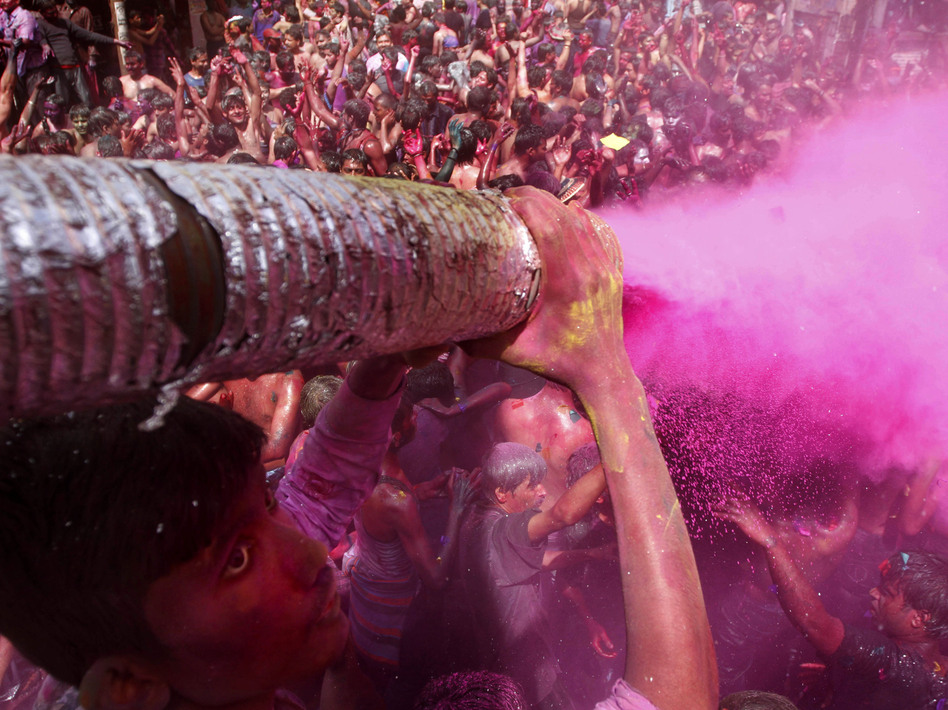
A man sprays colored dye on people dancing during Holi celebrations in India in 2012. Holi, the Hindu festival of colors, also heralds the coming of spring — a detail that partiers at the Shout Color Throw might miss. i i

A man sprays colored dye on people dancing during Holi celebrations in India in 2012. Holi, the Hindu festival of colors, also heralds the coming of spring — a detail that partiers at the Shout Color Throw might miss.

Rajesh Kumar Singh/AP
Copyright 2014 NPR. To see more, visit http://www.npr.org/.
04 Jul 23:25

Is Univision Ready To Up Its Game When It Comes To Women?

Is Univision Ready To Up Its Game When It Comes To Women?

by Jose Manuel Simian

The finalists for Miss Mundial Brasil 2014 visit the set of Univision's entertainment talk show El Gordo y la Flaca. The show often invites guests to take a dip in an on-set hot tub. This particular segment is titled i i

The finalists for Miss Mundial Brasil 2014 visit the set of Univision's entertainment talk show El Gordo y la Flaca. The show often invites guests to take a dip in an on-set hot tub. This particular segment is titled "8 reasons to fire up the Jacuzzi."

Screenshot/Univision.com

EDITOR'S NOTE: This post includes the use of an anti-gay slur because it is relevant to the the story.

Right before the kickoff of the World Cup match between Mexico and the Netherlands (June 29), one of the Univision announcers interrupted the network's reliably hyperkinetic broadcast to read a statement.

After the first generic words, it became clear the Spanish-language network was addressing the use of the anti-gay slur puto (translatable both as "faggot" and "man whore") that fans of El Tri have long yelled to rattle their opponents during the execution of a goal kick or other set pieces. The audible presence of the slur during World Cup matches moved FIFA to consider sanctioning Mexico (it didn't). Gay rights organizations asked for the yell to be muted during broadcasts on ESPN and Univision. The networks didn't oblige that request. The statement was used to draw a line without having to repeatedly mute the natural sound feed during the match.

As of this writing, the statement hasn't been posted to the network's World Cup press page, but the translated version provided on the website of GLAAD (formerly the Gay & Lesbian Alliance Against Defamation) reads as follows:

"We recognize that during the game there may be language, or chants, from some fans that are offensive to some members of our television audience. Although we realize this can happen in any televised sporting event, we do not, in any case, condone or endorse the use of such language. Univision Communications supports a World Cup that is inclusive, one that celebrates the diversity of the sport we love and can be enjoyed by all — absent what can be the hurtful consequences of certain words. In this regard, we strive to make sure that our own coverage and commentary is respectful and inclusive of all, including the gay community. This is our commitment to our audience, our community and our partners."

A step in the right direction? Of course. Univision has come a long way in changing its relationship with and treatment of the LGBT community, particularly following the awful incident in which a radio station owned by the corporation was fined by the Federal Communications Commission for outing a gay man on air through a prank call in 2002. In recent years, the network has won several GLAAD Media Awards for its investigative stories on gay topics, and has distanced itself from the mocking portrayals of the LGBT community provided by other Hispanic media.

That said, Univision's coverage and commentary are far from being "respectful and inclusive of all" as its statement promised.

Not only have some of its own World Cup broadcasters been called out for their careless use of offensive words during their match chitchat, but in a different broadcast, I cringed as I heard two of the broadcasters joking about how they'd like to marry their sisters with one player or the other, as if the women were disposable objects.

Univision may be on the right path when it comes to gay rights — and mind you, they were not the ones chanting the offensive slur, just transmitting the international feed over which they have no control — but their implicit condemnation of the behavior of Mexican fans comes off as flatly hypocritical when you consider how the television network actively denigrates and objectifies women in their own daytime shows for the sake of easy ratings.

Consider, for instance, República Deportiva, a weekly "sports" show that many people watch because of its "senators," three women in skimpy outfits who pose for calendars and sometimes pay a visit ("in their teeny bikinis") to the jacuzzi that plays a central role in El Gordo y la Flaca, another popular show on the network. Or just think of how women are routinely treated in the Guinness-record holding variety show Sábado Gigante, which, as another contributor to this blog recently pointed out, holds beauty contests that refer to actual mothers by the catcall mamacita. The show's host Don Francisco may be gay-friendly (he interviewed the first gay couple married in Mexico), but in 1994 he settled a sexual harassment suit filed by one of his "models" out of court.

I'm not the one to cast the first stone here. As a kid growing up in Chile, where Sábado Gigante originated, I would spend hours in front of the TV (the show used to run all Saturday afternoon, for about six hours) waiting to see one of the sexy Argentine showgirls acting in the lowbrow comedy sketches. But what flew in the Pinochet-ruled Chile of the '80s shouldn't be acceptable in the United States of the 21st century. And just as I grew up and figured out a few things about respecting women long before I moved to this country, it's high time for Univision to stop aiming at the lowest common denominator and resorting to recycling the worst gender stereotypes of Latin America.


José Manuel Simián is a Chilean-American writer based in Brooklyn. He is the executive editor of the Latino culture and lifestyle website Manero. In a former life, he was a lawyer and law professor in Santiago.

Copyright 2014 NPR. To see more, visit http://www.npr.org/.
03 Jul 23:14

Hobby Lobby and the war on poor women

by Syreeta

10461633_10152520561634321_5422608368923610435_n

Years ago, my doctor prescribed oral contraceptives after I was hospitalized from a ruptured ovarian cyst. I had insurance through my employer at the time and paid a modest monthly copay of $10. When we switched insurance plans during an enrollment period, my coverage lapsed and I had to pay out of pocket for the medication. The snafu was quickly resolved but it was important information, a quick glimpse of the kind of expense I’d incur if I didn’t have a job, or the kind of job that would allow me to contact someone without taking time off work or fearing retribution from my employer to resolve the matter. I worked really long hours then, probably about 80 and at busy season, longer. My compensation included health insurance coverage.

I’ve been curious since this preposterous case where Hobby Lobby refused to comply with ACA’s contraceptive mandate was elevated to the nation’s high court (and now with Monday’s devastating decision) – what kind of fringe costs did these employers fear they’d incur from ACA? How does the mathematics of the exemption of health care costs for female employees inform their bottom line? When you consider how low wages are for retail employees, could it possibly be that the argument that ACA’s new rules would be an undue financial burden for a business as large as Hobby Lobbby, wouldn’t hold water? That’s just the cost of doing business, right? The market could figure this out. Yet, when non-profit faith based organizations sought their exemption from ACA’s contraceptive mandate, we witnessed the advent of the religiously sentient corporate entity, wrapped in the body of Hobby Lobby owner, David Green.

ACA was affirmed the law of the land in 2012, but these incremental, tenacious challenges that we’ve witnessed for the past two years – whether it’s congress seeking to repeal it on loop, GOP ruled states refusing Medicaid expansion or challenges of religious liberty of your employer – have been an incredible mix of powerful men seeking to restrict the lives of not only of women, but poor women and poor people.

Maybe this is simply a war on poor women.

Depending on how other closely held private corporations seek to use the Hobby Lobby decision to deprive female employees medically effective contraceptive health care, what we can expect to see is a disproportionate affect on poor women and sadly, poor women of color.

In Ebony, Elizabeth Dawes Gay outlines anticipated impacts the ruling has for black women:

Black women may rely on contraception to treat endometriosis, manage uterine fibroids, and quell PMS symptoms. Many others rely on it simply to prevent or space pregnancy which can be lifesaving for Black women, who are three times more likely to die from pregnancy-related causes than our white counterparts. For us, and so many women across the world, birth control is a matter of health and life. Allowing for-profit employers to deny contraceptive coverage to employees who work hard for their health care coverage makes accessing contraception more difficult and could very well impact the health and well-being of women across the nation.

In 2011, more than half of Black people were covered by private (usually employer-sponsored) health insurance, either through their own employer or that of a family member, and 57 million adult women of all races were covered through employer-sponsored insurance. If the behavior of companies like Hobby Lobby becomes the norm rather than the exception, it could impact contraceptive access for millions of people in the U.S. and have a disproportionate impact on Black women who, with lower income and wealth on average, may not be able to afford to pay for their contraception out-of-pocket.”

In Colorlines, former Feministing editor Miriam Perez reiterates Justice Ginsberg’s concern in her scathing dissent, noting that, “Women of color are more likely to be low-income, and also more likely to work a minimum wage job…. getting an IUD could cost as much as an entire month’s rent working at the minimum wage…Women of color who are already struggling to make ends meet may face increased burdens. That could mean doing things like splitting one pack of pills between two women each month, as Kimberly Inez McGuire reports two Latina women living in South Texas have been doing.”

Irin Carmon also points to an amicus brief from the American College of Obstetricians and Gynecologists that notes, “Lack of insurance coverage deters many women from choosing a high-cost contraceptive, even if that method is best for her health and lifestyle, and may result in her resorting to a method that places her more at risk for medical complications or improper or inconsistent use.” Moreover, the savings for women under the contraceptive coverage mandate from August 2012 yielded “an average of $269 per woman, according to a recent report by the IMS Institute for Healthcare Informatics, or $483 million total in 2013.

Social conservatives can hide steep their logic in junk science and feign concern over the morality of women sexual autonomy, but they’re erasing the economic and health realities of women of color.

Poor women are burdened with all the economic consequences of sex and barriers to reproductive health and autonomy. The freedom of Christian values is to pay women low wages and shame them for seeking medical coverage that helps them determine their economic futures.

Previously: In the wake of the Hobby Lobby ruling, what happens next?

sm-bio Syreeta McFadden lives, writes, reads in Brooklyn.

02 Jul 22:28

Study finds LGBT applicants 23 percent less likely to get a job interview

by Sesali Bowen

exxon.png

A new study, conducted by the Equal Rights Center and Freedom to Work, compared the responses to 100 pairs of fictional applications for jobs with government contractors. Each pair included an “LGBT application” that listed experience at an LGBT organization, and a “non LGBT application” that names similar roles in organizations that are not LGBT-focused. It played out something like this:

“‘Jennifer’ and ‘Michelle’ filled out applications for a job as an administrative assistant at ExxonMobil. The applications show they attended the same high school and college but ‘Jennifer’ had better grades in both schools and a stronger work history. ExxonMobil calls ‘Michelle’ for an interview — twice. She does not respond. They follow up with an email, stating they’ll hold the position for her. She does not respond. They never call ‘Jennifer’ and they hired someone else.”

Using results from all of the pairs, the study concluded that applicants who had roles in LGBT organizations were 23 percent less likely to be called back for an interview, even if they were more qualified for the position. 

The study targeted eight federal contractors including ExxonMobil, whose shareholders have repeatedly voted against a resolution to protect employees from LGBT discrimination. The other contractors were AmerisourceBergen Corp., the Babcock & Wilcox Co., Fluor Corp., General Electric Co., L-3 Communications Holdings Inc., Supreme Group Holding SARL, and URS Corp.

The debate over ENDA has pushed LGBT employment discrimination to the forefront. Americans being asked to think about LGBT rights outside of the parameters of marriage and morality (finally). With that being said, I wonder what is implied by one’s role at an LGBT organization. Beyond the assumption that one actually identifies as LGBT, I wonder if corporations consider working at an LGBT organization to pose a threat because it connotes a heightened sensitivity to LGBT issues, a stronger responsibility to seek fair and just treatment, lesser willingness to look the other way in the event that LGBT discrimination occurs, and access to individuals/groups/organizations that can support them. In other words, are companies more afraid to hire LGBT-identified people or LGBT activists who could possibly blow their spot up with LGBT discrimination cases?

I’d be interested to see some variation of this study that perhaps included cover letters. In this way some fictional applicants may be able to identify themselves as LGBT (and where they fit under the umbrella) without an organizational affiliation. Either way, employment discrimination still represents a real barrier to LGBT communities.

Avatar ImageSesali gets satisfaction knowing that her fellow rebel rousers are still scaring the hell out of oppressors.

01 Jul 17:43

You Need Help: What’s The Deal With Scissoring?

by Ali
I researched scissoring for you. My Google history is awesome right now.
27 Jun 01:20

Rebel Girls: The Writing That Made A Movement (Or A Bunch of Feminism’s Primary Sources)

by Carmen
Women's studies, as a whole, is a discipline grounded in words. These pieces are some of the words that ground the entire thing.
23 Jun 20:39

Zola Jesus: "Dangerous Days"

by Ian Cohen

We'll start with the obvious: Nika Danilova's voice is an elemental, powerful thing. It doesn't take long for listeners to use "force of nature." Her output as Zola Jesus has been something of a parable of humanity's instinct to control and corral nature—whether it was the lo-fi production of her earliest work, the focused pop structures of Stridulum, Conatus' muted electronics, or their orchestral reworkings on Versions

Occasionally, Danilova will collaborate with populist electronic producers, like Orbital and M83, who challenge her by going in the opposite direction, putting that same voice within the context of expansive, expensive tracks. "New France" and "Intro" have been two of her most satisfying recordings to date, and "Dangerous Days" gives the impression that Danilova might not see pop as the path of least resistance anymore. She hasn't altered her approach much from Conatus, and she doesn't need to; her performances have never been subtle, and the result on "Dangerous Days" recasts an archetypical Zola Jesus song as an electro-pop banger of gothic grandeur. Danilova has suggested the title of her upcoming LP Taiga let her spiritually commune with her Russian heritage—in going home, she's gone big.

19 Jun 02:45

And Now, Every Character From “Orange Is The New Black” As They Appear On “Law And Order”

by Stef
There is no tradition more time-honored than playing the role of a random New Yorker who discovers a corpse in Central Park on an episode of Law and Order.
16 Jun 00:38

A Mother's Beloved Cooking, A Daughter's Bittersweet Inheritance

A Mother's Beloved Cooking, A Daughter's Bittersweet Inheritance

by Beenish Ahmed

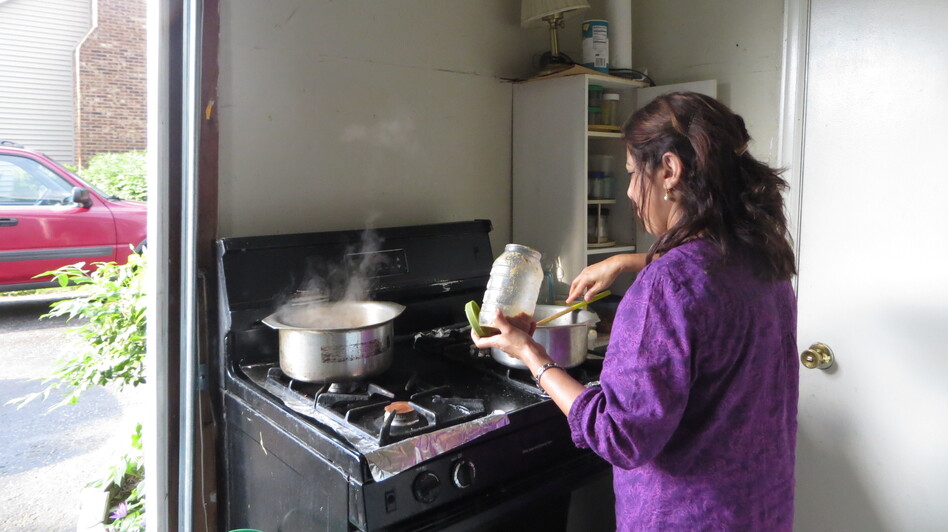
Tahira Ahmed sometimes cooks in a makeshift kitchen in her garage. Her daughter loves her cooking, but has resisted learning to cook her mother's signature Pakistani dishes.i i

Tahira Ahmed sometimes cooks in a makeshift kitchen in her garage. Her daughter loves her cooking, but has resisted learning to cook her mother's signature Pakistani dishes.

Beenish Ahmed/Beenish Ahmed For NPR

My mom cooks in a makeshift kitchen in the garage because she doesn't want the smell of simmering onions — the start of most of her dishes — to settle into the walls of our house. Even when there's a foot of snow on the ground, I find her there pulling jars of spices out of mismatched cabinets and stirring stews in a pan she brought from Pakistan when she couldn't find anything big enough to entertain with in the States.

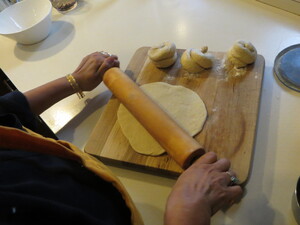
When she's cooking roti, a flatbread, Ahmed moves into her kitchen.i i

When she's cooking roti, a flatbread, Ahmed moves into her kitchen.

Beenish Ahmed/Beenish Ahmed For NPR

That's where she is Sunday morning, preparing curried chickpeas and potatoes plus a sweet halva for brunch. Her father bought these items from the bazaar almost daily during her childhood in Pakistan, but here, my mom, Tahira Ahmed, tells me while stirring cream of wheat into sugar she's caramelized, "If you want to keep the tradition, you have to work for it."

Cooking evokes a bittersweet sort of nostalgia to her. My grandmother died when my mom was just 16. My mom first started to cook several years later as a newlywed in America, reconstructing dishes from memory. On trips back to Pakistan, her brothers look like they've seen a ghost when she cooks for them: they say the food she prepares tastes exactly like her mother's did.

Food connects my mom to her family, her homeland and her past. That might be why she stuck to what she knew in those early years, packing me lunches of Pakistani food when I was a plaid jumper-wearing Catholic school-going first-grader. It makes her sad when I tell her for the first time all these years later that my hallway partner refused to hold my hand whenever I'd had lentils to eat. "I'm not going to touch you after you ate all that slime!" she'd say, accepting a scolding from our teacher before taking my hand.

"People were very narrow-minded," my mom says, pushing the potatoes she's chopped into a pot of boiling chickpeas.

My parents moved from Northwest Pakistan to Northwest Ohio after they were married in 1981. Back then, finding the mainstays of Pakistani cuisine was a challenge. They had to drive to ethnic grocery stores in Detroit or Chicago to find what they most craved. Over time, they developed ways to keep fresh the trunkfuls of ingredients they brought home, grinding up ginger to jar and storing rice in plastic barrels.

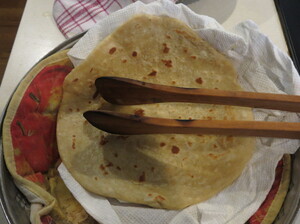
Beenish Ahmed writes that her mother's roti is at the core of most of the family's meals.i i

Beenish Ahmed writes that her mother's roti is at the core of most of the family's meals.

Beenish Ahmed/Beenish Ahmed For NPR

When I was younger, I enjoyed my mother's cooking at home but feared what others might think of it. A friend asked me what I'd had for dinner at every one of our evening gymnastics classes. To compete with her descriptions of mac and cheese or meatloaf, I'd translate the Pakistani dishes I'd had to more American ones, turning bits of beef curried with carrots into steak and steamed veggies. So I was relieved when my mom became a more creative cook, adding everything from chicken pot pie to goulash to her standard rotation of Pakistani dishes, if only because I didn't have to stand around telling lies in my leotard.

"I always wanted to learn [about] different cultures," she tells me when I ask about how she ever even heard of goulash. She's a hairstylist and connected with some of her clients over food, asking them for their favorite recipes and sharing some of hers too — though she knows her spiciest dishes aren't for everyone. To be safe, she delivers less intensely flavored ones to our neighbors whenever one of them falls ill or loses a loved one: homemade flatbread, or roti, tops the list.

“ I've always somehow imagined that the second I start to clap roti dough between my hands, it'll mark the start of a lifetime of feminine domesticity.

- Beenish Ahmed

That's what she's making now; forming balls of dough, rolling them out, crisping them one by one over the stove. Roti is what she wants me to learn to make more than anything. It's at the core of most of our meals. Watching her, I can almost see back centuries to generations of women standing over stoves, passing bread to their families to eat before it cools. And this is part of the problem. I've always somehow imagined that the second I start to clap roti dough between my hands, it'll mark the start of a lifetime of feminine domesticity. Though she's always worked, catering to our family is something my mother holds sacred. To me, it feels unforgivingly difficult — not to mention unfair.

For years I told my mom that the mere thought of making half-baked versions of her meals made me homesick. I couldn't quite explain to her that I felt burdened by all the expectations she put on me as her only daughter. I never felt equipped to carry on the traditions she'd worked so hard to recreate. Growing up, I struggled to make room for my culture outside of my family home. Now that I've lived on my own for a few years, I've started to feel something is missing from my life without delicious day-to-day reminders of where I'm from. Like my mom did when she set up a kitchen in the garage, I finally feel determined to create space in my life to indulge the best of my heritage — and allow the rest to float away. I might even learn to make roti.


Beenish Ahmed is a multimedia journalist and writer. She's a former Pulitzer Center on Crisis Reporting grantee to Pakistan, NPR Kroc Fellow in Washington, D.C. and Fulbright Scholar to the United Kingdom.

Copyright 2014 NPR. To see more, visit http://www.npr.org/.
12 Jun 16:37

Feministing Jamz: A femme power playlist to tune out street harassment

by Verónica Bayetti Flores

our mudflap girl, jammin on her headphones

This weekend was the first weekend that it felt straight HOT in the northeast. Tropical lady that I am, I can’t get enough of the hot weather, and I was taking full advantage by wearing shorts, my femme shark crop top, ball cap, hoops, and gold high tops. So yeah, I was slaying. But it seems like the first weekend a girl can show some skin is some kind of street harasser holiday. Harassers come out of hibernation mad hungry for exerting their power over you in public, and this weekend was no different.

Femininity is a special kind of target on the streets. Now, I know that more masculine-presenting women and gender non-conforming folks get street harassed plenty too. I was with my more masculine-presenting girl this weekend, and we were both targeted. But femininity is so often conflated with powerlessness, so often painted as inferior, so often the target of street harassment.

So I want to dedicate this playlist to the femmes. To those of us who find power in our femininity – however that may look, in whatever genders and bodies it may live. To those of us who resist the patriarchy in a bold lip, and those whose thickly-lined eyes shoot daggers at the creeps. To those whose bold femininity both gives us life at the same time that it risks it. This is for you. For us. Turn it up.


1bfea3e7449eff65a94e2e55a8b7acda-bpfullVerónica believes in the power of femmes.

12 Jun 16:13

Feministing Jamz: Junglepussy’s Satisfaction Guaranteed

by Verónica Bayetti Flores

our mudflap girl, jammin on her headphones

If you’re not hip to Junglepussy yet, the time to get up to speed is right now. Unapologetically sexual, proudly black and West Indian, and with unmatched swag, Junglepussy has been releasing tracks here and there and making cameos in the videos of Feministing Jamz faves Dai Burger and Le1f. Now, she’s finally here with a debut album.

Satisfaction Guaranteed came out Tuesday, and y’all: it is off the hook. A few of these tracks have been released over the past year and have already been on my personal rotation (ahem, Picky Bitch Checklist), but this album brings it with great new tracks as well, and in addition to shouting out women who’ve been important to her (Brandy, Foxy, Kim, Patra, Erykah), Junglepussy’s throwing us gems throughout. “It’s a full time job fucking loving yourself.” “Fuck a petition, listen, let the revolution begin.” “What’s a girl to do when the world is against you? Throw it in they face, let ‘em know that you meant to.”

These jams are what summer dance parties are made of. Get into it.

1bfea3e7449eff65a94e2e55a8b7acda-bpfullVerónica is a picky bitch too.


10 Jun 20:26

Real Lies: "North Circular"

by Ian Cohen

If you asked me a week ago what Mike Skinner, Jarvis Cocker, and Bruce Springsteen have in common, I might've told you that in my younger, more impressionable days, I found each's depiction of a blue-collar life I will never experience to be extremely meaningful and worthy of devotion. Also, I haven't listened to any of them in years. And yet, here's Real Lies' stunning single "North Circular", which somehow manages to evoke all three—the rambling, passionate prose-poetry of vintage Springsteen filtered through Cocker's deadpan, the kind where he's working out in realtime whether he has a secret he should keep to himself. This is laid over a light club beat that, like the Streets' "Weak Become Heroes", recalls a specific era of drug-taking, but not as clearly as a general "better times," of something youthful and pure lost to the passage of time.

There's a more important, underlying commonality Real Lies get at—they are unabashed romantics, respectful of the potential listener's fathomless longing, incapacitating nostalgia and the belief that these feelings and the fleeting, intense relationships responsible for them are worthy of being presented on a grand scale.  The lyrics of "North Circular" are certainly evocative and worthy of recall, but I don't wish to write any of them down—that might violate the spirit here, of trying and failing to recall why the sense that the future could just be like this forever vanished in an instant. And so, "North Circular" is that song where you take that hungover walk, train, or cab home and take solace in your progress, knowing that no matter how far you look backwards, time just keeps inevitably moving forward.

06 Jun 21:48

TED: Yoruba Richen: What the gay rights movement learned from the civil rights movement - Yoruba Richen (2014)

by TEDTalks
As a member of both the African American and LGBT communities, filmmaker Yoruba Richen is fascinated with the overlaps and tensions between the gay rights and the civil rights movements. She explores how the two struggles intertwine and propel each other forward — and, in an unmissable argument, she dispels a myth about their points of conflict. A powerful reminder that we all have a stake in equality.
05 Jun 22:02

Slut-Shaming Becomes Even Grosser Than You Thought With Bonus Classism

by Maddie
"Good Girls" reminds us that patriarchy is not only a tool for men, but a tool for women with other privileged identities to use against women with marginalized identities.
22 May 04:36

Vic Mensa: "Down on My Luck"

by Renato Pagnani

Although he was just named one of the twelve artists in this year's XXL freshman class, the latest track from Vic Mensa can barely be considered a rap song. The Chicago rapper makes great use of his nimble mercury-slicked flow on "Down on My Luck", removing the spaces between words so that they tumble into each other like dominoes, but with its soft neon fog and translucent chords, the song could've slotted onto the back half of Settle—last year's breakout debut from Disclosure—without raising any eyebrows.

In fact, even though he's recently been on tour with the UK dance duo, it's the restlessness of last year's Innanetape that helps contextualize "Down on My Luck" as a natural extension of Mensa's omnivorous musical appetite rather than a hard—and cynical—left turn. It also doesn't hurt that the track nails the propulsive throb of deep house and comes equipped with an earworm of a hook that suggests Mensa might have a career in him as a dance vocalist if this rapping thing doesn't pan out.

21 May 18:08

Starting a Different Conversation: On Mixed-Race/Biracial/Multiracial Visibility and Inclusion

by the team
"I began to step back. Not because of low confidence, or a fear of public speaking, or an inferiority complex — all of them were about my story, and my skin, and my inability to find a way to belong in spaces for people of color without first justifying and laboriously explaining both."
21 May 18:03

How Far Your Paycheck Goes, In 356 U.S. Cities

How Far Your Paycheck Goes, In 356 U.S. Cities

by Quoctrung Bui

There's this thing people say all the time in New York and other expensive cities: If I could move somewhere cheaper, and keep my income the same, I'd be much better off.

Alas, in places where the cost of living is lower, pay tends to be lower as well.

So what you really want to know is this: How much do workers make in different cities? And how far does that money go in each city?

The government recently released a data set that lets us dive into these questions. In the graph below, the left-hand side shows the annual income for typical, full-time workers in different metro areas. The right-hand side adjusts that figure for the cost of living in each metro area.

Enter a city name in the box below.

A few things to note:

After adjusting for cost of living, Rochester, Minn., has the country's highest median wage. Bloomington, Ind., has the lowest.

When you adjust for the cost of living, the biggest absolute decline is in Washington, D.C.; the biggest rise is in Danville, Ill.

A few wonky details about the data we used for this graph:

What is interesting about this data set is that it accounts for the things that people actually buy in each city. For example, while owning a car may be way more expensive in New York City than it is in Kansas, car ownership is relatively rare in New York City, so it's not going to figure as prominently in a New Yorker's cost of living.

Copyright 2014 NPR. To see more, visit http://www.npr.org/.
16 May 23:15

Parquet Courts: "Instant Disassembly"

by Jayson Greene

"I kept explaining I was too tired to continue to speak," Andrew Savage mumbles heavily on "Instant Disassembly". You might recognize this feeling: You might've said something like this yourself, sunk into a chair and feeling the sudden accumulation of a night's drinking, like someone is pressing down on your skull with a hardcover dictionary. Parquet Courts usually report from the opposite end of the energy spectrum, their songs zipping along like dune buggies piloted by eighth graders. But on "Disassembly," they sound both exhausted. It is a downright Stonesy rock ballad, built on numb-fingered power-chord strumming  and an insistent but splintered guitar lead.  Savage calls up the languor of the music in the lyrics, which pop off the surface like sweat beads on a Heineken: "The last classic rock band's last solid record creeps in/ A call out of the blue from an old, old friend." Parquet Courts have always been a smart band, one with insightful things to say about themselves and others, but they've never sounded this emotionally open before.

15 May 05:53

Sharon Van Etten: "Your Love Is Killing Me"

by Jayson Greene

What are you supposed to do with a song like this? You can't gaze directly at it. You certainly can't cook dinner to it.  How do you interact with it?  You have to shut the door, close the browser window, stare at your hands. Sharon Van Etten sings like someone throwing a dirt clod in your face, and on "Your Love Is Killing Me", she performs violence on your ability to maintain composure. The song title is the sentiment: "Break my leg so I can't walk to you/ Cut my tongue so I can't talk to you/ Burn my skin so I can't feel you/ Stab my eyes so I can't see." It is about as understated and shaded as an I-Beam to the face.

On "Your Love is Killing Me", her singing is so tremendously powerful it trembles at the edge of intelligibility. Listen to the way she sings "Your love is killing me"—almost all of the hard consonants disappear from the words, and they become a howl. It is, frankly, knee-buckling. The ability of a human voice to induce this weakness  is one of the most profound and mysterious things music can do. When it happens, you go quiet, just for a moment. After it's over, the machines start whirring again as you attempt to explain to yourself where your faculties just went.

14 May 04:28

Unboxing the Nescafé Alarm Cap Press Kit! Made...

by NOTCOT


Unboxing the Nescafé Alarm Cap Press Kit! Made by NOTlabs in collaboration with Publicis Mexico's Innovation Lab: the 3D Printed, Arduino-based Nescafe Alarm Caps where you open the cap (and smell the coffee) to turn it off.

(Want more? See Tasteologie and NOTCOT.com)
07 May 16:39

Notes From A Queer Engineer: Can Inanimate Objects Be Sexist?

by Laura Mandanas
What can virtual reality, automotive safety standards, and anatomy textbooks tell us about the way sexism works in 2014?
06 May 18:21

The Long Game

by Aki and Alex

I found this 2-part video essay from Delve on Paperback Writer. It's a great reminder that true success takes time, experience, and patience. Just what I needed today.


Years Past

May 6, 2013

May 6, 2012

May 6, 2011

May 6, 2010

May 6, 2009

May 6, 2008

May 6, 2007

May 6, 2006

May 6, 2005

Ideas in Food: Great Recipes and Why They Work

Maximum Flavor: Recipes That Will Change the Way You Cook

02 May 03:30

Röyksopp / Robyn: "Do It Again"

by Jamieson Cox

While both Robyn and Röyksopp have recorded their fair share of indomitable tracks on a solo basis, their song-length collaborations have all shared the same crackling energy and sinewy muscularity. Junior showstopper “The Girl and the Robot” used volatile, charging electronics to transform a lonely partner into a wrathful spirit; Body Talk Pt. 1’s “None of Dem” did the same thing with ennui, with Robyn riding its chilly dancehall like an ice princess. “Do It Again” is the title track from their forthcoming collaborative mini-album (due May 26 on Cherrytree/Interscope), and it proudly follows in the footsteps of the tracks mentioned above: this is hard-driving electro-pop nonpareil, with synths that bloom and move against eardrums like smooth, cold steel and a lyric that explores the joy, and pain, of repetition with surprising nuance.

The key is Robyn, who will make an incredible spin class instructor if she ever gets tired of pop music: she keeps platitudes from sounding stale and grants the bridge an unexpected melancholy, dragging the song from the dancefloor to the quiet bedroom. This could’ve been the musical equivalent of jamming the speed button on the treadmill until it can’t go any faster, and it would’ve been fine; Robyn takes us inside the mind of the runner, and tells us why they’re running.

25 Apr 01:21

Why the gender gap in children’s allowances matters

by Maya

I figured the gender wage gap in babysitting had to be the earliest wage gap out there. But Bryce Covert has uncovered an even earlier one:

Nearly 70 percent of boys say they get an allowance, compared to just under 60 percent of girls, according to a new survey from Junior Achievement.

But unfortunately, it’s not likely because boys do more chores. One study found that girls do two more hours of housework a week than boys, while boys spend twice as much time playing. The same study confirmed that boys are still more likely to get paid for what they do: they are 15 percent more likely to get an allowance for doing chores than girls. A 2009 survey of children ages 5 to 12 found that far more girls are assigned chores than boys. A study in Europe also found fewer boys contribute to work around the house.

And it’s not just that boys are more likely to be paid by their parents, but they also get more money. One study found that boys spent just 2.1 hours a week on chores and made $48 on average, while girls put in 2.7 hours to make $45. A British study found that boys get paid 15 percent more than girls for the same chores.

Obviously, compared to pay inequity in the adult working world, the stakes of the allowance gap aren’t all that high. But in terms of socialization, I think it tells us a lot. Since allowances exist in this fuzzy gray area — some kids don’t get them at all, some get them loosely as “payment” for chores, some get them just for being a kid as an early entitlement program – this gap reveals a lot about how sexist norms around gender and unpaid labor are perpetuated, starting from a very young age. 

The research Bryce points to illustrates a few different dynamics at play here beyond just the fact that boys are more likely to get an allowance than girls. There’s the fact that, regardless of the payment factor, girls are assigned more chores than boys in general, which teaches both to view housework as “naturally” women’s responsibility, and contributes to the housework gender gap that only worsens as they grow up and have families of their own. And there’s the fact that when payment is given for chores, girls get less than boys for the same tasks — a nice little preview of the blatant pay discrimination they may face as adults in the workforce.

But it’s the fact that boys are more likely to get an allowance for chores that really speaks to the complicated way sexism determines how labor is valued under capitalism. As Bryce notes, ”Asking girls to do more chores without paying them teaches both genders that women are meant to do unpaid work.” And if they are meant to do it, it will not be seen as a work at all. It will be duty or responsibility or love — unless a guy does it and then it will become worthy of compensation.

This is the magical alchemy of patriarchy: labor that is devalued when done by women becomes valued when done by men.

One of the linked studies provides some clues to how this works. Boys got more money putting in less time on chores, because “parents divided jobs along gender lines, with boys more likely to mow lawns, wash cars and take out the bins. Girls were assigned indoor chores, such as cleaning bedrooms, washing up and doing laundry.” Clean laundry, of course, is no less necessary to the household than a neatly trimmed lawn, but somehow the masculine-coded chores just happen to “have a higher monetary value.” I can’t imagine why.

So this particular gap is not just about pay disparities. It’s about how we reproduce a capitalist culture that refuses to account for women’s unpaid household labor and systemically devalues any of the important work — like domestic work and care work — that women have traditionally done for free.

Maya DusenberyMaya would like to bring back the Wages for Housework movement. 

24 Apr 03:53

Two Justices Debate The Doctrine Of Colorblindness

Two Justices Debate The Doctrine Of Colorblindness

The Supreme Court ruled Monday that Michigan voters' 2006 decision to ban affirmative action in the state's higher education system passed constitutional muster.

But much of the attention on the decision has zeroed in on a specific exchange between Justice Sonia Sotomayor and Chief Justice John Roberts on the idea of "colorblindness" — the notion that the consideration and discussion of race perpetuate racial division.

Roberts is, of course, skeptical of racial preferences in education; he famously wrote in a school busing case that "the way to stop discrimination on the basis of race is to stop discriminating on the basis of race." (In this case, the plurality that Roberts joined said it wasn't ruling on the question of affirmative action but whether the state's voters could decide on affirmative action via the ballot.)

But Sotomayor pushed back, and she remixed Roberts' much-quoted line in doing so. "The way to stop discrimination on the basis of race is to speak openly and candidly on the subject of race, and to apply the Constitution with eyes open to the unfortunate effects of centuries of racial discrimination," she wrote.

Here's the part of her dissent that's gotten the most attention:

"Race matters. Race matters in part because of the long history of racial minorities being denied access to the political process. ... Race also matters because of persistent racial inequality in society — inequality that cannot be ignored and that has produced stark socioeconomic disparities.

"And race matters for reasons that really are only skin deep, that cannot be discussed any other way, and that cannot be wished away. Race matters to a young man's view of society when he spends his teenage years watching others tense up as he passes, no matter the neighborhood where he grew up. Race matters to a young woman's sense of self when she states her hometown, and then is pressed, 'No, where are you really from?', regardless of how many generations her family has been in the country. Race matters to a young person addressed by a stranger in a foreign language, which he does not understand because only English was spoken at home. Race matters because of the slights, the snickers, the silent judgments that reinforce that most crippling of thoughts: 'I do not belong here.'

"In my colleagues' view, examining the racial impact of legislation only perpetuates racial discrimination. This refusal to accept the stark reality that race matters is regrettable. The way to stop discrimination on the basis of race is to speak openly and candidly on the subject of race, and to apply the Constitution with eyes open to the unfortunate effects of centuries of racial discrimination.

"As members of the judiciary tasked with intervening to carry out the guarantee of equal protection, we ought not sit back and wish away, rather than confront, the racial inequality that exists in our society. It is this view that works harm, by perpetuating the facile notion that what makes race matter is acknowledging the simple truth that race does matter."

To which Roberts issued a rebuttal:

"The dissent states that '[t]he way to stop discrimination on the basis of race is to speak openly and candidly on the subject of race.' And it urges that '[r]ace matters because of the slights, the snickers, the silent judgments that reinforce that most crippling of thoughts: 'I do not belong here.'

"But it is not 'out of touch with reality' to conclude that racial preferences may themselves have the debilitating effect of reinforcing precisely that doubt, and — if so — that the preferences do more harm than good. To disagree with the dissent's views on the costs and benefits of racial preferences is not to 'wish away, rather than confront' racial inequality. People can disagree in good faith on this issue, but it similarly does more harm than good to question the openness and candor of those on either side of the debate."

We wanted to highlight some other considerations of the decision (and the differing opinions therein) that are worth your time, and which tackle the case from markedly different points of view.

MSNBC's Adam Serwer writes that "colorblindness" as invoked by opponents of affirmative action is markedly different from that term's traditional meaning.

"Roberts's 'colorblindness' bears only a superficial resemblance to the concept as understood by past champions of equal rights, since as applied by the conservative majority on the court the approach has had dire consequences for racial minorities. ... Roberts's argument that affirmative action, rather than racism, reinforces those 'crippling thoughts' is all the more remarkable given that Sotomayor sits on the court with a fellow Justice who once belonged to a group that would have barred her from attending Princeton."

Slate's Emily Bazelon said that there may be a silver lining in this ruling both for folks in favor of affirmative action and for those opposed to it.

"For liberals as well as conservatives, there's an upside to that outcome, despite the expected denunciation by groups like the NAACP and the ACLU. According to Richard Kahlenberg of the Century Foundation, who has studied affirmative action for years, in seven of the states that have banned it, leading and other public universities have maintained black and Latino enrollment and admitted more low-income students. As I explained in October, 'Some of the schools have taken income and wealth and neighborhood into account. Some have plans that admit the top 10 percent of high school graduates statewide. Three have banned legacy preferences.' Those are strategies for achieving racial diversity that also improve socioeconomic diversity, which at many selective schools is sorely lacking."

Ilya Somin of the Volokh Conspiracy said that it's a mistake to discuss the effect affirmative action will have on minorities, because it will have different consequences for different minority groups.

"But, in reality, banning racial preferences in admissions affects different minorities in different ways. It may well burden African-Americans, Hispanics, and other groups favored by affirmative policies currently practiced in universities (though the literature on educational mismatch suggests that the benefits are not unambiguous). But current affirmative action policies also often harm those minority groups that score well on conventional academic admissions standards, most notably Asian-Americans. Thus, it cannot be said that the Michigan amendment is a straightforward case of burdening racial minorities while benefiting the majority. In reality, the policy affects different minority groups in different ways."

Copyright 2014 NPR. To see more, visit http://www.npr.org/.
23 Apr 05:36

Future: "Benz Friendz (Watchutola)" [ft. Andre 3000]

by Jayson Greene

Arriving late on Honest, "Benz Friendz" is Future's reminder to us: This captivating AutoTune alien-unicorn guy, about whose not-a-rapper weirdness we enjoy rhapsodizing? He's a member of the Dungeon Family. We knew this, somehow, but "Benz Frenz" foregrounds it firmly, bringing Organized Noize and Three Stacks, with both of his feet planted in the recording studio and eyes locked with ours, to hammer the point home. Keith Murphy already observed it at VIBE, but "Benz Friendz" feels more like a new Outkast song than anything in six or seven years. Future opens by imprinting the rat-tat-tat rhythm of "graduated from the fabricated sabotages" directly onto your cerebral cortex, lacing his scolding verse with some inspired silliness: "Let's have a heart-to-heart; drink wine, make art."

And Andre? Well, who knows how many of these perfectly formed verses he sees when he closes his eyes. He begins somewhere bitter ("Fly on a n***a back while he Superman/But if I'm in a wheelchair, you still there?") and then dials out to storytelling details ("Had to write her birthday down because my memory sucks/But this shit come back up like some acid reflux") and philosophical musings ("I might not never buy a new car again, if I can help it/Cuz if buy one they will sell ten, and what I'm left with") with all the observable effort of a stretch and a yawn.