Shared posts

25 Jan 03:21

Doug Ford, Canada's Next Prime Minister

by Jordan Roberts

The status quo (and Harper) are working cooperatively to put Doug in the PMO
Doug Ford, Canada's Next Prime Minister

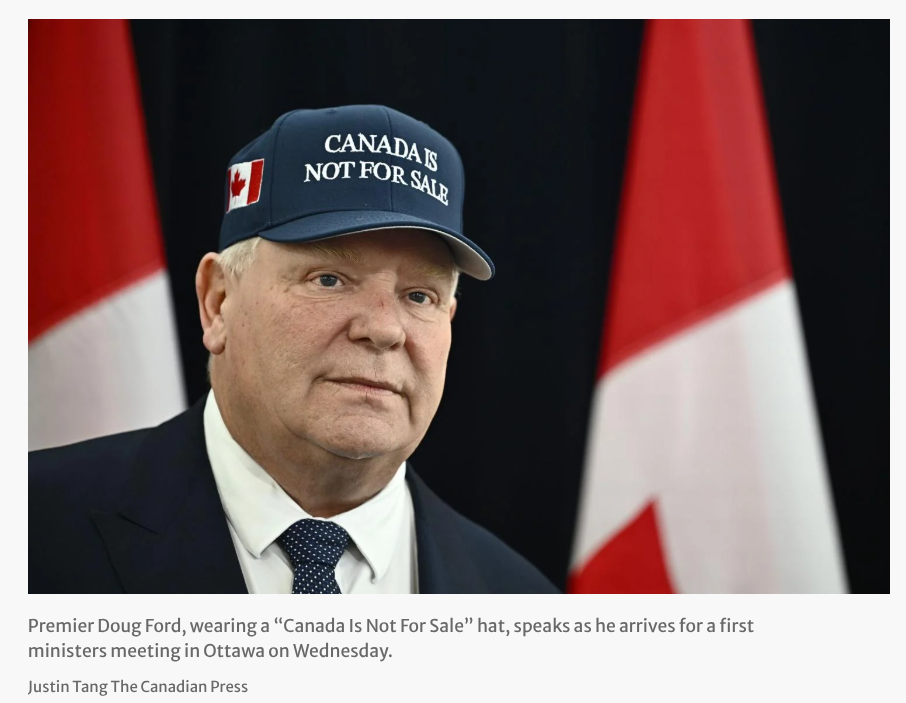
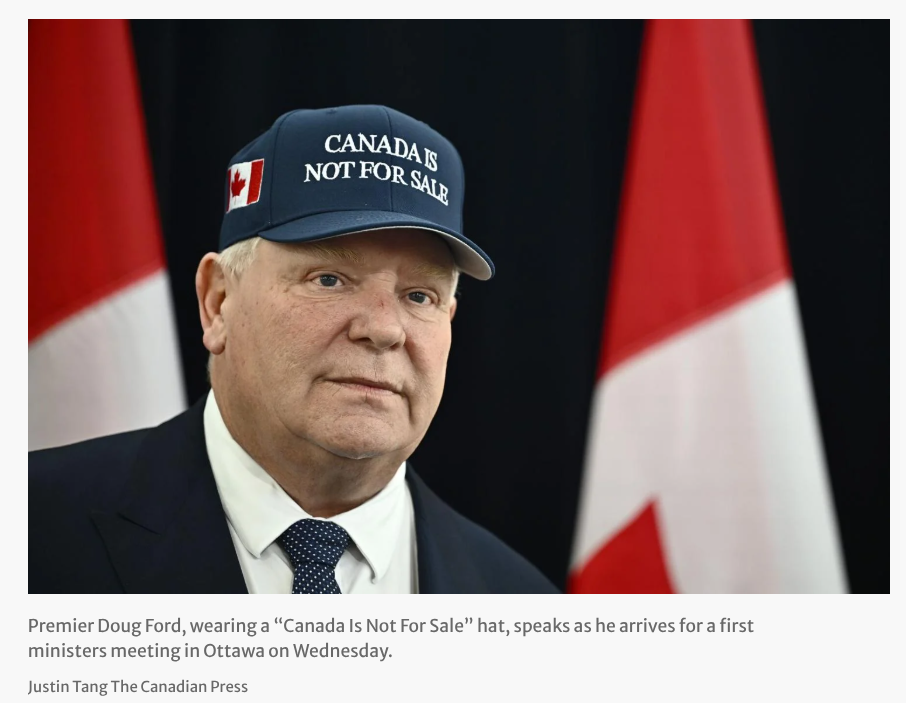
By now, you’ve seen Doug Ford in his blue “Canada Is Not For Sale” MAGA hat. Like moths to a flame, Canadian newspapers and news outlets have neatly and efficiently aligned to showcase Doug in Captain Canada mode, “taking on” Trump and leading the Premiers in a “fight” against US tariffs and Canadian annexation. 

For at least a year now, Doug’s multi-million dollar election-style advertising campaign has been unavoidable, depicting Ontario as a land of milk and honey, with a voiceover spilling a river of lies and half truths about the Ford government’s “successes.” (In the fiscal year that ended last March, the Ontario government spent $103.5 on its own propaganda, the most any Ontario government has spent on advertising in a year. The figures for this year will almost certainly be higher.)

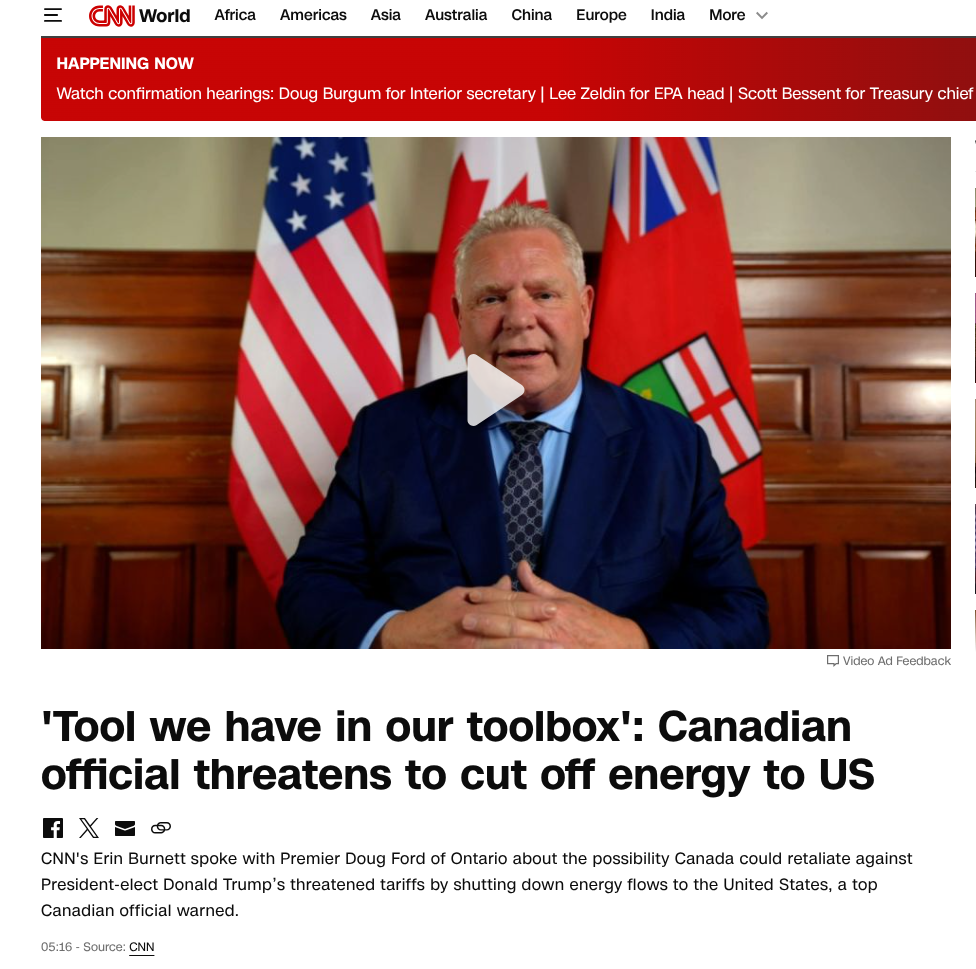
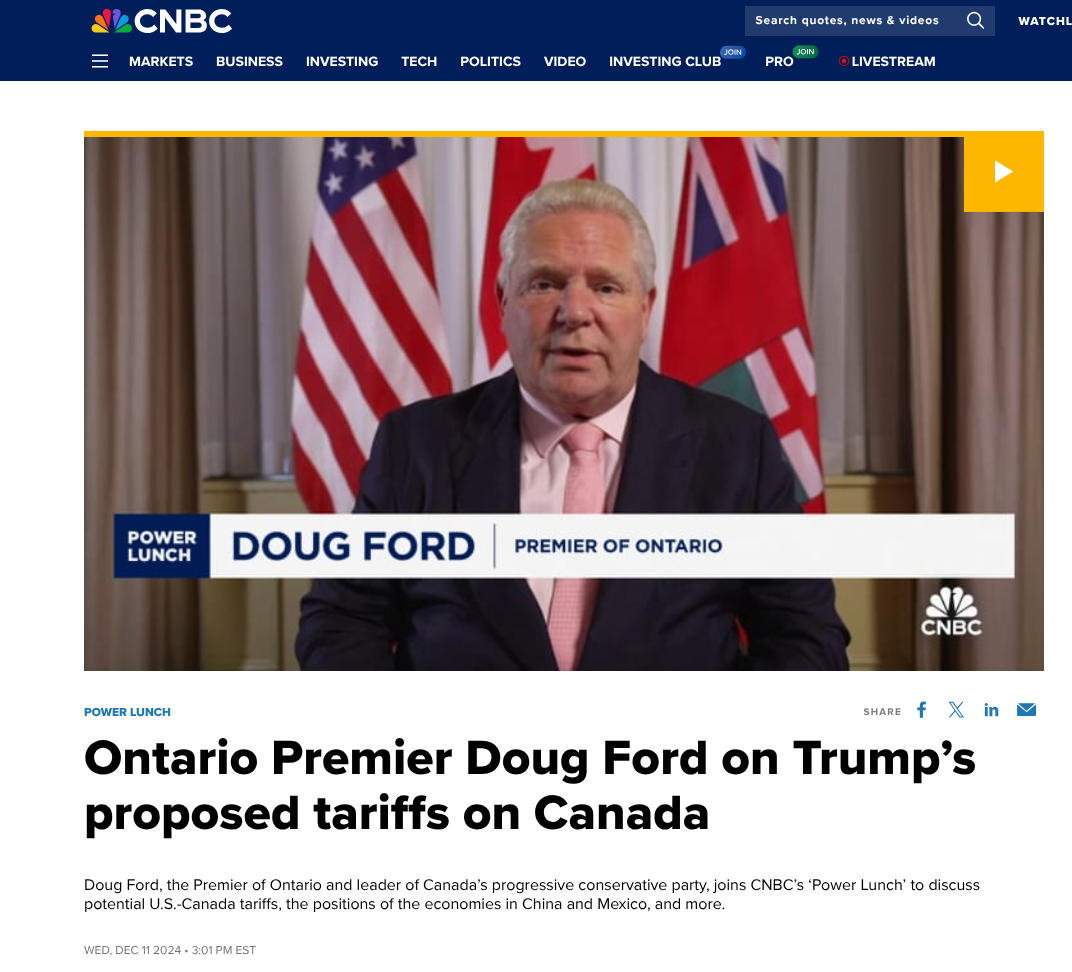
Since late last year, Team Ford has been advertising in the US too, spending millions to depict Ontario (and Ford) in the most flattering light for American audiences. In recent weeks, Doug (who is rarely interviewed by Canadian media other than in a scrum, or the “one question, one follow-up” format of their press events) has been interviewed on CNN, Fox News, CNBC and on NBC News’ Meet the Press. 
Doug Ford, Canada's Next Prime Minister
Doug Ford on CNBC, December 2024
Doug Ford, Canada's Next Prime Minister
Doug Ford on CNN, December 2024

If you sense there’s an election coming, you’re right. But Team Ford does not seem to be preparing for an early Ontario election. They look like they’re getting their man ready to run for Prime Minister. 

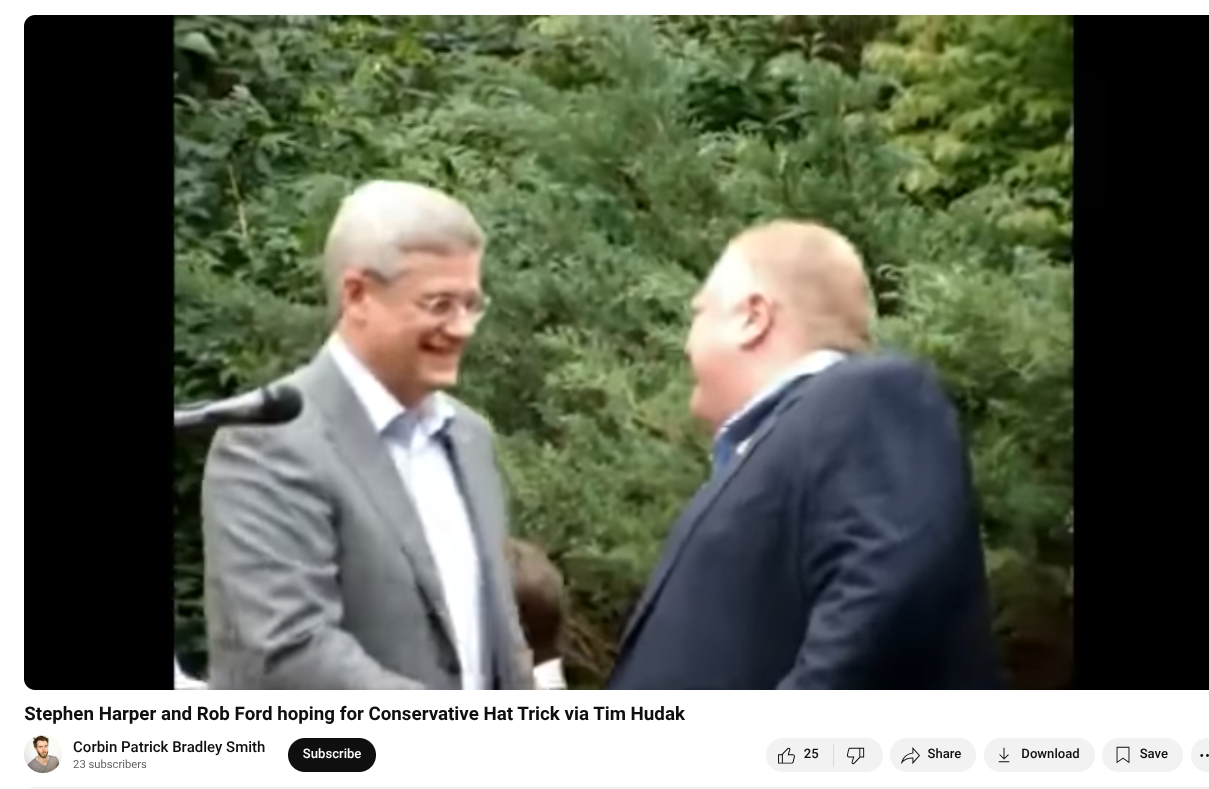
If you have followed us on social media, you’ll know we’ve talked about Stephen Harper’s plans for Ford for years. Well over a decade ago, in Diane Ford’s backyard, Stephen Harper talked about a hat trick - getting “their people” to lead all three levels of government: federal, provincial and municipal.
Doug Ford, Canada's Next Prime Minister
Stephen Harper and Doug Ford at FordFest, where Harper talked about the Ford political dynasty, and the importance of capturing leadership of all three levels of government.

As reported in Robyn Doolittle’s Crazy Town: The Rob Ford Story, the Ford family has planned on making one of their own Prime Minister for decades, as John Tory found out when he was summoned to meet the Fords before running to be mayor of Toronto. 
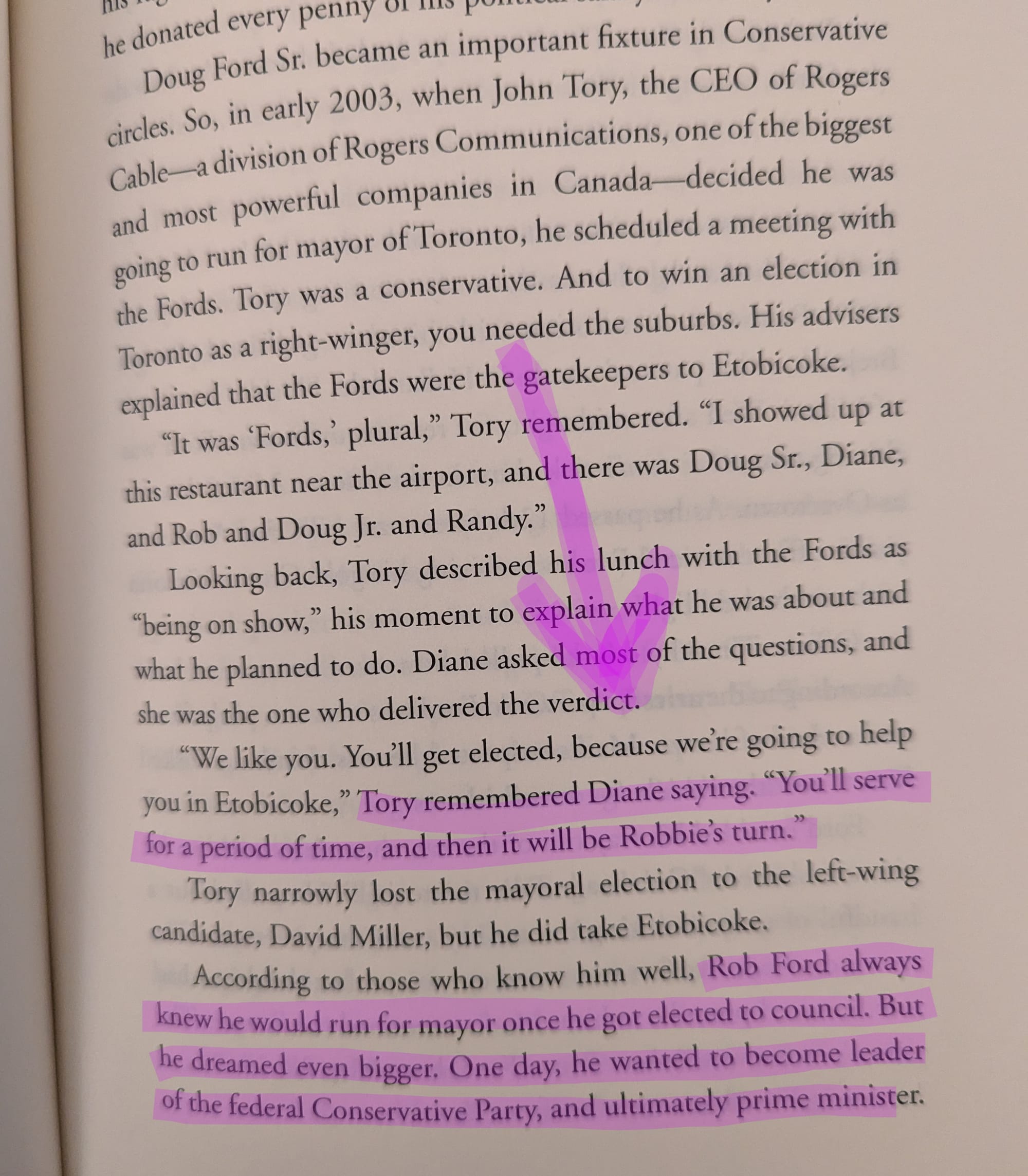
Doug Ford, Canada's Next Prime Minister
Photo of page 47 of Robyn Doolittle's book Crazy Town: The Rob Ford Story. This chapter is called The Canadian Kennedys.

As far back as 2019, a year into Doug’s first term, staffers and others in Harper’s orbit told us Harper intended to install Doug in the PMO, after enough pressure had been applied to remove Justin Trudeau, and after he had “finished off” Ontario.
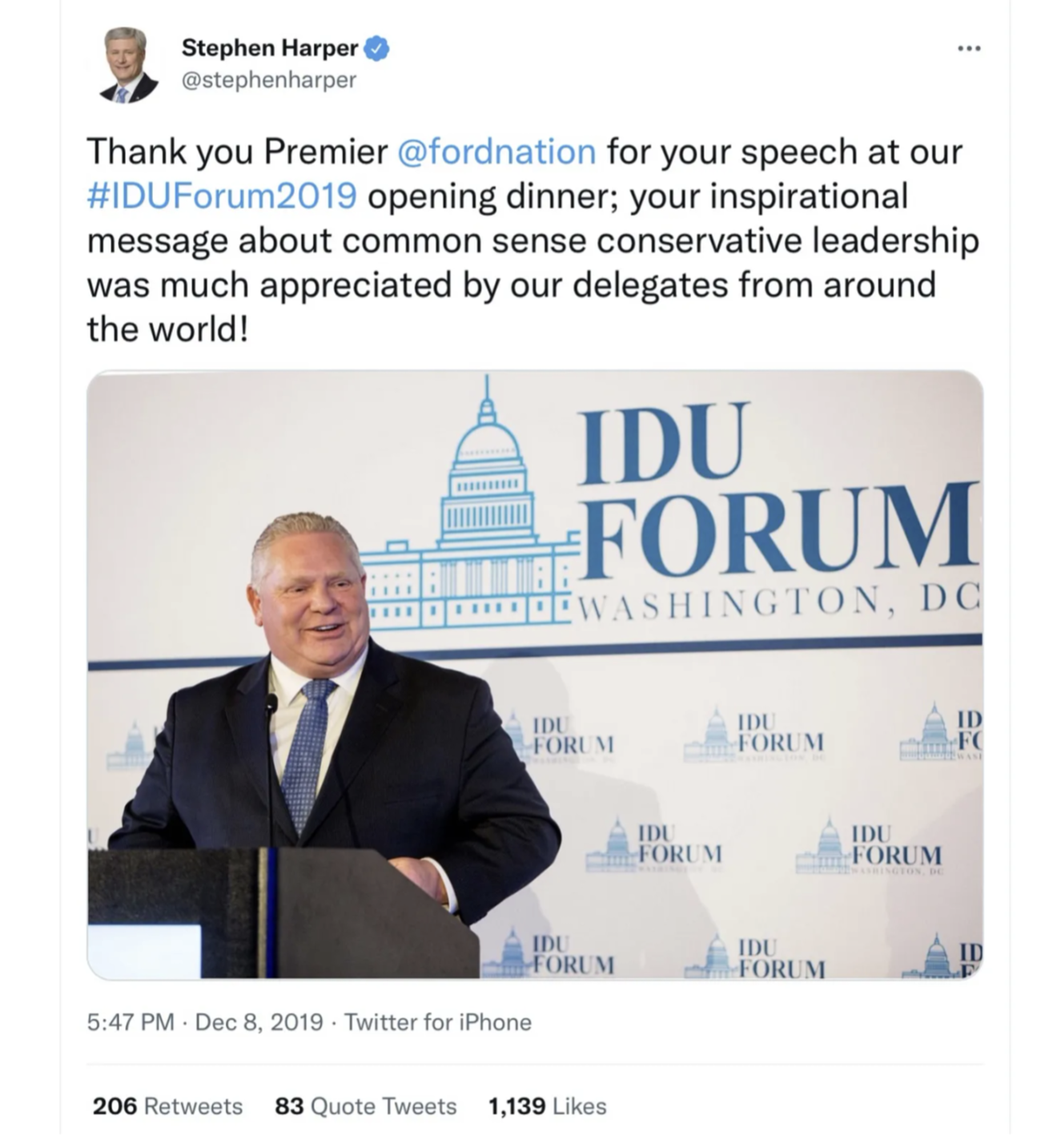
Doug Ford, Canada's Next Prime Minister
Tweet from Stephen Harper thanking Ford for his speech at the 2019 IDU Forum in Washington, DC. Harper has chaired the IDU since leaving office in Canada.

For the last few years, we have interpreted this information to mean Doug would ultimately become leader of the federal Conservative Party, somehow replacing Pierre Poilievre. Our hypothesis was that once Poilievre had turned off everyone but the dimmest and meanest, or once Poilievre had imploded personally, Doug would be swapped in to offer a more folksy face on the fascism. 

Over the last two weeks, since the resignation of Justin Trudeau on January 6th, we’ve been considering a different tactic. It has begun to dawn that perhaps Doug Ford will run against Poilievre for the PMO rather than replace him. What if the plan is to install Doug as the head of the federal Liberal party instead? As we have written about, the member parties of the IDU, as chaired by Stephen Harper, are big proponents of “owing all sides”, a trick they picked up from their partners in organized crime. If all parties are controlled by IDU members or an IDU proxy, the Russians, the oligarchs and organized crime don’t worry as much about the outcome of these elections, because they win either way. 

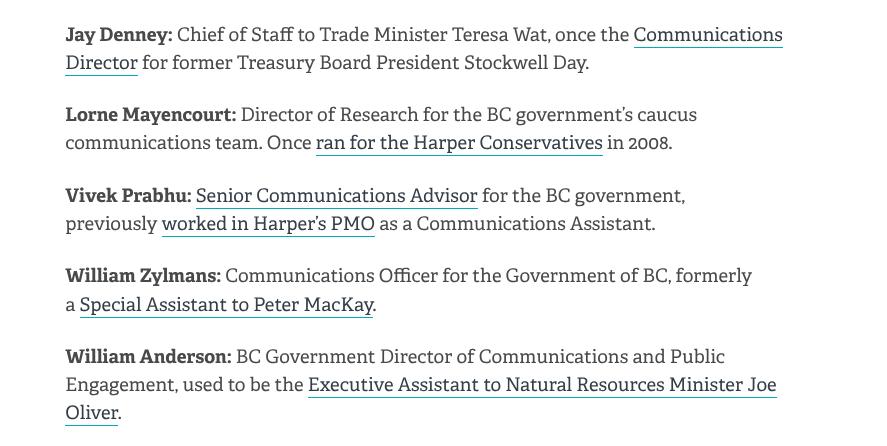
The idea of Doug as leader of the Liberal Party only sounds crazy at the most superficial level. Until a few days ago, when Christy Clark announced she wouldn’t run, Ford wouldn’t have even been the only Harper plant in the Liberal leadership race. As outlined in this 2017 article from Press Progress, Clark (like Ford) was elected with the help of Harper’s people, and was staffed and advised by members of Team Harper. Clark’s chief of staff, Ken Boesenkool, was a senior advisor to Harper in the PMO. When he resigned as Clark’s chief, Bosenkool returned to work for Harper’s war room for the 2015 election. Many of the key figures of Team Harper (including Stockwell Day, Chuck Strahl, Nick Kouvalis) worked with and for Clark. (Team Ford is also a remix of Team Harper, as we’ve written about here and here.) 
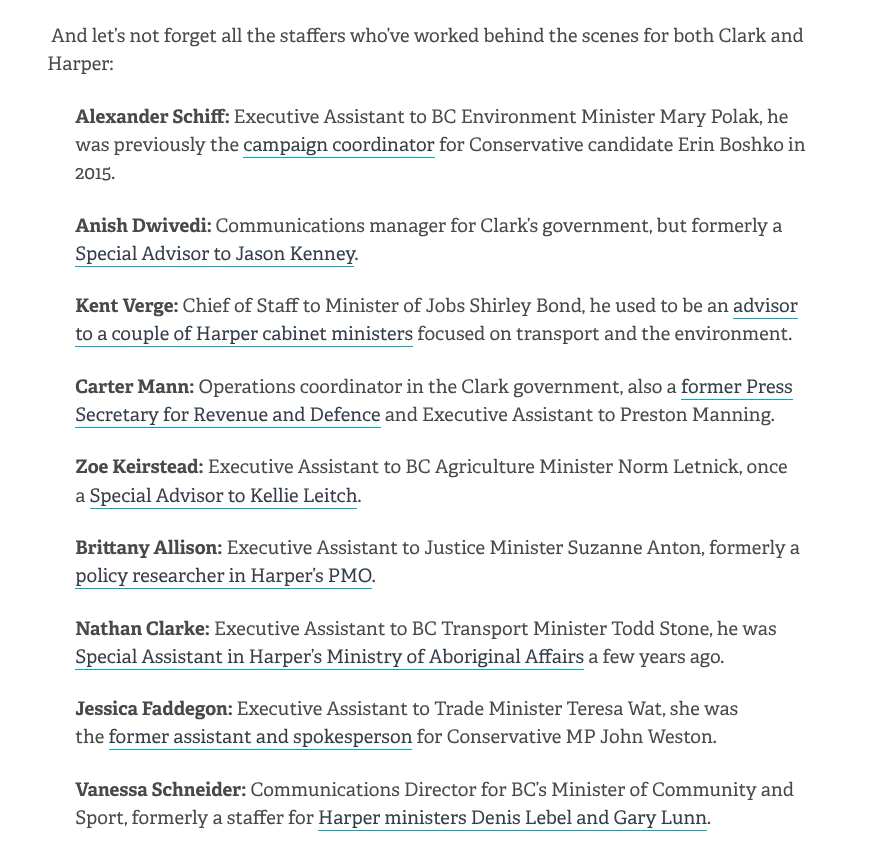
Doug Ford, Canada's Next Prime Minister
Screenshots from PressProgress article on connections between Christy Clark and Stephen Harper.

Canadian media owners, publishers and editors have been instrumental in the development of Doug’s public persona, creating a folksy, down-to-earth man of the people out of an illiterate former drug dealer from a well-known crime family, with decades of backroom relationships with police leaders and organized crime. Doug benefited from the persona Canadian media created for his brother, internationally famous crack smoker and former Toronto mayor, Rob Ford. In fact, once Rob was dead, Doug was able to put on Rob’s folksy persona like a costume, with the help of Canadian media.
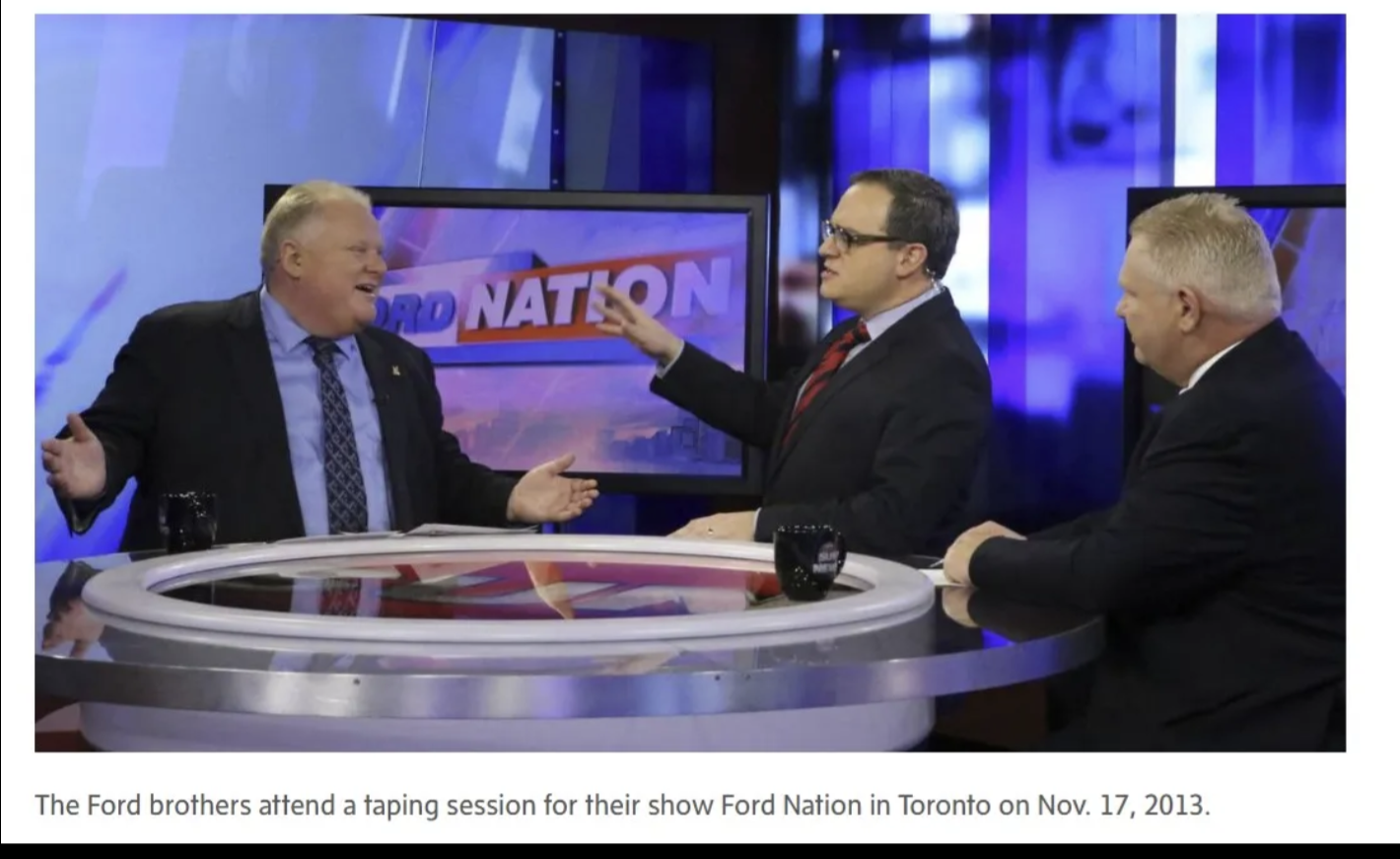
Doug Ford, Canada's Next Prime Minister

Like Trump, Doug benefits from a media ecosystem which treats him as a normal person and normal politician, furnishing him with an air of credibility. By repeating Ford’s untruths, Canadian media gives them plausibility. Though it is 100% concocted, Doug’s folksy persona works. Many voters in Ontario will have voted in support of both Justin Trudeau and Doug Ford. 

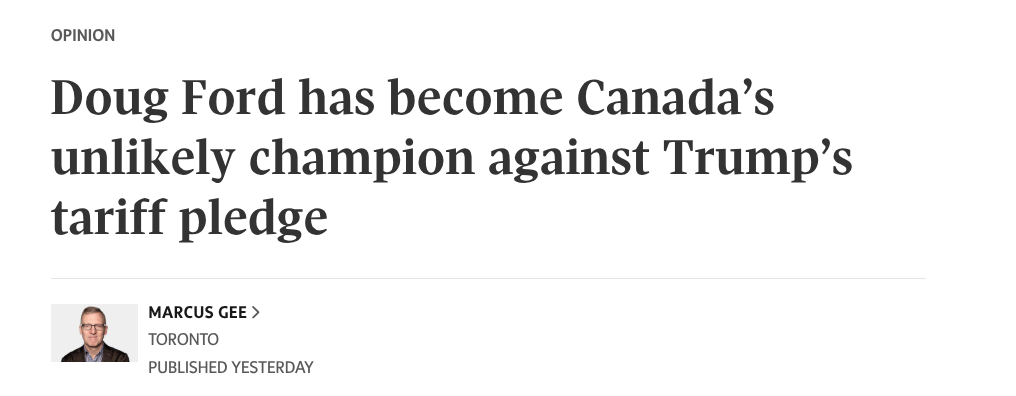
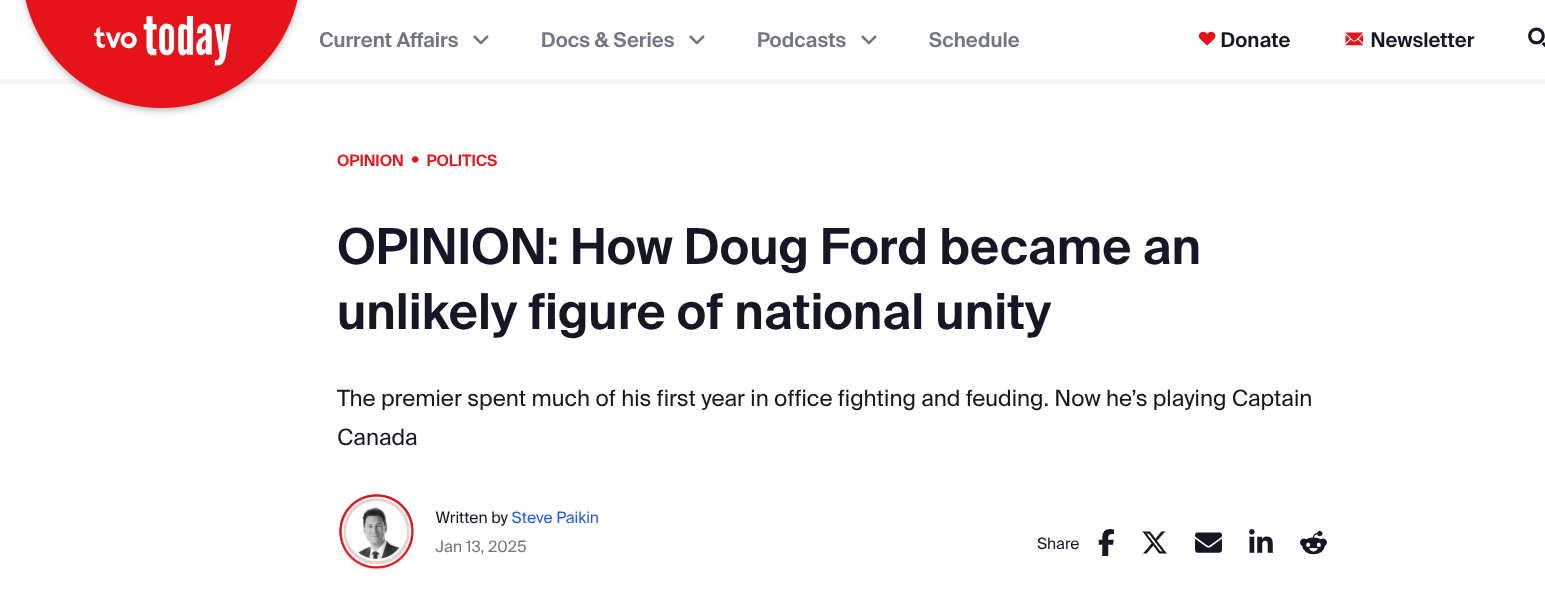
Canadian media have been providing Team Ford a critical service in the last few months, positioning and profiling him (via their story angles, headlines, word choices and photo choices) as a saviour of Canada, ready to “take on” Trump and lead Canada back to its former glory.
Doug Ford, Canada's Next Prime Minister
Marcus Gee from the Globe and Mail, anointing Doug as a "champion" against Trump.
Doug Ford, Canada's Next Prime Minister
Steve Paikin of TVO positioning Ford as the bringer of national unity.

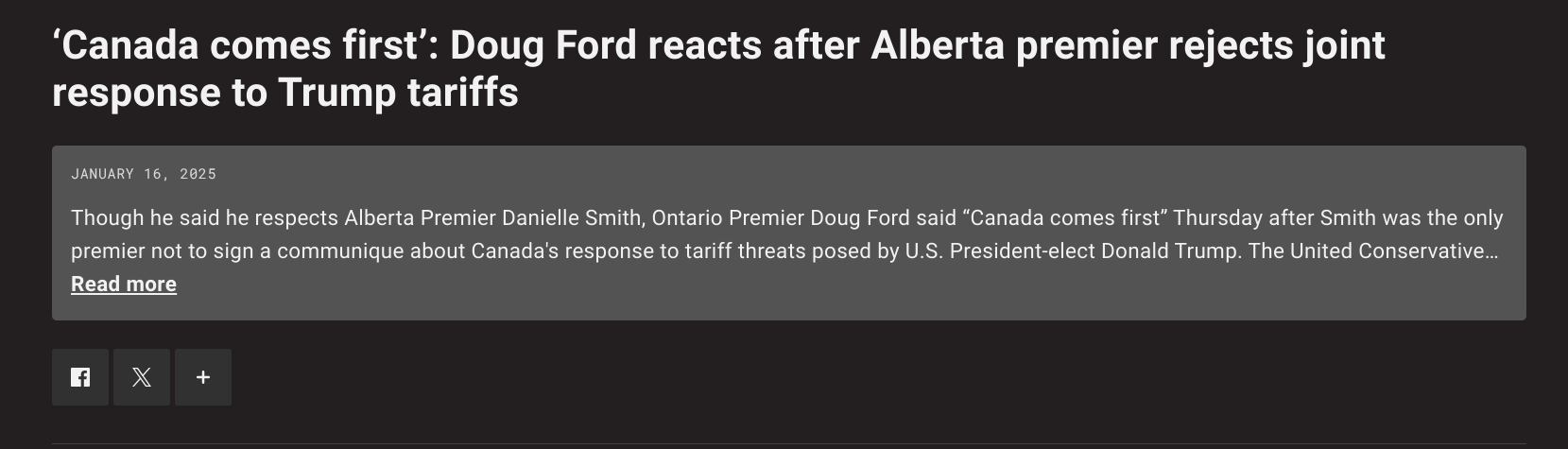
In recent days Ford has also been trying to create distance between himself and fellow Conservative premier, Danielle Smith, using her refusal to sign a joint response from the premiers to Trump as an opportunity to portray himself as a patriot and a statesman.
Doug Ford, Canada's Next Prime Minister

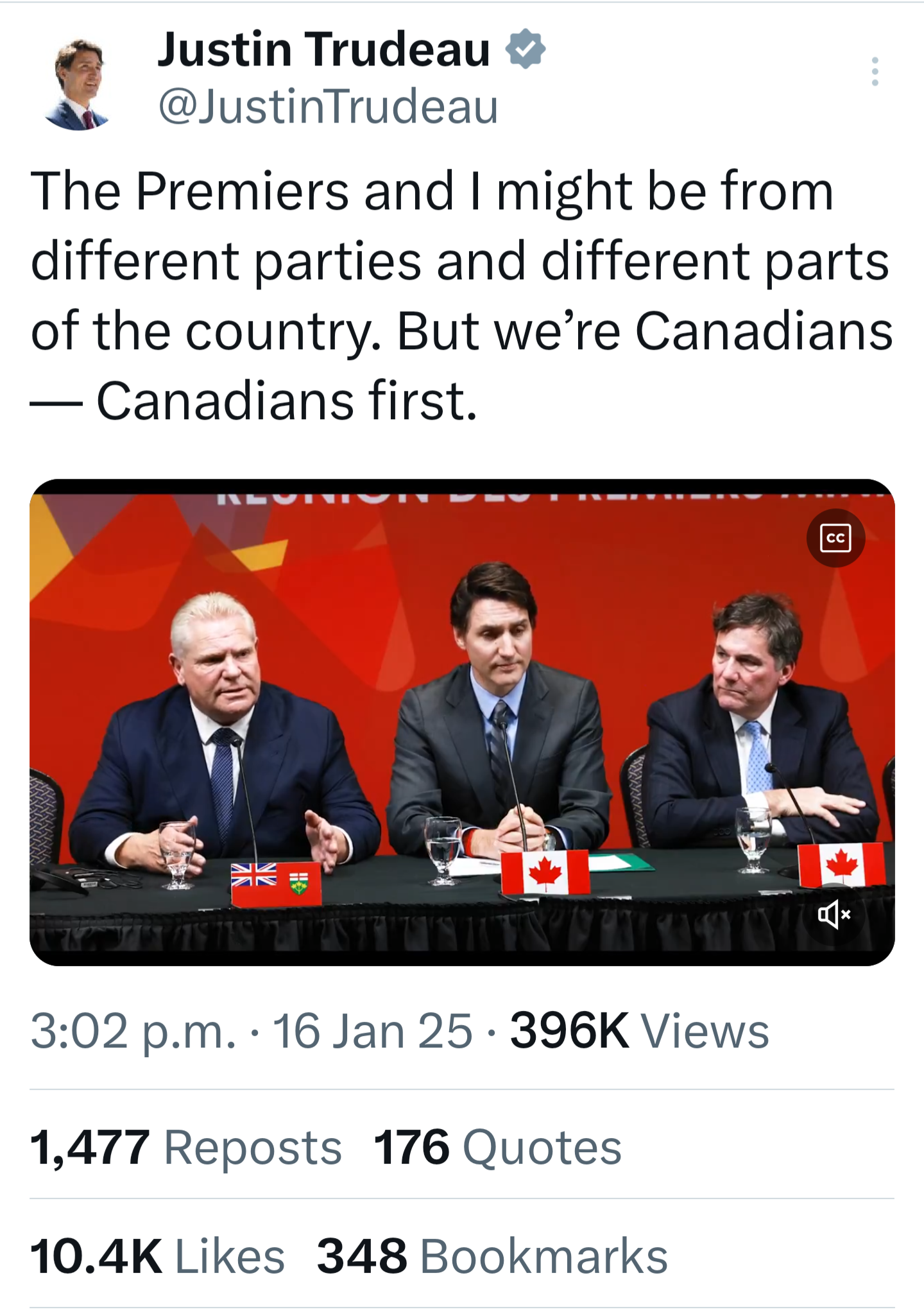
This recent tweet from Justin Trudeau, featuring Ford sitting next to Trudeau and Finance Minister Dominic LeBlanc (who was expected to run for the Liberal leadership himself) at the First Ministers conference, is an interesting photo choice by the Prime Minister’s communications team. It visually suggests Ford is at the same level as the two federal politicians, and the framing gives the impression this trio is on the same team.
Doug Ford, Canada's Next Prime Minister

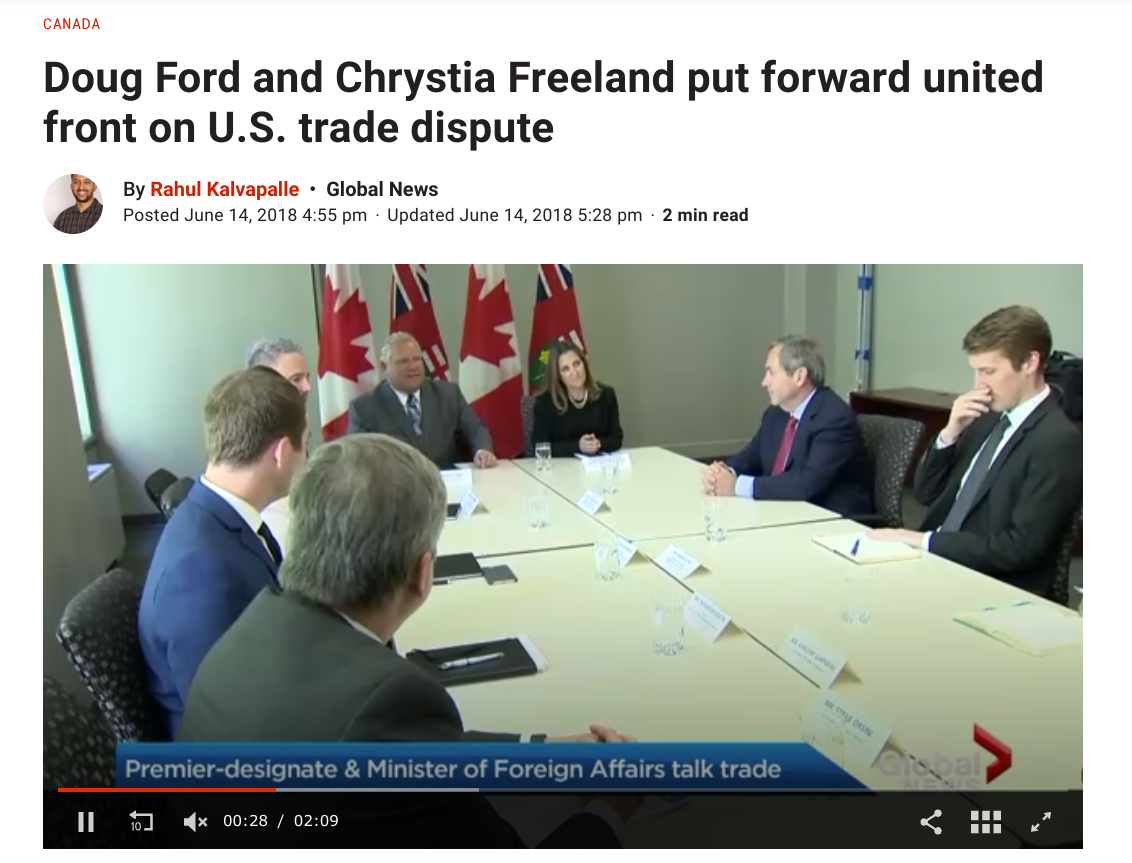
On social media we have often called Trudeau and Ford BFFs (best friends forever), for the frequency with which they make announcements together and for how often they are singing from the same song sheet. However, the warm relations between Trudeau and Ford cannot hold a candle to the ongoing love affair between Ford and Chrystia Freeland. Freeland and Ford have been a mutual support society for a number of years now. 
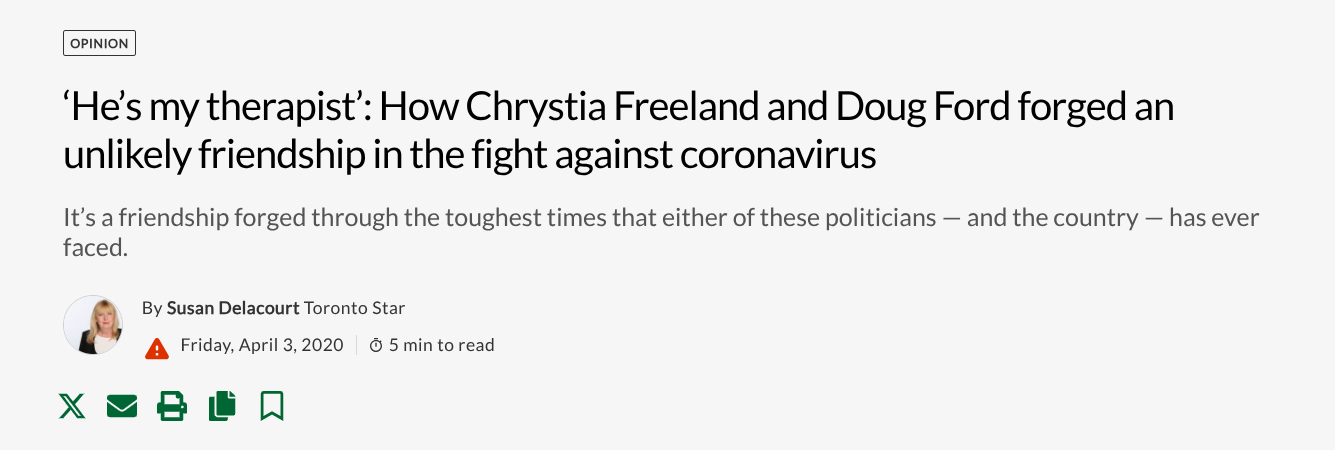
Doug Ford, Canada's Next Prime Minister
Article from the Toronto Star's Susan Delacourt on the warm, close relationship between Ford and Freeland.
Doug Ford, Canada's Next Prime Minister
Global News item from June 2018, just after Ford's election as premier.

Though it is difficult for dyed-in-the-wool partisans to accept, political party politics in Ontario has been dubious for quite some time. As we wrote about the 2022 provincial election, the “opposing parties” did not put up a fight during the campaign, and their leaders - DelDuca and Horvath - were both rewarded with mayoralties in organized crime hubs, along with “strong mayor” powers to do Ford’s bidding municipally despite any opposition from council or residents. It was DelDuca, as Minister of Transportation, who hired Phil Vester to oversee Metrolinx, to benefit the gangsters and oligarchs pretending to build the transit. The current leader of the Ontario Liberal party, Bonnie Crombie, who has been described as “Doug in a red skirt”, is affiliated with the same developers and “donors” as Ford.
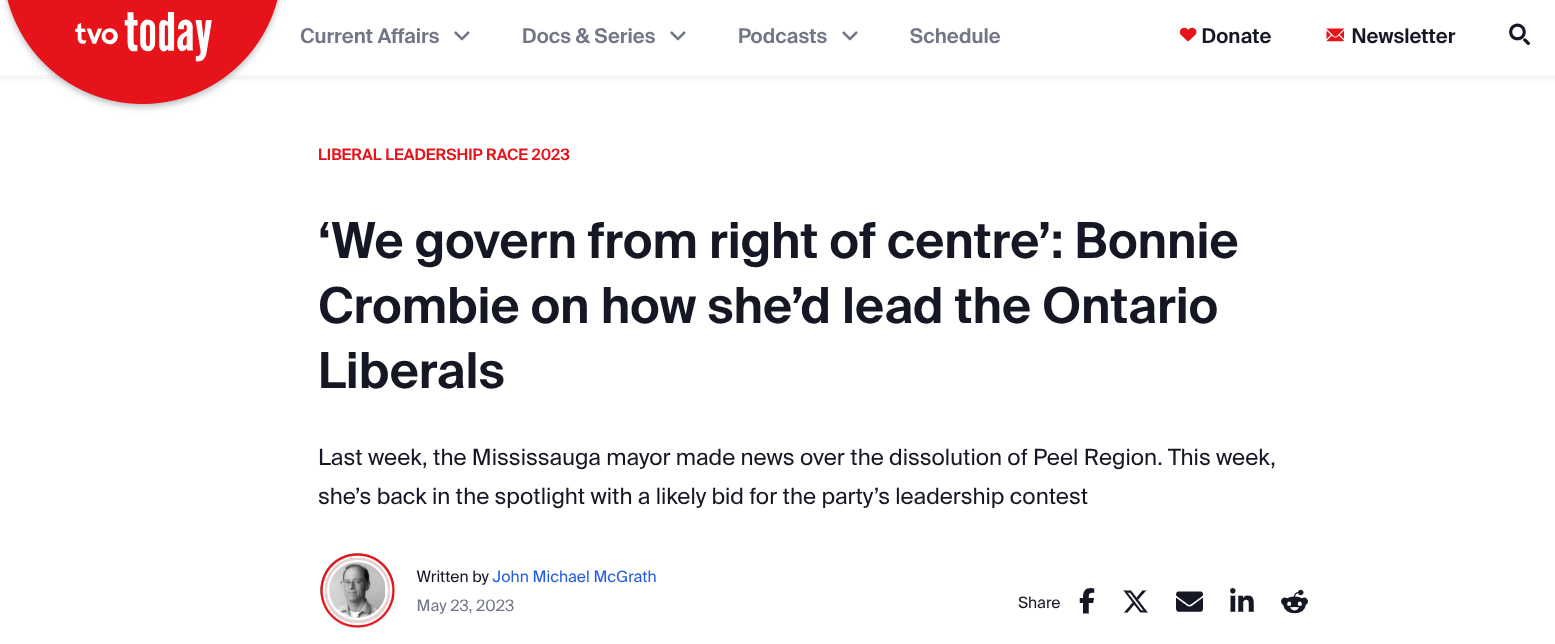
Doug Ford, Canada's Next Prime Minister
TVO item on Ontario Liberal leader, Bonnie Crombie.

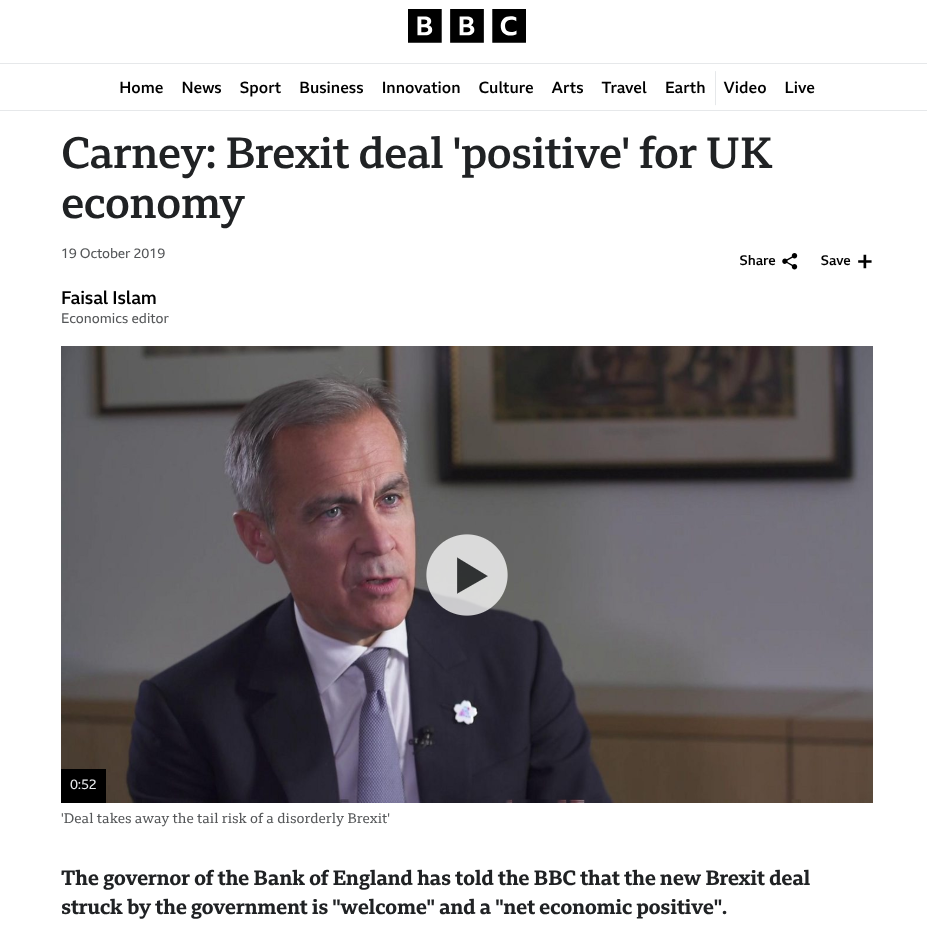
The embrace of Mark Carney by Liberal party faithful is also curious. Carney is the monopoly man from Goldman Sachs, in essence. He is the chair of Brookfield Asset Management and Bloomberg, and sits on the board of Stripe, at a time when the public is cheering the shooting of CEOs. Carney was governor of the Bank of Canada for years under a Harper government, then went to the UK to become the governor of the Bank of England under David Cameron, Theresa May, and Boris Johnson. Carney, who used his credibility to help Boris sell Brexit to Britain, has been in the belly of the IDU for a very long time. 
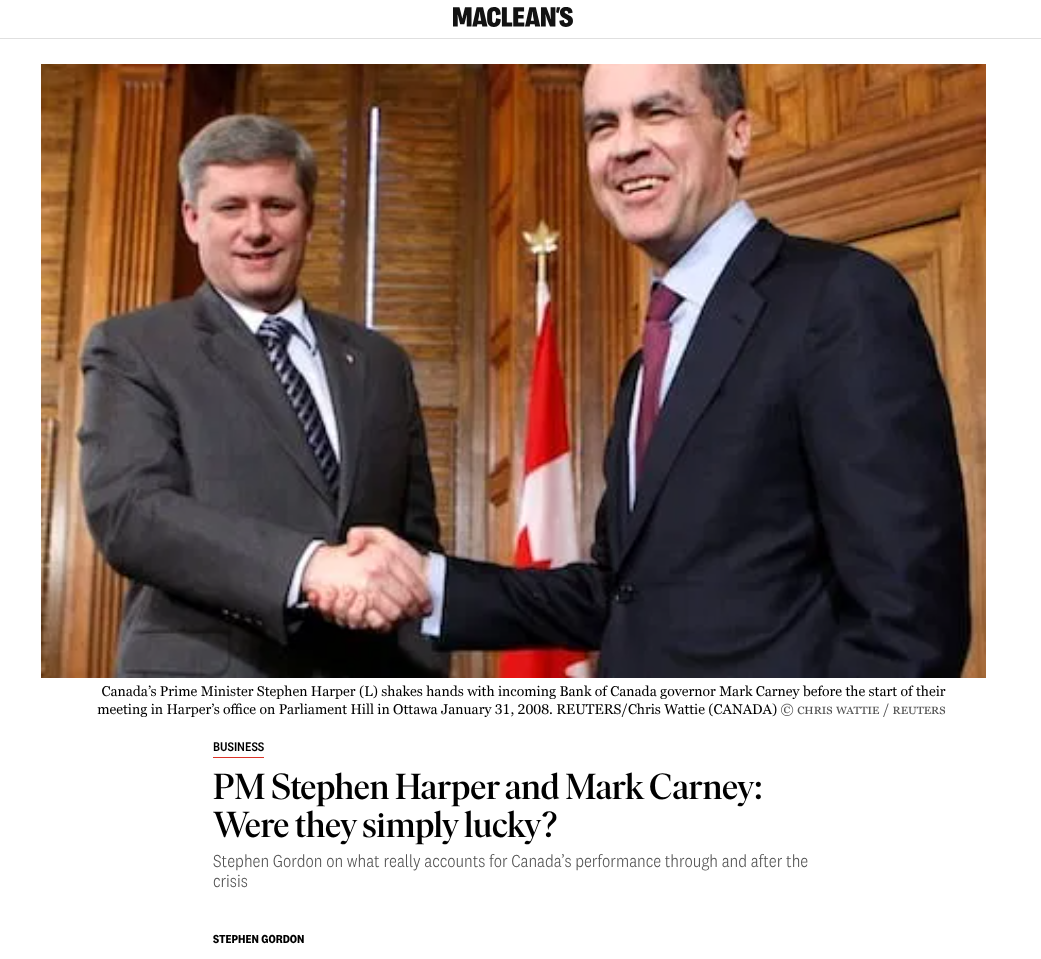
Doug Ford, Canada's Next Prime Minister

Former New Zealand Prime Minister, Jacinda Ardern, resigned after an effective coordinated attack by the far right and their media partners, both domestically and internationally. In the subsequent NZ election, her party was replaced in leadership by an IDU member party. At the time, we noted that effective removal of Ardern meant the resources of the IDU would now be turned towards the removal of Justin Trudeau. We expected the attack on Trudeau (from the media, particularly) to be particularly relentless, given that his removal, for IDU chair Harper, is very personal. It was Trudeau who removed Harper from office. 
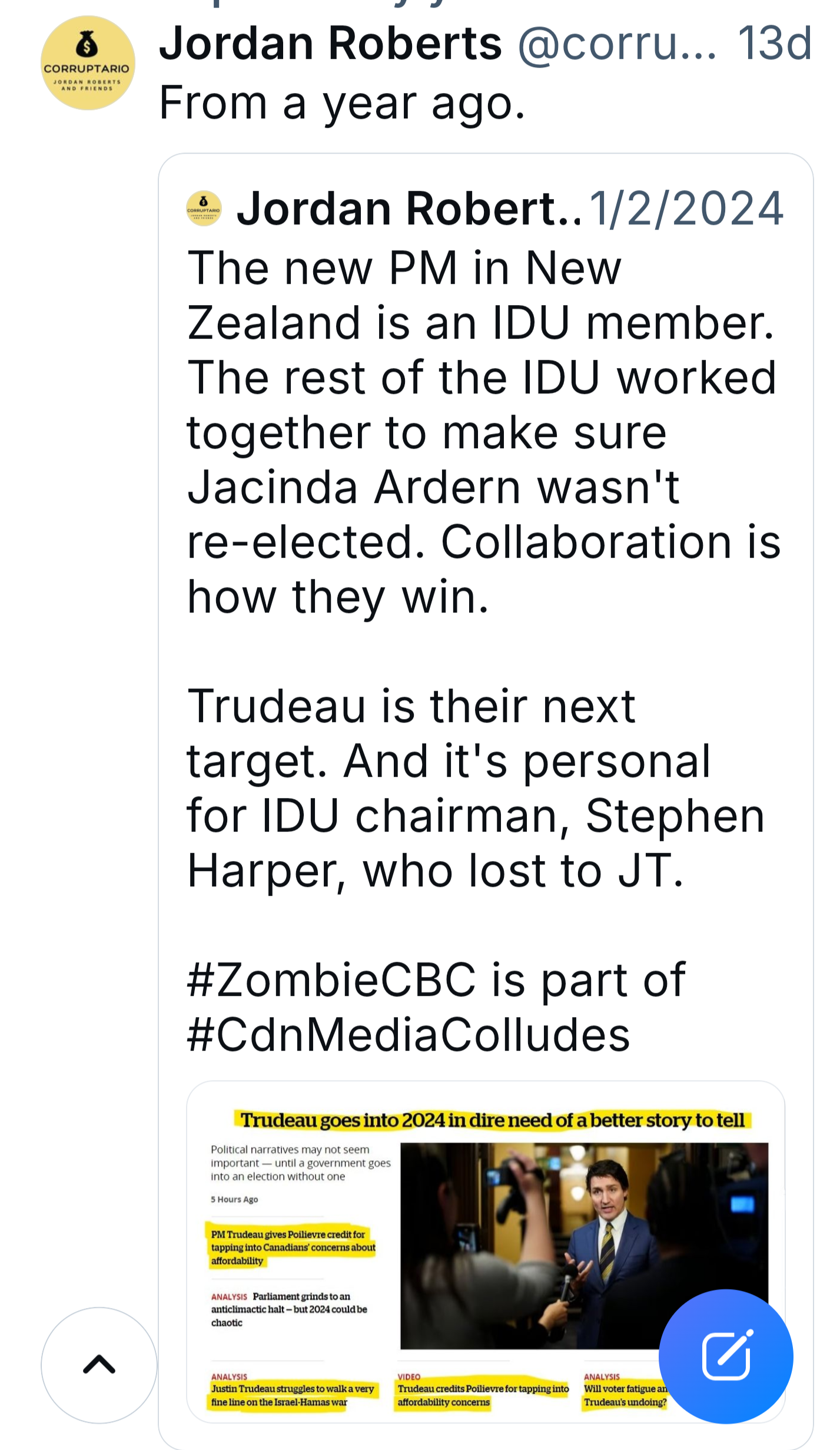
Doug Ford, Canada's Next Prime Minister
Recent reshare of Bluesky post from January 2024, a year ago.

Having effectively ended Trudeau’s time in the PMO, Harper might find extra satisfaction in subverting the Liberal party as well, to make sure the interests of IDU members are protected no matter the electoral outcome. Doing that in the form of Doug Ford would just be the cherry on top. 

Corruptario is a reader-supported publication. To receive new posts and support our work, consider becoming a free or paid subscriber. If you find this work valuable, you can leave us a tip here to help offset our costs.
24 Dec 18:30

Savoie ne sait pas: The Governor General of Canada Does Not Unadjourn the House of Commons

by J.W.J. Bowden
The Governor General does not decide when the House of Commons or the Senate come out of an adjournment and resume sitting. The House of Commons and Senate vote to adjourn themselves and to resume sitting, but the Crown summons, … Continue reading →
20 Dec 20:26

Canadian news media are suing OpenAI for copyright infringement, but will they win?

by Robert Diab

Last week, five of Canada’s most prominent news media outlets launched a lawsuit against OpenAI for copyright infringement, demanding what could amount to billions in damages. The suit follows similar cases brought earlier this year against the creator of ChatGPT by The New York Times and other media companies in the United States.

At the heart of all these lawsuits is the claim that OpenAI “scraped” large amounts of content from media sites. This involved copying without permission. And the company is making a profit from it without compensating the original creators.

OpenAI has yet to formally respond to the Canadian lawsuit, but insists that using news material to train its chatbot is “fair dealing” under copyright law — and not an infringement.

Who is right? And why is OpenAI entering licensing agreements with various media companies if they’re so sure they’re not breaking the law?

Is the Canadian case just a ploy to land a big licensing deal?

A closer look at how chatbots are trained suggests that OpenAI may be right that “scraping” isn’t copying. But it may not be “fair dealing” either.

Breach of contract?

To be clear, the five media companies — Torstar, Postmedia, The Globe and Mail Inc., The Canadian Press and CBC/Radio-Canada — are also making two further claims.

OpenAI thwarted protective measures the news sites employ to block tools used to scrape their websites, and by doing so, breached the sites’ terms of service.

The news companies bringing the lawsuit rely on tools to “prevent unauthorized scraping of data” from their websites. An example is the Robot Exclusion Protocol, which manages how software like bots and web crawlers can access a site. These tools, along with paywalls and account restrictions, are meant to safeguard against unauthorized uses of their material.

The plaintiffs say that by reading their content online, site visitors accept the terms of use found somewhere in the background, and that since 2015, the terms have made clear that news material is for “personal, non-commercial use of individual users only.”

Fair dealing exemption

The crux of all three claims in the Canadian lawsuit is that by using their material — scraping content — OpenAI is copying their work and making unauthorized use of it for profit.

But is scraping really copying? And if it is, does it count as fair dealing?

Copyright law in Canada and the U.S. allows for unauthorized copying or use of a protected work in some cases under the fair dealing or fair use exception. Courts consider a series of factors, including the purpose of the copying (commercial or educational), the extent of the copying and its impact on the original work.

Soon after The New York Times launched its lawsuit, OpenAI argued that training its chatbot on news material found on the web does not involve unlawful copying. It falls under fair use, and they pointed to various legal experts and civil society groups that agree.

Legal scholars have argued that scraping data from news sites involves making a temporary copy, but only as a first step for the purpose of “abstract[ing] metadata” or information about relationships between words and sentences. Combining large amounts of metadata creates a new “artifact” that is “not substantially similar to any particular work in the training data.”

As the authors put it: “Generative AI models are generally not designed to copy training data; they are designed to learn from the data at an abstract and uncopyrightable level.”

There is, after all, no copyright in statistical patterns or word frequencies.

The nonprofit group Creative Commons agrees: OpenAI’s use of news material to train a chatbot is similar, they say, to Google’s digitizing millions of books to create a searchable database. Both are “transformative” uses of the original material. They result in a product that serves different purposes that don’t compete with or take anything away from the original creators.

Licensing and settlements

To hedge its bets, right after The New York Times lawsuit, OpenAI did two things. It said that it would respect a news organization’s choice to opt out of allowing its content to be used for training data. And it began to make deals with news organizations to license their content for training purposes.

But the lawsuits remain, and judges in Canada and the U.S. will soon begin hearing them. They will have to decide: is scraping a form of reproduction that copyright protects against — and is it fair dealing?

One factor will be the non-competitive nature of chatbots and their inability to access paywalled content from The Globe and Mail or Toronto Star.

But another factor might involve licensing. As other commentators have noted, finding that OpenAI’s use of news content to train its AI is fair dealing could reduce the market for licensing deals. The more deals that are struck, the stronger this market will appear — and the greater the cost to media companies of calling this fair dealing.

This makes a settlement and licensing deal in the Canadian case likely. But OpenAI may just roll the dice.

And if it does, the future of AI could hang in the balance.

Robert Diab, Professor, Faculty of Law, Thompson Rivers University

This article is republished from The Conversation under a Creative Commons license.

The Conversation

The post Canadian news media are suing OpenAI for copyright infringement, but will they win? first appeared on J-Source.

18 May 03:37

Rehabilitation Pilot Project Now Half Complete On The Elephant Hill wildfire Area At Pressy Lake

by Pat Matthews

A pilot project to rehabilitate the 2017 Elephant Hill wildfire-affected area at Pressy Lake in the South Cariboo continues.

The project is focused on the efficient extraction and utilization of seven year old burnt fibre on a large, 450-plus hectare swath of land.

Operations Manager at Tsideldel Biomass Joe Webster said the actual test area that turned out to be 231 hectares has been completed.

“We took a grand total of 27,430 cubic metres of biomass from that area. That's a combination of chips, hog fuel and biomass for the power plants in Williams Lake. The variability of the burn was dictating how the operation went and the big finding for me was you can't predict that at all. It's the biggest challenge in the whole project.”

Webster said after the analysis of all the data on what was done, they decided to finish that permit so there is another 250 hectares to do which are currently being worked on now.

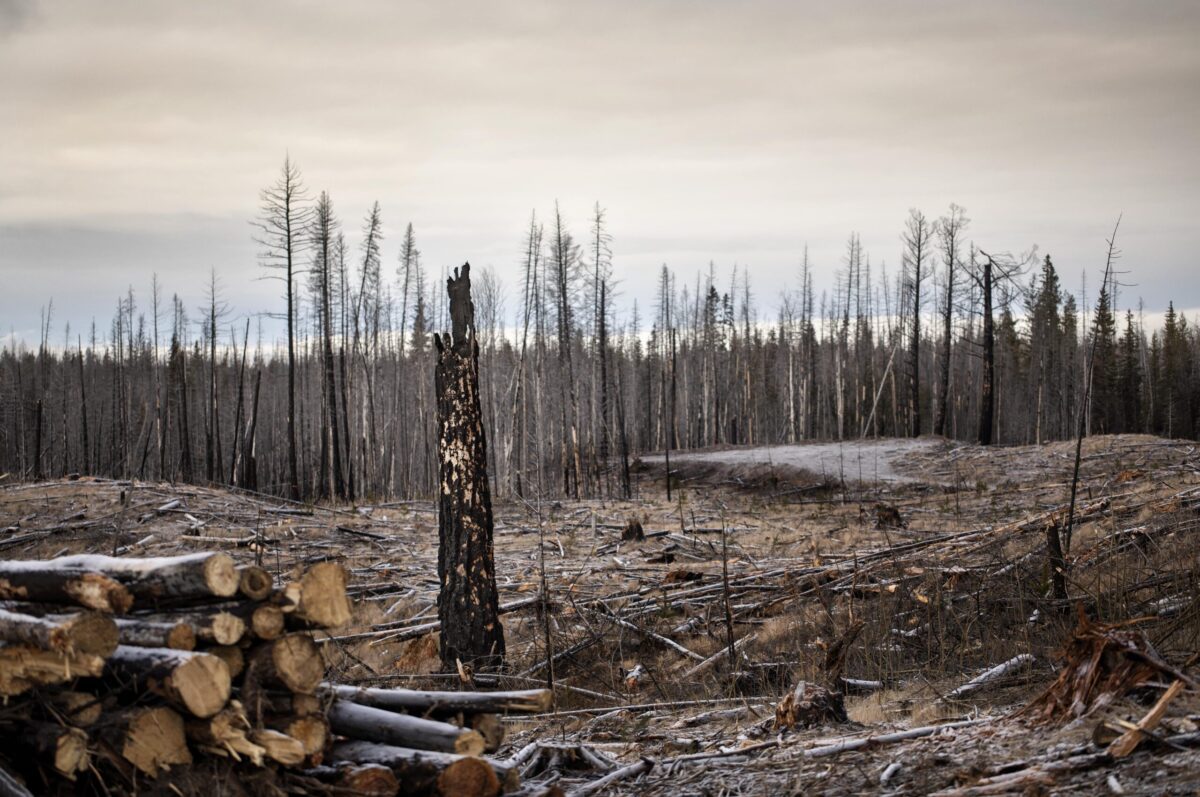
[caption id="attachment_97529" align="alignright" width="300"] The 2017 Elephant Hill wildfire-devastated area (Photo CCR)[/caption]

“We should finish up in August if all goes well. The bunchers are cutting there right now and the skidders are due to start next week. We have some other areas pinpointed already within the burn and we're looking to get the permitting done, if it can be done, for September, October, then that would be our next winter project. The ideal situation would be that we treat another 3 to 4 hundred hectares by Springtime,” Webster said.

Webster noted that Cariboo Pulp in Quesnel took some of the fibre as a test to see if they could run it and they were happy and are looking for more in the future.

“That 231 hectares that we completed as a pilot project as of March 31st has been planted already this Spring. We had extra trees so Central Chilcotin Rehabilitation Ltd. had a crew go in there for a week and a half prepping and planting. So now we cross our fingers and hope everything works the way its planned and we have a new forest,” Webster said.

Pressy Lake is located East of 70 Mile and West of Little Fort off Highway 24 near Bridge Lake.

The post Rehabilitation Pilot Project Now Half Complete On The Elephant Hill wildfire Area At Pressy Lake appeared first on My Cariboo Now.