Hurricane Harvey, Hurricane Irma, an earthquake in Mexico, a two-headed tortoise in Switzerland, wildfires across the western United States, Rohingya refugees driven from Burma, a frightening "Super Monster Wolf" in Japan, and President Donald Trump makes a deal with Democratic leaders.
The Eagle Creek wildfire burns in the background as golfers play at the Beacon Rock Golf Course in North Bonneville, Washington, on September 4, 2017.
(Kristi McCluer / Reuters)
Easy to handle: A practical radiofluorination of anilines with [18F]fluoride is achieved via N-arylsydnone intermediates. This method displays broad functional group tolerance, is compatible to automation on a commercial radiosynthesis module and can facilitate rapid 18F-labeling of peptides.
[Communication] Maruthi Kumar Narayanam, Gaoyuan Ma, Pier Alexandre Champagne, Kendall N. Houk, Jennifer M. Murphy Angew. Chem. Int. Ed., September 07, 2017, https://doi.org/10.1002/anie.201707274 Read article
Rob Bilott was a corporate defense attorney for eight years. Then he took on an environmental suit that would upend his entire career — and expose a brazen, decades-long history of chemical pollution.
One-atom-thick crystals are impermeable to atoms and molecules, but hydrogen ions (thermal protons) penetrate through them. We show that monolayers of graphene and boron nitride can be used to separate hydrogen ion isotopes. Using electrical measurements and mass spectrometry, we found that deuterons permeate through these crystals much slower than protons, resulting in a separation factor of ≈10 at room temperature. The isotope effect is attributed to a difference of ≈60 milli–electron volts between zero-point energies of incident protons and deuterons, which translates into the equivalent difference in the activation barriers posed by two-dimensional crystals. In addition to providing insight into the proton transport mechanism, the demonstrated approach offers a competitive and scalable way for hydrogen isotope enrichment.
Authors: M. Lozada-Hidalgo, S. Hu, O. Marshall, A. Mishchenko, A. N. Grigorenko, R. A. W. Dryfe, B. Radha, I. V. Grigorieva, A. K. Geim
“People are dying,” the president said. “And the constant excuses for inaction no longer do, no longer suffice. That is why we are here today. Not to debate the last mass shooting, but to do something to prevent the next one.”
Obama said his executive action would leverage existing law that requires all licensed gun sellers to carry out background checks of potential buyers. The president wants to make “anybody in the business of selling firearms” register as a licensed dealer. Such criteria would mean more oversight, particularly for people selling guns over the Internet, which could mean more buyers would be subject to background checks.
Obama said the FBI will hire more employees to work on the national background-check system; White House officials have promised that checks will be processed 24 hours a day, seven days a week. The administration will also improve the process by which states submit mental-health records to the system, and fund research of gun-safety technology, he said.
“If we have the technology to unlock your phone without the right fingerprint, why can’t we do the same for our guns?” Obama said Tuesday. “If a child can’t open up a bottle of aspirin, we should make sure that they can’t pull the trigger on a gun.”
The president spoke in the East Room of the White House, flanked by families of gun-violence victims,as well as gun-control activists. He spoke for more than half an hour, referencing places whose names have become synonymous with tragedy: Tucson, Aurora, Newtown, Charleston, San Bernardino.
Obama grew emotional as he recalled the deaths of 20 children at a Connecticut elementary school at the hands of a gunman in 2012.
“Our unalienable right to life and liberty and the pursuit of happiness were stripped from college kids in Blacksburg and Santa Barbara, and from high schoolers in Columbine, and from first-graders in Newtown. First-graders. And from every family who never imagined that their loved one would be taken from their lives by a bullet of a gun,” Obama said, pausing to wipe away tears. “Every time I think about those kids, it gets me mad. And by the way, it happens on the streets of Chicago everyday.”
Watch the full speech:
Obama compared the push for greater gun control in the United States to the movements that abolished slavery, gave women the right to vote, and granted equal rights to LGBT people. “It won’t happen in this Congress, it won’t happen in my presidency,” he said. “But a lot of things don’t happen overnight.”
Obama criticized Republicans and gun-control opponents who say the president is disregarding the Second Amendment, injecting some sarcasm into a mostly solemn speech. “I taught constitutional law,” he said. “I know a little bit about this.”
The president was introduced by Mark Barden, whose son Daniel was killed in Newtown. In the wake of that shooting, Obama announced 23 executive initiatives related to gun violence. In the months after the massacre, a bipartisan proposal to expand background checks for gun purchases, far more than Obama’s latest measure would, was introduced in Congress. The proposal was defeated in the Senate in spring 2013.
“The gun lobby may be holding Congress hostage right now, but they can’t hold America hostage,” Obama said Tuesday.
According to an October Gallup poll, 86 percent of Americans support the idea of laws that would require universal background checks for gun buyers. But Americans are split on whether such regulation would reduce the number of mass shootings in the nations.
Obama will hold a town hall-style meeting on gun violence on Thursday in Fairfax, Virginia. A week from now, he will deliver his final State of the Union address before a joint session of Congress, where he is expected to raise the issue again.
With the United Nations holding its climate change conference in Paris, Getty Images photographer Mario Tama traveled to Argentina’s Los Glaciares National Park, to capture images of the beautiful region, and of climate change in action. In Los Glaciares, part of the Southern Patagonian Ice Field, most of its 50 large glaciers have been retreating during the past half-century due to warming temperatures, according to the European Space Agency.
Monte Fitz Roy stands in Los Glaciares National Park, part of the Southern Patagonian Ice Field, on December 2, 2015 in Santa Cruz Province, Argentina.
(Mario Tama / Getty)
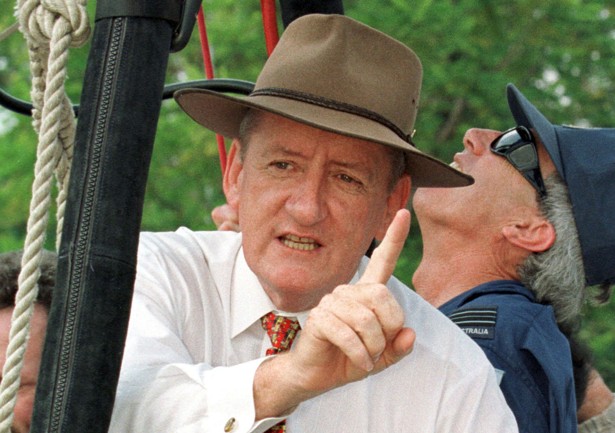
Tim Fischer attends a weaponry fair in Thailand. Reuters
The deadpan reaction of one BBC presenter to the shooting rampage in San Bernardino on Wednesday—“Just another day in the United States in America, another day of gunfire, panic, and fear”—got a lot of attention this week as a window of sorts into the world’s despair over the mundanity of American gun violence.
But the response was quite tame compared with that of Australia’s former deputy prime minister, Tim Fischer, who on Thursday urged the Australian government to issue more dire warnings about travel to the United States. (The current Australian advisory notes, among other things, that there is “a heightened threat of terrorist attack in the United States” stemming from the conflicts in Syria and Iraq; that there has been civil unrest in places like Ferguson, Missouri; and that “the United States has a generally higher incidence of violent crime, including incidences where a firearm (gun) is involved, compared to Australia.”)
“You are 15 times more likely to be shot dead in the U.S.A. than in Australia per capita,” Fischer told the Australian Broadcasting Corporation, adding that he was therefore “sick and tired” of the U.S. government advising American travelers about potential terrorist attacks in Australia. Some context for his numbers: There are .15 fatalities in mass shootings per 100,000 people in the United States, and .01 in Australia, according to one study; the rate of homicide by firearm yields an even greater divide between the two countries.
Noting that there have been more than 350 mass shootings in the United States so far this year, Fischer said that “all [are] unacceptable because the U.S. is not stepping up on the public-policy reform front.”
“It’s time to call out the U.S.A,” he argued. He also had words for the National Rifle Association: “The NRA in particular needs to be called out for their unacceptable blockage of any sensible reform, including [ammunition] magazine limitation.”
Fischer is a farmer, Vietnam War veteran (yes, Australia fought in Vietnam), and gun owner himself. And he isn’t just any politician spouting off. After an Australian named Martin Bryant murdered 35 people with a semiautomatic rifle in Port Arthur in 1996, in the deadliest mass shooting in Australian history, Fischer and then-Prime Minister John Howard helped lead a massive effort to reform the country’s gun laws—a campaign often cited as a potential model for enacting stricter gun control in the United States. (The San Bernardino shooters also used semiautomatic rifles, which were purchased legally and then modified.)
Following Bryant’s killing spree, the Australian government banned automatic and semiautomatic firearms, adopted new licensing requirements, established a national firearms registry, and instituted a 28-day waiting period for gun purchases. It also bought and destroyed more than 600,000 civilian-owned firearms, in a scheme that cost half a billion dollars and was funded by raising taxes. The entire overhaul took only months to implement.
The program was (and to a degree remains) controversial, especially with rural, conservative constituents of Fischer’s own National Party. But there is considerable evidence that it has, on balance, been effective. The number of mass shootings in Australia—defined as incidents in which a gunman killed five or more people other than himself, which is notably a higher casualty count than is generally applied for tallying mass shootings in the U.S.—dropped from 13 in the 18-year period before 1996 to zero after the Port Arthur massacre. Between 1995 and 2006, gun-related homicides and suicides in the country dropped by 59 percent and 65 percent, respectively, though these declines appear to have since leveled off. Two academics who have studied the impact of the reform initiative estimate that the gun-buyback program saves at least 200 lives each year, according to The New York Times. In a multinational study for the Small Arms Survey, Marcus Wilson cited the Australian case as an example of the most efficacious type of government effort to control arms and measurably reduce armed violence, in which weapons-collection programs are combined with legislative reform, campaigns to shift public opinion, and civil-society involvement.
Fischer’s prescription in the aftermath of the San Bernardino attack—a more severe travel warning for the United States—may seem not only small-bore but alarmist, an overreaction to one horrific event. And it very well might be. After all, the number of foreigners who die in mass shootings in the United States is probably exceedingly small.
But the retired Australian politician has actually been railing against U.S. gun laws for years. In 2012, after the mass shooting at a movie theater in Aurora, Colorado, Fischer issued a similar warning to his fellow citizens about visiting the United States. “U.S. senators and diplomats over the years almost all privately say that the U.S. must revamp their gun laws, but the NRA has a block on allowing this to happen,” he said. “Truth of the matter is there is a certain gutlessness at the highest levels in and around Washington, which is preventing some minimum logical steps being taken, especially over the number of guns that any individual can purchase.”
“We really did walk away from a policy of more and more guns, and we did so recalling that if more guns made us safer, the U.S. would be the safest nation in the world.”
And it was actually the fatal shooting of a foreigner—an Australian named Chris Lane, who was gunned down by a few teenagers while out for a run in Oklahoma—that prompted yet another Fischer travel advisory back in 2013. At the time, the Australian politician characterized the killing of Lane as “the bitter harvest and legacy of the policies of the NRA.” He went further, stating that U.S. gun culture was “corrupting the world,” with firearms flowing illegally from America to countries like Australia and Mexico, and that the United States “cannot expect not to have any criticism of it worldwide.” He continued: “Anybody can tomorrow go to a gun show in Oklahoma or California and buy a gun without a simple background check. That is illogical.”
Last year, after another mass shooting in America, Fischer reflected in an interview with NPR on the lessons he’d learned from his gun-control campaign in Australia, which included a moment in which he was hung in effigy by protesters at a public meeting in Queensland.
“This was Australia’s chance to jump through the hoops, take some pain, withdraw private property from individuals but pay them just compensation,” he said. “The result is there for everyone to see.”
The Australian government’s policies “caused people to think, ‘Do I really need a gun?’ If I do, I’ll apply, and get it. But if I don’t really need it, I won’t go down that pathway.’ So we really did walk away from a policy of more and more guns, and we did so perhaps recalling some of the comments that many have made … [that] if more guns made us safer, the U.S. would be the safest nation in the world.”
“You are not,” he made sure to add. This time, he didn’t bother issuing a travel warning.
Cats with hitherto unknown talents: Tetraalkylammonium salts are widely used for phase-transfer catalysis. It is now demonstrated that they can also function as hydrogen-bonding catalysts. The hydrogen-bonding ability of appropriately designed ammonium salt catalysts was evaluated in Mannich-type reactions of N-acyl isoquinolines and NMR titration studies. Structural information was obtained by X-ray crystallography (see picture).
Christian A. Malapit, Dr. Jonathan T. Reeves, Dr. Carl A. Busacca, Prof. Dr. Amy R. Howell and Dr. Chris H. Senanayake
Hot DMMN: A carbon-bound electrophilic CN source, dimethylmalononitrile (DMMN), undergoes transnitrilation with aryl boronic acids. Compared to other cyanating reagents, DMMN is stable, safe, and commercially available. This novel rhodium-catalyzed process tolerates various functional groups, thus making it a practical method to access aryl nitriles.
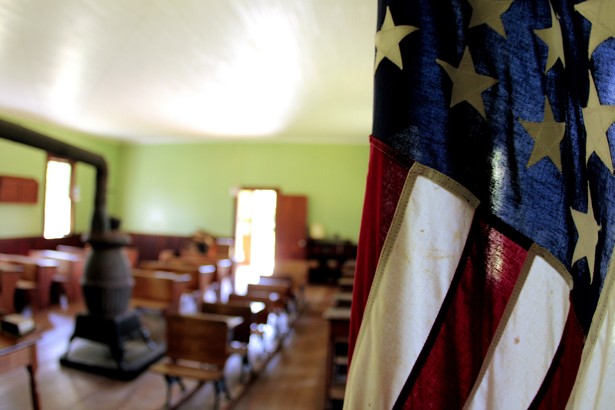
Earlier this month, McGraw Hill found itself at the center of some rather embarrassing press after a photo showing a page from one of its high-school world-geography textbooks was disseminated on social media. The page features a seemingly innocuous polychromatic map of the United States, broken up into thousands of counties, as part of a lesson on the country’s immigration patterns: Different colors correspond with various ancestral groups, and the color assigned to each county indicates its largest ethnic representation. The page is scarce on words aside from an introductory summary and three text bubbles explaining specific trends—for example, that Mexico accounts for the largest share of U.S. immigrants today.
The recent blunder has to do with one bubble in particular. Pointing to a patch of purple grids extending throughout the country’s Southeast corridor, the one-sentence caption reads:
The Atlantic Slave Trade between the 1500s and 1800s brought millions of workers from Africa to the southern United States to work on agricultural plantations.
The photo that spread through social media was taken by a black Texas student named Coby Burren, who subsequently texted it to his mom, Roni-Dean Burren. “Was real hard workers, wasn’t we,” he wrote. Roni-Dean quickly took to Facebook, lambasting the blunder: the reference to the Africans as workers rather than slaves. A video she later posted has been viewed nearly 2 million times, and her indignation has renewed conversations around the Black Lives Matter movement while attracting coverage by almost every major news outlet. “It talked about the U.S.A. being a country of immigration, but mentioning the slave trade in terms of immigration was just off,” she told The New York Times. “It’s that nuance of language. This is what erasure looks like.”
McGraw Hill swiftly did its damage control. It announced that it was changing the caption in both the digital and print versions to characterize the migration accurately as a “forced” diaspora of slaves: “We conducted a close review of the content and agree that our language in that caption did not adequately convey that Africans were both forced into migration and to labor against their will as slaves,” the company said in a statement. “We believe we can do better.” Catherine Mathis, the company’s spokeswoman, also emphasized that the textbook accurately referred to the slave trade and its brutality in more than a dozen other instances. And McGraw Hill has offered to provide various additional resources to any school that requests them, including supplement materials on cultural competency, replacement textbooks, or stickers with a corrected caption to place over the erroneous one. But Texas school districts were already in possession of more than 100,000 copies of the book, while another 40,000, according to Mathis, are in schools in other states across the country.
“We’re not teaching the forest—we’re not even teaching the trees. We are teaching twig history.”
If nothing else, the incident may serve as yet another example of why social studies—and history in particular—is such a tricky subject to teach, at least via textbooks and multiple-choice tests. Its topics are inherently subjective, impossible to distill into paragraphs jammed with facts and figures alone. As the historian and sociologist Jim Loewen recently told me, in history class students typically “have to memorize what we might call ‘twigs.’ We’re not teaching the forest—we’re not even teaching the trees,” said Loewen, best known for his 1995 book Lies My Teacher Told Me: Everything Your American History Textbook Got Wrong. “We are teaching twig history.”
This is in part why a growing number of educators are calling for a fundamental shift in how the subject is taught. Some are even calling on their colleagues to abandon traditional models of teaching history altogether. Instead of promoting the rote memorization of information outlined in a single, mass-produced textbook, these critics argue that teachers should use a variety of primary-source materials and other writings, encouraging kids to analyze how these narratives are written and recognize the ways in which inherent biases shape conventional instructional materials. In an essay for The Atlantic earlier this year, Michael Conway argued that history classes should focus on teaching children “historiography”—the methodologies employed by historians and the exploration of history itself as an academic discipline:
Currently, most students learn history as a set narrative—a process that reinforces the mistaken idea that the past can be synthesized into a single, standardized chronicle of several hundred pages. This teaching pretends that there is a uniform collective story, which is akin to saying everyone remembers events the same. Yet, history is anything but agreeable. It is not a collection of facts deemed to be “official” by scholars on high. It is a collection of historians exchanging different, often conflicting analyses. And rather than vainly seeking to transcend the inevitable clash of memories, American students would be better served by descending into the bog of conflict and learning the many "histories" that compose the American national story.
But according to Loewen, the shortcomings of the country’s history teachers make the improvement of its instruction, let alone the introduction of historiography, a particularly difficult feat. Compared to their counterparts in other subjects, high-school history teachers are, at least in terms of academic credentials, among the least qualified. A report by the American Academy of Arts & Sciences on public high-school educators in 11 subjects found that in the 2011-12 school year, more than a third—34 percent—of those teaching history classes as a primary assignment had neither majored nor been certified in the subject; only about a fourth of them had both credentials. (At least half of the teachers in each of the other 10 categories had both majored and been certified in their assigned subjects.)
In fact, of the 11 subjects—which include the arts, several foreign languages, and natural science—history has seen the largest decline in the percentage of teachers with postsecondary degrees between 2004 and 2012. And it seems that much of the problem has little to do with money: The federal government has already dedicated more than $1 billion over the last decade to developing quality U.S.-history teachers, the largest influx of funding ever, with limited overall results. That’s in part because preparation and licensing policies for teachers vary so much from state to state.
A recent report from the National History Education Clearinghouse revealed a patchwork of training and certification requirements across the country: Only 17 or so states make college course hours in history a criterion for certification, and no state requires history-teacher candidates to have a major or minor in history in order to teach it.
“Many [history teachers] aren’t even interested in American history,” said Loewen, who’s conducted workshops with thousands of history educators across the country, often taking informal polls of their background and competence in the subject. “They just happen to be assigned to it.”
“Many [history teachers] aren’t even interested in American history. They just happen to be assigned to it.”
This disconnect can take a serious toll on the instruction kids receive, according to Loewen. Absent a genuine interest in history, many teachers simply defer to the information contained in textbooks. “They use the textbook not as a tool but as a crutch,” Lowen said. And chances are, that makes for a pretty lousy class. Loewen suspects that these and other textbook woes are largely why students frequently list history and other social-studies subjects as their least favorite classes. And perhaps it’s why so few American adults identify them as the most valuable subjects they learned in school. In a 2013 Gallup poll, just 8 percent of respondents valued history most, while just 3 percent voted for social studies. (First place, or 34 percent of votes, went to math, while 21 percent of respondents selected English and reading.)
And as the McGraw Hill example demonstrates, the textbooks teachers rely on so heavily are prone to flaws. A National Clearinghouse on History Education research brief on four popular elementary and middle-school textbooks concluded that the materials “left out or misordered the cause and consequence of historical events and frequently failed to highlight main ideas.” And the flaws can be much more egregious than isolated errors, disorganization, or a lack of clarity—sometimes they’re fundamental distortions of the contexts leading up to many of today’s most dire social ills.
Take the Civil War. As Loewen argued in a recent Washington Post op-ed, textbook publishers tend to “mystify” the reasons for the South’s secession largely “because they don’t want to offend school districts and thereby lose sales.” Some of the most widely used history textbooks today even insinuate that the South’s motivation for secession was simply to protect states’ rights—not to preserve slavery. And this “mystification” can come with significant societal implications. As The Atlantic’s Ta-Nehisi Coates has pointed out, Americans still disagree about “What This Cruel War Was Over.” A recent national poll found that while 54 percent of Americans identify slavery as the cause, 41 percent do not; beliefs over what schools should teach children about the cause mirror that distribution.
“They use the textbook not as a tool but as a crutch.”
Perhaps these realities help explain why racial achievement gaps are so large in social-studies subjects—comparable to the divide in math, a subject notorious for socioeconomic disparities in proficiency. One of the largest gaps is in geography, which saw a 33-point difference between black and white eighth-graders’ average scores on the 2013 National Assessment of Educational Progress (NAEP); the difference between Hispanic and white students was 25 points. But the gap was also notably large on the 2013 U.S. history and civics exams, too. These disparities aren’t likely to improve, considering how No Child Left Behind has reduced the time dedicated to social-studies instruction nationwide—a concern highlighted just last week in a report published by the U.S. Government Accountability Office.
And the overall lack of achievement and engagement in social studies has been a concern among educators decades. An Institute of Education Sciences report published in 1982—“Why Kids Don’t Like Social Studies”—found “largely indifferent or negative attitudes toward social studies subjects” among adolescents. “Many students found social studies content boring, citing that the information is too far removed from their experience, too detailed, or too repetitious,” the report concluded. “These reasons suggest the need to strive for greater variety in instruction and provide more opportunities for student success.”
Ultimately, these education dilemmas extend beyond the classroom. Jen Kalaidis explored the consequences of declining social-studies instruction in an article for The Atlantic in 2013. Citing a report by the Carnegie Corporation of New York, Kalaidis noted that “students who receive effective education in social studies are more likely to vote, four times more likely to volunteer and work on community issues, and are generally more confident in their ability to communicate ideas with their elected representatives.”
* * *
The McGraw Hill fiasco is the latest manifestation of the Lone Star State’s fraught history of textbook politics. A few years ago, the state’s school board famously established a social-studies curriculum that, according to the Times, gave the subject’s textbooks a conservative bent. Texas’s high-school standards, for example, require that students identify Moses as one of the individuals “whose principles of laws and government institutions informed the American founding documents” and establish how Judeo-Christian, and “especially biblical law,” “informed the American founding.” The standards also effectively aim to distinguish religious freedom in the U.S. from “the separation of church and state.”
But as Dan Quinn, a former social-studies-textbook editor who now works with the Texas Freedom Network, has noted, when it comes to textbooks, “what happens in Texas does not stay in Texas.” The state buys nearly 50 million textbooks each year, according to the National Education Association, giving it enormous influence on the entire country’s instructional-material market. As Zack Kopplin, an activist best known for his efforts to keep creationism out of schools, wrote in an Atlantic piece last year, school districts across the country “buy books that were written to meet Texas’s standards, flaws included.” Kopplin even quoted Don McLeroy, a former chairman of Texas’s Board of Education who has advocated for the teaching of intelligent design, as saying, “Sometimes it boggles my mind the kind of power we have.”
Texas’s controversies are emblematic of the kinds of disputes taking place nationwide. For one, close to half of all states, like Texas, adopt textbooks on a statewide basis. That means state education boards—not districts or schools—dictate the textbooks used in classrooms, a policy that the Fordham Institute has described as “fundamentally flawed.” In a report titled “The Mad, Mad World of Textbook Adoption,” the institute argued that “it distorts the market, entices extremist groups to hijack the curriculum, and papers the land with mediocre instructional materials.”
History classes often mislead kids with Eurocentric interpretations of the actors and events.
Meanwhile, the last year alone has witnessed an array of clashes over history education. There’s the recent (and ongoing) battle over the AP U.S.-history curriculum, which has become embroiled in a tug-of-war between those who say it’s too patriotic and others who say it isn’t patriotic enough. Similar debates have taken place over the teaching of civics—and, in particular, over one group’s effort to make the U.S. citizenship exam a high-school graduation requirement in every state. And this summer, Dylann Roof’s massacre of nine African Americans in a Charleston church—and the concerns subsequently raised about the persistence of white supremacy and ideologies symbolized by the Confederate Flag—renewed conversations about the distorted ways in which the history of slavery are taught in so many of America’s schools.
A consistent point of tension across all these examples is whether history classes and their accompanying texts are misleading kids with Eurocentric interpretations of the actors and events that have shaped the human experience. “Research finds that the overwhelming dominance of Euro-American perspectives leads many students to disengage from academic learning,” wrote the author and teacher Christine Sleeter in a 2011 report promoting the academic and social benefits of teaching ethnic studies in schools.
The critiques are certainly growing in prevalence and reach, and they’re resulting in all kinds of phenomena. Earlier this year, Jessica Huseman wrote a piece for The Atlantic about the rise in homeschooling among black families, a trend that experts have in part attributed to the skewed teaching of world history. Schools “rob black children of the opportunity to learn about their own culture” because of these curricular biases, Huseman wrote, citing Temple University’s Ama Mazama. “Typically, the curriculum begins African American history with slavery and ends it with the civil-rights movement,” Mazama told Huseman. “You have to listen to yourself simply being talked about as a descendent of slaves, which is not empowering. There is more to African history that that.”
And it’s not just the black-white dichotomy that’s driving these controversies, of course. Tucson, Arizona, remains embroiled in a legal battle over the state’s ban on a Mexican American Studies class—a clash that’s helped fuel a movement to bring ethnic studies into schools across the country. And in a piece for The Atlantic last week, Melinda Anderson wrote that some schools have started to teach children a more nuanced version of Christopher Columbus’s role in America’s founding.
Perhaps many of these controversies trace back to the history-class dilemma—the reality that its instruction often suffers because of under-qualified or under-engaged teachers who, in turn, rely on textbooks that at best oversimplify and at worst flat out lie. “Most history teachers don’t do history, and don’t know how to do history,” Loewen said. “And by that, I mean they were never asked to actually research something. They just took courses with textbooks and that was it.”
This, again, is where historiography comes in. “Historiography asks us to scrutinize how a given piece of history came to be written,” wrote Loewen in his introduction to the The Confederate and Neo-Confederate Reader: The “Great Truth” About the “Lost Cause,” a compilation and analysis of primary-source documents related to the Civil War. “Who wrote it? When? With whom were they in debate? What were they trying to prove? Who didn’t write it? What points of view were omitted?” The importance of historiography, Loewen argued, is especially evident when it comes to teaching about the Civil War.
In his workshops with teachers—and not just those in the South—Loewen regularly found that small percentages identified slavery as the reason for the Civil War. “Most teachers continue to present and misrepresent this issue to the next generation of Americans … Most of them had been presenting an untrue version of why the South seceded” he wrote in the Reader, “because they didn’t know the key documents.” These documents, which include the declarations of the 11 Confederate states marking their departure from the union and speeches like the one Henry Benning gave to the Virginia Convention, rarely get much, if any, play in mainstream history textbooks because it’s risky. But the risks that come with such “erasure,” as Roni-Dean Burren would put it, is even greater.
“At its best, history embodies the triumph of evidence over ideology,” Loewen wrote. “Textbooks do not embody history at its best … White history may be appropriate for a white nation. It is inappropriate for a great nation. The United States is not a white nation. It has never been a white nation. It is time for us to give up our white history in favor of a more accurate history, based more closely on the historical record… Surely a great nation can afford that.”
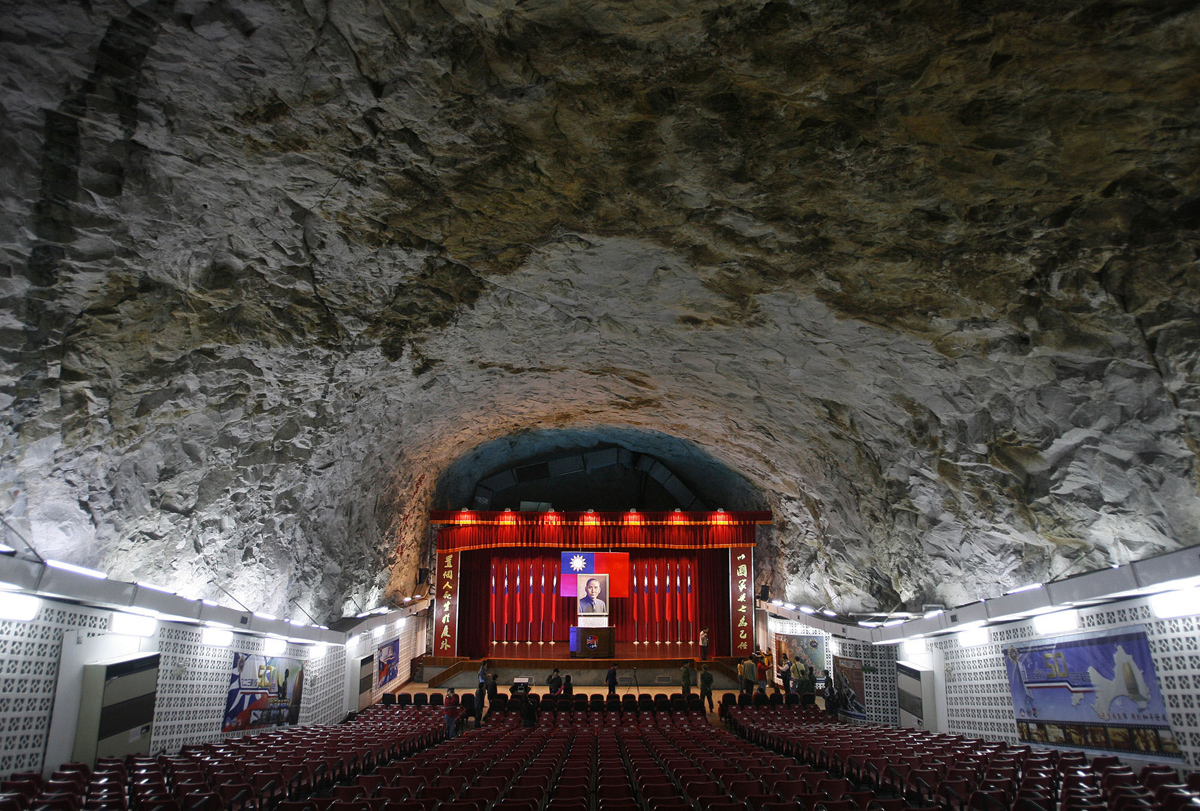
The island of Taiwan, governed by the Republic of China (ROC), lies about 100 miles (161 kilometers) east of mainland China, across the Taiwan Strait. Taiwan also administers a number of smaller islands known as the Kinmen archipelago, or Kinmen County. Great Kinmen Island and its neighbor islets are on the other side of the strait, in a harbor just east of the port city of Xiamen, practically surrounded by the People’s Republic of China (PRC)—in some places barely more than a mile apart. Back in the 1950s, the islands were heavily shelled during the two Taiwan Strait Crises—military clashes between the PRC and ROC. The small islands were heavily fortified against bombardment and invasion, with barricades placed on beaches, artillery emplaced on hillsides, massive tunnels dug to shelter troops, and concrete walls of loudspeakers built to blast propaganda across the water. Reuters reports that today, the island of fewer than 129,000 residents is “eyeing closer commercial ties with China,” wanting to pipe water from Xiamen, and “has plans to build a bridge and set up a glittering free trade zone with the city,” as China continues to seek unification with Taiwan under the “one country, two systems” model practiced in Hong Kong and Macau.
The Chintien hall, inside a cavern, is seen inside the Chintien military base in Kinmen County, on November 25, 2008. Kinmen, which means “Golden Door” or “Golden Gate," is a small archipelago of several islands administered by Taiwan and located near Xiamen, China—no more than 2 kilometers (1.2 miles) away. The island was the site of extensive shelling between Communist and Nationalist forces during the first and second Taiwan Straits Crises. The hall was built as a shelter for military commanders to safely give instructions to soldiers during the shelling from the Communists.
(Nicky Loh / Reuters)
Robotic probes launched by NASA, the European Space Agency (ESA), and others are gathering information all across the solar system. We currently have spacecraft in orbit around the Sun, Venus, Earth, Mars, Ceres, a comet, and Saturn; two operational rovers on Mars; and a recent close flyby of Pluto and its moons. Astronauts aboard the International Space Station are still performing experiments in low Earth orbit and sending back amazing photos. With all these eyes in the sky, I’d like to take another opportunity to put together a recent photo album of our solar system—a set of family portraits, of sorts—as seen by our astronauts and mechanical emissaries. This time, we have closeups of Pluto and of Comet 67P/Churyumov-Gerasimenko, a closer look at bright spots on dwarf planet Ceres, several eclipses, wonderful images of Saturn and its moons, and, of course, lovely images of our home, planet Earth.
The far side of the moon, illuminated by the sun as it crosses between the DSCOVR spacecraft’s Earth Polychromatic Imaging Camera (EPIC) camera and telescope, and the Earth, one million miles away, in a NASA image taken on July 16, 2015. The lunar far side lacks the large, dark, basaltic plains, or maria, that are so prominent on the Earth-facing side, NASA said in a news release.
(NASA / NOAA / Reuters)

![Synthesis of [18F]Fluoroarenes by Nucleophilic Radiofluorination of N‐Arylsydnones](http://onlinelibrary.wiley.com/store/10.1002/anie.201707274/asset/image_m/anie201707274-toc-0001-m.png?v=1&s=323ac7e88e277a88fd4f8d9f8bfde4627701d615 "Synthesis of [18F]Fluoroarenes by Nucleophilic Radiofluorination of N‐Arylsydnones")





 Hot DMMN: A carbon-bound electrophilic CN source, dimethylmalononitrile (DMMN), undergoes transnitrilation with aryl boronic acids. Compared to other cyanating reagents, DMMN is stable, safe, and commercially available. This novel rhodium-catalyzed process tolerates various functional groups, thus making it a practical method to access aryl nitriles.