Cowboy Who?
Shared posts
Retail News: Walmart Drone delivery arrives in Houston
Houston LULAC council cancels 2026 Cinco de Mayo parade over ICE concerns
This is so depressing! This is like something out of Mike’s youth.


This is so depressing! This is like something out of Mike’s youth.
DOS Memory Management
The memory management in DOS is simple, but that simplicity may be deceptive. There are several rather interesting pitfalls that programming documentation often does not mention.
DOS 1.x (1981) had no explicit memory management support. It was designed to run primarily on machines with 64K RAM or less, or not too much more (the original PC could not have more than 64K RAM on the system board, although RAM expansion boards did exist). A COM program could easily access (almost) 64K memory when loaded, and many programs didn’t rely on even having that much. In fact the early PCs often only had 64K or 48K RAM installed. But the times were rapidly changing.
DOS 2.0 was developed to support the IBM PC/XT (introduced in March 1983), which came with 128K RAM standard, and models with 256K appeared soon enough. Even the older PCs could be upgraded with additional RAM, and DOS needed to have some mechanism to deal with that extra memory.
The DOS memory management was probably written sometime around summer 1982, and it meshed with the newly added process management functions (EXEC/EXIT/WAIT)—allocated memory is owned by the current process, and gets freed when that process terminates. Note that some versions of the memory manager source code (ALLOC.ASM) include a comment that says ‘Created: ARR 30 March 1983’. That cannot possibly be true because by the end of March 1983, PC DOS 2.0 was already released, and included the memory management support. The DOS 2.0 memory management functions were already documented in the PC DOS 2.0 manual dated January 1983.
In PC DOS 2.0, three memory management functions were introduced: ALLOC (48h), DEALLOC (49h), and SETBLOCK (4Ah). The DEALLOC function may be better known as “free” and SETBLOCK as “resize”. The all-caps names are used in the actual DOS source code.
Structure
The memory managed by DOS (the “memory arena”) starts out as a single contiguous block. It begins just past the end of statically allocated memory and ends at the end of conventional memory. The available memory can be subdivided into smaller blocks through allocation. After a number of cycles of allocating and freeing memory, the available memory may be split up into a relatively large number of blocks, often a mix of free and used memory.
Each block of memory is prefixed by a header. Note that in the DOS source code, this is called an “arena header”. In third party literature, it is usually called a “memory control block” or MCB. This article will use the MCB terminology.
First of all, DOS manages memory in units of paragraphs (16 bytes), not individual bytes. This approach is derived from the segmented 8086 architecture. Managing memory in paragraph units allows DOS to use 16-bit quantities to record the starting address and size of each block. In addition, the starting paragraph address is also implicitly the segment address of the block. Note that due to tracking sizes in terms of paragraphs, DOS memory blocks are not limited to 64K.
The MCB by necessity takes up an entire paragraph, even though only 5 bytes were initially used; the following is an excerpt from MS-DOS 2.11 DOSSYM.ASM:
;
; arena item
;
arena   STRUC
arena_signature     DB  ?               ; 4D for valid item, 5A for last item
arena_owner         DW  ?               ; owner of arena item
arena_size          DW  ?               ; size in paragraphs of item
arena   ENDS
The signature byte is ‘M’ for all memory blocks except the last one, with the last block using a ‘Z’ signature. Perhaps ‘M’ stands for “memory” and ‘Z’ for “last” (block), or perhaps MZ are the initials of Mark Zbikowski, one of the core developers of DOS 2.0.
The DOS memory management functions check the signature of each MCB they work with. If it’s not ‘M’ or ‘Z’, an error is reported–and if that happens, all bets are off because something in the system corrupted memory, and nothing can be trusted anymore.
The owner of a memory block is a 16-bit word. It is set to zero to indicate a free block. A non-zero value is normally the PID (process identifier) of the owner, that is, the address of the PSP of the owning process. This is important when a process terminates, because DOS automatically frees all memory blocks that the process owned. Note that DOS performs no validity checks on the owner; any process can free or resize any block, regardless of who owns it, and the MCB owner need not be a valid PID.
The size is simply the size of the memory block in paragraphs, in theory up to (almost) 1MB.
The entirety of the memory managed by DOS is described by a chain of MCBs. The start of the chain is located through the arena_head variable within DOS. Each memory block is immediately followed by the MCB describing the next block, except for the last block in the chain (with the ‘Z’ signature) which has no follower.
The MCB chain acts somewhat like a linked list, but it is not a linked list. Instead of using some kind of a link pointer to the next item in the chain, the chain structure is implied by the location and size of the memory blocks. The memory blocks can only be processed in strictly ascending order and there cannot be any gaps between them.
Functions
The DOS memory functions are simple enough. The ALLOC function takes the desired size in paragraphs, and either returns a pointer to newly allocated memory in the AX register, or returns an error code in AX and the size of the largest free block in the BX register.
DOS programs often call ALLOC twice, first attempting to allocate FFFFh paragraphs, which will fail and return the maximum available size. The available maximum is then allocated in the next ALLOC call. Because DOS isn’t a multi-tasking OS, this simple approach reliably works.
A successful ALLOC returns returns the segment address of the newly allocated memory block in register AX, and the paragraph immediately preceding the allocated memory contains the block’s MCB header.
The DEALLOC function is very simple, only setting the block’s owner to zero to mark it as free.
The SETBLOCK function is somewhat like realloc() in the Standard C library, but never moves the allocated block. Resizing a block to the same or smaller size will always succeed, and will free up the remaining memory. Resizing to a larger size may fail, and if it does, the maximum available size will be returned in the BX register (just like when allocating).
Coalescing
An important feature of the DOS memory manager is coalescing of free memory, i.e. merging adjacent free memory blocks.
If a program successfully calls the ALLOC function twice, it will often own two adjacent memory blocks. If it then calls DEALLOC on each block, there will be two adjacent free memory blocks. When allocating memory again, these free blocks somehow need to be coalesced so that the free memory wouldn’t become endlessly fragmented.
DOS uses a simple strategy which will always coalesce free blocks when necessary. It works as follows:
- The DEALLOC function performs no coalescing whatsoever.
- The SETBLOCK function will coalesce all free blocks that immediately follow the memory block being resized (even if the new size is the same or smaller).
- The ALLOC function processes the entire MCB chain and coalesces all free memory blocks that can be coalesced; this ensures that ALLOC always finds the largest available free block.
Naively one might think that the DEALLOC function is a good time to coalesce, but it’s not. If two adjacent blocks are freed, and the block higher in memory is freed last, coalescing can’t be done because DOS cannot reach the previous (lower in memory) MCB, only the next one.
The ALLOC function does the heavy lifting, but that is inevitable: Only by walking the entire MCB chain can DOS coalesce all eligible memory and ensure that the largest free block is found. This means that calling the ALLOC function can be somewhat expensive if the MCB chain is long. In practice, there are unlikely to be more than a few dozen MCBs, even in a heavily loaded system.
Caveats
Now we come to the less obvious aspects of DOS memory management. Some are inevitable, some are strange, some are really bugs.
It is possible to have zero-sized memory blocks (i.e. blocks consisting solely of an MCB header). The ALLOC function does not refuse to allocate zero-sized blocks. In addition, zero-sized blocks may be inevitably created in the course of calling other functions. For example, if an existing allocation is resized to be exactly one paragraph smaller, DOS will be forced to create precisely such a zero-sized MCB.
The SETBLOCK function always sets the MCB owner when it succeeds. That is, a DOS process may resize any existing memory block, regardless of who owns it, and become the owner. If the resizing succeeds (and resizing to the same or smaller size always will), the calling process will become the owner of the block. Obviously, resizing memory blocks owned by other processes is a risky business.
It is possible to use SETBLOCK on a free memory block. Programs obviously should not be doing that, because they do not own free memory. However, DOS makes no attempt to prevent such calls. In addition, thanks to the surprising behavior noted above, successfully calling SETBLOCK on a free memory block will effectively allocate it.
When the SETBLOCK function fails because the requested size was too large, it returns the maximum available size that the block can be resized to. However, DOS already resized the memory block to that maximum available size. This is almost certainly a bug, one that Microsoft didn’t dare fix in later DOS versions.
DOS 2.11 Enhancements
In MS-DOS version 2.11, Microsoft added a memory management tweak which was never documented until much later. Note that this change was not in PC DOS 2.1, but was naturally included in PC DOS 3.0.
In MS-DOS 2.11, there is a new INT 21h function called AllocOper (58h). It allows the caller to set or get the memory allocation strategy. The available options are usually referred to as “first fit” (0, the default value), “best fit” (1), and “last fit” (2).
When the ALLOC function scans the entire MCB chain and coalesces memory, it makes a note of the first (lowest) free memory block that is big enough to satisfy the allocation, the last (highest) free memory block that is big enough, and also the smallest (best) memory block big enough to satisfy the allocation.
Obviously these are not necessarily three different blocks. Two or even all three of the possible allocation options may well be the same block, especially if the number of free memory blocks is low.
Note that INT 21h/58h was not documented in official Microsoft programming references for DOS 2.x, 3.x, and 4.0. The DOS 5.0 reference does document AllocOper, but claims that it was added in DOS 3.0, which is not quite true.
DOS 5.0 Enhancements
The DOS memory management saw very minimal changes from version 2.11 up to and including DOS 4.0. DOS 5.0 brought somewhat significant changes related to UMB support.
When DOS 5.0 and later runs with DOS=UMB, there will be not one but two memory arenas (assuming that UMBs are actually available). The AllocOper function (58h) was significantly extended to support UMBs.
In addition to the first/best/last fit allocation strategy introduced in DOS 2.11, DOS 5.0 introduces three additional strategies, each of which is combined with the first/best/last fit strategy:
- Allocate from conventional memory only (backward compatible)
- Allocate from UMBs first, then from conventional memory
- Allocate from UMBs only
In addition to supporting new memory allocation strategies as controlled by INT 21h/58h subfunctions 0 and 1 (get and set allocation strategy, respectively), DOS 5.0 also added new subfunctions 2 and 3. These allow the caller to query (subfunction 2) or set (subfunction 3) the UMB link.
That is, DOS 5.0 can either link or unlink UMBs from the standard memory chain (in conventional memory). To allocate memory from UMBs, a program must both set an allocation strategy which looks at UMBs and link the UMBs to the pool of available memory.
Note that the allocation strategy and UMB link setting are both global DOS state, not per-process. A DOS program which changes either the allocation strategy or the UMB link state should restore the original setting before it terminates, at least according to the MS-DOS 5.0 Programming Reference.
Summary
Although DOS memory management is in principle very simple, users may find some of its behaviors surprising. The addition of UMB support in DOS 5.0 made DOS memory management noticeably less simple than before, although only TSRs and drivers tend to worry about upper memory.
Pentagon mistakenly brings down Border Patrol drone in West Texas, lawmakers say
wire
wire
mono
![[img]:reulra](https://analognowhere.com/_/reulra/reulra.png)
hair is made of walls that are made of wires
Saturday Morning Breakfast Cereal - Pulley
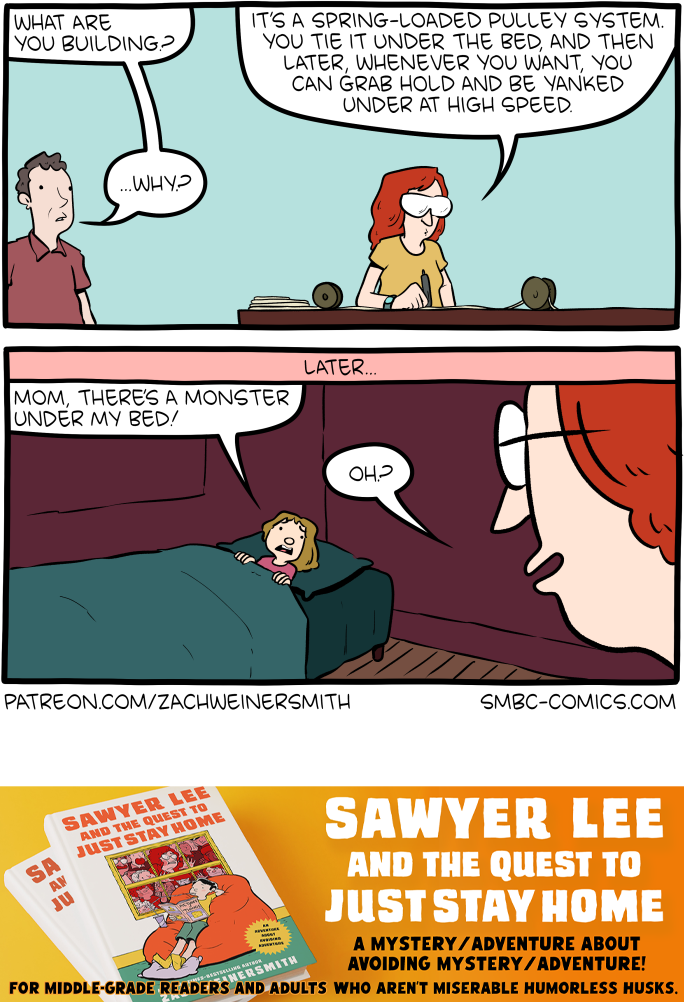
Click here to go see the bonus panel!
Hovertext:
You should've seen the look on your face when you thought you'd gotten your mom killed!
Today's News:
A total lunar eclipse to turn the moon blood red on Tuesday across many continents

Epstein Files Reveal Deepak Chopra Still Lost On Little St. James
WASHINGTON—Amid shocking materials that include a photo in which the word ‘HELP’ has been spelled out with rocks, seaweed, and several stuffed animals, a newly released tranche of Epstein files revealed Friday that Deepak Chopra was still lost on the private island of Little St. James. “From what we can gather, Chopra has been deliriously wandering the now largely uninhabited Epstein Island for years, crying out for food and forbidden eros,” said independent analyst Gina Mosley, adding that the alternative medicine guru had sent hundreds of urgent emails pleading for rescue and the sweetest sensual delights, and most recently had been seen looking sunburned and emaciated as he loaded a flare gun atop a large nude statue of the Greek deity Zeus. “He’s even kept a kind of video journal where he vacillates between saying tearful goodbyes to his family, friends, and fans, and striking a more hopeful tone on the off chance a 13-year-old is still on the island.” Despite the extensive new disclosures, sources told reporters that there are currently no plans to bring Chopra home.
The post Epstein Files Reveal Deepak Chopra Still Lost On Little St. James appeared first on The Onion.
Artist Profile: Jelly Roll
Jelly Roll, the artist behind songs “Son Of A Sinner” and “Save Me,” has announced a 2026 tour. The Onion shares everything you need to know about the singer.
Birthplace: Walmart bathroom
Legal Name: Davidson County Inmate No. 248323
Genre: Country for people who don’t like music
Easily Identifiable By: Tattoo-shaped birthmarks on face
Common Lyrical Themes: Faith, Ozempic side effects
Vocal Style: Energy drink burp
Often Confused With: Michael Bublé
Pardoned By Tennessee Governor For: Cheating on wife
Grammy Wins: Somehow
Current Project: Writing next James Bond theme
The post Artist Profile: Jelly Roll appeared first on The Onion.
Prosthetic Hand Recipient Slowly Relearning To Lick Barbecue Sauce Off Fingers
COLUMBUS, OH—Speaking with an unflagging sense of hope despite the long, challenging road ahead of him, prosthetic hand recipient James Bratton told reporters Friday he was slowly learning to lick barbecue sauce off his fingers again. “I’m still getting the hang of moving my sauce-covered hand to my extended tongue, but once I struggled past the pain, I was able to suck a full dollop of Sweet Baby Ray’s off my pinky yesterday,” said Bratton, who thanked his wife and children for cheering him on every time he tried to slurp a bit of extra hickory flavor from his new silicone fingers and credited his nurses with helping him dunk his prosthetic hand in a bowl of barbecue sauce for extra licking practice. “I mean, right after the surgery, I had to rely on [my wife] Jessica to lick all the barbecue sauce off my new hand, which was, of course, very humbling. But I couldn’t be more pleased with my progress, especially after doctors warned that I might have to spend the rest of my life removing all condiments, pizza grease, and french-fry residues from my fingers with a napkin.” At press time, Bratton had asked reporters to excuse him as a physical therapist had wheeled a big platter of ribs into his hospital room.
The post Prosthetic Hand Recipient Slowly Relearning To Lick Barbecue Sauce Off Fingers appeared first on The Onion.
Lest We Forget the Horrors: An Unending Catalog of Trump’s Cruelties, Collusions, Corruptions, and Crimes: January 2026: Atrocities 658-730
Early in President Trump’s first term, McSweeney’s editors began to catalog the head-spinning number of misdeeds coming from his administration. We called this list a collection of Trump’s cruelties, collusions, corruptions, and crimes, and it felt urgent to track them, to ensure these horrors—happening almost daily—would not be forgotten. Now that Trump has returned to office, amid civil rights, humanitarian, economic, and constitutional crises, we felt it critical to make an inventory of this new round of horrors. This list will be updated monthly between now and the end of Donald Trump’s second term.
These lists, along with everything McSweeney’s publishes on this site, are offered ad-free and at no charge to our readers. If you are moved to make a donation in any amount or subscribe to our website’s Patreon, please do. This will help support this project and our other work.
ATROCITY KEY

– Constitutional Illegalities, Collusion, and/or Obstruction of Justice
– Environment
– Harassment, Bullying, Retribution, and/or Sexual Misconduct
– Lies and Misinformation
– Musk Madness
– Policy
– Public Statements and Social Media Posts
– Trump Family Business Dealings
– Trump Staff and Administration
– White Supremacy, Racism, Misogyny, Homophobia, Transphobia, and/or Xenophobia
December 2025
Main Index
Trump’s first term
January 2026
-
– January 1, 2026 – In an interview with The Wall Street Journal, Trump said that he takes a higher dose of aspirin than his doctors have recommended, blaming the higher dose for his visible hand bruises. He stated, “They say aspirin is good for thinning out the blood, and I don’t want thick blood pouring through my heart. I want nice, thin blood pouring through my heart. Does that make sense?” Trump gave the Journal the impromptu interview after learning they were working on a story about his health. Immediately after the piece was published, Trump lashed out on Truth Social, insisting that he was in “PERFECT HEALTH.” The Journal piece highlighted growing concerns about Trump’s health, like the swelling in his legs and his apparent dozing off during public events.
-
-
US Strikes Venezuela and Captures Maduro and His Wife. (AP)
-
-
-
-
-
– January 4, 2026 – The Guardian reported that thirty-two people died in ICE custody in 2025, the deadliest year since 2004. Seven of the deaths occurred in December alone, when the Trump administration detained a record number.
-
– January 5, 2026 – At an emergency UN meeting, American allies criticized the US incursion into Venezuela and the capture of Venezuela’s president Nicolás Maduro as violations of international law. The deputy French ambassador Jay Dharmadhikari, said the raid “chips away at the very foundation of international order” and “runs counter to the principle of peaceful dispute resolution and runs counter to the principle of non-use of force.” US allies Bahrain, Brazil, and Mexico also said the Trump administration violated the UN charter. “I am deeply concerned about the possible intensification of instability in the country, the potential impact on the region, and the precedent it may set for how relations between and among states are conducted,” said UN Secretary General António Guterres.
-
– January 5, 2026 – Defense Secretary Pete Hegseth began proceedings against Senator Mark Kelly, a retired Navy captain, that could result in a demotion of Kelly’s military retirement rank and cuts to his military pension. The proceedings were retaliation for a video Kelly released in November that called on service members to refuse illegal orders, an action that Hegseth called “seditious.” Hegseth also issued a “formal Letter of Censure” accusing Kelly of engaging in “a sustained pattern of public statements” over a six-month period that characterized lawful military operations as “illegal.” In the letter, Hegseth cited Kelly’s criticisms of him for firing generals and admirals and Kelly’s accusations that Hegseth had committed war crimes. Kelly responded, “My rank and retirement are things that I earned through my service and sacrifice for this country… Pete Hegseth wants to send the message to every single retired servicemember that if they say something he or Donald Trump doesn’t like, they will come after them the same way. It’s outrageous, and it is wrong. There is nothing more un-American than that.”
-
– January 5, 2026 – The CDC announced an overhaul of the childhood vaccine schedule, recommending that children get vaccines for eleven diseases rather than the previously recommended eighteen. Health and Human Services officials said the changes would restore trust in public health that was lost during the Covid pandemic. However, many doctors and public health experts rejected those claims. “The abrupt change to the entire US childhood vaccine schedule is alarming, unnecessary, and will endanger the health of children in the United States,” said Dr. Helen Chu, an infectious disease professor at the University of Washington. “It’s really the most significant weakening of childhood vaccine recommendations, I would say, in modern American history,” added Dr. Jake Scott, an infectious diseases specialist at Stanford Medicine.
-
“Obviously, Greenland Should Be Part of the United States”: Stephen Miller Doubles Down. (New York Post)
-
-
-
-
– January 6, 2026 – According to two anonymous sources close to the White House, Trump dismissed Venezuelan opposition leader María Corina Machado for the Venezuelan presidency because she accepted the Nobel Peace Prize, an award he had openly coveted. “If she had turned it down and said, ‘I can’t accept it because it’s Donald Trump’s,’ she’d be the president of Venezuela today,” said one of the sources, who called Machado’s acceptance of the prize the “ultimate sin” in the eyes of the administration.
-
-
-
A Close Examination of the Shooting of Renée Good. (Star Tribune)
-
-
-
-
-

 ALT
ALTTaylor Swift Pays Off Bride Who Booked Maid Of Honor She Wanted
NEW YORK—Doing everything within her power to ensure the big day would be absolutely perfect, pop superstar Taylor Swift paid off a bride who had booked the maid of honor she wanted, sources confirmed Friday. “I just really had my heart set on Lindsey,” said the multiplatinum recording artist who reportedly made a cash offer of $25,000 to convince the local bride to give up her best friend and sorority sister on Swift’s chosen wedding date. “I’m not trying to pressure you into anything, and ultimately the choice is yours. But if you do choose to accept, then I hope this can pay for a great honeymoon for you and a serviceable replacement maid of honor. Travis and I just think Lindsey would be ideal for a summer wedding in Newport. She’ll look beautiful in the pictures, especially with the flowers I have planned.” At press time, Swift had reportedly offered to lend the bride Sophie Turner.
The post Taylor Swift Pays Off Bride Who Booked Maid Of Honor She Wanted appeared first on The Onion.
No One At Combine Sure Who Told Prospects To Walk With Water Balloon Between Knees
The post No One At Combine Sure Who Told Prospects To Walk With Water Balloon Between Knees appeared first on The Onion.
17 measles cases reported in El Paso, including 13 at ICE detention facility


Lawmakers say U.S. military used laser to take down Border Protection drone in Texas


our employee is criticizing our sponsors on social media
A reader writes:
I oversee a public-facing department at a nonprofit. One of our long-time program managers is an oversharer. This includes on social media, where she has in the recent past criticized two of our sponsors in long Facebook posts, which included phrases like “Corporation X needs to get their crap together.” These were criticisms based on her personal experiences, not related to work (think complaining about the customer service at Corp X when she was shopping there). Yesterday, she followed up with more complaining during a program meeting that included clients.
I know she is connected to many of our volunteers and clients, as well as colleagues, on social media. She has also talks about promoting the program she manages on her personal accounts, so it’s clear to anyone following her that she is an employee. Our organization does not have any policies about social media use. Can I tell her to stop with the negative posts about sponsors and then hold her accountable, given her public-facing role? Should we instead create a policy about social media use that would ensure everyone in the company is getting the same message/equal treatment?
I answer this question — and two others — over at Inc. today, where I’m revisiting letters that have been buried in the archives here from years ago (and sometimes updating/expanding my answers to them). You can read it here.
Other questions I’m answering there today include:
- I don’t want to keep meeting with my business mentor
- Can I brush my teeth at work?
The post our employee is criticizing our sponsors on social media appeared first on Ask a Manager.
can I ask for a cost-of-living raise after I chose to move to a more expensive city?
A reader writes:
I’m a 32-year-old professional on a niche team for a large corporation and have been in my role for four years.
When I was interviewing, I was living in City A, a low-cost-of-living city that I really disliked. When I took my current job, they were clear that they allow my role to be performed from anywhere in the U.S., and I was hired at a salary consistent with my experience and then-geographic location.
About five months after starting, I moved to City B, a much-higher-cost-of-living city. My director told me that while my move was no problem logistically, I would not receive a pay increase for relocating, as the move was my initiative and the company didn’t care where I performed my work from. I agreed, because this made sense to me and I was desperate to get out of City A. Now, I’ve been in City B for a few years, received merit increases each year, and have only gotten good feedback from my team. I love my work, feel supported in my role, and see a real future for myself here. I also love living in City B and intend to stay here or a comparably-sized (and comparably-priced) coastal city long-term.
Despite all this, I can’t help but think about the fact that if I had just lived in City B at the time of hiring, I’d have started at a higher salary band based on my local cost of living and would certainly be making more each year. I get by alright, but am definitely not able to contribute to savings at the rate I should be and have no viable path to home ownership here with what I make. When I’ve seen comparable roles in my city advertised, they’re paying about 20% more than I make now.
Thinking about being here long-term, I worry that I’ll never really catch up to what I’d be making if I’d been hired while living here despite consistently receiving raises, but am not sure how to explain it to my higher-ups without sounding like A) I’m just being greedy or B) I’m reneging on the very clear conversation I had with my director when I moved, and am now expecting them to pay me more for a move I initiated.
I’m not sure at what point I should flag for them that while I want to stay here, I’m worried that doing so will keep my annual pay lower than it’d be if I applied elsewhere with a home address in a high-cost-of-living city. Is there a way to raise this conversation, or is this a lost cause since my job is a do-it-from-anywhere role and I chose to live someplace expensive? It feels like I’d be most easily able to bring this to a head if I got a higher-paying job offer from someplace else and brought it to my boss, but that feels risky, time-consuming, and like overkill when I don’t want to leave my job in the first place.
Any guidance is appreciated, even if that guidance is telling me that I’m being unnecessarily fixated on the “what ifs” of my salary. For what it’s worth, while my team has been fantastic, I am the youngest person by about a decade, the only woman, and the only one of my racial/ethnic background, all of which really seem to be compounding my stress about having an honest conversation about pay with my bosses.
I wrote back and asked more how cost-of-living pay normally works in the letter-writer’s company:
Generally, my company sets starting pay for people based on experience and the local market where they are living. If an employee transfers to a different location and begins working from an office there, their salary is updated for cost of living to make it competitive in their new local market. That didn’t apply to me because I work completely remotely and thus didn’t go through the whole office-transfer process when I moved.
Since my team is fully remote, I think there’s just not a clear policy that would address my situation. Most/all of the people on my team have lived in the same cities since they were hired and are settled there. When I moved after being hired, a few people noted that I was the first person they could remember to have moved a significant distance while on our team. So I think it’s not like they’re intentionally paying me less, mine just isn’t a situation that they’ve encountered recently.
It’s true that this isn’t something you could have raised just a few months after moving — when you’d clearly agreed that the move wouldn’t come with a pay raise since it was at your initiative rather than the company’s — but it’s been nearly four years. It’s more reasonable to revisit how your pay is structured now: you’ve been there a lot longer, your value has presumably increased significantly (you’d only been there five months when you first negotiated this!), and you’re thinking about what your future will look like long-term.
I would frame it this way: “Would Company consider a cost-of-living adjustment for me being in CityName? I know originally the plan was that my pay wouldn’t change when I moved, but now that I’ve been here a few years and I think have been contributing to the team at a high level, I’m hoping we can revisit my compensation. I’d love to stay with the company long-term and I also plan to be in CityName long-term. When I see comparable roles advertised here, they’re paying about 20% more than I make. My concern is that if I’d applied while living here originally, my salary would have been set higher from the start, and that difference will compound the longer I’m here.”
Again, it’s been four years and you’re more valuable to them now! It makes sense that you’re thinking about how and whether this can work for you long-term, and it makes sense that they would want to know how they can increase the chances of keeping you long-term. If your manager values you, they may be a lot more willing to work with you on this now than when you were only five months in.
They still might say no! That’s always a risk when you ask for a raise. But you won’t look greedy or out of line for asking.
The post can I ask for a cost-of-living raise after I chose to move to a more expensive city? appeared first on Ask a Manager.
intern won’t stop giving unsolicited “corrections,” I have bad breath and have to meet with clients, and more
It’s four answers to four questions. Here we go…
1. Intern won’t stop giving unsolicited “corrections”
We’ve been dealing with a troublesome intern. He keeps giving senior members of the staff unsolicited advice, corrections, and “tips” about everything from life lessons to ways for everyone to do their work. He’s been told many times that it’s inappropriate and that other members of the staff are uncomfortable with it but he keeps doing it. How, as a manager, can I deal with this situation without making it difficult for the intern? I’m afraid I will shatter his self-esteem as it seems fragile despite the over-confidence.
You’re not doing him any favors by dancing around it! Since softer conversations haven’t worked, the kindest thing you can do at this point is to be blunt and straightforward. Lay out clearly what he needs to stop doing, and don’t pull your punches when you say it. Otherwise he’s going to keep repeating the behavior at future jobs and it will impact him longer-term than it will at an internship. The whole point of interning is to learn this kind of thing when the stakes are lower than they will be later on.
If you’ve already been very direct and it’s still happening — i.e., you’ve given him clear directives to stop doing XYZ and he’s continuing it anyway — then you should reconsider keeping him on. Your job isn’t to protect his self-esteem at the expense of letting him aggravate everyone else.
Related:
our intern told us our ideas were boring and stupid
2. Is there anything worth saying to my manager after a coworker was laid off?
I work for a medium-sized company in an industry that has had a rocky few years. We’ve had two rounds of layoffs per year in the three years I’ve been there. The previous layoffs didn’t directly affect my team, which has historically been a little undersized compared to the amount of work it does.
But recently, one member of my four-person team was let go and my manager, grandboss, and great-grandboss all separately asserted that no further layoffs were planned (they say this after every layoff) and I am a valued member of the team (ditto), and asked me to share my feelings and any questions not related to immediate logistical needs.
I let them all know that I was personally bummed and professionally concerned but didn’t have any non-logistical questions, which seemed to fall a bit flat. I just … couldn’t think of anything to ask that they would be able to answer, and didn’t see any point in burdening them with the actual intensity of my feelings (very sad! extremely anxious!).
Are there any questions I could ask and expect a meaningful answer? Is there some etiquette around asking the non-meaningful questions anyway? I came out of all three conversations feeling like I’d missed the mark.
Most likely they were hoping you would ask things that they could give reassuring-sounding answers to, so they could feel confident that they had left you reassured. When you didn’t do that, it felt like the conversation “fell flat” because they were left to sit with the knowledge that you’re probably still uneasy. Which you presumably are! And which they shouldn’t be trying to reassure you out of unless they truly have extremely solid, insider knowledge that more layoffs aren’t going to hit your team. And maybe they do have that knowledge, but it’s very unlikely that there’s anything they could say on that front that you’d find believable; that’s just how it goes when a company has two rounds of layoffs per year for three years. The discomfort is theirs — because it’s an inherently uncomfortable situation — but it doesn’t need to be yours.
If you really wanted to ask something, you could have asked how you could be confident that more layoffs weren’t going to hit your area (which is probably what they were expecting you to ask) but the problem with that question is that you can’t put real weight on the answer. Maybe your remaining team is safe now and maybe they have a business explanation for why, but there’s no reason you should believe that, even if they say it, since it sounds like they offer false reassurances after every round of cuts.
3. I have bad breath and have to meet with clients
I have recently developed tonsil stones. While this is otherwise nothing more than a slight annoyance, it comes with the embarrassing symptom of truly horrifying bad breath. I’ve tried mints, gum, mouthwash, you name it. Nothing seems to make it go away completely. I’m in a public-facing role and I meet with clients and small groups throughout the day.
How would you handle this? Wear a mask? Live off of Altoids and hope it masks the odor? Be up-front and apologize? I cringe with embarrassment every time I have to be in close quarters with a client.
When someone feels self-conscious about something extremely noticeable, I’m normally a fan of just mentioning it so it’s out of the way (for example, this person who was in the middle of dental work and interviewing while missing several front teeth — ooh, and the first update ever published on this site was from someone in a similar situation), but for some reason with this I feel like it’s more likely to make the other person more uncomfortable than if you didn’t mention it. I’m curious to hear other opinions on that, though.
If you’re up for wearing a mask, that would almost certainly help. Alternately, yes, Altoids (or a similarly strong mint) right before or during a meeting. And can you arrange your chair so that you’re not as likely to be breathing right in their space? (Last, probably doesn’t need to be said, but talk to your doctor! Tonsil stones can be treated.)
4. Can we consider leaves of absences when deciding on raises?
My employer has an annual raise cycle that we’re coming up on where any employee who is meeting expectations is generally given a raise. They are merit-based in that employees who do not meet expectations in their annual performance review do not qualify, and managers get a budget of X% of their total team’s salary to divide among individuals as they deem appropriate. In the training for this year’s merit cycle, HR recommended that raises be prorated for hires during the year (reasonable, in my opinion) and for leaves of absence (outrageous, in my opinion).
Is this legal for them to do? It seems like it would disproportionately impact women taking leave to have children, and leaving it to manager discretion seems extra dicey.
Federal law says that employees who were on FMLA or parental leave for part of the year are entitled to any unconditional pay increases that cover that period (like if everyone is getting an X% raise), but when it’s performance based (e.g., dependent on productivity or meeting specific goals) employers are allowed to factor in time away from the job, as long as they do it equally for all types of leave. In other words, they couldn’t decide to prorate raises for people who were on maternity leave but not do the same thing for someone who was out on a different type of leave.
The post intern won’t stop giving unsolicited “corrections,” I have bad breath and have to meet with clients, and more appeared first on Ask a Manager.


Confusing Japanese Glory Hole Has Too Many Bells And Whistles
TOKYO—In a bathroom stall outfitted with a glowing panel of cartoon icons and a series of tubular suction gears that pulsed in choreographed sequence to a cheery welcome jingle, American tourist Trevor Willis acknowledged he was totally overwhelmed Thursday by a confusing Japanese glory hole with way too many bells and whistles. “Okay, so the screen is telling me to select my ‘pleasure style,’ and the options are a picture of a tulip, a volcano, and a trumpet…is there not just a normal blow-job button?” a baffled and sexually frustrated Willis said before he hesitantly chose the tulip, which prompted a nozzle to spray his groin with a spermicidal mist as a uniformed digital attendant appeared on a screen and politely instructed him to “Please reveal genitals and commence stimulation.” The attendant then reportedly gestured to what appeared to be some kind of ergonomic stirrups on the floor that Willis was apparently supposed to fasten himself into before inserting his erection into a heated, self-sanitizing penis slot. “Um, not sure if I’m doing this correctly. Definitely some sucking happening, but…uh, okay, now there is some very loud music playing. Maybe it’s to cover the sound of my moaning? Oh, God, this is stressful. And there’s a whole line of men neatly queued outside the door waiting for me to finish. I don’t even know if I can cum. Never tried to get off with an animation of a sexy mackerel flaunting its cleavage and giggling at me. And what—oh, fuck, what is happening? Something is coiling around my balls. It is definitely on my balls. I don’t like this at all.” According to sources, Willis eventually managed to reach climax, triggering an ejaculation-activated farewell ceremony in which animated characters on the screen bowed to him and a robotic arm emerged from the wall to shake his hand and congratulate him on his “successful emission.”
The post Confusing Japanese Glory Hole Has Too Many Bells And Whistles appeared first on The Onion.
Mother Who Went Missing In 2001 Found Alive
A mother in North Carolina who went missing while Christmas shopping 24 years ago was found “alive and well,” though she claimed she did not want to be contacted by her family. What do you think?

“Christmas and the following two and a half decades can be a stressful time.”
Joey Sauter, Sand Scooper

“Oh great, let’s hear what all the perfect mothers have to say about this.”
Missy Klippel, Unemployed

“She should at least give her family the Christmas presents she bought them.”
Corey Lesner, Figurine Purchaser
The post Mother Who Went Missing In 2001 Found Alive appeared first on The Onion.
DOJ Fails To Redact Thousands Of Secret Epstein Family Recipes | Onion News Network
The post DOJ Fails To Redact Thousands Of Secret Epstein Family Recipes | Onion News Network appeared first on The Onion.
Heated Rivalry fans unfamiliar with concept hockey players might be gross
TORONTO – Fans of the smash hit romance show Heated Rivalry, many of whom have also become fans of hockey, are expressing confusion at the discovery that the overwhelming majority of real life hockey players are problematic boorish creeps. While viewing a widely-shared video of the U.S. Men’s hockey team on a phone call with […]
The post Heated Rivalry fans unfamiliar with concept hockey players might be gross appeared first on The Beaverton.
“Pierre is the Conservative Party’s Justin Trudeau” reads tearful Poilievre in CPC men’s room
“I used to say Conservatives weren’t funny, but now I’m changing my mind. That’s a savage burn.” This week Ian and the Panel (Megan MacKay, Nile Séguin, and special guest Andrew Ivimey of Talk From Superheroes) talk about Carney’s latest floor-crosser, the NDP debate that apparently just happened, Trump’s gross call to the US men’s […]
The post “Pierre is the Conservative Party’s Justin Trudeau” reads tearful Poilievre in CPC men’s room appeared first on The Beaverton.



HULL OR HIGH WATER begins Monday

A new story begins on Monday. Where is Glenn? I am sure this cover reveals almost nothing. Can you believe this will be the 17th chapter of Solver? I can, because the folders I keep the artwork in are all numbered. Only two chapters left to go and Solver volume 2 will be complete.
The whole issue will be downloadable in PDF format for my Patreon subscribers on Sunday.
The post HULL OR HIGH WATER begins Monday appeared first on Bad Machinery.