Cowboy Who?
Shared posts

Don't give me that! You have no idea who you're...
Don't give me that! You have no idea who you're dealing with here! #CowboyWho


Good morning, Mr. Wendell J. Rossmore!

Good morning, Mr. Wendell J. Rossmore!
Coleman Francis actually had a staff for this movie? I can’t believe it!

Coleman Francis actually had a staff for this movie? I can’t believe it!
It was a long and hard campaign, yet we emerged victorious! We tamed the Beast of Yucca Flats!

It was a long and hard campaign, yet we emerged victorious! We tamed the Beast of Yucca Flats!
We rallied ‘round the Coleman Francis cry, I’M CHEROKEE JACK. We took the worst they had to offer, and we say proudly, COFFEE? YES, I LIKE COFFEE.

what happens when someone recognizes your letter to an advice column?
It’s the Thursday “ask the readers” question. A reader writes:
I’m a longtime reader and huge fan of Ask a Manager. I wondered if you’ve ever done a column about people who were busted as writing in — people whose coworkers, boss, family, or friends read a post and realized the author was someone they knew.
I have not, although I know of a few times when it’s happened: If you remember the manager whose best employee quit when she wasn’t allowed to go to her college graduation, the employee herself recognized the letter years later and wrote in, one of the other interns fired for writing a petition about the dress code wrote in a year later, and someone who thought they were a coworker of the person angry about cheap ass rolls also wrote in. There was also a letter-writer who was pretty sure that her employee was having an affair with a married coworker, but wasn’t sure if she knew that the guy was married — and the employee in question saw the letter on the manager’s screen. I’ve also occasionally heard privately from someone who says, “I think I’m in the office where this is happening, and here’s the other side of the story.”
I will say that sometimes people think they recognize a situation and they’re wrong (there’s a key detail that’s different) or the situation happens enough that they couldn’t possibly know it’s theirs. And generally I want people to feel comfortable writing in here without having to worry that people will try to guess who they are! But it’s an interesting topic, so let’s open it up for the comment section!
The post what happens when someone recognizes your letter to an advice column? appeared first on Ask a Manager.
update: my new team thinks they’re incredibly overworked, but they actually do nothing
Remember the letter-writer whose new team thought they were incredibly overworked, but they actually did nothing? Here’s the update.
I wanted to send an update as many of the commentators had requested one. I was the person who wrote about the team that spent all their time reading books and organizing their record collections, and yet kept insisting they were Really Very Busy.
Alison’s advice was spot-on — I was only there on a temporary basis, so I decided to just enjoy the madness as a casual observer before I went back to my permanent role.
There was a lot of discussion in the comments as to why the team was behaving the way they were, and some of the commentators had great insights. A couple of things that might provide context:
– The job that the team does is the sort of job that would have genuinely been quite demanding in the days before smartphones. Without giving too much away, the basic task is supporting colleagues in the field (imagine police officers or the military). So things like iphones, Google maps, and group chats have taken a lot of those tasks away, and the people in the field are now broadly very independent from the people in the office. So I think maybe some of the team’s attitude was a hangover from the old days?
– We work in an industry that’s usually very competitive and fast-paced. A few people in the comments wondered if that might have something to do with it and I think on some level it did (it was almost as though they thought they ought to be busy, without considering whether they actually were).
– It started to become apparent after a few months that it was management which was significantly adding to the problem. They were OBSESSED with coverage — bringing in four workers when one would do, refusing leave requests because two out of 20 people were already off, etc. It actually got really depressing because I started missing events in my personal life just to be dragged into the office to do nothing, on the basis that “we won’t cope without you.” I really think that management hold a lot of responsibility for the current situation, as the team seem to be feeding off that “coverage anxiety.”
One thing I did appreciate was it gave me a lot of time for my own projects. I worked on several pitches for things I really wanted to do, and was successfully given a lot of opportunities in the wider company.
But aside from that, the really big thing was that it helped me get over my work anxiety. I’ve been guilty in the past of not setting the right emotional boundaries — the mindset of “I’m lucky to have a job,” as opposed to “money is exchanged for goods and services.” Working somewhere that I really didn’t care about helped cure me of that. I started putting my career ahead of my job and focussing on what would help me succeed in the long-term, as opposed to just working hard for my boss. De-centering my job from my career has completely changed my life — and for that reason, I’m very grateful for my time with the Team That Work Forgot!
The post update: my new team thinks they’re incredibly overworked, but they actually do nothing appeared first on Ask a Manager.
digs about working from home, coworker doesn’t check references because “everyone just lists their friends,” and more
It’s four answers to four questions. Here we go…
1. How can I manage digs about remote working and return-to-office?
I’m a woman in my 60s, and before Covid I was doing a long, multi‑leg commute five days a week. Working primarily from home has dramatically improved my health, energy, productivity, and ability to manage everyday life. However, now my workplace is requiring us to be in the office more, and I’m not sure how to handle a few friends who make unsupportive comments about it. Most of my friends understand and are considerate, but a small group repeatedly dismisses my concerns.
They tell me to retire, “suck it up,” or insist that office work is better for collaboration and socializing, even though that doesn’t reflect the reality of my workplace. And the commute is the biggest factor, and they know it.
What makes this more frustrating is that these particular friends either don’t work at all or are self‑employed and mostly work from home themselves. Yet they expect me to accommodate plans that would require me to leave work early, travel late at night before early office days, or take time off. They’re unwilling to adjust plans or meet halfway, and their comments often include digs about people “slacking off” or mothers (not parents) doing school pickups. If I did resign, and took the financial hit while job‑hunting, I doubt they’d adjust their expectations or activity choices to accommodate my new budget.
I’ve tried explaining the real impact that increased commuting has on my health, time, and finances, and that I can’t reduce the burden without taking a significant financial hit. I’ve corrected misconceptions, avoided the topic, and changed the subject when they bring it up, but the comments continue. I now even dread being asked what days I’ll be in the office, because what used to be a simple scheduling question reliably turns into a rant about remote workers. I sometimes feel tempted to snap back with something unkind, but I don’t want to go there.
I can distance myself from these particular friends if I need to, but it’s made me wonder how people who deal with similar comments from relatives manage it, especially when they want to maintain those relationships and genuinely enjoy family gatherings. They just want to show up and have a pleasant time without bracing for Uncle or Aunt X to take a dig at them. I’m looking for better ways anyone in this situation can respond when these conversations keep happening despite clear discomfort.
First, why is this group of friends so focused on this topic in the first place? If you’re the one bringing it up, you should stop — for whatever reason, they’re not the right audience for it — and if it’s them, tell them you need a break from it.
But also, they don’t sound like great friends. It’s one thing to make a few out-of-touch comments because they just haven’t thought it through, but if they’re the ones initiating the topic, you’ve explained the situation, and the comments haven’t stopped and they’re unwilling to adjust any plans to allow for the reality that you have an on-site job and a commute? The issue is the friends.
But with people you can’t escape, like family members, the easiest strategy is to avoid talking about work altogether, or quickly change the topic if it comes up. “Ugh, I can’t do any more work talk right now — tell me all about how the hemorrhoid surgery was” and “Yeah, what are you gonna do — so how are the kids doing?” should become your staples (even if — and perhaps especially if — there wasn’t actually any hemorrhoid surgery).
2. My coworker doesn’t check references because “everyone just lists their friends”
I’m a manager at a smallish firm (i.e., no dedicated HR team for hiring). A colleague of mine at the same level has a couple openings on his team, and in a recent conversation told me he “never checks references, because people always just put their friends down anyways.” Yikes!
I was caught off guard by his comment in the moment, and looking back I’m curious how you’d respond to this. I think some of the issue might be how he conducts reference checks in the first place — I’ve heard it’s best to ask open-ended questions about working style, or whether a candidate is more X or more Y, versus asking whether their skills are any good or other questions where you might just get a “oh yeah, they’re great!” kind of response. I’ve also heard it can be good practice to reach out to former (not current!) companies on a candidate’s resume directly to see if there’s any info they can provide outside the provided reference list. I’m lucky enough that my team has had very little turnover since I’ve been here (so it’s been a minute since I’ve had to check references), whereas my colleague is often hiring.
First, it’s categorically not true that most people just put down their friends. Most people don’t. Occasionally someone does, and a good reference checker screens for that by getting specific information about how the reference knows the candidate, what their role was when they worked together and how their jobs intersected, and how closely they worked together.
Second, I suspect you’re right that this guy hasn’t conducted effective reference checks, if he’s conducted them all. (And yes, you are also right about asking more open-ended questions, including ones that don’t make the “right” answer obvious.) He also sounds like he sees references as pass/fail, when in fact they should be a lot more nuanced than that; someone could receive a glowing reference that makes you realize they’re not actually the strongest match for the job you’re hiring for (such as a reference who raves about how fast-paced and entrepreneurial the person is when you need someone who will thrive in a job that requires a slower, more deliberate pace and adherence to a precise structure).
As for how to respond, you could talk to him about your own experience checking references and how you’ve found it helpful … or you might just show him this!
3. Should I let my great boss know I’m thinking about leaving?
I have a weird gift: pretty quickly I become the “right hand (wo)man” of my boss in every place I’ve worked. Generally, this means that they trust me, confide in me (not inappropriately, but they may share some behind the scenes information), rely on me for feedback about decisions that they’re thinking of making, have conversations with me about kids, life, etc. I think this stems both from the fact that I’m a pretty good conversationalist and generally provide solid analytical advice, and because I’ve never abused any trust so they know I won’t gossip about things I’ve learned from these conversations. In all those cases, I’ve genuinely liked my bosses, and it has created relationships that are partially friendship-based, with them going to bat for me whenever I needed it.
However, when I’ve decided to leave because I found a better opportunity that aligns with my career goals, all my bosses have had a hard time not being personally offended that I “dropped a bomb” on them. None of them were unprofessional about it, but they were clearly hurt and confused (like starting a sentence with “I can’t believe you didn’t talk to me first, we could have worked something out…”, only to realize what they said and backtrack to “I guess you can’t really share with your boss that you’re thinking of leaving”). In all those instances, even if I had shared my intentions with them, there was really nothing they could have done — my next professional step clearly involved leaving.
Now I’ve been at the same place for four years, and I’m looking into finding a more senior role (with higher compensation), which isn’t currently available where I am. My boss and I are very close, she pushes for me to get big projects and recognition within the company, trusts me as her inner circle, and would be blindsided if I left. While the role I am looking for doesn’t currently exist here, I’m not 100% sure that it can’t be created, if absolutely necessary. Do you recommend that I broach the subject of leaving with my boss before I find another job and announce that I’m leaving? The advantage would be to give her a chance to try and create the role that I want (with commensurate compensation) and avoid blindsiding her after many instances where she went above and beyond for me. Ideally, I’d love to be able to stay under such terms. The drawback of course, is showing my cards before I have an outside offer on the table. My understanding has always been that it’s usually not a good idea to get what you want by threatening to leave. How do I navigate this?
Yes, in a situation where you’re highly valued by your boss and have a strong relationship, it can make sense to put your cards a bit on the table. It’s not about threatening to leave; it’s about sharing with her that you’re starting to think about your next step and would love to be able to stay.
So the framing isn’t “I’m starting to job search and will leave if you don’t create a role for me a role doing ABC.” It’s more: “I’m starting to think about where I want my career to take me long-term, and I’m wondering if the company would ever consider creating a role like ABC. I would love to stay here long-term, and I think that work would benefit us in XYZ ways.” You don’t need to spell out “and I will leave if the answer is no” — she’s going to be able to read between the lines and understand what you’re saying.
Related:
how to ask my company to pay me more if they want me to stay
4. Is my boss BS’ing me about why a contractor is earning so much more than me?
My boss has put me on an infernal hellscape of a group project, and I am the only person regularly working on the project who’s on staff — everyone else is a contractor. One of the contractors, “Fergus,” was brought on to essentially be a second me. Our jobs on the project are extremely similar, though I have a few added responsibilities — let’s say we are both designing the product, sourcing materials for the product, and building the product, but I am also testing the product.
Fergus is currently negotiating his contract, and I just found out that he’s asking for $30,000 more a year than I’m currently paid. While it’s extremely unlikely that he’ll get that, I talked to some of our past contractors, and I think it’s quite likely that my boss will pay Fergus over $10,000 more per year than I’m paid, even though we will be doing the same job on this group project and I will also be expected to keep performing my other duties outside of the group project.
I talked to my boss about this and said that because Fergus and I have the same duties, I would expect to be paid at least as much as him. My boss said that negotiating around this was premature, since the group project is still in its early stages. However, he then added that contractors are often paid more than staff employees because they don’t get benefits and don’t “benefit from the predictability” of being a salaried employee somewhere.
Is this even a little bit a thing? I can’t say I trust my boss to be honest about this, and my benefits package is so small that even if I factored it in, Fergus would still be getting paid more than me. Also it’s not like Fergus is some super sought after rockstar who we have to pay a lot to retain—it really just seems like the going rate for contractors went up, and my workplace is avoiding raising salaries to match them. How would you suggest I negotiate around this?
This is 100% a thing! Independent contractors are typically paid significantly more than employees (often around twice as much) because they’re responsible for their own payroll taxes (including the employer portion that your company pays for you if you’re an employee), as well as not getting health insurance or paid time off. If they were paid the same as employees, their take-home pay after all those things were deducted would be significantly less than yours, and that’s before getting into inherently having less stability than employees. $30,000 more than an employee isn’t outside the norm.
You can still negotiate if you believe your work warrants more pay than you’re getting now. You just shouldn’t base it on what contractors are getting.
The post digs about working from home, coworker doesn’t check references because “everyone just lists their friends,” and more appeared first on Ask a Manager.
Saturday Morning Breakfast Cereal - Water
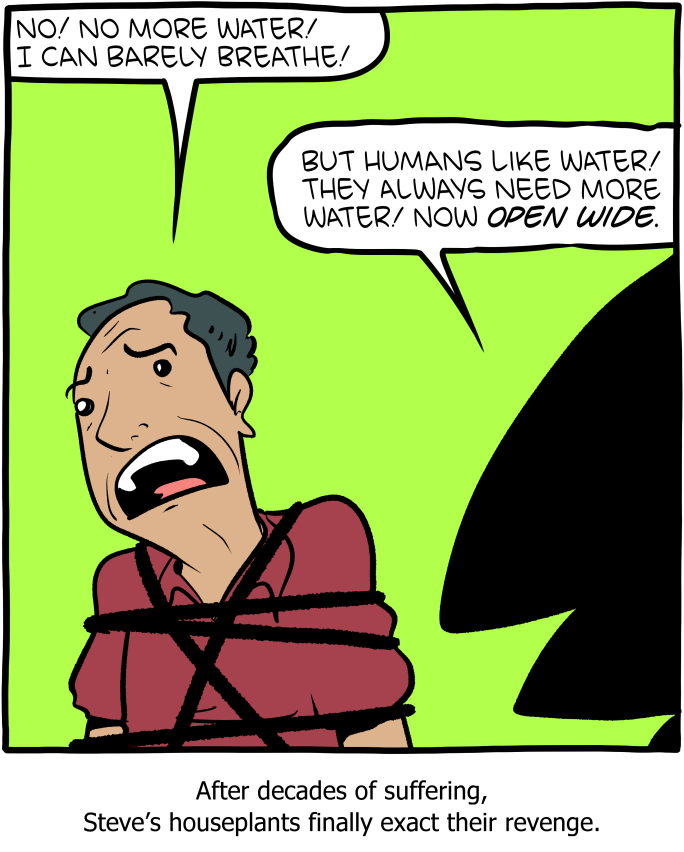
Click here to go see the bonus panel!
Hovertext:
Later, it puts him in a corner and forgets about him for six months.
Today's News:
Scientists may be overestimating the amount of microplastics in the environment – and the culprit is lab gloves
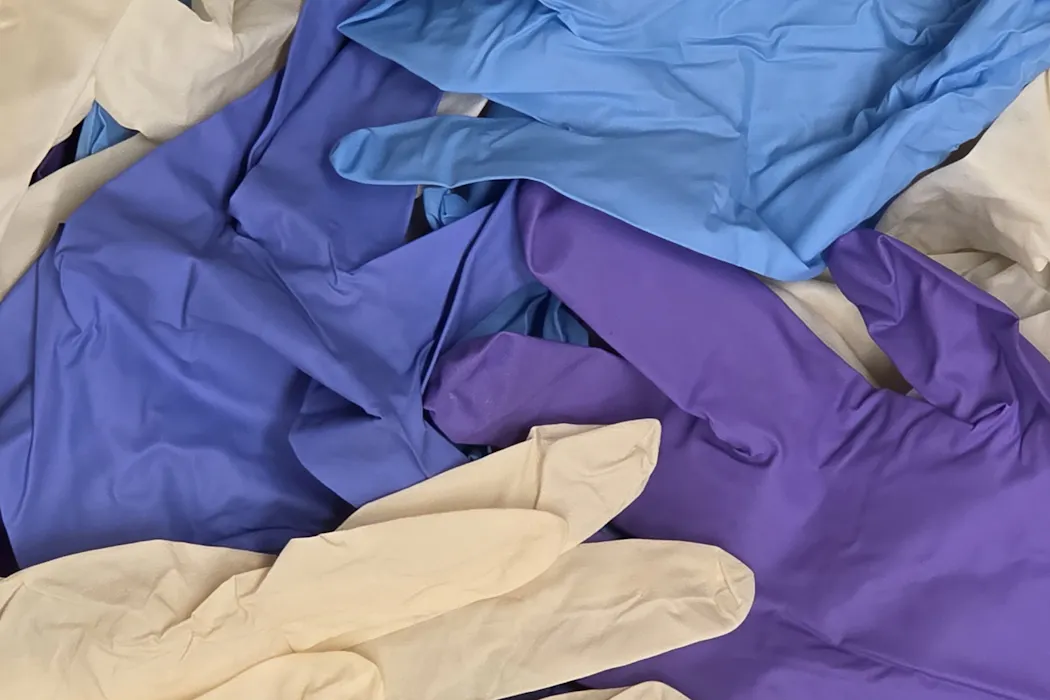
It seems like every day a new study finds tiny plastic particles called microplastics where they should not be: in our bodies and our food, water and air.
Yet finding and identifying microplastics is extremely challenging, especially given their small size. One microplastic can range from as large as a ladybug to as small as an eighth of a red blood cell.
In addition, it can be hard for researchers to avoid unintentionally contaminating their samples, because these plastics are practically everywhere. As a result, much of this research may be overestimating the number of microplastics.
In a new study published in March 2026, our team found that, even when following established protocols, using certain methods to measure environmental microplastics can potentially contaminate the results.
The study
We are chemists at the University of Michigan working in a collaborative team. We set out to understand how many microplastics Michiganders were inhaling when outside, and whether that depended on where they lived.
When preparing our samples, we followed all the standard protocols while conducting our research – we avoided plastic use in the lab, wore nonplastic clothing and even used a specialized chamber to reduce potential contamination from the laboratory air.
Despite these precautions, we found plastic counts in the air that were over 1,000 times greater than previous reports. We knew these numbers didn’t seem right, so what happened?
The culprit: Lab gloves
After a long path to pinpointing the contamination source, we found that laboratory gloves, which the scientific community recommends using as a best practice, can transfer particles to the surface of our samples – in this case, small metal sheets used to collect material depositing from the air. Moreover, the particles led to an overestimation of microplastic abundance in our study.
Here’s how: The particles, which we identified as stearate salts, are used to help the gloves cleanly release from their mold during the manufacturing process. When gloves are used to handle laboratory equipment, the particles are transferred to anything they touch. Stearate salts are similar to soap molecules – if you eat a lot of them, they’re probably not good for you, but they’re not harmful in the environment in the same way that microplastics are.
While not microplastics themselves, stearate salts are structurally similar to polyethylene, the type of plastic most often found in the environment. This structural similarity makes it difficult to distinguish them using the most common tools scientists use to determine whether a particle is plastic.
Researchers use vibrational spectroscopy to identify microplastics, which entails measuring how the particle interacts with light to produce what scientists call a chemical fingerprint.
Because polyethylene and stearate salts have very similar structures, they also interact with light in a similar way.
As a result, at least some of the time, the particles from gloves are incorrectly identified as microplastics. As more researchers rely on automated methods to speed up their analyses, glove residue may be increasingly mistaken for microplastics, leading to higher reports of microplastics in the environment than in reality.
How widespread is this contamination?
To investigate how prevalent this contamination might be, we looked at different glove types. We mimicked the touch between seven types of gloves while handling laboratory equipment and counted the number of microplastics we would incorrectly attribute to the environment if we followed the most common approaches.
We found that gloves can contribute over 7,000 particles per square millimeter that are misidentified as microplastics. This finding means that researchers could be unknowingly overestimating microplastic abundance in the environment when handling their samples with gloves.
Even more concerning, we found that the particles were largely less than 5 um in size. Microplastics in this size range have larger impacts on human and ecosystem health because they can more easily enter cells. By inflating microplastic counts in this size range, using laboratory gloves may jeopardize the studies that inform future policies and regulations.

Moving forward
To avoid contamination, we suggest scientists avoid glove use while conducting microplastic research. If that is not possible – for example, with biological samples where the researchers must wear gloves to protect themselves – we recommend a glove made without stearates, such as those designed for electronics manufacturing. To recover older, potentially contaminated datasets, we have developed methods to help differentiate the chemical fingerprints.
Science is an iterative process. New areas of research, including environmental microplastics, introduce new challenges to the scientific community. In addressing these new challenges, we will encounter setbacks, such as unforeseen contamination.
While we had to discard our initial dataset, we expect the lessons we learned about glove contamination to reach other scientists. In addition, we plan to continue our research on Michigan’s atmospheric microplastic contamination – but this time without gloves.
It’s important to note that even if the microplastic abundance in the environment is lower than researchers originally thought, any amount of microplastics can be troublesome, given their negative effects on human health and ecosystems.

Anne McNeil receives funding from the National Science Foundation, the Department of Energy, the Vinyl Institute, the University of Michigan, and the State of Michigan Economic Development Corporation.
Madeline Clough receives funding from the University of Michigan Rackham Graduate School and the University of Michigan College of Literature, Science, and The Arts. She is affiliated with the Michigan Microplastics Coalition.
Extreme drought expanding into Houston metro area with limited rainfall on the horizon
In brief: In today’s post we have some good news, and some bad news. Let’s start with the good. There are many, many outdoor activities this weekend in the Houston region, from sporting events to public gatherings. All of these should have fine weather. The bad news is that a drought that has been building all winter is starting to become acute.
A deepening drought
We’ve been talking about drying soils a lot here because the state of Texas, particularly the eastern half of the state, has had such a dry winter and start to spring. At the beginning of October, last year, just 23.6 percent of Texas was in a ‘moderate’ drought, and only 13 percent in a ‘severe’ drought. Those numbers today, respectively, are 84.5 and 55.5 percent.
For the greater Houston area the problem has been building this winter, but until recently was not acute. As days lengthen and warm up, that is now changing, and areas of ‘severe’ and an even worse category, ‘extreme’ drought now encroaching upon Harris County. Much of Chambers, Waller, and Fort Bend counties now find themselves in an ‘extreme’ drought.
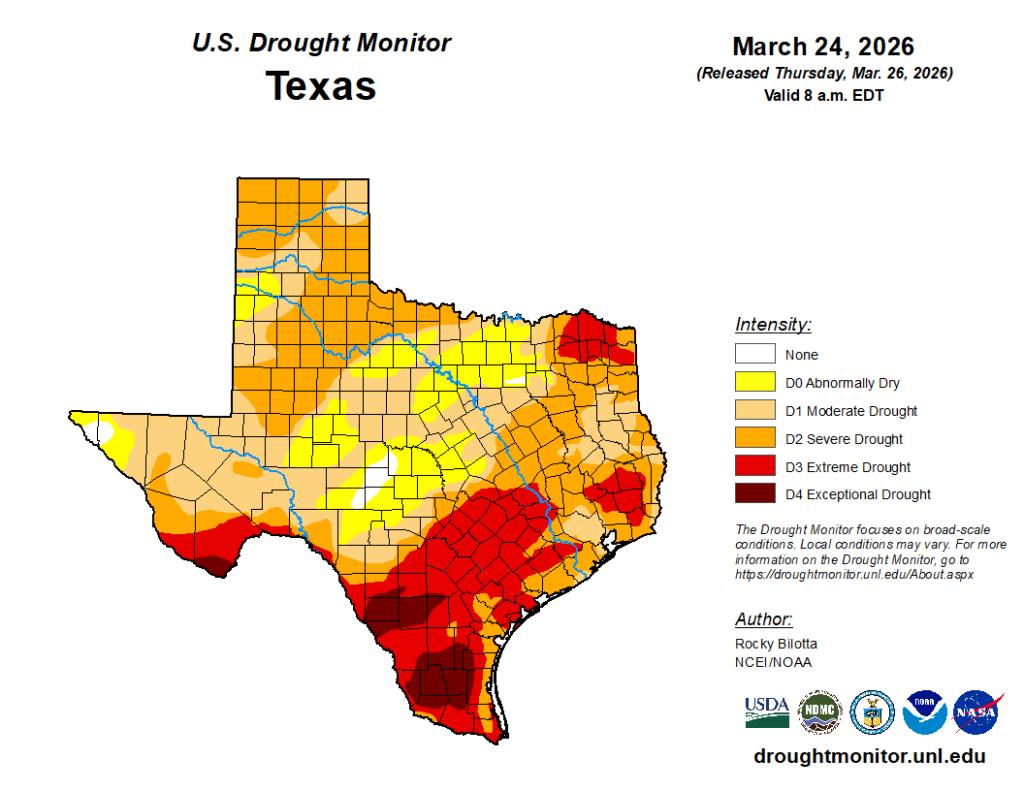
I am concerned about this because the next six months or so represents the warmest period of the year, with the Sun reaching a much higher angle in the sky, meaning that droughts develop much more quickly. Typically we see springtime rains in Houston (and don’t look now, but we’re only a couple of months from the opening of the Atlantic hurricane season), but for now the overall forecast shows no drought busters. No one wants flooding, of course. But we could use some rain events in the coming weeks.
Friday
Highs today should reach the mid- to upper-80s across the Houston area with mostly sunny skies. You know the drill as our weather has not changed much over the last week. It will be another mild evening. However conditions should begin to change tonight, likely around or after midnight, as winds shift to come from the north-northeast and bring in much drier air. As a result I expect temperatures to drop into the upper 50s by Saturday morning, with noticeably lower humidity.
Saturday
Saturday morning may see gusty winds up to about 25 mph, but these should start to fade by the afternoon hours. As for high temperatures, this will depend on the extent of any lingering cloud cover as skies will eventually turn fairly sunny. I expect highs will get into the mid- to upper-70s with low humidity. Saturday evening looks exceptional, and then most areas outside of the urban core should drop into the mid- to upper-50s on Saturday night. We know there are a ton, just a ton of outdoor activities from major sporting events to marches and parades this weekend, and the weather just looks exceptionally fine. (And if you took my long-standing advice for outdoor weddings in Houston, which is to hold them during the last two weeks of March, well done).

Sunday
Just as quickly as the front came in on Saturday, it’s likely to ease out on Sunday as the onshore flow resumes. Highs should reach around 80 degrees with mostly sunny skies and rising humidity levels. Lows on Sunday night will only fall into the low- to mid-60s.
Next week
We’re back into the mid-80s for much of next week, but there will be some overall changes to the forecast as high pressure recedes somewhat. At some point we’ll start to see partly to mostly cloudy days, and our nights will turn a little warmer and muggier (i.e. overnight lows drop to 70 degrees in Houston, rather than 65). By Wednesday or Thursday we’ll also finally start to see some slight rain chances enter the forecast.
As we get into next weekend, and remember Easter Sunday is then, rain chances may go up further. It’s still too fuzzy for confidence, but my sense is that we’ll see a stronger front trying to move through our region in 8 to 10 days, and that this will bring with it a healthier chance of more widespread rain. But whether this happens on Easter Sunday, or the day after (or heck, even not at all) remains impossible to say at this point.
For now, please enjoy what looks to be a fine weekend weather-wise in Houston.

Saturday Morning Breakfast Cereal - Cure
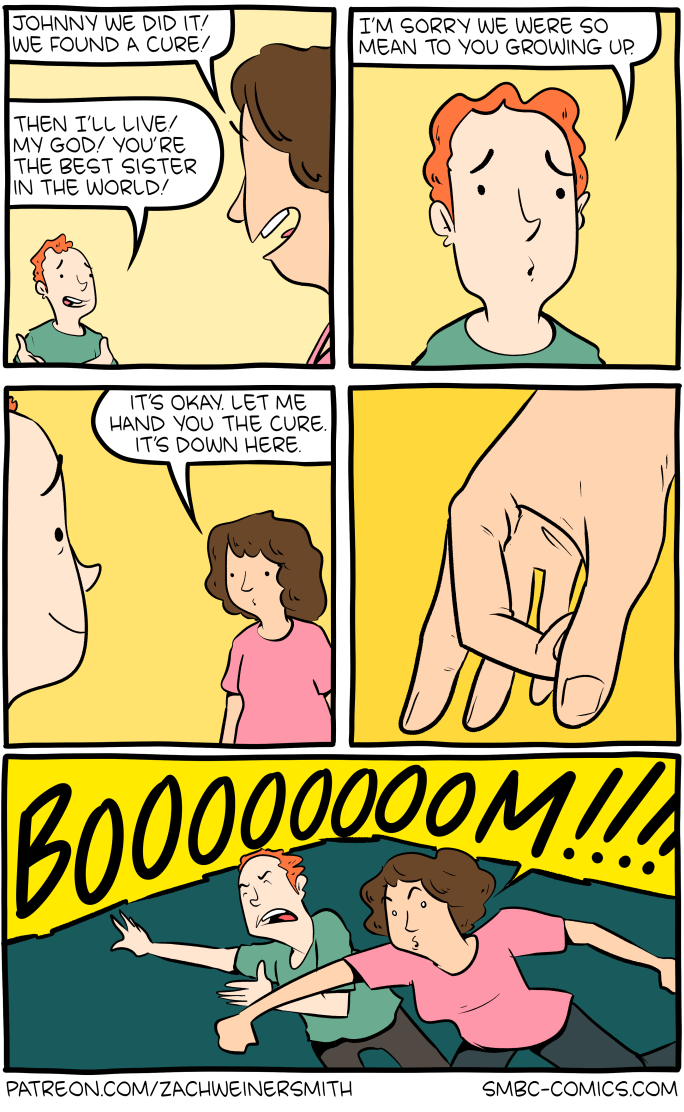
Click here to go see the bonus panel!
Hovertext:
Later, while he's crying on the floor she wedgies him without mercy.
Today's News:
Lest We Forget the Horrors: An Unending Catalog of Trump’s Cruelties, Collusions, Corruptions, and Crimes: February 2026: Atrocities 731-779
Early in President Trump’s first term, McSweeney’s editors began to catalog the head-spinning number of misdeeds coming from his administration. We called this list a collection of Trump’s cruelties, collusions, corruptions, and crimes, and it felt urgent to track them, to ensure these horrors—happening almost daily—would not be forgotten. Now that Trump has returned to office, amid civil rights, humanitarian, economic, and constitutional crises, we felt it critical to make an inventory of this new round of horrors. This list will be updated monthly between now and the end of Donald Trump’s second term.
These lists, along with everything McSweeney’s publishes on this site, are offered ad-free and at no charge to our readers. If you are moved to make a donation in any amount or subscribe to our website’s Patreon, please do. This will help support this project and our other work.
ATROCITY KEY


January 2026
Main Index
Trump’s first term
February 2026
-
-
-
Trump calls for Nationalized Elections. (Young Turks/YouTube)
-
-
-
-
-
President Trump Calls CNN’s Kaitlan Collins “Worst Reporter,” Says “I’ve Never Seen You Smile.” (New York Post)
-
-
-
-
Robert F. Kennedy Jr. Says Keto Diet Cured Schizophrenia and Bipolar Disorder (YouTube)
-
-
-
-
-
Hakeem Jeffries Directly Accuses Trump of Trying to “Steal” 2028 Election By Nationalizing It (Forbers/CNN)
-
-
-
“Outright Fascist”: Dan Goldman Interviews Acting ICE Director Todd Lyons. (Forbes)
-
-
SevenMoments Bondi Butted Heads with Lawmakers over Epstein (PBS NewsHour).
-
-
-
Think about it! With Professor Dave! #CowboyWho
Think about it! With Professor Dave! #CowboyWho

FREE GREENS! Turning an invasive plant into dinner 🍽️
I was craving creamed spinach and falafel, so I decided to let those cravings guide my cooking… you’ll have to be the judge of the results!
'No Kings' rallies draw crowds across U.S. and Europe as Springsteen headlines Minnesota demonstration

 ALT
ALT
Nation almost excited to see how bad Via Rail can get after Carney’s spending cuts
“It’s already running on old chewing gum and hope, so are we losing the chewing gum or the hope?” Luke and the Panel (Ian MacIntyre, Clare Blackwood and special guest Andrew Ivimey) recap Poilievre’s Joe Rogan experience, break down Carney’s dramatic spending cuts and dive into Trump’s latest attempts to end the War in Iran […]
The post Nation almost excited to see how bad Via Rail can get after Carney’s spending cuts appeared first on The Beaverton.
Poilievre returns to his emotional support culture war
OTTAWA – A leading psychologist says a distressed Pierre Poilievre is regressing emotionally and seeking a safe space in the culture wars by celebrating the Olympics ban of Trans and Intersex athletes. “This is a familiar behaviour for this personality type,” says Dr. Claire Scoville, a behavioural psychologist at the University of Calgary. “He’s in […]
The post Poilievre returns to his emotional support culture war appeared first on The Beaverton.
Trump Weighs Deploying 340 Million More U.S. Troops To Middle East
The post Trump Weighs Deploying 340 Million More U.S. Troops To Middle East appeared first on The Onion.
RFK Jr.: ‘I Am 6 Animal Penises Away From Curing Cancer’
WASHINGTON—To announce that his decades-long project to revolutionize modern oncology was nearing fruition, Health and Human Services Secretary Robert F. Kennedy Jr. held a press conference Friday in which he stated that he was only six animal penises away from curing cancer. “After major breakthroughs in obtaining the penises of a manatee, an armadillo, and a pygmy jerboa, I’m pleased to announce that my experimental anticancer elixir is mere weeks away from completion,” said Kennedy, adding that he expected the warehouse in which he stored thousands of unrefrigerated animal penises for his work to prove as significant to human civilization as the laboratory in which Alexander Fleming discovered penicillin. “Early death and painful chemotherapy will be a thing of the past as soon as I can get my hands on a Przewalski’s horse penis and a few others to complement the raccoon, marmoset, and blue whale penises I’ve already secured. Then it’s just a matter of stirring them together in a big pot and distributing this lifesaving medicine to hospitals across the country. I urge anyone who finds a roadkill echidna to contact me immediately so I can retrieve its penis before natural scavengers do. Millions of human lives hang in the balance.” At press time, witnesses reported seeing Kennedy dutifully raise a cleaver above his head after he realized the final animal penis he needed to end cancer was his own.
The post RFK Jr.: ‘I Am 6 Animal Penises Away From Curing Cancer’ appeared first on The Onion.
NASA To Build $20 Billion Moon Base
NASA will repurpose components from a scrapped space station to construct a $20 billion base on the moon’s surface over the next seven years, opting to focus on infrastructure that supports sustained operations on the lunar surface. What do you think?

“That $20 billion could be better spent building moon bases in disadvantaged communities.”
Irena McGrath, Resource Funneler

“I support anything that makes a good Popular Mechanics illustration.”
Tristan Winslet, Wiring Expert

“No way the moon’s zoned for that.”
Owen Blair, Microwave Optimizer
The post NASA To Build $20 Billion Moon Base appeared first on The Onion.
Olympics Bans Trans Athletes From Women’s Events
The International Olympic Committee banned transgender women from female events at the upcoming 2028 Los Angeles Olympics and future games, with the IOC also confirming that all athletes wanting to compete in the female category will have to undergo a one-off screening to detect their biological sex. What do you think?

“That should shorten future Joe Rogan episodes by about an hour and a half.”
Josue Corrales, Duct Installer

“The Olympics are just a social construct.”
Maggie Paulik, Carrot Pickler

“Take that, nuanced issue.”
Bo Luebben, Chipmunk Tamer
The post Olympics Bans Trans Athletes From Women’s Events appeared first on The Onion.
Color-Changing Pine Cookies & BOOK ANNOUNCEMENT 📣
Aye, you know you can make it! #CowboyWho
Aye, you know you can make it! #CowboyWho
