Shared posts

08 Apr 13:26

This Spillway Failed On Purpose

by Wesley Crump

[Note that this article is a transcript of the video embedded above.]

Hurricane Helene was one of the more unusual tropical storms to hit the United States. In late September 2024, it made landfall on the gulf coast of Florida as a Category 4 hurricane. We’re used to seeing storm damage on the coast from hurricanes, but this time the worst damage was hundreds of miles inland. As Helene tracked northward across the Appalachian Mountains, it dropped a deluge of rainfall, swelling rivers, destroying buildings, washing away bridges, and ultimately causing more than 250 deaths in the US. Places normally immune to tropical storms faced flooding worse than anything in recorded history, with some areas receiving more than three feet (or 900 millimeters) of precipitation. The worst of the rain was in a narrow band centered roughly on Asheville, North Carolina.

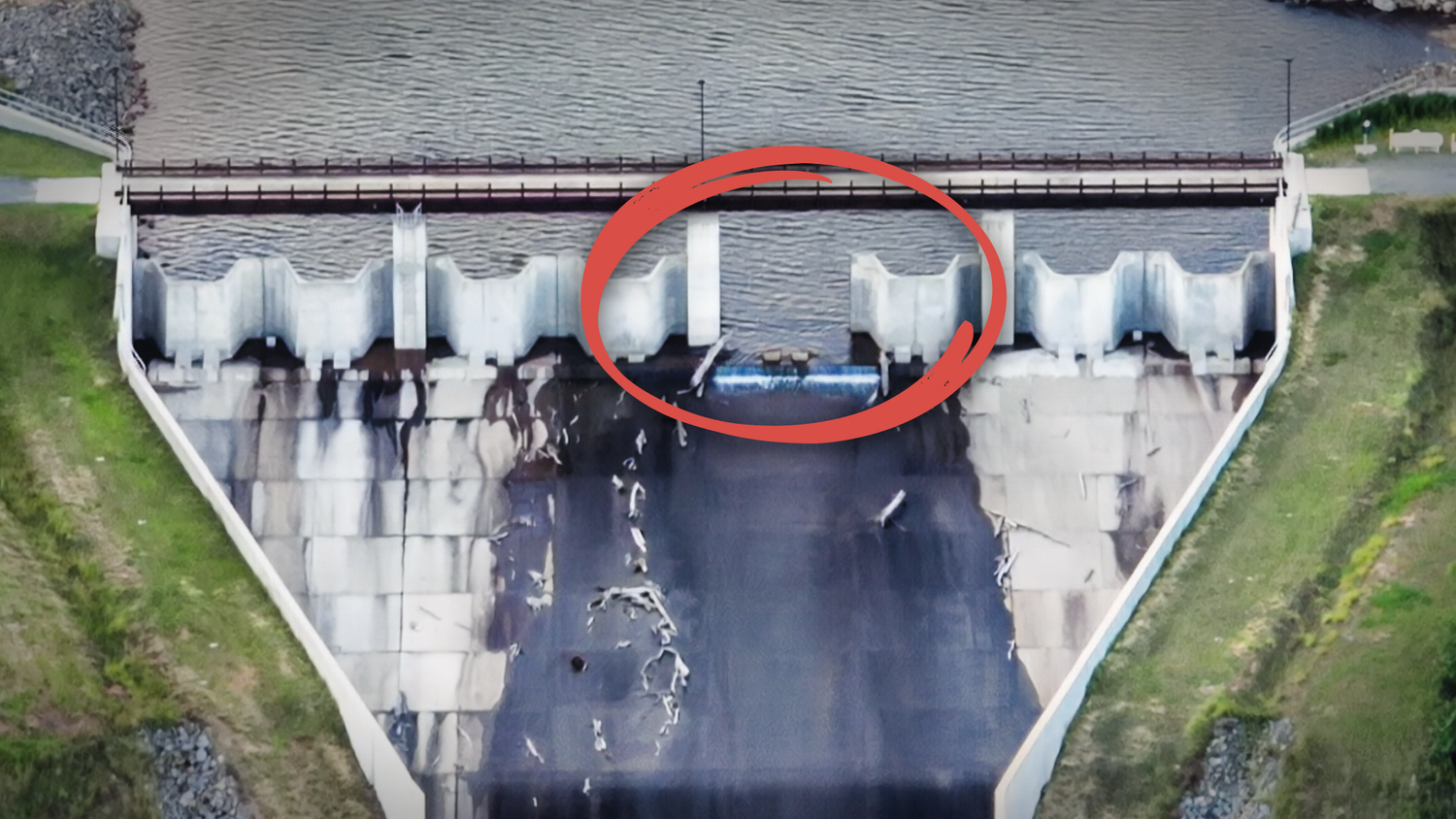
Asheville’s primary source of water is the North Fork Reservoir northeast of the city. Built in the early 1950s, North Fork Dam impounds a relatively pristine portion of the Swananoa River. After some earlier major floods and six decades of service life, the dam was starting to show its age, so the City of Asheville embarked on a major rehabilitation project. The project included a new auxiliary spillway to help manage floods and make the dam safer under newer state regulations. It was finished in October 2021, and three years later, nearly to the day, Hurricane Helene hit the region. When it did, a part of that brand new spillway blew out, tumbling down the chute, unleashing a torrent of reservoir water downstream. In other words, it worked exactly like it was designed. I’m Grady, and this is Practical Engineering.

Nearly every dam has a spillway for a pretty simple reason: every once in a while, a big storm comes along. In most cases, it doesn’t make sense to build a dam tall enough to absorb a once-in-a-lifetime flood, and then keep that storage volume empty until one comes. It’s not a good use of resources. Even dams designed explicitly for flood control that intentionally keep some or all of the reservoir empty in anticipation of heavy rain usually aren’t intended to store the largest of floods entirely. Instead, we use spillways to discharge that water in a safe and controlled way so that it doesn’t overtop the dam or cause damage to the structure. I’ve done a bunch of videos about spillways if you want to learn more after this.

One of the most fundamental decisions when it comes to designing a spillway is whether to include gates. The vast majority of dams around the world use uncontrolled spillways, meaning there’s no way to make adjustments in real time. Usually, some kind of weir sets the elevation where the spillway engages and water naturally flows through. Depending on the configuration of the dam and the type of spillway, this might be the normal water level where the reservoir sits when it’s full. Other dams have auxiliary spillways that don’t engage until a higher level. In either case, once the water reaches the crest of the weir, it flows over. A chute controls and directs the flow down, and often a special pool or structure called a stilling basin helps dissipate the energy in the water, making it less erosive as it transitions into a natural channel downstream.

Most spillways are designed according to a simulated extreme storm called the design flood. In many cases, it’s the Probable Maximum Flood, essentially the most extreme inflow that we think is meteorologically possible. The flow through a spillway is proportional both to its width and the height of the water, called the “head” by engineers. So there are some tradeoffs here. For a given design flood, a smaller spillway means the reservoir is going to rise higher as the water builds up waiting to get out. This difference between the reservoir’s normal operating level and the maximum level during the design storm is called the flood surcharge storage. So, on top of the height you need to store the normal water in the reservoir, you also need extra height up to the top of the surcharge storage, plus usually some additional margin for waves. If you widen the spillway, you can get more water out quickly, decreasing the height of the surcharge pool and reducing the need for a taller dam. Smaller spillway, taller dam. Wider spillway, smaller dam. Both have costs, so it’s an engineering balancing act. But with an uncontrolled spillway, there’s no human intervention needed at all. The spillway discharges water when the reservoir reaches a certain elevation, and that’s it. There’s a fixed relationship between the reservoir level and the discharge rate, called the spillway’s rating curve. But sometimes you need more flexibility than that.

Adding gates doesn’t increase the width of a spillway, but it can change that second part of the equation: the head. And it really only makes sense for reservoirs designed to hold a permanent pool of water, usually for irrigation or water supply. Obviously, with an uncontrolled spillway, you have to choose a crest height above the level of that permanent pool or you would just lose all your water. You can only use the height above the crest to drive that water through the spillway. Not true if you have gates. Opening a gate instantly gets you a lot more head above the spillway crest, providing greater flow. That means, for a given design storm, a gated structure can be a lot narrower. You don’t need to rely on width to get the water out. Of course, the gates are an added expense, but there are situations where that cost is offset by the reduced width of the spillway. Plus you have a lot more flexibility. Discharge is no longer fixed to the level of the reservoir. You can adjust releases based on season or downstream conditions or even forecasted inflows, providing greater control.

Those gates don’t only add to a project’s overall cost; they also add to the complexity. You have moving parts, which means more wear and tear and more maintenance. Gates rely on hoists or hydraulics, seals, gearboxes, and other specialized equipment where knowledge and replacement parts aren’t always readily available. The other thing is: they need someone to open them when a storm comes.

There are plenty of spillways equipped with some level of automation, but in general you want a real human brain in the decision tree. Remember that spillways are a critical safety feature of a dam. The whole purpose is to protect the structure so it doesn’t breach during a flood, the consequences of which can be catastrophic. On the other side of that coin, opening floodgates can be dangerous to people and property downstream. Dams with gated spillways usually have elaborate systems to warn people when making releases, including lights, sirens, and sometimes even emergency alerts sent to cell phones. A gate opening when it shouldn’t can be almost as bad as one not opening when it should have. There are risks on both sides. That means nearly all gated spillways require someone to be on call 24/7/365 to make sure operations go to plan. It means checking the weather forecasts every day, testing gates regularly to make sure they stay operable, and having staff available mornings, nights, weekends, and holidays in case of a storm. It is a major obligation, especially when you consider the decades or centuries-long lifetimes of these structures. There cannot be a single day when someone isn’t available to handle a flood. For large organizations, like federal agencies or water districts, it’s definitely doable. Most of the largest dams in the world have gated spillways with whole teams of staff dedicated to their operation. But it’s still a challenge, especially for small owners like cities. So there is another option, kind of in between controlled and uncontrolled spillways, and its use is growing worldwide.

Behold, a fuse plug spillway. Let me put some water in this flume and show you how this works… You can see water builds up on the upstream side, but none is released yet. As soon as the water rises above the plug, things happen pretty quickly. The overtopping water erodes the fuse plug down, quickly washing it away and opening up a much larger area for the water to flow. It’s basically a floodgate made of dirt. Obviously, in my little demo, there’s not really a reservoir, so the water level drops pretty quickly back down. But you can imagine if there was a larger volume of water to release, the difference in flow rate before and after the fuse plug washed out would be pretty dramatic.

It’s funny because this is exactly what you don’t want to happen at an embankment dam. Overtopping is basically a worst-case scenario precisely because of how that erosion can cut through an embankment so quickly. But that erosive force can be used in a beneficial way on a spillway. It’s a little crude, but the advantages are obvious. You don’t need a person on site to operate gates, and there are no moving parts. Plus, maintenance for an earthen structure is a lot simpler than for mechanical and electrical components. Just like an electrical fuse is a small section of wire that fails before the main wiring fails, the fuse gate is like a mini-dam that fails before the big dam is at risk.

Of course, this takes some pretty careful engineering. The materials you use for a fuse plug have to be both sufficiently durable - able to consistently hold water back for non-overtopping reservoir levels - but also relatively erodible so that they will wash out in a predictable and controlled way when called upon to function. Usually, this means a zoned embankment, where part of the structure is pre-weakened using erodible materials like sands, silts, or fine gravel. Many fuse plugs include a pilot channel or notch to give the erosion a head start. So you tune both the materials and the geometry of the fuse plug so it performs as intended. And these are used in quite a few dams. One of the most famous examples is at Warragamba Dam in Australia that provides the primary source of water for Sydney. You can see that the service spillway in the center of the dam still uses gates to control more frequent, lower magnitude floods. But each bay of the auxiliary spillway is equipped with a fuse plug of earth and rock fill. The crests of each plug are staged so they don’t all wash away at the same time. As the reservoir gets closer and closer to the top of the dam, more of the bays will open up to increase the discharge capacity of the spillway. But these structures aren’t foolproof.

In 2003, the fuse plug spillway failed at Silver Lake Basin, a reservoir in a remote part of Michigan’s Upper Peninsula. No one was hurt, but the event prompted the evacuation of nearly 2000 residents. Bridges were washed out, and the failure inflicted millions of dollars of damage to the areas downstream. When the fuse plug overtopped, it eroded down as designed, but the erosion didn’t stop. The foundation soil was just as erodible, if not more, than the fuse plug, and water continued to cut downward until most of the lake had drained out. It’s a good case study in why engineers only use soil erosion as a failsafe measure in limited situations. It’s hard to predict and hard to control. So there’s a similar solution to this kind of fusible spillway that avoids it altogether.

I’ve removed the fuse plug in my demo and replaced it with something a little more elaborate. I mounted a sliding bracket on the side of the flume now. On one side is a float, and on the other is a little arm. And I have a crest gate mounted to the bottom. Let me get this set up and turn on the water. You can see just like the fuse plug, this holds back the water when the reservoir comes up. And actually, this gate can allow water over the top as it gets higher. But at a certain point, my mechanism slides up (pushed by the float), and the arm clears the top of the gate. When it does, the gate folds down, quickly opening up the spillway for a lot more flow.

This has a major benefit over fuse plugs in that it can release some water before it fully opens. The gate basically acts like an uncontrolled spillway until the reservoir reaches the literal tipping point. It’s not an all-or-nothing thing like the fuse plug. The other benefit here is control. I can adjust the float or the arm to change the exact point when this gate opens, unlike an erodible structure that has some inherent uncertainty around the amount and the duration of flow required to wash it out. But you might be thinking: “Grady, this is a mechanical system with a sliding bearing and moving parts.” And you’d be exactly right. You’re not likely to find a system exactly like this installed on a dam. It’s not even that reliable in my model, to be honest, so I wouldn’t trust it at full scale. I’m just using it to show the fundamental advantages because all of the fusible concrete spillways that I know of around the world use a proprietary system called Fusegates developed by the company, Hydroplus. I didn’t want to step on any of their patents by building a model in my garage, but the way they work is pretty clever.

Fusegates are concrete structures set on top of a platform with a chamber built into the bottom. An inlet connects the chamber to a prescribed elevation above the gate. When the reservoir reaches that target elevation, water flows into the chamber, pressurizing it just enough that the gate loses stability and tips downstream. The benefits are the same as my demo: namely, that you can discharge water before the gate washes out, and the precise control you get over when the gate tips. A lot of dams around the world have been equipped with Fusegates. In the US, a few high-profile projects include (of course) the North Fork Dam in Asheville, Canton Dam in Oklahoma, and Terminus Dam that holds back Lake Kaweah in California.

One important application of both fuse plugs and Fusegates is extending the life of an existing reservoir. I’ve talked about sedimentation in a previous video, where a reservoir gradually loses storage as it fills up with silt and sand transported from upstream. There are no easy fixes, and there are plenty of cases where dams have to be decommissioned or removed because they just don’t have enough storage anymore. For dams that use uncontrolled spillways, the volume typically reserved for flood surcharge above the spillway crest is kind of an untapped resource. So, there are projects where a fuse plug or similar-type spillway is retrofitted onto an existing dam to gain more storage without sacrificing spillway capacity. In some cases, this can save millions of dollars associated with decommissioning a dam and developing an alternative source of water. But there are some downsides too.

When a fuse plug or tipping spillway activates, it’s a major endeavor to put it back. Unlike a gate that you just close after the flood is over, replacing a fusible spillway is a construction project, which brings along all kinds of complications, like hiring an engineer, procuring a contractor, significant expenses, and a lot of time. The time is important because, until it’s replaced, you’ve lost a lot of storage in your reservoir. The other disadvantage to these systems is also what makes them useful in the first place: there’s no human control. It does make them safer; it also means that there may be little warning when they activate. In places with a lot of development downstream, that’s a big deal, because dramatic and sudden increases in water levels are dangerous. That’s why these systems usually break up the fusible structures into stages that give way at different reservoir levels, smoothing out the changes in flow as a flood passes through. But even then, it can still cause problems.

North Carolina came face-to-face with the issue when Hurricane Helene hit in 2024. A major impetus for the new auxiliary spillway at North Fork Dam was a previous storm, Hurricane Frances. Flows through the old spillways washed out key pipelines that carry water from the treatment plant at the dam into Asheville. In response, the city built a new bypass line to provide redundancy against failures. When Hurricane Helene hit and tipped one of the Fusegates at the auxiliary spillway, the surge eroded the channel downstream, taking out not just the original transmission lines but the bypass line too. So, somewhat ironically, the flood left major parts of the city without water for weeks.

The water crisis in Asheville was just one of the problems caused by Hurricane Helene along its path. But I think it’s important to recognize the tragedies that didn’t happen too, one of those being that North Fork Dam was never in any danger of breaching. Despite the incredible rainfall, and despite the fact that there was no way to control releases, the flood passed through exactly as designed. The fusible spillway tipped just when it was supposed to, allowing more discharge during an extreme event, and no one had to be there to push a button.
08 Apr 13:25

Expect delays along I-10 as the White Oak Bayou elevation project is causing closures

by Kyle McClenagan
A series of closures this week are part of TxDOT’s $400 million White Oak Bayou project, which will raise the I-10 main lanes out of a floodplain.
08 Apr 02:30

Carney: “I love being PM, except for the brief time I have to spend in Canada”

by Luke Gordon Field

OTTAWA – Reflecting on being PM for over a year, Mark Carney told reporters that he loves every aspect of the job, except for “the short amount of time I have to spend in Canada every month.” “I’ve enjoyed my time in office immensely,” said Carney. “I like going to international conferences, taking international meetings, […]

The post Carney: “I love being PM, except for the brief time I have to spend in Canada” appeared first on The Beaverton.

08 Apr 02:30

Dow Jones closes down 11 points as Apocalypse destroys all life on Earth

by Jacob McArthur Mooney

NEW YORK- The complete eradication of sentient life on our planet spurned the end of history, the death of time, and a permanent all-consuming blackness, as markets reacted negatively, shedding eleven points to close down .02% on the day. “To some degree, the losses associated with the end times were priced-in by investors,” claimed BMO […]

The post Dow Jones closes down 11 points as Apocalypse destroys all life on Earth appeared first on The Beaverton.

08 Apr 02:09

#Sage #RoninWarriors

08 Apr 02:08

IT IS NOW TIME TO WAKE UP! #CowboyWho

08 Apr 02:04

Check it out, I’m giving Houston the finger. Whooooo!

mst3kgifs:

Check it out, I’m giving Houston the finger. Whooooo!

08 Apr 02:04

Downed U.S. Airman Rescued From Iran

by The Onion Staff

A U.S. Air Force officer who went missing after his fighter jet was shot down over a remote area of Iran has been rescued, with the CIA having developed a deception plan to buy time for the high stakes operation. What do you think?

“Good, he can work off the cost of the jet.”

Vera Sokolova, Contract Printer

“I take it word of our victory hasn’t yet reached the front.”

Kenneth Wolff, Systems Analyst

“If they can’t rescue people without lying, they shouldn’t be rescuing people at all.”

Travis Doyle, Packet Distributor

The post Downed U.S. Airman Rescued From Iran appeared first on The Onion.

08 Apr 02:03

Pick a side

by John Allison

I don’t know what a “serverless edge platform” is, I had to ask for help.

07 Apr 17:20

Snob Doesn’t Think Audiobook Counts As Real Porn

by The Onion Staff
07 Apr 17:19

our breast-feeding employee is spending too much time pumping

by Ask a Manager

A reader writes:

We recently hired a nursing mother with the understanding that she would be taking time to pump three times a day for about a year. She is being paid for the time used to pump. She was provided a comfortable private space in which to do so and she logs the time as “general overhead” on her timesheets (unbillable); it comes to about 90 minutes per day. We’re just now, a few months in, realizing how quickly this time adds up – in the last billing period (five weeks) it was nearly 40 hours! Is there a tactful, legal way to ask her to make up some of this time (50%?) so that we get more billable hours from her?

Ou company is pro-family, but having done the math this comes out to about 10 full work weeks per year in paid pumping time, time that we cannot bill to our clients.

I answer this question — and two others — over at Inc. today, where I’m revisiting letters that have been buried in the archives here from years ago (and sometimes updating/expanding my answers to them). You can read it here.

Other questions I’m answering there today include:

  • I’m not included in meetings about my team’s work
  • Can I borrow language from other job descriptions?

The post our breast-feeding employee is spending too much time pumping appeared first on Ask a Manager.

07 Apr 17:16

PHOTOS: Boundary-breaking Artemis II captures view of Earthset from moon's far side

by Dan Cooney
Humanity's farthest-traveling explorers captured historic images of Earth on Monday evening.
07 Apr 16:05

Five weeks after teasing endorsement, Trump remains on the sidelines of Cornyn-Paxton Senate runoff

by Gabby Birenbaum, Texas Tribune
The president could still weigh in over the next seven weeks. But his inaction before last month’s dropout deadline has only hardened the rivalry.
07 Apr 15:53

how much money do you make?

by Ask a Manager

It’s hard to get real-world information about what jobs pay. Online salary websites are often inaccurate, and people can get weird when you ask them directly.

So to take some of the mystery out of salaries, it’s the annual Ask a Manager salary survey.

Fill out the form below to anonymously share your salary and other relevant info. (Do not leave your info in the comments section! If you can’t see the survey questions, try this link instead.)

When you’re done, you can view all the responses in a sortable spreadsheet.

Loading…

The post how much money do you make? appeared first on Ask a Manager.

07 Apr 15:52

I just saw Howard Hughes in the desert.

I just saw Howard Hughes in the desert.

07 Apr 15:52

Pete Hegseth Laid On Side For Cabinet Meeting

by The Onion Staff

WASHINGTON—In an effort to keep his airways clear while his colleagues discussed foreign policy, U.S. Secretary of Defense Pete Hegseth was laid on his side for a Cabinet meeting Friday, according to sources within the White House. “Hey, Scott [Bessent], could you grab us a couple towels to support his head and soak up some of the piss?” said Secretary of State Marco Rubio, who reportedly kneeled beside Hegseth while the former Fox News host lapsed in and out of consciousness, drying heaving and occasionally muttering incoherent threats against Sen. Mark Kelly of Arizona. “Before I can brief you guys on the situation in Nigeria, I need someone to help me wriggle him out of his suit so we can wash off the vomit. Ugh, the whole Cabinet Room smells like sour Jägermeister. I’m gonna turn him on his other side so he’s not breathing on us. Let’s try to get some water in him once we’re sure he can keep it down. JD [Vance], would you mind taking over for me down here while I present? Just use your fingers to scoop out his mouth if it seems like he’s choking on puke.”  At press time, an aide was seen hoisting the completely limp defense secretary over his shoulder and taking him back to the Pentagon to oversee the invasion of Greenland.

The post Pete Hegseth Laid On Side For Cabinet Meeting appeared first on The Onion.

07 Apr 15:51

Samantha Irizarry and Isaac Porter

by The Onion Staff

The couple were wed Saturday in a ceremony attended by both of their future spouses.

The post Samantha Irizarry and Isaac Porter appeared first on The Onion.

07 Apr 15:51

Bari Weiss Attempts To Boost Ratings By Kidnapping Tony Dokoupil’s Mom

by The Onion Staff

NEW YORK—In a desperate ploy aimed at playing on the sympathies of concerned viewers, CBS News editor-in-chief Bari Weiss reportedly attempted to boost ratings for her struggling programs this week by kidnapping the mother of evening anchor Tony Dokoupil. “I’m not going to hurt you, Ms. Dokoupil, but you’ll be staying with me at least until the end of spring sweeps next month,” said a masked Weiss, who, according to sources, planned to seed tentpole shows such as Face The Nation and Sunday Morning with lurid details of Gail Dokoupil’s captivity, counting down the days, hours, and minutes until a deadline set by an “anonymous kidnapper” to bring in an additional 2 million viewers. “If all goes to plan, particularly in the more coveted demographics, I’ll get you home safe and sound. If not—well, let’s just hope the audience comes through for you.” At press time, CBS News ratings had yet to improve, and witnesses claimed to have seen a masked woman ushering the granddaughters of longtime 60 Minutes host Lesley Stahl into the back of a van.

The post Bari Weiss Attempts To Boost Ratings By Kidnapping Tony Dokoupil’s Mom appeared first on The Onion.

07 Apr 15:50

An Excerpt from Johanna Gohmann and Emily Flake’s New Book All Toddlers Are Scorpios

by Johanna Gohmann and Emily Flake

- - -

McSweeney’s contributor Johanna Gohmann channels the chaos and charm of life with a toddler into All Toddlers Are Scorpios a hilarious astrology guide illustrated by cartoonist (and McSweeney’s contributor) Emily Flake.

We’re thrilled to share an excerpt today from the book’s opening chapter. All Toddlers Are Scorpios is out now and available at your nearest bookseller.

- - -

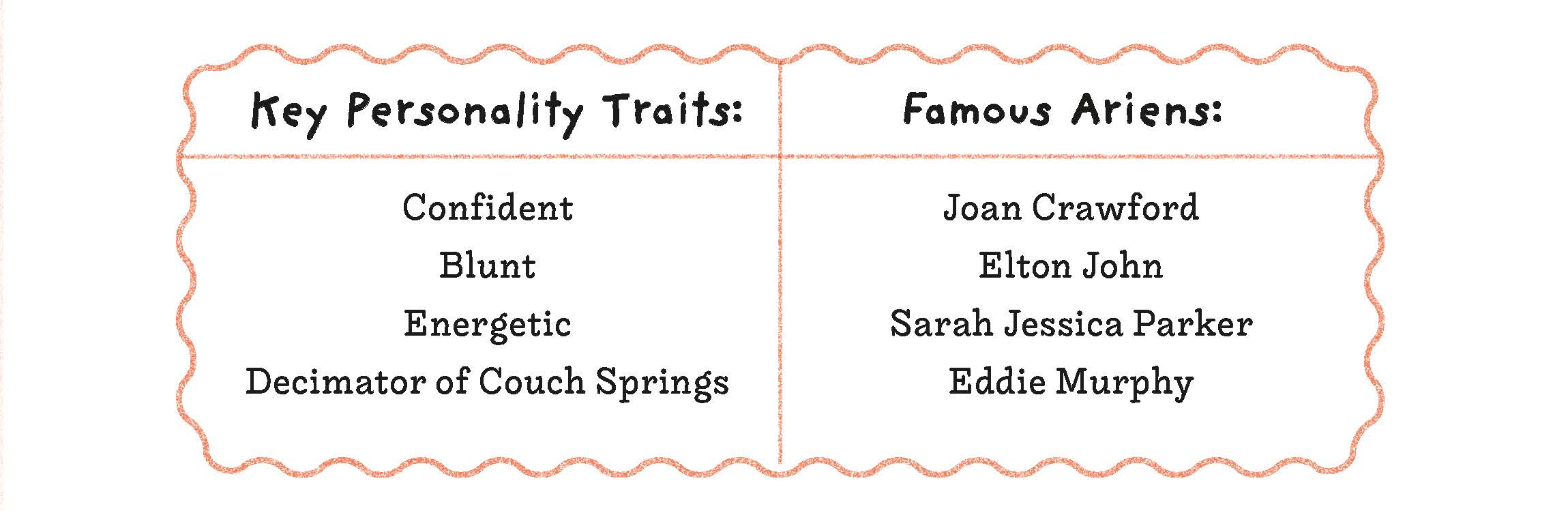
With the fiery planet of Mars as their ruling house, the Aries toddler is known for their high energy and adventurous nature. A bold, fearless child, they can often be found rapidly scaling the nearest Barnes & Noble bookcase or attempting to fit their head into the neighbor’s Dalmatian’s mouth. You, meanwhile, can most often be found struggling to open some Tylenol or cleaning up the hummus the Aries has smeared all over the doorknobs for absolutely no reason whatsoever.

The Aries communication style can be both honest and quite blunt, and parents should be prepared for them to ask why Grandpa’s mouth resembles old hot dogs, or for them to loudly inform the UPS driver that Mommy has been crying because her pants no longer button. The little ram can be extremely self-confident as well as combative, and you should expect to lose many minutes of your life locked in heated arguments over things like why they aren’t allowed to power the lawn mower or cut their own hair.

Creative, impulsive, and a smidge accident-prone, parenting an Aries may mean taking lots of deep, calming breaths, as well as having many uncomfortable conversations with Dr. Bettenmeyer, explaining how your little ram got a Calico Critters coffeepot lodged inside their nasal cavity.

Best Playdate for the Aries Toddler: Libra

As the Libra toddler is also fun-loving and adventure-seeking, they can make for a very amusing companion. A Libra will happily join an Aries in repeatedly kicking over the bubble machine at a sing-along or pretending your night guard is a Chinese throwing star. However, Libras are also known to be a bit more cautious in nature, so when your child suggests rolling down the stairs in the laundry basket, the Libra might offer not to ride but rather to give them a push.

Worst Playdate for the Aries Toddler: Cancer

The fun-loving little ram might find the changeable moods of a Cancer rather confusing and struggle to discern why mere moments ago they were happily engaged in a contest over who could quack the loudest, but now the Cancer is sadly stomping the Little People farmhouse. Meanwhile, the Aries’ blunt manner might upset the sensitive Cancer, and the child may take offense when the Aries smacks them in the face with The Giving Tree.

Best Babysitter for the Aries Toddler: Virgo

A Virgo makes an excellent caregiver for the Aries, as adult Virgos are both patient and protective, thus keeping the Aries entertained and out of harm’s way. The ideal Virgo sitter will be well-rested and relatively fit—someone who can handle a small human clambering up their vertebrae like a fire escape and whose skin can tolerate the harsh scrubbing required to remove facial tattoos etched with a Sharpie.

Best Sibling Match for the Aries Toddler: Leo

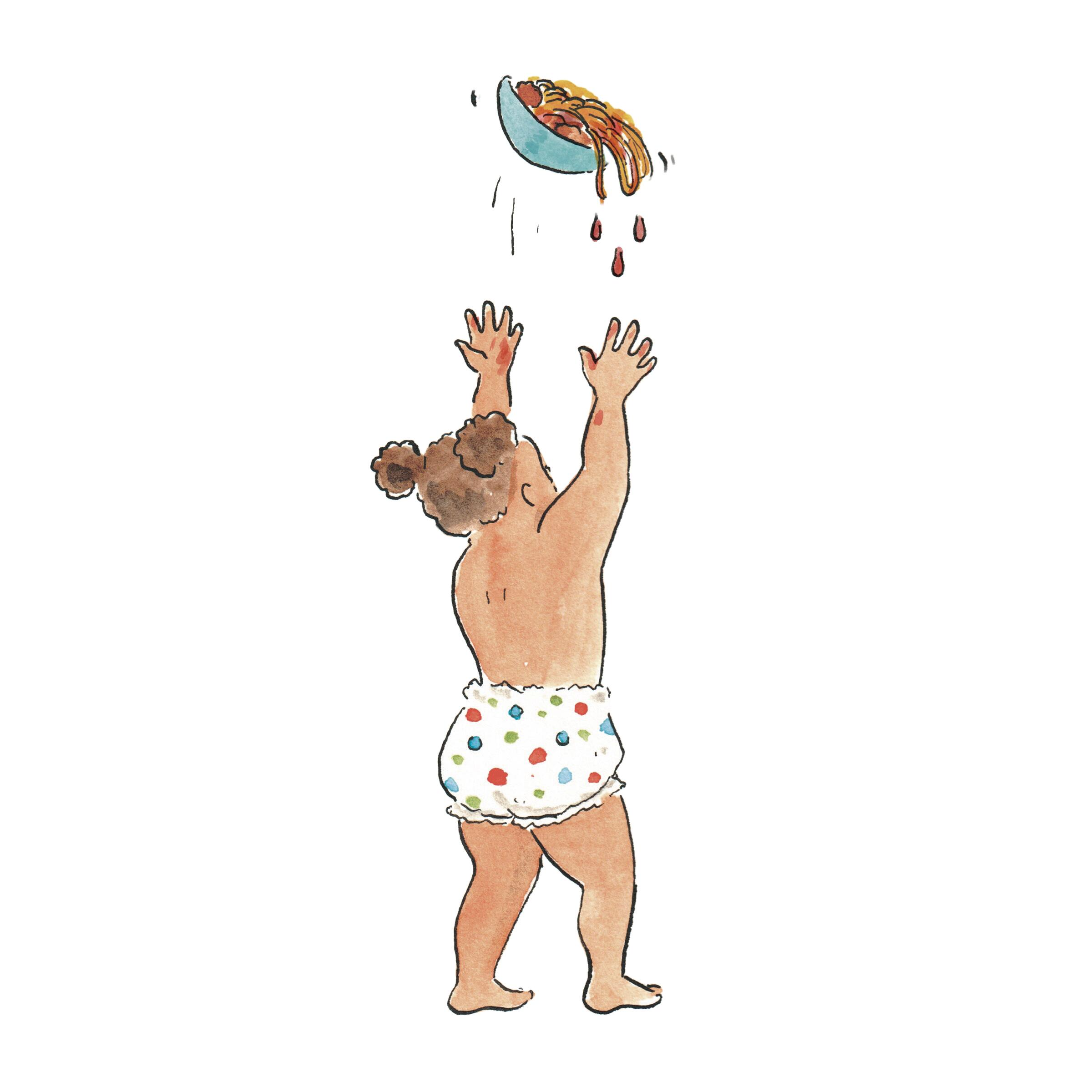
Aries and Leo possess a similar high-spirited zest for life, making them an excellent sibling match. These two will feed off each other’s wild ideas, such as throwing wet spaghetti at the ceiling, throwing wet spaghetti at each other’s faces, and just generally testing how the laws of physics apply to overcooked pasta. This enthusiastic pairing is sure to mean a home of laughter and hijinks, as well as one where the parents receive a large weekly wine delivery.

Preferred Music of the Aries Toddler

Anything upbeat and slightly unhinged will bring a grin to the Aries’ Nutella-smeared face. They may especially enjoy “John Jacob Jingleheimer Schmidt” (particularly when sung at the most manic speed possible), as well as AC/DC’s “Thunderstruck” when played at 200 decibels. Classic rock, dad rock, or really any music they can wildly run around to while throwing actual rocks. They may also make some music of their own, squeezing the life out of their toy accordion and playing many private concerts near Mommy’s head, preferably in the predawn light of morning.

Preferred Snacks of the Aries Toddler

Ideally, this will be something that can be easily consumed while attempting to roll off the hood of Uncle Eric’s Kia (e.g., a GoGosqueeZ, or whatever was in that Burger King cup they just found in the sandbox). The Aries isn’t too fussy about their food, so long as they aren’t chained for a prolonged period of time to the meal prison commonly known as their high chair. Some live to eat; others eat to live—but the Aries eats so that they may get back

Preferred Toys of the Aries Toddler

The little ram loves action and anything in motion. Pull-back race cars, the moving sidewalk at LaGuardia, and the garage door clicker may be counted among their favorite playthings. Mini-trampolines, inflatable punching bags, and the skateboard you keep discreetly rolling under the bed will also be coveted items, as will pencils, umbrellas, and anything with optimal eye-poking potential.

Ideal Pet for the Aries Toddler

The Aries can be rather forgetful, so the best pet will be one that can be fed every other day… or never. As the child is still learning “gentle touch,” their pet should be comfortable being gripped by the neck, chased at high speed, and launched into frigid bathwater. This makes the ideal pet for the Aries toddler to, in fact, be no pet at all… or perhaps a small betta fish kept high on a shelf and admired from a great distance.

Best Play Outing for the Aries Toddler

A playground or park is generally a good option for the active Aries. Just be sure to always have a large tube of Neosporin on hand, as well as several Band-Aids that do not feature the likeness of any cartoon characters they disdain. (They’d sooner bleed out than let you affix Moana to their flesh.) More sedate activities like children’s story hours are not recommended for the Aries toddler, unless you enjoy saying “Shhhhhh, listen” approximately 483 times a minute while an irritated librarian hisses Chicka Chicka Boom Boom in your general direction.

Best Halloween Costume for the Aries Toddler

Aries are often known for their trailblazing ways, so don’t be surprised if your confident little ram eschews the standard Elsa or Elmo garb and thinks a little more outside the box. In fact, that might be exactly what they want to wear: a box… with a pancake as a hat. And then tell everyone they are “a pumpkin bone.” While confusing, it is best to go along with their selection, as all attempts to coax them into anything resembling either a cute insect or fairy will only be met with fury and a set of mangled wire wings from Party City.

Preferred Screen Time of the Aries Toddler

Cartoons that are either fast-paced or slightly bananas will hold great appeal, making anything Minions-related a solid choice. Lovers of slapstick and physical humor, they may also enjoy reels featuring brides falling into swimming pools, children crying on ski lifts, and gender reveals that result in midsize explosions. Were the Aries put in charge of the Hollywood Foreign Press, all Golden Globes would be awarded to the video of Daddy gagging while changing their diaper… though a close runner-up might be the YouTube clip of a Ford F-150 rolling over a large bowl of Jell-O.

Best Reading Material for the Aries Toddler

Getting the Aries toddler to sit still for a story can at times feel on par with asking a badger to do your taxes: it is unlikely to go well and has a high probability of resulting in puncture wounds. But opting for books with absurdist humor might engage the creative Aries, making authors like Seuss and Sendak solid selections. The child may also enjoy flipping through the Bible, though their interest seems less spiritual in nature, and instead lies more in the thin, easily tearable pages. Be forewarned that if left unsupervised, they can completely shred the Old Testament in under two minutes.

Best Birthday Party for the Aries Toddler

The ideal birthday bash will be at an establishment that boasts a ball pit, bouncy castle, and/or trampoline—basically any place that features numerous fun ways to accidentally step on someone’s windpipe, as well as numerous opportunities to contract hand, foot, and mouth disease. There should be as many guests as you can cram into the space, and the Black Eyed Peas’ “I Gotta Feeling” should be played at a volume that makes Daddy quietly book a vasectomy while eating a slice of ice-cream cake.

Preferred Tantrum Style of the Aries Toddler

As one might expect from the theatrical, passionate Aries, their tantrums are likely to be full-bodied and full-throated, bringing numerous stares of reproach from your fellow Whole Foods shoppers. The impulsive Aries may be prone to the raking of things from shelves, as well as the raking of tiny fingernails over your ankles. Should they suddenly fall quiet mid-meltdown, parents should attempt to remove them from the public sphere as quickly as possible, as if removing a small, overalls-clad bomb from the scene. For silence merely means the child is gathering every bit of force and power they can summon from their wee lungs, and they will soon issue forth a wail that will make you rethink all of your life choices leading up to that moment, including dating that trombone player with the goatee in college.

- - -

Buy All Toddlers Are Scorpios

07 Apr 13:17

Pluralistic: Switzerland's Goldilocks fiber (07 Apr 2026)

by Cory Doctorow


Today's links

  • Switzerland's Goldilocks fiber: Public provision is a layered question.
  • Hey look at this: Delights to delectate.
  • Object permanence: EU appoints henhouse fox (copyright); Emacs x Tron: Legacy; Spammer v dead man's AOL account; Scott Walker's pork fountain; "No toilets, try Amazon"; Iceland falls (x Panama Papers); Rooms in Milanese sewers; China bans Panama Papers; "Parent Hacks"; "The Nameless City"; Phishing the world's top breach expert.
  • Upcoming appearances: Toronto, Montreal, Toronto, San Francisco, London, Berlin, NYC, Hay-on-Wye, London.
  • Recent appearances: Where I've been.
  • Latest books: You keep readin' em, I'll keep writin' 'em.
  • Upcoming books: Like I said, I'll keep writin' 'em.
  • Colophon: All the rest.


A vintage idyllic picture-postcard view of Lucerne, Switzerland; it features an impressive lakeside building and two elegant span bridges, with snow-capped Alps in the background. The image has been altered: a 'code waterfall' effect (as seen in the credit sequences of the Wachowskis' 'Matrix' movies) cascades down over the mountains and streaks across the water of the lake. Three massive fiber optic bundles rear up out of the harbor, their cut tips glowing white. The Swiss flag atop the lakeside building is haloed with radiant glowing streaks.

Switzerland's Goldilocks fiber (permalink)

If you live in Switzerland you can get a 25Gbit fiber link to your home. That's 25Gbit symmetrical – upload and download. On a dedicated connection that's yours and yours alone. From multiple providers. And you can switch providers with the click of a mouse. It's the ne plus ultra, magnifico, wunderschön:

https://www.init7.net/de/internet/fiber7/

In a fascinating blog post, Stefan Schüller unpacks how this came to pass, in Switzerland, a country known for its impassable mountains and its impossible national telco (Swisscom):

https://sschueller.github.io/posts/the-free-market-lie/

Schüller describes the Swiss system as a kind of Goldilocks approach that's midway between two failed systems: the American "free market" system and the German state provision system.

Most people in the US can't get fiber at all, and if you can get it, it's probably 1Gbit, and available from a single provider (that's nearly my situation in Los Angeles, where I can buy 2Gbit symmetrical fiber from AT&T, who run a shared connection on old Worldcom fiber they've lit up). Some (very foolish) people say that Starlink represents a competitive alternative to fiber. This is nonsense – first, because Starlink is another natural monopoly (how many competing satellite constellations can we cram into stable orbits before they start smashing into each other?), and second, because satellite is millions of times slower than fiber:

https://www.somebits.com/weblog/tech/bad/starlink-nov-2022-data-caps.html

In Germany, most people also have a single fiber provider, and the connection they get is shared, and caps out at 1-2Gbit.

Meanwhile, the Swiss can get connections that are far faster, and cheaper. How did they do it?

For starters, the Swiss recognized what any Simcity player knows: fiber is a "natural monopoly." It doesn't make any sense to build multiple, competing fiber networks – any more than it would make sense to build multiple, competing sewer systems or electric grids.

In the US, private fiber providers get city permits to dig up the roads and lay their network. If you have two competing networks, they dig up the road twice.

You'd think that the (more regulated) Germans would lay a single network, but they, too, have multiple, competing networks. German regulators have a complex set of priorities and constraints: to encourage competition, they promote the idea of competing networks in competing trenches, often just meters apart (rather than on competing services running over the same fiber and/or fiber run through the same conduit – pipe – laid in a single trench).

This makes setting up fiber extremely capital-intensive, so Germany backstops this system with "essential facilities sharing" – a rule that requires the incumbent (formerly state-owned, now partially state-owned) Deutsche Telekom to offer space in its conduit to smaller ISPs that want to thread their own fiber from their data-centers to their customers' homes. This is a good idea in theory – but in practice, DT has largely captured its regulators and so it is free to place all kinds of administrative hurdles in the paths of competitors seeking to use its lines.

The result is that Germans can get fiber from multiple, heavily capitalized network providers who overbuilt redundant systems under the city streets, squandering capital digging trenches that they could have spent on providing faster and/or cheaper connections.

Meanwhile, in the US, they leave this all up to "the market" (though, of course, there's no way "the market" could get fiber laid down without public participation, because the clearing price for privately negotiated licenses to dig up every street in town is "infinity"). The US is dominated by a cartel of massive incumbents: there's AT&T (formerly a regulated monopoly that was so entangled with the US government that it was effectively a for-profit state enterprise) and the cable giants, Comcast and Charter, who divide up the country into exclusive territories like the Pope dividing up the "New World."

These companies generally enjoy regional monopolies, which means they're less interested in making profits (money you get by mobilizing capital) than they are from extracting rent (money you get from sweating assets). For example, when Frontier went bankrupt in 2020, we got to look at its internal bookkeeping system, and learned that the company treated 1m customers who had no alternative carriers as special assets because it could charge them more for worse service and poor maintenance:

https://pluralistic.net/2022/12/15/useful-idiotsuseful-idiots/

This means that US fiber networks tend to be underbuilt (the opposite of Germany's overbuilt networks), meaning that even if you're buying "gigabit" fiber, you're probably sharing that one gig connection with your whole block or neighborhood, so you only get your nominal throughput at weird hours when all the other subscribers aren't streaming Netflix.

(Note that there are cities in the US with a better situation; particularly cities served by Ting, which is owned by Hover, the amazing domain registry. Ting operates an excellent mobile carrier and a fiber networks in many cities. If you are lucky enough to have Ting as an option, then you should treasure that option.)

So, that's Germany and America. What did they do in Switzerland?

For starters, they ran a four-strand, dedicated line (an insulated wire with four separate strands of fiber in it) to every house. That wire terminates at your wall with a "neutral, open hub." Any carrier can provide service over those four strands: Swisscom (the incumbent, majority state-owned carrier); Init7 or Salt (national, commercial carriers); or a local ISP.

Each of the strands in your neutral hub operate independently. That means that you can switch from one carrier to another with a click. You can also run two or more carriers' signal through your hub, meaning that you can try out a new carrier before canceling your old one. The carriers compete on price, speed and customer service – but they don't compete on who can actually connect your home to the internet.

The origins of this excellent system are in 2008, when Switzerland's Federal Communications Commission convened a roundtable to determine the future of the country's broadband. Incredibly, it was Swisscom that pushed for the multi-strand, dedicated fiber system, on the grounds that anything less would lead to monopolization.

I say "incredibly," because in all my travels over the past three decades, a single encounter with Swisscom stands out as the most absurd and backwards run-in I ever experienced with a telco.

It was while I was working as EFF's delegate to the United Nations in Geneva, as part of an infinitesimal coalition of digital rights group convened by James Love and Manon Ress of Knowledge Ecology International. Geneva is not a forgiving city for someone working for a cash-strapped NGO: it's a city where everyone (except you) is on a lavish expense account courtesy of a national government, or (better still) an industry body that lobbies the UN.

My usual daggy two-star hotel (which cost as much as a four-star in London) didn't have its own wifi: instead, you signed on through Swisscom, which did not offer its own payment processing. To get onto the Swisscom wifi, you had to buy a scratch-off prepaid card that was good for a certain number of hours or minutes. The hotel was always sold out of these cards.

So my normal ritual upon my arrival in Geneva was to scour the tobacco shops around the train station for scratch-off cards. Normally, this would take four or five tries – the shops would either be completely sold out, or would only have the two-hour cards (needless to say, these were a lot more expensive on a per-hour basis than the one-day and multi-day cards).

On one trip, though, all the shops were sold out of these cards, so I skipped breakfast the next morning to wait outside the doors of the Swisscom offices, which opened five minutes late (the only business in Switzerland that wasn't achingly prompt!). The clerk let me in eventually, but when I approached his counter, he made me trudge to the opposite end of the room to take a number (I was the only person in the shop).

After an ostentatious delay, the clerk called out "Numero un!" and I went up to his counter and asked for a three-day card. No dice, he was sold out. Two-day cards? Nope. One-day? Uh-uh. He only had two-hour cards, too. Literally, the Swiss national telco had run out of integers.

This incident stuck with me so durably that I wrote it into my third novel, Someone Comes To Town, Someone Leaves Town. You can hear me read that passage here:

https://pluralistic.net/2020/08/17/aura-of-benevolence/#sctt-slt

So it's frankly amazing to me to learn that Swisscom – who will forever be synonymous in my mind with the most catastrophically stupid internet delivery system imaginable – demanded this anti-monopoly fiber rollout.

But – as Schüller points out – Swisscom's foray into uncharacteristic reasonableness was short-lived. By 2020, the company had regressed to its mean, and was demanding an end to the neutral, four-strand, point-to-point system, petitioning for regulatory permission to switch to a cheaper, slower, shared hub-and-spoke system. This system wouldn't just be slower – it would also require all of Swisscom's rivals to rent access to its fiber, with Swisscom having the final say over who could compete with it and how.

This went all the way to the Swiss federal courts, who ruled that Swisscom had failed to demonstrate "sufficient technological or economic grounds" for the change and fined the company CHF18m for wasting everyone's time with this stupid idea (that is, "violating Swiss competition law"). And so it is that, in 2026, you can get 25Gbit symmetrical fiber throughout Switzerland. Wunderschön!

Schüller closes out his piece with a set of recommendations for countries hoping to replicate Switzerland's broadband miracle: open access to physical infrastructure; point-to-point service; neutral fiber standards; municipal fiber; and strong antitrust enforcement to keep the incumbent carriers in line.

These are great recommendations; they address the contradiction of regulated monopoly telcoms provision. On the one hand, these networks are natural monopolies, and they can only exist with extensive government intervention (at a minimum, to clear the way for poles, trenches and conduit for the physical fiber).

On the other hand, telcoms (especially broadband) play an important role in the political realm, because broadband connections are essential to civic and political engagement. You can't turn people out for a protest, or run an election campaign, a referendum, a ballot initiative, a regulatory notice-and-comment campaign, or even a campaign to get people to a public meeting or listening session without broadband.

This means that state-provided broadband is an incredibly tempting target for political corruption and regulatory capture. Think of all the terrible things that governments are doing with broadband regulation today, like Trump demanding that service providers turn over the identities and locations of his political enemies so that ICE can hunt them down and kidnap or murder them; or "age verification" systems that accumulate mountains of easily raided personal information on adults and children.

Do you want Trump's FCC chairman Brendan Carr setting content moderation policies for your internet connection? The guy who wants to pull TV and radio stations' broadcast licenses if they criticize Trump and Israel's catastrophic Iran war?

https://www.techdirt.com/2026/03/17/brendan-carr-pretends-to-be-tough-demands-broadcasters-support-disastrous-war/

Do you want your local ISP being run by your mayor? I mean, sure, there are some reasonable mayors out there, but imagine if your ISP was managed by Eric Adams, Boris Johnson…or Rob Ford:

https://www.patreon.com/posts/rob-ford-part-1-111985831

Saying that broadband should be run "like a utility," raises more questions than it answers. I, too, want broadband run "like a utility," but that doesn't mean that I want the whole show to be provided solely by my federal or municipal government. A "utility" model for broadband should mean running conduit to every home in town, with point-to-point connections that deliver broadband via a municipally owned network – but not just that.

The municipal network should also offer "essential facilities sharing" in two forms: first, they should allow anyone to set up an ISP by renting shelf-space in the municipal data-center and installing their own switches that can provide internet to anyone in town. This would let large and small companies set up ISPs, as well as co-ops and nonprofits, or even tinkerers wanting to provide access to a group of friends. Beyond that, the city should rent space in the conduit itself, to support point-to-point links beyond those offered by the city – for example, between a university campus and an offsite supercomputing center, or two buildings owned by the same company, or even as a parallel set of fiber connections run by someone who's fed up with getting their internet service from Eric Adams.

This is a "pluralized" utility model: one that involves the city in providing infrastructure at several layers, as well as a "public option" – but which doesn't allow a city that's in thrall to Moms For Liberty to decide what you can say on the internet.

This principle generalizes beyond internet provision, too. Many people have observed that social media, with its strong "network effects" (meaning its value increases as more people use it), could be a "natural monopoly" and want a social media "utility." I can see the reasoning there, but if there's one thing we've learned from zuckermuskian legacy social media, it's that centralized control over speech forums is a moral hazard and an attractive nuisance. It's a political prize beyond measure, and it attracts all sorts of skullduggerous bids to suborn it and harness it to some political faction.

But there's a pluralized utility model for social media, too, thanks to modern, federated social media systems like Mastodon and Bluesky. These are open platforms that can support multiple, interconnected servers that all talk to one another. Unlike, say, Twitter, where you can only talk to other Twitter users, federated social media allows you to talk with anyone on any server, provided they want to talk with you.

As with fiber, a "utility" model for federated social media would feature public intervention at multiple layers of the system. Governments could (should!) run their own servers, providing the canonical source of government information. They can also provide turnkey cloud services for people who want to start their own services – and they can spin out the code that goes into these services into free/open source projects that others can use (and contribute to). Governments could support people who are trying to migrate off of legacy social media (for example, through library workshops and helplines), and pay to label and tag media (for example, media that is compliant with the public education curriculum). Governments could also offer public servers where you could sign up to get online – and because federated social media makes it easy to move your account from one server to another, it would be easy to move from that server to one run by a nonprofit, a co-op or a business:

https://pluralistic.net/2025/06/25/eurostack/#viktor-orbans-isp

Think of this pluralized utility model as being something like your city's roads. It's great for your city to provide roads, and great for them to run buses on those roads, and to create bike lanes and bike parking spots and other infrastructure. For roads to be "public," it does not follow that everything on them be licensed and operated by the municipal government: we can still have private bikes, bikeshares, regulated taxis and licensed private motor vehicles. The roads are still "public" but Boris Johnson doesn't get to decide where you can go.

A utility model needn't be all-or-nothing. As the Swiss have demonstrated, public provision of various layers of the system, combined with strong regulation, combined with a public option, can deliver a best-of-all-worlds solution.


Hey look at this (permalink)


A shelf of leatherbound history books with a gilt-stamped series title, 'The World's Famous Events.'

Object permanence (permalink)

#15yrsago Recording industry lobbyist appointed head of copyright for European Commission https://arstechnica.com/tech-policy/2011/04/top-music-industry-lawyer-now-eu-copyright-chief/

#15yrsago How emacs got into Tron: Legacy https://web.archive.org/web/20110407224426/http://jtnimoy.net/workviewer.php?q=178

#15yrsago Dead man’s AOL account hijacked by spammer https://ip.topicbox.com/groups/ip/T274c51b2ba843fb0-Mb6bf8853b1ed34a26b07ce44/deceasesd-father-in-law-spamming-friends-and-family-two-years-on

#15yrsago Scarring Party: megaphone songs, sea chanteys and dark vaudeville tunes https://web.archive.org/web/20110406044523/http://www.avclub.com/milwaukee/articles/the-scarring-party-losing-teeth%2C43871/

#15yrsago Snaggly table made out of computer junk https://web.archive.org/web/20110406044521/http://brcdesigns.com/furniture/binary-low-table

#15yrsago Scott Walker gives cushy $85.5K/year government job to major donor’s young, underqualified son https://web.archive.org/web/20110406040138/https://thinkprogress.org/2011/04/04/scott-walker-hires-dropout/

#15yrsago Closing down Borders sign: “No toilets, try Amazon” https://web.archive.org/web/20110406044522/https://consumerist.com/2011/04/sign-at-borders-store-closing-in-chicago-tells-customers-where-to-find-a-restroom.html

#15yrsago What is legitimate “newsgathering” and what is “piracy”? https://zunguzungu.wordpress.com/2011/04/05/why-arianna-huffington-is-bill-kellers-somali-pirate/

#10yrsago Iceland’s Prime Minister asks to dissolve Parliament https://www.bbc.co.uk/news/world-europe-35966412

#10yrsago Artist installs rooms beneath Milan’s sewer entrances https://web.archive.org/web/20160406132425/https://www.biancoshock.com/borderlife.html

#10yrsago Banned on China’s Internet: all discussion of the Panama Papers https://www.bbc.co.uk/news/world-asia-china-35957235

#10yrsago Google reaches into customers’ homes and bricks their gadgets https://arlogilbert.com/the-time-that-tony-fadell-sold-me-a-container-of-hummus-cb0941c762c1#.srp9ym34a

#10yrsago Middle class housing projects are the Bay Area’s future https://www.newyorker.com/culture/cultural-comment/welcome-to-the-future-middle-class-housing-projects

#10yrsago Pollster explains how Chamber of Commerce can steamroller empathetic execs into opposing progressive policies https://web.archive.org/web/20160406190524/https://gawker.com/business-execs-support-progressive-policies-but-the-ch-1768898477

#10yrsago How to write about scientists who are women https://www.doublexscience.org/the-finkbeiner-test/

#10yrsago Garden: XKCD’s latest maddening, relaxing webtoy https://xkcd.com/1663/#3978da67-1ead-45e1-a293-9c8e4918a147

#10yrsago Parent Hacks: illustrated guide is the best kind of parenting book https://memex.craphound.com/2016/04/05/parent-hacks-illustrated-guide-is-the-best-kind-of-parenting-book/

#10yrsago The Nameless City: YA graphic novel about diplomacy, hard and soft power, colonialism, bravery, and parkour https://memex.craphound.com/2016/04/05/the-nameless-city-ya-graphic-novel-about-diplomacy-hard-and-soft-power-colonialism-bravery-and-parkour/

#5yrsago How Facebook will benefit from its massive breach https://pluralistic.net/2021/04/05/zucks-oily-rags/#into-the-breach

#1yrago How the world's leading breach expert got phished https://pluralistic.net/2025/04/05/troy-hunt/#teach-a-man-to-phish


Upcoming appearances (permalink)

A photo of me onstage, giving a speech, pounding the podium.


A screenshot of me at my desk, doing a livecast.

Recent appearances (permalink)


A grid of my books with Will Stahle covers..

Latest books (permalink)


A cardboard book box with the Macmillan logo.

Upcoming books (permalink)

  • "The Reverse-Centaur's Guide to AI," a short book about being a better AI critic, Farrar, Straus and Giroux, June 2026 (https://us.macmillan.com/books/9780374621568/thereversecentaursguidetolifeafterai/)
  • "Enshittification, Why Everything Suddenly Got Worse and What to Do About It" (the graphic novel), Firstsecond, 2026

  • "The Post-American Internet," a geopolitical sequel of sorts to Enshittification, Farrar, Straus and Giroux, 2027

  • "Unauthorized Bread": a middle-grades graphic novel adapted from my novella about refugees, toasters and DRM, FirstSecond, 2027

  • "The Memex Method," Farrar, Straus, Giroux, 2027


Colophon (permalink)

Today's top sources:

Currently writing: "The Post-American Internet," a sequel to "Enshittification," about the better world the rest of us get to have now that Trump has torched America. First draft complete. Second draft underway.

  • "The Reverse Centaur's Guide to AI," a short book for Farrar, Straus and Giroux about being an effective AI critic. LEGAL REVIEW AND COPYEDIT COMPLETE.
  • "The Post-American Internet," a short book about internet policy in the age of Trumpism. PLANNING.

  • A Little Brother short story about DIY insulin PLANNING


This work – excluding any serialized fiction – is licensed under a Creative Commons Attribution 4.0 license. That means you can use it any way you like, including commercially, provided that you attribute it to me, Cory Doctorow, and include a link to pluralistic.net.

https://creativecommons.org/licenses/by/4.0/

Quotations and images are not included in this license; they are included either under a limitation or exception to copyright, or on the basis of a separate license. Please exercise caution.


How to get Pluralistic:

Blog (no ads, tracking, or data-collection):

Pluralistic.net

Newsletter (no ads, tracking, or data-collection):

https://pluralistic.net/plura-list

Mastodon (no ads, tracking, or data-collection):

https://mamot.fr/@pluralistic

Bluesky (no ads, possible tracking and data-collection):

https://bsky.app/profile/doctorow.pluralistic.net

Medium (no ads, paywalled):

https://doctorow.medium.com/

Tumblr (mass-scale, unrestricted, third-party surveillance and advertising):

https://mostlysignssomeportents.tumblr.com/tagged/pluralistic

"When life gives you SARS, you make sarsaparilla" -Joey "Accordion Guy" DeVilla

READ CAREFULLY: By reading this, you agree, on behalf of your employer, to release me from all obligations and waivers arising from any and all NON-NEGOTIATED agreements, licenses, terms-of-service, shrinkwrap, clickwrap, browsewrap, confidentiality, non-disclosure, non-compete and acceptable use policies ("BOGUS AGREEMENTS") that I have entered into with your employer, its partners, licensors, agents and assigns, in perpetuity, without prejudice to my ongoing rights and privileges. You further represent that you have the authority to release me from any BOGUS AGREEMENTS on behalf of your employer.

ISSN: 3066-764X

07 Apr 13:14

Texans, tell us what matters to you this election year

by María Méndez
We’re committed to supporting Texans throughout the 2026 election. Share your thoughts by using the form below.
07 Apr 13:14

After 1,700 Sundays preaching outside and under bridges, a Central Texas pastor retires

by Story and Photos by Justin Hamel, The Waco Bridge
Urban minister Jimmy Dorrell bade farewell Sunday to his outdoor Waco congregation after baptizing a dozen people in the chilly waters of the Middle Bosque River.
07 Apr 13:13

Five weeks after teasing endorsement, Trump remains on the sidelines of Cornyn-Paxton Senate runoff

by Gabby Birenbaum
The president could still weigh in over the next seven weeks. But his inaction before last month’s dropout deadline has only hardened the rivalry.
07 Apr 13:13

I work with my spouse, losing sick days I was given when hired, and more

by Ask a Manager

It’s five answers to five questions. Here we go…

1. I work with my spouse, and it’s affecting me at work

My spouse (“Sam”) and I work in an agency that is a smaller arm of a large national corporation. Sam began working here five years ago, made close friendships with others in the program, and has an extremely good professional reputation.

Three years ago, I was hired out of graduate school for the agency site associated with Sam’s program. It is likely I was interviewed because of their success in the field. At the time I was hired, I discussed with my manager that I would not work directly with my spouse for many reasons, including ethics and work-life balance. This wasn’t a concern at the time since Sam was working in a special program and with clients in a different state. That, however, changed last year.

I’ve learned a lot from this job. My performance reviews are good, and I get positive feedback. I’ve also learned that this subset of our industry is not healthy for me to remain in. As a result, I’m building a small business of my own on the side with hopes of eventually leaving this company, and have I transitioned to half-time. Additionally, with a lot of therapy and introspection, I know that I’m deeply unhappy in my marriage. I see parts of Sam that our colleagues never see. It’s very difficult to be working from home, living with them, and sharing coworking space. At a minimum, I would like for us to live separately and am working on how to do that financially.

Last year, a sociopolitical situation resulted in Sam needing to quickly move from their work in the other state. Big Boss brought Sam on to our site, working on a team adjacent to mine. Then, when my manager took a different position at the end of last year, Sam applied for their role. Big Boss split the management role into two positions to promote Sam and one of Sam’s coworkers from the special project (“Clarissa”) into the position.

Initially, I reported to Clarissa while still working in my old team with someone managed by Sam. This quickly leaked into our private lives, and I was put in the uncomfortable position of trying to navigate supporting Sam and supporting coworkers when conflict arose. When this happened, I spoke with managerial parties involved about how this structure was not working and asked to transition directly to an open position on Clarissa’s team. This was facilitated, enthusiastically by Clarissa and oddly reluctantly by Big Boss.

The work on this team is more challenging and is impacting my mental health. However, I enjoy working with Clarissa as a manager and a human. I would like to open up to her about some of the ways my relationship, finances, and current living situation are impacting my overall health and ability to show up for clients. However, given her friendship with Sam and the already porous boundaries within our field, I have concerns about how to navigate this conversation. I don’t want it to feel like I am badmouthing her friend and colleague. At the same time, my relationship struggles are relevant to my work performance. Do you have any advice on how to navigate talking to coworkers about struggling in your marriage when your spouse is your coworker?

In this situation, you can’t really talk to your coworkers about what’s going on in your marriage, when your spouse is also a coworker. You just … can’t. (It would be different if Sam were being abusive; then you’d have to talk with your employer about safety measures.)

I think the question is: if you could talk to Clarissa about this, what would you want her to do with that information? If there’s something specific she could do, like taking over a particular meeting with Sam so you don’t have to do it or some other concrete thing that would help, just ask her for that specifically. If you need some grace because it’s a challenging time in your personal life, you can ask for that (while being vague about what the challenges are). But it should be something specific and actionable, not just background info. Plus, as your boss, she doesn’t really need info about what’s going on with your relationship, finances, and living situation (and may feel uncomfortable having it); she needs info about what you need from her, and that’s what you should focus on, without getting into the personal details.

There are situations where you could share more with a boss, but (a) that’s more of a bonus in a boss/employee relationship, not a default, and (b) when you take a job working with a partner, you necessarily give some of that up. I’m sorry because this sounds hard!

2. Losing sick days I was given when hired

When I was first hired to my job, I was given vacation and 10 sick days. My hiring letter said 10 sick days, as did all subsequent letters (we get new hiring letters when we get raises). The employee handbook, although not revised in many years, also said 10 sick days.

I’ve asked for more vacation in my annual reviews and been told no because everyone has to have the same vacation days or it’s not fair.

It has come to light that recently hired employees are only getting five sick days. I asked my supervisor to confirm the days my supervisee gets, and he said she should only have five. I told him full-time employees get 10 days, and I was hired at 10 days and it’s in the employee handbook. He said the handbook is old and now everyone should only get five. And that at the end of this calendar year he’s going to redo everyone’s vacation and sick days to make sure everyone has the same thing.

It seems like I’m about to be docked five sick days! My last letter reaffirming my 10 sick days was only last year! (And I’m pretty sure he’s taking more than five sick days himself, although I guess that’s not really relevant.)

It’s a small nonprofit and I’m pretty senior. I believe that shorting people on sick days is very short-sighted because it costs the organization nothing, it doesn’t carry over, and not everyone uses them, but when you really need them, you really need them! Lots of staff have kids and elderly parents; five days is not enough. It’s a way to be kind and supportive, and cutting some people’s days will really tank morale. How would you suggest I approach this?

Make the case for keeping the 10 sick days and raising the recently hired employees’ allotment to match. You said you’re pretty senior, so you have standing to advocate for this. Point out that it would be a significant cut in benefits to yourself and other employees and is likely to harm morale, and that people will end up coming into work sick and getting others sick, thereby harming everyone’s productivity. You might also point out that five sick days is well below the national average, and that nonprofits typically try to make up for lower-than-average salaries by keeping benefits good, or least competitive.

And I don’t know what your manager’s role is, but if he’s not the decision-maker on this, talk to the person who is — and consider getting other senior-level employees to push back with that person too.

3. What can HR offer employees when a manager just isn’t good?

How do you navigate situations in HR where an employee’s concerns about their manager are valid from a relational standpoint, but not actionable from a policy perspective?

Sometimes the honest reality is … their manager just isn’t great.

We currently share resources such as mediation, ways to respond to disciplinary actions, and recommend escalating through their management chain, but employees still feel stuck. What else can HR realistically offer?

If your company is set up to support it, you can offer coaching and training for the manager, pinpointing the issues that you see come up as patterns on their team. If your company isn’t set up to support that, you can advocate for it, or at least try to do some less formal coaching of managers. You should also be flagging any pattern of problems with a manager to the person who manages them.

Sometimes, too, HR can be well positioned to act as a sort of interpreter — “it sounds like when your manager said X, what she was getting at was Y” and “What if you approached it like X?” and so forth. But ultimately, when managers aren’t good at managing, it’s in the company’s best interests to get them better at it, which means they need coaching and training and sometimes intervention from above.

4. Should I tell my boss about an employee who’s claiming overtime when she’s not working?

I usually err on not reporting on coworkers unless it impacts me or is potentially hurting others. However, I am in a weird place. I report to the director, but previously reported to the manager. While I do not manage anyone now, I am considered part of the leadership team, and the manager and I have a good relationship. She reports to the director as well.

We have one non-exempt employee who routinely comes in at least an hour early and clocks in for it even though there really isn’t any work for that role to be done at that time. She reports to the manager, who says nobody has challenged the overtime so she isn’t interfering. We have four people in the same position who do not get this overtime and come in at the appropriate time to serve clients.

This is awkward because I do metrics, audits, SOPs, training, etc. — nothing client-facing. And I report to the manager’s boss, who I feel would not be happy with this situation. On the other hand, I’ve noted it to the manager and they’ve chosen to do nothing. I am hesitant to bring this to my director, but I am also aware she will know that I knew about this if it comes out later and is a problem. If I talk to the director, she will talk to the manager, who will almost certainly know I was the person. So — stay quiet (eyes on my own paper) or talk to my boss, who is also the manager’s boss, so she can work with the manager on the correct solution?

Discreetly share it with your boss. This is actually pretty clear-cut because it does affect you: you said your director will know that you knew about it if it comes out later. That would be my advice to anyone in your shoes, but particularly as someone involved in auditing, there are additional expectations on you not to look away when someone is, pretty literally, stealing from the company and their manager has decided not to intervene.

When you talk to your boss, say you’d like to avoid causing tension in your relationship with the manager, if there’s a way for her to “discover” what’s happening on her own.

5. Listing an acquisition on my resume

I just got my first job after graduating (thanks for the resume and interview tips on your site!) and three months after I started, my company got acquired by a larger firm.

I’m not planning to leave soon and I doubt they’d let me go with our spring and summer busy season coming up, but when I do decided to head out, how I put this on my resume without looking like I skipped out on a job after less than a quarter of a year?

It’s going to stay all one job on your resume, not be separated into two different listings. Do it like this:

Taco Quality Tester
Tacos Inc. (formerly Taco Utopia), October 2025 – November 2027

The post I work with my spouse, losing sick days I was given when hired, and more appeared first on Ask a Manager.

07 Apr 12:53

7News reports that Ben Roberts-Smith has been arrested on multiple counts of being too much of a handsome legend

by John Delmenico

Alleged war hero and defamation law expert Ben Roberts-Smith has been arrested over allegations of war crimes.

Meanwhile 7 News has reported exclusive details saying that Roberts-Smith has actually been arrested on the ‘new crime’ of being a cool guy with incredible abs.

“It’s disgusting what is happening to him,” said Kerry Stokes referring to the man arrested for alleged war crimes not the person in jail for whistleblowing about the alleged war crimes.

“These soldiers and other army whistleblowers making accusations against Benny have no clue what things are allegedly like in war.”

The post 7News reports that Ben Roberts-Smith has been arrested on multiple counts of being too much of a handsome legend appeared first on The Chaser.

07 Apr 01:46

Well ... you know ... they don't need to use re...

Well ... you know ... they don't need to use real cars. They could just get little models, put the camera up close.
What are ya talking about Cowboy Slim?
The cop show those kids are talking about.
We don't want them to do a cop show, do we? We want them to have fun right here at the corral.
#CowboyWho

07 Apr 01:30

Cambot, quick! Cue up the sequencer for Joel’s Rinky-Dink Fun sketch and Hexfield Viewscreen Fun…

Cambot, quick! Cue up the sequencer for Joel’s Rinky-Dink Fun sketch and Hexfield Viewscreen Fun Time Holo-Clowns!

06 Apr 19:44

the office with the cardboard coworker, part 2

by Ask a Manager

Remember the letter last month from the person asking how their office could hire people who wouldn’t be uncomfortable with their culture and quickly leave? Among other things, they mentioned a cardboard cut-out coworker (Robert), a celebrity death betting pool where winners would get an extra day off, and a lunchtime discussion of whether aliens can have orgasms. The letter-writer provided more info after my response, and agreed I could share it and respond here:

Thank you for responding to my letter. After reading the response and comments, I realized that the alien orgasm example drew more attention than I expected, even though I had meant it as one particularly bad example rather than the main issue itself. I wanted to add a little more context and clarify a few points.

The alien orgasm example was an outlier, and one of the worst examples I could remember, which is why I used it. The “alien anatomy” discussion was also less about sex itself than about whether extraterrestrials would experience pleasure or physical sensation the same way humans do, especially if they did not even have bodies like ours. I understand that it was still inappropriate, but some commenters seemed to come away with the impression that sex is a regular topic in the office, and that is not really the case.

A more typical version of these conversations would be discussions about books, movies, and TV shows. We have had conversations like which horror movie character was so stupid that you actively rooted for their death. We have also had conversations like which politician you would “make disappear” if you could get away with it, but when someone pointed out that it was inappropriate, the conversation moved on without any fuss. In general, the conversations tend to get strange in a morbid way rather than in a sexualized one. That is still a problem, of course, just not quite the same one some people focused on.

The office betting pool is less about hostility toward specific celebrities and more about the kind of morbid joking people make about public figures who seem as though they have been old forever. The attitude is usually more “I cannot believe this person is still alive” than “I want this person to die.” Similarly, the “scandals” people talk about are usually things like cheating, wearing something provocative, or being rude to a fan, rather than actual criminal behavior. I do not participate in the betting pool because I would feel too guilty winning a paid day off by correctly guessing someone’s death, but people do sometimes mention their picks during lunch.

I mentioned lunch because that is usually when the conversations can get strange. Most of our work requires concentration, so there is not much chatting during the day, and many people wear headphones most of the time. Team lunches also really are optional. We are a small team inside a large company, so the whole team does not eat together every day, but there are usually six to eight people having lunch together, even if it is not always the same group.

I described cardboard Robert as the strangest part because all the other things are occasional, and lunch itself is optional. Some people never have lunch with the team, and that is completely fine. But Robert is there every day, sitting at a desk and being greeted. It took me about two months to find out there was a death pool, and some time before I heard one of the more inappropriate lunch conversations, but I was introduced to Robert on my first day. My manager even told the team to act normal during my first week so they would not scare me off. The monthly “hunt” for Robert is optional and avoidable, but comments about him happen every day, and new employees are introduced to him as though he is simply part of the team.

In your response, it seemed as though my letter came across as asking, “How can we change our culture so people don’t feel this is a sexualized environment?” I can understand why, given the example I used, but the help I was really hoping for was a little different. What I was trying to ask was something more like, “How can I help my manager hire someone who is likely to fit in here, while also giving candidates a fair sense of what the office is like, so neither side feels misled?” Someone suggested inviting candidates to join a typical team lunch, and that was much closer to the kind of suggestion I had been hoping for.

I also appreciated your point that inappropriate conversations are inappropriate no matter when they happen. I do know that, and I think at least part of the team knows it too, given the ongoing joke that there is probably a reason our room is physically as far from HR as possible. But I am not a manager, and honestly I do not want to be one. My manager decided that because I was the most recent hire, I was the right person to help her think through this, even though I do not really have the authority or the tools to change how the team operates. I will pass these points along to her, but I do not think much would change without rebuilding the team almost from scratch.

To be clear, I do understand why these things are a problem. I am not trying to defend them or suggest that people are wrong for not wanting to work here. I just wanted to provide more context so I could get advice that was more specific to the situation I was actually asking about. Some of the comments were genuinely helpful, and I was hoping that with a better explanation I might get more of that. But if the answer is still simply that the culture needs to change, I do understand that, and I appreciate your response anyway.

Sincerely,
The Person with the Cardboard Coworker

I do get what you’re saying, and this adds helpful nuance, particularly that this is mostly happening at lunch! But yes — my answer is still that the culture might be the problem.

Your letter didn’t come across as if you were asking, “How can we change our culture so people don’t feel this is a sexualized environment?” It was clear that you were asking how to hire people more likely to fit in. It’s just that the culture is the thing your boss should be looking at.

If your boss truly wants an inclusive culture, she’s got to take another look at things like giving people extra days off for winning celebrity death pools, sexualized conversations that extended over multiple days (and I take your point that the alien orgasm conversation was an outlier, but it’s a thing that happened and stuck in your mind enough to mention it), and what sounds in general like a sort of doubling down on silliness to the point that it permeates the office in a way that a lot of people would just find exhausting.

And to be clear, companies do have their own unique cultures, and it often does make sense to screen for people who will be happy there. But when the last two hires both left after a few weeks and cited the culture as their reason, you do need to take another look at whether this is the culture you should be protecting and preserving, and whether it’s serving your organization’s goals (like hiring and retaining the people you want to hire and retain) or whether it would benefit from some revisions. That does not mean “rebuilding the team from scratch” — it could be that some fairly minor tweaks could have a big impact (as a start, get rid of the extra days off for people who correctly predict when other humans will die — the fact that the death pool has official rewards for participating is a problem).

Your boss also might talk to the people who don’t generally join the group at lunch to find out how they’re experiencing the culture, what their take on the office’s inclusivity is, and how comfortable they think the office might be to new hires who have a different sense of humor or different interests — not because it’s a problem not to join everyone at lunch (it’s definitely not) but to make sure she’s hearing the perspectives of people outside that core group.

Maybe there’s not even a significant problem to fix. Maybe those two recent hires who noped right out were outliers! But this is the first stuff your boss should be looking at with a critical eye while she’s assessing what happened. After that, she could think about things like sending finalist candidates out to lunch with a group of would-be coworkers, letting finalists talk one-on-one with people who would be their peers, and talking explicitly in the interview process about things that make the office’s culture unique, so that people get a clearer picture of what life is like there and can self-select-out if it’s not for them (although none of that is foolproof, since not everyone is great about assessing this kind of thing while they’re interviewing, particularly when they need a job). But it would be a mistake to skip over the first, more fundamental part.

Also, though, keep in mind: this is your boss’s to figure out, not yours! You don’t need to solve this just because you were the last person hired who didn’t immediately leave.

The post the office with the cardboard coworker, part 2 appeared first on Ask a Manager.

06 Apr 19:28

Trump Warns Iran To Accept His Ultimatum Or Face Wrath Of Next Ultimatum

by The Onion Staff

WASHINGTON—Threatening to continue issuing threats if the Islamic Republic did not quickly agree to his demands, President Donald Trump warned Iran on Monday to accept his ultimatum or face the wrath of his next ultimatum. “Lay down your weapons now or I will have no choice but to ask you to lay down your weapons later,” the commander in chief wrote on Truth Social, adding that the Iranian regime only had two more days to consider his terms before he would give them eight more days to consider his terms. “Mark my words, this is your last chance before your next last chance. If you do not act immediately, I won’t hesitate to wait even longer. You may think I’m bluffing, but believe me when I say you will feel the full weight of my social media posts.” At press time, Trump urged Iran not to try his patience because they would find it much, much greater than they expected.

The post Trump Warns Iran To Accept His Ultimatum Or Face Wrath Of Next Ultimatum appeared first on The Onion.

06 Apr 19:28

AI commercial produced on budget of just 3 lakes

by Mike McPhaden

LOS ANGELES, CA — The advertising industry is abuzz after reports that a recent AI-made television commercial was produced on a budget of only three pristine Tennessee lakes. This marks a significant improvement in the environmental impact of generative AI, or as ecologists call it, “the Sleepless Hunger that will devour every leaf in the […]

The post AI commercial produced on budget of just 3 lakes appeared first on The Beaverton.