Welcome to the April 2026 edition of our occasional SCW Q&A series. This version features one of our most-asked questions: What can we expect from the forecast El Niño coming our way?
Q. What is the expected effect of the predicted super El Niño (predicted to be the strongest in 150 years) on the Houston area for this summer and going into 2027? Will we see more rain? If so, when will such a pattern start? It seems we have been so dry for 4-5 years now.
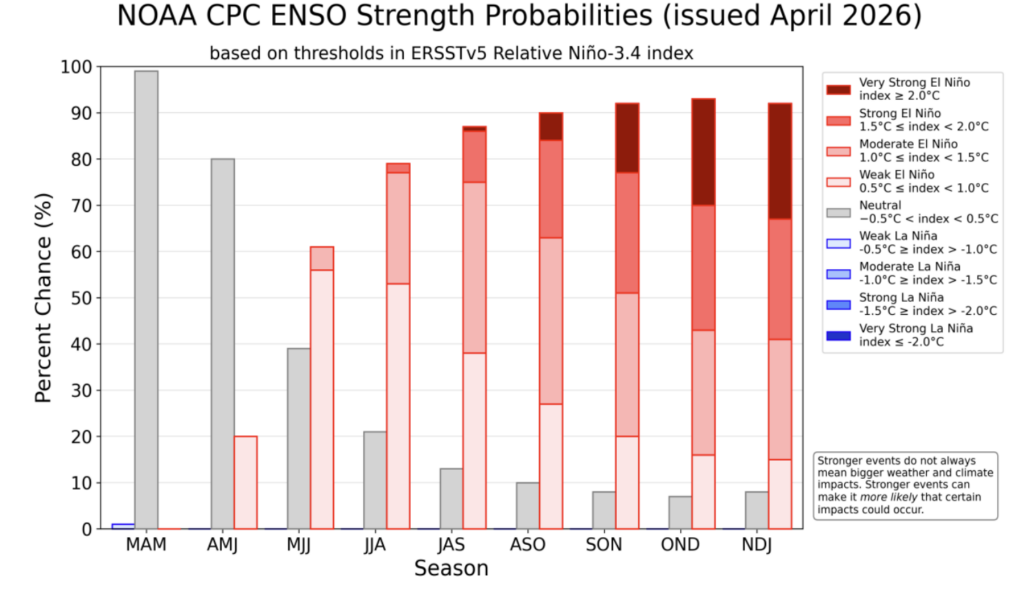
A. We are now reasonably confident that El Niño will develop this summer, and strengthen as we head in to this fall and winter. Whether it becomes a super El Niño, well, we don’t know for sure. But it is quite possible. As for this summer there probably will be some tailwind effect pushing temperatures upward (we are already expecting a moderately warmer than normal summer). I am also hopeful that a developing El Niño will suppress some hurricane activity this season. We’ll have more to say about that in the coming weeks, but at this point it does not look to be a super-active season.
The probabilities of a strong to very strong El Niño are increasing as we get toward summer (i.e. JJA is June, July, August). (NOAA)
Then, as we get into the fall and winter, my sense is that with a strong El Niño in place we could see a reasonably wet season. However this is far enough into the future that I’m not sure we can really be confident about that. Unfortunately, what I am fairly confident in is that, should we get a super El Niño this summer and fall, its impacts will linger into 2027. This is likely to make for a very hot year for the globe, including summer in Houston next year.
– Eric
Q. I have always wondered what a capping inversion is. It seems to happen fairly often.
A. It does indeed! We often refer to a capping inversion on Space City Weather, but don’t always explain what it means. The concept is quite simple. For showers and thunderstorms to form the warm, moist air at the surface needs to rise several thousand feet and form clouds. If there is warmer air aloft in the atmosphere, this acts as a lid and prevents air from rising. (There’s a nice National Weather Service video showing this in practice on Facebook). This is the “cap.”
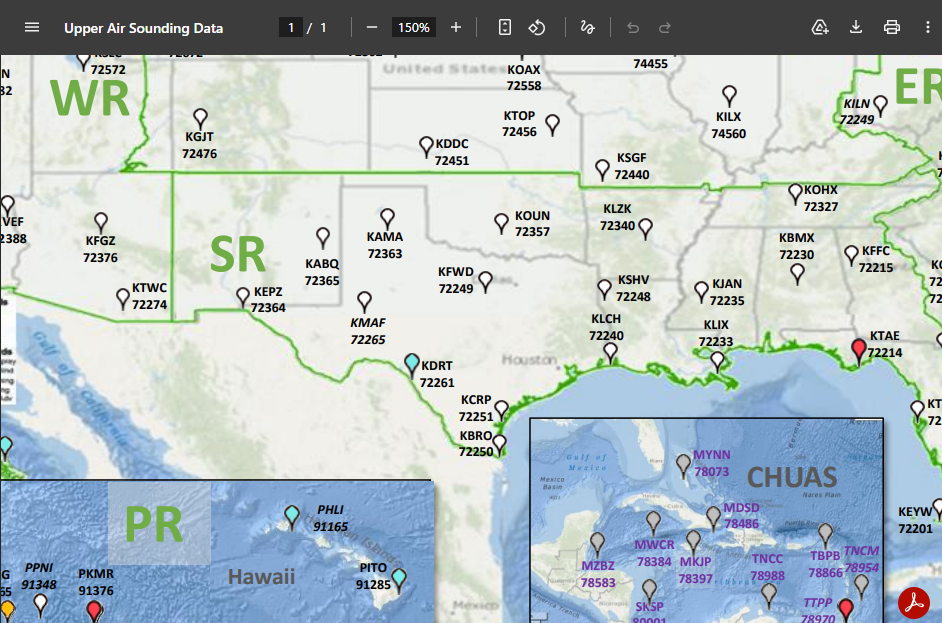
Unfortunately there are not great sounding locations upstream of Houston. (NOAA)
Atmospheric “soundings” are a really useful tool for meteorologists to get a vertical profile of the atmosphere, allowing us to determine when there is, and is not a cap. Unfortunately for Houston, there are a lack of good sounding locations (usually gathered by a weather balloon) nearby. Often times on a summer day, the difference between no rain and strong thunderstorms is whether this cap is strong enough to hold on, or erodes throughout the day. This lack of good nearby soundings is another reason why forecasting rainfall locally in Houston is a challenge.
– Eric
Q. I have no meteorological background and am basing this purely off observation but over the last couple of years, or longer, it has seemed that there has been significantly more rainfall in the northern part of Houston/Woodlands/Conroe than in the southern, specifically in the greater SW Houston. It’s almost as if I-10 has some kind of invisible wall. I’ve lived in the greater Houston area my whole life, the last 16 being in Sugar Land. Is there any veracity to this observation or am I just jealous of not getting the rainfall I need for my lawn and garden?
A. I am sorry to say, my jealous friend in Sugar Land, that I believe it is the latter. I should say, I often feel the same way about the area of town I live in, southeast of Houston. It will seem like it is raining everywhere but my neighborhood and this feels very bad. But this, almost certainly, is bias. (For example, the next time it is raining at your house, check the radar to see who is missing out!)
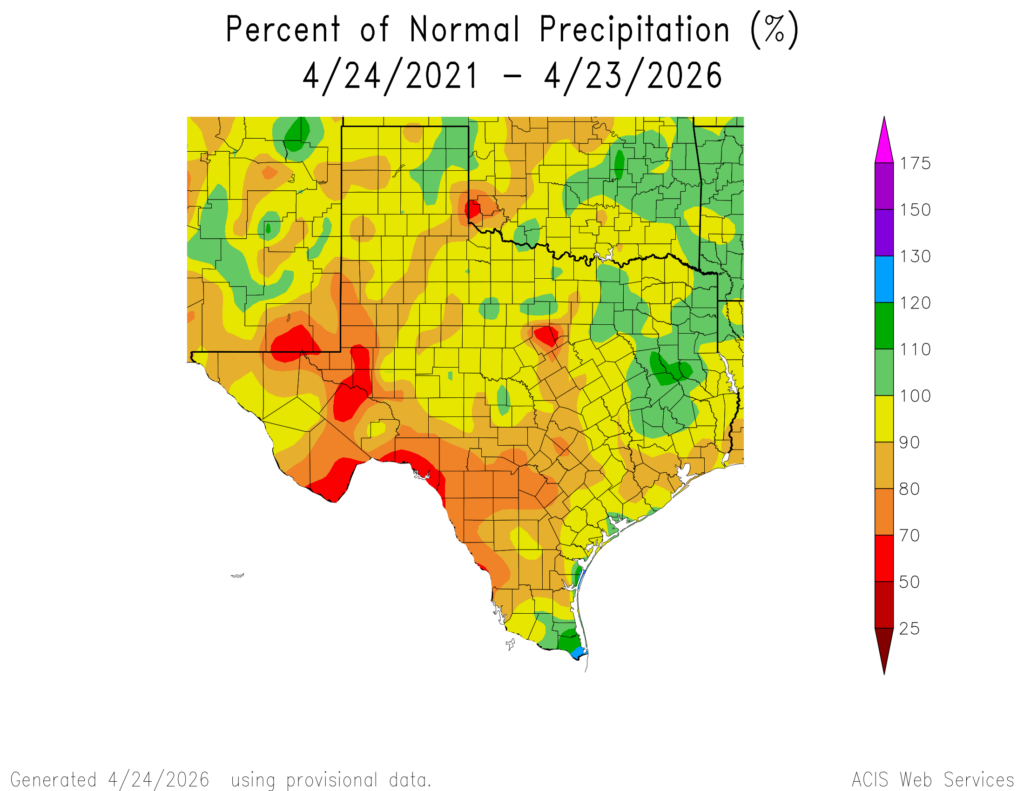
To put a little data to this question, let’s take a look at “percent of normal” rainfall totals for the state of Texas over the last five years. Basically, we can see, for areas from The Woodlands to Galveston pretty much everyone has received 80 to 100 percent of normal rainfall levels. If you squint the Fort Bend County has done a little worse than most.
Percent of normal rainfall over the last five years. (NOAA)
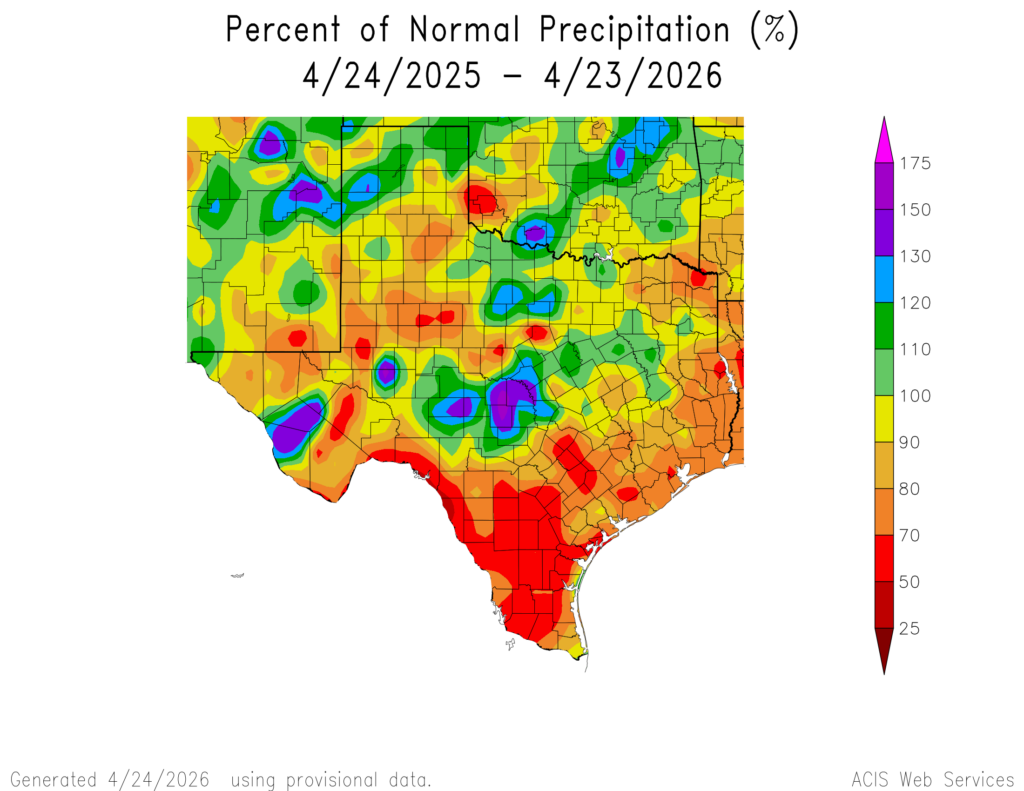
If we look at just the last 12 months, the story is pretty much the same. Areas north of Houston, generally, have gotten a little more rainfall on a “normal” basis compared to southern areas. But it’s not super significant and everyone has gotten a fair amount of precipitation.
Percent of normal rainfall over the last 12 months. (NOAA)
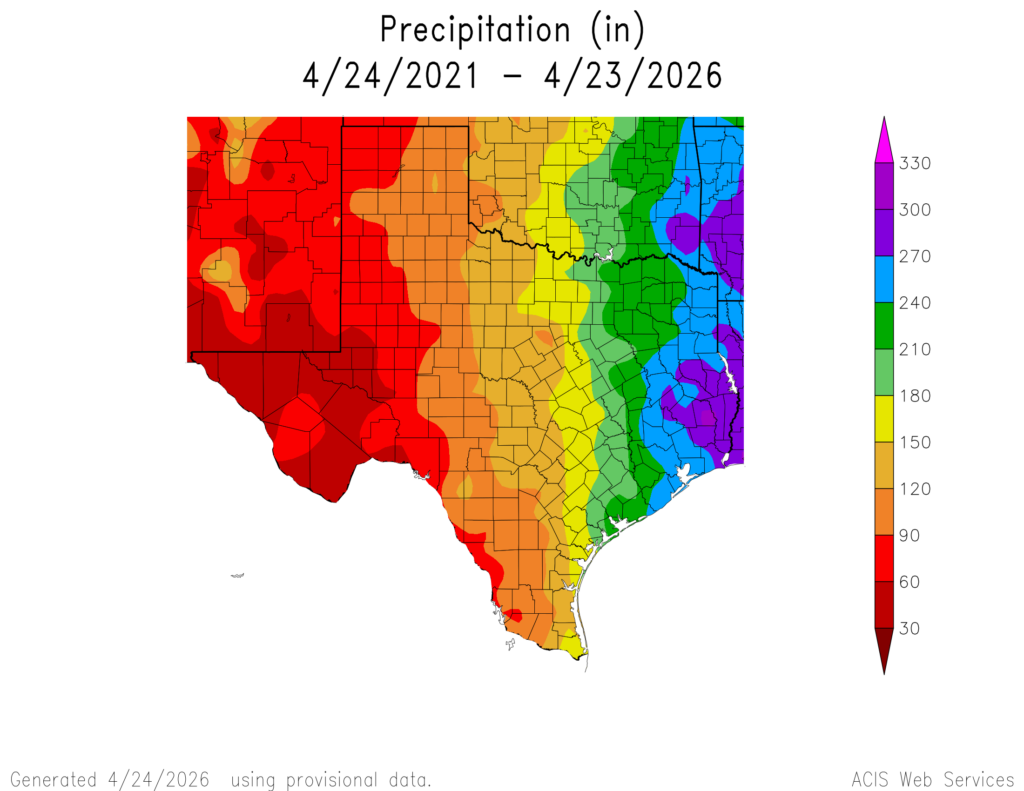
Finally, let’s look at raw rainfall totals over the last five years (below). We can see that the real gradient in rainfall amounts is more of an east-to-west one rather than a north-to-south one. What this reveals is that areas west of Houston, including Fort Bend County, are climatologically a little bit drier than areas to the south and east of the city. This is primarily due to Gulf proximity. Anyway the bottom line is that all of this is mostly psychological.
Raw rainfall totals over the last five years. (NOAA)
-Eric
Q. Will the Gulf of Mexico ever cool down? And what would it take for it to cool down? Or will it never cool down until the next ice age?
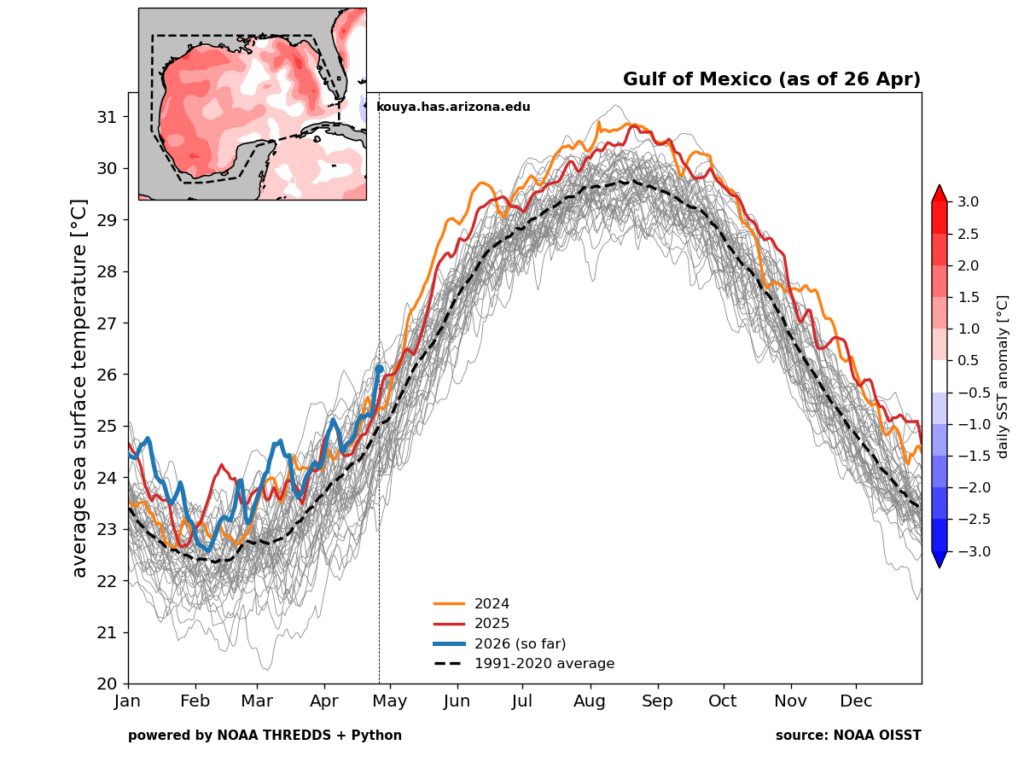
A: The Gulf has indeed been running hot. Most global oceans have, but we’re seeing a little bit of easing back of that this year. Still, relative to what is the best normal we have from satellite data (since the late 70s), the Gulf is the warmest it has been.
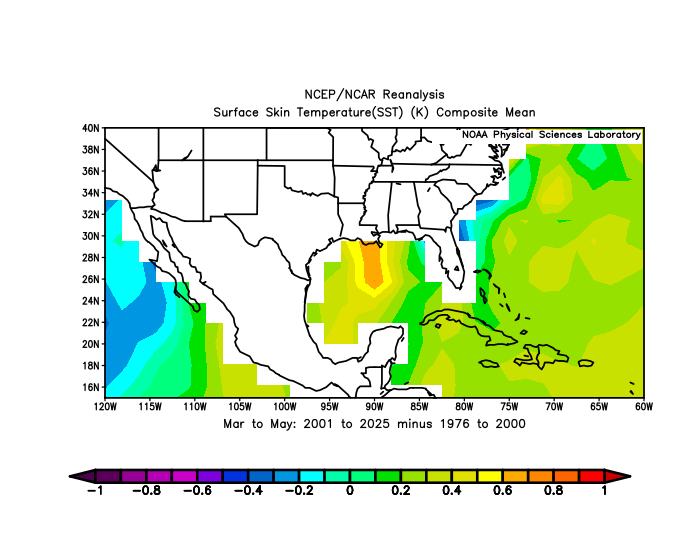
In the above chart from the University of Arizona, the blue line is in the middle of the pack for above normal water temperatures, but you can see that 2024 and 2025 were setting numerous daily records too. What we’ve sort of seen with the Gulf is a minor warming in the summer in the last 20 to 30 years but a more substantial warming in the fall, winter, and (as shown below) spring. Essentially what seems to be happening is that as our winters, springs, and autumns have warmed, the Gulf has not cooled off as much as we used to see historically.
Sea surface temperature differences from the last 24 years compared to the previous 2024 years. (NOAA PSL)
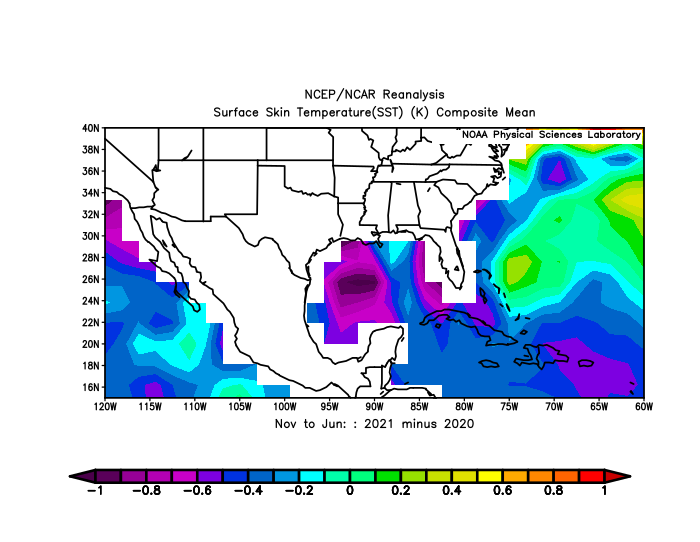
It pains me to type this, but what would cool down the Gulf of Mexico? The only two logical things that could do it are time or a very large and intense hurricane traversing the middle of the Gulf. Let’s take a look at the most potent Gulf hurricane season in recent memory: 2020. We’ll subtract the November through June sea surface temperatures from the following period (November 2020 through June 2021) just as an example. You’d expect the Gulf to be notably cooler. And it is quite a bit cooler.
The average SST anomaly from 2021 after hurricane season showed a notable cooling of the Gulf of Mexico. (NOAA PSL)
But also keep in mind, the Gulf is a curious body of water with very shallow shelf waters and very deep offshore waters. The shelf waters are prone to a lot of fluctuations month to month and year to year, and they’ll respond more to how the seasons perform (colder winters –> colder shelf waters, etc.). But ultimately, what has happened is that the floor on how cool the Gulf can get has likely been raised due in part to climate change. I know a handful of readers don’t want to read that, but that’s the reality. And this is one of the clearest signs of climate warming there is in my opinion because of what has been observed with coral reefs in particular.
So the frustrating answer is that it’s probably going to be warm for a while, at least until we actually get a legitimately sustained cold winter in the Southeast, not just a couple one-off stronger events. Or until we have another active hurricane season. I hope it’s not the latter.
–Matt
Q. Why does it always seem to rain on weekends? Your forecasts for fronts seem to consistently show non-rainy weekdays, with fronts moving through over the weekend. I know weeks and weekends are human things, not nature, but is there some kind of cycle that causes this?
A. I love this question. Because it’s one of those things that sounds a little silly on the surface but people genuinely notice it and are curious. And the reality is actually quite nuanced! So on the one hand, there’s no single mechanism that says cold fronts are going to hit only on Saturdays and Sundays. Our bigger events happen any day of the week. The 1992 November tornado outbreak happened on a Saturday. The 2023 Pasadena tornado happened on a Tuesday.
But! There are a couple ways of looking at this that make chemical and meteorological sense. First, as we all commute to work and school and drive around during the week, our cars, our work, etc. leads to a build-up of aerosols in the atmosphere. Those aerosols act as nuclei in the atmosphere for rain drops to form on. Once you get to the weekend, those aerosols are at their highest amount of the week, and thus you’ve tilted the odds a bit.
Another rainy start to the weekend. (SCW app)
Or so that’s what is speculated on in a 1998 paper. That one focused mostly on the Northeast urban corridor. A subsequent paper in 2010 also looked into this across the entire U.S. and found that there remains a weekend pattern signal even when you remove human (anthropogenic) influences. In other words, there may be a naturally occurring cycle at play. Additionally, a 2003 paper looked into temperature patterns that also found a “weekend effect” that exists. There was also a 2011 paper that noted hailstorms and tornadoes tend to be less frequent on weekends.
But a lot of scientists have also poked holes in this research question, speculating experimental flaws, cognitive biases, etc. The reality is, we just don’t know. But here: I decided to look at Houston’s total rainfall since 2023. 38.72 inches fell on Saturdays and Sundays. 109.18 inches fell on weekdays. About a quarter of our precip since January 2023 has fallen on weekends, which makes up about 29 percent of the week. You could say I’m cherrypicking data here but at least in the last few years, there’s no statistic “weekend effect” in Houston. Still, there’s enough there there in some cases to continue researching the topic!
-Matt
Q. What should I be doing now to prep my home to get ready for summer and better manage my energy costs?
We’ll toss this one to our sitewide partner, Reliant, to weigh in.
A. With warmer days already settling in, now is a smart time to tackle quick home fixes that can improve efficiency and help limit cooling costs as temperatures continue to rise. Plus, as AC use ramps up earlier in the season, small, smart energy choices can help keep homes comfortable while managing monthly bills. Here are a few simple, cost‑conscious tips:
Inspect ductwork for loose connections or damaged insulation as leaks can waste up to 30% of cooled air.
Add more insulation, which is a critical component of home energy efficiency and can be among the most cost-effective improvements you can make.
Replace or clean air filters every 30-60 days, as a clean filter can reduce AC energy consumption by up to 15 percent.
Schedule a spring tune‑up to ensure the AC system is ready for high demand.
Follow the 4×4 rule by raising your air conditioning temperature 4 degrees if you’ll be away from home 4 hours or more.
Get ahead of the summer heat by investing in a smart thermostat, which helps make managing your home’s energy effortless and can lead to real savings when temperatures climb.
At the heart of Houston’s International District is the Alief- Bissonnet campus. A small, intimate campus where students from all over the globe come to learn the trades of construction, HVAC, and even cosmetology. A campus once so brimming with diversity that it held an event to celebrate the cultural heritages of its student body and recognize the shared traditions and activities humans from around the world engage in, like music and art.
But today, the campus feels empty; devoid of its brimming diversity and celebration of cultures that once made it so unique from all the other campuses at HCC.
On April 29, 2025, the Bissonnet campus hosted the inaugural and only “Voices from Around the World” event. Organized by Alief-Bissonnet’s Continuing Education (CE) Intensive English Program in collaboration with campus management, the event provided English-Second language (ESL) students with an opportunity to engage with and explore world cultures. Attendees enjoyed various activities, including live music, talent showcases, Mardi Gras-style parades, and tasting food from different countries, among other attractions.
On the April 28, 2025, edition of HCCTV’s “Up to the Minute”, CE English Language Skills Faculty Lisa Devoe and Mercedes Wilson-Everett appeared to discuss the event in more detail. They spoke about using the event to help ESL students improve their self-esteem and tying everything back to the classroom setting.
“We’re taking it to the real world,” said Devoe. “We’re using the students in real-world instances. They’re doing performances, playing instruments, [and listening] to songs that are going to inspire them.”
Everett added by explaining the importance of working with campus management to organize the event, referencing the Ubuntu African quote, “they are because we are.”
“It takes a village to take care of the students. We are all working together,” said Everett. Both women then went on to explain how the event would allow ESL students the space and time to share their talents and provide them a sense of belonging.
“A caring campus,” as described by Devoe. One that wanted to use “Voices from Around the World” to show how much it cared about the diversity of its student body. Yet despite the event being a huge success with students who participated last year, the hopes and plans for a second one this year were shattered after a long, lengthy attempt to get funding from the school was denied.
A source close to the situation revealed that the denial was influenced by HCC’s legal department, which expressed concerns over the “cultural aspects” of the event.
An online funding proposal for another “Voices from Around the World” event sent to the College Activities Board last October and obtained by the Egalitarian mentioned the word “culture” 11 times.
This comes at a time when colleges and universities are scaling back their diversity, equity, and inclusion (DEI) offices and programs following President Trump’s signing of executive orders aimed at dismantling DEI initiatives in higher education.
The Egalitarian reached out to a representative from the HCC Student Services department, who relayed the information about the denial of funding to the organizers of “Voices from Around the World” two months after the proposal was sent to the College Activity Board, according to a source familiar with the situation.
As of now, there is no word on whether “Voices from Around the World” will return to Alief-Bissonnet.
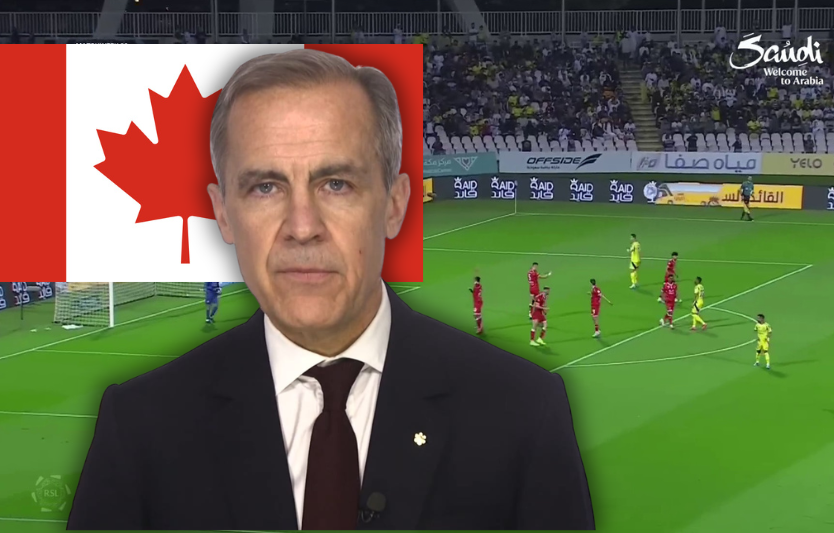
OTTAWA — Prime Minister Mark Carney has announced that the first use of Canada’s new sovereign wealth fund will be to purchase a Saudi Arabian soccer team and festoon it with Canadian branding. “While much of the fund will be used to bribe corrupt American officials, it’s also important to improve Canada’s reputation abroad,” Prime […]
Using an in-home HEPA purifier for one month spurs a small but significant improvement in brain function in adults age 40 and older. That’s the result of a new study we co-authored in the journal Scientific Reports.
We analyzed data from a study of 119 people ages 30 to 74 living in Somerville, Massachusetts. Somerville sits along Interstate 93 and Route 28, two major highways, resulting in relatively high levels of traffic-related air pollution. This makes it an especially good location for testing the health effects of air purifiers.
We randomly assigned participants to one of two groups. One used a HEPA air purifier for one month and then a sham air purifier – which looked and acted like the real thing but did not contain the air-cleaning filter – for one month, with a monthlong break in between. The second group used the real and sham purifiers in reverse order.
After each month, participants took a test that measured different aspects of their mental capacity. The test probed people’s visual memory and motor speed skills by measuring how quickly they could draw lines between sequential numbers, and it tested executive function and mental flexibility by asking them to draw lines between alternating sequential numbers and letters.
We found that participants 40 years and older – about 42% of our sample – on average completed the section testing for mental flexibility and executive function 12% faster after using the HEPA purifier than after using the sham purifier. That was true even when we accounted for factors like differences in the amount of time participants spent indoors, with either filter, as well as how stressful they found the test.
This improvement may seem small, but it is similar to the cognitive benefits that people experience from increasing their daily exercise. While you may not experience a sudden increase in clarity from a 12% boost, preventing cognitive decline is vital for long-term well-being. Even small decreases in cognitive functioning may be associated with a higher risk of death.
Studies increasingly show that air pollution can be detrimental to brain health.
Why it matters
Air pollution can negatively affect mental function after just a few hours of exposure. Studies show that air purifiers are effective at reducing particulates, but it’s unclear whether these reductions can prevent cognitive harm from ongoing pollution sources like traffic. Research has been especially lacking in people living near major sources of air pollution, such as highways.
Our study shows that HEPA air purifiers may offer meaningful health benefits under these circumstances.
What still isn’t known
Research shows that air pollution begins to affect cognitive function especially strongly around age 40. These effects may become increasingly prominent as people age.
HEPA air purifiers may therefore be especially beneficial for older adults. Our study did not explore this possibility, as fewer than 10 of our 119 participants were over the age of 60.
Also, our participants only used a HEPA air purifier for one month. It’s possible that longer durations of air purification may sustain or even increase the improvement in cognitive function we observed in our study.
We plan to study whether reducing particulate matter by using air purifiers is indeed protecting the brain’s white matter, and whether it could reverse some cognitive decline. We will explore that possibility by studying how levels of molecules called metabolites, which cells produce as they do their jobs, change in response to breathing polluted air and air cleaned by a HEPA filter.
The Research Brief is a short take on interesting academic work.
Nicholas Pellegrino and Doug Brugge received funding from the National Institute of Environmental Health Sciences under Grant ID: R01 ES030289
Late last month we noted how the Trump FCC under Brendan Carr announced a new “ban” on all routers made overseas (which means pretty much all of them). At the time, we also noted how this was less of a ban and more of a shakedown, with router manufacturers required to beg the Trump FCC for conditional waivers (fees, favors, whatever) to continue doing business in the States.
Not long after, Netgear, which does a lot of work with the U.S. government, announced it had received an exemption from the Trump FCC, though neither Netgear or the government transparently indicated what Netgear had to do to get the exemption. Pay a bribe? Host Brendan Carr for a game of golf? Install a surreptitious backdoor for CIA and ICE access? Nobody knows.
Now Amazon is the latest to get an exemption for both its Eero consumer routers and its Leo low Earth orbit (LEO) routers. Amazon showed up on the exemption list, but again there’s absolutely no indication of what the company had to actually do to get it, or the standards the Trump FCC is using to determine what hardware can be trusted. An Amazon announcement is painfully vague:
“We’re pleased to share that the U.S. government has recognized eero as a trusted and secure provider of routers.”
How did this happen? Does anybody trust the Trump administration to make this determination? Are there concerns about backdoors in exchange for being allowed to continue to do business? Nobody knows, though the FCC has indicated the ban has been expanded to include personal hotspots.
This would all likely be less alarming if the Trump administration wasn’t aggressively transactional, unethical, and authoritarian. Little to nothing Brendan Carr and Donald Trump do is genuinely for the public interest; and while this ban is being proposed as an act to protect national security, with their other hand they’ve taken countless steps to ensure consumers are less secure than ever.
That’s ranged from firing of officials responsible for online election security and investigating hacks, or to the relentless “deregulation” (real, the elimination of corporate oversight) of a U.S. telecom sector that was just the target of one of the worst cybersecurity incidents in U.S. history (in large part because telecom executives failed to change default router admin passwords).
Most press coverage of this new router ban acts as if the Trump FCC is still a trusted actor when it comes to the public interest, but that’s a pretty broad assumption given all the dodgy, unethical, and illegal behavior we’ve seen from the agency and administration more generally.
I don’t think most U.S. journalism is journalism. It’s some weird simulacrum designed to not offend. Why would you not at least include one sentence or paragraph on how nothing about this is transparent? Or that the administration has a bad track record on ethics and transparency?
Similarly, no outlets have been inclined to mention that the Trump administration’s open corruption and mindless dismantling of corporate oversight and consumer protection have most certainly endangered national security and consumer cybersecurity and privacy in ways we’ve not yet begun to calculate. “You can trust us on this,” isn’t something anybody, especially media outlets, should be accepting as an answer.
LUNENBURG, NS – Local resident and business owner Tyson MacNeil expressed his deep disdain for tourists this past Sunday, despite living a life that is only financially possible due to tourist spending. “It’s the same thing every year from May to October,” said MacNeil, a man who voluntarily chose to live and work in a […]
1. My boss doesn’t want to give me a bonus because I’m leaving soon
I am moving soon to another state and leaving my agency to be closer to family. I really don’t want to leave and neither does my boss. He even advocated for me to stay on as fully remote, but his boss and HR said no; the agency has a new strict policy that doesn’t allow employees to be fully remote. I have no choice but to resign.
Coincidentally, my annual performance review is due shortly before the time my lease is up and I have to leave my job. My annual reviews have always come with a bonus, so I’m expecting a lump sum payment that will help cover some of the costs of moving. I’ve been somewhat transparent with my boss about my plans on leaving, but I have not given him an exact resignation date yet because I’m still in the process of finding new employment and coordinating the move so the dates are not yet set in stone.
I have been pushing my boss to get my performance review done so I can feel secure knowing that money is on the way. When I asked him for an update, he was vague and made it seem like he wasn’t sure if it would be approved because his boss and HR know I’m leaving soon. So I asked him if he himself is resistant to giving me a bonus because he knows I’m leaving soon and he said yes because it “doesn’t come off as a good financial decision” to give a chunk of money to an employee who is leaving. I argued that this is my reward for my performance of last year to now, so that money should be paid to me anyway. Plus, I haven’t submitted a resignation letter yet, so technically I’m not leaving until that is made official.
I can say with confidence that I earned a bonus this year and it doesn’t feel fair to be withheld a bonus because I’ll be gone a month or so after it’s paid. I think anyone else in my position would also try to leave with as much as they could. Am I asking for too much or is my timing just bad?
Your timing is bad. It’s very common for companies not to pay bonuses to people who have made it clear they’re leaving soon. You see the bonus as compensation for work you’ve already done, but employers see bonuses as a retention strategy and very often won’t give them if you’ve told them you’re leaving. That’s not always the case; some organizations handle it differently (and for some, the bonus is contractually obligated). But it’s the case enough of the time that it’s an established thing for people to need to delay their exits (and any discussion of their exits) until after a bonus is paid out.
You can certainly make the argument for a bonus as compensation for work already done if you want to — but from what your boss is saying, your company is unlikely to give it to you.
2. When a candidate’s resume has different job titles than LinkedIn does
I’m screening resumes for a role. For anonymity’s sake, let’s say it’s a teapot designer, and we’re looking for five years of designer experience. Many people in designer roles first spend time as teapot painters, and while that experience is valuable, designer is a more expansive, senior role.
On a few occasions now, I’ve looked at resumes that appear strong, with several past designer roles, but when I click through to the applicant’s LinkedIn profile, I see these are actually painter roles, and they’ve changed the titles on their resume. When they’ve done this across the board and have no actual designer experience, I can easily screen them out. But sometimes I’m finding it’s a mix — their current role is in fact a designer role, but previous designer roles were actually painter roles. If they’d been truthful on their application, I would’ve screened them in! But now I feel like I have to screen out these candidates because they’re embellishing their applications.
Am I being too harsh? Is this the red flag I think it is? I feel for applicants in this difficult job market, but I just can’t get past the false titles on the resume, and I’m not sure how I’d explain to my boss that I’m screening in people who don’t have the experience they claim to, even if their actual experience is solid. (Also, these applicants are willingly handing over their LinkedIn links. Do they think we won’t notice the discrepancies between their profile and their application? What am I missing here?)
If they’re people who you otherwise would have advanced, it’s worth doing a phone screen with them to clarify — where you’d ask directly, “I saw your resume calls your current job ’teapot designer’ but on LinkedIn you list it as a ’teapot painter’ role. Which is correct?” Give them a chance to elaborate — because while I can’t speak for what’s common in the teapot industry, there a lot of people have titles that don’t accurately reflect the work they’re doing, and it’s not unheard of for people to try to clarify by using a more accurately descriptive title on their resumes. That might not be what’s happening here; this might just be people trying to finesse their experience into something it isn’t. But it’s worth talking to at least a handful and finding out, to inform your thinking going forward.
If it turns out to be a straight-up lie — they’re just flagrantly misrepresenting their experience to try to get their foot in the door — that’s prohibitive. But if someone says, “I started out doing painting, but for the last two years I’ve been doing the designer job and my company never updated my title,” I wouldn’t hold that against them.
But also, if you’re just doing the initial resume screen before passing resumes on to your boss (and you’re the person doing the phone screens), you should have this conversation with her to get aligned on how to handle it. She may not know you’re seeing this and may have her own opinions about how she wants you to handle it.
3. People misspell my name
I have a fairly straightforward issue that I’m sure you’ve run into as well — my name gets misspelled on emails! I have a fairly common name that has a fairly understandable misspelling (think “Anglea” instead of “Angela”). While this is easy for me to correct internally, how does one go about correcting this for people outside of our organization?
I work in a company where I regularly interact with people from client companies asking for my services, and yes, my name is in my email signature! So far, I’ve been happy to just ignore it and reply to the email content itself, but is there anything you would recommend to “repeat offenders”?
Personally, as someone with a name that frequently gets misspelled, I just ignore it. I have decided that life is less stressful when I just don’t care unless it’s someone who’s close to me.
That said, if it bothers you and someone has done it multiple times, it’s fine to just matter-of-factly say at the end of your next reply, “By the way, it’s Angela, not Anglea!” (But expect this still won’t completely solve it.)
4. Should I tell my boss my commute is only doable if we remain hybrid?
I’m a very highly valued executive assistant for a very senior partner in a law firm.
I know eventually my work is going to consider changing our remote work policy to only allow us to work from home one day a week. My commute is 75 minutes each way. It’s a pretty relaxing commute, and I did not mind it at all before I had a baby. However, with a baby it’s only doable because I only have to go in three days a week.
Is it risky to verbalize to my boss and HR that if they ever increased the amount of days in office required, I would have to look for a new job in my own city? I don’t think my job would it be at risk; they’re lost without me and I always have top reviews each year, but am I being naive? My boss isn’t the managing partner at the firm but is very senior and her word has a lot of power. I feel like she should know that one of her most valued employees can only stay because of the current benefits offered with remote work. I really love my job and really love working for my boss I don’t want to leave my job but would absolutely have to if they increased the days in office required.
In your shoes, I’d have a conversation with your boss right now (not with HR) and say something like, “Is your sense that the firm is likely to stick with our current hybrid policy or that they might increase the number of in-office days required at some point? I’m asking because I love my job and I love working for you, but the commute is only doable right now because I only need to do it three days a week.”
Since you’re highly valued, that’s not terribly risky to say. And since she has a lot of capital herself, arm her now with the info she needs if a change ever does start to get discussed. That doesn’t mean they still won’t do it, but at least they won’t be surprised by what it means for you if they do.
5. Employees donating to their own organization in memory of a colleague
My mom worked for a nonprofit for many years. When she passed away, we asked for donations to the nonprofit in her memory. Several of the donations they received were from her colleagues, who still worked for the organization. My sister thinks it’s weird they’d donate to their own employer. I don’t. Who’s right?
I’ve worked at nonprofits where some employees donated simply because they felt strongly about the mission (truly of their own volition, with no pressure from the organization to do it) and were proud to be donors. So I don’t think it’s weird, particularly since these colleagues were honoring her in the specific way your family requested.
When you get to the big jams at the end of the concert, you can play it. Now, it takes two hands to play this chord, so at that point you have your dynamic front man, I guess Crow will do it, will strum it.
Listen, I don’t have thin skin. If I did, I would teach fourth grade and cry along with my students when the spider died at the end of Charlotte’s Web. Anyone can teach kids; I teach young adults. And I introduce them to their mentor, who will decide their fate: New York’s most haunted forever teen, Holden Caulfield.
By introducing decades of students to the philosopher in the backward red hunting cap, I’ve presented them with their next step into adulthood. Most English students make one of two choices: Either they love Holden and go on to have intense, fleeting, and passionate careers in fields like English or theater, or they realize they have good relationships with their mothers.
These past few years, however, I’ve noticed a startling trend: ambivalence.
My students feel nothing for this young man. In 2022, some of them began dismissing Holden as cringe—not cringey, just cringe. The kids aren’t all right—they used to froth at the mouth over this complex character. The ’90s kids made magazine collages about his general disillusionment. Ten years ago, my students were crafting Tumblr pages around things that felt like the essence of Holden, like Arctic Monkeys songs or angsty messages sharpied on restaurant walls. Not anymore. Now, my discussions start with the most promising emo kid in my class saying, “Sounds like cope.”
Well, I have news for you, tenth graders at Bellview West High: Life is cope. And if you don’t want to sit with the fact that ducks leave the pond in the winter, you’re going to look stupid when your family leaves you on a random Thursday with no note. You need to long for Holden Caulfield because longing for something is good for the emotionally unwell. That’s what I told my friends when they stopped coming to my parties because I was getting “too intense” about metaphors.
Well, you know what? It’s not my fault that humanity is one big tenth grader who only wants to play Fortnite. Nobody wants to read anymore. And I’m starting to think our society doesn’t deserve metaphors—or symbolism, for that matter. Holden’s struggle doesn’t mean anything to my disappointing students or nonexistent friends.
WASHINGTON—In an effort to provide some joy to the nation and boost overall well-being, Justice Department officials announced plans Monday to bring back firing squads as a means of entertainment. “For too long, weak-on-fun Democrats have prevented our country from exercising this beloved tradition of murdering for enjoyment,” said acting Attorney General Todd Blanche, claiming the practice was also a far cheaper and more efficient method of amusement than lethal injection. “Capital punishment with actual guns and bullets acts as a natural deterrent for boredom when it is carried in front of millions of thrilled, screaming Americans. Firing squads are going to completely expedite the delight and euphoria that are often slow in death penalty cases, with some inmates being forced to wait years before their death provides amusement for a cheering crowd.” Blanche added that the Justice Department was also considering reestablishing state electrocutions for a one-night-only exclusive livestream on YouTube.
ROLAND, AR—Expressing frustration that the rabid Cabinet member had completely decimated the cattle inventory, local farmer Lindon Trelby told reporters he purchased a guard dog Tuesday to protect his livestock from Health and Human Services Secretary Robert F. Kennedy Jr. “I first knew something was getting into the pens when I found a tattered, bloody pair of jeans tangled up in the razor wire, and I’ve heard tell of nearby farms getting picked clean by RFK Jr., so I went and bought me a guard dog in case he ever comes back,” said Trelby, adding that the dog has been trained to bark when he smells the telltale scent of beef tallow from the HHS head entering the vicinity. “I hope the new dog will ward him off, because I can’t take another day of finding chickens with their heads bitten clean off after RFK Jr. sneaks into their coop in the middle of the night.” At press time, Trelby was reportedly horrified to learn Kennedy had killed the guard dog and dragged the corpse back to his home as a prize.
Some magnetic combination of incredible imagination combined with insatiable curiosity manifested itself in Houston, Texas, in 1986 when Wendy Watriss and Fredrick Baldwin — cofounders of FotoFest — chose to launch the very first Month of Photography. Of course, four decades ago, photographers were making photographs entirely with analog film and many of them were processing their own images using a variety of liquid chemicals, paper materials, and darkroom technologies. Digital images were scantily available but certainly not mainstream well into the early 21st century.
It was precisely at this time, in 1986, that Polaroid won its brutal ten year intellectual property litigation case against Kodak, forcing Kodak to stop instant film production. We know how that ended for both companies. Far removed were we from the gracious days when Nicéphore Niépce gave away his recipe (it included lavender oil!) and Louis Daguerre relinquished all rights to his intellectual property for the benefit of the French public (the English still had to pay). Instead, today’s corporations utilizing photographic technologies are so ubiquitous and addictive in ways that Kodak and Polaroid would not have been able to fathom. They implement tactics so surreptitious and behavior-altering that stealing consumers’ data and images is hardly perceived, much less contested. As these mega-corporations mine our actual images in order to formulate their own new machine-made images, we stare glossily and snap haphazardly. In our current era of technofeudalism, eyeballs upon our devices provide free labor for mega-corporations that profit greatly from our attention.
In the early ’80s, the cultural critic Fredric Jameson predicted “an addiction to the photographic image,” in which the hyper-real (pseudo)image is so seductive as to eclipse the importance of history and common societal values.* I believe Jameson (a proficient science-fiction writer) would be revoltingly unsurprised with the present day pervasiveness of smartphones, social media, and AI imaging. If our current era has been labeled “dopamine culture,” then we undoubtedly find ourselves engaging in a type of “dopamine vision,” a way of seeing that is driven by shiny, sexy, quick images existing upon the infinite scroll.** These devices are each intentionally engineered, through predatory algorithms, to create bursts of dopamine in viewers’ brains, creating a chemical addiction to our devices. Our eyes ping-pong upon a grid of sensational thumbnail images, creating an economy of attention meant to distract us. We must ask ourselves: By looking, what are we meant to not see?
Photography’s intention, from its inception, has always been to deliver realism. However, we must understand this desire originates in the viewer, not the apparatus, as if we crave and chase a tipping point of credulity. We have now surpassed our own desire for reality and have entered a realm beyond the real, into a pseudo-reality — not fiction, not fact. We can no longer believe what we see, and we must admit that perhaps we always wanted it this way. AI ethicists predict everything from viewer cynicism to societal cataclysm and demand regulations on such Frankensteined images. Yet, simultaneously, our 45th president regularly utilizes (others’) AI imagery in order to inform the American people of his imaginings and potential strategies, including intentions of a lifelong tenure in office, the fate of future land rights in Palestine, and visions of himself as Jesus Christ, among others.
I find myself yearning for Roland Barthes to tell us what to make of it all. I trust him, and few others, to be up to such an onerous task. Without a Barthian lexicon, I feel a dangerous sinking feeling as a generation of young viewers are taught to first mistrustan image before imagining the possibility that it may be accurate. How far we have come from any notions of a “straight” photograph, crisply and plainly revealing the world to us. Once upon a time, photographs could be documents, imbued with the ability to achieve societal change and justice for those who could not advocate for themselves.
FNI→IAH
Arles is located on the coast of France, in the Provence region, and is an area that attracts wealthy leisure travelers from across the globe in pursuit of the geological riches of blue waters, warm sun, and grapes that alchemize into rosé. This could not be further — geographically and culturally — from our own coast of Texas (or, as we prefer to call it, the Gulf of Mexico, named by Spanish cartographers in the mid-16th century), a coastal area that likewise brings wealthy patronage from across the globe in pursuit of the geological riches of hydrocarbons and crude oil that alchemize into petroleum.
Baldwin and Watriss visited Arles in 1983 when Watriss was invited to share her award-winning photographs at Recontres d’Arles, the world’s preeminent photography festival. They were so inspired by what they witnessed in Arles that they immediately decided to reconstruct such a festival in Houston. It is worth recalling that in 1986 Texas was at the peak of the epic oil bust (1982-1987) when the price of a barrel of oil halved overnight — the era was considered Houston’s Great Depression. Banks were on the verge of collapse, real estate had plummeted, and residents and investors were fleeing the city in droves. And we must remember another crucial fact: in 1986, photography itself was still a contested art form (Susan Sontag notwithstanding). Although at the turn of its ascent, the discourse surrounding the medium still predominantly hedged upon theories forwarded by a white Western, mostly imperial, point of view. The improbability (the audacity!) to imagine a global photography festival to rival that of Recontres d’Arles, deep in the heart of Texas.
However, Baldwin and Watriss’ audacious experiment not only succeeded, but it changed the field of photography. FotoFest is the first city-wide international photography biennial in the United States. In this year’s grand retrospective, we are given four decades of some of the world’s best image-makers, with an awareness of global concerns their images have proffered, and the impact these images have had on the field of photography. Here, Watriss as lead curator exhibits a passionate dedication to her craft and a still-firm belief in the power of a great image — best combined with a brave photographer — to help shift societal beliefs and perhaps even behaviors.
The curatorial team of “Global Visions: FotoFest at 40”: Steven Evans (Executive Director), Annick Dekiouk (specialist curator), Wendy Watriss (Co-founder and Lead Curator), and Madi Murphy (Associate Curator). Photo: Cammie Tipton-Amini on Porta 200 film
This year’s retrospective exemplifies exactly how encyclopedic and passionate Baldwin and Watriss’ vision was. From the 1980s into the millennium, exhibition after exhibition delivered by two photojournalists could have eventually had the effect of curatorial tunnel vision. However, it was the spirit of the couple — entrenched in fierce intelligence and wild curiosity — that guided their curatorial choices and never enabled viewers to know what was coming next. Here, 40 years of biennials appear in chronological order.
An installation view of works from the “Contemporary Russian Photography” 2012 biennial in “Global Visions — FotoFest at 40.” Photo: Cammie Tipton-Amini on Porta 200 film
Watriss’ promotion of Latin American photography was an anomaly at the time (especially inside Cuba) and helped forge a path forward into the discipline. Inside revolutionary Czechoslovakia, the couple worked with photographers to smuggle film and other photographic materials into the nation, resulting in the 1990 exhibition The Velvet Generation. A close look at China in 2008, was an early study of a nation gaining in power and global presence that included comprehensive visual surveillance of its citizens. Russian and Ukrainian photographers from the 1950s until 2012 show creative work that boldly chronicles the lifespan of communism in the region. We are given one remarkable exhibition after another. Both raised in diplomatic households, Baldwin and Watriss came of age amidst Cold War geopolitical tensions, and the imminency of politics run through their veins. Like many of their generation, the camera was an extension of their political and moral values.
One of the highlights of the FotoFest legacy is The Meeting Place. A hallmark of the festival, it was the first of its kind anywhere in the world outside of Arles, and since its inception, dozens of cities across the globe have adopted the form. The Meeting Place was always meant to gather and connect the photographers (especially the young and emerging) with the tastemakers in a fun and intellectual setting. Additionally, to counteract any potential curatorial tunnel vision, the duo adopted the Discoveries of the Meeting Place, a brilliant program that invites participation from ten chosen professionals in the field, graciously widening the curatorial scope and adding an element of excitement and surprise for The Meeting Place participants. Now titled Ten by Ten, this year’s highlights include the emerging photographers André Ramos-Woodard and Joseph Bui, along with fine intimate work from the artists Celine Marchbank and Aimee McCrory, among others.
An installation view of the “Ten by Ten” exhibition at The Silos, Sawyer Yards. Photo: Cammie Tipton-Amini on Porta 200 film
In 2014, with the initiation of Steven Evans as Executive Director, there came an era of transition. To ease the transition, Evans brilliantly invited world-renowned guest co-curators, photographer Sunil Gupta (India!, 2018), whom Evans had known since the ’90s, and the British scholar Mark Sealy (African Cosmologies, 2020), whom Watriss has known and worked alongside for decades. These global thinkers and curators brought intellectual heft and professional respect that resulted in exciting biennials and outstanding catalogs equally worthy of the university library and the coffee table. Though guest curators have not been the norm in recent years, I certainly hope that more stimulating collaborations like these will continue.
Anoop Ray, “Untitled, October 2011,” from “India!,” 2018 biennial. Photo: Cammie Tipton-Amini on Porta 200 film
Evans understood the time of FotoFest’s traditional reliance upon the nation-state and geographical boundaries needed to shift. The growth of the nation-state is instrumental in helping to define the 20th century and thereby a vital component of the history of photography; however, by the 21st century the geopolitical realities of contested borders, citizenship, and sovereignty were far too prescient for the organization to ignore. Thus, Evans’ first solo biennial, Critical Geography (2024) spoke directly to the organization’s forward movement while also maintaining connections to its photojournalistic past.
With the bondage of co-curators gone as well as ties to the nation-state (or continent), the curatorial door was swung wide open, and it showed. Standouts include Shilo Group, two Ukrainian photographers bravely documenting one of the most profound wars of our contemporary era; the black and white self-portraits of C. Rose Smith, printed on flowy sheer fabrics, positioning the contemporary Black body onto plantation lands and homes in the deep South, with the effect of visually reconstructing the past; and Siu Wai Hang’s visually surreal resistance, in the form of dotted-erasure, against surveillance from the Chinese government. It has been noted that the glaringly obvious omission of anything in conversation with the Israel/Palestine conflict was a poor choice in an exhibition titled Critical Geography. Additionally, the positioning of several video artists, one of which held the space of an entire room directly upon entering, was regrettable. Looking forward while looking back could make anyone wobbly, but it appears that Evans is doing a fine job working to balance the past and the future — at a time when photography sits upon a profound precipice of change.
An Experiment
The opening night of the 40th biennial was a fizzy affair, and despite the rain, it was well attended, with several of the represented artists present. After the appearance of a lively jazz band, Watriss spoke, in her usual eloquent articulation (it is a gift she possesses), about the origins of the organization and giving thanks to those who supported the immense task of reviving 40 years of work.
Previously, the week before, during a guided tour, Watriss said “If you think there are too many photographs on the wall, you are right. But that’s purposeful. Here is only one sixth of what could have been presented.” Walking through the Silver Street studios exhibition, it is not the number of photographs that overwhelms me (I am excited to see those), but the copious amount of text on the walls, detailing each biennial, funder, artist, and inter-biennial show. This combined with a colossal 500-page catalog dressed in an emergency-red, feels like a plea to the photography world and its viewership to not forget the history of what this organization has accomplished.
An installation view of Susan Mieseles’ “Kurdistan: In the Shadow of History.” Photo: Cammie Tipton-Amini on Porta 200 film
Immediately upon entering, Baldwin and Watriss’ extraordinary curatorial vision is apparent. FotoFest’s first biennial includes the then-unknown photographers Chris Killip and Martin Parr, among other now-famous names (brilliantly juxtaposed with Japanese pictorialism of the ’80s). Walking along, I see a section of Susan Mieseles’ photographic and historical work on the Kurdish people from 1996. A long-time friend and peer of Watriss’, Meiselas was in town to celebrate Watriss and was present for Mark Sealy’s opening remarks at the Museum of Fine Arts, Houston. Her project, Kurdistan: In the Shadow of History (2008), forms the only visual history of the Kurdish people. Later, I witnessed Watriss’ own excellent knowledge of the Russian Perestroika era on display in the 2012 biennial, highlighting over 50 years of Russian artists.
An installation view of “Global Visions — FotoFest at 40” at Winter Street Studios at Sawyer Yards. Photo: Cammie Tipton-Amini on Porta 200 film
In the Winter Street Studios, I see a magnificent selection of Arab and North African artists from the biennial View From the Inside (2014) that introduced many of the artists to wider audiences at a time, not long after the U.S. war in Iraq, when education on the region was greatly needed. These are extraordinarily intelligent exhibitions, handled with care and an intention to connect with others, and this sentiment is felt throughout the halls.
All of this is to say, I feel the organization’s legacy is secure. At its core, FotoFest is an experiment. Many other cities around the globe have since adopted the concept, in various formats. Some have found success and others are now gone. Throughout the past 40 years, FotoFest has remained one of the premier photography gatherings in the world with thousands convening to participate, view, and celebrate the most democratic and relentlessly contested art form, and an unstoppable technology.
Baldwin and Watriss brought (then) completely unknown photographers into the same fold as household names. As a curatorial choice it was incredibly bold and generous. Their “discoveries” of photographers are too many to name here, but those photojournalists, documentarians, and artists hold great respect for the founders that helped launch their careers. This year’s biennial signals decades of the couple traveling the world together, meeting with diplomats, ambassadors, journalists, revolutionaries, curators, directors, and countless photographers. The goal was to bring the extraordinary work of global photographers to U.S. audiences, at a time before photography was even considered an artform and was collected by only a few museums worldwide.
If there exist any detractions, the overriding sentiment points to FotoFest’s location inside the Sawyer Yards artists’ studios. Spanning three buildings of varying sizes, the architecture is a labyrinthine and misaligned collection of buildings that is awkward at best and is counter-instinctual for a large chronological retrospective. For an organization so integral to the global photography community, it is deserving of a location purely its own that allows for cohesion and focused viewing.
Today, the art world is in the grip of biennial fatigue. The relentless expansion of these global art venues since the 1980s now suspiciously resembles the capitalistic spirals of growth and art-market colonization many artists represented in these exhibitions seek to dismantle. The form does not follow the (artists’) function. However, FotoFest is an event that the city anticipates at each iteration. Hundreds of Participating Spaces in and around the city help to showcase photographers, enabling the organization to fully democratize its curatorial vision with the inclusion of local galleries, curators, business-owners, and artists. This inclusivity is one of the best examples of FotoFest’s generosity of spirit that has always been at the core of Baldwin and Watriss’ vision. Houston embraces the biennial as its own with pride — no fatigue in sight.
Perhaps the most remarkable achievement of this year’s biennial is the incredible feat pulled off by the staff itself. As a nonprofit with limited staff and resources, they managed to construct the largest, and arguably most complex, biennial to date, and it is an achievement they should all be greatly proud of and recognized for.
There and Back Again
Previous to globally networked technologies such as the internet and social media; previous to globalization rendering the world in an uncanny sameness; previous to the endless onslaught of 24-hour global news updates — in the mid-1980s there were film, rotary phones, the Encyclopedia Britannica, and three major broadcast channels. Nan Goldin released her seminal collection The Ballad of Sexual Dependency, Cindy Sherman displayed decomposing bodies reflective of society’s corporeal fears at the height of the AIDS crisis, and Olivier Toscani’s controversial photographs for Benetton shattered ideas of what was possible in consumer acceptance. Images like these helped initiate a politics of representation that partially fueled the culture wars of the 1980s. Photographs were labeled “obscene and indecent” and “immoral trash.”*** Exhibitions were canceled and public funding was cut.
If it sounds familiar, we must consider that perhaps it never left. What we once thought was a clash of cultures has metastasized into a pseudo-authoritarianism that seeks dissolution of free speech, ceasing of academic dialogue, corruption of the justice department, disregard for the rule of law, deportation and jailing of citizens, and an outright cessation of democracy itself. An atmosphere of schizophrenia immobilizes us.
However, lately, I am buoyed by the sincere interest in analog photographic technologies by a young generation of image-makers — slow, deliberate, patient practice can only be a good thing at this moment in time. I am thankful for a reexamination of the photographic archive in order to include omitted narratives and present questions to our current understanding of history. I am awed by interstices created by media collectives (using new and old photographs) that work to bring justice to people where there is none, and redefine our ways of seeing.**** I am astonished by new theories in the discourse that seek to provide a pathway for us to reexamine the very intentions of the camera itself.*****
There is much to be hopeful about. This year’s biennial retrospective helps propagate that hope by showing us that, even through the turmoil, there are those who never stopped using the camera as a method of resistance.
While changing technologies — and definitions — are constantly shifting our ideas of what a photograph is and can achieve, for many of us, what we photograph and why we do it has not changed much at all. In life’s fleetingly precious moments we hope to grasp what is ungraspable. We desire an imprint of a memory, so that the subject will not entirely fade away — which, of course, it will. The medium has always sought and failed in its desire for permanence. However, we stubbornly persist.
Since photography was invented over 200 years ago, people have been taking photographs of their food (Fox Talbot’s perfectly set dinner table); their families (Julia Margaret Cameron’s children as angels); their pets (Poodle with Bow on Table, Daguerreotype circa 1850s); celebrities (Felix Nadar’s stars); their passionate fights (James Ball’s triptych of William Biggerstaff). Today, candy colored infrared images disseminated from the James Webb Telescope show us the dawn of our universe while we here on Earth continue to take photographs of babies, birthdays, and buffets. Not much has changed. After all, 40 years is not a long time.
****
*Fredric Jameson, “Postmodernism, or The Cultural Logic of Late Capitalism,” The New Left Review, Summer 1984.
**Ted Gioia, “The State of the Culture, 2024,” The Honest Broker, February 18, 2024.
***Jesse Helms, “Amendment 420: The NEA Should Not Fund Obscenity,” July 1989, stephenhicks.org.
****Forensic Architecture and others.
*****Ariella Azoulay, “Unlearning the Origins of Photography,” Verso, September 7, 2018, blog post.
Global Visions – FotoFest at 40 is on view at Houston’s Sawyer Yards through May 10, 2026.
BUCHAREST, ROMANIA – Notorious manosphere influencer and indicted sex trafficker Andrew Tate announced on his podcast that he will never set foot in Canada, specifically after learning the country broadly disapproves of criminal sex pests. “Canada is completely fucked, and there’s a negative ten thousand percent chance I’ll ever set foot there in my life,” […]
WASHINGTON—Declaring that the frightening incident underscored a point he had been making for many years, President Donald Trump claimed Monday that the shooting at the White House Correspondents’ Dinner reinforced the need to end journalism. “Over the weekend, there was an act of horrible violence that never would’ve happened if we didn’t have a free press,” said Trump, adding that the senseless crime would have been impossible if anyone had taken his repeated pleas to repeal the First Amendment seriously. “I’ve spent years trying to warn people of the danger involved in holding my administration accountable for its actions, and look where we are now. We can’t undo the past, but I hope this terrible event proves once and for all that journalism must be banned and banned right now. If it isn’t, then it’s only a matter of time before there’s another, and even more tragic, shooting.” Trump later conceded he was cautiously encouraged by the growing number of media outlets that had assumed some responsibility and made progress in letting him get away with everything.
LEXINGTON, KY—Researchers at the University of Kentucky published a study Monday confirming that you should brace yourself for a massive personal disaster, because you are probably due to experience a big life tragedy soon. “Our results have found that since it’s been so long since you had something absolutely terrible happen to you, there is likely a massive calamity coming right down the pipeline,” said researcher Sean LaMonte, adding that you could expect there to be a day in the next month or so when you would wake up to 12 missed calls from everyone in your family, and that the reason would likely tear your life apart. “Your friend’s parents have been dying off lately, could be something with that. Or perhaps there’s a major career setback lurking right around the corner for you. There’s no telling exactly what is going to happen, but mathematically it’s going to be in the near future and it’s going to be real fucking awful.” LaMonte claimed the only way you could feasibly prepare was to remain paralyzed in fear until the tragedy occurred.
In brief: Houston is about to experience its warmest weather of the last six months, but at least there’s an expiration date. Widespread showers on Friday and/or Saturday will usher in a cool front that will bring cooler and drier air. Sunday, at this point, looks especially nice.
The 90s? Great decade. April temperatures, not so much.
As a member of Generation X, I’m firmly of the belief that the 1990s were the best decade. We balanced the budget, won the Cold War, had some great Thursday night television, and the internet was in its youth—a place of wonder before smart phones and social media. However that does not mean I’m a fan of 90-degree days in April.
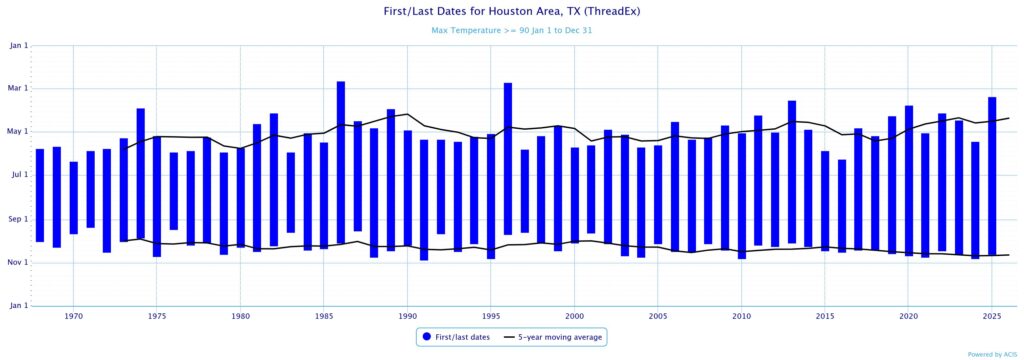
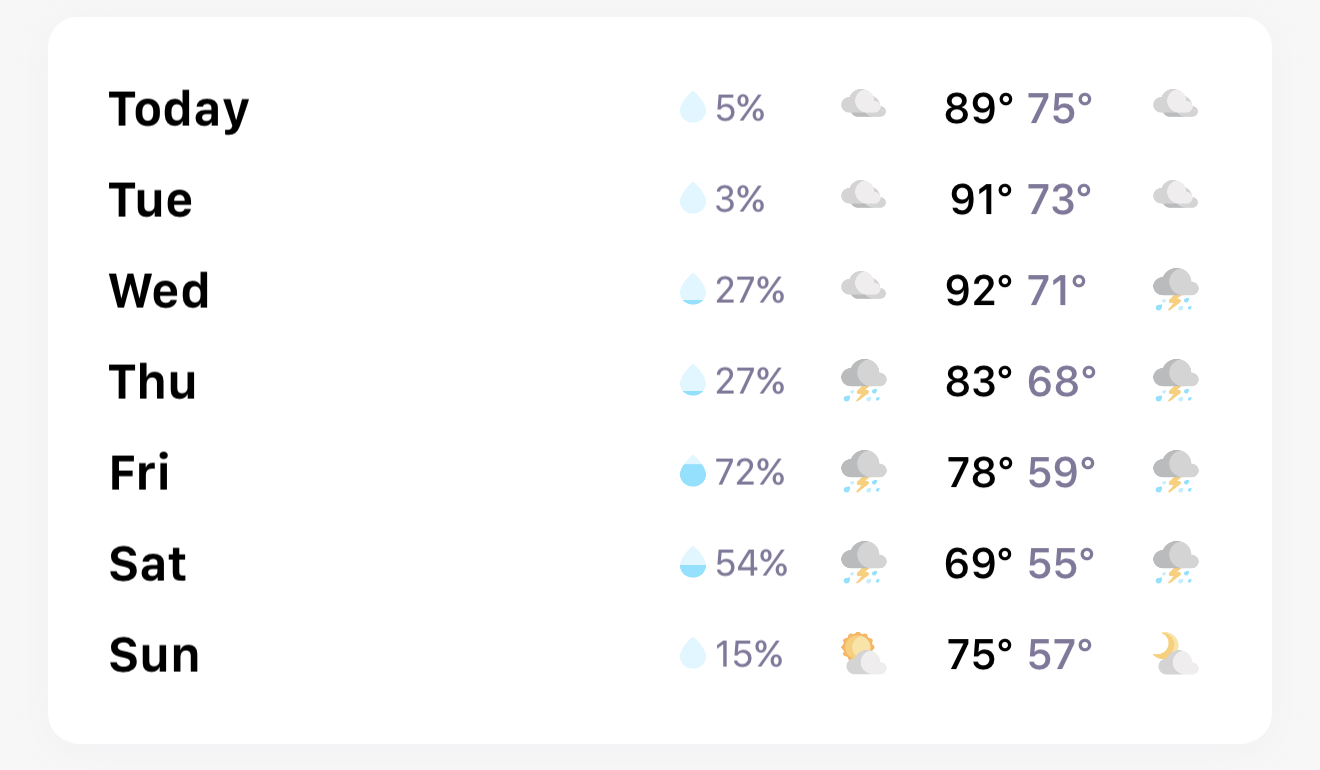
Houston got close on Saturday, with a mark of 89 degrees at Bush Intercontinental Airport. Sunday was a shade cooler. If not today, then Tuesday or Wednesday is virtually certain to hit 90 degrees. If we look at data over the last 60 years (when the city’s official meteorological station has been located at Intercontinental Airport) Houston has recorded its first annual 90-degree day as early as February and as late as June. The average first 90-degree day has been May 2 (this coming Saturday).
Graphic showing earliest and latest 90-degree days since 1968. (NOAA)
So we are not particularly early with temperatures in the 90s this year. And the good news is that we really do have a nice-looking cool front on the way for this weekend. So although summer is indeed coming, it is not here yet to stay.
Monday
We are starting out this morning very warm, in the mid- to upper 70s, and muggy. Skies are mostly cloudy but by mid-morning we should start to clear out. Highs this afternoon will range from the mid-80s near the coast to around 90 degrees for inland areas. Winds will be from the south at about 10 mph, with gusts up to 20 mph during the afternoon. Rain chances are near zero, but if a capping inversion breaks we could see some isolated showers and thunderstorms later today. Low temperatures tonight will only drop into the mid-70s.
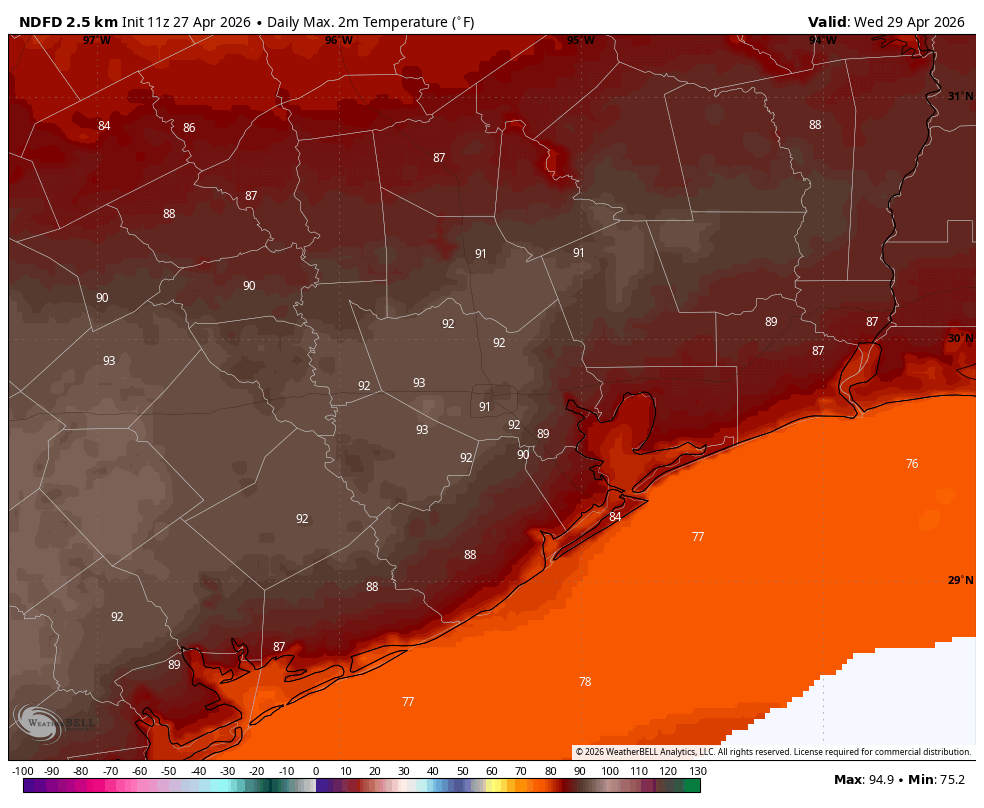
High temperature forecast for Wednesday. (Weather Bell)
Tuesday and Wednesday
These will be the warmest days of the week, with inland areas possibly seeing highs in the lower 90s. Tuesday should be the sunnier of the two days, with a few more clouds on Wednesday. Humidity levels remain very high. Both days, again, will carry a low-end chance of showers and thunderstorms. Chances are probably only 10 percent each day. These will be our region’s warmest days in half a year.
Thursday
A weak front will approach the area on Wednesday evening, and this may lead to some slightly cooler weather, perhaps bringing highs down to the mid-80s. We are going to see some much better rain chances to end the work week, but it’s not clear to me that we’ll see much more than a smattering of showers on Thursday. We’ll see. Overnight lows should drop to around 70 degrees.
Friday and Saturday
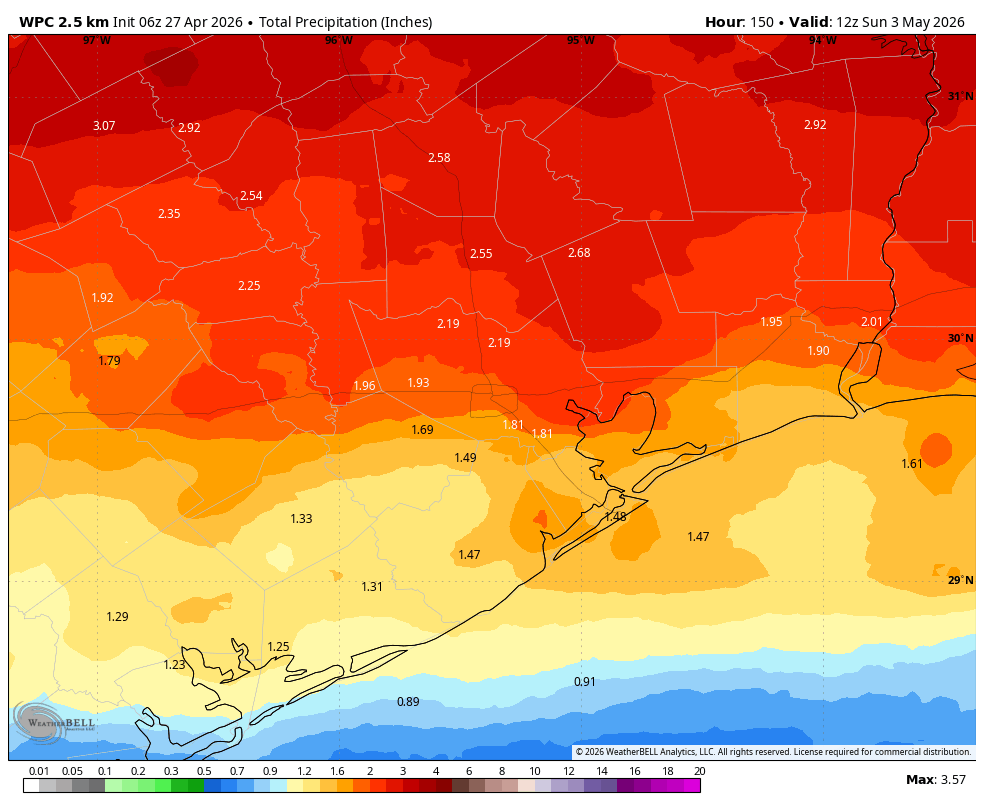
By Friday an increasingly disturbed atmosphere should lead to widespread showers, maybe during the daytime or maybe not until later in the afternoon or evening with a frontal passage. Overall the setup does not look super favorable for severe weather, but it’s too early to make that determination. What does seem likely is widespread showers starting some time on Friday and lasting well into Saturday. High temperatures on Friday will likely peak in the upper 70s, with highs on Saturday perhaps not pushing out of the upper 60s. Lows on Saturday night should drop into the 50s as rains end.
NOAA rain accumulation forecast for now through Saturday night. (Weather Bell)
Sunday
At this point, with the knowledge that things could change, Sunday looks like it could be a really fine day. Skies are likely to be mostly sunny, with mild temperatures in the 70s, low humidity, and light winds. It’s an early candidate for one of the 10 nicest days of the year. We’ll see. Lows on Sunday night will probably drop into the 50s again for most of Houston.
Next week
Houston should start out in the 70s next week before returning to the mid-80s. I don’t think we’re going to get back to the 90s, but we shall see!
Kash Patel’s time as FBI director has been plagued by accusations of chaotic behavior, binge drinking, and unexplained absences. The Onion shares everything you need to know about the head of the federal law enforcement agency.
Claim To Fame: First person to give up looking for Nancy Guthrie
Office Nickname: Shhh, He’s Right There
Greatest Asset: 360-degree field of vision
Signature Look: “Oh you definitely took too much, bro.”
Case He’s Currently Working On: Heinekens
Biggest Case Solved: Which bar he left credit card at






 ALT
ALT