


Welcome to the Cub Den of Love. We were just having our den meeting.
Welcome to the Cub Den of Love. We were just having our den meeting.
It is Blando the Unforgettable. That's why I changed my name from Blando the Magnificent, so people would not forget it. #CowboyWho
Eric Adams prides himself on staying out late. People sometimes refer to him as the “nightlife mayor” (though, in fact, that is a real position in the city that never sleeps, currently held by Jeffrey Garcia), and his line about “staying out late with the boys and getting up with the men” is repeated so frequently that I’ve seen it on T-shirts while walking around town.
What does Adams’s understanding of nightlife entail? Mostly it means going to expensive restaurants and bars — the club Zero Bond has effectively functioned as Adams’s after-hours office during his mayoral term — then mentioning those establishments by name as often as possible (and flaunting the B- and C-list celebrities he met there). Everyone who lives here knows at least a few New Yorkers like this, who are enthralled with the glamor of brushing shoulders with a celebrity and name-drop at every opportunity, who couldn’t possibly be paying for all those fancy dinners they post photos of on social media.
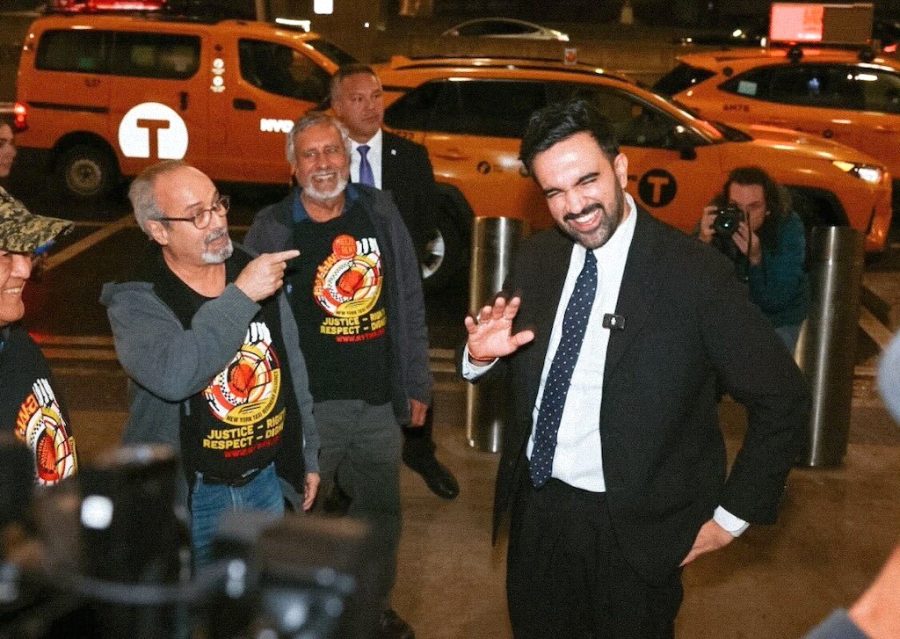
Yet there is a very different version of New York nightlife for many of the city’s residents, one that doesn’t make Page Six: the night shift, the workers who keep the city running and clean and healthy while the rest of us sleep. Speaking on a street corner of Jackson Heights, Queens, just before 1 a.m. on October 31, Zohran Mamdani was concerned with these New Yorkers.
“Less Zero Bond, more a mayor who visits nurses and hospitals after the sun is set, who speaks to EMS workers and bus operators working the late shifts,” he said, flanked by a group of health care workers and taxi drivers.
While the candidate is happy to visit clubs and venues — a few nights later, Mamdani would go on a barhopping get-out-the-vote odyssey across Bushwick that stretched past 2 a.m. — Thursday night was about bringing politics to workers whose schedules make participation in the campaign difficult. In the final days before the election, there was a sense of urgency in the multi-stop outing, a feeling that those with whom the candidate had organized long ago needed to be front and center at the campaign’s conclusion.
“Millions of New Yorkers live in the darkness,” said Mamdani at the street-corner press conference. He continued:
As we cook dinner and prepare our children for bed, these are the New Yorkers who lock their doors behind them and set out to work. These are the people who do not ask for special treatment, but instead, just equality. These are those who keep this city running when we arrive at LaGuardia on a red eye. These are the New Yorkers who pick us up when we carry a feverish child into the ER at three in the morning. . . . When I say that they live in the darkness, I mean that they labor not just when the moon hangs high in the night sky, but also that they are too often forgotten by those with power, their issues and concerns too often relegated to obscurity. They deserve a mayor who will not only stand with them at midnight but fight for them in the morning at city hall.
Mamdani started with taxi drivers. At around 10 p.m. on Thursday night, he arrived at LaGuardia Airport, canvassing the lot where drivers queue and break before taking a new fare. He was joined by members of the New York Taxi Workers Alliance (NYTWA), , an organization representing taxi drivers founded in 1998. Today the group has has tens of thousands of members including rideshare drivers, and they know Mamdani well.
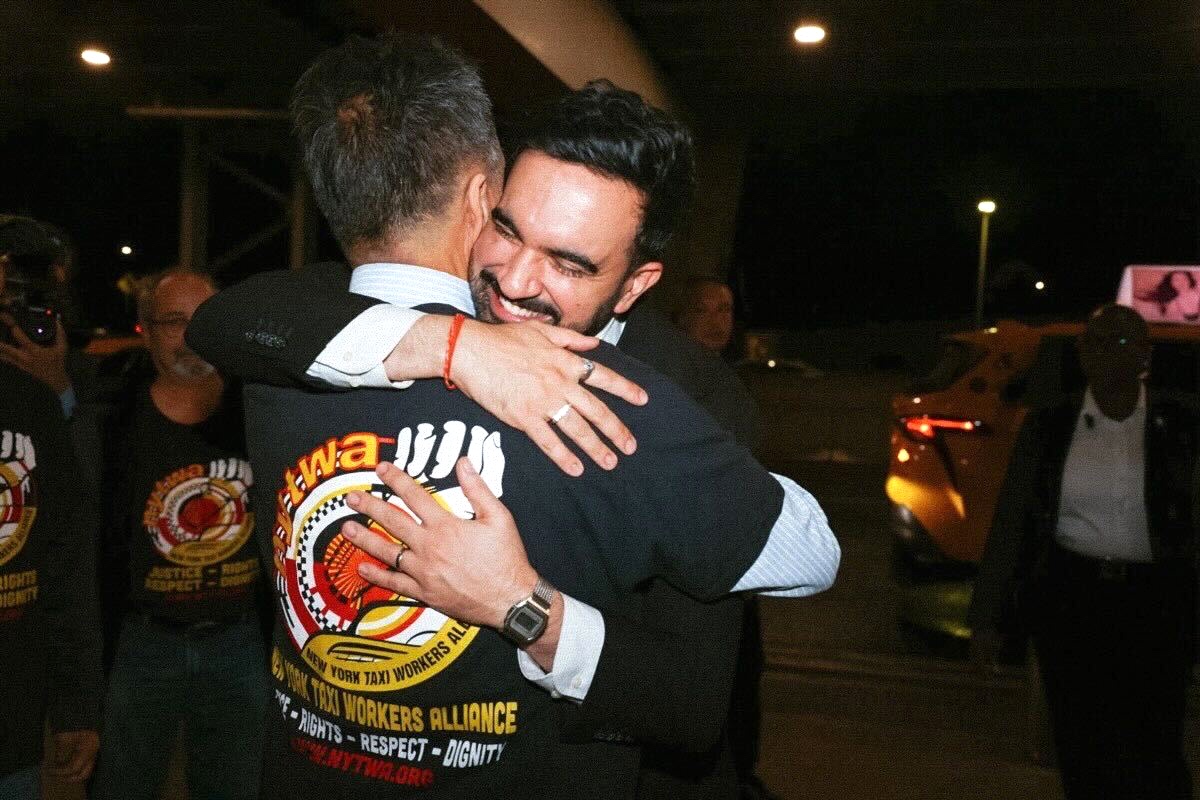
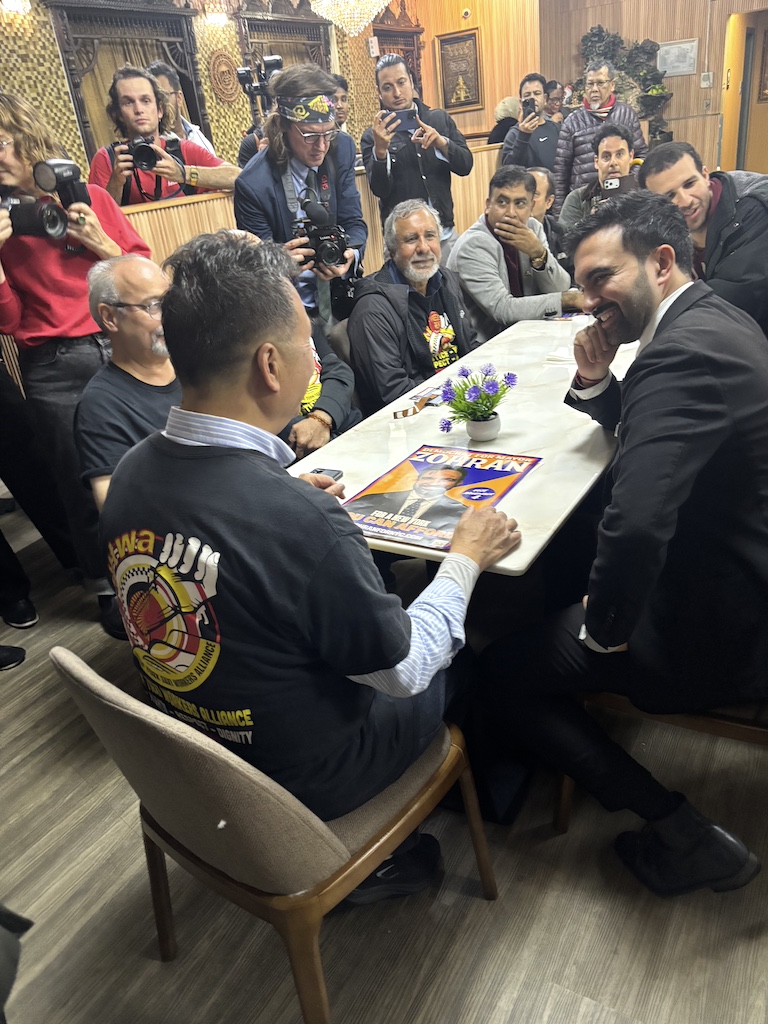
“In 2018, nine drivers committed suicide, and one of my brothers was among them,” Richard Chow, a member of the NYTWA, told me as we sat at Kabab King in Jackson Heights for a late-night meal after the canvass. Back then, drivers were desperate for relief from the taxi medallion system that pushed many of them into insurmountable debt — some owed more than $500,000 — making the job not just unsustainable but a matter of debt peonage and despair.
They wanted the city to intervene and offer relief, but then-mayor Bill de Blasio “ignored us,” explained Chow, which is why some of them, Chow included, began a hunger strike outside city hall in 2021. They were joined by a handful of allies, including then-assemblymember Mamdani. After fifteen days, the NYTWA secured a deal, reducing and capping monthly payments for medallion holders, with the city guaranteeing loans in case of default.
“Ten days in, a doctor told Richard he had to start eating, and he refused,” Mamdani recounted, citing that steadfastness as inspiration during the strike’s grueling final five days.
Life remains difficult for taxi drivers, though. Many still work seven days a week to get by in one of the most expensive cities in the world. When Mamdani canvassed the drivers in the LaGuardia lot, they confirmed that reality.
“One taxi driver at LaGuardia told me that the money that he makes during his 5 p.m. to 1 a.m. shift is not enough to keep his family in their home,” said Mamdani. He pointed out that Chow, who is now in his seventies, still works seven days a week.
From LaGuardia, the campaign moved to Elmhurst Hospital in Queens. The public Health + Hospitals facility is a prime vantage point on the human toll of the city’s affordability crisis.
“Our patients often need more help than the rest, and they usually have fewer resources than the rest,” said Petar Lovric, who has worked at Elmhurst for a decade and lives nearby. “Medicaid patients who are often denied medical services elsewhere come to us.”

The facility is chronically underfunded. It was one of the first hospitals overrun by COVID-19, with the scenes of chaos inside its walls serving as a warning to the rest of the country about what was to come. Lovric gestured to the roof above us outside the hospital’s main entrance as we spoke, pointing out that the night’s drizzle was leaking through it. I could only imagine what it had been like during the morning’s downpour.
Elmhurst’s health care workers comprise an array of unions, as is often the case in a hospital. Lovric and his fellow nurses are members of the New York State Nurses Association (NYSNA). District Council 37 (DC37) and 1199SEIU represent other employees, from psychologists to cafeteria workers and janitorial staff. The Committee of Interns and Residents (CIR-SEIU) represents doctors at Elmhurst. In 2023, they went on strike, the first physician work stoppage in New York in thirty years.
NYSNA and DC37 endorsed Mamdani during the primary, while 1199SEIU, representing some two hundred thousand health care workers in New York City, opted for Andrew Cuomo. As with much of the rest of the city’s labor movement, all three unions have now endorsed Mamdani in the general election.
Outside Elmhurst on Thursday night, several nurses mentioned to me that Mamdani stood with them during a 2023 contract fight over the pay gap between jobs at the city’s eleven public hospitals and private facilities, a disparity of some $20,000 — even as the city had spent $549 million the prior year on travel nurses, temp workers who receive far higher hourly pay than their unionized colleagues. To increase pressure on the city, several hundred of Elmhurst’s nurses, legally prohibited from striking, rallied outside the hospital, with Mamdani in attendance. But Lovric had met the assemblyman before that.
“I’ve been up to speak to him about Medicare for All and single-payer two or three times,” the nurse told me. “He’s been a proponent of it for as long as he’s been in office, and that’s important to me, and it’s an important issue for our patients and the hospital.”
Several nurses mentioned to me that Mamdani stood with them during a 2023 contract fight over the pay gap between jobs at the city’s eleven public hospitals and private facilities.
“As a public hospital, it’s our job to take care of our patients, who might be homeless or without insurance, when they’re in the hospital. But no one takes care of them outside the hospital,” added a first-year medical resident I’d cajoled into an interview, who didn’t want to give his name, as his fellow residents, giggling over his moment in the spotlight, looked on. “It’d be great if there were more resources for homeless people. There needs to be preventative care so they don’t have to come here all the time, which would ease the burden on our work too.”
It’s not hard to see how Mamdani’s agenda would make a difference for these working-class New Yorkers. A $20 minimum wage by 2030 would ease the burden on taxi drivers and Elmhurst’s lowest-paid workers alike, not to mention the hospital’s patients. Many of the facility’s staff rely on buses to get to and from work at all hours of the night, with some shelling out much of their income for the care of their own children while they care for others. What if those buses and that childcare were free?
There are other, workplace-specific elements of Mamdani’s agenda that would ease the burden of life in this city. The candidate has earned support from Los Deliveristas Unidos, an organization of app-based delivery workers in the city, by emphasizing the need to regulate gig companies rather than penalizing the e-bike drivers who sometimes speed through intersections. These platforms incentivize speed, and the workers are paid by piece rate; the violations follow from there. DoorDash has donated much to pro-Cuomo super PACs. (The strangest use of that money I’ve come across was an Instagram ad with a photo of Mamdani and Hasan Piker with bright red text over the image instructing me to Google “HASAN PIKER 9/11.”)

Mamdani has urged Amazon to recognize Amazon workers’ unions, both those formed by its warehouse workers and its subcontracted delivery drivers. When delivery drivers at several New York Amazon warehouses went on strike in December 2024, he voiced his support for them, stating, “Now the world’s largest corporation needs to stop its illegal practices, recognize the union and settle a contract with fair pay, safe working conditions, and respect on the job.”
These drivers and their counterparts across the country constitute a gigantic, misclassified workforce. The company wanted to get into the transportation business, but it did not want to deal with unions, the International Brotherhood of Teamsters foremost among them in that sector. It did so by minimizing its liabilities by using delivery service partners, or DSPs, which, in turn, employ the drivers who show up at your door in Amazon-branded vans and shirts.
It’s a prime example of the rise of the “fissured workplace,” in which a corporation foregoes employing workers directly in favor of outsourcing to smaller companies, exacerbating inequality and declining working wages and working conditions. Other workers see the effects of this exploitation: Heather Irobunda, an Elmhurst OB-GYN who spoke with Mamdani on Friday night, noted that Amazon workers sometimes land in the hospital for urinary tract infections incurred from an inability to use the restroom at work when they need one.
City Councilmember Tiffany Cabán recently introduced a bill that would force Amazon to directly employ its last-mile driver workforce, the workers who take the final stretch of package delivery. In addition to requiring delivery companies like Amazon directly employ drivers, the Delivery Protection Act would mandate safety training, make companies directly responsible for driver safety, and require last-mile delivery centers to be licensed with the city. The legislation is backed by the Teamsters, who have been organizing with DSP drivers and making the argument that Amazon constitutes a joint employer of its drivers, a status that would require it to bargain with those workers if they unionize.
Thus far, several National Labor Relations Board regions have concurred with the union’s argument, but Amazon has the capacity to appeal. Of course, the company has demonstrated that it has no problem ignoring labor law entirely and eating whatever fines it may incur. Cabán’s bill, were it to gain traction, would be met with a knockdown, drag-out fight from Amazon, which would view it as an existential threat to its business model.
Mamdani has urged Amazon to recognize Amazon workers’ unions, both those formed by its warehouse workers and its subcontracted delivery drivers.
Companies breaking labor laws as they please has been the order of the day for many years. Workers in the United States effectively do not have the right to organize, and rather than seeing it as the emergency that it is, an alarm that should lead them to radically change their ways, many existing unions prefer to tend to their shrinking membership even as the cost of living eats up wage gains. Too many union leaders rely on staying in the good graces of Democratic Party leadership to maintain power because it’s easier than building enough muscle and engagement among rank-and-file members to enforce power in the old-fashioned way: through collective action.
This complacency is why many of the city’s unions quickly (and sometimes undemocratically) endorsed Cuomo: Why educate your members about someone whose policies could improve their lives rather than simply go with the guy you and they already know? Unions must spend more money on organizing, and the Left must be present again and again as crises erupt in any number of industries, ready and able to make the case for organizing collectively rather than waiting for relief to come down from on high.
That brings us back to a Mamdani mayoralty. There’s plenty of risk that, should he win, people will do precisely that, investing their political agency in him and observing from the sidelines. I wonder about that when I see the pedestal some supporters place him on, as if building someone up higher doesn’t just mean they’ll have farther to fall. But it will be something of a miracle if Mamdani can realize much of his agenda: he needs state legislators and the governor to change the tax code, and the federal government can stop providing the billions of dollars in funds on which the city and state rely.
Then there is the guaranteed resistance of the city’s very rich, who will fight these policies tooth and nail. Mamdani’s supporters will have to fight this if there’s any hope of implementing his agenda. (Of the claim that the rich will leave town, evidence from the Fiscal Policy Institute suggests that isn’t the case, no matter how often the New York Post says otherwise; in fact, it is the poor who are constantly forced to leave New York because they can’t afford it. But I expect some corporations will threaten to abandon their lucrative operations here should Mamdani target them. Rideshare companies and Amazon have a history of doing so.)
While there will be many people whose political activity consists entirely of voting for Zohran, I suspect very few of them were otherwise activists who will now rest on their laurels. The question is how many newly politically engaged New Yorkers the city’s left and social movements can bring into further political activity.
The Mamdani campaign has a hundrd thousand volunteers: How many will become union organizers? This is no rhetorical question. I’ve met many people whose first political engagement was through one of Bernie Sanders’s presidential campaigns who, upon its conclusion, took jobs at Starbucks or Amazon with the intention of organizing. Labor scholar Eric Blanc’s recent research confirms these and other similar origins for union activists in many of the country’s most exciting recent organizing drives.
How many Zohran activists will the Democratic Socialists of America convert to active members? How many can be brought into the tenants’ rights or labor movement?
Being the mayor of New York City seems like one of the worst jobs in the country, a position that turns you into the scapegoat when anything goes wrong. I still don’t quite understand why Mamdani, who seems like an otherwise rational person, wants to do it. But if the movement that has grown from his campaign sticks around, putting its energy toward other endeavors, a lot can change.
Fiorello La Guardia, a key predecessor for Mamdani, spoke of the need for a “100 percent union city,” pressing for a “baby Wagner” law for New York businesses and incentivizing employers to recognize unions through a host of measures. Mamdani has similar tools at his disposal; subsidizing unionized childcare providers is right in line with his prioritization of the subject. He’ll also need to staff up the woefully under-resourced Department of Consumer and Worker Protection to enforce these regulations: the department largely pays for itself through fines and licensing, but its workforce, currently around 450 people, needs to double.
There’s also the matter of the attention a Mayor Mamdani could bring to workers’ struggles, the “bully pulpit.” His spotlight is gigantic. (Every recent profile of Mamdani mentions the media circus around him, but it’s really a shocking dynamic to experience — on Thursday night, every step he took was matched by a claustrophobically tight circle of photographers, cameras flashing in every direction.) He could use that attention to direct workers to organizing resources, demystifying unions, and introducing them to a new generation that largely still has no personal experience with organized labor.
There’s no doubt there will be contradictions in a Mamdani mayoralty, and not only in the dilemma of governing as a pro-worker mayor while unions are all but nonexistent in the city’s private sector. Most pressing may be the tricky business of handling the New York Police Department (NYPD) as a socialist.
Looking at de Blasio’s time in office is illuminating. Upon winning the mayoral race, de Blasio, who had criticized stop and frisk and advocated police reform, appointed Bill Bratton as NYPD commissioner. Bratton had held the post under Mayor Rudy Giuliani, garnering criticism for his advocacy of “broken windows” policing. But NYPD officers liked him, so de Blasio, seeking to accommodate a hostile force, brought him back.
It didn’t work out. Bratton resigned before the end of de Blasio’s first term after months of disagreement between the two. The commissioner had resisted one City Council reform bill after another — this was the first wave of Black Lives Matter protests — and his officers still hated de Blasio, turning their backs to him at a cop’s funeral in 2015. The hostility didn’t go away during his second term: in 2020, the Sergeants Benevolent Association broadcasted that they had arrested de Blasio’s daughter at a protest over the killing of George Floyd. The cops released a constant barrage of criticism and hysteria through their influence over the city’s media outlets, and de Blasio never overcame it.
Thus far, despite fearmongering about cops quitting if Mamdani wins, he hasn’t provoked much visible ire among the NYPD rank and file. In part, this may be because the department is a mess under Mayor Adams. Cops may hate Mamdani’s old tweets about defunding the police, but under Adams, they’re working forced overtime while higher-ups allegedly engage in brazen graft, generating an astonishing number of scandals.
But if Mamdani wins and moves to eliminate the Strategic Response Group, the widely reviled and legally expensive force created by Bratton in 2015 that shows up at protests, and the department’s gang database — his two concrete policing proposals, along with diverting mental health calls to a new Department of Community Safety — he could have a revolt on his hands.
His decision to keep billionaire heiress Jessica Tisch, an opponent of bail reform and supporter of quality-of-life policing (a cousin of broken windows) as commissioner is noteworthy in this light. Unlike Bratton, she is not especially beloved by officers. It suggests a desire to appease rather than restrain the NYPD (a strategy that did not work for de Blasio). It may equally be an appeasement of the city’s elite, the business class, and power brokers who are panicking not just about having Mamdani in office but over the fact that he will be hiring people they do not already know. Retaining Tisch, a competent bureaucrat and known figure, works as a salve.
New Yorkers of all stripes want the future he advocates building, and they aren’t swayed by the racist attacks that have defined his opponents’ messages.
Explaining Tisch’s appointment, Mamdani has said that he is confident the commissioner will follow his lead. I’m not sure that will happen. Maybe he doesn’t want to pick this fight right now, preferring to retain a laser-focus on his affordability agenda, but the conflict will be unavoidable.
There is also the issue of Israel’s genocide and the Palestine solidarity movement’s criminalization. The Democratic Party will incorporate some elements of that movement for the sake of its own future, but it will not back a free Palestine, with all of what that entails. Mamdani’s campaign has been productive in putting the lie to the idea that one must be a Zionist to succeed in US politics, which opens a lane for other political figures to push on the subject, weakening the hold of the Israel lobby.
He’ll be under pressure to moderate on the issue, and, in turn, that discipline will almost certainly be applied to the anti-capitalist left when it goes further than him, either in messaging or action. But I’m glad to have someone who founded a college Students for Justice in Palestine chapter and says he wouldn’t have sicced the NYPD on Columbia University students earlier this year in Gracie Mansion, especially in a climate of rising Islamophobia and anti-immigrant sentiment.
But that is all to come. First, he must win.
Watching Zohran late Thursday night, as I considered the obstacles ahead, I couldn’t help but be jolted back into the present by the sheer improbability of what I was witnessing: in the middle of the night, a socialist mayoral candidate whose campaign now consists of a hundred thousand volunteers was standing with working-class New Yorkers on a street corner, speaking to their priorities. And he was the favorite to win! New Yorkers of all stripes couldn’t get enough of the guy! They want the future he advocates building, and they weren’t swayed by the racist attacks that have defined his opponents’ messages in the final weeks of the race. The evidence was right there on the sidewalk.
It wasn’t just the media-trained workers next to him at the podium. A crowd immediately formed, even at 1 a.m. on a weeknight. Passersby yelled out to the candidate. Supporters followed him to his car when the press conference adjourned.
As I peeled away from the crowd, a woman speaking into a phone walked near me. “He’s talking about stuff like free buses, freezing the rent. If he can even get some of that done, maybe we don’t need to leave New York after all.”
The post Mike Johnson: ‘My Christian Faith Is More About Not Jacking Off Than Feeding The Poor’ appeared first on The Onion.
Texas has grown a bumper crop of book authors and, with that, an ever-expanding list of literary festivals. San Antonio’s sprawls around its towering tomato-red public library every spring. Lubbock daringly throws its in sweaty August, while Boerne awaits the arrival of typically more bearable October weather. Then there’s the biggest of them all: the Texas Book Festival, which will gather some 250 authors in early November and erect a bibliophilic tent city out front of the state Capitol, perhaps ironically the launching pad of myriad political attacks on supposedly intolerable tomes and sinful librarians.
This year’s Austin fest includes a suite of authors whose work the Texas Observer has covered: Steve Harrigan, with Sorrowful Mysteries, his haunting “sideways memoir” meditation on Portuguese child mystics;Jim Harrington, who recently penned his account of building the Texas Civil Rights Project; and my own true Texas horror story, The Scientist and the Serial Killer.
The festival lineup adds plenty more to Texans’ 2025 must-read lists. Here are three featured nonfiction tales by Texas authors filled with intrigue, espionage, and previously untold backstories.
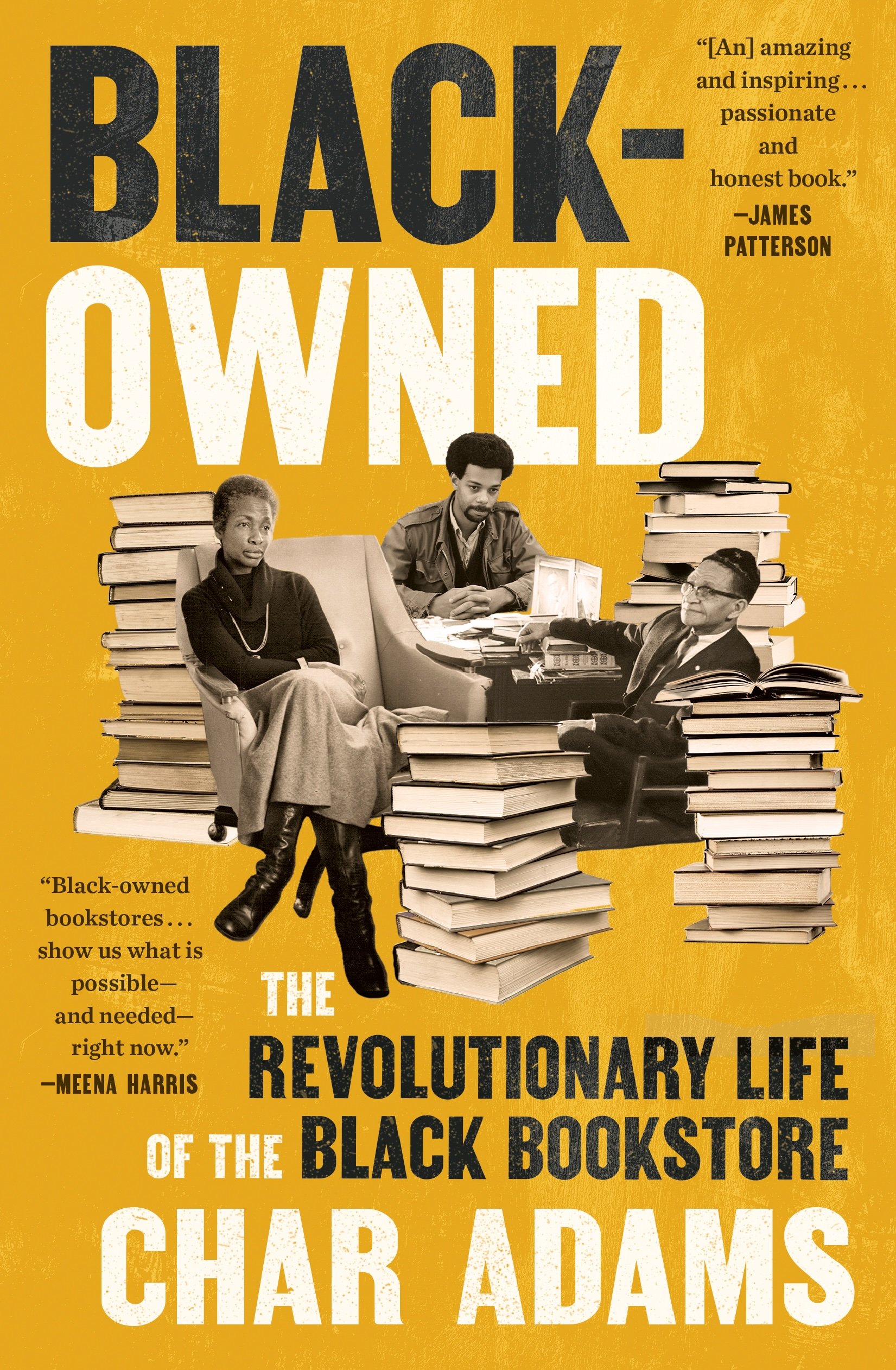
Char Adams, until recently an NBC News correspondent in Dallas, has a background in edgy contemporary features: She previously worked for People magazine. But her first book takes a historical turn. It’s a compelling compilation of mini-profiles of many unsung heroes of America’s Black-owned bookstores, from a courageous pioneering abolitionist who ran his own store in the 1800s—surviving many attacks on his business and himself—to contemporary owners, like the two sisters who operate The Dock in East Fort Worth.
In each chapter, Adams delves deep into the owners’ biographies, philosophies, and roles, weaving a tapestry that crosses time and space.
“When I went into this project, I knew I had a really big responsibility—there were so many Black booksellers and historians who were and who are counting on me to tell the story right,” Adams told the Observer. “It truly is the first full-length book to chronicle the history of Black-owned bookstores in this country.”
Her book introduces us to many admirable men—and women. Many were pioneers who stood up for emancipation, civil rights, or (particularly in the 1970s) Black nationalism. They sold books that were banned or were simply unavailable elsewhere. They hosted speakers and events and joined local protests. Some died long ago, yet Adams rooted out their words through documents and brought them to life. There’s David Ruggles, the abolitionist who opened the nation’s first Black bookstore, in Manhattan in 1834, when he was sometimes targeted by runaway-slave catchers. And Lewis Michaux, who ran the African National Memorial bookstore in Harlem from the 1930s to the 1970s.
Adams tracked down and interviewed contemporary owners like James Fugate, of the celebrity-filled Los Angeles bookstore Isso Wan. And Emma Rodgers, a Texan whose Black Images Book Bazaar was born in 1986 from her own desire for more Black children’s books: As Adams writes, “She drove all over Dallas looking for titles with positive images of Black children to add to party favors for her son’s birthday in the late 1970s. Rodgers ultimately found them, but not without great frustration.”
Sadly, the stories of too many Black-owned stores ended after the shops were damaged or destroyed by looting, vandalism, and arson—in the case of one Detroit store, at the hands of local police. The FBI pops up in these pages for its monitoring of bookstore owners. Indeed, Adams’ book was inspired by an Atlantic article she read about “The FBI’s War on Black-Owned Bookstores” in the 1960s and ’70s.
“My interest was piqued in the sense that I wanted to know what that experience was like for booksellers personally,” Adams said. “So I started just tracking down those booksellers and talking to them and getting a vivid picture.”
Two Kansas couples whose bookstore was targeted weren’t politically active at all. “They just saw a need in their communities. They just saw that Black kids around them did not have a lot of access to books,” Adams told the Observer.
Adams trains a revealing new lens on American history and on the struggles of Black literary leaders. Each store’s success, as she writes, has relied in part on the owners’ courage, tenacity, and vision—and the faithfulness of its patrons.
Adams is particularly skilled at telling stories about American culture and history—from 2020 until March 2025, she covered race and identity for NBC.She witnessed firsthand how Black-owned bookstores saw business surge after shootings of young Black men by police, especially in 2020 after Houston native George Floyd was restrained and killed by Minneapolis police.
Even as she rushed to complete her research, Adams still frequented Black bookstores near her Dallas home, including the older Pan-African Connection and the Blacklit bookstore, which opened in 2022 in Farmers Branch. (Her book includes a list of U.S. stores and booksellers’ recommended reading.) To her, those two Dallas stores represent generational differences—the first being more spiritual and traditional and the second “a carefully designed event space”—yet she considers both “different branches of a single tree.”

John Lisle, a mild-mannered University of Texas at Austin professor who specializes in the history of science, spends a lot of time in voluminous government archives tracking dark secrets that sound like conspiracy theories. He was busy reviewing records in the Library of Congress for his PhD dissertation when he stumbled on previously unpublished accounts of a top-secret CIA mind-control program—the subject of his new book.
Lisle already knew a lot about the odd life and strange career of Sidney Gottlieb, a shadowy scientist who led a program called MKUltra. Gottlieb oversaw mind-control experiments for about two decades that used an “exhaustive number of drugs” as well as hypnotism and myriad other techniques. But he’d largely evaded scrutiny, partly because he destroyed nearly all of his records in the 1970s.
In the archives, Lisle found sworn statements that he’d never seen published anywhere. His discovery of depositions from Gottlieb and other CIA figures allowed him to build compelling narratives about Gottlieb and MKUltra—and to disclose previously unknown information.
Some early CIA mind-control experiments were conducted (without permission) on government employees, including Frank Olson, a scientist dosed at a work gathering in Maryland who returned home “a totally different person,” according to his wife. The agency whisked Olson away to New York for emergency mental health treatment, but he threw himself out of a 13-story hotel window. An internal CIA investigation blamed Olson’s death on the flawed experiments, Lisle writes, yet they continued unchanged.
Olson’s family eventually sued and won a settlement. But Lisle’s discovery was of depositions in another lawsuit involving people who sued the CIA after being subjected to MKUltra experiments while incarcerated in the Atlanta Federal Penitentiary. As part of that case, an activist civil rights attorney grilled Gottlieb and other key CIA players.

Lisle found 823 pages of material, and he uses it to weave a narrative centered on the bizarre scientist: “From the defense’s perspective, Gottlieb’s depositions were a disaster. From the historian’s perspective, they’re a gold mine,” he writes.
Lisle’s book provides new details from insiders about how America’s mind-control program progressed. It eventually included about 149 subprojects conducted by scientists at mental hospitals, military bases, and safe houses. All were funded by CIA money laundered through shell companies and foundations. One redacted subproject list, eventually made public, suggests some experiments were conducted in Texas, possibly at the University of Texas and Texas Christian University.
The author describes some victims: Harold Blauer, a professional tennis player, who was killed during experiments conducted at the New York State Psychiatric Institute in 1953 and whose family received a settlement. And Jimmy Shaver, a 29-year-old father of two stationed at Lackland Air Force Base, who suddenly kidnapped, raped, and murdered a 3-year-old girl in a 1954 incident that he claimed not to recall. Shaver, who had no prior criminal history, was then examined before trial by Louis Jolyon West, the base’s resident psychiatrist, who had been conducting work funded under MKUltra around that same time.
Lisle devotes little space to allegations raised in another nonfiction book, CHAOS: Charles Manson, the CIA, and the Secret History of the Sixties,by journalist Tom O’’Neill. O’Neill spent years investigating possible ties between Manson and the CIA’s mind-control program and postulated that Manson, a former federal prisoner, might have met West, who visited San Francisco as part of his LSD experiments. In an interview, Lisle expressed skepticism that Manson’s ability to order other “Family” members to kill could have been linked to the CIA’s conducting MKUltra experiments on him. Instead, Lisle suggested that West, the CIA researcher, could have been trying to learn from the cult leader’s techniques. “Manson was actually a lot better [than West] at manipulation,” Lisle told the Observer.
Lisle found only scant information about what happened to the many victims who received the bizarre treatments, including the former Atlanta Federal Penitentiary prisoners who sued the CIA. “I had a really hard time looking up people who were involved in this. It was difficult to find major figures, anyone involved with them, anyone who is willing to talk,” he told the Observer.
I couldn’t help but wonder: What else was in the files Gottlieb purged?

Fans of Skip Hollandsworth, famed chronicler of true crime, will find much to love in this new collection of compelling narratives featuring the dark side of Texas womanhood. It includes many page-turning Texas Monthly features that I had never forgotten, including the 2007 tale of soft-spoken Vickie Dawn Jackson, the goody-two-shoes-nurse-turned-serial-killer dubbed the “Angel of Death” and the 2021 story of “The Notorious Mrs. Mossler,” a deadly high-society Houstonian.
Often, Hollandsworth uses his considerable skills to delve deep beneath the skin of the most complex and bizarre characters, and he frequently uncovers common ground and unexpected insights. He introduces Jackson to his readers, for example, explaining how carefully she tapped small-town resources to make herself pleasing to patients, including those she eventually killed. “Her hair, which she dyed herself at her kitchen sink with Lady Clairol Pale Blonde, would be neatly brushed and pulled back in a little knot on the top of her head—Vickie believed it was important that a nurse never let her hair get in the way of her work—and because she also thought that patients liked nurses who smelled good, she would be wearing a dab of Charlie on her neck, which she’d buy on sale at Wal-Mart.”
His ability to connect and convey folk in far-flung Texas is also apparent in his masterful “Midnight in the Garden of East Texas,” but that story’s disqualified for this collection given that the killer is male. (Fortunately, Richard Linklater made a film about Bernie.)
My favorite part of this story collection is the personalized notes that Hollandsworth uses to stitch it together. In the introduction, Hollandsworth shares how his fascination with crime began and his life changed in the summer of 1974, when he was a preacher’s kid and read about an unsolved crime in his hometown of Wichita Falls.
“When church members asked me what I planned to do when I grew up, I told them I would most likely become a Presbyterian pastor. … Then, on the morning of June 22, I walked into the kitchen and glanced at the local newspaper, the Wichita Falls Record News, that my father had brought in from the yard. Spread across the front page, in heavy two-inch-high block print, was the headline: Millionaire Oilman, Wife Found Dead; Couple Fatally Shot in Home Here.”
Throughout the rest of the book, Hollandsworth provides information on that case and other crimes he’s spent his life chronicling. Another standout tale is “The Fugitive,” his 2008 story about yet another nurse, Deborah Murphey, an apparently law-abiding wife and mother in East Texas who was suddenly arrested by out-of-state bounty hunters to the shock of her friends and neighbors. “‘The nicest lady in the world turned into an escapee from the law,’ marveled Linda Veitch, the owner of the town’s biggest beauty salon, the Hair Depot,” he wrote.
Hollandsworth’s investigation of Murphey’s unusual arrest revealed she’d been convicted of armed robbery as a teen more than three decades prior. She’d subsequently managed to escape from a Georgia prison, only after being repeatedly abused by a trio of guards. He found evidence of a broader culture of abuse of female prisoners in those years. An attorney who filed suit on behalf of other victims told Hollandsworth that several inmates had “mentioned [Murphey] and the abuse she had been forced to endure.”
That compelling tale became a game-changing investigation. Outraged readers contacted the governor’s offices in Georgia and Texas, creating a wave of support for Murphey. Ultimately, the Georgia Department of Corrections didn’t pursue extradition, and Murphey, according to Hollandsworth’s postscript, was able to continue her life as a law-abiding Texan.
Hollandsworth’s previous book, Midnight Assassin, chronicles an unidentified ax murderer—Austin’s own Jack the Ripper, a complex historic mystery that he investigated and told without being able to interview a single living witness. Still, I think Hollandsworth’s superpower is his ability to connect with people and get them to make surprising or even shocking admissions.
I’m hoping Hollandsworth’s next book is a memoir. I’d like to hear more about the lessons he’s learned as a Texas true crime writer and how his own life changed by forging deep connections with so many notorious, tragic, eccentric, and downright strange characters. Sometimes, as he told me, he winds up “inside their lives.”
For more Observer books coverage, see texasobserver.org/topics/books.
The post Black Bookstore Owners, Government Spies, and Murder appeared first on The Texas Observer.
When my wife and I were deciding which city to live in, we made a list of cities, and scored each city based on some criteria. Here’s San Francisco and Minneapolis, for example, on weather and affordability.
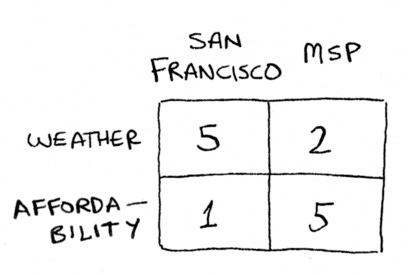
You can see we loved the weather in San Francisco, but Minneapolis was way cheaper to live in. After this was done, we just added up the columns to figure out which city to live in!
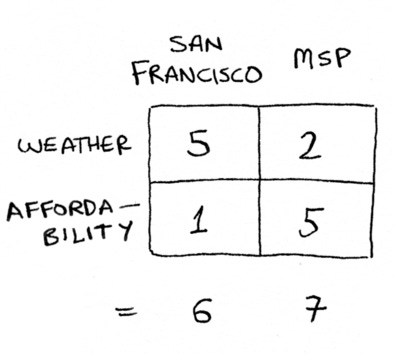
Here’s the thing, though: I really liked the weather in San Francisco. I wanted some way to do this calculation, but have the weather matter more. Well, I could do that by using weights.
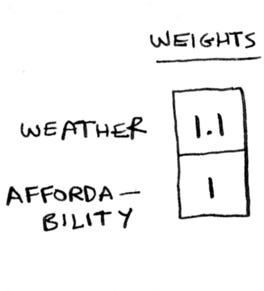
If I wanted the weather to matter 10% more, I could multiply by 1.1 before doing the addition.
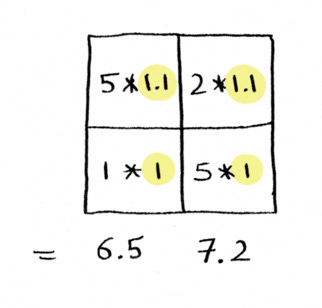
(I also multiplied the affordability by 1 to show that I’m keeping it the same).
This is the essence of what a dot product is! Earlier I was adding up the numbers. Now I’m weighting the numbers before I add them
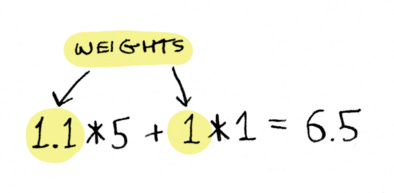
A dot product is a type of weighted sum.
Remember vectors from last chapter? Well, the dot product is an operation you perform on two vectors. Let’s write the above as a vector. For example, here are the scores for San Francisco as a vector
![[5 1]](https://substackcdn.com/image/fetch/%24s_!cVCy!,f_auto,q_auto:good,fl_progressive:steep/https%3A%2F%2Fsubstack-post-media.s3.amazonaws.com%2Fpublic%2Fimages%2F25a22cfe-3e41-4dc8-a01e-fa6f46f3f0af_158x254.png "[5 1]")
Here are the weights as a vector
![[1.1 1]](https://substackcdn.com/image/fetch/%24s_!IdFP!,f_auto,q_auto:good,fl_progressive:steep/https%3A%2F%2Fsubstack-post-media.s3.amazonaws.com%2Fpublic%2Fimages%2Fe7b8cb6a-a37b-4010-be19-9a6504910ea1_158x256.png "[1.1 1]")
We simply multiply the numbers by the weights and then add:
Tada! We just took a dot product of two vectors! It’s a straightforward operation.

Let’s see the same example with three cities. Here are our three cities with scores for weather and affordability:

The simple way to calculate scores would be to just add up the numbers:

But instead, we’re going to take the dot product:

We are taking three separate dot products here. For each city, we multiply its scores by the weights:

I’m saying that now to make it clear that we’re not taking the dot product of three vectors. That’s impossible, we can only take the dot product of two vectors. Instead we are taking three separate dot products. More on this later.
Now let’s look at another example. Let’s look at the Minnesota lottery.
It takes $2 to buy a ticket for the Minnesota lottery. Here are the odds:

So your odds of winning $2 are 1 in 17, your odds of winning $20 are 1 in 2404, etc. Given this information, how do you calculate how much a single ticket is worth, on average?
To find out, we again need to take the dot product. Here are the two vectors:

Prize money on the left, probability of winning on the right. Let’s see the calculation:
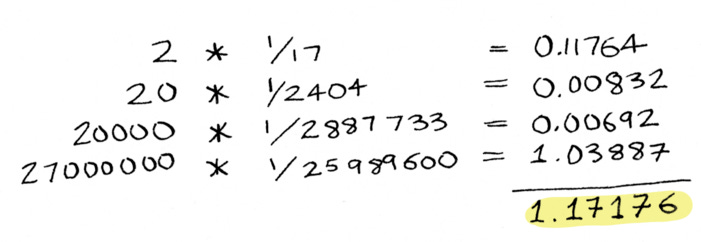
The ticket is worth $1.17176. It costs $2, so on average you can expect to lose money, which is what we knew already.
Same as the cities example, we are weighting the numbers, except this time the weights are the probability that we win that much money. The final number is called the expected value.
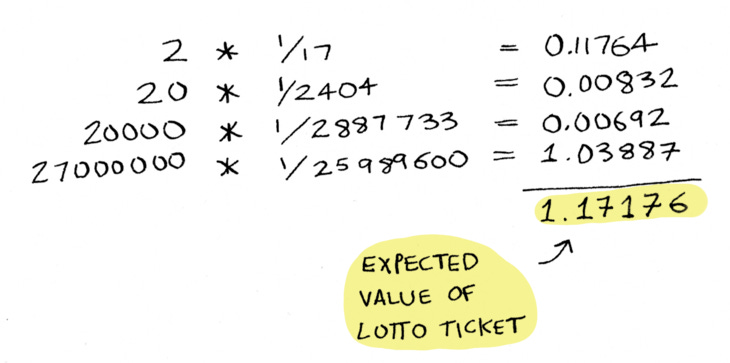
It’s the expected value of our ticket.
That’s all for dot products. It’s a straightforward operation, but one that’s important to know for matrix multiplication, which is the topic of the next chapter.
A dot product is a type of weighted sum, and is an operation you do on two vectors. You multiply each element of the vectors together, then add up the results:

Thanks for reading DuckTyped! Subscribe for free to receive new posts and support my work.
WASHINGTON—With deep unease and outright horror haunting millions of Americans as a great shroud enveloped the land, late-breaking reports confirmed Monday that the darkness had returned.
Bystanders first spotted the churning, amorphous black fog at 2:37 p.m., when it arose from the shadows and crept toward small towns and cornfields in the Midwest. From there, the inky swath reportedly poured through main streets nationwide, sweeping over mountains, valleys, and highways as it plunged Chicago, Minneapolis, Boston, and other metropolitan areas into eternal night and caused citizens across the country to vanish, possibly forever, inside its lightless depths.
“We once thought we had beaten back the darkness, but we were wrong, dead wrong,” said the Department of Homeland Security’s inspector general, Joseph Cuffari, who urged Americans to stay calm, turn on any floodlights they had, and cover their home’s vents with towels, as that was how the darkness often leaked in. “So far as we’re aware, traditional weaponry is useless against the darkness. armies, our best technologies, cannot stop it from drawing closer and closer. Your best bet—your only bet, really—is to stay in the light as long as you can.”
“The darkness is back, and soon it will consume us all,” Cuffari added.

Authorities have estimated that since the dark scourge’s reappearance, it has already cloaked nearly 1.5 million square miles of the country, disrupting economic and government function worldwide as vast swaths of land were abandoned to the seemingly endless dusk. Speculations about the origin, trajectory, or intention of the darkness have been described as futile by experts, who noted merely that it was “coming nearer, always nearer” as it seethed out of deep forests, murky swamps, and pitch-black caverns.
Witnesses in New York City spotted the darkness enclosing the Statue of Liberty and described hearing a low-pitched whisper in their ears as the black clouds approached, filling them with an irresistible urge to extinguish every candle and lamp in their home. Meanwhile, a farm family in Okemah, OK, said they heard the chattering of thousands of voices that seemed to beckon them to turn around their car, drive into the unyielding dimness, and become one with the abyss.
According to historians, the source of the darkness remains no less mysterious now than when it last emerged in 1846 and reduced the nation to an inescapable twilight, separating parents from children, driving wild animals to flee from its pursuing shadows, and causing the Donner Party to succumb to cannibalism due to what one survivor account described as “gloom-induced madness.”
“I’m the only one left,” President Donald Trump said in a live broadcast from the Oval Office, which grew steadily dimmer as the windows behind him filled with complete blackness and a single lamp on the Resolute desk flickered. “I’m the only one left. They all tried to escape, but it was too late. It already took Melania. Once you see it on the horizon, the darkness already has you.”
“Oh dear God, it’s here—it’s here,” added the president, his voice falling to a whisper as a hissing black fog filled the room.
Until the darkness can be contained or turned back—a possibility that grows increasingly unlikely by the hour—authorities have urged citizens to flee to the federally protected lighting corridor that spans Colorado, Kansas, and Missouri, the three states that remain as an island of light in an ocean of tarry blackness. However, the likelihood that even these strongholds will hold out against the insurmountable threat appeared doubtful as numerous assumptions fell to the perpetually shifting ways of the darkness.
For example, experts long thought those who were swallowed by the darkness never reemerged. But doubt has been cast upon this belief by reports of a survivor who stumbled out of the so-called Dark Zones to deliver a grave pronouncement.
“What I have seen on the other side would destroy you,” said the self-described survivor of the darkness, 43-year-old Andrew Weiss, whose monotone voice was heard in a 30-second online video that prompted many viewers to remark upon his pure black pupils and the coal-dark smoke that seemed to emerge from his mouth with each breath. “Do you understand? Of course not. You are too blinded by the light. But when you peer into the darkness, you see it for what it is. There is dark, yes. But it is a dark mirror. Do you see now? Hide in the light all you want, but the truth is the darkness already courses through your veins.”
“You have been in the darkness since the moment you were born,” he concluded.
At press time, sources confirmed an eerie stillness reigned over the land, in which there was only nothing, dark nothing, stretching on forever.
The post Breaking: The Darkness Returns appeared first on The Onion.
LOS ANGELES—Anticipating the project could be the biggest horror hit of the decade, film studios were reportedly locked in a bidding war Friday over a napkin Stephen King had written the word “Ghoul” on. “It only took him two weeks to write, but it’s incredible—it’s an entire fleshed-out world,” said an insider source, who confirmed that Warner Bros., Sony, Lionsgate, and Amazon MGM were among the major studios
“practically salivating” at the chance to produce an adaptation of the two-ply disposable paper napkin the bestselling author had scribbled on. “It could easily go for upwards of seven figures. After all, this is the type of story with billion-dollar franchise potential. Netflix is desperate to secure it, but King’s team believes the napkin deserves a theatrical release. All I know is I’d love to see Glen Powell as the ghoul.” At press time, Jordan Peele was reportedly “fuming” after Monkeypaw Productions lost the bidding war to New Line Cinema.
The post Studios Enter Bidding War Over Napkin Stephen King Wrote ‘Ghoul’ On appeared first on The Onion.
LONG BEACH, CA—Wiping sweat from his brow as he clenched a scalpel in his mouth, a man reportedly hot-wired a vasectomy Friday while his accomplice served as lookout. “I’ve got to get in and get out without anyone noticing,” said the unidentified man, whose hands shook as he fumbled with the vas deferens, causing sparks to fly everywhere. “Shit, shit, shit—if we don’t get this right on the first try, the whole thing’s gonna short-circuit and the erection will completely shut down. Hand me that coat hanger, a screwdriver, and a piece of chewing gum. Now, I just need to cross the red vein and the blue vein, and we should be in business. There it is! Hear that puppy roar!” Authorities later confirmed they had launched a citywide manhunt for the pair of suspects, who they allege hit nearly two dozen penises overnight.
The post Vasectomy Hot-Wired appeared first on The Onion.
The post Trump Writes Netanyahu Strongly Worded Check appeared first on The Onion.
Pizzas from both large chains and local restaurants have successfully found their way to this three-bedroom, two-bath home, so that much is set.
Reference #24350
The post Pizza’s Been Delivered Here Before appeared first on The Onion.
Eighty-year-old Betty Kellenberger, without realizing it, became the oldest person to complete the Appalachian Trail, pushing through injuries and weather challenges to finish the full 2,197-mile hike. What do you think?

“Eh, sounds cool, but eventually she’ll need to figure out what she wants to do with her life.”
Louise Hicks, Snack Assembler

“I plan on getting all of my exercise in at the end, too.”
Norbert Bartoe, Umbrella Tester

“It’s gonna take a much older person to inspire me to get outside.”
Jacob Alden, Sprinkle Manufacturer
The post 80-Year-Old Becomes Oldest Woman To Hike Appalachian Trail appeared first on The Onion.
The post Twirling Britney Spears Unaware Phone Died Hours Ago appeared first on The Onion.
CHICAGO—His heart racing with terror as he found himself completely surrounded, an Immigration and Customs Enforcement agent conducting a raid on a Chicago elementary school reportedly fell into panic Monday when he realized there were more children on the playground than he could subdue with flash-bang grenades. “Oh God, send for backup—there’s, like, 30 under 6!” the embattled agent said as he tossed one of his last remaining stun grenades at a group of girls playing hopscotch and emptied his pepper-ball rifle into a crowd of kindergartners. “I’ve zip-tied a few, but they just keep coming! There’s so many of them, and their crying is really loud! Some of them have Hula-Hoops and jump ropes—my baton is no match for them. If I don’t make it out alive, tell my ex-wife I love her.” At press time, the desperate ICE agent was seen lowering his head in silent prayer as he called in an airstrike on his location.
The post ICE Agent Panics After Realizing There More Children Than He Has Flash-Bangs appeared first on The Onion.
PALO ALTO, CA – A group of Silicon Valley tech CEOs assure North Americans that job losses from artificial intelligence could easily be mitigated by universal basic income, while also adding that they will stop any UBI plans at all costs. “I know that people are scared of AI, which nobody asked for, destroying jobs,” […]
The post Tech CEOs suggest AI job losses could be offset by UBI which they will violently oppose appeared first on The Beaverton.
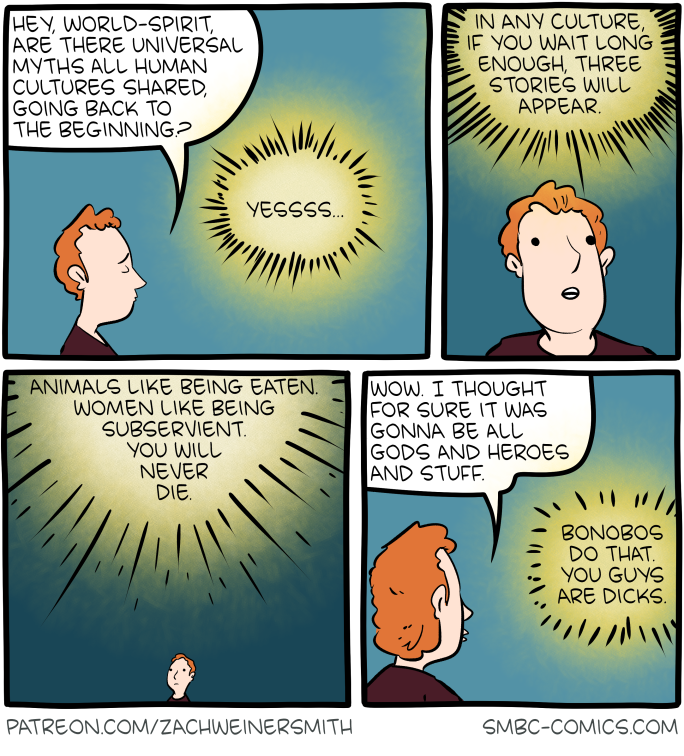
Hovertext:
The one about purpose doesn't show up until you have to spend 12 hours a day at a repetitive job.
A reader writes:
I found your site a few months ago after receiving an angry, almost violent letter from a former employee of mine.
I used to own and operate a small bed and breakfast in a resort community. She was a maid, cook, and sometimes bookkeeper.
I have always known that I’m a difficult person and would warn new employees that they were on probation for them to get to know me as much as for me to get to know them. I have always found those who can’t handle me to be weak or too sensitive. When I got her letter, I was shocked, angry, hurt, defensive, and ready for war. However, after taking some time to read through your past letters, I now don’t know how to feel or what to think.
This employee worked for me for a little over six months and ghosted one day, never to be heard from again. She was a good employee and at first I thought she was one of the few who didn’t take my personality personally. At the time I received her letter and for years afterward, I found her to be childish, immature, angry, and emotional. Why not come to me to tell me she had a problem? But reading your blog has made me aware of the fact that I was probably considered an abusive boss — and to be honest, an abusive person overall.
Her letter outlined bad treatment from me and how much it impacted her. She reminded me of almost every slight from the time I screamed at her for getting up out of her chair while I was training her on some software (she needed a pen to take notes and it annoyed me that she wasn’t ready to learn) to the time I reprimanded her for using what I found to be a too-small wad of paper towel to clean a mirror. She reminded me that I got upset at everything and anything. She called me petulant. She reminded me of guests I was unkind to by linking to bad reviews online. She told me she wishes her departure caused trouble for me. She told me I deserved the online hate from past guests of my B&B (I didn’t have a good reputation on Yelp). She told me it took a long time to get over how I treated her and sending me this letter was part of how she chose to heal.
At first, I was very defensive. I wanted to write back and tell her she was a child, sensitive, and obsessive. That she must not have a fulfilling life if she felt the need to write to a long-ago boss.
However, each time I consider writing back, I realize she can counter everything with fair evidence that I was, in fact, a monster to work for. She’s right. I’m not different now, but I am no longer working. I am retired and live in a different state. I no longer have reason or opportunity to treat people like I treated my employees and guests. I had to close my B&B after too many years of trying to make it work.
If you were me, if you had made these mistakes and really were as bad as my old employee said, what would you do here? Would you write back to apologize? Ignore it and try to move on?
It would be an act of incredible graciousness and growth to write back, thank her for her honesty, and apologize how you treated her. You could acknowledge that your initial reaction upon receiving her letter was defensiveness but you sat with what you she wrote and you see the truth in it, and you were indeed terrible to work for. You could tell her that you’re no longer managing anyone, and that you hope she has landed in a better place. And you could thank her for the self-reflection her letter prompted.
Because it is a gift for someone to give you such an unvarnished look at yourself — and I also believe it is a gift to you from yourself that you were able to see the truth in it. You could have gone on feeling defensive and blaming the employee and thinking she was overly sensitive, but something in you pushed past that.
Can you go a step further and really grapple with what you’ve realized (not in the letter, but on your own)? That could mean exploring why your natural default was to the type of behavior you described (for example, did you grow up with a parent who was hyper-critical and punitive and that was your model for how to relate to people? or in an environment where extreme control over every detail was the best way to survive, and you carried that onward after it was no longer serving you? did you learn growing up that anger was a default state of dealing with the world?) and what the impact of that has been on important relationships to you throughout your life … and what it would look like and feel like to do things differently.
There can be incredible liberation in dropping your defenses, accepting feedback, and committing to doing things differently. If you don’t let yourself go into denial mode (which is a form of self-protection), it can even feel good to confront that stuff — not good like “eat your vegetables, they’re good for you” good, but good like chocolate is good. (Both, really, but people tend not to realize the almost physical pleasure there can be in facing hard things head-on in the service of moving toward a more peaceful place.) If you are willing to do that work, it can dramatically change the kinds of relationships you have in your life, the amount of peace and happiness you feel internally, and your day-to-day quality of life.
Which is why I say you should write back and thank your former employee. What she offered you is a gift if you want to take it. She most likely didn’t intend it to be one, but it very much can be that if you choose.
The post I was the abusive boss appeared first on Ask a Manager.
A reader writes:
Our local business group/Chamber of Commerce had a luncheon today to hand out awards to the business community. My business was nominated and picked for an award.
As I only have four employees, I closed the business for the afternoon and had them join me for the lunch and award ceremony. As the luncheon was finishing up, I left the room to go get my picture taken with the other award winners and then left. I had let my employees know they could leave at anytime and would see them tomorrow.
Shortly after I got back to my office, I received a text from a fellow friend/business owner, saying I had better check out the Chamber’s Facebook page. When I looked, to my horror there were multiple comments and pictures about a lady who had almost physically cornered our mayor and a state representative and was getting very vocal in her questions and her opinions to them about some political hot topics. It was “Teena,” who works for me!
I am beyond embarrassed. Luckily, she wasn’t wearing one of our company’s logo shirts, so just looking at the pictures you may not know who she works for, but I am sure word got around to who her employer is and I am worried her actions will hurt my business’ reputation in the community. I am not so naïve that I don’t realize some political talk goes on at this event (I myself had talked to others about an unpopular decision the city council had made about closing a parking lot for redevelopment and how that would affect business owners near the lot), but I didn’t get into a loud argument with anybody.
Is there anything I can or should do about this situation with her? Her actions were outside the office but were at a company event that she was getting paid to attend. Any suggestions for “damage control” if I get questioned about my employee’s actions or I lose an account(s) over what she did?
I’m all for people asking questions of their elected representatives, and there are certainly things happening that warrant being impassioned about those topics — but the time to get into it with legislators is not when you are being paid to attend an event on behalf of your employer. I suspect that distinction was completely lost on Teena, and it’s reasonable to have a conversation with her to explain it.
Sample wording: “You’re of course welcome to advocate for your political views and to lobby our legislators on any issues you’re concerned with, but when you are attending an event as part of your job, you are there as a representative of our business, and your actions reflect on us. You can bow out of attending those events in the future if you don’t want to be constrained in that way, but you cannot accost legislators at events you’re attending for work or in situations where you will be perceived as representing the company.”
As for damage control if it comes up with others, it depends on exactly what she was saying and how poorly it reflects on your company. If it was something wildly offensive to your average person, you have a different problem than if it was more mundane. For the latter you could simply say, “She misunderstood that she was attending as an employee, not a private citizen, and it won’t happen again.”
The post my employee chewed out local officials at a business event appeared first on Ask a Manager.

My Patreon subscribers can read the whole of NEMS part 3 as a PDF, now.
Esther has phoned home, and we get a tantalising glimpse into the Ministry of History. Who are these scientists? It won’t matter if time collapses in on itself, so don’t worry too much about it.
The post Still operational appeared first on Bad Machinery.
Shawinigan, Quebec – US President Donald Trump has responded to Ford’s anti-tariff commercial with his own anti-protestor commercial featuring previous Canadian prime minister Jean Chrétien. “Looks like Canada’s leaders made mistakes too,” wrote Trump on Truth Social. “Not that Reagan ever made mistakes, because he never said tariffs were bad. But look at this John […]
The post Trump responds to Reagan ad with own commercial featuring Jean Chrétien strangling protestor appeared first on The Beaverton.








 ALT
ALT