Cowboy Who?
Shared posts

The state is making a list of transgender Texans. It’s using driver’s licenses to help.

‘What’s the point of a library?’: This town found an answer in adult literacy programs

Canada's Carney called out for 'utilizing' British spelling
Funeral and visitation plans set for former Houston news anchor Dave Ward
FBI Designates Brown University Shooting A Cold Case
The post FBI Designates Brown University Shooting A Cold Case appeared first on The Onion.
My Name Is Gregor Samsa, and This Time I Woke Up as a Grad Student at Cal State San Bernardino
You’ve probably heard about the first time this happened to me. You know: guy goes to sleep, wakes up as a giant bug, freaks out his family, worries about losing his job, and his dad throws an apple at him. It’s a tale as old as time. And, I’m not going to lie, it was a huge pain in the ass. Life as a bug was rough. Eating rotten food and scurrying around all day isn’t as fun as it sounds. But the worst part was all the essays college students were forced to write about how what happened to me was supposed to represent man’s inhumanity to man or whatever. Give me a fucking break.
What you probably don’t know is that life gradually got better for me. Yes, I was still a disgusting bug, but I was able to make the best of things. I built up a pretty big following on TikTok, and before long, my sponsored content and merch sales were more than enough to cover my family’s monthly expenses. Even my father admitted that I had made something of myself. It wasn’t perfect by any means, but for the first time in a long time, I felt like I’d found my place in the world, even if it took a bizarre metamorphosis to bring it about.
And then it happened again. I went to bed on my cozy bug’s nest of straw and wood shavings, and I woke up on a thirdhand Ikea futon being propped up with a copy of Judith Butler’s Gender Trouble. I was human again, but just barely. I stumbled out of my bedroom to discover that I shared this tiny, squalid apartment with a person named Thad who claimed to be a part-time barista and a full-time experimental sound artist. Thad offered me a sip from his can of Red Bull and played some of his latest sound art for me. I know I have described many of the indignities I have experienced in life, but listening to Thad’s “art” was so traumatic that language alone cannot capture the sense of dread and horror that I felt. Once the horrendous sounds abated, I felt the need to escape from this apartment and never return. Fortunately, Thad told me that I was expected at work.
Apparently, I worked as a teaching assistant somewhere called “Cal State San Bernardino,” where I was a graduate student. In my old life, in Prague, scholars were among the most respected people in the city. I was delighted to learn about my new fate; it almost made up for being exposed to Thad’s “schizo-rhizomatic soundscape.” Naturally, I expected a private limousine with a driver to pull up in front of my apartment building, as was the case with the other doctors and professors that I knew back home. At this point, Thad told me that I would need to take the bus. He showed me the bus pass in my wallet, along with several credit cards that he told me were all maxed out. I felt a pit of dread opening in my stomach, the same feeling I had as a bug when I thought somebody might step on me. The bus pulled up, and I got on board.
When I arrived at the campus, I was told I would be brought to my office, but this turned out to be just the latest of the lies I have been subjected to. When I pictured a scholar’s office, I imagined a grand den, lined with mahogany bookshelves, and filled with ancient tomes and the latest scientific equipment, not unlike Dr. Freud’s office at Berggasse 19 in Vienna (I was sent there after the whole “bug thing” happened). What I was shown was an abandoned janitor’s closet that had most likely been used as a nest/bathroom/breeding den by a colony of feral cats. There was no window, a single desk, a defunct vending machine, and twenty other grad students who “shared” this space with me. These were the saddest looking people I had ever seen; compared to them, even Thad looked like Archduke Franz Ferdinand or Czar Nicholas.
One of them handed me a stack of paper almost a meter high. They told me that these were my share of the freshman comp essays and that I needed to finish grading them by five o’clock. They also said that, even though the papers had students’ names on them, almost all of them were actually written by someone called “A.I.” I asked why this A.I. was writing all of the students’ papers for them, but nobody seemed to know. When I asked them why we allowed this to happen, one of the grad students said we were supposed to “critically embrace generative A.I. technology.” When I asked what that meant, nobody had an answer. I sat down to look at the essays.
The ones written by this A.I. person were easy to spot: bland, boring, and full of clichés. The writing was fine, but lifeless, as if it had been created by some kind of automaton like the Golem of Prague (good buddy of mine and a great guy by the way!). One of the TAs told me it was school policy to just give those papers a B- and forget about it, which was easy enough to do. The papers actually written by students were usually more interesting, but also filled with errors. I gave all of them a B-, too, except for one, which I gave an A+. That paper was about me.
This student seemed to have stumbled across that famous short story about my life as a bug. I’d read this story before, of course, but now that I was a grad student instead of a disgusting cockroach, it resonated in a different way for me. The student’s description of my strange transformation, my disgusting bug’s body, my hideous diet, and my isolation from my family and friends made me feel extremely nostalgic for that magical time in my life. Nobody named Thad made me listen to terrifying experimental music. Nobody forced me to grade essays in an overcrowded, underground prison cell. I found myself fantasizing about returning to my old life, determined to make the most of it this time. I wandered out of my office, caught the bus home, and—after brushing aside Thad’s collection of “rare Japanese funk LPs”—I fell asleep on my futon. I disappeared into a dreamless night.
Again, I awoke transformed. Gone was my futon, gone was Thad’s rare vinyl, gone was Thad himself (I already liked this new life better). This time, my apartment was pretty sweet. For starters, it was less of an apartment and more of a gigantic mansion in the California mountains with a seven-car garage and an infinity pool. I noticed a small bell on my bedside table. Curious, I picked it up and rang it. Instantly, a team of servants—some of whom I recognized from the TA office—came rushing in carrying flowers, breakfast, and a Microsoft Excel spreadsheet called “Emergency Financial Contingency Plan—Faculty Cuts.” Glancing at the spreadsheet while my underlings stared at me in rapt silence, it suddenly hit me: I was the University President.
Forget the whole bug thing, this new life ruled. All I had to do was hand out honorary doctorates to brain-dead tech bros, solicit donations from weapons manufacturers and fossil fuel powerhouses, and rubber-stamp plans to raze the library and begin construction on an on-campus lazy river. And if anybody ever questioned any of my decisions, I could fire them! It was a perfect existence. I just had to make sure I never fell asleep. If my life as a traveling salesman got me turned into a bug, this new life was going to get me something much, much worse.
This is an exclusive excerpt from long-time Tendency contributor Ross Bullen’s new comedy book, How to Succeed in Academia, available now from Humorist Books.
The Real Reason For Boat Strike ‘Double Taps’ Is Preventing Survivors From Challenging Extrajudicial Killings In Court
The Trump Administration’s murder-in-international-waters program debuted far ahead of its legal rationale. Many people inside the administration were blindsided by this sudden escalation. Those expected to stay on top of these things — military oversight, congressional committees, etc. — found they were even further behind the curve than the late-arriving “justification” for extrajudicial killings of alleged “narco-terrorists” that used to be handled by interdiction efforts that left everyone alive and anything of value (drugs, boats, weapons) in the hands of the US government and its foreign partners.
This was something new and horrible from a regime already known for its awfulness. Even after the belated (and then hastily revised) justification was delivered by the Office of Legal Counsel, it was difficult to see how the US government could justify extrajudicial killings of alleged “terrorists” who were — at worst — simply moving narcotics from point A to point B.
The administration’s bizarre insistence that the mere existence of an international drug trade constituted a deliberate, violent attack on America was further undercut by a lot of inconvenient facts. First of all, most of those being killed had no connection to the top levels of drug cartels. They were merely mules tasked with transporting drugs. In other cases — including the one that involved a double-tap strike (which was actually four strikes) to ensure the survivors clinging to boat wreckage could no longer be referred to as “survivors” — the drugs allegedly being trafficked were headed to midpoints that suggested the narcotics were actually headed to Europe, rather than the United States.
To be clear, this administration doesn’t actually care whether or not it engages in murder or other acts of violence. What it does care about is allowing the killing to continue for as long as possible before the system of checks and balances finally gets around to dialing back the murders a bit.
A recent article from the New York Times gives the game away, even if the lede gets a bit buried. The headline mentions a White House “scramble” to “deal with” people who survived initial extrajudicial killing attempts. In one case, two survivors were rescued by the US military after failing to die during the initial strike. The White House said they should be sent to El Salvador’s torture prison. The State Department — currently headed by Marco Rubio — said this simply wasn’t possible. Both survivors ended up being sent back to their countries of origin.
Two weeks later, another murder attempt failed to murder everyone on the boat, leading to another hasty conference call between the White House, career diplomats, and Defense Department leadership. The ultimate goal was to get rid of these people as quickly as possible, which necessarily involved hasty arrangements made with government officials in their home countries.
The real reason for these hasty talks — and the secrecy surrounding them — is this: The administration definitely doesn’t seem confident that it’s fully justified in ordering military members to engage in actual war crimes; specifically, the murder of people military bylaws make clear they are supposed to be rescuing.
The two attacks discussed above happened nearly two months after the double-tap boat strike that definitely looks like a war crime. But the Trump administration definitely isn’t going to bring back survivors to face justice by charging them and giving them their day in court. If it does that, it might lose everything it likes about murdering people in international waters.
Legal cases in the United States involving survivors would force the administration to present more information to try to back up its rationale for the attacks.
[…]
“From the administration’s point of view, there are good reasons to be averse to bringing survivors to Guantánamo Bay or to the continental United States,” [former State Dept. lawyer Brian Finucane] said.
If the U.S. military brings the survivors to the Navy-run prison at Guantánamo Bay, Cuba, lawyers defending them could file a habeas corpus lawsuit in U.S. federal court questioning whether there really is an armed conflict, for legal purposes, between the United States and cartels. Congress has not authorized the United States to engage in any such conflict.
To use the ever-popular poker parlance, that’s an obvious “tell” — something that indicates the administration has very little confidence in the legal rationale for these extrajudicial killings. If it thought it’s arguments had a very good chance of holding up in court, it wouldn’t be hastily returning “narco-terrorists” to their home countries as quickly and quietly as possible, where they’ll presumably immediately resume their “narco-terrorism.”
That’s also why the first double-tap strike occurred only days into Trump’s undeclared war on alleged drug boats. As far as we know, this hasn’t been repeated, despite everyone who hasn’t already resigned from the Defense Department (or been thrown under the bus by those whose positions are unassailable thanks to their deference to Trump) claiming either ignorance of the double-strike or saying lots of stuff about “saving” the country from being murdered by inanimate fentanyl (or whatever).
Any survivor is just another chance to prove the US government wrong. And if it isn’t immediately clear survivors have somewhere to be hastily dumped, you can probably assume the military will resort to Plan B: mob-style “hits” to make sure these witnesses can’t talk.
Misunderstanding what the Cricket Celebration Bowl is
Apparently, late last week was an event known as the Cricket Celebration Bowl.
I thought to myself, “The Cricket Celebration Bowl sounds like the name of the least popular item on the Panera menu.”
And no, it’s not a cricket match either.
Turns out it’s an American college football game between the champions of two collegiate leagues, named the Celebration Bowl, but sponsored by Cricket Wireless, making it the Cricket Celebration Bowl.
In 2017, Safeco Field, the local Seattle baseball stadium, included grasshoppers on the menu (sometimes popularly misidentified as crickets). In 2018, you could get actual crickets at the Oakland Coliseum (at the time, another baseball stadium).
The post Misunderstanding what the Cricket Celebration Bowl is appeared first on The Old New Thing.
Australia’s Social Media Ban Was Pushed By Ad Agency Focused On Gambling Ads It Didn’t Want Banned
We’ve talked about the Australian social media ban that went into effect last week, how dumb it is, and why it’s already a mess.
But late last week, some additional news broke that makes the whole thing even more grotesque: turns out the campaign pushing hardest for the ban was run by an ad agency that makes gambling ads. The same gambling ads that were facing their own potential ban—until the Australian government decided that, hey, with all the kids kicked off social media, gambling ads can stay.
Really.
That’s the latest in this incredible scoop from the Australian publication Crikey.
The big marketing campaign pushing the under-16 social media ban was called “36 Months”—framed (misleadingly) that way because they claimed that raising the social media age from 13 to 16 was keeping kids offline for an additional 36 months.
But, as Crikey details, the entire 36 Months campaign was actually planned out and created by an ad company named FINCH, which just so happened to also be working on a huge gambling ad campaign for TAB, which is a huge online betting operation in Australia. And, it wasn’t their only such campaign:
FINCH has worked on at least five gambling advertisements since 2017, according to public announcements and trade magazine reporting. Its clients include TAB Australia (a 2023 campaign called “Australia’s national sport is…”), Ladbroke, Sportsbet and CrownBet (now BetEasy).
There was staff overlap, too. Attwells’ LinkedIn lists him as both 36 Months’ managing director and FINCH’s head of communications from May to December 2024. FINCH staff worked on the 36 Months campaign.
Now, add to that the missing piece of the puzzle, which is that Australia had been investigating bans on online gambling ads, but just last month (oh, such perfect timing) it decided not to do that citing the under-16 ban as a key reason why they could leave gambling ads online.
The Murphy inquiry suggested bookmakers were grooming children with ads online, but Labor’s new social media ban on under-16s is viewed as a solution because it would, in principle, limit their exposure to such advertising online.
How very, very convenient.
This is exactly the false sense of security many ban critics warned about. Politicians and parents now think kids are magically “safe,” even though kids are trivially bypassing the ban. Meanwhile, the adults who might have educated those kids about online gambling risks—a problem that heavily targets teenage boys—now assume the government has handled it. Gambling ads stay up, kids stay online, and everyone pretends the problem is solved.
Crikey goes out of its way to say that there’s no proof that FINCH did this on behalf of their many gambling clients, but it does note that FINCH has claimed that it funded the 36 Months campaign mainly by itself, which certainly raises some questions as to why an advertising firm would do that if it didn’t have some other reason to do so.
Incredibly, Crikey notes that part of the 36 Months campaign was to attack anyone who called the social media ban into question by calling them big tech shills, even without any proof:
Spokespeople for 36 Months had previously accused an academic and youth mental health group of being bought off by big tech because of their unpaid roles on boards advising social media platforms on youth safety.
When Crikey asked them what proof they had, citing denials from those they accused, Attwells said he “hadn’t looked into it” but that they’d heard of a trend where technology companies would indirectly fund people to support work that supports “their agenda”.
“The money doesn’t go straight to them,” he said.
Yes: an ad agency funded by gambling clients, running a campaign that benefits those gambling clients, accused critics of being secretly funded by tech companies—without evidence—while claiming indirect funding is how these things work. Such projection.
There’s a famous concept around regulations known as “bootleggers and Baptists,” as a shorthand way of denoting some of the more cynical “strange bedfellows” that team up to get certain regulations in place. The canonical example, of course, being the temperance movement that sought to ban alcohol. Bootleggers (illegal, underground alcohol producers) loved the idea of prohibition, because it would greatly increase demand for their product, for which they could cash in.
But, no one wants to publicly advocate for prohibition on behalf of the bootleggers. So, you find a group to be the public face to present the cooked up moral panic, moralizing argument for the ban: the Baptists. They run around and talk about how damaging alcohol is and how it must be banned for the good of society. It’s just behind the scenes that the bootleggers looking to profit are helping move along the legislation that will do exactly that.
Here we’ve got a textbook case. The gambling industry, facing its own potential ban, appears to have had a hand in funding the moral panic campaign, complete with think-of-the-children rhetoric, that convinced the government to ban kids from social media instead. Now the gambling ads flow freely to an audience the government has declared “protected,” while the actual kids slip past the ban with zero new safeguards in place.
Instead of Bootleggers and Baptists, this time it’s Punters and Parents, or maybe Casinos and Crusaders. Either way it’s a form of regulatory capture hidden behind a silly moral panic.
'It's outrageous' - JetBlue pilot decries near collision with US military aircraft
Do you think you can make witty remarks all the way through this week’s movie?


Do you think you can make witty remarks all the way through this week’s movie?
Saturday Morning Breakfast Cereal - Life

Roomba maker iRobot swept into bankruptcy
Roomba maker iRobot has filed for bankruptcy and will be taken over by its Chinese supplier after the company that popularized the robot vacuum cleaner fell under the weight of competition from cheaper rivals.
The US-listed group on Sunday said it had filed for Chapter 11 bankruptcy in Delaware as part of a restructuring agreement with Shenzhen-based Picea Robotics, its lender and primary supplier, which will acquire all of iRobot’s shares.
The deal comes nearly two years after a proposed $1.5 billion acquisition by Amazon fell through over competition concerns from EU regulators.

Merriam-Webster’s word of the year for 2025 is AI ‘slop’

‘No Way To Prevent This,’ Says Only Nation Where This Regularly Happens
PROVIDENCE, RI—In the hours following a violent rampage in Rhode Island in which a lone attacker killed at least two individuals and injured several others, citizens living in the only country where this kind of mass killing routinely occurs reportedly concluded Monday that there was no way to prevent the massacre from taking place. “This was a terrible tragedy, but sometimes these things just happen and there’s nothing anyone can do to stop them,” said Idaho resident Kathy Miller, echoing sentiments expressed by tens of millions of individuals who reside in a nation where over half of the world’s deadliest mass shootings have occurred in the past 50 years and whose citizens are 20 times more likely to die of gun violence than those of other developed nations. “It’s a shame, but what can we do? There really wasn’t anything that was going to keep this individual from snapping and killing a lot of people if that’s what they really wanted.” At press time, residents of the only economically advanced nation in the world where roughly two mass shootings have occurred every month for the past eight years were referring to themselves and their situation as “helpless.”
The post ‘No Way To Prevent This,’ Says Only Nation Where This Regularly Happens appeared first on The Onion.
Man stops Spring ISD bus before pointing weapon at driver and students, constable says
The state is making a list of transgender Texans. It’s using driver’s licenses to help
 ALT
ALTWater does not care about your geopolitical borders
I wrote a bit about the flooding this past week in Washington State over at The Eyewall. It was pretty bad. In some places, it was at record levels, others the worst since 1990, and so on. I neglected to look much at how the heavy precip and flooding was impacting Oregon. Or British Columbia.
The Nooksack River sources in North Cascades National Park on Mt. Shuksan. It flows north and then west, eventually dumping into Bellingham Bay off Puget Sound. Because of the topography in that region, when the Nooksack River floods badly, it spills north into the Sumas River. The Sumas sources in Whatcom County, Washington and flows around past the Nooksack and dumps into the Fraser River in British Columbia northeast of Abbotsford.
As is often the case, the reason this is a problem is because of what we chose to do many years ago. This whole area is a leftover flat plain from glacial retreat that acts as a floodplain for the rivers. It is called the Sumas Prairie, but it actually used to be a lake. In the 1920s, the lake was diked and drained. This opened up a bunch of fertile land for farming, as well as reduced flooding on the Fraser River in Canada. But it also is a former lakebed, and water was there for a reason. Thus, in floods like this, the lake is attempting to refill, except now people live where a lake once sat. Essentially, the Nooksack watershed gets higher than the Sumas watershed, and water essentially “spills” downhill into the Sumas, which flows from Washington into Canada.
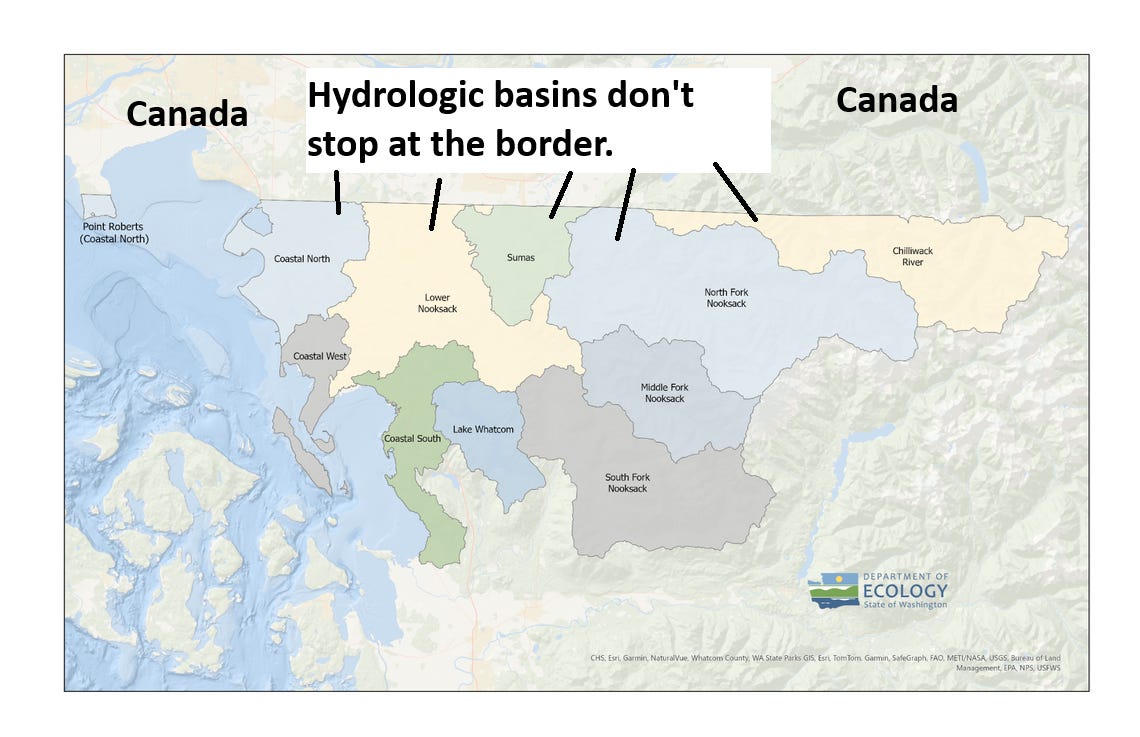
After the bad flooding in 1990, a cross-border group was created to propose flood mitigation measures, specifically near Everson, WA where the Nooksack overflows into the Sumas Prairie. Some modeling efforts were undertaken, some solutions proposed but as time wore on and urgency disappeared, nothing happened, and the effort sort of ended in 2011. After 2021 flooding, the effort was revived. The rub is that a solution that could help alleviate flooding in British Columbia and in Everson would probably cause disastrous effects downriver from there. So, you could fix one problem only to create new ones.
After this event, there will be renewed momentum to try and address this, but the problem is complicated. Some possible ways of solving the problem will take years and are quite costly. Other problems are similar in nature to problems we’ll have to address with respect to dams, which is sediment buildup. In the case of the Nooksack, the river has been constrained for years, when in reality it used to expand and contract. This has allowed for sediment to remain constrained and build up over years, reducing the capacity of the river to hold water, which is challenging even when we don’t factor in that atmospheric river events in the Northwest are becoming stronger. More water from the sky, less capacity to hold water on the ground, a natural floodplain, more flooding. It’s an extremely complex problem underpinned by pretty simple math.
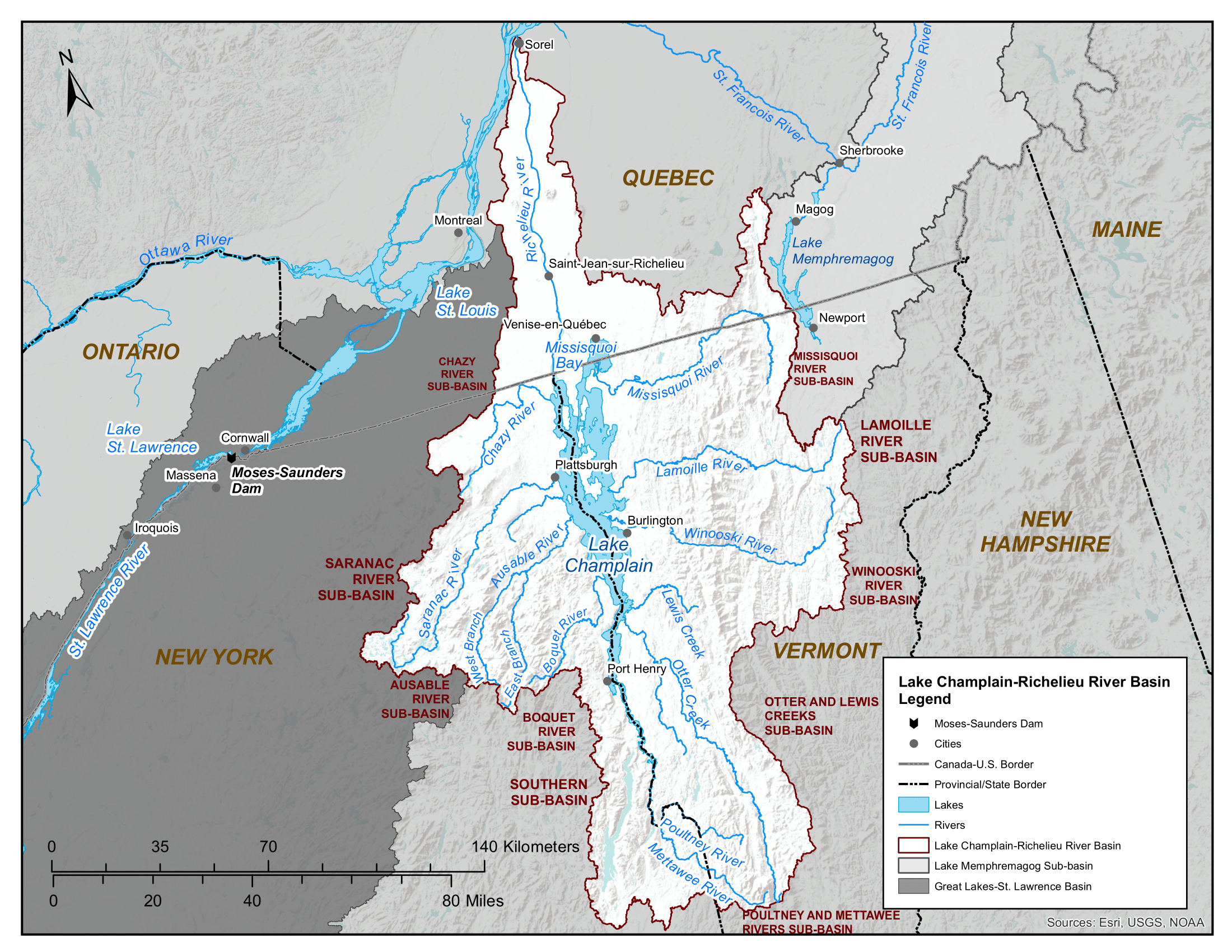
This is not a problem isolated to Washington and British Columbia. On the other side of the countries, flooding problems led to the International Joint Commission (created from the 1909 Boundary Waters Treaty to investigate and come up with joint solutions for U.S.-Canada water challenges) to propose solutions to flooding on the Lake Champlain-Richelieu River basin shared between Quebec, Vermont and New York. The IJC has not yet been involved with the issues in Washington and British Columbia.
Locally in my world, there’s an issue right now between Harris County and Montgomery County in Texas. A proposed development in Montgomery County west of a particularly flood prone community in the Houston area (Kingwood in Harris County) forced a Harris County precinct commissioner to push out a high-level resolution requesting that Montgomery County ensure the development adopts Harris County’s minimum drainage standards. Montgomery County has generally weaker standards for developments than does Harris County. In this instance, their choices could directly impact the outcomes for people that do not live in their jurisdiction.
In Canada, Abbotsford’s mayor is not happy with Canada’s federal government or with their neighbors in Washington. In addition to the issues around Lake Champlain and the Richelieu, the IJC did adjudicate and come up with a bunch of recommendations after the horrific 1997 Red River of the North flood that impacted the Upper Midwest and Manitoba. In 2017, they issued a report showing how a good chunk of the effort had succeeded. In Asia, there have been and will continue to be tensions over how countries, in particular China and India manage substantial quantities of water that source in their regions and flow into other nations. In Africa, dam building on the Nile in Ethiopia has created significant tension downstream in Egypt where they believe they have superior water rights on the river.
At what point does it become one community’s responsibility to ensure an adjacent one is not negatively impacted by decisions they make? Look at the Colorado River for one. This is less about flooding and more about water rights, but there are substantial tensions between the upper and lower basins (not to mention tribal nations) over this question. These are not easy problems to solve. But they do require coordination and cooperation. We have that to some degree with the Colorado River, which is governed by the 1922 Colorado River Compact. But when you have a patchwork of requirements and regulations rather than a single agency overseeing an entire region it can make for difficulties, such as in Southeast Texas, where decisions made in rapidly growing counties can impact many neighborhoods in the Houston area. The counties bordering Harris County have grown by nearly 1 million people in the last 15 years. Harris County itself has grown by nearly a million people in that same time. The growth is likely to continue. A formalized regional regulatory approach to flooding in this area is not currently in progress.
But these are the things we’re going to need to be thinking about as flooding likely continues to worsen. Climate change will get the oxygen for a lot of these issues. And it’s obviously a major factor. But it’s not just climate change. In the case of the Sumas/Nooksack flooding, it’s pretty much because we chose to drain a lake in the 1920s that existed for this specific reason, and we decided to constrain the flow of the river leading to sediment buildup and less room for water. In the Houston area we are eradicating prairie and former farmland in differing jurisdictions with differing requirements for building and quickening runoff. In the Colorado River, we are sharing a scarce resource and have dammed the river up. Rather than treating the Washington-British Columbia problems as an unfortunate circumstance from an extreme weather event, it should be a (yet another) wake-up call about some of the decisions we make as people in charting our growth.
the worst boss of 2025 is…
The final votes are in, and the CEO keeps asking young male employees to try her breast milk won the Worst Boss of 2025 Award, with 57% of the vote in the final match-up.
Coming in second, the company that made summer interns wear bikinis captured 43% of the vote.
The runners-up, who all managed to be pretty terrible themselves:
my boss told me to stop having sex with my boyfriend or quit my job
boss says it’s unacceptable not to meet all deadlines, no matter how unreasonable
my boss made me verify that I’m really exercising
I was written up for having a visible thong outside of work
can I ask my boss not to scream at me with her door open?
my boss said I’m threatened by his “masculine energy”
Congratulations, you all suck!
The post the worst boss of 2025 is… appeared first on Ask a Manager.
update: am I obligated to use my personal network for my job?
It’s “where are you now?” month at Ask a Manager, and all December I’m running updates from people who had their letters here answered in the past.
There will be more posts than usual this week, so keep checking back throughout the day.
Remember the letter-writer whose boss was pushing them to fundraise from their family and friends and tap their personal network for prizes for raffles? Here’s the update.
In the months during which my boss was pressuring me to solicit gifts, I managed to procure exactly one in-kind gift from a local business I frequent, and I was so awkward doing it. There’s a local yarn shop that I frequent, so I intended to ask the owner for a donation for an upcoming fundraising auction. On the day I’d psyched myself up to make the request (as noted in my original letter, this kind of thing is NOT my bailiwick), I went into the shop, had a nice, long conversation about my current knitting project with the very nice woman who owns the place, then totally chickened out when a crafting group arrived and she got busy dealing with multiple other people. I ended up finding her email address on the shop website later and just emailed her the request. As stated, she is completely lovely so she overlooked my cringeworthy solicitation attempt and happily agreed to donate an item for the auction.
Despite my (admittedly minor) success, my boss still wasn’t happy. He didn’t like the gift she donated — a hand-knitted item, very beautifully done. I thought she was being very thoughtful by donating a finished product rather than just straight-up yarn or supplies, as it should have broader appeal beyond just knitters. My boss thought it was something no one would want or bid on. (Many of the other auction items were similarly small items, like a tote bag or gift card, so it wasn’t an issue where it needed to be something worth thousands.)
So after this, I just started lying. I told him I’d made the requests of my friends with small businesses and they declined. I think this was not just the “easier” way, but really the only way, because if I’d tried to stand on principle he would’ve argued with me.
Over the time I worked there, I got the feeling that he cared a lot more about potential contacts that employees might have vs. actual professional skills, and he was disappointed that my address didn’t mean I had a cache of wealthy friends to exploit. (I live in a tourist town that has a really high wealth disparity — very wealthy summer people, and then the year-round residents who work mostly blue-collar jobs. He was dismayed that my circle of contacts and I were in the latter camp. I actually do remember him making kind of a big deal about the town where I lived during my interview. Hindsight and all that.)
I did end up quitting, about two weeks after I sent in my original letter. The problem I outlined in my original letter was a very, very minor part of the reason. Actually, the reason I chose that problem to submit was because for most of the others, I pretty much knew your answer would just be “get out.” I should’ve listened to tiny Alison in my head sooner!
My boss was actually set to be going on vacation about two weeks after I made up my mind to resign, so I — very kindly, I thought — offered to extend my notice to a month, to provide coverage during the time he’d be gone. I thought I’d get an extra two weeks’ paycheck and not have to deal with him at all, because he’d be on vacation. (And to be clear: I actually really liked my job itself, as in my actual job duties. It was him that was the problem.) This turned out to be a mistake because after accepting my offer — in which I made it clear that I was extending my notice because he’d be away — he pushed back his departure date and rushed to hire someone to replace me, so my last two weeks were spent (1) still dealing with his bullshit and (2) trying to infodump my entire brain into the unqualified new hire, because that’s what my boss thought “training” was.
I was validated in my initial reluctance to solicit gifts from businesses and friends when I went back to the yarn shop recently and the owner asked how the organization was doing. (Just FYI, she received a prompt thank-you card for the donation! This was months later.) I had to awkwardly explain that I no longer worked there, and it was kind of uncomfortable because I was trying not to disparage the organization (and hence make her regret her donation), but people do wonder about it when you just quit with no backup plan. I babbled something about it not being the right fit for me. Hopefully it won’t come up again.
The pièce de résistance of this story is that the new hire I trained to replace me quit two weeks after I left. And a woman who started shortly before I put in my notice quit as well, after about four months total. I lasted eight months. I think both of them were smarter than me.
The post update: am I obligated to use my personal network for my job? appeared first on Ask a Manager.
In-N-Out Removes ‘67’ From Ordering System
In-N-Out Burger quietly removed “67” from its order call-out system nationwide, apparently to deter youths from erupting into cheers when the number was announced. What do you think?

“I’m proud of the younger generation for forcing company higher-ups to have a conversation that stupid.”
Adam Thach, Lunch Orderer

“But that was my order.”
Zach Cabralda, Holiday Designator

“A shrewd marketer would take the opportunity to embrace the meme and ruin it forever.”
Kara Ripner, Jar Sealer
The post In-N-Out Removes ‘67’ From Ordering System appeared first on The Onion.
‘Every time I read a script, it blows my mind’: Night sky still amazes StarDate host Billy Henry
Pluralistic: Break up bad companies; replace bad union bosses (15 Dec 2025)

Today's links
- Break up bad companies; replace bad union bosses: Labor should be fixed, capital should be vanquished.
- Hey look at this: Delights to delectate.
- Object permanence: "Star Island"; "Mediactive"; Afraid of solar; Well-Armed Peasants; Dumpster fire exits; Wikipedia v Brittanica; Pentagon v Quakers; Stealing whole houses; "Situation Normal."
- Upcoming appearances: Where to find me.
- Recent appearances: Where I've been.
- Latest books: You keep readin' em, I'll keep writin' 'em.
- Upcoming books: Like I said, I'll keep writin' 'em.
- Colophon: All the rest.

Break up bad companies; replace bad union bosses (permalink)
Unions are not perfect. Indeed, it is possible to belong to a union that is bad for workers: either because it is weak, or corrupt, or captured (or some combination of the three).
Take the "two-tier contract." As unions lost ground – thanks to changes in labor law enforcement under a succession of both Republican and Democratic administrations – labor bosses hit on a suicidal strategy for contract negotiations. Rather than bargaining for a single contract that covered all the union's dues-paying members, these bosses negotiated contracts that guaranteed benefits for existing members, but did not extend these benefits to new members:
https://pluralistic.net/2021/11/25/strikesgiving/#shed-a-tier
A two-tier contract is one where all workers pay dues, but only the dwindling rump of older, more established workers get any protection or representation from their union. An ever-larger portion of the membership have to pay dues, but get nothing for them. You couldn't come up with a better way to destroy unions if you tried.
Thankfully, union workers figured out that the answer to this problem was firing their leaders and replacing them with militant, principled leaders who cared about workers, not just a subsection of their members. Radicals in big unions – like the UAW – teamed up with comrades from university grad students' unions to master the arcane rules that had been weaponized by corrupt bosses to prevent free and fair union elections. Together, they forced the first legitimate union elections in generations, and then the newly elected leaders ran historic strikes that won huge gains for workers (and killed off the two-tier contract):
https://theintercept.com/2023/04/07/deconstructed-union-dhl-teamsters-uaw/
Corrupt unions aren't the only life-destroying institutions that radicals have set their sights on this decade. Concentrated corporate power is the most dangerous force in the world today (indeed, it's large, powerful corporations that corrupted those unions). Antitrust activists, environmental activists, consumer rights activists, privacy activists and labor activists have stepped up the global war on big business all through this decade. From new antitrust laws to antitrust lawsuits to strikes to boycotts to mass protests and direct action, this decade has marked a turning point in the global consciousness about the danger of corporate power and the need to fight it.
But there's a big, important difference between bad corporations and bad unions: what we should do about them.
The answer to a powerful, corrupt corporation is to take action that strips it of its power: break the company up, whack it with fines, take away its corporate charter, strip its executives of their fortunes, even put them in prison. That's because corporations are foundationally undemocratic institutions, governed by "one share, one vote" (and the billionaires who benefit from corporate power are building a society that's "one dollar, one vote").
They fundamentally exist to consolidate power at the expense of workers, suppliers and customers, to extract wealth by imposing costs on the rest of us, from pollution to political corruption. When a corporation gets big enough to pose a risk to societal wellbeing, we need to smash that corporation, not reform it.
But the answer to a corrupt union is to fire the union bosses and replace them with better ones. The mission of a union is foundationally pro-democratic. A unionized workplace is a democratic workplace. As in any democracy, workplace democracies can be led by bad or incompetent people. But, as with any democracy, the way you fix this is by swapping out the bad leaders for good ones – not by abolishing democracy and replacing it with an atomized society in which it's every worker for themself, bargaining with a boss who will always win a one-on-one fight in the long run.
I raise this because a general strike is back on the table, likely for May Day 2028 (5/1/28):
https://labornotes.org/2025/12/maybe-general-strike-isnt-so-impossible-now
Unions are an important check against fascism. That's why fascists always start by attacking organized labor: solidarity is the opposite of fascism.
To have unions that are fit for purpose in this existential battle for the future of the nation – and, quite possibly, the human race – we desperately need better leaders. Like the union bosses who gave us the two-tier contract, many of our union leaders see their mission as narrowly serving their existing members, and not other workers – not even workers who might some day become their members.
To get a sense of how bad it's gotten, consider these five facts:
I. Public support for unions is at its highest level since the Carter administration;
II. More workers want to join unions than at any time in living memory;
III. Unions have larger cash reserves than at any time in history;
IV. Under Biden, the National Labor Relations Board was more friendly to unions than at any time in generations; and
V. During the Biden years, the number of unionized workers in America went down, not up.
That's because union bosses – sitting on a mountain of cash, surrounded by workers begging to be organized – decided that their priority was their existing members, and declined to spend more than a pittance of their cash reserves on organizing efforts.
This is suicidal – as self-destructive as the two-tier contract was. To pull off a general strike, we will need mass civil disobedience, and a willingness to ignore the Taft-Hartley Act's ban on solidarity strikes. Trump's NLRB isn't just hostile to workers – he's illegally fired so many of its commissioners that they can't even perform most of their functions. But a militant labor movement could turn that to its advantage, because militants know that when Trump fires the refs, you don't have to stop the game – you can throw out the rule book:
https://pluralistic.net/2025/01/29/which-side-are-you-on-2/#strike-three-yer-out
This is the historic opportunity and challenge before us – to occupy our unions, save our workplace democracies, and then save our national democracy itself.
Hey look at this (permalink)

- Secret Documents Show Pepsi and Walmart Colluded to Raise Food Prices Across the Economy https://www.thebignewsletter.com/p/secret-documents-show-pepsi-and-walmart
-
20 Years of Digital Life, Gone in an Instant, thanks to Apple https://hey.paris/posts/appleid/
-
Enjoy the new year in your headset https://brucesterling.tumblr.com/post/802750890885906432/gartner-predicts-25-of-people-will-spend-at-least
-
Merry Mixmas 2025 https://djriko.com/merry-mixmas-mixes/
-
I Wasted 8 Years of My Life in Crypto https://x.com/kenchangh/status/1994854381267947640

Object permanence (permalink)
#20yrsago Sony Artists offering home-burned CDs to replace spyware-infected discs https://web.archive.org/web/20060719082355/http://www.rollingstone.com/news/story/8950981/copyprotection_troubles_grow
#20yrsago Pentagon bravely vigilant against sinister, threatening Quakers https://www.nbcnews.com/id/wbna10454316
#20yrsago Brooklyn camera-store crooks threaten activist’s life https://thomashawk.com/2005/12/brooklyn-photographer-don-wiss.html
#20yrsago Britannica averages 3 bugs per entry; Wikipedia averages 4 https://www.nature.com/articles/438900a
#20yrsago Diane Duane wonders if she should self-publish trilogy conclusion https://web.archive.org/web/20051215151654/https://outofambit.blogspot.com/archives/2005_12_01_outofambit_archive.html#113446948274092674
#20yrsago Table coverts to truncheon and shield http://www.jamesmcadam.co.uk/portfolio_html/sb_table.html
#20yrsago Royal Society members speak out for open access science publishing https://web.archive.org/web/20051210023301/https://www.frsopenletter.org/
#20yrsago TiVo upgrading company offers $25k for hacks to the new DirecTV PVR https://web.archive.org/web/20051215050848/https://www.wkblog.com/2005/12/weaknees_offers_up_to_25000_fo.html
#20yrsago Michigan HS students will need to take online course to graduate https://web.archive.org/web/20051215052603/https://www.chronicle.com/free/2005/12/2005121301t.htm
#15yrsago Hiaasen’s STAR ISLAND: blisteringly funny tale of sleazy popstars and paparazzi https://memex.craphound.com/2010/12/13/hiaasens-star-island-blisteringly-funny-tale-of-sleazy-popstars-and-paparazzi/
#15yrsago Dan Gillmor’s Mediactive: masterclass in 21st century journalism demands a net-native news-media https://memex.craphound.com/2010/12/13/dan-gillmors-mediactive-masterclass-in-21st-century-journalism-demands-a-net-native-news-media/
#15yrsago Council of Europe accuses Kosovo’s prime minister of organlegging https://www.theguardian.com/world/2010/dec/14/kosovo-prime-minister-llike-mafia-boss
#15yrsago Gold pills turn your innermost parts into chambers of wealth https://web.archive.org/web/20110930011010/https://www.citizen-citizen.com/collections/all/products/gold-pills
#10yrsago The Red Cross brought in an AT&T exec as CEO and now it’s a national disaster https://www.propublica.org/article/the-corporate-takeover-of-the-red-cross
#10yrsago Philips pushes lightbulb firmware update that locks out third-party bulbs https://www.techdirt.com/2015/12/14/lightbulb-drm-philips-locks-purchasers-out-third-party-bulbs-with-firmware-update/
#10yrsago UK spy agency posts data-mining software to Github https://github.com/gchq/Gaffer
#10yrsago Cybercrime 3.0: stealing whole houses https://memex.craphound.com/2015/12/14/cybercrime-3-0-stealing-whole-houses/
#10yrsago US politicians, ranked by their willingness to lie https://www.nytimes.com/2015/12/13/opinion/campaign-stops/all-politicians-lie-some-lie-more-than-others.html
#10yrsago 24 privacy tools — not messaging apps — that don’t exist https://dymaxion.org/essays/pleasestop.html
#10yrsago North Carolina town rejects solar because it’ll suck up sunlight and kill the plants https://web.archive.org/web/20250813151735/https://www.roanoke-chowannewsherald.com/2015/12/08/woodland-rejects-solar-farm/
#10yrsago Giant hats were the cellphones of the silent movie era https://pipedreamdragon.tumblr.com/post/135065922736/movie-movie-etiquette-warnings-shown-before
#10yrsago Plaid Lumberjack Cake https://www.youtube.com/watch?v=_1hDl53c-kw
#10yrsago MRA Scott Adams: pictures and words by Scott Adams, together at last https://web.archive.org/web/20151214002415/https://mradilbert.tumblr.com/
#10yrsago American rents reach record levels of unaffordability https://www.nbcnews.com/business/economy/its-not-just-poor-who-cant-make-rent-n478501
#5yrsago Well-Armed Peasants https://pluralistic.net/2020/12/13/art-thou-down/#forsooth
#5yrsago Where money comes from https://pluralistic.net/2020/12/14/situation-normal/#mmt
#5yrsago China's best investigative stories of 2020 https://pluralistic.net/2020/12/14/situation-normal/#gijn
#5yrsago Situation Normal https://pluralistic.net/2020/12/14/situation-normal/#more-constellation-games
#1yrago Social media needs (dumpster) fire exits https://pluralistic.net/2024/12/14/fire-exits/#graceful-failure-modes
#1yrago The GOP is not the party of workers https://pluralistic.net/2024/12/13/occupy-the-democrats/#manchin-synematic-universe
Upcoming appearances (permalink)

- Hamburg: Chaos Communications Congress, Dec 27-30
https://events.ccc.de/congress/2025/infos/index.html -
Denver: Enshittification at Tattered Cover Colfax, Jan 22
https://www.eventbrite.com/e/cory-doctorow-live-at-tattered-cover-colfax-tickets-1976644174937 -
Colorado Springs: Guest of Honor at COSine, Jan 23-25
https://www.firstfridayfandom.org/cosine/

Recent appearances (permalink)
- (Digital) Elbows Up (OCADU)
https://vimeo.com/1146281673 -
How to Stop “Ensh*ttification” Before It Kills the Internet (Capitalisn't)
https://www.youtube.com/watch?v=34gkIvYiHxU -
Enshittification on The Daily Show
https://www.youtube.com/watch?v=d2e-c9SF5nE -
Enshittification with Four Ways to Change the World (Channel 4)
https://www.youtube.com/watch?v=tZQaEeuuI3Q -
The Plan is to Make the Internet Worse. Forever. (Novarra Media)
https://www.youtube.com/watch?v=7wE8G-d7SnY

Latest books (permalink)
- "Canny Valley": A limited edition collection of the collages I create for Pluralistic, self-published, September 2025
-
"Enshittification: Why Everything Suddenly Got Worse and What to Do About It," Farrar, Straus, Giroux, October 7 2025
https://us.macmillan.com/books/9780374619329/enshittification/ -
"Picks and Shovels": a sequel to "Red Team Blues," about the heroic era of the PC, Tor Books (US), Head of Zeus (UK), February 2025 (https://us.macmillan.com/books/9781250865908/picksandshovels).
-
"The Bezzle": a sequel to "Red Team Blues," about prison-tech and other grifts, Tor Books (US), Head of Zeus (UK), February 2024 (thebezzle.org).
-
"The Lost Cause:" a solarpunk novel of hope in the climate emergency, Tor Books (US), Head of Zeus (UK), November 2023 (http://lost-cause.org).
-
"The Internet Con": A nonfiction book about interoperability and Big Tech (Verso) September 2023 (http://seizethemeansofcomputation.org). Signed copies at Book Soup (https://www.booksoup.com/book/9781804291245).
-
"Red Team Blues": "A grabby, compulsive thriller that will leave you knowing more about how the world works than you did before." Tor Books http://redteamblues.com.
-
"Chokepoint Capitalism: How to Beat Big Tech, Tame Big Content, and Get Artists Paid, with Rebecca Giblin", on how to unrig the markets for creative labor, Beacon Press/Scribe 2022 https://chokepointcapitalism.com

Upcoming books (permalink)
- "Unauthorized Bread": a middle-grades graphic novel adapted from my novella about refugees, toasters and DRM, FirstSecond, 2026
-
"Enshittification, Why Everything Suddenly Got Worse and What to Do About It" (the graphic novel), Firstsecond, 2026
-
"The Memex Method," Farrar, Straus, Giroux, 2026
-
"The Reverse-Centaur's Guide to AI," a short book about being a better AI critic, Farrar, Straus and Giroux, June 2026

Colophon (permalink)
Today's top sources:
Currently writing:
- "The Reverse Centaur's Guide to AI," a short book for Farrar, Straus and Giroux about being an effective AI critic. LEGAL REVIEW AND COPYEDIT COMPLETE.
-
"The Post-American Internet," a short book about internet policy in the age of Trumpism. PLANNING.
-
A Little Brother short story about DIY insulin PLANNING

This work – excluding any serialized fiction – is licensed under a Creative Commons Attribution 4.0 license. That means you can use it any way you like, including commercially, provided that you attribute it to me, Cory Doctorow, and include a link to pluralistic.net.
https://creativecommons.org/licenses/by/4.0/
Quotations and images are not included in this license; they are included either under a limitation or exception to copyright, or on the basis of a separate license. Please exercise caution.
How to get Pluralistic:
Blog (no ads, tracking, or data-collection):
Newsletter (no ads, tracking, or data-collection):
https://pluralistic.net/plura-list
Mastodon (no ads, tracking, or data-collection):
Medium (no ads, paywalled):
Twitter (mass-scale, unrestricted, third-party surveillance and advertising):
Tumblr (mass-scale, unrestricted, third-party surveillance and advertising):
https://mostlysignssomeportents.tumblr.com/tagged/pluralistic
"When life gives you SARS, you make sarsaparilla" -Joey "Accordion Guy" DeVilla
READ CAREFULLY: By reading this, you agree, on behalf of your employer, to release me from all obligations and waivers arising from any and all NON-NEGOTIATED agreements, licenses, terms-of-service, shrinkwrap, clickwrap, browsewrap, confidentiality, non-disclosure, non-compete and acceptable use policies ("BOGUS AGREEMENTS") that I have entered into with your employer, its partners, licensors, agents and assigns, in perpetuity, without prejudice to my ongoing rights and privileges. You further represent that you have the authority to release me from any BOGUS AGREEMENTS on behalf of your employer.
ISSN: 3066-764X
Review: “Teddy Sandoval and the Butch Gardens School of Art” at The Contemporary Austin
On October 11, I drove to Austin to attend the Teddy Sandoval and the Butch Gardens School of Art Symposium, which was hosted by The Contemporary Austin — Jones Center. I had no idea what to expect. At the symposium, I learned about Los Angeles-based artist Teddy Sandoval (1949-1995) through his friend Joey Terill, who recalled Sandoval’s exuberant nature during his lifetime. Sandoval died of AIDS-related complications in 1995, and the posthumous exhibition, Teddy Sandoval and the Butch Gardens School of Art, honors his legacy.

The retrospective is organized by Dr. C. Ondine Chavoya and David Evans Frantz, who performed tedious archival research to bring this exhibition to fruition. What makes Teddy Sandoval and the Butch Gardens School of Art unique among art museum retrospectives is that it considers Sandoval’s artwork in dialogue with other Latinx artists who feature LGBTQ+ characters; some of these artists, like Joey Terill, directly engaged with Sandoval during his life, while others, like Ever Astudillo, did not. Artists in the show negotiate Latinx LGBTQ+ identity, depicting people in diverse settings, where they are sometimes alone, and other times, directly confronting other characters, or each other. The exhibition’s showing at The Contemporary Austin is the first time that it is displayed outside of a college or university setting.
Sandoval charged forward amid a rather repressive time for Chicano artists, and especially for those who were queer. At a time when gay bars and discos excluded people of color, and when Chicano artists were largely missing from museums, Sandoval created a fictitious organization named the Butch Gardens School of Art. The organization takes its name from the Butch Gardens, which was a real bar in Los Angeles that provided a safe space for queer people of color from 1972 to 1975. Sandoval’s fictitious school mailed postcards and flyers to people who were considered to be newly enrolled members of the academy. The result of this was a network of queer connections among artists in the Los Angeles area and beyond.

Sandoval’s painting La Traición de Malinche is a melodrama depicting Malintzin, or La Malinche, a controversial Nahua woman in Mexican history who served as interpreter for — and had a child with — the Spanish conquistador Hernán Cortés. In the artwork, Malinche and Cortés lean toward one another, their protruding tongues signifying an impending kiss. To their side, Aztec emperor Moctezuma II is shown with a spear piercing his heart as he gazes upon the scene in dismay. All three figures are rendered in profile, echoing the visual conventions of Mesoamerican art and the colonial codices produced by Indigenous artists. Sandoval also infuses the work with a queer sensibility, depicting Moctezuma II in a speedo. Sandoval painted on small pieces of treated canvas and paper to produce aging effects on pieces such as La Traición de Malinche.

Part of the Butch Gardens School of Art’s avant-garde practice was the embrace of mail art as an alternative art form. Rosa conveys one of Sandoval’s mail art alter egos, Rosa de la Montaña, a faceless femme fatale and drag persona who looks over her shoulder expressively. Though Rosa occupies a small area on the paper, she still asserts her presence through acts of self-expression. For Sandoval, Rosa de la Montaña functioned as both a projected self and a campy cipher — hosting exhibitions and parties, distributing mail art, and even exhibiting alongside Sandoval’s non–alter ego self. This performative play of identity aligns with the avant-garde tradition of self-mythologization initiated by Marcel Duchamp in 1920 through his artistic alter ego, Rrose Sélavy.

Sandoval provides another view of Rosa in Nude #2. He extends her presence beyond the playful glance of Rosa into something more direct. Few of Rosa’s clothes remain, and the artist positions her in motion, as if she is about to drop them. Her near-nude figure invites attention, yet she maintains control of the gaze by how she performs for it. This balance between vulnerability and self-possession visualizes Rosa’s power as an active participant in her own representation. For Sandoval, this image carries weight: it places a queer, confident, and flirtatious Chicana body at the center of attention at a time when such visibility was rare. Through Rosa, Sandoval reimagines desire not as objectification but as a form of self-assertion that resists both erasure and containment. Together, Rosa and Nude #2 illustrate how Sandoval used his alter ego to navigate the politics of visibility and identity, transforming self-portraiture into an act of queer defiance and artistic liberation.

The dynamics of the male gaze and arousal are further visualized in Ever Astudillo’s Sábado. The large-scale drawing depicts the silhouettes of two muscular men. Details of their faces are obscured in favor of the faceless, ambiguous character that Sandoval himself often employed. The man being gazed at wears a white sleeveless shirt that accentuates his build, a subtle nod to the social codes and visual cues that helped gay men recognize one another in public. The figure closest to the viewer rests his hand on his head, his body angled with clear interest toward the other man. Through posture, clothing, and the deliberate concealment of identity, Astudillo captures a moment of queer recognition and desire unfolding in plain sight.

Additionally, Ana Segovia’s I Was Never Really Ready presents yet another faceless, muscular figure, further extending this thread of coded visibility. Segovia draws from the hyper-masculine archetypes of the Golden Age of Mexican Cinema: think of icons like Pedro Infante, Jorge Negrete, Cantinflas, and Pedro Armendáriz. Their on-screen swagger shaped a national ideal of manhood. That same cultivated bravado is echoed here, yet Segovia complicates it. As in the earlier works I’ve discussed, the viewer is guided not by facial identity but by posture and style. The scars beneath the figure’s pectoral area subtly signal a transgender body, queering the very archetype the painting references. In doing so, Segovia not only reclaims this cinematic masculinity but also highlights how identity can be both performed and powerfully affirmed through the body itself.
Each of the artworks in this exhibition underscores how the body becomes a site of power, visibility, and self-affirmation. I left The Contemporary Austin struck by how unapologetically Latino, queer, and campy Teddy Sandoval was — and how boldly that energy radiates through the show. The exhibition not only honors that spirit but also acknowledges a generation of artists and individuals lost to AIDS complications, whose stories were never fully told. Sandoval’s legacy feels especially urgent today, reminding us that representation is not only personal, but profoundly necessary.
Teddy Sandoval and the Butch Gardens School of Art is on view through January 11, 2026, at The Contemporary Austin — Jones Center.
The post Review: “Teddy Sandoval and the Butch Gardens School of Art” at The Contemporary Austin appeared first on Glasstire.
How To Keep Your Christmas Tree Fresh
With the holiday season getting longer every year, Americans nationwide are searching for methods to ensure the focal point of their decor remains healthy and vibrant through Dec. 25 and beyond. Here are tips on how to keep your Christmas tree fresh.
Choose A Genetically Pure Tree Of Noble Heritage: Often the reason a Christmas tree sheds its needles when brought home is because it’s been tainted by foreign pollen from contemptible stock.
Replicate Its Natural Environment: Add a razor wire fence, 600 gallons of asphalt concrete, and a chain-smoking Russian man to your living room, and your Christmas tree will feel at home in no time.
Forgo Buying Your Children Presents: Fewer presents under the tree will allow it more growing room.
Play The Song Of The Forest On Your Pan Flute: The mystical melody of merriment and glee is sure to perk your Christmas tree right up as it sways to your folk instrument’s hypnotic tune.
Cut Down Adjacent Trees In Your House: Overcrowding can deprive smaller Christmas trees of sunlight, so thin out all existing growth in your home within 8 feet of your tree’s base.
Appoint A Shadow Christmas Tree: In its unofficial parliamentary role, it can scrutinize the work of the acting Christmas tree and keep it on its toes.
Let It Roam Around In The Woods For At Least 30 Minutes A Day: Allowing your tree to get outdoors will keep its mind sharp and its trunk strong.
Perform Sap Infusions From Younger Trees: Regular infusions of sap from a more youthful spruce can reverse your tree’s biological age to that of a seedling.
Don’t Cut It Down In The First Place: You took an ax to its trunk, and now you’re confused as to why it’s not perfectly healthy?
Make It Someone Else’s Responsibility: Let the housekeeper know that if a single pine needle turns brown, she can find employment at a different chalet.
The post How To Keep Your Christmas Tree Fresh appeared first on The Onion.
Timeline Of Katy Perry And Justin Trudeau’s Relationship
Former Canadian Prime Minister Justin Trudeau and pop star Katy Perry confirmed their status as a couple after a number of public sightings sparked rumors of a romance. The Onion presents a timeline of the pair’s relationship.
A.D. 1100
The couple’s common ancestor establishes two distinct bloodlines.
2008
A trembling 37-year-old Trudeau lies awake all night with strange and frightening feelings after hearing “I Kissed A Girl.”
2012
Katy Perry and Toronto Mayor Rob Ford file for divorce.
2019
Perry sees the photos of Trudeau in brownface and can’t help but notice his kind eyes.
May 2025
Matched on GlutenFreeSingles.com.
July 2025
Trudeau is spotted leaving Perry’s apartment in a cupcake bra.
August 2025
Perry and Trudeau discover they have a mutual love of having their picture taken.
September 2025
Trudeau tearfully confides in Perry that he used to be the prime minister of Canada.
The post Timeline Of Katy Perry And Justin Trudeau’s Relationship appeared first on The Onion.