Shared posts

18 Jul 21:58

UC Berkeley developing 180 nm printed transistors at $25 per square meter which is 1000 times cheaper than current processes

by noreply@blogger.com (brian wang)
UC Berkeley is now developing printed transistors at 180nm. The technology could deliver chips costing $25 a square meter, not the $25,000 per square meter of current processes, again a huge cost reduction that is mind boggling.

UPDATE - Here are some technical documents related to UC Berkeley's work on printed transistors. I have not yet found a combination research work that states that they have 180nm printing transistors with $25 a square meter cost. There is one dissertation that talks about printing 200nm feature size transistors and another that talks about roll to roll printing larger transistors.

Janusz Bryzek of Fairchild Semiconductor thinks we are looking at a trillion (yes trillion) sensors and MEMS as the big driver. A trillion sensors will be where the Internet of Things takes off.

* The mobile market is the bullet train of MEMS and sensors. For example, the Samsung Galaxy S4 has eight sensors today and who know how many more in the next version.

* 3D printing and printed electronics have huge implications for IoT because sensors can be printed on anything (even your arm) and could become very cheap. Anybody see an inflection point there?

* Using microfluidics on paper opens up the possibility of a lab on a chip, which could change medical diagnostics forever. That's going to generate huge amounts of data -- and you can forget about the plastic bottle for samples!

* Printing sensors on skin is also a huge breakthrough and points to the fact that much of IoT will probably be triggered by medical applications which are sucking up a big chunk of our GDP these days. We need this technology now.

There will be trillion sensor summit at Stanford Oct 23-25, 2013

Read more »
18 Jul 19:37

ALL YOUR BASE ARE BELONG TO TSA!

by Stephen Green

Thanks for the heads-up:

She says she had no warning that someone was going to search her car after she left to catch her flight.

So the woman contacted News10NBC. We found out it happened to her because she valet parked her car. Those are the only cars that get inspected. So if security feels it is necessary to search some cars in the name of safety, why not search all of them?

Laurie Iacuzza walked to her waiting car at the Greater Rochester International Airport after returning from a trip and that’s when she found it, a notice saying her car was inspected after she left for her flight.

Iacuzza said, “I was furious, they never mentioned it to me when I booked the valet or when I picked up the car or when I dropped it off.”

Iacuzza’s car was inspected by valet attendants on orders from the TSA.

When you go through TSA security in the airport, at least you know it’s coming. Oh, sure it’s an indignity and has never stopped a terrorist and it takes too long, but you know it’s coming. But the valet parking ought to say right there on the sign, “Valet Parking Plus Free Car Search.”

18 Jul 19:25

EVERGREEN HEADLINE: Ethanol Still A Boondoggle. The ethanol targets set by the Renewable Fuel St…

by Glenn Reynolds

EVERGREEN HEADLINE: Ethanol Still A Boondoggle.

The ethanol targets set by the Renewable Fuel Standard are out of sync with both the demand for ethanol and its potential supply. Gasoline consumption is projected to be relatively flat this year, a change that the Renewable Fuel Standard lacks a mechanism to account for. This shortfall in demand could potentially be fixed if producers up the percentage of ethanol they mix in with their gasoline past the current industry standard of 10 percent, but few oil companies are willing to move past this so-called “blend wall,” citing studies that link higher ethanol content with engine damage. Even if refiners started blending in more ethanol, the supply problem remains: this year’s supply is projected to be less than the mandate.

All of this explains why oil companies are snatching up increasingly-rare RINs at ever-higher prices. Oh, the RIN-sanity!

This is a mess even before you consider the foibles of the source of the lion’s share of this ethanol: corn. Before the Renewable Fuel Standard set these arbitrarily high targets, the US used just 23 percent of its corn to produce ethanol. Last year 43 percent of our corn crops went towards producing the biofuel. That shift has driven up global prices for corn, starving the world’s poor and potentially fueling food riots. And to what end? Corn ethanol is categorized as a biofuel, but it doesn’t reduce emissions. Advanced biofuels produced from such sources as sugarcane and algae pass the green test, but they haven’t yet proven their commercial viability.

It’s a crime against humanity. When do the trials start?

18 Jul 19:23

The Beholden State and Its Potemkin Economic Recovery

by Steven Hayward
(Steven Hayward)

So where am I today?  Some mornings it takes me moment to recall, although I’m tempted to blame the second Talisker at the bar at closing last night for this morning’s fog.  Oh, wait—that’s real fog out the window: I’m in San Francisco.  Today is the northern California launch for the Manhattan Institute’s new collection of City Journal California articles entitled The Beholden State: California’s Lost Promise and How to Recapture It.  I’ll be speaking on a panel at the City Club (it’s sold out, so don’t try for a last minute seat) along with the City Journal editors and authors Brian Anderson, Steve Malanga, and Ben Boychuk.

The book covers the entire coastline and interior of California’s multiple dysfunctionalities with many familiar writers (Victor Davis Hanson, William Voegeli, Joel Kotkin, etc), so there aren’t many original observations I can add.  But they did leave me with one scrap to dilate: housing.  Right now Gov. Jerry Brown is crowing that “California is back on track,” and that the economy is recovering.  California still lags the country badly, though, and having grown up through several economic cycles in the state, the current economy is still lagging.

One reason for this can be seen in the chart below, which shows the cycle of single-family housing starts going back to the early 1960s.  In each recession up to the early 1990s each recovery was marked by a surge in housing starts, usually approaching 300,000 at the peak.  But then it changes in the late 1990s, and barely topped 200,000 starts in the middle of the housing bubble and during the boom of the late 1990s.  And you can see that so far housing is still in the dumps, even thought he housing industry is recovering nicely elsewhere in the country.

There are a few secular reasons (as economists would say) for this change, but by far the most significant reason is the increasingly hostile regulatory climate toward single-family housing development, especially “smart growth” policies that disdain detached single-family homes, along with aggressive moves to place more and more land off limits to residential development.

In such a climate, you’re going to aggravate California’s increasing class divide between affluent citizens and low-income laborers (mostly Hispanic), with a shrinking middle class.  That’s just how rich liberals in the state want things: it’s those grubby middle class people with their suburban lifestyles that clog up the roads for the Prius set.

Single-Family Housing Starts in CA, 1963 - 2012

18 Jul 19:22

HOW DID THE TRAYVON MARTIN CASE BECOME A NATIONAL MEDIA SENSATION? With help from the Justice Depar…

by Glenn Reynolds

HOW DID THE TRAYVON MARTIN CASE BECOME A NATIONAL MEDIA SENSATION? With help from the Justice Department. “Through their requests for documents from local, state and federal authorities, Judicial Watch researchers were able to obtain hundreds of documents and emails pertaining to the case. This information helped Judicial Watch prove that a little-known unit of the Department of Justice (DOJ), the Community Relations Service (CRS), was deployed to Sanford following the Trayvon Martin shooting to help organize and manage rallies and protests against George Zimmerman.”

Frankly, for the government to help organize and manage rallies and protests against an individual charged with a crime looks like a civil rights violation to me. I hope Zimmerman’s lawyers go ahead and sue, as they’ve indicated. The discovery process will be fascinating.

18 Jul 19:21

Life in the Cloud: Global cloud WAN on the cheap

by Margaret Walker
Using public cloud services and overlay networks, content experts can create global WANs with little initial expense, low maintenance costs and overall low total cost of ownership. Now it is actually possible for app developers to use the cloud as points of presence to link global partners and customers.

WAN: an expensive solution
Photo credit and good reference
article: "What is a Network?" from the BBC
Traditionally, global WANs are limited to large  organizations due to the major capital investments, agreements with service providers, and connectivity.  Gone are the days of large capital outlays and long-term contracts.
Cloud providers have made the investment to provide state-of-the-art facilities, experienced staff, and fantastic equipment distributed across the globe.
App developers and content creators of any size can leverage public cloud points of presence (POPs) to build a globally distributed network. Essentially, anyone with a credit card can use the public cloud to create a new point of presence on a project by project basis.

The scenario: 
One of our customers, a European mobile app developer, wanted to connect its cloud-based app servers to a portfolio of its APAC telco partners and revenue sources.
The customer wanted to create a cloud WAN to connect to partners, but also needed to keep customer traffic separate and isolated using standard extra-net technology. The solution needed to quickly scale up and down, with a price package to match.

The challenges: 
The European telco wanted to connect cloud-based app servers to portfolio partners, but the partners required them to use exact IP addresses of LANs.
The customer needed to connect to the networks dictated by partners while still keeping customer traffic separate and isolated. If possible, they had to connect all of these aspects using standard extra-net technology.

The outcome: 
We helped the customer create a segmented overlay network with VNS3.
Now our customer's network is capable of running in multiple regions and multiple clouds as needed. The network enforces partner segmentation, yet allows the organization to define its own address pools as dictated by partners and customers.

The IPsec connections to the global WAN guarantee encryption for all data in motion. In this company’s case, it secured the customer session tokens and payment information.

The project resulted in a scalable, pay as you go solution that matched its business model and satisfied customer. The solution included:
  • Overlay network
  • Instance-based solution using pay-as-you-go virtual appliances
  • Customer-defined address pools
  • Guarantee encryption for all data in motion, including customer session tokens and payment information
The company was able to use overlay networks, and the features of cloud VPNs and IPsec connections to create points of presence in multiple regions with "attestable" security.
The project resulted in a scalable, pay as you go solution that matched its business model and satisfied custom.
18 Jul 00:24

A PACIFIC RIM RESPONSE: We Don’t Need No Stinkin’ Robots: How the Pentagon Could Destroy All Monste…

by Glenn Reynolds
17 Jul 22:44

How Machine Learning Changes the Game

Federal Computer Week

Machine learning is making significant advances, as increasingly effective algorithms emerge that enable computers to learn on their own. Several converging factors are contributing to the real-world applicability of machine learning, including the availability of large datasets that can train learning algorithms and inexpensive computational power that enables rapid training. In addition, methodological changes, such as Flickr users tagging millions of images online, are making large datasets more useful. Speech- and facial-recognition technologies are already transforming society and are poised to make an even larger impact. For example, speech-recognition technologies have radically altered call and contact centers, and as the tools improve, government agencies with significant public interaction will gauge the extent to which automated voice-recognition systems can carry out public-facing tasks. Meanwhile, Stanford University professor Andrew Ng and his colleagues recently presented a paper showing that it is possible to train networks with as many as 11 billion parameters within days on a cluster of 16 commercial servers. After training on a dataset of 10 million unlabeled YouTube video thumbnails, the neural network had an 86.5 percent success rate in differentiating 13,152 faces from 48,000 distractor images. Autonomous vehicles also are rapidly advancing, and researchers worldwide are creating robots capable of learning.

From "How Machine Learning Changes the Game"
Federal Computer Week (07/15/13) Konstantin Kakaes
View Full Article
17 Jul 19:58

'Intelligent knife' tells surgeon which tissue is cancerous

Scientists have developed an "intelligent knife" that can tell surgeons immediately whether the tissue they are cutting is cancerous or not. In the first study to test the invention in the operating theatre, the "iKnife" diagnosed tissue samples from 91 patients with 100 per cent accuracy, instantly providing information that normally takes up to half an hour to reveal using laboratory tests.
17 Jul 19:58

Puppet Labs acquires Cloudsmith to ease devops' automation burden (Jordan Novet/GigaOM)

Jordan Novet / GigaOM:
Puppet Labs acquires Cloudsmith to ease devops' automation burden  —  Puppet Labs, a fan favorite configuration management tool among devops folks, has acquired Cloudsmith to make Puppet tools easier to use and deploy going forward.  Devops refers to the movement to get software developers …

17 Jul 19:58

SCIENCE: Finding Cancer Cells in the Blood: Technologies that can pull tumor cells from patients

by Glenn Reynolds
16 Jul 22:37

Novel quantum dot-based technique sees 100 different molecules in a single cell

New research from the University of Washington offers a more comprehensive way of analyzing a single cell’s unique behavior and could reveal patterns that indicate why a cell will or will not become malignant.

Xiaohu Gua and graduate student Pavel Zrazhevskiy have used an array of distinctly colored quantum dots to illuminate 100 biomarkers, a ten-fold increase from the current research standard, to help analyze individual cells from cultures or tissue biopsies.

Other approaches have measured multiple biomarkers in a single cell, but what makes this technique promising is that it reuses the same precious tissue sample in a cyclical process to measure 100 biomolecules in groups of ten.

How to measure 100 biomolecules

The process starts by pairing a commercially available antibody (left) (known to bind with specific biomolecules) with a quantum dot (center) of distinct size and therefore color.

Once formed, different probes are pooled in a single cocktail (left) and then incubated with cells for parallel multiplexed staining (right)


The investigators then inject a solution of ten of these antibody-quantum dot pairs onto a tissue sample and use a fluorescence microscope to quantify which of the constructs bind at the single cell level.


Once the measurement is complete, they then wash the tissue sample with a fluid of detergents at low pH to get rid of the antibodies and quantum dots without degrading the tissue sample, and repeat the staining step for different target molecules

The two investigators have shown that they can repeat this process at least ten times without producing any signs of tissue damage.

The researchers note that because this methodology uses commercially available enzymes and standard fluorescence microscopes, it is relatively low cost. They also plan to automate the procedure using microfluidics and automated image processing technologies.

This work, which was supported in part by the National Cancer Institute, is detailed in an open access paper in Nature Communications.

Credit for images: Pavel Zrazhevskiy et al./Nature Communications

16 Jul 22:37

Boldly illuminating biology’s ‘dark matter’

phylogenetic_inference

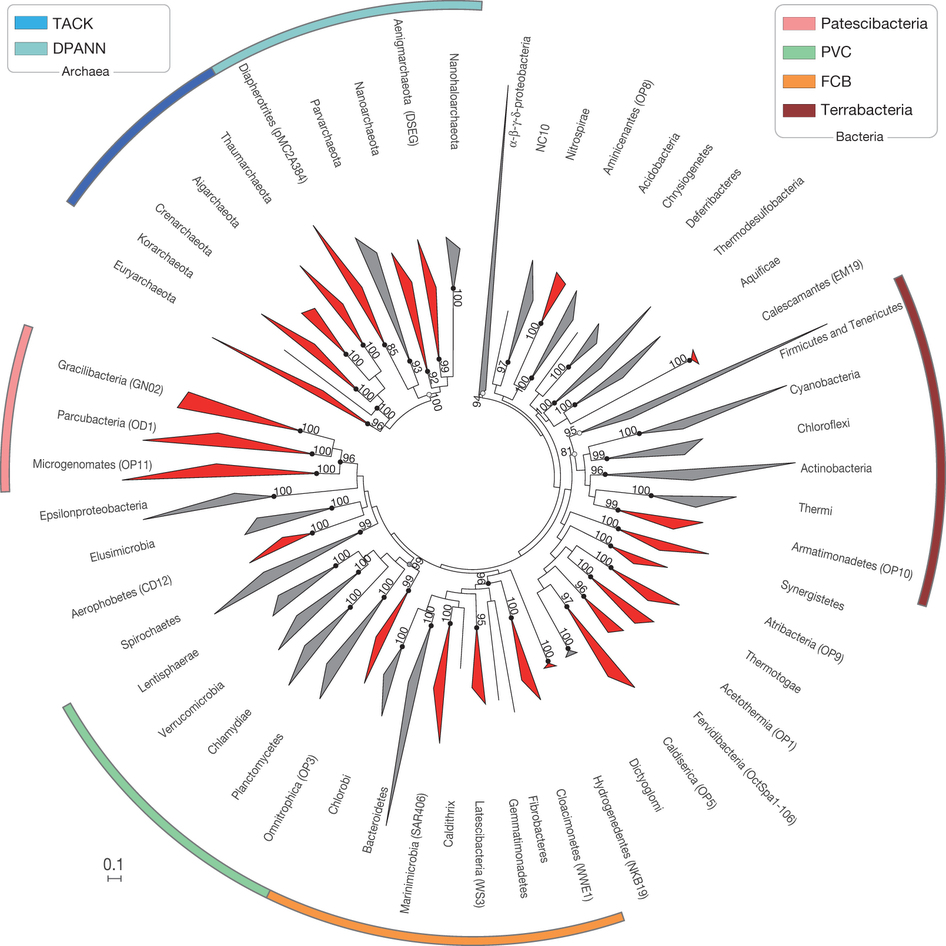
The phylogenetic trees are based on up to 38 marker genes and sequences are collapsed at the phylum level occluding subgroups such as the Geoarchaeota which clusters within the Crenarchaeota. Phyla containing SAGs from this study are highlighted in red. Superphyla (TACK, DPANN, Terrabacteria, FCB, PVC and Patescibacteria) are highlighted with colour ranges. The phylogenetic robustness (monophyly score) of phyla and superphyla is indicated by a small circle on the node: black circle (node was resolved in 100% of all tree calculations); grey circle (resolved in ≥90% of all calculations); light-grey circle (resolved in ≥50% of all calculations). Average bootstrap support values are provided for each phylum and superphylum when resolved.The two domain trees were independently calculated and are unrooted and the scale bar represents 10% estimated sequence divergence for both trees. (Credit: Christian Rinke et al./Nature)

“Microbial dark matter” is the pervasive yet practically invisible infrastructure of life on the planet, which can have profound influences on the most significant environmental processes: from plant growth and health, to nutrient cycles in terrestrial and marine environments, the global carbon cycle, and possibly even climate processes.

By employing next-generation DNA sequencing of genomes isolated from single cells, great strides are being made in the monumental task of systematically bringing to light and filling in uncharted branches in the bacterial and archaeal tree of life.

‘Next great frontier’

In an international collaboration led by the U.S. Department of Energy Joint Genome Institute (DOE JGI), the most recent findings from exploring microbial dark matter were published July 14 in the journal Nature (open access).

“Instead of wondering through the starkness of space, this achievement is more like the 21st Century equivalent of Lewis and Clark’s expedition to open the American West,” said Eddy Rubin, DOE JGI Director.

“This is a powerful example of how the DOE JGI pioneers discovery, in that we can take a high throughput approach to isolating and characterizing single genomes from complex environmental samples of millions of cells, to provide a profound leap of understanding the microbial evolution on our planet.  This is really the next great frontier.”

This microbial dark matter campaign targeted uncultivated microbial cells from nine diverse habitats: Sakinaw Lake in British Columbia; the Etoliko Lagoon of western Greece; a sludge reactor in Mexico; the Gulf of Maine; off the north coast of Oahu, Hawaii, the Tropical Gyre in the south Atlantic; the East Pacific Rise; the Homestake Mine in South Dakota; and the Great Boiling Spring in Nevada.

From these samples, the team laser-sorted 9,000 cells, from which they were able to reassemble and identify 201 distinct genomes, which then could be aligned to 28 major previously uncharted branches of the tree of life.

“Microbes are the most abundant and diverse forms of life on Earth,” said Tanja Woyke, DOE JGI Microbial Program Head and senior author on the Nature publication. “They occupy every conceivable environmental niche from the extreme depths of the oceans to the driest of deserts.

However, our knowledge about their habits and potential benefits has been hindered by the fact that the vast majority of these have not yet been cultivated in the laboratory. So we have only recently become aware of their roles in various ecosystems through cultivation-independent methods, such as metagenomics and single-cell genomics.

What we are now discovering are unexpected metabolic features that extend our understanding of biology and challenge established boundaries between the domains of life.”

Genome sequencing

To get around the difficulty of growing most microbes in the lab, recent efforts have focused on conducting surveys based on sequencing marker (16S ribosomal RNA) genes that are conserved across microbial lineages because of their essential role as “housekeeping” genes — critical for the organism’s survival.

Genome sequencing of the rest of the genomes of most of these lineages is however proceeding much more slowly. “Microbial genome representation in the databases is quite skewed,” said Chris Rinke, DOE JGI postdoctoral fellow and first author of the study.

“More than three-quarters of all sequenced genomes fall into three taxonomic groups or phyla but there are over 60 phyla we know of.”  For the majority of them, however, there are no cultivated members available.

“Based on 16S surveys we know they’re out there, but we don’t know much about them — that’s why we call them microbial dark matter,” Woyke added. “Using modern single-cell techniques allowed us to access the genetic make-up for some of them, even without growing them in the lab.”

In this effort to “seek out new life,” the team’s findings fell into three main areas.  The first was the discovery of unexpected metabolic features. They observed certain traits in Archaea that previously only were seen in Bacteria and vice-versa.

One such trait involves an enzyme that bacteria commonly use for creating space within their protective cell wall, which is needed so the cell can, for example, expand during cell division. As it rather generically cleaves the protective bacterial cell envelope, it needs to be very tightly regulated. For the first time, a group of Archaea was found to encode this potent enzyme and the authors hypothesize that Archaea may deploy it as a defense mechanism against attacking Bacteria.

The second contribution arising from the work was the correct reassignment, or binning, of data of some 340 million DNA fragments from other habitats to the proper lineage. This course correction provides insights into how organisms function in the context of a particular ecosystem as well as a much improved and more accurate understanding of the associations of newly discovered genes with resident life forms.

The third finding was the resolution of relationships within and between microbial phyla — the taxonomic ranking between domain and class — which led the team to propose two new superphyla, which are highly stable associations between phyla.

Anchors for phylogeny

The 201 genomes provided solid reference points, anchors for phylogeny — the lineage history of organisms as they change over time. “Our single-cell genomes gave us a glimpse into the evolutionary relationships between uncultivated organisms — insights that extend beyond the single locus resolution of the 16S rRNA tree and are essential for studying bacterial and archaeal diversity and evolution,” Woyke said.

“It’s a bit like looking at a family tree to figure out who your sisters and brothers are.  Here we did this for groups of organisms for which we solely have fragments of genetic information.  We interpreted millions of these bits of genetic information like distant stars in the night sky, trying to align them into recognizable constellations.

At first, we didn’t know what they should look like, but we could estimate their relationship to each other, not spatially, but over evolutionary time.” Woyke and her colleagues are pursuing a more accurate characterization of these relationships so that they can better predict metabolic properties and other useful traits that can be expressed by different groups of microbes.

Phil Hugenholtz, Director of the Australian Centre for Ecogenomics at The University of Queensland, a former DOE JGI researcher, and another one of the paper’s authors reinforced the motivation for taking on this expedition of sorts.

“For almost 20 years now we have been astonished by how little there is known about massive regions of the tree of life. This project is the first systematic effort to address this enormous knowledge gap. One of the most significant contributions is that based on these data, we provided names for many of these lineages which, like most star systems, were just numbered previously.

“For me, taxonomic assignment is important as it welcomes in strangers and makes them part of the family.  Yet this is just a start.  We are talking about probably millions of microbial species that remain to be described,” Hugenholtz said.

The path ahead

Cosmologists have only mapped half of one percent of the observable universe and the path ahead in environmental genomics is similarly daunting.  “There is still a staggering amount of diversity to explore,” Woyke said.  “To try to capture 50 percent of just the currently known phylogenetic diversity, we would have to sequence 20,000 more genomes, and these would have to be selected based on being members of underrepresented branches on the tree.  And, to be sure, these are only what are known to exist.”

The Nature publication “Insights into the phylogeny and coding potential of microbial dark matter” builds upon a DOE JGI pilot project, the Genomic Encyclopedia of Bacteria and Archaea (GEBA) and closely articulates with other international efforts such as the Microbial Earth Project which aims to generate a comprehensive genome catalog of all archaeal and bacterial type strains, and the Earth Microbiome ProjectMore information about GEBA-MDM is available here.

Joining the DOE JGI in authorship on the MDM paper are researchers from Bielefeld University, Germany, the University of California, Davis, the University of Technology Sydney, the Bigelow Laboratory for Ocean Sciences, University of British Columbia, the University of Nevada, Las Vegas, the University of Western Greece, Woods Hole Oceanographic Institution, University of Illinois at Urbana-Champaign, and the Australian Centre for Ecogenomics of the University of Queensland, Australia.

16 Jul 22:35

What we can learn from the electric vehicle shakeout

by Adam Lesser

This article originally appeared on GigaOM Pro, our premium research subscription service.

The last few months have seen the expected demises of a few major VC-backed startups in the electric vehicle game, including Coda and Better Place, not to mention the seemingly unending saga that has become Fisker’s fate. The reasons for each of these companies’ hard times varies. But in aggregrate, they tell us a lot about what can and cannot work in the EV market.

Rather than look back at what happened to each of these companies, something that was well done by others, I want to look forward at the changing landscape that has become car ownership and where EVs fit in that world. Here are lessons that we can take forward:

Better Place Israel1). It’s a technology product, not a car. I’ve long believed that the automakers must view the EV as a technology product, more akin to an iPhone than a V8. This sentiment was uttered again this weekend by Mimi Sheller, Drexel University’s Director of Mobilities Research and Policy Center, in a New York Times article trying to explain why driver’s license rates among 16 to 39 year olds have fallen so consistently from 1983 to present. The article paraphrases Sheller as saying “The Millenials don’t value cars and car ownership, they value technology – they care about what kinds of devices you own.”

If millenials are going to care about a car, they’re going to care about the car that most represents having the coolest technology device. One doesn’t have to look far toward Tesla’s extensive computer console and Coda’s lack of tech styling, to understand how thinking around this topic differs at different EV makers. Yes, most Tesla buyers are a bit older but if an EV is going to crack the mid market, as Tesla is focused on doing, it will have to contain great user interfaces, excellent connectivity, and next generation body design.

2). The realities of range anxiety. It’s hard to know how much of the Nissan Leaf’s tepid sales and Coda’s failure had to do with concerns over range. Clearly Tesla is concerned enough about it that it first built cars with 200 or more miles of range and just recently rolled out a battery swapping option for long distance road trips. Better Place showed us that battery swapping technology is still a difficult sell, maybe less so in markets like urban European cities where putting in a home charger is difficult.

The Nissan LEAFWhether battery swapping technology lives another day or whether Tesla manages to revive it for a single purpose is less the point. The point is that there’s still consumer sensitivity here. I do believe that drivers, particularly millenials, will be willing to sacrifice some convenience to own an EV. But I think the sweet spot for mass adoption of an EV will always be a $25,000 car that goes 200 miles on a charge. Yes, it’s irrational, given that most drivers drive less than 40 miles a day. But such a car would unlock the market.

The dark horse here is a battery innovation that revolutionizes range. Remember Envia?

3. The luxury car market will never be the same. I’m thankful that Fisker’s disastrous mismanagment and subpar engineering was paralleled by Tesla’s success, just so everyone understands that there isn’t consumer resistance to an EV. There’s consumer resistance to a poorly made and poorly marketed EV.

While there’s a lot of focus on Fisker’s rough times right now, the companies I’m more concerned with are BMW, Lexus, and Mercedes. It’ll happen slowly but I can see Tesla and the luxury EV becoming a status symbol with a sustainability twist that slowly creeps into the German and Japanese luxury automaker’s markets.

Green Overdrive: We ride a Tesla Model S Beta! Thumbnail

BMW, for example, sells around 70,000 7-series vehicles every year. Tesla will sell around 20,000 Model S vehicles this year. Those are major differences but not that major. What happens if Tesla sells 40,000 in 2015? Perhaps as problematic is that Tesla founder Elon Musk says he can do 25 percent margins on his cars, much higher than has been seen among traditional automakers and very attractive to investors.

By the time the major automakers decide they want to compete in the EV game, it’ll be late and Tesla the brand will represent next generation technology, not BMW or Lexus. Remember it’s a technology product, not a question of reputation related to a century of work on the internal combustion engine, which is what sets companies like Mercedes apart but which is no help in the EV market. Not to mention the fact that Tesla will have had a multi-year engineering and production head start.

There has been a fair bit of gloominess among investors as they’ve watched billions evaporate in the recent round of EV bankruptcies. But I see lessons here. Like many areas of cleantech investing, there’s likely an element of first mover disadvantage in electric cars that includes a slowly maturing consumer. But I don’t think one would argue that now is a better time to launch an innovative EV than it was even three years ago.


Related research and analysis from GigaOM Pro:
Subscriber content. Sign up for a free trial.

16 Jul 22:32

AI software smart as a 4-year-old

682px-Child_drawing

(Credit: Effeietsanders/Wikimedia Commons)

Artificial and natural knowledge researchers at the University of Illinois at Chicago have IQ-tested one of the best available artificial intelligence systems to see how intelligent it really is.

About as smart as the average 4-year-old, they will report July 17 at the U.S. Artificial Intelligence Conference in Bellevue, Wash.

The UIC team put ConceptNet 4, AI software developed at MIT, through the verbal portions of the Weschsler Preschool and Primary Scale of Intelligence Test, a standard IQ assessment for young children.

Commonsense: not so good

They found ConceptNet 4 has the average IQ of a young child. But unlike most children, the machine’s scores were very uneven across different portions of the test.

“If a child had scores that varied this much, it might be a symptom that something was wrong,” said Robert Sloan, professor and head of computer science at UIC, and lead author on the study.

Sloan said ConceptNet 4 did very well on a test of vocabulary and on a test of its ability to recognize similarities.

“But ConceptNet 4 did dramatically worse than average on comprehension — the ‘why’ questions,” he said.

One of the hardest problems in building an artificial intelligence, Sloan said, is devising a computer program that can make sound and prudent judgment based on a simple perception of the situation or facts — the dictionary definition of commonsense.

Commonsense has eluded AI engineers because it requires both a very large collection of facts and what Sloan calls implicit facts — things so obvious that we don’t know we know them. A computer may know the temperature at which water freezes, but we know that ice is cold.

“All of us know a huge number of things,” said Sloan. “As babies, we crawled around and yanked on things and learned that things fall. We yanked on other things and learned that dogs and cats don’t appreciate having their tails pulled.” Life is a rich learning environment.

“We’re still very far from programs with commonsense-AI that can answer comprehension questions with the skill of a child of 8,” said Sloan. He and his colleagues hope the study will help to focus attention on the “hard spots” in AI research.

Study coauthors are UIC professors Stellan Ohlsson of psychology and Gyorgy Turan of mathematics, statistics and computer science; and UIC mathematical computer science undergraduate student Aaron Urasky.

The study was supported by the Office of Naval Research and the National Science Foundation.

16 Jul 22:31

Levitation with acoustic waves

surfing_on_acustic_waves

A toothpick levitates and rotates on acoustic waves (credit: Daniele Foresti/ETH Zurich)

ETH researchers can make objects such as particles and liquid droplets fly in mid-air by letting them ride on acoustic waves.  They can also control their movement and merge droplets, which can react chemically or biologically. They can even rotate a toothpick in the air.

The magic trick is based on acoustic waves, reveals Daniele Foresti, former doctoral student now a postdoctoral researcher at the Laboratory of Thermodynamics in Emerging Technologies.

Moving objects such as particles or droplets of a liquid freely in mid-air makes it possible to investigate processes while avoiding any disruptive contact with a surface. For instance, some chemical reactions and biological processes are compromised by surfaces, and certain substances disintegrate on contact with a surface.

Magnets not required

Until now, scientists have been able to generate such a “contact-free” levitational state only with the help of magnets, electrical fields, or in liquids, with the help of buoyancy. These methods, however, limit the selection of materials that can be handled.

“It is extremely difficult to levitate and precisely move a drop of liquid with a magnet. The fluid has to possess magnetic properties. In liquids, where buoyancy force supports levitation, you can only use immiscible liquids such as a drop of oil in water,” explains Dimos Poulikakos, Professor of Thermodynamics and head of the research project.

With acoustic waves, in contrast, it is possible to levitate various objects regardless of their properties. The limiting factor is the maximum diameter of the object, which must correspond to half the wavelength of the acoustic wave being used. An object reaches the stationary levitated state when all the forces acting on it are in equilibrium.

In other words, the force of gravity that pulls the object in one direction is counteracted by an equally large force in the opposite direction. This force comes from the acoustic wave, which the researchers generate as a standing wave between an emitter and a reflector that reverberates the acoustic waves. The force of the acoustic wave pushes against the object and thus prevents it from falling due to gravity. It is conceptually similar to the air jet from a fan that keeps a ping-pong ball in the air.

Creating instant coffee in midair

The knowledge that acoustic waves can exert a force — the acoustic radiation pressure effect — on an object to keep it in suspension was discovered more than 100 years ago. Until now, however, no one had been successful in controlling the motion of objects riding on acoustic waves in mid-air. Foresti achieved this goal by switching on multiple emitter-reflector modules in parallel next to each other. He varied the acoustic waves from module to module to transfer particles or droplets of liquid from one module to the next.

In a test run, Foresti used this method to move a granule of instant coffee onto a droplet of water and merge the two. In a further experiment, he mixed two droplets of liquid with different pH values, one alkaline and the other acidic; the resulting droplet contained a fluorescent pigment that glows only at a neutral pH value. In a video, he captured how the two droplets mix and the pigment begins to glow.

“This method of moving levitated objects could have a wide range of possible applications,” says Foresti. The process of controlled movement can run in parallel with several objects, making it interesting for industrial applications.

For example, some biological and chemical experiments require particles or droplets of source material to be initially processed and then analyzed. With this technique, researchers can mix tiny amounts of substances and liquids in a step by step manner without any chemical changes arising due to contact with a surface.

The researchers have tested the method with droplets and particles that are several millimeters in diameter. The excitation of the acoustic waves has to be chosen after careful theoretical analysis: if the acoustic force exceeds the surface force of a certain liquid, the droplet is atomized explosively.

The researchers successfully levitated drops of water, hydrocarbons, and various solvents.

16 Jul 21:00

Machine learning startup Ayasdi raises $30.6M to map your data

by Derrick Harris

Ayasdi, the machine learning startup that creates maps out of complex datasets, has raised a $30.6 million series B round of venture capital. New investor IVP led the round, with Citi Ventures and GE Ventures chipping in, as well as existing investors Khosla Ventures and Floodgate. This makes a total of nearly $41 million in funding for the red-hot Ayasdi, which emerged from stealth mode in January.

The company, founded by Gunnar Carlsson and Gurjeet Singh, uses a technique called topological data analysis to create the visually stunning maps that help set its product apart. A lot goes on under the covers in order to map out the data — hundreds of machine learning algorithms analyzing up to billions of data points — but the result is a map of the data that looks similar to a classic network graph. Only, instead of showing how data points are connected to each other, the clusters in the Ayasdi map signify similarity.

Aside from the sheer scale it can handle, the real benefit to the data analysts or data scientists who use the product, called Iris, is how it automates the process of discovering potentially valuable correlations. And it does so using many more algorithms that any one data scientist would likely use (or know how to use together) on a single dataset. With the results all right there in front of them, users can begin drilling down into the clusters to see whether there is indeed fire where the algorithms have discovered smoke.

“The amount of work they actually to do is reduced by a very large degree because they don’t have to write code anymore,” Co-founder and CEO Singh said.

One of Ayasdi's graph-like data maps

One of Ayasdi’s graph-like data maps

Ayasdi has attracted a lot of attention from large enterprise customers, including new new investors Citi and GE. The latter, Singh explained, is using Iris to find markers that can predict failure in jet engines. Oil and gas companies, such as Anadarko, are doing the same thing with drilling equipment, as well as analyzing vast amounts of “microseismic” data in order to figure out whether or not to drill in a new location.

Other Ayasdi customers include Merck, U.S. Food and Drug Administration, Centers for Disease Control and Prevention, the University of California San Francisco, Mount Sinai Hospital, Texas A&M University and Harvard Medical School. The company itself is now up to 50 people, Singh noted.

Asked how Ayasdi intends to evolve the platform, Singh said that a big data product always needs to increase the scale of data it can handle, and those like Ayasdi that target lines of business rather than the IT department can always get easier to use. “I don’t see machine learning as a field becoming dormant any time soon,” he said. “… We truly believe to make machine learning accessible, you have to make user experiences that are accessible to a very large number of people.”

Indeed, and Ayasdi isn’t alone it its approach to solving the world’s data problems, even if its approach is unique. We’ve covered different approaches to automatic pattern discovery by BeyondCore, as well as a handful of up-and-coming machine learning startups. An Atlanta-based company called Emcien is doing something at least similar to Ayasdi on the surface.

The goal is the same whatever the underlying technologies: take very complicated techniques and make them much easier to consume. If technology can mitigate the need for hordes of data scientists because it can empower business users, so be it. If technology just lets those hordes of data scientists operate a lot more efficiently and a lot more intelligently, that’s a win, too.

For an explanation on Ayasdi from Singh himself, check out this video of presentation from Structure: Data 2013 in March.

This post was updated at 5:36 a.m. to correct Gurjeet Singh’s title at Ayasdi.


Related research and analysis from GigaOM Pro:
Subscriber content. Sign up for a free trial.

16 Jul 21:00

New theory uncovers cancer’s deep evolutionary roots

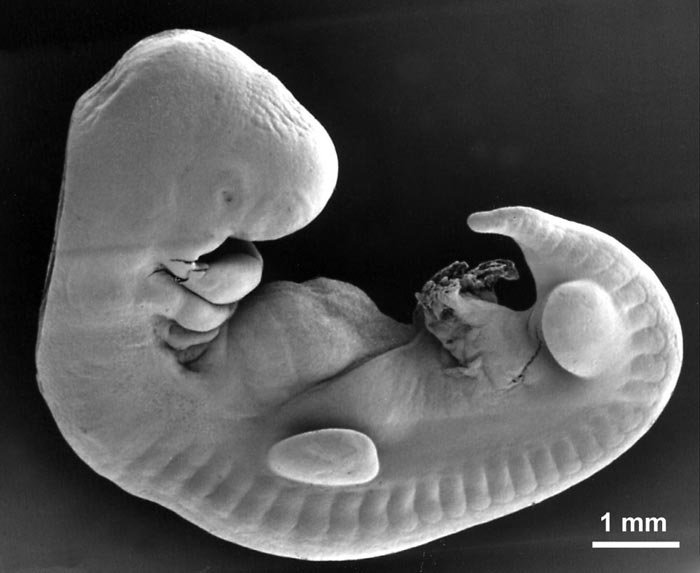
This typical four-week-old human embryo looks similar to fish embryos, with proto-gills and a tail.(credit: University of New South Wales)

A new way to look at cancer — by tracing its deep evolutionary roots to the dawn of multicellularity more than a billion years ago — has been proposed by Paul Davies of Arizona State University’s Beyond Center for Fundamental Concepts in Science in collaboration with Charles Lineweaver of the Australian National University.

If their theory is correct, it promises to transform the approach to cancer therapy, and to link the origin of cancer to the origin of life and the developmental processes of embryos.

Davies and Lineweaver are both theoretical physicists and cosmologists with experience in the field of astrobiology — the search for life beyond Earth.

They turned to cancer research only recently, in part because of the creation at Arizona State University of the Center for the Convergence of Physical Science and Cancer Biology. The center is one of twelve established by the National Cancer Institute to encourage physical scientists to lend their insights into tackling cancer.

Challenging orthodoxy

The new theory challenges the orthodox view that cancer develops anew in each host by a series of chance mutational accidents. Davies and Lineweaver claim that cancer is actually an organized and systematic response to some sort of stress or physical challenge. It might be triggered by a random accident, they say, but thereafter it more or less predictably unfolds.

Their view of cancer is outlined in the article “Exposing cancer’s deep evolutionary roots,” written by Davies (available free with registration). It appears in a special July issue of Physics World devoted to the physics of cancer.

“We envisage cancer as the execution of an ancient program pre-loaded into the genomes of all cells,” says Davies, an Arizona State University Regents’ Professor in ASU’s College of Liberal Arts and Sciences. “It is rather like Windows defaulting to ‘safe mode’ after suffering an insult of some sort.” As such, he describes cancer as a throwback to an ancestral phenotype.

The new theory predicts that as cancer progresses through more and more malignant stages, it will express genes that are more deeply conserved among multicellular organisms, and so are in some sense more ancient. Davies and Lineweaver are currently testing this prediction by comparing gene expression data from cancer biopsies with phylogenetic trees going back 1.6 billion years, with the help of Luis Cisneros, a postdoctoral researcher with ASU’s Beyond Center.

But if this is the case, then why hasn’t evolution eliminated the ancient cancer subroutine?

“Because it fulfills absolutely crucial functions during the early stages of embryo development,” Davies explains. “Genes that are active in the embryo and normally dormant thereafter are found to be switched back on in cancer. These same genes are the ‘ancient’ ones, deep in the tree of multicellular life.”

Reversing evolution at high speed

Cancer cells can become mobile and travel in the bloodstream to invade other organs (credit: Annie Cavanagh, Wellcome Images)

The link with embryo development has been known to cancer biologists for a long time, says Davies, but the significance of this fact is rarely appreciated. If the new theory is correct, researchers should find that the more malignant stages of cancer will re-express genes from the earliest stages of embryogenesis.

Davies adds that there is already some evidence for this in several experimental studies, including recent research at Harvard University and the Albert Einstein College of Medicine in New York.

“As cancer progresses through its various stages within a single organism, it should be like running the evolutionary and developmental arrows of time backward at high speed,” says Davies.

This could provide clues to future treatments. For example, when life took the momentous step from single cells to multicellular assemblages, Earth had low levels of oxygen. Sure enough, cancer reverts to an ancient form of metabolism called fermentation, which can supply energy with little need for oxygen, although it requires lots of sugar.

Davies and Lineweaver predict that if cancer cells are saturated with oxygen but deprived of sugar, they will become more stressed than healthy cells, slowing them down or even killing them. ASU’s Center for the Convergence of Physical Science and Cancer Biology, of which Davies is principal investigator, is planning a workshop in November to examine the clinical evidence for this.

“It is clear that some radically new thinking is needed,” Davies states. “Like aging, cancer seems to be a deeply embedded part of the life process. Also like aging, cancer generally cannot be cured but its effects can certainly be mitigated, for example, by delaying onset and extending periods of dormancy. But we will learn to do this effectively only when we better understand cancer, including its place in the great sweep of evolutionary history.”

16 Jul 20:58

Graphene could deliver Internet 100 times faster

shutterstock_95617615_graphene

Graphene (credit: University of Bath)

The use of graphene in telecommunications could dramatically accelerate Internet speeds by up to a hundred times, according to new research by scientists in the University of Bath‘s Department of Physics.

In a paper published in Physical Review Letters, researchers from the Centre for Graphene Science at the Universities of Bath and Exeter have demonstrated incredibly short optical response rates using graphene, which could pave the way for a revolution in telecommunications.

Internet information is transmitted and processed through optoelectronic devices such as optical fibers, photodetectors and lasers, and processed using optical switches, which convert data signals into a series of light pulses.

Ordinarily optical switches respond at rate of a few picoseconds — around a trillionth of a second. But the physicists in this study have observed the response rate of an optical switch using a few layers of graphene to be around one hundred femtoseconds — nearly 100 times quicker than current materials. That should allow for building optoelectronic and photonic devices with modulation speeds up to 200 GHz, the researchers suggest.

Commenting on the report’s main findings, lead researcher Dr Enrico Da Como said the finding has “exciting applications for the development of high speed optoelectronic components based on graphene. This fast response is in the infrared part of the electromagnetic spectrum, where many applications in telecommunications, security and also medicine are currently developing and affecting our society.”

In the long term this research could also lead to the development of quantum cascade lasers based on graphene. Quantum cascade lasers are semiconductor lasers used in pollution monitoring, security and spectroscopy. Few-layer graphene could emerge as a unique platform for this interesting application.

16 Jul 20:57

Long-lasting blood vessels from reprogrammed human cells

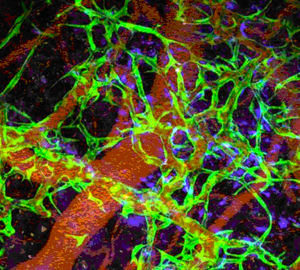
Functional, durable blood vessels grown in a mouse model from human induced pluripotent stem cells. Laser microscopy image shows iPSC-generated endovascular cells in green, connective tissue cells in blue and red blood cells in red. (Credit: PNAS)

Massachusetts General Hospital (MGH) researchers have used vascular precursor cells derived from human induced pluripotent stem cells (iPSCs) to generate, in an animal model, functional blood vessels that lasted as long as nine months.

In their report being published in Proceedings of the National Academy of Sciences, the investigators describe using iPSCs — reprogrammed adult cells that have many of the characteristics of embryonic stem cells — from both healthy adults and from individuals with type 1 diabetes to generate blood vessels on the outer surface of the brain or under the skin of mice.

“The discovery of ways to bring mature cells back to a ‘stem-like’ state that can differentiate into many different types of tissue has brought enormous potential to the field of cell-based regenerative medicine, but the challenge of deriving functional cells from these iPSCs still remains,” says Rakesh Jain, PhD, director of the Steele Laboratory for Tumor Biology at MGH and co-senior author of the study.

“Our team has developed an efficient method to generate vascular precursor cells from human iPSCs and used them to create networks of engineered blood vessels in living mice.”

The ability to regenerate or repair blood vessels could make a crucial difference in the treatment of cardiovascular disease — which continues to be the number one cause of death in the U.S. — and other conditions caused by blood vessel damage, such as the vascular complications of diabetes.  In addition, providing a vascular supply to newly-generated tissue remains one of the greatest barriers facing efforts to build solid organs through tissue engineering.

Several previous studies have generated from iPSCs the types of cells required to build blood vessels — endothelial cells that line vessels and connective tissue cells that provide structural support — but those cells could not form long-lasting vessels once introduced into animal models. “The biggest challenge we faced during the early phase of this project was establishing a reliable protocol to generate endothelial cell lines that produced great quantities of precursor cells that could generate strong, durable blood vessels,” says co-senior author Dai Fukumura, MD, PhD, also of the Steele Lab.

The MGH team adapted a method originally used to derive endothelial cells from human embryonic stem cells (hESCs). But while that method used a single protein marker to identify vascular progenitors, the researchers sorted out iPSC-derived cells that expressed not only that protein but also two other protein markers of vascular potential.  They then expanded that population using a culture system that team members had previously developed to differentiate endothelial cells from hESCs and confirmed that only iPSC-derived cells expressing all three markers generated endothelial cells with the full potential of forming blood vessels.

To test the capacity of those cells to generate functional blood vessels, they implanted onto the surface of the brains of mice a combination of the iPSC-derived endothelial precursor cells expressing the three markers with the mesenchymal precursors that generate essential structural cells.

Within two weeks, the implanted cells had formed networks of blood-perfused vessels that appeared to function as well as adjacent natural vessels and continued to function for as long as 280 days in the living animals.  While implantation of the combined precursor populations under the skin of the animals also generated functional blood vessels, it required implantation of five times more cells, and the vessels were short-lived, an observation consistent with the team’s previous studies of vessel generation in these two locations.

Because patients with type 1 diabetes (T1D), which can damage blood vessels, could benefit from the ability to make new blood vessels, the researchers wanted to determine whether iPSCs derived from the cells of such patients could help generate functional blood vessels.  As with cells from healthy individuals, precursors derived from T1D-iPSCs were able to generate functional, long-lasting blood vessels.  However, the researchers note, different lines of the T1D-iPSCs — including different lines derived from the same patient — showed differences in cell-generating potential, indicating the need to better understand the underlying mechanisms.

“The potential applications of iPSC-generated blood vessels are broad — from repairing damaged vessels supplying the heart or brain to preventing the need to amputate limbs because of the vascular complication of diabetes,” says co-lead author Rekha Samuel, MD, formerly of the Steele Laboratory and now at the Christian Medical College, Vellore, India.

“But first we need to deal with such challenges as the variability of iPSC lines and the long-term safety issues involved in the use of these cells, which are being addressed by researchers around the world.  We also need better ways of engineering the specific type of endothelial cell needed for specific organs and functions.”

Jain is also the Cook Professor of Radiation Oncology (Tumor Biology), and Fukumura is an associate professor of Radiation Oncology at Harvard Medical School.

Support for the study includes grants from the National Institutes of Health and the Harvard Stem Cell Institute.

16 Jul 20:56

HIGHER EDUCATION BUBBLE UPDATE: Research: Yes, Aid Fuels Tuition Inflation. “Why? Because cheap a…

by Glenn Reynolds

HIGHER EDUCATION BUBBLE UPDATE: Research: Yes, Aid Fuels Tuition Inflation. “Why? Because cheap aid encourages students to demand stuff they otherwise wouldn’t, and enables colleges to raise their prices at excessive rates.”

16 Jul 20:55

Inner speech speaks volumes about the brain

Whether you're reading the paper or thinking through your schedule for the day, chances are that you're hearing yourself speak even if you're not saying words out loud. This internal speech -- the monologue you "hear" inside your head -- is a ubiquitous but largely unexamined phenomenon. A new study published in Psychological Science looks at a possible brain mechanism that could explain how we hear this inner voice in the absence of actual sound.
16 Jul 20:54

IRS SCANDAL UPDATE: Feds admit improper scrutiny of candidate, donor tax records, Justice declines …

by Glenn Reynolds

IRS SCANDAL UPDATE: Feds admit improper scrutiny of candidate, donor tax records, Justice declines to prosecute. “The Treasury Department has admitted for the first time that confidential tax records of several political candidates and campaign donors were improperly scrutinized by government officials, but the Justice Department has declined to prosecute any of the cases.”

Of course it has. The Justice Department exists to serve the Administration.

16 Jul 20:54

SORRY, THAT’S NOT WHAT’S REWARDED IN OBAMA’S AMERICA: Legal Immigrants Seek Reward For Years of Fol…

by Glenn Reynolds

SORRY, THAT’S NOT WHAT’S REWARDED IN OBAMA’S AMERICA: Legal Immigrants Seek Reward For Years of Following The Rules. But seriously, the way we treat legal immigrants is disgraceful, and has been for a long time.

16 Jul 18:46

VNS3 on GCE

by Chris Swan
We recently announced the availability of our Network Function Virtualization (NFV) product VNS3 on Google Compute Engine (GCE), which means it's available there in addition to other clouds such as Amazon EC2, IBM SmartCloud Enterprise, GoGrid, Terremark vCloud Express, Flexiant, ElasticHosts, and CloudSigma.

Advanced routing


One of the things that makes GCE different from most of the other clouds is the presence of advanced routing features, which are explained brilliantly in this IO event video featuring Sunil James and John Cormie: 'Speed, Efficiency, and Control: Advanced Packet Routing Techniques in a Google Compute Engine Network'.

The GCE documentation explains how to create your own VPN gateway using a VM running Openswan, but for those wanting a richer feature set, an SDN API and a web GUI VNS3 can be used as the gateway.

The presence of advanced routing features in GCE means that there are two options for deploying VNS3:

Without client packs


In most clouds a client pack is required for a cloud server to connect to the VNS3 manager, but this isn't needed if GCE advanced routing is used to send packets to a VNS3 gateway:


Advantage: no VPN client or client pack needs to be deployed onto cloud servers (thus simplifying installation and configuration).

Disadvantages: no encryption of traffic inside the cloud, no overlay network (and hence no portability of IP addresses between regions/providers), no multicast capability.

With client packs


An alternative to using GCE's advanced routing features with VNS3 is to use the client pack based approach where each cloud server connects to the VNS3 manager using an SSL VPN (OpenVPN). The client pack itself is a file containing keys and connection parameters for the OpenVPN client:

Advantages: network traffic is encrypted in the cloud, an overlay network can be constructed that spans multiple regions/providers, IP addresses for servers can be reallocated within the overlay, multicast enabled.

Disadvantages: OpenVPN client and client pack need to be installed on all connected instances.

The choice is yours


However you decide to deploy VNS3 in GCE it's a great way of connecting to partners, remote offices, data centers and other clouds:


16 Jul 18:04

As server upstarts begin to gain ground, old-guard vendors take notice

by Jordan Novet

Companies that make money by providing physical infrastructure services for other companies to use — think Microsoft, with more than a million servers — have a big incentive to buy gear that’s as efficient as possible. And more of those companies are showing interest in leaving behind longstanding OEMs and looking to lesser known hardware builders that can be more enthusiastic about letting their customers buy a tailored product.

Previously, content-delivery network and security company CloudFlare had gone to Dell, Hewlett-Packard and ZT Systems for servers. But for its latest batch, CloudFlare went with Quanta. As a result, CloudFlare has been able to incorporate into the boxes (pictured) equipment that was just right for their workloads, including network-interface cards from Solarflare, Intel solid-state drives, and energy-sipping Intel 2620 Xeon E5 processors, said Matthew Prince, the company’s CEO and a co-founder (and one of our 2013 Cloud Trailblazers).

There could be some tradeoffs in going with these vendors: companies such as Quanta might not have as many service people available for support in every country, Prince said. Beyond that, there could be a layer of complexity around the distribution of the servers to all sites running a customer’s infrastructure. But at the CloudFlare office in San Francisco last week, it didn’t seem like much of an issue. Cardboard boxes containing servers were piled up along the walls but didn’t sop up all the floor space at company headquarters as they waited to be shipped to sites around the world.

ProfitBricks, an Infrastructure-as-a-Service (IaaS) provider, went to SeaMicro for servers packed with AMD chips, said Pete Johnson, the company’s senior director of platform evangelism. But he thinks the company’s distinguishing factor is its use of InfiniBand technology — not only for faster networking, but also to allow customer to have virtual machines of whatever size they want.

That technology could help provide better service than the one-size-fits-all approach in play at Amazon Web Services, or then again IaaS providers could do so by buying more customized server gear through companies historically known as original-design manufacturers (ODMs), Johnson said.

Like hiring a contractor

Meanwhile, at least one other IaaS provider is rolling its own servers with the help of ODMs. Rackspace works with Quanta to build its own machines. NTT and Orange have joined the Open Compute Project, suggesting interest in streamlined server design. And while it’s not an IaaS provider, Riot Games worked with Hyve Solutions to build servers inspired by Open Compute Project designs.

Fast-growing IaaS provider DigitalOcean has worked with Dell and Supermicro to get servers optimized for its needs, but co-founder and CEO Ben Uretsky can see why Quanta and its ilk could be a compelling alternative in the future. “We started off with retail servers with the traditional guys, and we’re constantly looking for something else, something denser, something better performing, who can really listen to the requirements we have for specific components,” Uretsky said.

And CloudSigma, another IaaS vendor, uses servers with custom-tailored accoutrements from Supermicro and Dell’s Data Center Solutions group, although CEO Robert Jenkins said Quanta looks worthy of consideration. Jenkins sees Quanta as well versed in working on requests for specialized gear, and he is curious about whether the company would be able to turn around products in response to orders faster than other vendors. “If you can cut the lead time from six to eight weeks to two to three weeks, that would be a different ball game,” Jenkins said.

At the same time, Jenkins said, companies that directly purchase from server makers and then lease them out to companies that use the gear, such as CloudSigma, might be more reluctant to provide support for Quanta than brand names such as HP or IBM. That’s possible because after a IaaS provider uses a server for a few years and wants to get new server to put in its place, the value of the original white-box server is lower on the market than, say, a similarly used IBM server.

The thing is, as computing resources become more centralized in clouds, Jenkins expects more companies wielding large-scale purchasing power to be able to customize machines, which translates to less business for cookie-cutter servers and more for Quanta-style specializing.

DIY servers

We’ve long known that Google has made its own switches and servers, although the company declined to disclose information on its suppliers for this article.

And Amazon surely has the scale at which getting highly customized gear would make sense, too. Amazon is secretive about what it has actually done. But an AWS spokeswoman did write in an email that “we do have specialized server design teams, and we work with a variety of vendors and sourcing models to refine our server technology and ensure the best possible cost, performance and reliability.” The statement says nothing about which types of companies go to work when AWS buys more servers, but it does suggest that the cloud provider likes getting exactly what it wants.

What do the traditional OEM vendors think about all this? An executive at an IaaS company that gets customized gear told me that traditional server sellers have been willing to go toe to toe on price, but that practice might not be sustainable, particularly when fat margins are desirable. Nevertheless, Dell is apparently planning price cuts and other changes. HP is banking on its Moonshot server line to stay cool. IBM reportedly has looked at selling its server division. And as for Oracle, well, at least one analyst is still holding out for a turnaround.


Related research and analysis from GigaOM Pro:
Subscriber content. Sign up for a free trial.

16 Jul 17:44

Cloud fight! Rackspace disputes Amazon’s dedicated instance claims

by Barb Darrow

Shocker: Rackspace thinks Amazon Web Services drastically overplays its claims for dedicated instance price cuts (and for its dedicated instances in general.)

Specifically, Rackspace CTO John Engates notes that, unlike you-know-who, Rackspace doesn’t charge a separate fee for every region where a dedicated server runs.  And, in a blog post, he contends that AWS defines dedicated computing differently than the rest of the world.

Rackspace CTO John Engates

Rackspace CTO John Engates

Given Amazon’s sheer size, competitors watch its every move like a hawk. These rivals, which include Rackspace, HP, Microsoft and others — want to wrest more of that public cloud business for themselves. And most of them also tout private cloud capabilities that make their offerings more enterprise-worthy than AWS — a claim that AWS heartily contests.

But getting back to dedicated instances, Engates maintains that AWS EC2 dedicated instances are not the same as true dedicated, bare metal servers. Rackspace’s dedicated servers are, he writes, “completely isolated from the public cloud and run on your own hardware with your own network, and you have your own storage.”

EC2 dedicated instances, he writes, also run on your own hardware but are connected to Amazon’s public cloud. “You’re just a dedicated, single-tenant slice of that cloud. If the AWS public cloud suffers an outage, you will be affected. Plus if you need additional block storage, you’re back to multi-tenancy with Amazon’s elastic block storage.”

He also maintains that true dedicated servers can be customized — a lot — with the operating system, storage, CPU type, memory and network speed of your choosing, whereas specs of EC2 dedicated instances “are predetermined for you.”

But you can read the rest of the post for yourself and make your own judgement.

Your move AWS!


Related research and analysis from GigaOM Pro:
Subscriber content. Sign up for a free trial.

16 Jul 17:43

You, Too, Can Move Your Company Into the Cloud

by Nathan McBride

On April 1 of this year, the Department of Defense announced that the US Navy would embark on a strategy to migrate its services to the cloud. While there have been numerous cases of big and small companies making this leap over the past few months, this one struck a particular chord with me because of its sheer scope. The US Navy is an organization utilizing 1,400 systems and 7,000 applications to serve more than 500,000 employees. My company, which is approximately .017%, .019% and .00028% the size of the USN in relative scope, made the transition years ago and it was no small effort taking almost 3 years to fully make the transition.

While the USN is relatively mum about its specific strategies, there are references to the fact that they intend to cut their systems in half within 36 months, reducing some overhead cost and modernizing. This is similar to the approach that the CIA has undertaken in moving much of its infrastructure to Amazon Web Services. These transitions, even when scaled down to a company of 140 like mine, require a substantial amount of planning, commitment, resources and time with little room for error. So it comes as no surprise that whenever I spend time with industry peers who have yet to move to the cloud, there is a palpable sense of fear and overwhelming anxiety about how to even think about the process.

When I'm asked to advise people on how they might craft strategies to get to the cloud, I give a four-point overview based on my own experience. It will get you to the starting line, but beyond that each and every strategy will be different depending on a myriad of circumstances in your corporation.

Move only what you have to and start fresh wherever possible
The first thing is to dispatch with the idea that you are going to "move" all of your current resources into the cloud. That is just not possible, especially if you have invested heavily in distributed enterprise class systems and the infrastructure to support them. While it is certainly likely that a good portion of your environment can be virtualized and moved into a Platform as a Service (PaaS)/Infrastructure as a Service (IaaS) environment like Amazon Web Services, the move to the cloud should be viewed as an opportunity to leave systems behind and replace them with systems that are lighter, faster and less expensive.

Tear down and rebuild your security model
If your Microsoft SysAdmin has convinced you that Active Directory is a viable solution for the cloud, or that because you use Active Directory you can only get into the cloud by sticking with solutions that support Active Director (AD)/Windows Azure Active Directory (WAAD), you need to get a second opinion. When moving to the cloud you have to consider that many solutions do not allow for authentication off of Active Directory and instead rely on more common security protocols such as SAML1, SAML2, OID and OAuth. Identity Access Management (IAM) vendors have been forced to consider brokering authentication for Active Directory because companies feel like they must stay on it as an internal authentication platform. Nothing could be further from the truth and if you do your research, you will discover that there is a wealth of options out there. To get into the cloud you need the most robust and extensible authentication model you can possibly build and by doing so your options for solutions will increase exponentially.

Cost savings are a benefit, not a driver
If you think that you need to get into the cloud to save money, you need to think again. Yes, you will ultimately save money by migrating to the cloud, lots of money in fact, but it takes time to get there and there is the chance that you will actually spend more money upfront. When making your pitch to senior management, talk about the benefits of reduced infrastructure, resources, better uptime, business continuity enhancements, mobility and access ubiquity. If asked about cost savings, be ready to deliver your pitch on how you intend to reduce or eliminate capex spending, reduce personnel resources, move services to a pay by month model eliminating long term contracts and ultimately reduce your annual budget by a modest percentage year over year over a 3-5 year period of time. Do not get caught in the trap of making cost savings one of your drivers for going into the cloud. You will bring a level of scrutiny over your claims, on which you will most likely be unable to deliver.

Create a long-term flexible strategy
The last bit of wisdom is to develop the most thorough 1-, 3- and 5-year cloud strategy that you can put down. My 1-year strategy is very specific; my 3-year is slightly less specific because I find that even 3 years down the road is very hard to see. It's impossible to see five years in the future, but if you work backwards from 5 years you can, even at a very amorphous level, describe how you would want your environment to look at that point. These should be rolling strategies that are flexible enough to consider the dynamics of the industries you will operate in. Today's Identity Access Management vendor will be tomorrow's Mobile Device Management (MDM) vendor and a week from now, could be bought by a company in some entirely different vertical. By creating a flexible strategy, you can constantly adapt to these changing conditions in the industry over which you have almost no control.

In considering these four concepts, keep in mind that they are applicable to any size organization and any cloud scope transformation. The more I have considered them, the more I have realized that they are applicable anywhere. It's no small task, but you can move your company into the cloud if you approach things with a new mind and put aside the technologies of the past.

One last thing to note...in the next five years, new employees coming into your company won't know (or care) how to use Outlook or mapped drives. They won't care for your PC laptop offering or why your firewall blocks Dropbox. They will have established methods for doing work and they will all involve the cloud. Seventy-five out of the top 100 universities in the latest US News and World Report college rankings use Google Apps as their primary backbone. Seven of the 8 Ivies are in the same boat. Do you really want to be the last one at the starting line?

16 Jul 17:18

Mathematical models target disease with drugs chosen by your DNA

Medicines that are personally tailored to your DNA are becoming a reality, thanks to the work of U.S. and Chinese scientists who developed statistical models to predict which drug is best for a specific individual with a specific disease.
16 Jul 17:18

Four Suggestions as You Face Your Industry's Steamroller

by Leonard Fuld

Remember the scene in the first Austin Powers film where Powers, attempting to escape in a steamroller, warns one of Dr. Evil's henchmen to move out of its path? Despite its comically slow speed — and a huge distance between them, the guard stays rooted to the spot, yelling Stop! ... until it's too late. (The scene dissolves to his Donna Reed-like wife getting the news and noting tragically: "People never think how things affect the family of a henchman.")

On the industrial stage, something like that scene plays out all too often. A company finds itself in the path of an unstoppable industry disruption, can hardly fail to see it, yet simply fails to act. Only, it's not at all funny.

Consider the pharmaceutical industry, the focus of a recent global survey my colleagues and I conducted. We asked nearly 200 life sciences executives about long-term trends that posed fundamental threats to their businesses and how management was dealing with them. Despite the fact that all were able to foresee developments unfolding over the coming decade with the power to irreparably damage their companies, 76 percent of the European respondents and 81 percent of the American ones said their companies had made no significant changes to strategy to counter those threats. (Executives representing Asia-Pacific life sciences companies were more sanguine, with 56 percent indicating their firms had prepared for an industry shock).

In the face of knowable threats, is your own company making more than a futile effort to cry Stop? If you fear not, here are the suggestions we're sharing with the industry leaders we serve:

Inject a steady flow of timely information and (sometimes harsh) outside perspectives into your strategic thinking. This means fresh information heard on the street, not just more searches on Google, and the use of outside experts to identify oncoming threats that they see and you don't. I've seen this work wonders for a number of companies that want neutral, unvarnished views of their competitive position. A large pharmaceutical firm, for example, was about to make a big bet on a new class of drugs. But a panel of outside experts that had been assembled to critique the strategy warned management about an emerging risk. Citing early warning signals that were not being emphasized by the scores of industry newsletters and Wall Street analysts, it saved the company from the move that a competitor subsequently took — to its detriment.

Develop scenarios of how the world might look five or ten years from now. No one can predict the future, but by combining known trends in various ways it is possible to anticipate multiple possibilities — likely story lines about shapes the market could take — for good or ill. The few companies that have mastered this discipline have benefited mightily. A decade ago Oracle developed a series of scenarios that anticipated massive industry consolidation. Instead of waiting to be steamrolled, the company acted on this intelligence and went on a ten-year acquisition binge, acquiring over 90 companies from 2003 to the present at a pace surpassed only by Google. The result: Oracle became one of the most successful companies in back office database products and tools and has now moved onto advancing in the next market, the cloud.

Experience threats through war games. There is no substitute for feeling and "touching" the disruption before it arrives. War games translate arguments and assumptions about the future into a tangible setting, allowing rival contestants to play out roles and experience risks. A successful war game can anticipate the moves of market players with an uncanny degree of accuracy. Multinationals have used war games to align strategy in global markets, where regulations and competitors differ. In a number of instances, I have seen war games acknowledge the threat from changing government regulation, informing the company that it must proactively work with authorities to help moderate new regulations, which in turn softened or averted the disruption altogether.

Set trip wires for action. War games and scenarios should provide you with threads that you can track in order to determine which future world is emerging. You can spot these signals far enough in advance to change strategic direction — but you must regard them as imperatives to make timely decisions and to act on them.

Preparing for a future industry shock and anticipating its direction is all about honest, steady collection of intelligence and the readiness to alter your plans based on what you have learned. Plenty of executives lose sleep over approaching disruptions; a few vocally oppose them. Neither response will move you out of a steamroller's path. To survive, you'll need to watch, reexamine your position, make tough decisions, and take timely action.