Shared posts

15 Oct 12:17

Attack of the week: POODLE

by Matthew Green
Believe it or not, there's a new attack on SSL. Yes, I know you're thunderstruck. Let's get a few things out of the way quickly.

First, this is not another Heartbleed. It's bad, but it's not going to destroy the Internet. Also, it applies only to SSLv3, which is (in theory) an obsolete protocol that we all should have ditched a long time ago. Unfortunately, we didn't.

Anyway, enough with the good news. Let's get to the bad.

The attack is called POODLE, and it was developed by Bodo Möller, Thai Duong and Krzysztof Kotowicz of Google. To paraphrase Bruce Schneier, attacks only get better -- they never get worse. The fact that this attack is called POODLE also tells us that attack names do get worse. But I digress.

The rough summary of POODLE is this: it allows a clever attacker who can (a) control the Internet connection between your browser and the server, and (b) run some code (e.g., script) in your browser to potentially decrypt authentication cookies for sites such as Google, Yahoo and your bank. This is obviously not a good thing, and unfortunately the attack is more practical than you might think. You should probably disable SSLv3 everywhere you can. Sadly, that's not so easy for the average end user.

To explain the details, I'm going to use the usual 'fun' question and answer format I employ for attacks like these.
What is SSL?
SSL is probably the most important security protocol on the Internet. It's used to encrypt connections between two different endpoints, most commonly your web browser and a web server. We mostly refer to SSL by the dual moniker SSL/TLS, since the protocol suite known as Secure Sockets Layer was upgraded and renamed to Transport Layer Security back in 1999.

This bug has nothing to do with TLS, however. It's purely a bug in the old pre-1999 SSL, and specifically version 3 -- something we should have ditched a long time ago. Unfortunately, for legacy reasons many browsers and servers still support SSLv3 in their configurations. It turns out that when you try to turn this option off, a good portion of the Internet stops working correctly, thanks to older browsers and crappy load balancers, etc.

As a result, many modern browsers and servers continue to support SSLv3 as an option. The worst part of this is that in many cases an active attacker can actually trigger a fallback. That is, even if both the server and client support more modern protocols, as long as they're willing to support SSLv3, an active attacker can force them to use this old, terrible protocol. In many cases this fallback is transparent to the user.
What's the matter with SSL v3?
So many things it hurts to talk about. For our purposes we need focus on just one. This has to do with the structure of encryption padding used when encrypting with the CBC mode ciphersuites of SSLv3.

SSL data is sent in 'record' structures, where each record is first authenticated using a MAC. It's subsequently enciphered using a block cipher (like 3DES or AES) in CBC mode. This MAC-then-encrypt design has been the cause of much heartache in the past. It's also responsible for the problems now.

Here's the thing: CBC mode encryption requires that the input plaintext length be equal to a multiple of the cipher's block size (8 bytes in the case of 3DES, 16 bytes for AES). To make sure this is the case, SSL implementations add 'padding' to the plaintext before encrypting it. The padding can be up to one cipher block in length, is not covered by the MAC, and always ends with a single byte denoting the length of the padding that was added.

In SSLv3, the contents of the rest of the padding is unspecified. This is the problem that will vex us here.
How does the attack work?
Let's imagine that I'm an active attacker who is able to obtain a CBC-encrypted record containing an interesting message like a cookie. I want to learn a single byte of this cookie -- and I'm willing to make the assumption that this byte happens to live at the end of a cipher block boundary.

(Don't worry about how I know that the byte I want to learn is in this position. Just accept this as a given for now.)

Imagine further that the final block of the record in question contains a full block of padding. If we're using AES as our cipher, this means that the last byte of the plaintext of the final block contains a '15' value, since there are 15 bytes of padding. The preceding 15 bytes of said block contain arbitrary values that the server will basically strip off and ignore upon decryption, since SSLv3 doesn't specify what they should contain. (NB: TLS does, which prevents this issue.)

The attack works like this. Since I control the Internet connection, I can identify the enciphered block that I want to learn within an encrypted record. I can then substitute (i.e., move) this block in place of the final block that should contain only padding.

When the server receives this new enciphered record, it will go ahead and attempt to decrypt the final block (which I'll call C_n) using the CBC decryption equation, which looks like this:
Decrypted final block := Decipher(C_n) XOR C_{n-1}
Note that C_{n-1} is the second-to-last block of the encrypted record.

If the decrypted final block does not contain a '15' in the final position, the server will assume either that the block is bogus (too much padding) or that there's less padding in the message than we intended. In the former case it will simply barf. In the latter case it will assume that the meaningful message is longer than it actually is, which should trigger an error in decryption since MAC verification will fail. This should also terminate the SSL connection.

Indeed, this is by far the most likely outcome of our experiment, since the deciphered last byte is essentially random -- thus failure will typically occur 255 out of every 256 times we try this experiment. In this case we have to renegotiate the handshake and try again.

Every once in a while we'll get lucky. In 1/256 of the cases, the deciphered final block will contain a 15 byte at the final position, and the server will accept this as as a valid padding length. The preceding fifteen bytes have also probably been changed, but the server will then strip off and ignore those values -- since SSLv3 doesn't care about the contents of the padding. No other parts of the ciphertext have been altered, so decryption will work perfectly and the server should report no errors.

This case is deeply meaningful to us. If this happens, we know that the decipherment of the final byte of C_n, XORed with the final byte of the preceding ciphertext block, is equal to '15'. From this knowledge we can easily determine the actual plaintext value of the original byte we wanted to learn. We can recover this value by XORing it with the final byte of the preceding ciphertext block, then XOR that with the last byte of the ciphertext block that precedes the original block we targeted.

Voila, in this case -- which occurs with probability 1/256 -- we've decrypted a single byte of the cookie.

The important thing to know is that if at first we don't succeed, we can try, try again. That's because each time we fail, we can re-run the SSL handshake (which changes the encryption key) and try the attack again. As long as the cookie byte we're attacking stays in the same position, we can continue our attempts until we get lucky. The expected number of attempts needed for success is 256.
We've got one byte, how do we get the rest?
The ability to recover a single byte doesn't seem so useful, but in fact it's all we need to decipher the entire cookie -- if we're able to control the cookie's alignment and location within the enciphered record. In this case, we can simply move one byte after another into that critical final-byte-of-the-cipher-block location and run the attack described above.

One way to do this is to trick the victim's browser into running some Javascript we control. This script will make SSL POST requests to a secure site like Google. Each time it does so, it will transmit a request path first, followed by an HTTP cookie and other headers, followed by a payload it controls.
Source: Möller et al.
Since the script controls the path and payload, by varying these values and knowing the size of the intermediate headers, the script can systematically align each specific byte of the cookie to any location it wants. It can also adjust the padding length to ensure that the final block of the record contains 16 bytes of padding.

This means that our attack can now be used to decrypt an entire cookie, with an average of 256 requests per cookie byte. That's not bad at all.
So should we move to West Virginia and stock up on canned goods?
Portions of the original SSL v3 specification being
reviewed at IETF 90.
Maybe. But I'm not so sure. For a few answers on what to do next, see Adam Langley and Rob Graham's blog posts on this question.

Note that this entire vulnerability stems from the fact that SSLv3 is older than Methuselah. In fact, there are voting-age children who are younger than SSLv3. And that's worrying.

The obvious and correct solution to this problem is find and kill SSLv3 anywhere it lurks. In fact, this is something we should have done in the early 2000s, if not sooner. We can do it now, and this whole problem goes away.

The problem with the obvious solution is that our aging Internet infrastructure is still loaded with crappy browsers and servers that can't function without SSLv3 support. Browser vendors don't want their customers to hit a blank wall anytime they access a server or load balancer that only supports SSLv3, so they enable fallback. Servers administrators don't want to lock out the critical IE6 market, so they also support SSLv3. And we all suffer.

Hopefully this will be the straw that breaks the camel's back and gets us to abandon obsolete protocols like SSLv3. But nobody every went bankrupt betting on insecurity. It's possible that ten years from now we'll still be talking about ways to work around POODLE and its virulent flesh-eating offspring. All we can do is hope that reason will prevail.
14 Oct 21:13

Four principles for an effective state

by Jean Tirole

This column by the 2014 Nobelist Jean Tirole was originally posted on 16 July 2007. It gives his views on reforms that are as necessary today as they were in 2007. Meeting the expectations of its citizens will require the French state to become more effective. A four-pronged approach is required: restructuring, competition, evaluation and accountability.

04 Oct 23:49

The effects of a money-financed fiscal stimulus

by Jordi Galí

Many unconventional policies adopted by central banks in response to the Crisis failed to boost the economy. This column discusses the effects of a temporary money-financed fiscal stimulus. When a more realistic model is allowed, such a stimulus can have a strong effect on output and employment, and a mild effect on inflation. 

04 Oct 23:47

Biocultural origins of human capital and growth

by Oded Galor, Marc Klemp

The substitution from child quantity to quality has been credited for mankind’s escape from the Malthusian trap and the advent of sustained economic growth. This column argues that biocultural preferences for quality faced positive selection pressure in the pre-growth era, presenting evidence from the founding population of Quebec. Individuals with moderate levels of fecundity had fewer children than those with high fecundity, but produced more descendants in the long run because their children enjoyed higher reproductive success. 

22 Sep 19:48

Finance sector wages: high and rising rent extraction

by Joanne Lindley, Steven McIntosh

Individuals who work in the finance sector enjoy a significant wage advantage. This column considers three explanations: rent sharing, skill intensity, and task-biased technological change. The UK evidence suggests that rent sharing is the key. The rising premium could then be due to changes in regulation and the increasing complexity of financial products creating more asymmetric information.

19 Sep 20:34

Al Qaeda’s Recognition of the Importance of Seapower

by noreply@blogger.com (Chris Rawley)
For several years now, I've written about al Qaeda's interest in the sea as a not only as an avenue for attack, but as a means to facilitate the movement of men, money, and material.  After some initial confusion in reporting, it appears that the recent attack against a Pakistani naval frigate was indeed part of a larger plot to target U.S. naval vessels.  Rob Farley writes about the potential efficacy of that attack method in some detail.  But the story has strategic implications beyond just another failed maritime attack.  
Embedded image permalink
The accompanying propaganda piece entitled “Operation against the American Navy by the Mujahideen” by Osama Mahmood, spokesman of Al Qa’eda in the Subcontinent, was translated into six languages. I’ll spare you most of the usual Islamists tripe in the two page screed and get to the meat of it: 
“The reality is that the real target of the operation was the American Naval fleet in the Indian Ocean, which was to be targeted using Pakistani warships, including PNS Zulfiqar. The attackers were portrayed as outsiders who had infiltrated a Pakistani naval installation; whereas all the participants of this daring operation were commissioned officers of the Pakistan Navy."
If true, the most concerning aspect of this story is the infiltration of militants into Pakistan's navy, one with which the U.S. Navy occasionally partners with in the Indian Ocean.  Even more disconcerting is the thought that if AQSI members are in the Navy, then they are likely in other parts of the Pakistani military, including perhaps the Army and Air Force Strategic Forces, that maintain Pakistan's nuclear inventory.  The already tenuous relationship between Pakistan and the U.S. will be put under even more strain if another "insider" attack is attempted.
Mahmood goes on to write:
                "Why were Naval Targets Selected?
  • It is because of their naval strength that America and its allies have been able to impose a military and economic stranglehold on the Muslim world, especially the land of Makkah and Madinah. America’s naval-military capability represents the backbone of its global empire of oppression. Using its seven naval commands, America rules the seas and oceans of the world; and in this way, America is able to control vital maritime trade routes and straits in the Muslim world and pillage the resources of the Ummah. These same resources are then employed by America to perpetuate its aggression against the Muslim world.
  •  It is from American naval bases that fighter jets take off to rain death and destruction on the oppressed peoples of Afghanistan, Pakistan, Yemen, Iraq and other Muslim countries. And the Crusader armies that are fighting against the Islamic Emirate of Afghanistan are also provided logistical support using this naval force.” 
So it appears that some elements of AQ realize that the sea is important not only to their overall offensive strategy, but that it is rather critical to America's economic and military power. 
Which means that U.S. vessels will continue to be a target for AQ franchises.  And as much as I hate to find myself agreeing with enemy propaganda, their recognition of the importance of American seapower is valid. The United States' continued ability to project force while fighting the Long War forward, away from our shores, has and will depend on a large, healthy naval fleet.  U.S. naval vessels provide eyes and ears to collect intelligence against the dispersed AQ network.  U.S. Navy aircraft, and occasionally subs and surface ships, have engaged terrorist targets in a number of countries.  These same vessels serve as afloat forward staging for special operators who also hunt AQ.  Finally, America's fleet provides strategic mobility and logistics support for times when American ground forces need to deploy against the enemy. 

The opinions and views expressed in this post are those of the author alone and are presented in his personal capacity. They do not necessarily represent the views of U.S. Department of Defense or the US Navy.
17 Sep 17:51

Senators opposing net neutrality rake in more campaign cash

by David Kravets

Senators who have vocalized their opposition to net neutrality are taking in, on average, 40 percent more campaign cash from the broadband-delivery industry than those who support it, according to an analysis of campaign data.

The data (XLSX)—a Maplight analysis of campaign contributions prepared for Ars Technica—highlights the disparity between what the monied Washington interests want compared to the public's desires. Most of the 800,000 initial public comments to the Federal Communications Commission backed the FCC adopting net neutrality rules. The commission is weighing whether to enact regulations that, among other things, could prevent broadband providers from charging for Internet fast lanes. The public commenting period ended Monday.

What the commission will do is anybody's guess, but the political money so far is lining up against net neutrality. No vote date has been set.

Read 13 remaining paragraphs | Comments

13 Sep 03:23

Reforming CEO pay: Focus on the right dimensions

by Alex Edmans

Executive pay is a controversial political issue with big implications for firm performance. Although public debate focuses on the level of compensation – or at best its sensitivity to firm performance – this column argues that the key issue is its temporal structure. A well designed payment structure can align CEO incentives with long-term shareholder value. The authors recommend lengthening the vesting period of equity and options.

11 Sep 21:31

CBC Warns Canadians of "US Law Enforcement Money Extortion Program"

by samzenpus
jfbilodeau writes The CBC is warning Canadians about a U.S. program where America law enforcement officers — from federal agents to state troopers right down to sheriffs in one-street backwaters — are operating a vast, co-ordinated scheme to grab as much of the public's cash as they can through seizure laws. "So, for any law-abiding Canadian thinking about an American road trip, here’s some non-official advice: Avoid long chats if you’re pulled over. Answer questions politely and concisely, then persistently ask if you are free to go. Don’t leave litter on the vehicle floor, especially energy drink cans. Don’t use air or breath fresheners; they could be interpreted as an attempt to mask the smell of drugs. Don’t be too talkative. Don’t be too quiet. Try not to wear expensive designer clothes. Don’t have tinted windows. And for heaven’s sake, don’t consent to a search if you are carrying a big roll of legitimate cash.

Share on Google+

Read more of this story at Slashdot.


09 Sep 19:16

Surprising Result of NYC Bike Lanes: Faster Traffic for Cars

by timothy
A report at vox.com says that the implementation of bike lanes in traffic-heavy New York City has one possibly non-intuitive result: car traffic was sped up as a result. The bike lanes have caused the lanes for cars to be narrowed, but as a result of the street redesign to accomodate bikes, one big change has especially helped to keep cars moving forward more steadily: Although narrower streets can slow traffic, that doesn't seem to have happened here — perhaps because traffic in this area was crawling at around 11 miles per hour to begin with. Instead, the narrower lanes were capable of handling just as much traffic, and one major improvement to intersection design helped them handle more, while also letting bikes travel more safely. This improvement was something called a pocket lane for left-hand turns: a devoted turning lane at most intersections that takes the place of the parking lane, which gets cars out of the way of moving traffic when they're making a left.

Share on Google+

Read more of this story at Slashdot.


07 Sep 07:30

Increasing government popularity predicts emerging-market financial crises

by Christoph Trebesch, Helios Herrera, Guillermo L. Ordoñez

Financial crises are often credit booms gone bust. This column argues that ‘political booms’, defined as an increase in government popularity, are also a good predictor of financial crises. The phenomenon of ‘political booms gone bust’ is, however, only observable in emerging markets. In these countries, politicians have more to gain from riding the popularity benefits of unsustainable booms.

03 Sep 20:13

Japan Breast Fondling Charity Fundraiser, Chinese Reactions

by Frans Engström

breast-fondling-charity-fundraiser-japan-sky-perfectv-av-idols-stop-aids-01

From NetEase:

“Breast Fondling Fundraiser” in Japan, AV Idols Lift Up Their Tops to “Donate Their Breasts”

From the August 30th to the 31st local time, Tokyo, Japanese pay-per-view [or premium cable] television channel SKY PerfecTV held a “STOP!AIDS” charity event– “24-Hour TV – The Erotic Saves the Planet! 2014″, with the most eye-catching event being the “Breast Fondling Fundraiser.” Held at 8pm on the 30th of August at Live House in Tokyo’s Shinjuku Kabukicho, currently active Japanese AV [Adult Video] idols Kasugano Yui, Sakuragi Yu, Serino Rina, Natsumi HanaRin, Nishida Kotone, Maisaka Hitomi, and more formed the nine-member “Beautiful Breasts to Raise Money Girls of ’14″. At the event, the girls brazenly “offered their bosoms”, allowing donors to “fondle their breasts”, thanking them for their efforts to eradicate AIDS. Photos: CFP

breast-fondling-charity-fundraiser-japan-sky-perfectv-av-idols-stop-aids-02

breast-fondling-charity-fundraiser-japan-sky-perfectv-av-idols-stop-aids-03

breast-fondling-charity-fundraiser-japan-sky-perfectv-av-idols-stop-aids-04

breast-fondling-charity-fundraiser-japan-sky-perfectv-av-idols-stop-aids-05

breast-fondling-charity-fundraiser-japan-sky-perfectv-av-idols-stop-aids-06

breast-fondling-charity-fundraiser-japan-sky-perfectv-av-idols-stop-aids-07

breast-fondling-charity-fundraiser-japan-sky-perfectv-av-idols-stop-aids-08

breast-fondling-charity-fundraiser-japan-sky-perfectv-av-idols-stop-aids-09

breast-fondling-charity-fundraiser-japan-sky-perfectv-av-idols-stop-aids-10

breast-fondling-charity-fundraiser-japan-sky-perfectv-av-idols-stop-aids-11

breast-fondling-charity-fundraiser-japan-sky-perfectv-av-idols-stop-aids-12

breast-fondling-charity-fundraiser-japan-sky-perfectv-av-idols-stop-aids-13

breast-fondling-charity-fundraiser-japan-sky-perfectv-av-idols-stop-aids-14

Comments from NetEase:

白曰衣衫尽 [网易河南省洛阳市网友]:

This once again proves that mosaic [censorship] is a stumbling block for mankind’s progress.

04953947 [网易云南省昆明市网友]:

What was originally a really touching charitable fundraiser has instantly become dirty after being censored by the editor.

幽默走天下 [网易广东省广州市网友]:

If this were in China, there would definitely be even more guys going to have a feel, and the donation box would definitely have received a lot of fake 100 yuan bills!

射那谁一脸 [网易广东省广州市网友]:

How evil the person adding mosaics on one nipple after another is!

网易山东省济南市网友 [天尚仁间] 的原贴:

Japan really is a little [smaller version of] China. When you look into the Sui, Tang and Song periods, you’ll find that the country [China] was rich and the people were strong, with appetites for food and sex, and was very open [liberal in morals/norms]. There is a written account in ancient books that says the dwarf country [Japan] wasn’t open and that the people were short. With subsequent arrival of Tang ambassadors, China’s more advanced [progressive] culture/civilization spread to the dwarf country, up until present-day Japan.

网易广东省惠州市网友 ip:125.93.*.* (responding to above)

The attitude of People in ancient China towards sex indeed really was open and free/liberated. For instance, there really weren’t any demands to stay a widow or to build a chastity memorial arch.

It wasn’t until the Ming dynasty when feudal Confucian ethics reached their pinnacle that people’s thinking reversed, and this actually was a retrogression.

网易北京市网友 ip:111.199.*.*

If XX [likely referring to the 红会, the Chinese Red Cross] hopes to ever solicit donations again, they better learn from these girls.

于小小龙 [网易辽宁省丹东市网友]:

How do girls donate?

网易广东省深圳市网友 ip:113.88.*.* (responding to 幽默走天下)

Ding your sister ["your ass"]! Don’t just recklessly spout conjecture. First, this would never be done out in the open in China. Second, don’t project your own mentality on other people making it as if everybody else has the same filthy, lowly disposition as you. Third, are you sure that the donation box in the picture is one hundred percent filled with genuine notes? Stop belittling ourselves [China] and raising others [Japan] up, let’s just focus on improving ourselves.

蒋介右 [网易北京市网友]:

Brest holding meeting.

20 Aug 16:32

How Patent Trolls Destroy Innovation

by Soulskill
walterbyrd sends this story from Vox: Everyone agrees that there's been an explosion of patent litigation in recent years, and that lawsuits from non-practicing entities (NPEs) — known to critics as patent trolls — are a major factor. But there's a big debate about whether trolls are creating a drag on innovation — and if so, how big the problem is. A new study (PDF) by researchers at Harvard and the University of Texas provides some insight on this question. Drawing from data on litigation, R&D spending, and patent citations, the researchers find that firms that are forced to pay NPEs (either because they lost a lawsuit or settled out of court) dramatically reduce R&D spending: losing firms spent $211 million less on R&D, on average, than firms that won a lawsuit against a troll. "After losing to NPEs, firms significantly reduce R&D spending — both projects inside the firm and acquiring innovative R&D outside the firm," the authors write. "Our evidence suggests that it really is the NPE litigation event that causes this decrease in innovation."

Share on Google+

Read more of this story at Slashdot.


12 Aug 14:37

Track who’s buying politicians with “Greenhouse” browser add-on

by David Kravets

Nicholas Rubin, a 16-year-old programmer from Seattle, has created a browser add-on that makes it incredibly easy to see the influence of money in US politics. Rubin calls the add-on Greenhouse, and it does something so brilliantly simple that once you use it you'll wonder why news sites didn't think of this themselves.

Greenhouse pulls in campaign contribution data for every Senator and Representative, including the total amount of money received and a breakdown by industry and size of donation. It then combines this with a parser that finds the names of Senators and Representatives in the current page and highlights them. Hover your mouse over the highlighted names and it displays their top campaign contributors.

In this sense, Greenhouse adds another layer to the news, showing you the story behind the story. In politics, as in many other things, if you want to know the why behind the what, you need to follow the money. And somewhat depressingly, in politics it seems that it's money all the way down.

Read 13 remaining paragraphs | Comments

31 Jul 19:00

“Housing Market Spillovers: Evidence from the End of Rent Control in Cambridge, MA,” D. Autor, C. Palmer & P. Pathak (2014)

by afinetheorem

Why don’t people like renters? Looking for rental housing up here in Toronto (where under any reasonable set of parameters, there looks to be a serious housing bubble at the moment), it seems very rare for houses to be rented and also very rare for rental and owned homes to appear in the same neighborhood. Why might this be? Housing externalities is one answer: a single run-down house on the block greatly harms the value of surrounding houses. Social opprobrium among homeowners may be sufficient to induce them to internalize these externalities in a way that is not true of landlords. The very first “real” paper I helped with back at the Fed showed a huge impact of renovating run-down properties on neighborhood land values in Richmond, Virginia.

Given that housing externalities exist, we may worry about policies that distort the rent-buy decision. Rent control may not only limit incentives for landlords to upgrade the quality of their own property, but may also damage the value of neighboring properties. Autor, Palmer and Pathak investigate a quasiexperiment in Cambridge, MA (right next door to my birthplace of Boston, I used to hear Cambridge referred to as the PRC!). In 1994, Massachusetts held a referendum on banning rent control, which was enforced very strongly in Cambridge. It passed 51-49.

The units previously under rent control, no surprise, saw a big spurt of investment and a large increase in their value. If the rent controlled house was in a block with lots of other rent controlled houses, however, the price rose even more. That is, there was a substantial indirect impact where upgrades on neighboring houses increases the value of my previously rent-controlled house. Looking at houses that were never rent controlled, those close to previously rent-controlled units rose in price much faster than otherwise-similar houses in the same area which didn’t have rent-controlled units on the same block. Overall, Autor et al estimate that rent decontrol raised the value of Cambridge property by 2 billion, and that over 80 percent of this increase was due to indirect effects (aka housing externalities). No wonder people are so worried about a rental unit popping up in their neighborhood!

Final version in June 2014 JPE (IDEAS version).


17 Jul 07:07

Trust and the welfare state: The twin-peaked curve

Yann Algan, Pierre Cahuc, Marc Sangnier, 17 July 2014

It is commonly argued that the persistence of large welfare states in Scandinavian countries is due to the trustworthiness of their citizens. This column shows that the relationship between trust and the size of the welfare state is twin peaked. Untrustworthy individuals support generous welfare states because they expect to benefit without bearing the costs, whereas civic-minded individuals only support generous welfare states when surrounded by people they trust.

Full Article: Trust and the welfare state: The twin-peaked curve
26 Jun 21:05

We don’t need net neutrality; we need competition

by Peter Bright
Aurich Lawson

The minutiae of network topology and infrastructure are not traditional topics for comedians; seeing them discussed on late-night TV proves that the debate over network neutrality has truly made it into the mainstream. This is perhaps not surprising, thanks to some truly alarmist headlines, but also to the sheer importance of the Internet to modern life. Anything that could cause the "death of the Internet" surely concerns us all, doesn't it?

But the network neutrality debate is a muddy one at best, with different people using the term in different ways. Regulatory enforcement of the idea would at best prove inadequate to achieve what people want. At worst, it might even prove harmful to innovation and progress, potentially outlawing existing widespread and harmless practices.

In addition, the current fixation on network neutrality happens to work to the advantage of the large incumbent Internet Service Providers (ISPs). While they may oppose network neutrality regulations (or, indeed, any legislative or regulatory limitations on their business at all), so long as the debate centers around network neutrality, the largest ISPs can be confident that nothing will challenge their dominant market positions.

Read 37 remaining paragraphs | Comments

13 Jun 18:59

Football in the time of protest

Nauro F Campos, 13 June 2014

The 2014 FIFA World Cup is upon us. This column argues that there will be plenty of partying, but also plenty of protests fuelled by the gross mismanagement and limited economic benefits from hosting the Cup. Stadia may be ready, but much planned infrastructure has already been abandoned. Indeed, rent-seeking may be one reason nations bid for the Cup. Since the returns to transportation infrastructure are higher in poor countries, the international community should work to stamp out corruption so that poor countries can continue to host mega-events like the World Cup.

Full Article: Football in the time of protest
12 Jun 21:32

ISIS Now Controls A Huge Territory Within Iraq And Syria

by War News Updates Editor
(Click on Image to Enlarge)

ISIS Now Controls A Shocking Percentage Of Iraq And Syria -- Business Insider

This map from the Washington-based Institute for the Study of War is an up-to-date depiction of the operational area of the Islamic State of Iraq and the Levant (ISIS), a jihadist group so intractable that it was expelled from Al Qaeda's global network in February of 2014.

The group took over Mosul, Iraq's second-largest city, earlier this week. And now the extremist militants have captured parts of Tikrit, Saddam Hussein's hometown, which is located just 95 miles from the capital of Baghdad. Hundreds of prisoners were freed from prisons in each city.

ISIS operates across a vast geographic area. Jalula, Iraq, the easternmost population center under ISIS's control, is over 360 miles from Raqqah, Syria, the group's westernmost zone of control. ISIS sprawls across the Iraqi-Syrian border. It's attacked inside of Iraqi Kurdistan, sits at the doorstep of Syria's Alawaite heartland, and has broad operational abilities inside Iraq's Sunni Triangle, and even its Shi'ite south. ISIS cuts across ethnic and sectarian regions, controlling major cities and desert wilderness.

Read more ....

My Comment: Within this territory ISIS now has in it's possession .... military bases for it's fighters, airports to transport people and cargo, and banks to finance their army. Even Al Qaeda never had such an infrastructure and such assets under it's control.

Update: Here is a must read article from the Institute fro the study of War .... The ISIS Battle Plan.
12 Jun 21:17

Cable Companies Duped Community Groups Into Fighting Net Neutrality

by samzenpus
walterbyrd (182728) writes Last week, it transpired that the big cable companies were bankrolling fake consumer groups like Broadband for America and The American Consumer Institute. These 'independent consumer advocacy groups' are, in truth, nothing of the sort, and instead represent the interests of its benefactors, in the fight against net neutrality. If that wasn't bad enough, VICE is now reporting that several of the real community groups (and an Ohio bed-and-breakfast) that were signed up as supporters of Broadband for America were either duped into joining, or were signed up to the cause without their consent or knowledge.

Share on Google+

Read more of this story at Slashdot.


12 Jun 03:59

Net neutrality: Goals and challenges

Joshua Gans, 11 June 2014

Netflix recently agreed to pay Comcast for faster access to Comcast’s customers, intensifying the debate over ‘net neutrality’ – the principle that internet service providers should treat all data equally. This column argues that without net neutrality regulation, ISPs can capture the benefits of higher-quality content, thereby discouraging innovation from content providers. To be effective, net-neutrality regulation must prevent content-based price discrimination on both sides of the market.

Full Article: Net neutrality: Goals and challenges
12 Jun 01:56

New study suggests patent trolls really are killing startups

by Joe Mullin
Patent trolls and startups don't mix: San Mateo "virtual eyewear" company Ditto.com laid off four employees and lost $4 million in value after patent attacks.

Patent reform advocates have long argued that "patent trolls"—companies that do nothing but sue over patents—are harmful to innovation, not just a plague on big companies. A new study attempted to find out if there's any real data behind that accusation or if it's just a few sad anecdotes.

Turns out there is a very real, and very negative, correlation between patent troll lawsuits and the venture capital funding that startups rely on. A just-released study [PDF] by Catherine Tucker, a professor of marketing at MIT's Sloan School of Business, finds that over the last five years, VC investment "would have likely been $21.772 billion higher... but for litigation brought by frequent litigators."

The study defines "frequent litigators" as companies that file 20 or more patent lawsuits, which limits the definition to true-blue "patent trolls," or Patent Assertion Entities (PAEs), the term used by the paper. The study covers the period from 1995 to 2012.

Read 14 remaining paragraphs | Comments

10 Jun 22:07

The experimenters strike back

“GIVE a man a fish”, said Bono, an Irish singer turned philanthropist, “he’ll eat for a day. Give a woman microcredit, she, her husband, her children and her extended family will eat for a lifetime." In the print edition of April 19th, we reviewed a paper by the World Bank that supports the notion that microfinance reduces poverty. The authors of the study, Shahidur Khandker and Hussain Samad, analysed observational data from households in Bangladesh spanning over two decades. They disputed the pessimistic results reported from many randomised controlled trials (RCTs) and found, on the contrary, that microcredit increases personal expenditure, household assets, labour supply and schooling of children. Now the experimenters are hitting back.

A new experimental study by Bruno Crépon, Florencia Devoto, Esther Duflo and William Pariente investigates the impact of a microcredit programme in rural Morocco. The authors randomly assigned 162 villages to either the treatment group (given access to microcredit) or the control group (not given access to...Continue reading

10 Jun 22:03

The macroeconomic effects of asset purchases

Martin Weale, Tomasz Wieladek, 10 June 2014

After reducing their policy rates close to zero in response to the global financial crisis, the Bank of England and the Federal Reserve began purchasing assets. This column assesses the effect of these asset purchases on output and inflation. In line with previous studies, the authors find that asset purchase announcements are associated with increases in both output and inflation in both countries. They also find that quantitative easing had a larger impact on UK inflation, which suggests that the UK Phillips curve is steeper.

Full Article: The macroeconomic effects of asset purchases
10 Jun 21:54

How Amazon got a patent on white-background photography

by Ars Staff

Ars covered the grant of Amazon's controversial patent last month. This guest post is by Charles Duan, director of the Patent Reform Project at Public Knowledge. It's an essay meant to answer a question frequently asked on Ars: how do bad patents get issued in the first place? 

I. The problem

The patent examiner sat down at her desk and pulled up the next item on her examination docket. Patent application 13/292,359. "Studio Arrangement."

"Right in my area," she thought. She scanned the patent application text and flipped through the drawings. It seemed straightforward—a camera, a platform for holding an object, a couple of lamps, a backdrop. She’d seen all of this before.

Read 73 remaining paragraphs | Comments

09 Jun 08:28

City of Buried Machines

by Geoff Manaugh
[Image: Courtesy of London Basement].

A story of buried digging machines made something of an unexpected splash over at New Statesman this week, quickly becoming their weekend's most-read article.

It turns out that all those elaborate basements and artificial show caves built for Londons' nouveau riche have led to an interesting spatial dilemma: contractors are unable to retrieve the excavation equipment they used to produce all those huge underground extensions in the first place, and they have thus developed a technique for simply abandoning their machines underground and burying them in place.

London is thus becoming a machine cemetery, with upwards of £5 million worth of excavators now lying in state beneath the houses of the 1%. Like tools invented by M.C. Escher, these sacrificial JCBs have excavated the very holes they are then ritually entombed within, turning the city into a Celtic barrow for an age of heroic machinery.

What will future archaeologists make of these interred devices, densely packed in earth and left behind in unmarked graves?

[Image: Courtesy of London Basement].

As we explored here on BLDGBLOG six years ago, deep below the mansions and row houses of the city's wealthiest residents, colossal cave adventures are taking shape: massive swimming pools, TV rooms, personal gymnasia, full-scale cinemas, and whole subterranean flats are being constructed in order to side-step strict historic preservation laws on the earth's surface.

Pioneered by firms such as the appropriately named London Basement, these massively expanded homes now feature "playrooms and cinemas, bowling alleys and spas, wine cellars and gun rooms—and even a two-storey climbing wall," the Guardian reported in 2012. "It is leading to a kind of iceberg architecture, a humble mansion on the surface just the visible peak of a gargantuan underworld, with subterranean possibilities only limited by the client's imagination."

As the architect of one such mega-basement explained, "We analyzed the planning laws and realized that they cover everything about the surface of the ground, but nothing beneath it. There was nothing whatsoever that could stop us from drilling all the way down to the south pole."

[Image: Courtesy of London Basement].

Those grand old piles you see lining the streets of Belgravia thus might hide vertically sprawling domestic labyrinths down in the soil and clay beneath their ever-growing foundations, as home ownership fractally expands downward into the planet by way of waterproof geotextiles and carefully buttressed retaining walls.

However, these vast catacombs are by no means uncontroversial and might yet see their era come to an end due to local frustration with the disruption caused by construction crews and because of ever-growing municipal fees and penalties.

Until then, though, this abyssal impulse is surely approaching the inevitable point where we will see a private home legally redefined as a mine, a site of excavation closer in spirit to the extraction industry than private housing.

(Thanks to Martin John Callanan, Peter Flint, Paul Black, and Nicola Twilley! Meanwhile, if you like this, you might also like Subterranean Machine Resurrections)
06 Jun 21:52

Secular Stagnation Part 1 – Paul Krugman’s Bicycling Problem

by Edward Hugh

“What’s really happening fast is the demographic transition, with Europe very quickly turning Japanese.”
Paul Krugman – For Bonds, This Time is Different


Ever since Larry Summers gave his game-changing speech at last autumn’s IMF research conference the back-and-forth flow of arguments about secular stagnation has been almost non-stop (indeed Larry himself now has a webpage dedicated to the topic). First to dive into the swimming pool after the sounding of the starting pistol was Paul Krugman, with a series of blogposts and NYT articles (here, here, here, here, here, here, and here).  These were followed/accompanied by a series of commentaries (both for and against), and then finally we got to one of the potential end points of the argument, the “negative natural interest rates for ever and ever” model produced by Gauti Eggertsson and Neil Mehrotra (here) – summarised by Krugman in his memorable “Stagnation Without End, Amen” post.   A fuller bibliography of major milestones in the secular stagnation issue can be found at the foot of this post, but I’m going to eat up most of the column space here looking at just one Krugmans arguments – the one contained in Demography and the Bicycle Effect – since in many ways in goes right to the nub of the issue.

The background to the argument (as originally, even if prematurely, explored by Alvin Hansen, Günar Myrdal and even John Maynard Keynes himself in the 1930s) is that the population dynamics set in motion by the industrial revolution of the late 18th century have reached a historic turning point. In the two centuries or so that have elapsed since what many term the modern growth era got going three related but distinct processes co-existed in time:

1/ positive trend population growth
2/ positive trend economic growth 
3/ steadily accelerating technical change

You could call these the “stylized facts” which characterize the modern growth era, but the secular tendency in two of them  is about to undergo a seismic shift. At some stage during the 21st century global population will peak, and then gradually start to decline, probably forever more. In fact in some countries (principally in Eastern Europe, but also Japan, Germany, Spain, Portugal, and Greece) population is already falling. All of Europe will likely head in this direction sometime in the 2020s, although there is considerable uncertainty still about the actual path dynamics of this process since in addition to birth rates immigration rates also play a part. At the present time some countries in Europe (the UK, Germany, Switzerland) are in receipt of large numbers of migrants annually, while others are losing working age population precisely to the aforementioned trio.

Hence the significance of the fact that Paul Krugman uses the expression “demographic transition” (for the first time to my knowledge) in the quote which opens this post. We are not talking here about some one-off problem (although often observers have spoken about Japan in just these terms), but a generalized phenomenon, a transition, something which eventually will affect all countries on the planet and our entire species. Previously people have tended to use the expression “demographic transition” to refer to the increase in the proportion of working age population and total population that accompanies the drop in fertility from high levels in less developed economies. The expression “demographic dividend” has often been used to describe the boost to economic activity this shift entails. Normally people assumed that this process would come to a halt around the 2.1tfr replacement level, but in one developed economy after another this hasn’t happened, and those in which it has have been more the exception than the rule. So now reality pushes us towards a broadening in the definition of that transition towards acceptance of a later phase wherein populations age, and ultimately decline, a process which is greatly accelerated in those countries which have experienced long term very low fertility.

What Alvin Hansen and others started to think about in the 1930s was what the consequence would be for the second of the secular process which have characterized the modern growth era  (positive economic growth). What happens if populations (or better put working age populations) start to shrink? The kernel of their argument is summed up (here) by Paul Krugman as follows:

“To have more or less full employment, we need sufficient spending to make use of the economy’s potential. But one important component of spending, investment, is subject to the accelerator effect: the demand for new capital depends on the economy’s rate of growth, rather than the current level of output. So if growth slows due to a falloff in population growth, investment demand falls — potentially pushing the economy into a semi-permanent slump.”

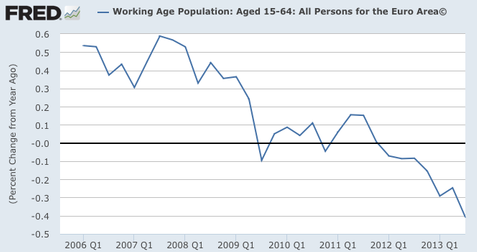
Pretty simple really, but isn’t this just what Keynes says at the start of the General Theory, sometimes the simplest things are the hardest to see. Especially if our natural intellectual disposition leads us towards assuming the opposite. Apart from the theoretical simplicity, the idea is backed by plenty of empirical evidence. It has become clear in one country after another that there is a steady falling off of economic growth after the rate of working age population growth peaks and then starts to decline.

The Japan case (as shown above) is clear enough, but the start of this process is already observable in China, where working age population is currently peaking, and where growth rates have now fallen from the earlier double digit levels to ones in the 6%/7% range. People are even alarming themselves by saying we’d better get used to the idea of 5% growth, but in fact this easing in growth rates has little to do with a housing slowdown. Rather it is structural and long term, and Chinese growth rates will eventually fall to the level of Japanese ones (see my 2008 “Has China’s Economic Growth Now Passed It’s Peak“). Or does anyone seriously think China can keep going on the basis of attracting immigration?

What we are seeing then is that as working age population growth drops towards zero, so GDP growth weakens. The question is, as it turns negative will GDP growth (as opposed to GDP per capita growth) also turn negative. The answer is it depends. A simple approximation to a growth accounting model of the type used by IMF, OECD etc to calculate trend growth in an economy would be the following:

GDP growth = growth in working age population + TFP (total factor productivity) growth

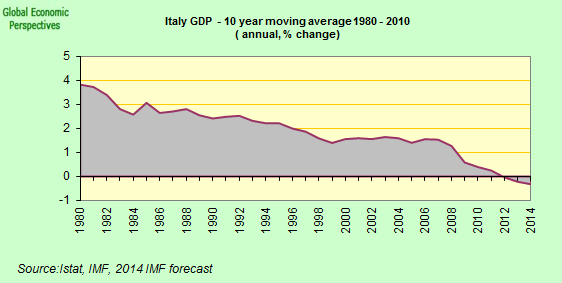
Now, if working age population growth turns negative, then GDP growth can only be positive if productivity grows faster. One conclusion is very obvious here, handling the later stages of the demographic transition is all about managing the rate of working age population decline. This can be achieved to some extent via lengthening the working life, raising the participation rate, or having immigration. Even so, we may arrive at a point were GDP trend growth rates drop below zero. This situation is very near to being the case in Japan, Italy and Portugal, among others.

So we could be moving to a world were eventually both population and GDP decline. What about technology? Well this will need to be the subject of a separate post, but it is highly likely that the rate of technical  change will continue to accelerate, so we could have the peculiar situation that while GDP notional falls, and keeps falling, materially we feel a lot better off.

Well, after this excursus, let’s go back to Paul Krugman’s bicycling issue. Basically Paul has started to run into a problem that Claus Vistessen and I ran into on our Demography Matters blog. If the world is overpopulated, and there is a constant pressure on natural resources, then why are you economist types worried about falling populations? Wouldn’t it be a positive for the planet?

“whenever I raise these points, I get questions from people who ask why I don’t regard slowing population growth as a good thing. After all, it means less pressure on resources, less environmental damage, and so on”.

Now naturally at the moment in the US we are talking about slower population growth, but in Japan and parts of Europe – and eventually as we have seen probably everywhere else – population and working age population are already falling. But still, if slowing population growth is going to be a problem for an economy, then sure as hell falling population could be.

“What’s important to realize, then, is that slower population growth indeed could and should be a good thing — but that what passes for sound economic policy is all too likely to turn this potentially good development into a major problem. Why? Because under the current rules of the game, there’s a strong bicycle aspect to our economies: unless they’re moving forward sufficiently rapidly, they tend to fall over.”

So what’s the issue here? What he calls the current rules of the game (is it in our power to change them?)? Or the bicycle effect, which implies that we are perpetually “condemned to grow”, since as Paul says, if our economies don’t move forward fast enough they tend to fall over. This is what I intend to examine in the posts which will follow.

To close this introduction to my series on Secular Stagnation I would like to cite the end of the Keynes speech I mention above (here):

“A too rapidly declining population  would obviously involve many severe problems, and there are strong reasons……why in that event, or in the threat of that event, measures ought to be taken to prevent it. But a stationary, or slowly declining population may, if we exercise the necessary strength and wisdom, enable us to raise the standard of life to what it should be, whilst retaining those parts of our traditional life which we value the more now we see what happens to those who lose them”


“In the final summing up, therefore……. I only wish to warn you, that the chaining up of one devil may, if we are careless, only serve to loose another still fiercer and more intractable.”

Conclusion

In this introduction we have seen that population decline may now well be inevitable, as may a turning negative of economic growth. This need not make us poorer, depending on how we:

a) develop technology
b) manage the process

As Paul Krugman warns, the current economic and financial “set up” implies the bicycle needs to constantly move forward, something which may prove more and more difficult to achieve. We therefore need as Keynes said, to exercise the necessary strength and wisdom. That is to say we need to adapt the current rules of the game to the new reality, and learn to manage the process. Is simply blowing bubbles the best way to handle this sort of epochal change? That is the topic we will turn to next.

Bibliography

 E. Cary Brown: Alvin H. Hansen’s Contributions To Business Cycle Analyisis, 1989 (here)

Willem H Buiter: The Simple Analytics of Helicopter Money, Why It Always Works, Cepr 2014 (here)
Willem H Buiter, Ebrahim Rahbari & Joe Seydl: Secular Stagnation: Only If We Ask For It, Citi Global Economics View January 2014

Gauti Eggertsson & Neil Mehrotra: A Model of Secular Stagnation, 2014 (here)

Alvin Hansen (1939), “Economic progress and declining population growth,” American Economic
Review.

John Maynard Keynes: Some Economic Consequences of a Declining Population, Galton Lecture, 1937 (here)

Paul Krugman: Inflation Targets Reconsidered, Sintra May 2014 (here)

Paul Krugman: For Bonds, This Time is Different, NYT 2 June 2014 (here)
Paul Krugman: Demography and the Bicycle Effect, NYT 19 May 2014
(here)
Paul Krugman: Secular Stagnation in the Euro Area, NYT 17 May 2014 (here)
Paul Krugman: Stagnation Without End, Amen (Wonkish), NYT 9 April 2014
(here)
Paul Krugman: Monetary and Fiscal Implications of Secular Stagnation, NYT 19 November 2013 (here)
Paul Krugman: A Permanent Slump?, NYT 17 November 2013 (here)
Paul Krugman: Secular Stagnation, Coalmines, Bubbles, and Larry Summers, NYT 16 November 2013 (here)

Paul Krugman: Monetary Policy In A Liquidity Trap NYT 11 April 2013 (here)
Paul Krugman: The Japan Story, NYT 5 Feb 2013 (here)
Paul Krugman: Japanese Relative Performance, NYT 9 February 2013 (here)

Paul Krugman: Japan: What Went Wrong? June 1998 (available in Japan section here)
Paul Krugman: Further Notes On Japan’s Liquidity Trap, June 1998 (available in Japan section here)
Paul Krugman: It’s Baaack: Japan’s Slump and the Return of the Liquidity Trap, Brookings Papers on Economic Activity, 2:1998
(here)

Gunnar Myrdal: The Effects of Population Decline. Godkin Lectures, Lecture VI, 1938 (here)

Masaaki Shirakawa (2014):Is inflation (or deflation) “always and everywhere” a monetary phenomenon?, BIS (here)
Masaaki Shirakawa (2012): Demographic Changes and Macroeconomic Performance, Bank of Japan  (here)

Larry Summers (2014):On secular stagnation (here).

Timothy Taylor: Secular Stagnation: Back To Alvin Hansen, 2013 (here)

For more information visit my webpage Edward Hugh Mainpage
04 Jun 01:14

Economic history and economic development

Peter Temin, 4 June 2014

Increasing the interaction between economic history and development could benefit both subfields. This column points how some recent insights from economic history can be relevant for development. The Black Death led to an improvement in agricultural technology, changed the status of women, and increased wages. This process helped the Industrial Revolution, but the technology boom was not profitable in low-income countries. These findings suggest an underlying problem of development could be the demographic patterns that keep wages low.

Full Article: Economic history and economic development
03 Jun 14:25

Four myths about the Great War of 1914-1918

Mark Harrison, 3 June 2014

The Great War offers lessons for today. But this column argues from recent research that many so-called lessons are misunderstood. Secretive, authoritarian regimes become dangerous when they fear the future. Deterrence matters. Other aspects also demand re-evaluation.

Full Article: Four myths about the Great War of 1914-1918
30 May 20:26

Factual response to FT’s fact checking

Thomas Piketty, 30 May 2014

‘Capital in the 21st century’ has had an extraordinary – and extraordinarily rapid – impact on the global economic dialogue. It has drawn an extraordinary – and extraordinarily rapid – response, including a front-page critique by an FT journalist. In this column, the book’s author responds point-by-point to the critiques. He rejects the notion that he made outright mistakes. Scholars working with old data make judgments and compromises to expand the dataset; disagreements are inevitable – a point that applies equally to the journalist’s ‘corrections’. In any case, the book’s overall analysis is robust to such critiques.

Full Article: Factual response to FT’s fact checking