Shared posts

31 Aug 12:29

Experimental and theoretical studies on the synthesis of 1,4,5-trisubstituted pyrrolidine-2,3-diones

by Nguyen Tran Nguyen, Vo Viet Dai, Nguyen Ngoc Tri, Luc Van Meervelt, Nguyen Tien Trung and Wim Dehaen

Abstract

Substituted 4-acetyl-3-hydroxy-3-pyrroline-2-ones have been prepared via three-component reactions and the tautomerism of these 3-pyrroline-2-ones is due to the slight difference of energy, and the significantly large rate constant of transformation between two tautomers. 1,4,5-Trisubstituted pyrrolidine-2,3-dione derivatives were prepared from the above mentioned 2-pyrrolidinone derivatives and aliphatic amines, which exist in enamine form and are stabilized by an intramolecular hydrogen bond. A possible reaction mechanism between 3-pyrroline-2-one and aliphatic amine (CH3NH2) was proposed based on computational results and the main product is formed favorably following the PES via the lowest ΔG# pathway in both the gas-phase and an ethanol solvent model. DFT calculations showed that kinetic selectivity is more significant than thermodynamic selectivity for forming main products.
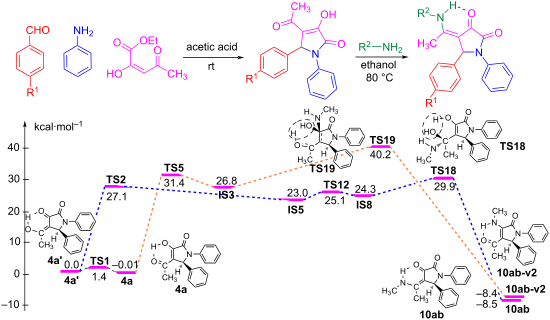
Beilstein J. Org. Chem. 2022, 18, 1140–1153. doi:10.3762/bjoc.18.118

30 Aug 05:29

Movable type printing method to synthesize high-entropy single-atom catalysts

by Peng Rao

Nature Communications, Published online: 29 August 2022; doi:10.1038/s41467-022-32850-8

It is challenging to integrate multi-single metal atoms into one support. In this work, the authors demonstrate the production of high-entropy single-atom catalysts via a movable typing method, which enables the anchor up to eleven metals as highly dispersed single-atom active centers on the carbon support for the oxygen reduction reaction.
29 Aug 09:12

Shapeshifting xantphos

by Lukas Veth

Nature Chemistry, Published online: 26 August 2022; doi:10.1038/s41557-022-01031-x

Lukas Veth and Paweł Dydio discuss the importance of ligands in transition metal catalysis, looking at the success story of xantphos and why it should earn the title of ‘privileged ligand’.
29 Aug 09:08

Fifty Years of a Dispute. A Triptych: Why Woodward?

by Jeffrey I. Seeman
Fifty Years of a Dispute. A Triptych: Why Woodward?**

R. B. Woodward received his early education in MO theory from the theoretical chemist William E. Moffitt (left) and needed to apply it to explain his 5th mysterious reaction in the course of his failed route to vitamin B12. This paper discusses “Why it was Woodward” who, together with Roald Hoffmann, solved the pericyclic no-mechanism problem.


Abstract

This publication discusses R. B. Woodward's motivations, personality qualities, and chemical experiences that placed him in a perfect position to discover, along with Roald Hoffmann, the solution to the pericyclic no-mechanism problem, that is, to discover the Woodward-Hoffmann rules or, as Woodward preferred, the Principle of Conservation of Orbital Symmetry.

29 Aug 09:04

Where did the pandemic start? Anywhere but here, argue papers by Chinese scientists echoing party line

China doesn’t just reject the “lab-leak” theory. It now claims SARS-CoV-2 came from another country
29 Aug 09:04

Rethinking the retraction process | Science

High-profile examples of scientific fraud continue to plague research. Recently, Science published two news stories on alleged image manipulation in Alzheimer’s research and unreliable data in an ecology study, sadly showing that the problem persists. ...
29 Aug 08:59

Recent advances in transition metal-mediated trifluoromethylation reactions

Chem. Commun., 2022, 58,10442-10468
DOI: 10.1039/D2CC04082D, Highlight
Debasish Mandal, Suman Maji, Tanay Pal, Soumya Kumar Sinha, Debabrata Maiti
This review provides a complete demonstration of amalgamating significant pieces of work in the metal-mediated trifluoromethylation genre of recent past years.
The content of this RSS Feed (c) The Royal Society of Chemistry
29 Aug 08:57

[ASAP] Photoexcited Direct Amination/Amidation of Inert Csp3–H Bonds via Tungsten–Nickel Catalytic Relay

by Qing Wang, Shengyang Ni, Lei Yu, Yi Pan, and Yi Wang

TOC Graphic

ACS Catalysis
DOI: 10.1021/acscatal.2c03456
29 Aug 08:57

A “one size fits all” ligand for photoredox and metallaphotoredox catalysis

Publication date: Available online 25 August 2022

Source: Chem

Author(s): Leila Zamani, Patricia Z. Musacchio

29 Aug 08:56

[ASAP] Synthesis of gem-Disulfonyl Enamines via an Iminyl-Radical-Mediated Formal 1,3-HAT/Radical Coupling Cascade

by Zhongxue Fang, Yujie Zhang, Zhansong Zhang, Qingming Song, Yong Wu, Zhaohong Liu, and Yongquan Ning

TOC Graphic

Organic Letters
DOI: 10.1021/acs.orglett.2c02277
29 Aug 08:54

Hydrodeoxygenation of lignin related phenolic monomers in polar organic electrolyte via electrocatalysis in a stirred slurry catalytic reactor

Green Chem., 2022, 24,7469-7480
DOI: 10.1039/D2GC01997C, Paper
Yanuar Philip Wijaya, Kevin J. Smith, Chang Soo Kim, Előd L. Gyenge
Electrocatalytic hydrodeoxygenation of cerulignol and creosol producing cycloalkanes can be achieved under mild conditions in a stirred slurry reactor using an acid–polar organic solvent–salt electrolyte system.
The content of this RSS Feed (c) The Royal Society of Chemistry
29 Aug 08:51

An efficient and convenient method to prepare amides by the carbonylation of amines

Publication date: 28 September 2022

Source: Tetrahedron Letters, Volume 107

Author(s): Dejin Zhang, Shu Sun, Zehua Qian, Kangle Pei, Xueyu Shang, Chengcheng Liu, Pan Guo

29 Aug 08:51

A reusable MOF supported single-site nickel-catalyzed direct N-alkylation of anilines with alcohols

Publication date: 8 October 2022

Source: Tetrahedron, Volume 124

Author(s): Yuanyuan Lu, Huining Chai, Kun Yu, Chaonan Huang, Yujie Li, Jinyu Wang, Jiping Ma, Weiqiang Tan, Guangyao Zhang

29 Aug 08:49

Nickel dual-atom sites for electrochemical carbon dioxide reduction

by Qi Hao

Nature Synthesis, Published online: 18 August 2022; doi:10.1038/s44160-022-00138-w

Dual-atom catalysts are promising for CO2 reduction reactions; however, sluggish kinetics limit practical applications. Now, a Ni dual-atom catalyst has been synthesized, realizing efficient electrocatalytic CO2 reduction with a CO partial current density of ~1 A cm2 at >99% Faradaic efficiency.
29 Aug 08:45

Is a Catalyst Always Needed? The Case of the Knoevenagel Reaction with Malononitrile

by Vincenzo Campisciano, Francesco Giacalone, Michelangelo Gruttadauria
Is a Catalyst Always Needed? The Case of the Knoevenagel Reaction with Malononitrile

To catalyse or not to catalyse, that is the question. Whether it is nobler to have a catalyst that speeds up a reaction or it is cheaper for the reaction to proceed on its own. The reaction between aldehydes and malononitrile raises a Hamletic doubt: is there a need for a catalyst?


Abstract

The aim of this Perspective is to start a discussion about the real usefulness of more or less sophisticated catalytic systems for the Knoevenagel reaction with malononitrile, a reaction that can take place under mild conditions without the need of a catalyst. From a sustainable viewpoint the questions are: Is it useful to increase the rate of a reaction that already occurs under mild conditions? Is it useful to spend resources and time in designing, characterizing and realizing complex catalytic systems for such reaction? Does it make sense to carry out the reaction under conditions such as to have a slower reaction rate and therefore to find a catalyst that is able to increase it?

29 Aug 08:14

What Matters for a European Research Council (ERC) Starting Grant?

by Athina Anastasaki
What Matters for a European Research Council (ERC) Starting Grant?

This Viewpoint Article provides tips on how to increase the chances of securing a European Research Council (ERC) Starting Grant.


Abstract

European Research Council (ERC) Starting Grants are arguably the most competitive grants in Europe and their prestige is fully justified considering that they (i) allow focus on a high risk/high gain project through generous funding of 1.5–2 million Euros, (ii) they can enable the foundation of a new academic group and earn the submitting principal investigator a professorship, and (iii) they serve as a highly reputable award that can either facilitate tenure/promotion or assist in securing a subsequent academic position. However, the journey to getting one is far from easy. In this Viewpoint Article, I will discuss my first two unsuccessful attempts to secure an ERC Starting Grant and how the lessons learned during the process led me to ultimately secure a grant upon my third attempt.

29 Aug 08:14

A Review on CO2‐Based Polyureas and Polyurea Hybrids

by Hui Li, Haiyang Cheng, Fengyu Zhao
A Review on CO2-Based Polyureas and Polyurea Hybrids

The progresses achieved in the synthesis of polyureas and polyurea hybrids directly or indirectly from CO2 have been reviewed, including the method, monomer structure, catalyst and properties.


Abstract

The utilization of CO2 as a renewable and cheap carbon resource to produce fuels, chemicals and polymers has attracted more attention. This review will summarize the developments in the production of polymers like polyureas and polyurea hybrids with CO2 as a monomer directly or indirectly. The influences of catalyst and the structure of diamine monomer on the molecular weight, thermal stability and mechanical properties of polyureas are discussed. In addition, the general properties and applications of functional CO2-based polyureas are also described. A few examples of CO2-based polyurea hybrids are also introduced. Finally, the future research priorities as well as the development trend of polyurea materials are depicted.

29 Aug 08:12

Additive‐Free Visible‐Light‐Initiated Three‐Component Cyanation and Azidation

by Zhiwei Wang, Jindong Hao, Yufen Lv, Chengming Qu, Huilan Yue, Wei Wei
Additive-Free Visible-Light-Initiated Three-Component Cyanation and Azidation

A simple and green visible-light-initiated strategy has been developed for the installation of cyano and azido groups through multi-component reaction of α-diazoesters, cyclic ethers and TMSCN/TMSN3. A number of structurally diverse organic nitriles and azides could be efficiently obtained in moderate to good yields with favorable functional group tolerance at room temperature.


Abstract

A simple and green visible-light-initiated strategy for the installation of cyano and azido groups has been established through multi-component reaction of α-diazoesters, cyclic ethers and TMSCN/TMSN3. A number of structurally diverse organic nitriles and azides could be efficiently obtained at room temperature without adding any external metal reagent, strong oxidant, base and photocatalyst. The synthetic transformations of the reaction products to some functionalized molecules were carried out to highlight the potential utility of this method.

17 Aug 14:50

Visible-light-mediated synthesis of β-keto sulfones using g-C3N4 as a recyclable photocatalyst under sustainable conditions

Green Chem., 2022, 24,7122-7130
DOI: 10.1039/D2GC02254K, Paper
Binoyargha Dam, Ashish Kumar Sahoo, Bhisma K. Patel
Syntheses of β-keto sulfones have been reported using g-C3N4 as a recyclable photocatalyst along with green chemistry metrics and eco-scale evaluation.
The content of this RSS Feed (c) The Royal Society of Chemistry
17 Aug 05:23

Ir-Catalyzed α-Alkylation of Ketones with Alcohols: One-Step Access to Donepezil

by Wang, Sen

Synthesis
DOI: 10.1055/a-1894-8826


We demonstrate an iridium-catalyzed alkylation of ketones with alcohols, which enables one-step access to donepezil, cyclic ketones, and linear ketones in high yields. A scale-up experiment shows the excellent practicability of this protocol. Comparative experiments show that a small amount of water is beneficial to the improvement of product yield.
[...]

Georg Thieme Verlag KG Rüdigerstraße 14, 70469 Stuttgart, Germany

Article in Thieme eJournals:
Table of contents  |  Abstract  |  Full text

16 Aug 14:25

Visible-light photocatalytic radical addition–translocation–cyclization to construct sulfonyl-containing azacycles

Chem. Commun., 2022, 58,10206-10209
DOI: 10.1039/D2CC03799H, Communication
Yu-Qing Liang, Yi-Xin Xu, Zhong-Jian Cai, Shun-Jun Ji
A novel visible-light photocatalytic radical addition–translocation–cyclization (RATC) approach for the efficient synthesis of sulfonyl-containing azacycles is described.
The content of this RSS Feed (c) The Royal Society of Chemistry
16 Aug 07:29

Promoting photocatalysts to a new role

by Diane N. Le

Nature Synthesis, Published online: 15 August 2022; doi:10.1038/s44160-022-00156-8

Adding a promoter to a catalytic reaction can dramatically alter the performance and reactivity of a chemical transformation. By incorporating a Brønsted acid promoter to a photocatalysed reaction, previously unreactive C–H bonds can be functionalized, enabling the discovery of drug molecules.
16 Aug 06:55

Metal–organic framework (MOF)-, covalent-organic framework (COF)-, and porous-organic polymers (POP)-catalyzed selective C–H bond activation and functionalization reactions

Chem. Soc. Rev., 2022, 51,7810-7882
DOI: 10.1039/D1CS00976A, Review Article
Saba Daliran, Ali Reza Oveisi, Yong Peng, Alberto López-Magano, Mostafa Khajeh, Rubén Mas-Ballesté, José Alemán, Rafael Luque, Hermenegildo Garcia
The review summarizes the state-of-the-art of C–H active transformations over crystalline and amorphous porous materials as new emerging heterogeneous (photo)catalysts.
The content of this RSS Feed (c) The Royal Society of Chemistry
16 Aug 06:55

Cover Feature: A “Power‐to‐X” Route to Acetic Acid via Palladium‐Catalyzed Isomerization of Methyl Formate (ChemSusChem 16/2022)

by Philipp Jürling‐Will, Tobias Botz, Giancarlo Franciò, Walter Leitner
Cover Feature: A “Power-to-X” Route to Acetic Acid via Palladium-Catalyzed Isomerization of Methyl Formate (ChemSusChem 16/2022)

The Cover Feature shows an illustration of a Rubik's Cube symbolizing the molecular isomerization of methyl formate to acetic acid. The seemingly simple rearrangement occurs via a complex catalytic manifold comprising NaOMe for the decarbonylation of HCO2CH3, NaI for the activation of methanol, and a molecular Pd-complex for the recombination of the components. This isomerization of methyl formate, which in turn can be produced from CO2 and green H2, offers a a “Power-to-X” route to acetic acid. More information can be found in the Research Article by P. Jürling-Will et al.


15 Aug 15:44

Diverse reactivity of alkynes in C–H activation reactions

Chem. Commun., 2022, 58,10262-10289
DOI: 10.1039/D2CC03294E, Highlight
Shyam Kumar Banjare, Pranav Shridhar Mahulkar, Tanmayee Nanda, Bedadyuti Vedvyas Pati, Lamphiza O. Najiar, Ponneri C. Ravikumar
The metal–carbon bond generated through C–H activation is a key organometallic intermediate, which could be further functionalized with various reacting partners. Among the various coupling partners used in metal-catalysed C–H activation, alkynes occupy a prominent position on account of their varied reactivity.
The content of this RSS Feed (c) The Royal Society of Chemistry
14 Aug 14:26

[ASAP] Iron-Catalyzed α‑Methylation of Ketones Using Methanol as the C1 Source under Photoirradiation

by Balakumar Emayavaramban, Priyanka Chakraborty, Pardeep Dahiya, and Basker Sundararaju

TOC Graphic

Organic Letters
DOI: 10.1021/acs.orglett.2c02545
14 Aug 14:24

[ASAP] Synthesis of N‑Substituted 3‑Amino-2-pyridones

by Philippe N. Bolduc, Magnus Pfaffenbach, Vanna D. Blasczak, Steven R. Mathieu, and Emily A. Peterson

TOC Graphic

Organic Letters
DOI: 10.1021/acs.orglett.2c02189
14 Aug 14:23

[ASAP] Unraveling the Pivotal Role of Atropisomerism for Cellular Internalization

by Claire Donohoe, Fábio A. Schaberle, Fábio M. S. Rodrigues, Nuno P. F. Gonçalves, Christopher J. Kingsbury, Mariette M. Pereira, Mathias O. Senge, Lígia C. Gomes-da-Silva, and Luis G. Arnaut

TOC Graphic

Journal of the American Chemical Society
DOI: 10.1021/jacs.2c05844
12 Aug 06:01

[ASAP] Copper-Catalyzed Cross-Coupling of Alkyl and Phosphorus Radicals for C(sp3)–P Bond Formation

by Cheng-Kun Li, Ze-Kun Tao, Adedamola Shoberu, Wei Zhang, and Jian-Ping Zou

TOC Graphic

Organic Letters
DOI: 10.1021/acs.orglett.2c02454
12 Aug 06:01

Why thinking hard makes us feel tired

by Heidi Ledford

Nature, Published online: 11 August 2022; doi:10.1038/d41586-022-02161-5

Difficult tasks can lead to build-up of a signalling molecule in the brain, triggering fatigue.