
Journal of the American Chemical Society
DOI: 10.1021/jacs.3c00744

Nature, Published online: 31 May 2023; doi:10.1038/d41586-023-01735-1
An explosion of skeletal editing methods to insert, delete or swap individual atoms in molecular backbones could accelerate drug discovery.Synthesis
DOI: 10.1055/a-2088-5000

We herein report a transition-metal-free cross-coupling reaction of acetals and Grignard reagents. The method provides a modular preparation of diarylmethyl alkyl ethers, triarylmethanes, and 1,1-diarylalkanes that constitute the core structures of many bioactive molecules and synthetic motifs. A series of readily accessible acetals bearing aryl, alkenyl, and alkyl substituents efficiently coupled with commercially available aryl, alkyl, and allylic magnesium bromides to give the products in high yields. In addition to acyclic and cyclic acetals, ketal and orthoester also serve as viable substrates to afford sterically hindered tertiary ether and ketal respectively. A sequential difunctionalization of acetals led to the rapid synthesis of triarylmethanes and diarylalkanes.
[...]
Georg Thieme Verlag KG Rüdigerstraße 14, 70469 Stuttgart, Germany
Article in Thieme eJournals:
Table of contents | Abstract | Full text


C−S bond formation has attracted considerable interest for a long time. The cover picture shows a straightforward and efficient C−S bond formation reaction via S−H insertion of phosphorodithioic acids with diazo compounds under catalyst-, and light-free conditions. It provides a simple strategy for the construction of C−S bond with high atom economy and allows access to some marketed phosphorodithioate pesticides, candidate agrochemicals and other interesting sulfur-containing molecules. More information can be found in the Research Article by Ming-Hua Xu et al.
Nature, Published online: 24 May 2023; doi:10.1038/d41586-023-01699-2
A component of the milk consumed by newborn mice triggers a crucial shift in heart cells’ metabolism.


Publication date: 23 June 2023
Source: Tetrahedron Letters, Volume 123
Author(s): Hoang H. Pham, T. Keith Hollis


An organocatalyzed controlled radical polymerization has been established using a bis(phenothiazine)arene catalyst, enabling efficient initiation from sulfonyl chlorides with pyridine activators via photo-induced electron transfer. This work furnishes a versatile method to tailor poly(meth)acrylates without transition-metal concerns. It facilitates grafting polymerization toward brush topologies, “ON/OFF” temporal control, and chain extensions.
Organocatalyzed reversible-deactivation radical polymerizations (RDRPs) are attractive for many applications. Here, we developed photoredox-mediated RDRP by activating (hetero)aryl sulfonyl chloride (ArSO2Cl) initiators with pyridines and designing a novel bis(phenothiazine)arene catalyst. The in situ formed sulfonyl pyridinium intermediates effectively promote controlled chain-growth from ArSO2Cl, enabling access to various well-defined polymers with high initiation efficiencies and controlled dispersities under mild conditions. This versatile method allows “ON/OFF” temporal control, chain-extension, facile synthesis of different polymer brushes via organocatalyzed grafting reactions from linear chains. Time-resolved fluorescence decay studies and calculations support the reaction mechanism. This work provides a transition-metal-free RDRP to tailor polymers with readily available aromatic initiators, and will promote the design of polymerization leveraged from photoredox catalysis.


Three new ruthenium arene complexes of N-(4-(benzo[d]thiazole-2-yl)phenyl)-1-(pyridine-2-yl)methanimine ligand (L1) were synthesized and characterized. Among the three complexes, the complex of ligand with ruthenium p-cymene showed excellent catalytic activity for N-alkylation of aniline derivative with alcohols (EtOH, PrOH, MeOH). The proton NMR of reaction mixture after 2 h suggested formation of Ru−H species during catalysis.
This report describes the synthesis of a new N-(4-(benzo[d]thiazole-2-yl)phenyl)-1-(pyridine-2-yl)methanimine ligand (L1) by the reaction of 2-(4-aminophenyl)benzothiazole with pyridine-2-carboxaldehyde. The three new ruthenium(II) arene complexes were synthesized by the reaction of L1 with [RuCl2(p-cymene)]2 (C1), [RuCl2(benzene)]2 (C2), and [RuCl2(hmb)]2 [hmb=hexamethylbenzene] (C3). The new ligand and complexes were characterized with the help of standard analytical techniques like 1H and 13C{1H} Nuclear Magnetic Resonance (NMR), Fourier Transform Infrared (FTIR), Ultraviolet-visible (UV-Visible), High-Resolution Mass Spectrometry (HRMS), cyclic voltammetry, and elemental analysis techniques. The structure of ruthenium complex (C1) and its bonding mode with the ligand were authenticated with the help of single crystal X-ray diffraction. The complex showed a pseudo-octahedral half-sandwich “piano-stool” type geometry around the Ru center. The ruthenium arene complexes (C1–C3) were used to catalyze the N-alkylation of aniline derivatives using aliphatic alcohols (EtOH, PrOH, MeOH). Among all three catalysts, C1 showed the highest yield of alkylated derivatives (up to 95%) with 1.0 mol% catalyst loading. The order of alkylation toward alcohol derivatives was EtOH = PrOH > MeOH. The alkylation reaction with ruthenium arene precursors showed poor yields (30–33%), demonstrating ligand design‘s potential in catalysis reactions. The proton NMR of the reaction mixture after 2 h shows the formation of Ru−H intermediate, which gave the desired alkylated products. Overall, these complexes are promising catalyst candidates for organic transformation.


 Open Access
   This article is licensed under a Creative Commons Attribution-NonCommercial 3.0 Unported Licence.

Publication date: 1 July 2023
Source: Molecular Catalysis, Volume 545
Author(s): Yujie Chen, Yang Yang, Xu Liu, Xiaoyu Shi, Chunling Wang, Heng Zhong, Fangming Jin
Abstract
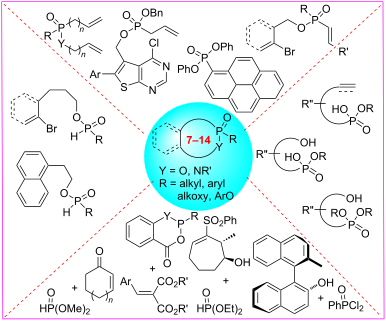
Phostams, phostones, and phostines are a series of 1,2-azaphosphaheterocycle and 1,2-oxaphosphaheterocycle 2-oxide derivatives. They are phosphorus analogues of lactams and lactones and important biologically active compounds. The strategies for the synthesis of medium and large phostams, phostones, and phostines are summarized. They include cyclizations and annulations. Cyclizations achieve ring construction through the formations of C–C, C–O, P–C, and P–O bonds in the rings, while annulations build the rings via [5 + 2], [6 + 1], and [7 + 1] fashions with the stepwise formation of two ring bonds. This review includes the recent syntheses of seven to fourteen-membered phostam, phostone, and phostine derivatives.
Beilstein J. Org. Chem. 2023, 19, 687–699. doi:10.3762/bjoc.19.50


