Shared posts

12 Dec 21:33

What’s the Best Zero-Proof Whiskey?

by Brett & Kate McKay

A selection of eight best non-alcoholic whiskey bottles is lined up on a wooden table.

During the past decade, more and more people have started to abstain from alcohol.

Most people do it for health reasons. Alcohol is hard on the body and the mind.  

The market has responded to the rise of alcohol abstainers by creating “zero-proof” alternatives that attempt to recreate the taste, aroma, and mouthfeel of popular alcoholic spirits without the alcohol. Today, you can find zero-proof tequilas, gins, and vodkas.

There are also zero-proof whiskeys out there. A lot of ‘em.

Some non-alcoholic whiskeys distill the base grain as in the traditional whiskey-making process, and then remove the alcohol afterward. But most use natural flavors — botanicals and extracts derived from spices, herbs, and grains — to replicate whiskey’s smoky, woody, and caramel notes.

Other ingredients are also added to simulate the taste and experience of traditional whiskey: small amounts of sugar, molasses, or caramel coloring for sweetness and color; tannins or natural acids to mimic alcoholic whiskey’s sharp, mouth-drying effect; glycerin to create its characteristic viscosity and “warming” sensation. Non-alcoholic whiskeys don’t typically undergo traditional aging in barrels, but manufacturers may use wood chips, barrel staves, or oak extracts to replicate the aged flavor.

To find out which zero-proof whiskeys are the best and come closest to matching the oak-aged warmth, subtle smoke, and rich complexity of traditional whiskey, I had my friend and barbell coach, Matt Reynolds, taste-test the whiskey alternatives on the market today.

Besides hoisting weights and running a business, Matt’s a whiskey aficionado who boasts a large whiskey library in his home and has led whiskey tastings for clients.

Here’s Matt’s take on which zero-proof whiskeys take top marks.
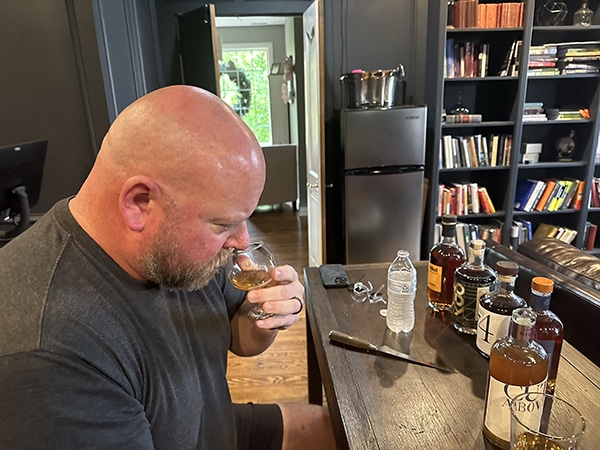
Image4

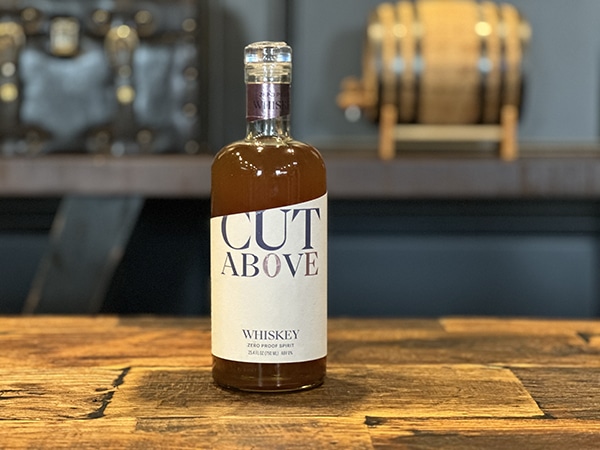
Cut Above

Image5

Rating: 1/10 Lowest Rated

Cut Above does not go through a traditional distillation process and relies on botanical infusions to achieve its whiskey-esque flavor. Unfortunately, while Cut Above does offer a genuine throat burn, that whiskey-esque flavor was not at all on display; lacking in oak-iness and smoke, it was the most disappointing of the bunch and missed the mark entirely.

Matt’s Tasting Notes:

  • “Smells like dirty socks.”
  • “Oh, man. That’s terrible.”

Nkd Whiskey Alternative

Image9

Rating: 2/10

Nkd (pronounced “naked”) is not traditionally distilled; instead, it’s crafted using flavor extracts and essences. This translucent spirit looked promising but failed to deliver on flavor and tasted more akin to a weak, tap water-y apple cider.

Matt’s Tasting Notes:

  • “Industrial pumpkin pie.”
  • “It’s got a little bit of oak.”
  • “Terrible.”

Lyre’s American Malt

Image6

Rating: 2/10

Lyre’s uses a blend of natural essences and botanicals rather than a traditional distillation process. While the nose showed promise with strong molasses notes, the taste and mouthfeel fell short.

Matt’s Tasting Notes:

  • “Super molasses-y. Reminds me of Southern Comfort.”
  • “Very watery. Really weak, like really weak tea.”

Spiritless Kentucky 74
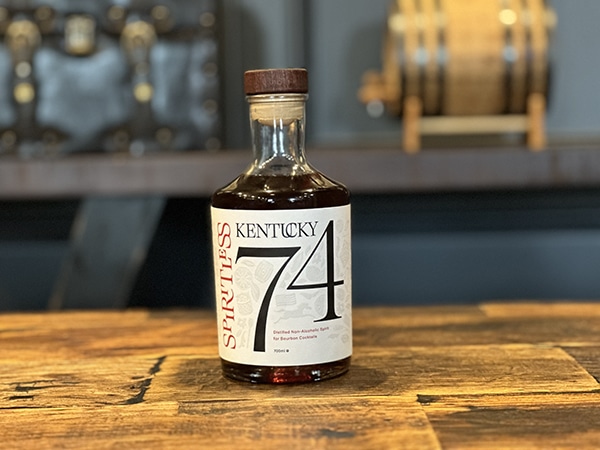
Image3

Rating: 3/10

Spiritless Kentucky 74 is partially distilled, with the alcohol removed post-distillation to preserve some bourbon-like characteristics. Despite being marketed as a bourbon alternative, this product presented more like a rye whiskey in aroma. However, the taste didn’t deliver on the promise of the nose.

Matt’s Tasting Notes: 

  • “This definitely has more of a rye smell to it.”
  • “Tastes like Panera’s iced tea. Like a fruity tea.”

Ritual Zero Proof Whiskey Alternative

Image2

Rating: 5/10

Ritual was an interesting entry that stood out for its unique and sophisticated flavor profile. It uses a blend of botanicals and natural flavors rather than the traditional distillation process to achieve its flavor and burn. While Ritual showed promising viscosity, Matt knocked off points for its overly tobacco-forward taste.

Matt’s Tasting Notes:

  • “Smells like Beech Nut tobacco. Literally smells like your grandpa that had the big pouches of Red Man.”
  • “Tastes like stone fruit, black peppercorn, and prickly ash.”
  • “Great viscosity. Good mouthfeel.”

Gnista

Image10

Rating: 5.5/10

Gnista is made using a maceration process with botanicals, rather than traditional whiskey distillation. It has a distinctive profile with strong herbal, spice, and root notes (including hints of chocolate rye) but not too much burn.

Matt’s Tasting Notes:

  • “Very rooty. Like root beer, sassafras, ginger-ish.”
  • “It’s very spiced; tastes almost like a spiced rum.”

Free Spirits
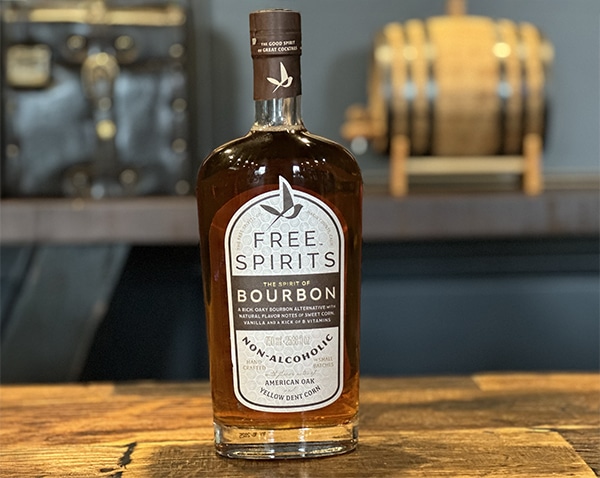
Image8

Rating: 6/10 Runner-up

Free Spirits uses a blend of natural flavor extracts and essences rather than a traditional distillation process. It’s strong on the nose with genuine bourbon characteristics. It was particularly notable for capturing whiskey’s oak notes. Matt thinks Free Spirits shows good potential for cocktail applications.

Matt’s Tasting Notes:

  • “This smells like bourbon without the burn in your nose.”
  • “The mouthfeel is really good on this. It’s still thinner than a real whiskey, but this probably has the closest mouthfeel.”

Monday Zero Alcohol Whiskey
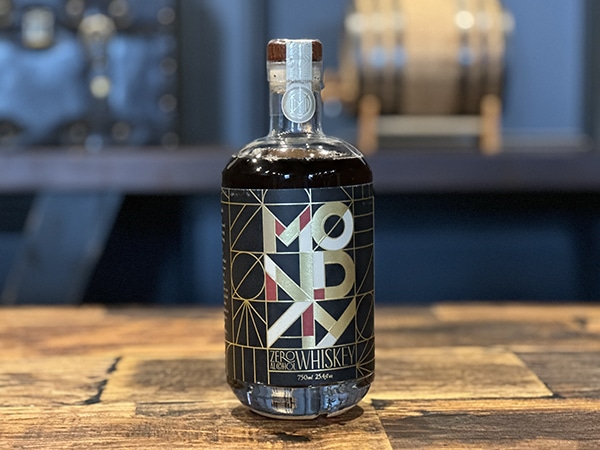
Image7

Rating: 7/10 Top Pick of the Tasting

This offering stood out as the clear winner. Monday doesn’t disclose how they make their offering, but Matt thinks they’re using extracts and flavors to get a whiskey flavor, rather than distilling it and then removing the alcohol. The nose presents strong molasses and burnt sugar notes, with a caramel-forward profile. While there’s a slight sourness in the taste (likely from citric acid), it maintains a solid whiskey-like character.

Matt’s Tasting Notes:

  • “This is way more like molasses, more like burnt sugar, caramel.”
  • “It’s not terrible for sipping, honestly.”
  • “The only thing I don’t like about it is it’s a little more sour.”

Key Takeaways

The tasting revealed that while some of these non-alcoholic whiskeys are solid alternatives, they still struggle to fully replicate the complexity and mouthfeel of traditional whiskey. None of them are home runs in that department. While some people might enjoy sipping on some of them (particularly Monday), they’re best employed in cocktails like an old fashioned; Matt recommends going a bit heavier on the bitters to compensate for the thinner mouthfeel.

Matt’s takeaway from the taste test is to manage expectations for what a zero-proof whiskey can be. They can never replicate a real whiskey completely; if you’re expecting that, you’re going to be greatly disappointed. If instead, you drink them with the idea that they’re something that harkens to whiskey but represent an entirely different beverage category, you’ll have a better chance of enjoying the experience.  

Help support independent publishing. Make a donation to The Art of Manliness! Thanks for the support!

07 Nov 13:13

Bernie Sander's Statement on Democrats Losing the 2024 Presidential Election

I am providing a text version of Bernie’s statement here, because all I could find online were images posted to various social media sites.

I’m also posting this because it needs to be seen, Bernie is right.

Bernie Sander’s Statement on Democrats losing the 2024 Presidential election:

It should come as no great surprise that a Democratic Party which has abandoned working class people would find that the working class has abandoned them. First, it was the white working class, and now it is the Latino and Black workers as well.

While the Democratic leadership defends the status quo, the American people are angry and want change. And they’re right.

Today, while the very rich are doing phenomenally well, 60% of Americans live paycheck to paycheck and we have more income and wealth inequality than ever before. Unbelievably, real, inflation-accounted-for weekly wages for the average American worker are actually lower now than they were 50 years ago.

Today, despite an explosion in technology and worker productivity, many young people will have a worse standard of living than their parents. And many of them worry that Artificial Intelligence and robotics will make a bad situation even worse.

Today, despite spending far more per capita than other countries, we remain the only wealthy nation not to guarantee health care to all as a human right and we pay, by far, the highest prices in the world for prescription drugs. We, alone among major countries, cannot even guarantee paid family and medical leave.

Today, despite strong opposition from a majority of Americans, we continue to spend billions funding the extremist Netanyahu government’s all out war against the Palestinian people which has led to the horrific humanitarian disaster of mass malnutrition and the starvation of thousands of children.

Will the big money interests and well-paid consultants who control the Democratic Party learn any real lessons from his disaster campaign? Will they understand the pain and political alienation that tens of millions of Americans are experiencing? Do they have any ideas as to how we can take on the increasingly powerful Oligarchy which has so much economic and political power? Probably not.

In the coming weeks and months those of concerned about grassroots democracy and economic justice need to have some very serious political discussions.

Stay tuned.

15 Jan 22:47

A Plea for Focused Bills

Among a lot of Democrats, Senator Manchin is persona non grata. And while I am not exactly a fan of his either, there is something profoundly wrong about how Democrats are approaching crises with massive bills. I was asked to publicly support the Build Back Better Act because of its climate provisions and there is no way I would do that given that it is a bloated monstrosity.

Going back to the American Recovery and Re-investment Act of 2009 (ARRA), the Democrats’ approach has been to throw everything and the kitchen sink into these massive rescue bills. So much in these bills is pork of the worst kind. It also makes it easy for Republicans to vote against the bills because every one can point to something that their constituents will find offensive (especially the ones who vote in the all important primaries). Martin Gurri has a great section in Revolt of the Public about how the ARRA helped foment the rise of the Tea Party movement.

Instead, I would pursue a laser focused strategy. For example: a bill to cut fossil fuel subsidies. This would put real pressure on Republicans. Yes many of them come from coal, oil and gas states but others don’t and in general they will be on the record then as voting to keep up subsidies which makes them look bad on climate, competition, and fiscal responsibility. Enough so that it will help swing moderate voters in the next election.

Then do a separate bill for a national high speed rail system modeled after the Federal Aid Highway Act of 1921 sponsored by a Republican and signed into law by Warren G. Harding. Again, it may not pass but get Republicans on the record about holding back a specific initiative aimed at affordable mass transport that would modernize the country’s infrastructure.

I believe that this focused strategy has the potential to re-open the door for bipartisanship. For sure that won’t happen overnight and the first few attempts may well be duds. But there is no way ever to even swing a single Republican with the current monster bill approach. So there is nothing to lose from trying the exact opposite.

21 Sep 14:07

Ask the CTO: Completing projects is difficult with a changing business roadmap

by Camille Fournier

Anticipate change, but keep an eye on technical debt.

The problem: It’s hard to direct a team when our goals as a company keep changing

I’m a manager at a growth-stage startup, and every year the same thing happens: the executives go off at the end of the year and do big planning. They roll out the planning, we all get on focused teams, and start working on that plan. Then, around July or August, something big changes and some of the teams are moved around to deal with that change, whether it is a new product initiative or a business scaling issue. The problem is, I feel like I can’t give my team any certainty at all, and we never get to implement half of the things we say we will do at the beginning of the year. My team has all of these ideas for technical improvements that we rarely manage to accomplish, and I just feel like we never get into any flow before things change again. How do I deal with this?

The solution: Accept the challenge and be flexible

Change is inevitable, especially in a startup. In fact, change is probably what drew us to working for a startup in the first place! We want to be able to move fast, and switch direction as needed. So, why do we fight against the changes when they actually happen?

The challenge of changing product and business roadmaps is a very common problem that managers at all levels face. Especially in smaller companies, it is hard to keep commitments made a month in advance for work to be done, let alone plans that last a year or more. Things just change too fast. Even at big companies, changes in the market can lead to sudden-seeming shifts in strategy that cause projects to be abandoned and planned work to be cancelled. If you’ve ever been at a big company during an economic downturn, you’ve probably experienced the surprise of massive shifts in focus that can come, even to a company that rarely seems to change.

This is really hard for engineering managers to deal with. When you hear the phrase “middle management,” changes in strategy are where being stuck in the middle feels the most unpleasant. You may have very little ability to push back on the changes to strategy coming from above, and even when you have promised your team that certain projects will happen, you sometimes have to pull back on that promise because of unexpected changes. This, in turn, makes the team unhappy and they complain to you. Because you have no ability to do much of anything about it, you can feel like it exposes you as powerless, and your team might feel that they are being treated not like humans but rather as cogs in the corporate machine.

Coming into play here is a secondary challenge: how do you manage to make the time for your team to deal with “technical debt” and other engineering-focused projects when there does not seem to be a clear process for prioritizing that work? After all, if you don’t put any time into dealing with the technical issues themselves, your team will start to slow down their ability to do product features. And yet, the product team will never have “technical debt” on their roadmap, so the planning process often means there is no time given for this type of work.

Practical advice: Shift work to respond to company’s goals and create a plan to reduce technical debt

How do you handle this kind of change and uncertainty?

Be realistic about the likelihood of changing plans given the size and stage of the company you work for. Since you are in a startup that has a history of changing the year’s plans every summer to account for the business results from the first half of the year, be prepared for a change in the summer, and try not to promise things to your team that would require continuity beyond that point.

Think about how to break down big projects into a series of smaller deliverables so that you can achieve some of the results, even if you don’t necessarily complete the grand vision. Breaking down the technical work will require you to work closely with the product or business managers to figure out how the details should be prioritized. All of you should be aware by now that things will change quickly, so everything must be repeatedly re-examined with an eye toward what is most valuable right now.

Don’t over-promise a future of technical projects. Don’t promise your team exciting technical projects “later” because the product roadmap for later hasn’t been written yet. This kind of thinking will get hopes up and then disappoint. If the project is important, get it scheduled now. Or as close to now as possible. If the project is not urgently important, you can put it on the backlog, but you should be realistic that once “later” rolls around, there will be a long list of competing priorities from other parts of the business. If you haven’t taken the time to articulate the value of this work, it will get pushed aside in favor of projects that are more clearly valuable.

Dedicate 20% of your team’s schedule to “sustaining engineering.” This means allowing time for refactoring, fixing outstanding bugs, improving engineering processes, minor cleanup, and ongoing support. This should be taken into account in every planning session. Unfortunately, 20% is not enough to do big projects, so additional planning will be needed to get major technical rewrites or other big technical improvements. But without that 20% time, there will be unpleasant consequences with missed delivery goals and unplanned and unpleasant cleanup work.

Understand how important various engineering projects really are. Product and business projects usually have some kind of value proposition to justify the project. However, the same rigor isn’t always applied when it comes to technical projects. When an engineer comes to you with an engineering project that she wants to do, think about framing the project by answering these questions:

  • How big is that project?
  • How important is it?
  • Can you articulate the value of that project to anyone who asks?
  • What would successful completion of the project mean for the team?

The value of these questions is that you start to treat big technical projects the same way as product initiatives. These projects have advocates and goals, they have schedules, and they are managed like other big initiatives. This is a scary process because there are times when you “know” something is important, but you don’t know how to articulate it in a way that the business will value. Especially given the complex nature of technical projects and the challenge with measuring things like engineering efficiency, you’re sometimes stuck trying to explain technical details to a non-technical partner who may not totally understand where you’re going or why. My advice is to do your best to gather data to support yourself, and talk about what will be possible when the work is done. If you look at a technical project and realize that you’re proposing a bunch of work for a system that is rarely changed and is not going to enable core improvements to your technology or business, it is probably not worth the effort. Unfortunately, there is never enough time for all the exploratory engineering, legacy code cleanup, and technical quality improvements your team will want to do, and this process will help you pick your battles.

So, back to our uncertain roadmap. Projects change. Teams may even be disbanded, or moved around, in ways that you don’t understand or agree with. As a manager, the best thing you can do is help people feel capable of tying up loose ends, stabilizing the current in-flight projects, and easing into their new work in a controlled fashion. This is where you can and should push back. Make sure that your teams get adequate time to finish up current work. Furthermore, push for engineering involvement in the early planning for the new work so that people can get excited about the projects they are moving onto. Take the time yourself to understand the reasons for the move, and even if you don’t totally agree, do your part to help make those reasons clear to your team and help them understand the new goals. The calmer you can be in the face of these changes, and the better you can show (or fake) enthusiasm for the new direction, the easier the transition will be for your whole team.

When you are faced with waves, you can let them pull you under, or you can learn how to surf. Hang 10.

Continue reading Ask the CTO: Completing projects is difficult with a changing business roadmap.

12 Feb 16:57

The Mobile Phone Addiction

by Fred Wilson
djdees

Truth in this, see it all the time these days, specially with children.

A year or two ago, the Gotham Gal and I were at dinner and were seated next to a young couple. It wasn’t clear if the young couple were on a date, or they were in a relationship, or they were married. We didn’t ask. But they were on their phones for the entire dinner. They did not talk to each other much, if at all. That scene bothers me. I see it all the time in one way or another.

My mobile phone addiction has waned over the years. The worst was the early Blackberry years of the late 90s. I couldn’t keep my Blackberry in my pocket. It was not good. I learned over time how to manage the addiction and by the time the smartphone arrived, I had largely conquered that urge to pull the phone out to distract, disengage, and go somewhere else. I still do it, but I am aware of the urge, and resist it constantly.

Last weekend, we arrived at a restaurant early for a dinner with a friend. The place was packed and the area around the bar was jammed. They asked us to wait at the bar until our table was free and our friend arrived. We were getting pushed and bumped into. Waiters and waitresses were constantly asking to get through. It was not pleasant. We couldn’t even get to the bar to order a drink. I felt this powerful urge to pull out my phone and distract myself from all of that craziness. But I decided to keep my phone in my pocket and just stand there and be present in the chaos. So that’s what I did. But that urge to pull out the phone was powerful. It’s a drug like any other drug.

I see my kids and their generation struggle with this addiction. When a text comes in, they can’t ignore it. They have to grab the phone and see who it is. And as the conversation goes on, they can’t put the phone down even if there are people in the room they can easily converse with. And it is not just the generation that grew up with a phone in their pocket. It is all of us.

The worst of it is in the car. Texting and driving is a scourge. We must find a solution to that. Maybe its a societal movement, like the way we have approached drunk driving. Or maybe its a technological solution. I’ve written about that before.

Having a powerful computer in our pocket that is connected to billions of computers in other pockets in real time is the reality of our time. And it is a drug. And we are all addicted to it in some ways. Being aware of the addiction and working on controlling it has helped me a lot over the years and I encourage everyone to work on it. You can either control it or it will control you.

29 Dec 15:09

Avoiding the "cost center" mentality.

CIO Magazine 2013 State of the CIO Survey lists five stages of an IT organization from a business stakeholders' view:

  1. Cost center
  2. Service Provider
  3. IT Partner
  4. Business Peer
  5. Business Game Changer

I don't think an IT department needs to start at one phase and work their way forward. However, I do think this list exemplifies the categories of IT organizations I've dealt with. If you think about the book "The Phoenix Project", it really is about how to leap ahead to be the last (best) category.

I think that many people don't even know that anything other than "cost center" is a possibility. Just having an awareness of these 5 categories would help inspire a lot of IT goodness.