Shared posts

03 Oct 18:24

You shouldn’t have known

by Julie

One of the best, shiniest, and most destructive assumptions we use against ourselves is this one: I should have known.

We say it when something goes wrong. We say it when things don’t turn out the way we thought they would. We say it when things don’t turn out the way we hoped they would. We say it when someone else’s dire predictions come true. We say it when we’re angry, when we’re disappointed, when we’re hurt.

Notice that we rarely say it when something goes right. “This relationship is wonderful – I should have known!” “I won the lottery. I should have known!”

Even when we do say it when things go well, we say it in relief and a little bit of laughing at ourselves for our stressing out. But we don’t blame ourselves for not knowing things were going to work out.

No, it’s exclusively a way to beat ourselves up by assigning ourselves the blame for things not working out, no matter what things we’re talking about.

It’s a lie

At base, it assumes that we can, actually, control things, and that in this particular instance we screwed up – instead of acknowledging the reality that the world is complex and variable and dynamic and shit happens that we couldn’t possibly predict or control.

Somehow, it’s easier to believe that we’re screw-ups than it is to believe that there are things we don’t get to be in charge of.

But sweeties. There are things we don’t get to be in charge of. Lots of things.

You aren’t in charge of the economy and how it affects higher education. You aren’t in charge of whether universities post jobs or how they fill them. You aren’t in charge of the way graduate school shapes you and your hopes. (Ideology, man. It happens.) You aren’t in charge of who else is out there, applying for jobs. You aren’t in charge of how many people are getting PhDs. You aren’t in charge of your advisors and their idiosyncracies. You aren’t in charge of how available jobs map on to your very legitimate geographic limitations.

The more we can distinguish between what we are in charge of (how many applications we send out, whether we send them out, other opportunities we pursue, how much time we spend on it, what kind of help and feedback we get, how much we work on our emotional gunk, how much time we spend exploring our options) and what we aren’t in charge of, the happier we’ll be.

Breathe

I once heard a great quotation, and of course I can’t remember now who said it. (The Dalai Lama? Thich Nhat Hahn?) “If you can’t do anything, don’t worry. If you can do something, don’t worry.”

In other words, do the parts that are yours to do. Let go of everything else. It’s not easy, but it’s a hell of a lot easier than trying to control the universe which, you know, is pretty much guaranteed to fail.
03 Oct 18:23

Your job options after a PhD – in a diagram

by Chris
What are your job options after you complete your PhD ? I don’t just mean within academia, but much more broadly – since doctoral researchers are capable of doing so many things after a PhD? I drew this diagram to help illustrate the range of career options open to researchers: The Continue reading Your job options after a PhD – in a diagram→
03 May 14:47

What it feels like to be bad at math

by Joanne

Every math teacher should understand What It Feels Like to Be Bad at Math, writes Ben Orlin on Math with Bad Drawings.

As a math teacher, it’s easy to get frustrated with struggling students. They miss class. They procrastinate. When you take away their calculators, they moan like children who’ve lost their teddy bears. (Admittedly, a trauma.)

Even worse is what they don’t do. Ask questions. Take notes. Correct failing quizzes, even when promised that corrections will raise their scores. Don’t they care that they’re failing? Are they trying not to pass?

Because of his experience with mathematical failure, Orlin understands why his students don’t ask for help. “Math makes people feel stupid. It hurts to feel stupid.”

7 - Symptoms (smaller)

Orlin excelled as a math major at Yale –until he took topology in his senior year.

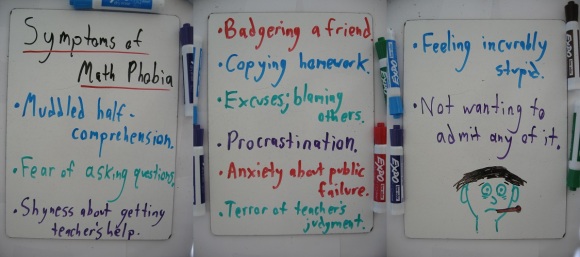
My failure began as most do: gradually, quietly. I took dutiful notes from my classmates’ lectures, but felt only a hazy half-comprehension. While I could parrot back key phrases, I felt a sense of vagueness, a slight disconnect – I knew I was missing things, but didn’t know quite what, and I clung to the idle hope that one good jolt might shake all the pieces into place.

But I didn’t seek out that jolt. In fact, I never asked for help. (Too scared of looking stupid.)

He copied his girlfriend’s homework. He procrastinated. He blamed others. He panicked. He exhibited “every symptom that I now see in my own students,” he writes. He managed to pass the course, but recalling the experience is still painful.

18 Apr 16:35

Building the Archives

by Yaacov
Back in the 1940s and 1950s, Israel faced various challenges such as housing the 50% of the populace which had just recently arrived, penniless, from devastated European or Arab lands. There was no time to think about many of the normal things countries spend their resources on. Things got better by-and-by, but the national archives never quite made it onto the list of institutions which could command full attention and, more important, budgets. And so, while some national archives look like this:
USA

Germany
Brazil

France

India

UK

Slovenia
The archives in Israel, sadly, looks like this
 And its streetfront looks like this
This morning the cabinet discussed the issue, and decided to adopt a proposal to have the state archives live in a more respective domicile. The idea is to team up with the Central Zionist Archvies, who already have an edifice, and build a joint structure which will serve both archives. Assuming this works out, the National Archives will be next to Binyanaei Hauma, in the middle of a new commercial area which the Jerusalem municiplaity is developing, alongside the new central train station, the existing central bus station, and, of course, the Calatrava bridge.

12 Apr 08:22

Locations of every photo from International Space Station

by Nathan Yau

ISS photos

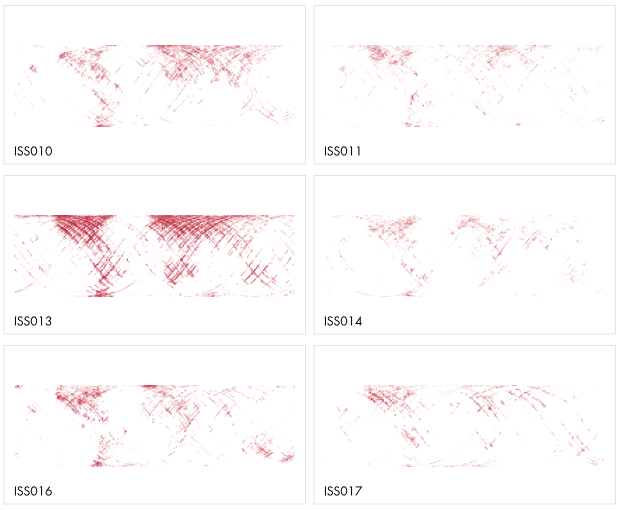
Over the last 12 years, astronauts have taken a lot of pictures from the International Space Station. About 1.1 million of them. And they're all archived on NASA's servers. Nathan Bergey mapped them.

Most of the photos are taken of land. Coastlines, islands and cities seem to be popular targets. So much so that it’s possible to make out basic continents. This makes sense, photos of clouds over an otherwise blank ocean get old after a while. I'm sure every astronaut has taken at least one photograph of the town they grew up in.

Above is the use of small multiples to show pictures taken during separate missions.

12 Apr 08:21

0 A.D. Alpha 13 and other less fanboyish updates

by Julius
Ok I admit it... I am a bit of a 0 A.D. fanboy! But the new Alpha 13 release is also great again, and deserved an update post:


Also pretty cool is the new OpenMW 0.22 release, that finally features player and NPC animations, and thus starts to look more like a functioning game:


Other unrelated news:
Julius out!

This post was retrieved from freegamer.blogspot.com.