
What would Pangea look like if today's political boundaries were drawn on it? Like this. [via]
– „כמה שפות אתה מדבר?”
זאת השאלה ששואלים אותי הכי הרבה, ואני שונא אותה.
– „בערך ארבע, וקורא עוד איזה כמה.”
– „ומה האהובה עליך?”
חשבתי למשך זמן קצר מאוד.
– „עברית.”


מדע הערים נמצא במצב דומה למדע הרפואה לפני 500 שנה. המאה ה-20 הייתה רוויה בניסיונות "להנדס" את העיר, להקיז את דמה ולתת לה כוסות רוח. התכנון המודרניסטי יצר ערים נכות ומוגבלות. אם המודרניסטיים היו מתכננים בן אדם הוא היה נולד בצורתו הבוגרת, והיו נחסכים ממנו החלפת השיניים וכאבי הגדילה. מצד שני הוא היה חסר זהות ומוגבל ביכולת הלמידה וההתפתחות שלו. מאמר עורך בכתב העת Environment אומר את הדברים בצורה ברורה: "It's Time for an Urbanization Science". המאמר מציע מספר שדות מחקר שעוד יורחבו בשנים הקרובות על הקשר בין מדעי העירוניות לעולם האמיתי והצורך לעסוק בכך:
We need a science of urbanization. This science would focus on the fundamental laws of the urbanization process: its origins, development, organization, emergent properties, and connections to other social and biophysical processes.
אחד מהמאמצים הכבירים במדעי הערים בעת האחרונה הוא ספרו של פרופ' שלמה אנג'ל Planet of Cities
………………………………………………..
בתוך העולם הכולל של מדעי האורבניזציה יש לנו גם חורים מדעיים רציניים בפסאודו-מדע הקרוי תכנון ערים. מאמר קליל עושה קצת סדר בנידון: ?Urban Legend: Can City Planning Shed Its Pseudoscientific Stigma. עולה התהייה האם מקצוע העיצוב העירוני יכול להיות משהו מדעי ולא תכנון שנשען על רגשות, טקסטים עמומים, אידיאלים מופרכים ובבל"ת כפי שהוא מתבצע ברובו כיום? המאמר הקליל הזה מתבסס על מאמר אקדמי משובח של ד"ר סטיבן מארשל מהשנה שעברה שנקרא: "Science, pseudo-science and urban design". מארשל מציין שאין כמעט שימוש במתודות אקדמיות בבחינת תכנון עירוני ולמעשה אין כיום תיאוריה של תכנון עירוני. למעשה, מארשל מראה שכמעט לא למדנו כלום עוד מאז שג'יין ג'ייקובס כתבה:
As in the pseudoscience of bloodletting, just so in the pseudoscience of city rebuilding and planning, years of learning and a plethora of subtle and complicated dogma have arisen on a foundation of nonsense.
הטבלה החשובה במאמר מראה שתיאוריות אורבניסטיות כמו זו של ג'יין ג'ייקובס, כריסטופר אלכסנדר וקווין לינץ', כולם הוגים ענקיים בתחום האורבני, לא הועמדו כמעט במבחן מדעי ובמספר הזעום של מקרים שבהם נבחנו תחת מתודות מדעיות, הן לא ממש עמדו בכך. זה לא כל-כך פשוט לקרוא את זה, אבל ארבעת העקרונות של ג'יין ג'ייקובס (עירוב שימושים, בלוקים קצרים, בניינים בני גיל שונה וצפיפות) לא הוכחו עד היום כתורמים לאותה חיות אורבנית בצורה מדעית. מארשל מציע במאמרו דרך לבסס את התכנון העירוני כמדע והמאמר עצמו מומלץ לכל מי שמתחיל להיכנס למאסטר או דוקטורט בתכנון עירוני, וגם למי שבכלל מתעניין בתחום הזה.
למיטיבי לכת שהגיעו איתי עד כאן נותר לי להמליץ גם לקרוא את הספר הראשון שסטיבן מארשל הוציא לפני מספר שנים הנושא את השם Streets and Patterns. הספר מתחקה אחרי האופן שבו ההתייחסות לתכנון רחובות השתנתה לאורך השנים ומיצירה של רחובות שהם מקומות למסחר, שהייה ותנועה הגענו עד הניתוק בין התנועה לפעילות שמתבטאת ברחובות ראשיים שלא קורה בהם שום דבר מלבד תנועה מהירה של מכוניות. הספר הזה עושה קצת סדר בתחום הזה וכאן גם יש סקירה מצויינת שלו. באופן ספציפי, אני מצאתי שלפחות חלק מהמחקרים שהייתי מעורב בהם הלכו קצת בעקבות הספר הזה והאופן שבו הוא עושה קטגוריזציה לרשתות רחובות שונות לפי רוח התקופה בה הן נוצרו.
לסיכום, מדע הערים ובתוכו גם החלק של מדע תכנון הערים זקוקים לעוד הרבה מחקר מדעי ועדיף במהלך השנים שבהן חלק משמעותי של העולם עדיין עובר אורבניזציה משמעותית.
סיכום לינקים לקריאה:
It's Time for an Urbanization Science
Urban Legend: Can City Planning Shed Its Pseudoscientific Stigma?
Science, pseudo-science and urban design

A cross section of a leaf showing the phloem, xylem, sclerenchyma, collenchyma and mesophyll.
In 2012 Wikimedia Commons contributor Kelvinsong created and contributed election-return diagrams during the United States elections to the freely licensed database. Kelvinsong credits encouragement at the time from another user, LadyofHats, for inspiring him to donate his talents and for making him one of the only scientific illustrators on Commons.
“My first science picture was a large diagram of the animal cell cycle, which somehow managed to make Featured Picture,” said Kelvinsong, who has also been surprised to find his pictures on T-shirts and coffee mugs being sold online. “Who would buy a lunchbox with the centrosome cycle on it?”
And while some illustrators might be bothered by this, Kelvinsong has a different outlook. “The concept of copyright has never really made much sense to me, and Commons is a great place to get your stuff out into the world. Not only is it awesome to be able to add your pictures to Wikipedia articles that are seen by thousands of people per day, it’s cool to see other websites pick up your pictures and use them. In my experience, 60-80 percent of them will give you credit for your work.”
Viewing himself as an amateur illustrator who also does photography, Kelvinsong has created vector illustrations since he was 13. He specializes in microscope photos and plant cell biology, though he has trouble identifying individual plants.
“Commons is severely lacking in plant microscopy photos, but I managed to find representatives of each cell type,” he said. “I take scientific accuracy very seriously, so I usually do a ton of research on the topic, and I wound up combing through a lot of plant science papers to figure out exactly what each cell looks like and to get the scale somewhat right.”
He said Plant Physiology and The Plant Cell are his two favorite journals due to their large collections and open-access policies.
To illustrate the image above, which was selected Wikimedia Commons Picture of The Day for July 27, Kelvinsong first made a wireframe render with Blender, then traced that in Inkscape. After the picture was complete, he wrote the captions and manually line broke the text, which he says is a big part of making these diagrams. Lastly, he did some grid aligning to make the image appear sharper at certain resolutions, then outlined the text so it looks good after the rendering process on Commons.
“I really had to work to keep the captions as short as possible while maintaining scientific accuracy,” he said. “I kind of overblew the perspective on that picture so only the Phloem and Xylem blocks could be made into stand-alone sub diagrams. Also, the scientists at Plant Physiology seem to be the only people who know what a phloem transfer cell looks like.”
Kelvinsong admitted he’s not a fan of the Featured Picture Candidate (FPC) judging process on Commons. From his perspective as an illustrator and photographer, he believes illustrations are judged on “the visual shapes they make at first glance.” He says this leads to comments like, “This is too complicated,” or, “This is too simple,” or, “This is too realistic.” Sometimes he gets all those critiques at the same time.
“If there exists a Goldilocks zone, I have yet to find it,” he said. Most aggravating is when a picture fails because of the FPC rules requiring enough votes.
On the other hand, he likes the free culture on Commons and the many people willing to help out with translations. “Unlike art sites, it’s good knowing your pictures have an educational purpose and will be seen by many.”
Advice from Kelvinsong to other illustrators: Scalable vector graphics masks are your friend. Also, do not use ellipses ever, circles are fine. Use a rounded rectangle “pill” shape or draw your own oval with the pencil tool.
“You should not add unnecessary borders, shading or gloss to stuff that does not require it,” he said. “I’m looking at you, MediaWiki interface. Also, no more DejaVu Sans, please.”
(View more of Kelvinsong’s illustrations on his Commons userpage.)
Donna Peterson, Communications Volunteer
1.
אני כועס.
אני כועס כי קצת נמאס לי מכל מיני דברים. נמאס לי מזה שכל מיני אנשים שמנהלים את כספי המסים שלי – בשמם האחר, תקציב המדינה – לא מתייחסים אל המסים שלי ביראת קודש, אלא כאל מן שנופל מהשמיים. ויותר מזה, כשאני שואל, הי, תגידו, מה בדיוק אתם עושים שם עם כספי המסים שלי, אלה שנתתי לכם בעבודה קשה ובעמל רב, הם עונים לי, אנחנו לא מתכוונים להגיד לך. אתה לא באמת אמור לדעת.
אז אני כועס.
2.
אני כועס.
היום בצהריים פתאום נחת מבול של הודעות לעיתונות מכיוון ירושלים. בסמסים, במיילים. ניצחנו את האוצר, קיצצנו את הגזרות, בלה בלה בלה. שוב חזר הריטואל החצי קבוע שבו החכים מתגאים בהישגים שהאוצר נתן להם להשיג בשביל שהם יוכלו להתגאות בהם – סרט משונה ששני השחקנים שמשחקים בו יודעים שהם רק משחקים, ורק הקהל לא מבין שהוא בעצם זה שמצולם. ניצחנו את האוצר, ביטלנו את הגזירות, היטבנו עם העם היהודי. כפיים.
הנה מה שקרה אחר כך.
התגובה הראשונה שלי הייתה להתקשר לאוצר. לא אגיד בדיוק עם מי דיברתי. ביקשתי לדעת את הפירוט של הצעדים שננקטו – מה שונה, מה יצא, מה נכנס, מה העלות של כל צעד או מה אובדן ההכנסות לקופת המדינה, ומה השורה התחתונה. הקריאו לי רשימה חלקית מדף. ביקשתי לקבל את כל הטבלה. אמרו לי, לא. אי אפשר. למה? כי אי אפשר. ומתי יהיה אפשר? לקראת ההצבעות במליאת הכנסת בשבוע הבא. אבל העיתון יוצא מחר, את העבודה שלי אני צריך לעשות עכשיו. לא, זה מה שיש. אבל זה מידע ציבורי, זה כסף ציבורי. לא, זה מה שיש. ביי.
השיחה הזו הכעיסה אותי עוד יותר.
אז התחלתי לעשות טלפונים, ולהסתמס, ולחבר חלק חלק, עוד סעיף סעיף סעיף. עד שאפשר היה להרכיב את הרשימה הבאה, של מה שיצא מחוק ההסדרים, והדברים שנכנסו במקום, בשביל לבדוק מה קרה בשורה התחתונה. זה נראה ככה:
בצד המינוסים, דברים שהוצאו מחוק ההסדרים, ולכן יצרו חור תקציבי -
ביטול הקטנת הטבות המס לחיסכון הפנסיוני: 1.2- מיליארד שקל
ביטול מס על רוכשי דירות – 1- מיליארד שקל
ביטול מס בריאות וביטוח לאומי על עקרות בית – 700- מיליון שקל
ביטול ביטול נקודות זיכוי לאקדמים – 120- מיליון שקל
הקטנת הקיצוץ בקצבאות הילדים – 180- מיליון שקל
(אולי שכחתי עוד משהו קטן)
סה”כ – חור של כ-3.2 מיליארד שקל שצריך לסגור
הנה, במקביל, הדברים שהוכנסו בתמורה לתוך חוק ההסדרים -
משיכת דיבידנדים מחברות ממשלתיות -500 מיליון שקל שקל (למה לא הצעתם את זה קודם אם זה כזה פשוט?)
הקטנת הגידול בתקציב המדינה – 1 מיליארד שקל (500 מיליון מהחינוך, 500 מיליון מהתחבורה)
עוד קצת הכנסות ממיסוי ירוק שנכנס לתוקף בעוד שבועיים
הגדלת מיסוי על רכישת קרקע – 250 מיליון שקל
סה”כ – תוספת של כ-1.8 מיליארד שקל
רק שיש בעיה עם הסיפור הזה – איפה עוד יותר ממיליארד שקל?
2.5. פסקה למיטיבי לכת. למי שאין כוח לממבו ג’מבו תקציבי מוזמן לקפוץ לפסקה הבאה.
עשיתי כל מיני טלפונים בשביל לברר. המידע היה מאוד מאוד חלקי. לבסוף, ממה שהצלחתי לברר, הצלחתי להרכיב תמונה שכזו. חלק מהמיליארד הזה יבוא מקיצוץ רוחבי. מיטיבי הלכת ישימו לב שזה לא מובן מאליו, משום שקיצוץ רוחבי לא באמת מקטין את מסגרת התקציב אלא רק עושה הסטות תקציביות בתוך התקציב. בשביל שקיצוץ רוחבי יהיה הפתרון, זה אומר שחלק מהגזרות שבוטלו בצד ההכנסות לא באמת היו בצד ההכנסות אלא בצד ההוצאות, אחרת הטריק הזה לא עובד. וזה אכן כך, מה שנדמה כהכנסות על ידי הטלת מס על עקרות בית בעצם נמצא בצד ההוצאות, בגלל טריק של אגף התקציבים שמוריד את הכסף הזה מתקציב התמיכה הממשלתית בביטוח הלאומי. אבל אני באמת נכנס כאן לרזולוציה גבוהה מדי.
3.
אז מאיפה יבוא הכסף?
חלק מהמיליארד יגיע מקיצוץ רוחבי. או במלים אחרות, ממפלטם של הפחדנים, של אלה שפוחדים לקבל החלטות, שאינם מסוגלים לקבל מנהיגות. נניח שהקיצוץ הזה יסתכם בסופו של דבר במיליארד שקל. אלה בדיוק מיליארד השקלים שהיו יכולים להגיע מקיצוץ בתקציב הביטחון. במקור, משרד האוצר הציע לקצץ 4 מיליארד שקל בביטחון. ראש הממשלה הכריע שהקיצוץ בביטחון יהיה קטן יותר, רק 3 מיליארד שקל. מאיפה הגיע המיליארד החסר? מסעיף שנקרא “רזרבת ההתאמות”, מעין כרית ביטחון תקציבית שהממשלה שומרת לשנה השנייה של התקציב הדו שנתי (ובמקרה הזה, שנת 2014, כי 2013 תיכף נגמרת).
אם ראש הממשלה לא היה נותן את המיליארד הזה לביטחון,זה היה יכול להיות המיליארד שהיה מכסה עכשיו את הגירעון במקום הקיצוץ התקציבי. או במלים אחרות, נתניהו העדיף לא לקצץ בביטחון, אלא לקצץ בכל היתר.
זו המשמעות של ההחלטה שלו, ולא שום סיפור אחר.
הנה הצעה קצרה, גסה, סכמטית, לאיך היה אפשר בכל זאת לגלח עוד מיליארד שקל, אולי מעט פחות, מתקציב הביטחון:
לסגור את משלחות הרכש של הצבא ומשרד הביטחון – כ-200 מיליון שקל
לבטל לשנה אחת, רק שנה, את סבסוד הנופשונים המבצעיים לאנשי הקבע, המוסד, השבכ ועובדי משרד הביטחון – 100 מיליון שקל
להקפיא לשנה אחת, רק שנה, את הטבות המס המופלגות שאנשי הקבע מקבלים – 350 מיליון שקל
להקפיא לשנה, רק שנה אחת, את ההטסות האוויריות (טרמפים מוסקים לאלופי הפיקודים במסוק הביתה ולבסיס, טרמפים מוטסים לאנשים שמשרתים בדרום) – כ-100 מיליון שקל
נותרו 250 מיליון שקל. קצרו בכמה חודשים את השירות של 10,000 חיילים בסדיר, במערך העורפי, קצצו קצת בסבסוד הדלק לקצינים, תשביתו כמה מערכי רכב צמוד לכמה חודשים, ותרו לשנה – רק שנה אחת – על סבסוד טיפולי השיניים וישוריי השיניים לילדים של אנשי הקבע, ואני משוכנע שתצליחו לגרד עוד כמה שקלים
(ולא אמרתי מילה על הפנסיה התקציבית)
אבל בשביל לגעת בדברים האלה צריך קצת אומץ, קצת לריב, קצת מנהיגות.
4.
אבל זה עוד לא הסוף. כי יש שם בחור הזה שנוצר עוד איזו שארית, אני לא יודע להגיד בדיוק, ככל הנראה של כמה מאות מיליוני שקלים, שהיא פשוט “שוליים”. מעין טווח נשימה, אורך נשימה, מרחב תמרון, מרחב טעות, תקראו לזה איך שתרצו – אלה מעין שוליים שאנשי אגף התקציבים מביאים בחשבון כשהם בונים את התקציב. הם יודעים שלא כל מה שהם יביאו לכנסת אכן יתממש. אז הם משאירים שוליים.
מי יכול לקבל מידע על זה? מי יכול לדעת מי זה? למי הם מדווחים על זה?
לאפאחד. זה רק כספי המסים שלכם, מה קרה, בשביל מה שתדעו.
וחברי הכנסת? הם סטטיסטים במשחק המשונה הזה שם בוועדת הכספים, במסדרונות שמוליכים אליה, ובחדר היו”ר שצמוד לה. סטטיסטים. מי יותר, מי פחות.
העיקר שהצבעתי.
5.
אז יוצא שאני קצת כועס הערב.
כועס על המונופול המטורף, מטורף באמת, של אגף התקציבים על המידע הבלעדי. אפילו בבנק ישראל מנחשים איך המספרים מסתדרים, והם לא תמיד מסתדרים. בבנק ישראל העריכו, למשל, שאגף התקציבים גיבש רשימה גבוהה ב-2 מיליארד של העלאות מסים ממה שבאמת צריך. 2 מיליארד פאקינג שקל מהכיס של הציבור.
וכשאתה מנסה לדעת, לברר, אתה ממש צריך להשתחל פנימה דרך איזה חור של מנעול, דרך קוף של מחט, בשביל לדלות פירורי מידע.
לא זה האופן שבו צריך לנהל את כספי הציבור, את כספי משלם המסים. מילא אל תשאלו אותי מה לעשות עם הכסף, אני מקבל את העיקרון של דמוקרטיה נציגותית, אבל לפחות ספרו לי. לפחות שיהיה לכם האומץ לעמוד ולהסתכל לי בעיניים ולהגיד לי מה אתם עושים את הכסף שלי.
לפחות זה.
6.
אז אני כועס. אבל עכשיו טיפה פחות.
זהירות, טקסט ארוך.
לא היה צריך תואר בשום דבר כדי לדעת שכתבתו של שי אספריל שהתפרסמה במוסף "כלכליסט", "לא צריך תואר כדי להבין את זה", תגרור תגובות רבות. אחרי הכל, כתבה שמצהירה על עצמה כמי שעומדת לשחוט פרה קדושה, היא בוודאי כתבה חשובה.
התזה של אספריל פשוטה: אין צורך בלימודים אקדמיים כדי להתקדם בחיים ו/או להשתלב בשוק העבודה ומי שבכל זאת הולך ללמוד באוניברסיטה או במכללה הוא או עשיר מופלג או דביל מוחלט או אחד שלא מבין את האמת הפשוטה, זו שאספריל חושף בכתבה.
כבר בראש הטקסט שלו ממסגר אספריל את העמדה שלו כאמת אבסולוטית. הוא לא כותב זאת במפורש, אבל מצהיר ש"רבים ממי שיקראו את הכתבה הזאת לא יאהבו אותה, משום שהיא חותרת תחת כל מה שחינכו אותם להאמין בו". המסגור הזה קובע שמי שיעז להתווכח עם אספריל הוא תינוק שנשבה, מי שאינו מצליח לחשוב מחוץ לקופסה (בניגוד לאספריל, כמובן), מי שלא יכול, כמה עצוב, להשתחרר מאינדוקטרינציה קיצונית שהתנחלה בראשו או לחילופין, יש לו אינטרס כלכלי בהמשך קיומו של הבלוף שנקרא "השכלה גבוהה".
אני רוצה להאמין שאינני תינוק שבוי ושאני מסוגל לבחון דברים באופן חדש ומקורי. מאידך, אינני יכול להכחיש שכמרצה במכללה (המסלול האקדמי המכללה למינהל), יש מי שיראו בי כמי שכותב מהפוזיציה. אני מקבל על עצמי את הביקורת הזו מראש ובדיעבד.
וכעת לעניין עצמו.
הבעיה העיקרית עם הטקסט של אספריל היא שהוא רוקח סלט של טיעונים, חלקם קשורים בדיונים אמיתיים, רציניים וחשובים, וחלקם טיעוני סרק הלוקים בחוסר הבנה בסיסי באשר למערכת ההשכלה הגבוהה, או כאלו המתובלים בבובות קש איתן אספריל נאבק כשמבט חתרני בעיניו.
כך לדוגמה, הדיון האם השכלה גבוהה מתאימה "לכל אחד" או לא, הוא דיון חשוב וראוי. יש הטוענים כי אין כל רע בהכנסת עוד ועוד סטודנטים למעגל ההשכלה הגבוהה וכי מדובר בהשבחה אינטלקטואלית של אזרחי המדינה ושל כוח העבודה. מאידך, יש שטוענים שהכנסת עוד ועוד סטודנטים לאוניברסיטאות ולמכללות לא נעשית מטעמים אידיאולוגיים או פדגוגיים אלא מטעמים כלכליים שמובילים בסופו של דבר להורדת רף הקבלה, להורדת הציפיות ולהזניית הלימודים. כאמור, דיון זה חשוב ואחת הדמויות המרתקות שמנהלות אותו הוא פרופ' עוז אלמוג, שמתראיין לכתבה.
אך על פי רוב זה לא הדיון שמעניין את אספריל. למעשה, הדיון של אספריל מתבסס על בובת קש שאותה הוא מציג כבר בפתח הכתבה שלו: "הכתבה הזאת נולדה בעצב, מתוך רצון לאתגר את התפיסה שלפיה לימודי תואר ראשון הם תעודת ביטוח".
זה דחליל קלאסי מכיוון שגם אם יש חוגים מסוימים במוסדות מסוימים, שמציגים עצמם כנותני תעודת ביטוח להשתלבות עתידית בשוק העבודה, הרי שמדובר במיעוט שרלטני. למעשה, קשה היום לחשוב על תחום אקדמי כלשהו שמישהו יכול להבטיח למישהו אחר, שאם הוא רק יהפוך לבוגר שלו, השתלבותו בשוק העבודה תהיה יצוקה בבטון. הניסיון לבסס כתבה שלמה כדי להילחם בתפיסה הזו דומה לכתיבת כתבה שתיפתח כך: "כתבה זו נולדה כדי לאתגר את התפיסה שכל הרופאים עשירים". מה?!
זאת ועוד, אספריל לא מבצע את אחת מאבחנות היסוד החשובות במערכת להשכלה גבוהה – בין בתי ספר שמכשירים למקצוע לבין חוגים שאינם כאלו. כך לדוגמה, באוניברסיטאות יש מספר בתי ספר שהתעודה שהם מעניקים בסוף הלימודים היא כרטיס הכניסה אל המקצוע כמו רפואה, אדריכלות, עבודה סוציאלית וכדומה (זו הסיבה שהם נקראים "בית ספר"). שאר החוגים אינם מתיימרים להסמיך את הבוגר שלהם למקצוע ובוודאי שאינם מתיימרים לשבצו בעבודה בסוף התואר: בוגר החוג למדע המדינה לא יהיה בהכרח "מדען מדינה" (יש בכלל מקצוע כזה?), בוגר החוג לסוציולוגיה לא יהיה בהכרח סוציולוג (מתי בפעם האחרונה ראיתם מודעת דרושים בה נכתב: "דרוש סוציולוג!") וכן הלאה. מי שמתלונן שהוא הלך ללמוד שלוש שנים בחוג לפילוסופיה ובסופו של יום לא נקלט בשוק הפילוסופיה התוסס, הוא, ובכן, איש מעניין והייתי שמח לשתות איתו כוס קפה.
כפי שלא מעט מגיבים מעירים בתגובות לכתבה, אספריל מערבב בין מערכת ההשכלה הגבוהה הישראלית לזו האמריקאית. שתי המערכות שונות האחת מהשניה בתכלית כי שוק העבודה שאליהן הן מתייחסות שונה בתכלית ולמרות זאת אספריל מבקש מהקוראים לגזור מהן גזירה שווה. כך לדוגמה, בשוק האמריקאי קיימת חשיבות גדולה לשאלה "היכן למדת", בניגוד לשאלה "מה למדת". משום כך, עצם העובדה שהתקבלת לאוניברסיטה מהדרג העליון, היא לכשעצמה אינדיקציה לאיכותך כעובד לעתיד. בישראל, מדינה קטנה בהרבה, עם מערכת השכלה גבוהה ושוק עבודה שונים לחלוטין, תופעה זו כמעט ואינה קיימת. זה, כאמור, רק הבדל אחד. יש בערך עוד חמש מאות.
ראוי גם להתעכב על העמדה העקרונית של אספריל, עמדה אנטי-אינטלקטואלית מוכרת לעייפה, שקובעת שאין צורך ללמוד כדי לעשות כסף (אפרופו ארגון ת'יל שמחלק כסף למי שעוזב את הלימודים). ואכן, יש לא מעט דוגמאות שממחישות את זה ובראשן מארק צוקרברג וביל גייטס שעזבו את לימודיהם והפכו מולטי-מיליארדרים.
מה שמספרי המיתוסים האנטי-אינטלקטואלים האלו שוכחים לספר (אם לרגע נישאר בעולם הטכנולוגיה) הוא שגם גייטס וגם צוקרברג התקבלו ללימודים בהרווארד, מה שאומר שמלכתחילה מדובר באנשים שהתקבלו לאוניברסיטה מליגת הקיסוס. הם גם שוכחים להפנות לדוגמאות אחרות כמו מייסדי גוגל, סרגי ברין ולארי פייג', שאמנם לא השלימו את לימודי הדוקטורט שלהם אבל הגיעו עד לרמה שבה הם עמדו להשלים את לימודי הדוקטורט שלהם, במדעי המחשב, באוניברסיטת סטנפורד. לבסוף, מספרי סיפורי המעשיות שוכחים לספר על אנשים דוגמת סטיב ג'ובס, שדיבר בערגה על הקורסים אליהם נכנס באוניברסיטה, ובייחוד קורס בטיפוגרפיה, קורסים שהעשירו אותו והפכו אותו למי שהוא.
זאת ועוד, העובדה שהטענה הזו, לפיה השכלה גבוהה מהווה תעודת ביטוח להצלחה כלכלית סלולה, מוזכרת בעיתון ששמו "כלכליסט", היא לא פחות ממופלאה. נדמה שהעיתון מבקש לשרטט משוואה לפיה כמו כל דבר אחר בחיים, גם השכלה גבוהה אמורה להיות שווה לתועלת מעשית ומידית ובייחוד כזו שמתורגמת לכסף והכנסה. מהרגע שזה לא קורה, מדובר באכזבה שראוי לחשוף אותה. זו עמדה קפיטליסטית קיצונית שבאופן אישי אני דוחה על הסף.
כן, ישנם אנשים שפונים למערכת ההשכלה הגבוהה כי הם סבורים שתואר ראשון יספק להם יתרון (בניגוד ל"תעודת ביטוח") בשוק העבודה – ובחלק מהמקרים יש לכך הצדקה מלאה (בחלק אחר לא). ישנם גם לא מעט סטודנטים שהולכים ללמוד כי הנושא שבחרו מעניין אותם, כי המוח שלהם התייבש בצבא, כי הם רוצים לפתוח את הראש שלהם לתחום חדש, כי הם אשכרה חושבים שללמוד זה כיף וכן, גם בגלל שהם עדיין לא החליטו מה הם רוצים לעשות כשהם יהיו גדולים. החבר'ה האלו סבורים שבמקום למלצר בלילה ולחשוב ביום מה הם ירצו לעשות כשיהיו גדולים, עדיף שימלצרו בלילה וילמדו ביום. תהרגו אותי, אבל אני לא רואה בזה אסון גדול.
לאלו שיטענו שהעמדה שלי בנוגע ל"לא אסון הגדול" היא צבועה כיוון ששכר הלימוד הוא אסטרונומי (ולכן זה אסון גדול), אזכיר שיש מוסדות רבים, אוניברסיטאות ומכללות מתוקצבות, בהן שכר הלימוד הוא שליש, לעתים פחות מכך, משכר לימוד במכללה פרטית. אמנם גם במקרים אלו לא מדובר בסכומי כסף מבוטלים, אבל בוודאי שלא יוצאים מהם עם חוב של מאה אלף דולר כמו הסטודנטים בארה"ב, אליהם אספריל (גם) מתייחס.
בשורה התחתונה אספריל סבור שמערכת ההשכלה הגבוהה מבטיחה הבטחה ריקה. בניגוד לכל מה שאמרו לו, כך גילה, השכלה גבוהה לא מובילה אותך אל מקום עבודה בטוח ומשום מה גם לא אל המיליון הראשון.
למערכת ההשכלה הגבוהה יש לא מעט בעיות. היא צריכה להתחדש, להתאים את עצמה לתנאי השוק המשתנים גם מבחינת שיטות ההוראה, גם מבחינת סגל ההוראה וגם מבחינת חומרי ההוראה, היא צריכה להתמודד עם טיעוניו של פרופ' אלמוג ולשאול את עצמה מה המשמעות של הורדת סיפי הקבלה, וזו רק תחילתה של רשימה. אפילו הטיעון שהמערכת ההשכלה הגבוהה אינה מלמדת (מספיק) את הצעירים לחשוב בצורה ביקורתית הוא טיעון שראוי לתת עליו את הדעת. מערכת ההשכלה הגבוהה, כמו מערכות רבות כיום, היא מערכת שצריכה להתמודד עם שאלות מהותיות באשר לאופן פעולתה וטבעה.
מה שמערכת ההשכלה הגבוהה לא צריכה לעשות הוא להתגונן בפני טיעוני סרק ("אבל הבטחתם לי עבודה!") או עם טענות גורפות לפיהן לימודים גבוהים באשר הם לא נותנים לבוגרים דבר. כל אחד מפיק מהלימודים שלו משהו אחר – יש כאלו שיותר, יש כאלו שפחות ויש כאלו שזה פשוט לא מתאים להם בכלל. אם להתייחס לנקודה המצומצמת והמצמצמת להחליא של כסף, לא חסרים בעולם סיפורים של אנשים שעם חצי פרוטה בכיס וללא השכלה נהיו איילי הון מהממים ולא חסרים סיפורים על אנשים משכילים שהפכו בזכות השכלתם לעשירים מופלגים. אז?
כולי תקווה שסיפורו האישי של אספריל על כך שבזבז את זמנו כי בחר ללמוד משפטים וניהול באוניברסיטת תל-אביב אך בניגוד לכל ציפיותיו הפך לעיתונאי מוצלח וסופר מוערך, לא יגרום לאחרים להאמין שלימודים הם עניין מיותר ולכן עדיף לצאת אל העולם כשאתה מצויד רק בתעודת בגרות. מצד שני, ליאיר לפיד אפילו אין תעודת בגרות וראו לאן הוא הגיע. כשחושבים על זה, אולי בכלל עדיף לפנות לשוק העבודה בכיתה י'; אחרי הכל, מה יש לנו עוד בחיים חוץ מעבודה, כסף והפרשות לפנסיה?
פוסט אורח מאת אדר' נעמה ריבה.
הערה: פוסט זה ממשיך את הדיון שהתחיל בפוסט הזה על אתגרי נוה-שאנן, שכונת המהגרים הגדולה של תל-אביב.
כשעומדים סביב שרידי רציפי התחנה המרכזית הישנה, מול דופן שכונת נווה שאנן, נצפים באופק מגדלי שדרות רוטשילד. אין ספק שזהו מראה פסטורלי במיוחד. שלטי הבנק הבינלאומי ובנק הפועלים נראים טוב על רקע ההזנחה הפושעת שמאפיינת את השכונה, כשבאוויר ניחוחות של שתן, שלא יפספסו גם את אפם של התתרנים שביננו. הקונטרסט הבלתי אפשרי הזה – בין גורדי השחקים המנצנצים לטיח המתקלף, בין שני המקומות שרחוקים זה מזה רק מאות מטרים אחד מן השני – הוא לא מקרי. הקונטרסט הזה הוא תוצר של מדיניות תכנונית בת 80 שנה, שהפכה את שכונת נווה שאנן ל"חצר האחורית" של תל אביב. המהגרים, הגיעו לשכונת נווה שאנן בגלל שהיא הייתה ה"החצר האחורית" של תל אביב מיום הקמתה. לא המהגרים הם אלו שהפכו אותה לכזו.
במהלך שנות העשרים החלו לקום שכונות יהודים סביב יפו – שפירא, פלורנטין וגם נווה שאנן. את השכונה הקימו 400 יהודים יפואים, שקצו בחיים ביפו, ורצו להוות אלטרנטיבה חקלאית ל"שרונה" הגרמנית. מהר מאוד בעיות כלכליות החלו לפקוד את השכונה הרב תרבותית, שתושביה היו מזרחיים ואשכנזים ורבים מהם התגוררו בצריפים. את השכונה תכנן יוסף טישלר כמנורה – רחובה המרכזי היה רחוב לוינסקי. היא הייתה אמורה להיות פאר הסוציאליזם הציוני – תוכנית רדיאלית – כמו נהלל, עפולה וכפר יחזקאל – בשילוב עם עקרונות אורבניים. אבל היא נקרעה שנה אחר שנה והיא ממשיכה להיקרע בעוד שורות אלו נכתבות. היא לא נקרעת בגלל סודנים, או אריתראים – היא נקרעת בגלל שורה של החלטות תכנוניות הרסניות, אולי הרסניות יותר מכל החלטה תכנונית שאי פעם נלקחה בארץ ישראל ובמדינת ישראל.
בשנות העשרים, נשכר המהנדס הסקוטי הנודע, פטריק גדס ע"י ראש העיר דאז – מאיר דיזינגוף המהולל, לשרטט תוכנית חדשה לעיר תל אביב. תוכניתו הראשונה התייחסה לנווה שאנן וביקשה להתחבר אליה ולשאר שכונות הדרום. אך דיזינגוף ומהנדס העיר בן סירה החליטו לכונן עיר חדשה – לבנה, ירוקה, "עיר גנים", ולכן הם החליטו לקרוע את הדרום מהצפון. בהמשך שורטט גבול שחור וגס בין הצפון לדרום – הגבול הזה חותך באופן גס את שכונת נווה שאנן. קו עובר סביב פרדס שנמצא בסמוך לשדרות לוינסקי – קו הגבול הזה יהפוך כמה עשרות שנים לאחר מכן, לקו הגבול של התחנה המרכזית החדשה. עליה אסביר בהמשך.
הבידול של שכונת נווה שאנן לא נגמר בקו השחור הזה. הוא ממשיך בהחלטה להקים את התחנה המרכזית הישנה בשטח שכונת נווה שאנן, והוא ממשיך בהחלטה להגדיר את נווה שאנן כאזור תעשיה, כפי שמתאר נתי מרום בספרו "עיר עם קונספציה" תחת הכותרת – התיעוש הכפוי של הדרום:
ראינו את מזרח העיר תל אביב כשטח אשר עליו לשמש בעיקר לצרכי דירה. רק השטחים הנמצאים בקרבתן של שכונות מונטיפיורי ונווה שאנן בדרומה מזרחה של תל אביב מיועדים לתעשייה (…) ראינו את חלקה הדרומי- מזרחי של העיר כראוי לתעשייה, משום קרבתן של תחנת הרכבת ותחנת האוטובוסים המרכזית וכן משום קרבתם של השטחים למוצאי החיבורים עם כבישי חיפה וירושלים ועכשיו הוחל בהגשמת תכנית תחבורה הכוללת בתכנית והיא הכניסה לעיר דרך נווה שאנן.
בהמשך הוקמה התחנה המרכזית החדשה, באדיבותו של היזם פילץ, שאחראי גם על ה"דיזינגוף סנטר". פילץ שכר את האדריכל רם כרמי כדי לממש את חזונו, הכול בשביל "לעשות ספונז'ה לעיר". "על החטא של התחנה המרכזית הישנה נוסף חטא חדש", כותב שרון רוטברד בספרו, "עיר לבנה- עיר שחורה". "זו הייתה הפעם הראשונה שבה נוסה בהצלחה עקרון "המתחנה המורעלת", שלפיו יזם או תורם מקבל מהציבור הטבות וטובות הנאה מפליגות ומעניק לעיר בתמורה, מתנה שלא רק שאין בה צורך, אלא שאף יש בה נזק ממשי", כותב רוטברד.
גורלה של נווה שאנן נחרץ סופית, וגורלו של הדרום כולו. אם היה עוד איזה סיכוי להתחדשות. 30 שנה התארכה בנייתה של התחנה, עד שנחנכה ב-1993. לאורך השנים מנסים לא מעט פקידים בעיריית תל אביב ומתכננים נוספים מחוץ לה לקדם תוכניות בשכונה, אך בפועל לא מתממש דבר. השכונה ממשיכה להידחק החוצה. מהגרי העבודה ומבקשי המקלט מצאו בית בשכונת נווה שאנן, מכיוון שהם חייבים להיות קרובים למקורות פרנסה – למגדלים ברוטשילד. הם מצאו בה בית – כי היא אזור שוליים, וכי היא תמיד הייתה אזור שוליים. מתפתחת שם קהילה בזכות התכנון המופלא של טישלר, שמאפשר את קיומם של רחובות מסחריים ועירוב שימושים.
איך יכול להיות שיש בתל אביב שכונת מהגרים? יש בתל אביב שכונה כזו, כי יש שכונה כזו בכל עיר גדולה בעולם. גם בברלין, בהונג קונג, בניו יורק ובלונדון. בכל מטרופולין בעולם שכונות המהגרים מתמקמות בשולי העיר. המהגרים תמיד ידחקו לשוליים, אבל הם תמיד יהיו בעיר, כל עוד העיר הזו – רוצה להיות חלק מהעולם הגלובלי, ולהיות "עיר עולם", כמו שתל אביב ביקשה להכריז על עצמה לאחרונה, ואף הקימה לצורך כך מנהלת מיוחדת. לא צריך לנקות את נווה שאנן, לא לעשות לה ספונז'ה ולא פינוי-בינוי. השכונה עובדת יופי כפי שהיא, צריך רק לעשות לה קוסמטיקה ולעבות את הבינוי הקיים. וצריך בלי קשר, למצוא פתרון חוקתי לבעיית מבקשי המקלט ולטפל בחיבוריות של השכונה לעיר, ובמתחמי התחנות המרכזיות – לא בשום דבר אחר.
נעמה ריבה היא אדריכלית, כתבת האדריכלות של xnet וחברה בהתארגנות ctlv, העורכים סיורים אלטרנטיביים בדרום העיר.
Valedictorians from low-performing Washington D.C. high schools are poorly prepared for competitive colleges, reports the Washington Post.
Nearly two-thirds of the District’s high school graduates enroll in college: 37 percent of D.C. students who go to college complete a four-year degree in the six years after graduating from high school.
Top students can get into top colleges, but then they’ve got to pass their classes.
(Sache) Collier, the 2011 valedictorian at Ballou Senior High in Southeast Washington, said the first thing she noticed when she arrived at Penn State University was how intently her fellow students paid attention during class.
“It was like, ‘Wow, everyone’s on the same page and everyone wants to learn,’ ” Collier said. “At Ballou, it wasn’t like that at all. I was always trying to get the students quiet.”
Collier had been a star at Ballou, where fewer than one-quarter of students are proficient in math and reading. But she said that her classes largely dealt with the basics: summarizing story plots, for example, and learning how to write complete and grammatically correct sentences.
Only in her senior year, in an advanced English course, did a teacher challenge her to think more deeply. “I feel like it was too late,” said Collier, who took two of the three AP classes she said were available to her at Ballou. “It just wasn’t enough to have that kind of teacher for one year.”
In her first semester at Penn State, Collier was surprised by professors’ expectations. She’d done little writing and no research in high school. She earned a 2.1 grade-point average, but raised it to a 3.38 by the end of sophomore year by using writing tutors and consulting librarians and professors. “I’m not the type of person to give up,” Collier said.
Seth Brown, valedictorian at Wilson HIgh, took 11 AP courses, passed five exams and got into Dartmouth. But he was “overwhelmed” by two five-page writing assignments — longer than any assignments he’d completed in high school — in his first semester. “I didn’t even know where to start,” said Brown, a rising senior at Dartmouth.
These students persisted. Many give up.
An excerpt from Daniel Dennett's new book, Intuition Pumps and Other Tools for Thinking, outlines seven of Dennett's tools for thinking. His second tool is "respect your opponent":
Tags: books Daniel Dennett Intuition Pumps listsThe best antidote I know for this tendency to caricature one's opponent is a list of rules promulgated many years ago by social psychologist and game theorist Anatol Rapoport.
How to compose a successful critical commentary:
1. Attempt to re-express your target's position so clearly, vividly and fairly that your target says: "Thanks, I wish I'd thought of putting it that way."
2. List any points of agreement (especially if they are not matters of general or widespread agreement).
3. Mention anything you have learned from your target.
4. Only then are you permitted to say so much as a word of rebuttal or criticism.

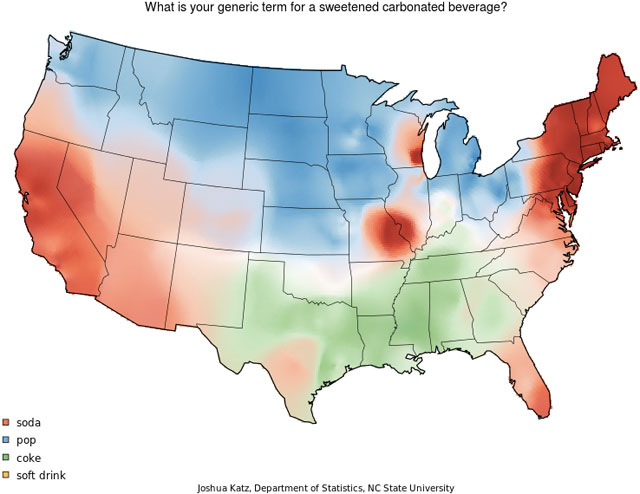
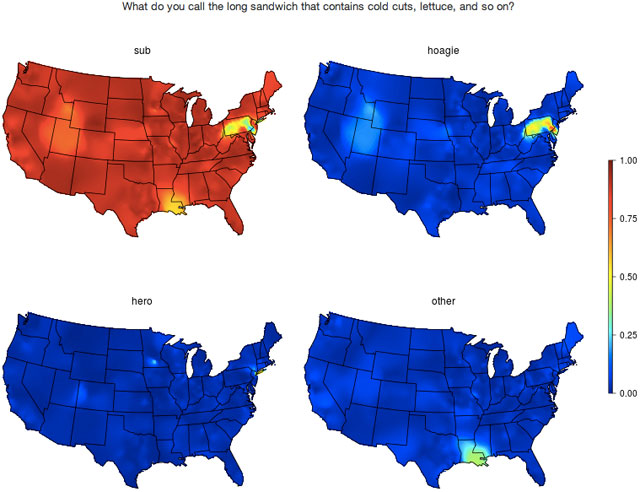
When you talk to different people across the United States, you notice small differences in how people pronounce words and phrases. Sometimes different terms are used to describe the same thing. Bert Vaux's dialect survey tried to capture these differences, and NC State statistics graduate student Joshua Katz mapped the data.
For example, the above shows how people refer to two or more people. In the north and west, people commonly say "you guys" but it's "ya'll" in the southeast.
Similarly, some pronounce "pajamas" with a long "a," whereas others use a soft "a."

Then there's the classic soda vs. pop vs. coke.

There's a whole bunch more here, 122 maps in total. It's interactive, albeit a bit slow.
Jonathan Spyer reviewed my new novel for The Jerusalem Post.

The review is behind the paywall, but here are some excerpts.
This is his first foray into fiction. It is a success.
[…]
‘Taken’ works on a number of levels. From one point of view, it is a thriller. The author drives the plot with a determined hand. He shows a talent for describing scenes of action and intensity which has already been apparent from his reporting on Iraq and Lebanon.
But the book is also a novel of ideas, and a character study. In terms of the former, Totten uses the framework of the novel to discuss the nature of journalism and war correspondence, as the kidnapped ‘Michael Totten’ ponders his fate from his incarceration.
He notes the nature of the war correspondent as a ‘tourist on the dark side’, observing that he has always been happy with a ‘certain amount of darkness in my life’, as long as its not ‘my own personal darkness.’ This, slipped into a scene in a thriller, is as insightful and honest a phrase on the typical foreign correspondent as any to be found.
Through the depiction of the kidnappers, the book also asks questions about the appeal of radical Islam for some western-raised Muslims, and the gap between the west and the Middle East.
The characters of three of the captors are finely drawn. In particular, that of Ahmed, the leader of the group, is closely observed. It is a portrait more subtle, and in a qualified and measured way sympathetic, than would generally be found in books dealing with the grim subject matter here.
This reviewer is generally skeptical regarding the postmodern tactic available to novelists of inserting themselves into their own novels. However, here the device works well. This is because of Totten’s slightly tongue in cheek approach to it.
Thus at one point, the (fictive) Michael Totten casts doubt on his own fictional status. He declares that while a particular course of action might have worked all very well in a work of fiction, he had to remember that ‘I wasn’t a character in a novel,’ and so this could not be assumed to also apply to his situation. Such acrobatics are slightly dizzying, but the (writer) Totten manages to pull it off.
[…]
On the most fundamental level, the question that needs to be asked about a work of fiction is; does the writer succeed in creating an imaginative world in which the reader is able to immerse himself for the duration of the story? Is the fictional world presented with sufficient depth and power to make this mysterious process possible? Here, the answer is yes.
The book is available at Amazon.com, Barnes and Noble, Powell’s Books, etc.

Issue number 33 of eLearning Papers focuses on the challenges and future of Massive Open Online Courses (MOOCs), a trend in education that has skyrocketed since 2008.
[…]
Among other topics, eLearning Papers 33 explores whether MOOCs may be a viable solution for education in developing countries and analyses the role of these emerging courses in the education system, especially in higher education. Furthermore, valuable examples from the field are presented, such as the quad-blogging concept and a game-based MOOC developed to promote entrepreneurship education.
Joshua Katz has been studying American dialects and has made more than 120 maps of some of the differences in American speech. Here are a few examples:

(thx, everyone)
Update: As he notes on the site, Katz's maps are based on the research and work of Bert Vaux...Vaux's maps of the same data can be found here. (thx, molly, margaret, & nicholas)
Tags: Joshua Katz language maps USAאסתר זנדברג כותבת לאחרונה דברי טעם בהארץ. כאן על דרך בגין ודרך נמיר, ועל האפשרות להפוך אותם לשדרה עירונית טובה. מה לעשות, אבל הייתי שם כבר לפני הרבה שנים, לפני עשור כמעט כאשר עבדתי כיועץ לנ.ת.ע ולנתיבי איילון והמלצנו לפתח את שדרות בגין כשדרה רב-מסלולית. אפשר לראות מאמר כללי יותר על דרכים אזוריות והאפשרות לפתח אותן כשדרות כאן. בסופו של דבר, מבחינה תחבורתית, משרד התחבורה תמך ברעיון, אבל לא הצלחנו לשכנע את עיריית תל-אביב בצורך להכין תכנית עיצוב אורבני לרחוב שתבטיח שהמבנים החדשים שיקומו לאורכו לא יפנו אליו את גבם, אלא ייצרו חזית פעילה לאורכו.
וכאן, כותבת זנדברג על הצורך במדיניות חניה. גם על נושאים אלה כתבו רבים וטובים בעיקר ידידי לרמן, בפוסט המעולה שלו על תקני החניה כדיור בר-השגה למכוניות. גם אני כתבתי כמה דברים בעניין: כאן, וכאן, וכאן, וכאן, וכאן, וכאן.
אה ודרך אגב, במסגרת המדיניות של לא לעצבן את האזרח (כלמור הנהג) בשנת בחירות הפסיקו לחלוטין לאכוף עבירות חניה. לא גוררים, לא נותנים דו"חות, לא מפריעים. אז מה אם אין להולכי רגל מקום ללכת על המדרכות – הם הרי לא אזרחים ממש.
ברוכה הבאה אסתר, אולי את תצליחי יותר מאיתנו, אנחנו כבר מדברים על זה כבר 10 שנים ויש לי הרגשה שאפילו ניצן הורביץ לא יעיז להגיד בקמפיין שלו כלום על חניה.


במשך כשנה עמלנו יובל אגסי ואני על תחקיר בנושא ההשכלה הגבוהה בישראל. איך להשיג תואר במינימום מאמץ? מי הוי איי פי שמתקבלים לתואר בלי לעמוד בתנאי קבלה וכו'? בשנה ומשהו שעבדנו על התחקיר גם הפנינו בקשה נרחבת לקבל מידע מהמועצה, מכוח חוק חופש המידע.
אנחנו לא תמימים, לא חשבנו שהמועצה תחשוב חלילה שזו חובתה לחשוף מידע לציבור, שזה בכלל תפקידה, שהיא צריכה לשמש דוגמא לאיך מתנהל רגולטור. בכול זאת, הם בסך הכול עוסקים במגדל השן האקדמי, באליטה, במוסדות של הנחלת ידע, מה להם ולשקיפות ועדיין לרמה כזאת של התחמקות והתפתלות, אני מודה שלא ציפינו.
רק שתי דוגמאות קטנות: ביקשנו את כל הפרוטוקולים של ישיבות המועצה להשכלה גבוהה. באתר המועצה מתפרסמות רק השורות התחתונות, אבל למה המועצה החליטה לאשר תוכנית לתואר שני במוסד איקס? מי התנגד? מי היה בעד? מה השיקולים? אישרו, למשל, לאוניברסיטת בן גוריון להעניק תואר ראשון לבוגרי קורס טייס. מי הצביע בעד? מי נגד? מה היו השיקולים?
ועדה מיוחדת של המועצה המליצה לא להסמיך את בוגרי בי"ס למשפטים של מכללת "כרמל". זה נדיר. ועדת המשנה של המועצה בראשות דפנה ברק ארז (היום שופטת בעליון ואז באוניברסיטת תל אביב) החליטה לא לקבל את ההמלצה. למה? מה היה המשקל של עמוס שפירא, דיקאן בי"ס למשפטים של "כרמל" וגם הוא אקס אוניברסיטת תל אביב, בהחלטה? איך בדיוק פעל שר החינוך סער, כשהנושא הגיע למליאת המועצה? איך זה שיזם המכללה, אדם בשם אבי ביתן, הבטיח שבאמצעות קשריו עם שר החינוך, הוא יסדר את זה ואכן, זה סודר?
הכול חסוי, סודי. תהפכו את העולם 6 פעמים ולא תמצאו סיבה הגיונית למה זה חסוי. למה זה לא מתפרסם. מה זה סוד מסחרי? שיקולי חוץ ובטחון? פרטיות? אין. ישבו החכמים של המועצה להשכלה גבוהה ומצאו פתרון: זה קשה. החוק קובע שלא צריך להעביר חומר אם הדבר כרוך בהקצאת משאבים בלתי סבירה.
אתם בטח תמימים ואומרים – כמה זה יכול להיות קשה לרכז את כל הפרוטוקולים של המועצה, שבטח נמצאים על אותה תיקייה על המחשב, לעשות להם פורוורד ותוך חמש דקות הם בצד השני? ובכן, אתם אכן תמימים.
להלן תשובת המועצה:
בהתאם לבדיקה מדגמית שערכנו, משת 2007 התקיימו כ – 70 ישיבות. מספר עמודים בממוצע בכל פרוטוקול כ – 40 עד 60 עמודים. יובהר כי בטרם הפנייה לצדדים שלישיים (כ – 140 פניות) על המל"ג לבחון כל פרוטוקול לגופו האם אין בחשיפת המידע פגיעה בעקרונות אחרים (כגון סודות מסחריים ופגיעה בפרטיות) אשר עקרון השקיפות נסוג בפניהם. אנו מעריכים כי היקף הטיפול בבקשה בהיקף עליה עמדת תדרוש הקצאת עובד ל – 6 חודשים לערך.
אתם מבינים? פרוטוקול של הגוף המפקח על המוסדות להשכלה גבוהה בישראל כולל סודות מסחריים, התוכנית לתואר ראשון של מכללה כזו או אחרת משנת 2008 היא סודית, אולי הפרטיות של איזה מרצה תיפגע כי יידעו שהוא מלמד שם (לא אמורים להתגאות בזה על אתר המכללה?). צריך לפנות לכל מי שהוזכר, לשאול אם אדוני נפגע, אולי הוא רוצה לערער, להקצות עובד שלם במשרה מלאה שישה חודשים רק כדי לטפל בזה, איזה קשקוש. אם זו המועצה להשכלה גבוהה, באמת אל תתפלאו איך שנראים פה חלק מהתארים. רגע, רגע. ביקשנו עוד דבר.
המועצה מקבלת מהמוסדות להשכלה גבוהה את כל התוכניות השונות שלהם. בתוכנית רשום מי הסגל, איזה תואר יינתן לסטודנטים, מה תנאי קבלה, בקיצור – מה שבבוא היום יירשם פחות או יותר בידיעון. טוב, ברור שהמועצה לא תשים את זה באינטרנט. מה פתאום. ככה חלילה אנחנו עוד עלולים לדעת איך היא פועלת, אבל אולי מהרגע שעיתונאי נודניק ביקש, אולי בכול זאת יעבירו לו את המידע הסופר מסווג הזה?
ובכן, להלן תשובת המועצה (לגזור ולשמור):
בכל ישיבת מל"ג (המועצה להשכלה גבוהה) נדונות כ – 20 תוכניות כאמור. הואיל והמדובר ב – 70 ישיבות מועצה אזי בקשתך מתייחסת ל – 1400 תוכניות. בהתאם לבדיקה מדגמית, הערכתנו שנדרשות כ – 4 שעות עבודה על כל תוכנית ובסה"כ 5,600 שעות עבודה. סך עלות הטיפול בסעיף זה מוערך על ידינו בכ – 250 אלף שקל, לא כולל עלות צילום המסמכים.
כמה שאלות: מה עושים ב – 4 שעות עבודה האלה על כל תוכנית? אין קובץ דיגיטלי שלהם? זה נכתב ביד? באבן? בכתב לימון? האם נכון שאת רוב התוכניות הללו מאשרים בפחות זמן ממה שלוקח לעבור עליהן כדי להחליט אם להעביר לתקשורת? הכי מעצבן - לא כולל עלות צילום? אתם רוצים רבע מיליון ואתם לא יכולים לצלם את התוכניות? וואו. ברבע מיליון שקל אני קונה לי חבר מל"ג, שיעדכן אותי בזמן אמת בכול תוכנית. על המכתב המופלא הזה, שאני מתכוון למסגר בבית, חתומה – מיכל פרי, רכזת פניות ציבור מל"ג/ות"ת. מיכל יקירתי, אנחנו לא מכירים, אבל כשמנחים אותך לכתוב את דבר ההבל הזה, מותר להגיד 'לא'. מתישהו כל החומר הזה יהיה באינטרנט נגיש לכולם ואז ניקח את המכתב הזה לכל כנס כדי להזכיר איך תפקדה המועצה להשכלה גבוהה בספטמבר 2012. למה את צריכה להיות חתומה על הפארסה הזאת?
Europe’s “youth unemployment crisis” is “truly terrifying,” writes Derek Thompson in The Atlantic. Overall, EU unemployment is 12.2 percent, but it’s twice that for would-be workers under 25. Youth unemployment is 56 percent in Spain and 62.5 percent in Greece. ”We’ve never seen a generation this educated also be this unemployed,” Thompson observes. Nearly 40 percent of young people in Spain and 30 percent in Greece are college educated.

The less scary “youth unemployment ratio” — the share of young job seekers divided by the entire population — is 9.7 percent in the EU. That doesn’t count the young people who’ve given up looking for work, writes Thompson. There are 26 million young”NEETS” (Not Employed, or in Education, or Training) in developed countries, according to the OECD.
The youth unemployment rate in the U.S. was 16 percent in late 2012, according to the Bureau of Labor Statistics. More young Americans (14.8 percent) than young Europeans (13.2 percent) were NEETs in 2011, the last time the OECD issued an estimate. In Italy, 19.5 percent of young people were out of work, out of school and out of luck in 2011, even higher than the numbers in Greece and Spain.
A recent article in Forbes asks if higher education is the next bubble to burst, after housing, high tech, and the stock market. It includes this observation:
“Schools suffer from an administrative bloat, as they are expanding their bureaucracies significantly faster than the numbers of instructors and researchers . . . Since the early 1990’s, spending on administration per student increased by 66%, while instructional spending per student rose by 39%.”
My reaction may strike you as predictably defensive, since as a system-office bureaucrat I’m doubly removed from the classroom, and a direct beneficiary of that 66%.
Yet I can’t help but think the writer is missing an important point. After all, one or two other things have also been changing since the early 1990s, among them the whole way humans create, store and disseminate knowledge. That has a profound affect on the purpose and organization of our universities, and the work they perform.
The internet has challenged us to redefine what we do. We’re still working up a new definition, but we know it’s no longer mostly to deliver content. And we’re groping around for analogies and business models that might help.
A few weeks ago NPR interviewed web and business guru Maxwell Gillingham-Ryan. He explained the “showroom” phenomenon in retail: shoppers go to the store for the immersive, tactile experience, and to get the “brand story,” but then they make the actual purchase elsewhere. In this world, Gillingham-Ryan argues, retailers have to be ready on both fronts: they need a lean, economical on-line presence, supported by a deeply satisfying in-person experience. As he put it:
“I think the store couldn’t compete [with the web site] in terms of being a better place to transact business. But what it does a lot better is it tells the brand story, and it also provides service. And so stores have adapted to do those things really, really well. The ones that do that are succeeding.”
This made sense to me, as I think about the way my wife and I go shopping, spend money, and get help. The analogy to university campuses doesn’t hold up completely, but there’s something instructive here.
Our colleges and universities will be more than just the latest speculative bubble, if we focus on what our campuses deliver that a MOOC can’t: the immersive, physical, and social context that accelerates learning.
 Providing such wraparound service in an intentional way isn’t easy or cheap. It means, among other things, adding a coordinating layer to the institution’s workforce, so the traditional model of essentially solitary faculty work in teaching and research is somehow brought together, coalescing into a meaningful, coherent student experience.
If I’m right, then our institutions’ very survival depends on bolstering our ability to connect faculty to each other, to colleagues in student affairs, and to students and their families in new ways. It could be 66% well spent.


Lately I’ve been wondering about how our colleges and universities might be organized to foster more of the learning our students need. At the right you can download today’s presentation on this, made to a town hall meeting at CSU Los Angeles.
The occasion was the management team’s last meeting under this president, James Rosser, whose long tenure is distinguished by the way his campus welcomed all students, including those whom higher education usually fails to serve. We saw a set of interviews from seven students conveying their sense of genuine belonging, despite strikingly diverse backgrounds.
So how to build on that? How to take that remarkable head start and get it to the bottom line? For all the warm and fuzzy, six-year grad rates at CSU LA have been in the 30 percents. In other words, students love it there, but few get what they came for.
It’s a tricky subject, relating to more than one facet of higher education. But I believe institutional integration toward a unified sense of purpose, may be it. But that’s tentative, in part because the upshot is a little strange looking. But here it goes.
1. Start with the learning.
If it’s fifty years ago, then industry and knowledge are advancing by specialization. You get good at your own thing, and your social connections are mostly to people in your own field. In the same way, your personal life is weirdly proscribed, by class, custom, Jim Crow, habit, or just the high price of phone calls. That was the world before everything was connected to everything else.
 Preparing students for that meant steeping them in the traditions, knowledge, and modes of inquiry particular to one discipline, or one industry. And with less need for interdisciplinarity comes a lower bar for socialization: I can devote less energy to empathizing with others, when they mostly think and act like I do.
So we organize postsecondary learning around a mostly-knowledge curriculum, funneling students from breadth at entry toward narrowness at exit. Choose your major at the halfway mark, and don’t look back.
For their part, colleges and departments survived in either of only two ways: recruit majors to your tip of the funnel, or persuade all your colleagues that you belong at the wide end, as part of the “general education” that all students should have.
If instead you are an unpopular specialization failing to make the case for universal need, then your enrollments and funding dry up, and you go the way of astrology and Esperanto.
That was then.
By contrast the current age subjects our graduates to relentless churning, to urgent demands of cross-cultural team-forming in pursuit of the one-off goal. When there’s less time to work out the hierarchical org chart, reporting structures get murky. Your effectiveness depends more on your ability to understand and persuade others, whose backgrounds, expectations, and training may not be like yours.
These proficiencies – flexibility, drive, interpersonal efficacy – might result from college, but we’ve hidden them. Our departments and disciplines have been ruthlessly winnowed by natural selection, surviving only if they could assert their differentness to recruit majors or to claim their essentialness, as purveyors mostly of content knowledge.
The other, dispositional proficiencies haven’t been touted much in academic affairs. Their visibility is instead in student affairs, in co-curriculars, clubs, and residence halls. The “extra” in extracurricular didn’t mean “bonus,” it meant “outside of.” As in, deliberately segregated from curriculum. Can you imagine? Institutional redlining.
It gets worse: further down the pecking order are the time management coaches and itinerant tutors, who pick up what others won’t do. Imagine our chagrin to wake up in the 21st century and discover they’re serving up what our students most need.
So that’s the learning.
2. The experiences that foster the learning we want.
On this the jury is in: a suite of high-impact practices like service learning, learning communities, undergraduate research, international experiences, and civic engagement get the hyper-specialized 20th-century learning out of its compartments, and reunite dispositional skills with the content in the curriculum.
Students can only get through these high-impact practices by working together, innovating and problem solving, forming temporary teams in pursuit of tangible goals. In other words, such experiences prepare them for their own lives, instead of their grandparents’.
 That advantage, of course, isn’t lost on the students. Put them into these things and they recognize the relevance and value of the whole baccalaureate. Grad rates rise, and gaps narrow.
The challenge is that we are not even remotely set up to deliver these experiences universally, or even consistently. They’re expensive and labor intensive, when compared to hiring a solo academic to get up and explain his field to an auditorium. Private and selective public institutions pull this off, but until we can get this to the rest – like say, 23 large-scale regional comprehensives in the Pacific Time Zone – we’re confronted by some troubling inequity for individuals. And for society, we’re not developing all the human capital we should.
So that’s the learning, and those are the experiences.
The question is, how do we de-specialize, and get mass higher education from here to there?
3. Three interventions that put dispositions into the curriculum.
What I find strange about this – suspiciously symmetrical – is that with all three of these interventions, the organization itself models the multifaceted thinking we want from our students. If we want them integrating everything, then we have to do it first.
Does we have to? Really?
That feels like sloppy thinking to me, an error of displacement. One analogy is to weight loss: the pop culture wisdom in the early 1990s was that eating fat makes you fat. So we thought things without fat — like bread – must be fine. Bagel shops proliferated, carbs were consumed, and guts grew. These days we’re likelier to distrust the carbs and seek the proteins, even if they come marbled with a little fat, and we seem better off. It turned out that assuming the input would equal the output was a red herring, because there’s a metabolism in between.
In the same way, I find it fishy to conclude that if we want our students learning content, skills, and attitudes all at the same time, then we need to deliver that kind of education with a consortium of departments, programs, coaches, and community partners all working seamlessly together.
In other words, is institutional integration really the only path to integrated learning? Got me. But we seem inclined to figure it out.


Below are three traits I’ve noticed all great resumes exhibit. This is not an exhaustive list and applies to the for-profit and non-profit sectors. Academia, art/music, and other fields likely exhibit other dynamics. I’m hoping to be helpful by sharing some tips I haven’t seen mentioned before.
Great resumes:
Quantifying accomplishments allows others to understand impact and demonstrates that you measure things. People who are in the mindset of measuring are the ones who improve most over time. And if you aren’t measuring yourself, then you probably aren’t measuring other day-to-day things like your team’s progress or your employees’ progress. Using numbers is a nice way to have the data stand out from the surrounding text and save space.
Most people talk about what they did instead of what they had to learn and how they learned it. Great companies look for someone who will excel at the required job, but who can grow into a larger role as well. Since there is rarely a perfect candidate, finding someone who can do 85% of a role and can grow into the other 15% is often the best hiring strategy. The best indicator of how you will grow is how you have already grown.
The jobs you’ve held should be the steps to reaching your dreams and ambitions. The best candidates think of the job for which they’ve applied as a stepping stone to these goals. Show how each position you’ve held built on the previous positions and it should be clear very quickly to someone scanning your resume that you’ve purposefully developed skills and progressed over a career.
You should also project this forward. Why is the job you’re applying for a natural extension of what you’re currently doing?
Not Great:
- Work with a team to provide reliable tracking of users (Flurry, Mixpanel and custom tracking tools) and to analyze customer behavior through frequent analysis of usage statistics and power users.
Better:
- Implemented user-metrics tracking that resulted in 50% faster resolution of support issues and a 25% drop in in-bound customer support requests.
- Analyzed customer behavior to proactively identify power users, resulting in 10% faster conversion of free users to paid and was part of an effort that increased sales $250,000/year.
Not Great:
Some University (Sweden), Bachelor, Software Technology Programme, 2009
- Awarded President’s Scholarship
- Bachelor Thesis: Comparative Analysis of Development Frameworks
Better:
Some University (Sweden), Bachelor, Software Technology Programme, 2009
- Awarded 100% scholarship, offered to 5 students per year
- Bachelor Thesis: Comparative Analysis of Web Development Frameworks, available at: http://www.someURL.com
Not Great:
- Developed websites for clients. Included database design and implementation, use of the Model-View-Controller methodology and creation of unit tests. Involved extensive use of PHP / CakePHP and MySQL, HTML, CSS, XML, Ajax and JavaScript.
Better:
- Designed, architected, and developed websites for 12 clients in 6 months.
- Learned Model-View-Controller paradigm using CakePHP, MySQL, HTML, CSS, and Javascript in 2 weeks to launch our first client’s website.
- Developed a custom unit testing framework in 1 month which resulted in a 25% reduction in bugs per client over the life of a project.
Not Great:
- Led several projects and initiatives involving the automation of previously manually tested functionality and migration of data to a database.
Better:
- Led team that automated testing tasks that previously took 50 hours per launch, saving 5000 hours/year.
- Promoted to database administration team after 6 months. Self-learned SQL and helped migration to scalable database systems that could handle 10x more load.
Not thinking about a career stepwise:
- Company1 – Premiere Field Engineer (Sept 2009 – Sept 2011)
- Engineered some project and worked on a team that did something
- Self Employed – Independent Consultant (Sept 2007 – Sept 2009)
- Technical consulting in IT and security projects
- Trainer in courses for MCSE and MCSA
- Company3 – Trainer & Engineer (June 2004 – June 2007)
- Trainer for Microsoft certified Systems Engineering courses
- Self Employed – Independent Consultant and Engineer (June 2002 – June 2004)
- Security Consultant
- Trainer and Consultant with deployment software
Stepwise positioning, with a clear building and career progression:
- Company1 – Premiere Field Engineer (Sept 2009 – Sept 2011)
- Engineered some project and worked on a team that did something
- Led Europe’s leading IT support company in initiatives to educate and train 450 support staff in Microsoft technologies
- Self Employed – Independent Consultant (Sept 2007 – Sept 2009)
- Started consulting business to train others for MCSE, MCT, MCSA
- Consulted 45 companies on best practices for IT, security, & Citrix projects with an average class size of 23 trainees
- Company3 – Trainer & Engineer (June 2004 – June 2007)
- Earned MCSE, MCT, MCSA certifications
- Promoted to train others in the company on Microsoft certifications
- Developed xyz things for the company
- Self Employed – Independent Consultant and Engineer (June 2002 – June 2004)
- Security consultant focused on training new engineers on best practices for building secure software


Turning and turning in the widening gyre
The falcon cannot hear the falconer;
Things fall apart; the centre cannot hold;
Mere anarchy is loosed upon the world,
The blood-dimmed tide is loosed, and everywhere
The ceremony of innocence is drowned;
The best lack all conviction, while the worst
Are full of passionate intensity.Surely some revelation is at hand;
Surely the Second Coming is at hand.
The Second Coming! Hardly are those words out
When a vast image out of Spiritus Mundi
Troubles my sight: a waste of desert sand;
A shape with lion body and the head of a man,
A gaze blank and pitiless as the sun,
Is moving its slow thighs, while all about it
Wind shadows of the indignant desert birds.The darkness drops again but now I know
That twenty centuries of stony sleep
Were vexed to nightmare by a rocking cradle,
And what rough beast, its hour come round at last,
Slouches towards Bethlehem to be born?
~ William Butler Yeats, “The Second Coming”
Folklorists often balk at the common usage of the word “myth” to mean “lie.” A myth, by their disciplinary definition, is quite the opposite. A myth is a culture’s sacred story. It involves supernatural or supreme beings — gods. It explains origins and destinies. A myth is the Truth.
So when I say then, that “disruptive innovation” is one of the great myths of the contemporary business world, particularly of the tech industry, I don’t mean by “myth” that Clayton Christensen’s explanation of changes to markets and business models and technologies is a falsehood. (I have an MA in Folklore, not an MBA — so that’s part of it, for sure.)
Rather, my assigning “myth” to “disruptive innovation” is meant to highlight the ways in which this narrative has been widely accepted as unassailably true. No doubt (as a Harvard professor) Christensen has faced very little skepticism or criticism about his theory about the transformation of industries— why, it’s as if The Innovator’s Dilemma were some sort of sacred text.
Helping to enhance its mythic status, the storytelling around “disruptive innovation” has taken on another, broader and looser dimension as well, as the term is now frequently invoked in many quarters to mean things quite different from Christensen’s original arguments in The Innovator’s Dilemma.
In this vein, almost every new app, every new startup, every new tech — if you believe the myth-making-as-marketing at least — becomes a disruptive innovation: limo-summoning iPhone apps (e.g. Uber), photo-sharing iPhone apps (e.g. Path), email on your iPhone (e.g. Mailbox), online payments (e.g. Paypal), electric vehicles (e.g. Tesla), cloud computing (e.g. Amazon Web Services), 3D printers (e.g. Makerbot), video-based lectures (e.g. Khan Academy), social search (e.g. Facebook Graph Search), the entire Internet, etc ad nauseum.

The companies above might very well be innovative. — in their technologies and their business models. That’s beside the point if you’re looking for disruption. Per Christensen’s framework, these could also be “sustaining innovations” — that is, products and services that strengthen the position (and the profits) of incumbent organizations.
But that’s not the mythology embraced by the tech industry, which despite its increasing economic and political power, continues to see itself as an upstart not an incumbent.
And as a self-appointed and self-described disruptor, the tech industry seems to have latched on to the most millennial elements of Christensen’s theories — that is, the predictions about the destruction of the old and the ascension of the new. At the hands of technology: The death of the music industry. The death of newspapers. The death of print. The death of Hollywood. The death of books. The death of the Web. The death of RSS. The death of Microsoft. All predicted to be killed — suddenly or gradually or in the library with a candlestick — by some sort of “disruptive innovation.”
The structure to this sort of narrative is certainly a well-known and oft-told one in folklore — in tales of both a religious and secular sort. Doom. Suffering. Change. Then paradise.
People seemingly love to believe in the “end of the world as we know it” stories — for reasons that have to do with both the horrors of the now and the heaven of the future. Many cultures (and Silicon Valley is, despite its embrace of science and technology, no different here) tell a story that predicts some sort of cataclysmic event(s) that will bring about a radical cultural (economic, political) transformation and, eventually, some sort of paradise.
The Book of Revelations. “The Hollow Men.” The Mayan Calendar. The Shakers. The Ghost Dance. Nuclear holocaust. Skynet. The Singularity.
I’ll be the first to admit that the data in folklore professor Dan Wojcik’s book The End of the World As We Know It is dated (um, he was my Master’s Thesis advisor, circa 2000); he wrote the book in 1997 — oh! the same year that The Innovator’s Dilemma was originally published! Wojcik’s analysis of a sweeping societal belief in “the end of the world” — was well-timed with the technological anxieties surrounding Y2K, making it is an interesting and contrasting companion to Christensen’s contention that we’ll witness “the end” of certain organizations thanks to technological “innovation.”
For his part Wojcik noted that, according to Nielsen, some 40% of Americans believed that there was nothing we could do to prevent nuclear holocaust. 60% believe in Judgment Day. 44% in the Battle of Armageddon. 44% in the Rapture. He didn’t say how many believed in Y2K. He didn’t say how many believed in “disruptive innovation.” He did not ask how many believed in “the singularity” and such.
I'd argue that despite its staid Harvard Business School origins, Christensen’s “disruptive innovation” story taps into these same powerful narratives about the end-times -- told, as always by the chosen ones (be they Americans, Christians, Shakers, Heaven’s Gate followers, survivalists, Java programmers, or "my generation"). Folks do seem drawn to these millennial stories, particularly when they help frame and justify our religious, moral, economic, political, cultural, social, technological worldview.

Here are a couple of (education-related) end-times predictions from Clayton Christensen:
Disruptive innovation will be, as Techcrunch (among other acolytes) is happy to profess, the end of school as we know it.
Such is its inevitability, so the story goes, that new players can enter the education market and, even though their product is of lower quality and appeals to those who are not currently “customers,” oust the incumbent organizations. (Incumbents, in this case, are publicly funded, brick-and-mortar schools.) As Christensen and his co-authors argued in Disrupting Class in 2008, “disruption is a necessary and overdue chapter in our public schools.”
But like many millennialist prophets are wont to do when their end-times predictions don’t quite unfold the way they originally envisioned, Clayton Christensen and his disciples at the Clayton Christensen Institute (which was recently renamed from the Innosight Institute) have just tweaked their forecast about (public) education’s future. 5 years post-Disrupting Class, "disrupting class" will look a bit different, they now say.
This week, the organization released a new white paper, detailing a new path for transformation that winds a new future between the disruptive and sustaining innovations: they call it “hybrid innovations.”
"A hybrid is a combination of the new, disruptive technology with the old technology and represents a sustaining innovation relative to the old technology."
It’s an interesting revision (a refinement, really) of the organization’s predictions in Disrupting Class, the book which first applied “disruptive innovation” to education technology and that argued online learning would be a way to “modularize the system and thereby customize learning.” (In other buzzwords, to “unbundle” and “personalize” education.)
Not so fast, the organization now says. Hybrid innovation. "Blended learning." A little bit online and a little bit offline. And while middle- and high schools (and colleges, although that isn’t the subject of this latest white paper) might offer opportunities for “rampant non-consumption,” -- that is, classically, an opportunity for "disruption" -- “the future of elementary schools at this point is likely to be largely, but not exclusively, a sustaining innovation story for the classroom.” Computer hardware and software and Internet-access in the classroom, as those of us who've been thinking about education technology for decades now keep saying, won't necessarily change "everything." (Go figure.)
Of course, even in Disrupting Class, the predictions of the ed-tech end-times were already oriented towards changing the business practices, not (necessarily) the pedagogy or the learning. And the promise of a thriving education technology eschatology were already muted in Christensen's earliest formulations, by the “restrictions” placed upon the education sector — restrictions by virtue of education being a public and not a private institution, of education not being beholden to market forces quite the same way that the other examples that the mythology of “disruptive innovation” has utilized to explain itself.
“People did not create new disruptive business models in public education, however. Why not? Almost all disruptions take root among non-consumers. In education, there was little opportunity to do that. Public education is set up as a public utility, and state laws mandate attendance for virtually everyone. There was no large, untapped pool of non-consumers that new school models could target.”

This latest Christensen Institute white paper clarifies then that the future of education isn't necessarily (or utterly or easily) "disrupted." There are limits to the predictions, to the predictive models, to the business school approach to education change and such. There are, for example, lots of non-consumers of learning (a necessary piece of the "disruptive innovation" framework) if you're willing to frame education as something that happens outside the officially-sanctioned, brick-and-mortar institutions. But it's not so easy to woo "non-consumers" if you're really just focused on the market and policy and practices of an otherwise compulsory schooling setting. (And the distintion between "consumers," "non-consumers," "students," and "learners" is important too, although all get lumped into a consumption framework by Christensen.)
Like so many millennialist entities faced with the harsh realities of faltering predictions, the Innosight Institute (now under its new name) offers a new prediction.
But, let's be clear, the organization doesn't just predict the future of education. The Clayton Christensen Institute does not just offer models -- business models -- for the future. It does not simply observe an always changing (education) technology market. It has not simply diagnosed the changes due to technological advancements. It has not simply prophesied or predicted what future outcomes might be.
It's written a best-selling book (or two) about disruptive innovation. It has actively lobbied governments for certain aspects of its agenda (its mythology?), becoming a vocal proponent for its particular vision of a disrupted and innovative future. The Clayton Christensen Institute is a member of ALEC, for example, a corporate lobbying organization whose education initiatives include writing and pushing for legislation that enables the outsourcing of education to for-profit, online education providers and that eases the restrictions of entry to the market of the very virtual schools.*
"Over time," the new white-paper reads, "as the disruptive models of blended learning improve, the new value propositions will be powerful enough to prevail over those of the traditional classroom." And so, according to the Christensen mythology, despite any sort of hesitatation about the hybridity of disruption now, disruption will prevail.
And so, indeed, it is written. And so, it is told.
Image credits: Pedro Szekely, dynamosquito, Luc Viatour, and the Noun Project
Note (6/15/2013): I was contacted this week by a spokesperson from the Clayton Christensen Institute saying that "we have never been a member of ALEC" and asking for a correction to that effect in this article. ALEC itself does not publish the list of its members, so I cannot verify information that way. The institute is listed as a member on the ALEC Exposed site. It is also referenced by the public accountability group Little Sis as an education reform group endorsed by ALEC.
[SORTA MAD MEN SPOILERS! but not really] I don't know if Ken Crosgrove dancing on the latest episode of Mad Men is the best thing that's ever been on the show, but it's definitely in the top 10. And it might be even better with a little Daft Punk.
And it might be best with the Crazy in Love cover from Gatsby...just load up that this YT video while watching the animated GIF and you're all set. (This is how Millennials watch TV, BTW...it's all animated GIFs with YouTube video soundtracks. Civilization is gonna be juuuuuuust fine.)
Tags: Daft Punk dance Mad Men remix TV videoAviv.sharonWhat a cool roundup

Udacity, Georgia Tech, and AT&T announced this week a partnership to offer an online Master’s Degree in Computer Science. The degree will cost less than $7000 (significantly cheaper than the MS that the university currently offers, in part because of the financial support for the program from AT&T), although anyone will be able to take the Udacity classes for free via its website. Udacity will take a 40% of the revenues, according to Inside Higher Ed, which also reports that Georgia Tech only plans to hire 8 or so more instructors to handle the new program, which is expected to have as many as 10,000 enrollees in the next 3 years.
Earlier this year Yale said it didn’t plan to “rush” into a MOOC decision, but this week it made public its plans to offer four courses via Coursera. This brings the number of institutions using Coursera as a MOOC provider to 70.
The University of Edinburgh has offered six classes via Coursera and released a report this week detailing its experiences. (PDF) Lots of details in the report about the university’s planning, course completion, and learners’ demographics (note: some 70.3% of those who responded to course surveys indicated they had completed a university degree.) According to the report, “It is probably reasonable to view these MOOC learners as more akin to lifelong learning students …than to students on degree programmes, which is a common comparison being made.”
Coursera announced this week that it’s partnering with a number of translation companies and philanthropies in order to translate its courses “into many of the most popular language markets reflected by Coursera students: Russian, Portuguese, Turkish, Japanese, Ukrainian, Kazakh, and Arabic.”
The Department of Education says it plans to fine Yale $165,000 for failing to report four forcible sex offenses on campus, as required under the Clery Disclosure of Campus Security Policy and Campus Crime Statistics Act.
California Governor Jerry Brown has proposed to spend $1 billion to help the state prepare for the Common Core. The money will include training, as well as funding for the technology infrastructure to comply with CCSS’s computer-based testing.
School’s out for summer for the 400 students in the Buena Vista school district in Michigan. And, to quote more Alice Cooper, it might be out forever as the district has fired all of its teachers and closed the doors to all the schools because it has run out of money. Students will be able to attend “skills camps,” for the remainder of the school year HuffPo’s Joy Resmovits reports.
Although the state of Maine chose HP as its vendor-of-choice for its one-to-one laptop program a few weeks ago, public schools in Auburn are ditching laptops altogether and adopting iPads for kindergartners through high schoolers.
Kiera Wilmot, the Florida teen arrested for causing a small explosion in her science class, will not face criminal charges, according to the State’s Attorney General. There’s no word if the arrest will be expunged from her record or if she can return to the school that expelled her. But and her twin sister are headed to Space Camp this summer, thanks to the former astronaut Homer Hickam and a fundraising campaign by the Internet.
Former Tennessee educator Clarence Mumford was sentenced to seven years in federal prison this week for his role in a test-cheating ring. Mumford charged $3000 to arrange for people to take a certification tests on behalf of aspiring teachers in Arkansas, Mississippi and Tennessee. More details via the AP.
The education-focused investment fund NewSchools Venture Fund has proposed the idea of a “Digital Depository,” which is says “represents a reimagining of the federal role in education.” The proposal would divide districts into consortiums managed by an “independent board of directors, some appointed by federal agencies, some by private business, and some by school districts themselves.”
The Saylor Foundation launched a new initiative this week, a suite of open online courses for K–12. Available courses include American Literature, Calculus, Algebra 1, Geometry, and Common Core 101. “Open” in this case means “open educational resources” for “open for business” which, let’s be honest, the “O” in MOOC certainly has become.
At its annual developer conference this week, Google announced Google Play for Education, an education-focused section of its Android App Store. My thoughts on Google’s long-awaited move into Android-for-EDU here.
Techcrunch’s Sarah Perez takes a look at a new feature launched in Kidaptive’s iPad app Leo’s Pad: “Parent’s Pad,” “an in-app, parents-only area that shows their child’s progress in reading comprehension and math skills, as well as in cognitive, emotional and social functions, meaning things like ‘being patient’ or ‘taking turns,’ for example.”
Aldebaran Robotics has made commercially available its ASK NAO ("Autism Solution for Kids") robot, which it says is able to “run educational, entertaining, and daily life assistance applications.”
More universities appear to have backed out of Semester Online, a consortium of schools that, through the 2U platform, would share online classes and offer credits. News broke a couple weeks ago that Duke was out; Inside Higher Ed reports that Vanderbilt University and the University of Rochester have also “quietly abandoned plan” to be part of Semester Online too.
The Higher Learning Commission of the North Central Association of Colleges and Schools is reviewing the University of Phoenix’s accreditation, and while there were some indications it might sanction the for-profit due to a lack of autonomy from its parent corporation, a committee recommended last week that the university just be put “on notice.” A final decision comes next month.
The University of Alabama plans to use drones to provide an “eye in the sky” for police to monitor students on campus.
The kids’ book subscription service Zoobean has raised $500,000 in seed funding from Kapor Capital and others. More details about the startup on Techcrunch.
AllThingsD’s Lauren Goode covers the startup Play-i. The company is building educational robots and hasn’t launched yet, but its founding team includes former Googlers and an Apple engineer and has raised $1 million in funding from Google Ventures.
The Chronicle of Higher Education posted a list of the best-paid university presidents in the US (there are now three whose salaries exceed a million dollars a year), and the Pacific Standard follows up with an examination of how much these schools cost (and how much these costs have increased in recent years). Topping the list, the now fired Graham Spanier who made $2,906,271 last year as Penn State in-state tuition increased 2.7% to $31,854. Number two on the list Auburn University's Jay Gogue, who earned $2,542,865 last year, while students at his school paid 6.4% more for in-state tuition ($23,788) and 7.1% more for out-of-state tuition ($39,532).
“Arthur Toga and Paul Thompson will move to the USC Keck School of Medicine campus next fall, along with scores of graduate students, postdoctoral fellows and staffers who now work at UCLA’s Laboratory of Neuro Imaging, known as LONI,” reports The LA Times. “In establishing a new institute at the USC campus in Boyle Heights, they will also move substantial government and private grants that fund the lab’s $12-million annual budget as well as some of the highly sophisticated equipment used to investigate the brain’s inner workings.” Move, that is, from a public to a private university. More thoughts on the Remaking the University blog on how this demonstrates the California legislatures’s lack of attention to public universities’ research mission.
Rutgers University has hired Julie Hermann as its new athletics director, a decision that comes on the heels of the school firing its basketball coach Mike Rice after he was show in video recordings shoving and verbally abusing his players.
The learning management system Instructure is offering a bounty to developers to build apps that utilize the LTI (learning tools interoperability) standard. This standard offers APIs and data integration so that apps can work across LMS platforms. Instructure will pay $250 bounty for each qualified app submitted, and the best apps are eligible for a $1000 prize. (Disclosure: I’m one of the judges for the latter.)
Stanford math education professor Jo Boaler is teaching “How to Learn Math” online this summer. The free course doesn’t offer any Stanford credit (although educators might be able to count it as PD hours), but it’s a chance to work with a great professor who’s helping topple many of the myths about both teaching and learning math.
Record producers Dr. Dre and Jimmy Irvine have given $70 million to the University of Southern California to “create a degree that blends business, marketing, product development, design and liberal arts.” More details in The New York Times.
Leigh Graves Wolf has poured through every State Department of Education website in her quest to see which states offer educators certifications in ed-tech. According to her research, State Department of Education websites suck — oh, and just 19 out of 50 states (plus DC) offer some sort of endorsement. You can see the full list here.
The National Student Clearinghouse Research Center has released data about the Spring Term 2013 college enrollments. (PDF) It’s found that enrollments are down almost across the board (with the exception of four-year private non-profits), with 2.3% fewer students on campuses than there were this time last year. The biggest drop in enrollment has occurred at for-profits, down 8.7% from last year and down 17.2% from 2011.
Just in time for graduation, the Pew Research Center has posted a collection of data about student debt. Among the figures, “The average student loan balance outstanding in 2010 was $26,682,” but, for what it's worth 38% of those who graduated from a public university with a four year degree in 2008 had no debt at all. (Just 4% of those who graduated from for-profits, however, left with no debt.)
The New America Foundation has released a report on “using student data to evaluate teachers in the early grades,” that is, preschoolers through grade 3.
Wired reports on a new study that suggests stimulating the brain with a mild electric current while learning arithmetic helped them learn faster and retain a 30 to 40% "performance edge" six months later. Over/under on the Gates Foundation opting to fund this idea?
Image credits: glasseyes view, the Noun Project
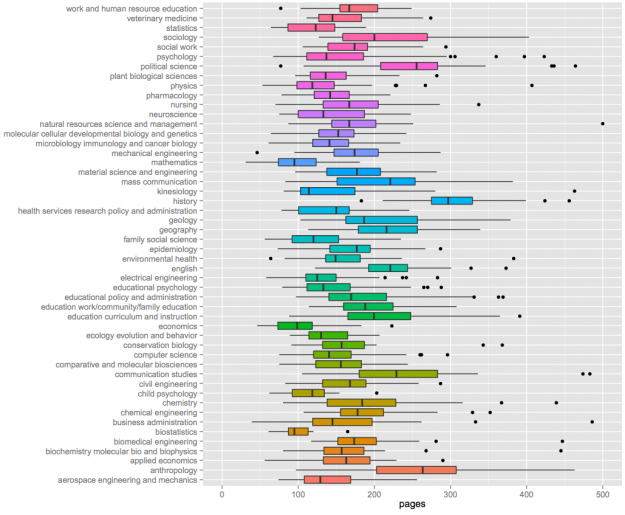
On R is My Friend, as a way to procrastinate on his own dissertation, beckmw took a look at dissertation length via the digital archives at the University of Minnesota.
I've selected the top fifty majors with the highest number of dissertations and created boxplots to show relative distributions. Not many differences are observed among the majors, although some exceptions are apparent. Economics, mathematics, and biostatistics had the lowest median page lengths, whereas anthropology, history, and political science had the highest median page lengths. This distinction makes sense given the nature of the disciplines.
I was on the long end of the statistics distribution, around 180 pages. Probably because I had a lot of pictures.
As I was working on my dissertation, people often asked me how many pages I had written and how many pages I had left to write. I never had a good answer, because there's no page limit or required page count. It's just whenever you (and your adviser) feel like there's enough to get a point across. Sometimes that takes 50 pages. Other times it takes 200.
So for those who get that dreaded page-count question, you can wave your finger at this chart and tell people you're somewhere in the distribution.
Aviv.sharonThe show was spot on

When I told my parents I was writing about cassette tapes they actually laughed at me. My dad is always very calm so his jokes tend to land hard: “I can go out to the garage and dig up your old Raffi tapes – you could write about that.” I admit it’s probably perplexing for hip baby boomer parents, who feel like it was just yesterday they bought you your first CD burner (remember those?). Growing up, I was either cherishing their beaten up vinyl collection or too busy spending their money on inkjet cartridges for custom CD-R labels to covet any real cassette tape collection. For me, tapes were just the lo-fi, unsexy middle period that I was born into. The cheap way to do storytime. And now that I think about it, Baby Beluga is probably among the last cassette tapes my parents ever bought. As teenagers we used our car tape decks, but only to plug in our Discmans or mp3 players. So what gives? Why are we talking about tapes again? And how is it possible that last month, the International Federation of the Phonographic Industry released their report of 2 million cassette tapes sold worldwide? Sales in the UK alone tripled last year.
Everyone who, like me, all but abandoned cassette tapes more than a decade ago, harbors several conceptions about tapes which, really, are misconceptions: Tapes are “lo-fi”; Tapes are clunky and ugly; Tapes are hinky and outdated; and bands who use tapes are pretentious and/or still in their “demo” stages. Well, guess what – all this conventional knowledge is wrong, and now that I’ve figured that out, I’m hoping to dispel these notions for you, too.
Let me take you first to the heart of Oakland, California, to a little urban cabin dwelling in a back lot off of 29th Street. This is where D Vikram Babu lives, in quiet comfort, with his stash. On the wall above his desk are more than 100 cassette tapes that he’s amassed just this year. Vikram calls himself Tape Famous, and has become an avid tape collector, as well as manager of a corresponding reviews blog. The rest of his collection is in storage in Ann Arbor, Mich., but he fancies the idea of starting from scratch. His room is tidy and impeccably organized, and there the tapes sit, in clean presentation, in a large pine wood storage display from the Napa Valley Box Company.

“When I look at that wall of tapes,” he says, “I can really make quick identifications. It’s even faster than vinyl because you have to flip through vinyl. But when I look at that, I know exactly what I’m feeling. I like that method of selection because it involves that sense of sight too. I don’t think scrolling through your computer is rich enough.” And it seems obvious now, watching him stand there before all the tape spines – in ranks, all facing at attention, thick, colorful, and boldly typefaced – this is the best way to survey a collection. Vikram, who is a web developer by day, has a large collection of mp3s which he listens to at work, but at home, his tapes are how he retreats from the digital world: “I actually find it less taxing. I’m not very good with names, so I find it easier just to look, and then stick a tape in.”
There’s this myth of tapes being lo-fi; it’s not only pretty much untrue, but tapes are laterally versatile in their own way. Professionally dubbed, or ProDub tapes (not the ones you’d buy in the store), come in different frequency ranges, the highest of which go up to 20,000 hz – if you require better than that you’re probably stressed out enough by your super-human ears anyway. Short of optimum frequency range, Vikram mentions how different kinds of tape can be used to different effects: “The highest frequency response ones they recommend for like, synthesizer music, whereas jazz you might get a different kind of tape. You don’t have that with CDs or vinyl, it’s just one kind of material. The tape itself changes how it sounds.” In addition to having the unique quality of being both a recording and a listening/consumer format, tape also requires a certain amount of forethought and creative planning. “There’s an end product in a way, whereas digital can seem so vast and editable. I know friends with Bandcamp sites who have altered tracks after they released them, and that’s ok, but you definitely have to make a commitment in order to finish a tape.”
“I’d loved the format ever since I was a kid, so there was some nostalgia involved.” Lars Gotrich is a producer, writer, and web editor at NPR Music in Washington, D.C., explaining his previous foray into releasing tapes. He’s a 6 foot-plus, mild-mannered guy with a long blonde mane and an encyclopedic knowledge of metal, noise, what he calls “outer sound,” and pop music. He’s also obsessed with tapes, and put out quite a few on his now dormant personal label, Thor’s Rubber Hammer. “I could say something about audio quality, I guess, and the object, but for me, it’s the artwork. I ended up falling in love with the cassette layout. That tall frame is weirdly inspiring, having to work within its ratio, and you get to extend the design in the foldout like a centerfold.” I told you tapes were sexy.
So what about the snobbery? Tapes are flimsy and can’t be expected to hold up for long, right? So aren’t these people just dabbling in an obsolete format, shunning the digital realm just to be different? Vikram shrugs and points out that tape dubbing is not expensive, and even professionals are used to dubbing for small scale operations, which makes it the ideal format for a limited release. Plus, most people he knows also want to distribute their music online – “People think tapes are anti-technology, but it’s more complicated than that.” This is where terms like “underground” and “DIY” start to come out, and sitting at the altar of Vikram’s tape collection, those terms don’t seem so overrated anymore. For Vikram the dream is one of hyper-locality. He started collecting around the time that the phrase “Brooklynization” was coined to describe homogenized musical product. With tapes coming out on labels that pop up in the most random small towns of the world, he feels like he’s fighting against that.
Maybe protecting a cultural niche like this is important, and whether that’s called “being a snob” or “keeping it holy” can be for you to decide. You can tell that Gotrich, who’s been hoarding cassettes for years now, is wary of the new hike in popular music on tape: “Yeah, it’s been curious to watch the indie-leaning bands and artists embrace the cassette. It makes sense because it can be quite the twee object. But one time I read that Burger Records pressed 2500 cassette copies of a popular garage-rock band’s album and it sold out in no time. To me, that feels counter-intuitive to cassette culture. But you can’t get territorial about these things. It’s just another way to experience music is all.” When asked directly about snobbery in cassette collecting, he didn’t seem eager to galvanize any movements, “I don’t know, it’s no more snobby than someone that collects old arcade games, except that it’s a helluva lot cheaper and more mobile.”
As for durability, this might just be a PR problem – there are no longer any big ad agencies or marketing campaigns telling you “tape is the way of the future,” and Sony isn’t making tape players anymore, so how could it be durable? Vikram says even in the tech world tapes are still respected: “Even like 5 years ago there was a lot of discussion about whether DVD would be a proven format, and they were still backing up data on tapes because it lasts a really long time, and it does well in different conditions. It might seem a bit backwards because we don’t have as many tape players anymore but it’s a really robust format. I think it holds up better than CDs in a way because CDs scratch really easily and I’ve never had a CD that lasted in my car more than a few years, but I’ve seen tapes in a car that have been there for a decade.”
Gotrich recommends coming to terms with a few harsher realities: “In the long run, the physical thing that is the cassette is not durable. I still have some punk cassettes from high school and the actual tape is wearing out, warbling and thinning the sound. The hard plastic, though sturdy, can’t save those magnetic strips. In a way, it’s poetic — that literal fading away, perhaps as some metaphor for musical tastes and memories past. In another way, it’s impractical. But $4-$10 is a small price to pay for a tangible piece of music that will someday lose its memory.”
I’ve spent hours at Goodwill and Salvation Army, scouring racks of toasters, receivers, and grilled cheese makers from the nineties, hoping to find a workable player, though everyone I’ve bought has broken on me. And that may be the biggest obstacle for tape fanatics today. In Vikram’s arsenal, he’s got a few old players, a nice dual deck, but nothing really fancy. He hands me an old Sony Walkman that’s heavy and compact. “I think that one might be worth a couple hundred bucks on ebay,” he guesses, “but I haven’t spent more than like 20 dollars on all these players.” There’s an ethos to cassette tapes that’s a little more Zen and a little less about obsessive collecting. Above all it seems to be about enjoying the music and remaining low-key. And if you find yourself wanting a dependable tape player, his advice: “Buy Japanese.”
Wanna’ get caught-up on the cassette craze? Browse Bandcamp releases by cassette here.


In a piece published by the Southern Poverty Law Center, David Arenberg describes his experience as one of the very few Jews in the state prison in which he's currently incarcerated.
Tags: crime Judaism prison religionI am always the last person to eat. It's part of a compromise I worked out with the skinheads who run the western state prison complex where I am incarcerated. Under this compromise, I'm allowed to sit at the whites' tables, but only after the "heads," and then the "woods," and then the "lames" have eaten. I am lower on the totem pole than all of them, the untouchable. I should feel lucky I'm allowed to eat at the whites' tables at all.
Not that there's anywhere else I could eat. The prison yard is broken down into five distinct racial categories and segregation is strictly enforced. There are the "woods" (short for peckerwoods) that encompass the whites, the "kinfolk" (blacks), the "Raza" (American-born people of Mexican descent), the "paisas" (Mexico-born Mexicans), and the "chiefs" (American Indians). Under the strict rules that govern interracial relations, different races are allowed to play on the same sports teams but not play individual games (e.g., chess) together; they may be in each others' cubicles together if the situation warrants but not sit on each others' beds or watch each others' televisions. They may go to the same church services but not pray together. But if you accidentally break one of these rules, the consequences are usually pretty mild: you might get a talking to by one of the heads (who, of course, claims exemption from this rule himself), or at worst, a "chin check."
Eating with another race, however, is a different story. It is an inviolate rule that different races may not break bread together under any circumstances. Violating this rule leads to harsh consequences. If you eat at the same table as another race, you'll get beaten down. If you eat from the same tray as another race, you'll be put in the hospital. And if you eat from the same food item as another race, that is, after another race has already taken a bite of it, you can get killed. This is one area where even the heads don't have any play.